
CS 61 C Great Ideas in Computer Architecture
![Great Idea #1: Levels of Representation/Interpretation temp = v[k]; v[k] = v[k+1]; v[k+1] =](https://slidetodoc.com/presentation_image_h2/eb28e34d22103ca5ed5092dca8fe5a8f/image-5.jpg "Great Idea #1: Levels of Representation/Interpretation temp = v[k]; v[k] = v[k+1]; v[k+1] =")
![Question: What is the output of the following code? char blocks[] = {‘ 6’,](https://slidetodoc.com/presentation_image_h2/eb28e34d22103ca5ed5092dca8fe5a8f/image-11.jpg "Question: What is the output of the following code? char blocks[] = {‘ 6’,")
![Array Basics • Declaration: int ar[2]; declares a 2 -element integer array (just a](https://slidetodoc.com/presentation_image_h2/eb28e34d22103ca5ed5092dca8fe5a8f/image-13.jpg "Array Basics • Declaration: int ar[2]; declares a 2 -element integer array (just a")
![Array and Pointer Example • ar[i] is treated as *(ar+i) • To zero an](https://slidetodoc.com/presentation_image_h2/eb28e34d22103ca5ed5092dca8fe5a8f/image-17.jpg "Array and Pointer Example • ar[i] is treated as *(ar+i) • To zero an")
![Arrays Stored Differently Than Pointers void foo() { int *p, a[4], x; p =](https://slidetodoc.com/presentation_image_h2/eb28e34d22103ca5ed5092dca8fe5a8f/image-18.jpg "Arrays Stored Differently Than Pointers void foo() { int *p, a[4], x; p =")
- Slides: 41
CS 61 C: Great Ideas in Computer Architecture C Arrays, Strings, More Pointers Instructor: Justin Hsia 6/26/2013 Summer 2013 -- Lecture #3 1
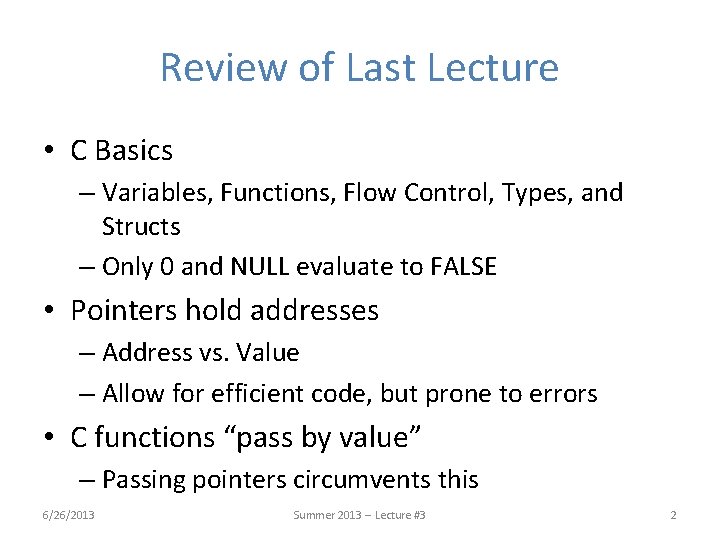
Review of Last Lecture • C Basics – Variables, Functions, Flow Control, Types, and Structs – Only 0 and NULL evaluate to FALSE • Pointers hold addresses – Address vs. Value – Allow for efficient code, but prone to errors • C functions “pass by value” – Passing pointers circumvents this 6/26/2013 Summer 2013 -- Lecture #3 2
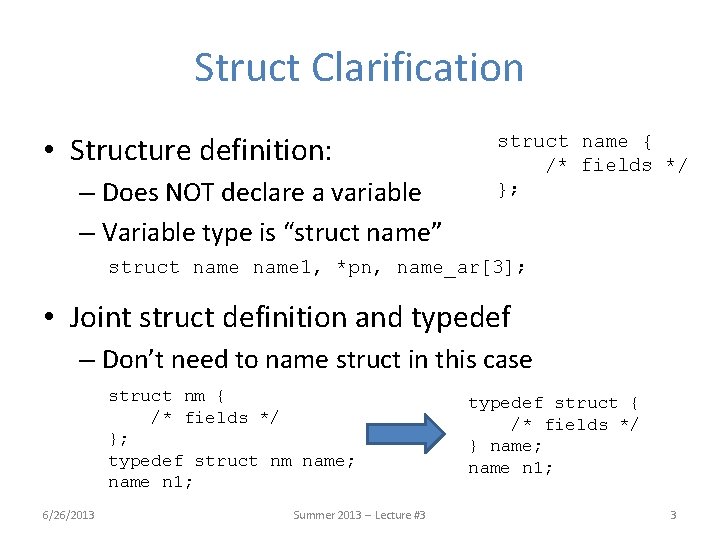
Struct Clarification • Structure definition: – Does NOT declare a variable – Variable type is “struct name” struct name { /* fields */ }; struct name 1, *pn, name_ar[3]; • Joint struct definition and typedef – Don’t need to name struct in this case struct nm { /* fields */ }; typedef struct nm name; name n 1; 6/26/2013 Summer 2013 -- Lecture #3 typedef struct { /* fields */ } name; name n 1; 3
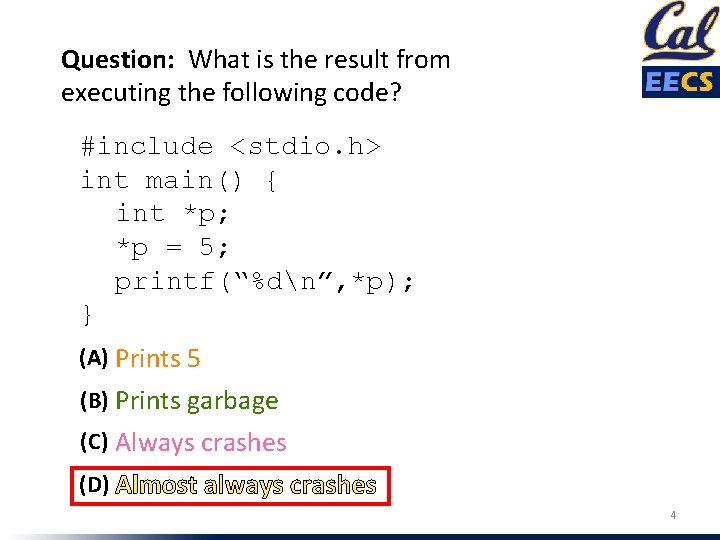
Question: What is the result from executing the following code? #include <stdio. h> int main() { int *p; *p = 5; printf(“%dn”, *p); } (A) Prints 5 (B) Prints garbage (C) Always crashes (D) Almost always crashes 4
Great Idea #1: Levels of Representation/Interpretation temp = v[k]; v[k] = v[k+1]; v[k+1] = temp; Higher-Level Language Program (e. g. C) Compiler lw lw sw sw Assembly Language Program (e. g. MIPS) Assembler Machine Language Program (MIPS) 0000 1010 1100 0101 We are here_ $t 0, 0($2) $t 1, 4($2) $t 1, 0($2) $t 0, 4($2) 1001 1111 0110 1000 1100 0101 1010 0000 0110 1000 1111 1001 1010 0000 0101 1100 1111 1000 0110 0101 1100 0000 1010 1000 0110 1001 1111 Machine Interpretation Hardware Architecture Description (e. g. block diagrams) Architecture Implementation Logic Circuit Description (Circuit Schematic Diagrams) 6/26/2013 Summer 2013 -- Lecture #3 5
Agenda • • • Miscellaneous C Syntax Arrays Administrivia Strings More Pointers – Pointer Arithmetic – Pointer Misc 6/26/2013 Summer 2013 -- Lecture #3 6
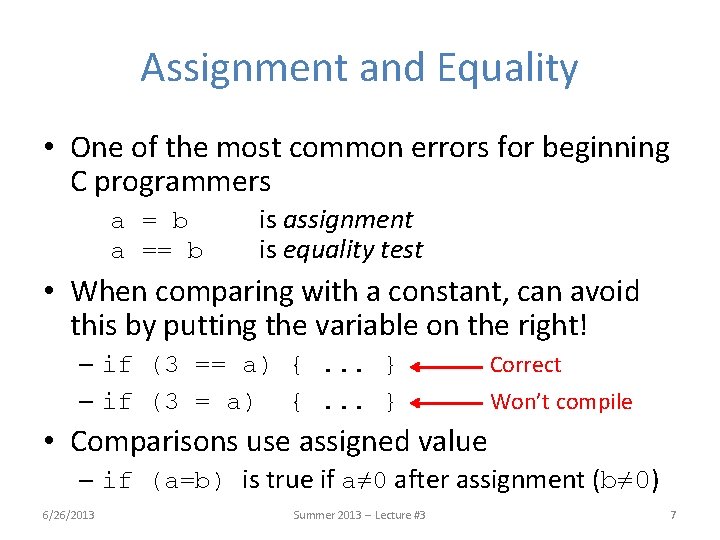
Assignment and Equality • One of the most common errors for beginning C programmers a = b a == b is assignment is equality test • When comparing with a constant, can avoid this by putting the variable on the right! – if (3 == a) {. . . } – if (3 = a) {. . . } Correct Won’t compile • Comparisons use assigned value – if (a=b) is true if a≠ 0 after assignment (b≠ 0) 6/26/2013 Summer 2013 -- Lecture #3 7
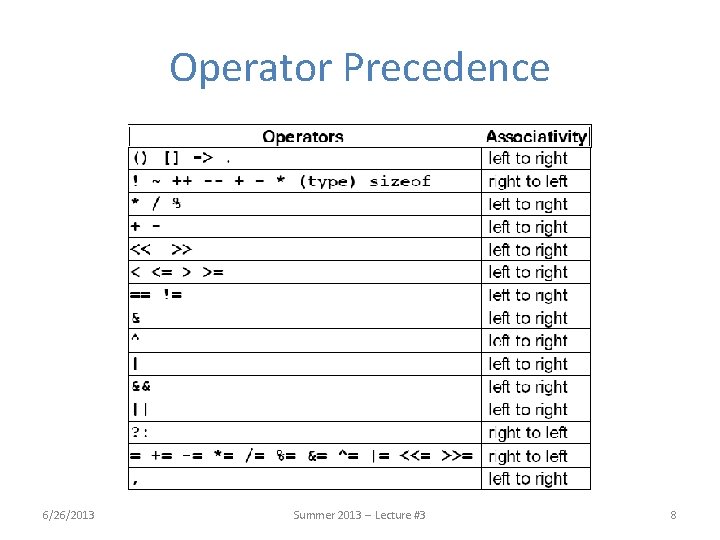
Operator Precedence 6/26/2013 Summer 2013 -- Lecture #3 8
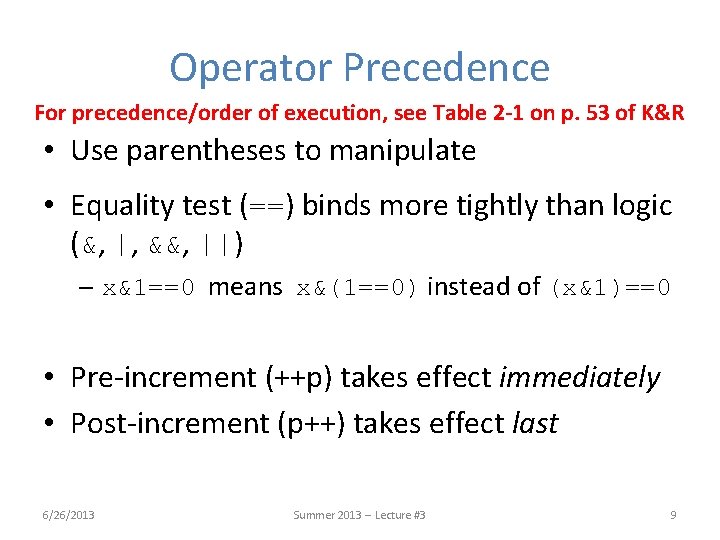
Operator Precedence For precedence/order of execution, see Table 2 -1 on p. 53 of K&R • Use parentheses to manipulate • Equality test (==) binds more tightly than logic (&, |, &&, ||) – x&1==0 means x&(1==0) instead of (x&1)==0 • Pre-increment (++p) takes effect immediately • Post-increment (p++) takes effect last 6/26/2013 Summer 2013 -- Lecture #3 9
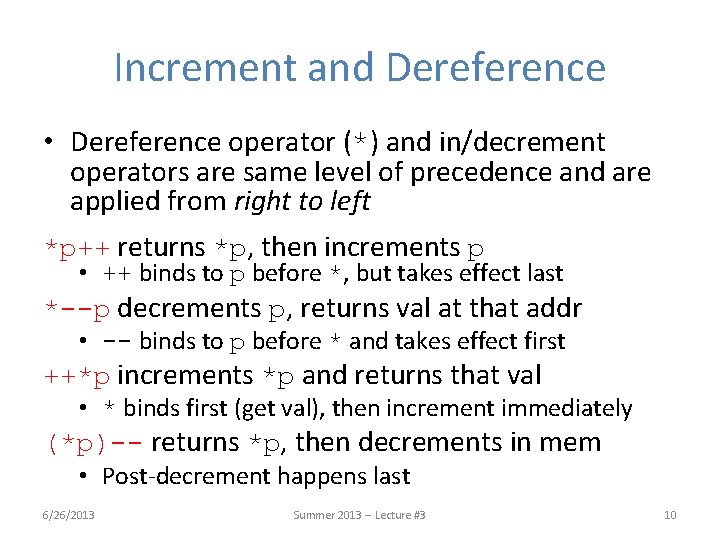
Increment and Dereference • Dereference operator (*) and in/decrement operators are same level of precedence and are applied from right to left *p++ returns *p, then increments p • ++ binds to p before *, but takes effect last *--p decrements p, returns val at that addr • -- binds to p before * and takes effect first ++*p increments *p and returns that val • * binds first (get val), then increment immediately (*p)-- returns *p, then decrements in mem • Post-decrement happens last 6/26/2013 Summer 2013 -- Lecture #3 10
Question: What is the output of the following code? char blocks[] = {‘ 6’, ‘ 1’, ‘C’}; char *ptr = blocks, temp; temp = *++ptr; printf(“ 1: %cn”, temp); temp = *ptr++; printf(“ 2: %cn”, temp); (A) (B) (C) (D) 1 7 7 1 1 2 8 1 1 C 11
Agenda • • • Miscellaneous C Syntax Arrays Administrivia Strings More Pointers – Pointer Arithmetic – Pointer Misc 6/26/2013 Summer 2013 -- Lecture #3 12
Array Basics • Declaration: int ar[2]; declares a 2 -element integer array (just a block of memory) int ar[] = {795, 635}; declares and initializes a 2 -element integer array • Accessing elements: ar[num] returns the numth element – Zero-indexed 6/26/2013 Summer 2013 -- Lecture #3 13
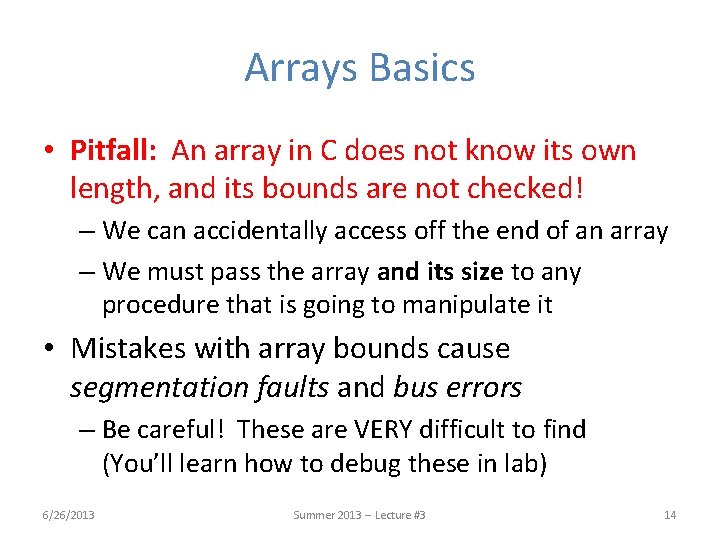
Arrays Basics • Pitfall: An array in C does not know its own length, and its bounds are not checked! – We can accidentally access off the end of an array – We must pass the array and its size to any procedure that is going to manipulate it • Mistakes with array bounds cause segmentation faults and bus errors – Be careful! These are VERY difficult to find (You’ll learn how to debug these in lab) 6/26/2013 Summer 2013 -- Lecture #3 14
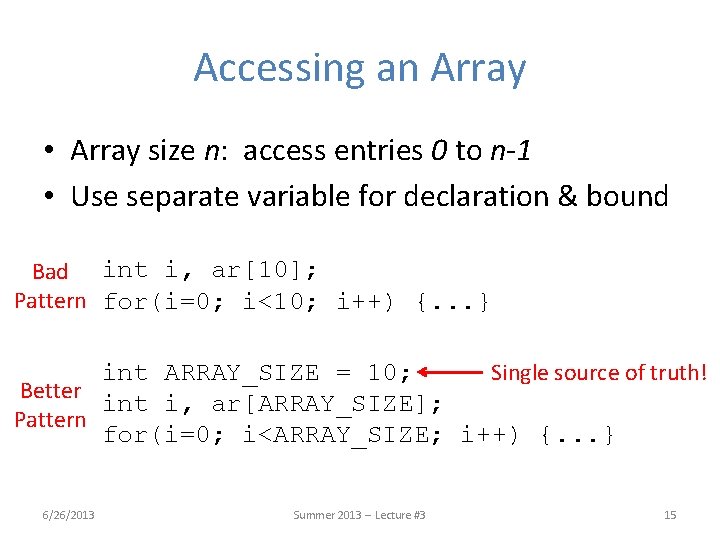
Accessing an Array • Array size n: access entries 0 to n-1 • Use separate variable for declaration & bound – Bad pattern Bad int i, ar[10]; Pattern for(i=0; i<10; i++) {. . . } – Better pattern Single source of truth! int ARRAY_SIZE = 10; Better int i, ar[ARRAY_SIZE]; Pattern for(i=0; i<ARRAY_SIZE; i++) {. . . } 6/26/2013 Summer 2013 -- Lecture #3 15
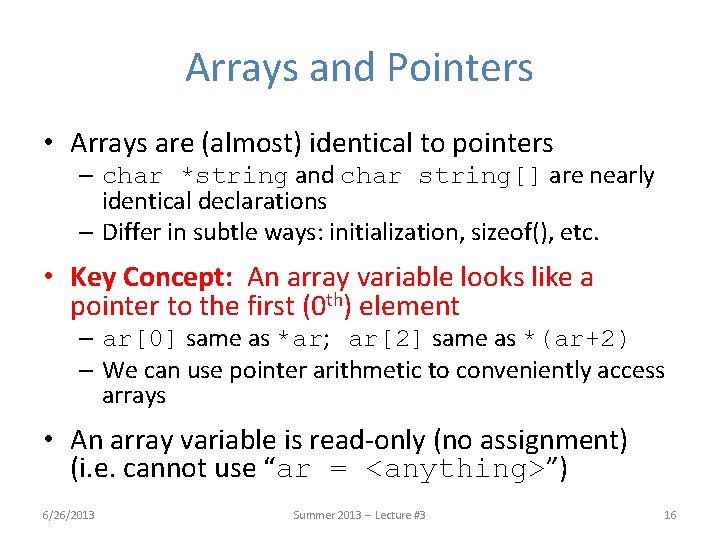
Arrays and Pointers • Arrays are (almost) identical to pointers – char *string and char string[] are nearly identical declarations – Differ in subtle ways: initialization, sizeof(), etc. • Key Concept: An array variable looks like a pointer to the first (0 th) element – ar[0] same as *ar; ar[2] same as *(ar+2) – We can use pointer arithmetic to conveniently access arrays • An array variable is read-only (no assignment) (i. e. cannot use “ar = <anything>”) 6/26/2013 Summer 2013 -- Lecture #3 16
Array and Pointer Example • ar[i] is treated as *(ar+i) • To zero an array, the following three ways are equivalent: 1) for(i=0; i<SIZE; i++) ar[i] = 0; 2) for(i=0; i<SIZE; i++) *(ar+i) = 0; 3) for(p=ar; p<ar+SIZE; p++) *p = 0; • These use pointer arithmetic, which we will get to shortly 6/26/2013 Summer 2013 -- Lecture #3 17
Arrays Stored Differently Than Pointers void foo() { int *p, a[4], x; p = &x; *p = 1; // or p[0] printf("*p: %u, &p: %un", *p, p, &p); *a = 2; // or a[0] printf("*a: %u, &a: %un", *a, a, &a); } . . . 0 4 8 12 16 20 24 28 32 36 40 44 48 … 40 ? 2? 1? p x ? 24 a 6/26/2013 *p: 1, p: 40, &p: 20 *a: 2, a: 24, &a: 24 Summer 2013 -- Lecture #3 . . . K&R: “An array__. name is not a variable”. 18
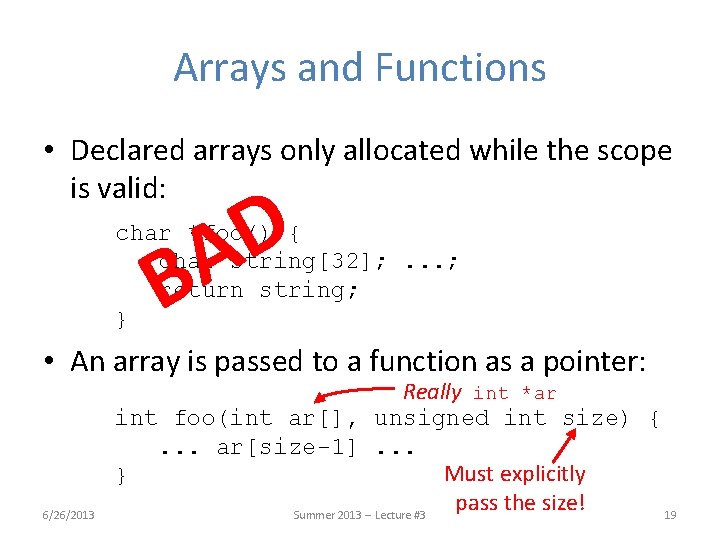
Arrays and Functions • Declared arrays only allocated while the scope is valid: D A B char *foo() { char string[32]; . . . ; return string; } • An array is passed to a function as a pointer: 6/26/2013 Really int *ar int foo(int ar[], unsigned int size) {. . . ar[size-1]. . . Must explicitly } pass the size! Summer 2013 -- Lecture #3 19
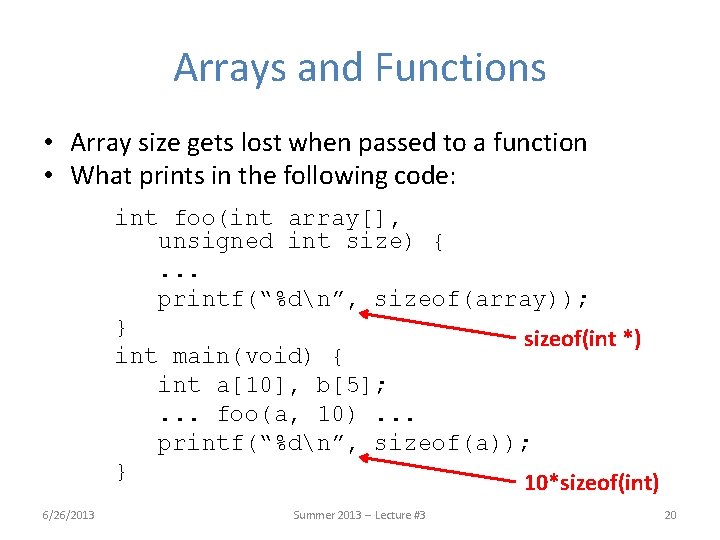
Arrays and Functions • Array size gets lost when passed to a function • What prints in the following code: int foo(int array[], unsigned int size) {. . . printf(“%dn”, sizeof(array)); } sizeof(int *) ? ? ? int main(void) { int a[10], b[5]; . . . foo(a, 10). . . printf(“%dn”, sizeof(a)); } 10*sizeof(int) ? ? ? 6/26/2013 Summer 2013 -- Lecture #3 20
Agenda • • • Miscellaneous C Syntax Arrays Administrivia Strings More Pointers – Pointer Arithmetic – Pointer Misc 6/26/2013 Summer 2013 -- Lecture #3 21
Administrivia • • • Lab 2 tomorrow HW 1 due Sunday night Lab 3 (big lab) next Tue (July 2) HW 2 released Fri, due next Wed (July 3) Suggested plan of attack: – Finish HW 1 by Sat night – Do 1 st half of Lab 3 Sun, start HW 2 – Do 2 nd half of Lab 3 Tue, finish HW 2 by Wed 6/26/2013 Summer 2013 -- Lecture #3 22
Agenda • • • Miscellaneous C Syntax Arrays Administrivia Strings More Pointers – Pointer Arithmetic – Pointer Misc 6/26/2013 Summer 2013 -- Lecture #3 23
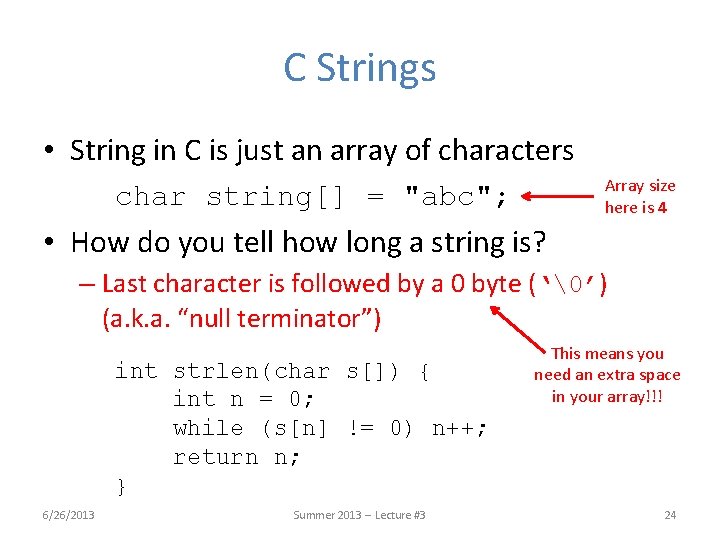
C Strings • String in C is just an array of characters Array size here is 4 char string[] = "abc"; • How do you tell how long a string is? – Last character is followed by a 0 byte (‘’) (a. k. a. “null terminator”) int strlen(char s[]) { int n = 0; while (s[n] != 0) n++; return n; } 6/26/2013 Summer 2013 -- Lecture #3 This means you need an extra space in your array!!! 24
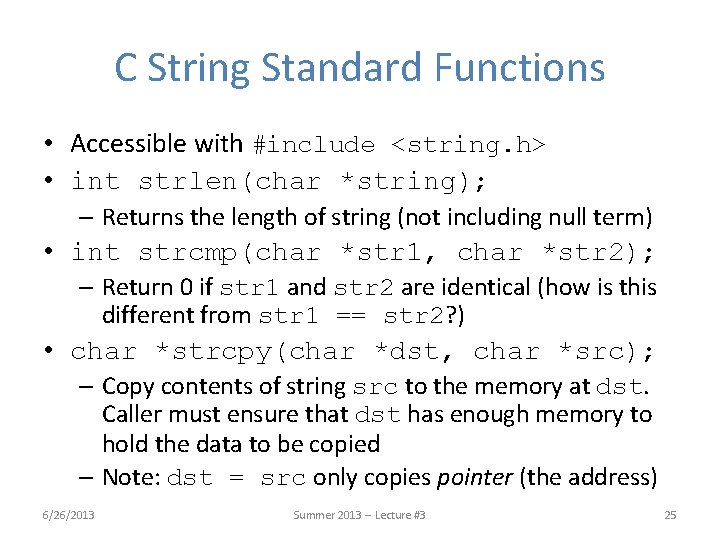
C String Standard Functions • Accessible with #include <string. h> • int strlen(char *string); – Returns the length of string (not including null term) • int strcmp(char *str 1, char *str 2); – Return 0 if str 1 and str 2 are identical (how is this different from str 1 == str 2? ) • char *strcpy(char *dst, char *src); – Copy contents of string src to the memory at dst. Caller must ensure that dst has enough memory to hold the data to be copied – Note: dst = src only copies pointer (the address) 6/26/2013 Summer 2013 -- Lecture #3 25
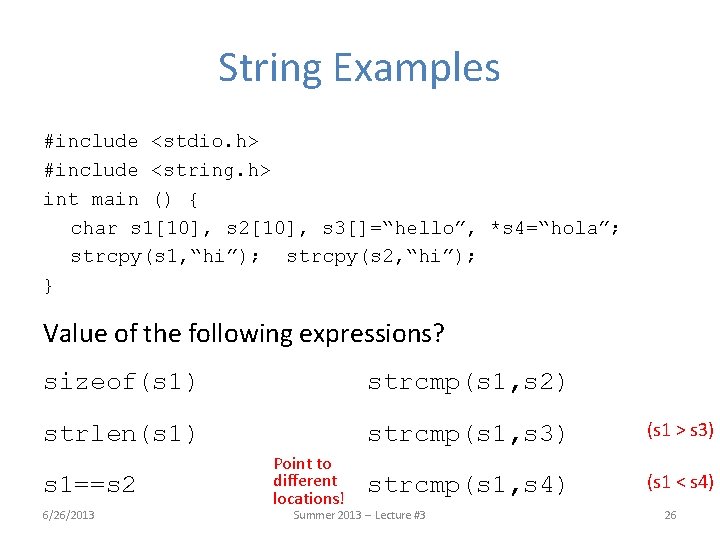
String Examples #include <stdio. h> #include <string. h> int main () { char s 1[10], s 2[10], s 3[]=“hello”, *s 4=“hola”; strcpy(s 1, “hi”); strcpy(s 2, “hi”); } Value of the following expressions? sizeof(s 1) 10 strcmp(s 1, s 2) 0 strlen(s 1) 2 strcmp(s 1, s 3) 4 (s 1 > s 3) strcmp(s 1, s 4) -6 (s 1 < s 4) s 1==s 2 6/26/2013 0 Point to different locations! Summer 2013 -- Lecture #3 26
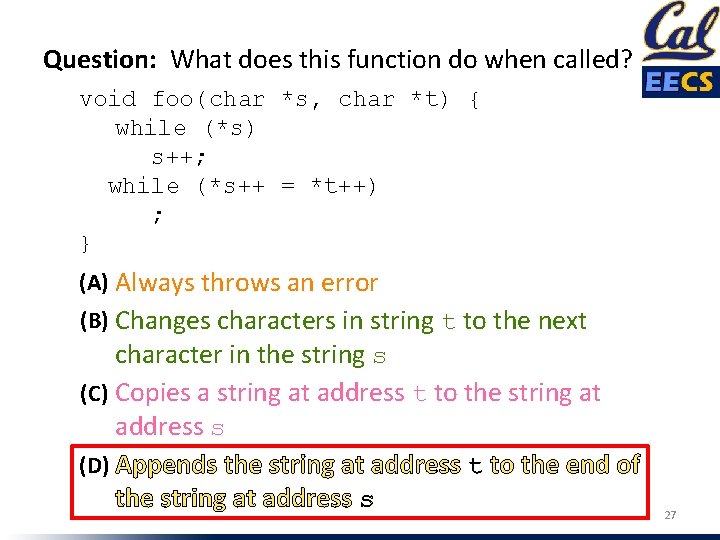
Question: What does this function do when called? void foo(char *s, char *t) { while (*s) s++; while (*s++ = *t++) ; } (A) Always throws an error (B) Changes characters in string t to the next character in the string s (C) Copies a string at address t to the string at address s (D) Appends the string at address t to the end of the string at address s 27
Agenda • • • Miscellaneous C Syntax Arrays Administrivia Strings More Pointers – Pointer Arithmetic – Pointer Misc 6/26/2013 Summer 2013 -- Lecture #3 28
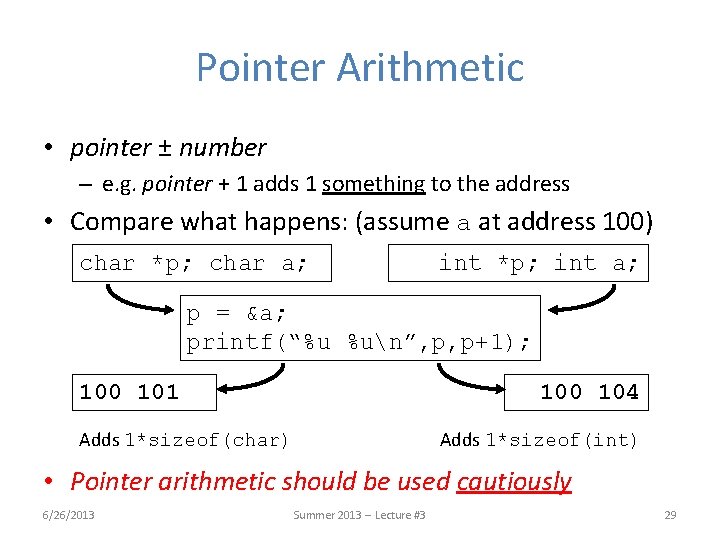
Pointer Arithmetic • pointer ± number – e. g. pointer + 1 adds 1 something to the address • Compare what happens: (assume a at address 100) char *p; char a; int *p; int a; p = &a; printf(“%u %un”, p, p+1); 100 101 100 104 Adds 1*sizeof(char) Adds 1*sizeof(int) • Pointer arithmetic should be used cautiously 6/26/2013 Summer 2013 -- Lecture #3 29
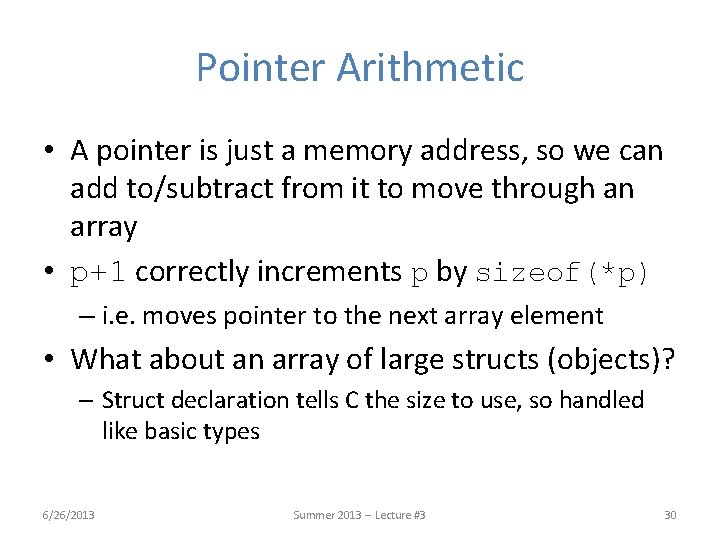
Pointer Arithmetic • A pointer is just a memory address, so we can add to/subtract from it to move through an array • p+1 correctly increments p by sizeof(*p) – i. e. moves pointer to the next array element • What about an array of large structs (objects)? – Struct declaration tells C the size to use, so handled like basic types 6/26/2013 Summer 2013 -- Lecture #3 30
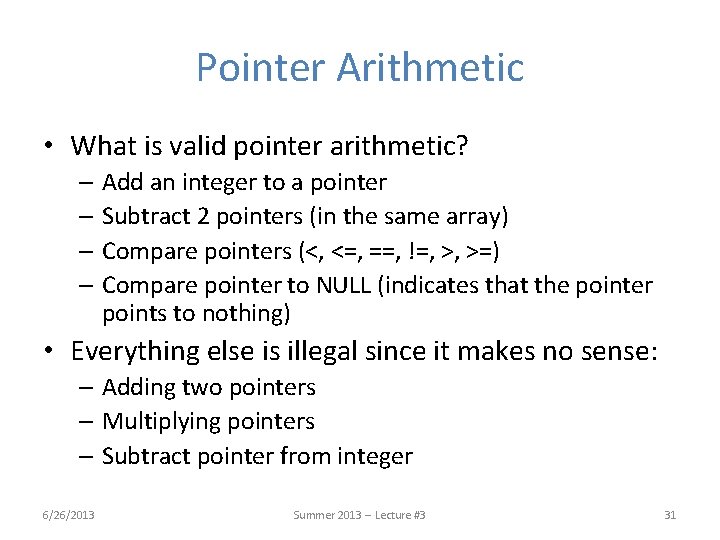
Pointer Arithmetic • What is valid pointer arithmetic? – Add an integer to a pointer – Subtract 2 pointers (in the same array) – Compare pointers (<, <=, ==, !=, >, >=) – Compare pointer to NULL (indicates that the pointer points to nothing) • Everything else is illegal since it makes no sense: – Adding two pointers – Multiplying pointers – Subtract pointer from integer 6/26/2013 Summer 2013 -- Lecture #3 31
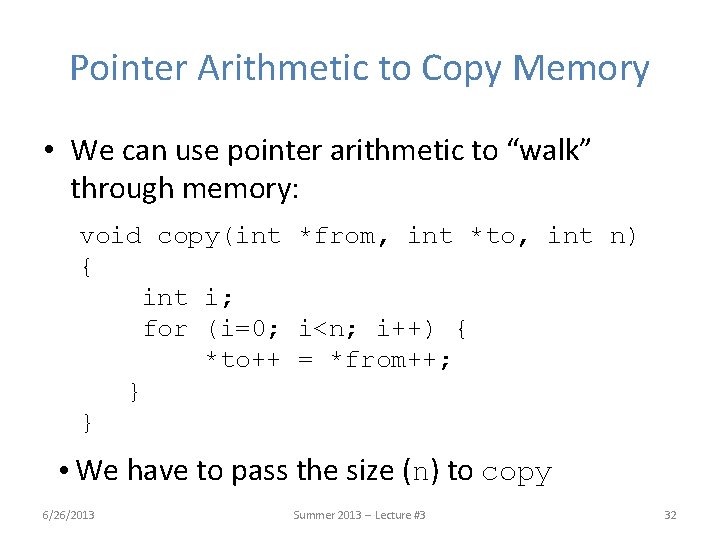
Pointer Arithmetic to Copy Memory • We can use pointer arithmetic to “walk” through memory: void copy(int *from, int *to, int n) { int i; for (i=0; i<n; i++) { *to++ = *from++; } } • We have to pass the size (n) to copy 6/26/2013 Summer 2013 -- Lecture #3 32
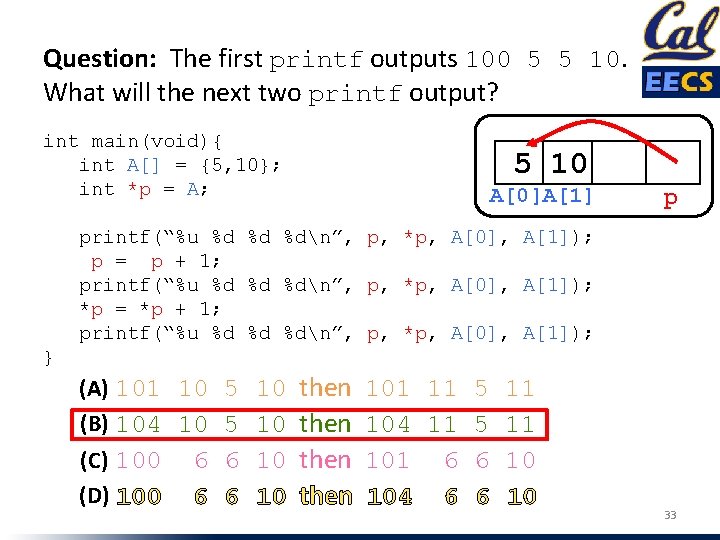
Question: The first printf outputs 100 5 5 10. What will the next two printf output? int main(void){ int A[] = {5, 10}; int *p = A; 5 10 A[0]A[1] p printf(“%u %d %d %dn”, p, *p, A[0], A[1]); p = p + 1; printf(“%u %d %d %dn”, p, *p, A[0], A[1]); *p = *p + 1; printf(“%u %d %d %dn”, p, *p, A[0], A[1]); } (A) 101 10 5 (B) 104 10 5 (C) 100 6 6 (D) 100 6 6 10 10 then 101 11 5 11 104 11 5 11 101 6 6 10 104 6 6 10 33
Get To Know Your Staff • Category: Cal 6/26/2013 Summer 2013 -- Lecture #3 34
Agenda • • • Miscellaneous C Syntax Arrays Administrivia Strings More Pointers – Pointer Arithmetic – Pointer Misc 6/26/2013 Summer 2013 -- Lecture #3 35
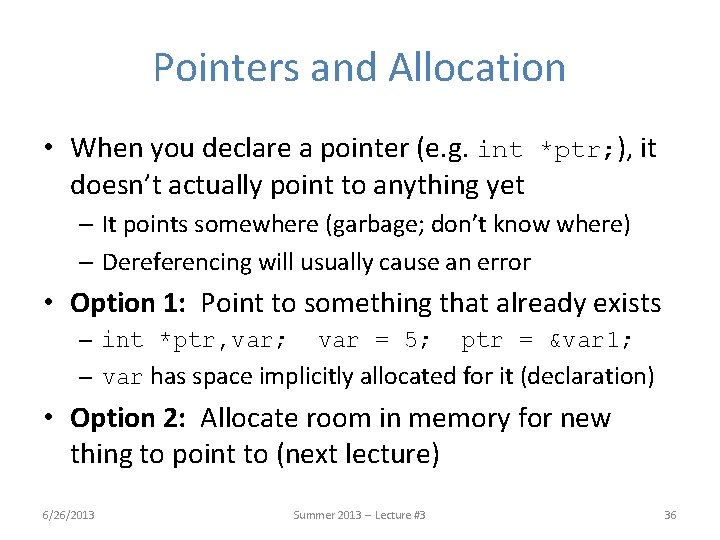
Pointers and Allocation • When you declare a pointer (e. g. int *ptr; ), it doesn’t actually point to anything yet – It points somewhere (garbage; don’t know where) – Dereferencing will usually cause an error • Option 1: Point to something that already exists – int *ptr, var; var = 5; ptr = &var 1; – var has space implicitly allocated for it (declaration) • Option 2: Allocate room in memory for new thing to point to (next lecture) 6/26/2013 Summer 2013 -- Lecture #3 36
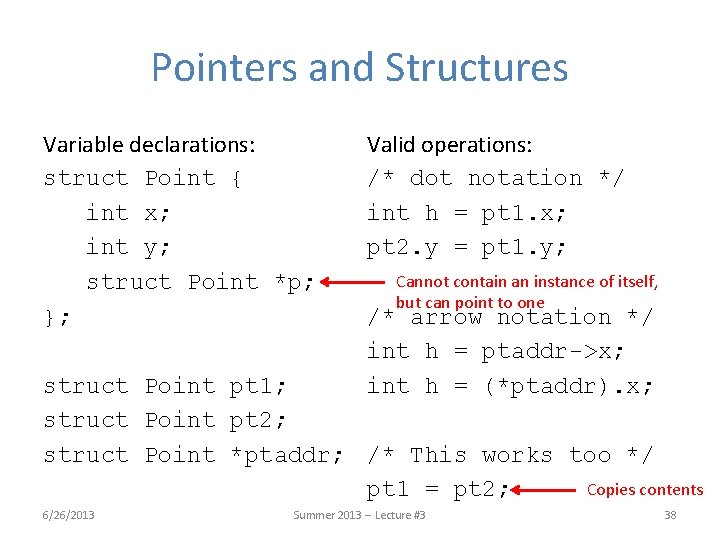
Pointers and Structures Variable declarations: struct Point { int x; int y; struct Point *p; }; Valid operations: /* dot notation */ int h = pt 1. x; pt 2. y = pt 1. y; Cannot contain an instance of itself, but can point to one /* arrow notation */ int h = ptaddr->x; int h = (*ptaddr). x; struct Point pt 1; struct Point pt 2; struct Point *ptaddr; /* This works too */ Copies contents pt 1 = pt 2; 6/26/2013 Summer 2013 -- Lecture #3 38
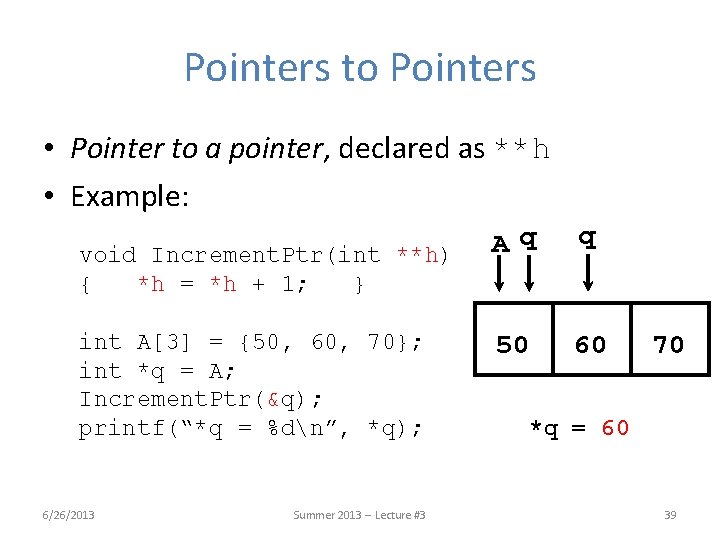
Pointers to Pointers • Pointer to a pointer, declared as **h • Example: void Increment. Ptr(int **h) { *h = *h + 1; } int A[3] = {50, 60, 70}; int *q = A; Increment. Ptr(&q); printf(“*q = %dn”, *q); 6/26/2013 Summer 2013 -- Lecture #3 Aq q 50 60 70 *q = 60 39
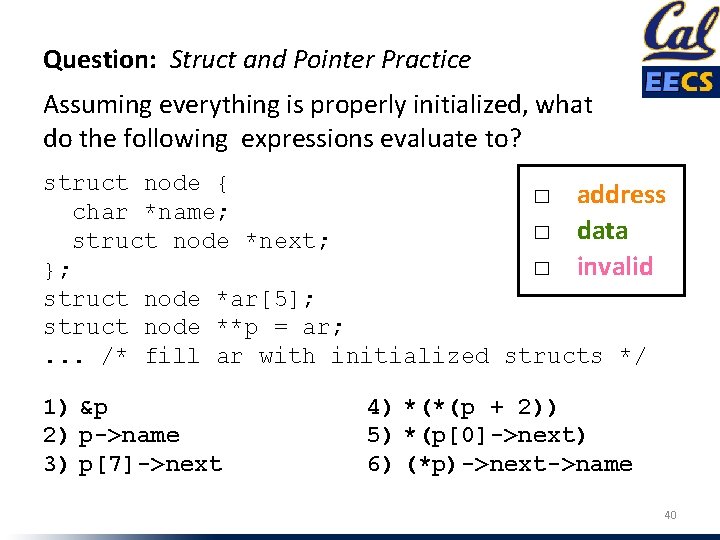
Question: Struct and Pointer Practice Assuming everything is properly initialized, what do the following expressions evaluate to? struct node { ☐ address char *name; ☐ data struct node *next; ☐ invalid }; struct node *ar[5]; struct node **p = ar; . . . /* fill ar with initialized structs */ 1) &p 2) p->name 3) p[7]->next 4) *(*(p + 2)) 5) *(p[0]->next) 6) (*p)->next->name 40
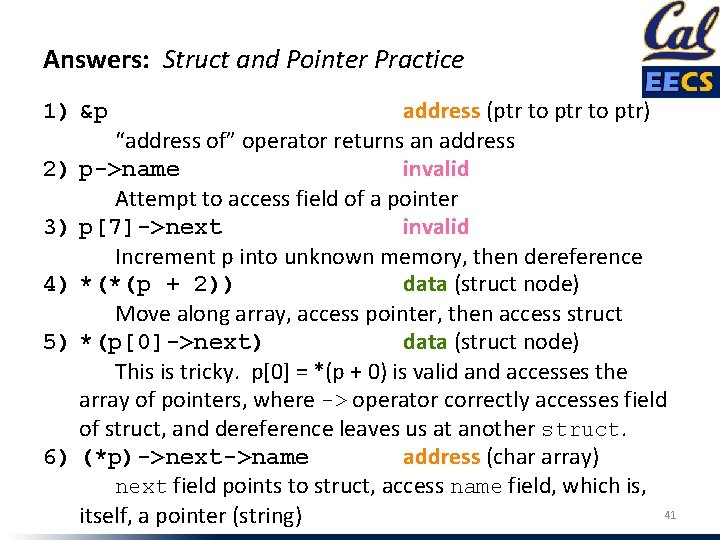
Answers: Struct and Pointer Practice address (ptr to ptr) “address of” operator returns an address 2) p->name invalid Attempt to access field of a pointer 3) p[7]->next invalid Increment p into unknown memory, then dereference 4) *(*(p + 2)) data (struct node) Move along array, access pointer, then access struct 5) *(p[0]->next) data (struct node) This is tricky. p[0] = *(p + 0) is valid and accesses the array of pointers, where -> operator correctly accesses field of struct, and dereference leaves us at another struct. 6) (*p)->next->name address (char array) next field points to struct, access name field, which is, 41 itself, a pointer (string) 1) &p
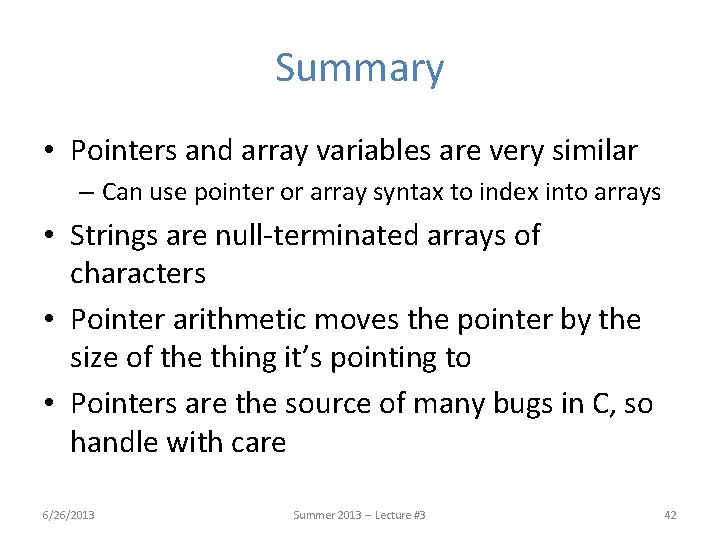
Summary • Pointers and array variables are very similar – Can use pointer or array syntax to index into arrays • Strings are null-terminated arrays of characters • Pointer arithmetic moves the pointer by the size of the thing it’s pointing to • Pointers are the source of many bugs in C, so handle with care 6/26/2013 Summer 2013 -- Lecture #3 42