
CS 61 C Great Ideas in Computer Architecture

- Slides: 45
CS 61 C: Great Ideas in Computer Architecture (Machine Structures) Caches Part 2 Instructors: John Wawrzynek & Vladimir Stojanovic http: //inst. eecs. berkeley. edu/~cs 61 c/
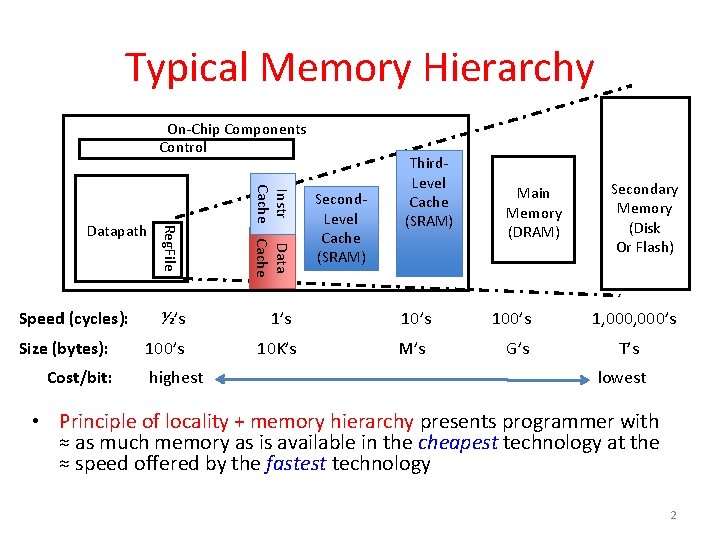
Typical Memory Hierarchy On-Chip Components Control Reg. File Instr Data Cache ½’s 10’s 10 K’s M’s Datapath Speed (cycles): Size (bytes): Cost/bit: Third. Level Cache (SRAM) highest Second. Level Cache (SRAM) Main Memory (DRAM) 100’s G’s Secondary Memory (Disk Or Flash) 1, 000’s T’s lowest • Principle of locality + memory hierarchy presents programmer with ≈ as much memory as is available in the cheapest technology at the ≈ speed offered by the fastest technology 2
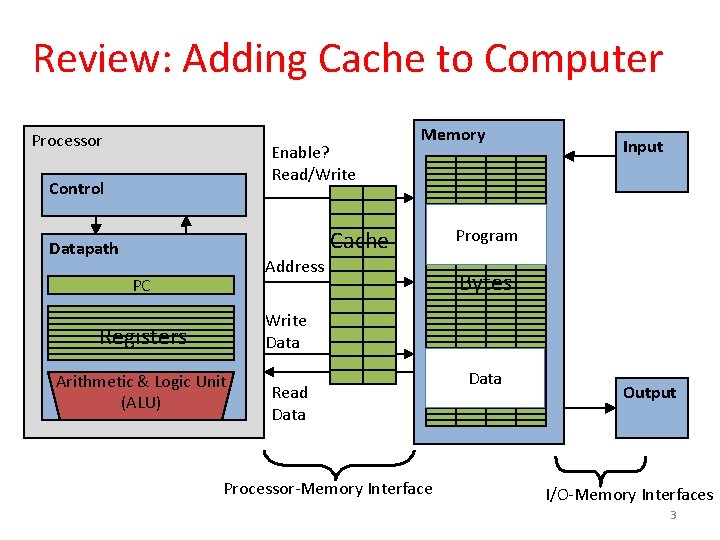
Review: Adding Cache to Computer Processor Enable? Read/Write Control Memory Cache Datapath Address PC Input Program Bytes Write Data Registers Arithmetic & Logic Unit (ALU) Read Data Processor-Memory Interface Data Output I/O-Memory Interfaces 3
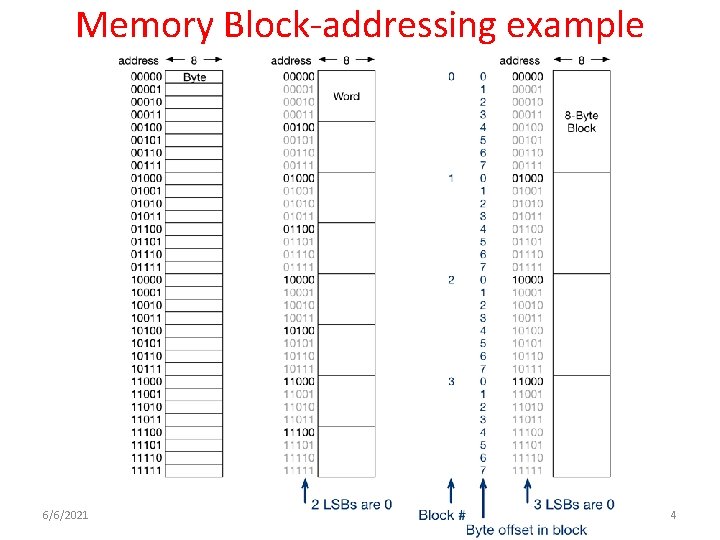
Memory Block-addressing example 6/6/2021 4
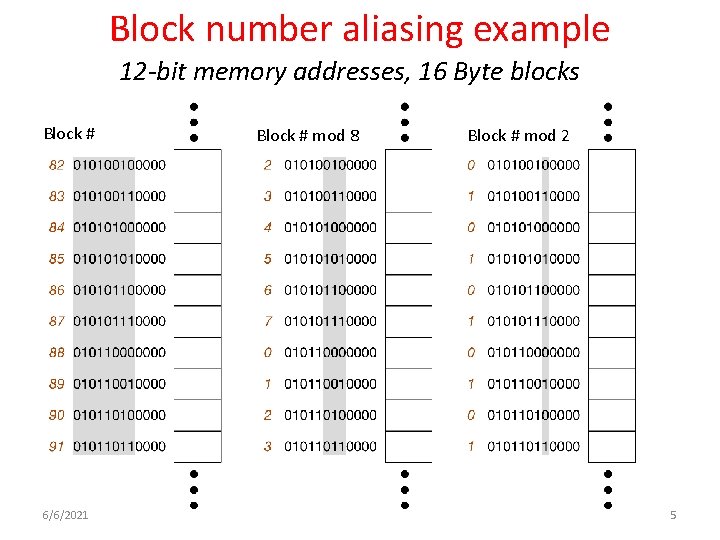
Block number aliasing example 12 -bit memory addresses, 16 Byte blocks Block # 6/6/2021 Block # mod 8 Block # mod 2 5
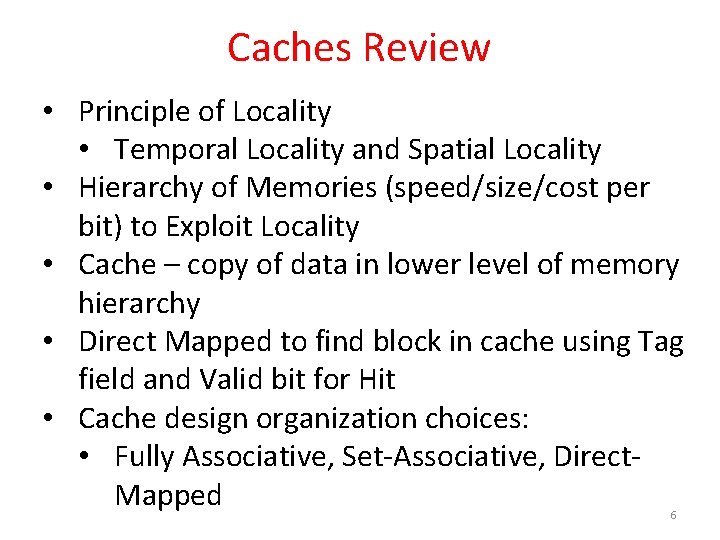
Caches Review • Principle of Locality • Temporal Locality and Spatial Locality • Hierarchy of Memories (speed/size/cost per bit) to Exploit Locality • Cache – copy of data in lower level of memory hierarchy • Direct Mapped to find block in cache using Tag field and Valid bit for Hit • Cache design organization choices: • Fully Associative, Set-Associative, Direct. Mapped 6
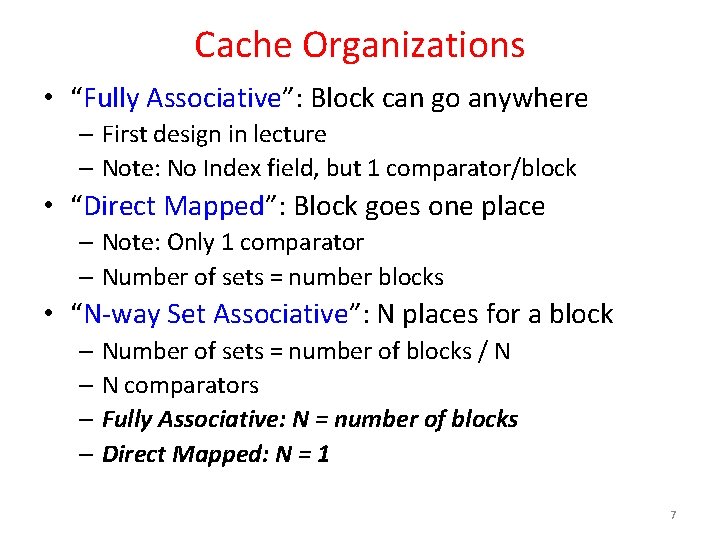
Cache Organizations • “Fully Associative”: Block can go anywhere – First design in lecture – Note: No Index field, but 1 comparator/block • “Direct Mapped”: Block goes one place – Note: Only 1 comparator – Number of sets = number blocks • “N-way Set Associative”: N places for a block – Number of sets = number of blocks / N – N comparators – Fully Associative: N = number of blocks – Direct Mapped: N = 1 7
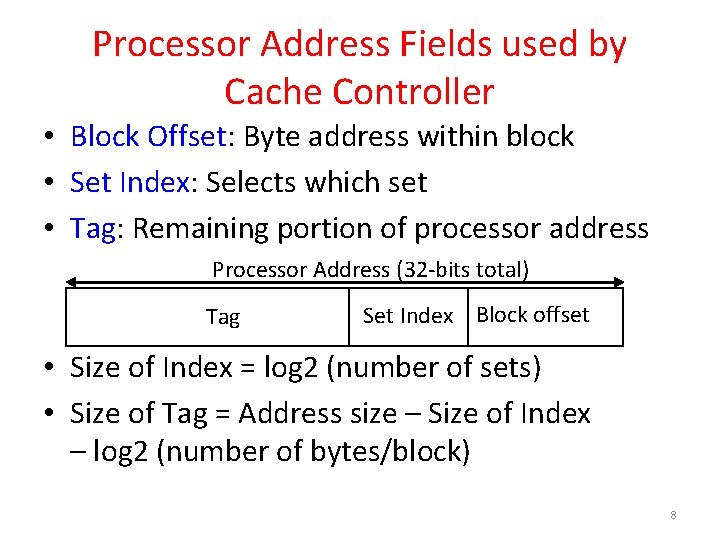
Processor Address Fields used by Cache Controller • Block Offset: Byte address within block • Set Index: Selects which set • Tag: Remaining portion of processor address Processor Address (32 -bits total) Tag Set Index Block offset • Size of Index = log 2 (number of sets) • Size of Tag = Address size – Size of Index – log 2 (number of bytes/block) 8
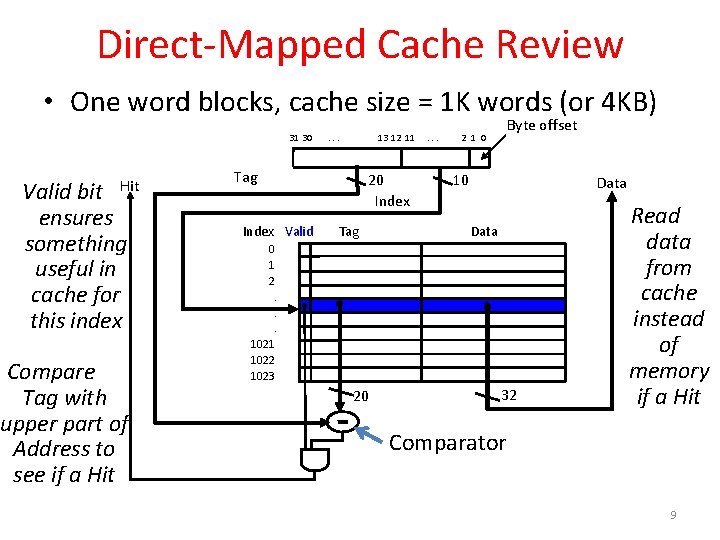
Direct-Mapped Cache Review • One word blocks, cache size = 1 K words (or 4 KB) 31 30 Hit Valid bit ensures something useful in cache for this index Compare Tag with upper part of Address to see if a Hit . . . 13 12 11 Tag 20 Index Valid Tag . . . Byte offset 2 1 0 10 Data 0 1 2. . . 1021 1022 1023 20 32 Read data from cache instead of memory if a Hit Comparator 9
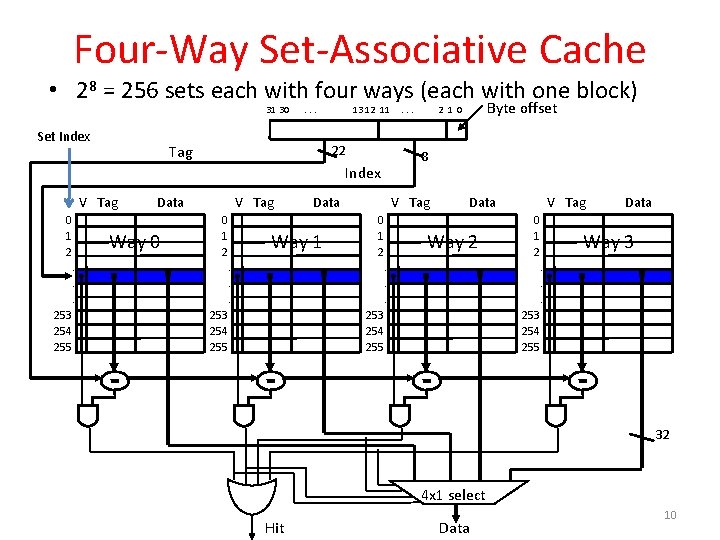
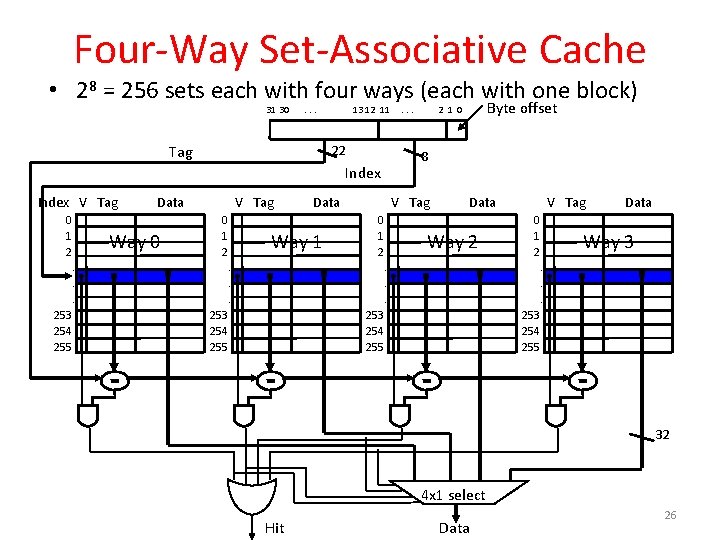
Four-Way Set-Associative Cache • 28 = 256 sets each with four ways (each with one block) 31 30 Set Index . . . Tag 13 12 11 22 0 1 2 V Tag Data Way 0 0 1 2 . . . 253 254 255 V Tag Data Way 1 0 1 2 . . . Byte offset 2 1 0 8 Index V Tag . . . V Tag Data Way 2 0 1 2 . . . 253 254 255 Data Way 3. . . 253 254 255 32 4 x 1 select Hit Data 10
Handling Stores with Write-Through • Store instructions write to memory, changing values • Need to make sure cache and memory have same values on writes: 2 policies 1) Write-Through Policy: write cache and write through the cache to memory – Every write eventually gets to memory – Too slow, so include Write Buffer to allow processor to continue once data in Buffer – Buffer updates memory in parallel to processor 11
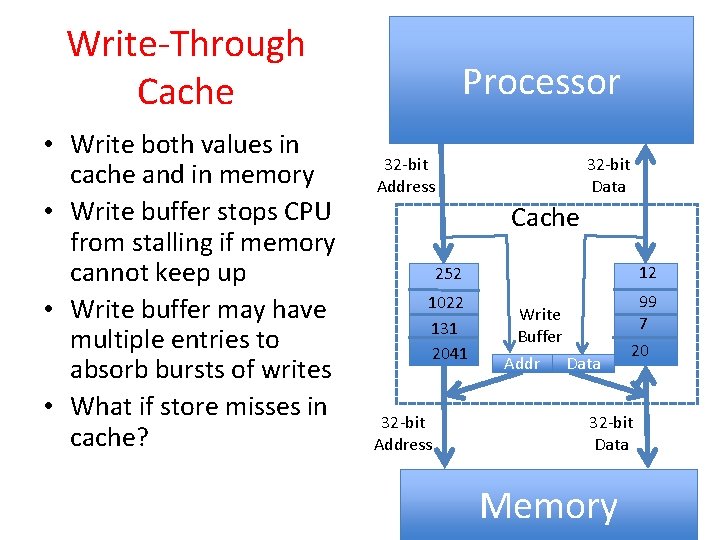
Write-Through Cache • Write both values in cache and in memory • Write buffer stops CPU from stalling if memory cannot keep up • Write buffer may have multiple entries to absorb bursts of writes • What if store misses in cache? Processor 32 -bit Address 32 -bit Data Cache 252 12 1022 131 2041 99 7 32 -bit Address Write Buffer Addr Data 20 32 -bit Data Memory 12
Handling Stores with Write-Back 2) Write-Back Policy: write only to cache and then write cache block back to memory when evict block from cache – Writes collected in cache, only single write to memory per block – Include bit to see if wrote to block or not, and then only write back if bit is set • Called “Dirty” bit (writing makes it “dirty”) 13
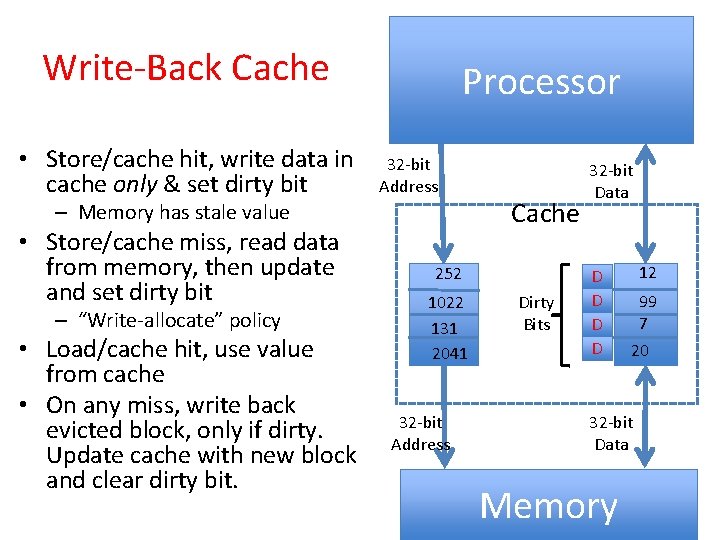
Write-Back Cache • Store/cache hit, write data in cache only & set dirty bit Processor 32 -bit Address – Memory has stale value • Store/cache miss, read data from memory, then update and set dirty bit – “Write-allocate” policy • Load/cache hit, use value from cache • On any miss, write back evicted block, only if dirty. Update cache with new block and clear dirty bit. Cache 252 1022 131 2041 32 -bit Address Dirty Bits 32 -bit Data D D 12 99 7 20 32 -bit Data Memory 14
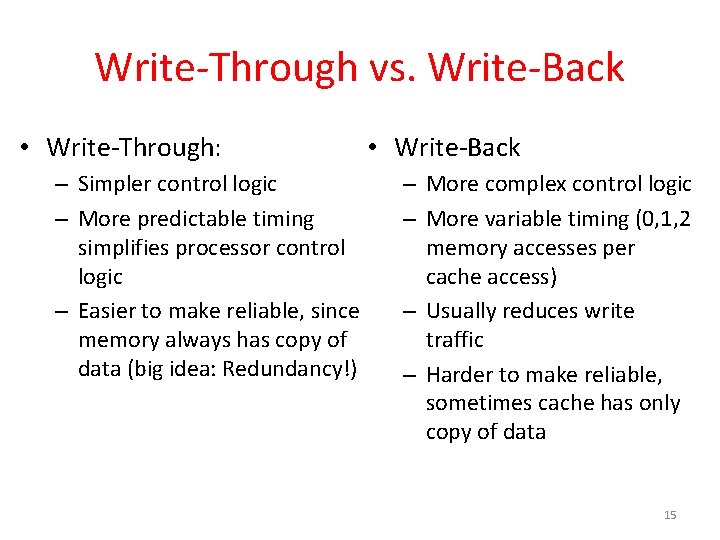
Write-Through vs. Write-Back • Write-Through: – Simpler control logic – More predictable timing simplifies processor control logic – Easier to make reliable, since memory always has copy of data (big idea: Redundancy!) • Write-Back – More complex control logic – More variable timing (0, 1, 2 memory accesses per cache access) – Usually reduces write traffic – Harder to make reliable, sometimes cache has only copy of data 15
Administrivia • Project 3 -1 due date Wednesday 10/21. • Project 3 -2 due date now 10/28 (release 10/21) • Midterm 1: – grades posted 16
Cache (Performance) Terms • Hit rate: fraction of accesses that hit in the cache • Miss rate: 1 – Hit rate • Miss penalty: time to replace a block from lower level in memory hierarchy to cache • Hit time: time to access cache memory (including tag comparison) • Abbreviation: “$” = cache (A Berkeley innovation!) 17
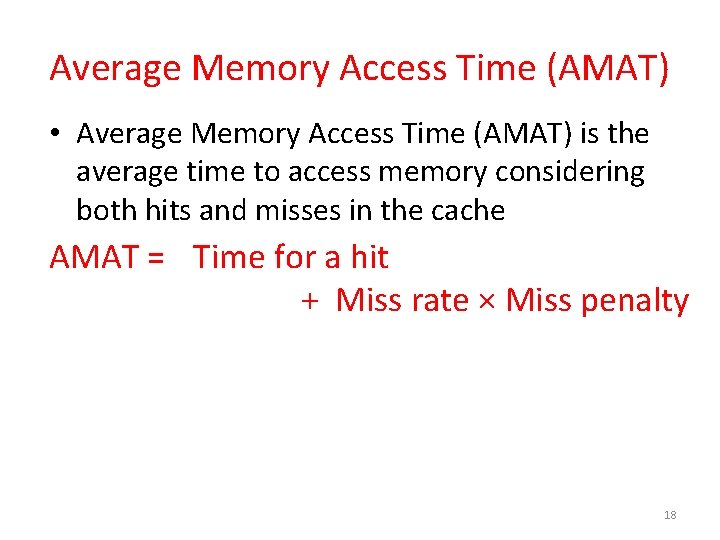
Average Memory Access Time (AMAT) • Average Memory Access Time (AMAT) is the average time to access memory considering both hits and misses in the cache AMAT = Time for a hit + Miss rate × Miss penalty 18
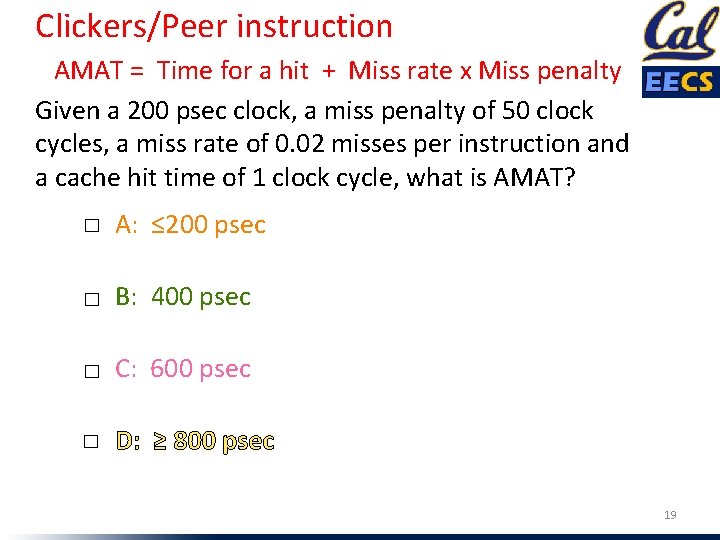
Clickers/Peer instruction AMAT = Time for a hit + Miss rate x Miss penalty Given a 200 psec clock, a miss penalty of 50 clock cycles, a miss rate of 0. 02 misses per instruction and a cache hit time of 1 clock cycle, what is AMAT? ☐ A: ≤ 200 psec ☐ B: 400 psec ☐ C: 600 psec ☐ D: ≥ 800 psec 19
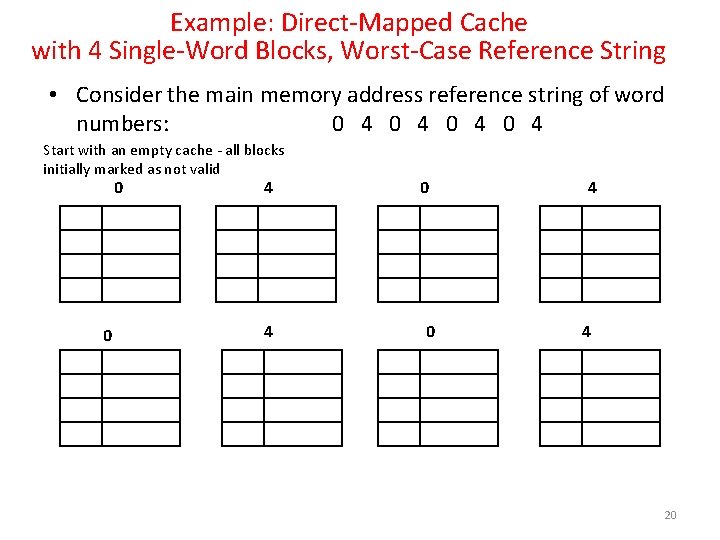
Example: Direct-Mapped Cache with 4 Single-Word Blocks, Worst-Case Reference String • Consider the main memory address reference string of word numbers: 0 4 0 4 Start with an empty cache - all blocks initially marked as not valid 0 0 4 4 20
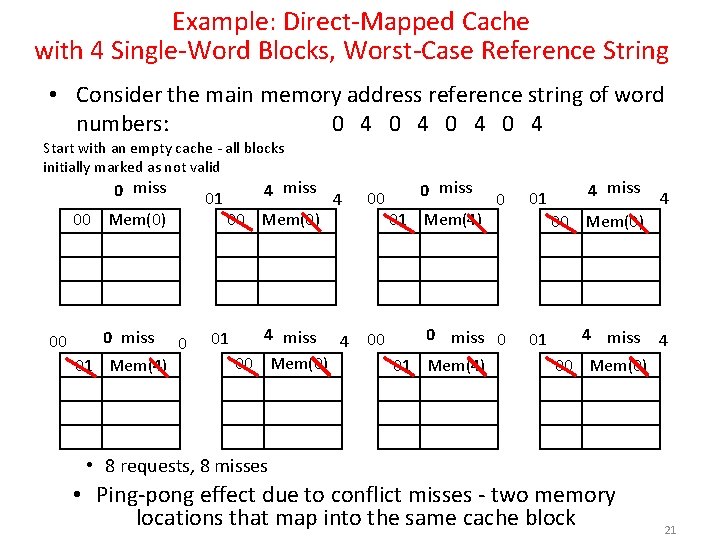
Example: Direct-Mapped Cache with 4 Single-Word Blocks, Worst-Case Reference String • Consider the main memory address reference string of word numbers: 0 4 0 4 Start with an empty cache - all blocks initially marked as not valid 0 miss 01 00 Mem(0) 00 0 miss 01 Mem(4) 0 4 miss 4 00 Mem(0) 01 4 miss 4 00 Mem(0) 00 00 0 miss 0 01 Mem(4) 01 01 Mem(4) 4 miss 4 00 Mem(0) • 8 requests, 8 misses • Ping-pong effect due to conflict misses - two memory locations that map into the same cache block 21
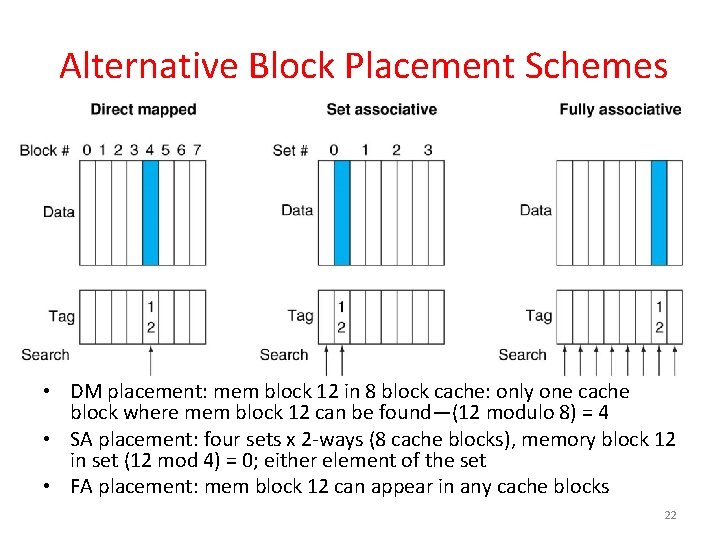
Alternative Block Placement Schemes • DM placement: mem block 12 in 8 block cache: only one cache block where mem block 12 can be found—(12 modulo 8) = 4 • SA placement: four sets x 2 -ways (8 cache blocks), memory block 12 in set (12 mod 4) = 0; either element of the set • FA placement: mem block 12 can appear in any cache blocks 22
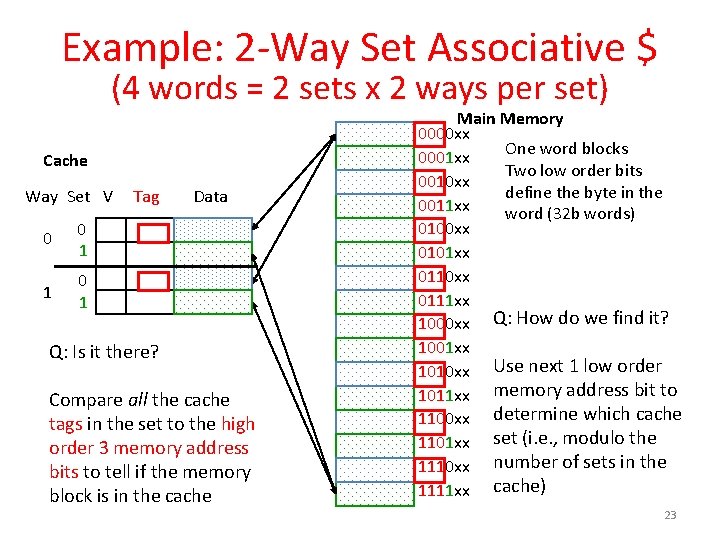
Example: 2 -Way Set Associative $ (4 words = 2 sets x 2 ways per set) Cache Way Set V 0 0 1 1 0 1 Tag Data Q: Is it there? Compare all the cache tags in the set to the high order 3 memory address bits to tell if the memory block is in the cache Main Memory 0000 xx One word blocks 0001 xx Two low order bits 0010 xx define the byte in the 0011 xx word (32 b words) 0100 xx 0101 xx 0110 xx 0111 xx 1000 xx Q: How do we find it? 1001 xx 1010 xx Use next 1 low order 1011 xx memory address bit to 1100 xx determine which cache 1101 xx set (i. e. , modulo the 1110 xx number of sets in the 1111 xx cache) 23
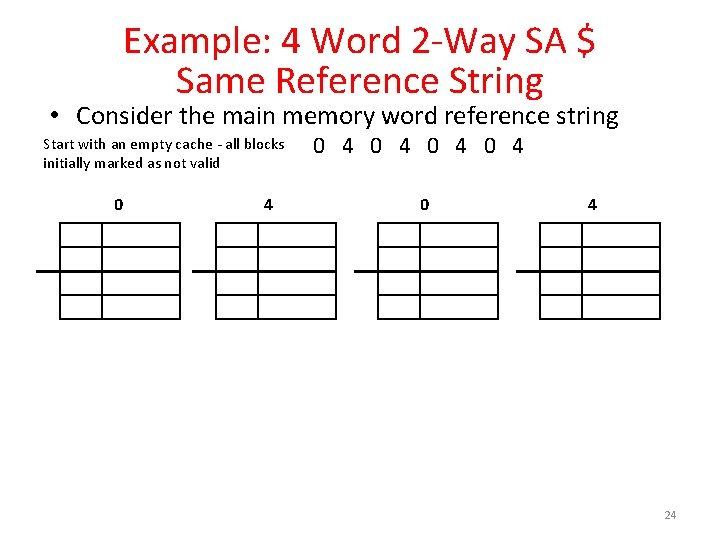
Example: 4 Word 2 -Way SA $ Same Reference String • Consider the main memory word reference string Start with an empty cache - all blocks initially marked as not valid 0 4 0 4 0 4 24
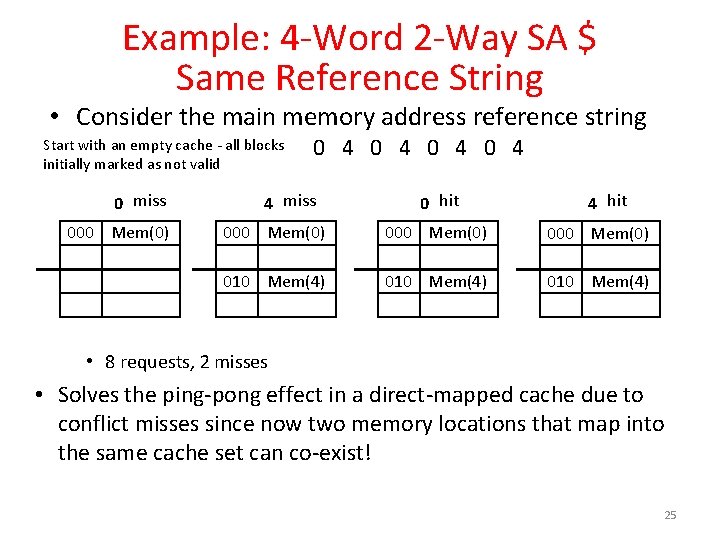
Example: 4 -Word 2 -Way SA $ Same Reference String • Consider the main memory address reference string Start with an empty cache - all blocks initially marked as not valid 0 miss 000 Mem(0) 0 4 0 4 4 miss 0 hit 4 hit 000 Mem(0) 010 Mem(4) • 8 requests, 2 misses • Solves the ping-pong effect in a direct-mapped cache due to conflict misses since now two memory locations that map into the same cache set can co-exist! 25
Four-Way Set-Associative Cache • 28 = 256 sets each with four ways (each with one block) 31 30 . . . Tag 13 12 11 22 0 1 2 V Tag Data Way 0 0 1 2 . . . 253 254 255 V Tag Data Way 1 0 1 2 . . . Byte offset 2 1 0 8 Index V Tag . . . V Tag Data Way 2 0 1 2 . . . 253 254 255 Data Way 3. . . 253 254 255 32 4 x 1 select Hit Data 26
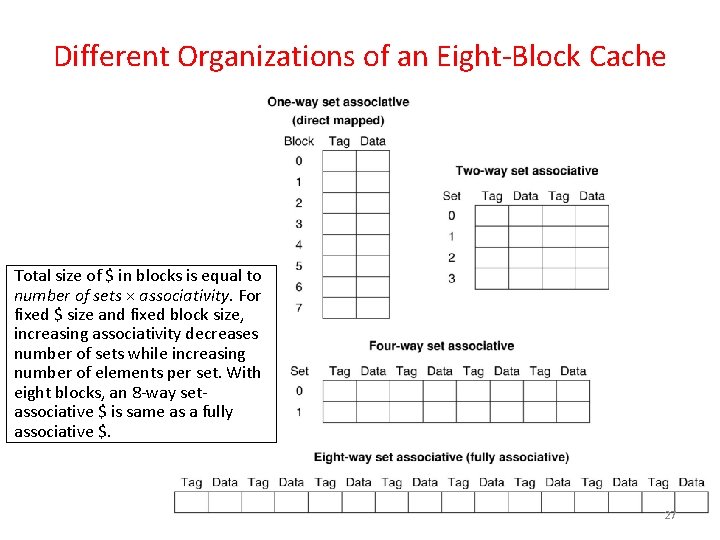
Different Organizations of an Eight-Block Cache Total size of $ in blocks is equal to number of sets × associativity. For fixed $ size and fixed block size, increasing associativity decreases number of sets while increasing number of elements per set. With eight blocks, an 8 -way setassociative $ is same as a fully associative $. 27
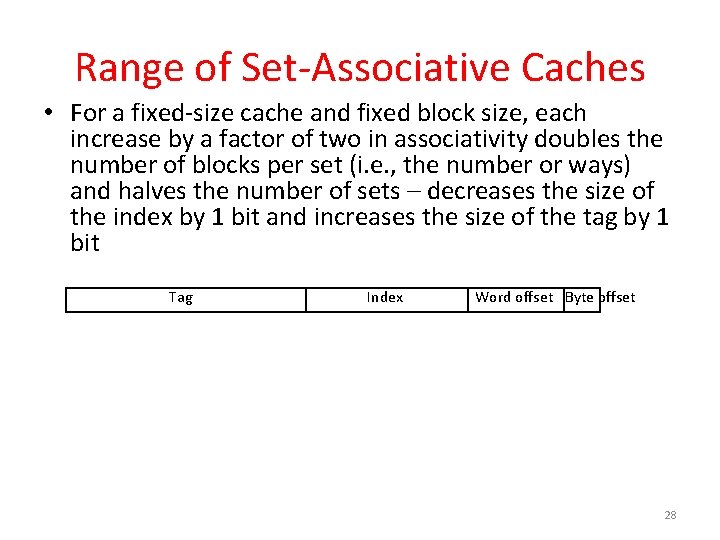
Range of Set-Associative Caches • For a fixed-size cache and fixed block size, each increase by a factor of two in associativity doubles the number of blocks per set (i. e. , the number or ways) and halves the number of sets – decreases the size of the index by 1 bit and increases the size of the tag by 1 bit Tag Index Word offset Byte offset 28
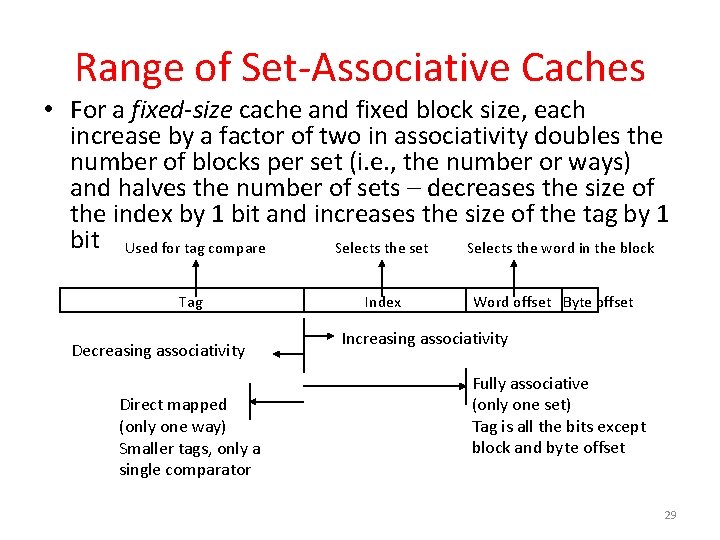
Range of Set-Associative Caches • For a fixed-size cache and fixed block size, each increase by a factor of two in associativity doubles the number of blocks per set (i. e. , the number or ways) and halves the number of sets – decreases the size of the index by 1 bit and increases the size of the tag by 1 bit Used for tag compare Selects the set Selects the word in the block Tag Decreasing associativity Direct mapped (only one way) Smaller tags, only a single comparator Index Word offset Byte offset Increasing associativity Fully associative (only one set) Tag is all the bits except block and byte offset 29
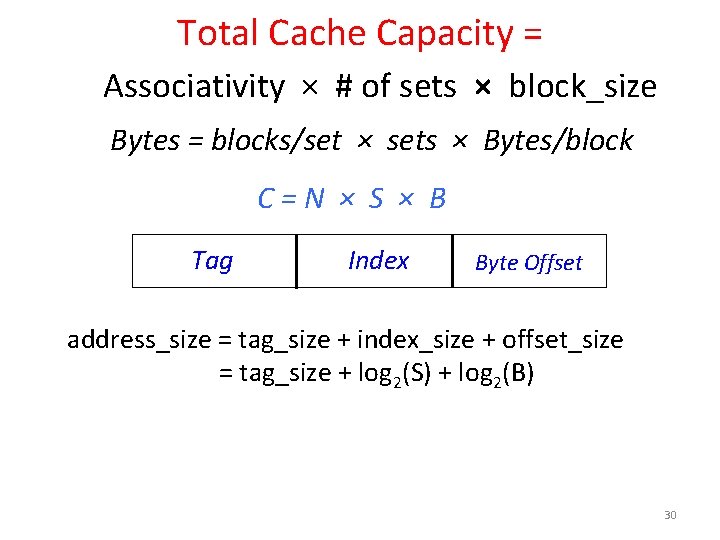
Total Cache Capacity = Associativity × # of sets × block_size Bytes = blocks/set × sets × Bytes/block C=N × S × B Tag Index Byte Offset address_size = tag_size + index_size + offset_size = tag_size + log 2(S) + log 2(B) 30
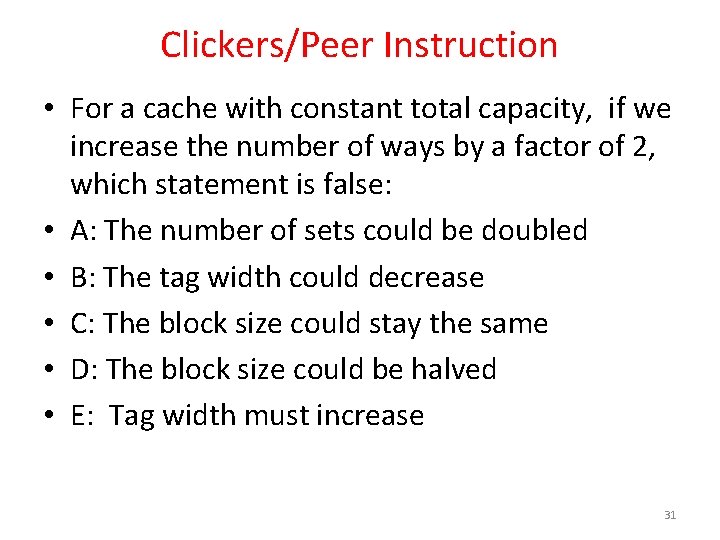
Clickers/Peer Instruction • For a cache with constant total capacity, if we increase the number of ways by a factor of 2, which statement is false: • A: The number of sets could be doubled • B: The tag width could decrease • C: The block size could stay the same • D: The block size could be halved • E: Tag width must increase 31
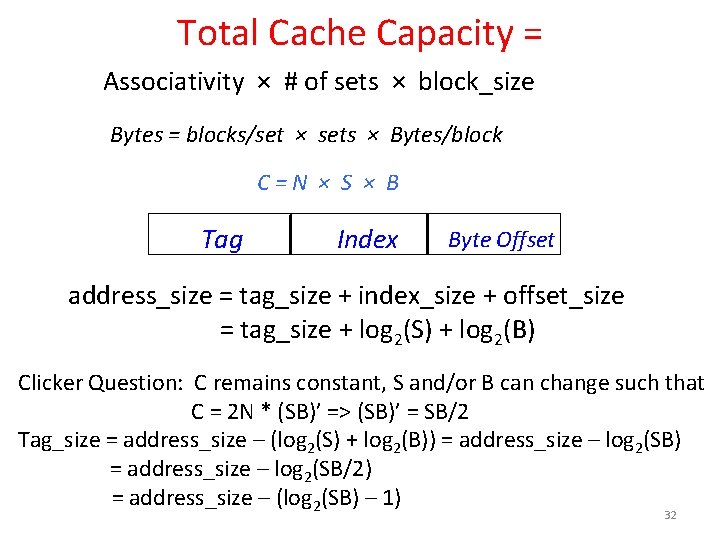
Total Cache Capacity = Associativity × # of sets × block_size Bytes = blocks/set × sets × Bytes/block C=N × S × B Tag Index Byte Offset address_size = tag_size + index_size + offset_size = tag_size + log 2(S) + log 2(B) Clicker Question: C remains constant, S and/or B can change such that C = 2 N * (SB)’ => (SB)’ = SB/2 Tag_size = address_size – (log 2(S) + log 2(B)) = address_size – log 2(SB/2) = address_size – (log 2(SB) – 1) 32
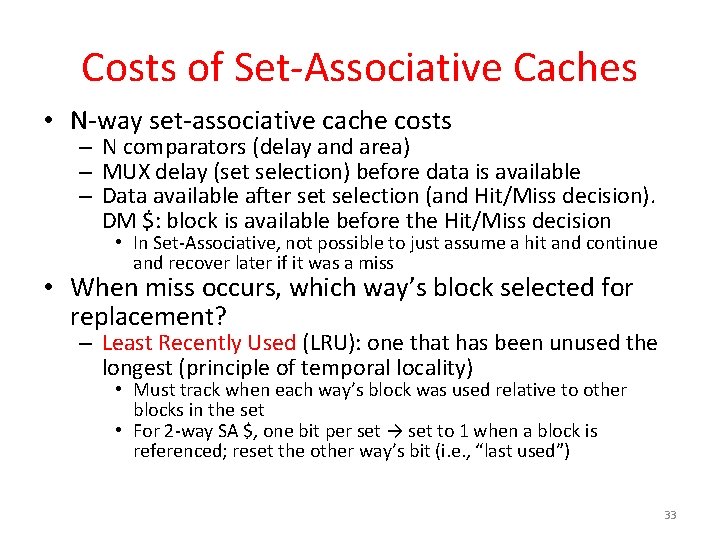
Costs of Set-Associative Caches • N-way set-associative cache costs – N comparators (delay and area) – MUX delay (set selection) before data is available – Data available after set selection (and Hit/Miss decision). DM $: block is available before the Hit/Miss decision • In Set-Associative, not possible to just assume a hit and continue and recover later if it was a miss • When miss occurs, which way’s block selected for replacement? – Least Recently Used (LRU): one that has been unused the longest (principle of temporal locality) • Must track when each way’s block was used relative to other blocks in the set • For 2 -way SA $, one bit per set → set to 1 when a block is referenced; reset the other way’s bit (i. e. , “last used”) 33
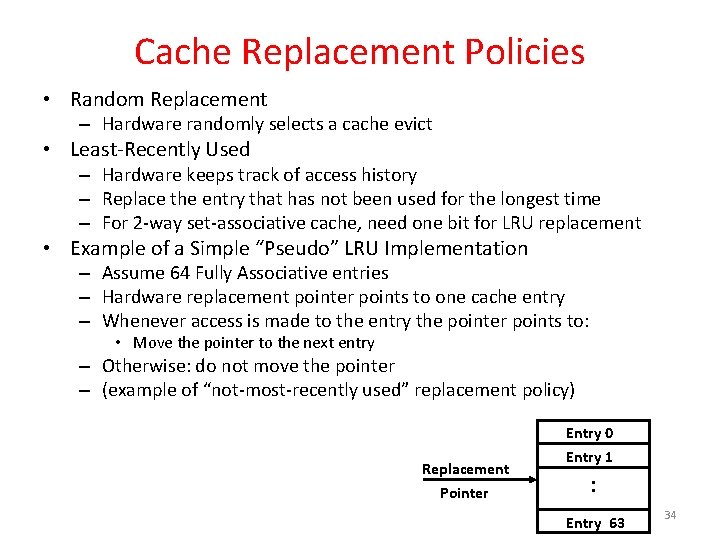
Cache Replacement Policies • Random Replacement – Hardware randomly selects a cache evict • Least-Recently Used – Hardware keeps track of access history – Replace the entry that has not been used for the longest time – For 2 -way set-associative cache, need one bit for LRU replacement • Example of a Simple “Pseudo” LRU Implementation – Assume 64 Fully Associative entries – Hardware replacement pointer points to one cache entry – Whenever access is made to the entry the pointer points to: • Move the pointer to the next entry – Otherwise: do not move the pointer – (example of “not-most-recently used” replacement policy) Replacement Pointer Entry 0 Entry 1 : Entry 63 34
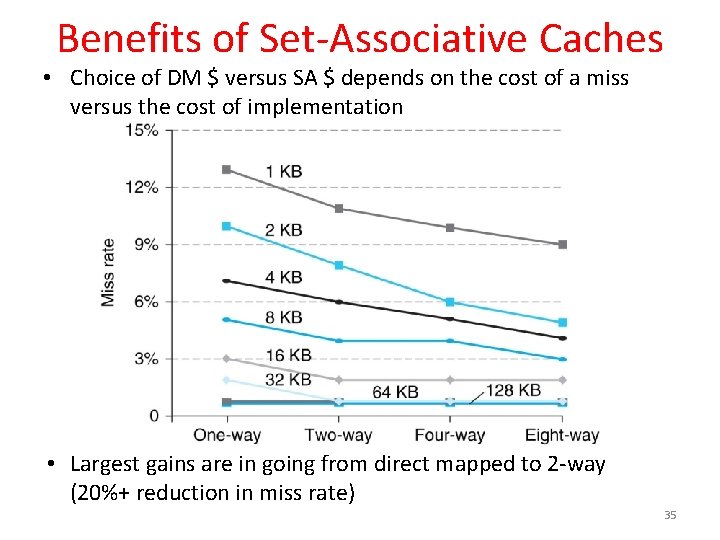
Benefits of Set-Associative Caches • Choice of DM $ versus SA $ depends on the cost of a miss versus the cost of implementation • Largest gains are in going from direct mapped to 2 -way (20%+ reduction in miss rate) 35
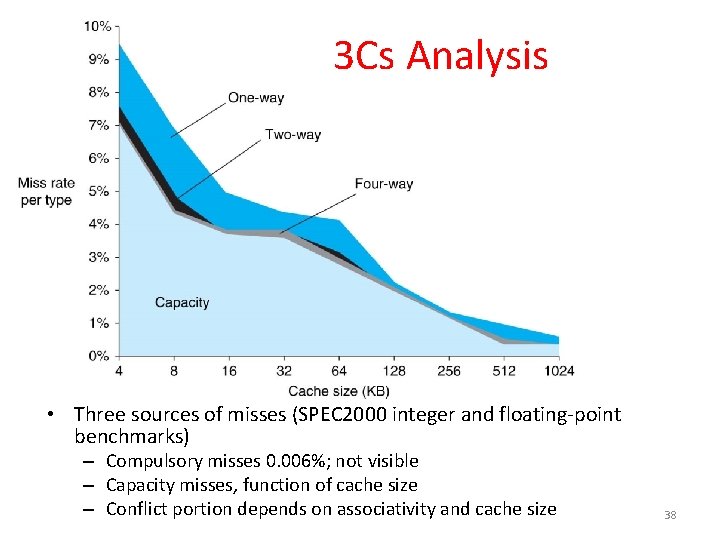
Understanding Cache Misses: The 3 Cs • Compulsory (cold start or process migration, 1 st reference): – First access to block impossible to avoid; small effect for long running programs – Solution: increase block size (increases miss penalty; very large blocks could increase miss rate) • Capacity: – Cache cannot contain all blocks accessed by the program – Solution: increase cache size (may increase access time) • Conflict (collision): – Multiple memory locations mapped to the same cache location – Solution 1: increase cache size – Solution 2: increase associativity (may increase access time) 36
How to Calculate 3 C’s using Cache Simulator 1. Compulsory: set cache size to infinity and fully associative, and count number of misses 2. Capacity: Change cache size from infinity, usually in powers of 2, and count misses for each reduction in size – 16 MB, 8 MB, 4 MB, … 128 KB, 64 KB, 16 KB 3. Conflict: Change from fully associative to n-way set associative while counting misses – Fully associative, 16 -way, 8 -way, 4 -way, 2 -way, 1 way 37
3 Cs Analysis • Three sources of misses (SPEC 2000 integer and floating-point benchmarks) – Compulsory misses 0. 006%; not visible – Capacity misses, function of cache size – Conflict portion depends on associativity and cache size 38
Improving Cache Performance AMAT = Time for a hit + Miss rate x Miss penalty • Reduce the time to hit in the cache – E. g. , Smaller cache • Reduce the miss rate – E. g. , Bigger cache • Reduce the miss penalty – E. g. , Use multiple cache levels 39
Impact of Larger Cache on AMAT? • 1) Reduces misses (what kind(s)? ) • 2) Longer Access time (Hit time): smaller is faster – Increase in hit time will likely add another stage to the pipeline • At some point, increase in hit time for a larger cache may overcome the improvement in hit rate, yielding a decrease in performance • Computer architects expend considerable effort optimizing organization of cache hierarchy – big impact on performance and power! 40
Clickers: Impact of longer cache blocks on misses? • For fixed total cache capacity and associativity, what is effect of longer blocks on each type of miss: – A: Decrease, B: Unchanged, C: Increase • Compulsory? • Capacity? • Conflict? 41
Clickers: Impact of longer blocks on AMAT • For fixed total cache capacity and associativity, what is effect of longer blocks on each component of AMAT: – A: Decrease, B: Unchanged, C: Increase • Hit Time? • Miss Rate? • Miss Penalty? 42
Clickers/Peer Instruction: For fixed capacity and fixed block size, how does increasing associativity effect AMAT? A: Increases hit time, decreases miss rate B: Decreases hit time, decreases miss rate C: Increases hit time, increases miss rate D: Decreases hit time, increases miss rate 43
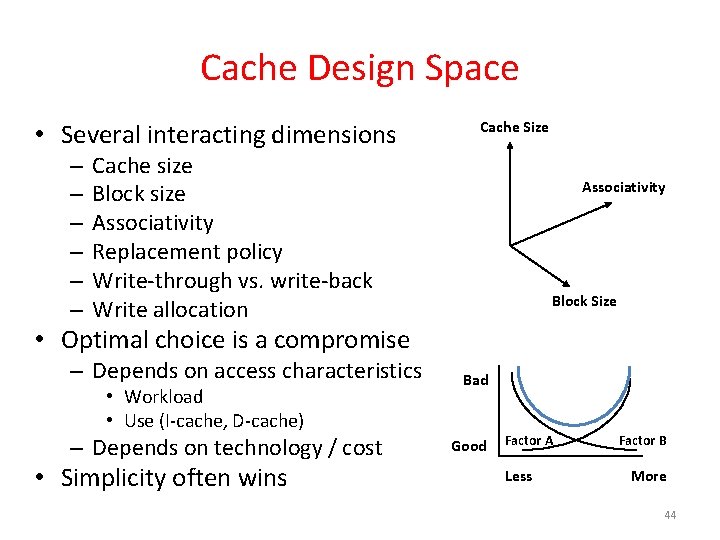
Cache Design Space • Several interacting dimensions – – – Cache Size Cache size Block size Associativity Replacement policy Write-through vs. write-back Write allocation Associativity Block Size • Optimal choice is a compromise – Depends on access characteristics • Workload • Use (I-cache, D-cache) – Depends on technology / cost • Simplicity often wins Bad Good Factor A Less Factor B More 44
And, In Conclusion … • Name of the Game: Reduce AMAT – Reduce Hit Time – Reduce Miss Rate – Reduce Miss Penalty • Balance cache parameters (Capacity, associativity, block size) 45