
CS 61 C Great Ideas in Computer Architecture
![Loop Fusion: Flashcard Quiz for(i=0; i < N; i++) a[i] = b[i] * c[i];](https://slidetodoc.com/presentation_image_h2/683b41bac7f88b1239edc304a7b69c86/image-14.jpg "Loop Fusion: Flashcard Quiz for(i=0; i < N; i++) a[i] = b[i] * c[i];")
![Loop Fusion: Flashcard Quiz for(i=0; i < N; i++) a[i] = b[i] * c[i];](https://slidetodoc.com/presentation_image_h2/683b41bac7f88b1239edc304a7b69c86/image-15.jpg "Loop Fusion: Flashcard Quiz for(i=0; i < N; i++) a[i] = b[i] * c[i];")
- Slides: 51
CS 61 C: Great Ideas in Computer Architecture Cache Performance and Parallelism Instructor: Randy H. Katz http: //inst. eecs. Berkeley. edu/~cs 61 c/fa 13 6/11/2021 Fall 2013 -- Lecture #13 1
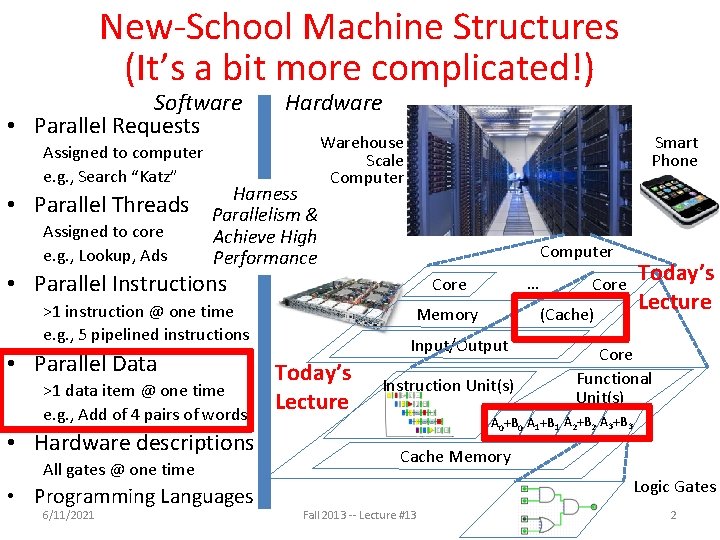
New-School Machine Structures (It’s a bit more complicated!) Software • Parallel Requests Assigned to computer e. g. , Search “Katz” • Parallel Threads Assigned to core e. g. , Lookup, Ads Hardware Harness Parallelism & Achieve High Performance Smart Phone Warehouse Scale Computer • Parallel Instructions >1 instruction @ one time e. g. , 5 pipelined instructions • Parallel Data >1 data item @ one time e. g. , Add of 4 pairs of words • Hardware descriptions All gates @ one time • Programming Languages 6/11/2021 … Core Memory (Cache) Input/Output Today’s Lecture Core Instruction Unit(s) Today’s Lecture Core Functional Unit(s) A 0+B 0 A 1+B 1 A 2+B 2 A 3+B 3 Cache Memory Logic Gates Fall 2013 -- Lecture #13 2
Agenda • • Review Cache Performance Administrivia Parallel Processing Technology Break Amdahl’s Law SIMD And in Conclusion, … 6/11/2021 Fall 2013 -- Lecture #13 3
Agenda • • Review Cache Performance Administrivia Parallel Processing Technology Break Amdahl’s Law SIMD And in Conclusion, … 6/11/2021 Fall 2013 -- Lecture #13 4
Review • Write-through versus write-back caches • AMAT = Hit time + Miss rate x Miss penalty • Larger caches reduce Miss rate via Temporal and Spatial Locality, but can increase Hit time • Multilevel caches help Miss penalty 6/11/2021 Fall 2013 -- Lecture #13 5
Caches Invisible to Software • Load and store instructions just access large memory (32 -bit addresses in MIPS); hardware automatically moves data in and out of cache • Even if programmer writes applications not knowing about caches, we observe temporal and spatial locality in memory accesses • Performance improves (over no caches) even when programmer unaware of cache’s existence 6/11/2021 Fall 2013 -- Lecture #13 6
Agenda • • Review Cache Performance Administrivia Parallel Processing Technology Break Amdahl’s Law SIMD And in Conclusion, … 6/11/2021 Fall 2013 -- Lecture #13 8
Performance Programming: Adjust software accesses to improve miss rate • Now that understand how caches work, can revise program to improve cache utilization • “Cache-Aware” performance optimizations – But code would still work even if no caches present 6/11/2021 Fall 2013 -- Lecture #13 9
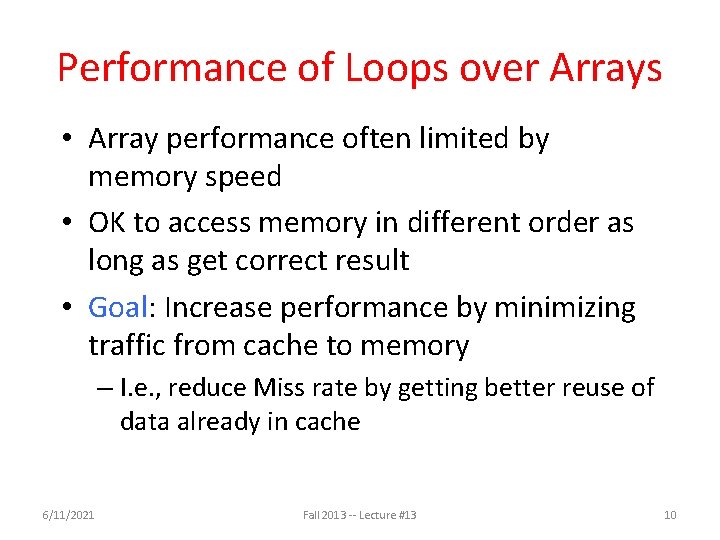
Performance of Loops over Arrays • Array performance often limited by memory speed • OK to access memory in different order as long as get correct result • Goal: Increase performance by minimizing traffic from cache to memory – I. e. , reduce Miss rate by getting better reuse of data already in cache 6/11/2021 Fall 2013 -- Lecture #13 10
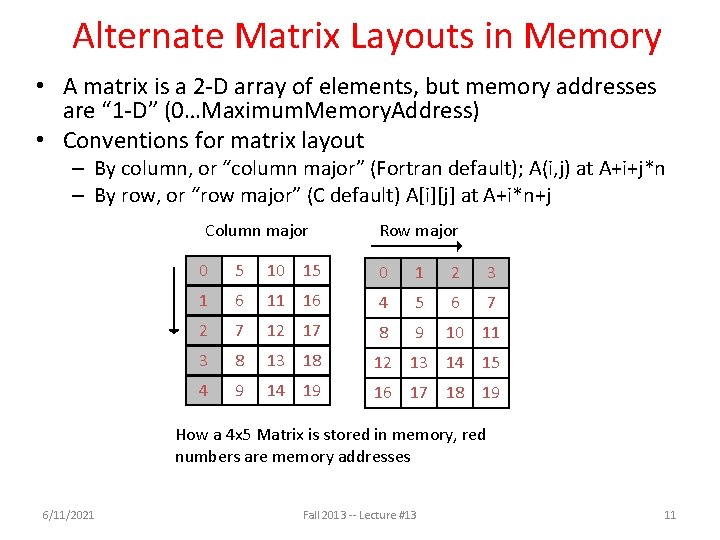
Alternate Matrix Layouts in Memory • A matrix is a 2 -D array of elements, but memory addresses are “ 1 -D” (0…Maximum. Memory. Address) • Conventions for matrix layout – By column, or “column major” (Fortran default); A(i, j) at A+i+j*n – By row, or “row major” (C default) A[i][j] at A+i*n+j Column major Row major 0 5 10 15 0 1 2 3 1 6 11 16 4 5 6 7 2 7 12 17 8 9 10 11 3 8 13 18 12 13 14 15 4 9 14 19 16 17 18 19 How a 4 x 5 Matrix is stored in memory, red numbers are memory addresses 6/11/2021 Fall 2013 -- Lecture #13 11
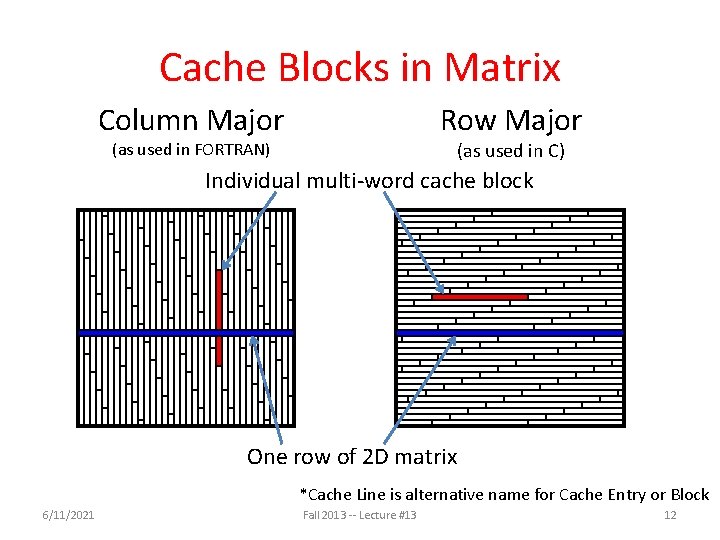
Cache Blocks in Matrix Column Major Row Major (as used in C) I (as used in FORTRAN) Individual multi-word cache block C One row of 2 D matrix *Cache Line is alternative name for Cache Entry or Block 6/11/2021 Fall 2013 -- Lecture #13 12
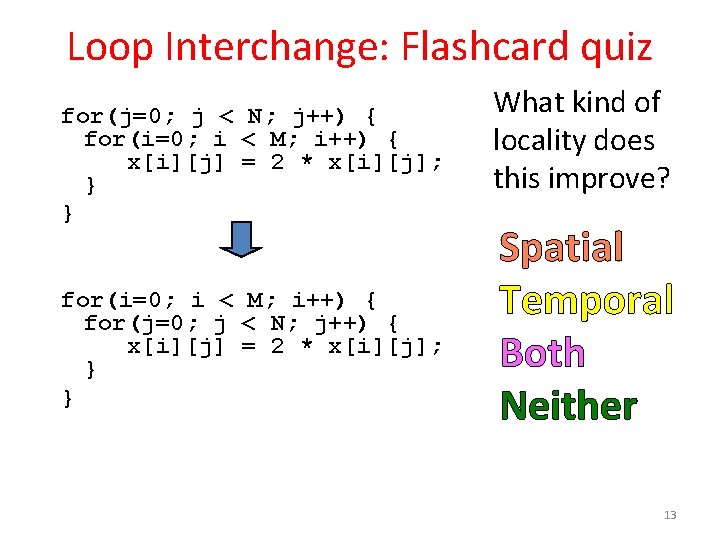
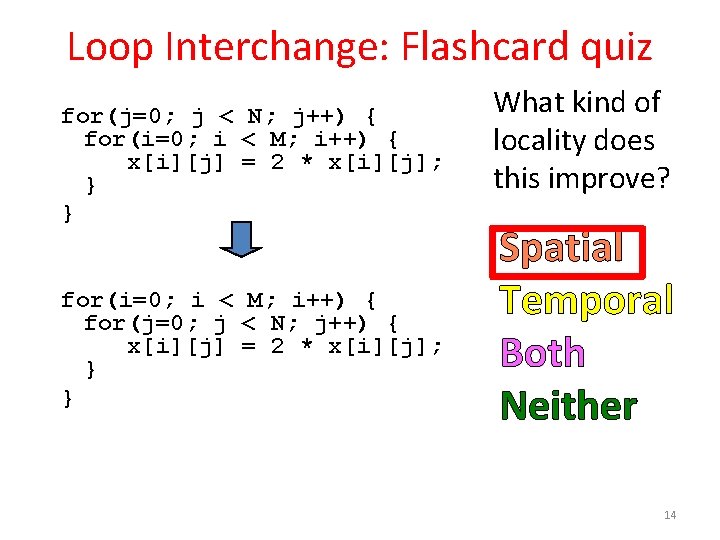
Loop Interchange: Flashcard quiz for(j=0; j < N; j++) { for(i=0; i < M; i++) { x[i][j] = 2 * x[i][j]; } } for(i=0; i < M; i++) { for(j=0; j < N; j++) { x[i][j] = 2 * x[i][j]; } } What kind of locality does this improve? Spatial Temporal Both Neither 13
Loop Interchange: Flashcard quiz for(j=0; j < N; j++) { for(i=0; i < M; i++) { x[i][j] = 2 * x[i][j]; } } for(i=0; i < M; i++) { for(j=0; j < N; j++) { x[i][j] = 2 * x[i][j]; } } What kind of locality does this improve? Spatial Temporal Both Neither 14
Loop Fusion: Flashcard Quiz for(i=0; i < N; i++) a[i] = b[i] * c[i]; for(i=0; i < N; i++) d[i] = a[i] * c[i]; for(i=0; i < N; i++) { a[i] = b[i] * c[i]; d[i] = a[i] * c[i]; } What kind of locality does this improve? Spatial Temporal Both Neither 15
Loop Fusion: Flashcard Quiz for(i=0; i < N; i++) a[i] = b[i] * c[i]; for(i=0; i < N; i++) d[i] = a[i] * c[i]; for(i=0; i < N; i++) { a[i] = b[i] * c[i]; d[i] = a[i] * c[i]; } What kind of locality does this improve? Spatial Temporal Both Neither 16
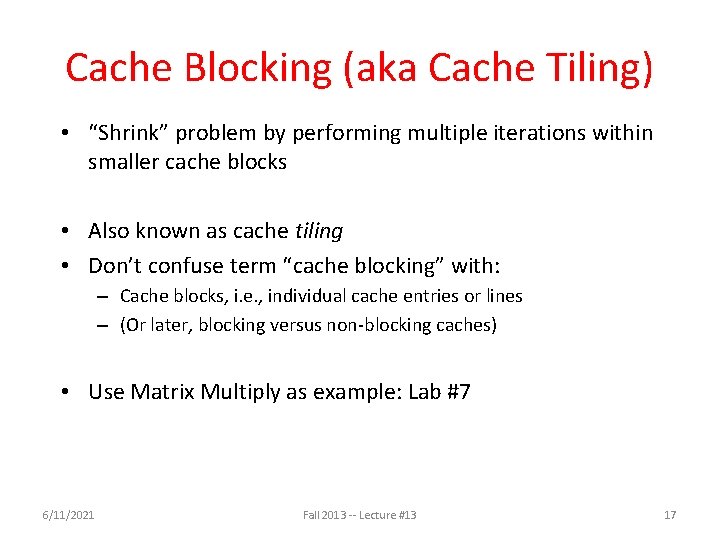
Cache Blocking (aka Cache Tiling) • “Shrink” problem by performing multiple iterations within smaller cache blocks • Also known as cache tiling • Don’t confuse term “cache blocking” with: – Cache blocks, i. e. , individual cache entries or lines – (Or later, blocking versus non-blocking caches) • Use Matrix Multiply as example: Lab #7 6/11/2021 Fall 2013 -- Lecture #13 17
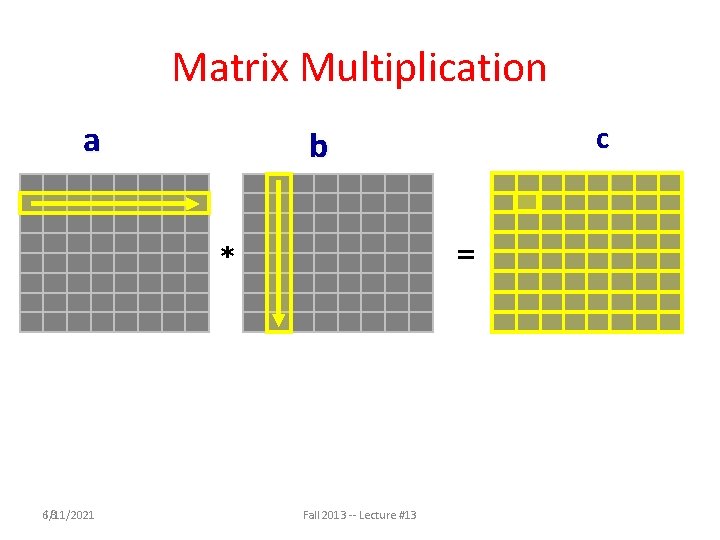
Matrix Multiplication a = * 6/11/2021 18 c b Fall 2013 -- Lecture #13
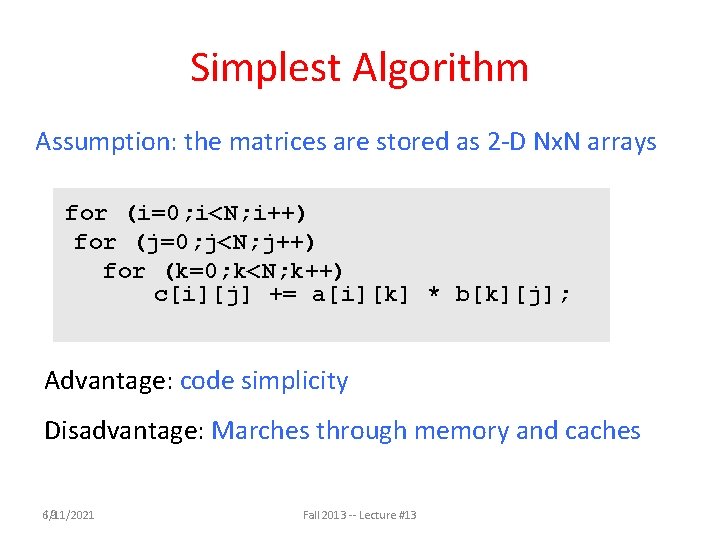
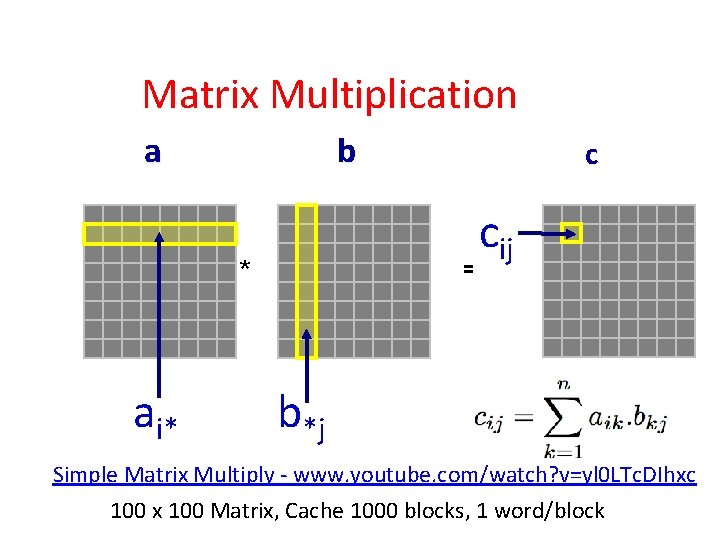
Simplest Algorithm Assumption: the matrices are stored as 2 -D Nx. N arrays for (i=0; i<N; i++) for (j=0; j<N; j++) for (k=0; k<N; k++) c[i][j] += a[i][k] * b[k][j]; Advantage: code simplicity Disadvantage: Marches through memory and caches 6/11/2021 19 Fall 2013 -- Lecture #13
Matrix Multiplication a b * ai* c = cij b*j Simple Matrix Multiply - www. youtube. com/watch? v=yl 0 LTc. DIhxc 20 100 x 100 Matrix, Cache 1000 blocks, 1 word/block
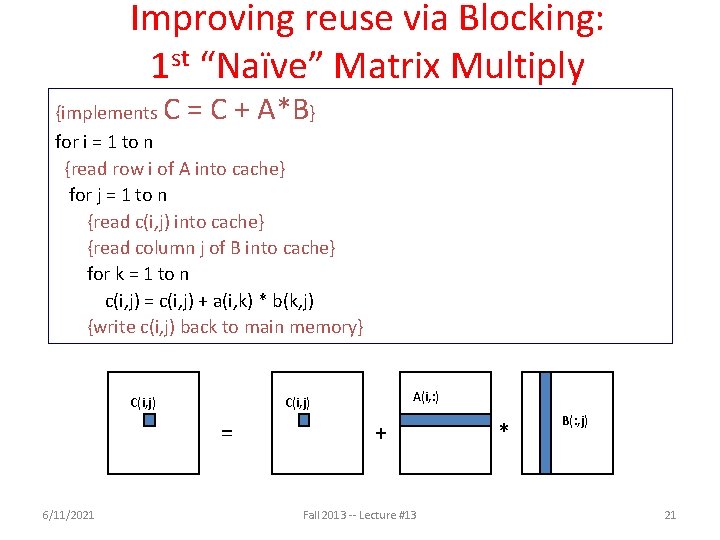
Improving reuse via Blocking: 1 st “Naïve” Matrix Multiply C = C + A*B {implements } for i = 1 to n {read row i of A into cache} for j = 1 to n {read c(i, j) into cache} {read column j of B into cache} for k = 1 to n c(i, j) = c(i, j) + a(i, k) * b(k, j) {write c(i, j) back to main memory} C(i, j) = 6/11/2021 A(i, : ) C(i, j) + Fall 2013 -- Lecture #13 * B(: , j) 21
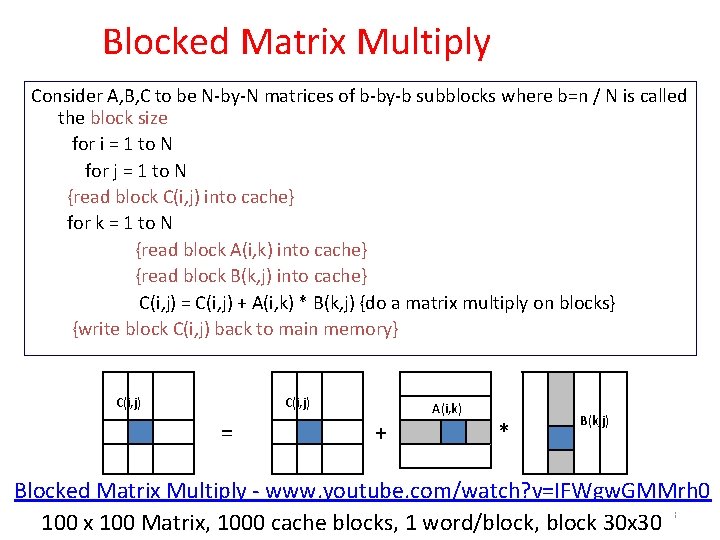
Blocked Matrix Multiply Consider A, B, C to be N-by-N matrices of b-by-b subblocks where b=n / N is called the block size for i = 1 to N for j = 1 to N {read block C(i, j) into cache} for k = 1 to N {read block A(i, k) into cache} {read block B(k, j) into cache} C(i, j) = C(i, j) + A(i, k) * B(k, j) {do a matrix multiply on blocks} {write block C(i, j) back to main memory} C(i, j) = A(i, k) + * B(k, j) Blocked Matrix Multiply - www. youtube. com/watch? v=IFWgw. GMMrh 0 6/11/2021 Fall 2013 -- Lecture #13 100 x 100 Matrix, 1000 cache blocks, 1 word/block, block 30 x 30 23
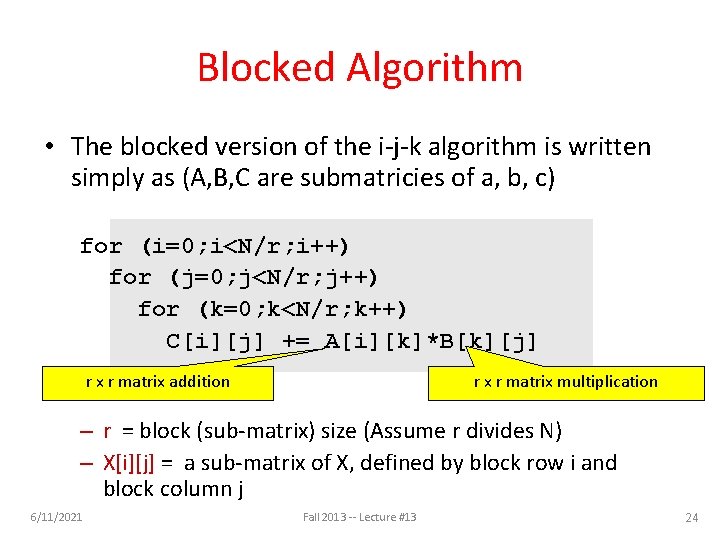
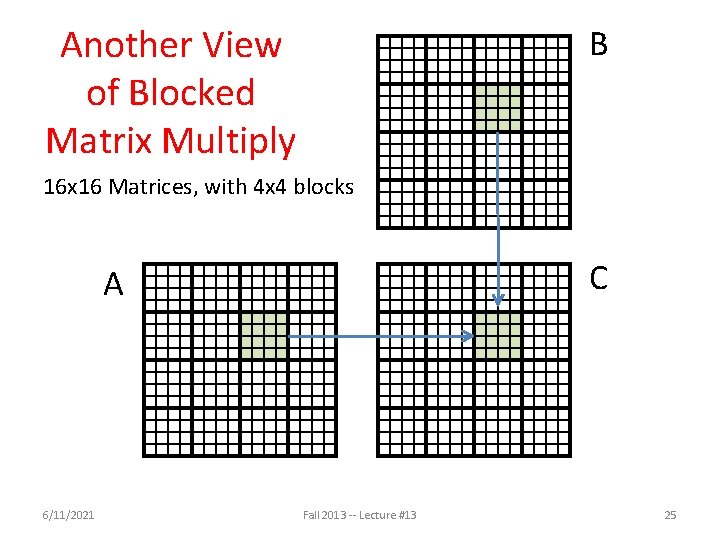
Blocked Algorithm • The blocked version of the i-j-k algorithm is written simply as (A, B, C are submatricies of a, b, c) for (i=0; i<N/r; i++) for (j=0; j<N/r; j++) for (k=0; k<N/r; k++) C[i][j] += A[i][k]*B[k][j] r x r matrix addition r x r matrix multiplication – r = block (sub-matrix) size (Assume r divides N) – X[i][j] = a sub-matrix of X, defined by block row i and block column j 6/11/2021 Fall 2013 -- Lecture #13 24
Another View of Blocked Matrix Multiply B 16 x 16 Matrices, with 4 x 4 blocks C A 6/11/2021 Fall 2013 -- Lecture #13 25
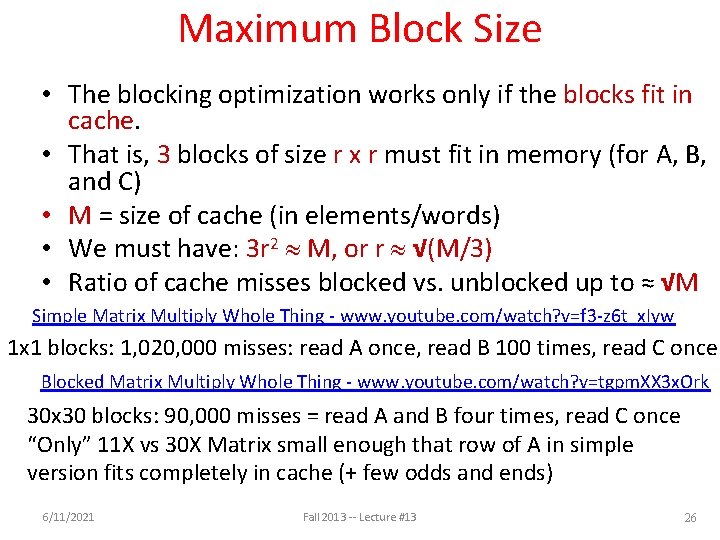
Maximum Block Size • The blocking optimization works only if the blocks fit in cache. • That is, 3 blocks of size r x r must fit in memory (for A, B, and C) • M = size of cache (in elements/words) • We must have: 3 r 2 M, or r √(M/3) • Ratio of cache misses blocked vs. unblocked up to ≈ √M Simple Matrix Multiply Whole Thing - www. youtube. com/watch? v=f 3 -z 6 t_x. Iyw 1 x 1 blocks: 1, 020, 000 misses: read A once, read B 100 times, read C once Blocked Matrix Multiply Whole Thing - www. youtube. com/watch? v=tgpm. XX 3 x. Ork 30 x 30 blocks: 90, 000 misses = read A and B four times, read C once “Only” 11 X vs 30 X Matrix small enough that row of A in simple version fits completely in cache (+ few odds and ends) 6/11/2021 Fall 2013 -- Lecture #13 26
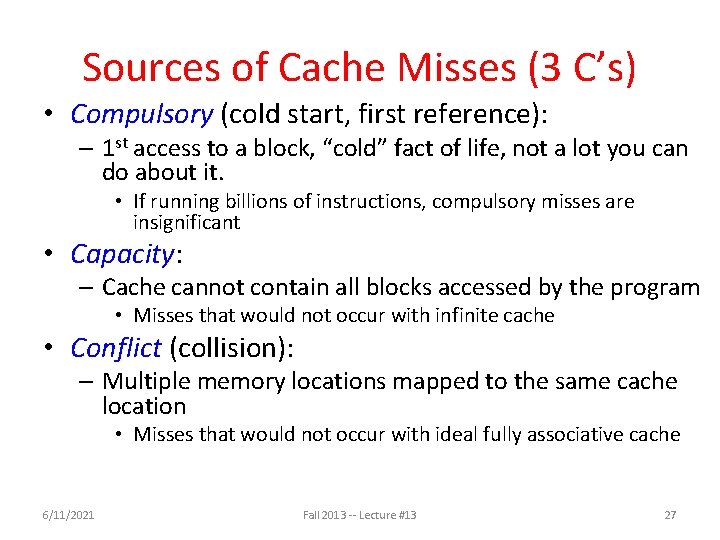
Sources of Cache Misses (3 C’s) • Compulsory (cold start, first reference): – 1 st access to a block, “cold” fact of life, not a lot you can do about it. • If running billions of instructions, compulsory misses are insignificant • Capacity: – Cache cannot contain all blocks accessed by the program • Misses that would not occur with infinite cache • Conflict (collision): – Multiple memory locations mapped to the same cache location • Misses that would not occur with ideal fully associative cache 6/11/2021 Fall 2013 -- Lecture #13 27
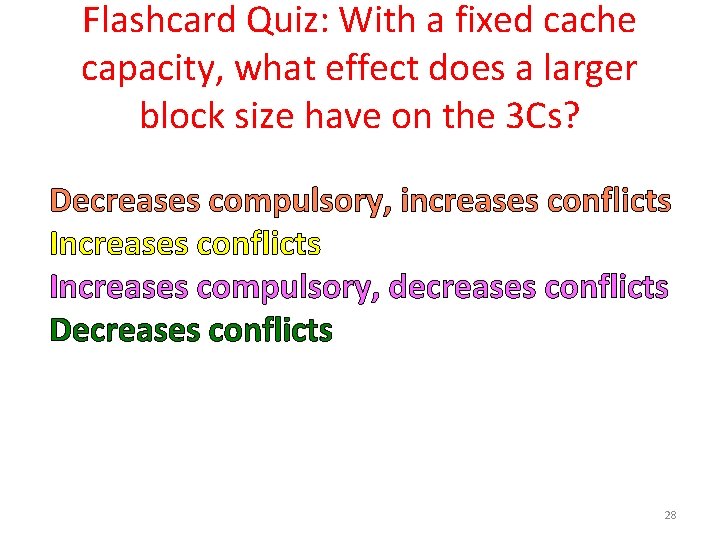
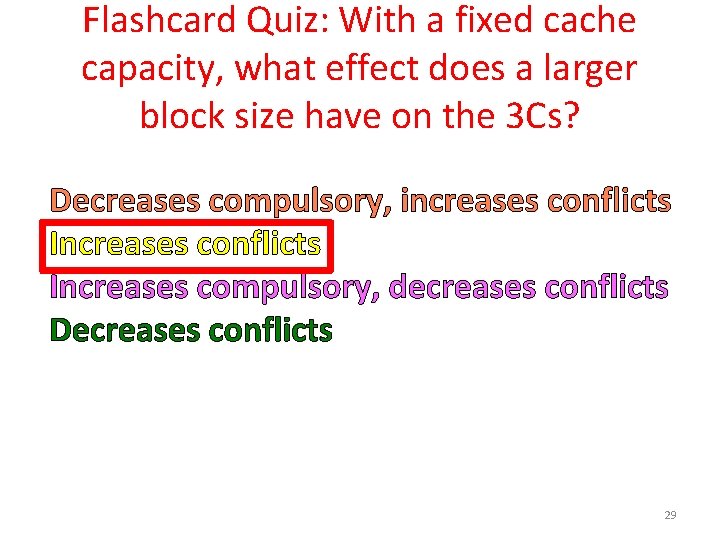
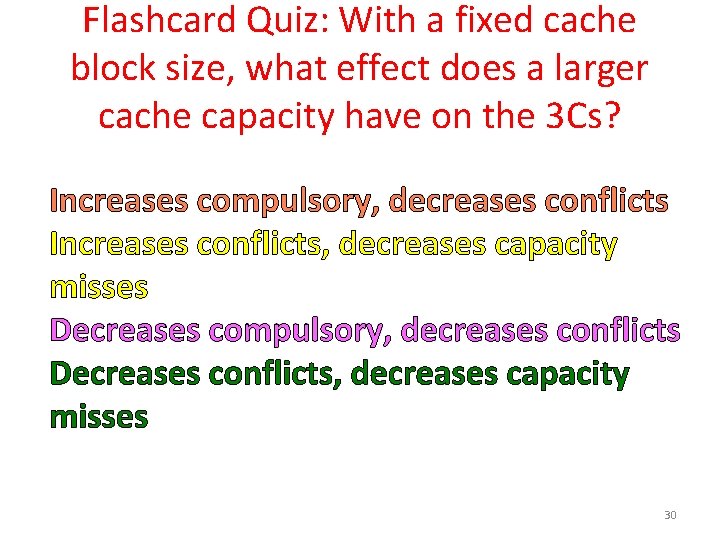
Flashcard Quiz: With a fixed cache capacity, what effect does a larger block size have on the 3 Cs? Decreases compulsory, increases conflicts Increases compulsory, decreases conflicts Decreases conflicts 28
Flashcard Quiz: With a fixed cache capacity, what effect does a larger block size have on the 3 Cs? Decreases compulsory, increases conflicts Increases compulsory, decreases conflicts Decreases conflicts 29
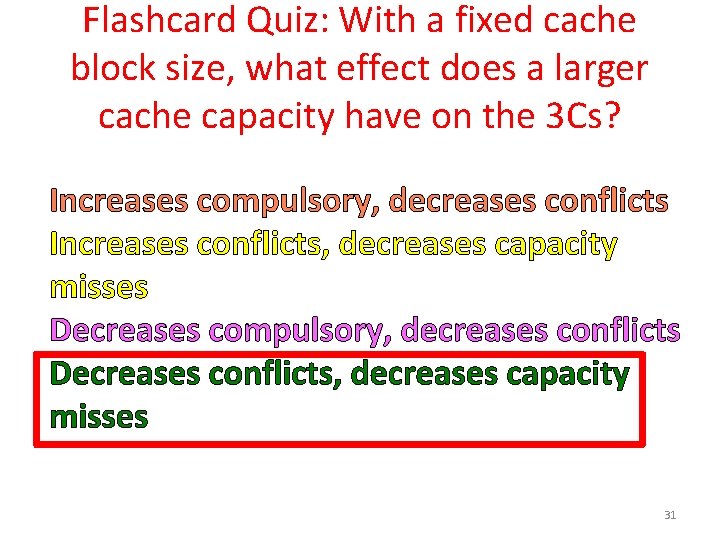
Flashcard Quiz: With a fixed cache block size, what effect does a larger cache capacity have on the 3 Cs? Increases compulsory, decreases conflicts Increases conflicts, decreases capacity misses Decreases compulsory, decreases conflicts Decreases conflicts, decreases capacity misses 30
Flashcard Quiz: With a fixed cache block size, what effect does a larger cache capacity have on the 3 Cs? Increases compulsory, decreases conflicts Increases conflicts, decreases capacity misses Decreases compulsory, decreases conflicts Decreases conflicts, decreases capacity misses 31
Agenda • • Review Cache Performance Administrivia Parallel Processing Technology Break Amdahl’s Law SIMD And in Conclusion, … 6/11/2021 Fall 2013 -- Lecture #13 33
Administrivia • Midterm One Week from Thursday (17 October) • Topics: – 6 -9 PM in three different rooms: • 10 Evans (cs 61 c-1 a thru -dz) • 155 Dwinelle (cs 61 c-ea thru -of) • 1 Pimentel (cs 61 c-og thru c-zz) – Closed book, double sided crib sheet, no calculator – TA-led review session Saturday, 2 -5 PM, Room 155 Dwinelle – (Additional HKN Review on Sunday) 6/11/2021 Fall 2013 -- Lecture #13 – Cloud Computing and Warehouse Scale Computers – C Programming – MIPS Assembly/Machine Language and Conventions – Compilers and Loaders – Number Representations – Memory Hierarchy and Caches – Parallelism (Request and Data-Level Parallelism) – Labs and Projects 34
Agenda • • Review Cache Performance Administrivia Parallel Processing Technology Break Amdahl’s Law SIMD And in Conclusion, … 6/11/2021 Fall 2013 -- Lecture #13 35
Alternative Kinds of Parallelism: The Programming Viewpoint • Job-level parallelism/process-level parallelism – Running independent programs on multiple processors simultaneously – Example? • Parallel-processing program – Single program that runs on multiple processors simultaneously – Example? 6/11/2021 Fall 2013 -- Lecture #13 36
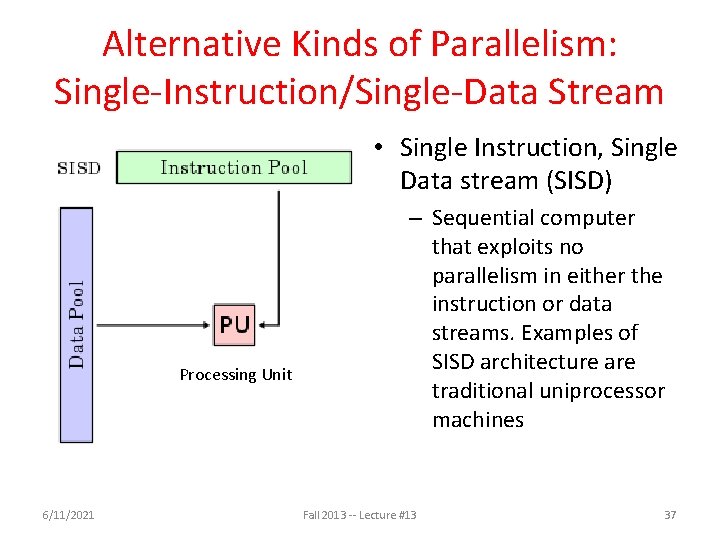
Alternative Kinds of Parallelism: Single-Instruction/Single-Data Stream • Single Instruction, Single Data stream (SISD) Processing Unit 6/11/2021 – Sequential computer that exploits no parallelism in either the instruction or data streams. Examples of SISD architecture are traditional uniprocessor machines Fall 2013 -- Lecture #13 37
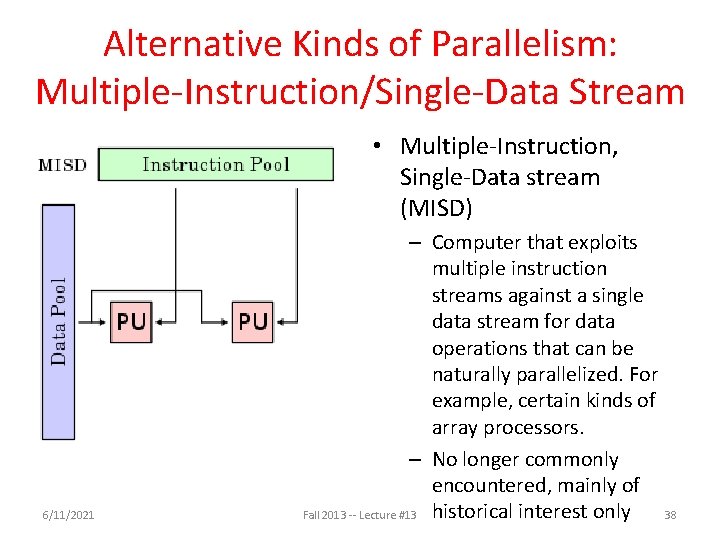
Alternative Kinds of Parallelism: Multiple-Instruction/Single-Data Stream • Multiple-Instruction, Single-Data stream (MISD) 6/11/2021 – Computer that exploits multiple instruction streams against a single data stream for data operations that can be naturally parallelized. For example, certain kinds of array processors. – No longer commonly encountered, mainly of Fall 2013 -- Lecture #13 historical interest only 38
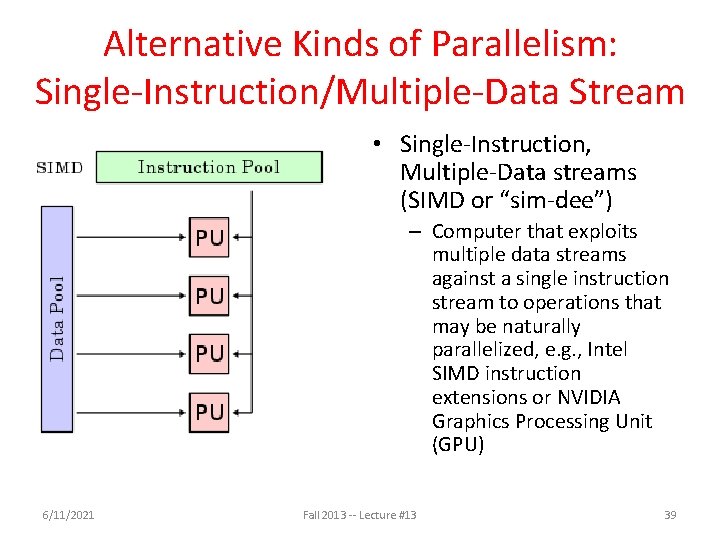
Alternative Kinds of Parallelism: Single-Instruction/Multiple-Data Stream • Single-Instruction, Multiple-Data streams (SIMD or “sim-dee”) – Computer that exploits multiple data streams against a single instruction stream to operations that may be naturally parallelized, e. g. , Intel SIMD instruction extensions or NVIDIA Graphics Processing Unit (GPU) 6/11/2021 Fall 2013 -- Lecture #13 39
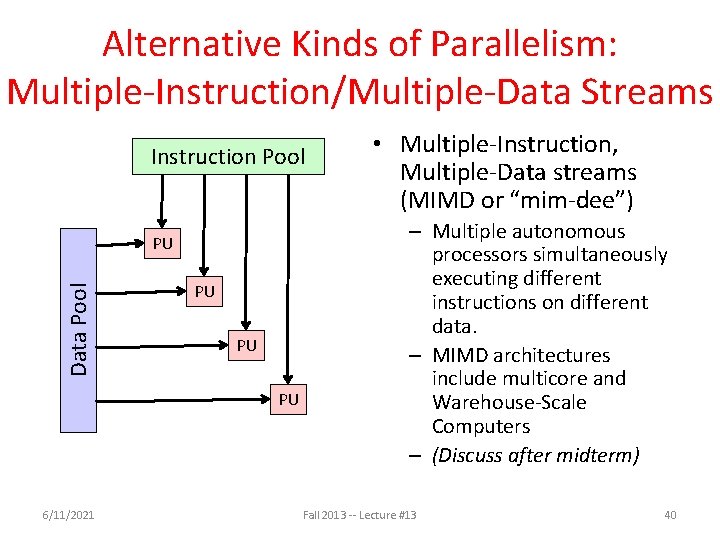
Alternative Kinds of Parallelism: Multiple-Instruction/Multiple-Data Streams Instruction Pool Data Pool PU PU 6/11/2021 • Multiple-Instruction, Multiple-Data streams (MIMD or “mim-dee”) – Multiple autonomous processors simultaneously executing different instructions on different data. – MIMD architectures include multicore and Warehouse-Scale Computers – (Discuss after midterm) Fall 2013 -- Lecture #13 40
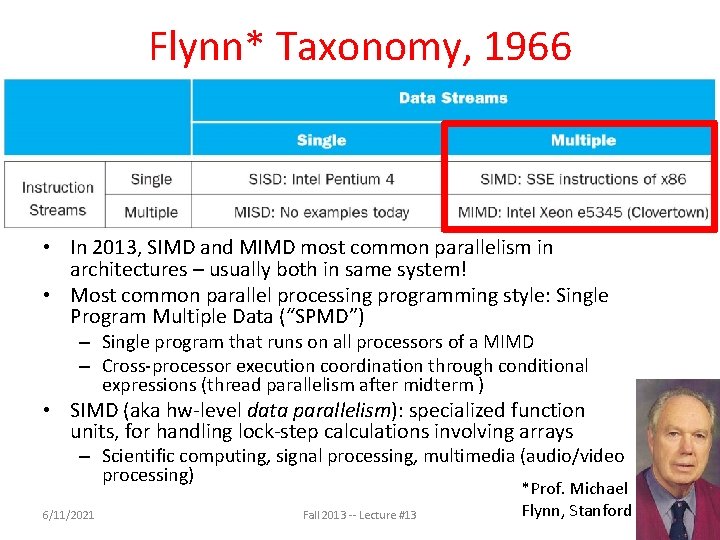
Flynn* Taxonomy, 1966 • In 2013, SIMD and MIMD most common parallelism in architectures – usually both in same system! • Most common parallel processing programming style: Single Program Multiple Data (“SPMD”) – Single program that runs on all processors of a MIMD – Cross-processor execution coordination through conditional expressions (thread parallelism after midterm ) • SIMD (aka hw-level data parallelism): specialized function units, for handling lock-step calculations involving arrays – Scientific computing, signal processing, multimedia (audio/video processing) 6/11/2021 Fall 2013 -- Lecture #13 *Prof. Michael Flynn, Stanford 41
Two kinds of Data-Level Parallelism (DLP) – Lots of data in memory that can be operated on in parallel (e. g. , adding together 2 arrays) – Lots of data on many disks that can be operated on in parallel (e. g. , searching for documents) • 2 nd lecture (and 1 st project) did DLP across 10 s of servers and disks using Map. Reduce • Today’s lecture (and 3 rd project) does Data. Level Parallelism (DLP) in memory 6/11/2021 Fall 2013 -- Lecture #13 42
Agenda • • Review Cache Performance Administrivia Parallel Processing Technology Break Amdahl’s Law SIMD And in Conclusion, … 6/11/2021 Fall 2013 -- Lecture #13 43
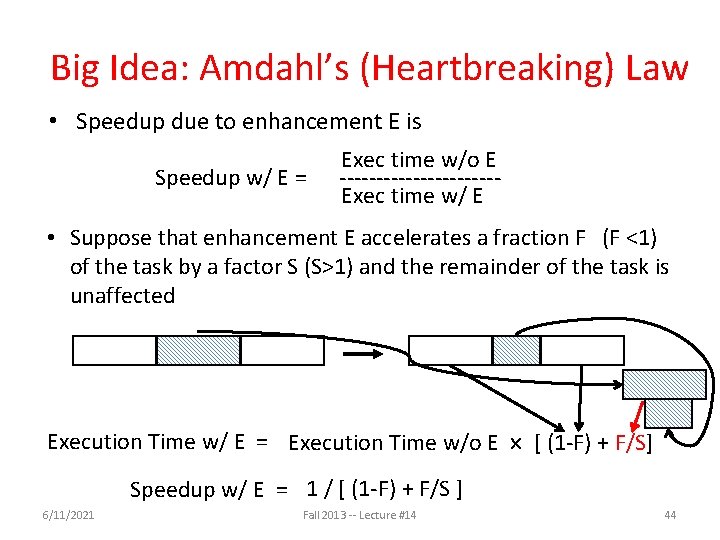
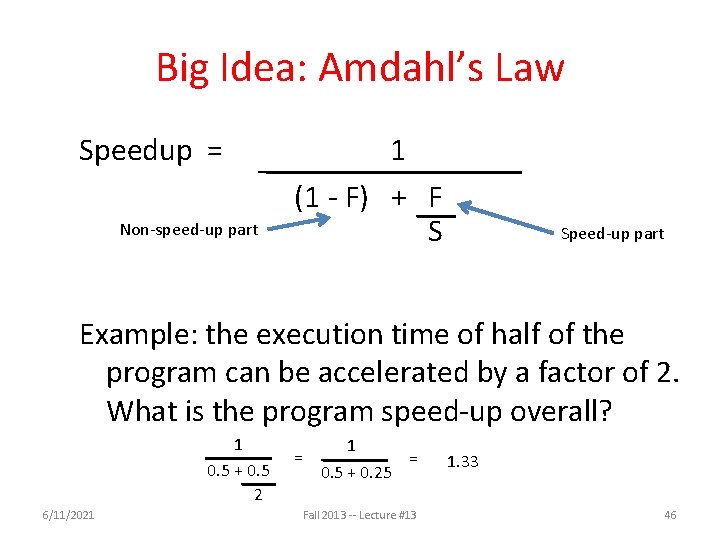
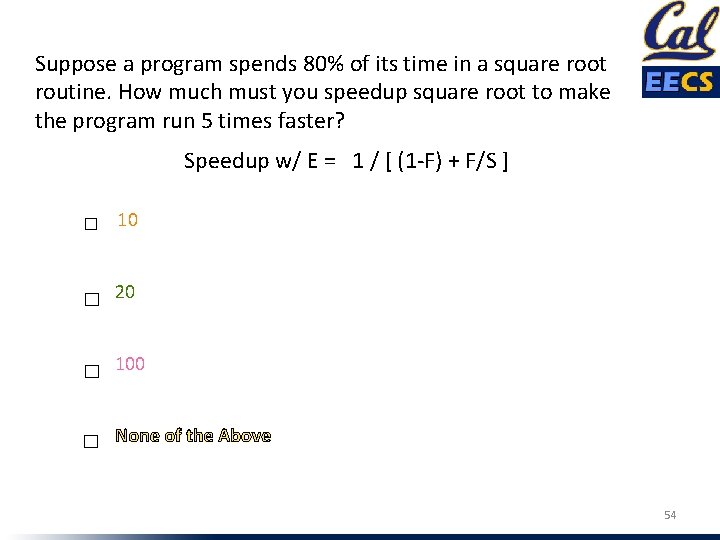
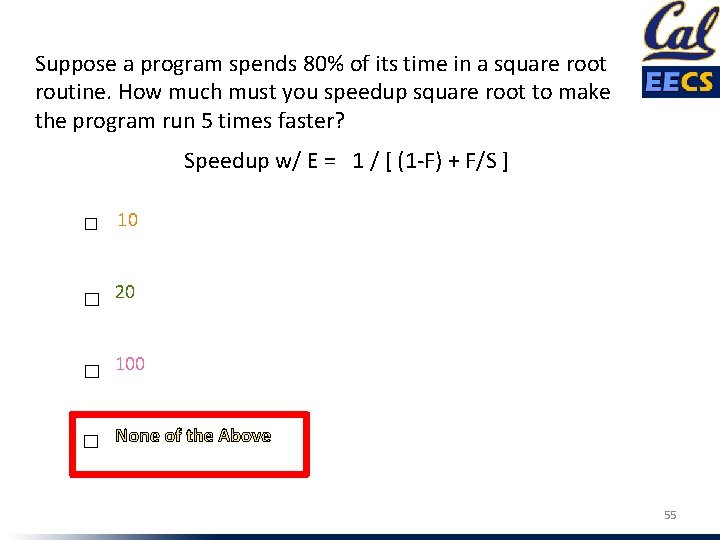
Big Idea: Amdahl’s (Heartbreaking) Law • Speedup due to enhancement E is Speedup w/ E = Exec time w/o E -----------Exec time w/ E • Suppose that enhancement E accelerates a fraction F (F <1) of the task by a factor S (S>1) and the remainder of the task is unaffected Execution Time w/ E = Execution Time w/o E [ (1 -F) + F/S] Speedup w/ E = 1 / [ (1 -F) + F/S ] 6/11/2021 Fall 2013 -- Lecture #14 44
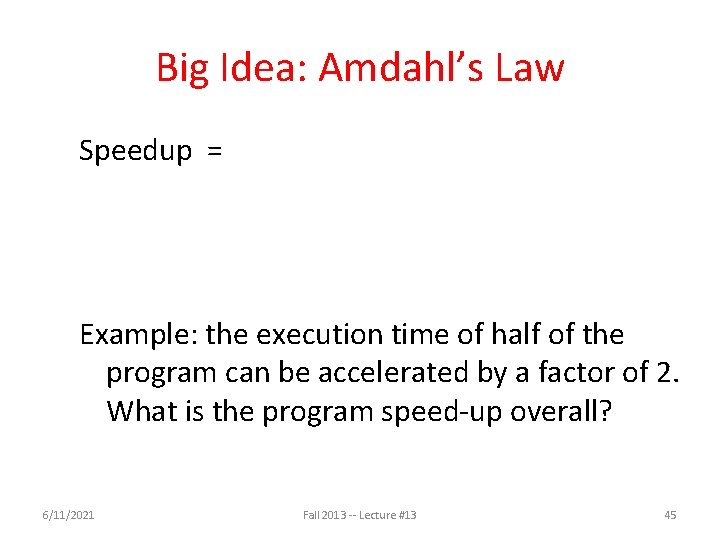
Big Idea: Amdahl’s Law Speedup = Example: the execution time of half of the program can be accelerated by a factor of 2. What is the program speed-up overall? 6/11/2021 Fall 2013 -- Lecture #13 45
Big Idea: Amdahl’s Law Speedup = Non-speed-up part 1 (1 - F) + F S Speed-up part Example: the execution time of half of the program can be accelerated by a factor of 2. What is the program speed-up overall? 1 0. 5 + 0. 5 2 6/11/2021 = 0. 5 + 0. 25 Fall 2013 -- Lecture #13 1. 33 46
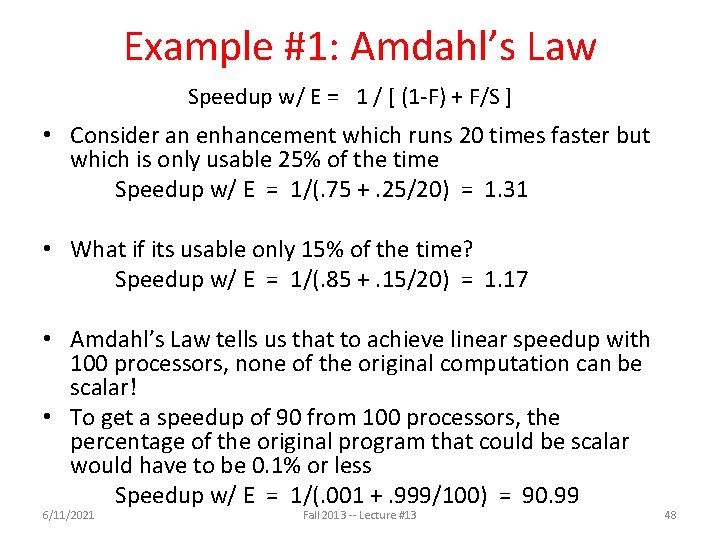
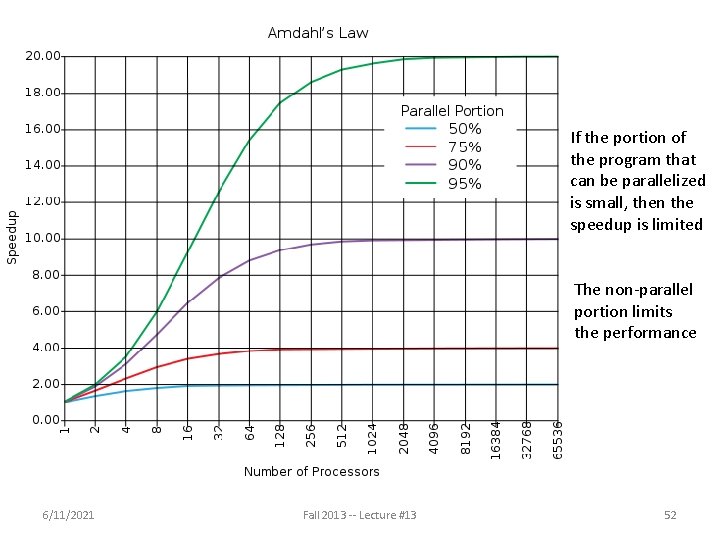
Example #1: Amdahl’s Law Speedup w/ E = 1 / [ (1 -F) + F/S ] • Consider an enhancement which runs 20 times faster but which is only usable 25% of the time Speedup w/ E = 1/(. 75 +. 25/20) = 1. 31 • What if its usable only 15% of the time? Speedup w/ E = 1/(. 85 +. 15/20) = 1. 17 • Amdahl’s Law tells us that to achieve linear speedup with 100 processors, none of the original computation can be scalar! • To get a speedup of 90 from 100 processors, the percentage of the original program that could be scalar would have to be 0. 1% or less Speedup w/ E = 1/(. 001 +. 999/100) = 90. 99 6/11/2021 Fall 2013 -- Lecture #13 48
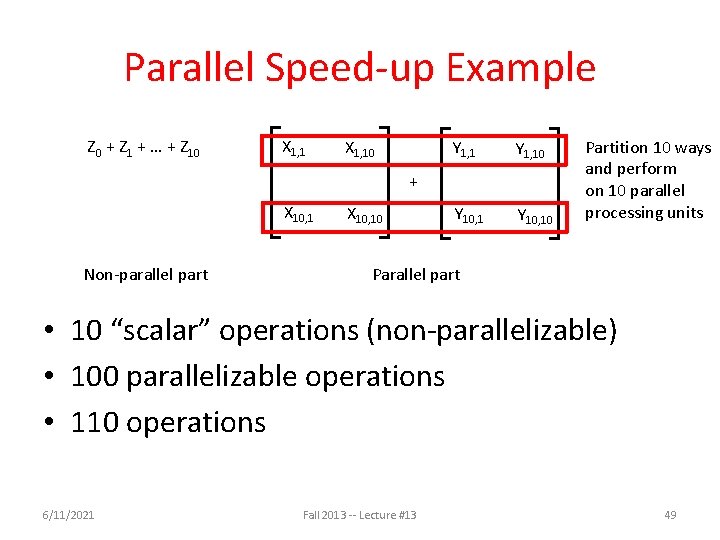
Parallel Speed-up Example Z 0 + Z 1 + … + Z 10 X 1, 10 Y 10, 10 + X 10, 1 Non-parallel part X 10, 10 Partition 10 ways and perform on 10 parallel processing units Parallel part • 10 “scalar” operations (non-parallelizable) • 100 parallelizable operations • 110 operations 6/11/2021 Fall 2013 -- Lecture #13 49
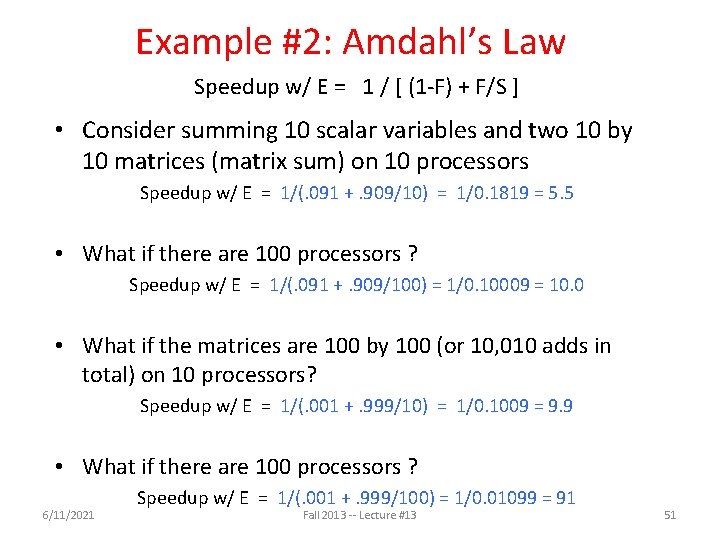
Example #2: Amdahl’s Law Speedup w/ E = 1 / [ (1 -F) + F/S ] • Consider summing 10 scalar variables and two 10 by 10 matrices (matrix sum) on 10 processors Speedup w/ E = 1/(. 091 +. 909/10) = 1/0. 1819 = 5. 5 • What if there are 100 processors ? Speedup w/ E = 1/(. 091 +. 909/100) = 1/0. 10009 = 10. 0 • What if the matrices are 100 by 100 (or 10, 010 adds in total) on 10 processors? Speedup w/ E = 1/(. 001 +. 999/10) = 1/0. 1009 = 9. 9 • What if there are 100 processors ? 6/11/2021 Speedup w/ E = 1/(. 001 +. 999/100) = 1/0. 01099 = 91 Fall 2013 -- Lecture #13 51
If the portion of the program that can be parallelized is small, then the speedup is limited The non-parallel portion limits the performance 6/11/2021 Fall 2013 -- Lecture #13 52
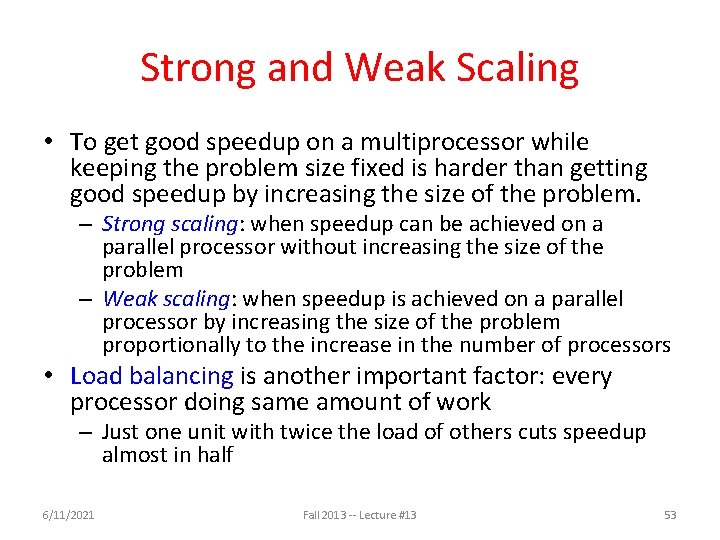
Strong and Weak Scaling • To get good speedup on a multiprocessor while keeping the problem size fixed is harder than getting good speedup by increasing the size of the problem. – Strong scaling: when speedup can be achieved on a parallel processor without increasing the size of the problem – Weak scaling: when speedup is achieved on a parallel processor by increasing the size of the problem proportionally to the increase in the number of processors • Load balancing is another important factor: every processor doing same amount of work – Just one unit with twice the load of others cuts speedup almost in half 6/11/2021 Fall 2013 -- Lecture #13 53
Suppose a program spends 80% of its time in a square root routine. How much must you speedup square root to make the program run 5 times faster? Speedup w/ E = 1 / [ (1 -F) + F/S ] ☐ 10 ☐ 20 ☐ 100 ☐ None of the Above 54
Suppose a program spends 80% of its time in a square root routine. How much must you speedup square root to make the program run 5 times faster? Speedup w/ E = 1 / [ (1 -F) + F/S ] ☐ 10 ☐ 20 ☐ 100 ☐ None of the Above 55
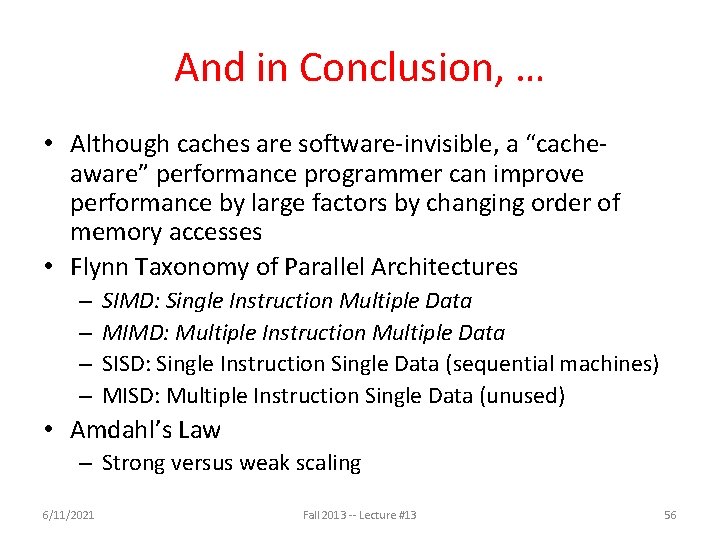
And in Conclusion, … • Although caches are software-invisible, a “cacheaware” performance programmer can improve performance by large factors by changing order of memory accesses • Flynn Taxonomy of Parallel Architectures – – SIMD: Single Instruction Multiple Data MIMD: Multiple Instruction Multiple Data SISD: Single Instruction Single Data (sequential machines) MISD: Multiple Instruction Single Data (unused) • Amdahl’s Law – Strong versus weak scaling 6/11/2021 Fall 2013 -- Lecture #13 56