
CS 61 C Great Ideas in Computer Architecture
![Fast String Copy Code in C • Copy x[] to y[] char *p, *q;](https://slidetodoc.com/presentation_image_h/aa03f5210270dbacb8bb724b334f8a7e/image-11.jpg "Fast String Copy Code in C • Copy x[] to y[] char *p, *q;")
![Which statement is TRUE? char *p, *q; p = &x[0]; q = &y[0]; while((*q++](https://slidetodoc.com/presentation_image_h/aa03f5210270dbacb8bb724b334f8a7e/image-15.jpg "Which statement is TRUE? char *p, *q; p = &x[0]; q = &y[0]; while((*q++")
- Slides: 39
CS 61 C: Great Ideas in Computer Architecture Strings and Functions Instructor: Krste Asanovic, Randy H. Katz http: //inst. eecs. Berkeley. edu/~cs 61 c/sp 12 11/27/2020 Fall 2012 -- Lecture #7 1
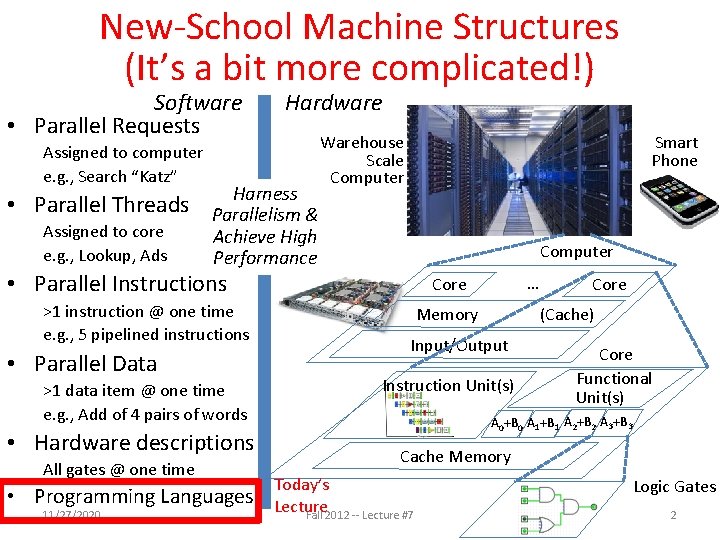
New-School Machine Structures (It’s a bit more complicated!) Software • Parallel Requests Assigned to computer e. g. , Search “Katz” • Parallel Threads Assigned to core e. g. , Lookup, Ads Hardware Harness Parallelism & Achieve High Performance Smart Phone Warehouse Scale Computer • Parallel Instructions >1 instruction @ one time e. g. , 5 pipelined instructions • Parallel Data >1 data item @ one time e. g. , Add of 4 pairs of words • Hardware descriptions All gates @ one time • Programming Languages 11/27/2020 … Core Memory Core (Cache) Input/Output Instruction Unit(s) Core Functional Unit(s) A 0+B 0 A 1+B 1 A 2+B 2 A 3+B 3 Cache Memory Today’s Lecture Fall 2012 -- Lecture #7 Logic Gates 2
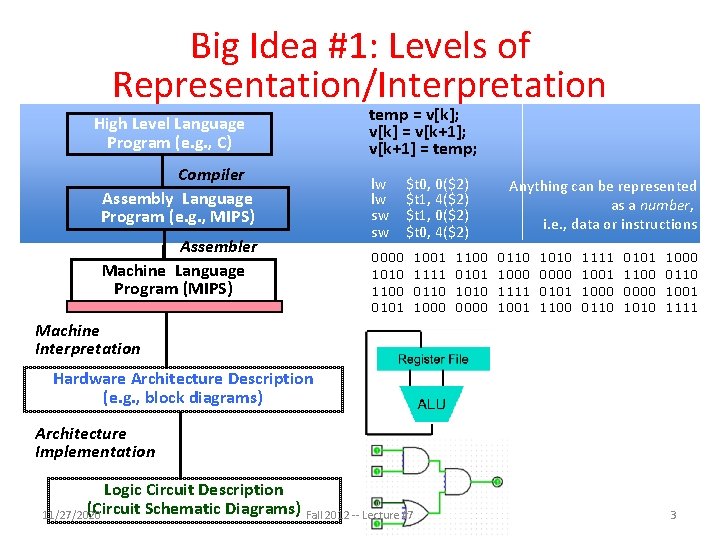
Big Idea #1: Levels of Representation/Interpretation High Level Language Program (e. g. , C) Compiler Assembly Language Program (e. g. , MIPS) Assembler Machine Language Program (MIPS) temp = v[k]; v[k] = v[k+1]; v[k+1] = temp; lw lw sw sw 0000 1010 1100 0101 $t 0, 0($2) $t 1, 4($2) $t 1, 0($2) $t 0, 4($2) 1001 1111 0110 1000 1100 0101 1010 0000 Anything can be represented as a number, i. e. , data or instructions 0110 1000 1111 1001 1010 0000 0101 1100 1111 1000 0110 0101 1100 0000 1010 1000 0110 1001 1111 Machine Interpretation Hardware Architecture Description (e. g. , block diagrams) Architecture Implementation Logic Circuit Description (Circuit Schematic Diagrams) Fall 2012 -- Lecture #7 11/27/2020 3
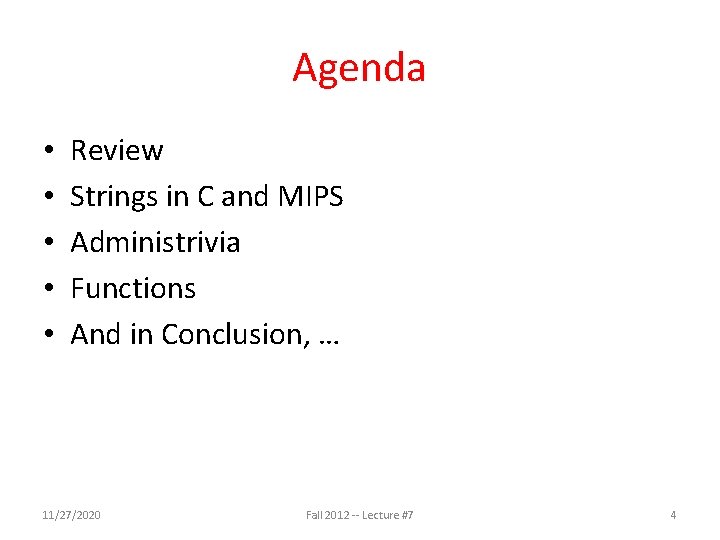
Agenda • • • Review Strings in C and MIPS Administrivia Functions And in Conclusion, … 11/27/2020 Fall 2012 -- Lecture #7 4
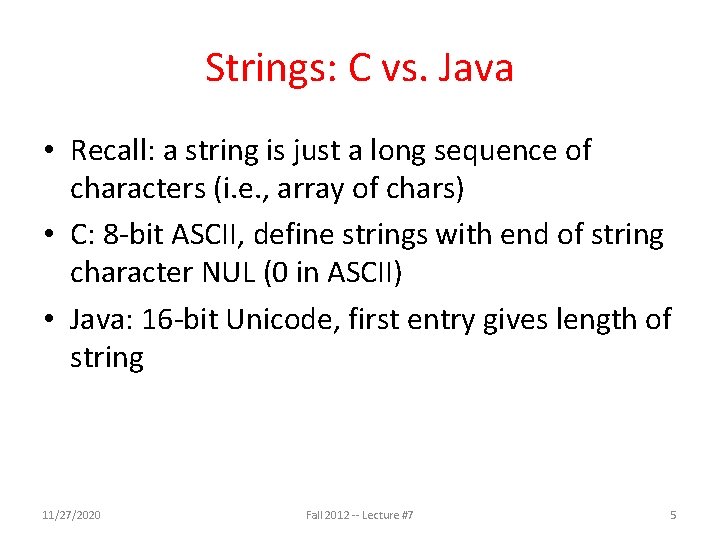
Strings: C vs. Java • Recall: a string is just a long sequence of characters (i. e. , array of chars) • C: 8 -bit ASCII, define strings with end of string character NUL (0 in ASCII) • Java: 16 -bit Unicode, first entry gives length of string 11/27/2020 Fall 2012 -- Lecture #7 5
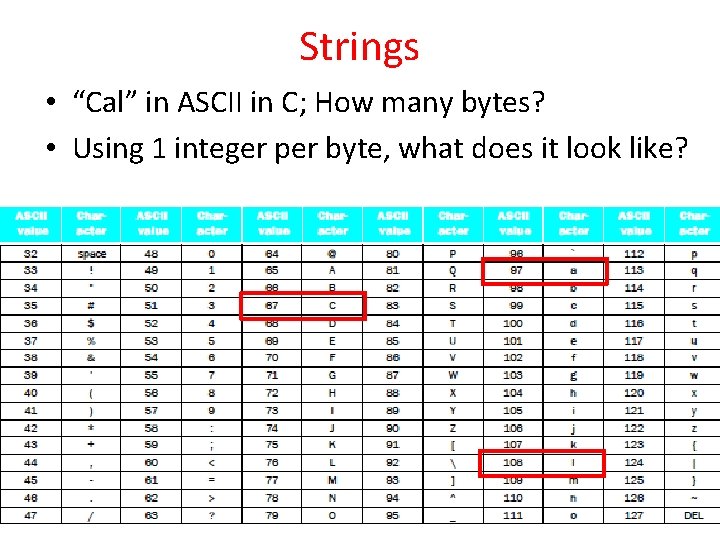
Strings • “Cal” in ASCII in C; How many bytes? • Using 1 integer per byte, what does it look like? 11/27/2020 Fall 2011 -- Lecture #7 6
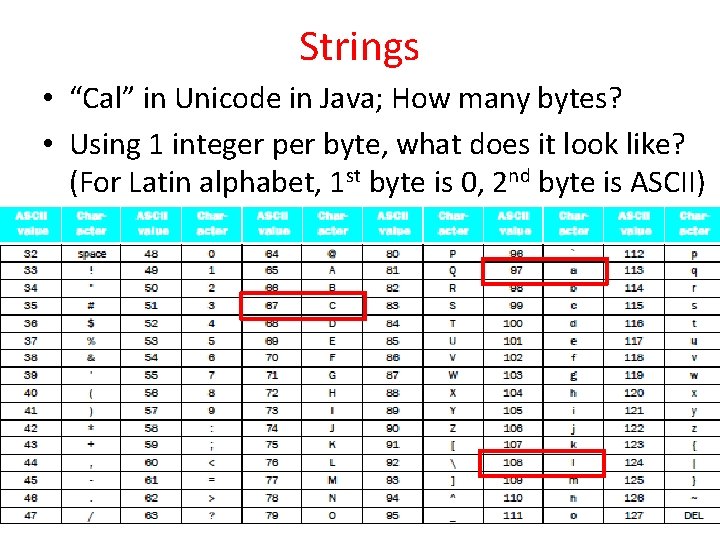
Strings • “Cal” in Unicode in Java; How many bytes? • Using 1 integer per byte, what does it look like? (For Latin alphabet, 1 st byte is 0, 2 nd byte is ASCII) 11/27/2020 Fall 2011 -- Lecture #7 7
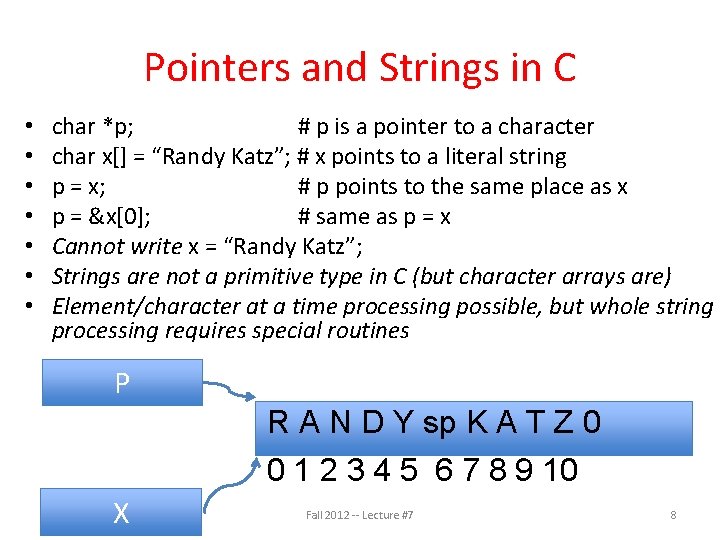
Pointers and Strings in C • • char *p; # p is a pointer to a character char x[] = “Randy Katz”; # x points to a literal string p = x; # p points to the same place as x p = &x[0]; # same as p = x Cannot write x = “Randy Katz”; Strings are not a primitive type in C (but character arrays are) Element/character at a time processing possible, but whole string processing requires special routines P R A N D Y sp K A T Z 0 0 1 2 3 4 5 6 7 8 9 10 11/27/2020 X Fall 2012 -- Lecture #7 8
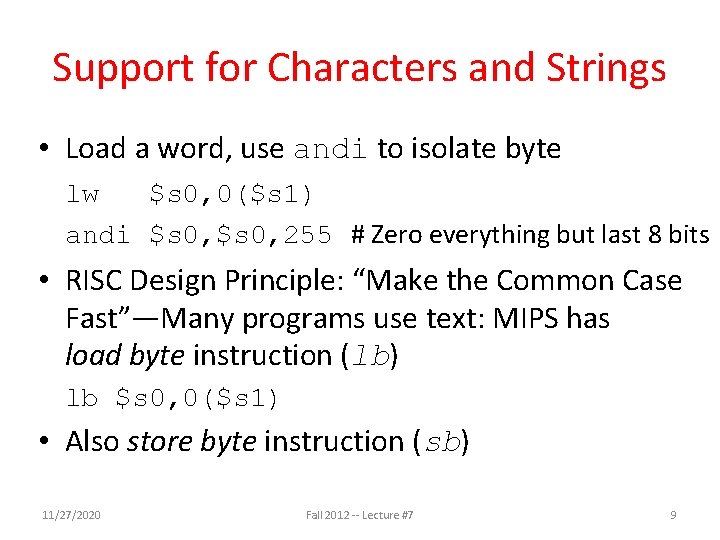
Support for Characters and Strings • Load a word, use andi to isolate byte lw $s 0, 0($s 1) andi $s 0, 255 # Zero everything but last 8 bits • RISC Design Principle: “Make the Common Case Fast”—Many programs use text: MIPS has load byte instruction (lb) lb $s 0, 0($s 1) • Also store byte instruction (sb) 11/27/2020 Fall 2012 -- Lecture #7 9
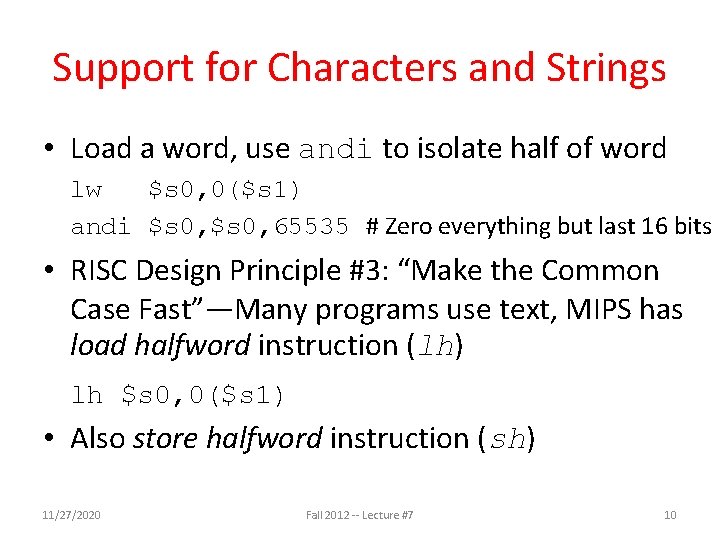
Support for Characters and Strings • Load a word, use andi to isolate half of word lw $s 0, 0($s 1) andi $s 0, 65535 # Zero everything but last 16 bits • RISC Design Principle #3: “Make the Common Case Fast”—Many programs use text, MIPS has load halfword instruction (lh) lh $s 0, 0($s 1) • Also store halfword instruction (sh) 11/27/2020 Fall 2012 -- Lecture #7 10
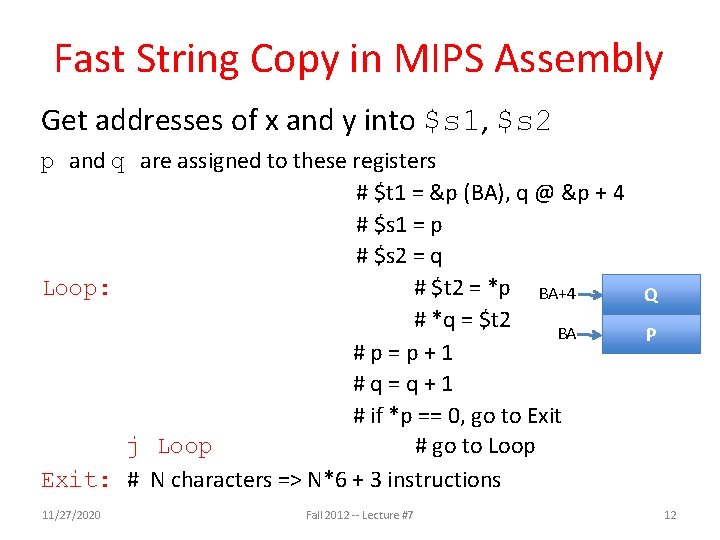
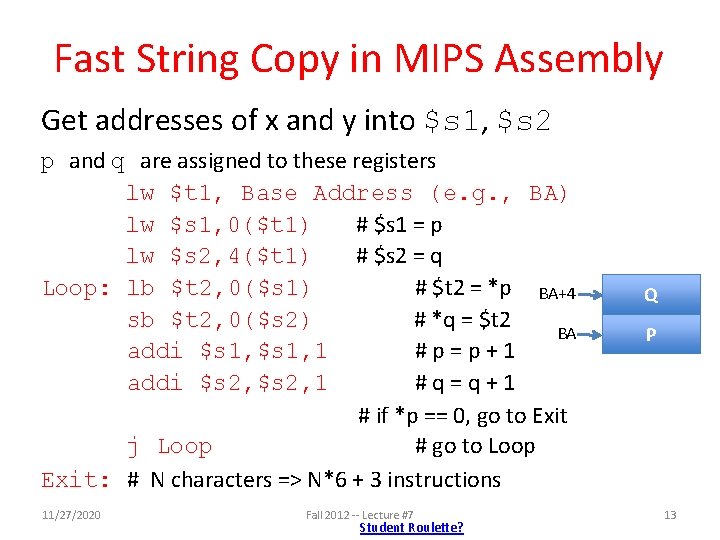
Fast String Copy Code in C • Copy x[] to y[] char *p, *q; p = &x[0]; /* p = x */ /* set p to address of 1 st char of x */ q = &y[0]; /* q = y also OK */ /* set q to address of 1 st char of y */ while((*q++ = *p++) != ‘’) ; 11/27/2020 Fall 2012 -- Lecture #7 11
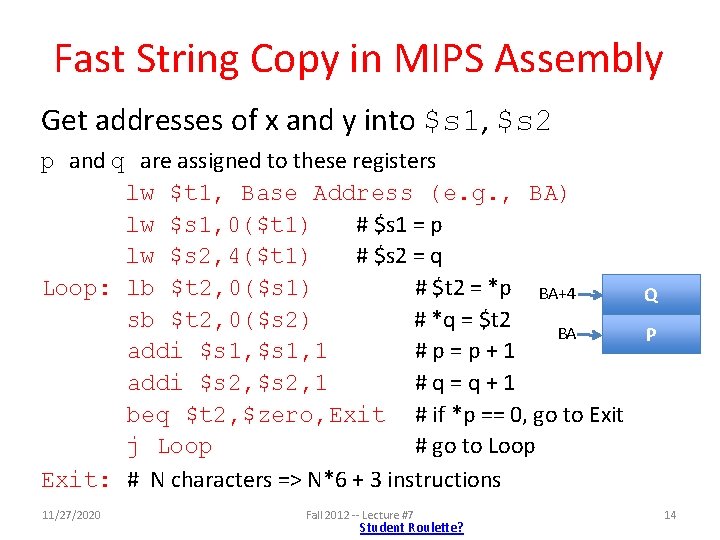
Fast String Copy in MIPS Assembly Get addresses of x and y into $s 1, $s 2 p and q are assigned to these registers # $t 1 = &p (BA), q @ &p + 4 # $s 1 = p # $s 2 = q Loop: # $t 2 = *p BA+4 Q # *q = $t 2 BA P #p=p+1 #q=q+1 # if *p == 0, go to Exit j Loop # go to Loop Exit: # N characters => N*6 + 3 instructions 11/27/2020 Fall 2012 -- Lecture #7 12
Fast String Copy in MIPS Assembly Get addresses of x and y into $s 1, $s 2 p and q are assigned to these registers lw $t 1, Base Address (e. g. , BA) lw $s 1, 0($t 1) # $s 1 = p lw $s 2, 4($t 1) # $s 2 = q Loop: lb $t 2, 0($s 1) # $t 2 = *p BA+4 sb $t 2, 0($s 2) # *q = $t 2 BA addi $s 1, 1 #p=p+1 addi $s 2, 1 #q=q+1 # if *p == 0, go to Exit j Loop # go to Loop Exit: # N characters => N*6 + 3 instructions 11/27/2020 Fall 2012 -- Lecture #7 Student Roulette? Q P 13
Fast String Copy in MIPS Assembly Get addresses of x and y into $s 1, $s 2 p and q are assigned to these registers lw $t 1, Base Address (e. g. , BA) lw $s 1, 0($t 1) # $s 1 = p lw $s 2, 4($t 1) # $s 2 = q Loop: lb $t 2, 0($s 1) # $t 2 = *p BA+4 Q sb $t 2, 0($s 2) # *q = $t 2 BA P addi $s 1, 1 #p=p+1 addi $s 2, 1 #q=q+1 beq $t 2, $zero, Exit # if *p == 0, go to Exit j Loop # go to Loop Exit: # N characters => N*6 + 3 instructions 11/27/2020 Fall 2012 -- Lecture #7 Student Roulette? 14
Which statement is TRUE? char *p, *q; p = &x[0]; q = &y[0]; while((*q++ = *p++) != ‘’) ; ☐ $t 1 corresponds to p ☐ $s 1 corresponds to q ☐ $s 1 corresponds to *p lw $t 1, Base Address lw $s 1, 0($t 1) lw $s 2, 4($t 1) Loop: lb $t 2, 0($s 1) # sb $t 2, 0($s 2) addi $s 1, 1 # addi $s 2, 1 # beq $t 2, $zero, Exit # j Loop # Exit: 15
Agenda • • • Review Strings in C and MIPS Administrivia Functions And in Conclusion, … 11/27/2020 Fall 2012 -- Lecture #7 16
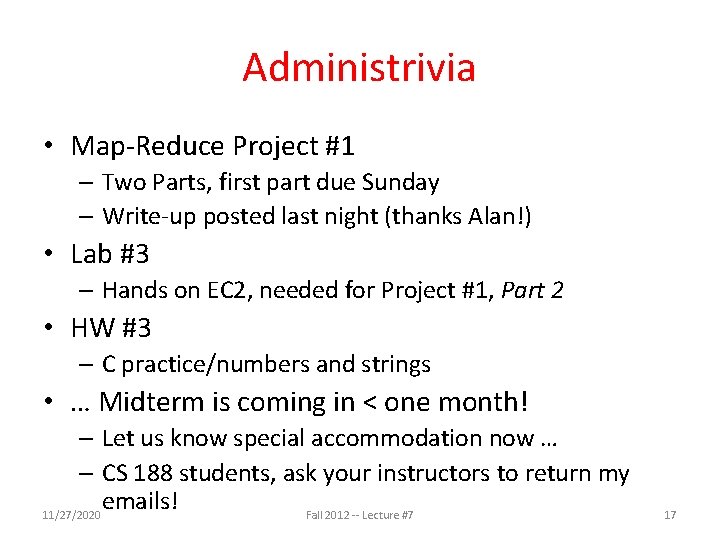
Administrivia • Map-Reduce Project #1 – Two Parts, first part due Sunday – Write-up posted last night (thanks Alan!) • Lab #3 – Hands on EC 2, needed for Project #1, Part 2 • HW #3 – C practice/numbers and strings • … Midterm is coming in < one month! – Let us know special accommodation now … – CS 188 students, ask your instructors to return my emails! 11/27/2020 Fall 2012 -- Lecture #7 17
Agenda • • • Review Strings in C and MIPS Administrivia Functions And in Conclusion, … 11/27/2020 Fall 2012 -- Lecture #7 18
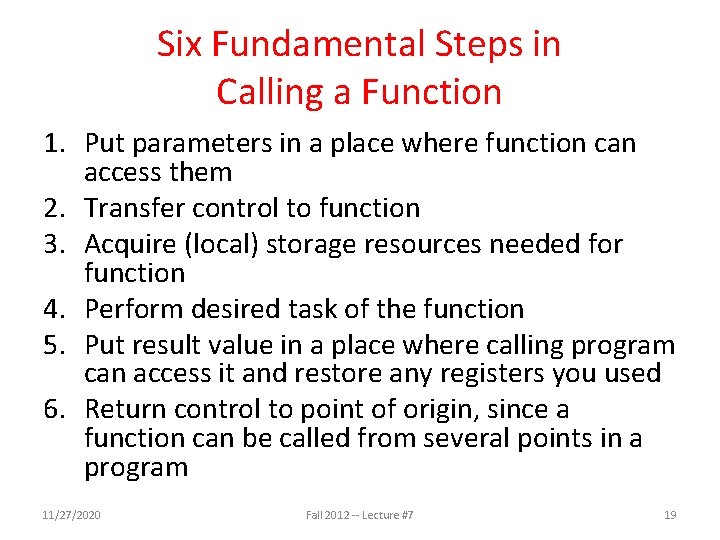
Six Fundamental Steps in Calling a Function 1. Put parameters in a place where function can access them 2. Transfer control to function 3. Acquire (local) storage resources needed for function 4. Perform desired task of the function 5. Put result value in a place where calling program can access it and restore any registers you used 6. Return control to point of origin, since a function can be called from several points in a program 11/27/2020 Fall 2012 -- Lecture #7 19
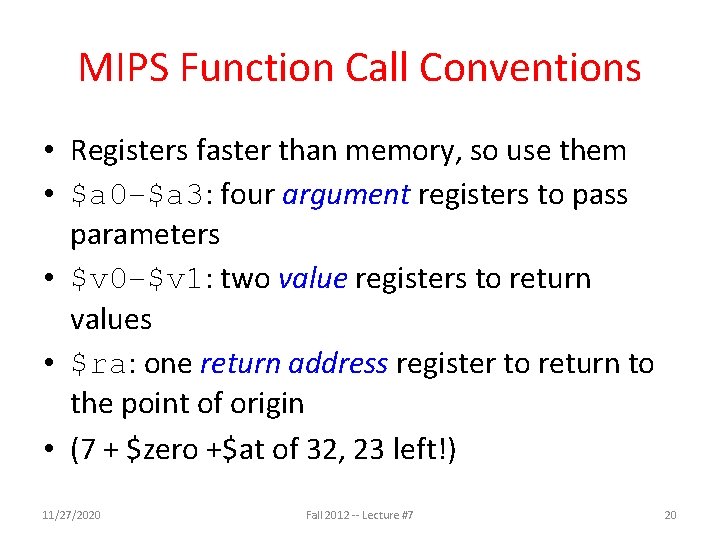
MIPS Function Call Conventions • Registers faster than memory, so use them • $a 0–$a 3: four argument registers to pass parameters • $v 0–$v 1: two value registers to return values • $ra: one return address register to return to the point of origin • (7 + $zero +$at of 32, 23 left!) 11/27/2020 Fall 2012 -- Lecture #7 20
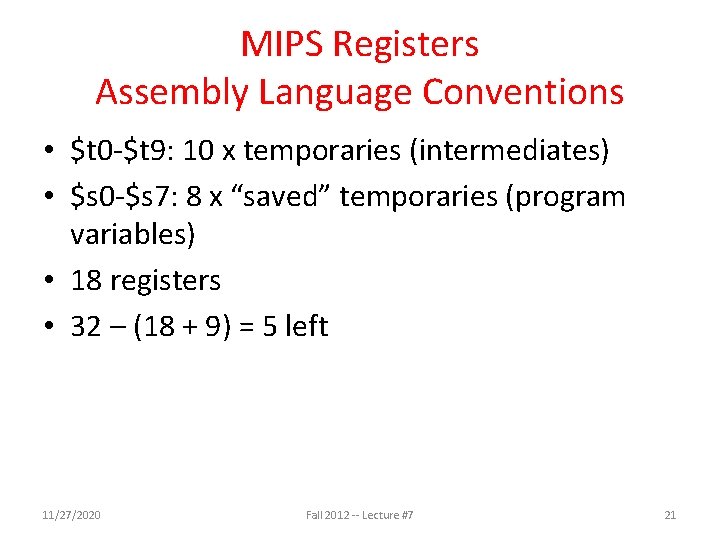
MIPS Registers Assembly Language Conventions • $t 0 -$t 9: 10 x temporaries (intermediates) • $s 0 -$s 7: 8 x “saved” temporaries (program variables) • 18 registers • 32 – (18 + 9) = 5 left 11/27/2020 Fall 2012 -- Lecture #7 21
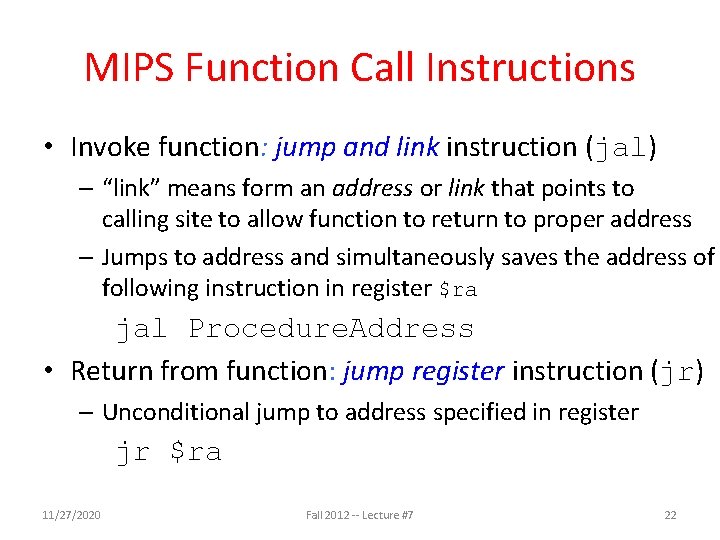
MIPS Function Call Instructions • Invoke function: jump and link instruction (jal) – “link” means form an address or link that points to calling site to allow function to return to proper address – Jumps to address and simultaneously saves the address of following instruction in register $ra jal Procedure. Address • Return from function: jump register instruction (jr) – Unconditional jump to address specified in register jr $ra 11/27/2020 Fall 2012 -- Lecture #7 22
Notes on Functions • Calling program (caller) puts parameters into registers $a 0 -$a 3 and uses jal X to invoke X (callee) • Must have register in computer with address of currently executing instruction – Instead of Instruction Address Register (better name), historically called Program Counter (PC) – It’s a program’s counter; it doesn’t count programs! • jr $ra puts address inside $ra into PC • What value does jal X place into $ra? ? ? 11/27/2020 Fall 2012 -- Lecture #7 Student Roulette? 23
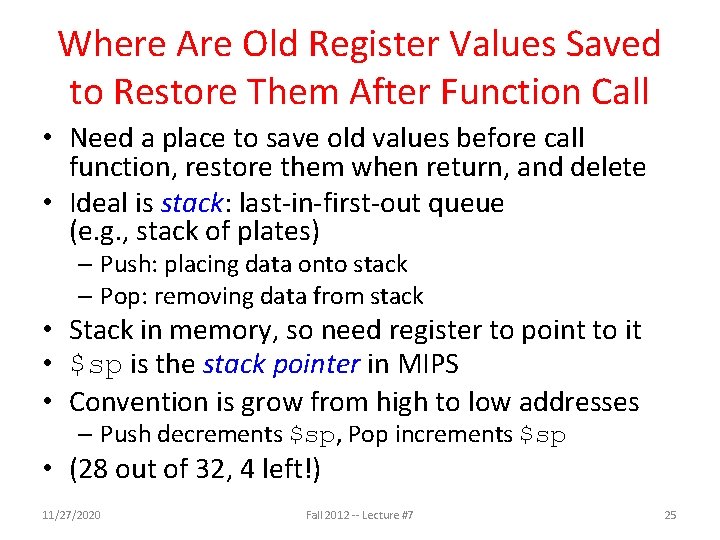
Where Are Old Register Values Saved to Restore Them After Function Call • Need a place to save old values before call function, restore them when return, and delete • Ideal is stack: last-in-first-out queue (e. g. , stack of plates) – Push: placing data onto stack – Pop: removing data from stack • Stack in memory, so need register to point to it • $sp is the stack pointer in MIPS • Convention is grow from high to low addresses – Push decrements $sp, Pop increments $sp • (28 out of 32, 4 left!) 11/27/2020 Fall 2012 -- Lecture #7 25
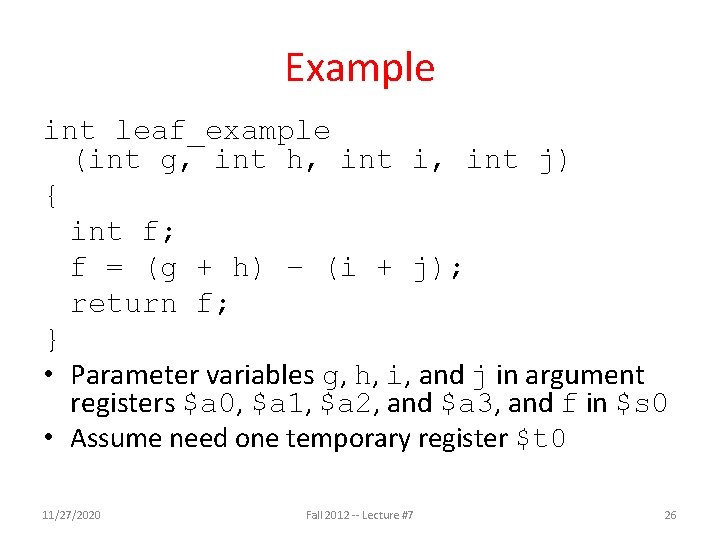
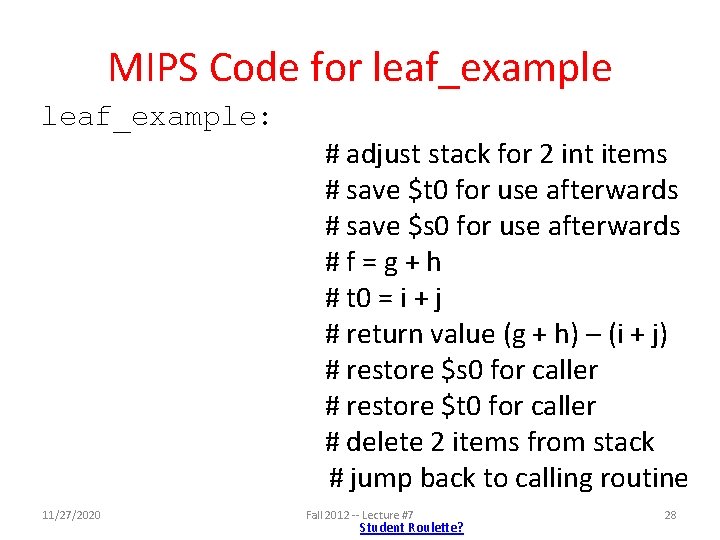
Example int leaf_example (int g, int h, int i, int j) { int f; f = (g + h) – (i + j); return f; } • Parameter variables g, h, i, and j in argument registers $a 0, $a 1, $a 2, and $a 3, and f in $s 0 • Assume need one temporary register $t 0 11/27/2020 Fall 2012 -- Lecture #7 26
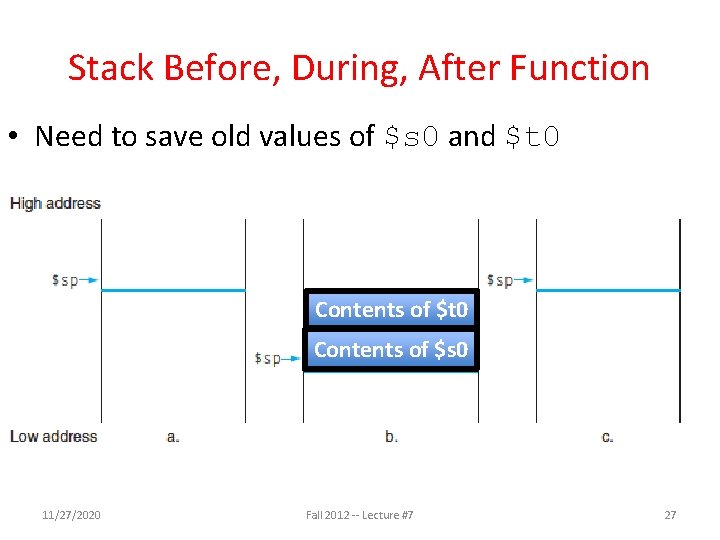
Stack Before, During, After Function • Need to save old values of $s 0 and $t 0 Contents of $s 0 11/27/2020 Fall 2012 -- Lecture #7 27
MIPS Code for leaf_example: 11/27/2020 # adjust stack for 2 int items # save $t 0 for use afterwards # save $s 0 for use afterwards #f=g+h # t 0 = i + j # return value (g + h) – (i + j) # restore $s 0 for caller # restore $t 0 for caller # delete 2 items from stack # jump back to calling routine Fall 2012 -- Lecture #7 Student Roulette? 28
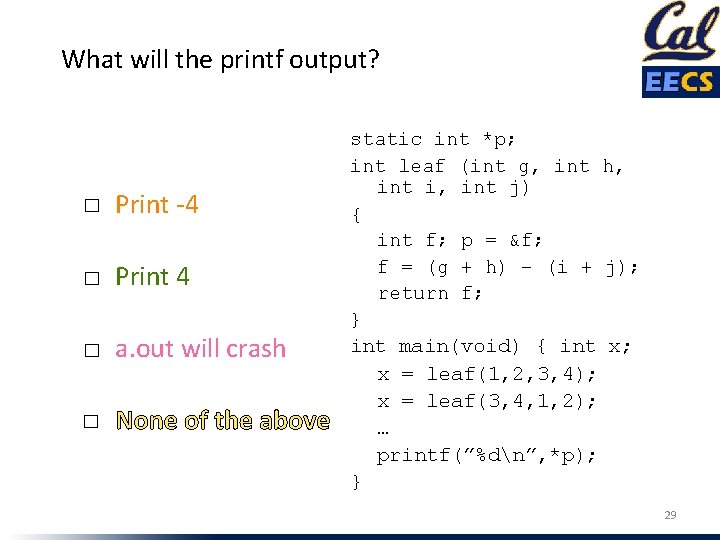
What will the printf output? ☐ Print -4 ☐ Print 4 ☐ a. out will crash ☐ None of the above static int *p; int leaf (int g, int h, int i, int j) { int f; p = &f; f = (g + h) – (i + j); return f; } int main(void) { int x; x = leaf(1, 2, 3, 4); x = leaf(3, 4, 1, 2); … printf(”%dn”, *p); } 29
What If a Function Calls a Function? Recursive Function Calls? • Would clobber values in $a 0 to $a 3 and $ra • What is the solution? 11/27/2020 Fall 2012 -- Lecture #7 Student Roulette? 30
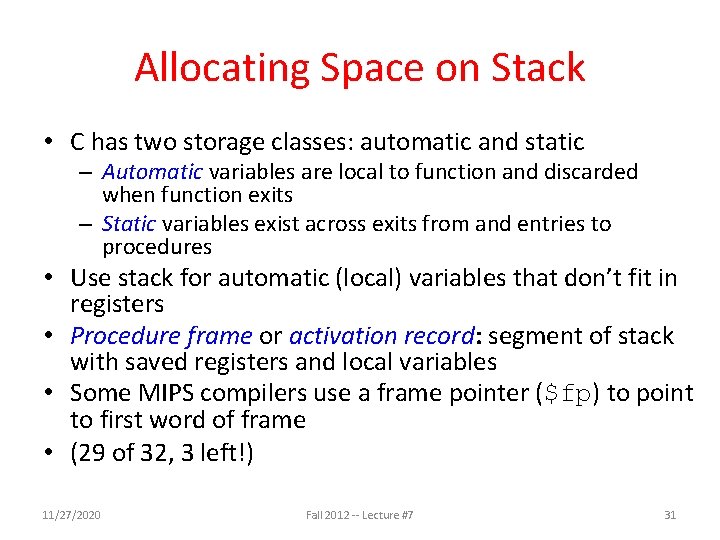
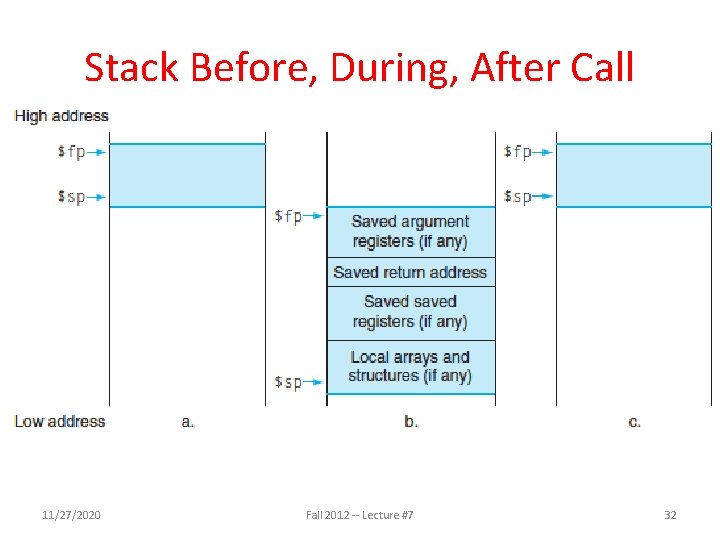
Allocating Space on Stack • C has two storage classes: automatic and static – Automatic variables are local to function and discarded when function exits – Static variables exist across exits from and entries to procedures • Use stack for automatic (local) variables that don’t fit in registers • Procedure frame or activation record: segment of stack with saved registers and local variables • Some MIPS compilers use a frame pointer ($fp) to point to first word of frame • (29 of 32, 3 left!) 11/27/2020 Fall 2012 -- Lecture #7 31
Stack Before, During, After Call 11/27/2020 Fall 2012 -- Lecture #7 32
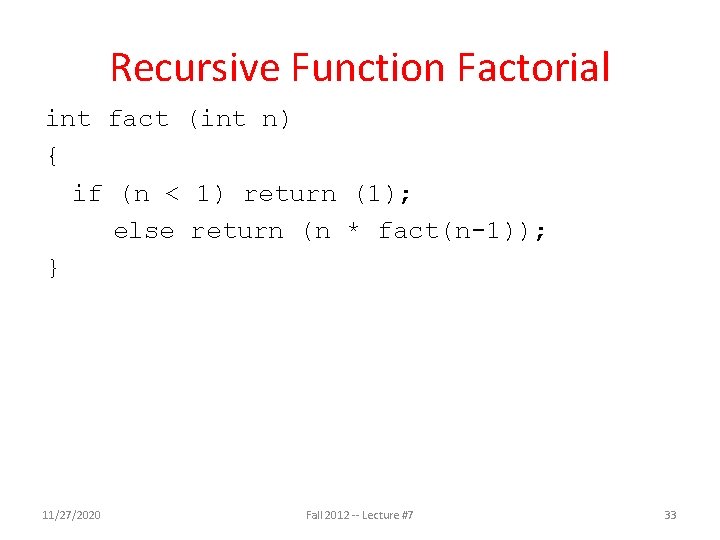
Recursive Function Factorial int fact (int n) { if (n < 1) return (1); else return (n * fact(n-1)); } 11/27/2020 Fall 2012 -- Lecture #7 33
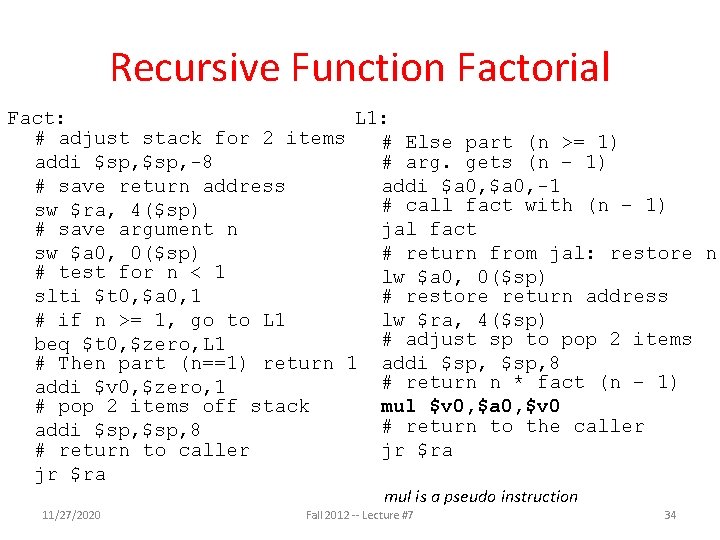
Recursive Function Factorial Fact: L 1: # adjust stack for 2 items # Else part (n >= 1) addi $sp, -8 # arg. gets (n – 1) # save return address addi $a 0, -1 # call fact with (n – 1) sw $ra, 4($sp) # save argument n jal fact sw $a 0, 0($sp) # return from jal: restore n # test for n < 1 lw $a 0, 0($sp) slti $t 0, $a 0, 1 # restore return address # if n >= 1, go to L 1 lw $ra, 4($sp) # adjust sp to pop 2 items beq $t 0, $zero, L 1 # Then part (n==1) return 1 addi $sp, 8 # return n * fact (n – 1) addi $v 0, $zero, 1 # pop 2 items off stack mul $v 0, $a 0, $v 0 # return to the caller addi $sp, 8 # return to caller jr $ra mul is a pseudo instruction 11/27/2020 Fall 2012 -- Lecture #7 34
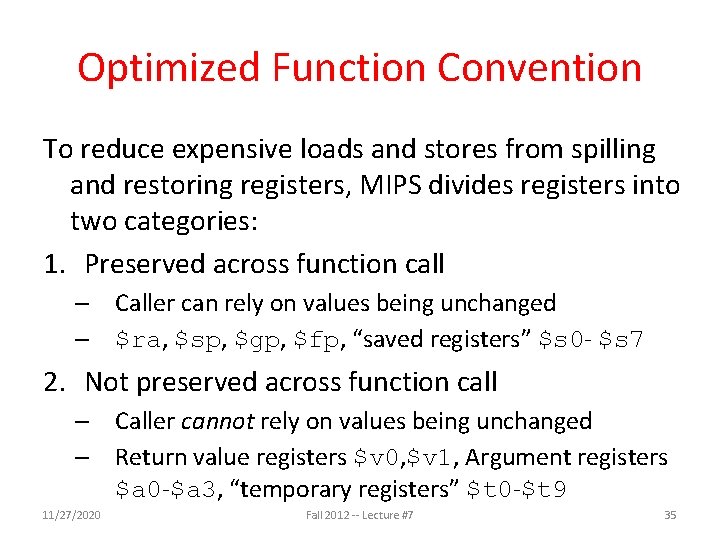
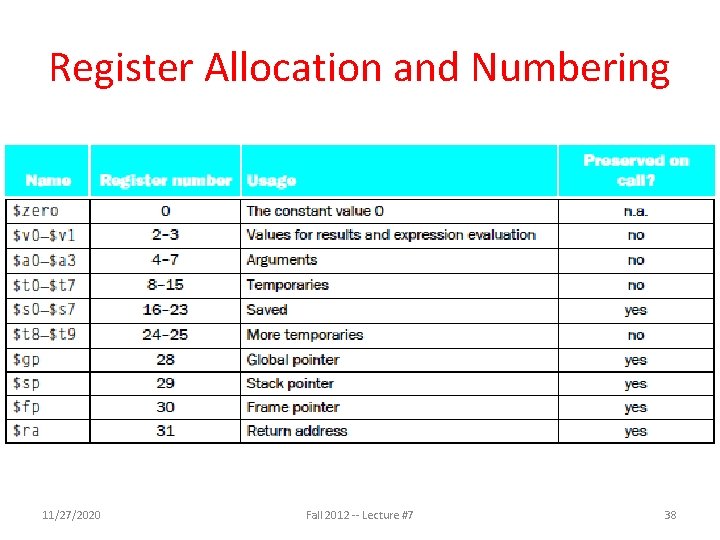
Optimized Function Convention To reduce expensive loads and stores from spilling and restoring registers, MIPS divides registers into two categories: 1. Preserved across function call – Caller can rely on values being unchanged – $ra, $sp, $gp, $fp, “saved registers” $s 0 - $s 7 2. Not preserved across function call – Caller cannot rely on values being unchanged – Return value registers $v 0, $v 1, Argument registers $a 0 -$a 3, “temporary registers” $t 0 -$t 9 11/27/2020 Fall 2012 -- Lecture #7 35
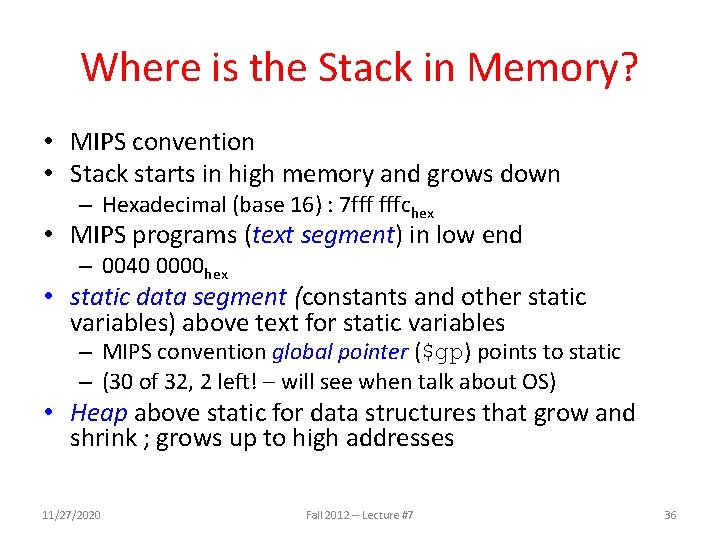
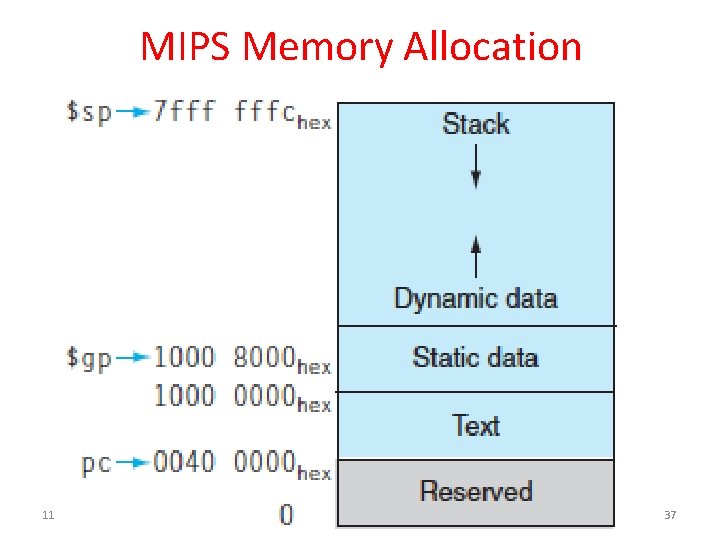
Where is the Stack in Memory? • MIPS convention • Stack starts in high memory and grows down – Hexadecimal (base 16) : 7 fff fffchex • MIPS programs (text segment) in low end – 0040 0000 hex • static data segment (constants and other static variables) above text for static variables – MIPS convention global pointer ($gp) points to static – (30 of 32, 2 left! – will see when talk about OS) • Heap above static for data structures that grow and shrink ; grows up to high addresses 11/27/2020 Fall 2012 -- Lecture #7 36
MIPS Memory Allocation 11/27/2020 Fall 2012 -- Lecture #7 37
Register Allocation and Numbering 11/27/2020 Fall 2012 -- Lecture #7 38
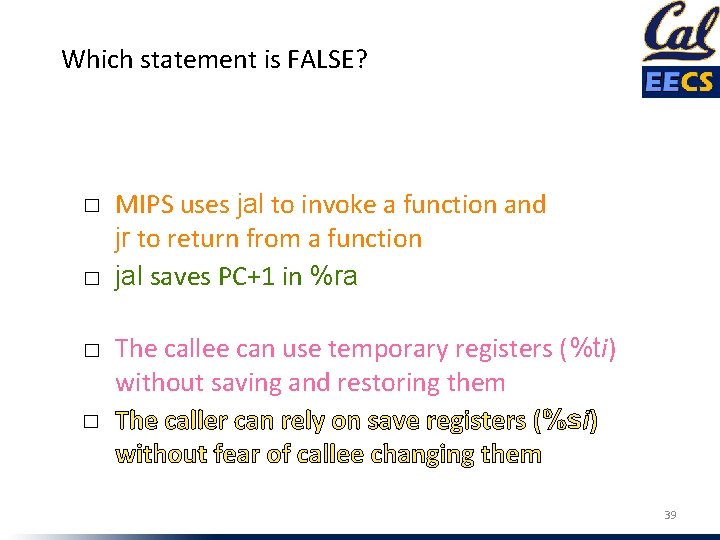
Which statement is FALSE? ☐ ☐ MIPS uses jal to invoke a function and jr to return from a function jal saves PC+1 in %ra The callee can use temporary registers (%ti) without saving and restoring them The caller can rely on save registers (%si) without fear of callee changing them 39
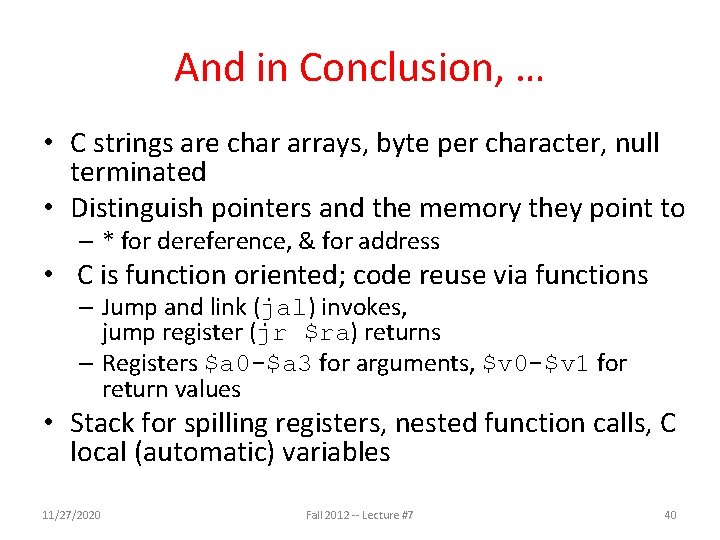
And in Conclusion, … • C strings are char arrays, byte per character, null terminated • Distinguish pointers and the memory they point to – * for dereference, & for address • C is function oriented; code reuse via functions – Jump and link (jal) invokes, jump register (jr $ra) returns – Registers $a 0 -$a 3 for arguments, $v 0 -$v 1 for return values • Stack for spilling registers, nested function calls, C local (automatic) variables 11/27/2020 Fall 2012 -- Lecture #7 40