
CS 5810 Formal Methods in Software Engineering Alloy
![Parametric Modules Example module graph[node] // 1 signature param open util/relation as rel pred](https://slidetodoc.com/presentation_image_h2/a923b09ba689240893cb0afb1518a974/image-15.jpg "Parametric Modules Example module graph[node] // 1 signature param open util/relation as rel pred")
![The Module Ordering module util/ordering[S] private one sig Ord { First, Last: S, Next,](https://slidetodoc.com/presentation_image_h2/a923b09ba689240893cb0afb1518a974/image-17.jpg "The Module Ordering module util/ordering[S] private one sig Ord { First, Last: S, Next,")
- Slides: 24
CS: 5810 Formal Methods in Software Engineering Alloy Modules Copyright 2007 -17, Laurence Pilard, and Cesare Tinelli. These notes are copyrighted materials and may not be used in other course settings outside of the University of Iowa in their current form or modified form without the express written permission of one of the copyright holders. During this course, students are prohibited from selling notes to or being paid for taking notes by any person or commercial firm without the express written permission of one of the copyright holders.
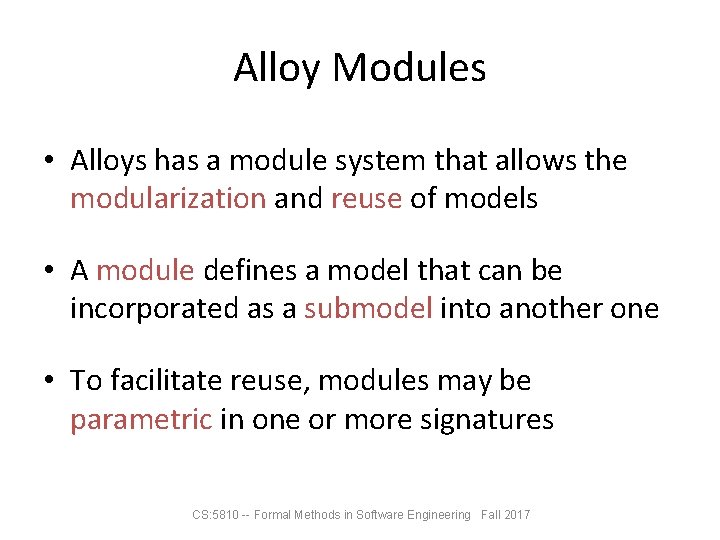
Alloy Modules • Alloys has a module system that allows the modularization and reuse of models • A module defines a model that can be incorporated as a submodel into another one • To facilitate reuse, modules may be parametric in one or more signatures CS: 5810 -- Formal Methods in Software Engineering Fall 2017
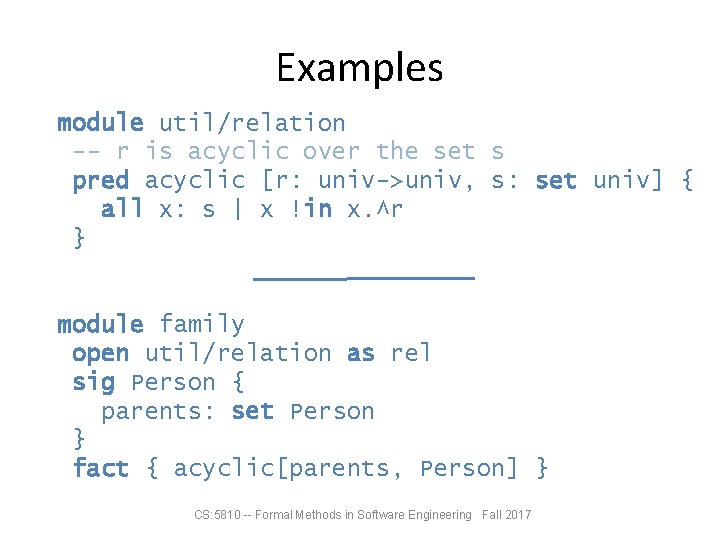
Examples module util/relation -- r is acyclic over the set s pred acyclic [r: univ->univ, s: set univ] { all x: s | x !in x. ^r } module family open util/relation as rel sig Person { parents: set Person } fact { acyclic[parents, Person] } CS: 5810 -- Formal Methods in Software Engineering Fall 2017
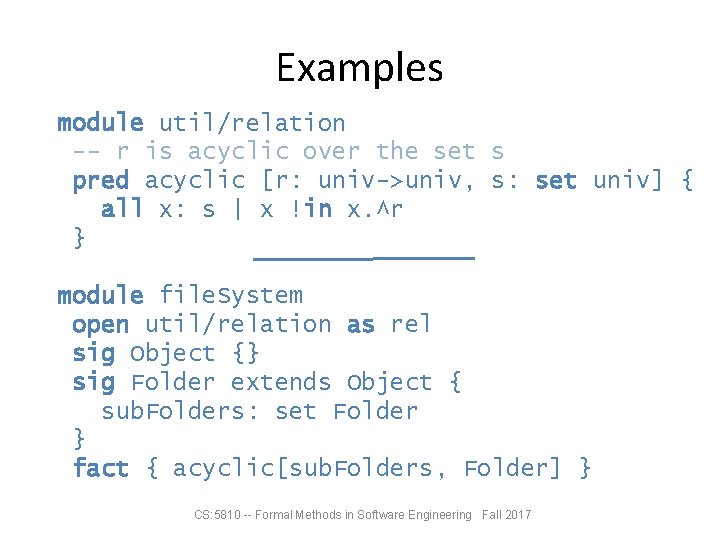
Examples module util/relation -- r is acyclic over the set s pred acyclic [r: univ->univ, s: set univ] { all x: s | x !in x. ^r } module file. System open util/relation as rel sig Object {} sig Folder extends Object { sub. Folders: set Folder } fact { acyclic[sub. Folders, Folder] } CS: 5810 -- Formal Methods in Software Engineering Fall 2017
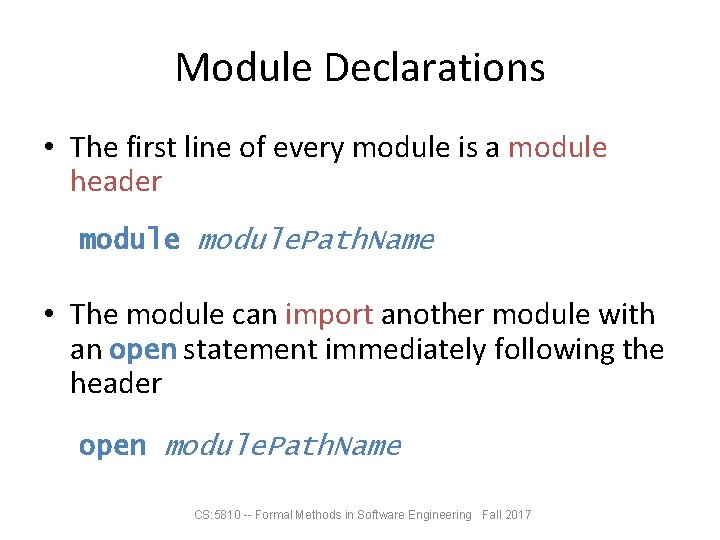
Module Declarations • The first line of every module is a module header module. Path. Name • The module can import another module with an open statement immediately following the header open module. Path. Name CS: 5810 -- Formal Methods in Software Engineering Fall 2017
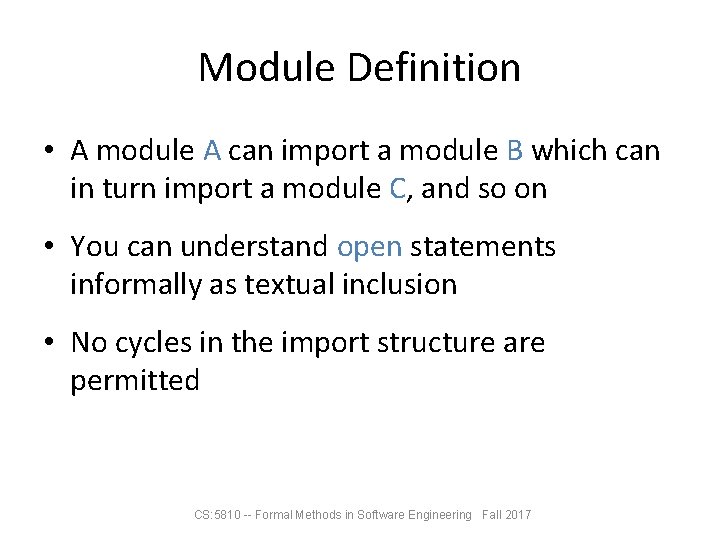
Module Definition • A module A can import a module B which can in turn import a module C, and so on • You can understand open statements informally as textual inclusion • No cycles in the import structure are permitted CS: 5810 -- Formal Methods in Software Engineering Fall 2017
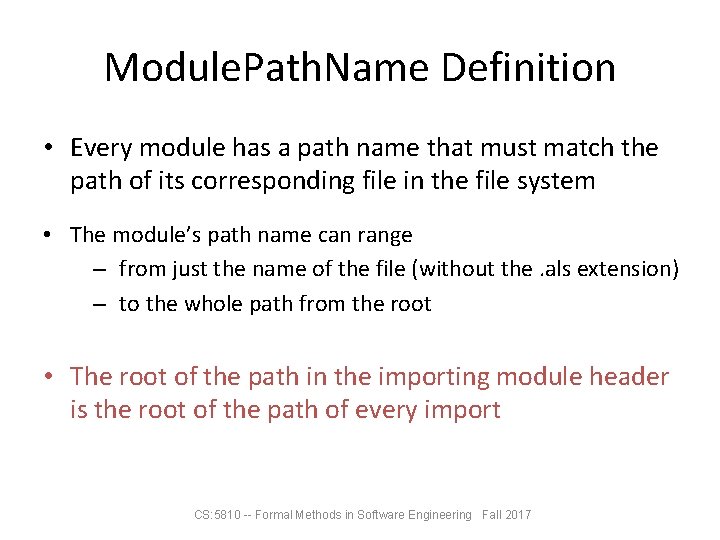
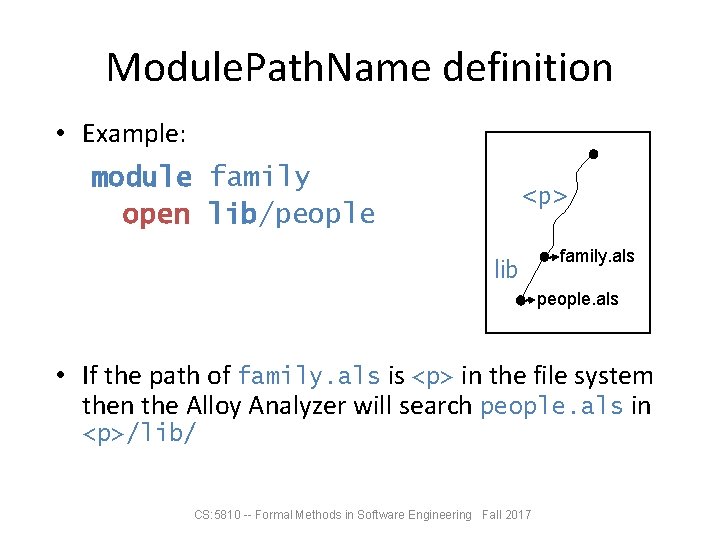
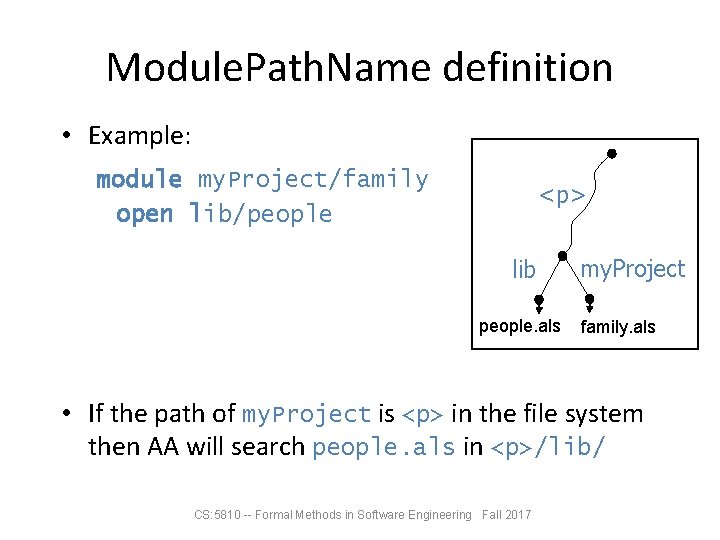
Module. Path. Name Definition • Every module has a path name that must match the path of its corresponding file in the file system • The module’s path name can range – from just the name of the file (without the. als extension) – to the whole path from the root • The root of the path in the importing module header is the root of the path of every import CS: 5810 -- Formal Methods in Software Engineering Fall 2017
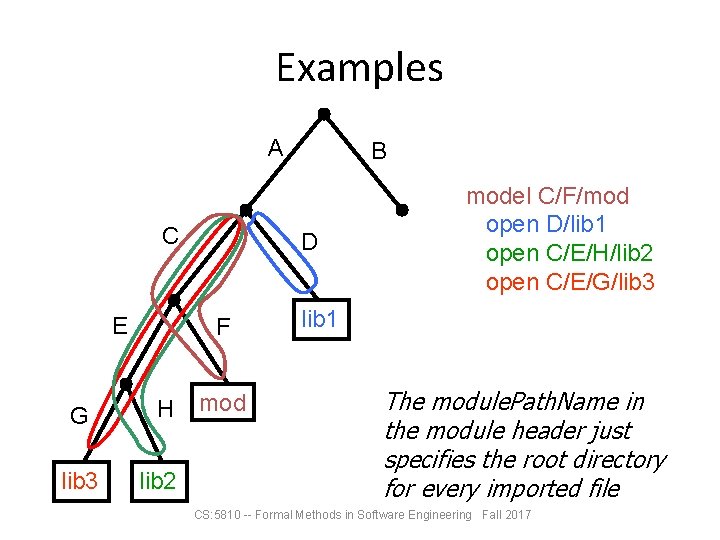
Examples A C E G lib 3 D F H lib 2 B model C/F/mod open D/lib 1 open C/E/H/lib 2 open C/E/G/lib 3 lib 1 The module. Path. Name in the module header just specifies the root directory for every imported file CS: 5810 -- Formal Methods in Software Engineering Fall 2017
Module. Path. Name definition • Example: module family open lib/people <p> lib family. als people. als • If the path of family. als is <p> in the file system then the Alloy Analyzer will search people. als in <p>/lib/ CS: 5810 -- Formal Methods in Software Engineering Fall 2017
Module. Path. Name definition • Example: module my. Project/family open lib/people <p> lib people. als my. Project family. als • If the path of my. Project is <p> in the file system then AA will search people. als in <p>/lib/ CS: 5810 -- Formal Methods in Software Engineering Fall 2017
Predefined Modules • Alloy 4 comes with a library of predefined modules • Any imported module will actually be searched first among those modules – Examples: • book/chapter 2/address. Book 1 a • util/relation • examples/puzzles/farmer • Failing that, the rules in the previous slides apply CS: 5810 -- Formal Methods in Software Engineering Fall 2017
As • When the path name of an import includes / (i. e. it is not just the name of a file but also a path) • Then you may give a shorter name to the module with as open util/relation as rel CS: 5810 -- Formal Methods in Software Engineering Fall 2017
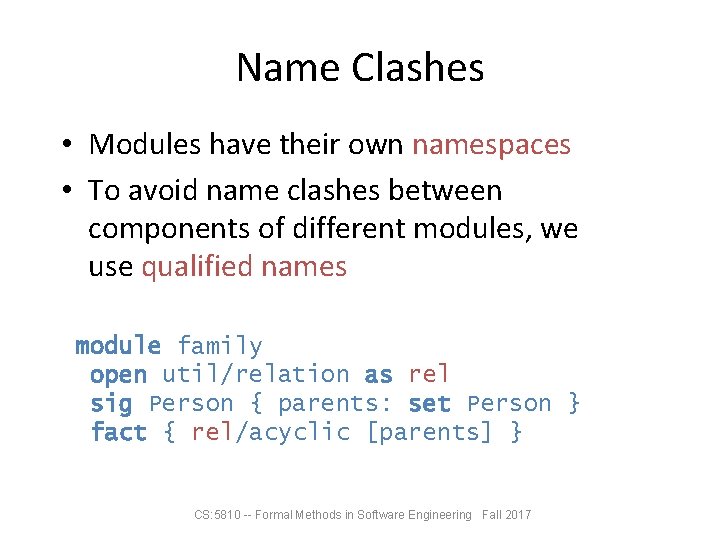
Name Clashes • Modules have their own namespaces • To avoid name clashes between components of different modules, we use qualified names module family open util/relation as rel sig Person { parents: set Person } fact { rel/acyclic [parents] } CS: 5810 -- Formal Methods in Software Engineering Fall 2017
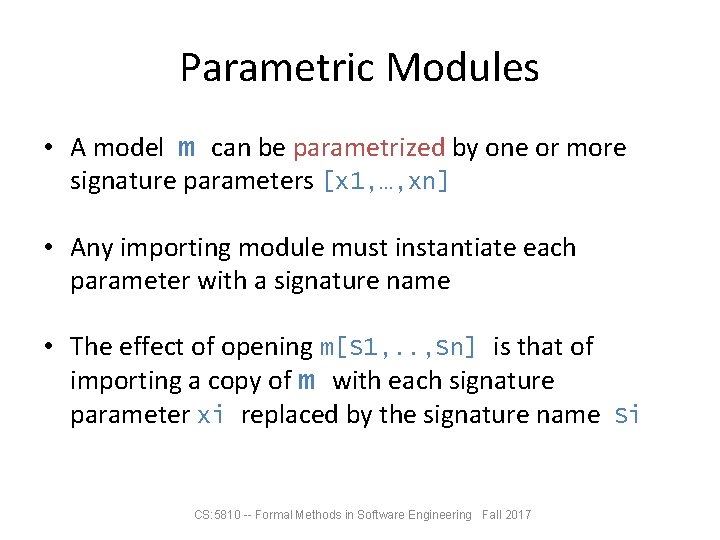
Parametric Modules • A model m can be parametrized by one or more signature parameters [x 1, …, xn] • Any importing module must instantiate each parameter with a signature name • The effect of opening m[S 1, . . , Sn] is that of importing a copy of m with each signature parameter xi replaced by the signature name Si CS: 5810 -- Formal Methods in Software Engineering Fall 2017
Parametric Modules Example module graph[node] // 1 signature param open util/relation as rel pred dag[r: node -> node] { rel/acyclic[r, node] } module family open util/graph[Person] as g sig Person { parents: set Person } fact { dag[parents] } CS: 5810 -- Formal Methods in Software Engineering Fall 2017
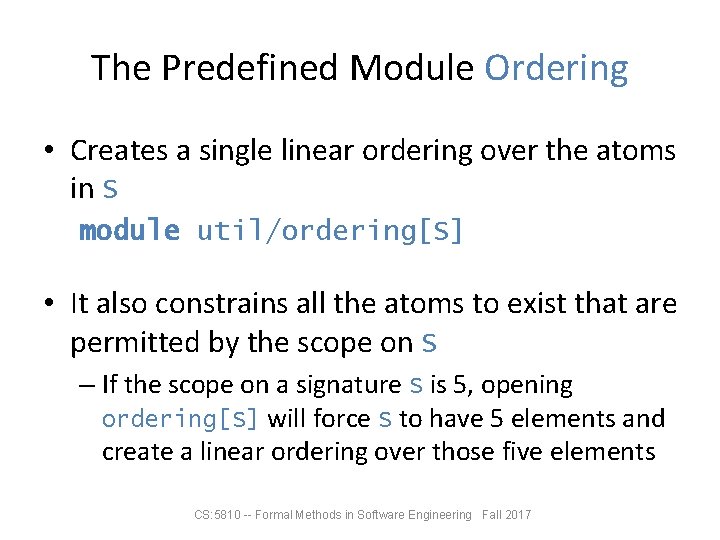
The Predefined Module Ordering • Creates a single linear ordering over the atoms in S module util/ordering[S] • It also constrains all the atoms to exist that are permitted by the scope on S – If the scope on a signature S is 5, opening ordering[S] will force S to have 5 elements and create a linear ordering over those five elements CS: 5810 -- Formal Methods in Software Engineering Fall 2017
The Module Ordering module util/ordering[S] private one sig Ord { First, Last: S, Next, Prev: S -> lone S } fact { // all elements of S are totally ordered S in Ord. First. *Next. . . } CS: 5810 -- Formal Methods in Software Engineering Fall 2017
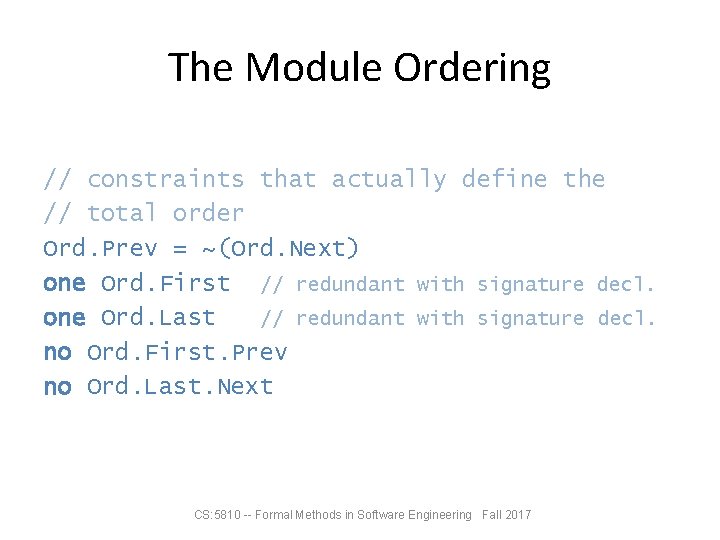
The Module Ordering // constraints that actually define the // total order Ord. Prev = ~(Ord. Next) one Ord. First // redundant with signature decl. one Ord. Last // redundant with signature decl. no Ord. First. Prev no Ord. Last. Next CS: 5810 -- Formal Methods in Software Engineering Fall 2017
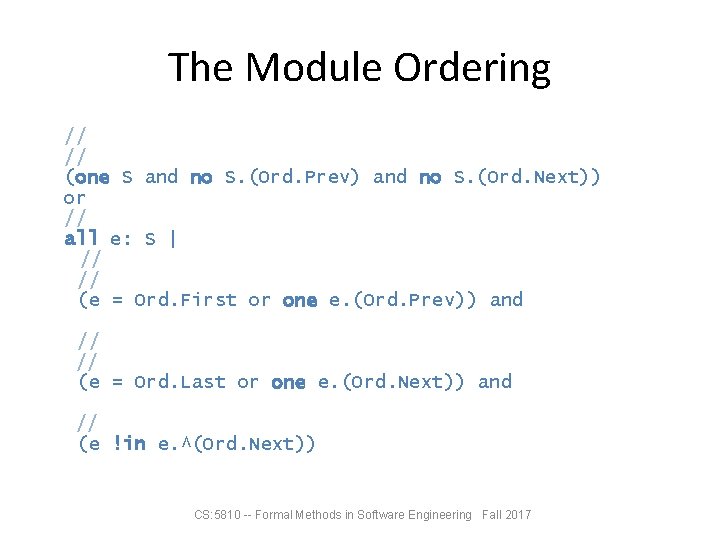
The Module Ordering // // (one S and no S. (Ord. Prev) and no S. (Ord. Next)) or // all e: S | // // (e = Ord. First or one e. (Ord. Prev)) and // // (e = Ord. Last or one e. (Ord. Next)) and // (e !in e. ^(Ord. Next)) CS: 5810 -- Formal Methods in Software Engineering Fall 2017
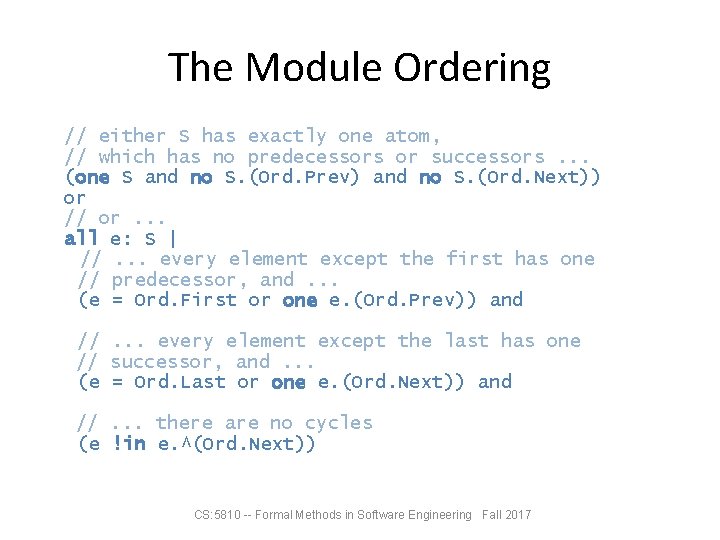
The Module Ordering // either S has exactly one atom, // which has no predecessors or successors. . . (one S and no S. (Ord. Prev) and no S. (Ord. Next)) or // or. . . all e: S | //. . . every element except the first has one // predecessor, and. . . (e = Ord. First or one e. (Ord. Prev)) and //. . . every element except the last has one // successor, and. . . (e = Ord. Last or one e. (Ord. Next)) and //. . . there are no cycles (e !in e. ^(Ord. Next)) CS: 5810 -- Formal Methods in Software Engineering Fall 2017
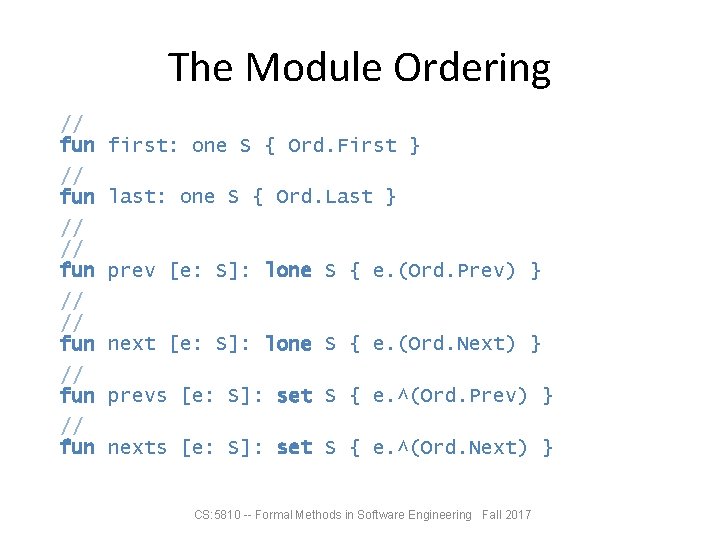
The Module Ordering // fun first: one S { Ord. First } // fun last: one S { Ord. Last } // // fun prev [e: S]: lone S { e. (Ord. Prev) } // // fun next [e: S]: lone S { e. (Ord. Next) } // fun prevs [e: S]: set S { e. ^(Ord. Prev) } // fun nexts [e: S]: set S { e. ^(Ord. Next) } CS: 5810 -- Formal Methods in Software Engineering Fall 2017
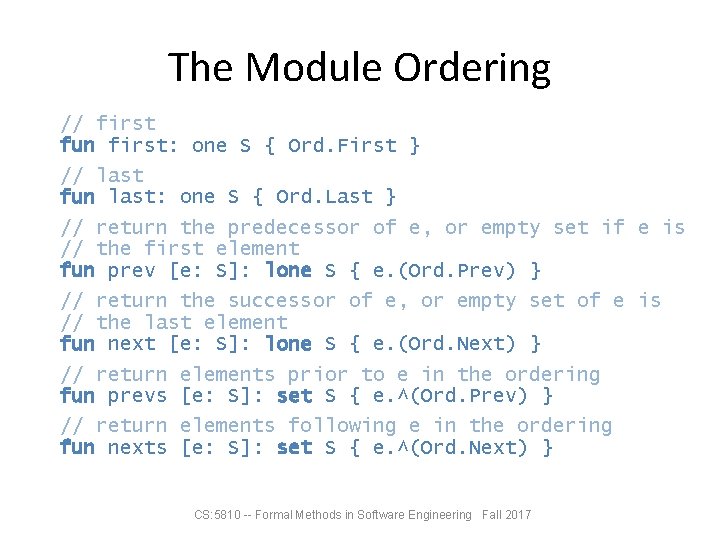
The Module Ordering // first fun first: one S { Ord. First } // last fun last: one S { Ord. Last } // return the predecessor of e, or empty set if e is // the first element fun prev [e: S]: lone S { e. (Ord. Prev) } // return the successor of e, or empty set of e is // the last element fun next [e: S]: lone S { e. (Ord. Next) } // return elements prior to e in the ordering fun prevs [e: S]: set S { e. ^(Ord. Prev) } // return elements following e in the ordering fun nexts [e: S]: set S { e. ^(Ord. Next) } CS: 5810 -- Formal Methods in Software Engineering Fall 2017
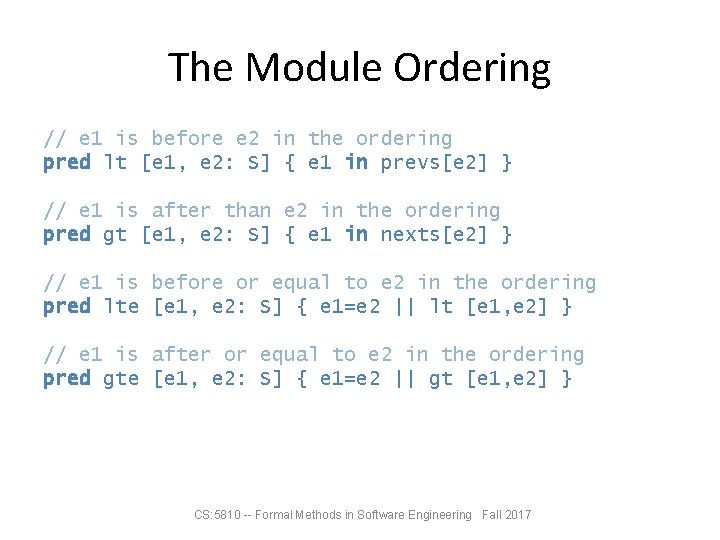
The Module Ordering // e 1 is before e 2 in the ordering pred lt [e 1, e 2: S] { e 1 in prevs[e 2] } // e 1 is after than e 2 in the ordering pred gt [e 1, e 2: S] { e 1 in nexts[e 2] } // e 1 is before or equal to e 2 in the ordering pred lte [e 1, e 2: S] { e 1=e 2 || lt [e 1, e 2] } // e 1 is after or equal to e 2 in the ordering pred gte [e 1, e 2: S] { e 1=e 2 || gt [e 1, e 2] } CS: 5810 -- Formal Methods in Software Engineering Fall 2017
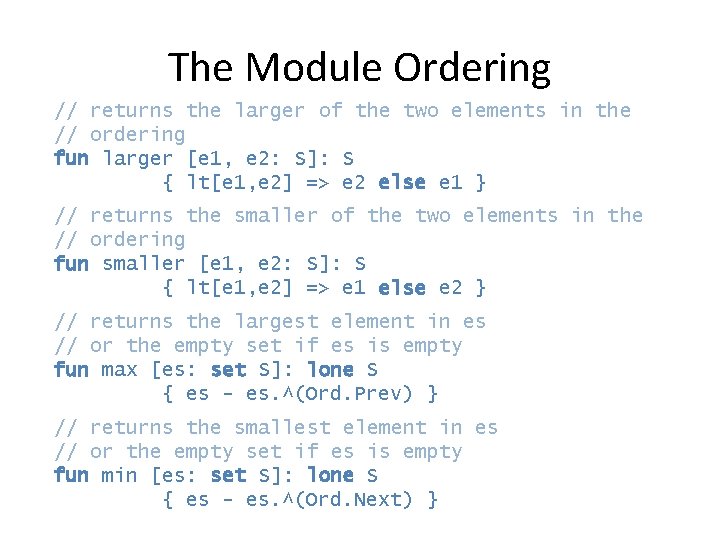
The Module Ordering // returns the larger of the two elements in the // ordering fun larger [e 1, e 2: S]: S { lt[e 1, e 2] => e 2 else e 1 } // returns the smaller of the two elements in the // ordering fun smaller [e 1, e 2: S]: S { lt[e 1, e 2] => e 1 else e 2 } // returns the largest element in es // or the empty set if es is empty fun max [es: set S]: lone S { es - es. ^(Ord. Prev) } // returns the smallest element in es // or the empty set if es is empty fun min [es: set S]: lone S { es - es. ^(Ord. Next) }