
CS 5670 Computer Vision Transformations and warping Reading



- Slides: 39
CS 5670: Computer Vision Transformations and warping
Reading • Szeliski: Chapter 3. 6
Announcements • Project 2 out, due Monday, March 4, by 11: 59 pm on CMSX – Please form teams of 2, and create your team on CMSX – Please declare your group on CMSX by this Wednesday, 2/19 – After Wednesday, we will randomly assign ungrouped students to groups – Feel free to use Piazza to form groups – Project demo last 10 minutes of class
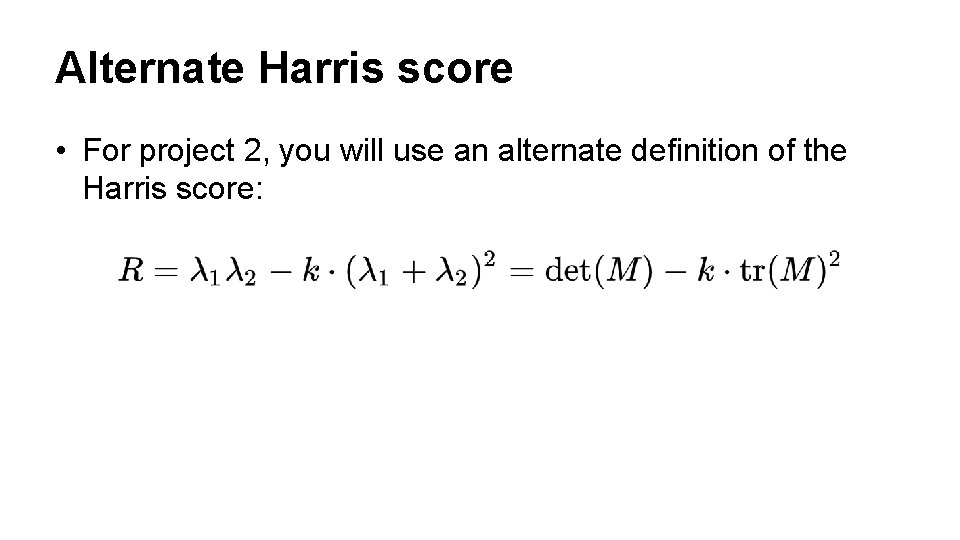
Alternate Harris score • For project 2, you will use an alternate definition of the Harris score:
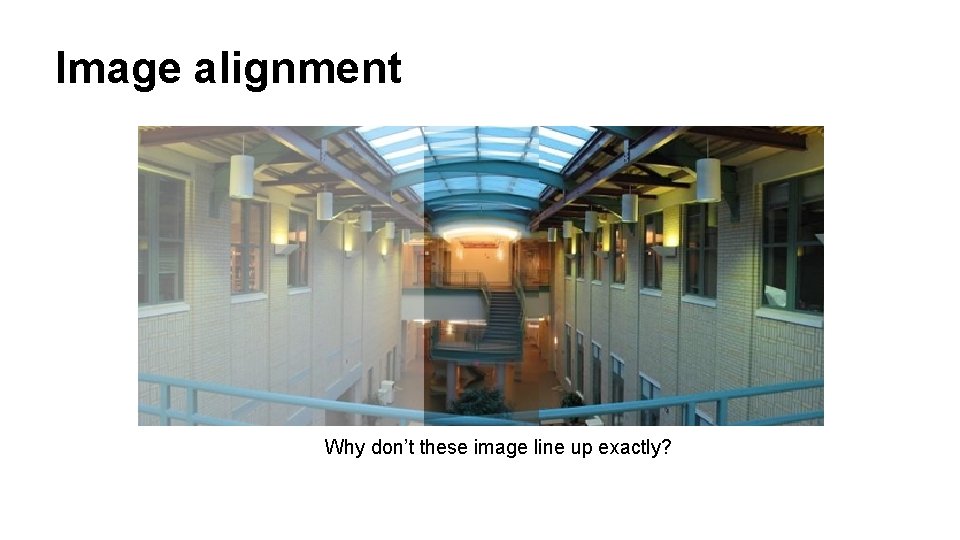
Image alignment Why don’t these image line up exactly?
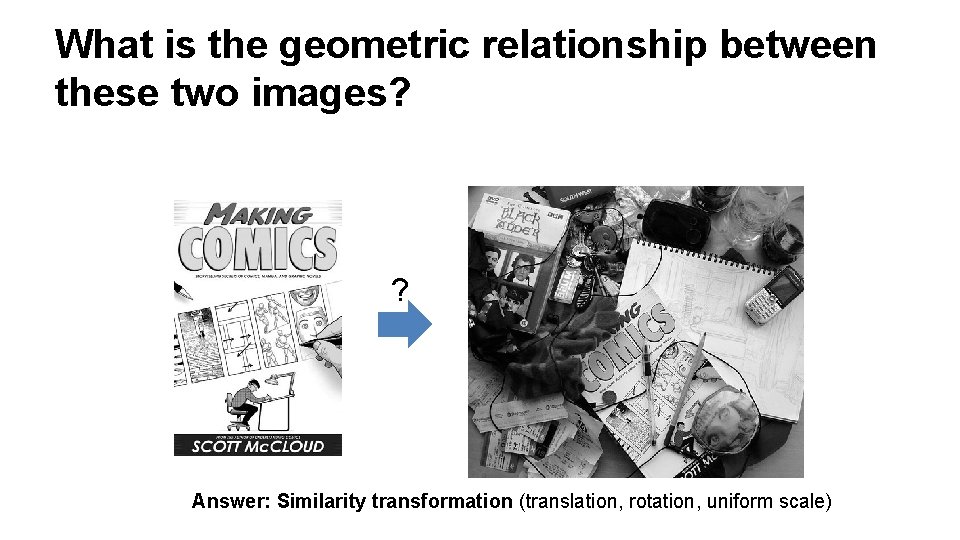
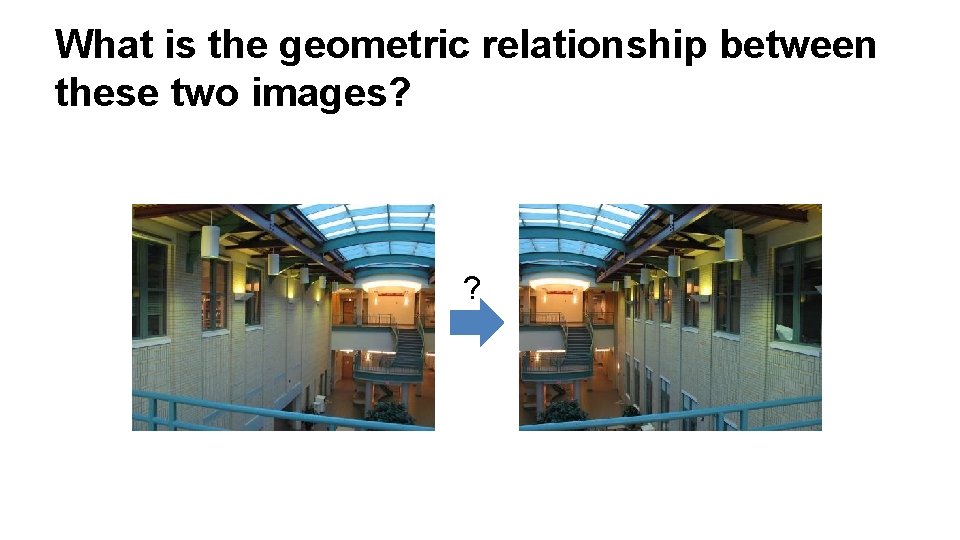
What is the geometric relationship between these two images? ? Answer: Similarity transformation (translation, rotation, uniform scale)
What is the geometric relationship between these two images? ?
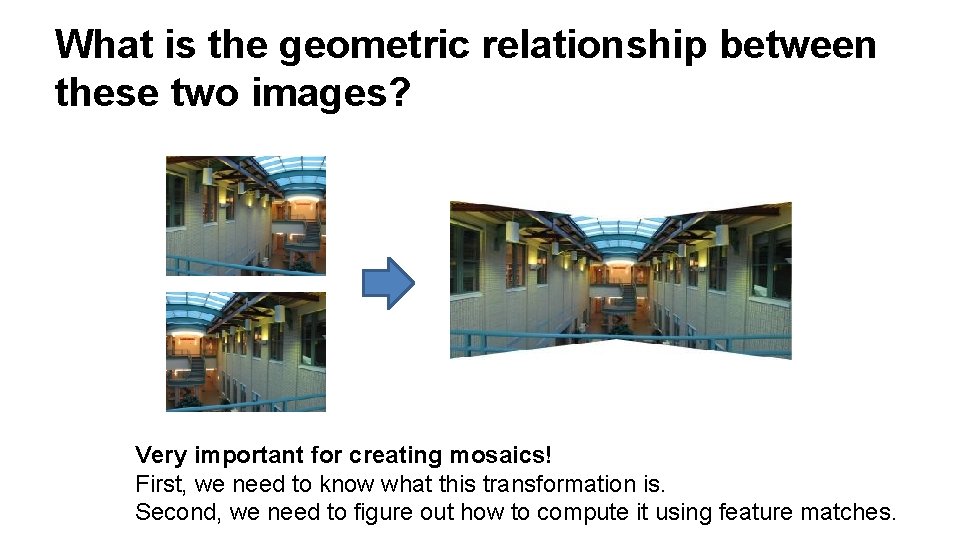
What is the geometric relationship between these two images? Very important for creating mosaics! First, we need to know what this transformation is. Second, we need to figure out how to compute it using feature matches.
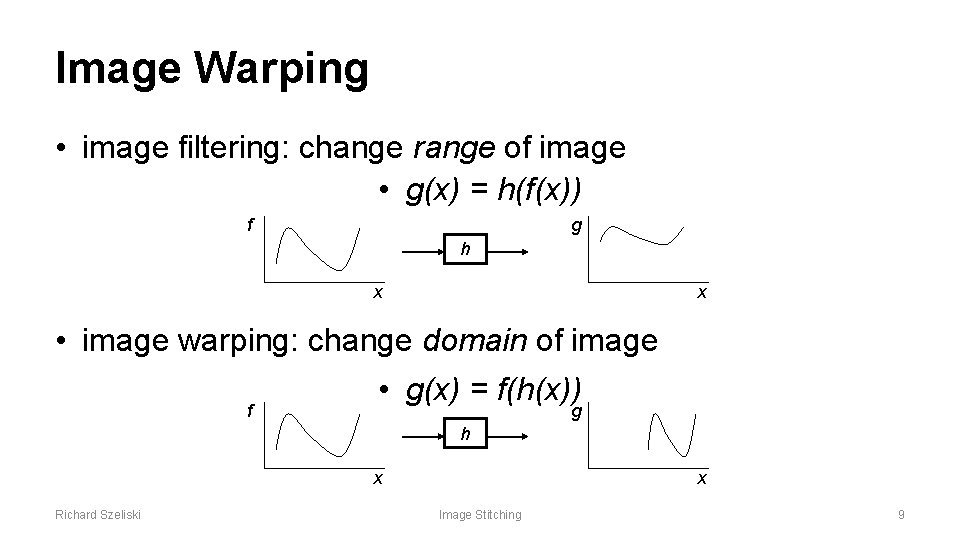
Image Warping • image filtering: change range of image • g(x) = h(f(x)) f g h x x • image warping: change domain of image • g(x) = f(h(x)) f g h x x Richard Szeliski Image Stitching 9
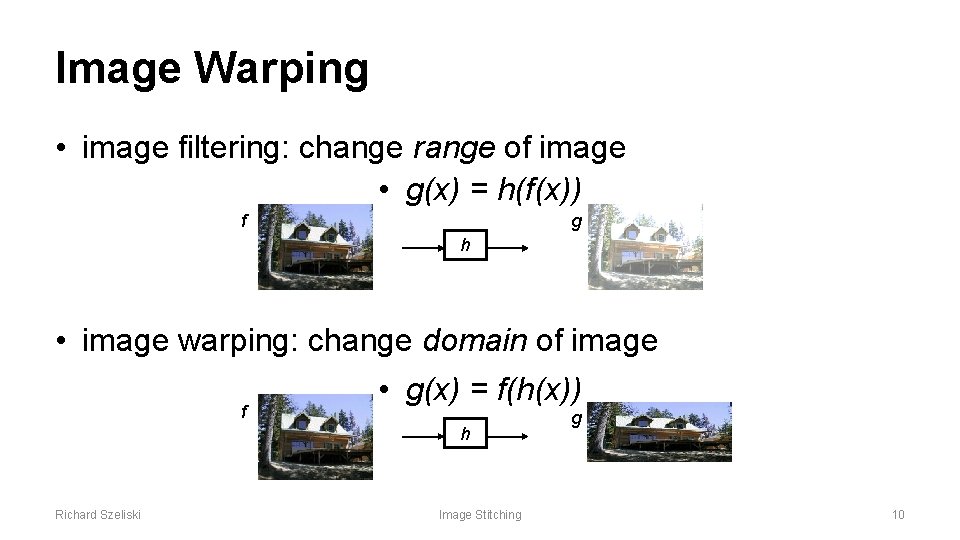
Image Warping • image filtering: change range of image • g(x) = h(f(x)) f g h • image warping: change domain of image • g(x) = f(h(x)) f h Richard Szeliski Image Stitching g 10
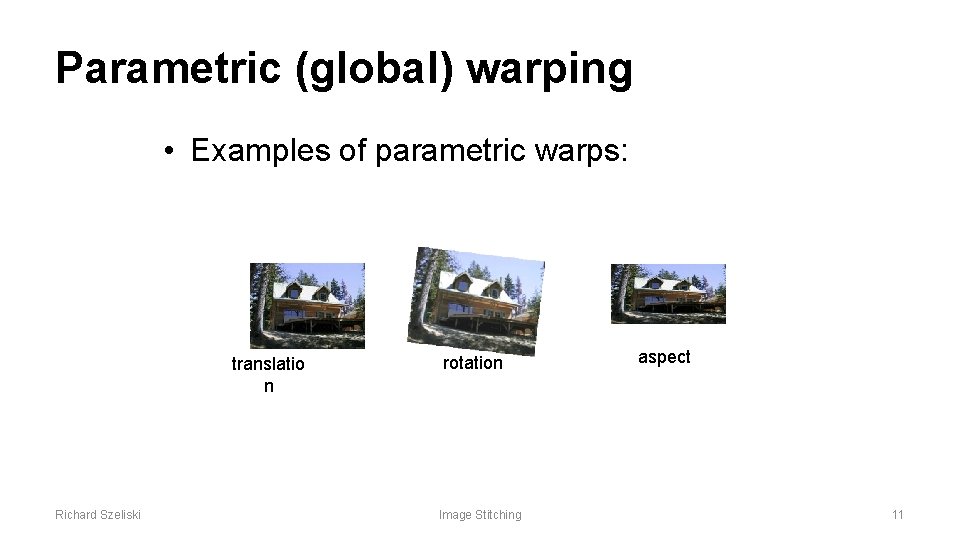
Parametric (global) warping • Examples of parametric warps: translatio n Richard Szeliski rotation Image Stitching aspect 11
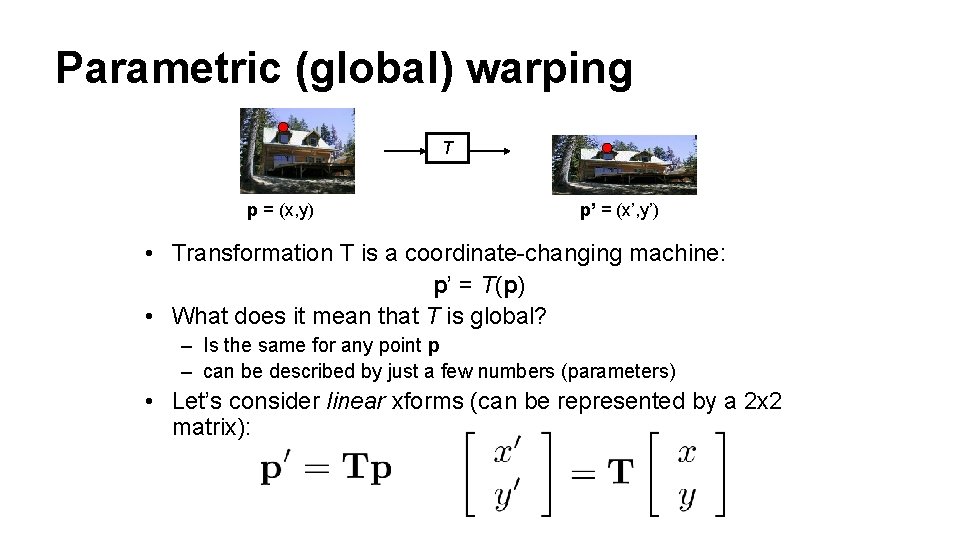
Parametric (global) warping T p = (x, y) p’ = (x’, y’) • Transformation T is a coordinate-changing machine: p’ = T(p) • What does it mean that T is global? – Is the same for any point p – can be described by just a few numbers (parameters) • Let’s consider linear xforms (can be represented by a 2 x 2 matrix):
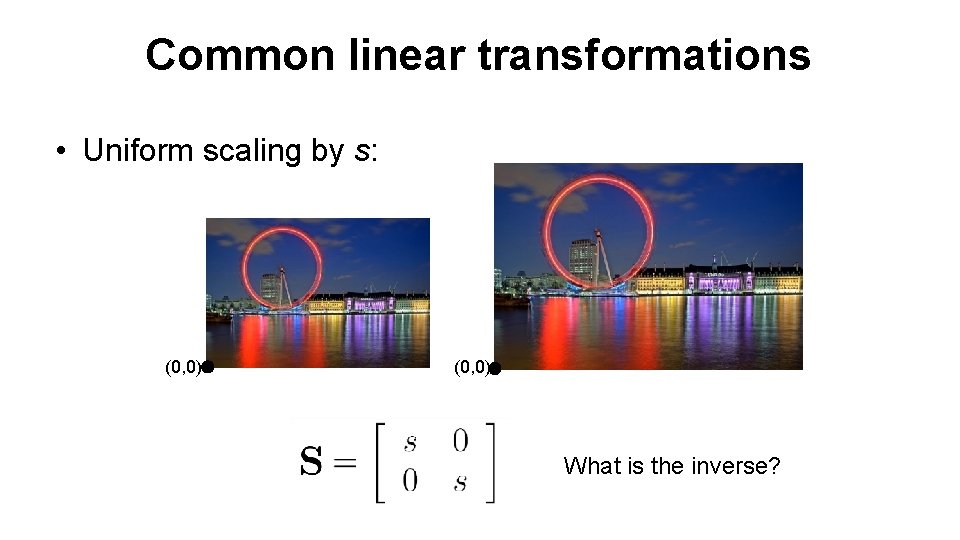
Common linear transformations • Uniform scaling by s: (0, 0) What is the inverse?
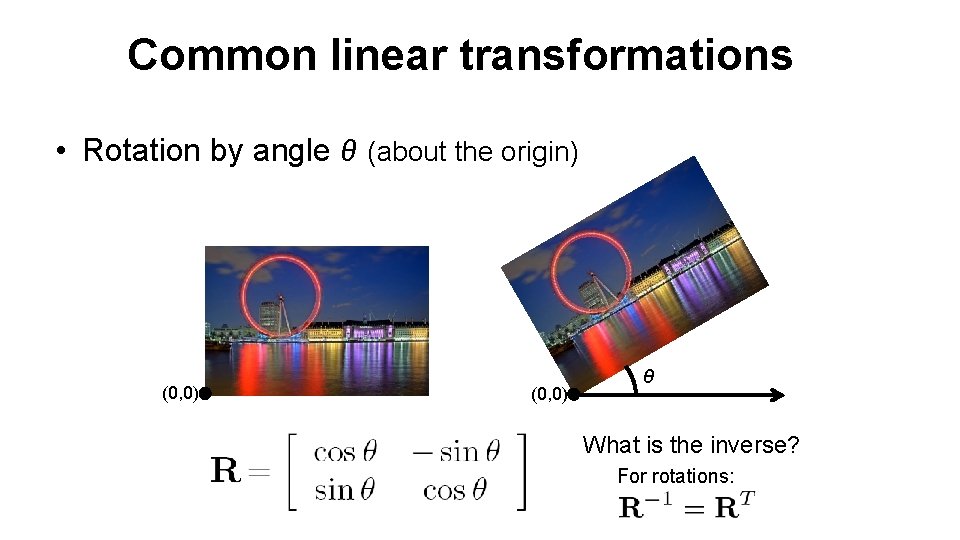
Common linear transformations • Rotation by angle θ (about the origin) (0, 0) θ What is the inverse? For rotations:
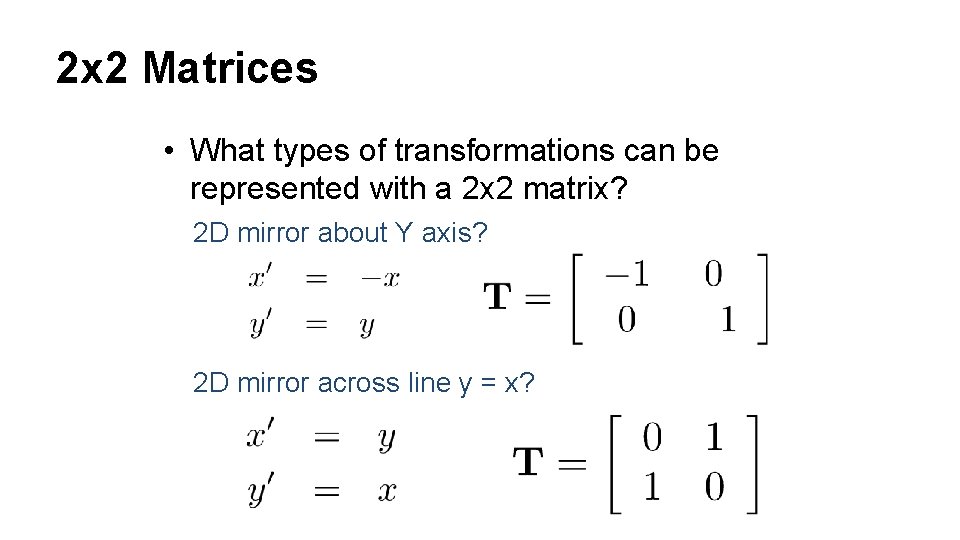
2 x 2 Matrices • What types of transformations can be represented with a 2 x 2 matrix? 2 D mirror about Y axis? 2 D mirror across line y = x?
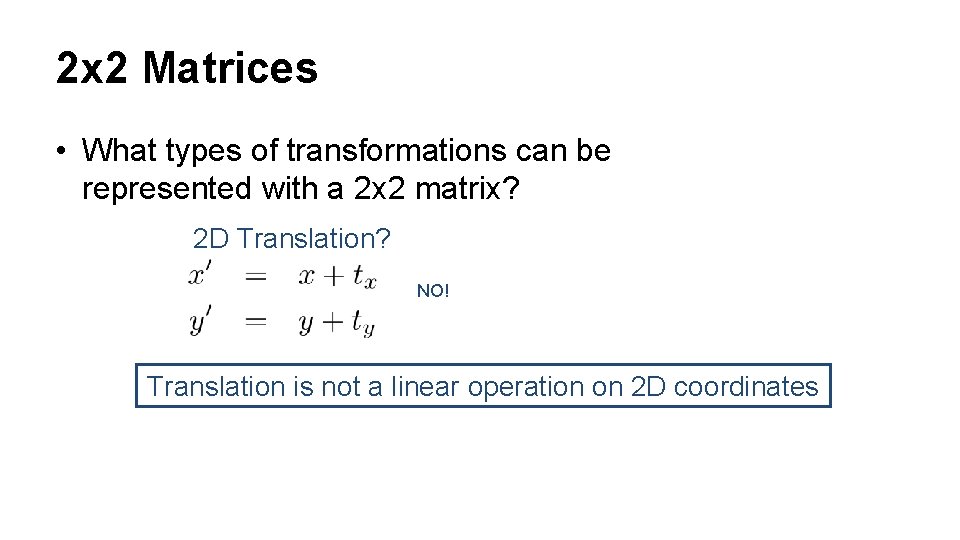
2 x 2 Matrices • What types of transformations can be represented with a 2 x 2 matrix? 2 D Translation? NO! Translation is not a linear operation on 2 D coordinates
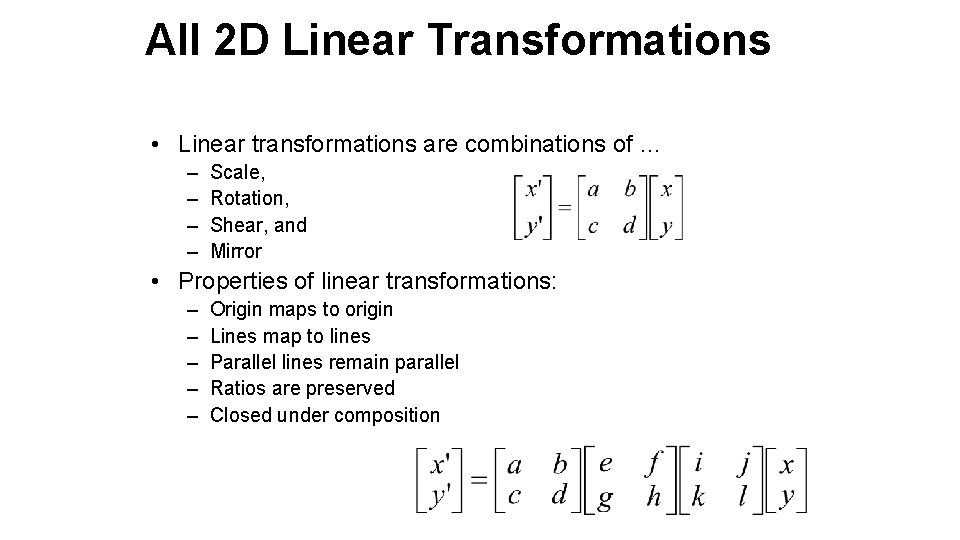
All 2 D Linear Transformations • Linear transformations are combinations of … – – Scale, Rotation, Shear, and Mirror • Properties of linear transformations: – – – Origin maps to origin Lines map to lines Parallel lines remain parallel Ratios are preserved Closed under composition
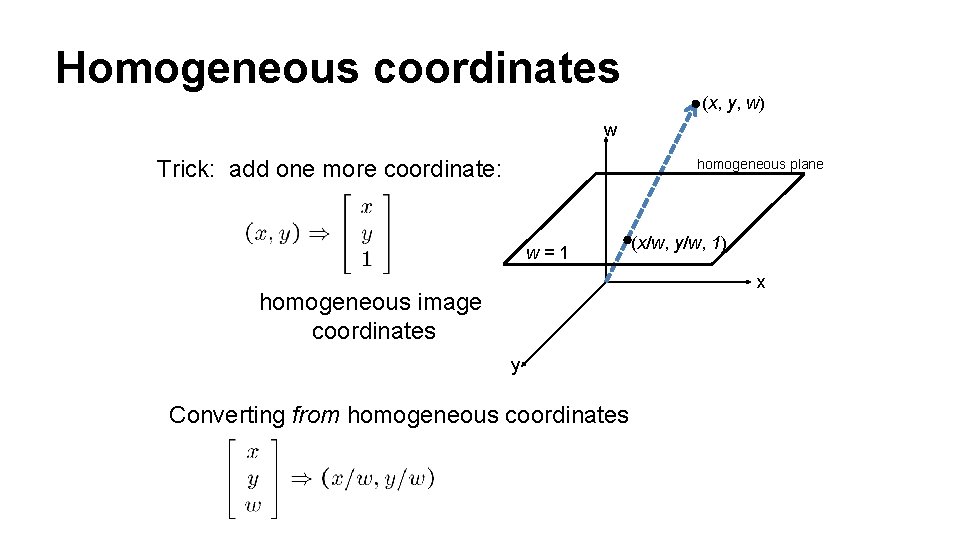
Homogeneous coordinates (x, y, w) w Trick: add one more coordinate: homogeneous plane w=1 (x/w, y/w, 1) x homogeneous image coordinates y Converting from homogeneous coordinates
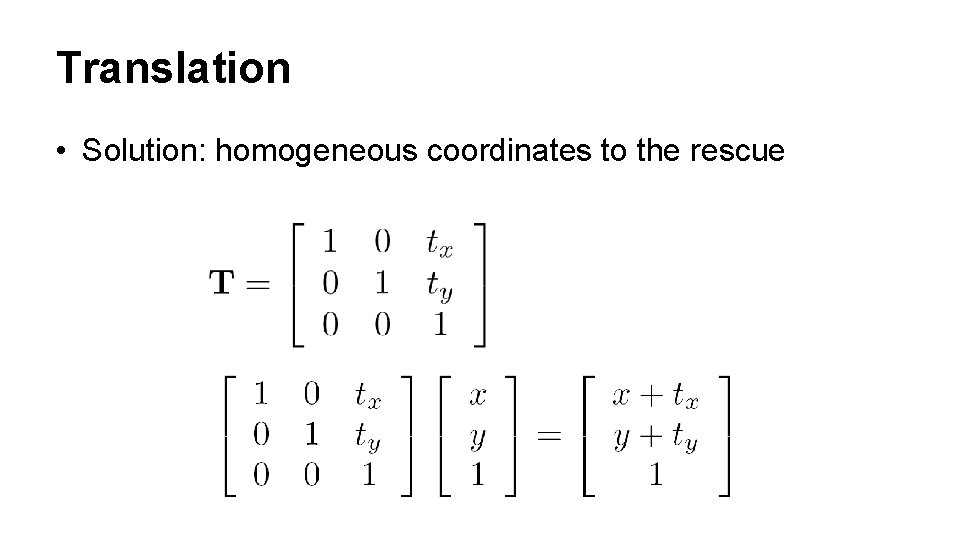
Translation • Solution: homogeneous coordinates to the rescue
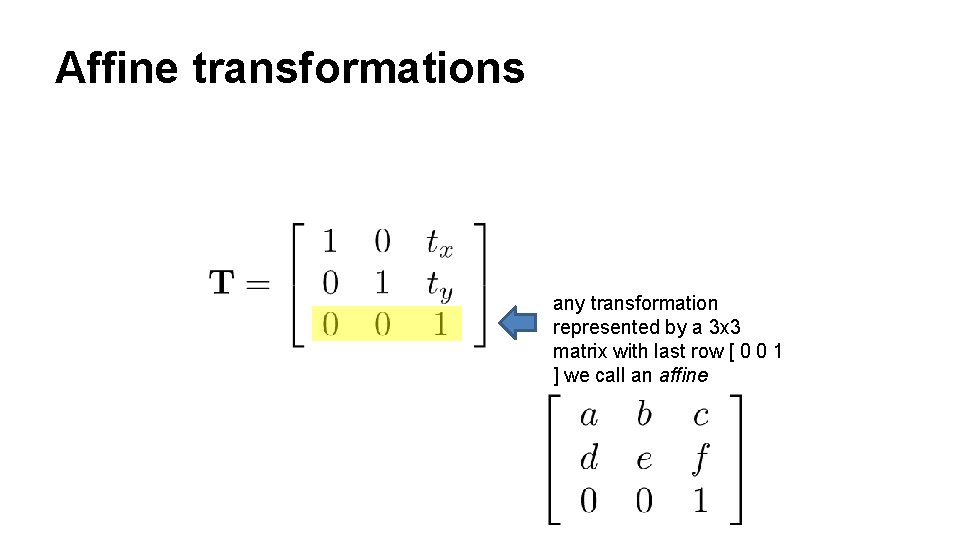
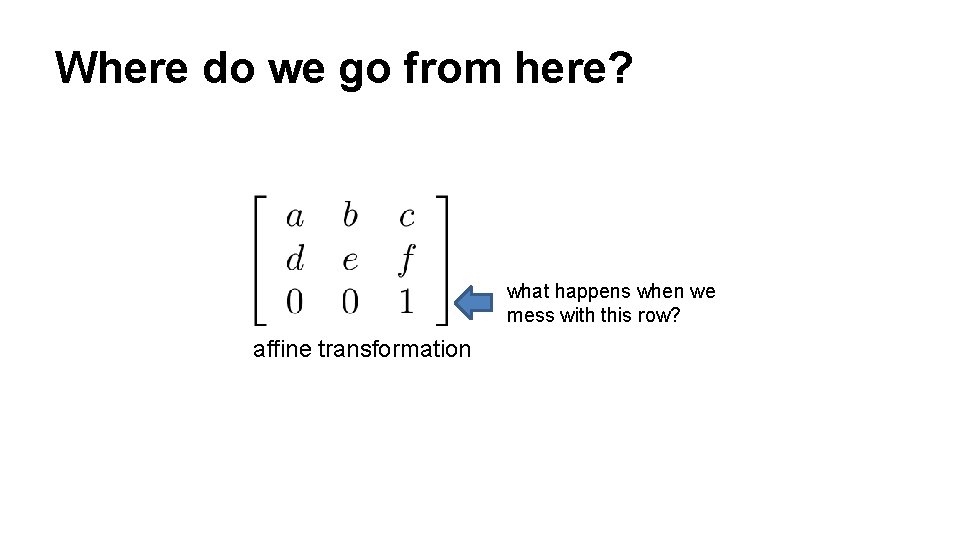
Affine transformations any transformation represented by a 3 x 3 matrix with last row [ 0 0 1 ] we call an affine transformation
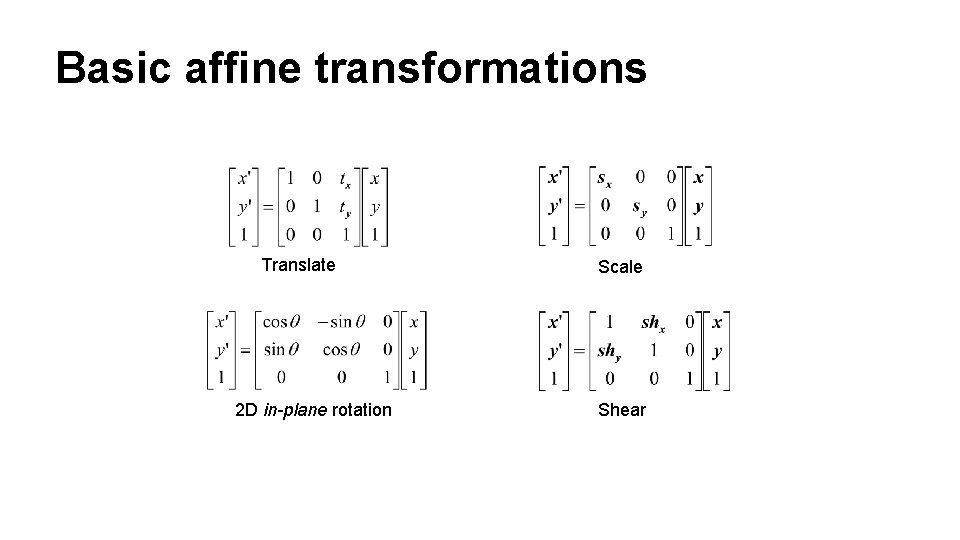
Basic affine transformations Translate 2 D in-plane rotation Scale Shear
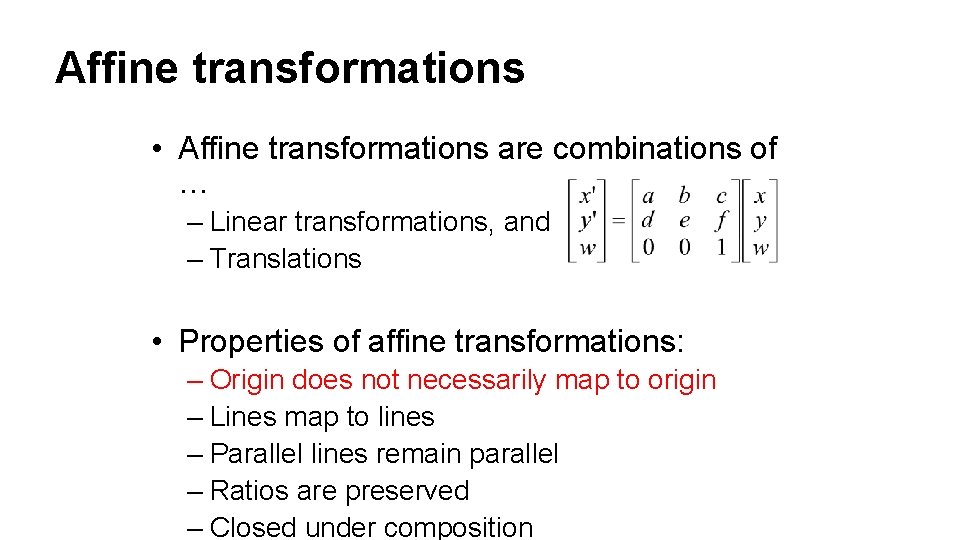
Affine transformations • Affine transformations are combinations of … – Linear transformations, and – Translations • Properties of affine transformations: – Origin does not necessarily map to origin – Lines map to lines – Parallel lines remain parallel – Ratios are preserved – Closed under composition
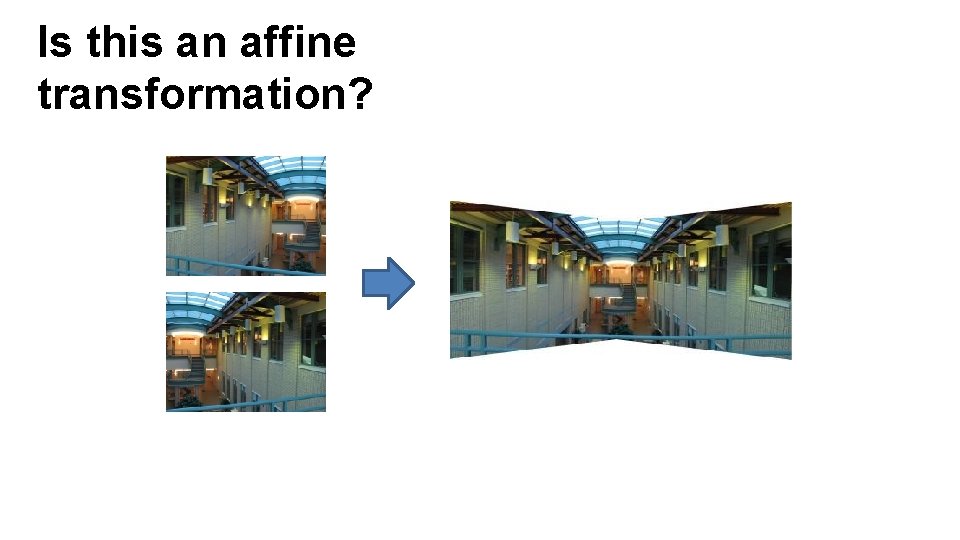
Is this an affine transformation?
Where do we go from here? what happens when we mess with this row? affine transformation
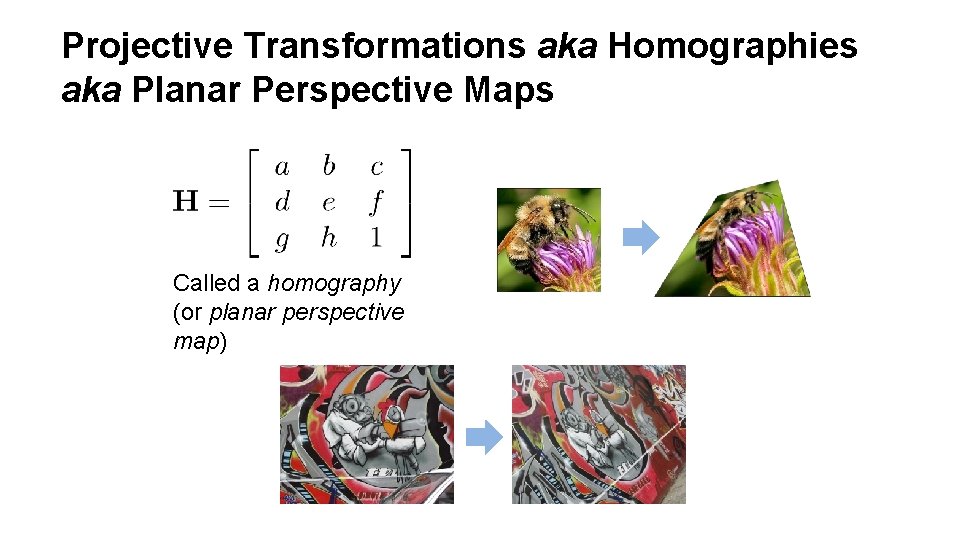
Projective Transformations aka Homographies aka Planar Perspective Maps Called a homography (or planar perspective map)
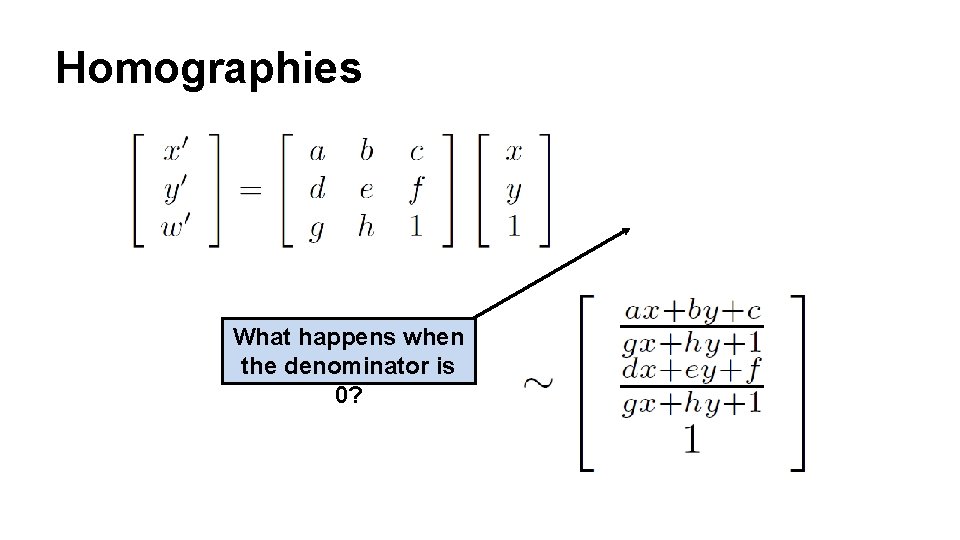
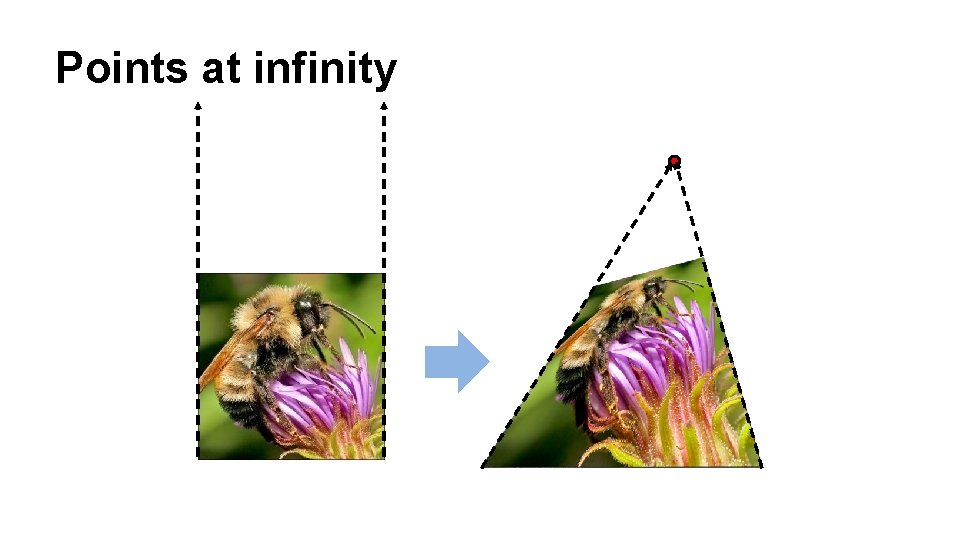
Homographies What happens when the denominator is 0?
Points at infinity
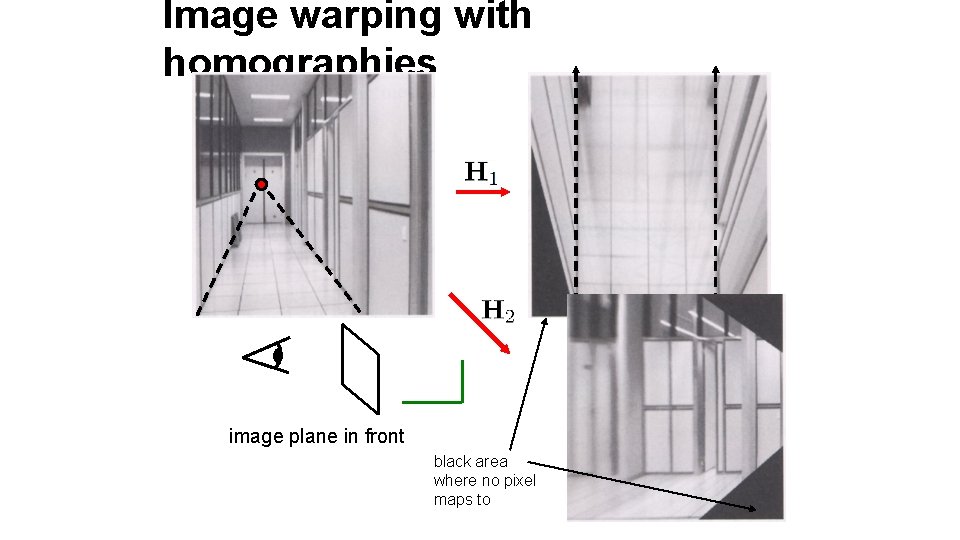
Image warping with homographies image plane in front image plane below black area where no pixel maps to
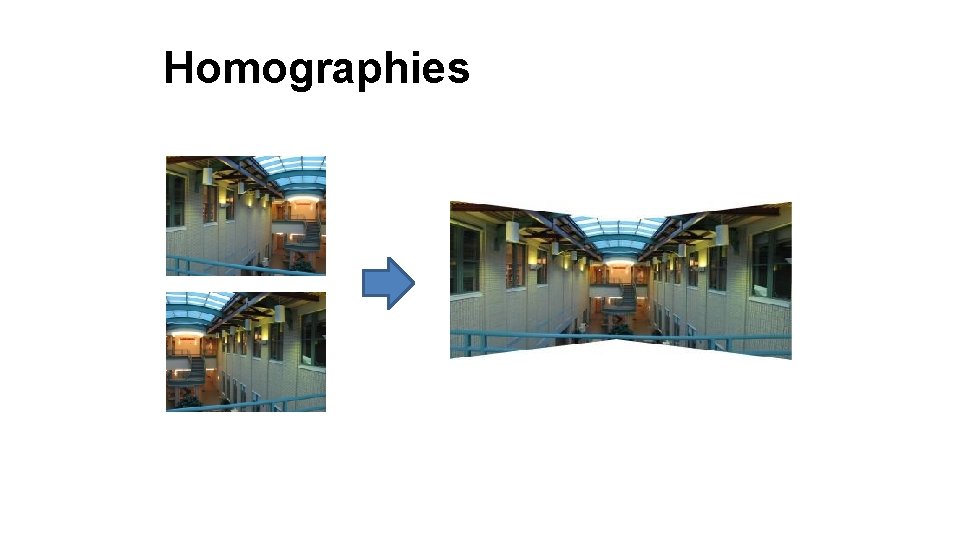
Homographies
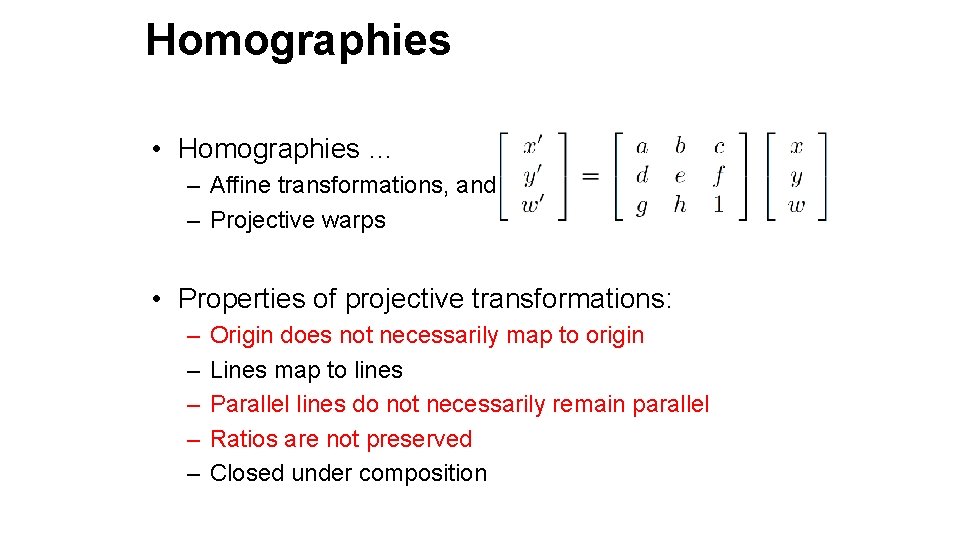
Homographies • Homographies … – Affine transformations, and – Projective warps • Properties of projective transformations: – – – Origin does not necessarily map to origin Lines map to lines Parallel lines do not necessarily remain parallel Ratios are not preserved Closed under composition
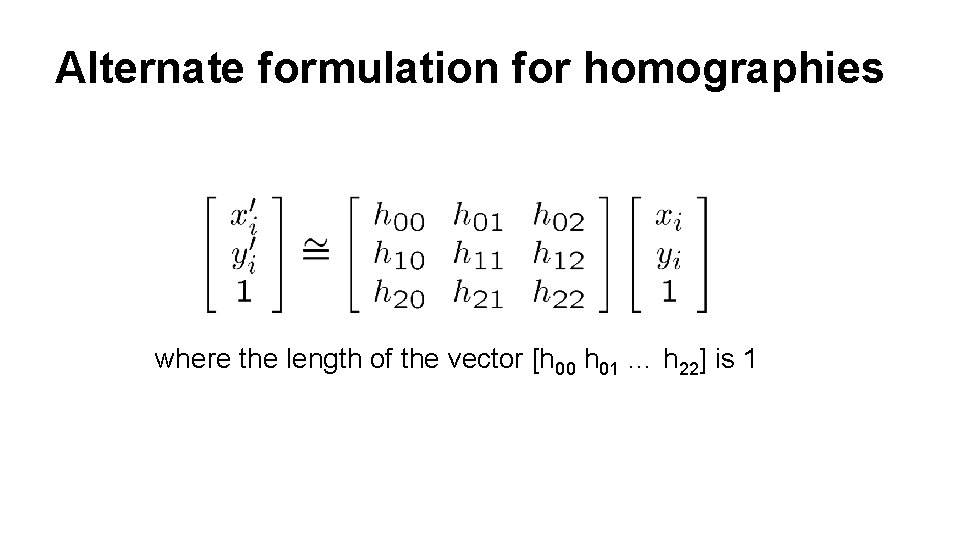
Alternate formulation for homographies where the length of the vector [h 00 h 01 … h 22] is 1
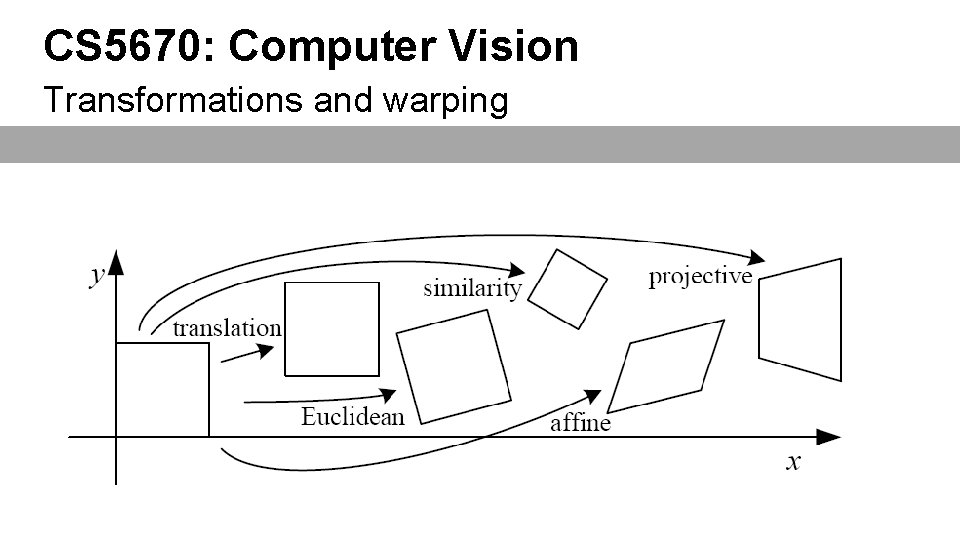
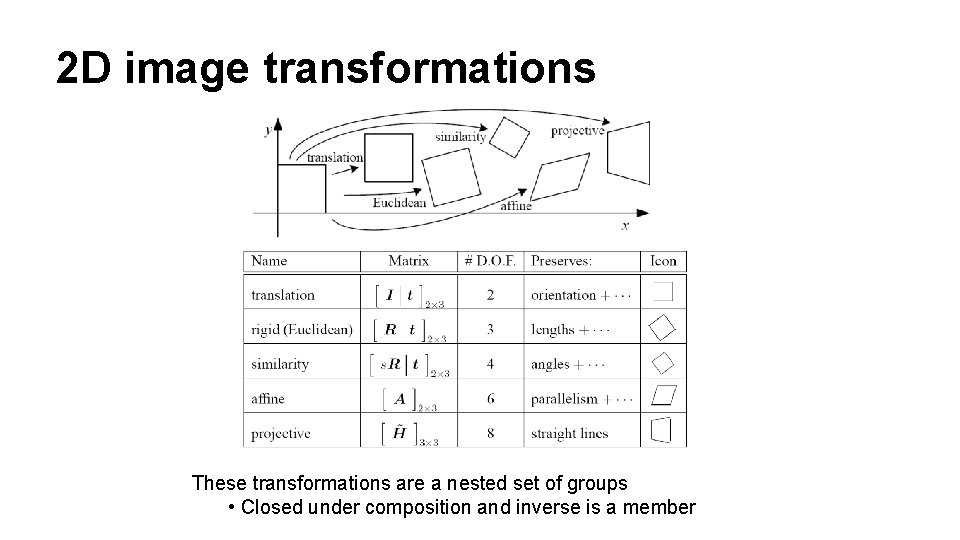
2 D image transformations These transformations are a nested set of groups • Closed under composition and inverse is a member
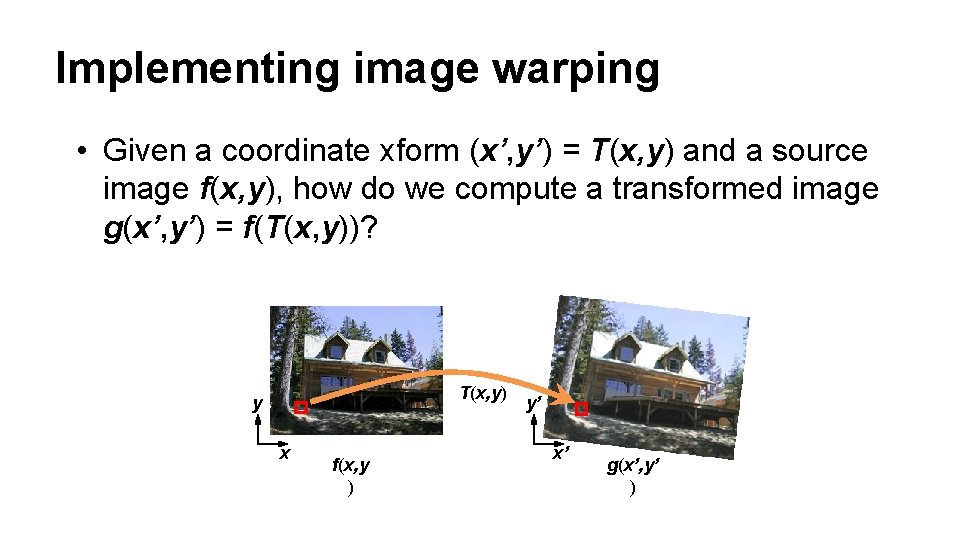
Implementing image warping • Given a coordinate xform (x’, y’) = T(x, y) and a source image f(x, y), how do we compute a transformed image g(x’, y’) = f(T(x, y))? T(x, y) y x f(x, y ) y’ x’ g(x’, y’ )
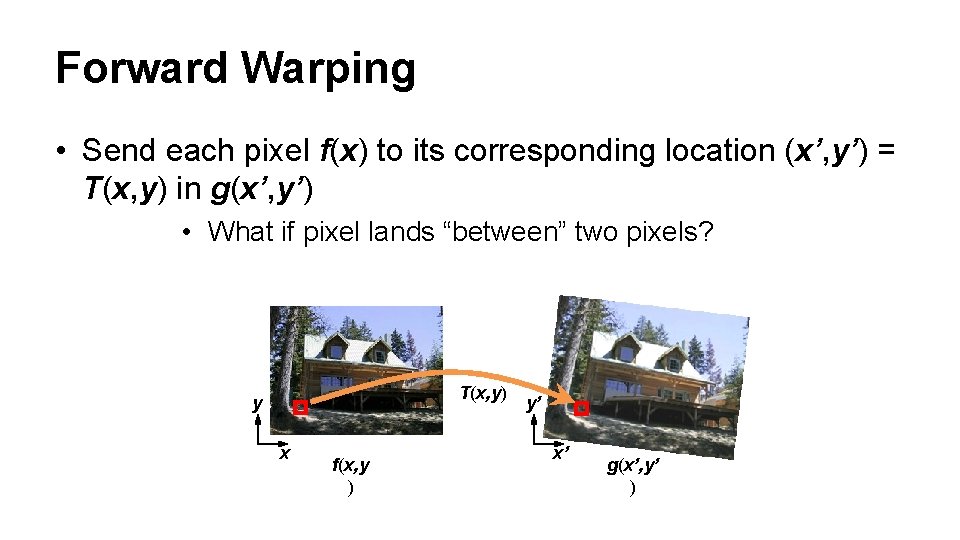
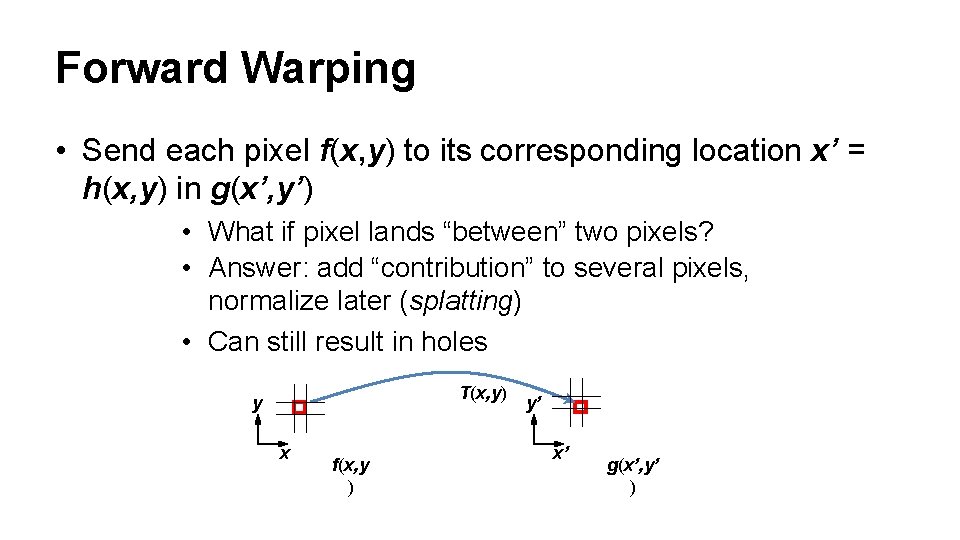
Forward Warping • Send each pixel f(x) to its corresponding location (x’, y’) = T(x, y) in g(x’, y’) • What if pixel lands “between” two pixels? T(x, y) y x f(x, y ) y’ x’ g(x’, y’ )
Forward Warping • Send each pixel f(x, y) to its corresponding location x’ = h(x, y) in g(x’, y’) • What if pixel lands “between” two pixels? • Answer: add “contribution” to several pixels, normalize later (splatting) • Can still result in holes T(x, y) y x f(x, y ) y’ x’ g(x’, y’ )
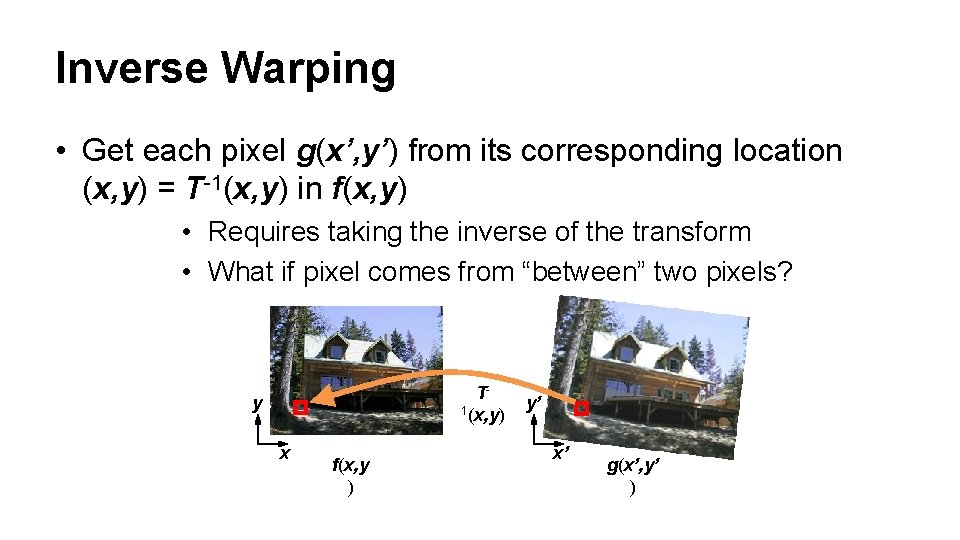
Inverse Warping • Get each pixel g(x’, y’) from its corresponding location (x, y) = T-1(x, y) in f(x, y) • Requires taking the inverse of the transform • What if pixel comes from “between” two pixels? T 1(x, y) y x f(x, y ) y’ x’ g(x’, y’ )
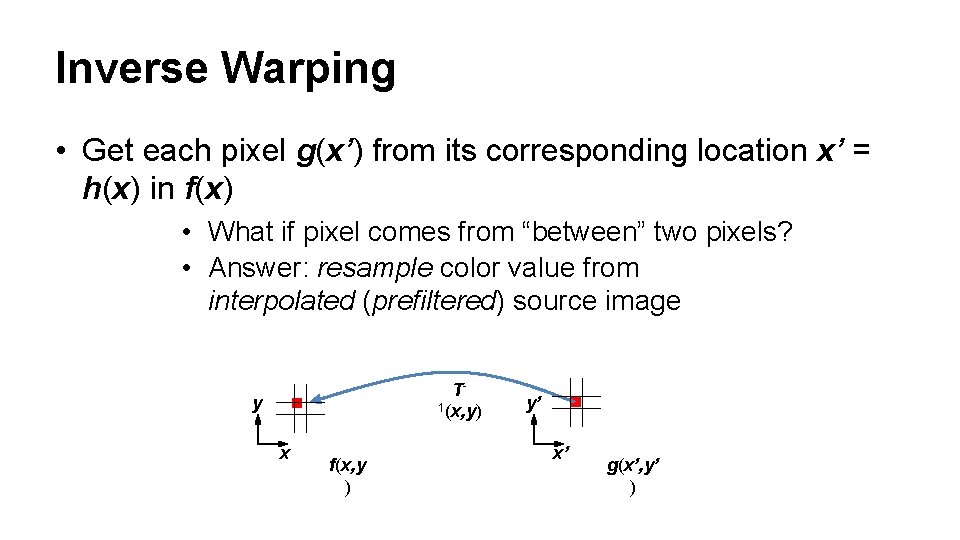
Inverse Warping • Get each pixel g(x’) from its corresponding location x’ = h(x) in f(x) • What if pixel comes from “between” two pixels? • Answer: resample color value from interpolated (prefiltered) source image T 1(x, y) y x f(x, y ) y’ x’ g(x’, y’ )
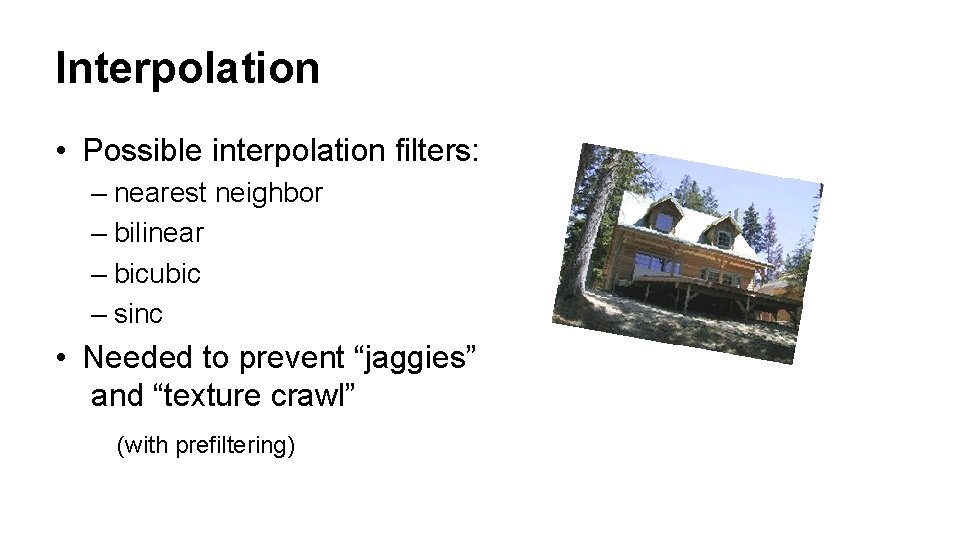
Interpolation • Possible interpolation filters: – nearest neighbor – bilinear – bicubic – sinc • Needed to prevent “jaggies” and “texture crawl” (with prefiltering)
Questions?