
CS 559 Computer Graphics Lecture 21 Subdivision Bspline
CS 559: Computer Graphics Lecture 21: Subdivision, Bspline, and Texture mapping Li Zhang Spring 2008
Today • Finish on curve modeling • Start Texture mapping • Reading – Shirley: Ch 15. 6. 2 – Redbook: Ch 9 – (optional) Moller and Haines: Real-Time Rendering, 3 e, Ch 6 • Linux: /p/course/cs 559 lizhang/public/readings/6_texture. pdf • Windows: P: coursecs 559 lizhangpublicreadings6_texture. pdf
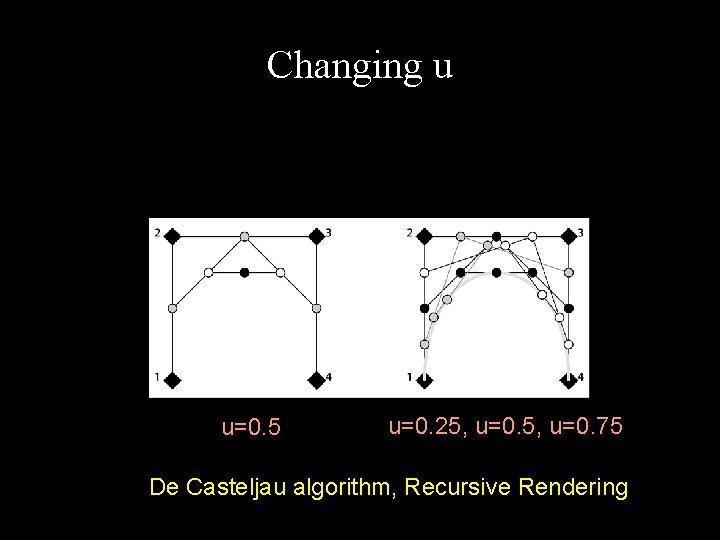
Changing u u=0. 5 u=0. 25, u=0. 75 De Casteljau algorithm, Recursive Rendering
![Subdivision De. Casteljau(float p[N][3], float u) { for (int n = N-1; n >=](http://slidetodoc.com/presentation_image/557da921697e32ca5df40270a155b183/image-4.jpg "Subdivision De. Casteljau(float p[N][3], float u) { for (int n = N-1; n >=")
Subdivision De. Casteljau(float p[N][3], float u) { for (int n = N-1; n >= 1; --n) { for (int j = 0; j < n; ++j) { p[j][0] = (1 -u) * p[j][0] + p[j][1] = (1 -u) * p[j][1] + p[j][2] = (1 -u) * p[j][2] + } } //(p[0][0], p[0][1], p[0][2]) saves u * p[j+1][0]; u * p[j+1][1]; u * p[j+1][2]; the result } De. Casteljau(float p[N][3], float u) { for (int n = N-1; n >= 1; --n) { for (int j = 0; j < n; ++j) { p[j][0] += u*(p[j+1][0]-p[j][0]); p[j][1] += u*(p[j+1][1]-p[j][1]); p[j][2] += u*(p[j+1][2]-p[j][2]); } } //(p[0][0], p[0][1], p[0][2]) saves the result }
Subdivision • Given a Bezier curve defined by P 0, P 1, P 2, . . . , Pn • we want to find two sets of n+1 control points Q 0, Q 1, Q 2, . . . , Qn and R 0, R 1, R 2, . . . , Rn such that – the Bézier curve defined by Qi's is the piece of the original Bézier curve on [0, u] – the Bézier curve defined by Ri's is the piece of the original Bézier curve on [u, 1]
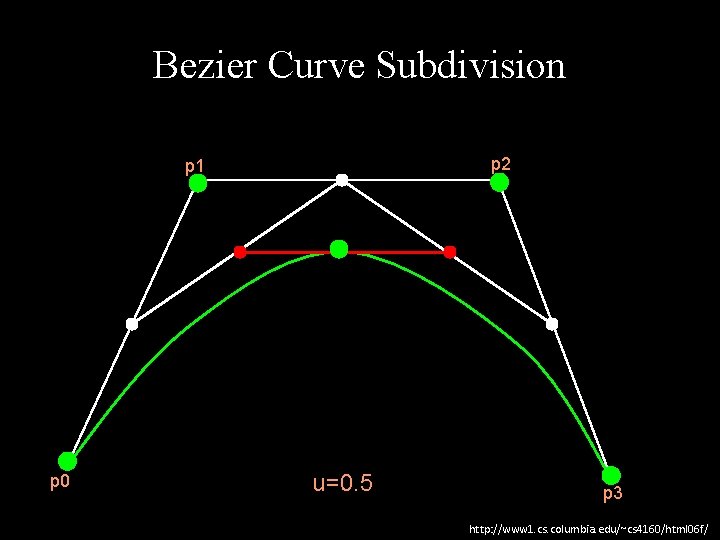
Bezier Curve Subdivision p 2 p 1 p 0 u=0. 5 p 3 http: //www 1. cs. columbia. edu/~cs 4160/html 06 f/
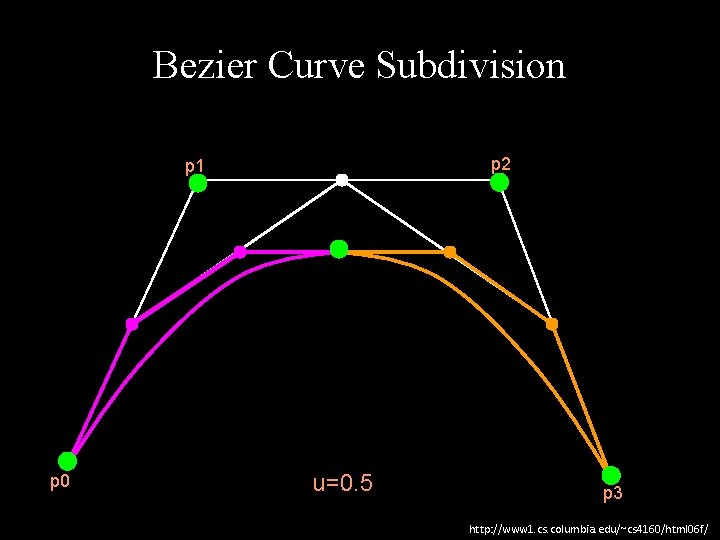
Bezier Curve Subdivision p 2 p 1 p 0 u=0. 5 p 3 http: //www 1. cs. columbia. edu/~cs 4160/html 06 f/

A 6 th degree subdivision example http: //www. cs. mtu. edu/~shene/COURSES/cs 3621/NOTES/spline/Bezier/bezier-sub. html
Bezier Curve Subdivision • Why is subdivision useful? – Collision/intersection detection • Recursive search – Good for curve editing and approximation
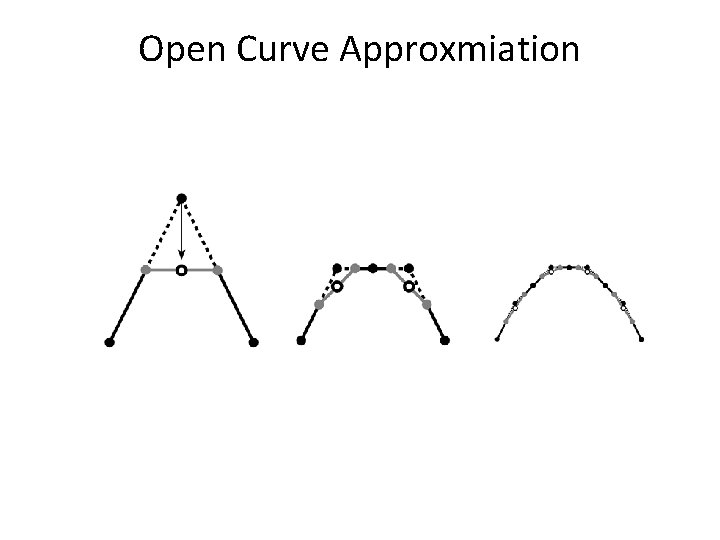
Open Curve Approxmiation

Closed Curve Approximation

Interpolate control points Has local control C 2 continuity Natural cubics Yes No Yes Hermite cubics Yes No Cardinal Cubics Yes No Bezier Cubics Yes No
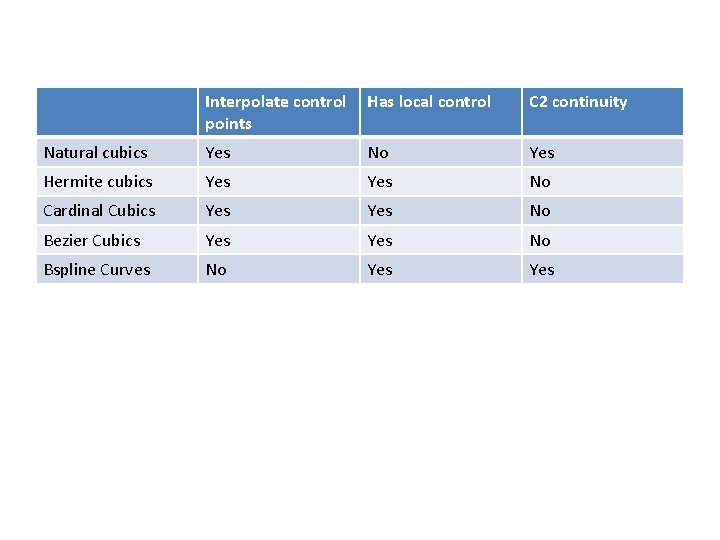
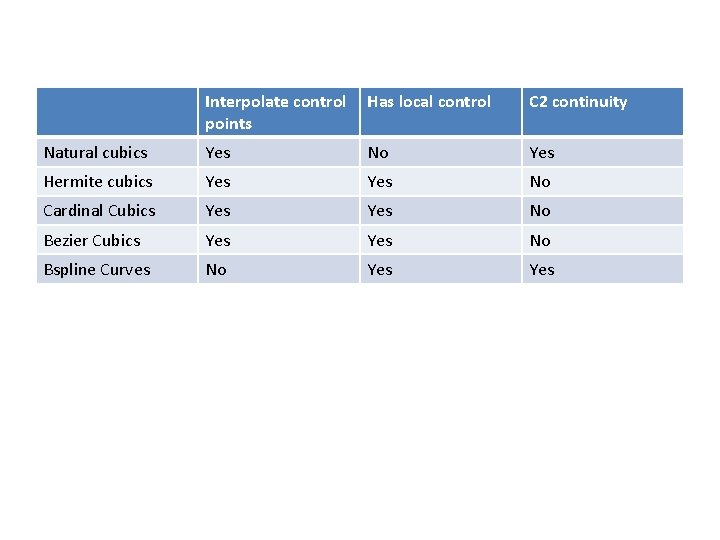
Interpolate control points Has local control C 2 continuity Natural cubics Yes No Yes Hermite cubics Yes No Cardinal Cubics Yes No Bezier Cubics Yes No Bspline Curves No Yes

Bsplines • Given p 1, …pn, define a curve that approximates the curve. If bi(t) is very smooth, so will be f If bi(t) has local support, f will have local control
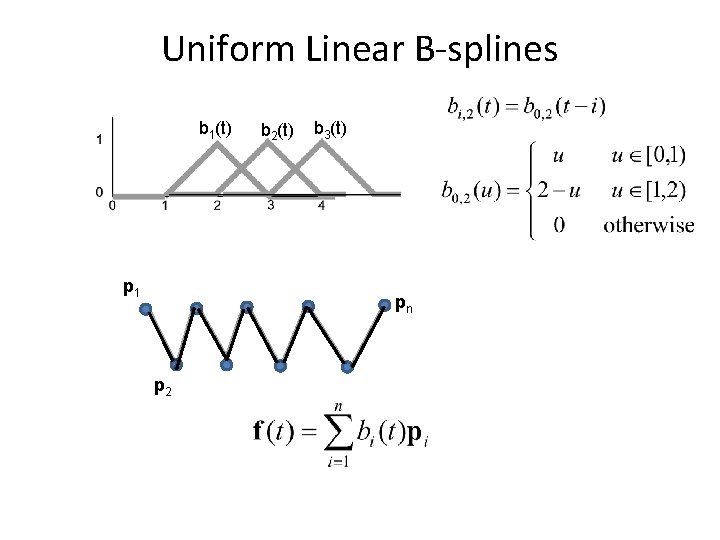
Uniform Linear B-splines b 1(t) b 2(t) b 3(t) p 1 pn p 2
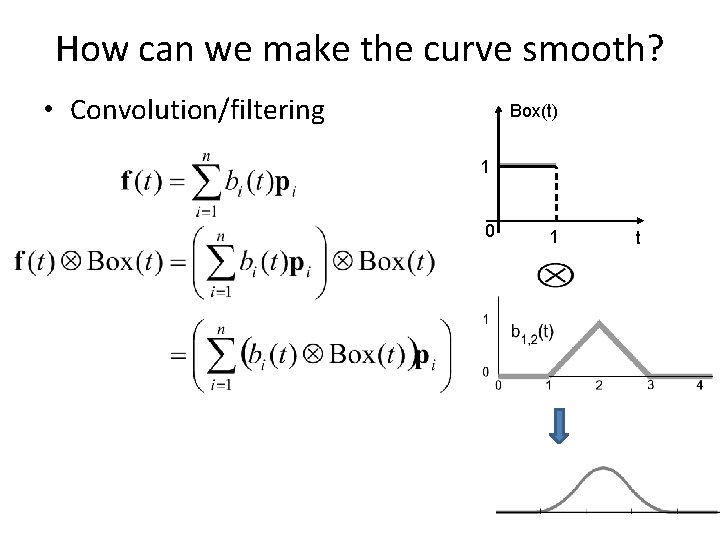
How can we make the curve smooth? • Convolution/filtering Box(t) 1 0 1 t
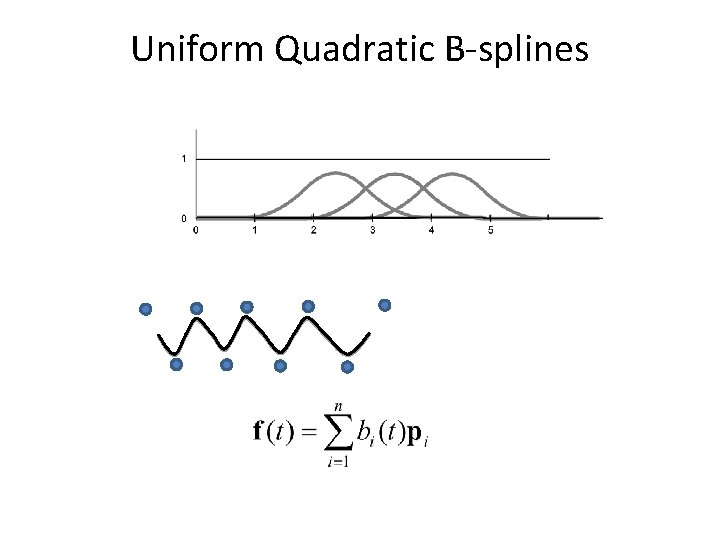
Uniform Quadratic B-splines
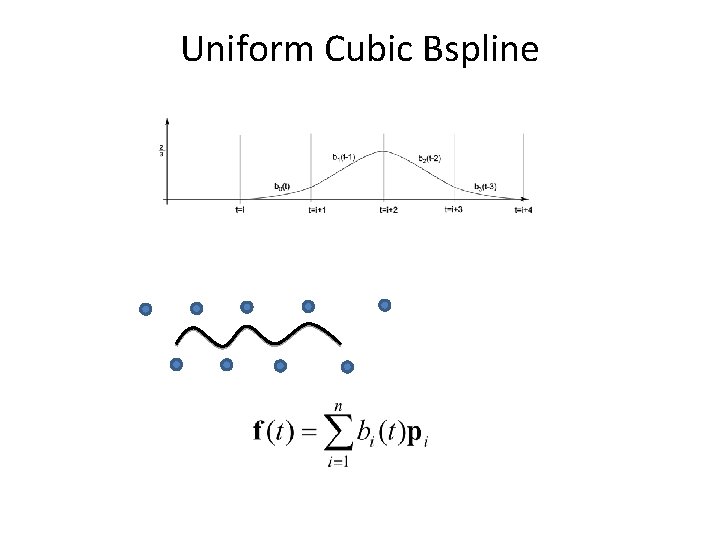
Uniform Cubic Bspline
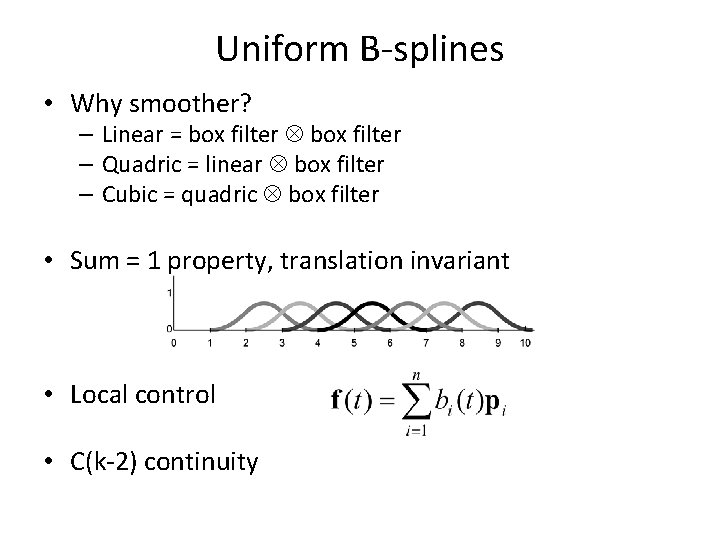
Uniform B-splines • Why smoother? – Linear = box filter – Quadric = linear box filter – Cubic = quadric box filter • Sum = 1 property, translation invariant • Local control • C(k-2) continuity
Interpolate control points Has local control C 2 continuity Natural cubics Yes No Yes Hermite cubics Yes No Cardinal Cubics Yes No Bezier Cubics Yes No Bspline Curves No Yes
Texture Mapping Many slides from Ravi Ramamoorthi, Columbia Univ, Greg Humphreys, UVA and Rosalee Wolfe, De. Paul tutorial teaching texture mapping visually
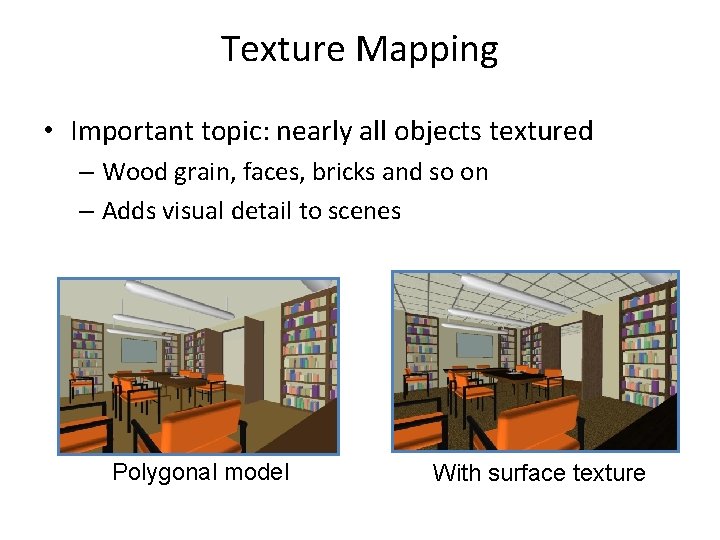
Texture Mapping • Important topic: nearly all objects textured – Wood grain, faces, bricks and so on – Adds visual detail to scenes Polygonal model With surface texture
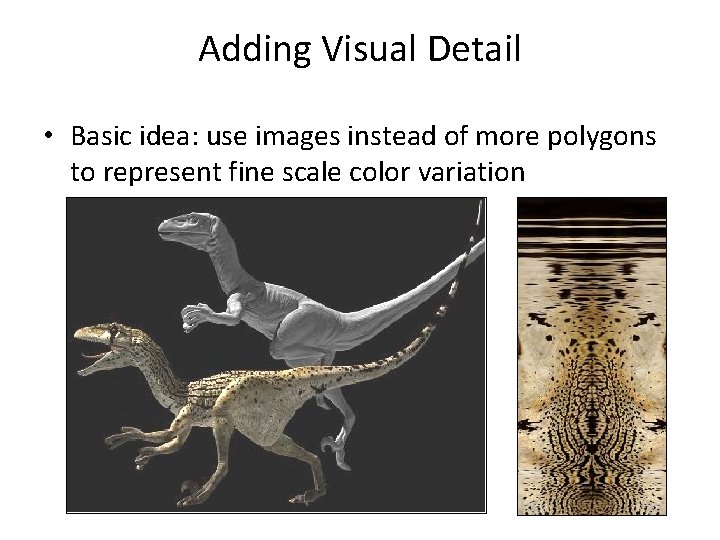
Adding Visual Detail • Basic idea: use images instead of more polygons to represent fine scale color variation
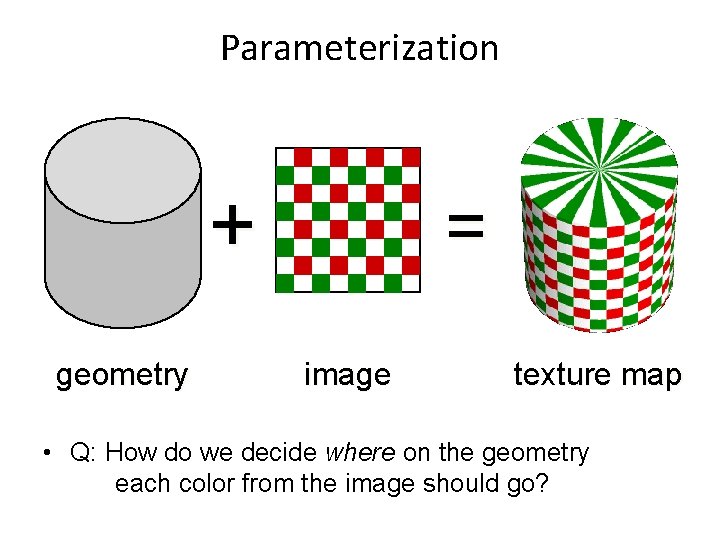
Parameterization + geometry = image texture map • Q: How do we decide where on the geometry each color from the image should go?
![Option: Varieties of mappings [Paul Bourke]](http://slidetodoc.com/presentation_image/557da921697e32ca5df40270a155b183/image-25.jpg "Option: Varieties of mappings [Paul Bourke]")
Option: Varieties of mappings [Paul Bourke]
![Option: unfold the surface [Piponi 2000]](http://slidetodoc.com/presentation_image/557da921697e32ca5df40270a155b183/image-26.jpg "Option: unfold the surface [Piponi 2000]")
Option: unfold the surface [Piponi 2000]
![Option: make an atlas charts atlas surface [Sander 2001]](http://slidetodoc.com/presentation_image/557da921697e32ca5df40270a155b183/image-27.jpg "Option: make an atlas charts atlas surface [Sander 2001]")
Option: make an atlas charts atlas surface [Sander 2001]
Outline • Types of mappings • Interpolating texture coordinates • Broader use of textures
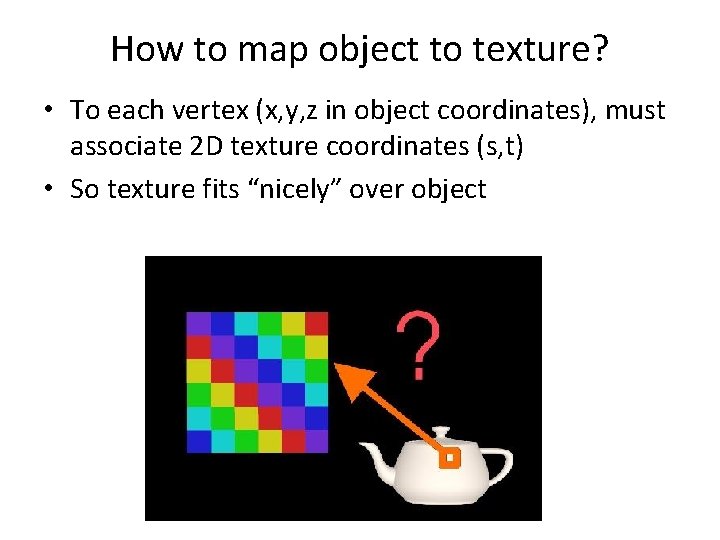
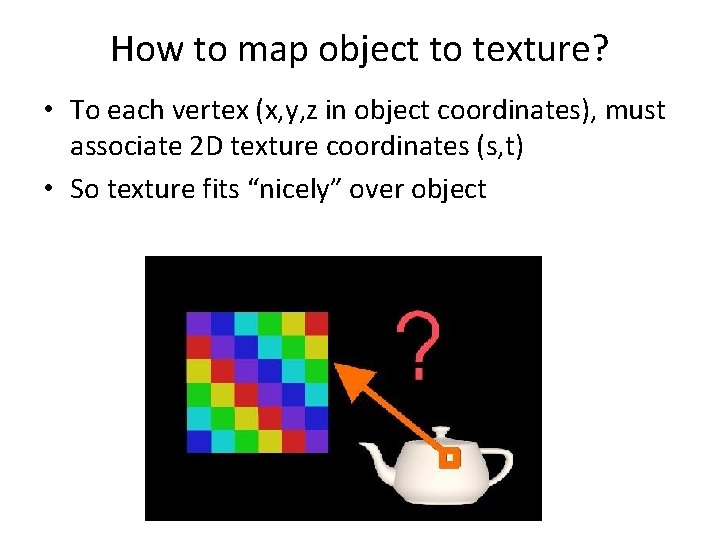
How to map object to texture? • To each vertex (x, y, z in object coordinates), must associate 2 D texture coordinates (s, t) • So texture fits “nicely” over object
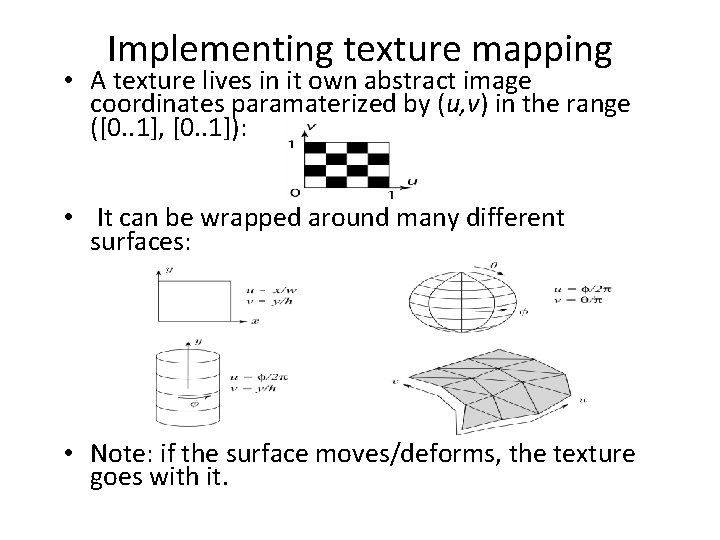
Implementing texture mapping • A texture lives in it own abstract image coordinates paramaterized by (u, v) in the range ([0. . 1], [0. . 1]): • It can be wrapped around many different surfaces: • Note: if the surface moves/deforms, the texture goes with it.
How to map object to texture? • To each vertex (x, y, z in object coordinates), must associate 2 D texture coordinates (s, t) • So texture fits “nicely” over object
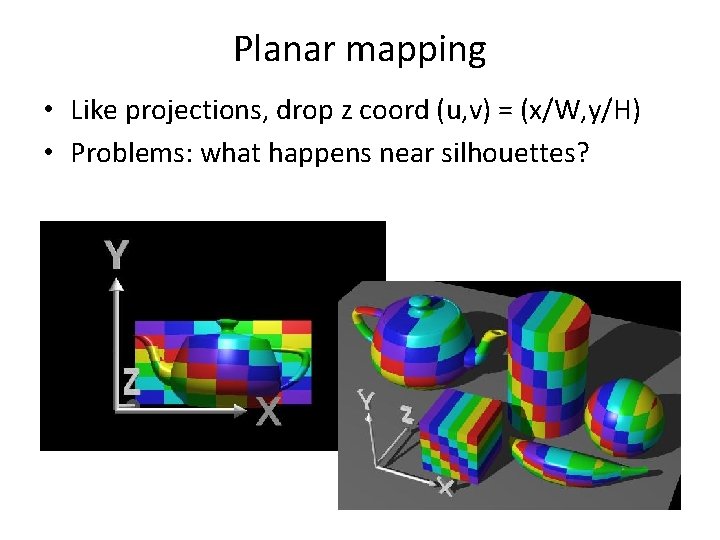
Planar mapping • Like projections, drop z coord (u, v) = (x/W, y/H) • Problems: what happens near silhouettes?
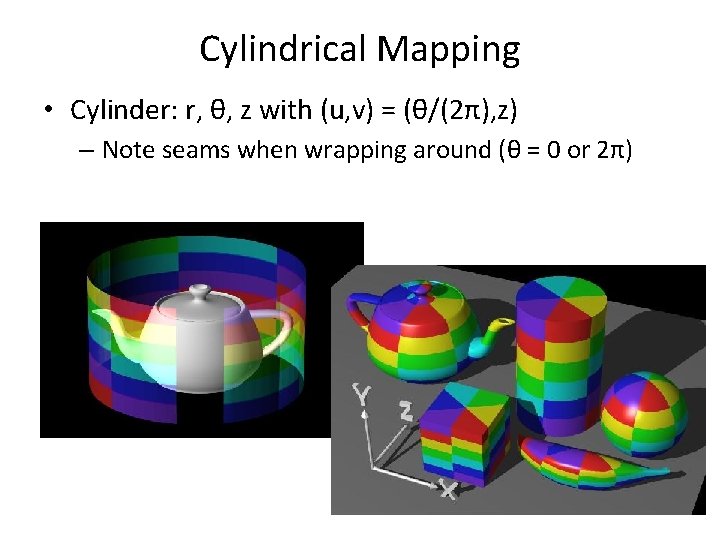
Cylindrical Mapping • Cylinder: r, θ, z with (u, v) = (θ/(2π), z) – Note seams when wrapping around (θ = 0 or 2π)
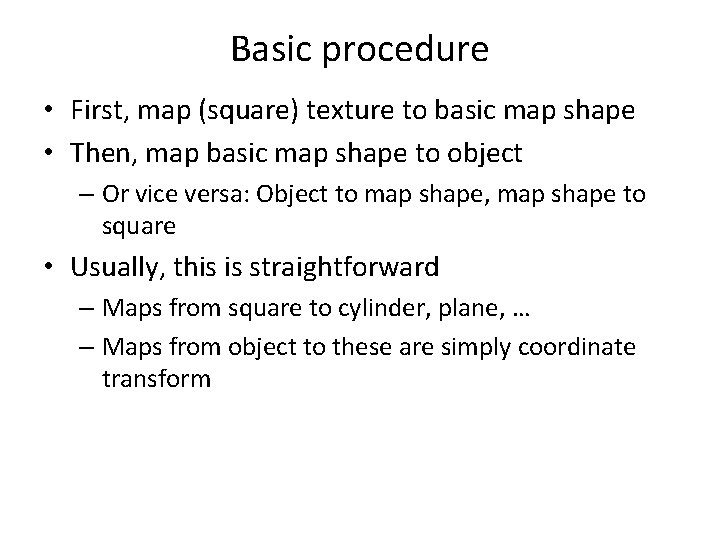
Basic procedure • First, map (square) texture to basic map shape • Then, map basic map shape to object – Or vice versa: Object to map shape, map shape to square • Usually, this is straightforward – Maps from square to cylinder, plane, … – Maps from object to these are simply coordinate transform
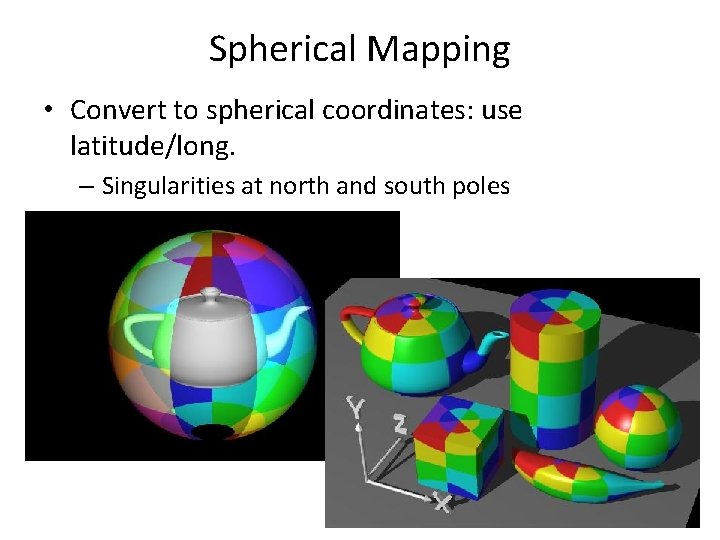
Spherical Mapping • Convert to spherical coordinates: use latitude/long. – Singularities at north and south poles
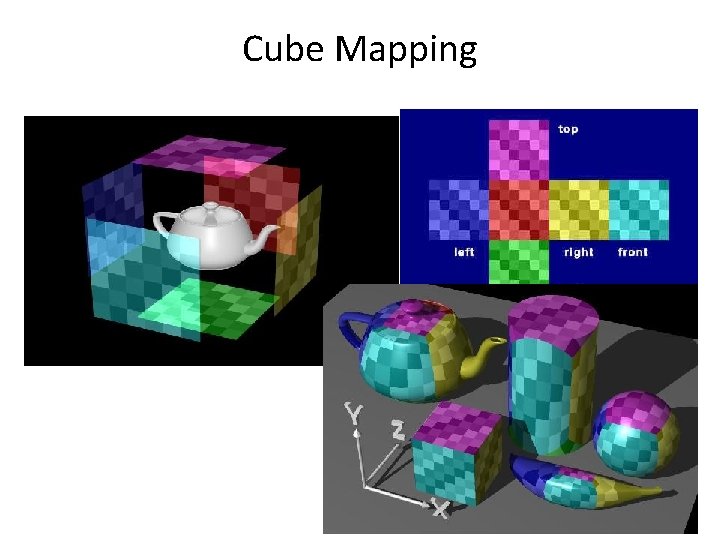
Cube Mapping
- Slides: 36