
CS 551651 Structure of Spoken Language Lecture 6
![Phonological Processes: Ladefoged Rules • [–voiced, +stop] [+aspirated] when syllable initial pit vs. spit](https://slidetodoc.com/presentation_image_h2/9ce70eaec7f7dfe3fb7936ed811b85b8/image-11.jpg "Phonological Processes: Ladefoged Rules • [–voiced, +stop] [+aspirated] when syllable initial pit vs. spit")
![Phonological Processes: Ladefoged Rules • [–voiced] longer when at end of syllable sass, shook](https://slidetodoc.com/presentation_image_h2/9ce70eaec7f7dfe3fb7936ed811b85b8/image-14.jpg "Phonological Processes: Ladefoged Rules • [–voiced] longer when at end of syllable sass, shook")
![Phonological Processes: Ladefoged Rules • [+alveolar, +stop] [+voiced, +flap] when between two vowels, second](https://slidetodoc.com/presentation_image_h2/9ce70eaec7f7dfe3fb7936ed811b85b8/image-16.jpg "Phonological Processes: Ladefoged Rules • [+alveolar, +stop] [+voiced, +flap] when between two vowels, second")
![Phonological Processes: Ladefoged Rules • [+vowel] longer in open syllables sea vs. seed vs.](https://slidetodoc.com/presentation_image_h2/9ce70eaec7f7dfe3fb7936ed811b85b8/image-19.jpg "Phonological Processes: Ladefoged Rules • [+vowel] longer in open syllables sea vs. seed vs.")
- Slides: 23
CS 551/651: Structure of Spoken Language Lecture 6: Phonological Processes John-Paul Hosom Fall 2010 1
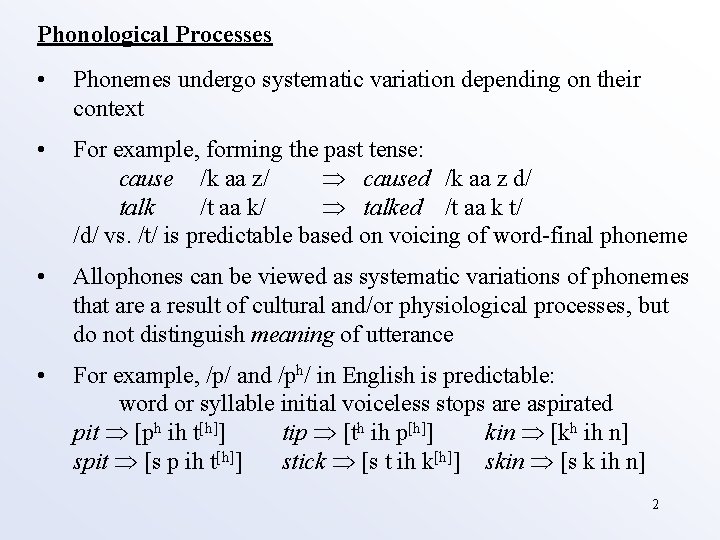
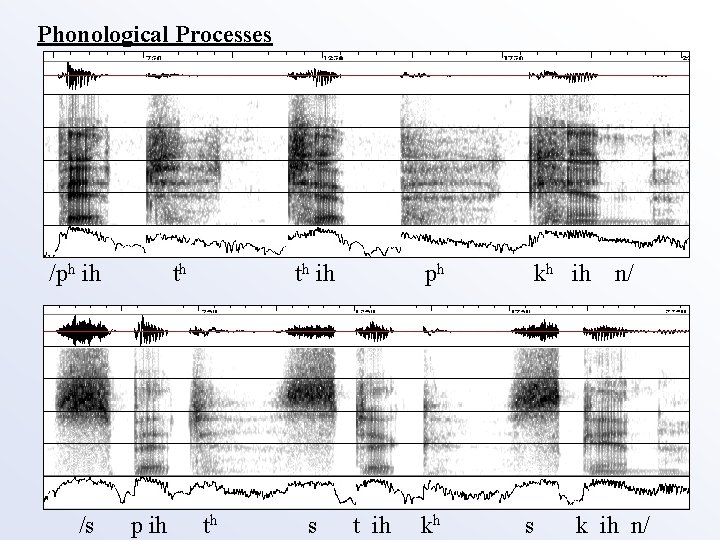
Phonological Processes • Phonemes undergo systematic variation depending on their context • For example, forming the past tense: cause /k aa z/ caused /k aa z d/ talk /t aa k/ talked /t aa k t/ /d/ vs. /t/ is predictable based on voicing of word-final phoneme • Allophones can be viewed as systematic variations of phonemes that are a result of cultural and/or physiological processes, but do not distinguish meaning of utterance • For example, /p/ and /ph/ in English is predictable: word or syllable initial voiceless stops are aspirated pit [ph ih t[h]] tip [th ih p[h]] kin [kh ih n] spit [s p ih t[h]] stick [s t ih k[h]] skin [s k ih n] 2
Phonological Processes /ph ih /s th p ih th s ph t ih kh kh ih s n/ k ih n/ 3
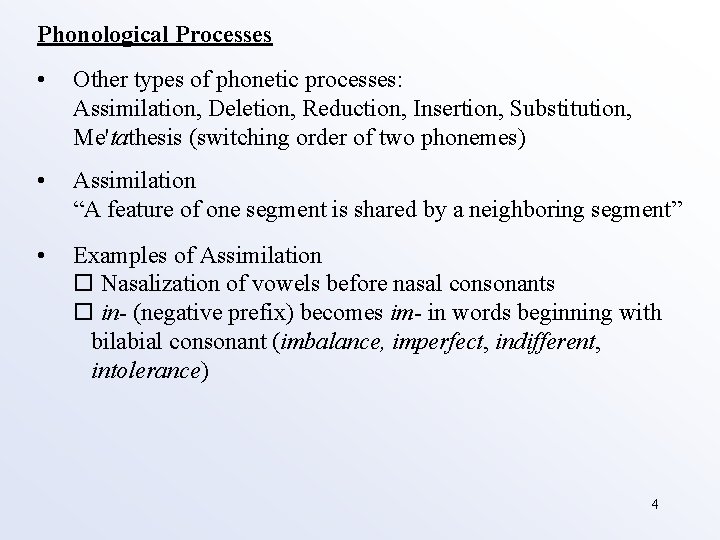
Phonological Processes • Other types of phonetic processes: Assimilation, Deletion, Reduction, Insertion, Substitution, Me'tathesis (switching order of two phonemes) • Assimilation “A feature of one segment is shared by a neighboring segment” • Examples of Assimilation Nasalization of vowels before nasal consonants in- (negative prefix) becomes im- in words beginning with bilabial consonant (imbalance, imperfect, indifferent, intolerance) 4
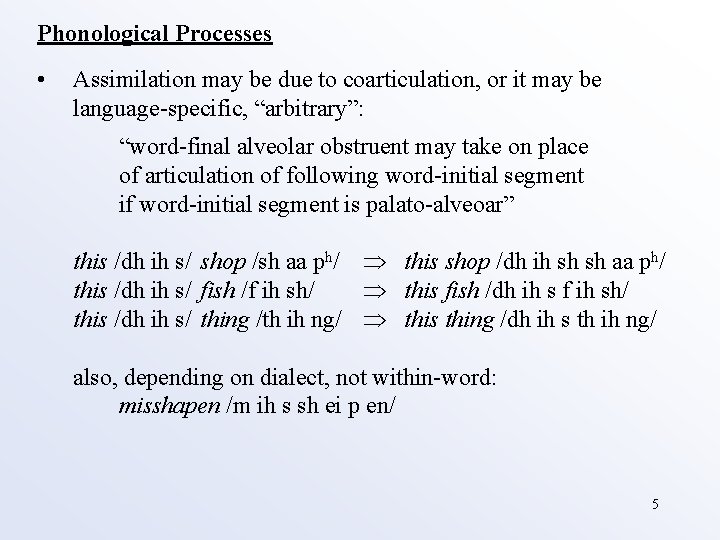
Phonological Processes • Assimilation may be due to coarticulation, or it may be language-specific, “arbitrary”: “word-final alveolar obstruent may take on place of articulation of following word-initial segment if word-initial segment is palato-alveoar” this /dh ih s/ shop /sh aa ph/ this shop /dh ih sh sh aa ph/ this /dh ih s/ fish /f ih sh/ this fish /dh ih s f ih sh/ this /dh ih s/ thing /th ih ng/ this thing /dh ih s th ih ng/ also, depending on dialect, not within-word: misshapen /m ih s sh ei p en/ 5
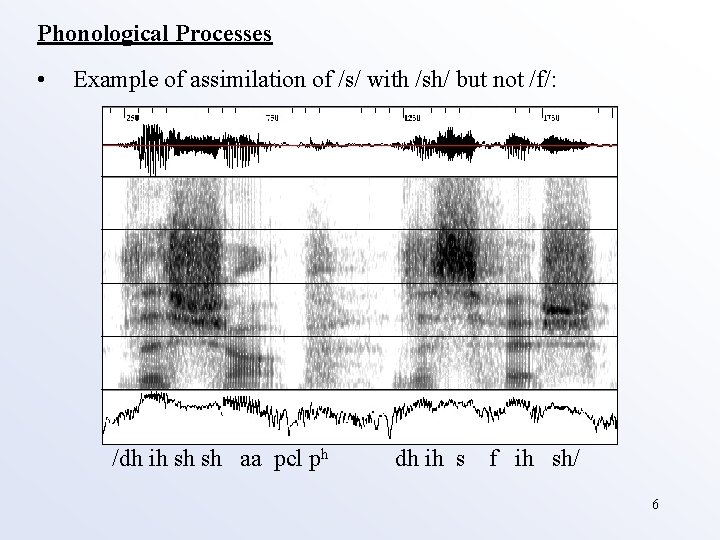
Phonological Processes • Example of assimilation of /s/ with /sh/ but not /f/: /dh ih sh sh aa pcl ph dh ih s f ih sh/ 6
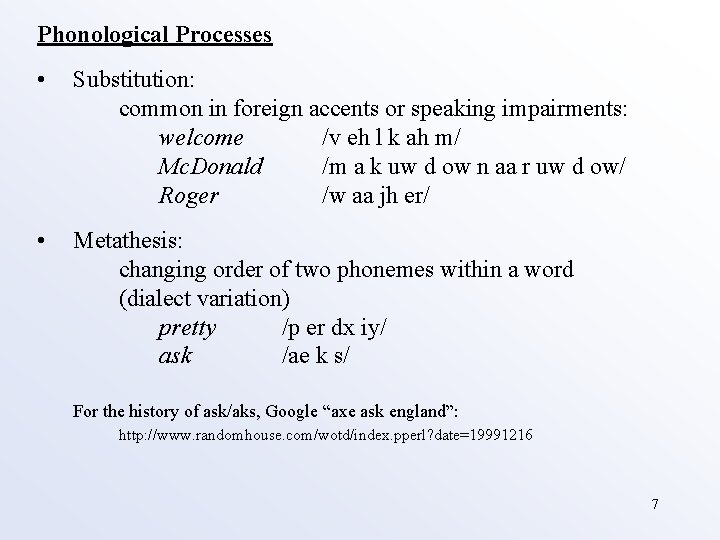
Phonological Processes • Substitution: common in foreign accents or speaking impairments: welcome /v eh l k ah m/ Mc. Donald /m a k uw d ow n aa r uw d ow/ Roger /w aa jh er/ • Metathesis: changing order of two phonemes within a word (dialect variation) pretty /p er dx iy/ ask /ae k s/ For the history of ask/aks, Google “axe ask england”: http: //www. randomhouse. com/wotd/index. pperl? date=19991216 7
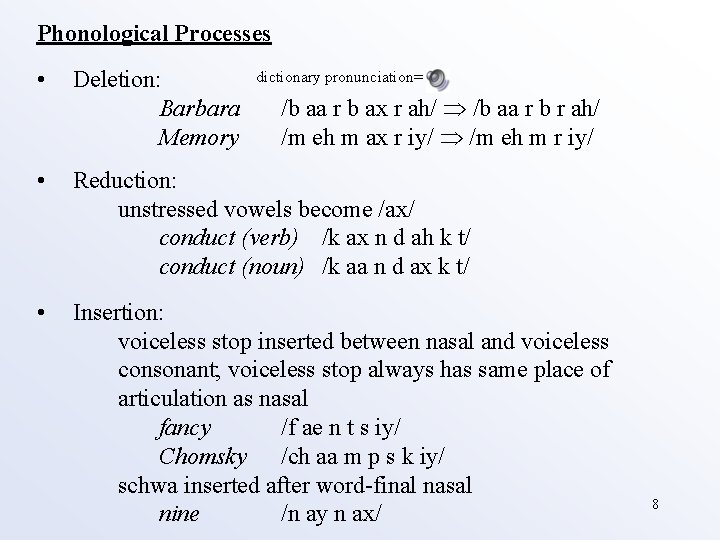
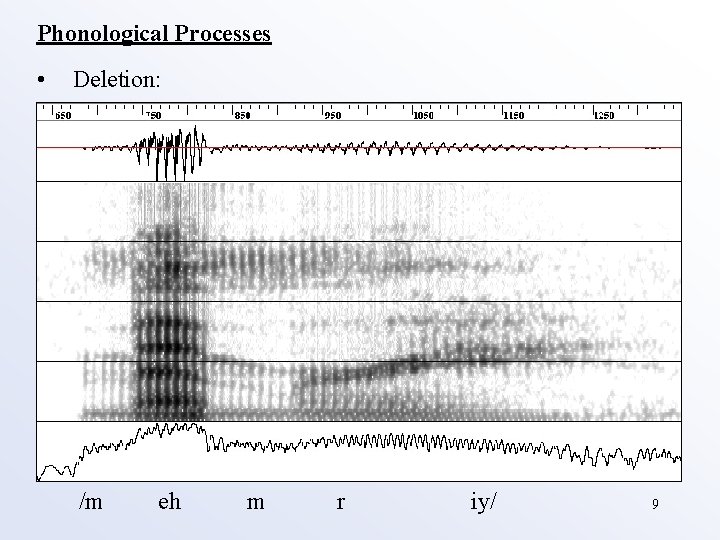
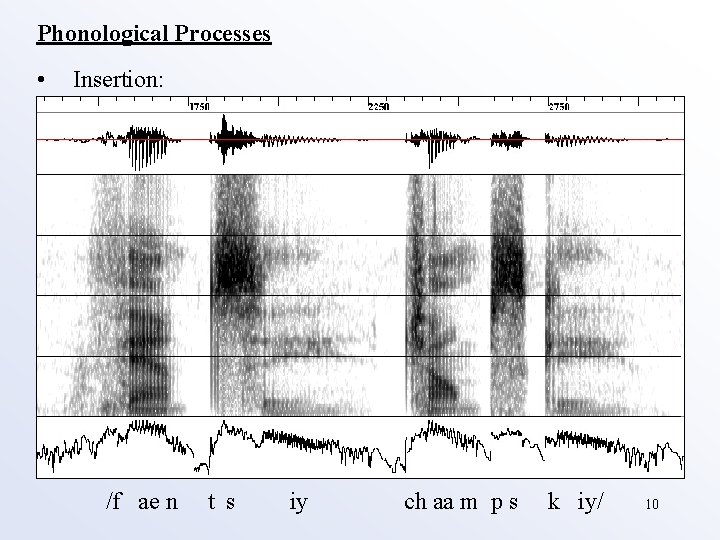
Phonological Processes • Deletion: Barbara Memory • Reduction: unstressed vowels become /ax/ conduct (verb) /k ax n d ah k t/ conduct (noun) /k aa n d ax k t/ • Insertion: voiceless stop inserted between nasal and voiceless consonant; voiceless stop always has same place of articulation as nasal fancy /f ae n t s iy/ Chomsky /ch aa m p s k iy/ schwa inserted after word-final nasal nine /n ay n ax/ dictionary pronunciation= /b aa r b ax r ah/ /b aa r b r ah/ /m eh m ax r iy/ /m eh m r iy/ 8
Phonological Processes • Deletion: /m eh m r iy/ 9
Phonological Processes • Insertion: /f ae n t s iy ch aa m p s k iy/ 10
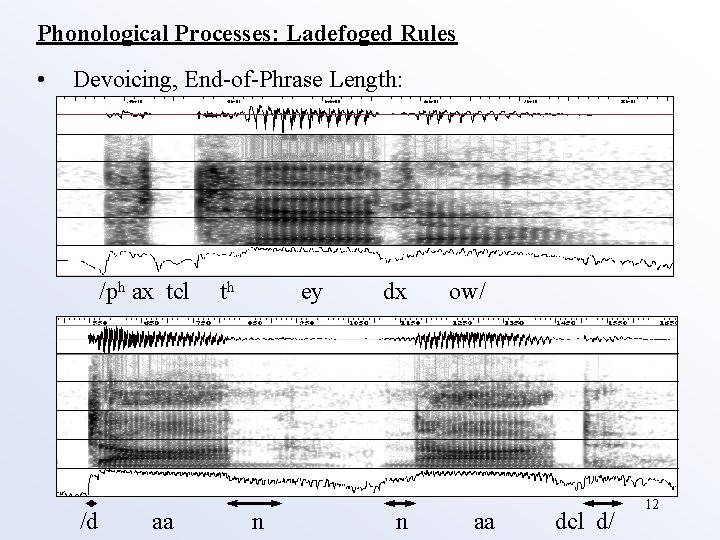
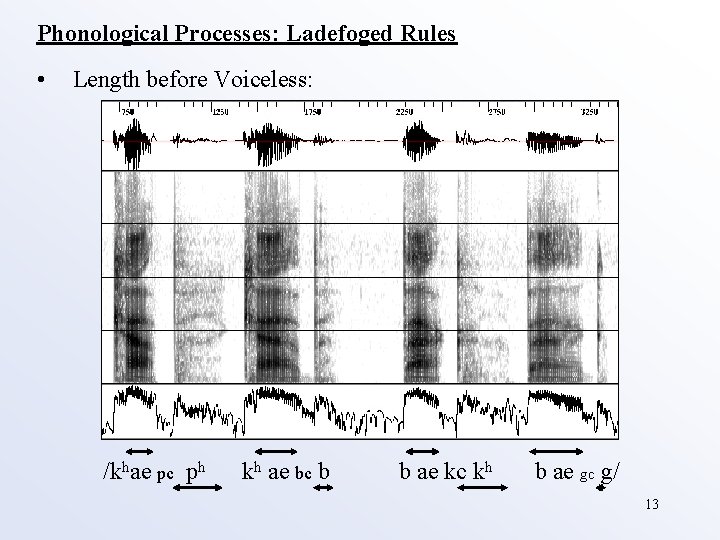
Phonological Processes: Ladefoged Rules • [–voiced, +stop] [+aspirated] when syllable initial pit vs. spit • [ax] [–voiced] after syllable-initial [–voiced, +stop] and before [–voiced, +stop] potato • [+consonantal] longer at end of phrase bib, did, don, nod • [–voiced, +stop] [–aspirated] after syllable-initial /s/ spew, stew, skew • [+vowel] shorter before unvoiced phonemes in same syllable cap vs. cab, back vs. bag 11
Phonological Processes: Ladefoged Rules • Devoicing, End-of-Phrase Length: /ph ax tcl /d aa th ey n dx n ow/ aa dcl d/ 12
Phonological Processes: Ladefoged Rules • Length before Voiceless: /khae pc ph kh ae bc b b ae kc kh b ae gc g/ 13
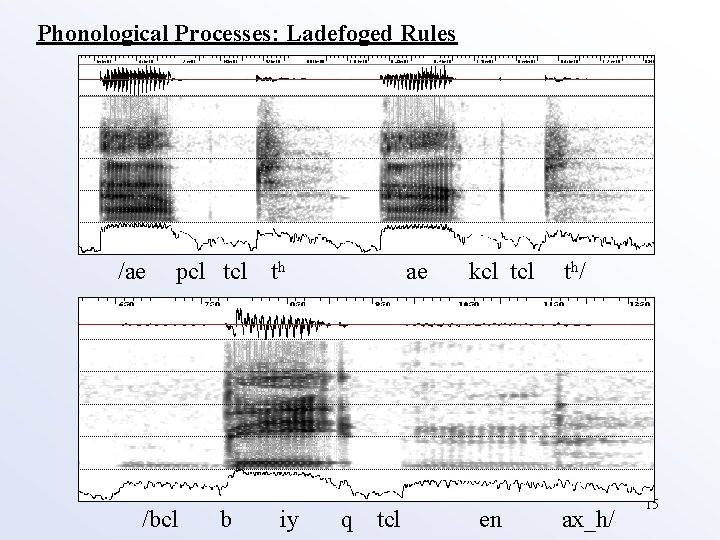
Phonological Processes: Ladefoged Rules • [–voiced] longer when at end of syllable sass, shook vs. push • [+stop] unreleased before [+stop] apt, act (often see some mark in spectrogram) • [–voiced, +alveolar, +stop] [+glottal stop] when before an alveolar nasal in same word beaten /b iy q en/ • [+nasal] [+syllabic] at word end when following [+obstruent] chasm /k ae z em/ NOT film (obstruent = complete closure of airway; /l/ is not) • [+liquid] [+syllabic] at word end and following [+consonant] paddle, whistle, kennel, razor, hammer, tailor NOT snarl; change to “following [+obstruent]”? 14
Phonological Processes: Ladefoged Rules /ae pcl tcl /bcl b th iy ae q tcl kcl tcl en t h/ ax_h/ 15
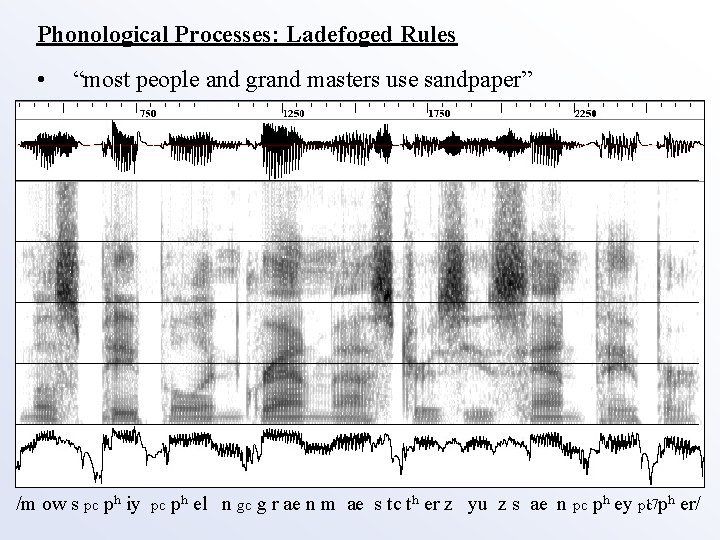
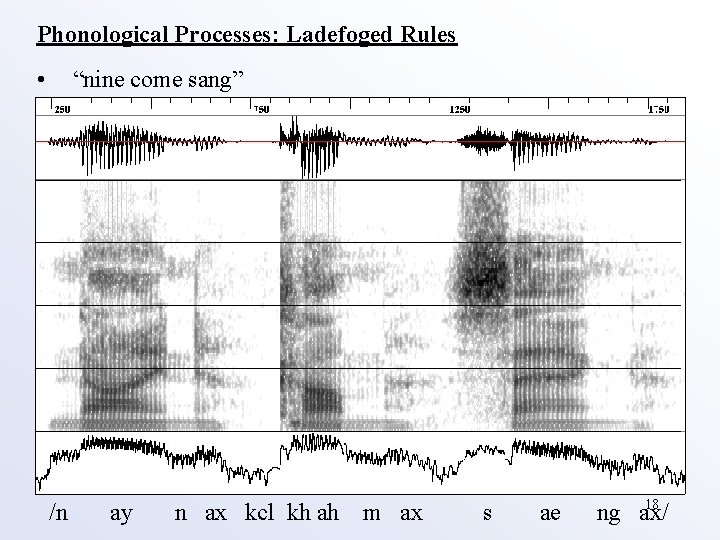
Phonological Processes: Ladefoged Rules • [+alveolar, +stop] [+voiced, +flap] when between two vowels, second of which is unstressed This rule has speaker-dependent variations • [+alveolar, +stop] omitted between two consonants most people, sandpaper, grand master • [+consonant] shortened before identical [+consonant] • [–voice, +stop] between [+nasal] and [–voice, +fricative] when following vowel absent or unstressed prince vs. prints (e'penthesis) • [&] following word-final [+nasal, +consonantal] nine come sang (e'penthesis) 16
Phonological Processes: Ladefoged Rules • “most people and grand masters use sandpaper” /m ow s pc ph iy pc ph el n gc g r ae n m ae s tc th er z yu z s ae n pc ph ey pc 17 ph er/
Phonological Processes: Ladefoged Rules • “nine come sang” /n ay n ax kcl kh ah m ax s ae 18 ng ax/
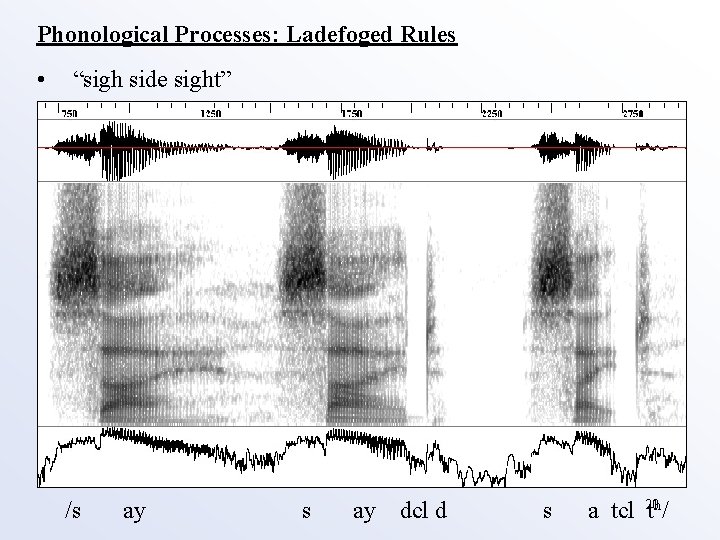
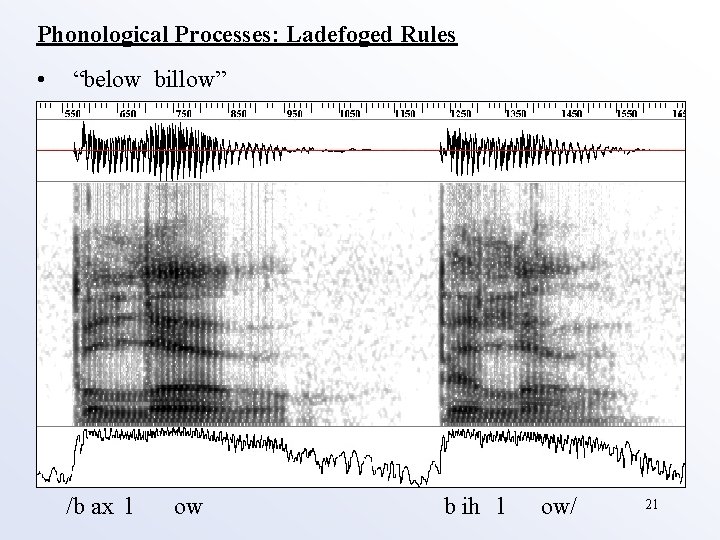
Phonological Processes: Ladefoged Rules • [+vowel] longer in open syllables sea vs. seed vs. seat sigh vs. side vs. sight (equalize length of syllables with differing numbers of segments) • [+vowel] longer in stressed syllable below vs. billow (stressed syllables are longer in duration than unstressed) • [+vowel] [+nasal] before [+nasal] consonant • [+vowel, –stressed] schwa (vowel reduction) able vs. ability Canada vs. Canadian photograph vs. photography 19
Phonological Processes: Ladefoged Rules • “sigh side sight” /s ay dcl d s a tcl 20 th/
Phonological Processes: Ladefoged Rules • “below billow” /b ax l ow b ih l ow/ 21
Phonological Processes • Why is this useful? (a) Providing models of known phenomenon is better than having classifier learn the phenomenon from data (b) Provides humans with appropriate cues for understanding, naturalness (c) Accurate phonetic modeling improves ability of classifier to discriminate between classes • Example for Text-to-Speech (case (b)): Create a TTS system Don’t shorten vowels before voiceless plosives Creates, by default, acoustic cue for voiced plosives Decrease intelligibility or at least naturalness of system 22
Phonological Processes • Example for Automatic Speech Recognition (case (c)): Train a speech recognizer using “dictionary” pronunciation Then, in all cases where [–voice, +stop] between [+nasal] and [–voice, +fricative] such as “fancy” (in CMU dictionary as /f ae n s iy/), acoustics show alveolar stop, but trained as either nasal /n/ or fricative /s/. Decreases ability of model to discriminate classes Decreases performance of system • Difficulty is in providing comprehensive, accurate rules that are not inappropriately “forced” on a system 23