
CS 548 Spring 2016 Decision Trees Showcase By
CS 548 Spring 2016 Decision Trees Showcase By Yi Jiang and Brandon Boos ----Showcase work by Zhun Yu, Fariborz Haghighat, Benjamin C. M. Fung, and Hiroshi Yoshino on A decision tree method for building energy demand modeling Worcester Polytechnic Institute
![References [1] Zhun Yu, Fariborz Haghighat, Benjamin C. M. Fung, and Hiroshi Yoshino. “A](http://slidetodoc.com/presentation_image_h/2feb63659cc6ef55a10752e101f0b990/image-2.jpg "References [1] Zhun Yu, Fariborz Haghighat, Benjamin C. M. Fung, and Hiroshi Yoshino. “A")
References [1] Zhun Yu, Fariborz Haghighat, Benjamin C. M. Fung, and Hiroshi Yoshino. “A decision tree method for building energy demand modeling, ” Energy and Building, Vol. 48, no. 10, pp. 16371646, Oct. 2010 [2] James, Witten, Hastie and Tibshirani. An Introduction to Statistical Learning with Applications in R. Springer Texts in Statistics Vol. 103, 2013 2 Worcester Polytechnic Institute

Why Predicting EUI matters? • EUI stands for Energy Use Intensity . • Energy consumption throughout the world increased significantly • For efficient building design Taken from baidu. com/imaghttp: //news. zhulong. com/read 2 05630. html 3 Worcester Polytechnic Institute
Overview of Decision tree • What is a tree? • A tree is a prediction method with simple rules to divide the range of variables into smaller and smaller sections. Taken from http: //www. taopic. com/vector/201212/286317. html Worcester Polytechnic Institute

Cons & Pros • Comparison among three method in this paper • Decision tree wins!(the accuracies are almost the same) Tree methods Advantage Disadvantage Regression models ANN models understandable interpretable easy to execute simple and efficient can model complex relationships too easy hard to interpret complicated to operate Worcester Polytechnic Institute
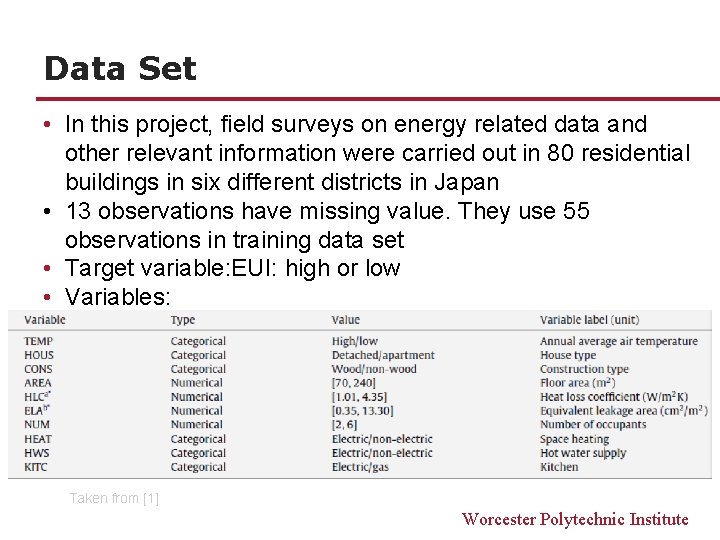
Data Set • In this project, field surveys on energy related data and other relevant information were carried out in 80 residential buildings in six different districts in Japan • 13 observations have missing value. They use 55 observations in training data set • Target variable: EUI: high or low • Variables: Taken from [1] Worcester Polytechnic Institute

Decision Tree Generation Splitting dataset into training and test data • Attribute Selection Criterion Generating decision tree using training data Estimating the accuracy Improve the model Worcester Polytechnic Institute
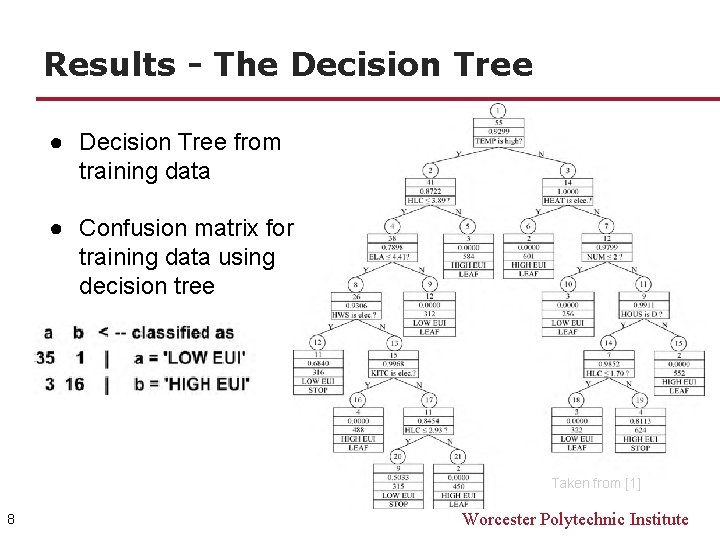
Results - The Decision Tree ● Decision Tree from training data ● Confusion matrix for training data using decision tree Taken from [1] 8 Worcester Polytechnic Institute
![Results - Prediction on Test Data Taken from [1] 9 Worcester Polytechnic Institute](http://slidetodoc.com/presentation_image_h/2feb63659cc6ef55a10752e101f0b990/image-9.jpg "Results - Prediction on Test Data Taken from [1] 9 Worcester Polytechnic Institute")
Results - Prediction on Test Data Taken from [1] 9 Worcester Polytechnic Institute
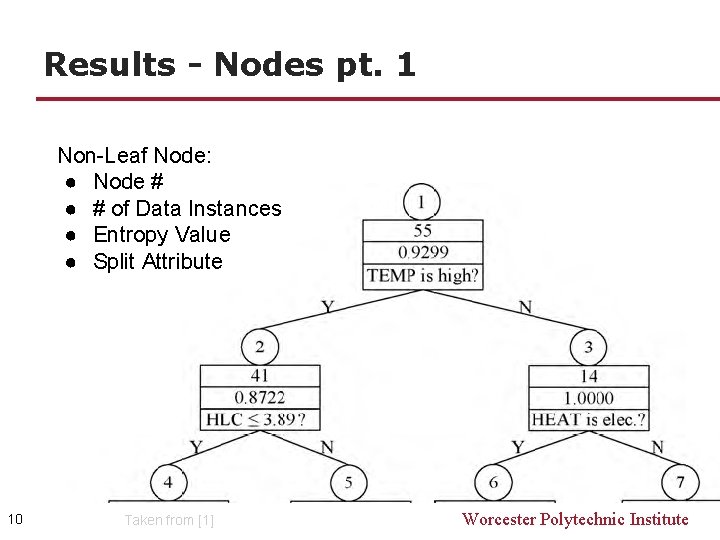
Results - Nodes pt. 1 Non-Leaf Node: ● Node # ● # of Data Instances ● Entropy Value ● Split Attribute 10 Taken from [1] Worcester Polytechnic Institute
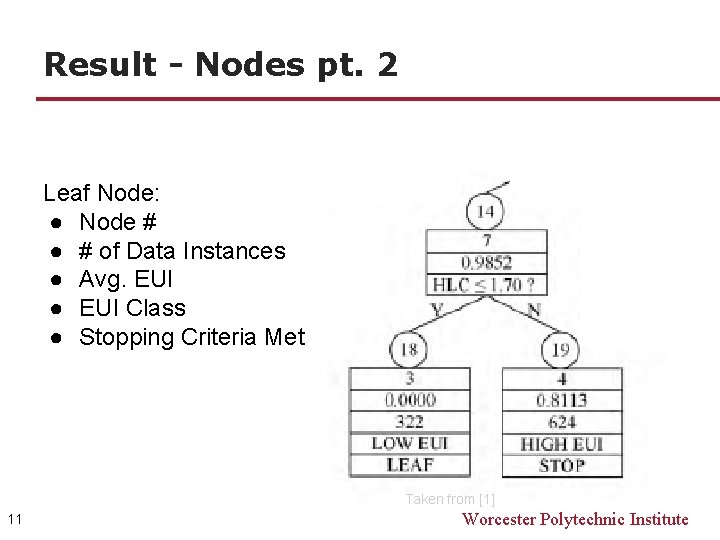
Result - Nodes pt. 2 Leaf Node: ● Node # ● # of Data Instances ● Avg. EUI ● EUI Class ● Stopping Criteria Met Taken from [1] 11 Worcester Polytechnic Institute
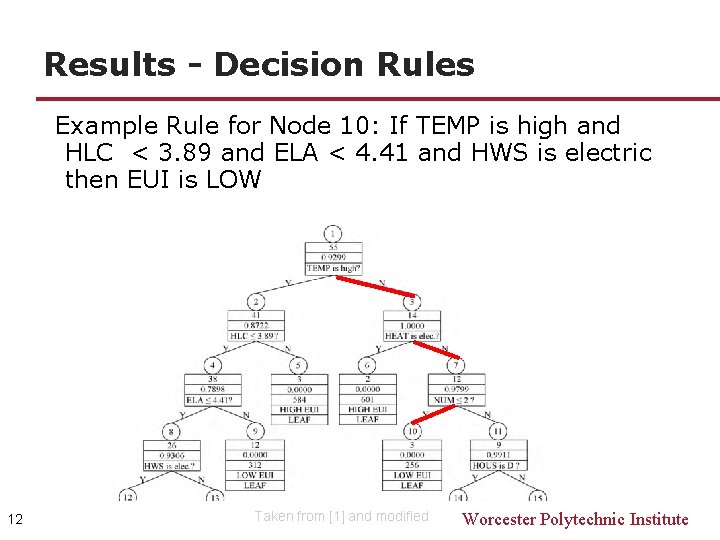
Results - Decision Rules Example Rule for Node 10: If TEMP is high and HLC < 3. 89 and ELA < 4. 41 and HWS is electric then EUI is LOW 12 Taken from [1] and modified Worcester Polytechnic Institute
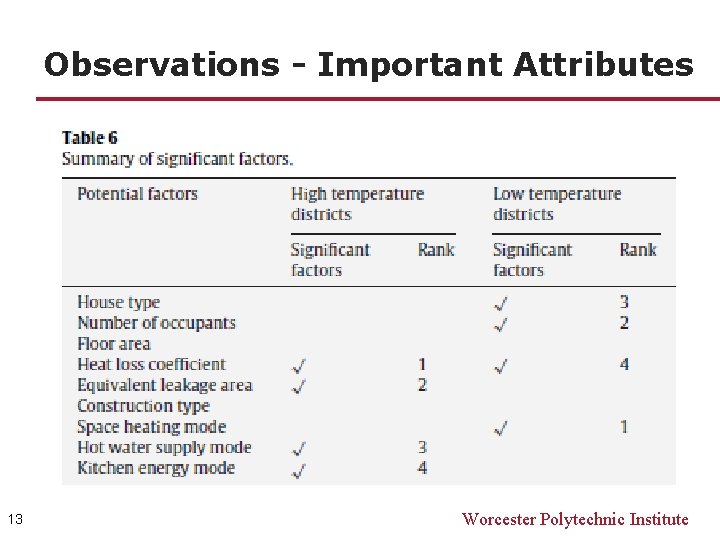
Observations - Important Attributes 13 Worcester Polytechnic Institute
Observations - Interesting • The importance of attributes for high and low temperature areas are different • High temperature areas benefit from a certain value of equivalent leakage area as long as the heat loss coefficient is low enough 14 Worcester Polytechnic Institute
Conclusions • The decision tree provides an easily understood model which can help building designers and owners know which attributes to prioritize in order to lower energy use • Non-binary classification could improve the results but would also increase chance of misclassification • Larger data set needed 15 Worcester Polytechnic Institute
- Slides: 15