
CS 541 Artificial Intelligence Lecture VIII Temporal Probability
CS 541: Artificial Intelligence Lecture VIII: Temporal Probability Models
Re-cap of Lecture VII � Exact inference by variable elimination: � � � polytime on polytrees, NP-hard on general graphs space = time, very sensitive to topology Approximate inference by LW, MCMC: � � LW does poorly when there is lots of (downstream) evidence LW, MCMC generally insensitive to topology Convergence can be very slow with probabilities close to 1 or 0 Can handle arbitrary combinations of discrete and continuous variables
Re-cap of Lecture IX Machine Learning � Classification (Naïve Bayes) � Decision trees � Regression (Linear, Smoothing) � Linear Separation (Perceptron, SVMs) � Non-parametric classification (KNN) �
Outline � Time and uncertainty � Inference: filtering, prediction, smoothing � Hidden Markov models � Kalman filters (a brief mention) � Dynamic Bayesian networks � Particle filtering

Time and uncertainty
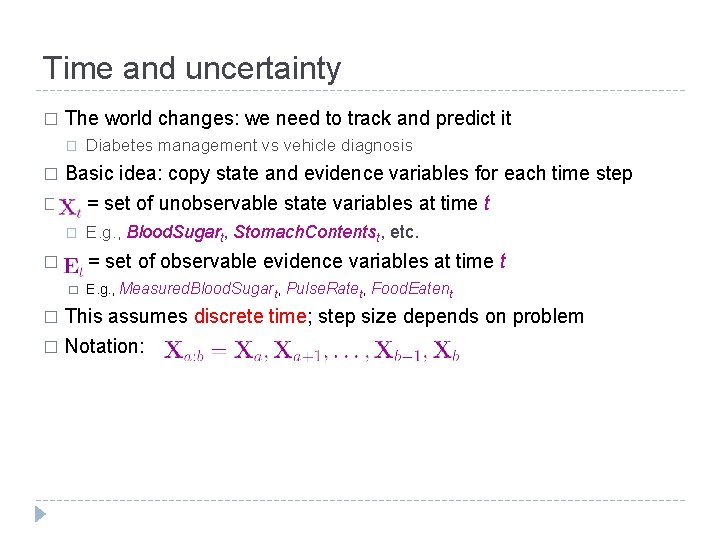
Time and uncertainty � The world changes: we need to track and predict it � Diabetes management vs vehicle diagnosis Basic idea: copy state and evidence variables for each time step � = set of unobservable state variables at time t � � E. g. , Blood. Sugart, Stomach. Contentst, etc. = set of observable evidence variables at time t � � E. g. , Measured. Blood. Sugart, Pulse. Ratet, Food. Eatent This assumes discrete time; step size depends on problem � Notation: �
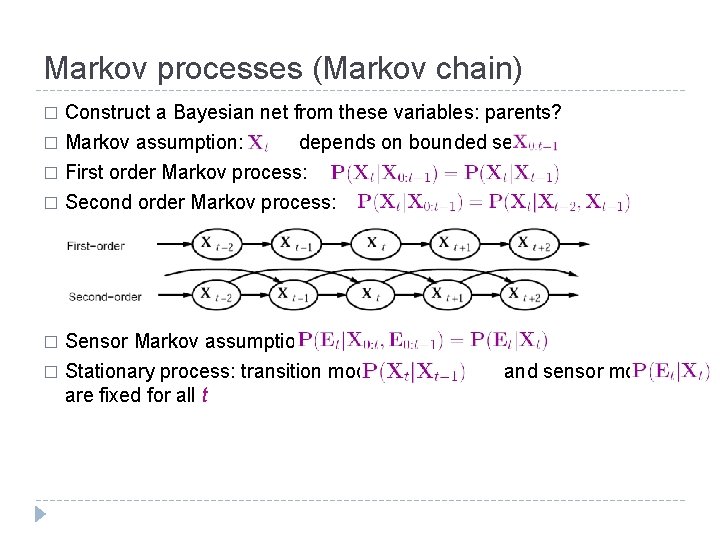
Markov processes (Markov chain) Construct a Bayesian net from these variables: parents? � Markov assumption: depends on bounded set of � First order Markov process: � Second order Markov process: � Sensor Markov assumption: � Stationary process: transition model are fixed for all t � and sensor model
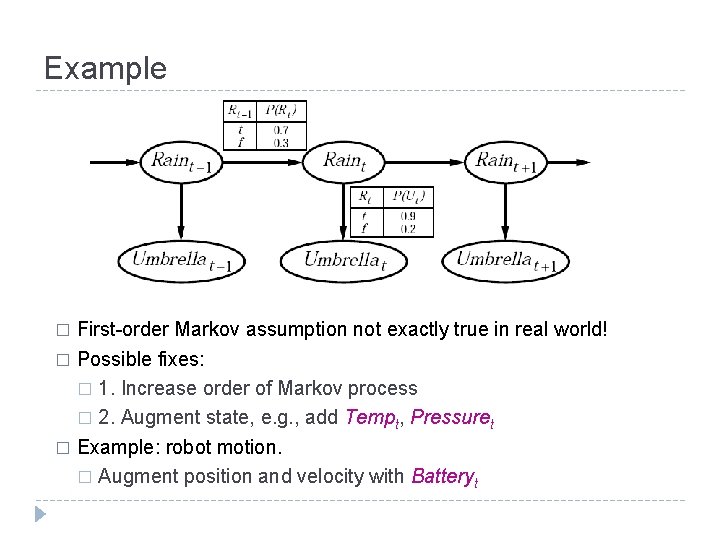
Example First-order Markov assumption not exactly true in real world! � Possible fixes: � 1. Increase order of Markov process � 2. Augment state, e. g. , add Tempt, Pressuret � Example: robot motion. � Augment position and velocity with Batteryt �
Inference
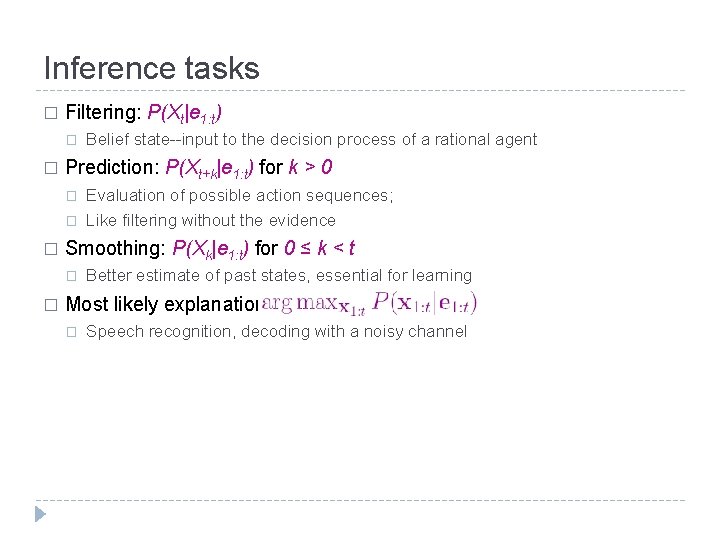
Inference tasks � Filtering: P(Xt|e 1: t) � � Prediction: P(Xt+k|e 1: t) for k > 0 � � � Evaluation of possible action sequences; Like filtering without the evidence Smoothing: P(Xk|e 1: t) for 0 ≤ k < t � � Belief state--input to the decision process of a rational agent Better estimate of past states, essential for learning Most likely explanation: � Speech recognition, decoding with a noisy channel
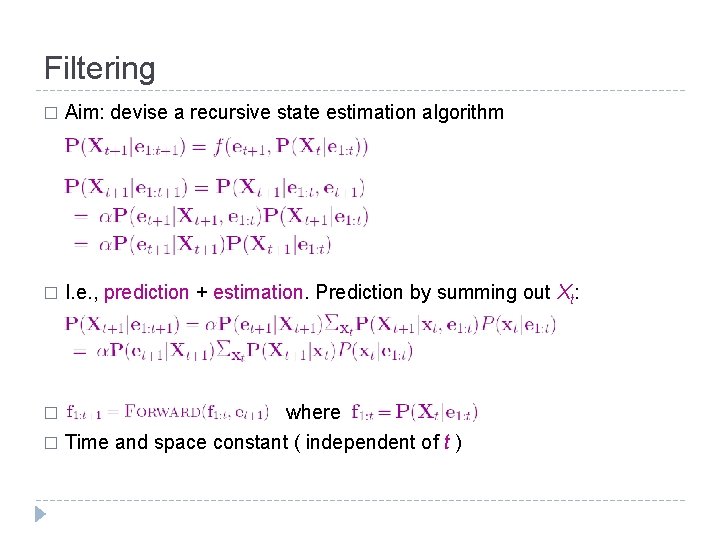
Filtering � Aim: devise a recursive state estimation algorithm � I. e. , prediction + estimation. Prediction by summing out Xt: where � Time and space constant ( independent of t ) �

Filtering example
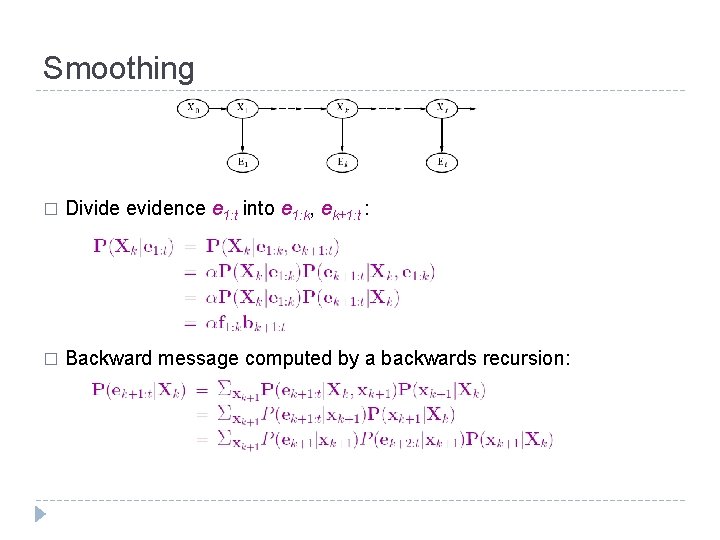
Smoothing � Divide evidence e 1: t into e 1: k, ek+1: t : � Backward message computed by a backwards recursion:
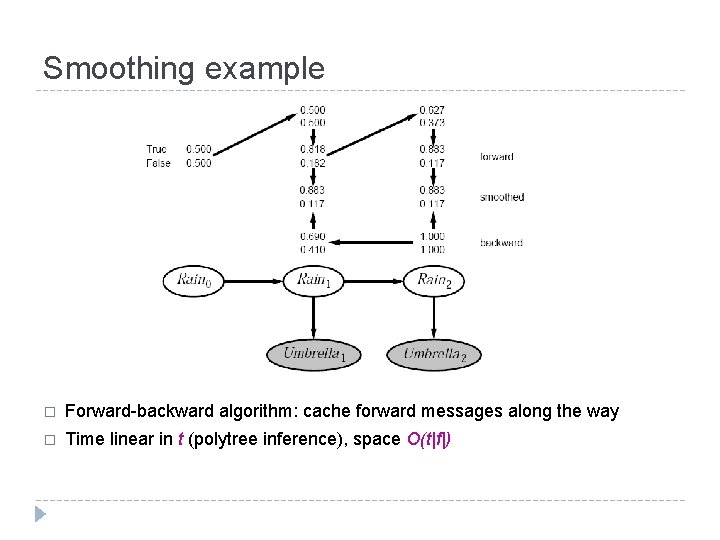
Smoothing example � Forward-backward algorithm: cache forward messages along the way � Time linear in t (polytree inference), space O(t|f|)
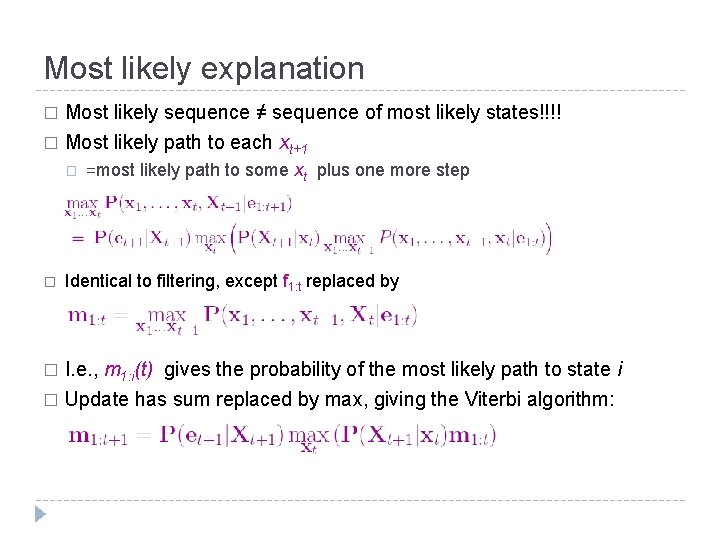
Most likely explanation Most likely sequence ≠ sequence of most likely states!!!! � Most likely path to each xt+1 � � � =most likely path to some xt plus one more step Identical to filtering, except f 1: t replaced by I. e. , m 1: i(t) gives the probability of the most likely path to state i � Update has sum replaced by max, giving the Viterbi algorithm: �
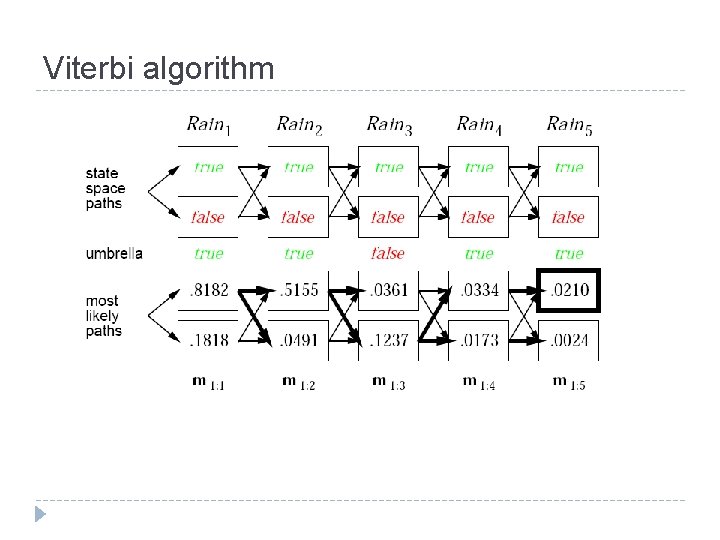
Viterbi algorithm

Hidden Markov models
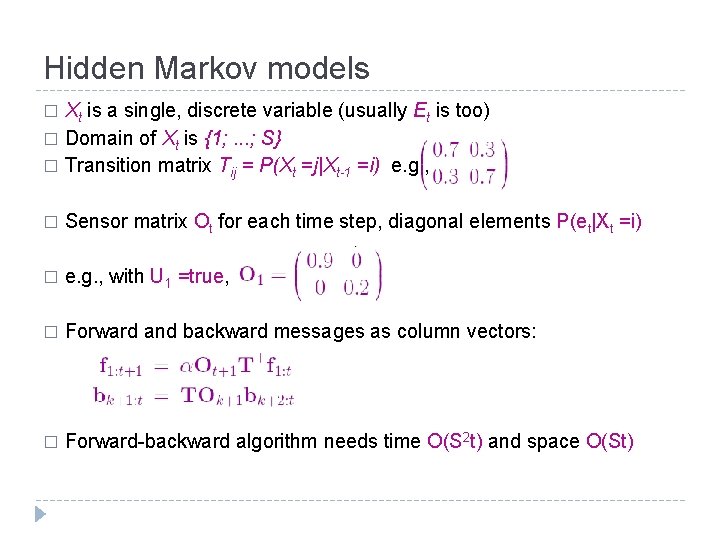
Hidden Markov models Xt is a single, discrete variable (usually Et is too) � Domain of Xt is {1; . . . ; S} � Transition matrix Tij = P(Xt =j|Xt-1 =i) e. g. , � � Sensor matrix Ot for each time step, diagonal elements P(et|Xt =i) � e. g. , with U 1 =true, � Forward and backward messages as column vectors: � Forward-backward algorithm needs time O(S 2 t) and space O(St)
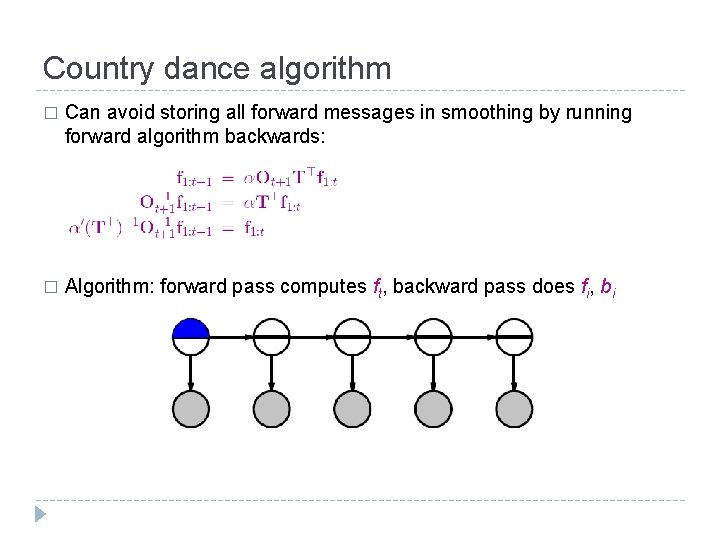
Country dance algorithm � Can avoid storing all forward messages in smoothing by running forward algorithm backwards: � Algorithm: forward pass computes ft, backward pass does fi, bi
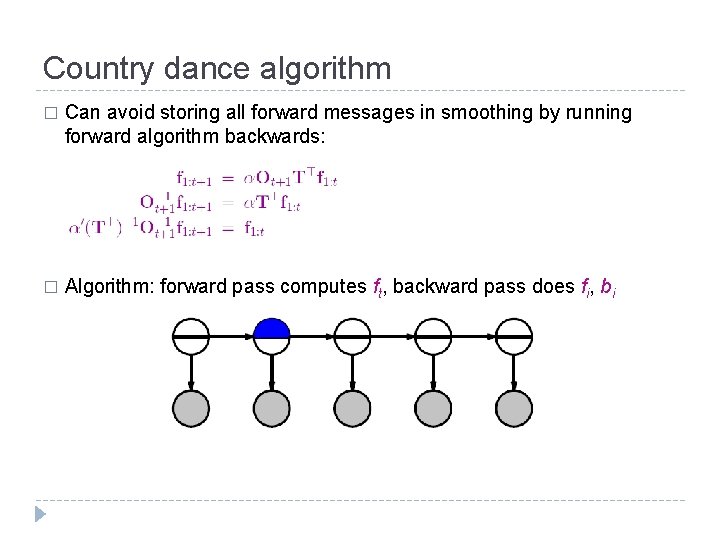
Country dance algorithm � Can avoid storing all forward messages in smoothing by running forward algorithm backwards: � Algorithm: forward pass computes ft, backward pass does fi, bi
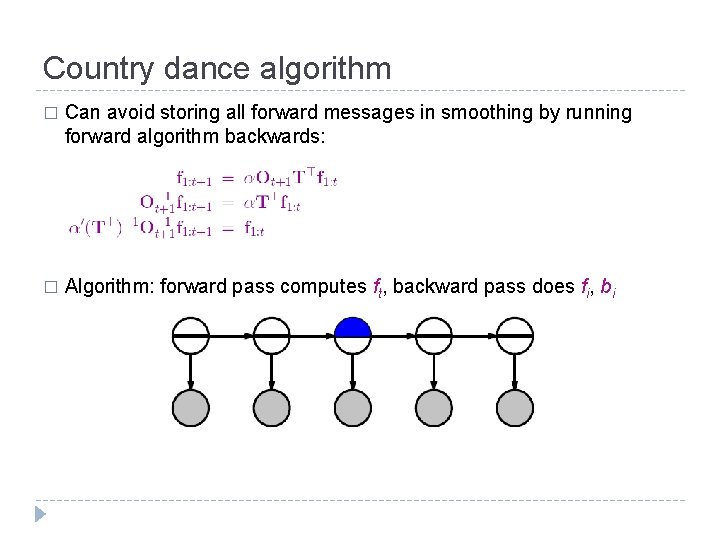
Country dance algorithm � Can avoid storing all forward messages in smoothing by running forward algorithm backwards: � Algorithm: forward pass computes ft, backward pass does fi, bi
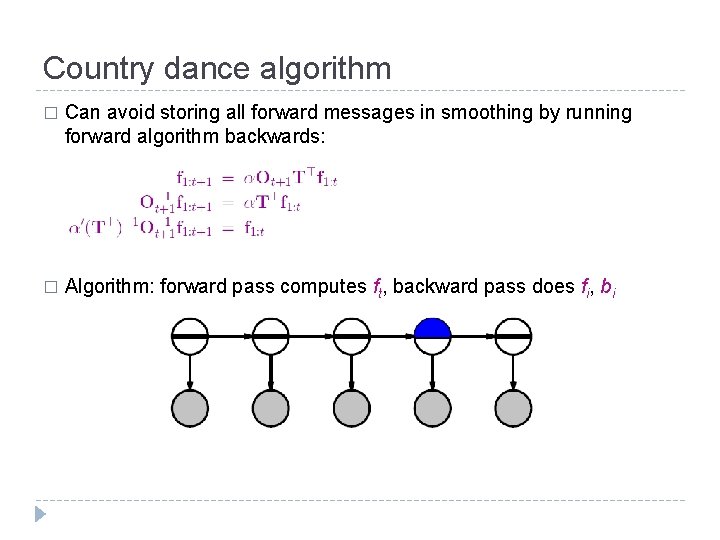
Country dance algorithm � Can avoid storing all forward messages in smoothing by running forward algorithm backwards: � Algorithm: forward pass computes ft, backward pass does fi, bi
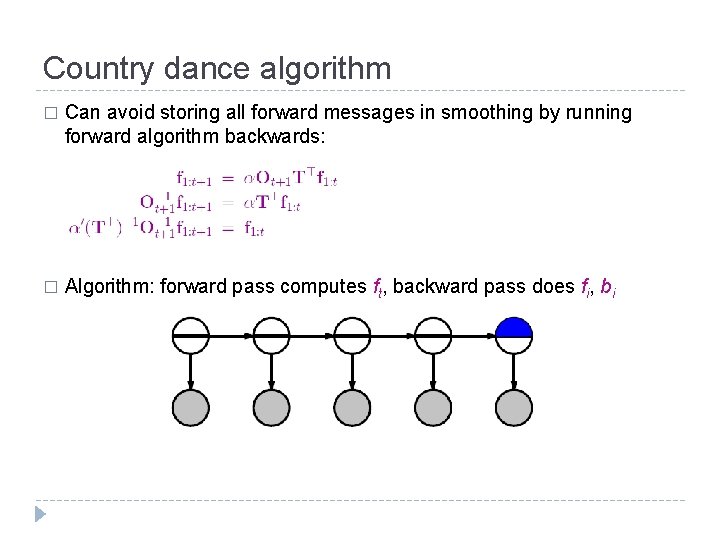
Country dance algorithm � Can avoid storing all forward messages in smoothing by running forward algorithm backwards: � Algorithm: forward pass computes ft, backward pass does fi, bi
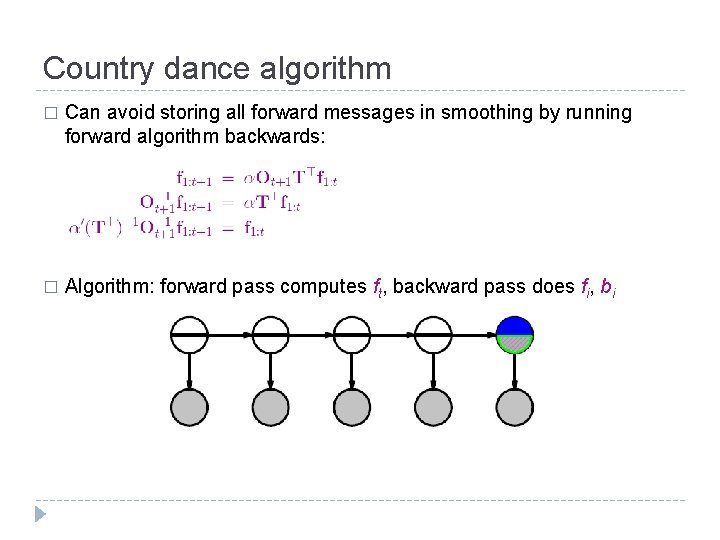
Country dance algorithm � Can avoid storing all forward messages in smoothing by running forward algorithm backwards: � Algorithm: forward pass computes ft, backward pass does fi, bi
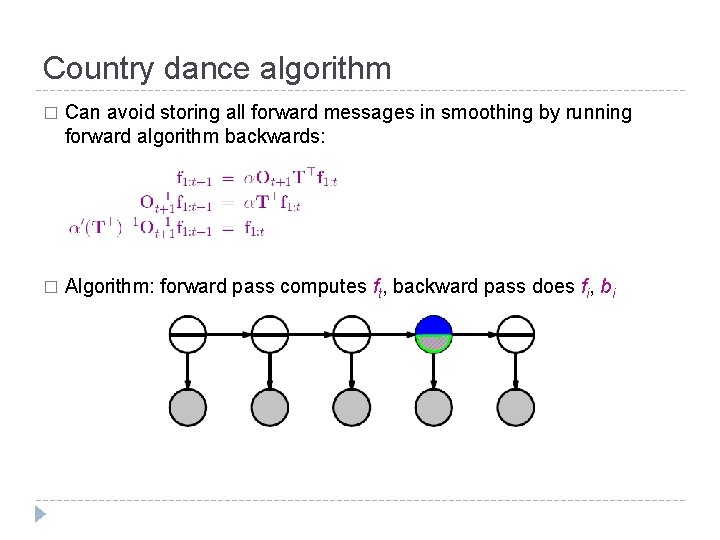
Country dance algorithm � Can avoid storing all forward messages in smoothing by running forward algorithm backwards: � Algorithm: forward pass computes ft, backward pass does fi, bi
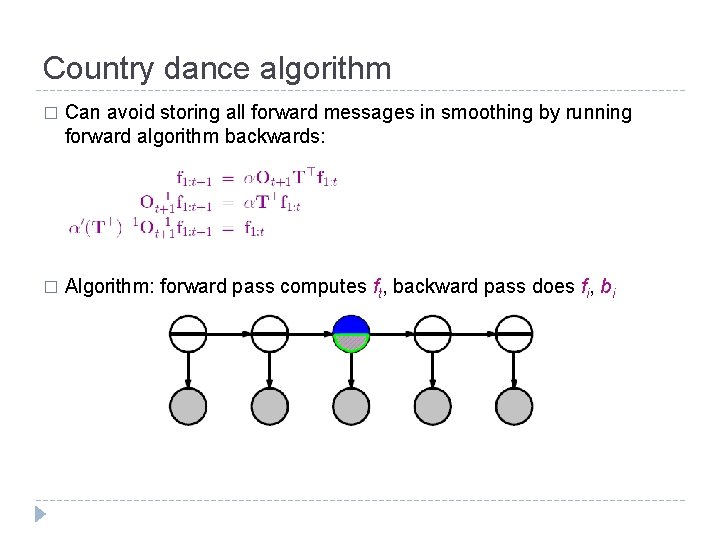
Country dance algorithm � Can avoid storing all forward messages in smoothing by running forward algorithm backwards: � Algorithm: forward pass computes ft, backward pass does fi, bi
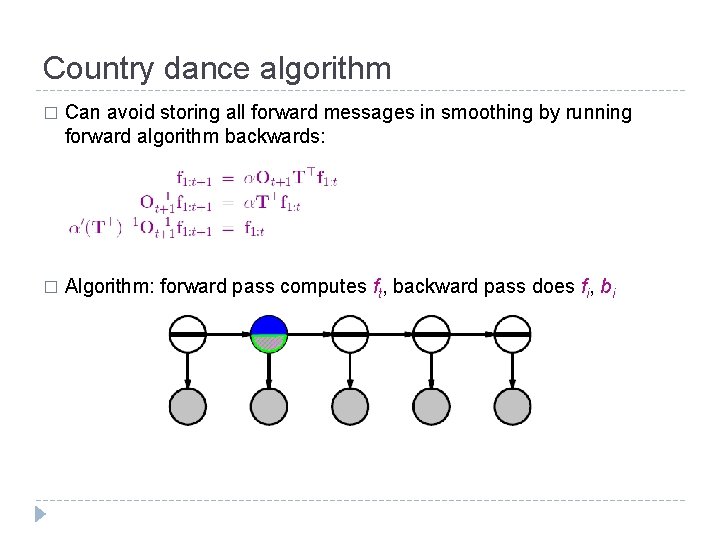
Country dance algorithm � Can avoid storing all forward messages in smoothing by running forward algorithm backwards: � Algorithm: forward pass computes ft, backward pass does fi, bi
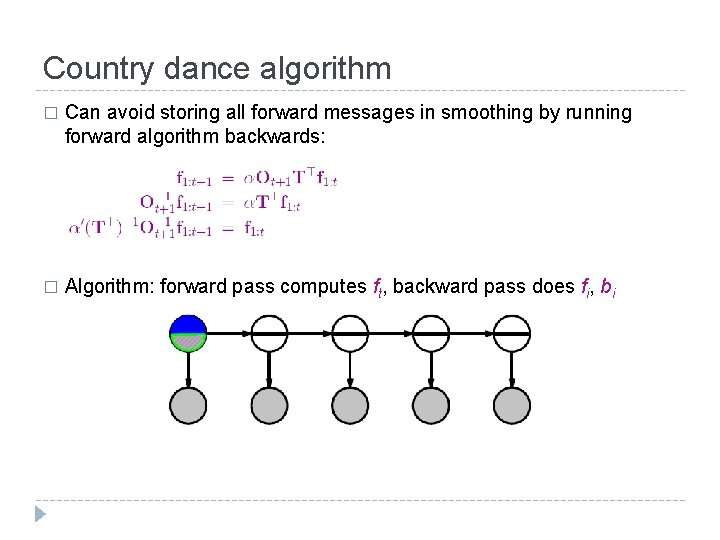
Country dance algorithm � Can avoid storing all forward messages in smoothing by running forward algorithm backwards: � Algorithm: forward pass computes ft, backward pass does fi, bi

Kalman filtering
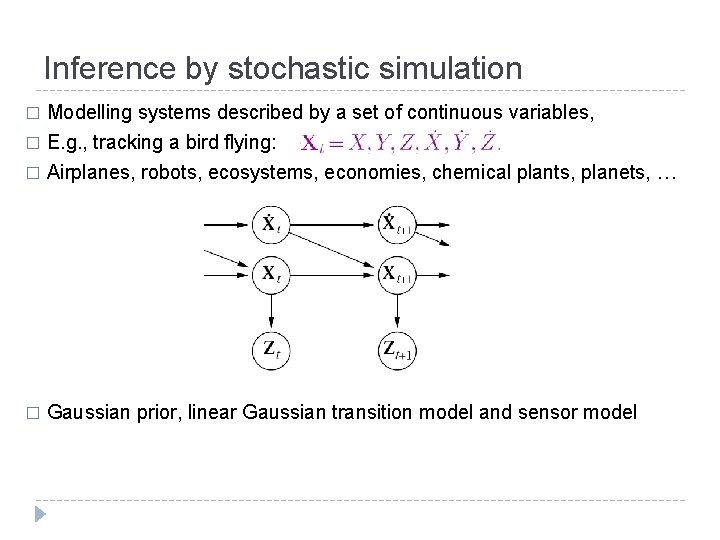
Inference by stochastic simulation Modelling systems described by a set of continuous variables, � E. g. , tracking a bird flying: � � Airplanes, robots, ecosystems, economies, chemical plants, planets, … � Gaussian prior, linear Gaussian transition model and sensor model
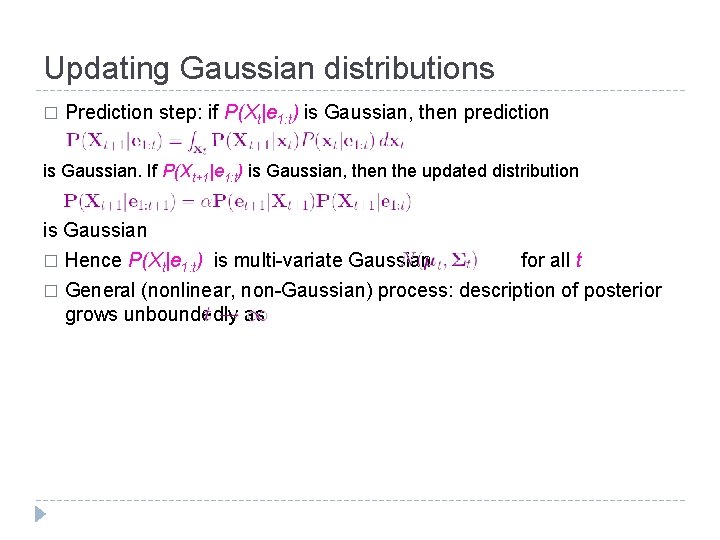
Updating Gaussian distributions � Prediction step: if P(Xt|e 1: t) is Gaussian, then prediction is Gaussian. If P(Xt+1|e 1: t) is Gaussian, then the updated distribution is Gaussian � Hence P(Xt|e 1: t) is multi-variate Gaussian for all t � General (nonlinear, non-Gaussian) process: description of posterior grows unboundedly as
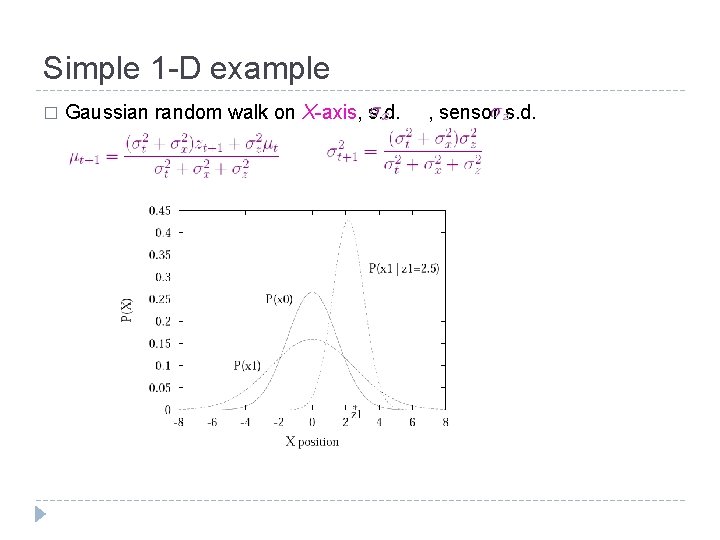
Simple 1 -D example � Gaussian random walk on X-axis, s. d. , sensor s. d.
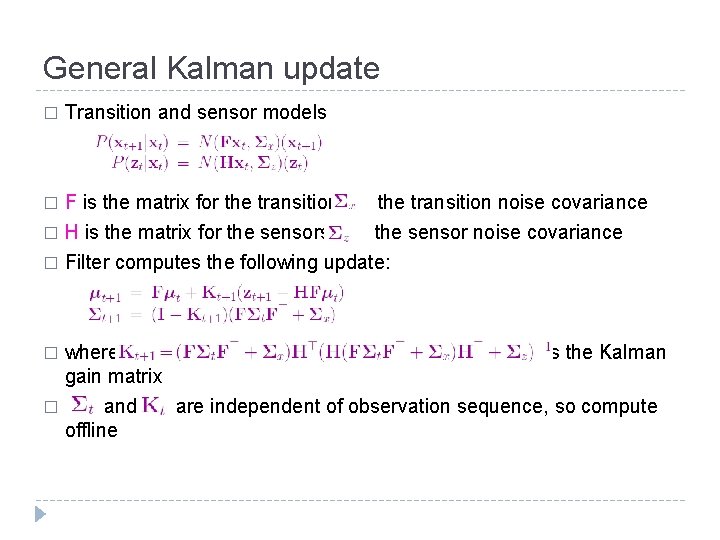
General Kalman update � Transition and sensor models F is the matrix for the transition; the transition noise covariance � H is the matrix for the sensors; the sensor noise covariance � Filter computes the following update: � where is the Kalman gain matrix � and are independent of observation sequence, so compute offline �
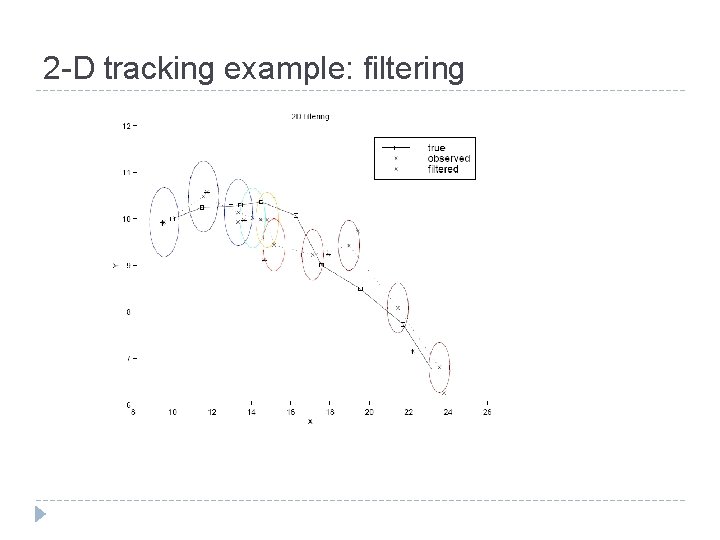
2 -D tracking example: filtering
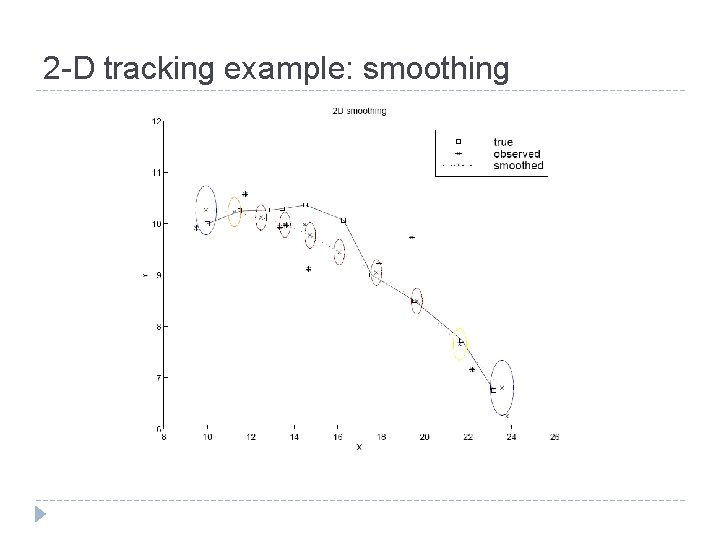
2 -D tracking example: smoothing
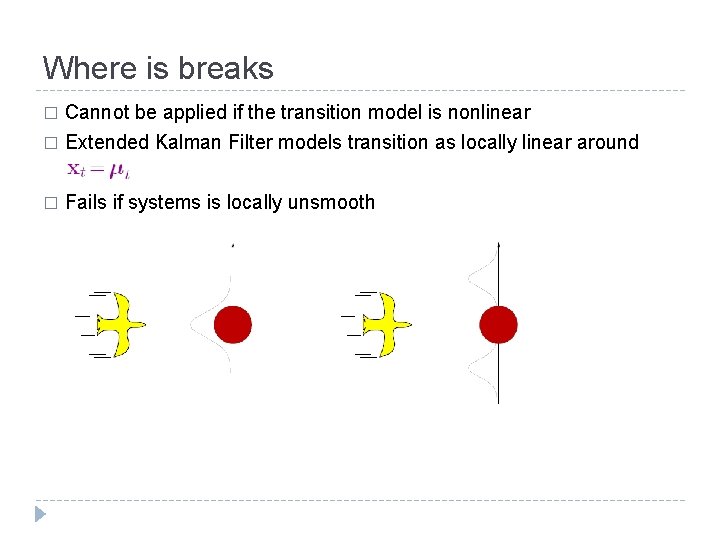
Where is breaks Cannot be applied if the transition model is nonlinear � Extended Kalman Filter models transition as locally linear around � � Fails if systems is locally unsmooth
Dynamic Bayesian networks
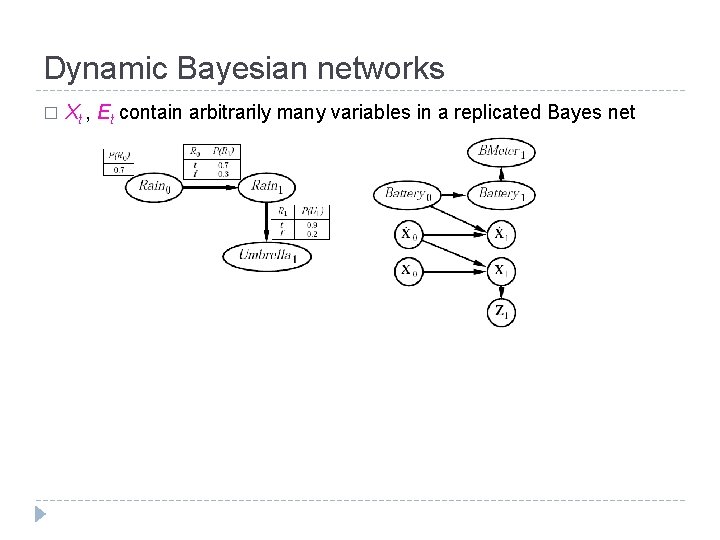
Dynamic Bayesian networks � Xt , Et contain arbitrarily many variables in a replicated Bayes net
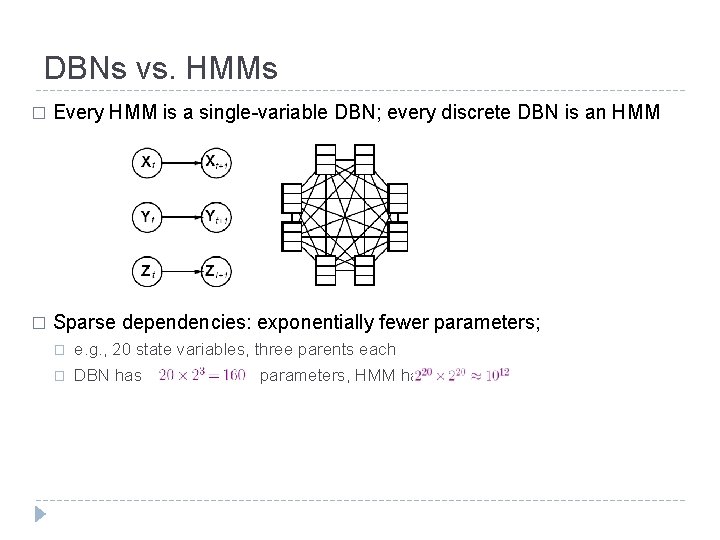
DBNs vs. HMMs � Every HMM is a single-variable DBN; every discrete DBN is an HMM � Sparse dependencies: exponentially fewer parameters; � � e. g. , 20 state variables, three parents each DBN has parameters, HMM has
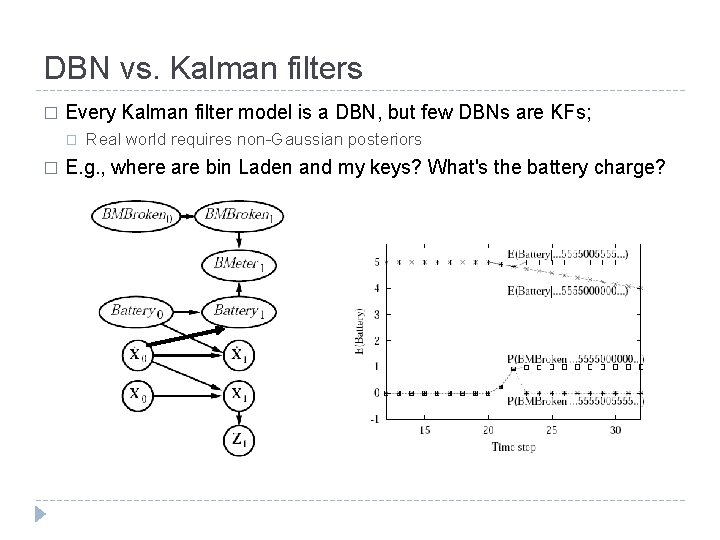
DBN vs. Kalman filters � Every Kalman filter model is a DBN, but few DBNs are KFs; � � Real world requires non-Gaussian posteriors E. g. , where are bin Laden and my keys? What's the battery charge?
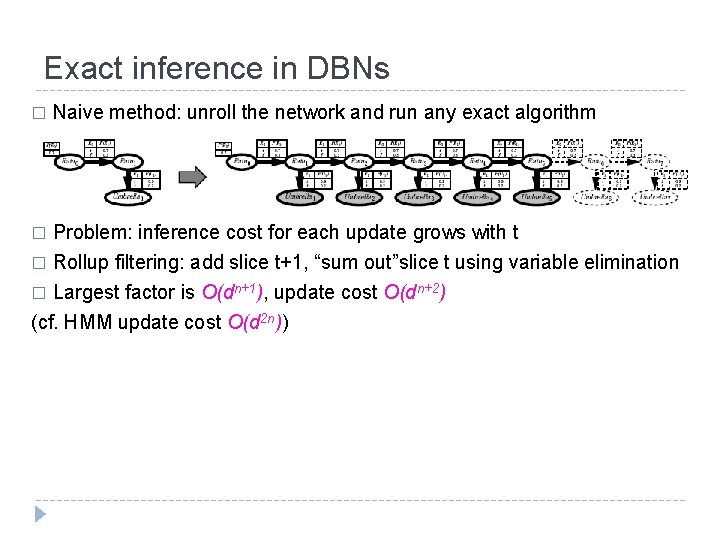
Exact inference in DBNs � Naive method: unroll the network and run any exact algorithm Problem: inference cost for each update grows with t � Rollup filtering: add slice t+1, “sum out”slice t using variable elimination � Largest factor is O(dn+1), update cost O(dn+2) (cf. HMM update cost O(d 2 n)) �
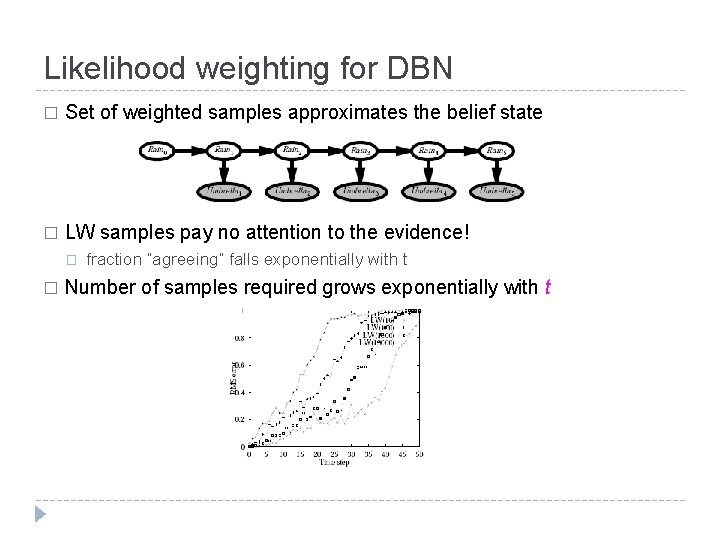
Likelihood weighting for DBN � Set of weighted samples approximates the belief state � LW samples pay no attention to the evidence! � � fraction “agreeing” falls exponentially with t Number of samples required grows exponentially with t

Particle filtering
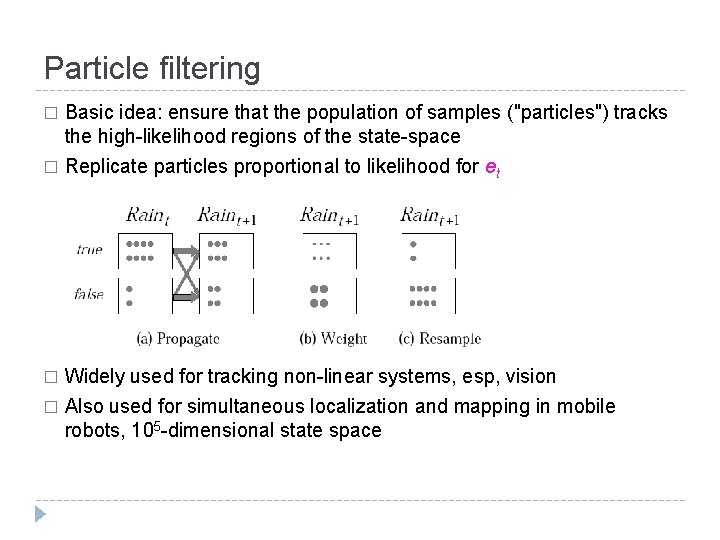
Particle filtering � Basic idea: ensure that the population of samples ("particles") tracks the high-likelihood regions of the state-space � Replicate particles proportional to likelihood for et Widely used for tracking non-linear systems, esp, vision � Also used for simultaneous localization and mapping in mobile robots, 105 -dimensional state space �
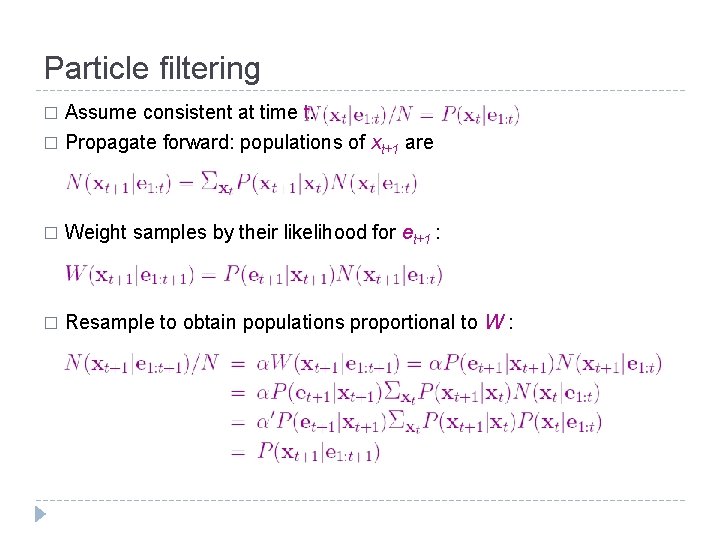
Particle filtering Assume consistent at time t: � Propagate forward: populations of xt+1 are � � Weight samples by their likelihood for et+1 : � Resample to obtain populations proportional to W :
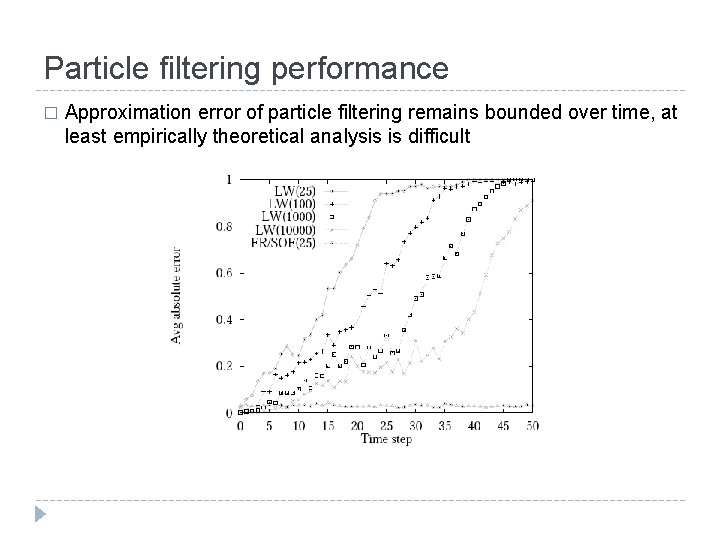
Particle filtering performance � Approximation error of particle filtering remains bounded over time, at least empirically theoretical analysis is difficult
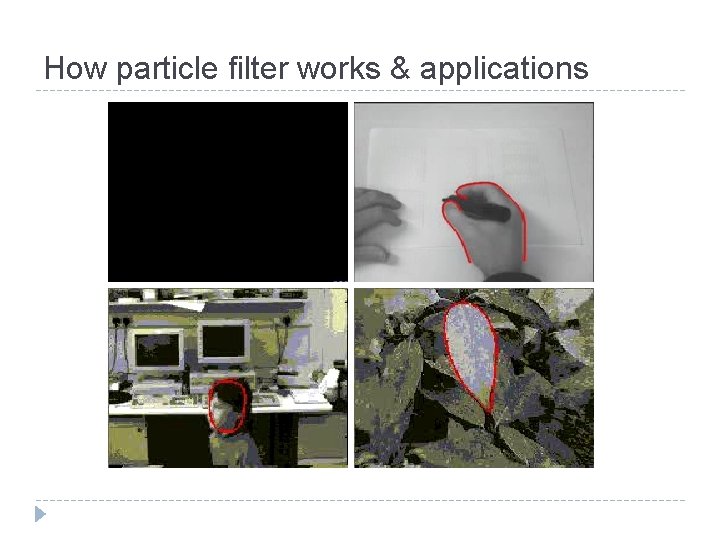
How particle filter works & applications
Summary Temporal models use state and sensor variables replicated over time � Markov assumptions and stationarity assumption, so we need � � Tasks are filtering, prediction, smoothing, most likely sequence; � � Transition model P(Xt|Xt-1) Sensor model P(Et|Xt) All done recursively with constant cost per time step Hidden Markov models have a single discrete state variable; � Widely used for speech recognition Kalman filters allow n state variables, linear Gaussian, O(n 3) update � Dynamic Bayesian nets subsume HMMs, Kalman filters; exact update intractable � Particle filtering is a good approximate filtering algorithm for DBNs �
- Slides: 48