
CS 5310 Graduate Computer Graphics Prof Harriet Fell


- Slides: 60
CS 5310 Graduate Computer Graphics Prof. Harriet Fell Spring 2011 Lecture 8 – March 16, 2011 10 September 2020 College of Computer and Information Science, Northeastern University 1
Today’s Topics • A little more Noise • ------------- • Gouraud and Phong Shading -------------- • Color Perception mostly ala Shirley et al. § Light – Radiometry § Color Theory § Visual Perception 10 September 2020 College of Computer and Information Science, Northeastern University 2
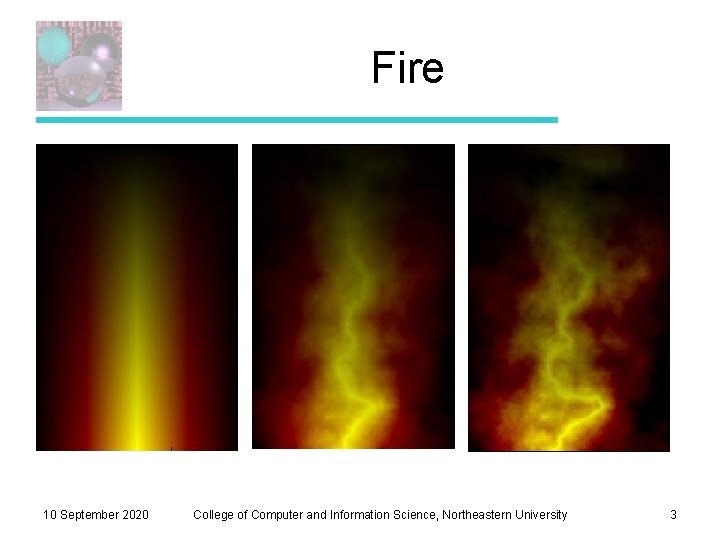
Fire 10 September 2020 College of Computer and Information Science, Northeastern University 3
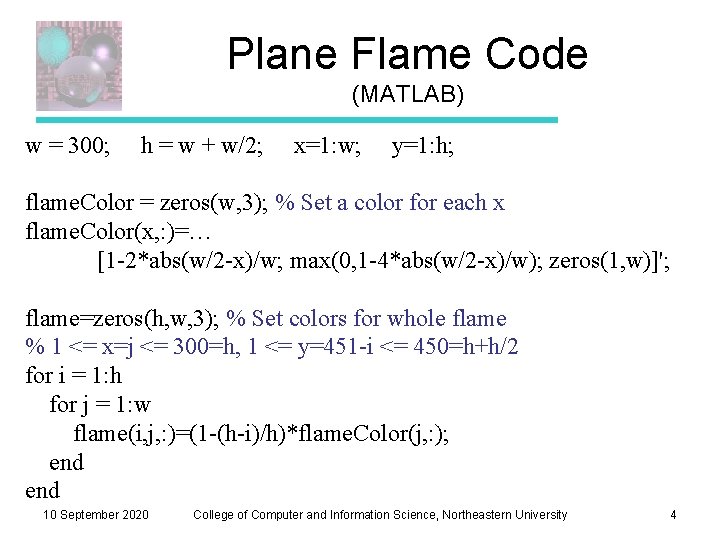
Plane Flame Code (MATLAB) w = 300; h = w + w/2; x=1: w; y=1: h; flame. Color = zeros(w, 3); % Set a color for each x flame. Color(x, : )=… [1 -2*abs(w/2 -x)/w; max(0, 1 -4*abs(w/2 -x)/w); zeros(1, w)]'; flame=zeros(h, w, 3); % Set colors for whole flame % 1 <= x=j <= 300=h, 1 <= y=451 -i <= 450=h+h/2 for i = 1: h for j = 1: w flame(i, j, : )=(1 -(h-i)/h)*flame. Color(j, : ); end 10 September 2020 College of Computer and Information Science, Northeastern University 4
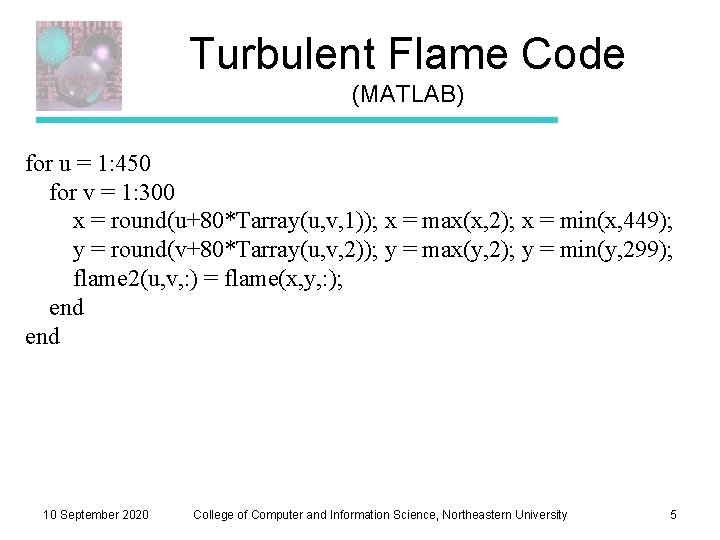
Turbulent Flame Code (MATLAB) for u = 1: 450 for v = 1: 300 x = round(u+80*Tarray(u, v, 1)); x = max(x, 2); x = min(x, 449); y = round(v+80*Tarray(u, v, 2)); y = max(y, 2); y = min(y, 299); flame 2(u, v, : ) = flame(x, y, : ); end 10 September 2020 College of Computer and Information Science, Northeastern University 5
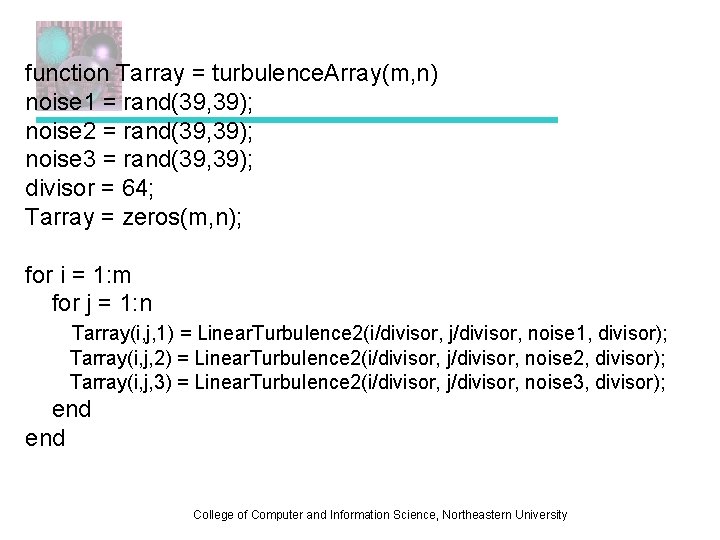
function Tarray = turbulence. Array(m, n) noise 1 = rand(39, 39); noise 2 = rand(39, 39); noise 3 = rand(39, 39); divisor = 64; Tarray = zeros(m, n); for i = 1: m for j = 1: n Tarray(i, j, 1) = Linear. Turbulence 2(i/divisor, j/divisor, noise 1, divisor); Tarray(i, j, 2) = Linear. Turbulence 2(i/divisor, j/divisor, noise 2, divisor); Tarray(i, j, 3) = Linear. Turbulence 2(i/divisor, j/divisor, noise 3, divisor); end College of Computer and Information Science, Northeastern University
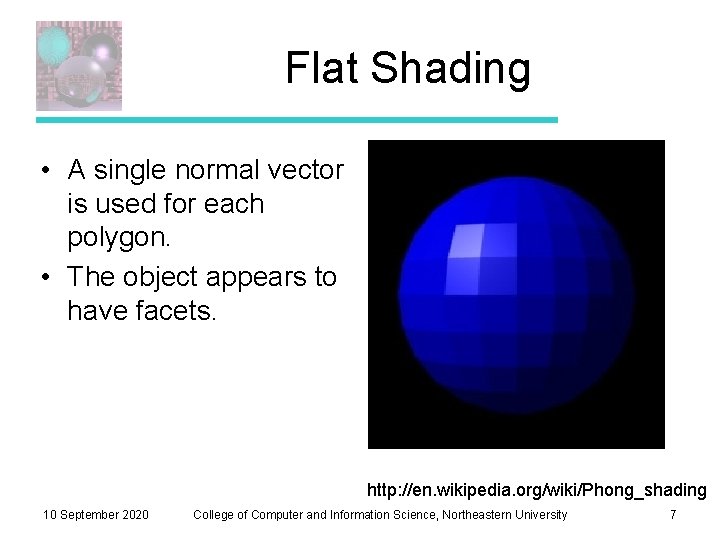
Flat Shading • A single normal vector is used for each polygon. • The object appears to have facets. http: //en. wikipedia. org/wiki/Phong_shading 10 September 2020 College of Computer and Information Science, Northeastern University 7
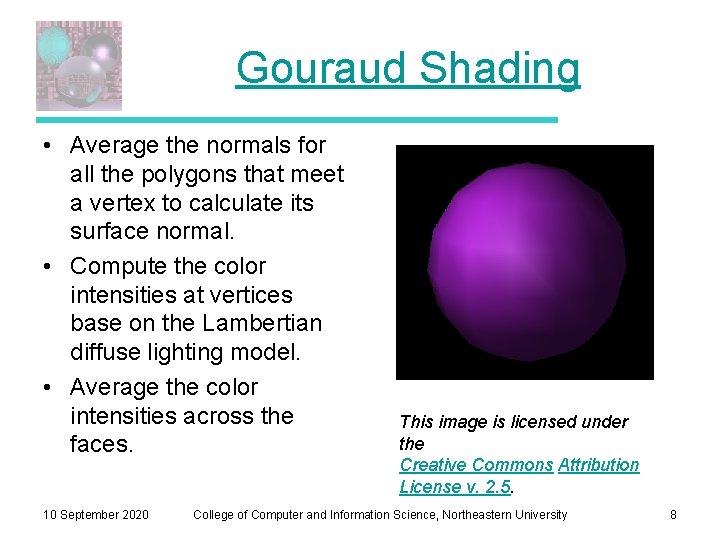
Gouraud Shading • Average the normals for all the polygons that meet a vertex to calculate its surface normal. • Compute the color intensities at vertices base on the Lambertian diffuse lighting model. • Average the color intensities across the faces. 10 September 2020 This image is licensed under the Creative Commons Attribution License v. 2. 5. College of Computer and Information Science, Northeastern University 8
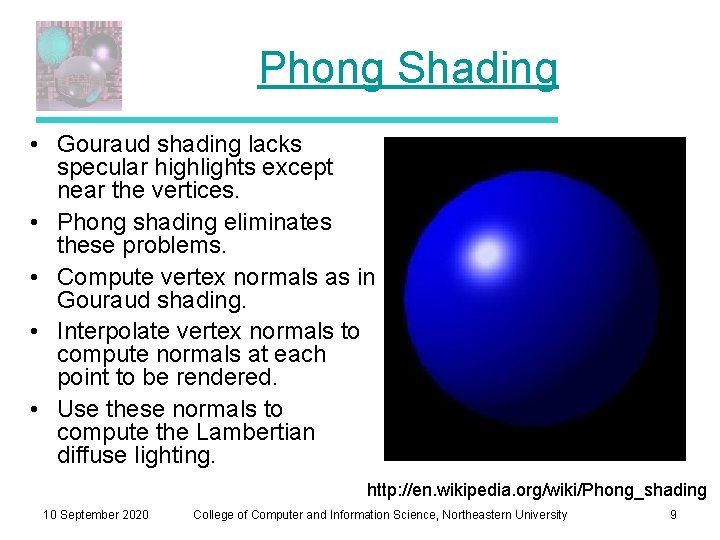
Phong Shading • Gouraud shading lacks specular highlights except near the vertices. • Phong shading eliminates these problems. • Compute vertex normals as in Gouraud shading. • Interpolate vertex normals to compute normals at each point to be rendered. • Use these normals to compute the Lambertian diffuse lighting. http: //en. wikipedia. org/wiki/Phong_shading 10 September 2020 College of Computer and Information Science, Northeastern University 9
Color Systems • • • RGB C MY K HVS YIQ CIE = XYZ for standardized color 10 September 2020 College of Computer and Information Science, Northeastern University 10
Light – Radiometry Things You Can Measure • Think of light as made up of a large number of photons. • A photon has position, direction, and wavelength λ. § λ is usually measured in nanometers § 1 nm = 10 -9 m = 10 angstroms • A photon has a speed c that depends only on the refractive index of the medium. • The frequency f = c/λ. § The frequency does not change with medium. 10 September 2020 College of Computer and Information Science, Northeastern University 11
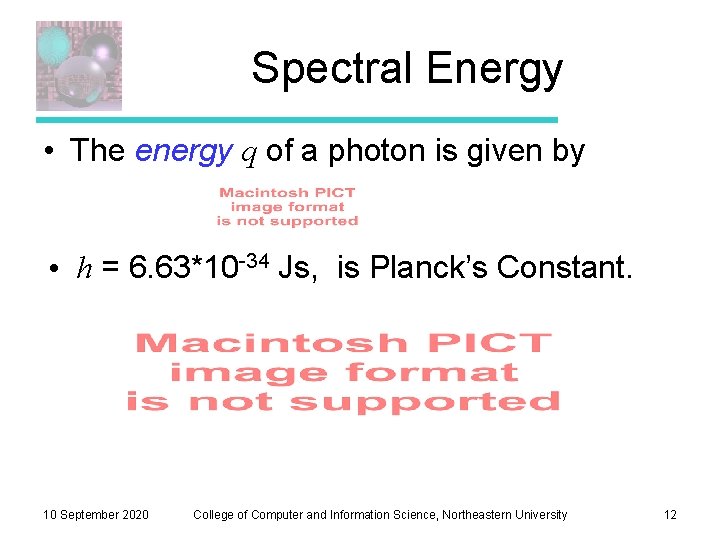
Spectral Energy • The energy q of a photon is given by • h = 6. 63*10 -34 Js, is Planck’s Constant. 10 September 2020 College of Computer and Information Science, Northeastern University 12
Spectral Energy We just use small Δλ for computation, but not so small that the quantum nature of light interferes. For theory we let Δλ 0. 10 September 2020 College of Computer and Information Science, Northeastern University 13
Radiance • Radiance and spectral radiance describe the amount of light that passes through or is emitted from a particular area, and falls within a given solid angle in a specified direction. • Radiance characterizes total emission or reflection, while spectral radiance characterizes the light at a single wavelength or frequency. • http: //en. wikipedia. org/wiki/Radiance 10 September 2020 College of Computer and Information Science, Northeastern University 14
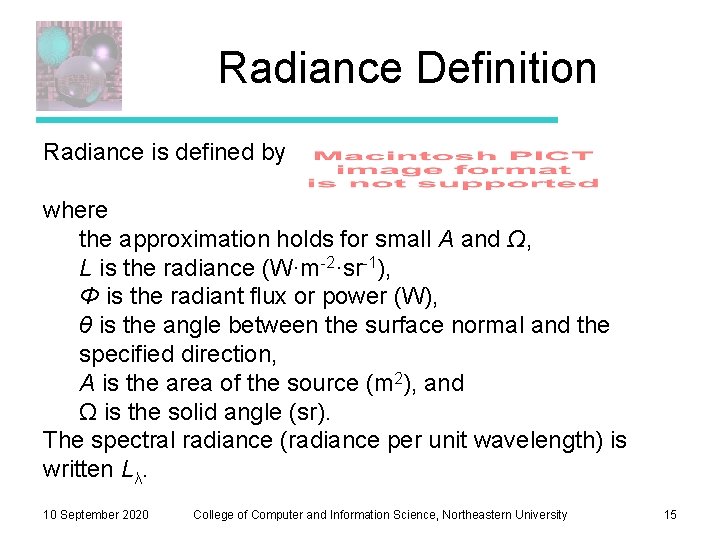
Radiance Definition Radiance is defined by where the approximation holds for small A and Ω, L is the radiance (W·m-2·sr-1), Φ is the radiant flux or power (W), θ is the angle between the surface normal and the specified direction, A is the area of the source (m 2), and Ω is the solid angle (sr). The spectral radiance (radiance per unit wavelength) is written Lλ. 10 September 2020 College of Computer and Information Science, Northeastern University 15
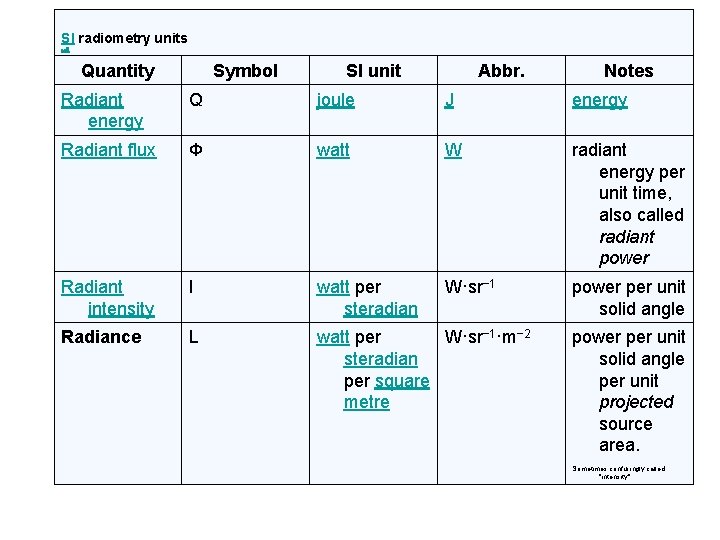
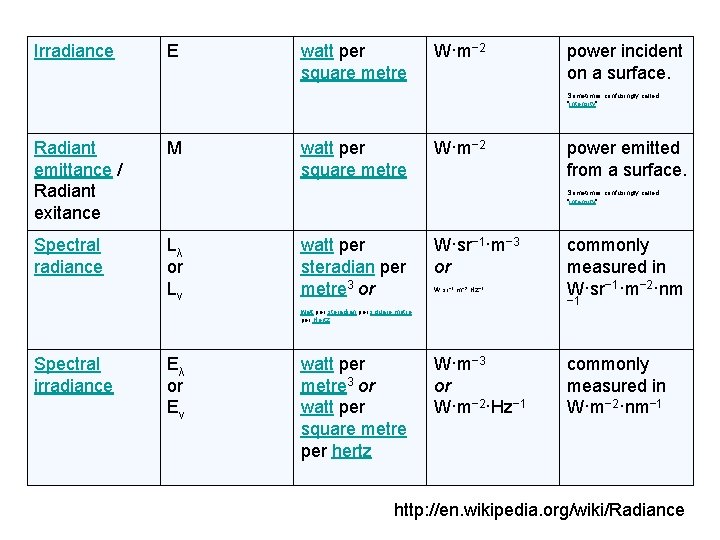
SI radiometry units edit Quantity Symbol SI unit Abbr. Notes Radiant energy Q joule J energy Radiant flux Φ watt W radiant energy per unit time, also called radiant power Radiant intensity I watt per steradian W·sr− 1 power per unit solid angle Radiance L watt per W·sr− 1·m− 2 steradian per square metre power per unit solid angle per unit projected source area. Sometimes confusingly called "intensity".
Irradiance E watt per square metre W·m− 2 power incident on a surface. Sometimes confusingly called "intensity". Radiant emittance / Radiant exitance M Spectral radiance Lλ or Lν watt per square metre W·m− 2 power emitted from a surface. Sometimes confusingly called "intensity". watt per steradian per metre 3 or W·sr− 1·m− 2·Hz− 1 commonly measured in W·sr− 1·m− 2·nm − 1 watt per steradian per square metre per Hertz Spectral irradiance Eλ or Eν watt per metre 3 or watt per square metre per hertz W·m− 3 or W·m− 2·Hz− 1 commonly measured in W·m− 2·nm− 1 http: //en. wikipedia. org/wiki/Radiance
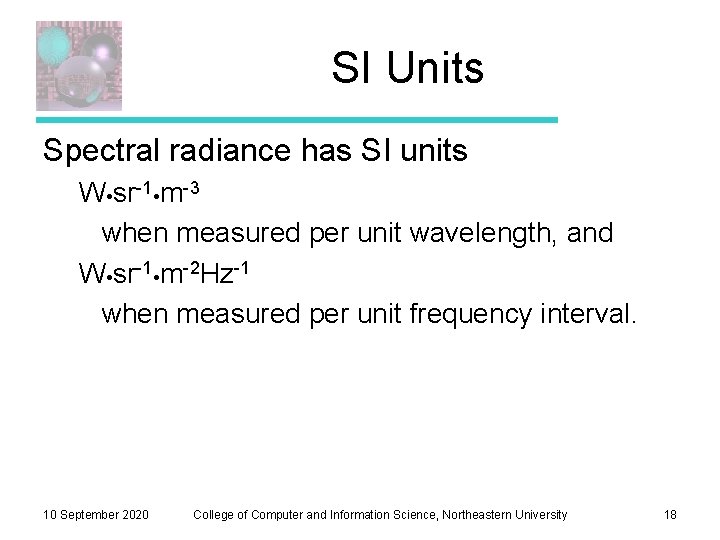
SI Units Spectral radiance has SI units W sr-1 m-3 when measured per unit wavelength, and W sr-1 m-2 Hz-1 when measured per unit frequency interval. 10 September 2020 College of Computer and Information Science, Northeastern University 18
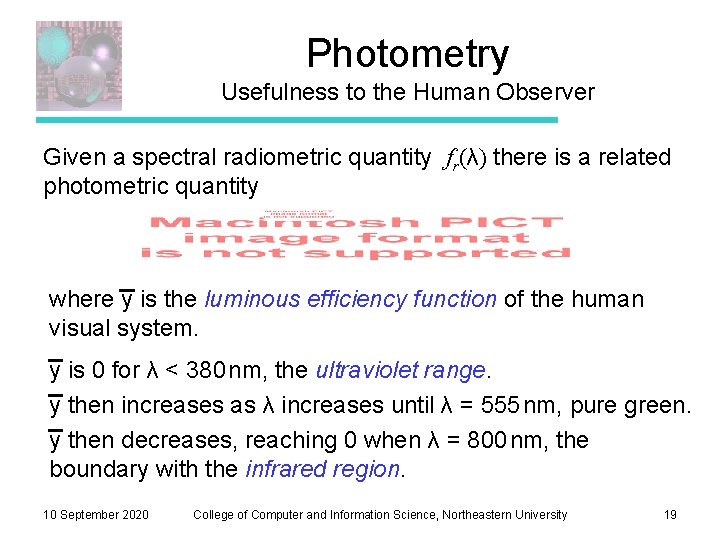
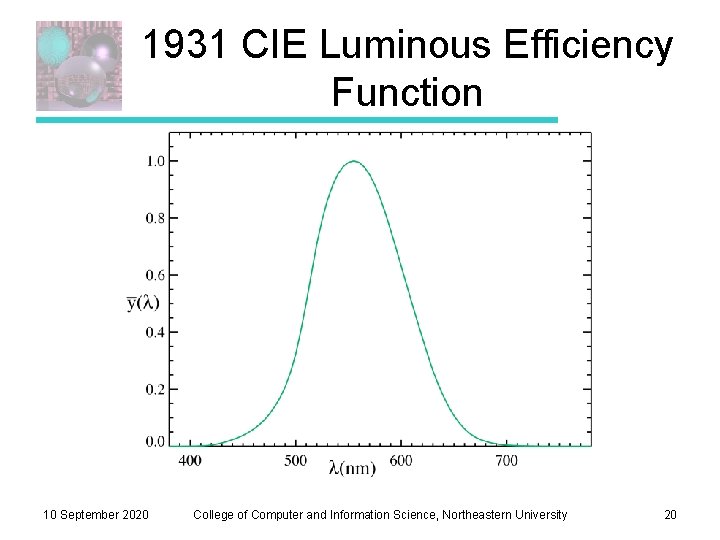
Photometry Usefulness to the Human Observer Given a spectral radiometric quantity fr(λ) there is a related photometric quantity where y is the luminous efficiency function of the human visual system. y is 0 for λ < 380 nm, the ultraviolet range. y then increases as λ increases until λ = 555 nm, pure green. y then decreases, reaching 0 when λ = 800 nm, the boundary with the infrared region. 10 September 2020 College of Computer and Information Science, Northeastern University 19
1931 CIE Luminous Efficiency Function 10 September 2020 College of Computer and Information Science, Northeastern University 20
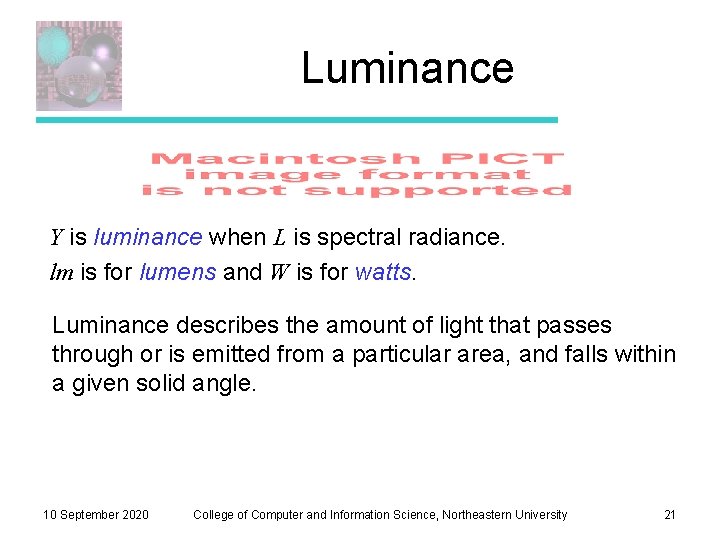
Luminance Y is luminance when L is spectral radiance. lm is for lumens and W is for watts. Luminance describes the amount of light that passes through or is emitted from a particular area, and falls within a given solid angle. 10 September 2020 College of Computer and Information Science, Northeastern University 21
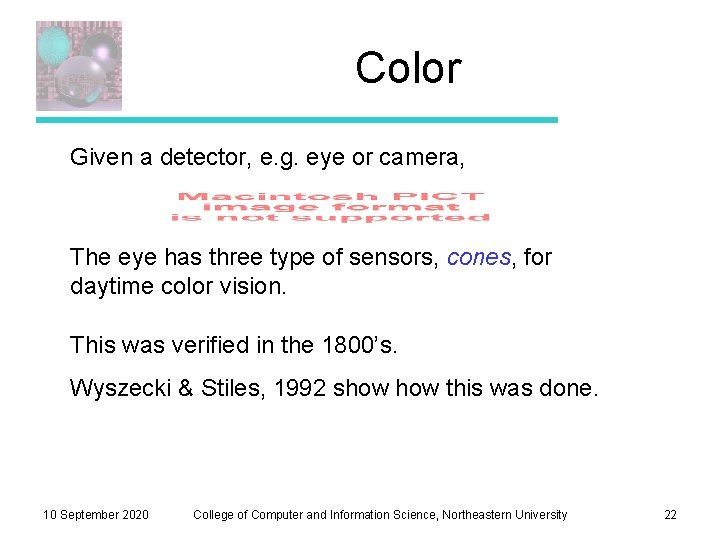
Color Given a detector, e. g. eye or camera, The eye has three type of sensors, cones, for daytime color vision. This was verified in the 1800’s. Wyszecki & Stiles, 1992 show this was done. 10 September 2020 College of Computer and Information Science, Northeastern University 22
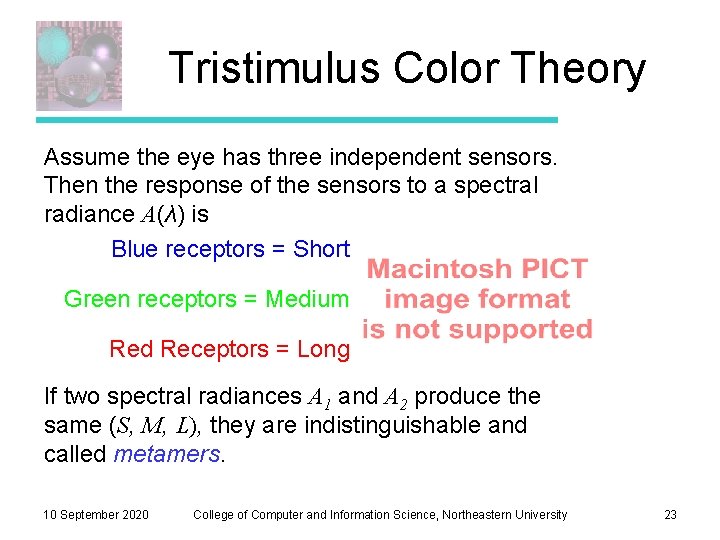
Tristimulus Color Theory Assume the eye has three independent sensors. Then the response of the sensors to a spectral radiance A(λ) is Blue receptors = Short Green receptors = Medium Red Receptors = Long If two spectral radiances A 1 and A 2 produce the same (S, M, L), they are indistinguishable and called metamers. 10 September 2020 College of Computer and Information Science, Northeastern University 23
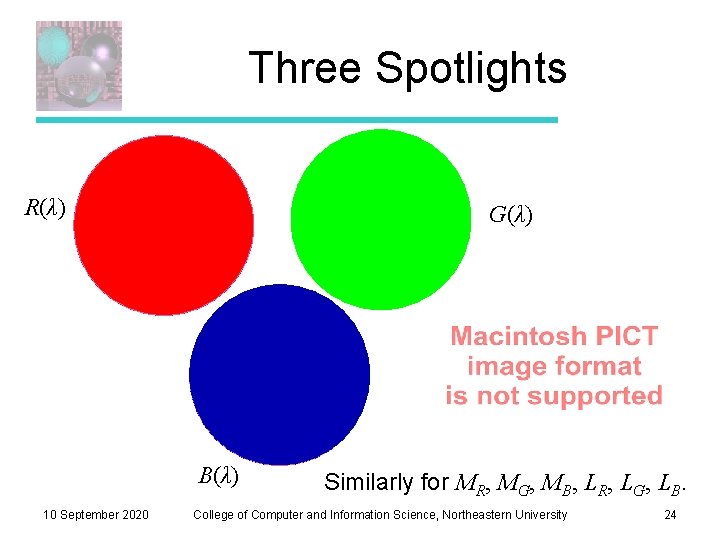
Three Spotlights R(λ) G(λ) B(λ) 10 September 2020 Similarly for MR, MG, MB, LR, LG, LB. College of Computer and Information Science, Northeastern University 24
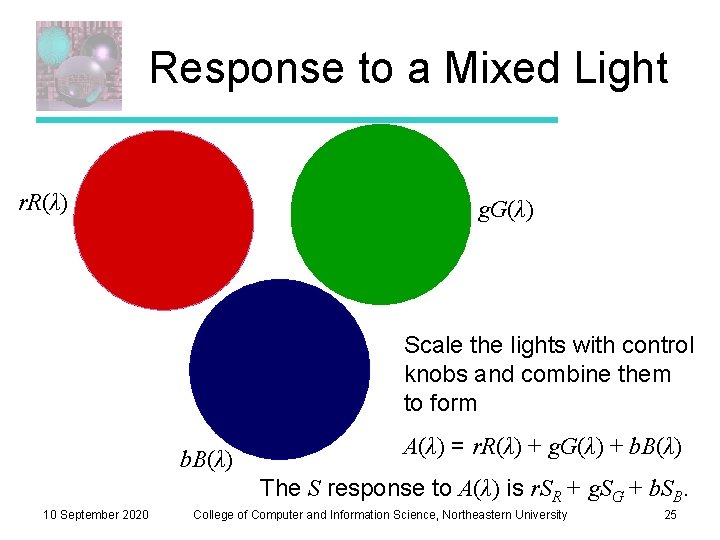
Response to a Mixed Light r. R(λ) g. G(λ) Scale the lights with control knobs and combine them to form b. B(λ) A(λ) = r. R(λ) + g. G(λ) + b. B(λ) The S response to A(λ) is r. SR + g. SG + b. SB. 10 September 2020 College of Computer and Information Science, Northeastern University 25
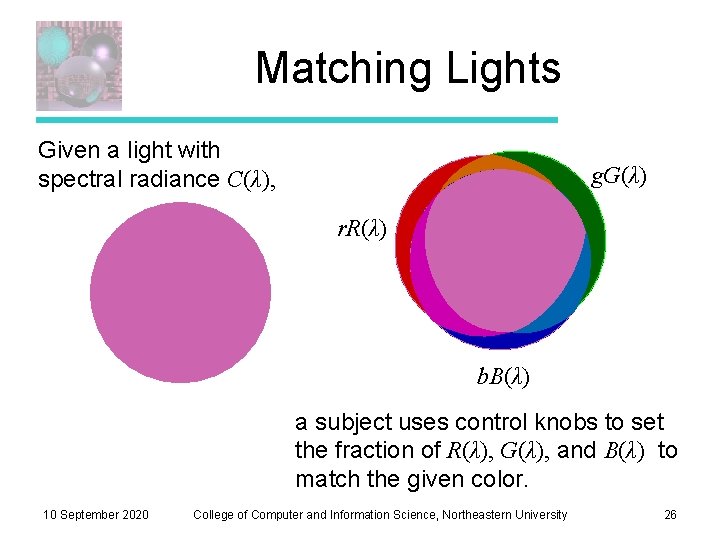
Matching Lights Given a light with spectral radiance C(λ), g. G(λ) r. R(λ) b. B(λ) a subject uses control knobs to set the fraction of R(λ), G(λ), and B(λ) to match the given color. 10 September 2020 College of Computer and Information Science, Northeastern University 26
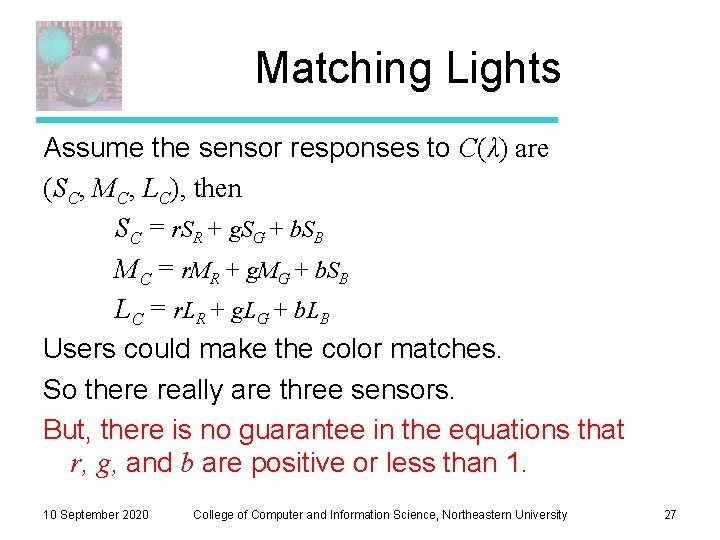
Matching Lights Assume the sensor responses to C(λ) are (SC, MC, LC), then SC = r. SR + g. SG + b. SB MC = r. MR + g. MG + b. SB LC = r. LR + g. LG + b. LB Users could make the color matches. So there really are three sensors. But, there is no guarantee in the equations that r, g, and b are positive or less than 1. 10 September 2020 College of Computer and Information Science, Northeastern University 27
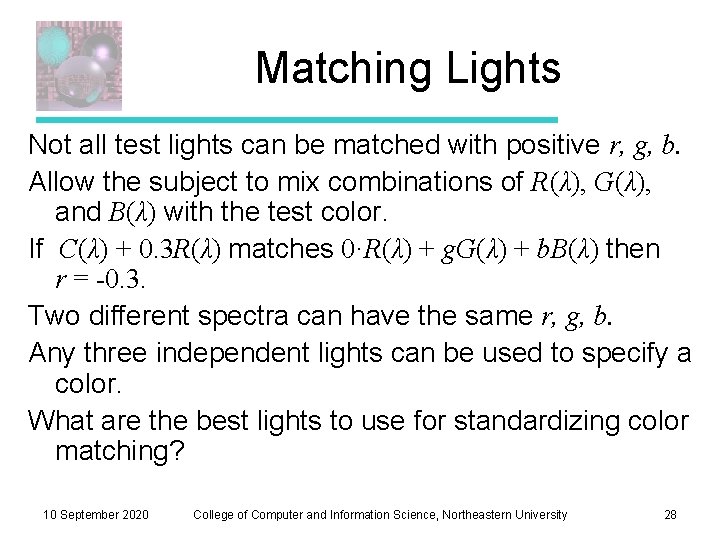
Matching Lights Not all test lights can be matched with positive r, g, b. Allow the subject to mix combinations of R(λ), G(λ), and B(λ) with the test color. If C(λ) + 0. 3 R(λ) matches 0·R(λ) + g. G(λ) + b. B(λ) then r = -0. 3. Two different spectra can have the same r, g, b. Any three independent lights can be used to specify a color. What are the best lights to use for standardizing color matching? 10 September 2020 College of Computer and Information Science, Northeastern University 28
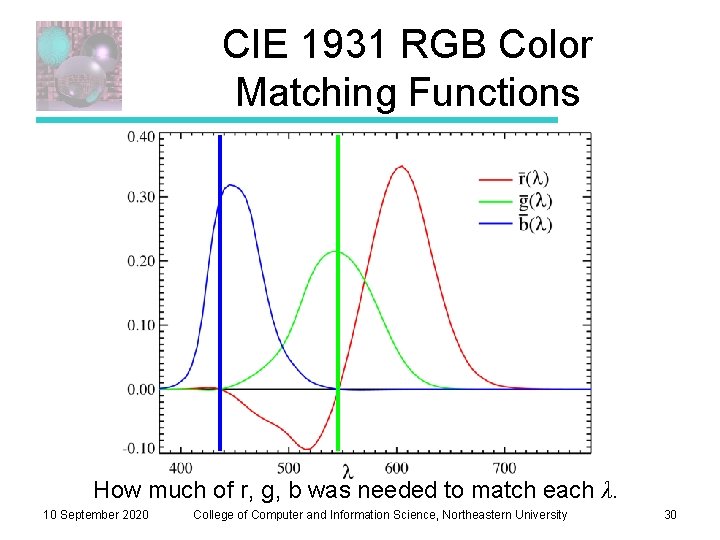
The Monochromatic Primaries • The three monochromatic primaries are at standardized wavelengths of § 700 nm (red) • Hard to reproduce as a monchromatic beam, resulting in small errors. • Max of human visual range. § 546. 1 nm (green) § 435. 8 nm (blue). • The last two wavelengths are easily reproducible monochromatic lines of a mercury vapor discharge. – http: //en. wikipedia. org/wiki/CIE_1931_color_space 10 September 2020 College of Computer and Information Science, Northeastern University 29
CIE 1931 RGB Color Matching Functions How much of r, g, b was needed to match each λ. 10 September 2020 College of Computer and Information Science, Northeastern University 30
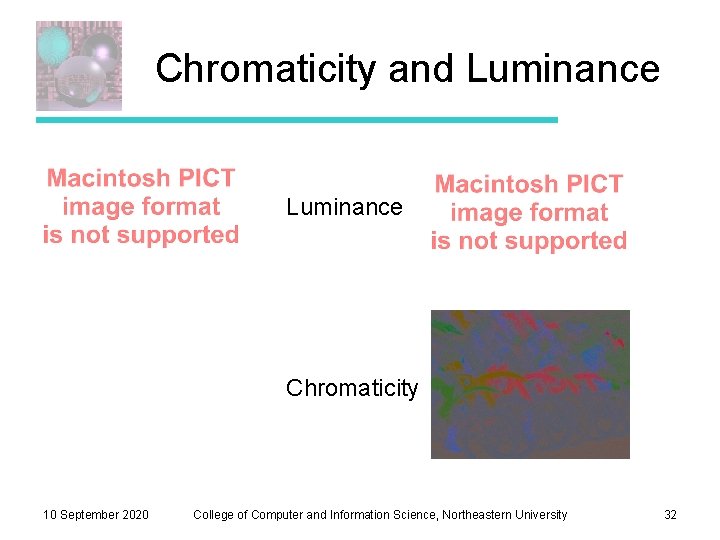
CIE Tristimulus Values ala Shirley • The CIE defined the XYZ system in the 1930 s. • The lights are imaginary. • One of the lights is grey – no hue information. • The other two lights have zero luminance and provide only hue information, chromaticity. 10 September 2020 College of Computer and Information Science, Northeastern University 31
Chromaticity and Luminance Chromaticity 10 September 2020 College of Computer and Information Science, Northeastern University 32
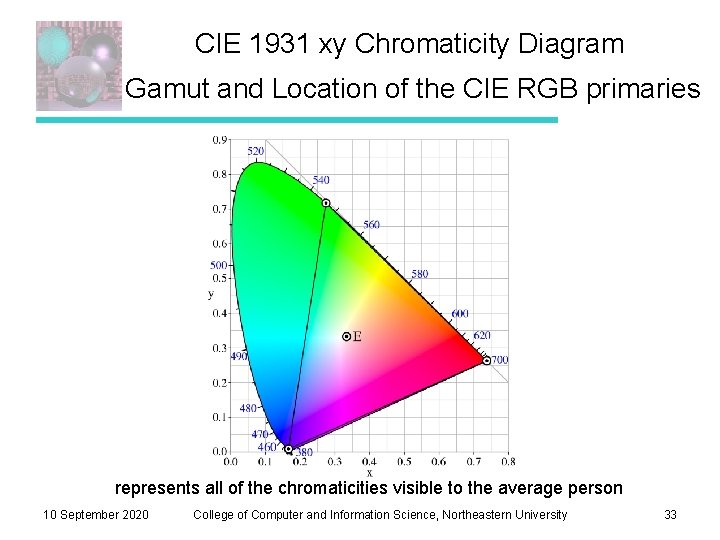
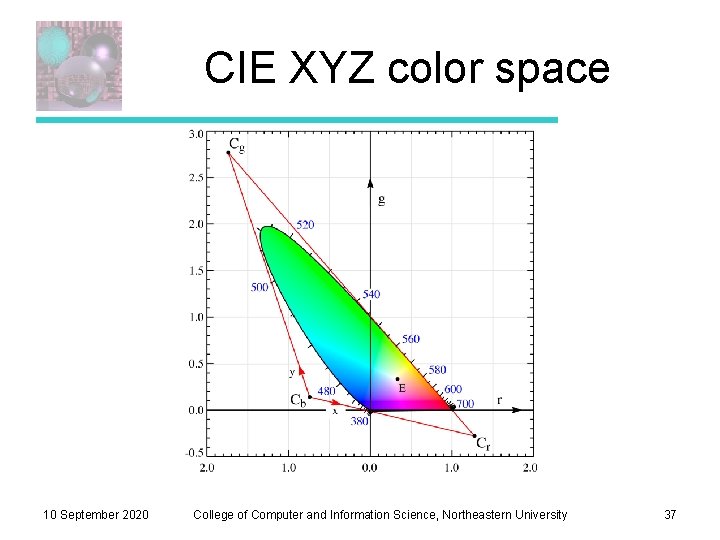
CIE 1931 xy Chromaticity Diagram Gamut and Location of the CIE RGB primaries represents all of the chromaticities visible to the average person 10 September 2020 College of Computer and Information Science, Northeastern University 33
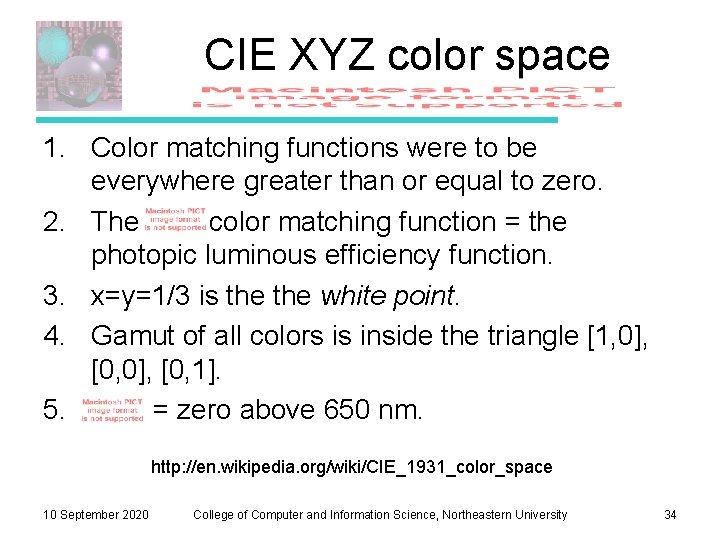
CIE XYZ color space 1. Color matching functions were to be everywhere greater than or equal to zero. 2. The color matching function = the photopic luminous efficiency function. 3. x=y=1/3 is the white point. 4. Gamut of all colors is inside the triangle [1, 0], [0, 0], [0, 1]. 5. = zero above 650 nm. http: //en. wikipedia. org/wiki/CIE_1931_color_space 10 September 2020 College of Computer and Information Science, Northeastern University 34
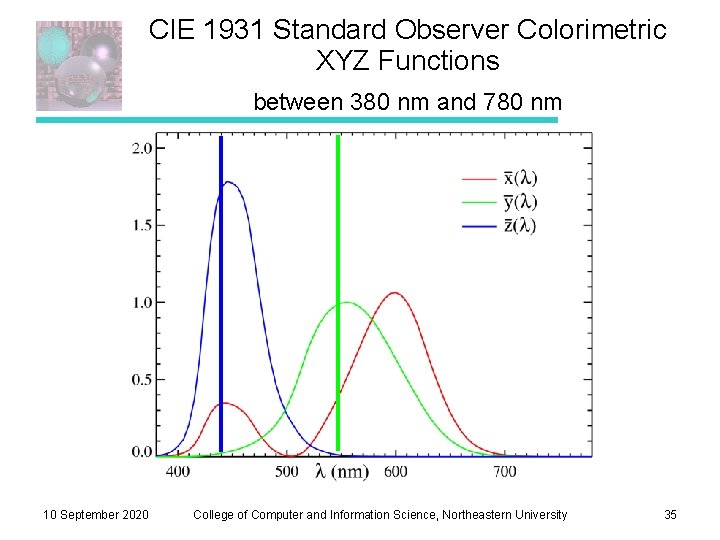
CIE 1931 Standard Observer Colorimetric XYZ Functions between 380 nm and 780 nm 10 September 2020 College of Computer and Information Science, Northeastern University 35
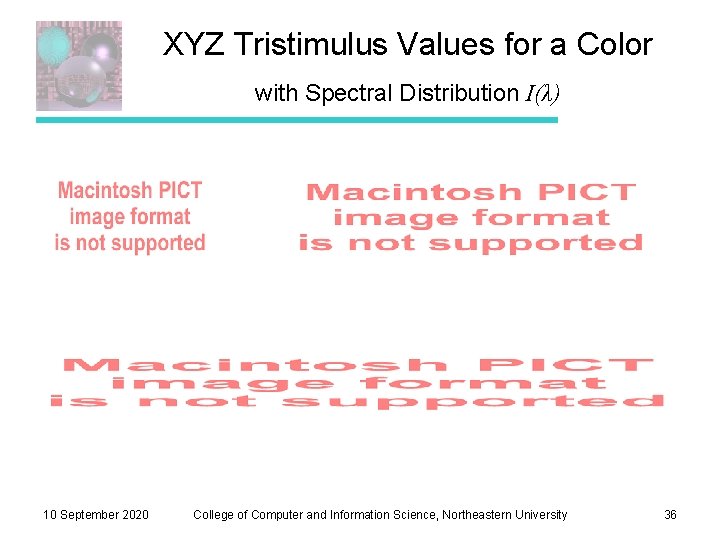
XYZ Tristimulus Values for a Color with Spectral Distribution I(λ) 10 September 2020 College of Computer and Information Science, Northeastern University 36
CIE XYZ color space 10 September 2020 College of Computer and Information Science, Northeastern University 37
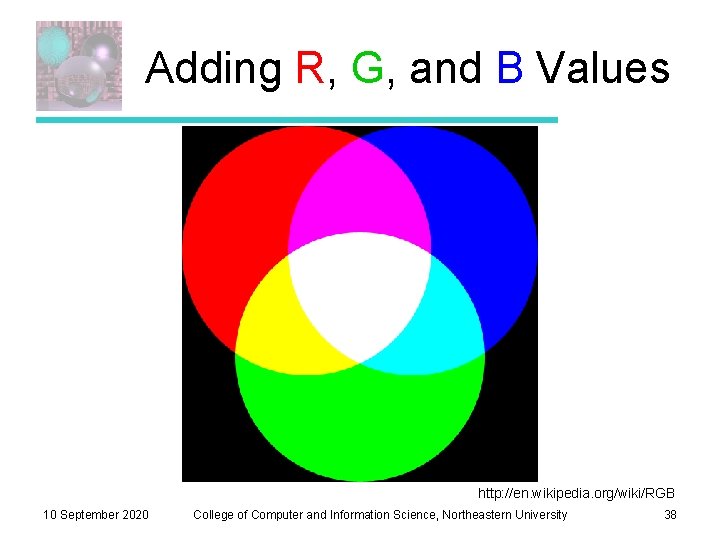
Adding R, G, and B Values http: //en. wikipedia. org/wiki/RGB 10 September 2020 College of Computer and Information Science, Northeastern University 38
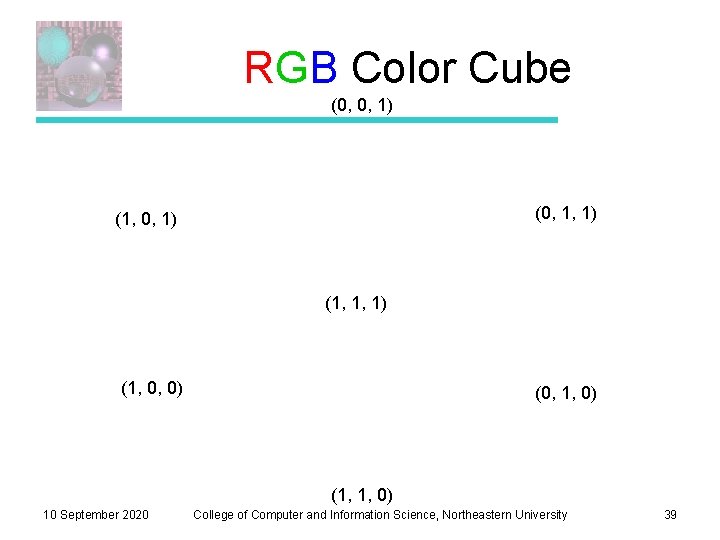
RGB Color Cube (0, 0, 1) (0, 1, 1) (1, 0, 1) (1, 1, 1) (1, 0, 0) (0, 1, 0) (1, 1, 0) 10 September 2020 College of Computer and Information Science, Northeastern University 39
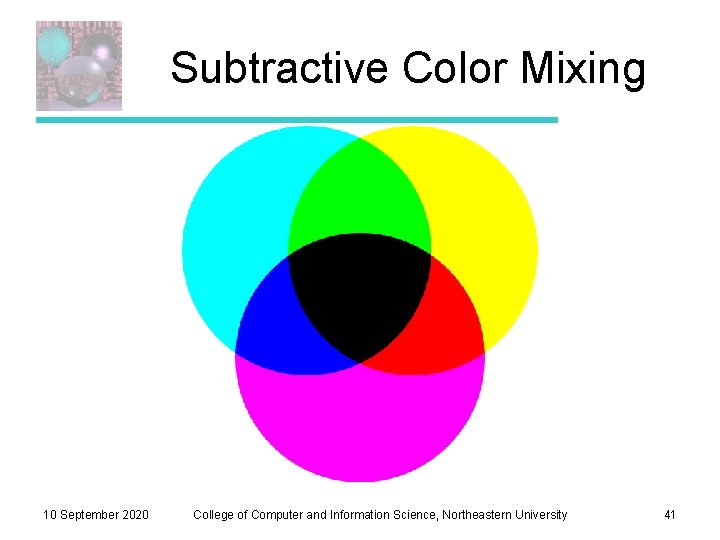
CMY Complements of RGB • CMYK are commonly used for inks. • They are called the subtractive colors. • Yellow ink removes blue light. 10 September 2020 College of Computer and Information Science, Northeastern University 40
Subtractive Color Mixing 10 September 2020 College of Computer and Information Science, Northeastern University 41
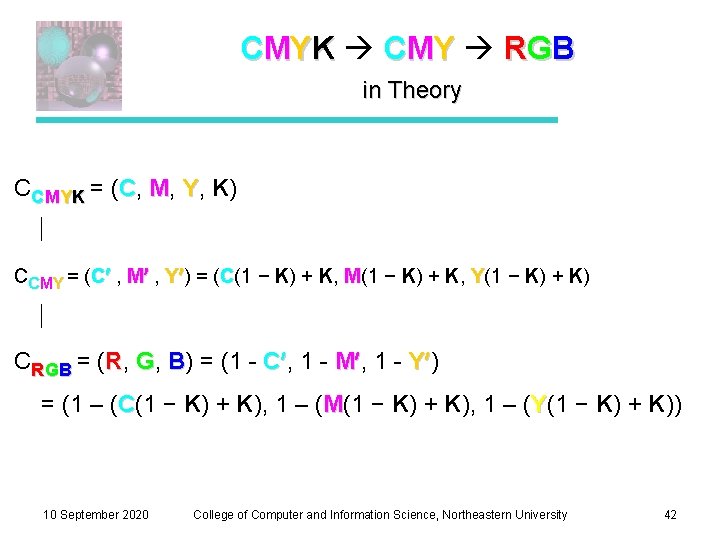
CMYK CMY RGB in Theory CCMYK = (C, M, Y, K) CCMY = (C , M , Y ) = (C(1 − K) + K, M(1 − K) + K, Y(1 − K) + K) CRGB = (R, G, B) = (1 - C , 1 - M , 1 - Y ) = (1 – (C(1 − K) + K), 1 – (M(1 − K) + K), 1 – (Y(1 − K) + K)) 10 September 2020 College of Computer and Information Science, Northeastern University 42
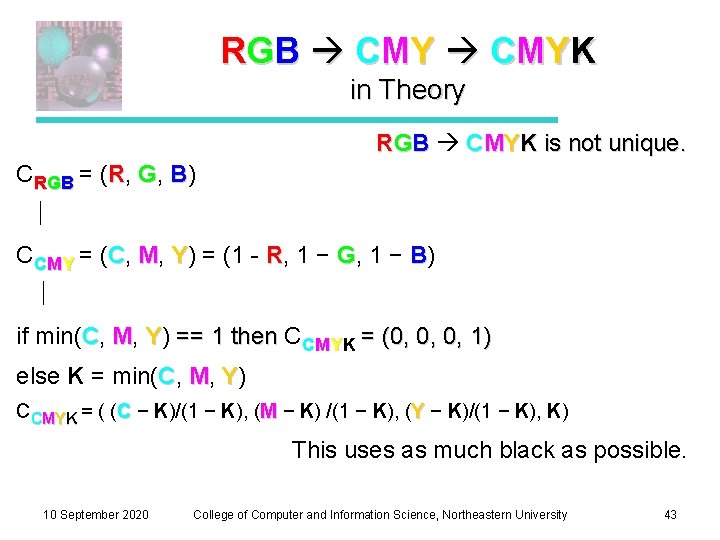
R G B C MY K in Theory RGB CMYK is not unique. CRGB = (R, G, B) CCMY = (C, M, Y) = (1 - R, 1 − G, 1 − B) if min(C, M, Y) == 1 then CMYK = (0, 0, 0, 1) else K = min(C, M, Y) CCMYK = ( (C − K)/(1 − K), (M − K) /(1 − K), (Y − K)/(1 − K), K) This uses as much black as possible. 10 September 2020 College of Computer and Information Science, Northeastern University 43
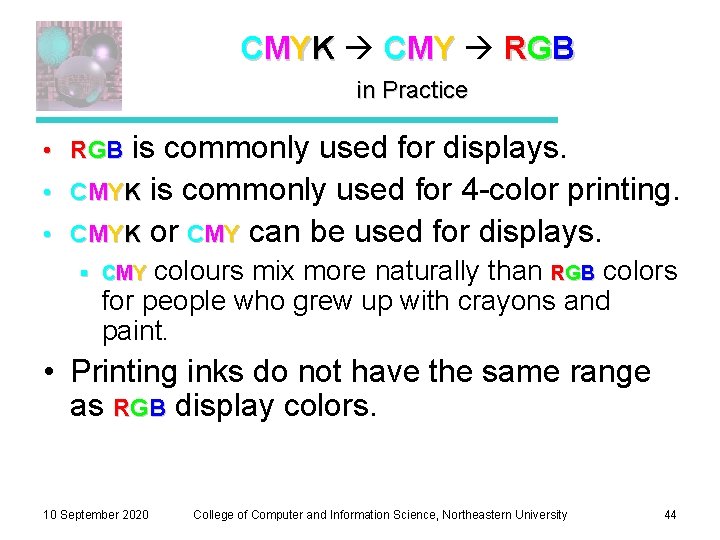
CMYK CMY RGB in Practice • RGB is commonly used for displays. • CMYK is commonly used for 4 -color printing. • CMYK or CMY can be used for displays. § CMY colours mix more naturally than RGB colors for people who grew up with crayons and paint. • Printing inks do not have the same range as RGB display colors. 10 September 2020 College of Computer and Information Science, Northeastern University 44
Time for a Break 10 September 2020 College of Computer and Information Science, Northeastern University 45
Color Spaces • RGB and CMYK are color models. • A mapping between the color model and an absolute reference color space results a gamut, defines a new color space. 10 September 2020 College of Computer and Information Science, Northeastern University 46
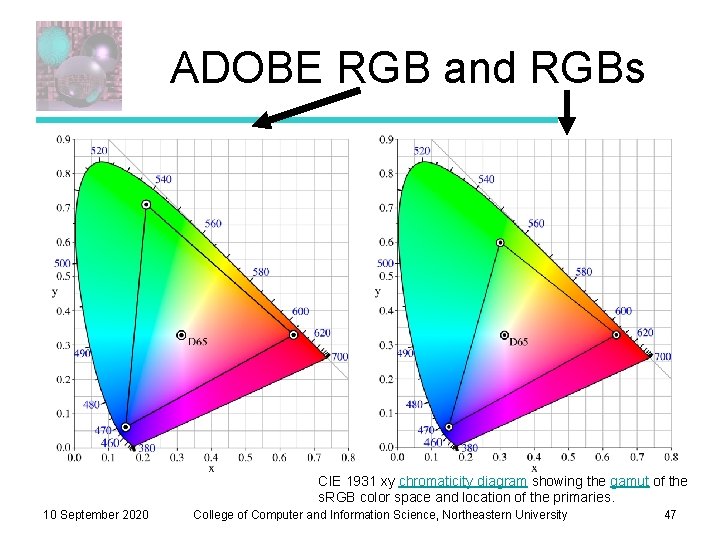
ADOBE RGB and RGBs CIE 1931 xy chromaticity diagram showing the gamut of the s. RGB color space and location of the primaries. 10 September 2020 College of Computer and Information Science, Northeastern University 47
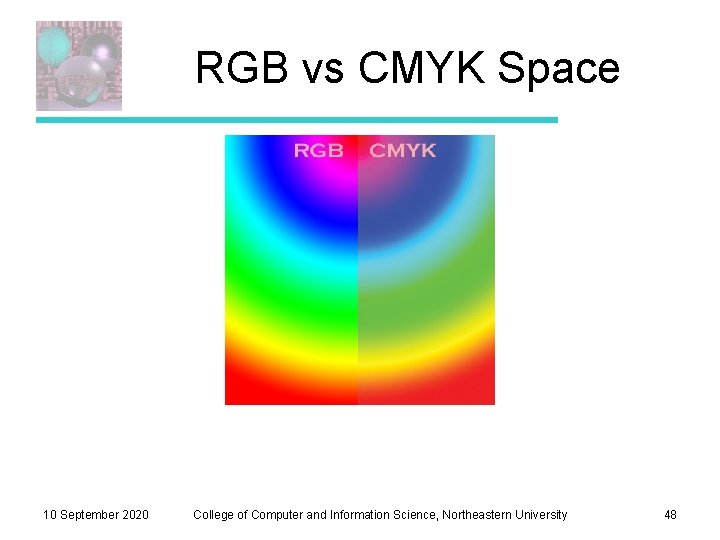
RGB vs CMYK Space 10 September 2020 College of Computer and Information Science, Northeastern University 48
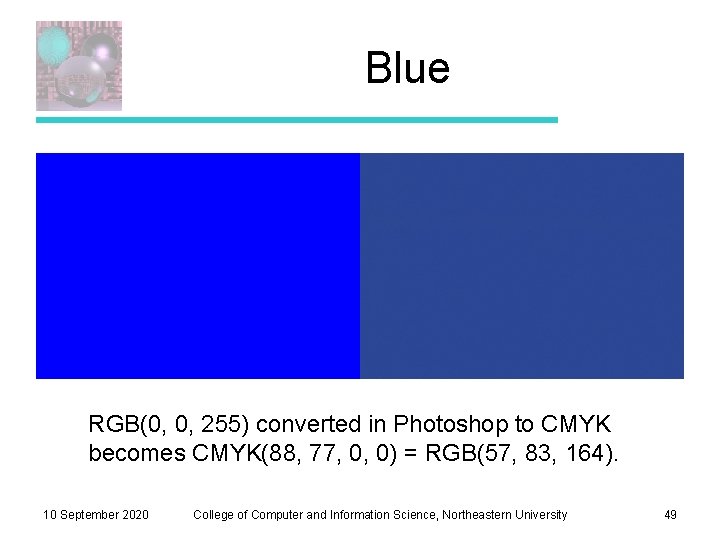
Blue RGB(0, 0, 255) converted in Photoshop to CMYK becomes CMYK(88, 77, 0, 0) = RGB(57, 83, 164). 10 September 2020 College of Computer and Information Science, Northeastern University 49
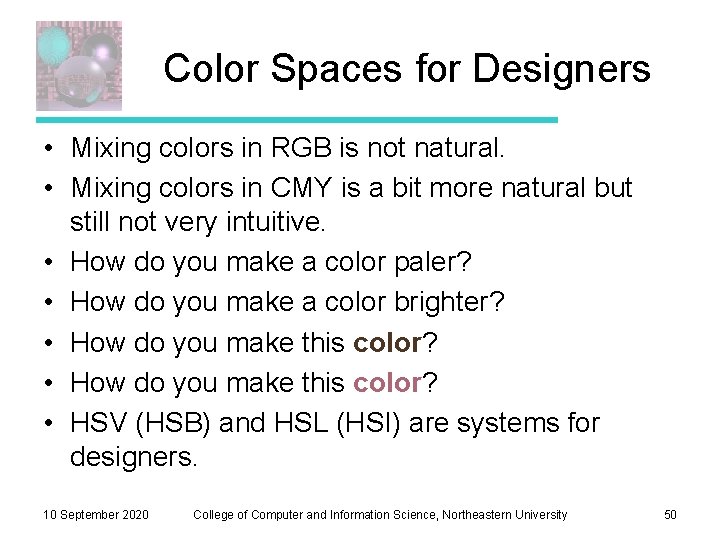
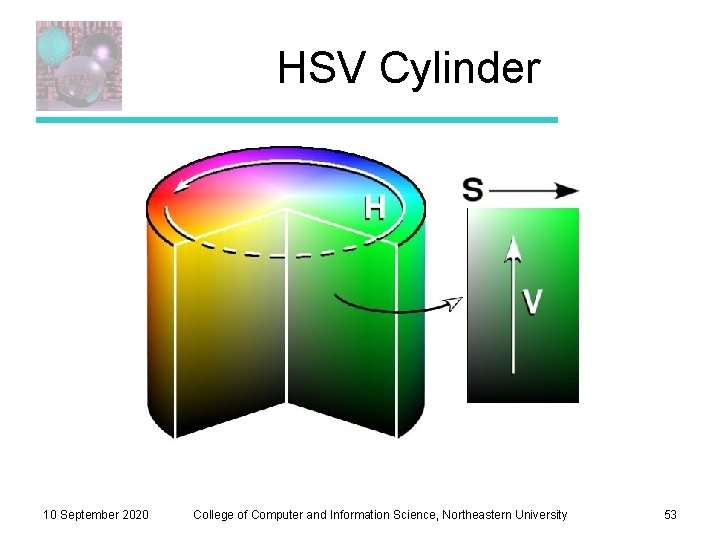
Color Spaces for Designers • Mixing colors in RGB is not natural. • Mixing colors in CMY is a bit more natural but still not very intuitive. • How do you make a color paler? • How do you make a color brighter? • How do you make this color? • HSV (HSB) and HSL (HSI) are systems for designers. 10 September 2020 College of Computer and Information Science, Northeastern University 50
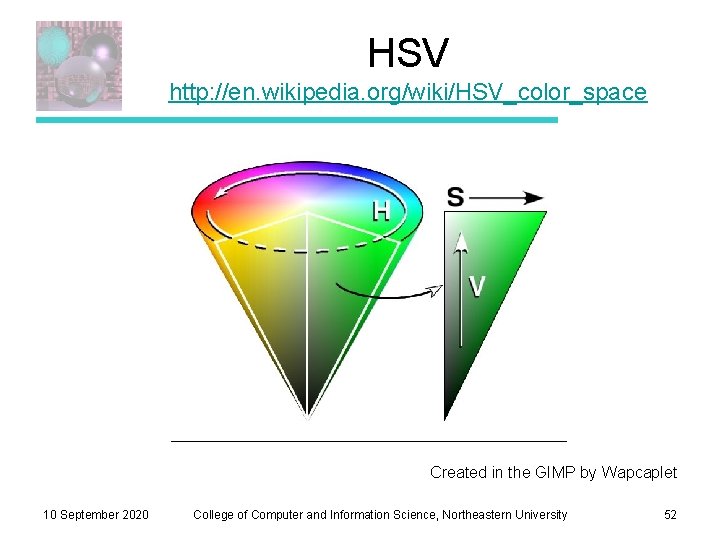
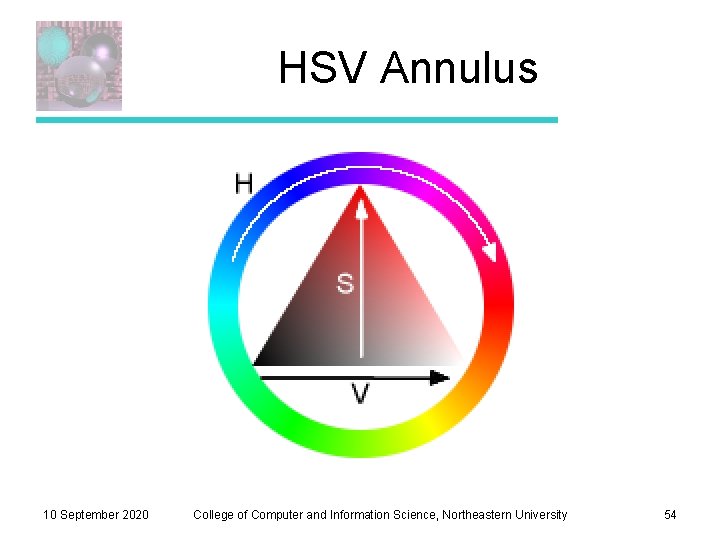
HSV (Hue, Saturation, Value) HSB (Hue, Saturation, Brightness) • Hue (e. g. red, blue, or yellow): § Ranges from 0 -360 • Saturation, the "vibrancy" or “purity” of the color: § Ranges from 0 -100% § The lower the saturation of a color, the more "grayness" is present and the more faded or pale the color will appear. • Value, the brightness of the color: § Ranges from 0 -100% 10 September 2020 College of Computer and Information Science, Northeastern University 51
HSV http: //en. wikipedia. org/wiki/HSV_color_space Created in the GIMP by Wapcaplet 10 September 2020 College of Computer and Information Science, Northeastern University 52
HSV Cylinder 10 September 2020 College of Computer and Information Science, Northeastern University 53
HSV Annulus 10 September 2020 College of Computer and Information Science, Northeastern University 54
HSL Alexandre Van de Sander 10 September 2020 College of Computer and Information Science, Northeastern University 55
RGB HSV Given (R, G, B) 0. 0 ≤ R, G, B ≤ 1. 0 MAX = max(R, G, B) MIN = min(R, G, B) 10 September 2020 College of Computer and Information Science, Northeastern University 56
HSV RGB Given color (H, S, V) 0. 0 ≤ H ≤ 360. 0, 0. 0 ≤ S, V ≤ 1. 0 if S == 0. 0 then R =G = B =V and H and S don’t matter. else 10 September 2020 College of Computer and Information Science, Northeastern University 57
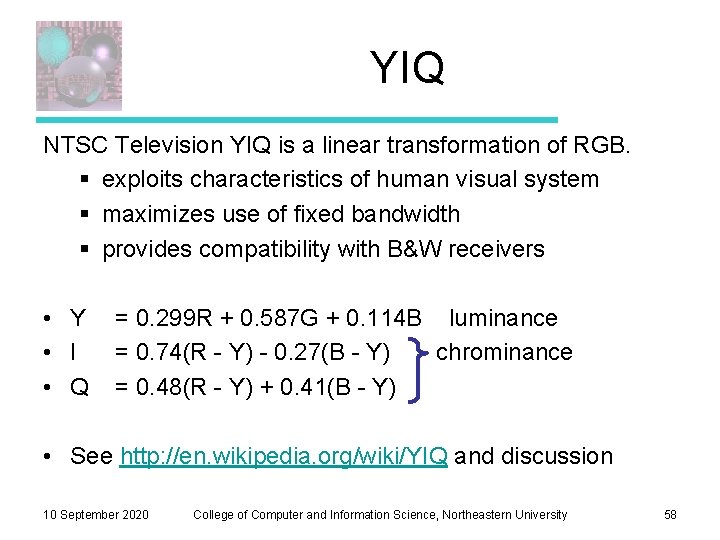
YIQ NTSC Television YIQ is a linear transformation of RGB. § exploits characteristics of human visual system § maximizes use of fixed bandwidth § provides compatibility with B&W receivers • Y = 0. 299 R + 0. 587 G + 0. 114 B luminance • I = 0. 74(R - Y) - 0. 27(B - Y) chrominance • Q = 0. 48(R - Y) + 0. 41(B - Y) • See http: //en. wikipedia. org/wiki/YIQ and discussion 10 September 2020 College of Computer and Information Science, Northeastern University 58
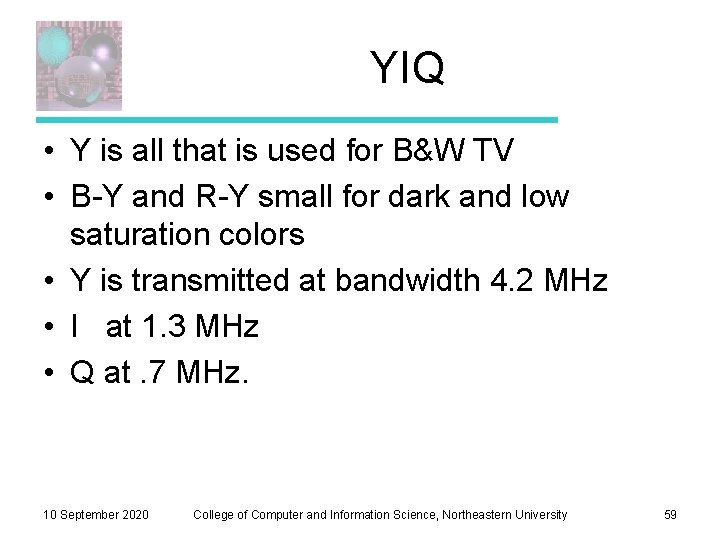
YIQ • Y is all that is used for B&W TV • B-Y and R-Y small for dark and low saturation colors • Y is transmitted at bandwidth 4. 2 MHz • I at 1. 3 MHz • Q at. 7 MHz. 10 September 2020 College of Computer and Information Science, Northeastern University 59