
CS 525 Special Topics in DBs LargeScale Data
CS 525: Special Topics in DBs Large-Scale Data Management Hadoop/Map. Reduce Computing Paradigm Spring 2013 WPI, Mohamed Eltabakh 1
Large-Scale Data Analytics • Map. Reduce computing paradigm (E. g. , Hadoop) vs. Traditional database systems Database vs. � Many enterprises are turning to Hadoop Especially applications generating big data Web applications, social networks, scientific applications 2
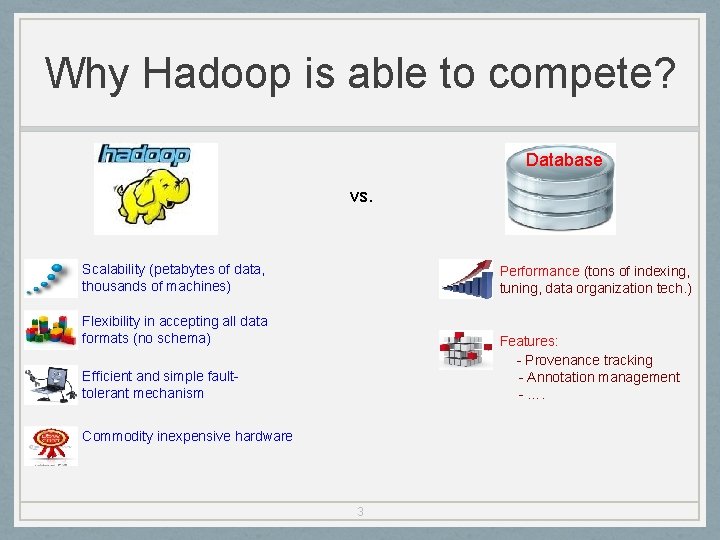
Why Hadoop is able to compete? Database vs. Scalability (petabytes of data, thousands of machines) Performance (tons of indexing, tuning, data organization tech. ) Flexibility in accepting all data formats (no schema) Features: - Provenance tracking - Annotation management - …. Efficient and simple faulttolerant mechanism Commodity inexpensive hardware 3
What is Hadoop • Hadoop is a software framework for distributed processing of large datasets across large clusters of computers • Large datasets Terabytes or petabytes of data • Large clusters hundreds or thousands of nodes • Hadoop is open-source implementation for Google Map. Reduce • Hadoop is based on a simple programming model called Map. Reduce • Hadoop is based on a simple data model, any data will fit 4
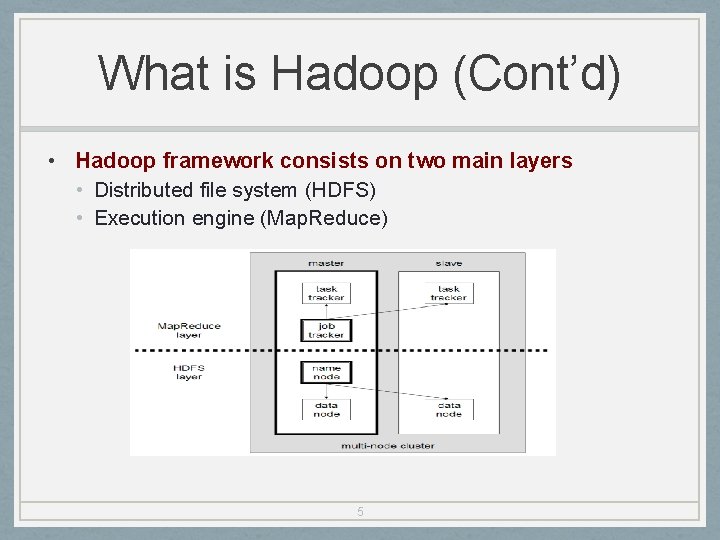
What is Hadoop (Cont’d) • Hadoop framework consists on two main layers • Distributed file system (HDFS) • Execution engine (Map. Reduce) 5
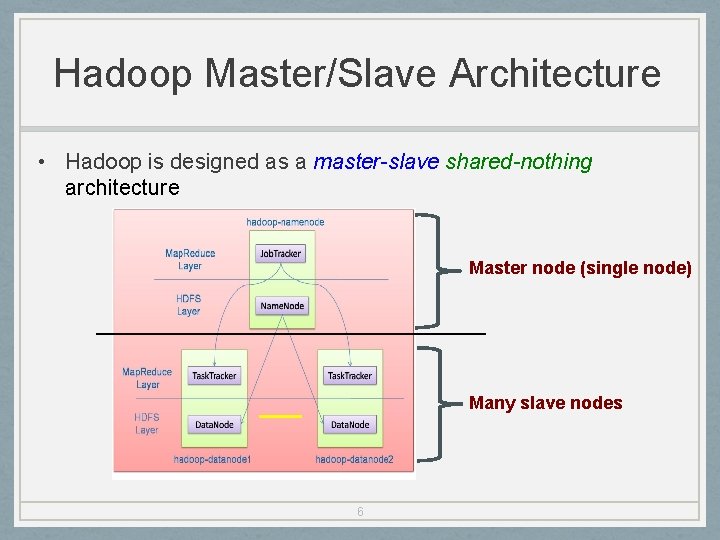
Hadoop Master/Slave Architecture • Hadoop is designed as a master-slave shared-nothing architecture Master node (single node) Many slave nodes 6
Design Principles of Hadoop • Need to process big data • Need to parallelize computation across thousands of nodes • Commodity hardware • Large number of low-end cheap machines working in parallel to solve a computing problem • This is in contrast to Parallel DBs • Small number of high-end expensive machines 7
Design Principles of Hadoop • Automatic parallelization & distribution • Hidden from the end-user • Fault tolerance and automatic recovery • Nodes/tasks will fail and will recover automatically • Clean and simple programming abstraction • Users only provide two functions “map” and “reduce” 8
How Uses Map. Reduce/Hadoop • Google: Inventors of Map. Reduce computing paradigm • Yahoo: Developing Hadoop open-source of Map. Reduce • IBM, Microsoft, Oracle • Facebook, Amazon, AOL, Net. Flex • Many others + universities and research labs 9
Hadoop: How it Works 10
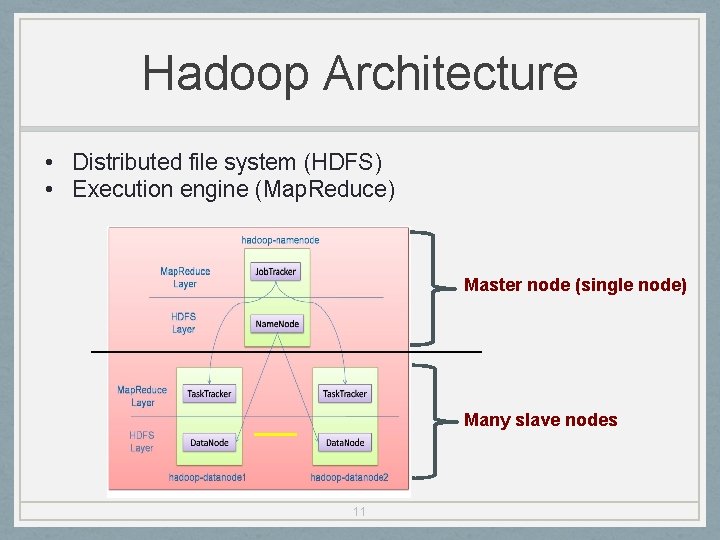
Hadoop Architecture • Distributed file system (HDFS) • Execution engine (Map. Reduce) Master node (single node) Many slave nodes 11
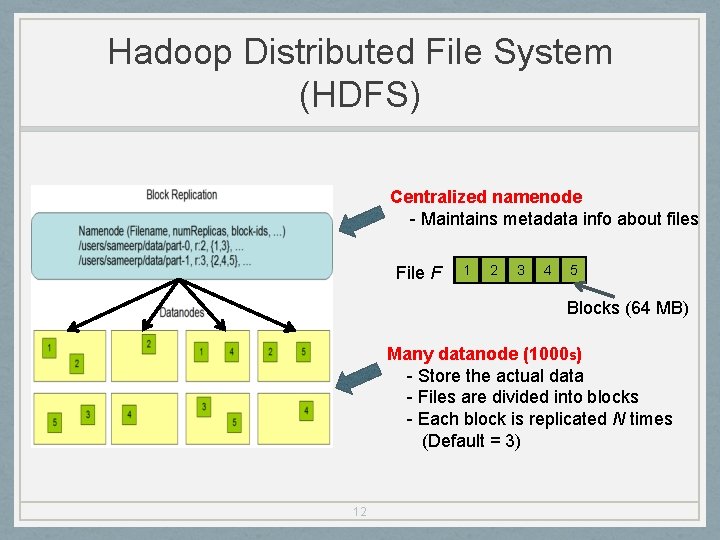
Hadoop Distributed File System (HDFS) Centralized namenode - Maintains metadata info about files File F 1 2 3 4 5 Blocks (64 MB) Many datanode (1000 s) - Store the actual data - Files are divided into blocks - Each block is replicated N times (Default = 3) 12
Main Properties of HDFS • Large: A HDFS instance may consist of thousands of server machines, each storing part of the file system’s data • Replication: Each data block is replicated many times (default is 3) • Failure: Failure is the norm rather than exception • Fault Tolerance: Detection of faults and quick, automatic recovery from them is a core architectural goal of HDFS • Namenode is consistently checking Datanodes 13
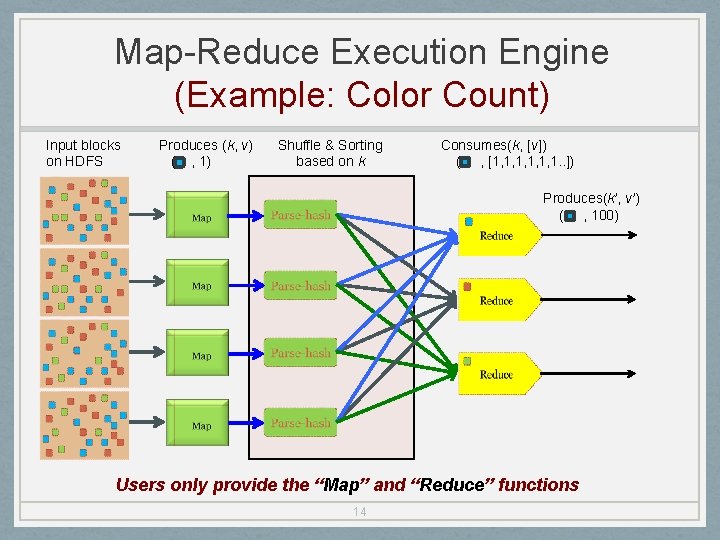
Map-Reduce Execution Engine (Example: Color Count) Input blocks on HDFS Produces (k, v) ( , 1) Shuffle & Sorting based on k Consumes(k, [v]) ( , [1, 1, 1, 1. . ]) Produces(k’, v’) ( , 100) Users only provide the “Map” and “Reduce” functions 14
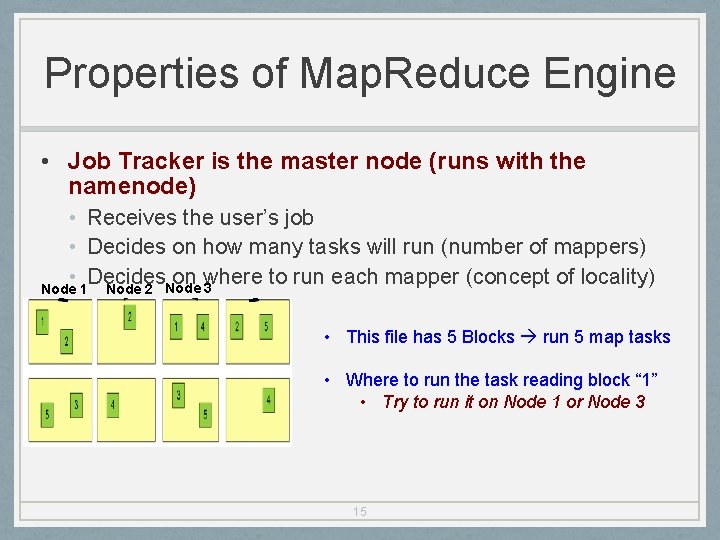
Properties of Map. Reduce Engine • Job Tracker is the master node (runs with the namenode) • Receives the user’s job • Decides on how many tasks will run (number of mappers) • Decides on where to run each mapper (concept of locality) Node 1 Node 2 Node 3 • This file has 5 Blocks run 5 map tasks • Where to run the task reading block “ 1” • Try to run it on Node 1 or Node 3 15
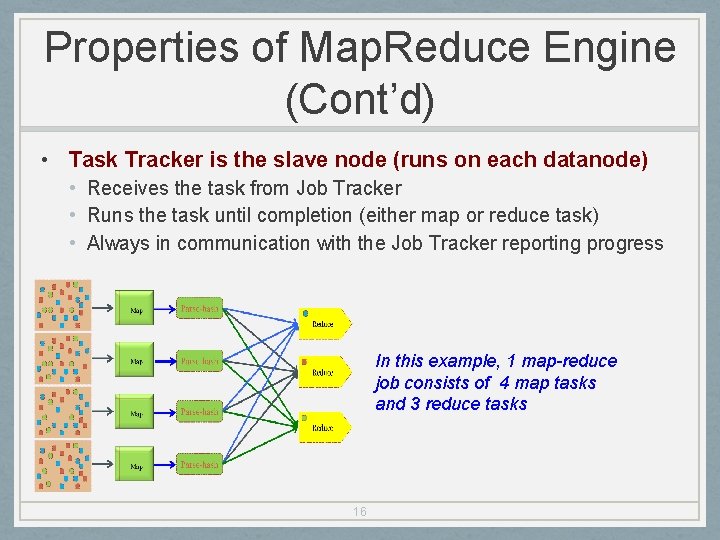
Properties of Map. Reduce Engine (Cont’d) • Task Tracker is the slave node (runs on each datanode) • Receives the task from Job Tracker • Runs the task until completion (either map or reduce task) • Always in communication with the Job Tracker reporting progress In this example, 1 map-reduce job consists of 4 map tasks and 3 reduce tasks 16
Key-Value Pairs • Mappers and Reducers are users’ code (provided functions) • Just need to obey the Key-Value pairs interface • Mappers: • Consume <key, value> pairs • Produce <key, value> pairs • Reducers: • Consume <key, <list of values>> • Produce <key, value> • Shuffling and Sorting: • Hidden phase between mappers and reducers • Groups all similar keys from all mappers, sorts and passes them to a certain reducer in the form of <key, <list of values>> 17
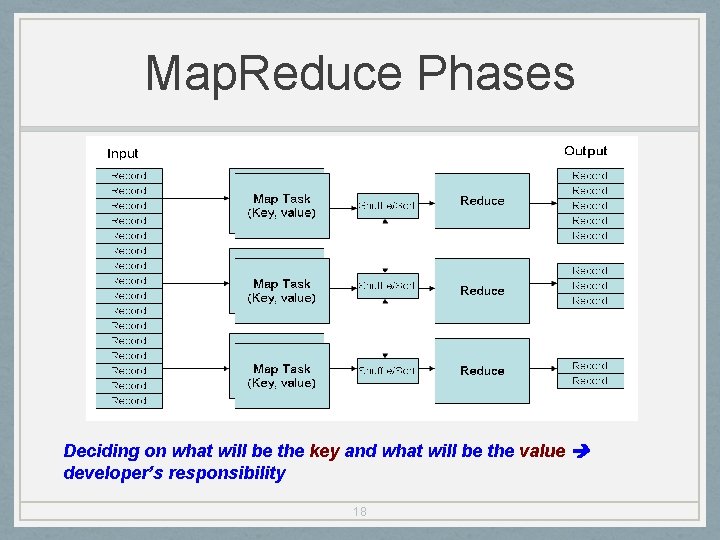
Map. Reduce Phases Deciding on what will be the key and what will be the value developer’s responsibility 18
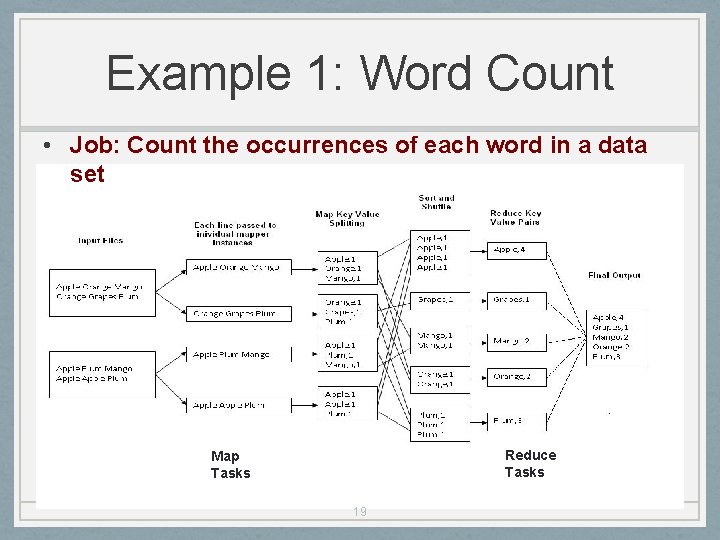
Example 1: Word Count • Job: Count the occurrences of each word in a data set Reduce Tasks Map Tasks 19
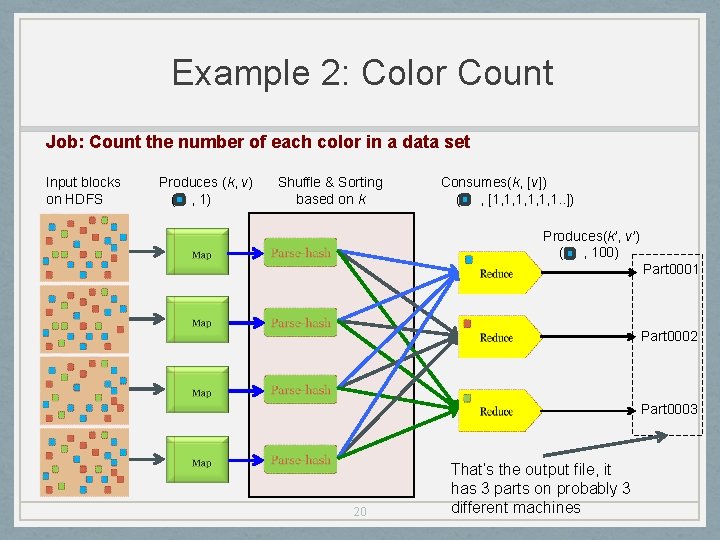
Example 2: Color Count Job: Count the number of each color in a data set Input blocks on HDFS Produces (k, v) ( , 1) Shuffle & Sorting based on k Consumes(k, [v]) ( , [1, 1, 1, 1. . ]) Produces(k’, v’) ( , 100) Part 0001 Part 0002 Part 0003 20 That’s the output file, it has 3 parts on probably 3 different machines
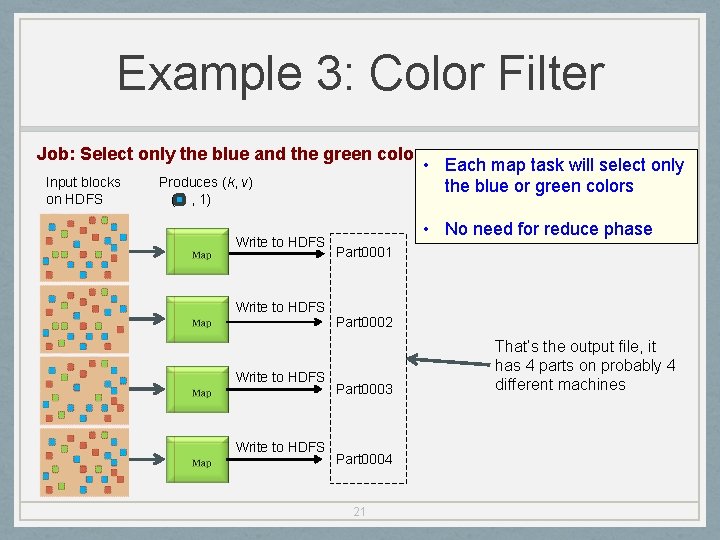
Example 3: Color Filter Job: Select only the blue and the green colors • Each map task will select only Input blocks Produces (k, v) the blue or green colors on HDFS ( , 1) Write to HDFS • No need for reduce phase Part 0001 Part 0002 Part 0003 Part 0004 21 That’s the output file, it has 4 parts on probably 4 different machines
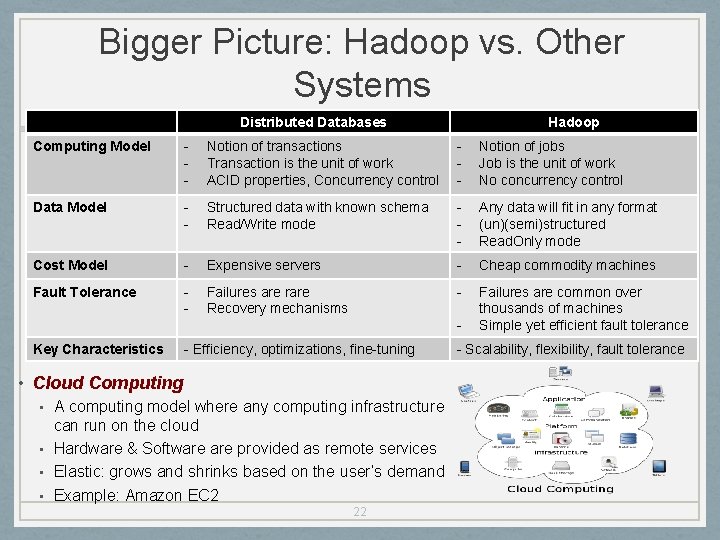
Bigger Picture: Hadoop vs. Other Systems Distributed Databases Hadoop Computing Model - Notion of transactions Transaction is the unit of work ACID properties, Concurrency control - Notion of jobs Job is the unit of work No concurrency control Data Model - Structured data with known schema Read/Write mode - Any data will fit in any format (un)(semi)structured Read. Only mode Cost Model - Expensive servers - Cheap commodity machines Fault Tolerance - Failures are rare Recovery mechanisms - Failures are common over thousands of machines Simple yet efficient fault tolerance Key Characteristics - Efficiency, optimizations, fine-tuning • Cloud Computing • A computing model where any computing infrastructure can run on the cloud • Hardware & Software provided as remote services • Elastic: grows and shrinks based on the user’s demand • Example: Amazon EC 2 22 - Scalability, flexibility, fault tolerance
- Slides: 22