
CS 525 Advanced Distributed Systems Spring 2018 Indranil
CS 525 Advanced Distributed Systems Spring 2018 Indranil Gupta (Indy) Lecture 3 Cloud Computing (Contd. ) January 24, 2018 1 All slides © IG
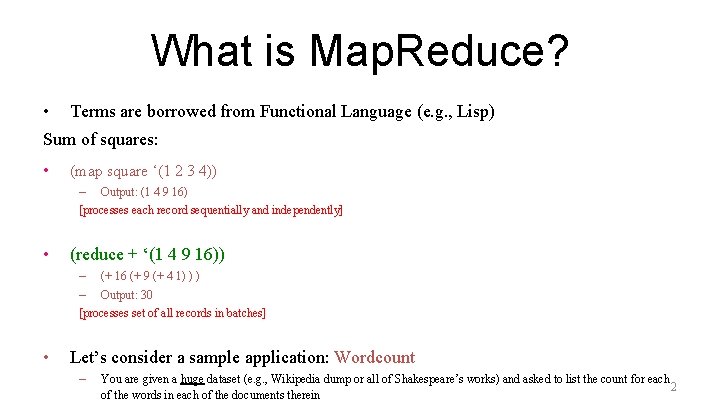
What is Map. Reduce? • Terms are borrowed from Functional Language (e. g. , Lisp) Sum of squares: • (map square ‘(1 2 3 4)) – Output: (1 4 9 16) [processes each record sequentially and independently] • (reduce + ‘(1 4 9 16)) – (+ 16 (+ 9 (+ 4 1) ) ) – Output: 30 [processes set of all records in batches] • Let’s consider a sample application: Wordcount – You are given a huge dataset (e. g. , Wikipedia dump or all of Shakespeare’s works) and asked to list the count for each 2 of the words in each of the documents therein
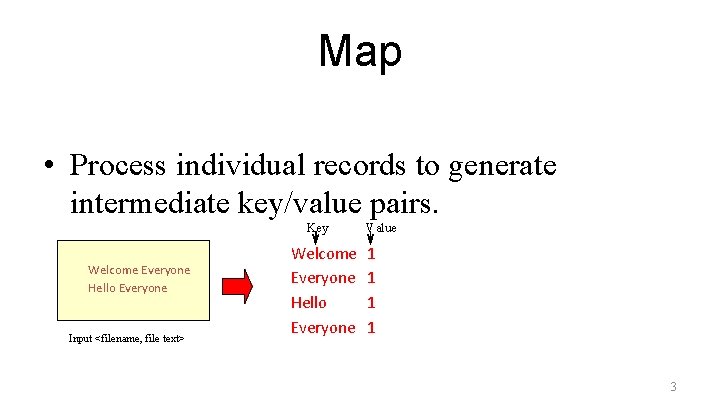
Map • Process individual records to generate intermediate key/value pairs. Key Welcome Everyone Hello Everyone Input <filename, file text> Welcome Everyone Hello Everyone Value 1 1 3
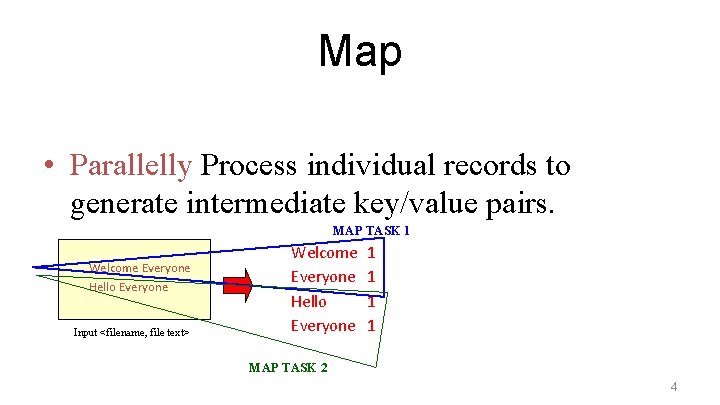
Map • Parallelly Process individual records to generate intermediate key/value pairs. MAP TASK 1 Welcome Everyone Hello Everyone Input <filename, file text> Welcome Everyone Hello Everyone 1 1 MAP TASK 2 4
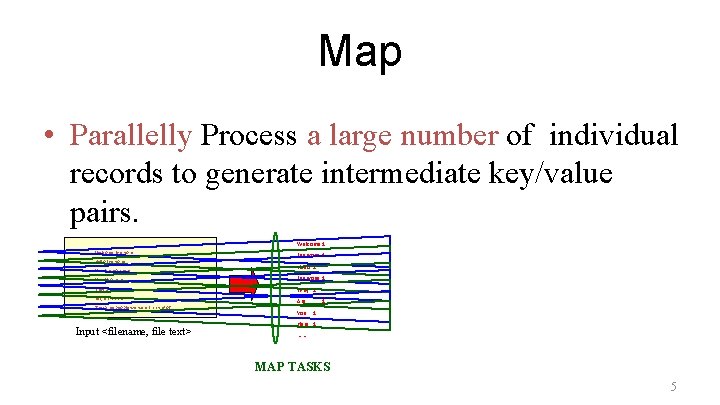
Map • Parallelly Process a large number of individual records to generate intermediate key/value pairs. Welcome 1 Welcome Everyone Hello Everyone Why are you here Everyone 1 Hello 1 I am also here Everyone 1 They are also here Why 1 Yes, it’s THEM! Are The same people we were thinking of ……. Input <filename, file text> You 1 1 Here 1 ……. MAP TASKS 5
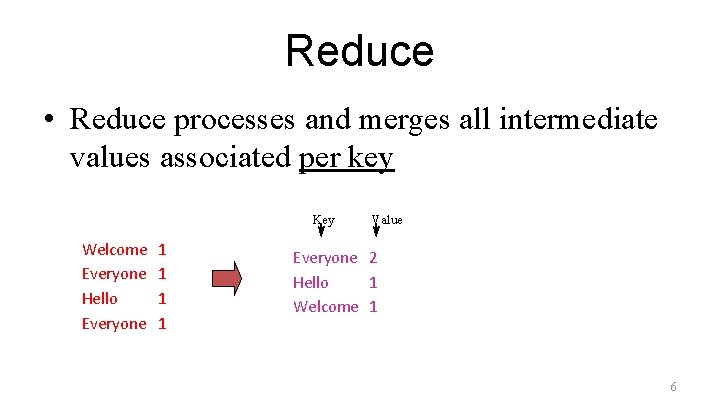
Reduce • Reduce processes and merges all intermediate values associated per key Key Welcome Everyone Hello Everyone 1 1 Value Everyone 2 Hello 1 Welcome 1 6
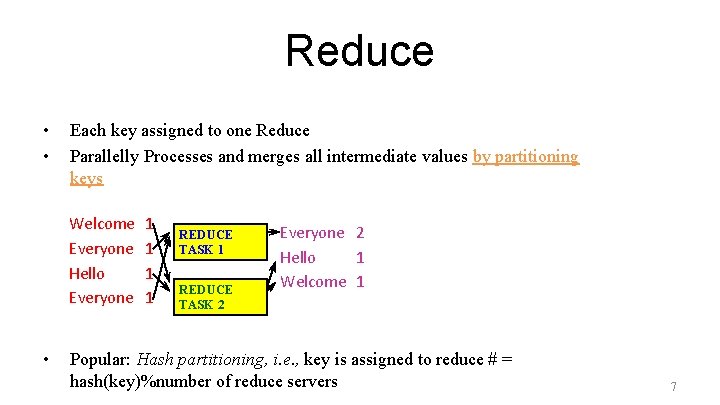
Reduce • • Each key assigned to one Reduce Parallelly Processes and merges all intermediate values by partitioning keys Welcome Everyone Hello Everyone • 1 1 REDUCE TASK 2 Everyone 2 Hello 1 Welcome 1 Popular: Hash partitioning, i. e. , key is assigned to reduce # = hash(key)%number of reduce servers 7
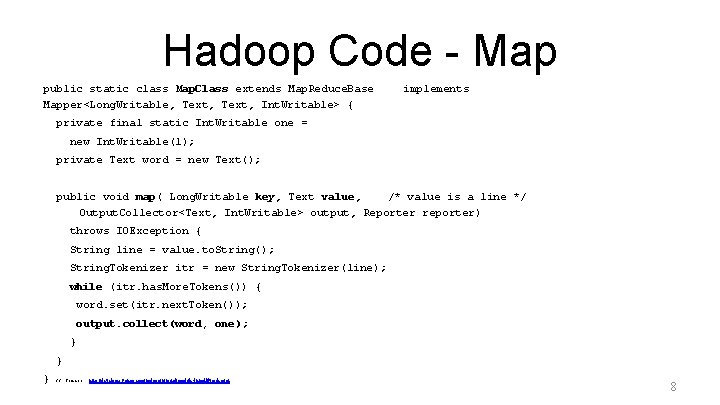
Hadoop Code - Map public static class Map. Class extends Map. Reduce. Base Mapper<Long. Writable, Text, Int. Writable> { implements private final static Int. Writable one = new Int. Writable(1); private Text word = new Text(); public void map( Long. Writable key, Text value, /* value is a line */ Output. Collector<Text, Int. Writable> output, Reporter reporter) throws IOException { String line = value. to. String(); String. Tokenizer itr = new String. Tokenizer(line); while (itr. has. More. Tokens()) { word. set(itr. next. Token()); output. collect(word, one); } } } // Source: http: //developer. yahoo. com/hadoop/tutorial/module 4. html#wordcount 8
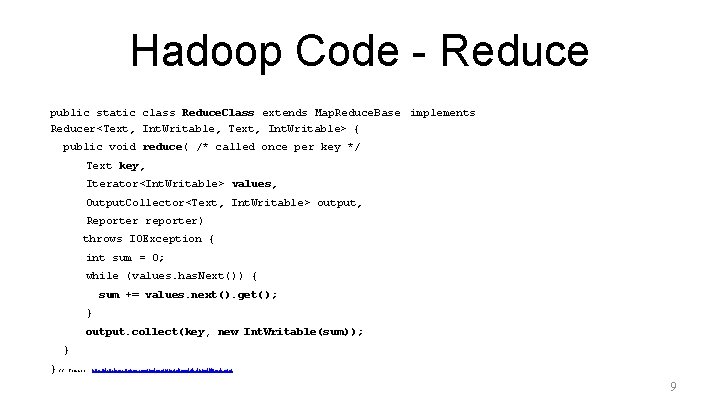
Hadoop Code - Reduce public static class Reduce. Class extends Map. Reduce. Base implements Reducer<Text, Int. Writable, Text, Int. Writable> { public void reduce( /* called once per key */ Text key, Iterator<Int. Writable> values, Output. Collector<Text, Int. Writable> output, Reporter reporter) throws IOException { int sum = 0; while (values. has. Next()) { sum += values. next(). get(); } output. collect(key, new Int. Writable(sum)); } } // Source: http: //developer. yahoo. com/hadoop/tutorial/module 4. html#wordcount 9
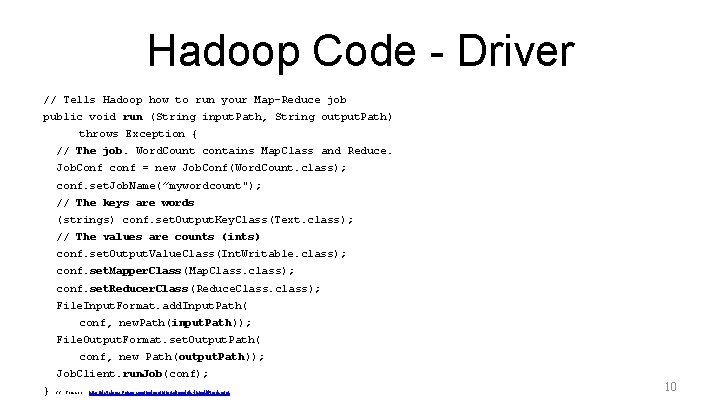
Hadoop Code - Driver // Tells Hadoop how to run your Map-Reduce job public void run (String input. Path, String output. Path) throws Exception { // The job. Word. Count contains Map. Class and Reduce. Job. Conf conf = new Job. Conf(Word. Count. class); conf. set. Job. Name(”mywordcount"); // The keys are words (strings) conf. set. Output. Key. Class(Text. class); // The values are counts (ints) conf. set. Output. Value. Class(Int. Writable. class); conf. set. Mapper. Class(Map. Class. class); conf. set. Reducer. Class(Reduce. Class. class); File. Input. Format. add. Input. Path( conf, new. Path(input. Path)); File. Output. Format. set. Output. Path( conf, new Path(output. Path)); Job. Client. run. Job(conf); } // Source: http: //developer. yahoo. com/hadoop/tutorial/module 4. html#wordcount 10
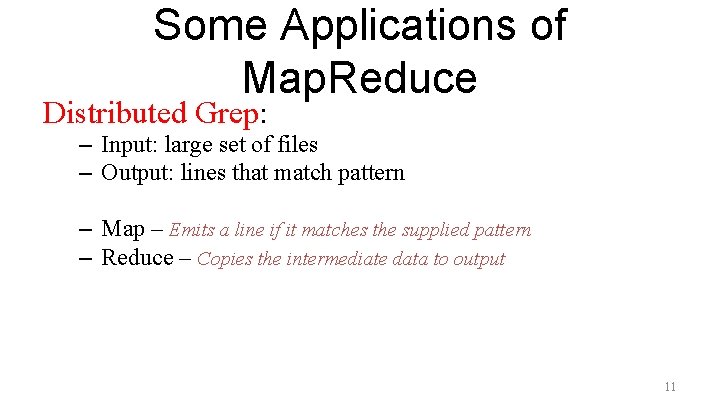
Some Applications of Map. Reduce Distributed Grep: – Input: large set of files – Output: lines that match pattern – Map – Emits a line if it matches the supplied pattern – Reduce – Copies the intermediate data to output 11

Some Applications of Map. Reduce (2) Reverse Web-Link Graph – Input: Web graph: tuples (a, b) where (page a page b) – Output: For each page, list of pages that link to it – Map – process web log and for each input <source, target>, it outputs <target, source> – Reduce - emits <target, list(source)> 12
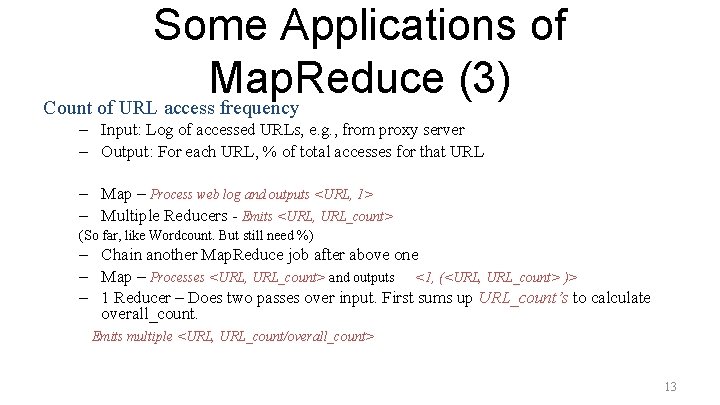
Some Applications of Map. Reduce (3) Count of URL access frequency – Input: Log of accessed URLs, e. g. , from proxy server – Output: For each URL, % of total accesses for that URL – Map – Process web log and outputs <URL, 1> – Multiple Reducers - Emits <URL, URL_count> (So far, like Wordcount. But still need %) – Chain another Map. Reduce job after above one – Map – Processes <URL, URL_count> and outputs <1, (<URL, URL_count> )> – 1 Reducer – Does two passes over input. First sums up URL_count’s to calculate overall_count. Emits multiple <URL, URL_count/overall_count> 13
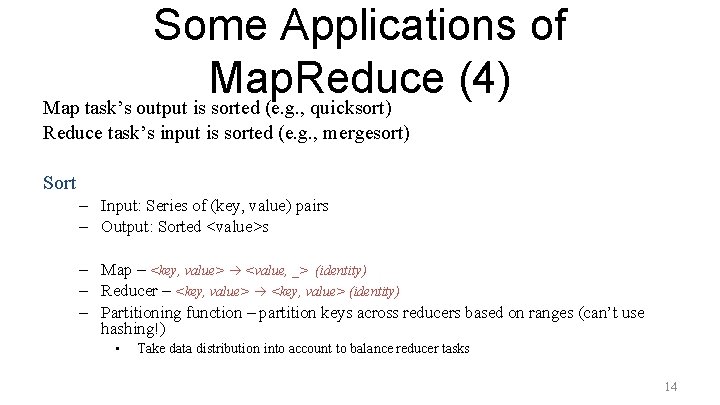
Some Applications of Map. Reduce (4) Map task’s output is sorted (e. g. , quicksort) Reduce task’s input is sorted (e. g. , mergesort) Sort – Input: Series of (key, value) pairs – Output: Sorted <value>s – Map – <key, value> <value, _> (identity) – Reducer – <key, value> (identity) – Partitioning function – partition keys across reducers based on ranges (can’t use hashing!) • Take data distribution into account to balance reducer tasks 14
Programming Map. Reduce Externally: For user 1. Write a Map program (short), write a Reduce program (short) 2. Specify number of Maps and Reduces (parallelism level) 3. Submit job; wait for result 4. Need to know very little about parallel/distributed programming! Internally: For the Paradigm and Scheduler 1. Parallelize Map 2. Transfer data from Map to Reduce 3. Parallelize Reduce 4. Implement Storage for Map input, Map output, Reduce input, and Reduce output (Ensure that no Reduce starts before all Maps are finished. That is, ensure the barrier between the Map phase and Reduce phase) 15
For the cloud: 1. 2. 3. 4. Inside Map. Reduce Parallelize Map: easy! each map task is independent of the other! • All Map output records with same key assigned to same Reduce Transfer data from Map to Reduce (“Shuffle” phase): • All Map output records with same key assigned to same Reduce task • use partitioning function, e. g. , hash(key)%number of reducers Parallelize Reduce: easy! each reduce task is independent of the other! Implement Storage for Map input, Map output, Reduce input, and Reduce output • Map input: from distributed file system • Map output: to local disk (at Map node); uses local file system • Reduce input: from (multiple) remote disks; uses local file systems • Reduce output: to distributed file system local file system = Linux FS, etc. distributed file system = GFS (Google File System), HDFS (Hadoop Distributed File System) 16
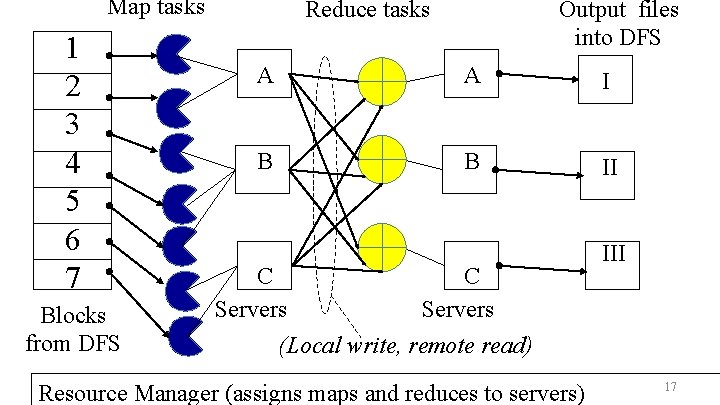
Map tasks 1 2 3 4 5 6 7 Blocks from DFS Reduce tasks Output files into DFS A A I B B II C C Servers (Local write, remote read) Resource Manager (assigns maps and reduces to servers) III 17
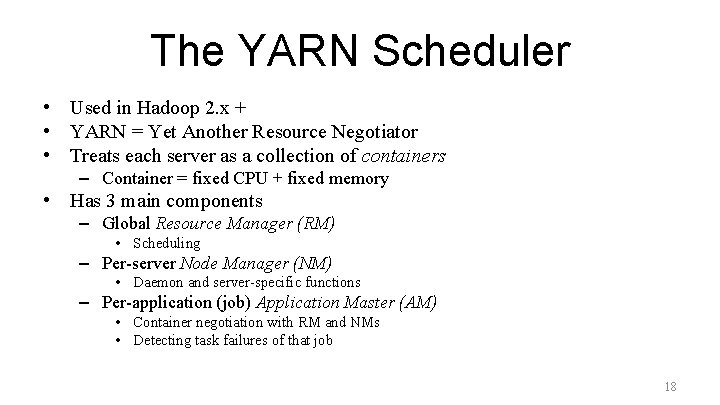
The YARN Scheduler • Used in Hadoop 2. x + • YARN = Yet Another Resource Negotiator • Treats each server as a collection of containers – Container = fixed CPU + fixed memory • Has 3 main components – Global Resource Manager (RM) • Scheduling – Per-server Node Manager (NM) • Daemon and server-specific functions – Per-application (job) Application Master (AM) • Container negotiation with RM and NMs • Detecting task failures of that job 18
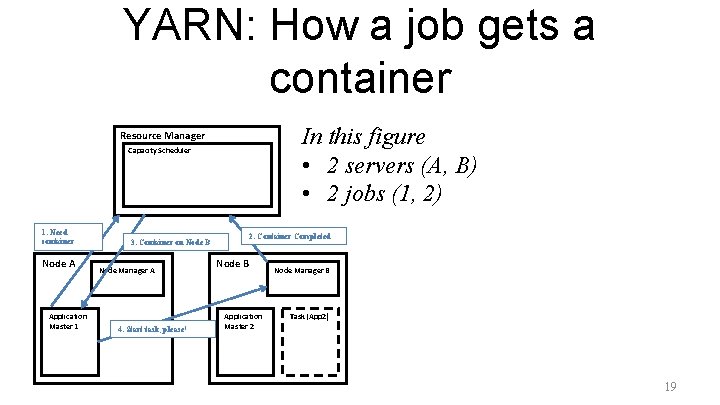
YARN: How a job gets a container In this figure • 2 servers (A, B) • 2 jobs (1, 2) Resource Manager Capacity Scheduler 1. Need container Node A Application Master 1 3. Container on Node B Node Manager A 4. Start task, please! 2. Container Completed Node B Application Master 2 Node Manager B Task (App 2) 19
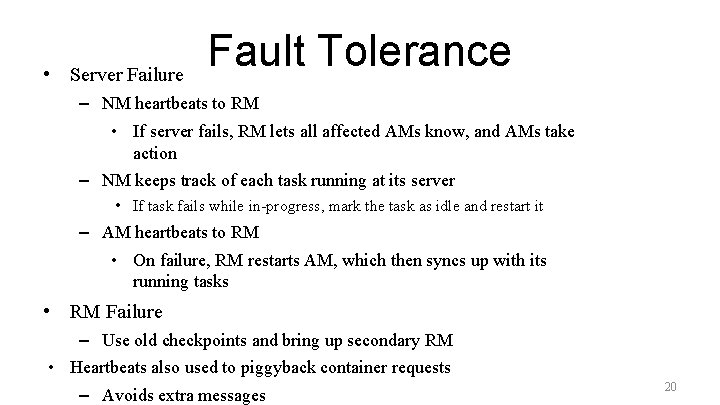
• Server Failure Fault Tolerance – NM heartbeats to RM • If server fails, RM lets all affected AMs know, and AMs take action – NM keeps track of each task running at its server • If task fails while in-progress, mark the task as idle and restart it – AM heartbeats to RM • On failure, RM restarts AM, which then syncs up with its running tasks • RM Failure – Use old checkpoints and bring up secondary RM • Heartbeats also used to piggyback container requests – Avoids extra messages 20
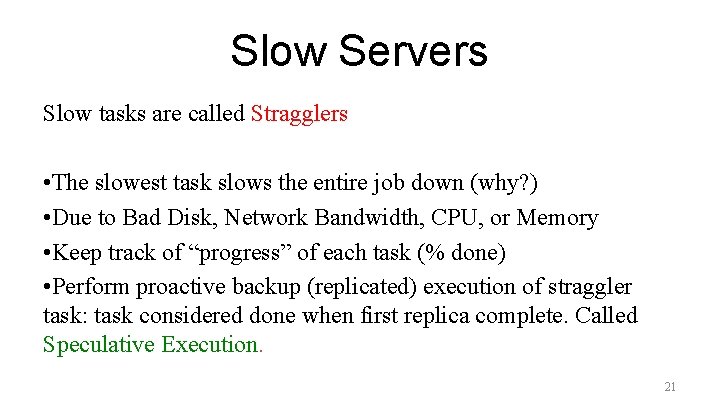
Slow Servers Slow tasks are called Stragglers • The slowest task slows the entire job down (why? ) • Due to Bad Disk, Network Bandwidth, CPU, or Memory • Keep track of “progress” of each task (% done) • Perform proactive backup (replicated) execution of straggler task: task considered done when first replica complete. Called Speculative Execution. 21
Locality • Locality – Since cloud has hierarchical topology (e. g. , racks) – GFS/HDFS stores 3 replicas of each of chunks (e. g. , 64 MB in size) • Maybe on different racks, e. g. , 2 on a rack, 1 on a different rack – Mapreduce attempts to schedule a map task on • a machine that contains a replica of corresponding input data, or failing that, • on the same rack as a machine containing the input, or failing that, • Anywhere 22
Mapreduce: Summary • Mapreduce uses parallelization + aggregation to schedule applications across clusters • Need to deal with failure • Plenty of ongoing research work in scheduling and fault-tolerance for Mapreduce and Hadoop 23
![10 Challenges [Above the Clouds] (Index: Performance Data-related Scalability Logistical) • • • Availability](http://slidetodoc.com/presentation_image_h2/070dc21d2f7b0a533912b4b86c063170/image-24.jpg "10 Challenges [Above the Clouds] (Index: Performance Data-related Scalability Logistical) • • • Availability")
10 Challenges [Above the Clouds] (Index: Performance Data-related Scalability Logistical) • • • Availability of Service: Use Multiple Cloud Providers; Use Elasticity; Prevent DDOS Data Lock-In: Standardize APIs; Enable Surge Computing Data Confidentiality and Auditability: Deploy Encryption, VLANs, Firewalls, Geographical Data Storage Data Transfer Bottlenecks: Data Backup/Archival; Higher BW Switches; New Cloud Topologies; Fed. Exing Disks Performance Unpredictability: Qo. S; Improved VM Support; Flash Memory; Schedule VMs Scalable Storage: Invent Scalable Store Bugs in Large Distributed Systems: Invent Debuggers; Real-time debugging; predictable prerun-time debugging Scaling Quickly: Invent Good Auto-Scalers; Snapshots for Conservation Reputation Fate Sharing Software Licensing: Pay-for-use licenses; Bulk use sales 24
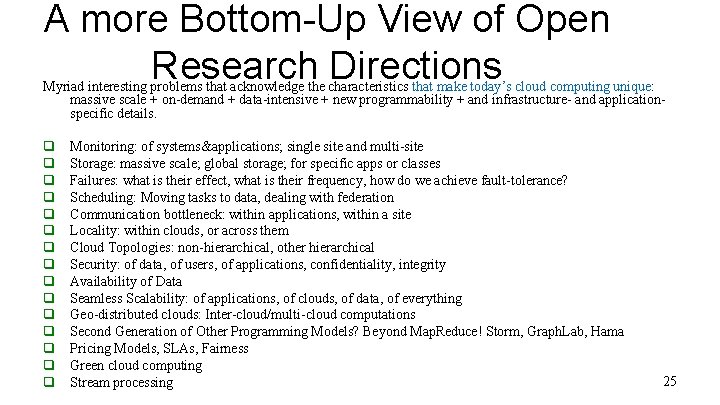
A more Bottom-Up View of Open Research Directions Myriad interesting problems that acknowledge the characteristics that make today’s cloud computing unique: massive scale + on-demand + data-intensive + new programmability + and infrastructure- and applicationspecific details. q q q q Monitoring: of systems&applications; single site and multi-site Storage: massive scale; global storage; for specific apps or classes Failures: what is their effect, what is their frequency, how do we achieve fault-tolerance? Scheduling: Moving tasks to data, dealing with federation Communication bottleneck: within applications, within a site Locality: within clouds, or across them Cloud Topologies: non-hierarchical, other hierarchical Security: of data, of users, of applications, confidentiality, integrity Availability of Data Seamless Scalability: of applications, of clouds, of data, of everything Geo-distributed clouds: Inter-cloud/multi-cloud computations Second Generation of Other Programming Models? Beyond Map. Reduce! Storm, Graph. Lab, Hama Pricing Models, SLAs, Fairness Green cloud computing Stream processing 25
Example: Rapid Atmospheric Modeling System, Colo. State U • Hurricane Georges, 17 days in Sept 1998 – “RAMS modeled the mesoscale convective complex that dropped so much rain, in good agreement with recorded data” – Used 5 km spacing instead of the usual 10 km – Ran on 256+ processors • Computation-intenstive computing (or HPC = High Performance Computing) • Can one run such a program without access to a supercomputer? 26
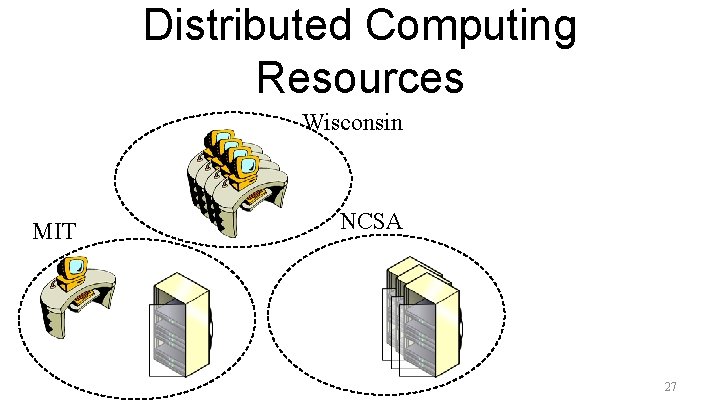
Distributed Computing Resources Wisconsin MIT NCSA 27
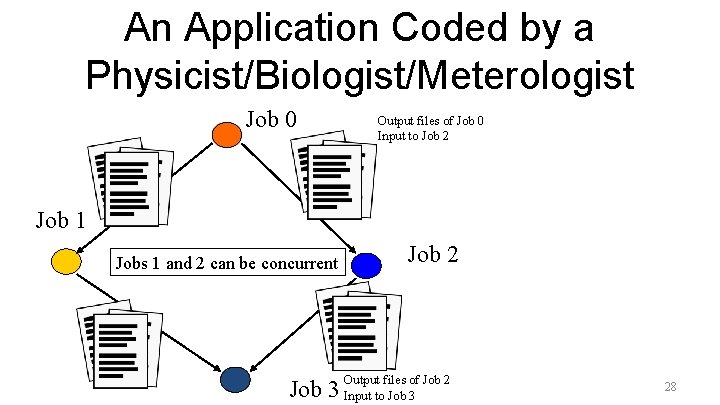
An Application Coded by a Physicist/Biologist/Meterologist Job 0 Output files of Job 0 Input to Job 2 Job 1 Jobs 1 and 2 can be concurrent Job 2 Output files of Job 2 Job 3 Input to Job 3 28
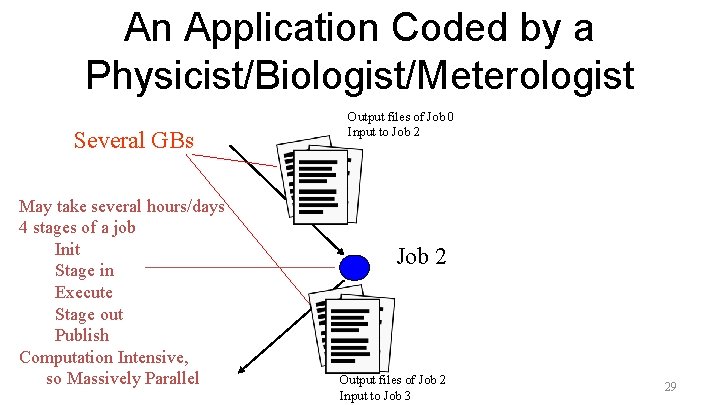
An Application Coded by a Physicist/Biologist/Meterologist Several GBs May take several hours/days 4 stages of a job Init Stage in Execute Stage out Publish Computation Intensive, so Massively Parallel Output files of Job 0 Input to Job 2 Output files of Job 2 Input to Job 3 29
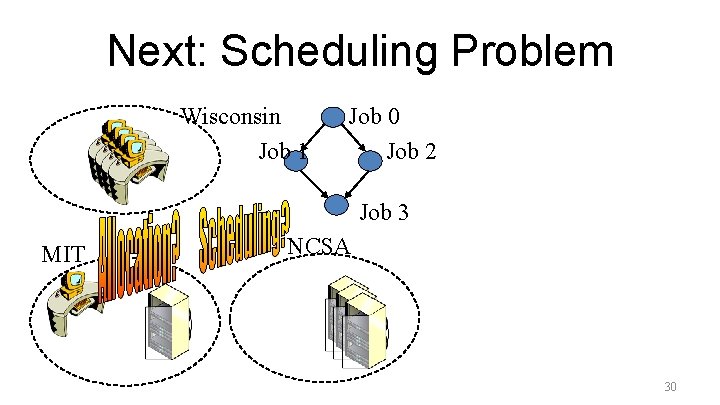
Next: Scheduling Problem Wisconsin Job 1 Job 0 Job 2 Job 3 MIT NCSA 30
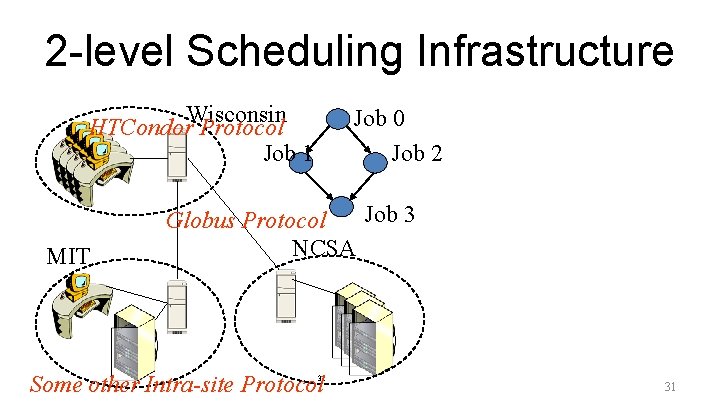
2 -level Scheduling Infrastructure Wisconsin HTCondor Protocol Job 1 MIT Job 0 Job 2 Job 3 Globus Protocol NCSA Some other Intra-site Protocol 31 31
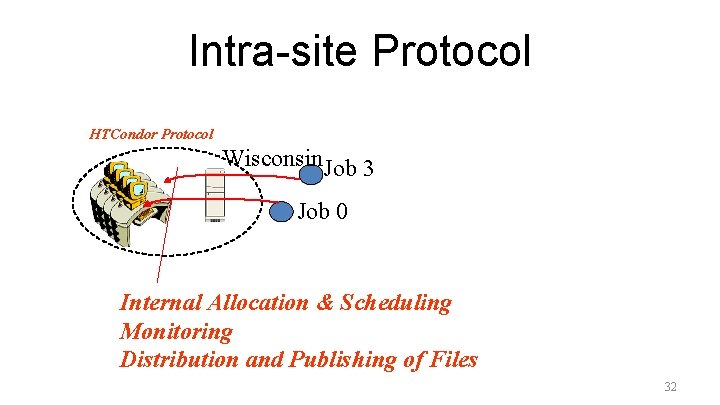
Intra-site Protocol HTCondor Protocol Wisconsin. Job 3 Job 0 Internal Allocation & Scheduling Monitoring Distribution and Publishing of Files 32
Condor (now HTCondor) • High-throughput computing system from U. Wisconsin Madison • Belongs to a class of Cycle-scavenging systems Such systems • Run on a lot of workstations • When workstation is free, ask site’s central server (or Globus) for tasks • If user hits a keystroke or mouse click, stop task – Either kill task or ask server to reschedule task • Can also run on dedicated machines 33
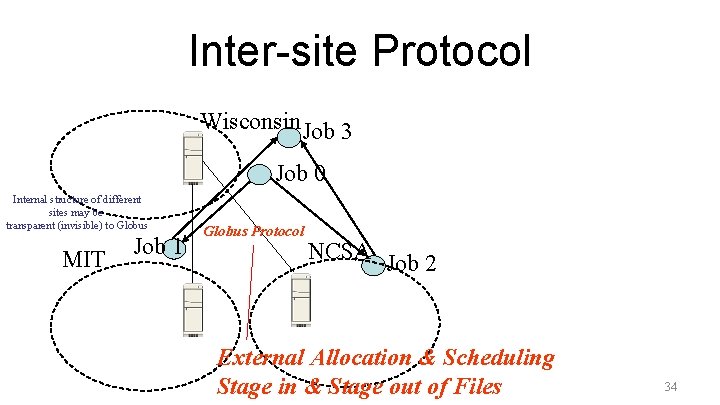
Inter-site Protocol Wisconsin. Job 3 Job 0 Internal structure of different sites may be transparent (invisible) to Globus MIT Job 1 Globus Protocol NCSA Job 2 External Allocation & Scheduling Stage in & Stage out of Files 34
Globus • Globus Alliance involves universities, national US research labs, and some companies • Standardized several things, especially software tools • Separately, but related: Open Grid Forum • Globus Alliance has developed the Globus Toolkit http: //toolkit. globus. org/toolkit/ 35
Globus Toolkit • Open-source • Consists of several components – Grid. FTP: Wide-area transfer of bulk data – GRAM 5 (Grid Resource Allocation Manager): submit, locate, cancel, and manage jobs • Not a scheduler • Globus communicates with the schedulers in intra-site protocols like HTCondor or Portable Batch System (PBS) – RLS (Replica Location Service): Naming service that translates from a file/dir name to a target location (or another file/dir name) – Libraries like XIO to provide a standard API for all Grid IO functionalities – Grid Security Infrastructure (GSI) 36
Security Issues • Important in Grids because they are federated, i. e. , no single entity controls the entire infrastructure • • • Single sign-on: collective job set should require once-only user authentication Mapping to local security mechanisms: some sites use Kerberos, others using Unix Delegation: credentials to access resources inherited by subcomputations, e. g. , job 0 to job 1 Community authorization: e. g. , third-party authentication • • • These are also important in clouds, but less so because clouds are typically run under a central control In clouds the focus is on failures, scale, on-demand nature 37
Points to Ponder • Cloud computing vs. Grid computing: what are the differences? • What has happened to the Grid Computing Community? – See Open Cloud Consortium – See CCGrid conference – See Globus 38
Summary • Grid computing focuses on computation-intensive computing (HPC) • Though often federated, architecture and key concepts have a lot in common with that of clouds • Are Grids/HPC converging towards clouds? – E. g. , Compare Open. Stack and Globus 39
Projects: Where to get your ideas from • Read through papers. Read ahead! Read both main and optional papers. • Leverage area overlaps: x was done for problem area 1, but not for problem area 2 • Look at hot areas: – – Stream processing Machine Learning Io. T RDMA • Look at the JIRAs of these projects – Lots of issues listed but not being worked on 40
Announcements • Please sign up for a presentation/scriber slot by next Wednesday office hours • Next up: Peer to peer systems 41
- Slides: 41