
CS 522 Advanced Database Systems Clustering DensityBased Methods

CS 522 Advanced Database Systems Clustering: Density-Based Methods Chengyu Sun California State University, Los Angeles
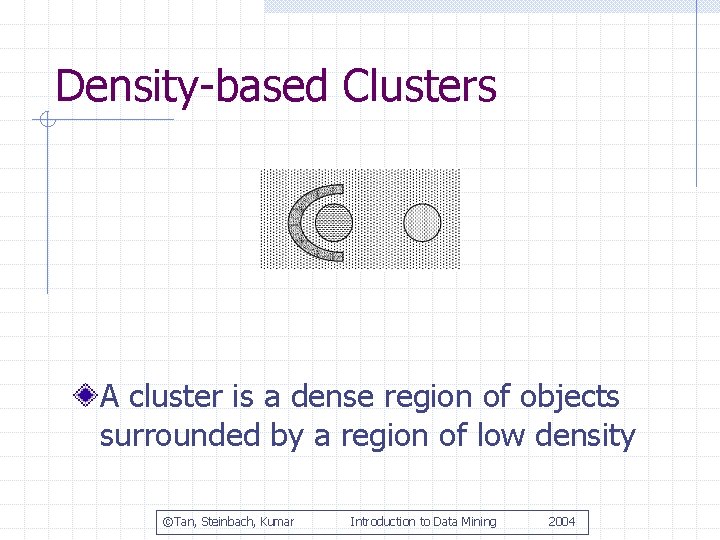
Density-based Clusters A cluster is a dense region of objects surrounded by a region of low density ©Tan, Steinbach, Kumar Introduction to Data Mining 2004
DBSCAN Density-Based Spatial Clustering of Applications with Noise
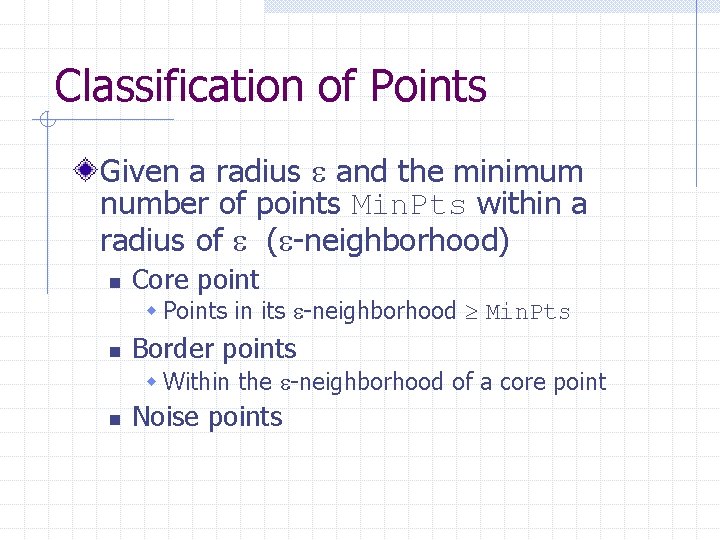
Classification of Points Given a radius and the minimum number of points Min. Pts within a radius of ( -neighborhood) n Core point w Points in its -neighborhood Min. Pts n Border points w Within the -neighborhood of a core point n Noise points
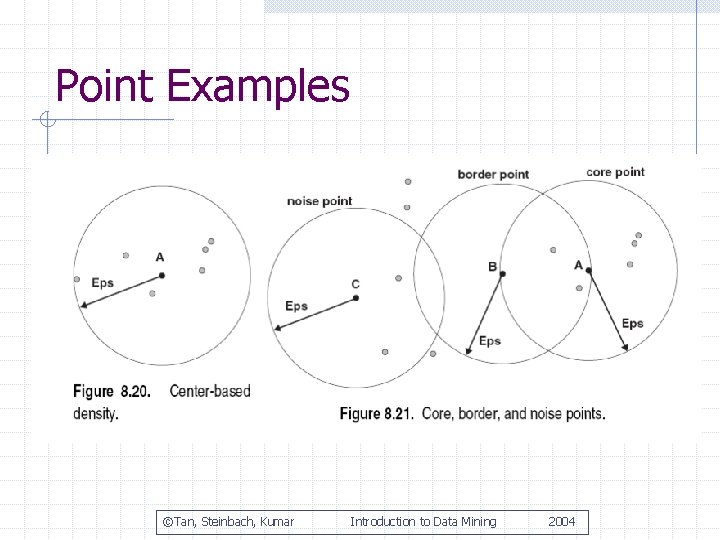
Point Examples ©Tan, Steinbach, Kumar Introduction to Data Mining 2004
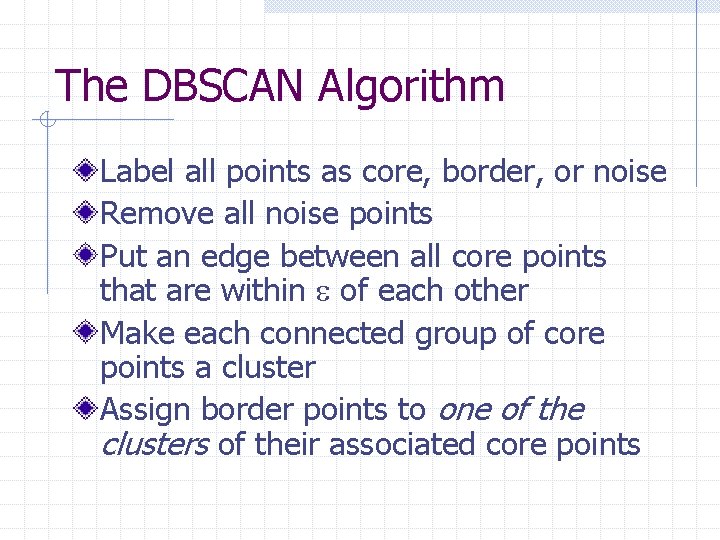
The DBSCAN Algorithm Label all points as core, border, or noise Remove all noise points Put an edge between all core points that are within of each other Make each connected group of core points a cluster Assign border points to one of the clusters of their associated core points

DBSCAN Example
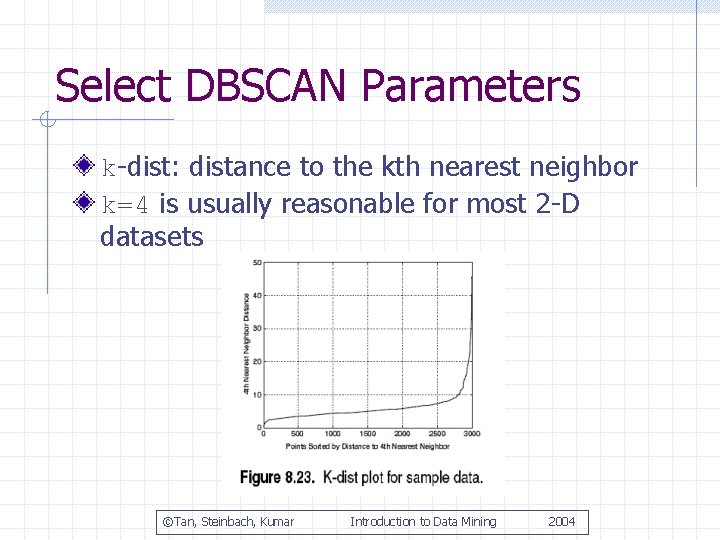
Select DBSCAN Parameters k-dist: distance to the kth nearest neighbor k=4 is usually reasonable for most 2 -D datasets ©Tan, Steinbach, Kumar Introduction to Data Mining 2004
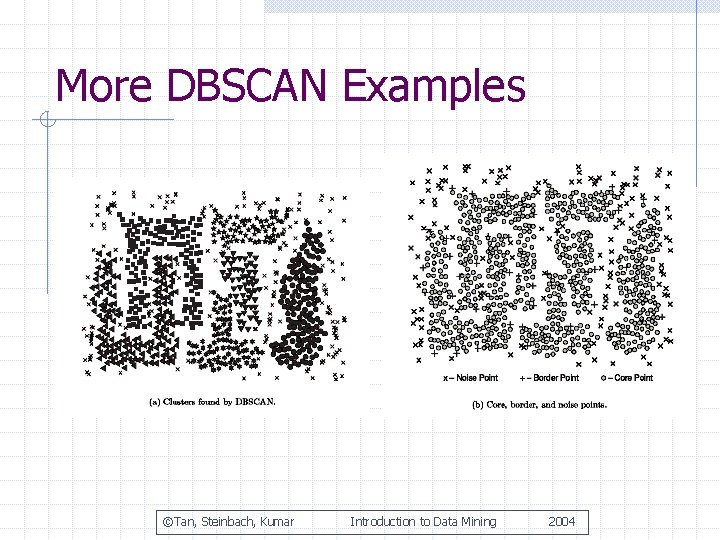
More DBSCAN Examples ©Tan, Steinbach, Kumar Introduction to Data Mining 2004
About DBSCAN Handle clusters with arbitrary shapes and sizes Limitations n n Clusters with varying densities High dimensional data Could be expensive because of nearest neighbor computation n Use a spatial index structure like R tree or k-d tree
Readings Textbook 10. 4. 1
- Slides: 11