
CS 520 Web Programming ObjectRelational Mapping with Hibernate
CS 520 Web Programming Object-Relational Mapping with Hibernate and JPA (I) Chengyu Sun California State University, Los Angeles
The Object-Oriented Paradigm The world consists of objects So we use object-oriented languages to write applications We want to store some of the application objects (a. k. a. persistent objects) So we use a Object Database?
The Reality of DBMS Relational DBMS are still predominant n n n Best performance Most reliable Widest support Bridge between OO applications and relational databases n n CLI and embedded SQL Object-Relational Mapping (ORM) tools
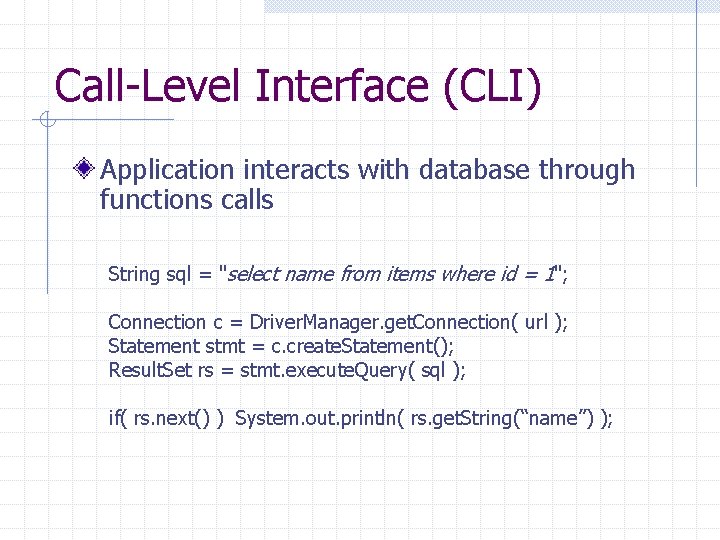
Call-Level Interface (CLI) Application interacts with database through functions calls String sql = "select name from items where id = 1"; Connection c = Driver. Manager. get. Connection( url ); Statement stmt = c. create. Statement(); Result. Set rs = stmt. execute. Query( sql ); if( rs. next() ) System. out. println( rs. get. String(“name”) );
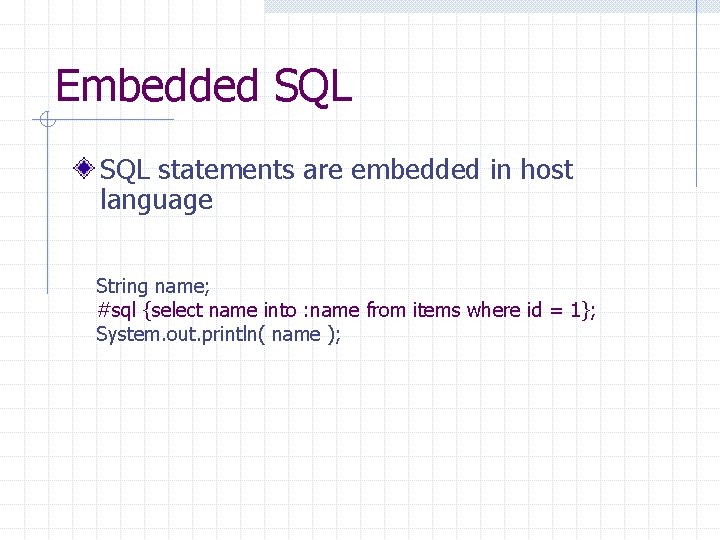
Embedded SQL statements are embedded in host language String name; #sql {select name into : name from items where id = 1}; System. out. println( name );
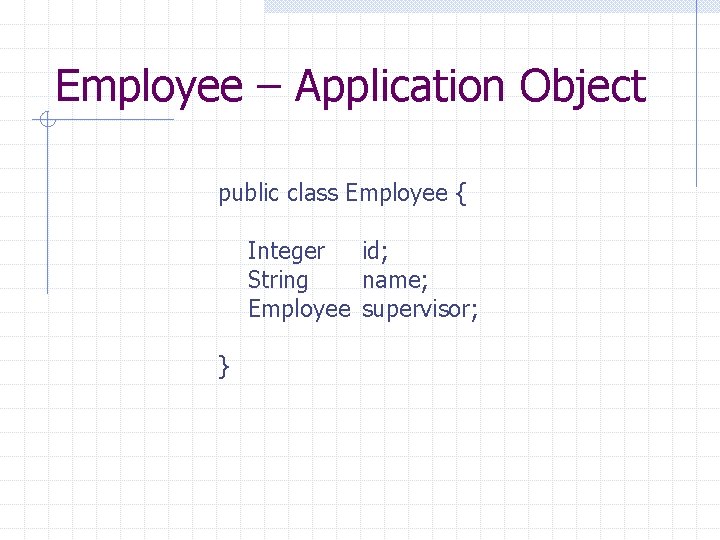
Employee – Application Object public class Employee { Integer id; String name; Employee supervisor; }
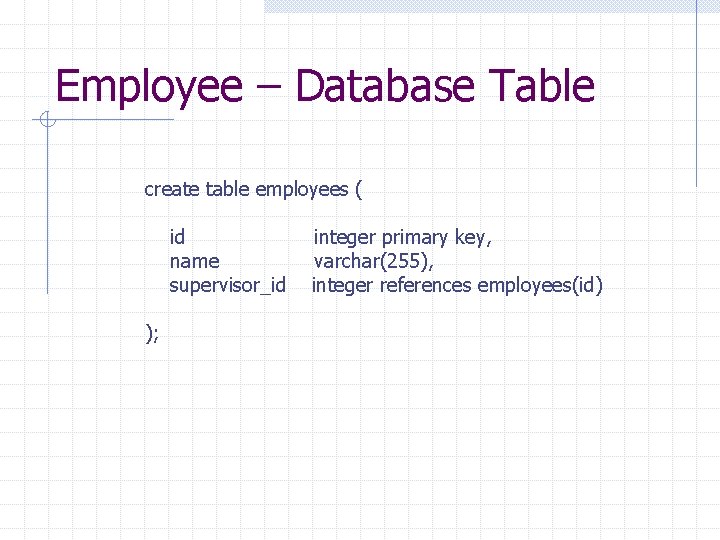
Employee – Database Table create table employees ( id name supervisor_id ); integer primary key, varchar(255), integer references employees(id)
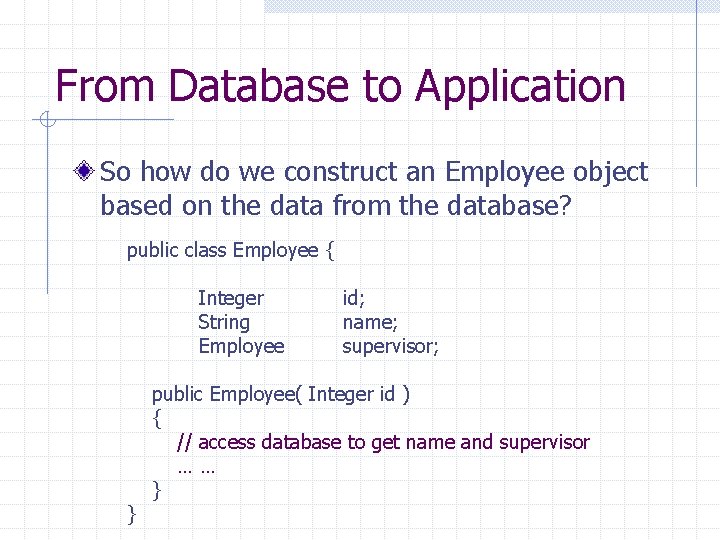
From Database to Application So how do we construct an Employee object based on the data from the database? public class Employee { Integer String Employee } id; name; supervisor; public Employee( Integer id ) { // access database to get name and supervisor …… }
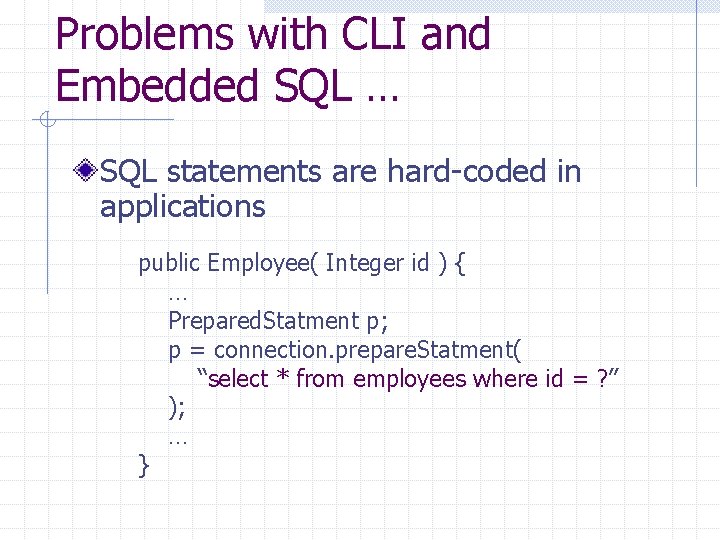
Problems with CLI and Embedded SQL … SQL statements are hard-coded in applications public Employee( Integer id ) { … Prepared. Statment p; p = connection. prepare. Statment( “select * from employees where id = ? ” ); … }
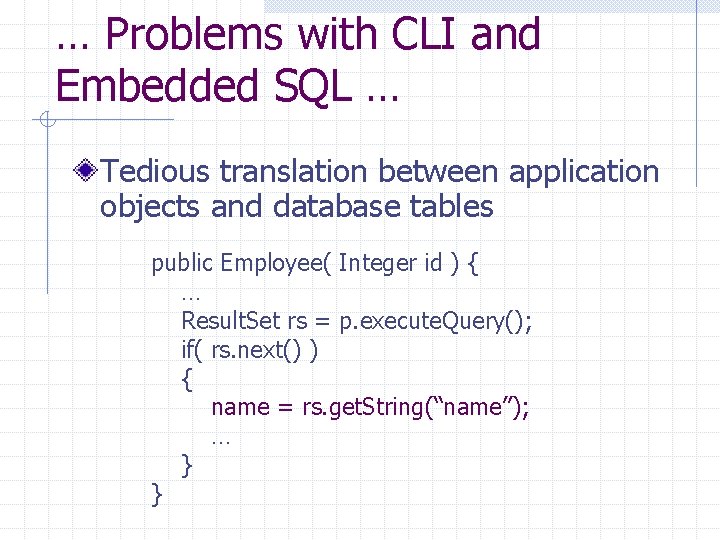
… Problems with CLI and Embedded SQL … Tedious translation between application objects and database tables public Employee( Integer id ) { … Result. Set rs = p. execute. Query(); if( rs. next() ) { name = rs. get. String(“name”); … } }
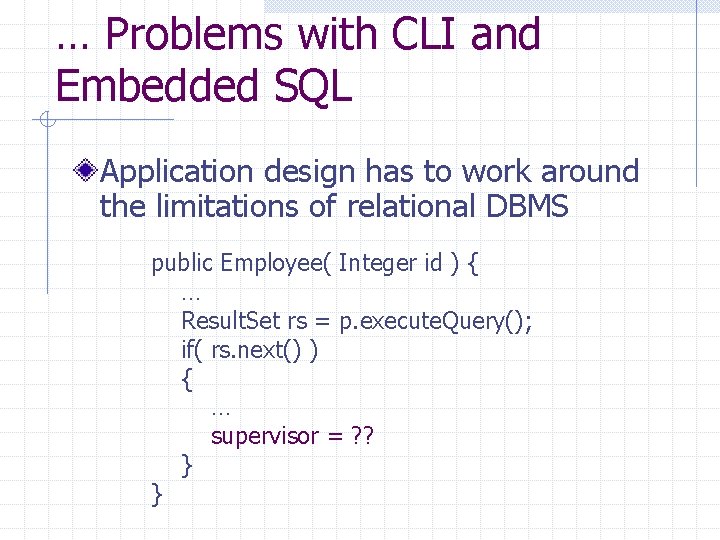
… Problems with CLI and Embedded SQL Application design has to work around the limitations of relational DBMS public Employee( Integer id ) { … Result. Set rs = p. execute. Query(); if( rs. next() ) { … supervisor = ? ? } }
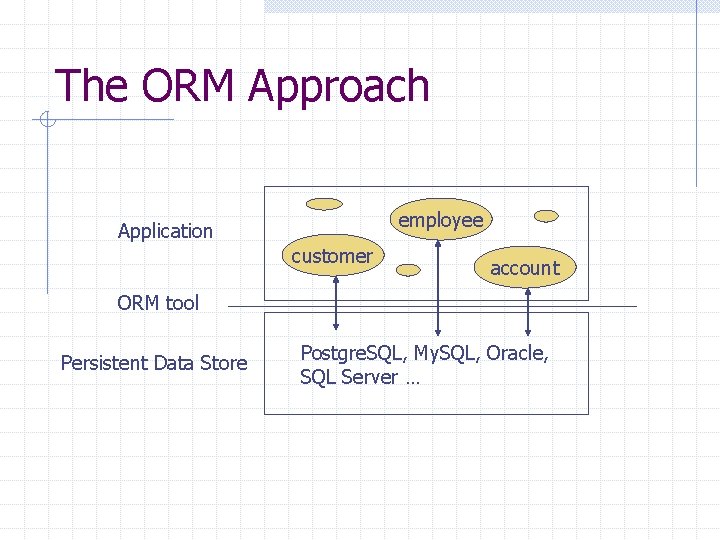
The ORM Approach employee Application customer account ORM tool Persistent Data Store Postgre. SQL, My. SQL, Oracle, SQL Server …
Hibernate and JPA Java Persistence API (JPA) n n n Annotations for object-relational mapping Data access API An object-oriented query language JPQL Hibernate n n The most popular Java ORM library An implementation of JPA
Hibernate Usage Hibernate without JPA n n API: Session. Factory, Session, Query, Transaction More features Hibernate with JPA n n n API: Entity. Manager. Factory, Entity. Manager, Query, Transaction Better portability Behaviors are better defined and documented
A Hibernate Example Java class n Employee. java Code to access the database n Employee. Test. java JPA configuration file n persistence. xml (Optional) Logging configuration file n log 4 j. properties
Persistent Class A class whose objects need to be saved (i. e. persisted) in a database Any Java model class can be a persistent class, though it is recommended that n n n Each persistent class has an identity field Each persistent class implements the Serializable interface Each persistent field has a pair of getter and setter, which don’t have to be public
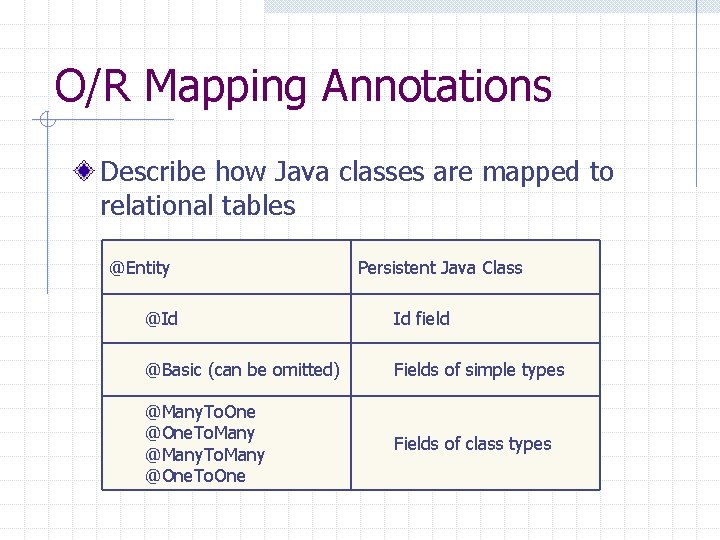
O/R Mapping Annotations Describe how Java classes are mapped to relational tables @Entity Persistent Java Class @Id Id field @Basic (can be omitted) Fields of simple types @Many. To. One @One. To. Many @Many. To. Many @One. To. One Fields of class types
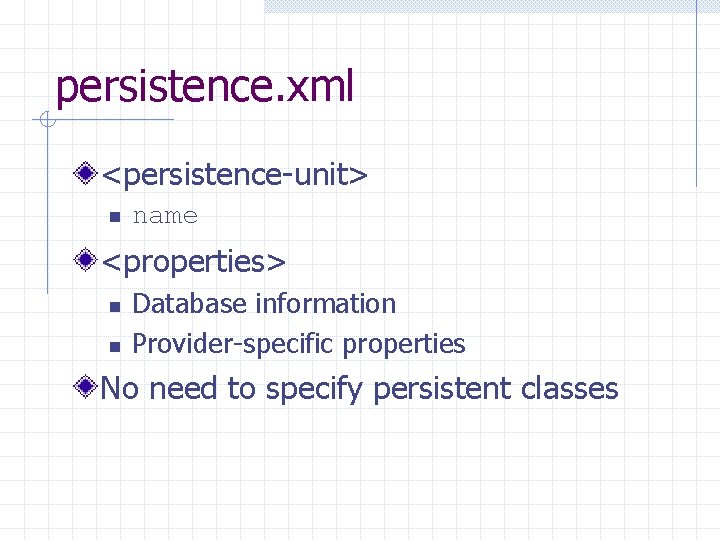
persistence. xml <persistence-unit> n name <properties> n n Database information Provider-specific properties No need to specify persistent classes
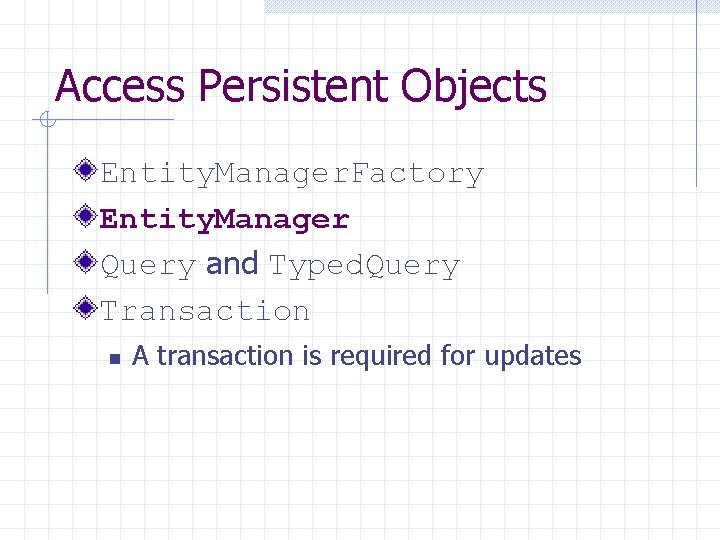
Access Persistent Objects Entity. Manager. Factory Entity. Manager Query and Typed. Query Transaction n A transaction is required for updates
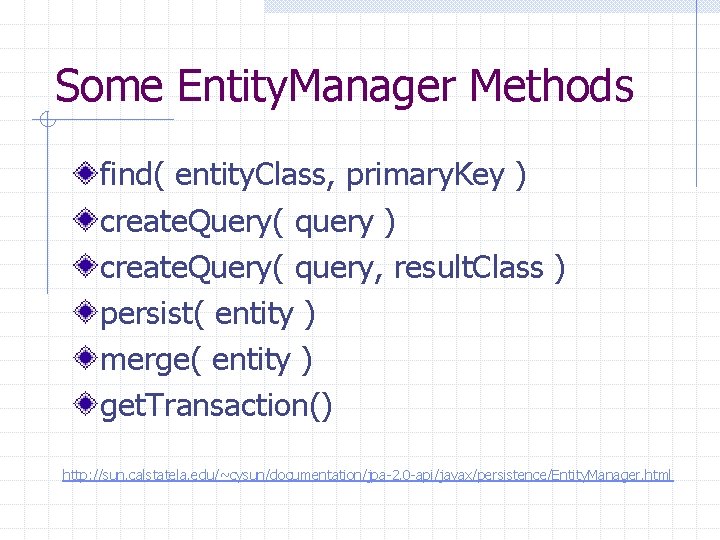
Some Entity. Manager Methods find( entity. Class, primary. Key ) create. Query( query, result. Class ) persist( entity ) merge( entity ) get. Transaction() http: //sun. calstatela. edu/~cysun/documentation/jpa-2. 0 -api/javax/persistence/Entity. Manager. html
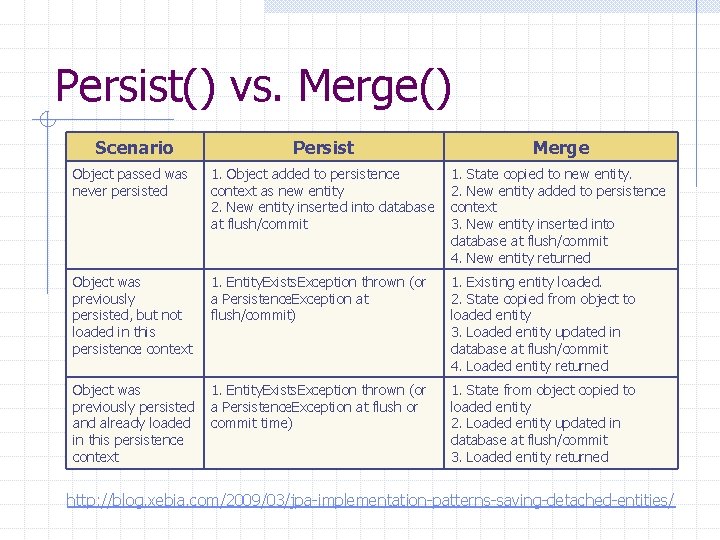
Persist() vs. Merge() Scenario Persist Merge Object passed was never persisted 1. Object added to persistence context as new entity 2. New entity inserted into database at flush/commit 1. State copied to new entity. 2. New entity added to persistence context 3. New entity inserted into database at flush/commit 4. New entity returned Object was previously persisted, but not loaded in this persistence context 1. Entity. Exists. Exception thrown (or a Persistence. Exception at flush/commit) 1. Existing entity loaded. 2. State copied from object to loaded entity 3. Loaded entity updated in database at flush/commit 4. Loaded entity returned Object was previously persisted and already loaded in this persistence context 1. Entity. Exists. Exception thrown (or a Persistence. Exception at flush or commit time) 1. State from object copied to loaded entity 2. Loaded entity updated in database at flush/commit 3. Loaded entity returned http: //blog. xebia. com/2009/03/jpa-implementation-patterns-saving-detached-entities/
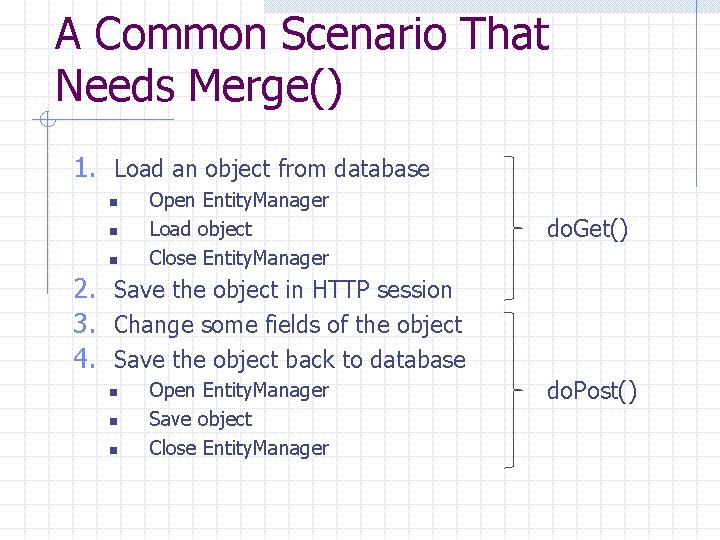
A Common Scenario That Needs Merge() 1. Load an object from database n n n Open Entity. Manager Load object Close Entity. Manager do. Get() 2. Save the object in HTTP session 3. Change some fields of the object 4. Save the object back to database n n n Open Entity. Manager Save object Close Entity. Manager do. Post()
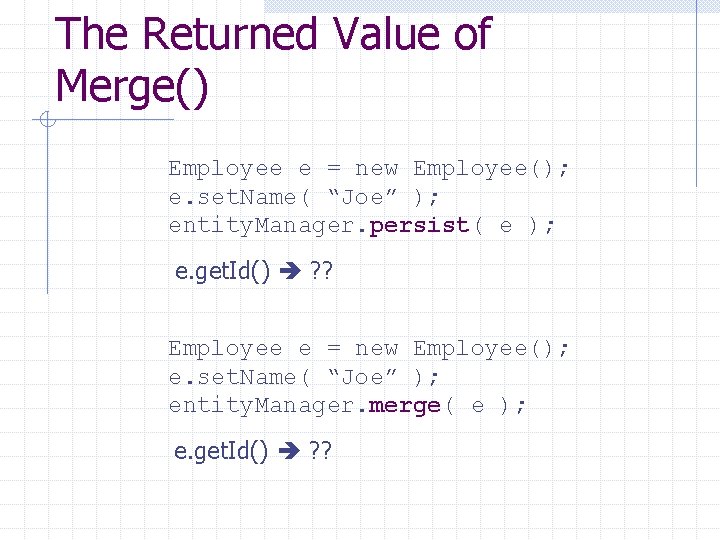
The Returned Value of Merge() Employee e = new Employee(); e. set. Name( “Joe” ); entity. Manager. persist( e ); e. get. Id() ? ? Employee e = new Employee(); e. set. Name( “Joe” ); entity. Manager. merge( e ); e. get. Id() ? ?
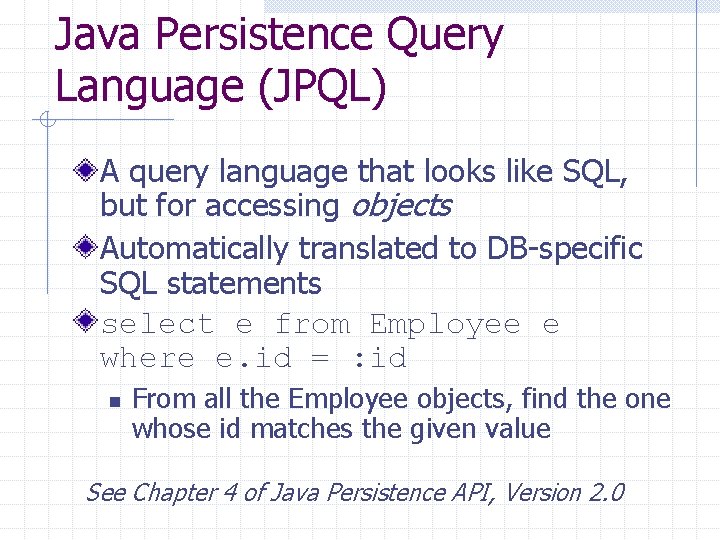
Java Persistence Query Language (JPQL) A query language that looks like SQL, but for accessing objects Automatically translated to DB-specific SQL statements select e from Employee e where e. id = : id n From all the Employee objects, find the one whose id matches the given value See Chapter 4 of Java Persistence API, Version 2. 0
Hibernate Query Language (HQL) A superset of JPQL http: //docs. jboss. org/hibernate/core/4. 2 /manual/en-US/html/ch 16. html
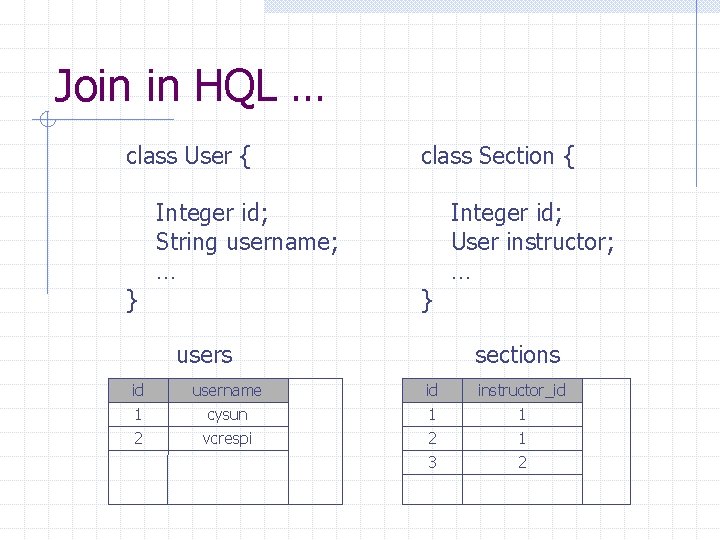
Join in HQL … class User { } Integer id; String username; … class Section { } users id 1 2 username cysun vcrespi Integer id; User instructor; … sections id 1 2 3 instructor_id 1 1 2
… Join in HQL … Query: find all the sections taught by the user “cysun”. n n SQL? ? HQL? ?
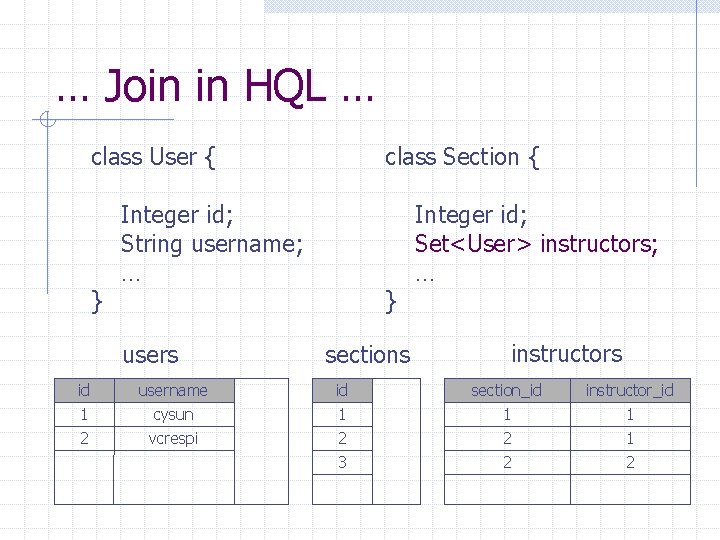
… Join in HQL … class User { } Integer id; String username; … users id 1 2 class Section { username cysun vcrespi } sections id 1 2 3 Integer id; Set<User> instructors; … instructors section_id 1 2 2 instructor_id 1 1 2
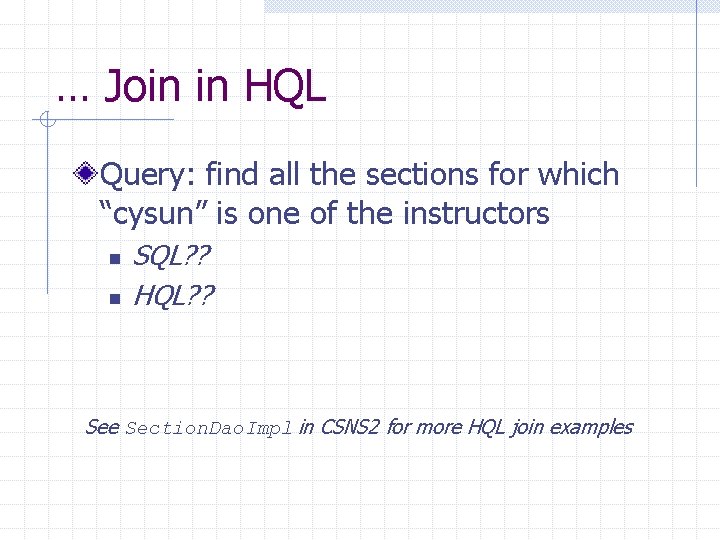
… Join in HQL Query: find all the sections for which “cysun” is one of the instructors n n SQL? ? HQL? ? See Section. Dao. Impl in CSNS 2 for more HQL join examples
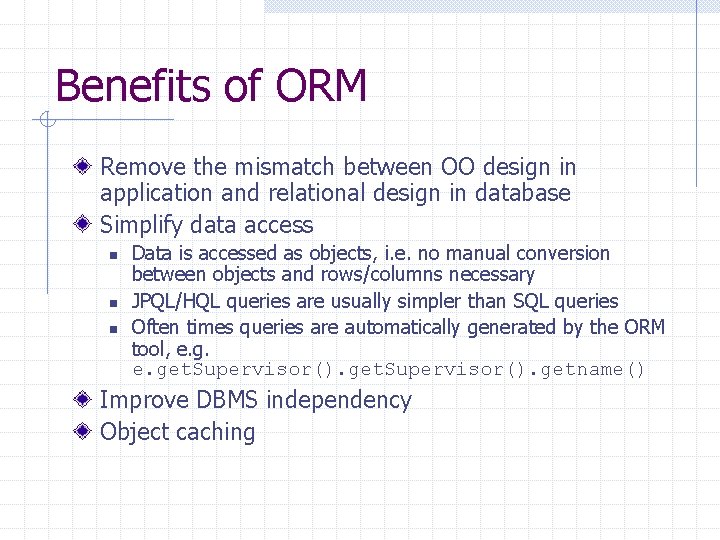
Benefits of ORM Remove the mismatch between OO design in application and relational design in database Simplify data access n n n Data is accessed as objects, i. e. no manual conversion between objects and rows/columns necessary JPQL/HQL queries are usually simpler than SQL queries Often times queries are automatically generated by the ORM tool, e. get. Supervisor(). getname() Improve DBMS independency Object caching
- Slides: 30