
CS 520 Web Programming ObjectRelational Mapping with Hibernate
CS 520 Web Programming Object-Relational Mapping with Hibernate Chengyu Sun California State University, Los Angeles
The Object-Oriented Paradigm The world consists of objects So we use object-oriented languages to write applications We want to store some of the application objects (a. k. a. persistent objects), e. g. accounts, customers, employees So we use a Object Database?
The Reality of DBMS Relational DBMS are still predominant n n n Best performance Most reliable Widest support Bridge between OO applications and relational databases n n CLI and embedded SQL Object-Relational Mapping (ORM) tools
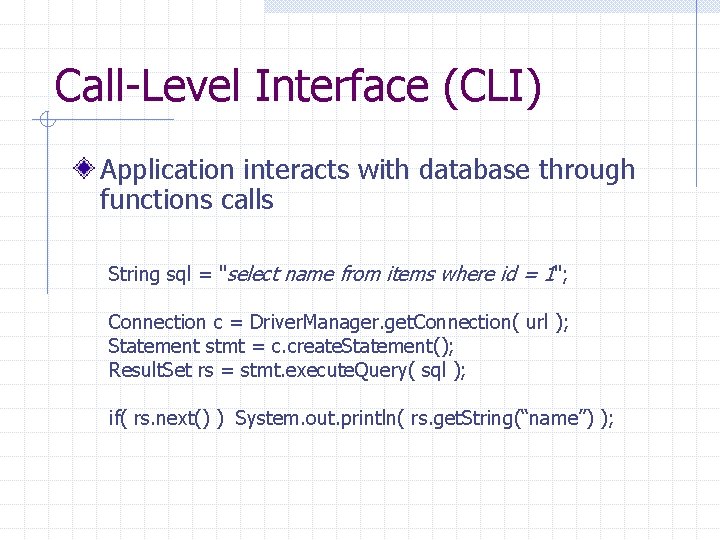
Call-Level Interface (CLI) Application interacts with database through functions calls String sql = "select name from items where id = 1"; Connection c = Driver. Manager. get. Connection( url ); Statement stmt = c. create. Statement(); Result. Set rs = stmt. execute. Query( sql ); if( rs. next() ) System. out. println( rs. get. String(“name”) );

Embedded SQL statements are embedded in host language String name; #sql {select name into : name from items where id = 1}; System. out. println( name );
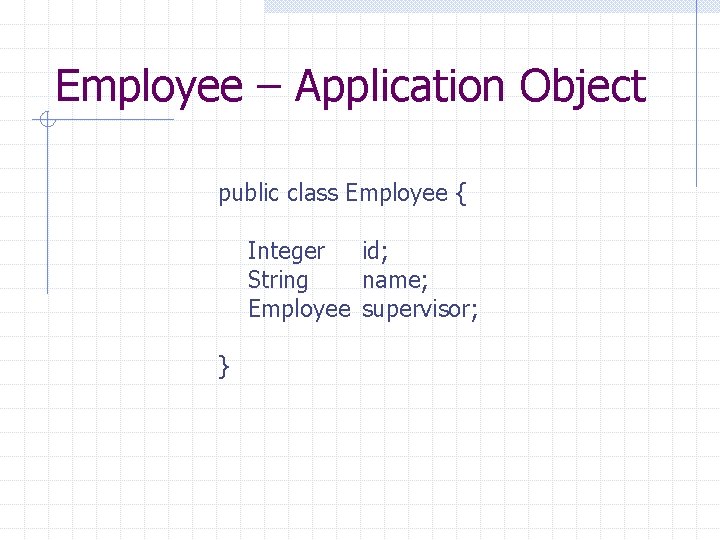
Employee – Application Object public class Employee { Integer id; String name; Employee supervisor; }
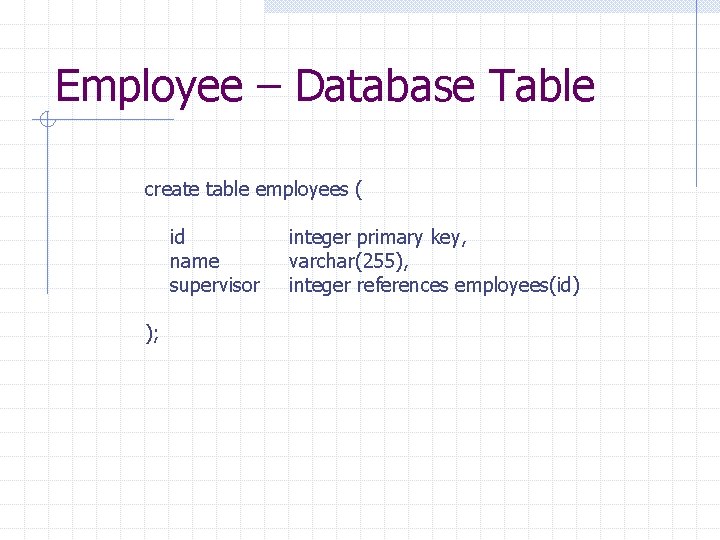
Employee – Database Table create table employees ( id name supervisor ); integer primary key, varchar(255), integer references employees(id)
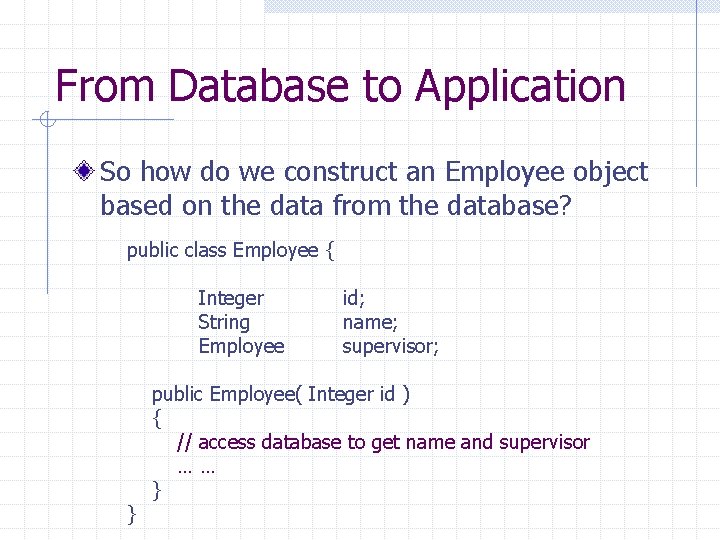
From Database to Application So how do we construct an Employee object based on the data from the database? public class Employee { Integer String Employee } id; name; supervisor; public Employee( Integer id ) { // access database to get name and supervisor …… }
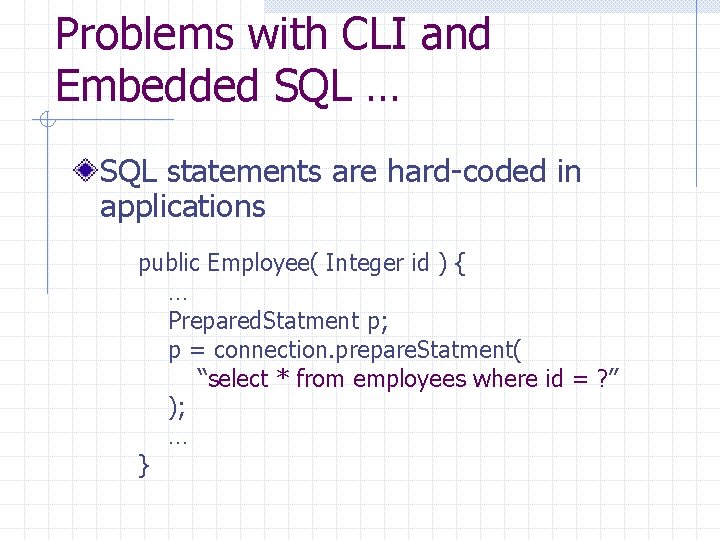
Problems with CLI and Embedded SQL … SQL statements are hard-coded in applications public Employee( Integer id ) { … Prepared. Statment p; p = connection. prepare. Statment( “select * from employees where id = ? ” ); … }
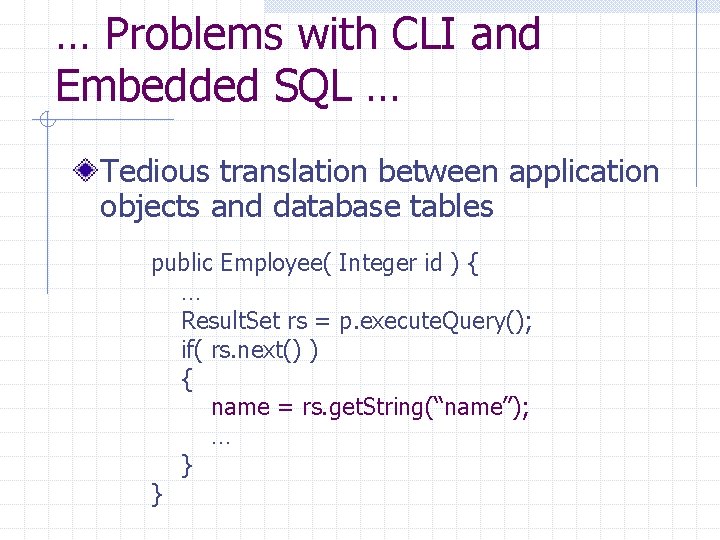
… Problems with CLI and Embedded SQL … Tedious translation between application objects and database tables public Employee( Integer id ) { … Result. Set rs = p. execute. Query(); if( rs. next() ) { name = rs. get. String(“name”); … } }
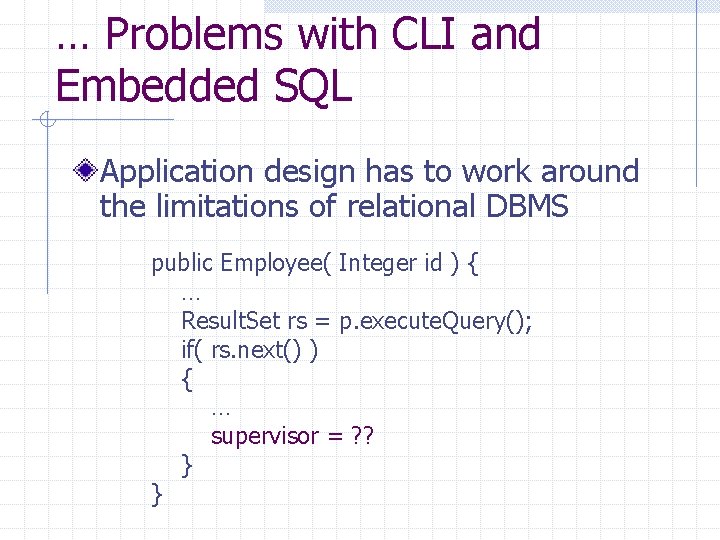
… Problems with CLI and Embedded SQL Application design has to work around the limitations of relational DBMS public Employee( Integer id ) { … Result. Set rs = p. execute. Query(); if( rs. next() ) { … supervisor = ? ? } }
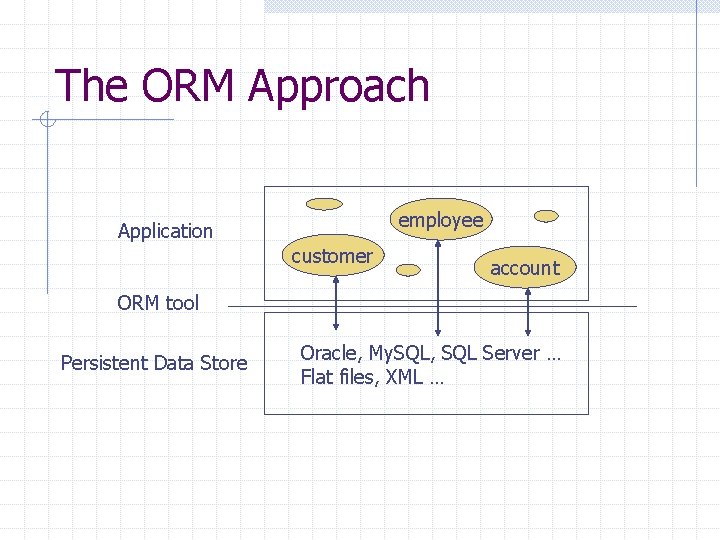
The ORM Approach employee Application customer account ORM tool Persistent Data Store Oracle, My. SQL, SQL Server … Flat files, XML …
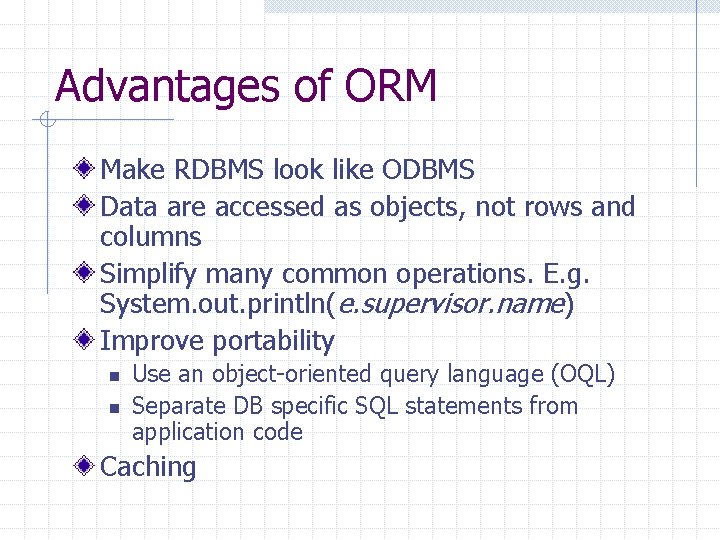
Advantages of ORM Make RDBMS look like ODBMS Data are accessed as objects, not rows and columns Simplify many common operations. E. g. System. out. println(e. supervisor. name) Improve portability n n Use an object-oriented query language (OQL) Separate DB specific SQL statements from application code Caching
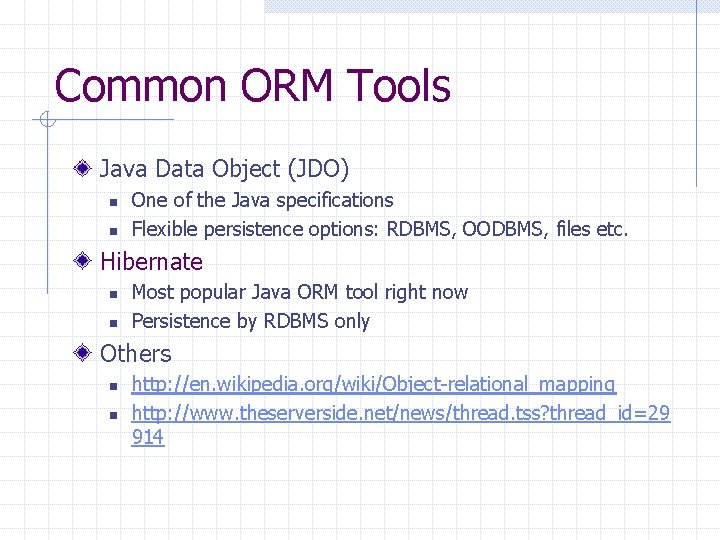
Common ORM Tools Java Data Object (JDO) n n One of the Java specifications Flexible persistence options: RDBMS, OODBMS, files etc. Hibernate n n Most popular Java ORM tool right now Persistence by RDBMS only Others n n http: //en. wikipedia. org/wiki/Object-relational_mapping http: //www. theserverside. net/news/thread. tss? thread_id=29 914
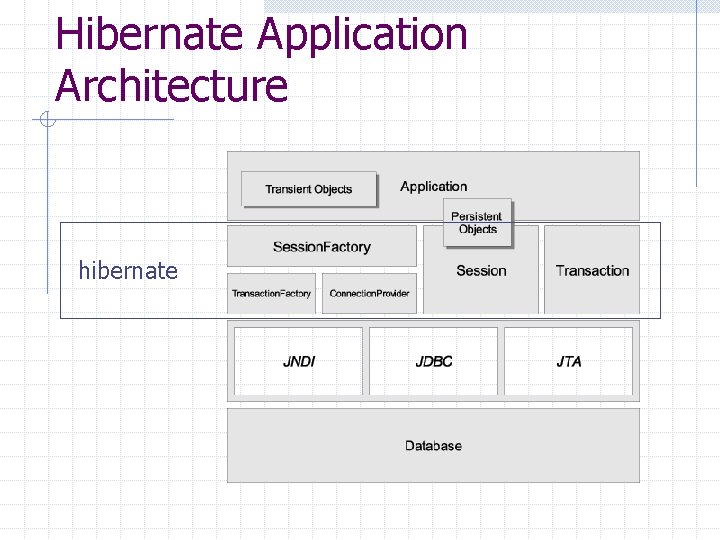
Hibernate Application Architecture hibernate
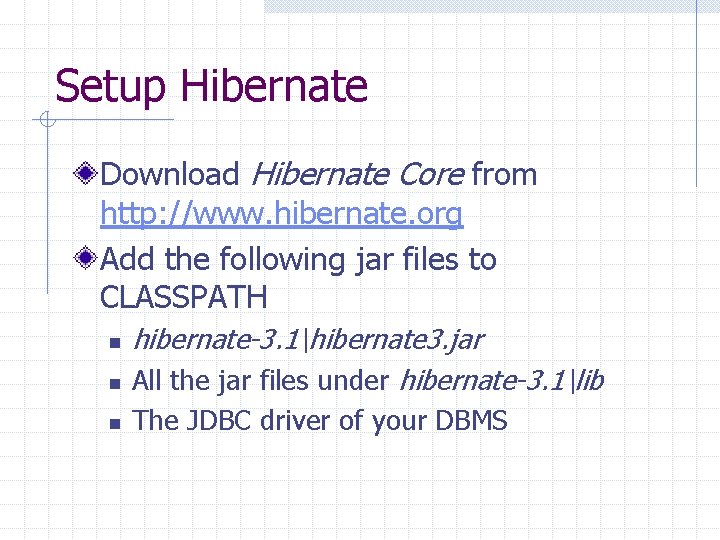
Setup Hibernate Download Hibernate Core from http: //www. hibernate. org Add the following jar files to CLASSPATH n hibernate-3. 1hibernate 3. jar All the jar files under hibernate-3. 1lib n The JDBC driver of your DBMS n
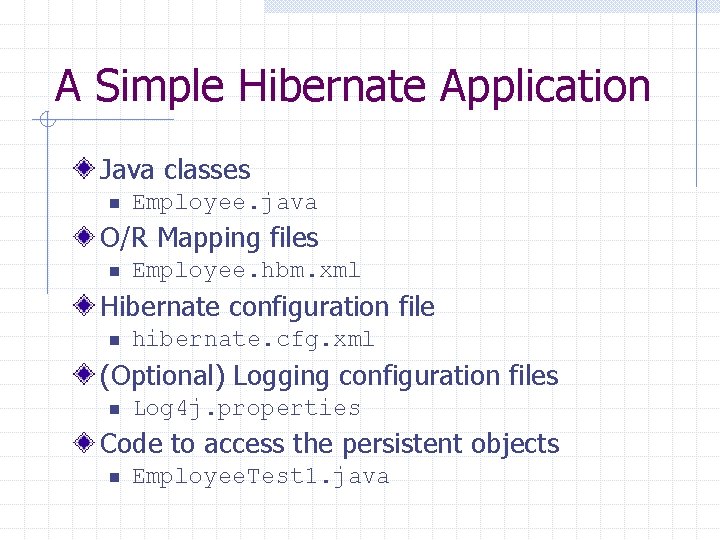
A Simple Hibernate Application Java classes n Employee. java O/R Mapping files n Employee. hbm. xml Hibernate configuration file n hibernate. cfg. xml (Optional) Logging configuration files n Log 4 j. properties Code to access the persistent objects n Employee. Test 1. java
Java Classes Plain Java classes (POJOs); however, it is recommended that n n Each persistent class have an identity field Each persistent field have a pair of getter and setter, which don’t have to be public The identity field is used to uniquely identify an object The persistent fields are accessed as bean properties
O/R Mapping Files Describe how class fields are mapped to table columns Three important types of elements in a a mapping file n n n <id> <property> - when the field is of simple type Association – when the field is of a class type w <one-to-one> w <many-to-many>
Hibernate Configuration Files Tell hibernate about the DBMS and other configuration parameters Either hibernate. properties or hibernate. cfg. xml or both n Sample files under hibernate-3. 1/etc
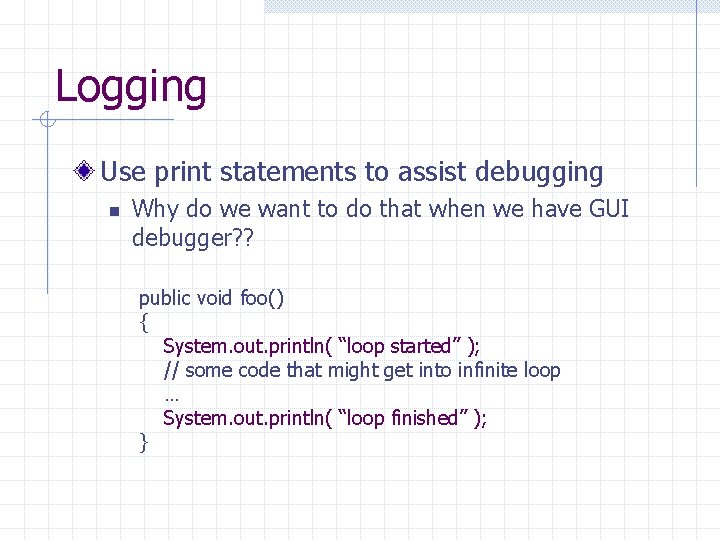
Logging Use print statements to assist debugging n Why do we want to do that when we have GUI debugger? ? public void foo() { System. out. println( “loop started” ); // some code that might get into infinite loop … System. out. println( “loop finished” ); }
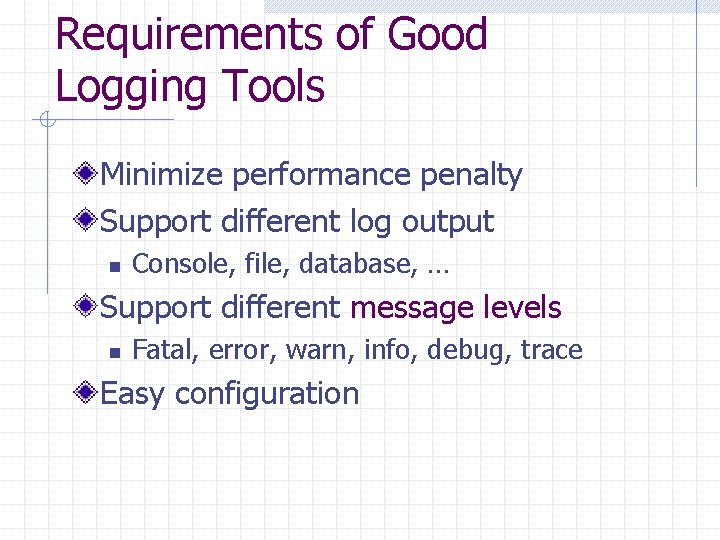
Requirements of Good Logging Tools Minimize performance penalty Support different log output n Console, file, database, … Support different message levels n Fatal, error, warn, info, debug, trace Easy configuration
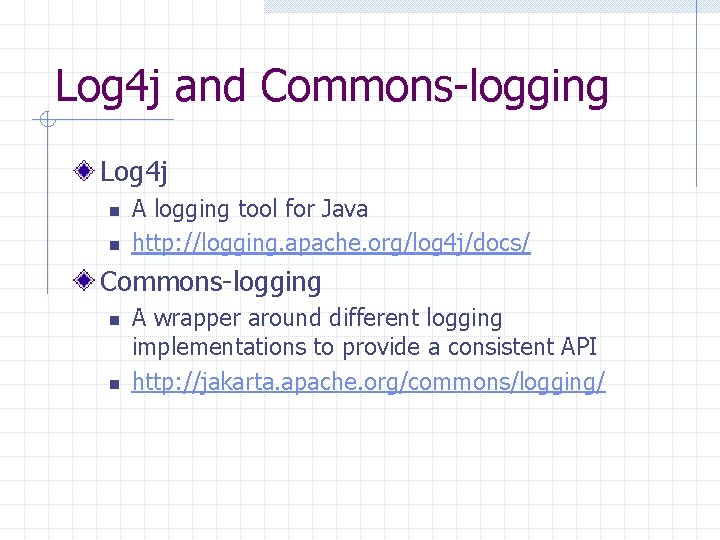
Log 4 j and Commons-logging Log 4 j n n A logging tool for Java http: //logging. apache. org/log 4 j/docs/ Commons-logging n n A wrapper around different logging implementations to provide a consistent API http: //jakarta. apache. org/commons/logging/
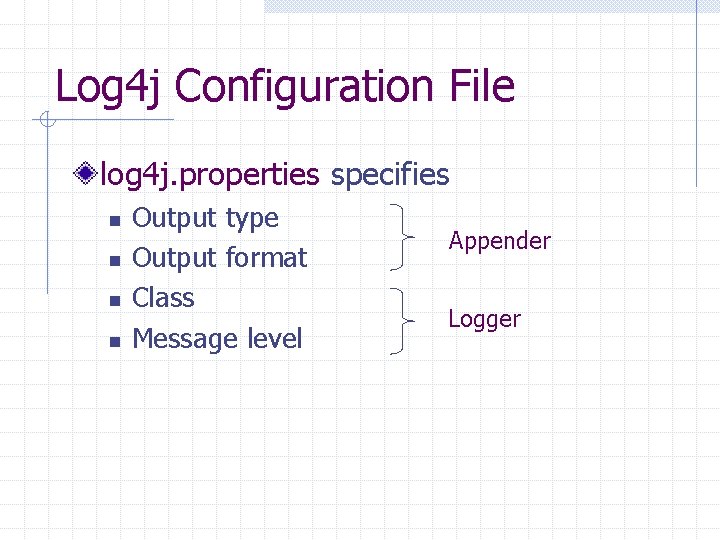
Log 4 j Configuration File log 4 j. properties specifies n n Output type Output format Class Message level Appender Logger
Logging Examples hex. test. Log. Test Textbook: Chapter 9
Access Persistent Objects Session Query Transaction n A transaction is required for updates
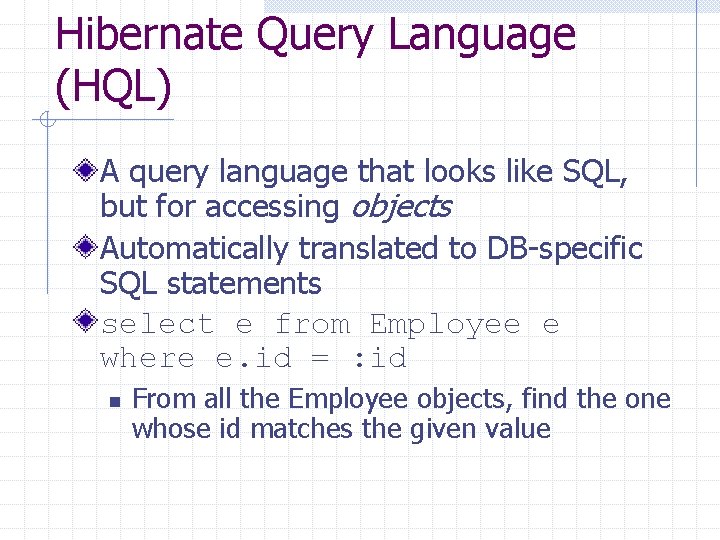
Hibernate Query Language (HQL) A query language that looks like SQL, but for accessing objects Automatically translated to DB-specific SQL statements select e from Employee e where e. id = : id n From all the Employee objects, find the one whose id matches the given value
CRUD Example Employee. Test 2. java n n “from Employee” load() or get()? How does hibernate tell whether an object is new? ? Caching
load() vs. get() load() raises an exception if an object cannot be found; get() would return null load() may return a proxy but get() never does
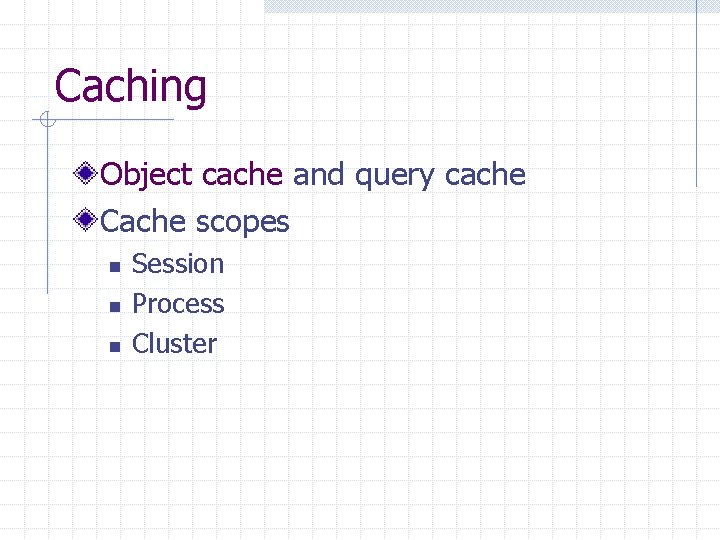
Caching Object cache and query cache Cache scopes n n n Session Process Cluster
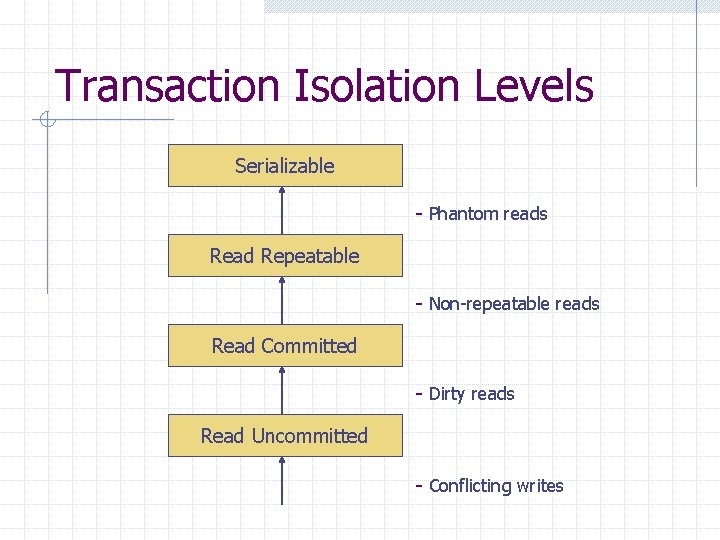
Transaction Isolation Levels Serializable - Phantom reads Read Repeatable - Non-repeatable reads Read Committed - Dirty reads Read Uncommitted - Conflicting writes
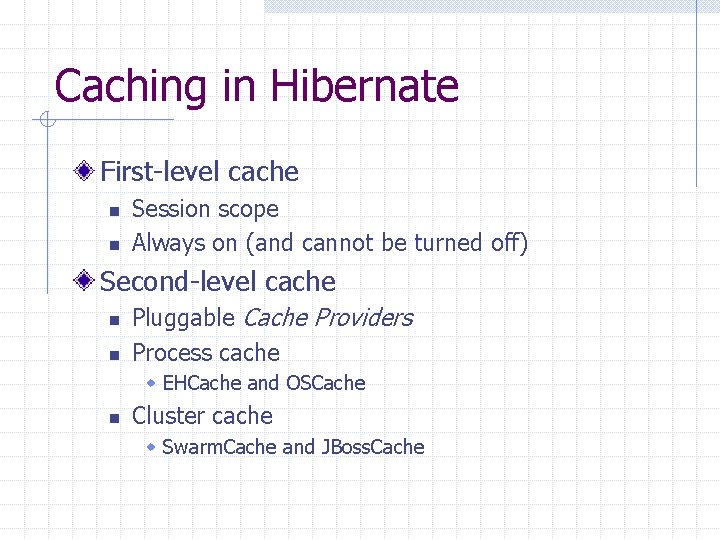
Caching in Hibernate First-level cache n n Session scope Always on (and cannot be turned off) Second-level cache n n Pluggable Cache Providers Process cache w EHCache and OSCache n Cluster cache w Swarm. Cache and JBoss. Cache
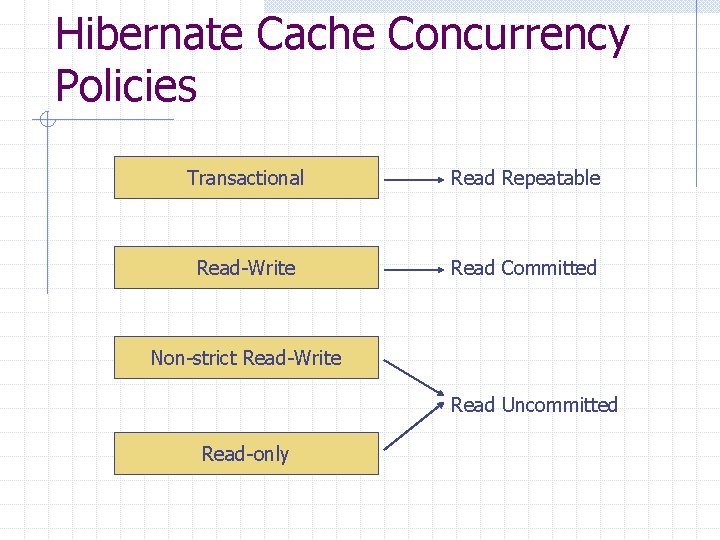
Hibernate Cache Concurrency Policies Transactional Read Repeatable Read-Write Read Committed Non-strict Read-Write Read Uncommitted Read-only
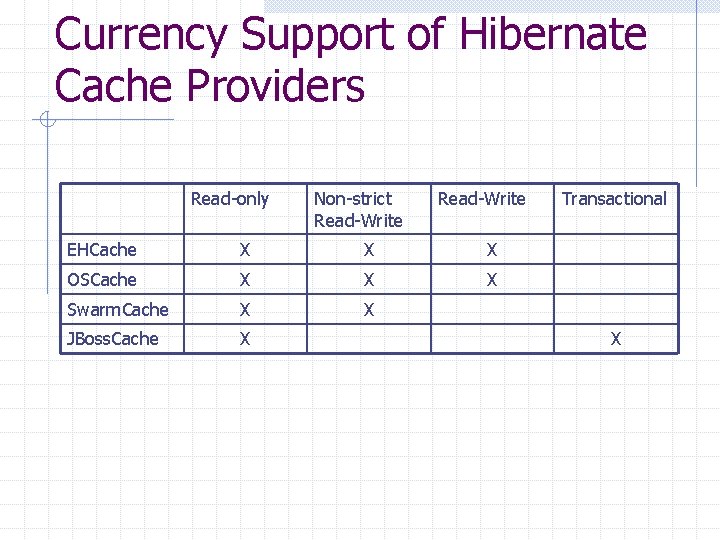
Currency Support of Hibernate Cache Providers Read-only Non-strict Read-Write EHCache X X X OSCache X X X Swarm. Cache X X JBoss. Cache X Transactional X
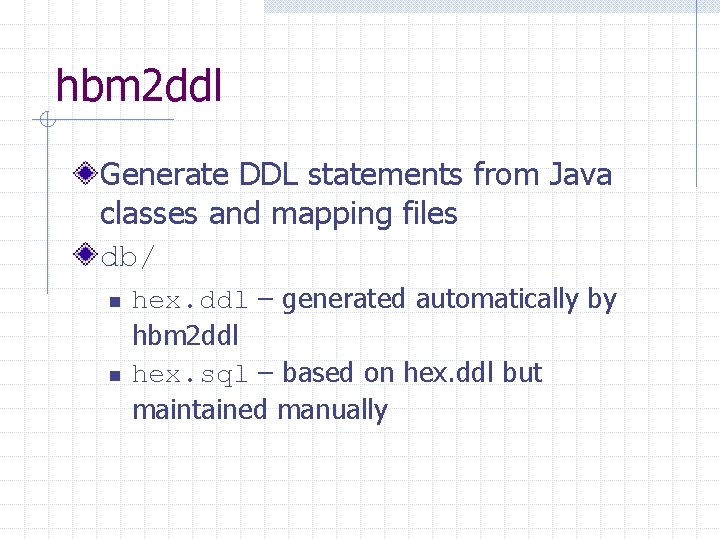
hbm 2 ddl Generate DDL statements from Java classes and mapping files db/ n n hex. ddl – generated automatically by hbm 2 ddl hex. sql – based on hex. ddl but maintained manually
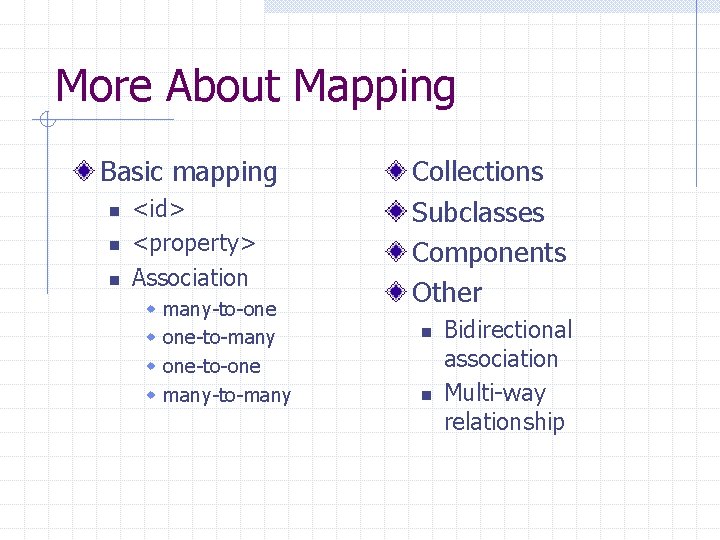
More About Mapping Basic mapping n n n <id> <property> Association w w many-to-one one-to-many one-to-one many-to-many Collections Subclasses Components Other n n Bidirectional association Multi-way relationship
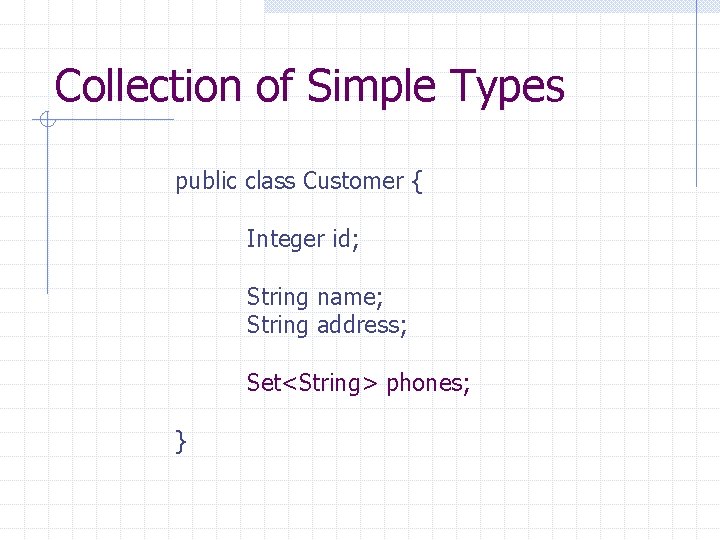
Collection of Simple Types public class Customer { Integer id; String name; String address; Set<String> phones; }
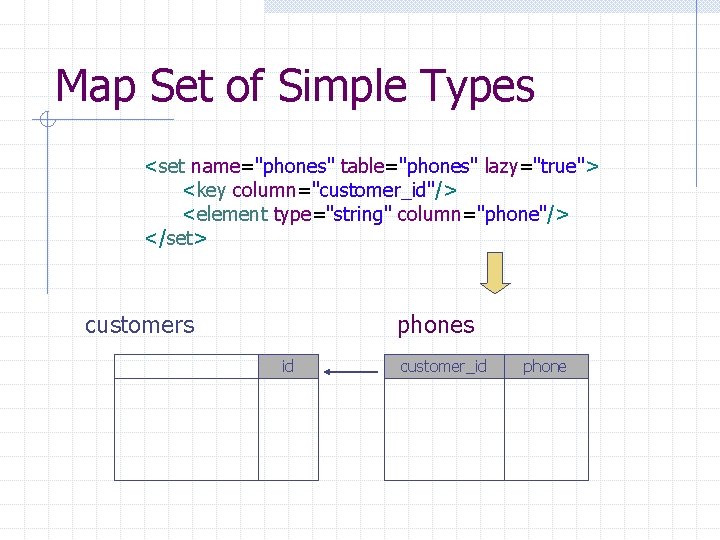
Map Set of Simple Types <set name="phones" table="phones" lazy="true"> <key column="customer_id"/> <element type="string" column="phone"/> </set> customers phones id customer_id phone
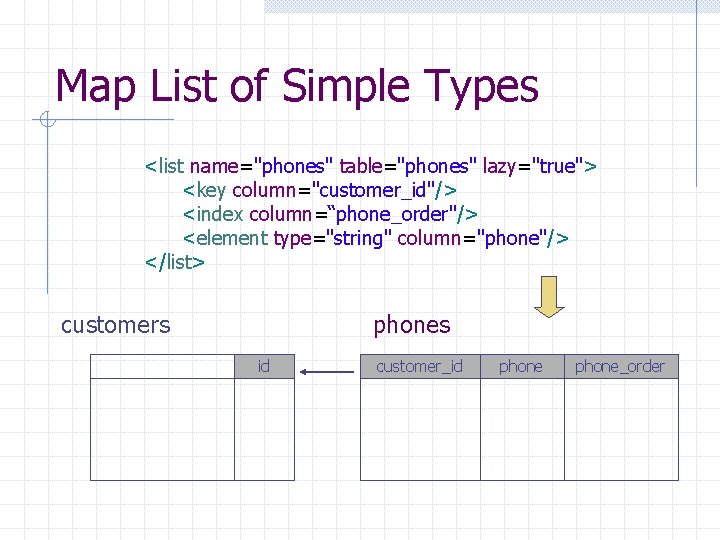
Map List of Simple Types <list name="phones" table="phones" lazy="true"> <key column="customer_id"/> <index column=“phone_order"/> <element type="string" column="phone"/> </list> customers phones id customer_id phone_order
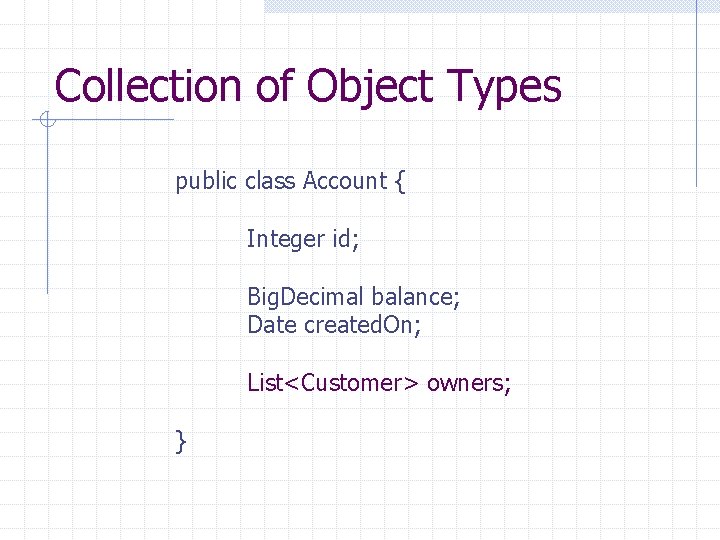
Collection of Object Types public class Account { Integer id; Big. Decimal balance; Date created. On; List<Customer> owners; }
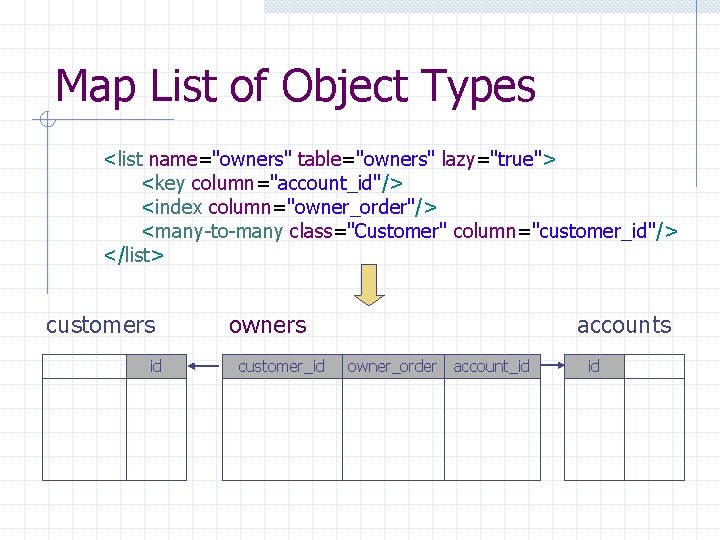
Map List of Object Types <list name="owners" table="owners" lazy="true"> <key column="account_id"/> <index column="owner_order"/> <many-to-many class="Customer" column="customer_id"/> </list> customers id owners customer_id accounts owner_order account_id id
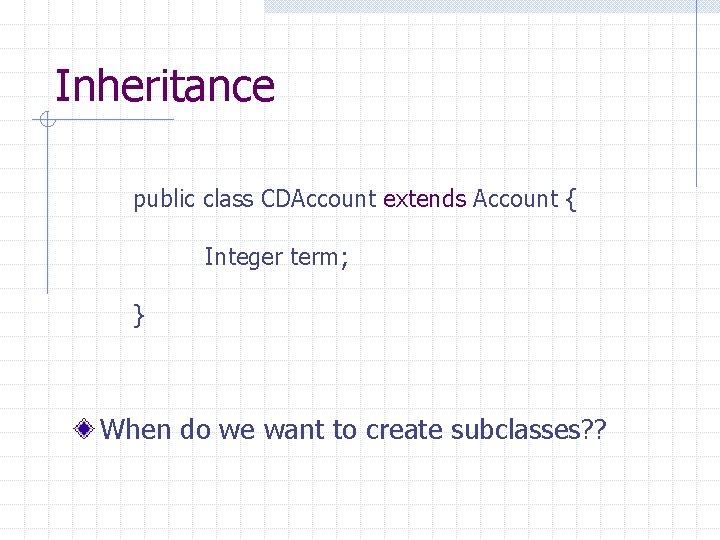
Inheritance public class CDAccount extends Account { Integer term; } When do we want to create subclasses? ?
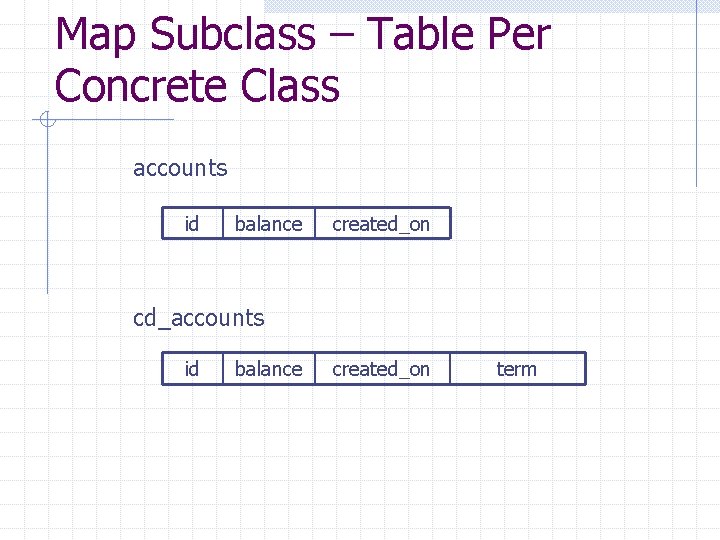
Map Subclass – Table Per Concrete Class accounts id balance created_on cd_accounts id balance created_on term
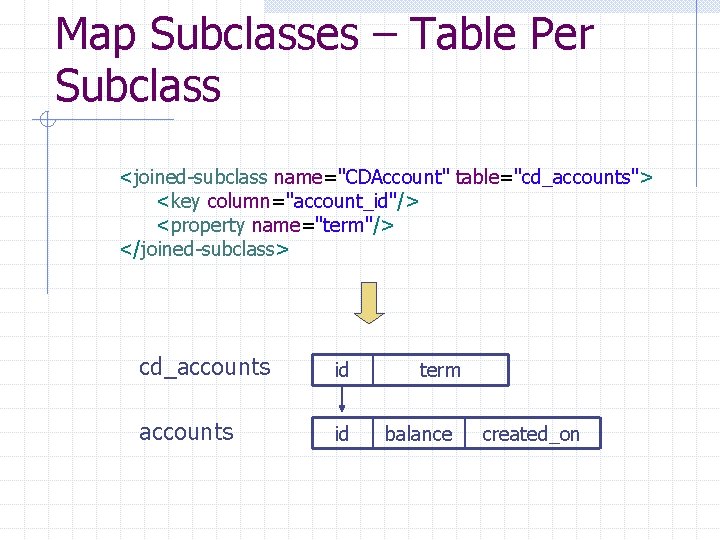
Map Subclasses – Table Per Subclass <joined-subclass name="CDAccount" table="cd_accounts"> <key column="account_id"/> <property name="term"/> </joined-subclass> cd_accounts id term balance created_on
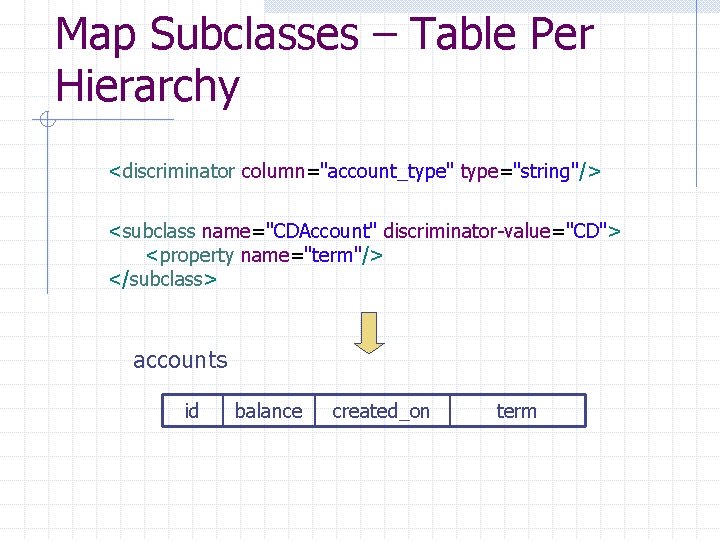
Map Subclasses – Table Per Hierarchy <discriminator column="account_type" type="string"/> <subclass name="CDAccount" discriminator-value="CD"> <property name="term"/> </subclass> accounts id balance created_on term
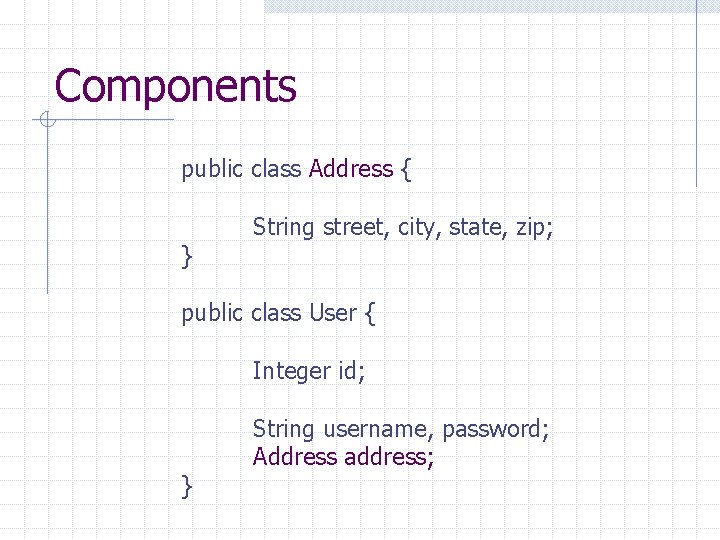
Components public class Address { } String street, city, state, zip; public class User { Integer id; } String username, password; Address address;
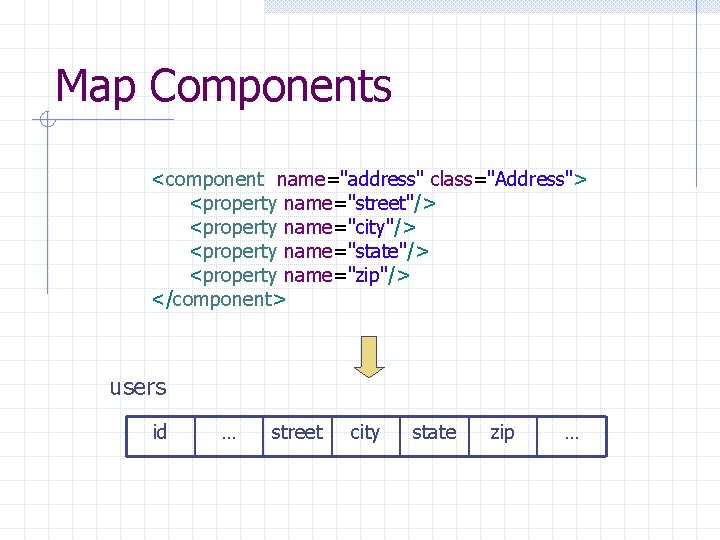
Map Components <component name="address" class="Address"> <property name="street"/> <property name="city"/> <property name="state"/> <property name="zip"/> </component> users id … street city state zip …
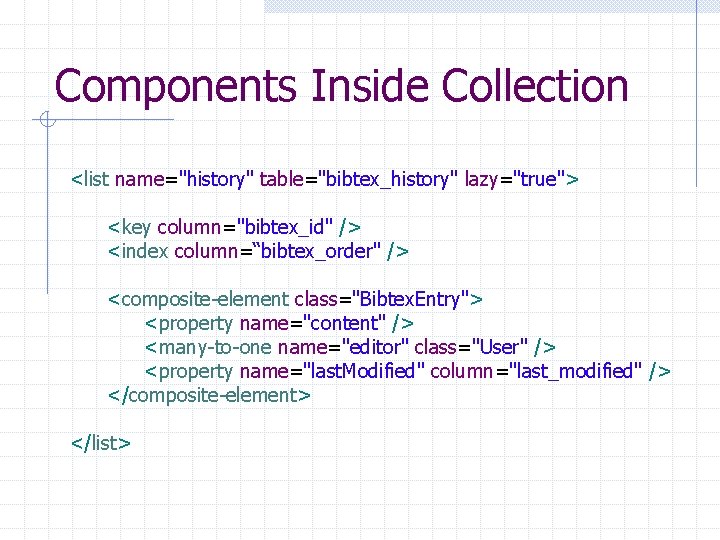
Components Inside Collection <list name="history" table="bibtex_history" lazy="true"> <key column="bibtex_id" /> <index column=“bibtex_order" /> <composite-element class="Bibtex. Entry"> <property name="content" /> <many-to-one name="editor" class="User" /> <property name="last. Modified" column="last_modified" /> </composite-element> </list>
Somewhat Unusual Mappings Bidirectional Association n n Accounts and Owners Item vs. Reviews, Ratings, and Tags Multi-way relationship n Tag
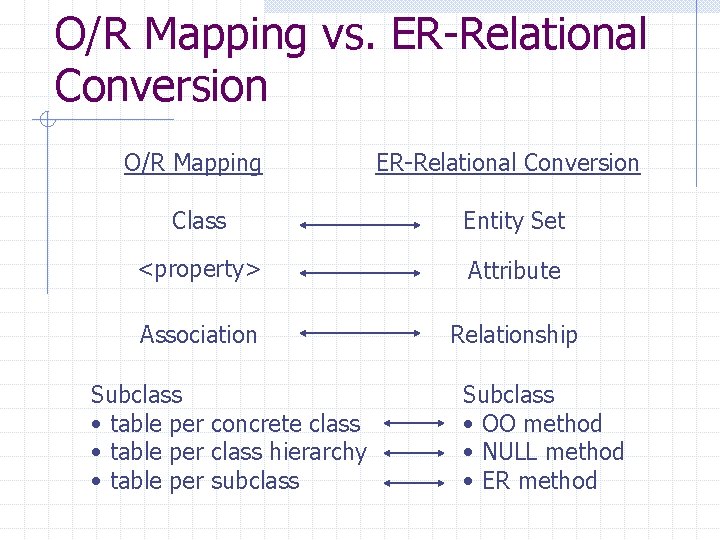
O/R Mapping vs. ER-Relational Conversion O/R Mapping ER-Relational Conversion Class Entity Set <property> Attribute Association Relationship Subclass • table per concrete class • table per class hierarchy • table per subclass Subclass • OO method • NULL method • ER method
Things We’ll Talk Later (Or Not) Fine tune the schema n not-null, unique etc. Performance-related issues n Lazy-loading More about queries n n Criteria queries Native SQL queries
Conclusion? What does hibernate give us? ?
More Hibernate Resource Textbook: Chapter 5 Hibernate in Action by Christian Bauer and Gavin King Hibernate documentation at http: //www. hibernate. org n Chapter 6 -10
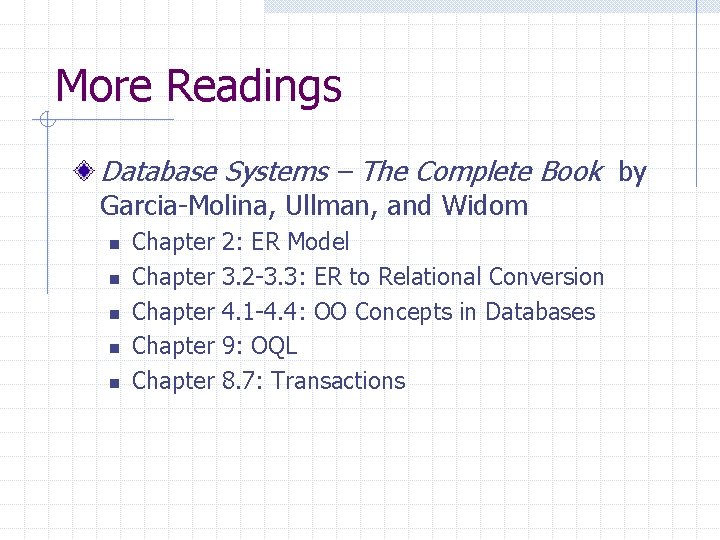
More Readings Database Systems – The Complete Book by Garcia-Molina, Ullman, and Widom n n n Chapter Chapter 2: ER Model 3. 2 -3. 3: ER to Relational Conversion 4. 1 -4. 4: OO Concepts in Databases 9: OQL 8. 7: Transactions
- Slides: 54