
CS 519 Big Data Exploration and Analytics Course
CS 519 Big Data Exploration and Analytics Course overview
Welcome to CS 519! • • Instructor: Arash Termehchy Assistant Professor at EECS Research on data management and analytics Information & Data Management and Analytics (IDEA) Lab • Your turn: – Name, field, DB and ML/AI background
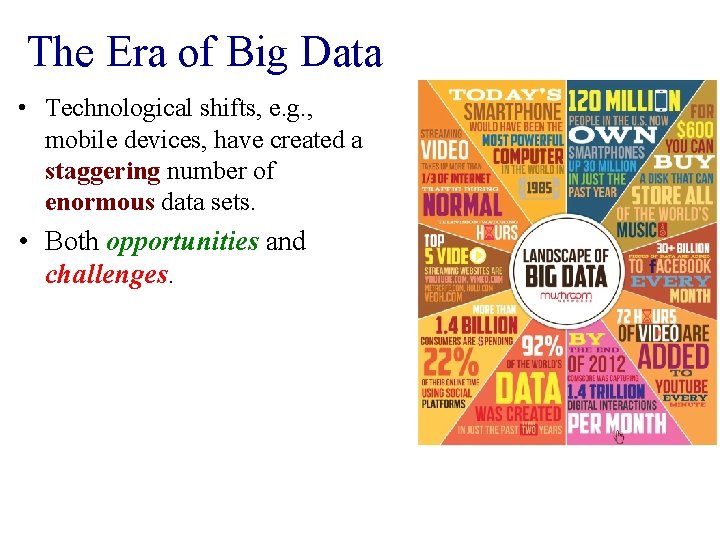
The Era of Big Data • Technological shifts, e. g. , mobile devices, have created a staggering number of enormous data sets. • Both opportunities and challenges.
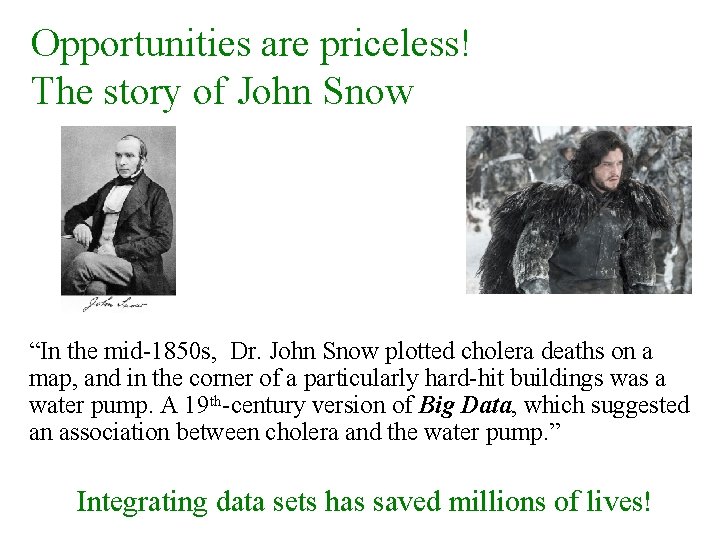
Opportunities are priceless! The story of John Snow “In the mid-1850 s, Dr. John Snow plotted cholera deaths on a map, and in the corner of a particularly hard-hit buildings was a water pump. A 19 th-century version of Big Data, which suggested an association between cholera and the water pump. ” Integrating data sets has saved millions of lives!
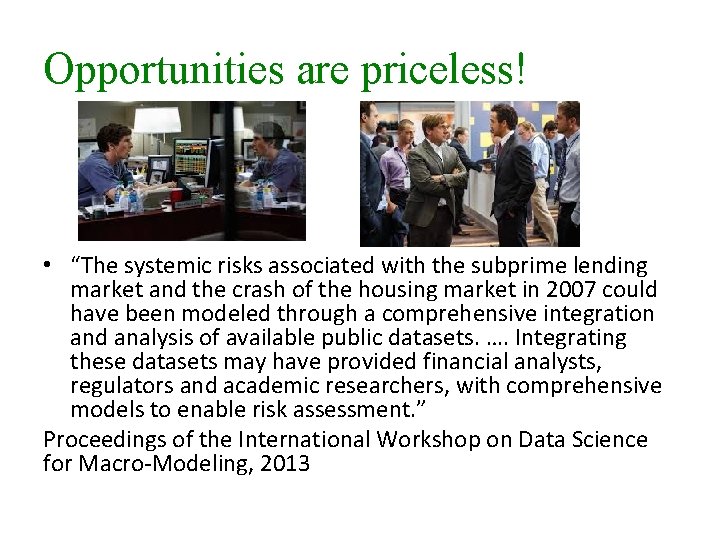
Opportunities are priceless! • “The systemic risks associated with the subprime lending market and the crash of the housing market in 2007 could have been modeled through a comprehensive integration and analysis of available public datasets. …. Integrating these datasets may have provided financial analysts, regulators and academic researchers, with comprehensive models to enable risk assessment. ” Proceedings of the International Workshop on Data Science for Macro-Modeling, 2013
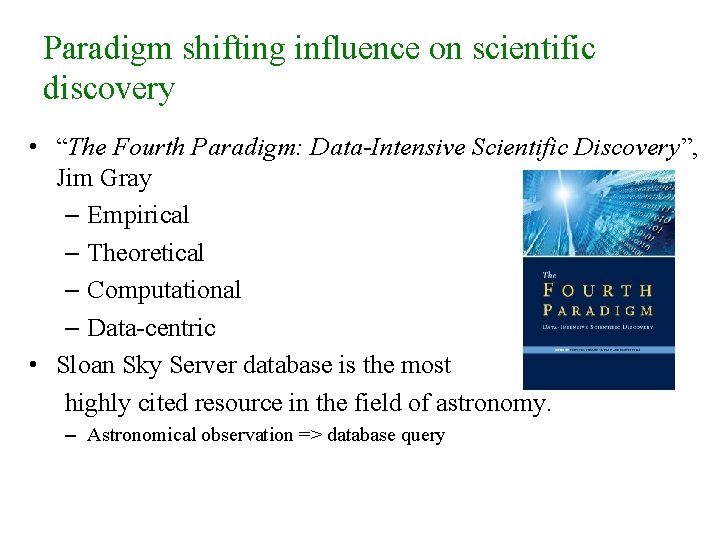
Paradigm shifting influence on scientific discovery • “The Fourth Paradigm: Data-Intensive Scientific Discovery”, Jim Gray – Empirical – Theoretical – Computational – Data-centric • Sloan Sky Server database is the most highly cited resource in the field of astronomy. – Astronomical observation => database query
Challenges: Volume • Sloan Sky Server will soon store 30 terabyte per day. • Hardon Colider can generate 500 exabyte per day. • Every two year : ten times more data – Exponentially increasing: • • • Smart/ wearable/ connected tools generate data Manufacturing tools generate data Humans generate data Robots generate data …
Challenges: Variety • Valuable information are scattered across various sources in various forms. • Large number of life databases and knowledge bases in every domain. – Different modalities: images, videos, graphs/ social networks, natural language text documents/ posts, …. • Ideally, we like to integrate and store them in a single DB that can be queried analyzed easily. • Need to transform, clean, and integrate large number of evolving data sets. – Impossible to do manually due to increasing number and varieties of datasets.
Challenges : Variety • It is arguably more challenging than volume, as it requires deeper understanding of the data • Data integration has been recognized as a hard problem in DB community.
Challenges : Velocity • Data is rapidly generated. – smart devices, social networks, … – fast data • Trends are changing in a short amount of time. – News media, stock market, … • We like to get the insight fast. • Data may also evolve – We do not like to rewrite our programs.
Challenges : Human collaboration • How users can communicate and use our systems? – Not everybody has a degree in CS! – Usable interfaces for users to query the data or build models Trends are changing in a short amount of time. • Users should understand the output – Interpretability of the output • Collaborate with human – How to harvest and integrate the intelligence of systems and human users?
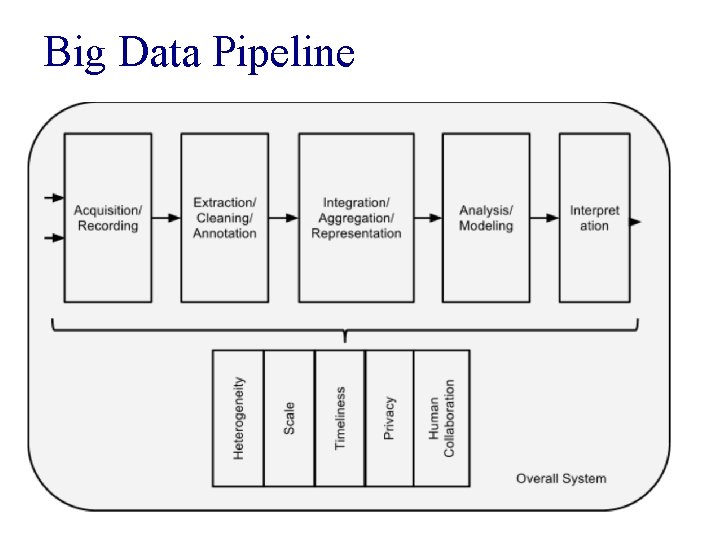
Big Data Pipeline
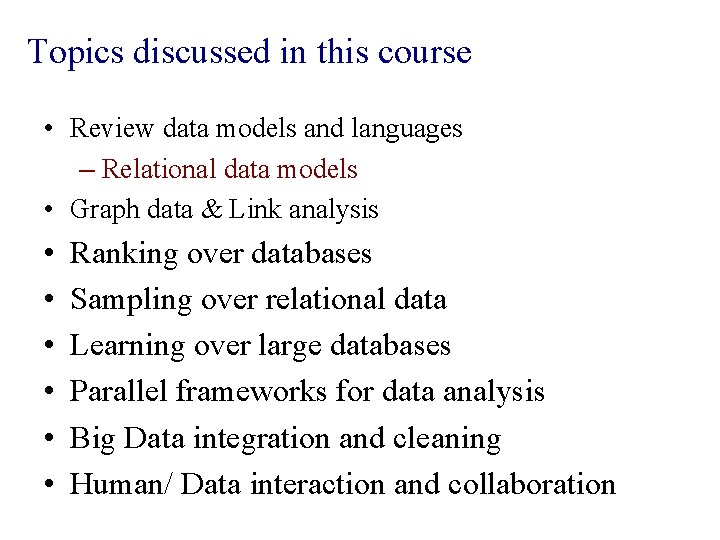
Topics discussed in this course • Review data models and languages – Relational data models • Graph data & Link analysis • • • Ranking over databases Sampling over relational data Learning over large databases Parallel frameworks for data analysis Big Data integration and cleaning Human/ Data interaction and collaboration
Prerequisites • CS 540 or equivalent • CS 440 A- or above • Contact instructor if you are not sure.
Course format • • Fundamental topics at the beginning. Paper presentation and discussion. One paper in most sessions. Instructor or student presentation followed by group discussion led by the instructor and presenter.
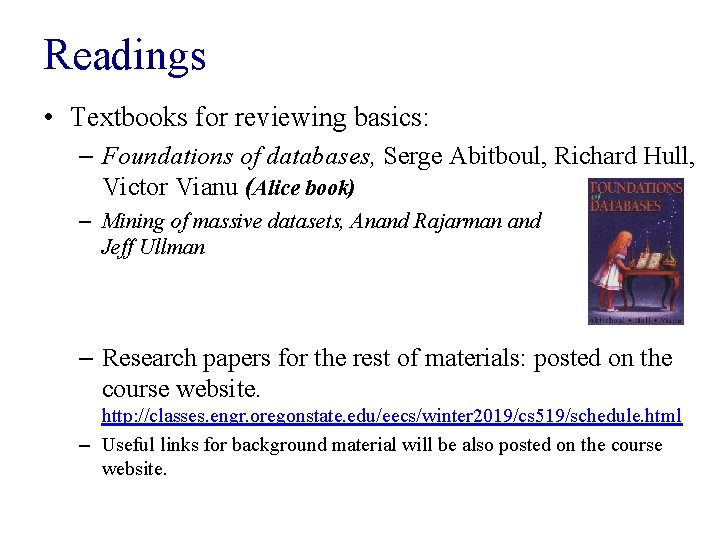
Readings • Textbooks for reviewing basics: – Foundations of databases, Serge Abitboul, Richard Hull, Victor Vianu (Alice book) – Mining of massive datasets, Anand Rajarman and Jeff Ullman – Research papers for the rest of materials: posted on the course website. http: //classes. engr. oregonstate. edu/eecs/winter 2019/cs 519/schedule. html – Useful links for background material will be also posted on the course website.
Discussion and participation • All students must read the paper and post a summary and questions on Piazza. • Each student should ask at least one question per week. • A short wrap-up quiz at the end of each presentation. – Questions about the main concepts discussed.
Paper review • Read and summarize the papers before the lecture: – What is the main problem discussed in the paper? – Why is it important? – What are the main ideas of the proposed solutions? – Positive and negatives? – (extra) How can one extend this work? • References on the course website on “how to read scientific papers”. • Post a 300 -words summary of the paper on Piazza by 11: 00 pm of the day before the class as private posts.
Student presentation • • Instructor/ student collaboration to present. A list of papers posted online Multiple papers for some subjects Choose a list of five exciting paper /subject for you by next Tuesday. • Email the presentation material by 5: 00 pm four days before to get feedback. • It is ok to use presentations online – acknowledge the authors.
Projects • Solve some interesting and challenging Big Data integration and cleaning problem. • Graded based on technical depth – Work with large (millions of tuples/records) and diverse databases (5 -10 datasets with different formats). – The idea must generalize/ remove some manual effort. • Graded based on the clarity of presentation. – Project reports and presentations • Groups of 2 – 4 students.
Projects: data integration • Information about an entity is in several sources – Wikipedia, online posts, … • Integrate the data and resolve the inconsistencies – transform data into a universal format – integrate and clean the data • Mostly manual! • Reduce the amount of manual labor. • Integration in a specific domain is easier! – certain data formats: e. g. , online posts 21
Data integration • Step 1) Identify: – Find a set of diverse data sets in terms of formats. • Step 2) Integrate: – Transform and clean the data sets – Integrate them in a relational database. • Step 3) Analyze: – Run interesting queries and/or create visualizations
Data cleaning & transformation • Most data scientists spend about 80% of their times on data preparation! – most data sets are in spreadsheets, flat files, XML, … – transform/clean them to a a “desired representation” • Removing meaningless values, apply constraints, … – transform them to relational / RDF format 23
Data cleaning & transformation • • Currently most data preparation are done manually. Reduce the manual cleaning/ restructuring burden Learning from examples Predicative transformation – Identify the most frequent/ likely transformations operations for a domain and generate them automatically. • More usable transformation interfaces 24
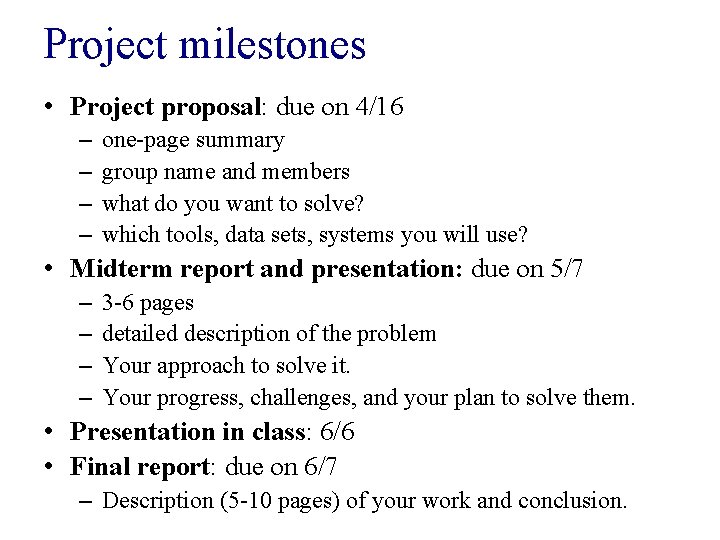
Project milestones • Project proposal: due on 4/16 – – one-page summary group name and members what do you want to solve? which tools, data sets, systems you will use? • Midterm report and presentation: due on 5/7 – – 3 -6 pages detailed description of the problem Your approach to solve it. Your progress, challenges, and your plan to solve them. • Presentation in class: 6/6 • Final report: due on 6/7 – Description (5 -10 pages) of your work and conclusion.
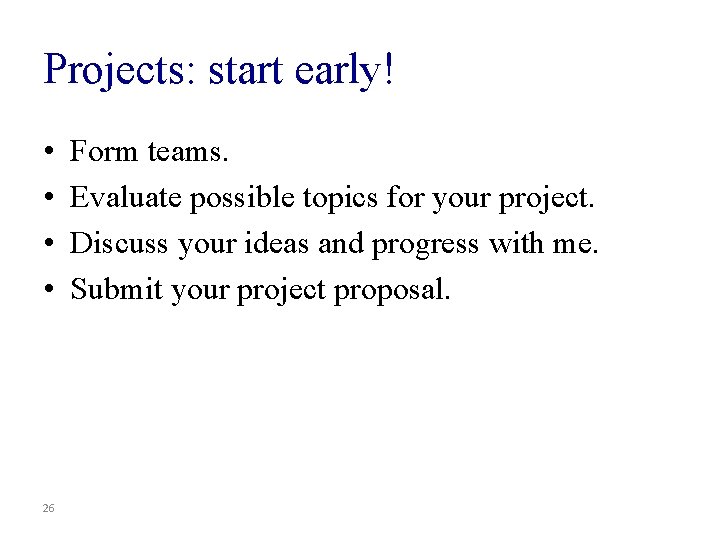
Projects: start early! • • 26 Form teams. Evaluate possible topics for your project. Discuss your ideas and progress with me. Submit your project proposal.
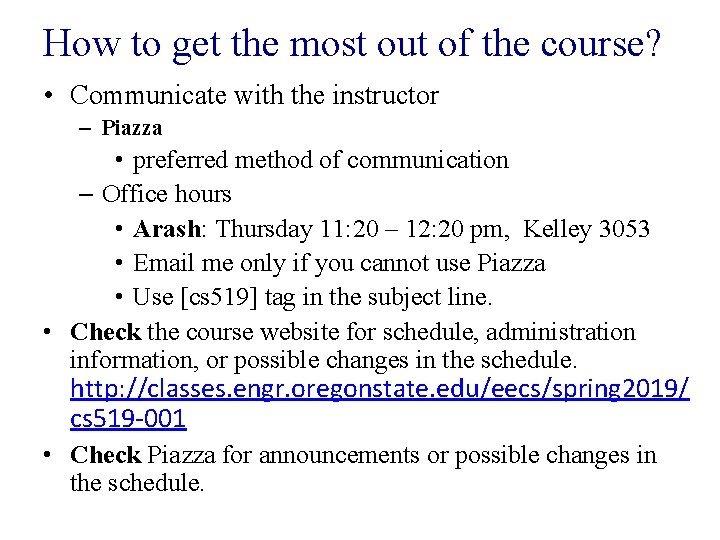
How to get the most out of the course? • Communicate with the instructor – Piazza • preferred method of communication – Office hours • Arash: Thursday 11: 20 – 12: 20 pm, Kelley 3053 • Email me only if you cannot use Piazza • Use [cs 519] tag in the subject line. • Check the course website for schedule, administration information, or possible changes in the schedule. http: //classes. engr. oregonstate. edu/eecs/spring 2019/ cs 519 -001 • Check Piazza for announcements or possible changes in the schedule.
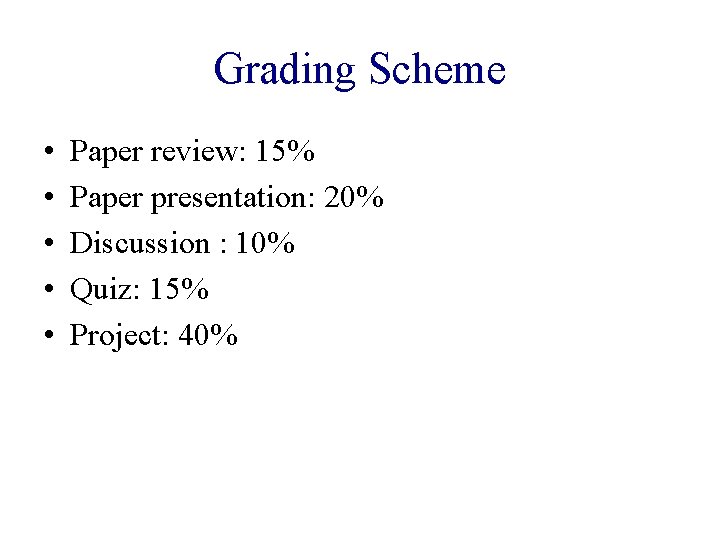
Grading Scheme • • • Paper review: 15% Paper presentation: 20% Discussion : 10% Quiz: 15% Project: 40%
- Slides: 28