
CS 5100 Advanced Computer Architecture Technology and Computing
- Slides: 48
CS 5100 Advanced Computer Architecture Technology and Computing Prof. Chung-Ta King Department of Computer Science National Tsing Hua University, Taiwan (Slides are from textbook, Prof. Hsien-Hsin Lee, Prof. Yasun Hsu, Prof. Marc Snir) National Tsing Hua University
Outline • Goal of this lecture: - Understand how technology affects automatic computing • Learn from the history • Know how we come to here • Lecture outline - History of computing and role of technology - Computer performance trend (Sec. 1. 1) • Trends in technology (Sec. 1. 4) • Trends in power and energy (Sec. 1. 5) - Classes of computers (Sec. 1. 2) National Tsing Hua University 1
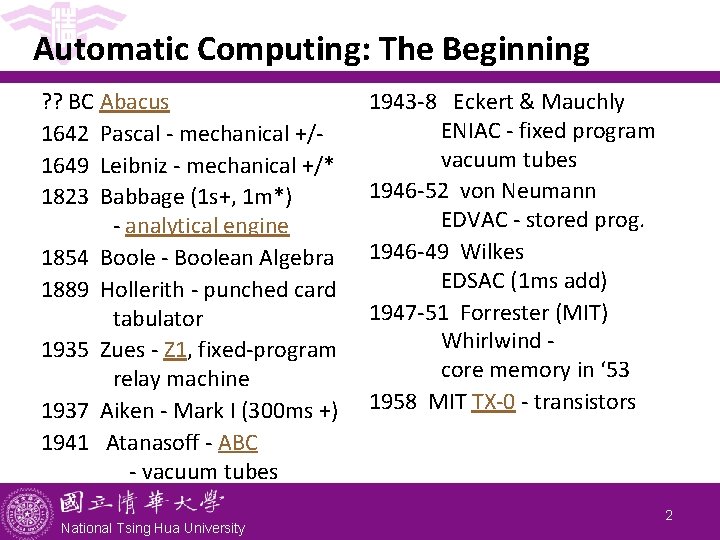
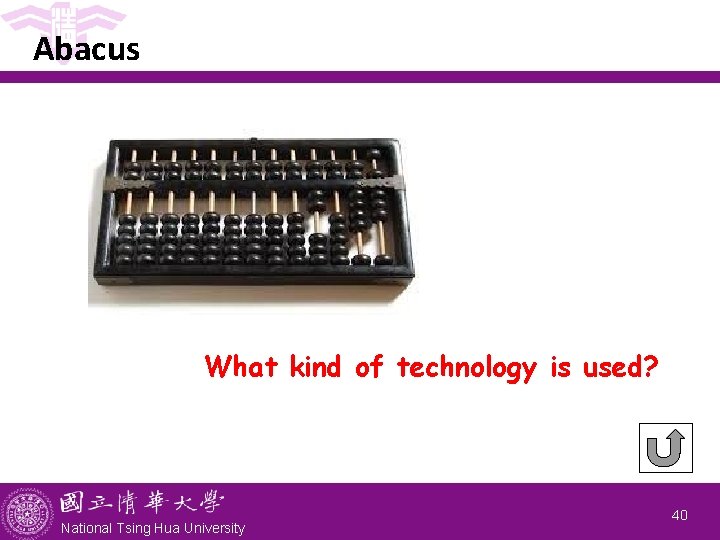
Automatic Computing: The Beginning ? ? BC Abacus 1642 Pascal - mechanical +/1649 Leibniz - mechanical +/* 1823 Babbage (1 s+, 1 m*) - analytical engine 1854 Boole - Boolean Algebra 1889 Hollerith - punched card tabulator 1935 Zues - Z 1, fixed-program relay machine 1937 Aiken - Mark I (300 ms +) 1941 Atanasoff - ABC - vacuum tubes National Tsing Hua University 1943 -8 Eckert & Mauchly ENIAC - fixed program vacuum tubes 1946 -52 von Neumann EDVAC - stored prog. 1946 -49 Wilkes EDSAC (1 ms add) 1947 -51 Forrester (MIT) Whirlwind core memory in ‘ 53 1958 MIT TX-0 - transistors 2
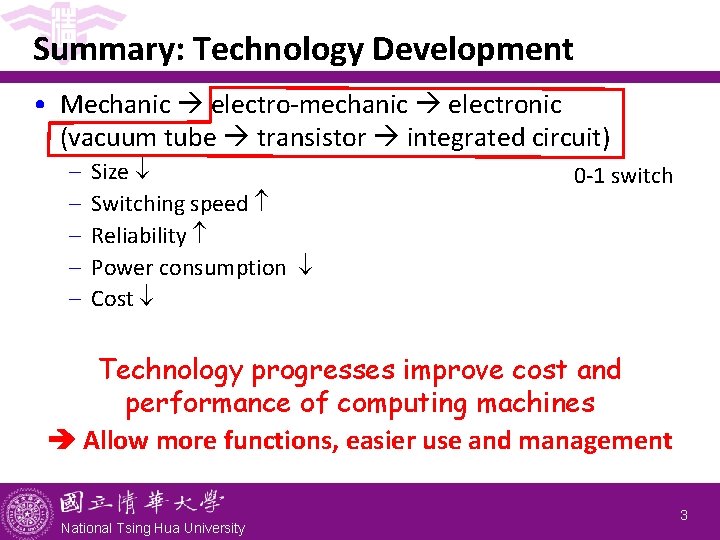
Summary: Technology Development • Mechanic electro-mechanic electronic (vacuum tube transistor integrated circuit) - Size Switching speed Reliability Power consumption Cost 0 -1 switch Technology progresses improve cost and performance of computing machines Allow more functions, easier use and management National Tsing Hua University 3
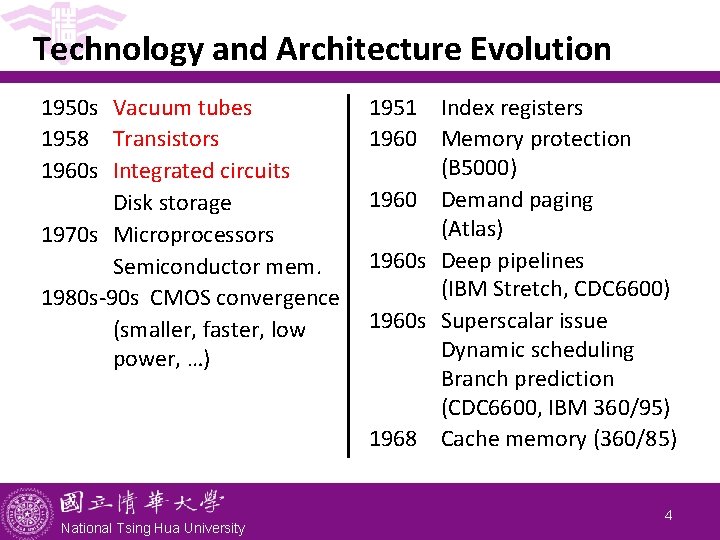
Technology and Architecture Evolution 1950 s Vacuum tubes 1958 Transistors 1960 s Integrated circuits Disk storage 1970 s Microprocessors Semiconductor mem. 1980 s-90 s CMOS convergence (smaller, faster, low power, …) National Tsing Hua University 1951 Index registers 1960 Memory protection (B 5000) 1960 Demand paging (Atlas) 1960 s Deep pipelines (IBM Stretch, CDC 6600) 1960 s Superscalar issue Dynamic scheduling Branch prediction (CDC 6600, IBM 360/95) 1968 Cache memory (360/85) 4
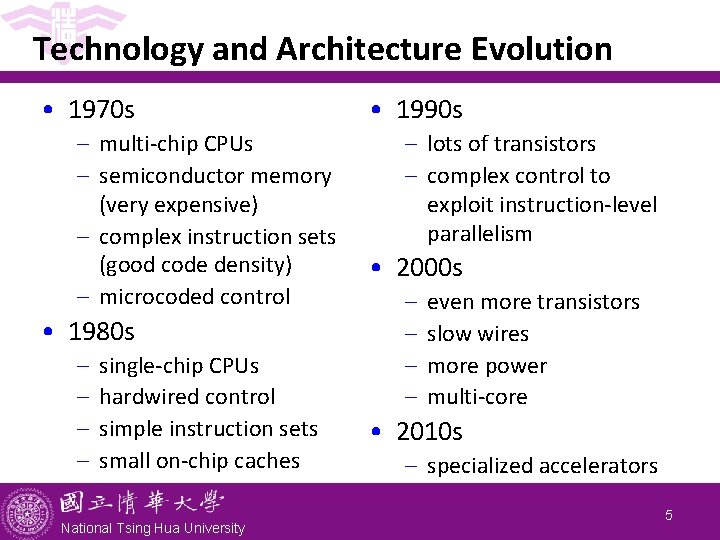
Technology and Architecture Evolution • 1970 s - multi-chip CPUs - semiconductor memory (very expensive) - complex instruction sets (good code density) - microcoded control • 1980 s - single-chip CPUs hardwired control simple instruction sets small on-chip caches National Tsing Hua University • 1990 s - lots of transistors - complex control to exploit instruction-level parallelism • 2000 s - even more transistors slow wires more power multi-core • 2010 s - specialized accelerators 5
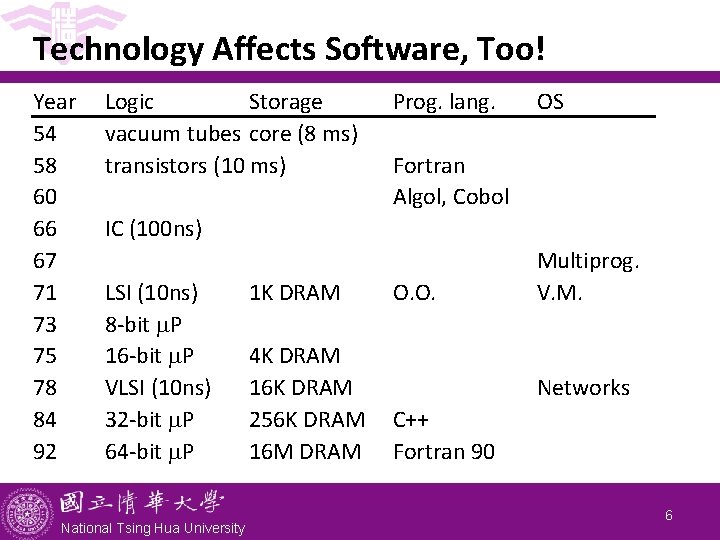
Technology Affects Software, Too! Year 54 58 60 66 67 71 73 75 78 84 92 Logic Storage vacuum tubes core (8 ms) transistors (10 ms) Prog. lang. OS Fortran Algol, Cobol IC (100 ns) LSI (10 ns) 8 -bit m. P 16 -bit m. P VLSI (10 ns) 32 -bit m. P 64 -bit m. P National Tsing Hua University 1 K DRAM 4 K DRAM 16 K DRAM 256 K DRAM 16 M DRAM O. O. Multiprog. V. M. Networks C++ Fortran 90 6
How Does Technology Affect Performance? Lecture outline • History of computing and role of technology • Computer performance trend (Sec. 1. 1) - Trends in technology (Sec. 1. 4) - Trends in power and energy (Sec. 1. 5) • Classes of computers (Sec. 1. 2) National Tsing Hua University 7
Single Processor Perf in Perspective Move to multi-core RISC Fig. 1. 1 National Tsing Hua University 8
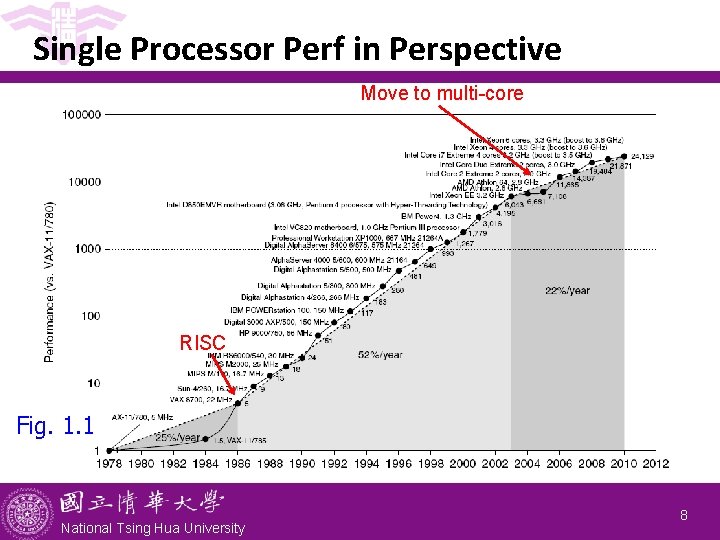
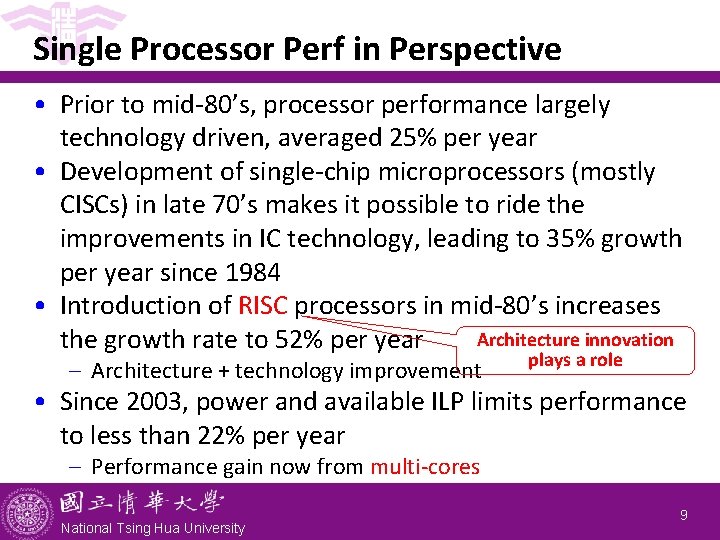
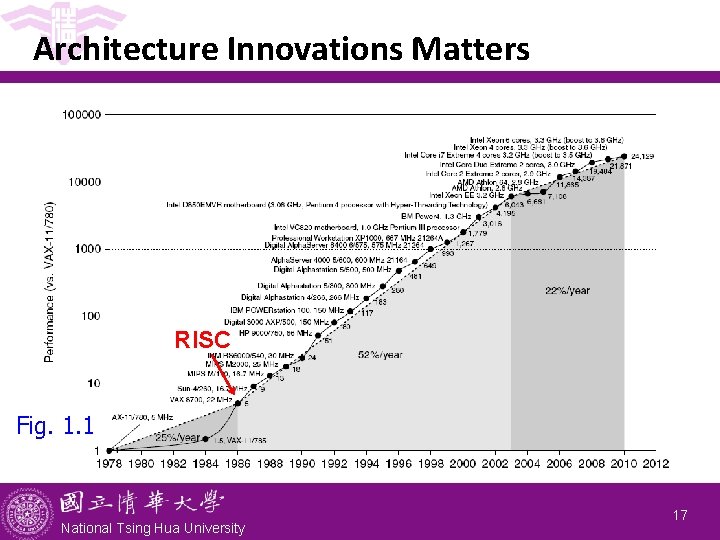
Single Processor Perf in Perspective • Prior to mid-80’s, processor performance largely technology driven, averaged 25% per year • Development of single-chip microprocessors (mostly CISCs) in late 70’s makes it possible to ride the improvements in IC technology, leading to 35% growth per year since 1984 • Introduction of RISC processors in mid-80’s increases Architecture innovation the growth rate to 52% per year - Architecture + technology improvement plays a role • Since 2003, power and available ILP limits performance to less than 22% per year - Performance gain now from multi-cores National Tsing Hua University 9
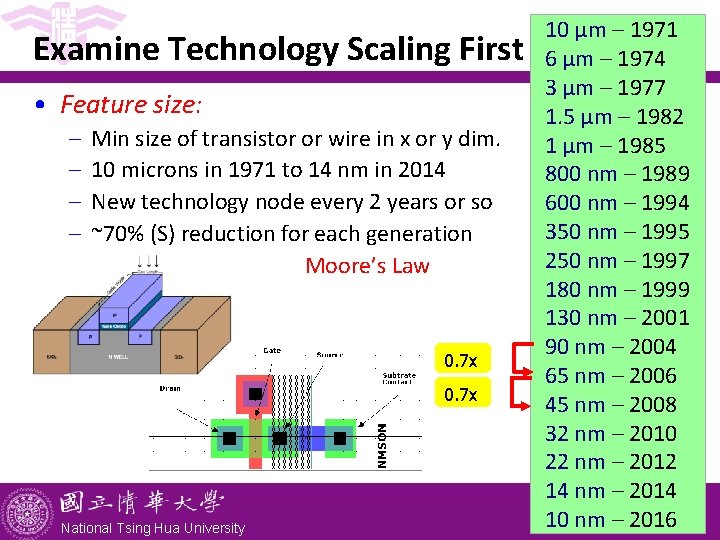
Examine Technology Scaling First • Feature size: - Min size of transistor or wire in x or y dim. 10 microns in 1971 to 14 nm in 2014 New technology node every 2 years or so ~70% (S) reduction for each generation Moore’s Law 0. 7 x National Tsing Hua University 10 µm – 1971 6 µm – 1974 3 µm – 1977 1. 5 µm – 1982 1 µm – 1985 800 nm – 1989 600 nm – 1994 350 nm – 1995 250 nm – 1997 180 nm – 1999 130 nm – 2001 90 nm – 2004 65 nm – 2006 45 nm – 2008 32 nm – 2010 22 nm – 2012 14 nm – 2014 10 nm – 201610
Effects of Scaling • More transistors per unit area - Feature size reduced by 0. 7 (S) area of a transistor reduced by 0. 5 (S 2) - 2 X # transistors/unit area - Fixed cost per wafer lower cost per transistor • Faster transistors - Reduce time to switch on/off transistors speed improved by S exponential increase in clock rate • Less supplied voltage and power - Power to switch transistor reduced, but not power density - Voltage to drive transistors reduced National Tsing Hua University 11
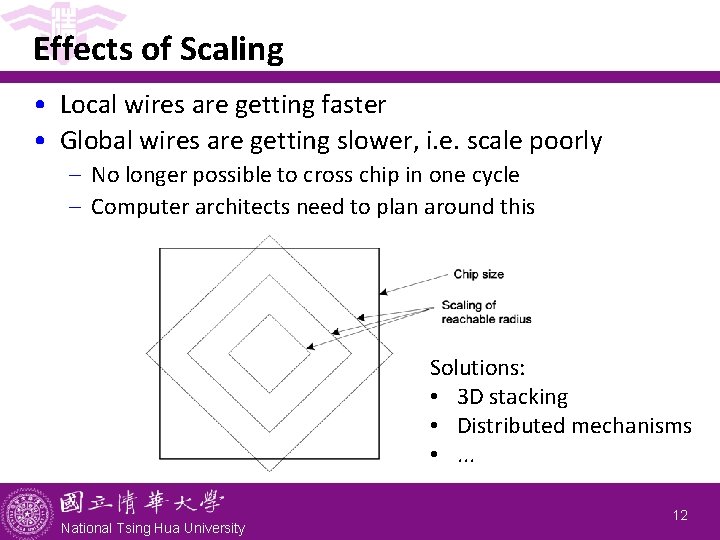
Effects of Scaling • Local wires are getting faster • Global wires are getting slower, i. e. scale poorly - No longer possible to cross chip in one cycle - Computer architects need to plan around this Solutions: • 3 D stacking • Distributed mechanisms • . . . National Tsing Hua University 12
General Technology Trends • Integrated circuit technology: - Transistor density: 35%/year - Die size: 10 -20%/year - Integration overall: 40 -55%/year (slow down after 2003!) • DRAM capacity: 25 -40%/year (slowing) • Flash capacity: 50 -60%/year - 15 -20 X cheaper/bit than DRAM • Magnetic disk capacity: 40%/year - 15 -25 X cheaper/bit than Flash - 300 -500 X cheaper/bit than DRAM - But not speed National Tsing Hua University 13
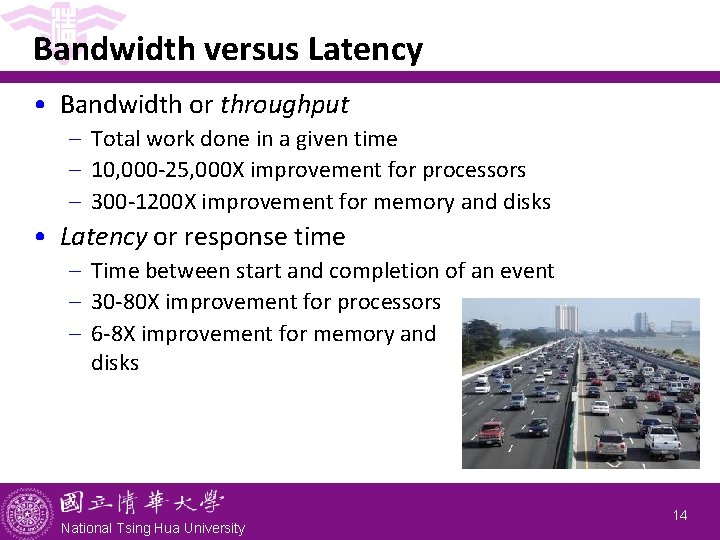
Bandwidth versus Latency • Bandwidth or throughput - Total work done in a given time - 10, 000 -25, 000 X improvement for processors - 300 -1200 X improvement for memory and disks • Latency or response time - Time between start and completion of an event - 30 -80 X improvement for processors - 6 -8 X improvement for memory and disks National Tsing Hua University 14
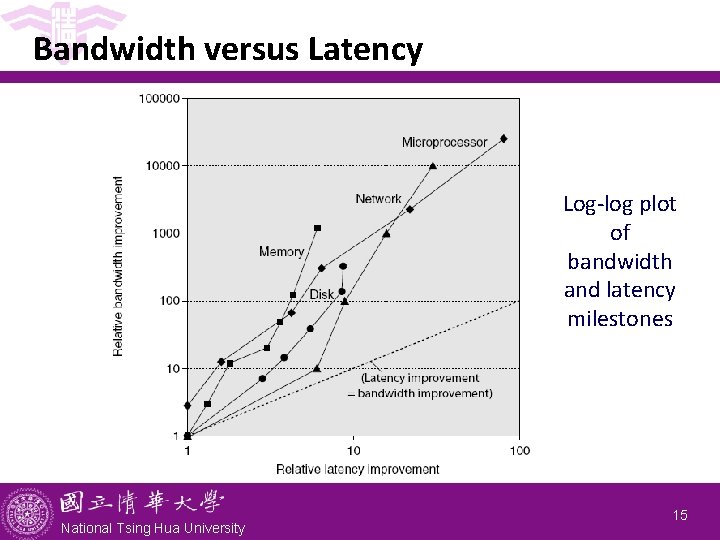
Bandwidth versus Latency Log-log plot of bandwidth and latency milestones National Tsing Hua University 15
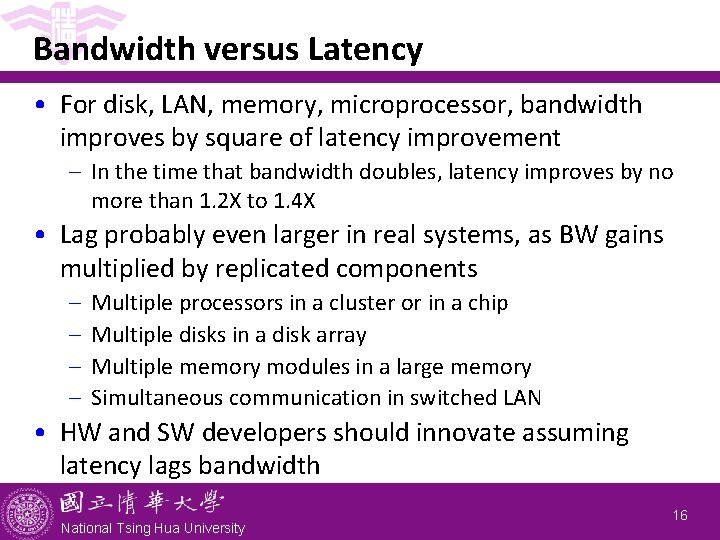
Bandwidth versus Latency • For disk, LAN, memory, microprocessor, bandwidth improves by square of latency improvement - In the time that bandwidth doubles, latency improves by no more than 1. 2 X to 1. 4 X • Lag probably even larger in real systems, as BW gains multiplied by replicated components - Multiple processors in a cluster or in a chip Multiple disks in a disk array Multiple memory modules in a large memory Simultaneous communication in switched LAN • HW and SW developers should innovate assuming latency lags bandwidth National Tsing Hua University 16
Architecture Innovations Matters RISC Fig. 1. 1 National Tsing Hua University 17
Why RISC Significant? • Pre-RISC: CISC (complex instruction set computer) - Good code density for small and slow memory - Inherit from multi-chip/board-level processor to single-chip processors • Opportunities - More computers based on single-chip microprocessors - A chip can accommodate sufficient # of transistors - Maturity of high-level languages (HLL) and compilers no assembly, no need for object-code compatible - Vendor-independent OSs, e. g. UNIX/Linux Easy to introduce new architectures • How to effectively use available transistors on a chip? National Tsing Hua University 18
Why RISC Significant? • RISC concept: - Simplify ISA simplify control circuitry (quantitative approach to simplification) - Use extra transistors for effective architectural designs pipelining, caches, register file, 32 -bit, multi-issue, … - As # transistors , can integrate more 52%/year - Sparc, MIPS, Power, Alpha, ARM, … • Effects of RISC: - Wipe out prior CISC, e. g. VAX - Or force to keep up, e. g. Intel 80 x 86 (RISC-like core) • Distinction less obvious now National Tsing Hua University 19
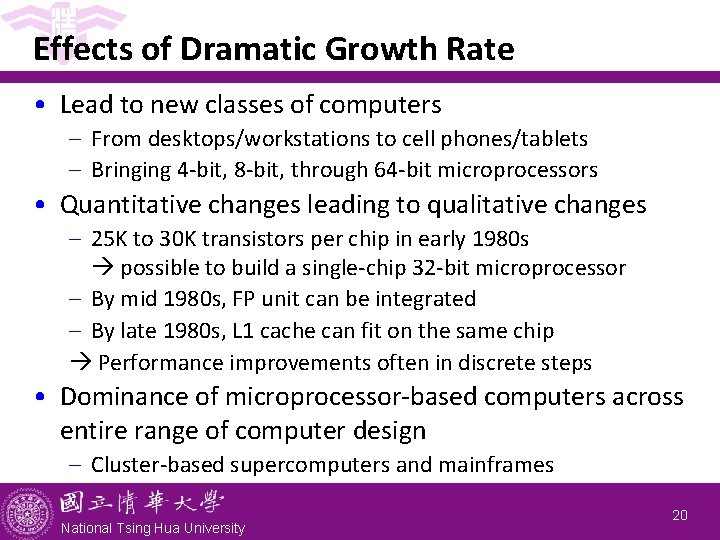
Effects of Dramatic Growth Rate • Lead to new classes of computers - From desktops/workstations to cell phones/tablets - Bringing 4 -bit, 8 -bit, through 64 -bit microprocessors • Quantitative changes leading to qualitative changes - 25 K to 30 K transistors per chip in early 1980 s possible to build a single-chip 32 -bit microprocessor - By mid 1980 s, FP unit can be integrated - By late 1980 s, L 1 cache can fit on the same chip Performance improvements often in discrete steps • Dominance of microprocessor-based computers across entire range of computer design - Cluster-based supercomputers and mainframes National Tsing Hua University 20
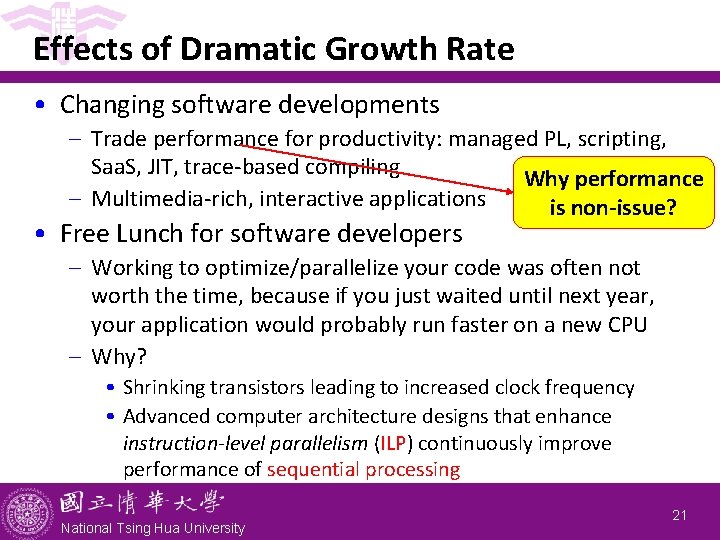
Effects of Dramatic Growth Rate • Changing software developments - Trade performance for productivity: managed PL, scripting, Saa. S, JIT, trace-based compiling Why performance - Multimedia-rich, interactive applications is non-issue? • Free Lunch for software developers - Working to optimize/parallelize your code was often not worth the time, because if you just waited until next year, your application would probably run faster on a new CPU - Why? • Shrinking transistors leading to increased clock frequency • Advanced computer architecture designs that enhance instruction-level parallelism (ILP) continuously improve performance of sequential processing National Tsing Hua University 21
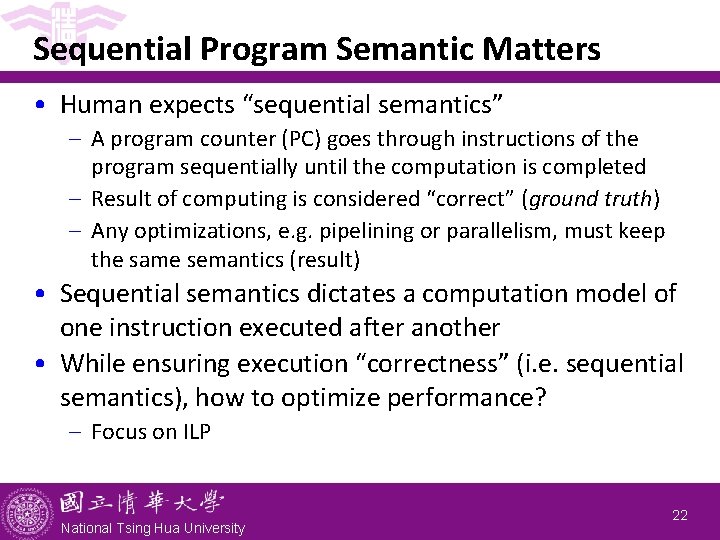
Sequential Program Semantic Matters • Human expects “sequential semantics” - A program counter (PC) goes through instructions of the program sequentially until the computation is completed - Result of computing is considered “correct” (ground truth) - Any optimizations, e. g. pipelining or parallelism, must keep the same semantics (result) • Sequential semantics dictates a computation model of one instruction executed after another • While ensuring execution “correctness” (i. e. sequential semantics), how to optimize performance? - Focus on ILP National Tsing Hua University 22
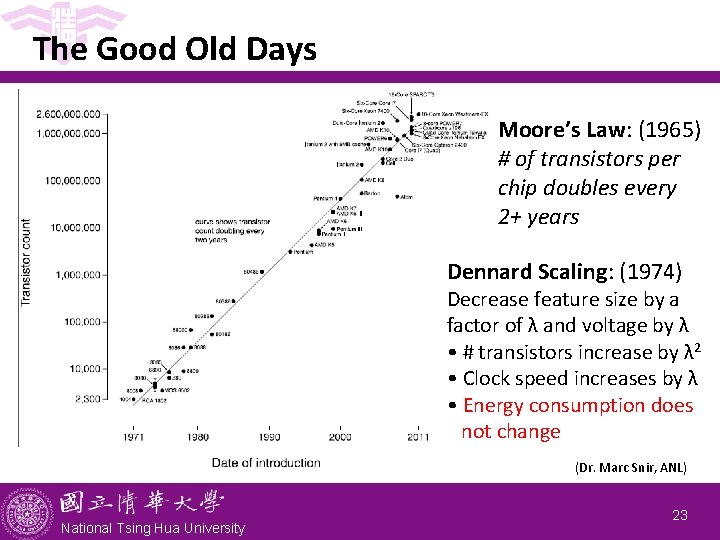
The Good Old Days Moore’s Law: (1965) # of transistors per chip doubles every 2+ years Dennard Scaling: (1974) Decrease feature size by a factor of λ and voltage by λ • # transistors increase by λ 2 • Clock speed increases by λ • Energy consumption does not change (Dr. Marc Snir, ANL) National Tsing Hua University 23
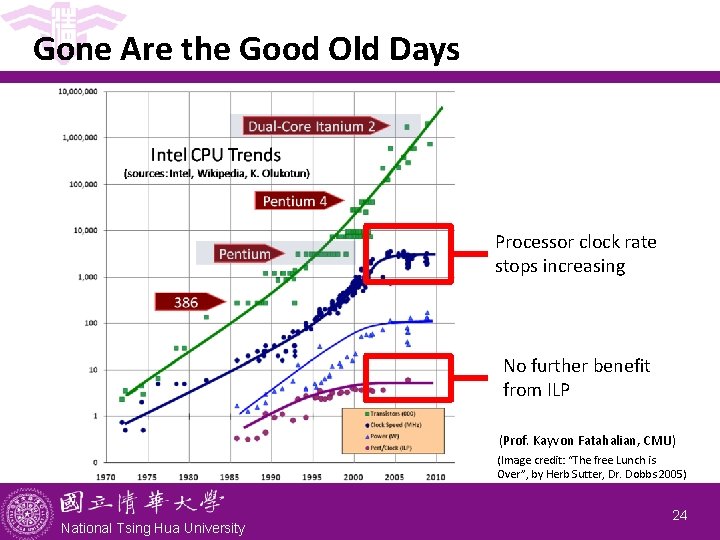
Gone Are the Good Old Days Processor clock rate stops increasing No further benefit from ILP (Prof. Kayvon Fatahalian, CMU) (Image credit: “The free Lunch is Over”, by Herb Sutter, Dr. Dobbs 2005) National Tsing Hua University 24
Dennard Scaling Ended • At around 130 nm in 2001~2004 - CMOS circuits leak too much current (static energy) • Growth in density continues after 2004, but clock speed is (slowly) decreasing • Since 2003, single-processor performance improvement dropped to 22% per year - Limitation of max power dissipation and lack of ILP No more free lunch National Tsing Hua University 25
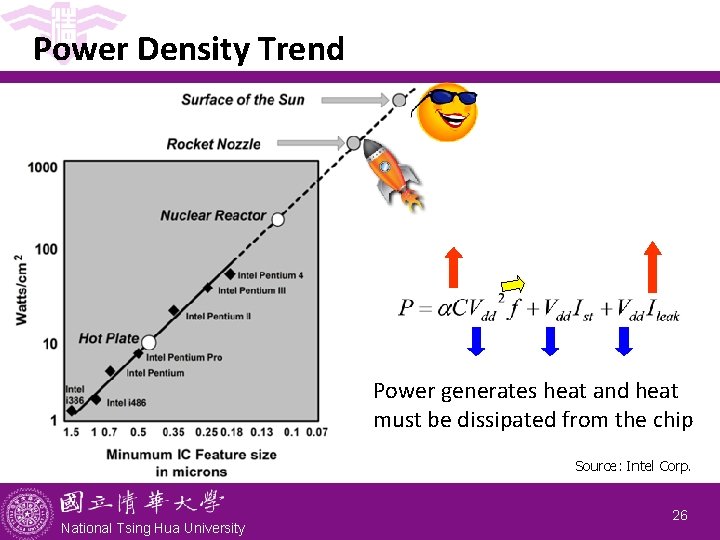
Power Density Trend Power generates heat and heat must be dissipated from the chip Source: Intel Corp. National Tsing Hua University 26
Power and Energy • Pavg = Pdynamic + Pstatic • Energy is related to power through time • If power dissipation remains constant through time T, then E = (Pavg x T) National Tsing Hua University 27
Dynamic Power and Energy • For CMOS chips, traditional dominant energy consumption has been in switching transistors, called dynamic power - ½ x capacitive load x voltage 2 x frequency switched • For mobile devices, energy is better metric - ½ x capacitive load x voltage 2 • Reducing clock rate reduces power, but not energy • Strategies to reducing power: - Do nothing well: turn off clock of inactive modules Dynamic Voltage-Frequency Scaling (DVFS) Low power state for DRAM, disks Overclocking, turning off cores National Tsing Hua University 28
Static Power • Because leakage current flows even when a transistor is off, now static power is important too - Currentstatic x Voltage - Scales with number of transistors - Increase as transistors shrink and # transistors increases • With 65 nm or better technologies, leakage can account for 50% of total power if not designed properly - To reduce: power gating National Tsing Hua University 29
Implications of Power for Architecture • Architectural designs for low power using metrics such as tasks per joule or performance per watt - Use the right power/energy to do the right things • Sometimes, do things faster but at a higher power may be better race to halt - Often techniques for performance also lead to power saving • From relying on ILP to DLP (data-level parallelism), TLP (thread-level parallelism), warehouse-scale computers, RLP (request-level parallelism) - DLP, TLP, RLP: explicit parallel; ILP: implicit National Tsing Hua University No more free lunch 30
2015 and Beyond: Near End of Light? • Physical and engineering limits - Transistor size cannot shrink forever • Need a few hundred atoms per gate • 5 nm seems to be the limit for 2 D (5 nm = 20 atoms) - Decreased return on feature size: performance improvement is not proportional to size reduction • Need additional spacing and larger safety margins • Economical limits - Investments for new fabs keep growing - Chip manufacturing costs keep increasing (more masks …) - IC market cannot grow forever and faster (Dr. Marc Snir, ANL) National Tsing Hua University 31
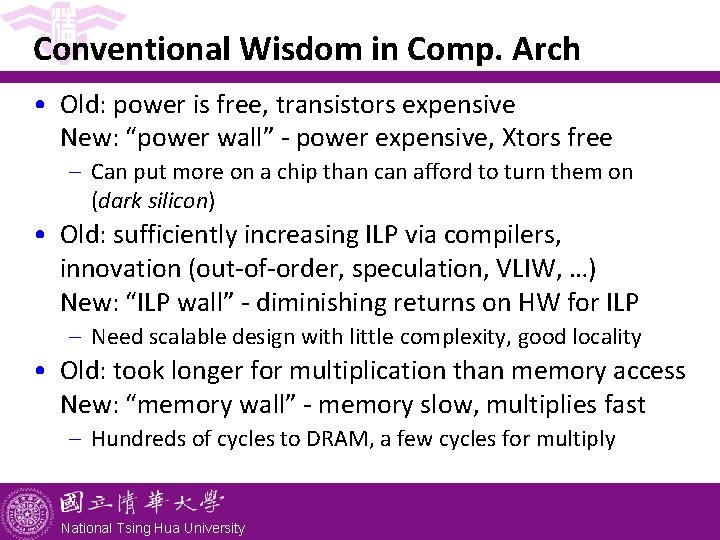
Conventional Wisdom in Comp. Arch • Old: power is free, transistors expensive New: “power wall” - power expensive, Xtors free - Can put more on a chip than can afford to turn them on (dark silicon) • Old: sufficiently increasing ILP via compilers, innovation (out-of-order, speculation, VLIW, …) New: “ILP wall” - diminishing returns on HW for ILP - Need scalable design with little complexity, good locality • Old: took longer for multiplication than memory access New: “memory wall” - memory slow, multiplies fast - Hundreds of cycles to DRAM, a few cycles for multiply National Tsing Hua University
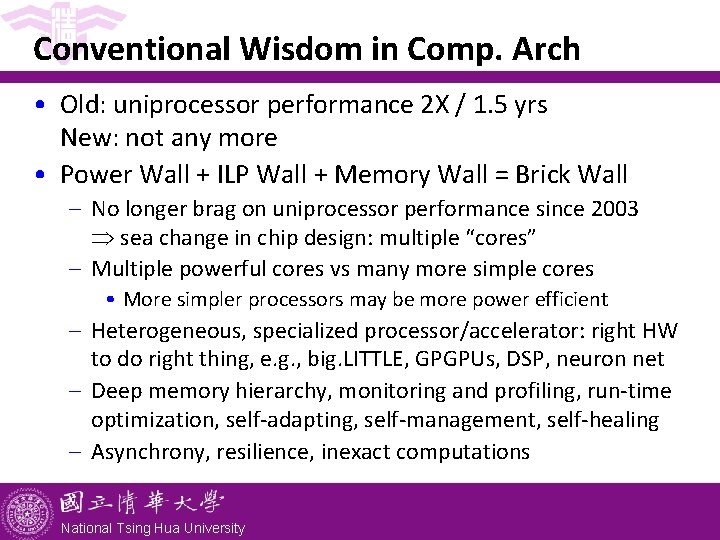
Conventional Wisdom in Comp. Arch • Old: uniprocessor performance 2 X / 1. 5 yrs New: not any more • Power Wall + ILP Wall + Memory Wall = Brick Wall - No longer brag on uniprocessor performance since 2003 sea change in chip design: multiple “cores” - Multiple powerful cores vs many more simple cores • More simpler processors may be more power efficient - Heterogeneous, specialized processor/accelerator: right HW to do right thing, e. g. , big. LITTLE, GPGPUs, DSP, neuron net - Deep memory hierarchy, monitoring and profiling, run-time optimization, self-adapting, self-management, self-healing - Asynchrony, resilience, inexact computations National Tsing Hua University
Outline • A bit of history technology and computer design • Computer performance trend (Sec. 1. 1) - Trends in technology (Sec. 1. 4) - Trends in power and energy (Sec. 1. 5) • Classes of computers (Sec. 1. 2) National Tsing Hua University 34
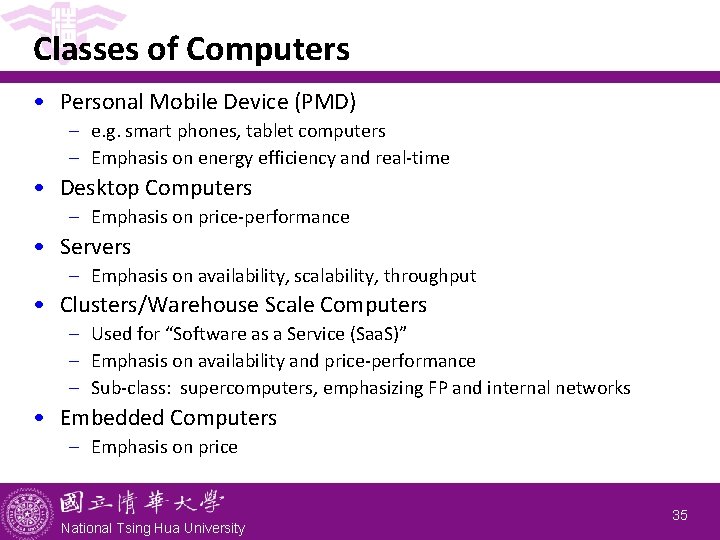
Classes of Computers • Personal Mobile Device (PMD) - e. g. smart phones, tablet computers - Emphasis on energy efficiency and real-time • Desktop Computers - Emphasis on price-performance • Servers - Emphasis on availability, scalability, throughput • Clusters/Warehouse Scale Computers - Used for “Software as a Service (Saa. S)” - Emphasis on availability and price-performance - Sub-class: supercomputers, emphasizing FP and internal networks • Embedded Computers - Emphasis on price National Tsing Hua University 35
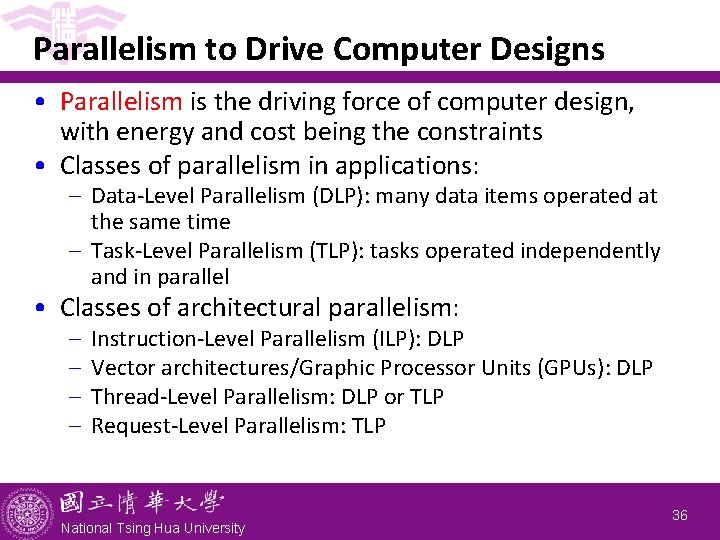
Parallelism to Drive Computer Designs • Parallelism is the driving force of computer design, with energy and cost being the constraints • Classes of parallelism in applications: - Data-Level Parallelism (DLP): many data items operated at the same time - Task-Level Parallelism (TLP): tasks operated independently and in parallel • Classes of architectural parallelism: - Instruction-Level Parallelism (ILP): DLP Vector architectures/Graphic Processor Units (GPUs): DLP Thread-Level Parallelism: DLP or TLP Request-Level Parallelism: TLP National Tsing Hua University 36
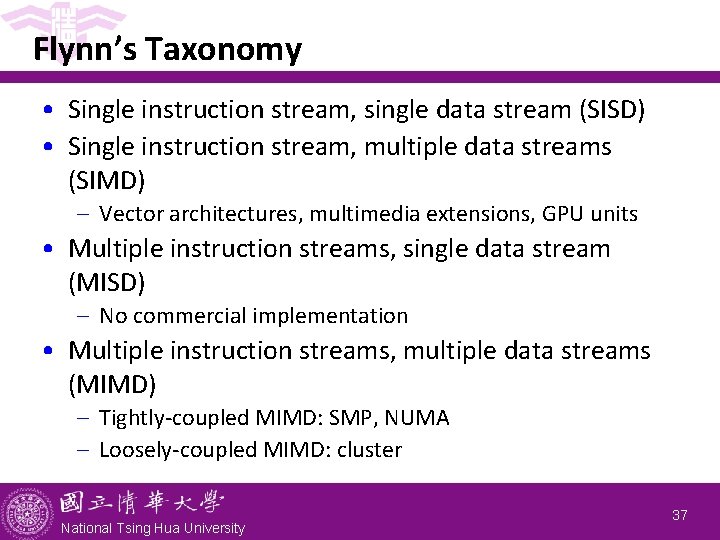
Flynn’s Taxonomy • Single instruction stream, single data stream (SISD) • Single instruction stream, multiple data streams (SIMD) - Vector architectures, multimedia extensions, GPU units • Multiple instruction streams, single data stream (MISD) - No commercial implementation • Multiple instruction streams, multiple data streams (MIMD) - Tightly-coupled MIMD: SMP, NUMA - Loosely-coupled MIMD: cluster National Tsing Hua University 37
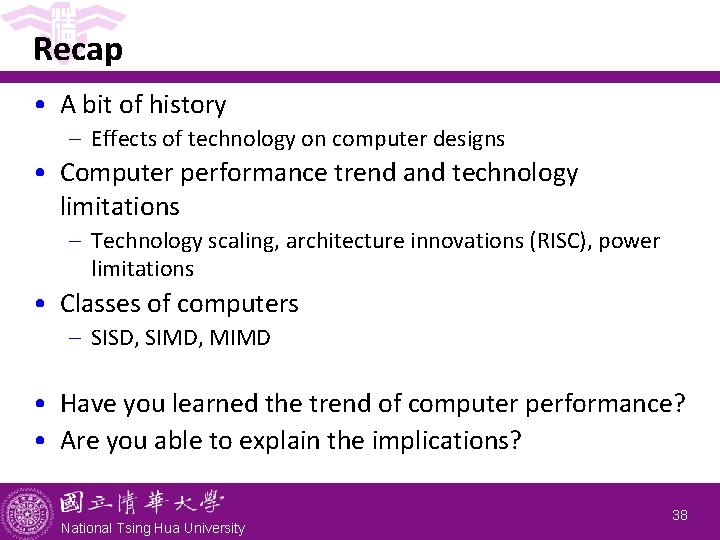
Recap • A bit of history - Effects of technology on computer designs • Computer performance trend and technology limitations - Technology scaling, architecture innovations (RISC), power limitations • Classes of computers - SISD, SIMD, MIMD • Have you learned the trend of computer performance? • Are you able to explain the implications? National Tsing Hua University 38
Sidebar National Tsing Hua University 39
Abacus What kind of technology is used? National Tsing Hua University 40
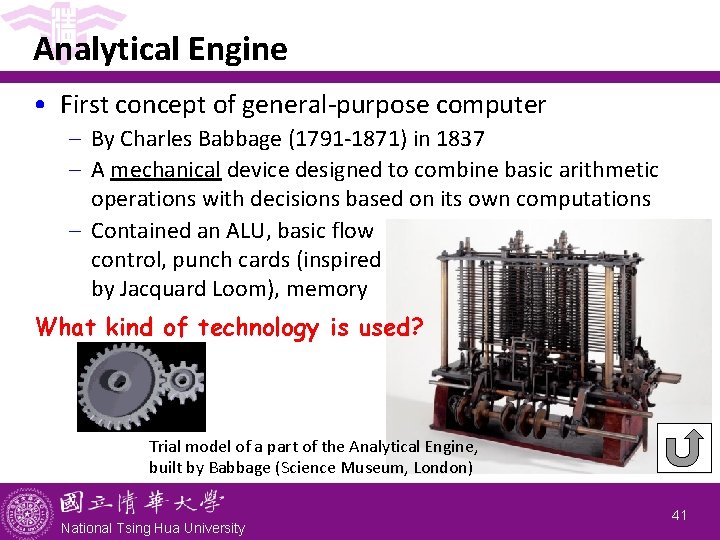
Analytical Engine • First concept of general-purpose computer - By Charles Babbage (1791 -1871) in 1837 - A mechanical device designed to combine basic arithmetic operations with decisions based on its own computations - Contained an ALU, basic flow control, punch cards (inspired by Jacquard Loom), memory What kind of technology is used? Trial model of a part of the Analytical Engine, built by Babbage (Science Museum, London) National Tsing Hua University 41
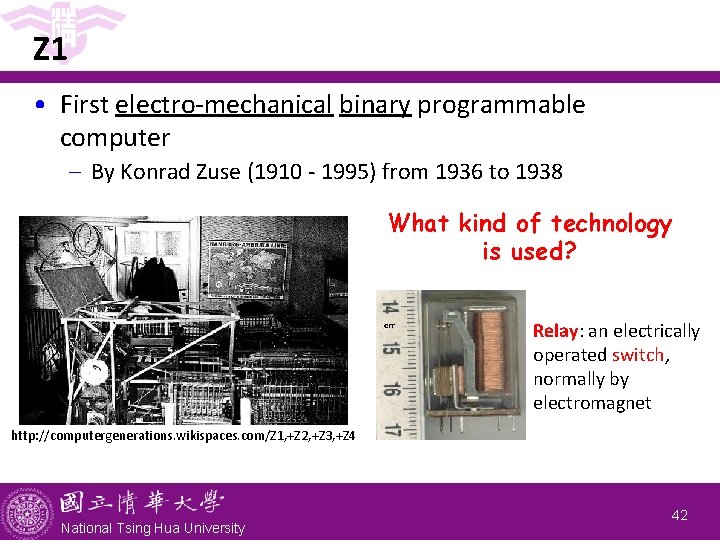
Z 1 • First electro-mechanical binary programmable computer - By Konrad Zuse (1910 - 1995) from 1936 to 1938 What kind of technology is used? Relay: an electrically operated switch, normally by electromagnet http: //computergenerations. wikispaces. com/Z 1, +Z 2, +Z 3, +Z 4 National Tsing Hua University 42
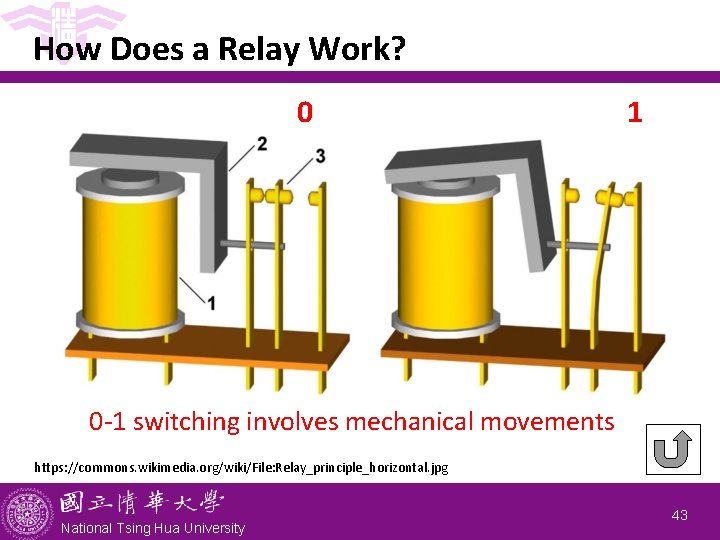
How Does a Relay Work? 0 1 0 -1 switching involves mechanical movements https: //commons. wikimedia. org/wiki/File: Relay_principle_horizontal. jpg National Tsing Hua University 43
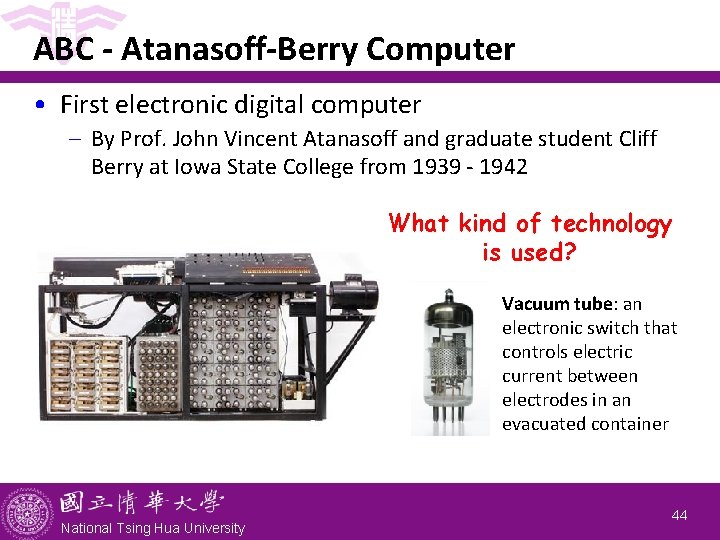
ABC - Atanasoff-Berry Computer • First electronic digital computer - By Prof. John Vincent Atanasoff and graduate student Cliff Berry at Iowa State College from 1939 - 1942 What kind of technology is used? Vacuum tube: an electronic switch that controls electric current between electrodes in an evacuated container National Tsing Hua University 44
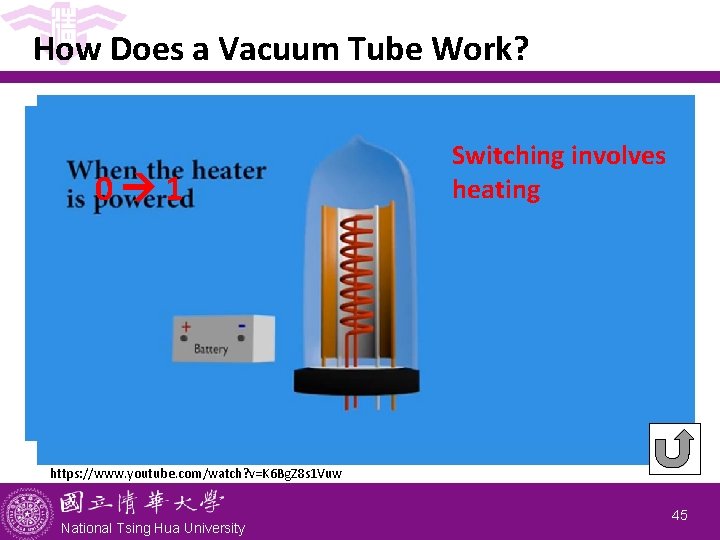
How Does a Vacuum Tube Work? 0 1 Switching involves heating https: //www. youtube. com/watch? v=K 6 Bg. Z 8 s 1 Vuw National Tsing Hua University 45
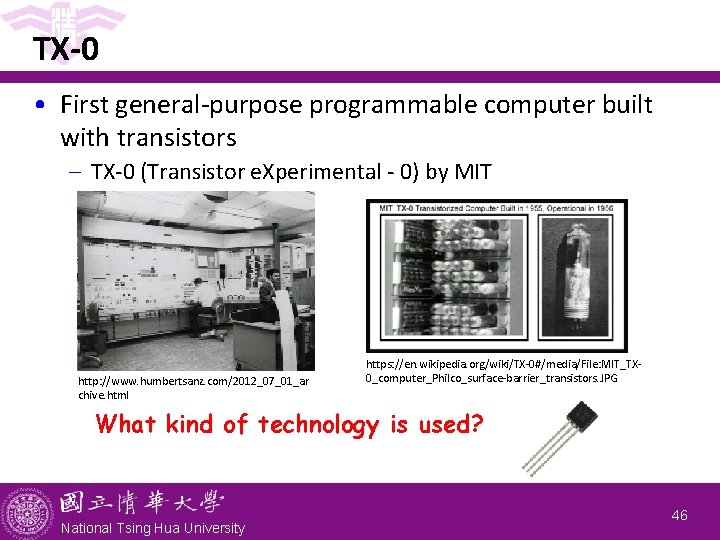
TX-0 • First general-purpose programmable computer built with transistors - TX-0 (Transistor e. Xperimental - 0) by MIT http: //www. humbertsanz. com/2012_07_01_ar chive. html https: //en. wikipedia. org/wiki/TX-0#/media/File: MIT_TX 0_computer_Philco_surface-barrier_transistors. JPG What kind of technology is used? National Tsing Hua University 46
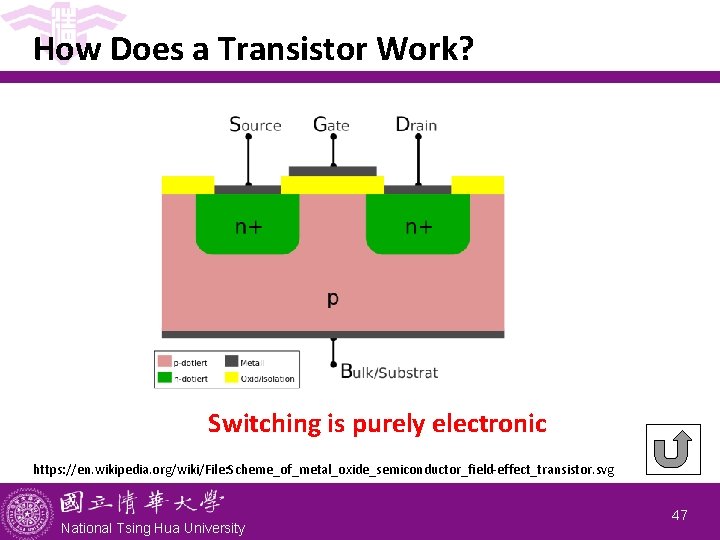
How Does a Transistor Work? Switching is purely electronic https: //en. wikipedia. org/wiki/File: Scheme_of_metal_oxide_semiconductor_field-effect_transistor. svg National Tsing Hua University 47