
CS 5100 Advanced Computer Architecture InstructionLevel Parallelism Prof




- Slides: 34
CS 5100 Advanced Computer Architecture Instruction-Level Parallelism Prof. Chung-Ta King Department of Computer Science National Tsing Hua University, Taiwan (Slides are from textbook, Prof. Hsien-Hsin Lee, Prof. Yasun Hsu) National Tsing Hua University
About This Lecture • Goal: - To review the basic concepts of instruction-level parallelism and pipelining - To study compiler techniques for exposing ILP that are useful for processors with static scheduling • Outline: - Instruction-level parallelism: concepts and challenges (Sec. 3. 1) • Basic concepts, factors affecting ILP, strategies for exploiting ILP - Basic compiler techniques for exposing ILP (Sec. 3. 2) National Tsing Hua University 1
Sequential Program Semantics • Human expects “sequential semantics” - A program counter (PC) goes through instructions of the program sequentially until the computation is completed - Result of computing is considered “correct” (ground truth) - Any optimizations, e. g. pipelining or parallelism, must keep the same semantics (result) • Sequential semantics dictates a computation model of one instruction executed after another • While ensuring execution “correctness” (i. e. sequential semantics), how to optimize executions? - Overlapping executions: instruction-level, thread-level, data-level, request-level National Tsing Hua University 2
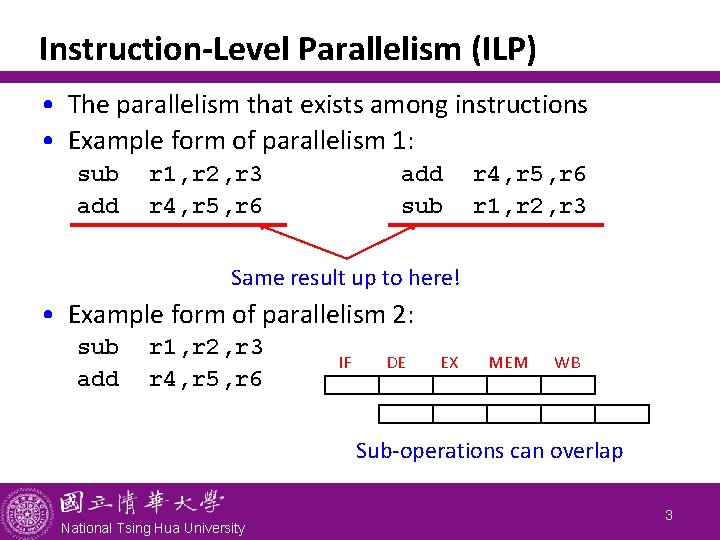
Instruction-Level Parallelism (ILP) • The parallelism that exists among instructions • Example form of parallelism 1: sub add r 1, r 2, r 3 r 4, r 5, r 6 add sub r 4, r 5, r 6 r 1, r 2, r 3 Same result up to here! • Example form of parallelism 2: sub add r 1, r 2, r 3 r 4, r 5, r 6 IF DE EX MEM WB Sub-operations can overlap National Tsing Hua University 3
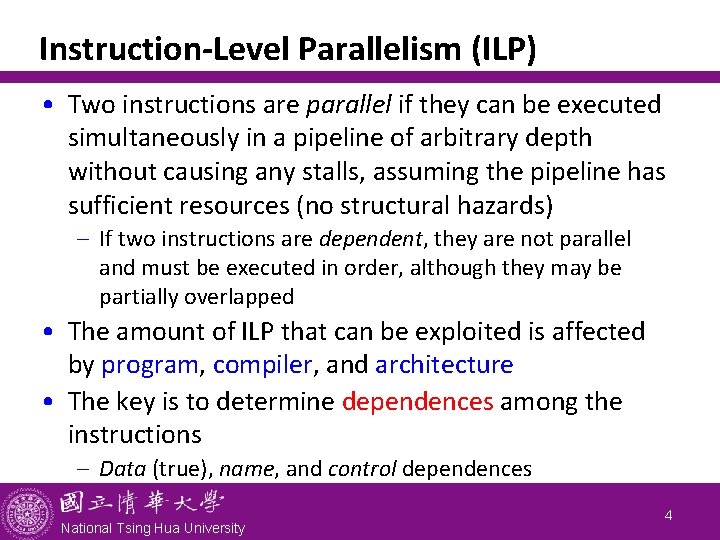
Instruction-Level Parallelism (ILP) • Two instructions are parallel if they can be executed simultaneously in a pipeline of arbitrary depth without causing any stalls, assuming the pipeline has sufficient resources (no structural hazards) - If two instructions are dependent, they are not parallel and must be executed in order, although they may be partially overlapped • The amount of ILP that can be exploited is affected by program, compiler, and architecture • The key is to determine dependences among the instructions - Data (true), name, and control dependences National Tsing Hua University 4
National Tsing Hua University 5
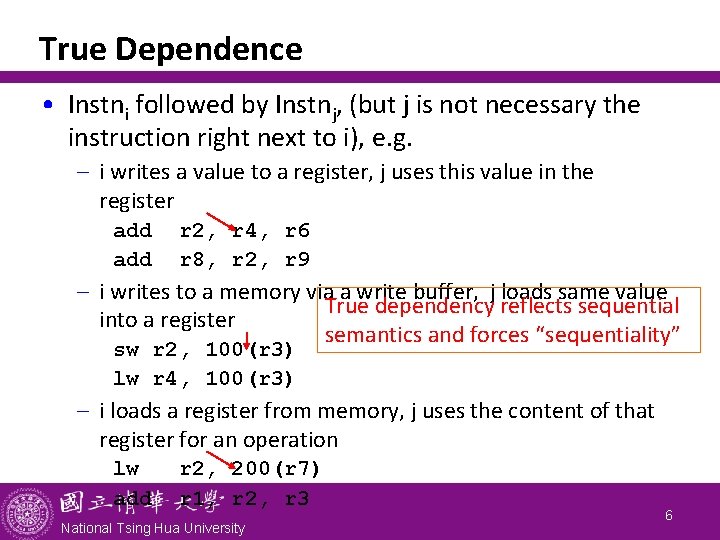
True Dependence • Instni followed by Instnj, (but j is not necessary the instruction right next to i), e. g. - i writes a value to a register, j uses this value in the register add r 2, r 4, r 6 r 8, r 2, r 9 - i writes to a memory via a write buffer, j loads same value True dependency reflects sequential into a register semantics and forces “sequentiality” sw r 2, 100(r 3) lw r 4, 100(r 3) - i loads a register from memory, j uses the content of that register for an operation lw add r 2, 200(r 7) r 1, r 2, r 3 National Tsing Hua University 6
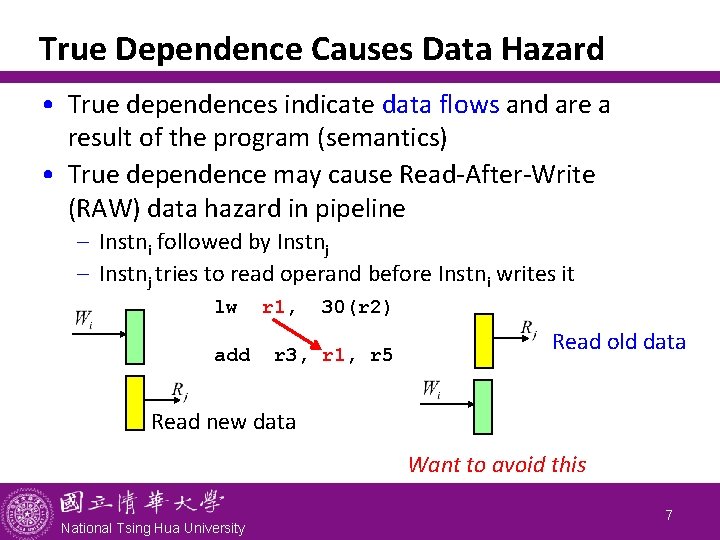
True Dependence Causes Data Hazard • True dependences indicate data flows and are a result of the program (semantics) • True dependence may cause Read-After-Write (RAW) data hazard in pipeline - Instni followed by Instnj - Instnj tries to read operand before Instni writes it lw add r 1, 30(r 2) r 3, r 1, r 5 Read old data Read new data Want to avoid this National Tsing Hua University 7
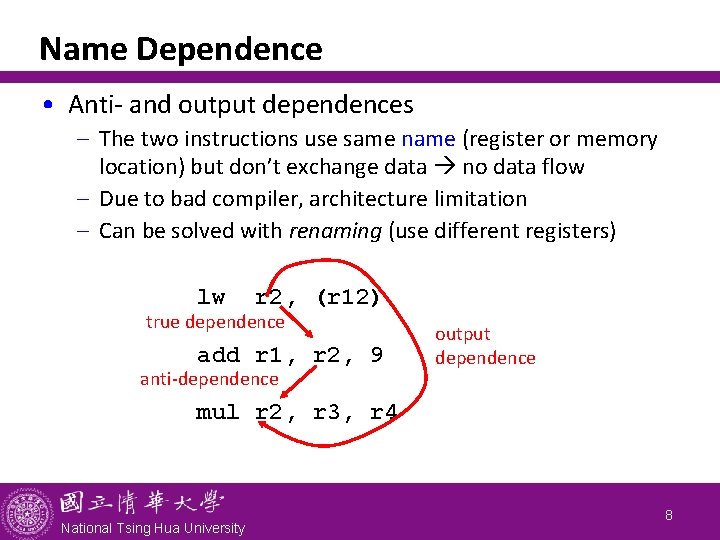
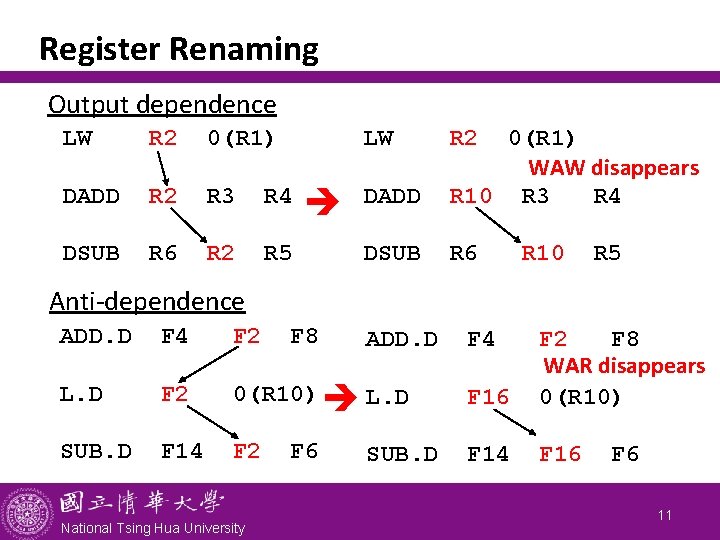
Name Dependence • Anti- and output dependences - The two instructions use same name (register or memory location) but don’t exchange data no data flow - Due to bad compiler, architecture limitation - Can be solved with renaming (use different registers) lw r 2, (r 12) true dependence add r 1, r 2, 9 anti-dependence output dependence mul r 2, r 3, r 4 National Tsing Hua University 8
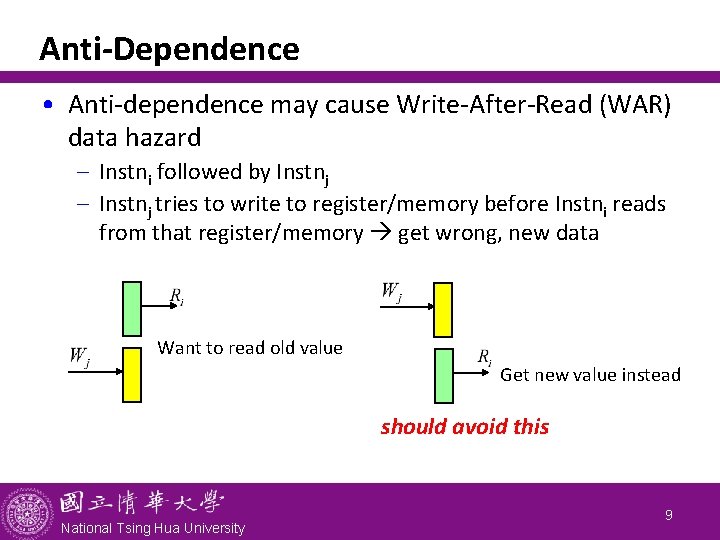
Anti-Dependence • Anti-dependence may cause Write-After-Read (WAR) data hazard - Instni followed by Instnj - Instnj tries to write to register/memory before Instni reads from that register/memory get wrong, new data Want to read old value Get new value instead should avoid this National Tsing Hua University 9
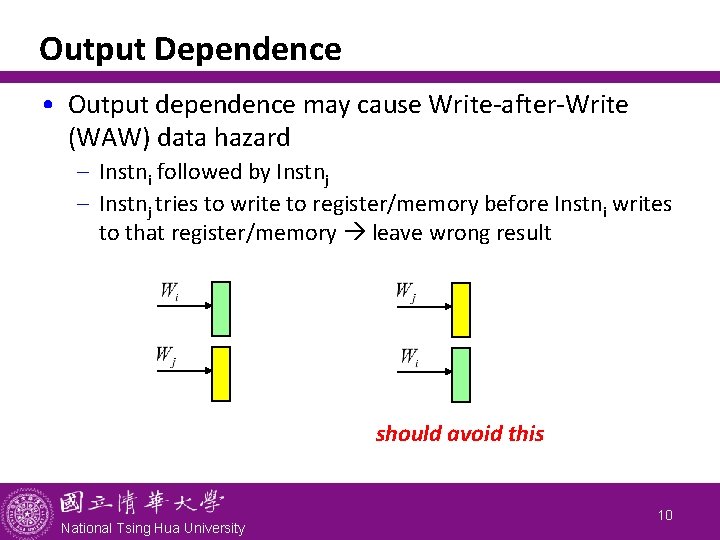
Output Dependence • Output dependence may cause Write-after-Write (WAW) data hazard - Instni followed by Instnj - Instnj tries to write to register/memory before Instni writes to that register/memory leave wrong result should avoid this National Tsing Hua University 10
Register Renaming Output dependence LW R 2 0(R 1) LW DADD R 2 R 3 R 4 DSUB R 6 R 2 R 5 R 2 DADD 0(R 1) WAW disappears R 10 R 3 R 4 DSUB R 6 R 10 R 5 Anti-dependence ADD. D F 4 F 2 L. D F 2 0(R 10) L. D F 16 F 2 F 8 WAR disappears 0(R 10) SUB. D F 14 F 2 F 14 F 16 National Tsing Hua University F 8 F 6 ADD. D SUB. D F 4 F 6 11
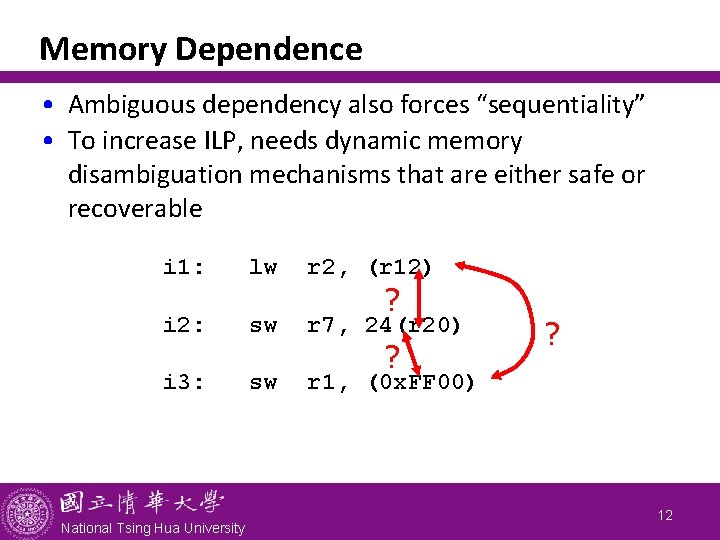
Memory Dependence • Ambiguous dependency also forces “sequentiality” • To increase ILP, needs dynamic memory disambiguation mechanisms that are either safe or recoverable i 1: lw r 2, (r 12) i 2: sw r 7, 24(r 20) i 3: sw r 1, (0 x. FF 00) National Tsing Hua University ? ? ? 12
Control Dependence • Ordering of instruction i with respect to a branch instruction - Instruction that is control-dependent on a branch cannot be moved before that branch so that its execution is no longer controlled by the branch - An instruction that is not control-dependent on a branch cannot be moved after the branch so that its execution is controlled by the branch bge r 8, r 9, Next Control dependence add r 1, r 2, r 3 National Tsing Hua University 13
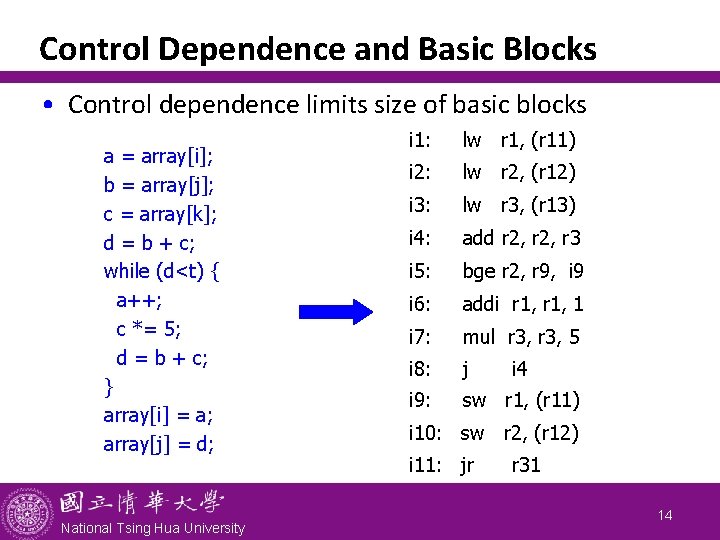
Control Dependence and Basic Blocks • Control dependence limits size of basic blocks a = array[i]; b = array[j]; c = array[k]; d = b + c; while (d<t) { a++; c *= 5; d = b + c; } array[i] = a; array[j] = d; National Tsing Hua University i 1: lw r 1, (r 11) i 2: lw r 2, (r 12) i 3: lw r 3, (r 13) i 4: add r 2, r 3 i 5: bge r 2, r 9, i 9 i 6: addi r 1, 1 i 7: mul r 3, 5 i 8: j i 9: sw r 1, (r 11) i 4 i 10: sw r 2, (r 12) i 11: jr r 31 14
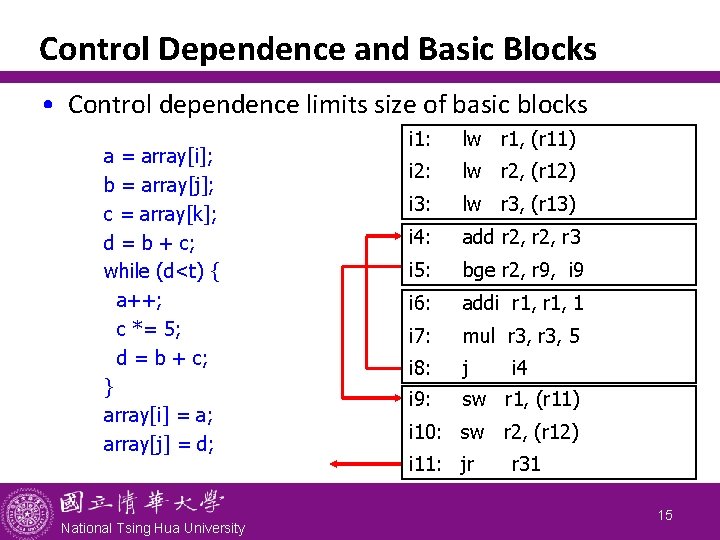
Control Dependence and Basic Blocks • Control dependence limits size of basic blocks a = array[i]; b = array[j]; c = array[k]; d = b + c; while (d<t) { a++; c *= 5; d = b + c; } array[i] = a; array[j] = d; National Tsing Hua University i 1: lw r 1, (r 11) i 2: lw r 2, (r 12) i 3: lw r 3, (r 13) i 4: add r 2, r 3 i 5: bge r 2, r 9, i 9 i 6: addi r 1, 1 i 7: mul r 3, 5 i 8: j i 9: sw r 1, (r 11) i 4 i 10: sw r 2, (r 12) i 11: jr r 31 15
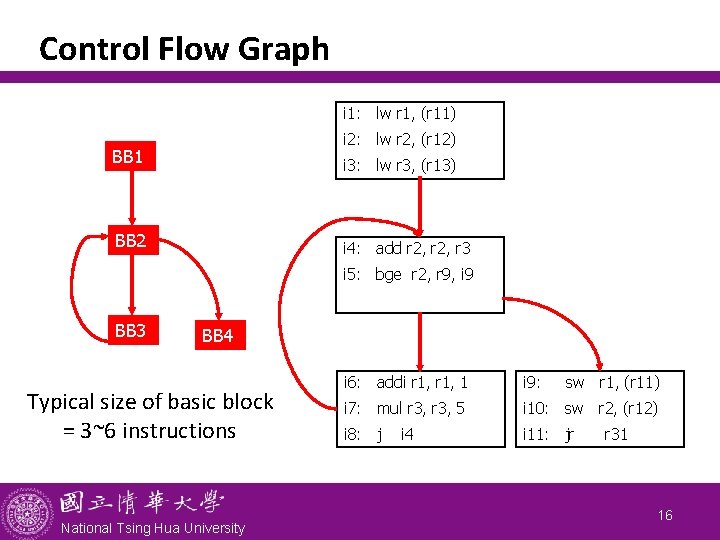
Control Flow Graph i 1: lw r 1, (r 11) i 2: lw r 2, (r 12) BB 1 i 3: lw r 3, (r 13) BB 2 i 4: add r 2, r 3 i 5: bge r 2, r 9, i 9 BB 3 BB 4 Typical size of basic block = 3~6 instructions National Tsing Hua University i 6: addi r 1, 1 i 9: i 7: mul r 3, 5 i 10: sw r 2, (r 12) i 8: j i 11: jr i 4 sw r 1, (r 11) r 31 16
Data Dependence: A Short Summary • Dependencies are property of program & compiler • Pipeline organization determines if a dependence is detected and if it causes a stall • Data dependence conveys: - Possibility of a hazard - Order in which results must be calculated - Upper bound on exploitable ILP • Overcome dependences: - Maintaining the dependence but avoid a hazard - Eliminating dependence by transforming code • Dependencies that flow through memory locations are difficult to detect National Tsing Hua University 17
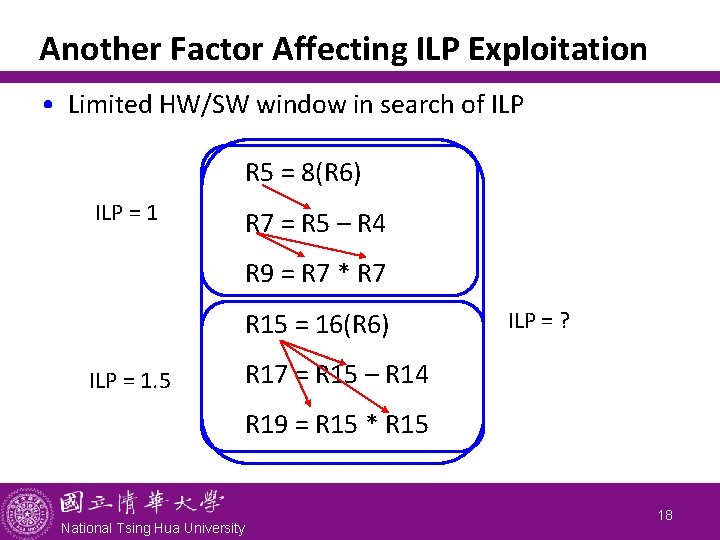
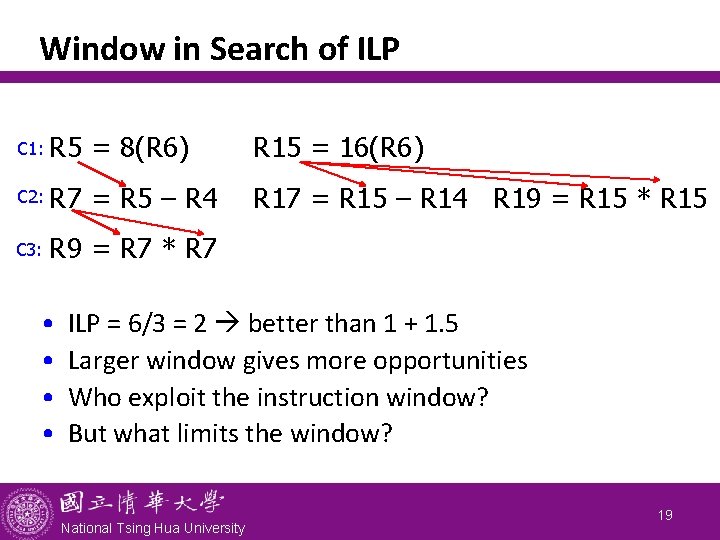
Another Factor Affecting ILP Exploitation • Limited HW/SW window in search of ILP R 5 = 8(R 6) ILP = 1 R 7 = R 5 – R 4 R 9 = R 7 * R 7 R 15 = 16(R 6) ILP = 1. 5 ILP = ? R 17 = R 15 – R 14 R 19 = R 15 * R 15 National Tsing Hua University 18
Window in Search of ILP C 1: R 5 = 8(R 6) R 15 = 16(R 6) C 2: R 7 = R 5 – R 4 R 17 = R 15 – R 14 R 19 = R 15 * R 15 C 3: R 9 = R 7 * R 7 • • ILP = 6/3 = 2 better than 1 + 1. 5 Larger window gives more opportunities Who exploit the instruction window? But what limits the window? National Tsing Hua University 19
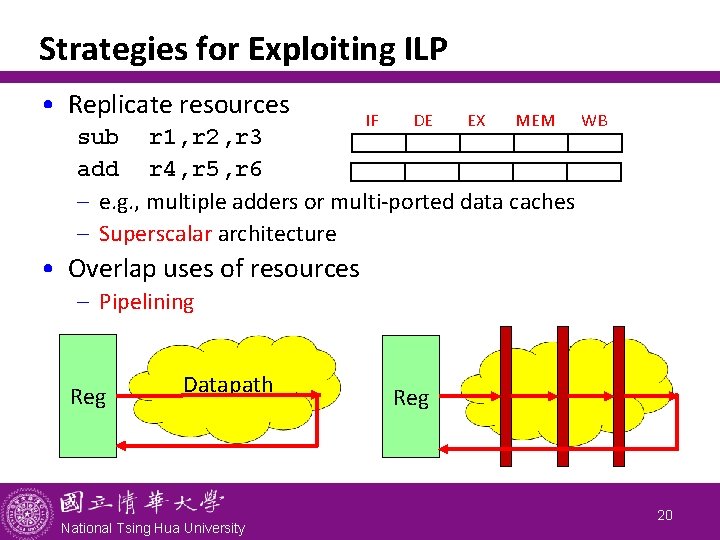
Strategies for Exploiting ILP • Replicate resources IF DE EX MEM sub r 1, r 2, r 3 add r 4, r 5, r 6 - e. g. , multiple adders or multi-ported data caches - Superscalar architecture WB • Overlap uses of resources - Pipelining Reg Datapath National Tsing Hua University Reg 20
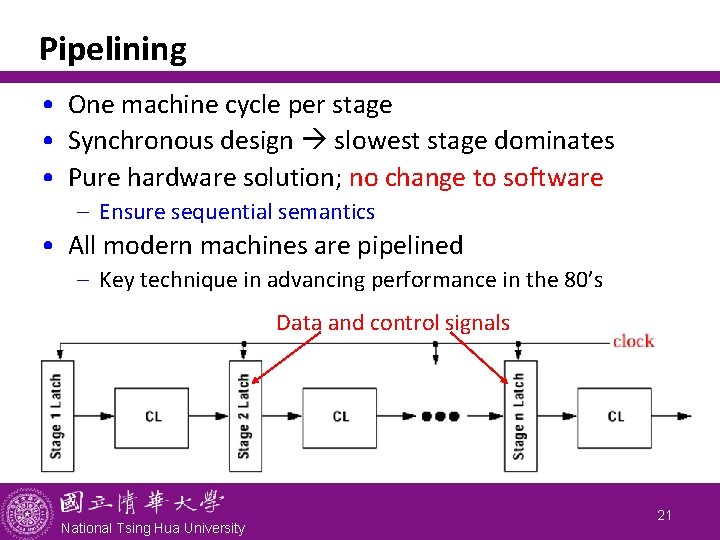
Pipelining • One machine cycle per stage • Synchronous design slowest stage dominates • Pure hardware solution; no change to software - Ensure sequential semantics • All modern machines are pipelined - Key technique in advancing performance in the 80’s Data and control signals National Tsing Hua University 21
Advanced Means of Exploiting ILP • Hardware - Control speculation (control) Dynamic scheduling (data) Register renaming (data) Dynamic memory disambiguation (data) • Software - (Sophisticated) program analysis Predication or conditional instruction (control) Better register allocation (data) Memory disambiguation by compiler (data) National Tsing Hua University 22
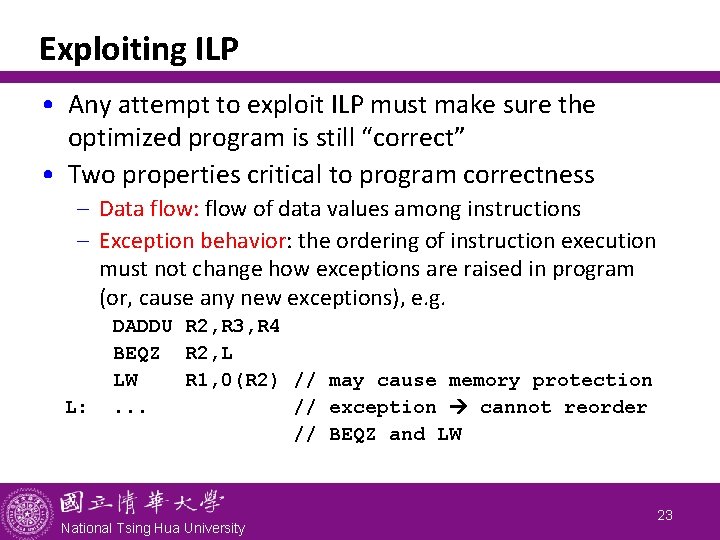
Exploiting ILP • Any attempt to exploit ILP must make sure the optimized program is still “correct” • Two properties critical to program correctness - Data flow: flow of data values among instructions - Exception behavior: the ordering of instruction execution must not change how exceptions are raised in program (or, cause any new exceptions), e. g. L: DADDU R 2, R 3, R 4 BEQZ R 2, L LW R 1, 0(R 2) // may cause memory protection. . . // exception cannot reorder // BEQZ and LW National Tsing Hua University 23
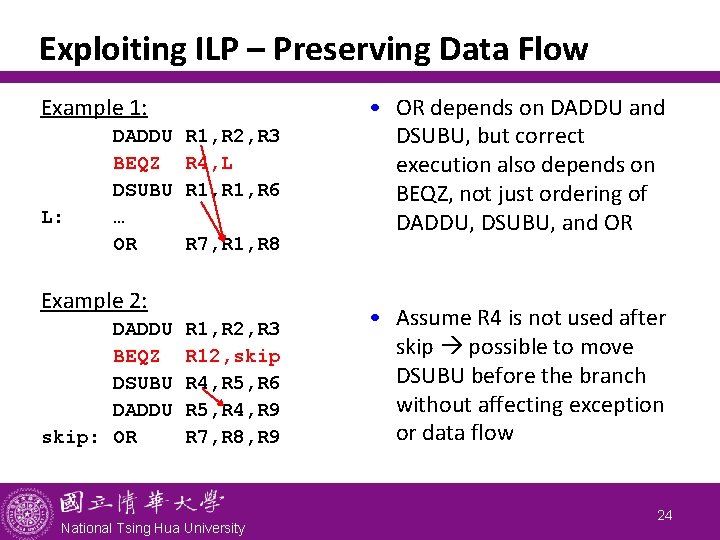
Exploiting ILP – Preserving Data Flow Example 1: L: DADDU BEQZ DSUBU … OR R 1, R 2, R 3 R 4, L R 1, R 6 R 7, R 1, R 8 Example 2: DADDU BEQZ DSUBU DADDU skip: OR R 1, R 2, R 3 R 12, skip R 4, R 5, R 6 R 5, R 4, R 9 R 7, R 8, R 9 National Tsing Hua University • OR depends on DADDU and DSUBU, but correct execution also depends on BEQZ, not just ordering of DADDU, DSUBU, and OR • Assume R 4 is not used after skip possible to move DSUBU before the branch without affecting exception or data flow 24
Outline • Instruction-level parallelism: concepts and challenges (Sec. 3. 1) • Basic compiler techniques for exposing ILP (Sec. 3. 2) National Tsing Hua University 25
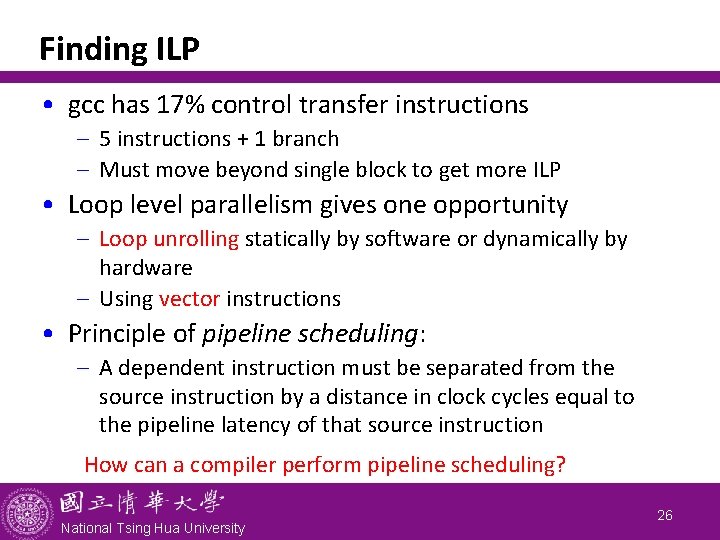
Finding ILP • gcc has 17% control transfer instructions - 5 instructions + 1 branch - Must move beyond single block to get more ILP • Loop level parallelism gives one opportunity - Loop unrolling statically by software or dynamically by hardware - Using vector instructions • Principle of pipeline scheduling: - A dependent instruction must be separated from the source instruction by a distance in clock cycles equal to the pipeline latency of that source instruction How can a compiler perform pipeline scheduling? National Tsing Hua University 26
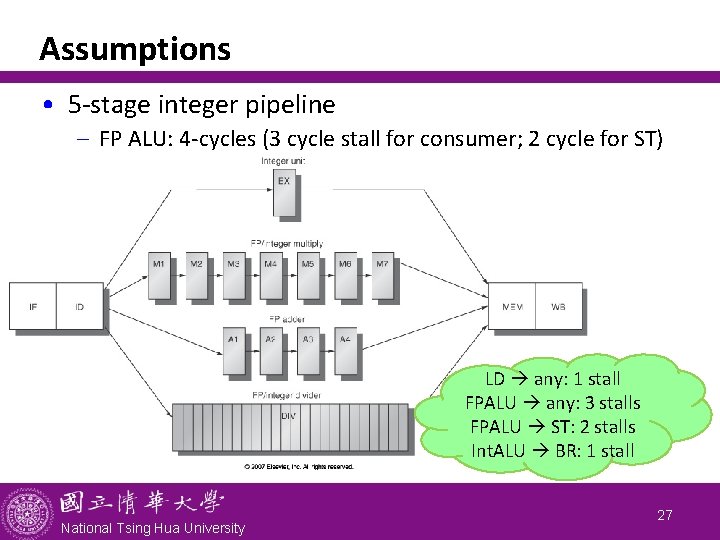
Assumptions • 5 -stage integer pipeline - FP ALU: 4 -cycles (3 cycle stall for consumer; 2 cycle for ST) LD any: 1 stall FPALU any: 3 stalls FPALU ST: 2 stalls Int. ALU BR: 1 stall National Tsing Hua University 27
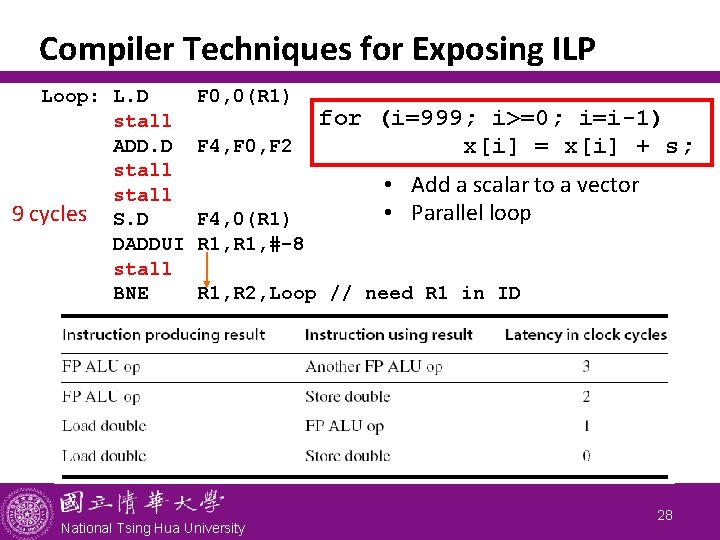
Compiler Techniques for Exposing ILP Loop: L. D stall ADD. D stall 9 cycles S. D DADDUI stall BNE F 0, 0(R 1) F 4, F 0, F 2 F 4, 0(R 1) R 1, #-8 for (i=999; i>=0; i=i-1) x[i] = x[i] + s; • Add a scalar to a vector • Parallel loop R 1, R 2, Loop // need R 1 in ID National Tsing Hua University 28
Pipeline Scheduling Scheduled code: Loop: L. D DADDUI ADD. D stall S. D BNE F 0, 0(R 1) R 1, #-8 F 4, F 0, F 2 7 cycles F 4, 8(R 1) R 1, R 2, Loop National Tsing Hua University 29
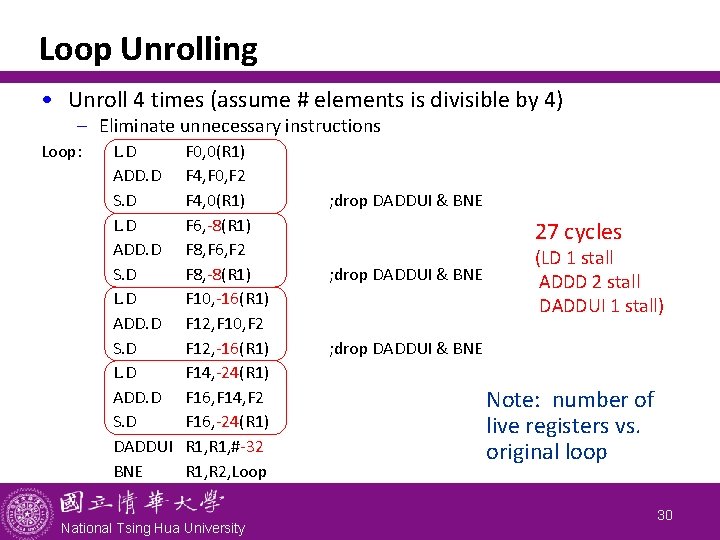
Loop Unrolling • Unroll 4 times (assume # elements is divisible by 4) - Eliminate unnecessary instructions Loop: L. D ADD. D S. D DADDUI BNE F 0, 0(R 1) F 4, F 0, F 2 F 4, 0(R 1) F 6, -8(R 1) F 8, F 6, F 2 F 8, -8(R 1) F 10, -16(R 1) F 12, F 10, F 2 F 12, -16(R 1) F 14, -24(R 1) F 16, F 14, F 2 F 16, -24(R 1) R 1, #-32 R 1, R 2, Loop National Tsing Hua University ; drop DADDUI & BNE 27 cycles ; drop DADDUI & BNE (LD 1 stall ADDD 2 stall DADDUI 1 stall) ; drop DADDUI & BNE Note: number of live registers vs. original loop 30
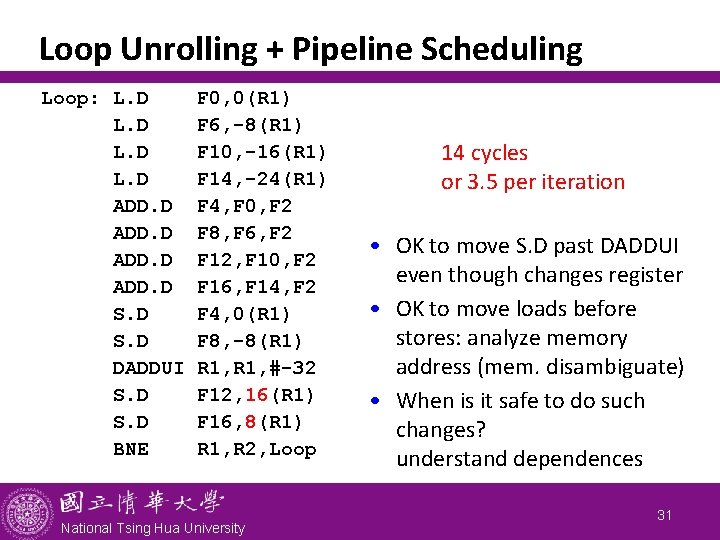
Loop Unrolling + Pipeline Scheduling Loop: L. D ADD. D S. D DADDUI S. D BNE F 0, 0(R 1) F 6, -8(R 1) F 10, -16(R 1) F 14, -24(R 1) F 4, F 0, F 2 F 8, F 6, F 2 F 12, F 10, F 2 F 16, F 14, F 2 F 4, 0(R 1) F 8, -8(R 1) R 1, #-32 F 12, 16(R 1) F 16, 8(R 1) R 1, R 2, Loop National Tsing Hua University 14 cycles or 3. 5 per iteration • OK to move S. D past DADDUI even though changes register • OK to move loads before stores: analyze memory address (mem. disambiguate) • When is it safe to do such changes? understand dependences 31
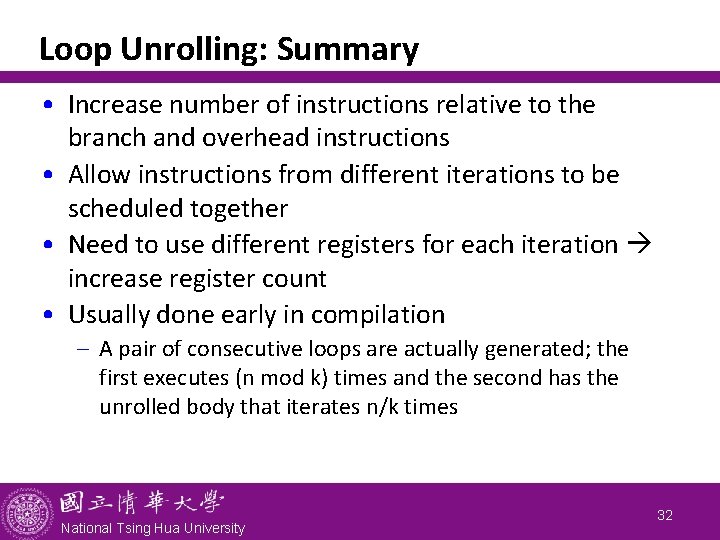
Loop Unrolling: Summary • Increase number of instructions relative to the branch and overhead instructions • Allow instructions from different iterations to be scheduled together • Need to use different registers for each iteration increase register count • Usually done early in compilation - A pair of consecutive loops are actually generated; the first executes (n mod k) times and the second has the unrolled body that iterates n/k times National Tsing Hua University 32
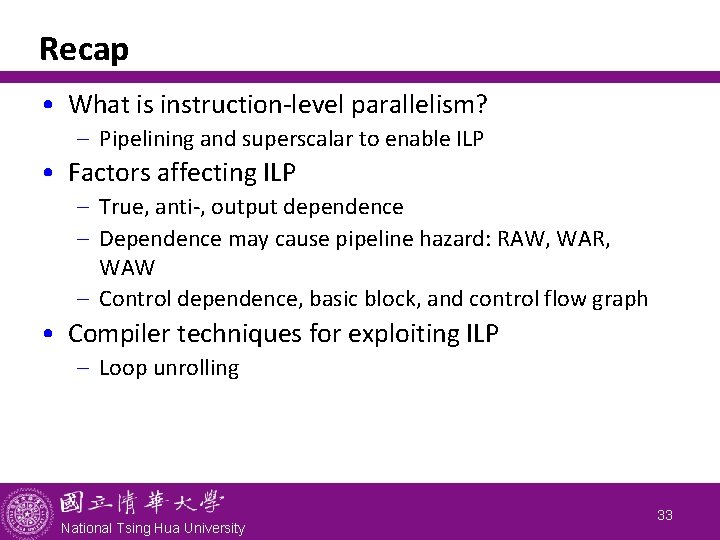
Recap • What is instruction-level parallelism? - Pipelining and superscalar to enable ILP • Factors affecting ILP - True, anti-, output dependence - Dependence may cause pipeline hazard: RAW, WAR, WAW - Control dependence, basic block, and control flow graph • Compiler techniques for exploiting ILP - Loop unrolling National Tsing Hua University 33