
CS 5100 Advanced Computer Architecture Advanced Techniques for



- Slides: 43
CS 5100 Advanced Computer Architecture Advanced Techniques for ILP Prof. Chung-Ta King Department of Computer Science National Tsing Hua University, Taiwan (Slides are from textbook, Prof. Hsien-Hsin Lee, Prof. Yasun Hsu) National Tsing Hua University
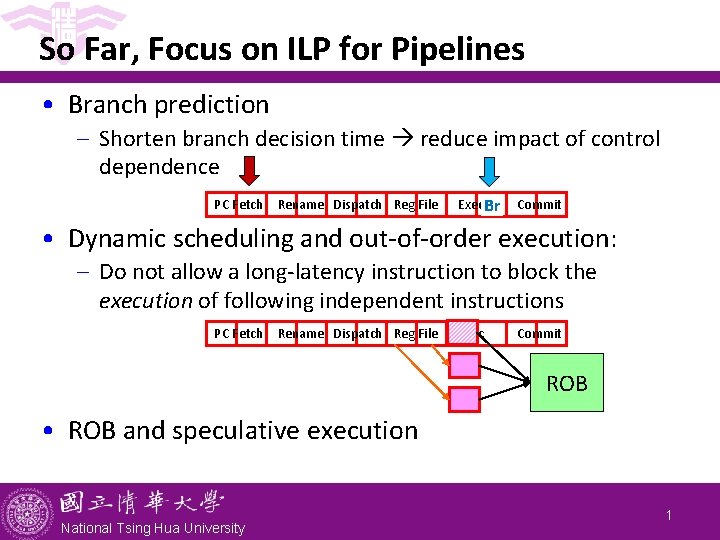
So Far, Focus on ILP for Pipelines • Branch prediction - Shorten branch decision time reduce impact of control dependence PC Fetch Rename Dispatch Reg File Exec. Br Commit • Dynamic scheduling and out-of-order execution: - Do not allow a long-latency instruction to block the execution of following independent instructions PC Fetch Rename Dispatch Reg File Exec Commit ROB • ROB and speculative execution National Tsing Hua University 1
Pipelining Delivers CPI = 1 at Best • How to get CPI < 1? - Issuing and completing multiple instructions/cycle - Challenge: checking and resolving dependences among the instructions issued at the same cycle • Lecture outline: - Multiple issue and static scheduling (Sec. 3. 7) - Dynamic scheduling, multiple issue, and speculation (Sec. 3. 8) - Multithreading: exploiting thread-level parallelism to improve uniprocessor throughput (Sec. 3. 12) - Advanced techniques for instruction delivery and speculation (Sec. 3. 9) National Tsing Hua University 2
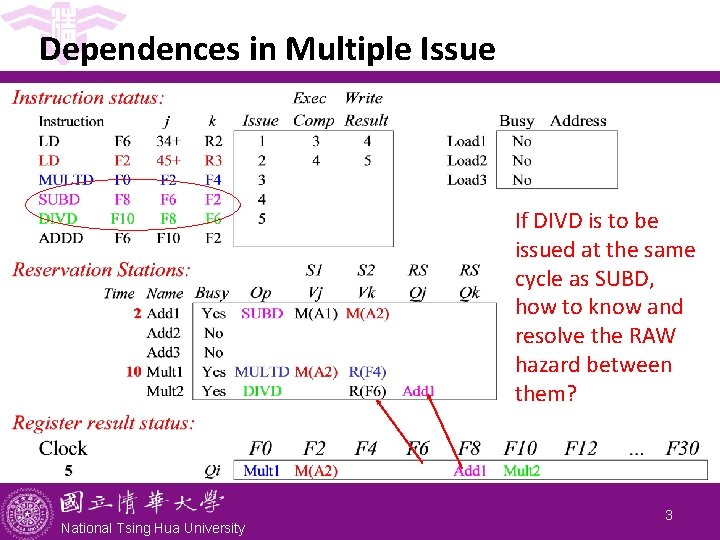
Dependences in Multiple Issue If DIVD is to be issued at the same cycle as SUBD, how to know and resolve the RAW hazard between them? National Tsing Hua University 3
Strategies for Multiple Issue • Superscalar: varying number of instructions/cycle (1 to 8), scheduled by compiler (static) or by HW (dynamic) - IBM Power. PC, Sun Ultra. Sparc, DEC Alpha, Pentium 4, i 7 • Very Long Instruction Words (VLIW): fixed number of instructions (4 -16) in a long instruction or a fixed instruction packet, scheduled statically by compiler - Intel architecture-64 (IA-64) 64 -bit address (renamed: “Explicitly Parallel Instruction Computer (EPIC)”) National Tsing Hua University 4
Strategies for Multiple Issue • Superscalar: fetch and issue multiple instructions at the same cycle National Tsing Hua University 5
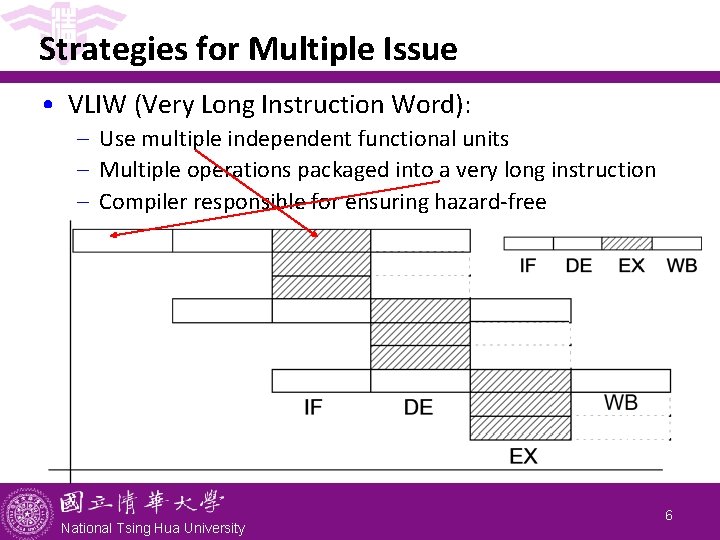
Strategies for Multiple Issue • VLIW (Very Long Instruction Word): - Use multiple independent functional units - Multiple operations packaged into a very long instruction - Compiler responsible for ensuring hazard-free National Tsing Hua University 6
Issuing Multiple Instructions/Cycle • Static multiple issue - Compiler handles data and control hazards and decides what instructions can be issued in the same cycle - Often restrict mix of instructions can be initiated in a clock - Recompilation required for machines with diff. pipelines • Dynamic multiple Issue - Fetch, decode, and commit multiple instructions - Use dynamic pipeline scheduling, HW-based speculation and recovery - Always beneficial if compiler can help, but recompiling not required for new machines National Tsing Hua University 7
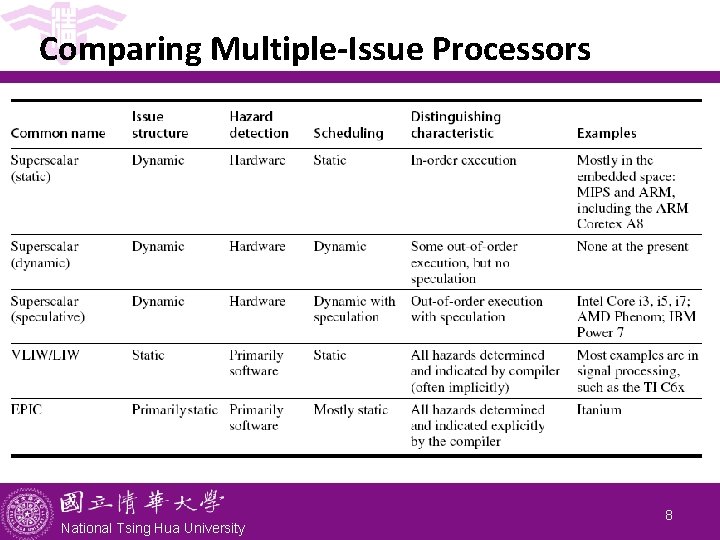
Comparing Multiple-Issue Processors National Tsing Hua University 8
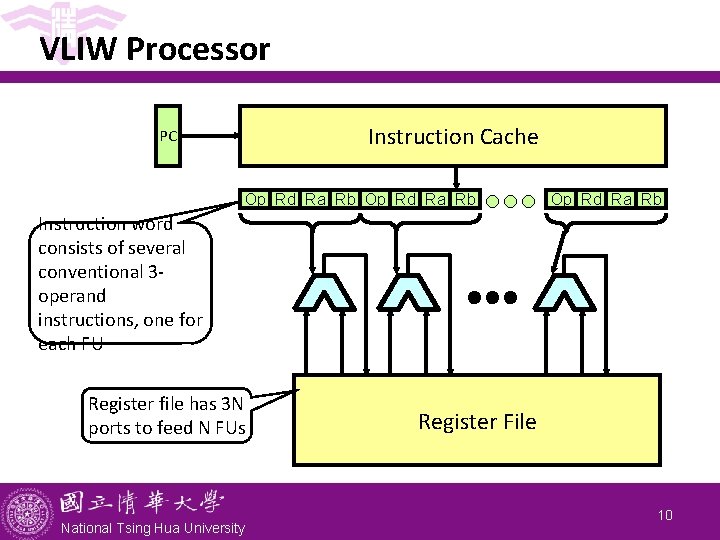
The VLIW Approach • High HW cost for checking parallelism, so … • VLIW: tradeoff for simple decoding - A VLIW instruction has many fields for many operations, e. g. , 2 INT, 2 FP, 2 memory, 1 branch 16 --24 bits/field, or 112 --168 bits wide - Compiler packs multiple independent operations into one very long instruction HW performs minimal check - In general, operations that compiler puts in instruction word can execute in parallel, but can indicate otherwise - Need compiler to schedule across basic blocks e. g. , loop unrolling, trace scheduling, software pipeline National Tsing Hua University 9
VLIW Processor Instruction Cache PC Op Rd Ra Rb Instruction word consists of several conventional 3 operand instructions, one for each FU Register file has 3 N ports to feed N FUs National Tsing Hua University Register File 10
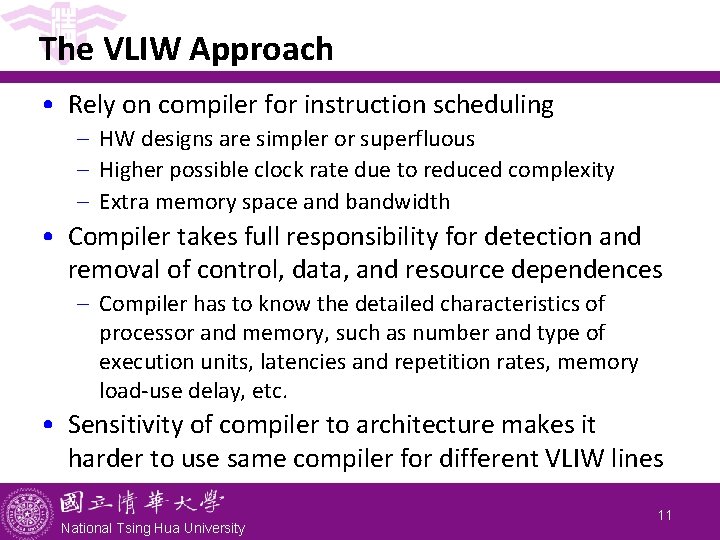
The VLIW Approach • Rely on compiler for instruction scheduling - HW designs are simpler or superfluous - Higher possible clock rate due to reduced complexity - Extra memory space and bandwidth • Compiler takes full responsibility for detection and removal of control, data, and resource dependences - Compiler has to know the detailed characteristics of processor and memory, such as number and type of execution units, latencies and repetition rates, memory load-use delay, etc. • Sensitivity of compiler to architecture makes it harder to use same compiler for different VLIW lines National Tsing Hua University 11
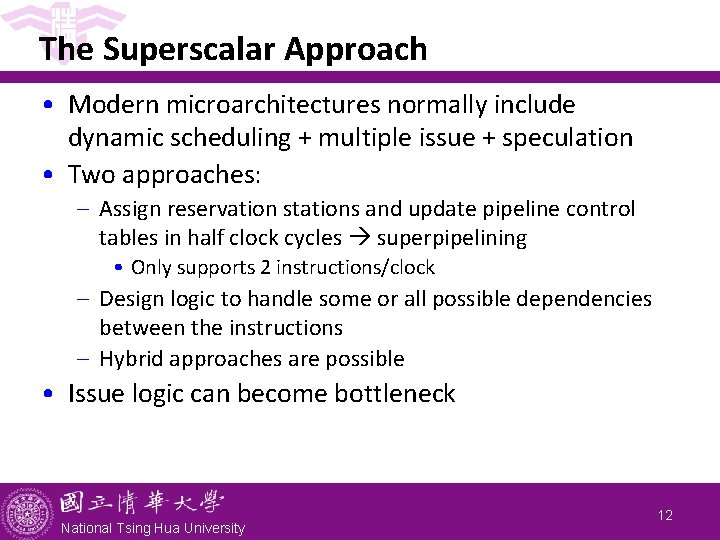
The Superscalar Approach • Modern microarchitectures normally include dynamic scheduling + multiple issue + speculation • Two approaches: - Assign reservation stations and update pipeline control tables in half clock cycles superpipelining • Only supports 2 instructions/clock - Design logic to handle some or all possible dependencies between the instructions - Hybrid approaches are possible • Issue logic can become bottleneck National Tsing Hua University 12
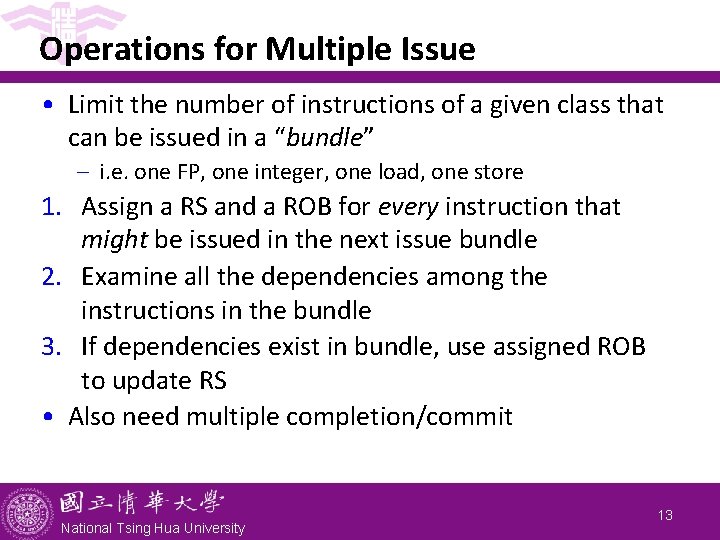
Operations for Multiple Issue • Limit the number of instructions of a given class that can be issued in a “bundle” - i. e. one FP, one integer, one load, one store 1. Assign a RS and a ROB for every instruction that might be issued in the next issue bundle 2. Examine all the dependencies among the instructions in the bundle 3. If dependencies exist in bundle, use assigned ROB to update RS • Also need multiple completion/commit National Tsing Hua University 13
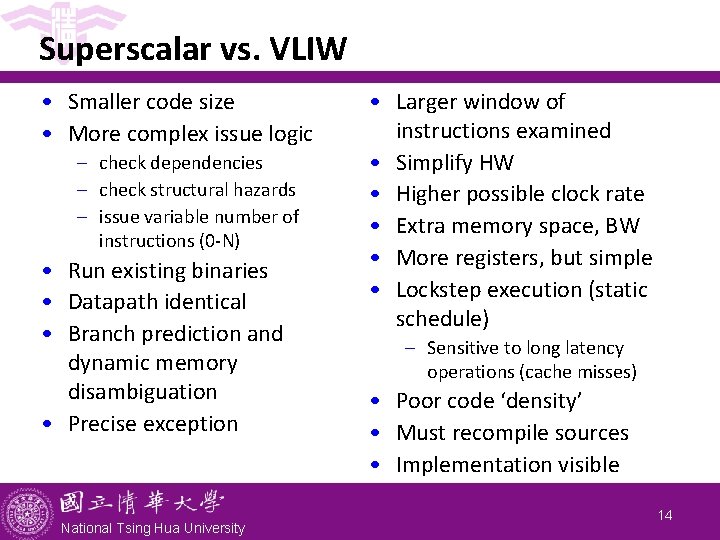
Superscalar vs. VLIW • Smaller code size • More complex issue logic - check dependencies - check structural hazards - issue variable number of instructions (0 -N) • Run existing binaries • Datapath identical • Branch prediction and dynamic memory disambiguation • Precise exception National Tsing Hua University • Larger window of instructions examined • Simplify HW • Higher possible clock rate • Extra memory space, BW • More registers, but simple • Lockstep execution (static schedule) - Sensitive to long latency operations (cache misses) • Poor code ‘density’ • Must recompile sources • Implementation visible 14
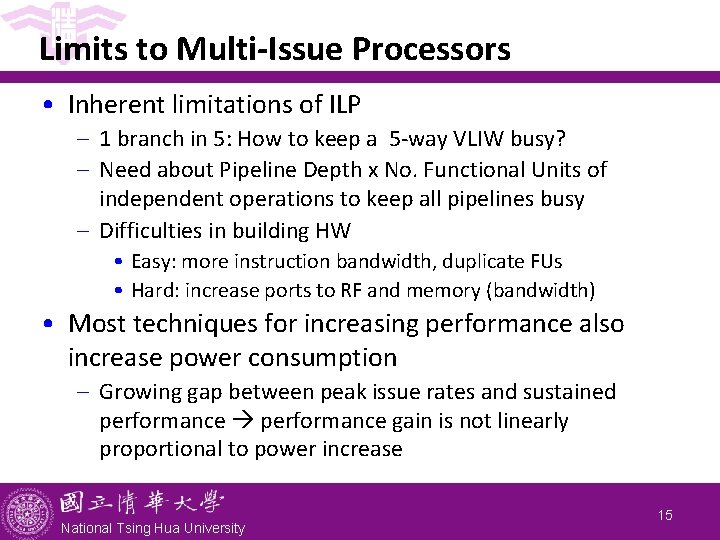
Limits to Multi-Issue Processors • Inherent limitations of ILP - 1 branch in 5: How to keep a 5 -way VLIW busy? - Need about Pipeline Depth x No. Functional Units of independent operations to keep all pipelines busy - Difficulties in building HW • Easy: more instruction bandwidth, duplicate FUs • Hard: increase ports to RF and memory (bandwidth) • Most techniques for increasing performance also increase power consumption - Growing gap between peak issue rates and sustained performance gain is not linearly proportional to power increase National Tsing Hua University 15
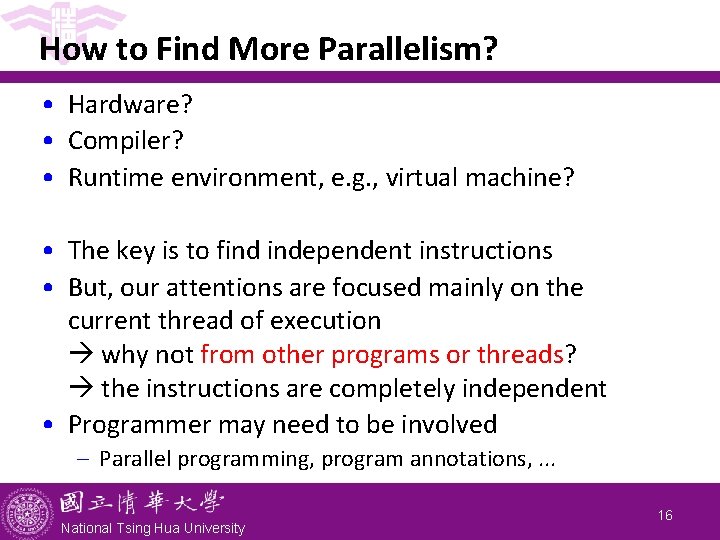
How to Find More Parallelism? • Hardware? • Compiler? • Runtime environment, e. g. , virtual machine? • The key is to find independent instructions • But, our attentions are focused mainly on the current thread of execution why not from other programs or threads? the instructions are completely independent • Programmer may need to be involved - Parallel programming, program annotations, . . . National Tsing Hua University 16
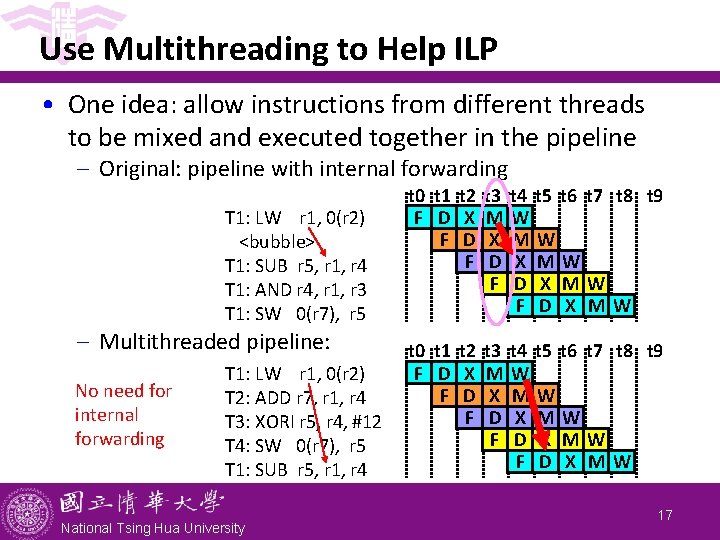
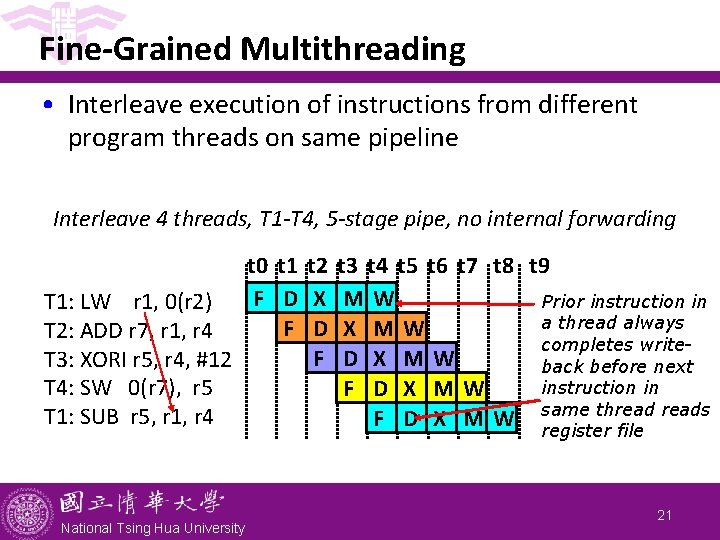
Use Multithreading to Help ILP • One idea: allow instructions from different threads to be mixed and executed together in the pipeline - Original: pipeline with internal forwarding T 1: LW r 1, 0(r 2) <bubble> T 1: SUB r 5, r 1, r 4 T 1: AND r 4, r 1, r 3 T 1: SW 0(r 7), r 5 - Multithreaded pipeline: No need for internal forwarding T 1: LW r 1, 0(r 2) T 2: ADD r 7, r 1, r 4 T 3: XORI r 5, r 4, #12 T 4: SW 0(r 7), r 5 T 1: SUB r 5, r 1, r 4 National Tsing Hua University t 0 t 1 t 2 F D X F D F t 3 M X D F t 4 t 5 t 6 t 7 t 8 t 9 W MW X MW D X MW F D X MW 17
Outline • Multiple issue and static scheduling (Sec. 3. 7) • Dynamic scheduling, multiple issue, and speculation (Sec. 3. 8) • Multithreading: exploiting thread-level parallelism to improve uniprocessor throughput (Sec. 3. 12) • Advanced techniques for instruction delivery and speculation (Sec. 3. 9) National Tsing Hua University 18
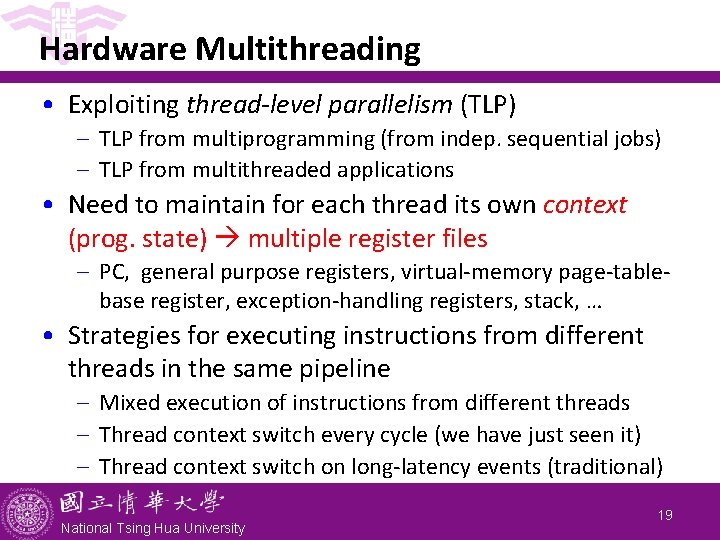
Hardware Multithreading • Exploiting thread-level parallelism (TLP) - TLP from multiprogramming (from indep. sequential jobs) - TLP from multithreaded applications • Need to maintain for each thread its own context (prog. state) multiple register files - PC, general purpose registers, virtual-memory page-tablebase register, exception-handling registers, stack, … • Strategies for executing instructions from different threads in the same pipeline - Mixed execution of instructions from different threads - Thread context switch every cycle (we have just seen it) - Thread context switch on long-latency events (traditional) National Tsing Hua University 19
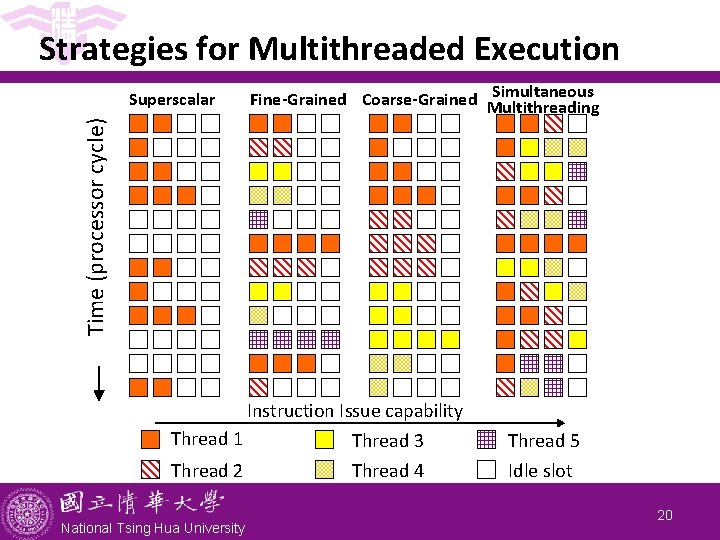
Strategies for Multithreaded Execution Time (processor cycle) Superscalar Simultaneous Fine-Grained Coarse-Grained Multithreading Instruction Issue capability Thread 1 Thread 3 Thread 2 Thread 4 National Tsing Hua University Thread 5 Idle slot 20
Fine-Grained Multithreading • Interleave execution of instructions from different program threads on same pipeline Interleave 4 threads, T 1 -T 4, 5 -stage pipe, no internal forwarding t 0 t 1 t 2 F D X T 1: LW r 1, 0(r 2) F D T 2: ADD r 7, r 1, r 4 F T 3: XORI r 5, r 4, #12 T 4: SW 0(r 7), r 5 T 1: SUB r 5, r 1, r 4 National Tsing Hua University t 3 t 4 t 5 t 6 t 7 t 8 t 9 MW Prior instruction in a thread always X MW completes write. D X MW back before next instruction in F D X MW threads F D X M W same register file 21
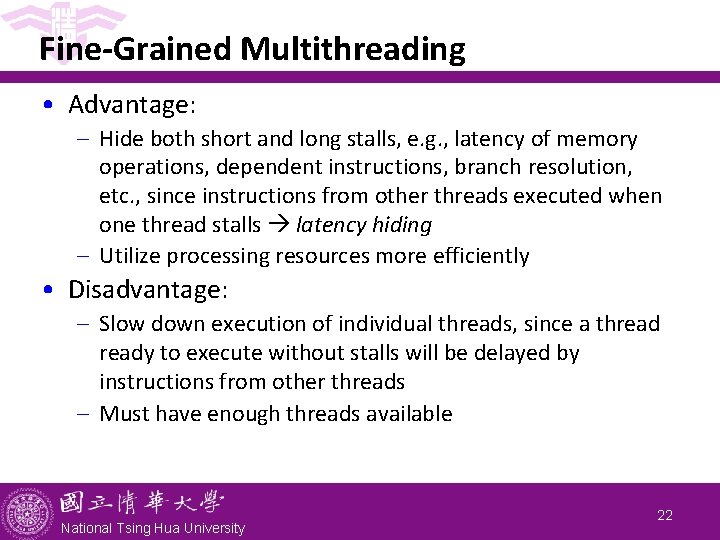
Fine-Grained Multithreading • Advantage: - Hide both short and long stalls, e. g. , latency of memory operations, dependent instructions, branch resolution, etc. , since instructions from other threads executed when one thread stalls latency hiding - Utilize processing resources more efficiently • Disadvantage: - Slow down execution of individual threads, since a thready to execute without stalls will be delayed by instructions from other threads - Must have enough threads available National Tsing Hua University 22
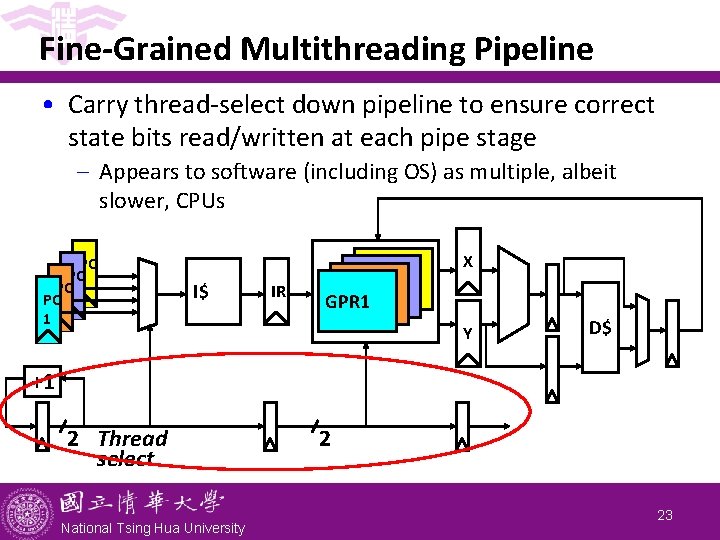
Fine-Grained Multithreading Pipeline • Carry thread-select down pipeline to ensure correct state bits read/written at each pipe stage - Appears to software (including OS) as multiple, albeit slower, CPUs PC PC 1 1 1 I$ IR GPR 1 X Y D$ +1 2 Thread select National Tsing Hua University 2 23
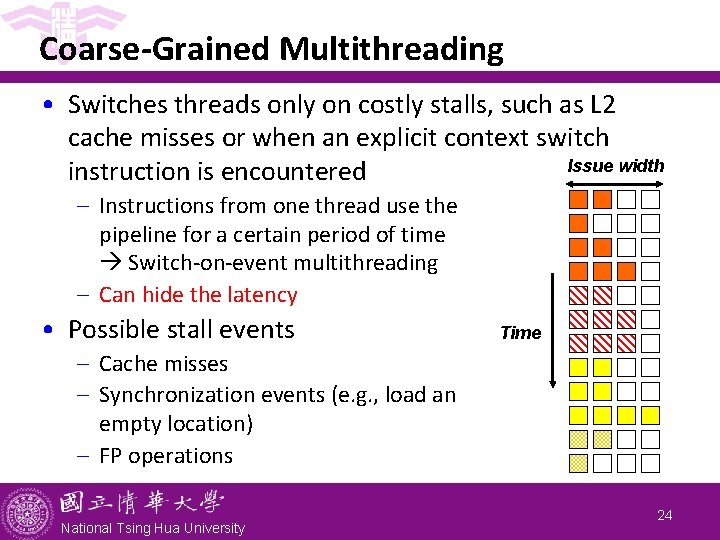
Coarse-Grained Multithreading • Switches threads only on costly stalls, such as L 2 cache misses or when an explicit context switch Issue width instruction is encountered - Instructions from one thread use the pipeline for a certain period of time Switch-on-event multithreading - Can hide the latency • Possible stall events Time - Cache misses - Synchronization events (e. g. , load an empty location) - FP operations National Tsing Hua University 24
Coarse-Grained Multithreading • Advantages: - Relieve the need to have very fast thread-switching - Do not slow down thread, since context-switch only when the thread encounters a costly stall - Priority may be given to critical thread • Disadvantages: - Instructions must be drained and refilled on a context switch bad for long pipeline, good only for costly stalls - Fairness: a low cache miss thread gets to use pipeline longer and other threads may starve • Possible solution: low miss thread may be preempted after a time slice expires, forcing a thread switch National Tsing Hua University 25
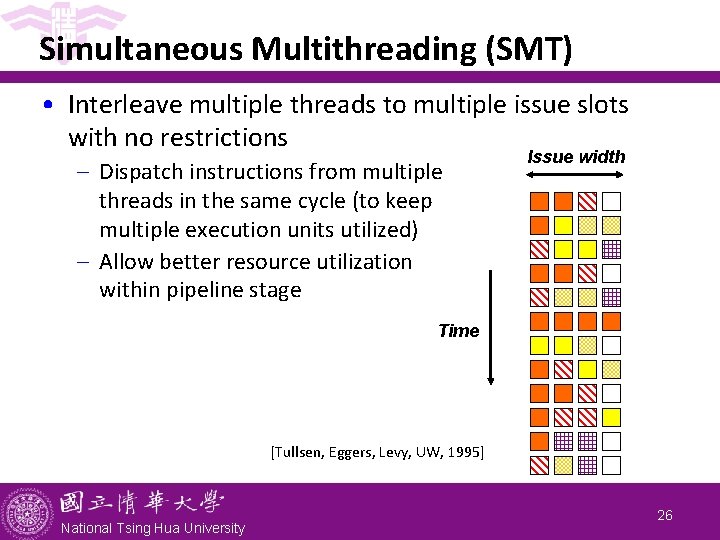
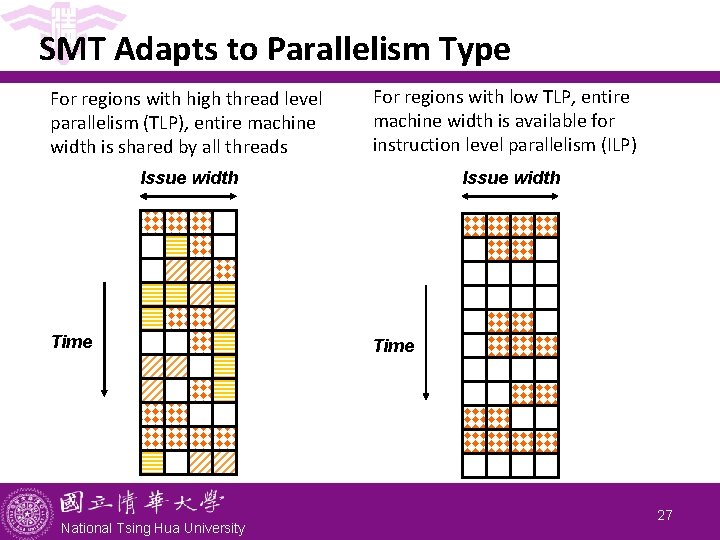
Simultaneous Multithreading (SMT) • Interleave multiple threads to multiple issue slots with no restrictions - Dispatch instructions from multiple threads in the same cycle (to keep multiple execution units utilized) - Allow better resource utilization within pipeline stage Issue width Time [Tullsen, Eggers, Levy, UW, 1995] National Tsing Hua University 26
SMT Adapts to Parallelism Type For regions with high thread level parallelism (TLP), entire machine width is shared by all threads For regions with low TLP, entire machine width is available for instruction level parallelism (ILP) Issue width Time National Tsing Hua University Issue width Time 27
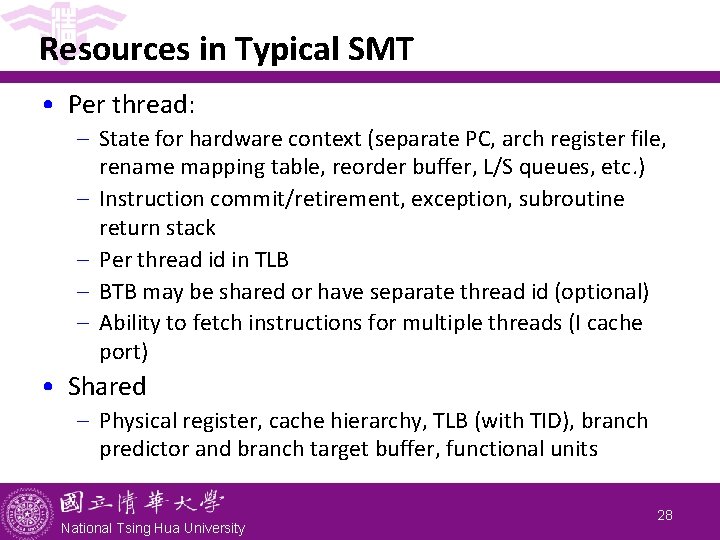
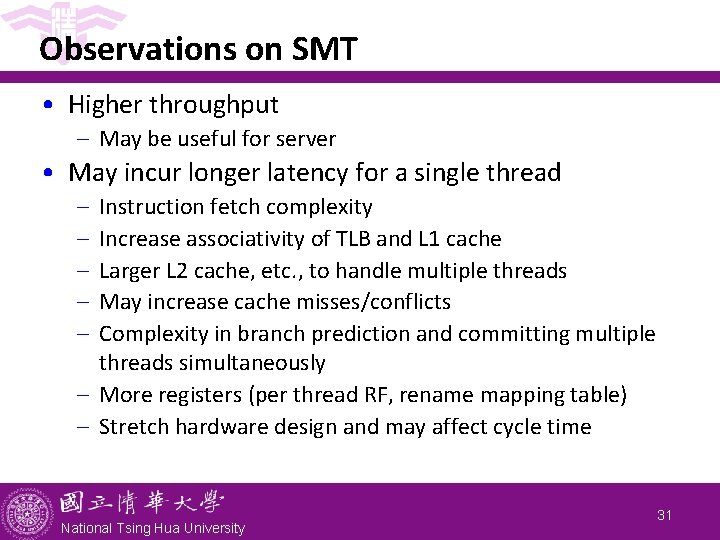
Resources in Typical SMT • Per thread: - State for hardware context (separate PC, arch register file, rename mapping table, reorder buffer, L/S queues, etc. ) - Instruction commit/retirement, exception, subroutine return stack - Per thread id in TLB - BTB may be shared or have separate thread id (optional) - Ability to fetch instructions for multiple threads (I cache port) • Shared - Physical register, cache hierarchy, TLB (with TID), branch predictor and branch target buffer, functional units National Tsing Hua University 28
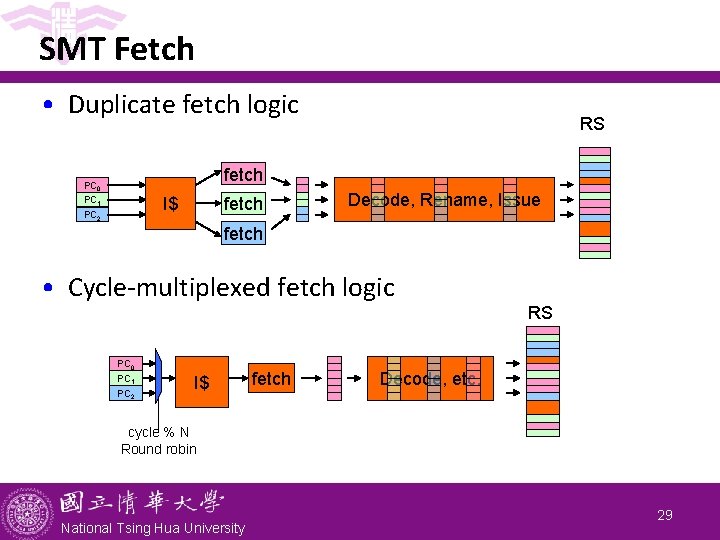
SMT Fetch • Duplicate fetch logic RS fetch PC 0 PC 1 PC 2 fetch I$ Decode, Rename, Issue fetch • Cycle-multiplexed fetch logic PC 0 PC 1 PC 2 I$ fetch RS Decode, etc. cycle % N Round robin National Tsing Hua University 29
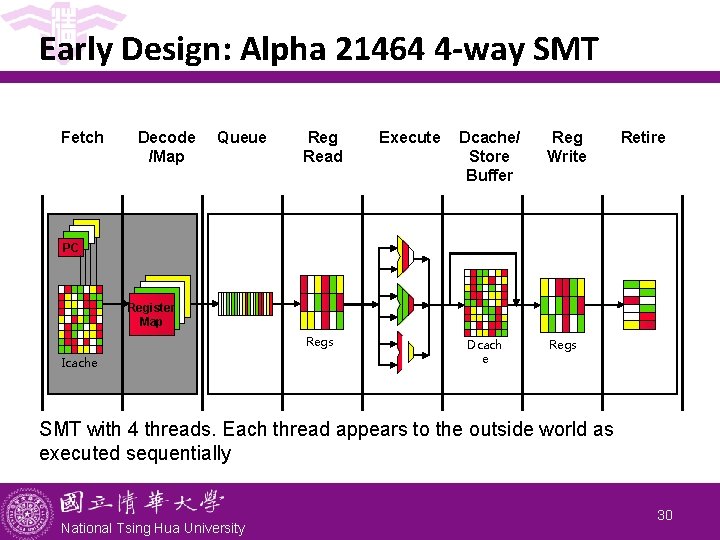
Early Design: Alpha 21464 4 -way SMT Fetch Decode /Map Queue Reg Read Execute Dcache/ Store Buffer Reg Write Retire PC Register Map Regs Icache Dcach e Regs SMT with 4 threads. Each thread appears to the outside world as executed sequentially National Tsing Hua University 30
Observations on SMT • Higher throughput - May be useful for server • May incur longer latency for a single thread - Instruction fetch complexity Increase associativity of TLB and L 1 cache Larger L 2 cache, etc. , to handle multiple threads May increase cache misses/conflicts Complexity in branch prediction and committing multiple threads simultaneously - More registers (per thread RF, rename mapping table) - Stretch hardware design and may affect cycle time National Tsing Hua University 31
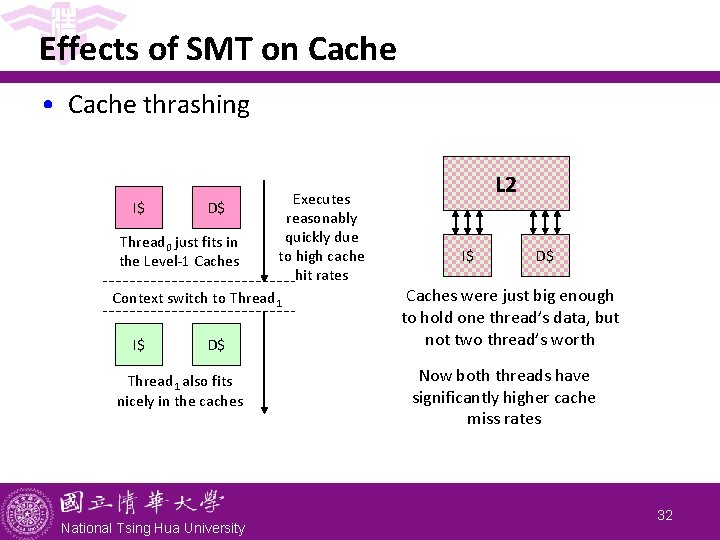
Effects of SMT on Cache • Cache thrashing I$ D$ Thread 0 just fits in the Level-1 Caches Executes reasonably quickly due to high cache hit rates Context switch to Thread 1 I$ D$ Thread 1 also fits nicely in the caches National Tsing Hua University L 2 I$ D$ Caches were just big enough to hold one thread’s data, but not two thread’s worth Now both threads have significantly higher cache miss rates 32
Outline • Multiple issue and static scheduling (Sec. 3. 7) • Dynamic scheduling, multiple issue, and speculation (Sec. 3. 8) • Multithreading: exploiting thread-level parallelism to improve uniprocessor throughput (Sec. 3. 12) • Advanced techniques for instruction delivery and speculation (Sec. 3. 9) National Tsing Hua University 33
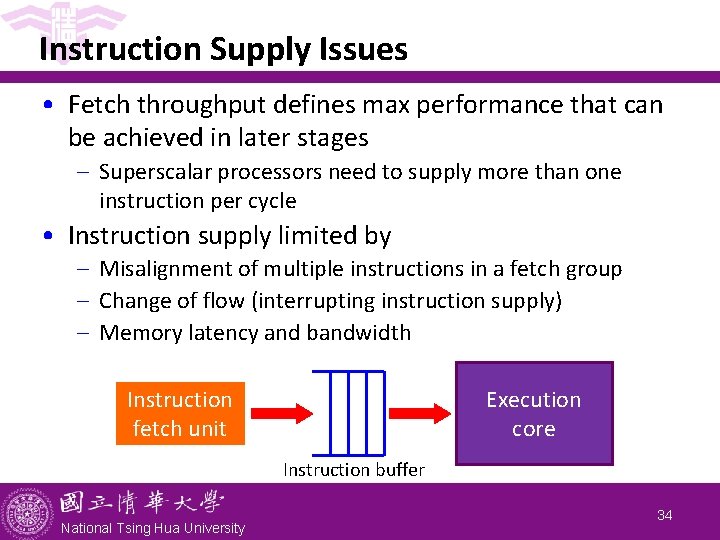
Instruction Supply Issues • Fetch throughput defines max performance that can be achieved in later stages - Superscalar processors need to supply more than one instruction per cycle • Instruction supply limited by - Misalignment of multiple instructions in a fetch group - Change of flow (interrupting instruction supply) - Memory latency and bandwidth Instruction fetch unit Execution core Instruction buffer National Tsing Hua University 34
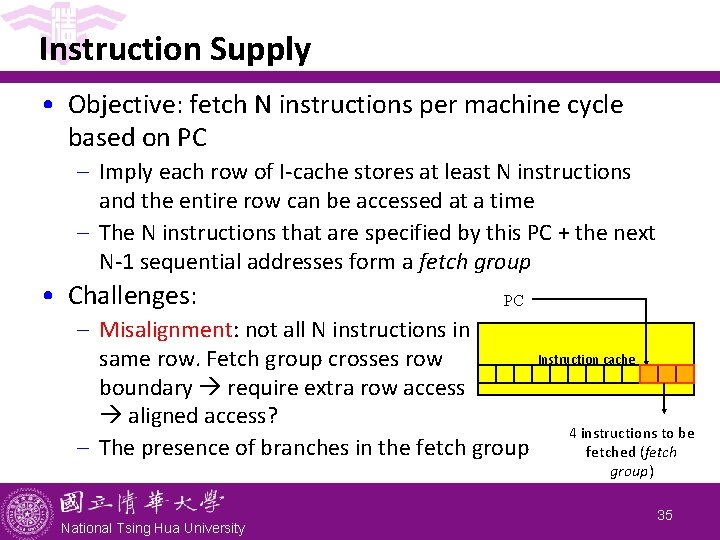
Instruction Supply • Objective: fetch N instructions per machine cycle based on PC - Imply each row of I-cache stores at least N instructions and the entire row can be accessed at a time - The N instructions that are specified by this PC + the next N-1 sequential addresses form a fetch group • Challenges: PC - Misalignment: not all N instructions in same row. Fetch group crosses row boundary require extra row access aligned access? - The presence of branches in the fetch group National Tsing Hua University Instruction cache 4 instructions to be fetched (fetch group) 35
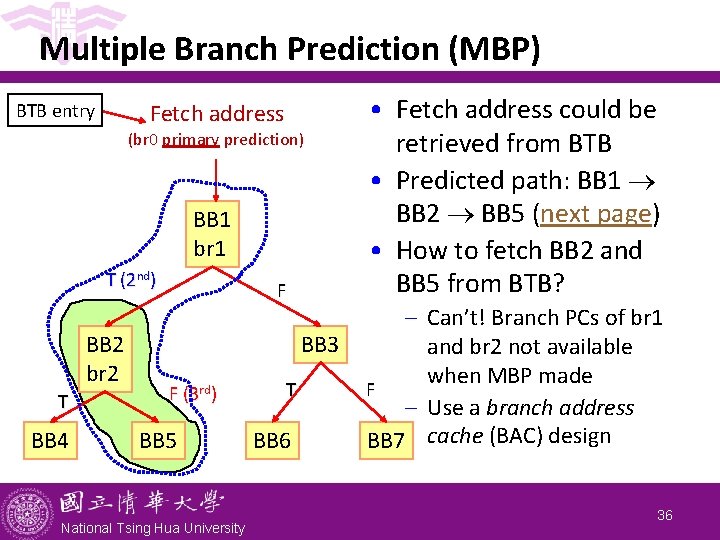
Multiple Branch Prediction (MBP) BTB entry Fetch address (br 0 primary prediction) BB 1 br 1 T (2 nd) BB 2 br 2 T BB 4 F BB 3 F (3 rd) BB 5 National Tsing Hua University T BB 6 • Fetch address could be retrieved from BTB • Predicted path: BB 1 BB 2 BB 5 (next page) • How to fetch BB 2 and BB 5 from BTB? - Can’t! Branch PCs of br 1 and br 2 not available when MBP made F - Use a branch address BB 7 cache (BAC) design 36
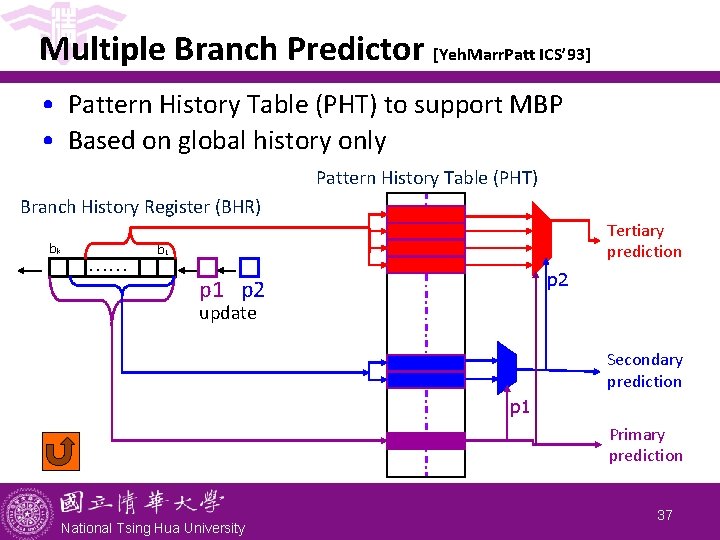
Multiple Branch Predictor [Yeh. Marr. Patt ICS’ 93] • Pattern History Table (PHT) to support MBP • Based on global history only Pattern History Table (PHT) Branch History Register (BHR) bk …… Tertiary prediction b 1 p 2 p 1 p 2 update Secondary prediction p 1 Primary prediction National Tsing Hua University 37
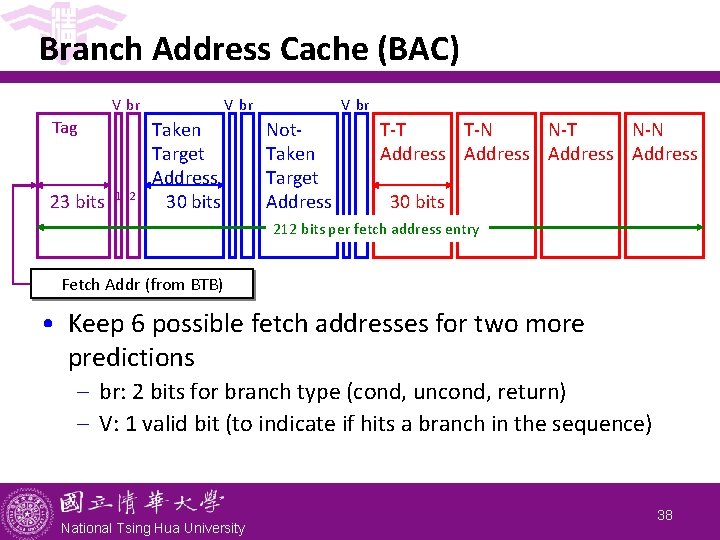
Branch Address Cache (BAC) V br Tag 23 bits 1 2 V br Taken Target Address 30 bits Not. Taken Target Address T-T T-N N-T N-N Address 30 bits 212 bits per fetch address entry Fetch Addr (from BTB) • Keep 6 possible fetch addresses for two more predictions - br: 2 bits for branch type (cond, uncond, return) - V: 1 valid bit (to indicate if hits a branch in the sequence) National Tsing Hua University 38
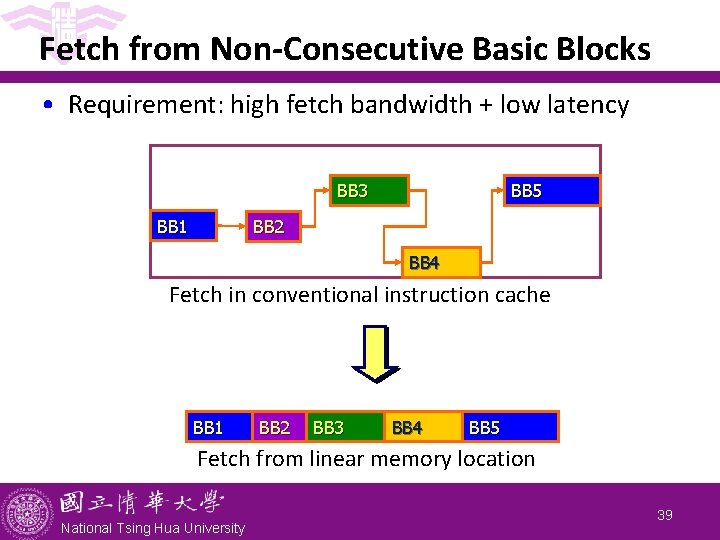
Fetch from Non-Consecutive Basic Blocks • Requirement: high fetch bandwidth + low latency BB 3 BB 5 BB 2 BB 1 BB 4 Fetch in conventional instruction cache BB 1 BB 2 BB 3 BB 4 BB 5 Fetch from linear memory location National Tsing Hua University 39
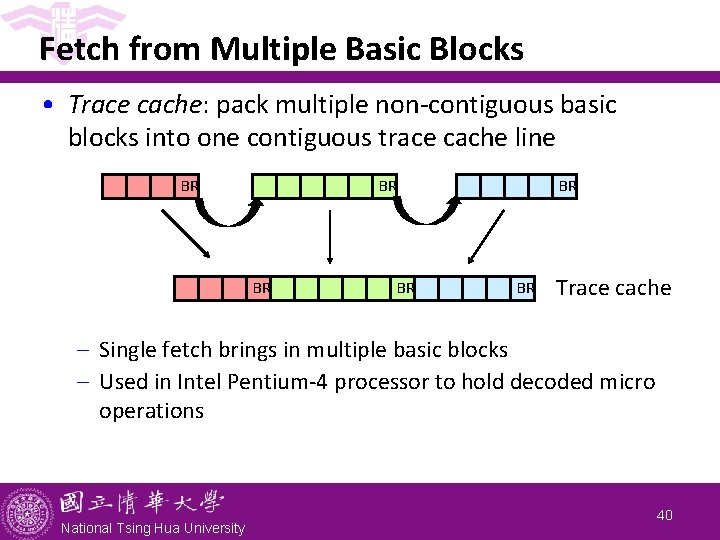
Fetch from Multiple Basic Blocks • Trace cache: pack multiple non-contiguous basic blocks into one contiguous trace cache line BR BR BR Trace cache - Single fetch brings in multiple basic blocks - Used in Intel Pentium-4 processor to hold decoded micro operations National Tsing Hua University 40
Integrated Instruction Fetch Unit • Multiple issue processors demand issuing multiple instructions per cycle - Fetch unit must fetch multiple instructions, while branches arrive faster in N-issued processor • Desirable to have a separate, autonomous fetch unit that feeds instructions to rest of pipe, which includes - Integrated branch prediction to constantly predicting branches to drive fetch pipeline - Instruction prefetch: prefetch from taken branch location - Instruction memory access and buffering: multiple outstanding cache misses, prefetching to deal with crossing cache lines National Tsing Hua University 41
Recap • Multiple issue processor: - Superscalar vs VLIW - Static vs dynamic • TLP explicitly uses multiple threads of execution that are inherently parallel - Fine-grained - Coarse-grained - Simultaneous multithreading • Handling branches for instruction fetch - Instruction alignment - Handling multiple branches: trace cache National Tsing Hua University 42