
CS 510 Operating System Foundations Jonathan Walpole Monitor
- Slides: 36
CS 510 Operating System Foundations Jonathan Walpole
Monitor Semantics, Message Passing, & Concurrency Review 2
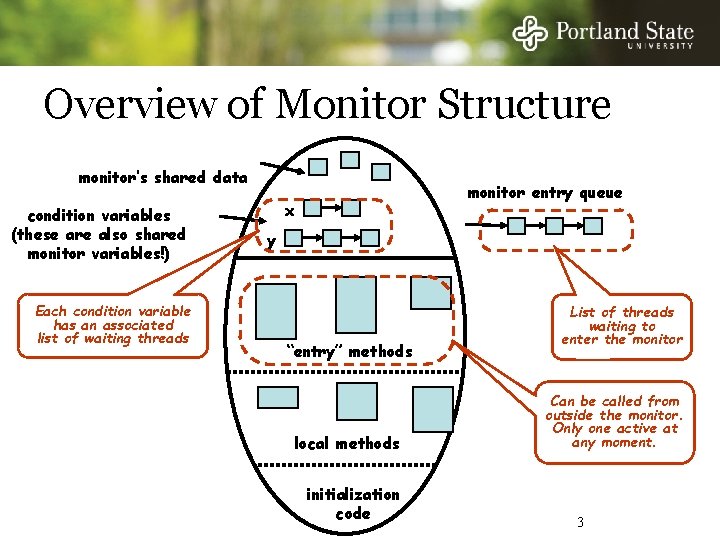
Overview of Monitor Structure monitor’s shared data condition variables (these are also shared monitor variables!) Each condition variable has an associated list of waiting threads monitor entry queue x y “entry” methods local methods initialization code List of threads waiting to enter the monitor Can be called from outside the monitor. Only one active at any moment. 3
Compiler Support for Monitors If monitors are part of the programming language, the compiler can generate the monitor lock and unlock code automatically - programmer may simply define the type of a data item to be monitor (or synchronized) - the monitor mutex to be released in wait is identified implicitly by the condition variable’s monitor If monitors are unknown to the compiler (as in Blitz), the programmer writes the monitor mutex code - wait takes the monitor mutex as a parameter 4
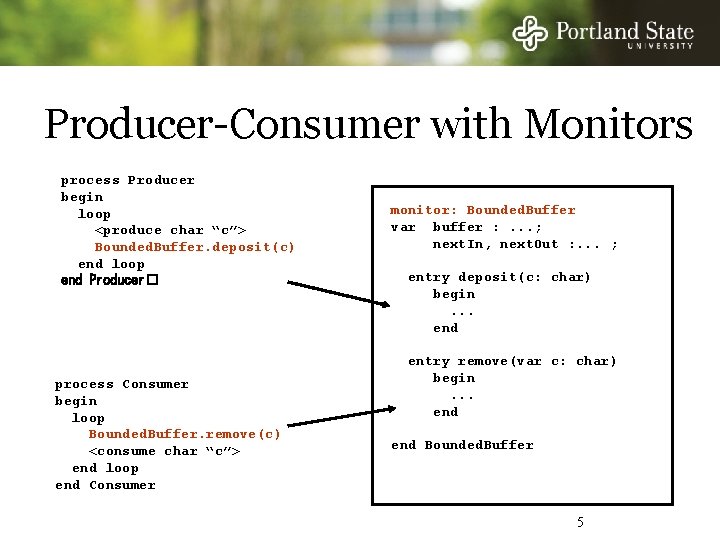
Producer-Consumer with Monitors process Producer begin loop <produce char “c”> Bounded. Buffer. deposit(c) end loop end Producer� process Consumer begin loop Bounded. Buffer. remove(c) <consume char “c”> end loop end Consumer monitor: Bounded. Buffer var buffer : . . . ; next. In, next. Out : . . . ; entry deposit(c: char) begin. . . end entry remove(var c: char) begin. . . end Bounded. Buffer 5
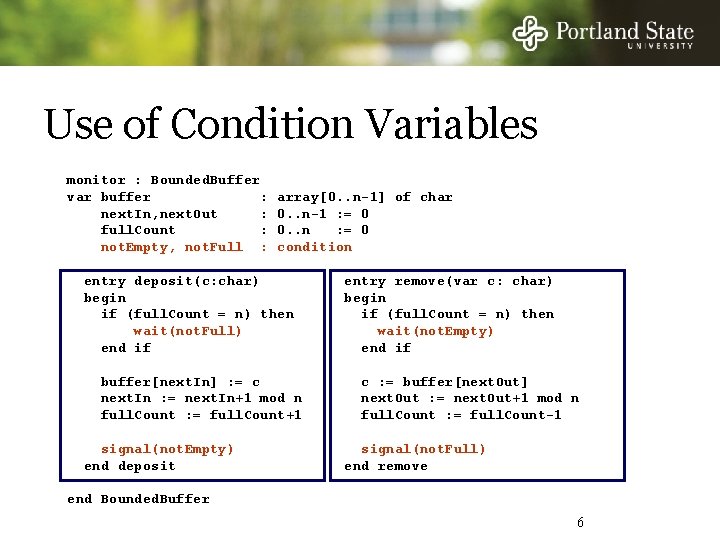
Use of Condition Variables monitor : Bounded. Buffer var buffer : next. In, next. Out : full. Count : not. Empty, not. Full : array[0. . n-1] of char 0. . n-1 : = 0 0. . n : = 0 condition entry deposit(c: char) begin if (full. Count = n) then wait(not. Full) end if buffer[next. In] : = c next. In : = next. In+1 mod n full. Count : = full. Count+1 signal(not. Empty) end deposit entry remove(var c: char) begin if (full. Count = n) then wait(not. Empty) end if c : = buffer[next. Out] next. Out : = next. Out+1 mod n full. Count : = full. Count-1 signal(not. Full) end remove end Bounded. Buffer 6
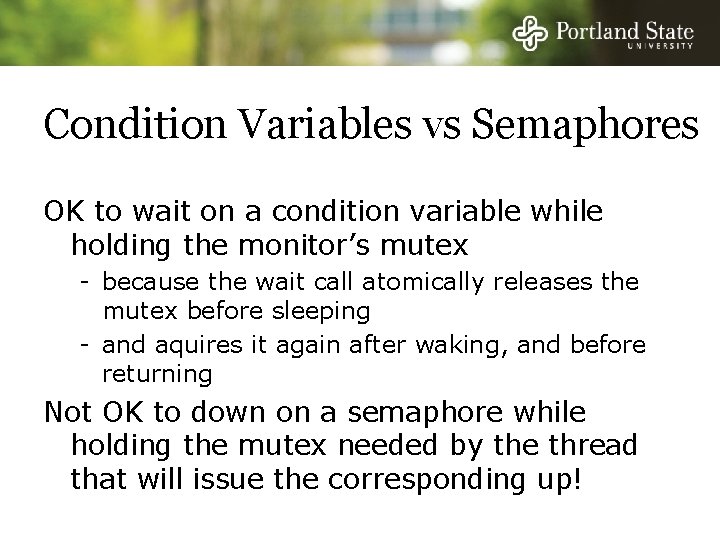
Condition Variables vs Semaphores OK to wait on a condition variable while holding the monitor’s mutex - because the wait call atomically releases the mutex before sleeping - and aquires it again after waking, and before returning Not OK to down on a semaphore while holding the mutex needed by the thread that will issue the corresponding up!
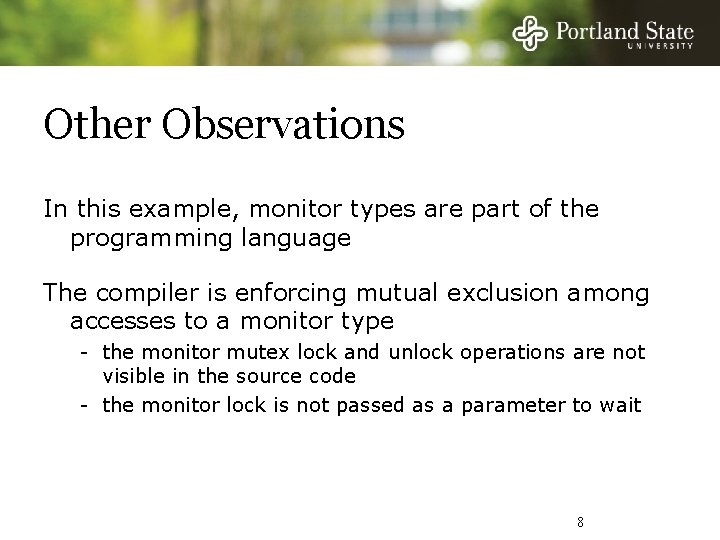
Other Observations In this example, monitor types are part of the programming language The compiler is enforcing mutual exclusion among accesses to a monitor type - the monitor mutex lock and unlock operations are not visible in the source code - the monitor lock is not passed as a parameter to wait 8
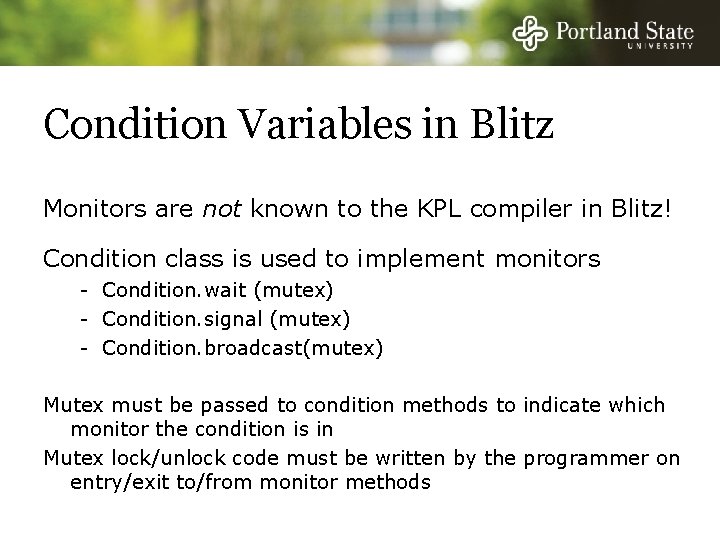
Condition Variables in Blitz Monitors are not known to the KPL compiler in Blitz! Condition class is used to implement monitors - Condition. wait (mutex) - Condition. signal (mutex) - Condition. broadcast(mutex) Mutex must be passed to condition methods to indicate which monitor the condition is in Mutex lock/unlock code must be written by the programmer on entry/exit to/from monitor methods
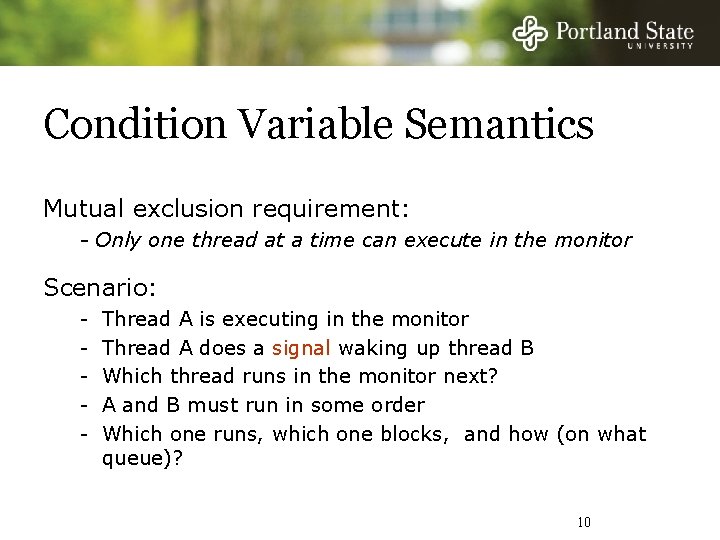
Condition Variable Semantics Mutual exclusion requirement: - Only one thread at a time can execute in the monitor Scenario: - Thread A is executing in the monitor Thread A does a signal waking up thread B Which thread runs in the monitor next? A and B must run in some order Which one runs, which one blocks, and how (on what queue)? 10
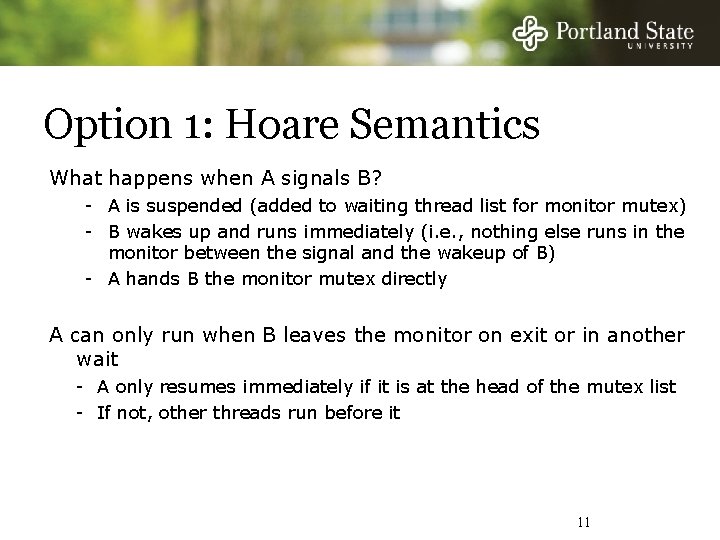
Option 1: Hoare Semantics What happens when A signals B? - A is suspended (added to waiting thread list for monitor mutex) - B wakes up and runs immediately (i. e. , nothing else runs in the monitor between the signal and the wakeup of B) - A hands B the monitor mutex directly A can only run when B leaves the monitor on exit or in another wait - A only resumes immediately if it is at the head of the mutex list - If not, other threads run before it 11
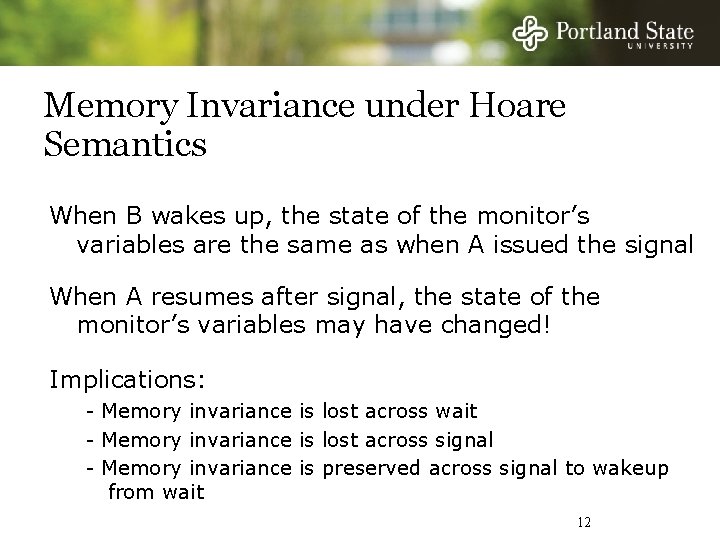
Memory Invariance under Hoare Semantics When B wakes up, the state of the monitor’s variables are the same as when A issued the signal When A resumes after signal, the state of the monitor’s variables may have changed! Implications: - Memory invariance is lost across wait - Memory invariance is lost across signal - Memory invariance is preserved across signal to wakeup from wait 12
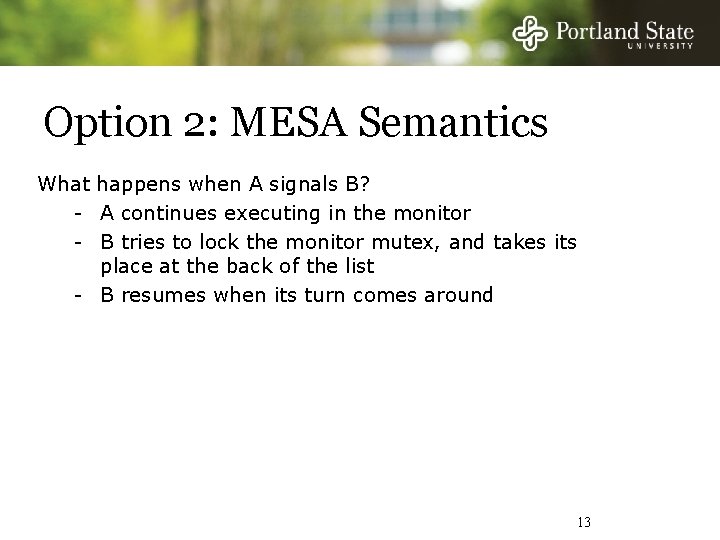
Option 2: MESA Semantics What happens when A signals B? - A continues executing in the monitor - B tries to lock the monitor mutex, and takes its place at the back of the list - B resumes when its turn comes around 13
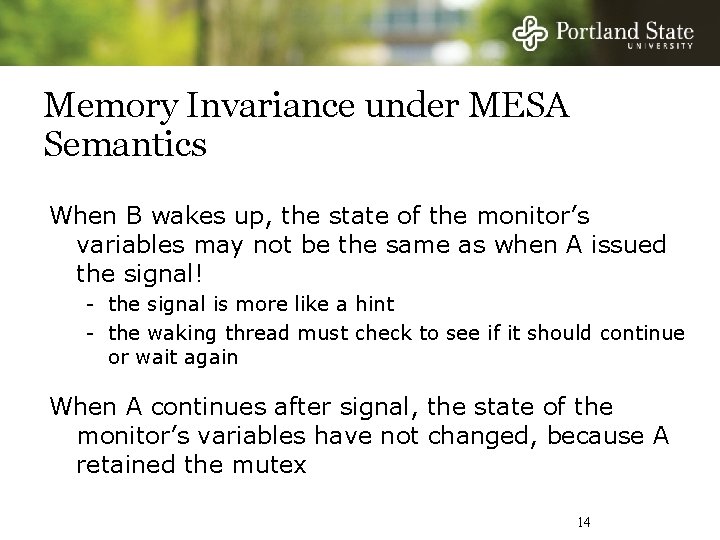
Memory Invariance under MESA Semantics When B wakes up, the state of the monitor’s variables may not be the same as when A issued the signal! - the signal is more like a hint - the waking thread must check to see if it should continue or wait again When A continues after signal, the state of the monitor’s variables have not changed, because A retained the mutex 14
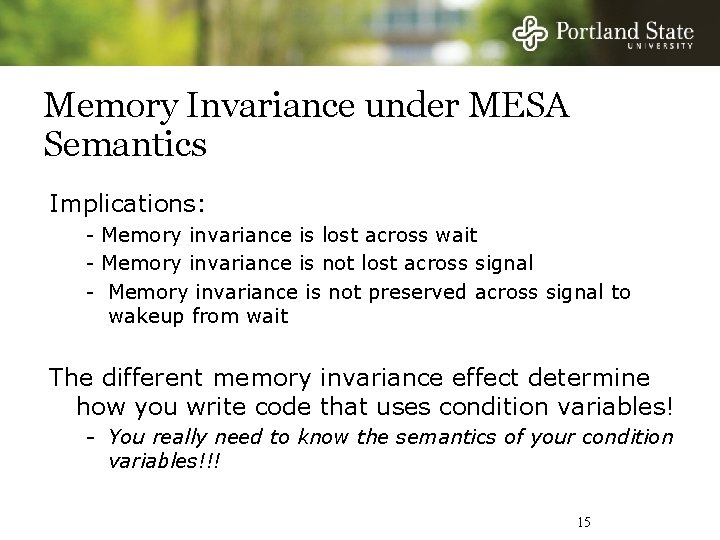
Memory Invariance under MESA Semantics Implications: - Memory invariance is lost across wait - Memory invariance is not lost across signal - Memory invariance is not preserved across signal to wakeup from wait The different memory invariance effect determine how you write code that uses condition variables! - You really need to know the semantics of your condition variables!!! 15
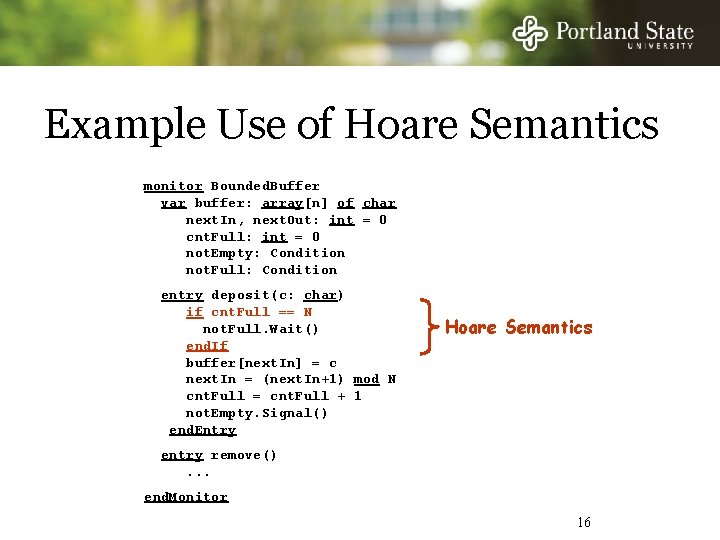
Example Use of Hoare Semantics monitor Bounded. Buffer var buffer: array[n] of char next. In, next. Out: int = 0 cnt. Full: int = 0 not. Empty: Condition not. Full: Condition entry deposit(c: char) if cnt. Full == N not. Full. Wait() end. If buffer[next. In] = c next. In = (next. In+1) mod N cnt. Full = cnt. Full + 1 not. Empty. Signal() end. Entry Hoare Semantics entry remove(). . . end. Monitor 16
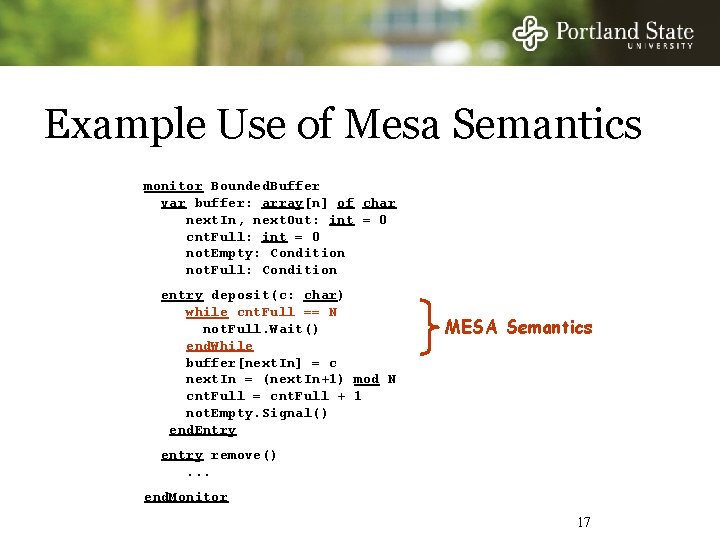
Example Use of Mesa Semantics monitor Bounded. Buffer var buffer: array[n] of char next. In, next. Out: int = 0 cnt. Full: int = 0 not. Empty: Condition not. Full: Condition entry deposit(c: char) while cnt. Full == N not. Full. Wait() end. While buffer[next. In] = c next. In = (next. In+1) mod N cnt. Full = cnt. Full + 1 not. Empty. Signal() end. Entry MESA Semantics entry remove(). . . end. Monitor 17
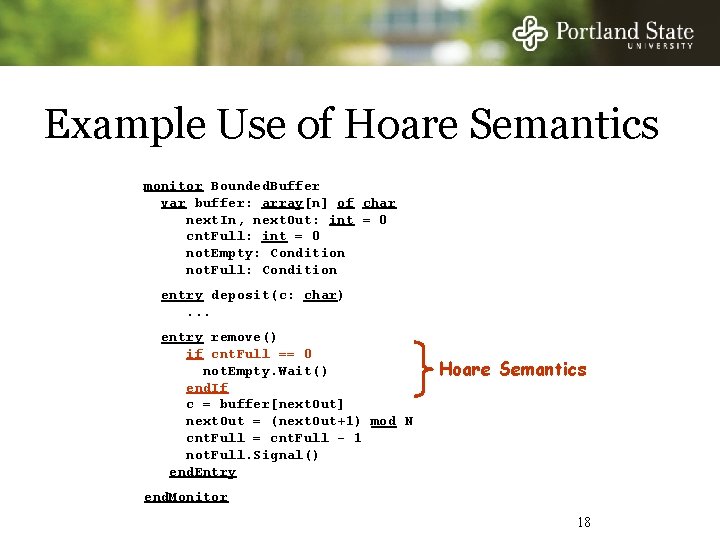
Example Use of Hoare Semantics monitor Bounded. Buffer var buffer: array[n] of char next. In, next. Out: int = 0 cnt. Full: int = 0 not. Empty: Condition not. Full: Condition entry deposit(c: char). . . entry remove() if cnt. Full == 0 not. Empty. Wait() end. If c = buffer[next. Out] next. Out = (next. Out+1) mod N cnt. Full = cnt. Full - 1 not. Full. Signal() end. Entry Hoare Semantics end. Monitor 18
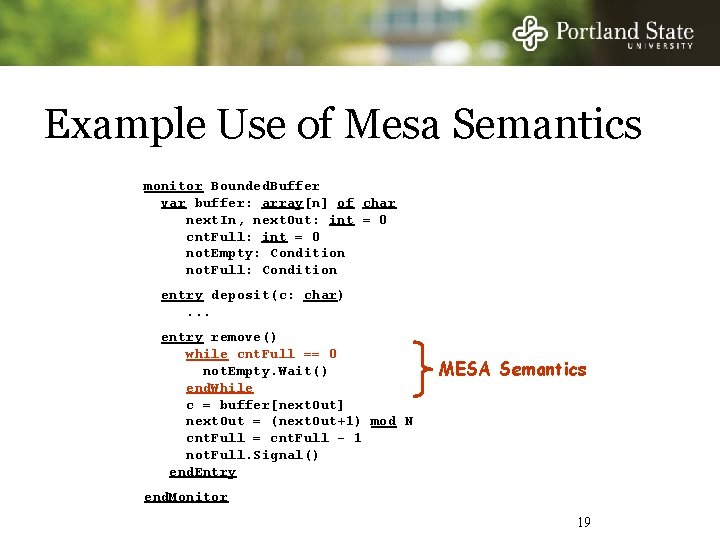
Example Use of Mesa Semantics monitor Bounded. Buffer var buffer: array[n] of char next. In, next. Out: int = 0 cnt. Full: int = 0 not. Empty: Condition not. Full: Condition entry deposit(c: char). . . entry remove() while cnt. Full == 0 not. Empty. Wait() end. While c = buffer[next. Out] next. Out = (next. Out+1) mod N cnt. Full = cnt. Full - 1 not. Full. Signal() end. Entry MESA Semantics end. Monitor 19
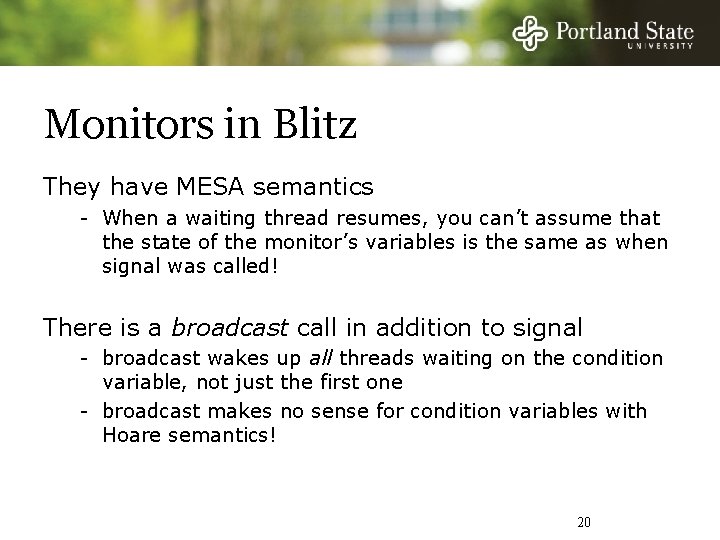
Monitors in Blitz They have MESA semantics - When a waiting thread resumes, you can’t assume that the state of the monitor’s variables is the same as when signal was called! There is a broadcast call in addition to signal - broadcast wakes up all threads waiting on the condition variable, not just the first one - broadcast makes no sense for condition variables with Hoare semantics! 20
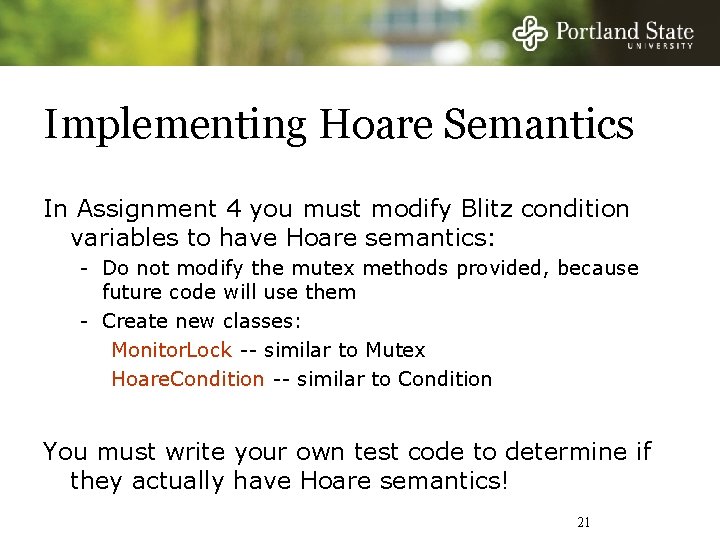
Implementing Hoare Semantics In Assignment 4 you must modify Blitz condition variables to have Hoare semantics: - Do not modify the mutex methods provided, because future code will use them - Create new classes: Monitor. Lock -- similar to Mutex Hoare. Condition -- similar to Condition You must write your own test code to determine if they actually have Hoare semantics! 21
Message Passing 22
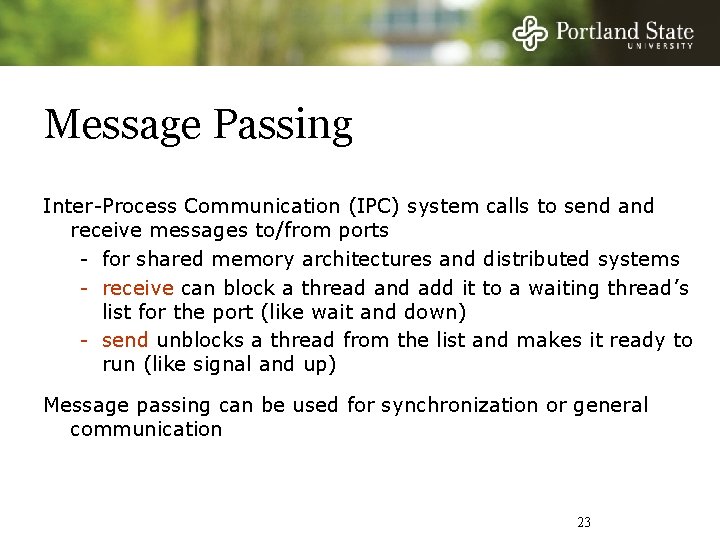
Message Passing Inter-Process Communication (IPC) system calls to send and receive messages to/from ports - for shared memory architectures and distributed systems - receive can block a thread and add it to a waiting thread’s list for the port (like wait and down) - send unblocks a thread from the list and makes it ready to run (like signal and up) Message passing can be used for synchronization or general communication 23
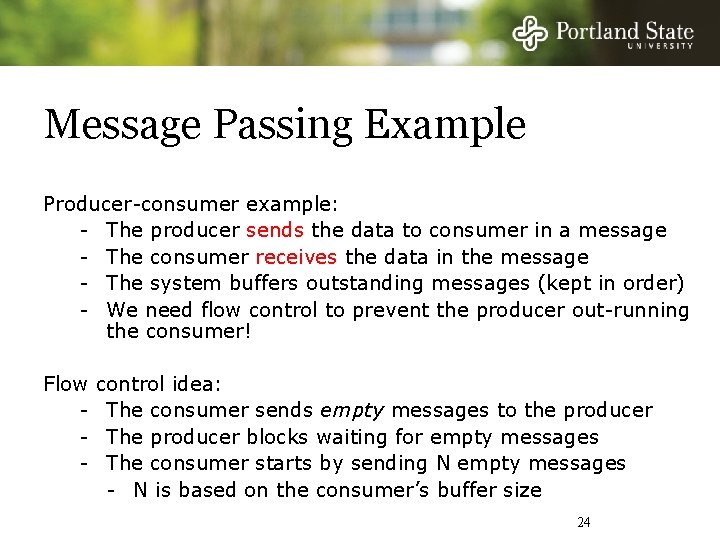
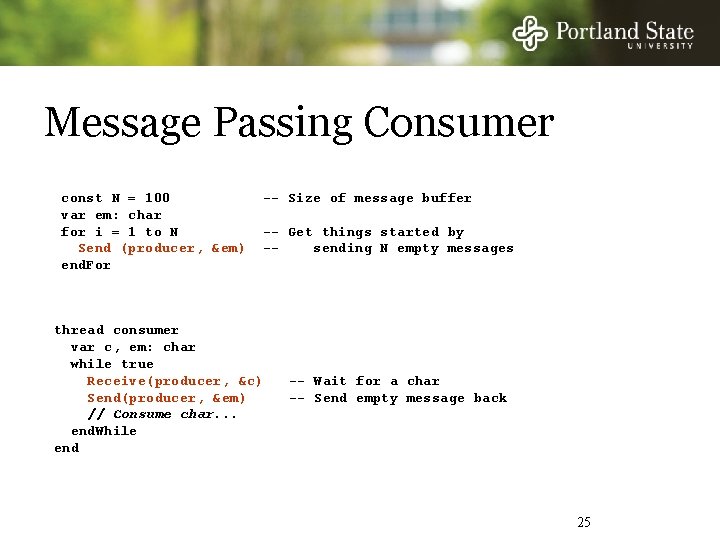
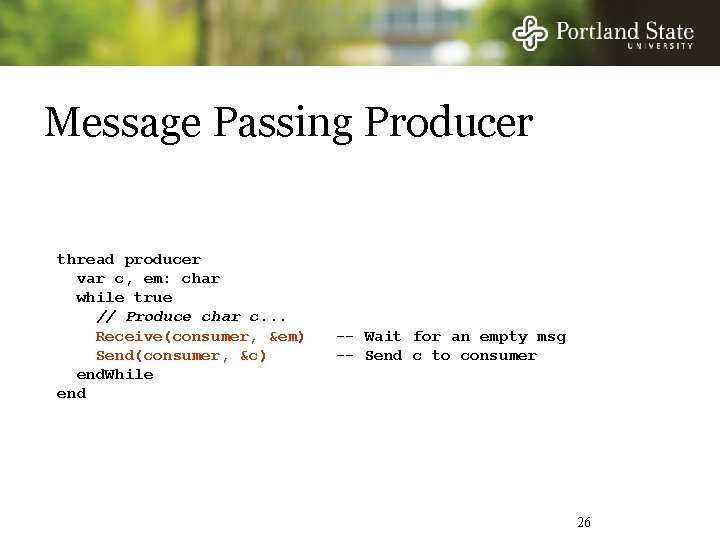
Message Passing Example Producer-consumer example: - The producer sends the data to consumer in a message - The consumer receives the data in the message - The system buffers outstanding messages (kept in order) - We need flow control to prevent the producer out-running the consumer! Flow - control idea: The consumer sends empty messages to the producer The producer blocks waiting for empty messages The consumer starts by sending N empty messages - N is based on the consumer’s buffer size 24
Message Passing Consumer const N = 100 var em: char for i = 1 to N Send (producer, &em) end. For -- Size of message buffer -- Get things started by -sending N empty messages thread consumer var c, em: char while true Receive(producer, &c) Send(producer, &em) // Consume char. . . end. While end -- Wait for a char -- Send empty message back 25
Message Passing Producer thread producer var c, em: char while true // Produce char c. . . Receive(consumer, &em) Send(consumer, &c) end. While end -- Wait for an empty msg -- Send c to consumer 26
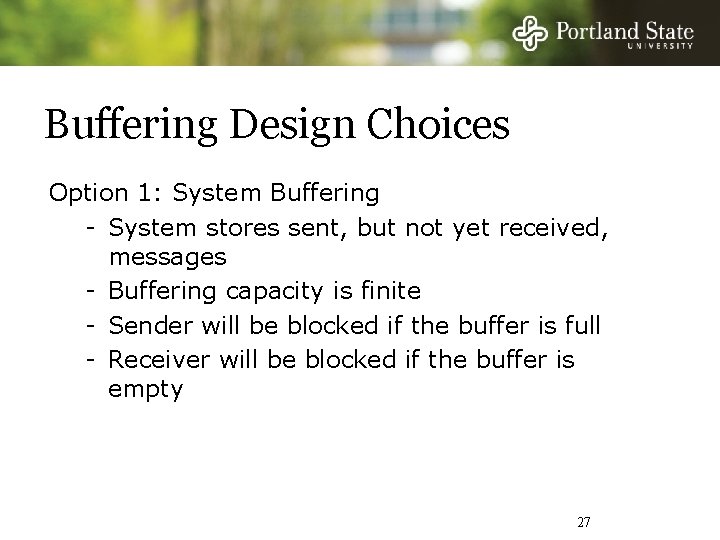
Buffering Design Choices Option 1: System Buffering - System stores sent, but not yet received, messages - Buffering capacity is finite - Sender will be blocked if the buffer is full - Receiver will be blocked if the buffer is empty 27
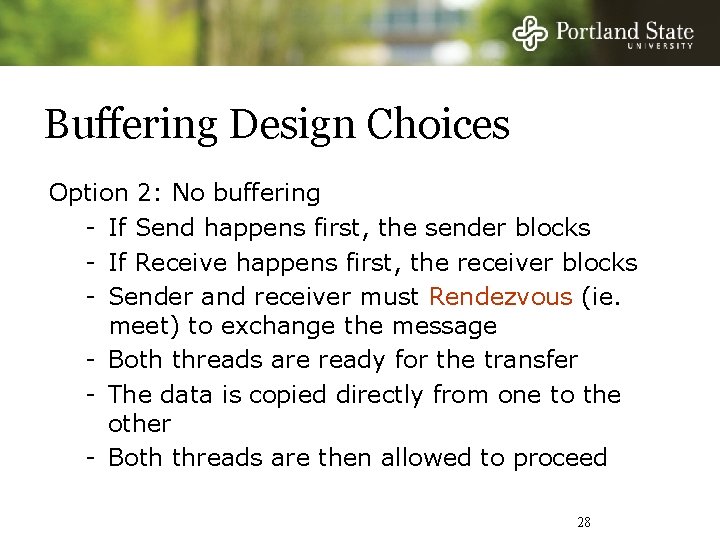
Buffering Design Choices Option 2: No buffering - If Send happens first, the sender blocks - If Receive happens first, the receiver blocks - Sender and receiver must Rendezvous (ie. meet) to exchange the message - Both threads are ready for the transfer - The data is copied directly from one to the other - Both threads are then allowed to proceed 28
Thread-Safe Routines 29
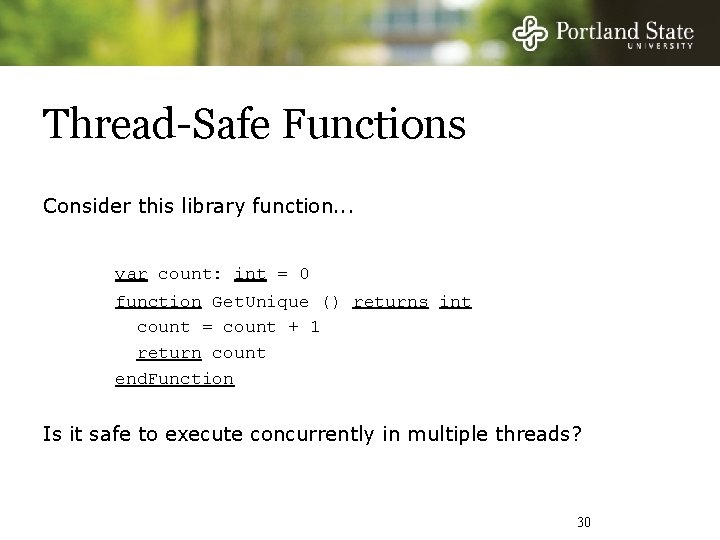
Thread-Safe Functions Consider this library function. . . var count: int = 0 function Get. Unique () returns int count = count + 1 return count end. Function Is it safe to execute concurrently in multiple threads? 30
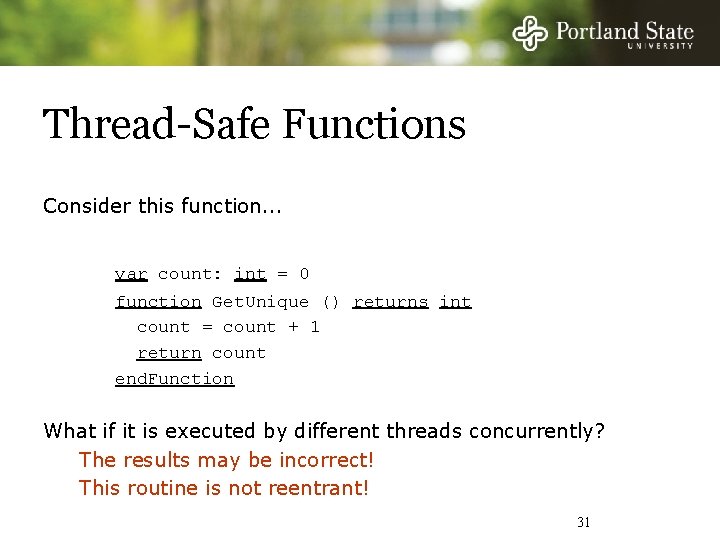
Thread-Safe Functions Consider this function. . . var count: int = 0 function Get. Unique () returns int count = count + 1 return count end. Function What if it is executed by different threads concurrently? The results may be incorrect! This routine is not reentrant! 31
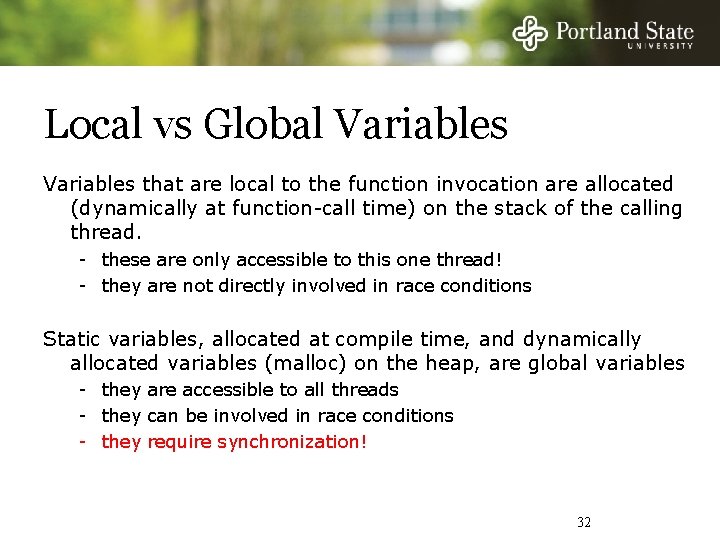
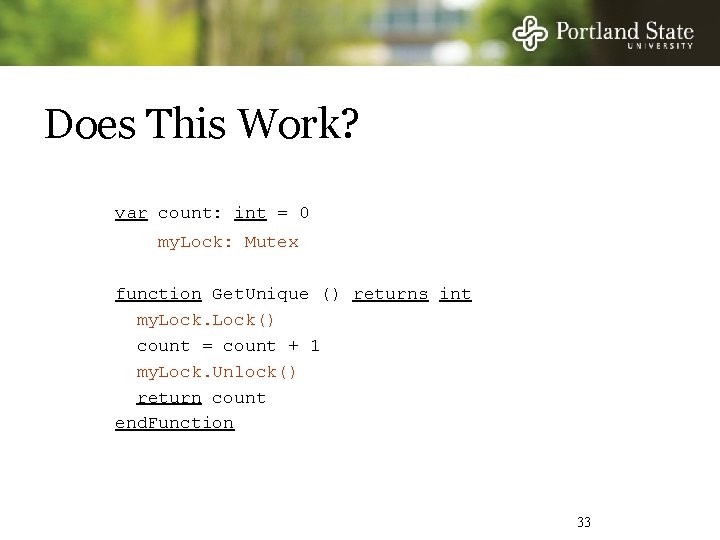
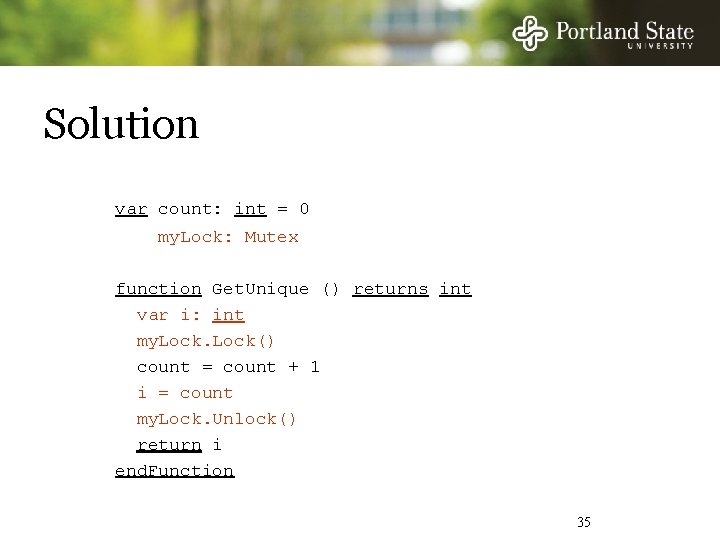
Local vs Global Variables that are local to the function invocation are allocated (dynamically at function-call time) on the stack of the calling thread. - these are only accessible to this one thread! - they are not directly involved in race conditions Static variables, allocated at compile time, and dynamically allocated variables (malloc) on the heap, are global variables - they are accessible to all threads - they can be involved in race conditions - they require synchronization! 32
Does This Work? var count: int = 0 my. Lock: Mutex function Get. Unique () returns int my. Lock() count = count + 1 my. Lock. Unlock() return count end. Function 33
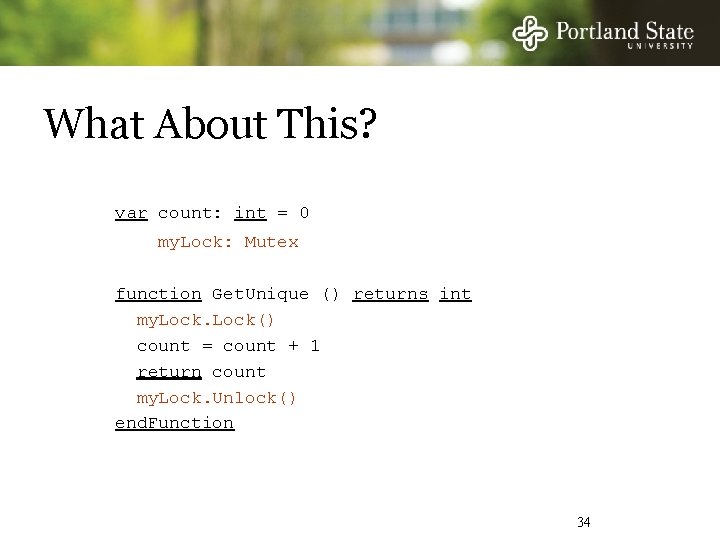
What About This? var count: int = 0 my. Lock: Mutex function Get. Unique () returns int my. Lock() count = count + 1 return count my. Lock. Unlock() end. Function 34
Solution var count: int = 0 my. Lock: Mutex function Get. Unique () returns int var i: int my. Lock() count = count + 1 i = count my. Lock. Unlock() return i end. Function 35
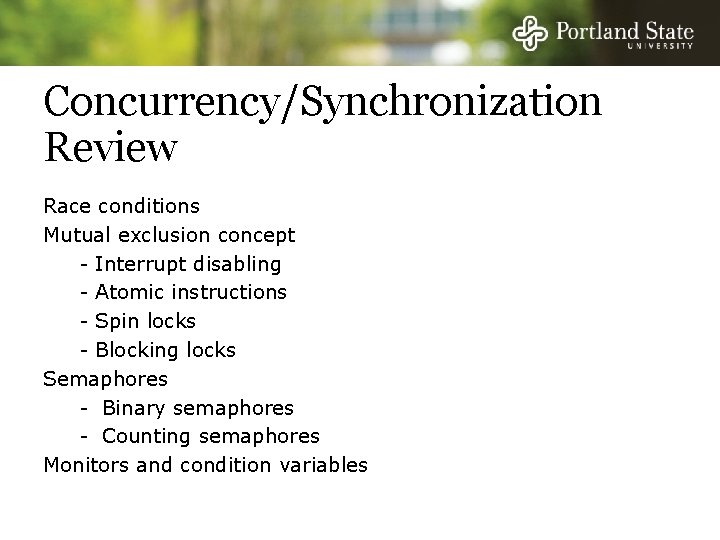
Concurrency/Synchronization Review Race conditions Mutual exclusion concept - Interrupt disabling - Atomic instructions - Spin locks - Blocking locks Semaphores - Binary semaphores - Counting semaphores Monitors and condition variables