
CS 510 Concurrent Systems Class 5 Threads Cannot


- Slides: 20
CS 510 Concurrent Systems Class 5 Threads Cannot Be Implemented As a Library
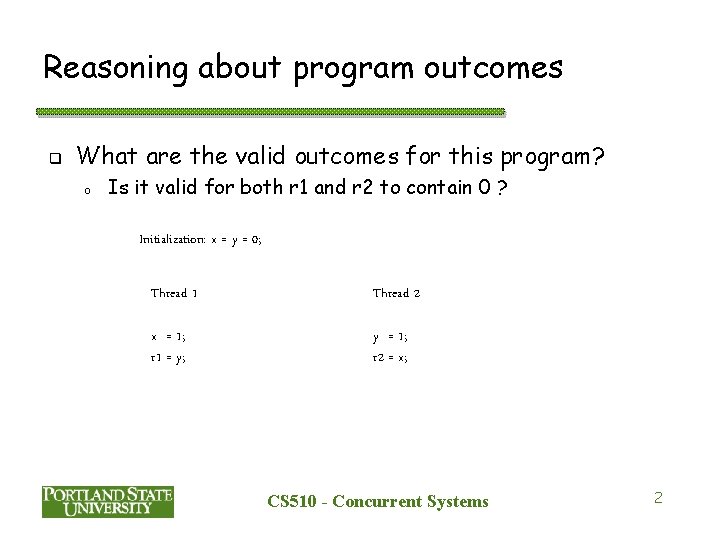
Reasoning about program outcomes q What are the valid outcomes for this program? o Is it valid for both r 1 and r 2 to contain 0 ? Initialization: x = y = 0; Thread 1 Thread 2 x = 1; r 1 = y; y = 1; r 2 = x; CS 510 - Concurrent Systems 2
Sequential consistency q q If your intuition is based on sequential consistency, you may think that r 1 = r 2 = 0 is invalid But sequential consistency does not hold on most (any? ) modern architectures o o Compilers may reorder memory operations under the (invalid) assumption that the program is sequential! Hardware may reorder memory operations, as we saw in the last class • You are expected to use memory barriers if this hardware reordering would be problematic for your program! CS 510 - Concurrent Systems 3
The problem q Languages such as C and C++ do not support concurrency o o q C/C++ compilers do not implement it Threads are implemented in library routines (i. e. Pthreads) The compiler, unaware of threads, reorders operations as if it was dealing with a sequential program Some of this reordering is invalid for concurrent programs But C programs with Pthreads work just fine … don’t they? CS 510 - Concurrent Systems 4
The Pthreads solution q Pthreads defines synchronization primitives o o q Pthread_mutex_lock Pthread_mutex_unlock Programmers must use them to prevent concurrent access to memory o o Define critical sections and protect them with mutex locks Do not allow “data races” in the program CS 510 - Concurrent Systems 5
Pthreads synchronization primitives q Lock and unlock must be implemented carefully because they themselves contain data races! o o q Use memory barriers to prevent hardware reordering Disable compiler optimizations to prevent compiler reordering This seems ok, doesn’t it? o o o Lock and unlock are implemented carefully The code between lock and unlock is executed sequentially due to mutual exclusion enforced by locks The code outside the critical section has no races CS 510 - Concurrent Systems 6
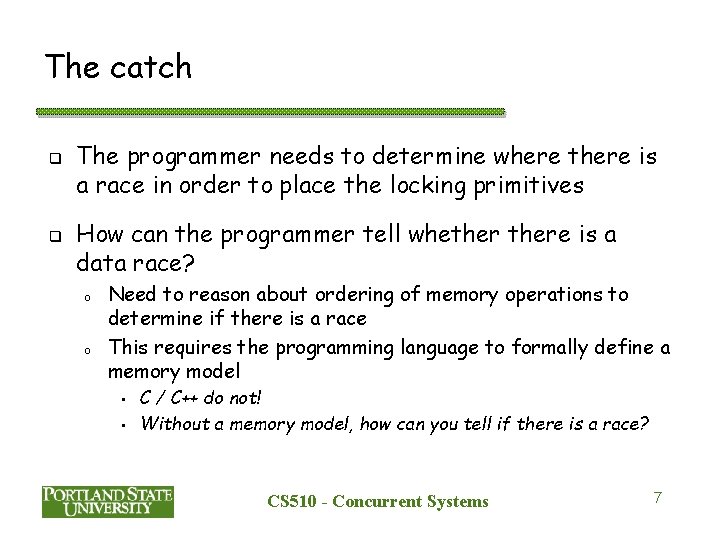
The catch q q The programmer needs to determine where there is a race in order to place the locking primitives How can the programmer tell whethere is a data race? o o Need to reason about ordering of memory operations to determine if there is a race This requires the programming language to formally define a memory model • • C / C++ do not! Without a memory model, how can you tell if there is a race? CS 510 - Concurrent Systems 7
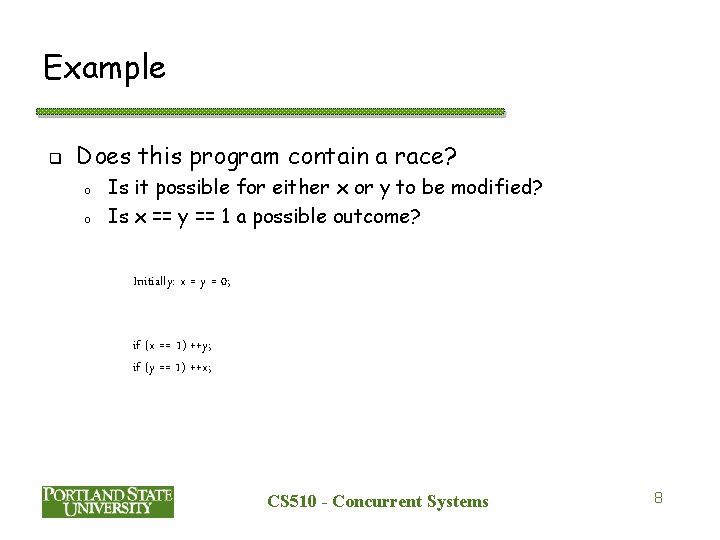
Example q Does this program contain a race? o o Is it possible for either x or y to be modified? Is x == y == 1 a possible outcome? Initially: x = y = 0; if (x == 1) ++y; if (y == 1) ++x; CS 510 - Concurrent Systems 8
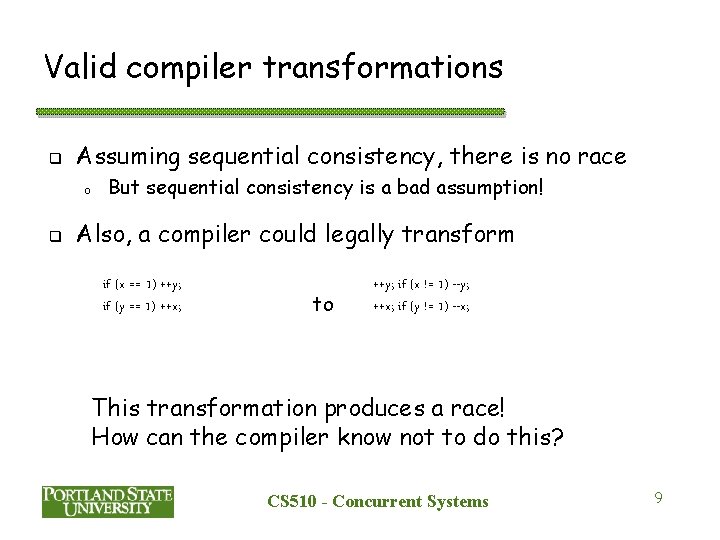
Valid compiler transformations q Assuming sequential consistency, there is no race o q But sequential consistency is a bad assumption! Also, a compiler could legally transform if (x == 1) ++y; if (y == 1) ++x; to ++y; if (x != 1) --y; ++x; if (y != 1) --x; This transformation produces a race! How can the compiler know not to do this? CS 510 - Concurrent Systems 9
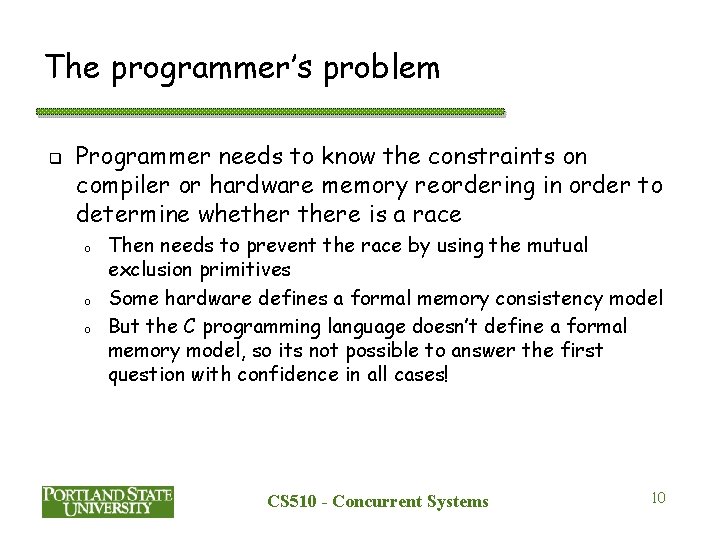
The programmer’s problem q Programmer needs to know the constraints on compiler or hardware memory reordering in order to determine whethere is a race o o o Then needs to prevent the race by using the mutual exclusion primitives Some hardware defines a formal memory consistency model But the C programming language doesn’t define a formal memory model, so its not possible to answer the first question with confidence in all cases! CS 510 - Concurrent Systems 10
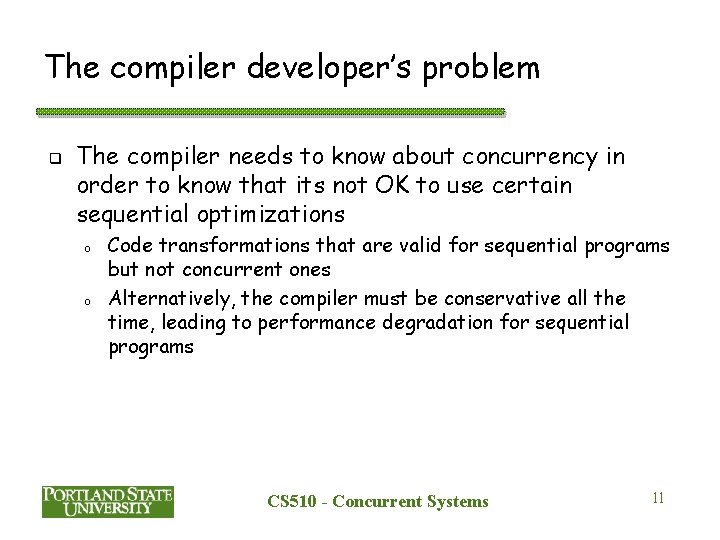
The compiler developer’s problem q The compiler needs to know about concurrency in order to know that its not OK to use certain sequential optimizations o o Code transformations that are valid for sequential programs but not concurrent ones Alternatively, the compiler must be conservative all the time, leading to performance degradation for sequential programs CS 510 - Concurrent Systems 11
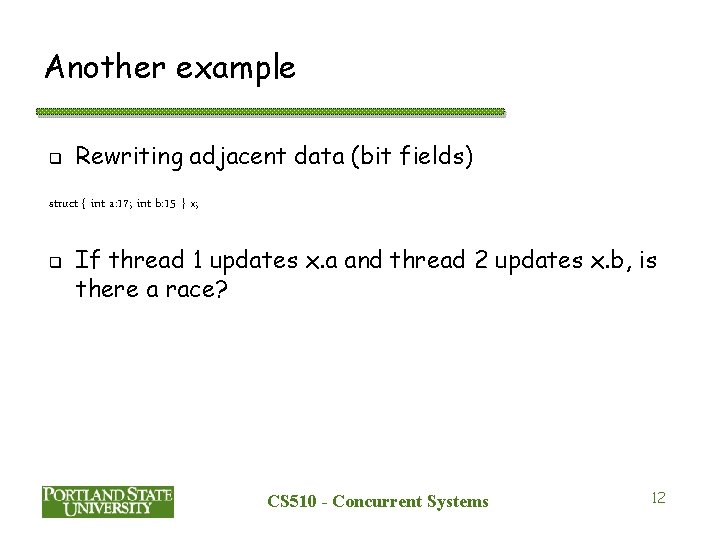
Another example q Rewriting adjacent data (bit fields) struct { int a: 17; int b: 15 } x; q If thread 1 updates x. a and thread 2 updates x. b, is there a race? CS 510 - Concurrent Systems 12
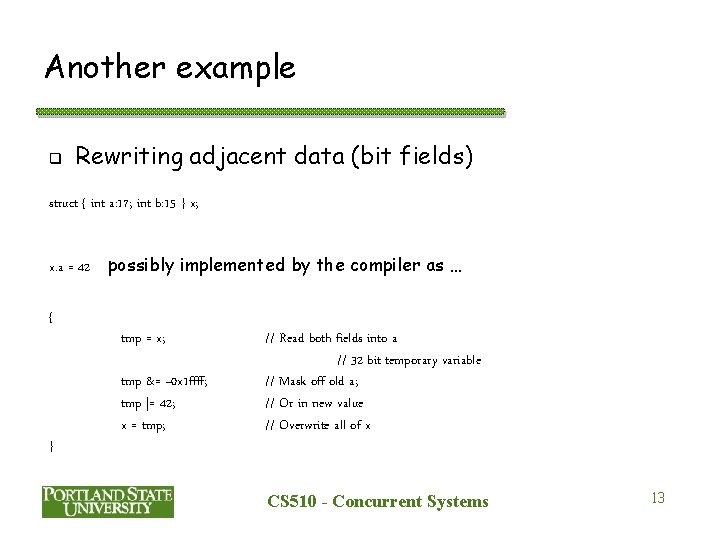
Another example q Rewriting adjacent data (bit fields) struct { int a: 17; int b: 15 } x; x. a = 42 possibly implemented by the compiler as … { } tmp = x; tmp &= ~0 x 1 ffff; tmp |= 42; x = tmp; // Read both fields into a // 32 bit temporary variable // Mask off old a; // Or in new value // Overwrite all of x CS 510 - Concurrent Systems 13
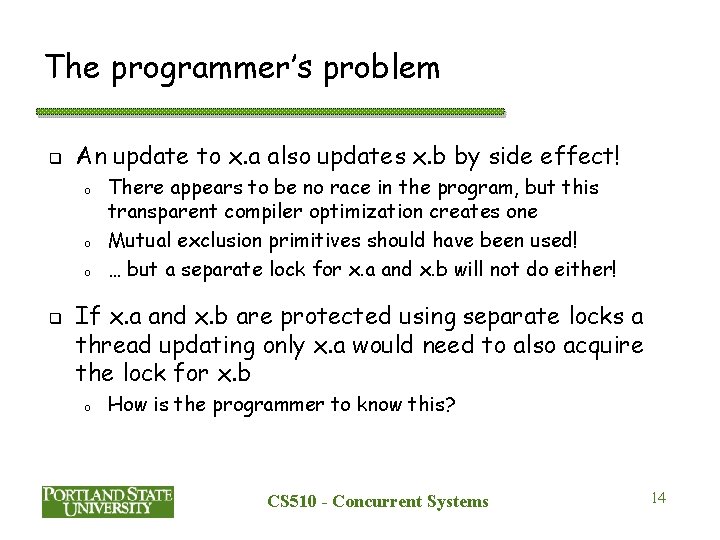
The programmer’s problem q An update to x. a also updates x. b by side effect! o o o q There appears to be no race in the program, but this transparent compiler optimization creates one Mutual exclusion primitives should have been used! … but a separate lock for x. a and x. b will not do either! If x. a and x. b are protected using separate locks a thread updating only x. a would need to also acquire the lock for x. b o How is the programmer to know this? CS 510 - Concurrent Systems 14
The compiler developer’s problem q How can you know that this optimization (which is fine for a sequential program) is not ok? o q If your language has no concept of concurrency? The granularity of memory operations (bit, byte, word etc) is architecture specific o o Programs that need to know this kind of detail are not portable! If the language defined a minimum granularity for atomic updates, what should it be? CS 510 - Concurrent Systems 15
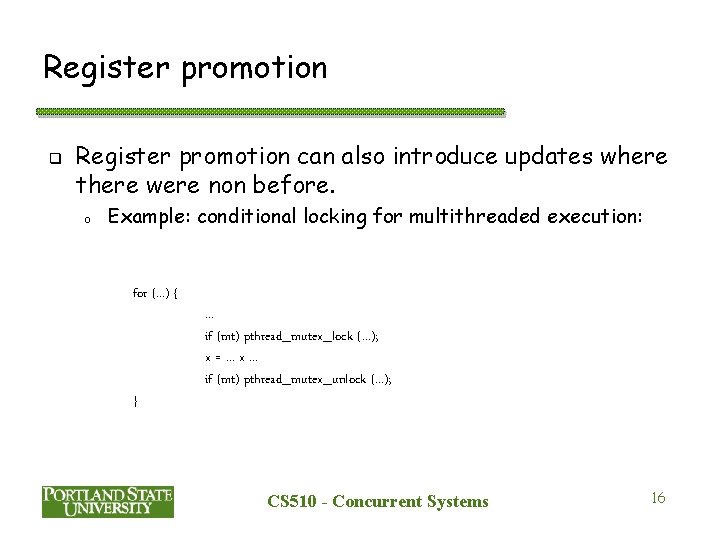
Register promotion q Register promotion can also introduce updates where there were non before. o Example: conditional locking for multithreaded execution: for (. . . ) { } . . . if (mt) pthread_mutex_lock (. . . ); x =. . . x. . . if (mt) pthread_mutex_unlock (. . . ); CS 510 - Concurrent Systems 16
Register promotion q Register promotion can also introduce updates where there were non before. o Example: conditional locking for multithreaded execution: Transformed to CS 510 - Concurrent Systems 17
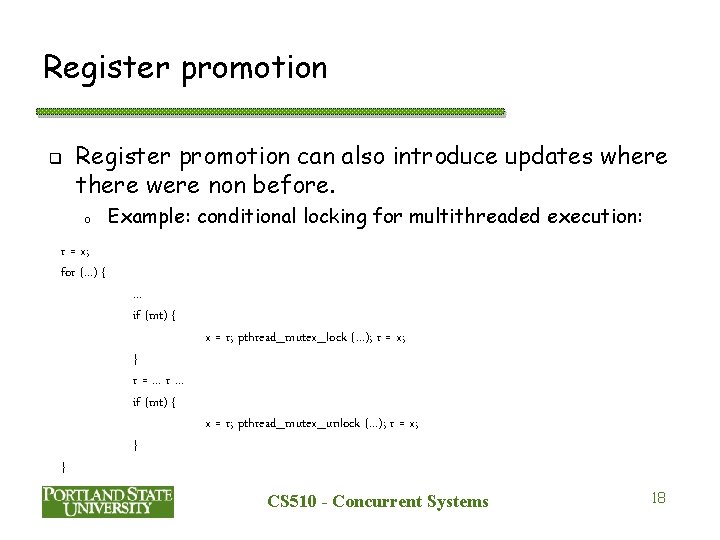
Register promotion q Register promotion can also introduce updates where there were non before. o r = x; for (. . . ) { Example: conditional locking for multithreaded execution: . . . if (mt) { } r =. . . r. . . if (mt) { } } x = r; pthread_mutex_lock (. . . ); r = x; x = r; pthread_mutex_unlock (. . . ); r = x; CS 510 - Concurrent Systems 18
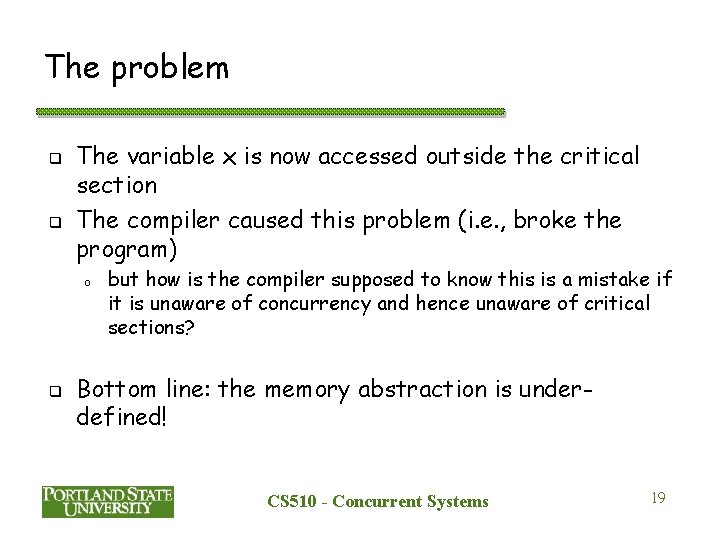
The problem q q The variable x is now accessed outside the critical section The compiler caused this problem (i. e. , broke the program) o q but how is the compiler supposed to know this is a mistake if it is unaware of concurrency and hence unaware of critical sections? Bottom line: the memory abstraction is underdefined! CS 510 - Concurrent Systems 19
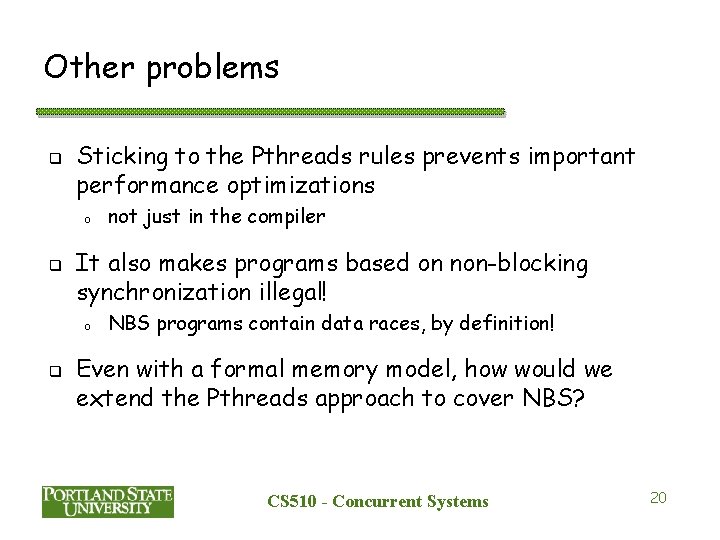
Other problems q Sticking to the Pthreads rules prevents important performance optimizations o q It also makes programs based on non-blocking synchronization illegal! o q not just in the compiler NBS programs contain data races, by definition! Even with a formal memory model, how would we extend the Pthreads approach to cover NBS? CS 510 - Concurrent Systems 20