
CS 501 Software Engineering Lecture 2 Software Processes

- Slides: 34
CS 501: Software Engineering Lecture 2 Software Processes 1 CS 501 Spring 2008
Administration Project teams Any short notices to class? Course team email address When you have formed your team and reached agreement with your client, please send a message to cs 501 -l@lists. cornell. edu with the names of the team, the client's name, and the topic of the project. Letter "l" 2 CS 501 Spring 2008
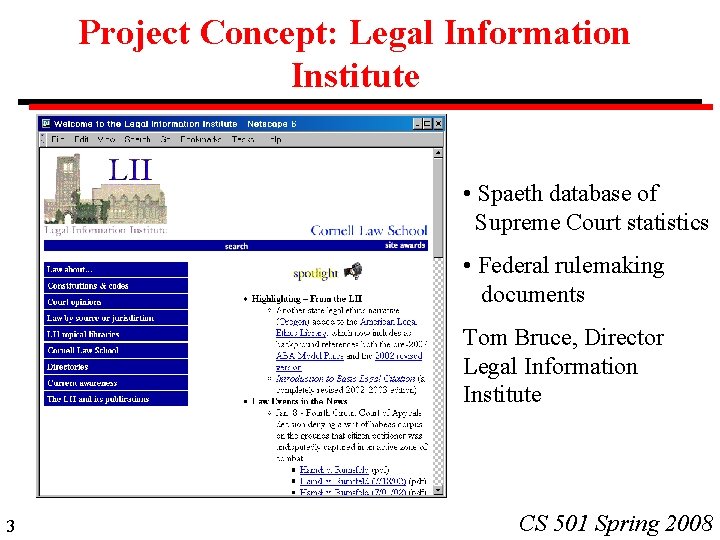
Project Concept: Legal Information Institute • Spaeth database of Supreme Court statistics • Federal rulemaking documents Tom Bruce, Director Legal Information Institute 3 CS 501 Spring 2008
Project Concept: Student Disability Services (SDS) Booking system for CULift service Michele D. Fish, Student Disability Services Center for Learning & Teaching 4 CS 501 Spring 2008
Project Suggestion: Cheaper and Better Textbooks Paul Francis, Computer Science Department 5 CS 501 Spring 2008
Project Suggestion: e. Commons • Harvesting from Web sites • Drag and drop user interface John Saylor, Cornell University Library 6 CS 501 Spring 2008
Project Concept: Collaborative Text Editor Adam Engst 7 CS 501 Spring 2008
Project Concept: Weill Cornell Medical Library e. Resources Paul Albert, Digital Services Librarian 8 CS 501 Spring 2008
Project Concept: Predict Systems Additunes: music recommendation system Blazej Kot, Predict Systems & Cornell Information Science 9 CS 501 Spring 2008
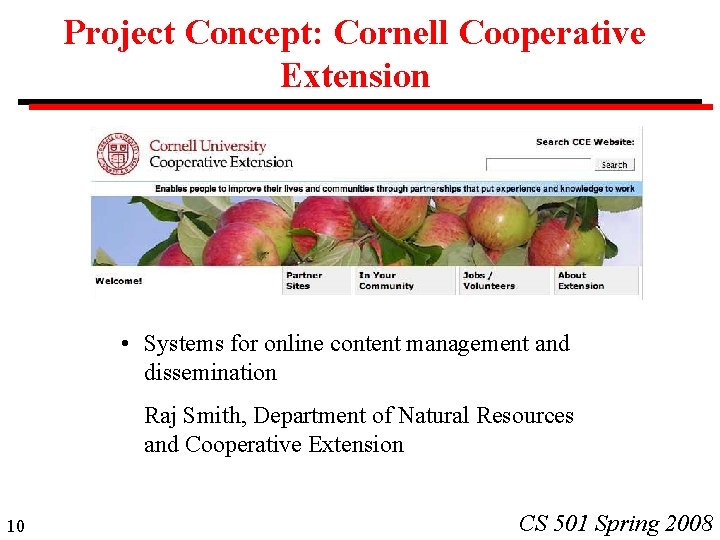
Project Concept: Cornell Cooperative Extension • Systems for online content management and dissemination Raj Smith, Department of Natural Resources and Cooperative Extension 10 CS 501 Spring 2008
A Classic Book Frederick P. Brooks, Jr. The Mythical Man Month. Addison-Wesley, 1972. 11 CS 501 Spring 2008
Software Process Fundamental Assumption: Good processes lead to good software Good processes reduce risk Good processes enhance visibility 12 CS 501 Spring 2008
Variety of Software Processes Software products are very varied. . . Therefore, there is no standard process for all software engineering projects BUT successful software development projects all need to address similar issues. This creates a number of process steps that must be part of all software projects 13 CS 501 Spring 2008
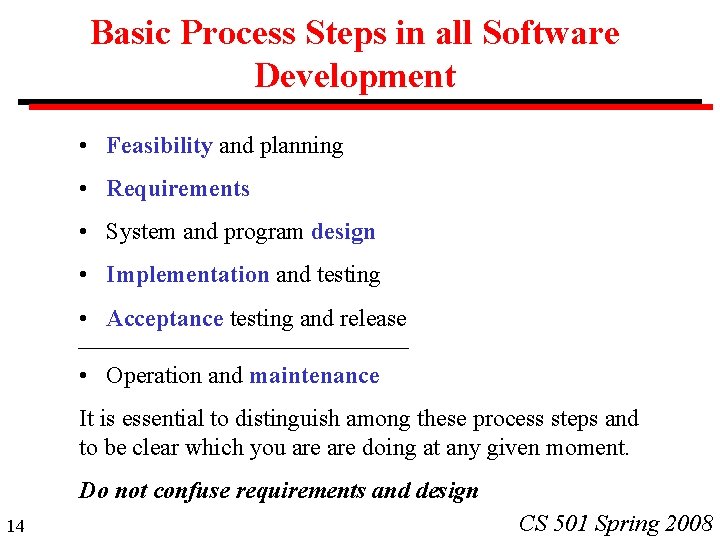
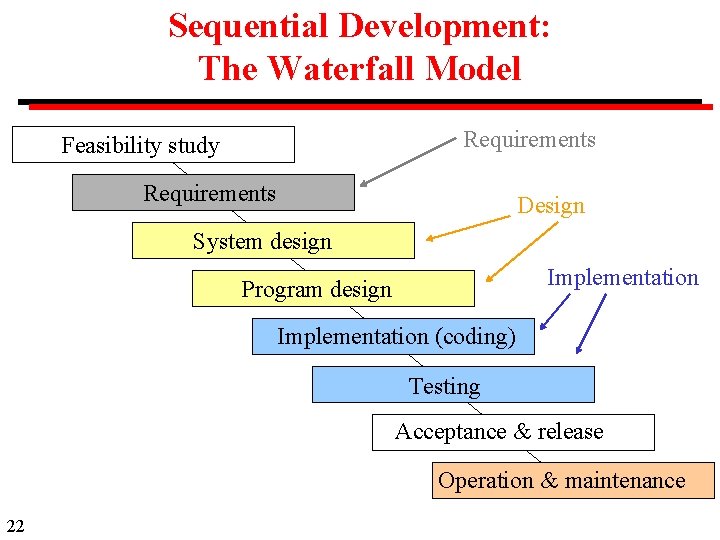
Basic Process Steps in all Software Development • Feasibility and planning • Requirements • System and program design • Implementation and testing • Acceptance testing and release • Operation and maintenance It is essential to distinguish among these process steps and to be clear which you are doing at any given moment. Do not confuse requirements and design 14 CS 501 Spring 2008
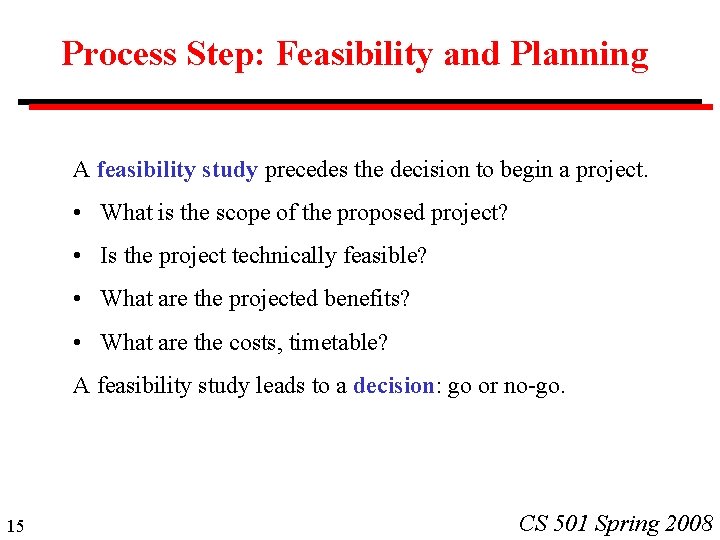
Process Step: Feasibility and Planning A feasibility study precedes the decision to begin a project. • What is the scope of the proposed project? • Is the project technically feasible? • What are the projected benefits? • What are the costs, timetable? A feasibility study leads to a decision: go or no-go. 15 CS 501 Spring 2008
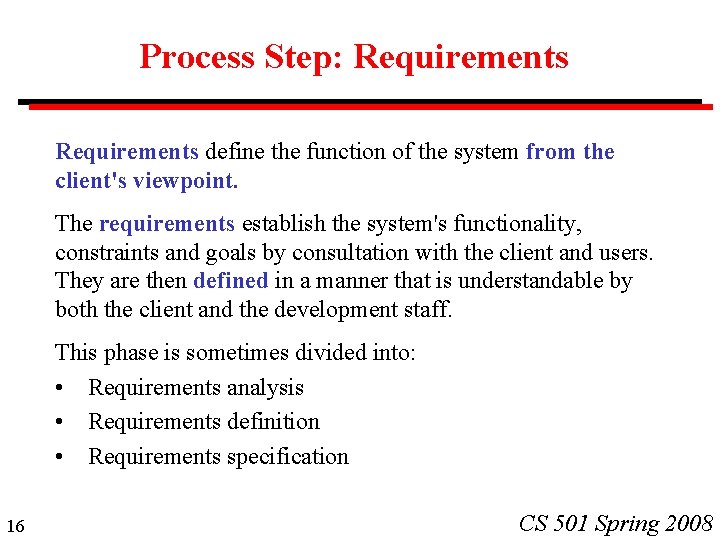
Process Step: Requirements define the function of the system from the client's viewpoint. The requirements establish the system's functionality, constraints and goals by consultation with the client and users. They are then defined in a manner that is understandable by both the client and the development staff. This phase is sometimes divided into: • Requirements analysis • Requirements definition • Requirements specification 16 CS 501 Spring 2008
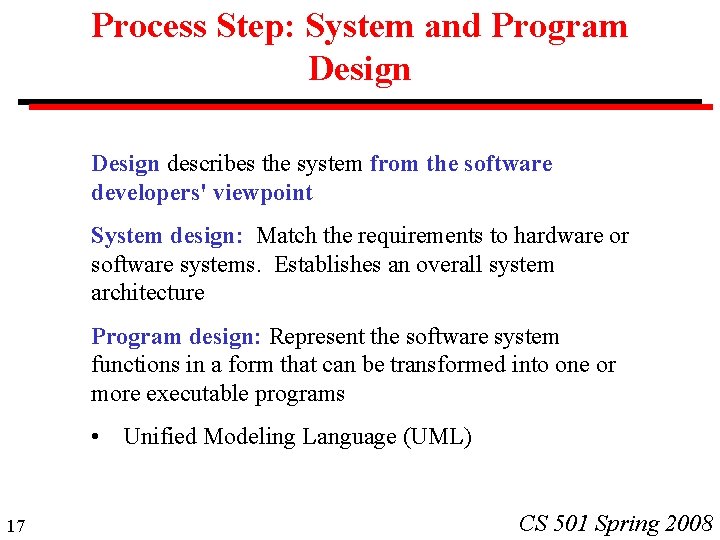
Process Step: System and Program Design describes the system from the software developers' viewpoint System design: Match the requirements to hardware or software systems. Establishes an overall system architecture Program design: Represent the software system functions in a form that can be transformed into one or more executable programs • Unified Modeling Language (UML) 17 CS 501 Spring 2008
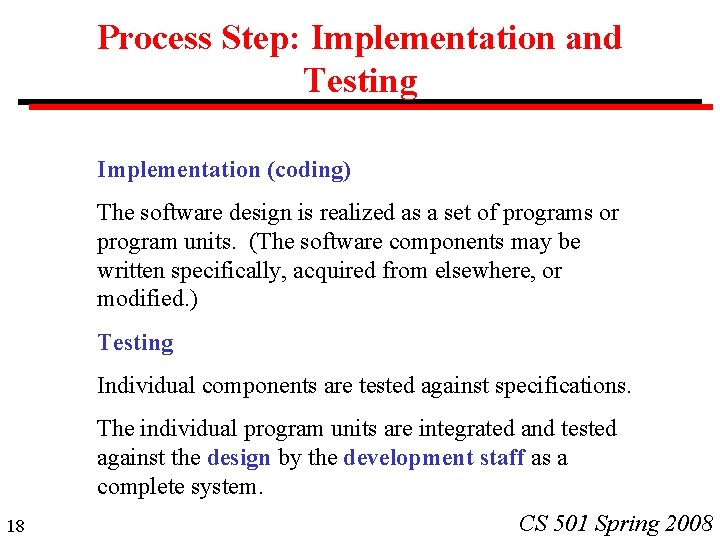
Process Step: Implementation and Testing Implementation (coding) The software design is realized as a set of programs or program units. (The software components may be written specifically, acquired from elsewhere, or modified. ) Testing Individual components are tested against specifications. The individual program units are integrated and tested against the design by the development staff as a complete system. 18 CS 501 Spring 2008
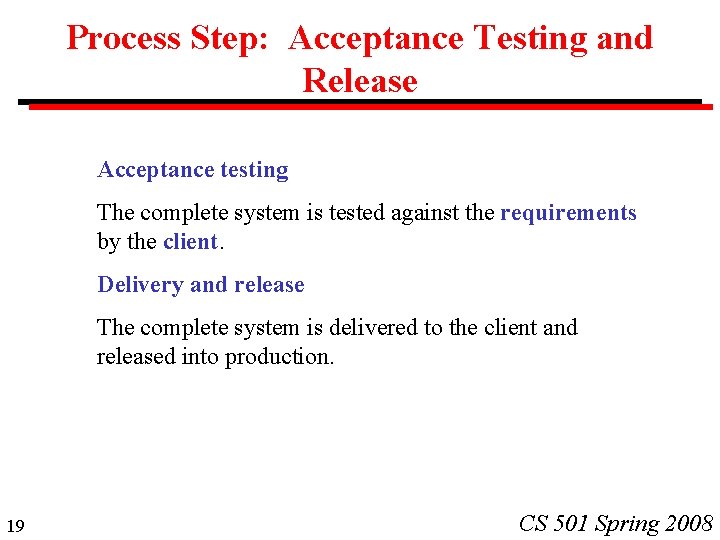
Process Step: Acceptance Testing and Release Acceptance testing The complete system is tested against the requirements by the client. Delivery and release The complete system is delivered to the client and released into production. 19 CS 501 Spring 2008
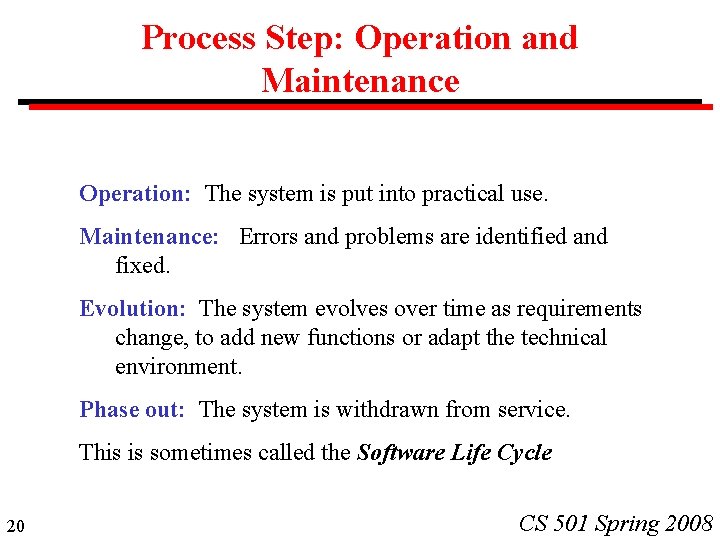
Process Step: Operation and Maintenance Operation: The system is put into practical use. Maintenance: Errors and problems are identified and fixed. Evolution: The system evolves over time as requirements change, to add new functions or adapt the technical environment. Phase out: The system is withdrawn from service. This is sometimes called the Software Life Cycle 20 CS 501 Spring 2008
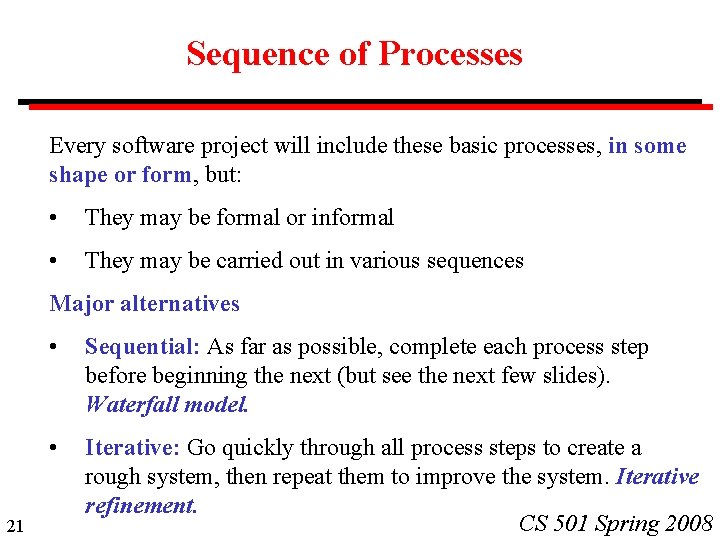
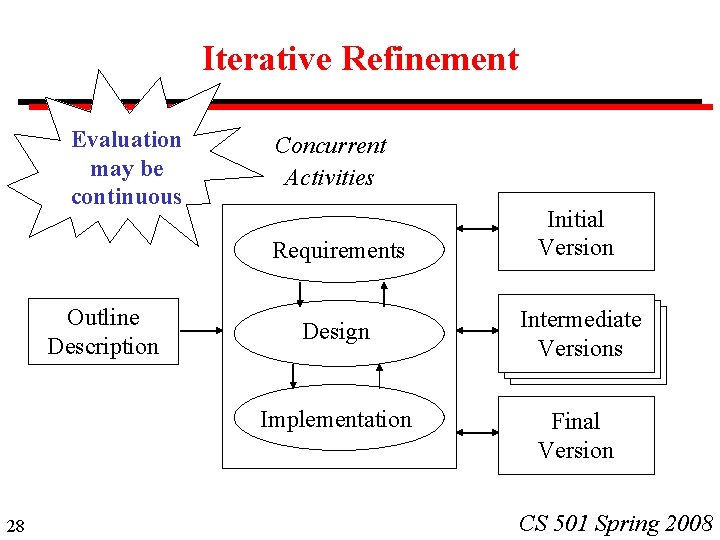
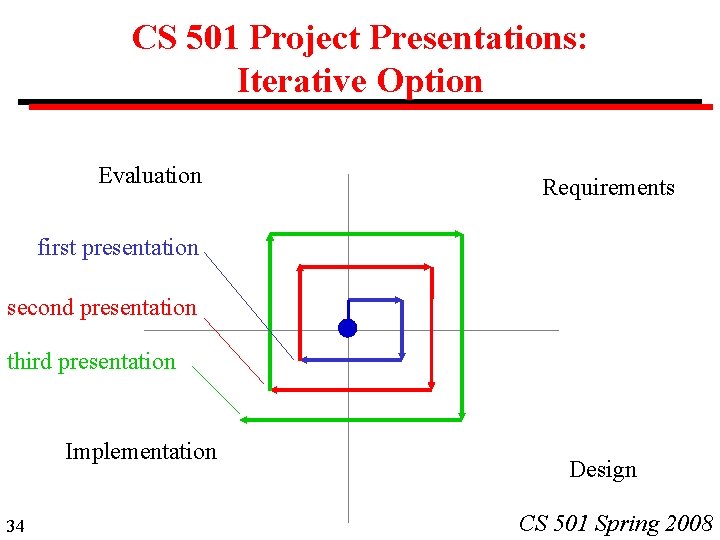
Sequence of Processes Every software project will include these basic processes, in some shape or form, but: • They may be formal or informal • They may be carried out in various sequences Major alternatives 21 • Sequential: As far as possible, complete each process step before beginning the next (but see the next few slides). Waterfall model. • Iterative: Go quickly through all process steps to create a rough system, then repeat them to improve the system. Iterative refinement. CS 501 Spring 2008
Sequential Development: The Waterfall Model Requirements Feasibility study Requirements Design System design Implementation Program design Implementation (coding) Testing Acceptance & release Operation & maintenance 22 CS 501 Spring 2008
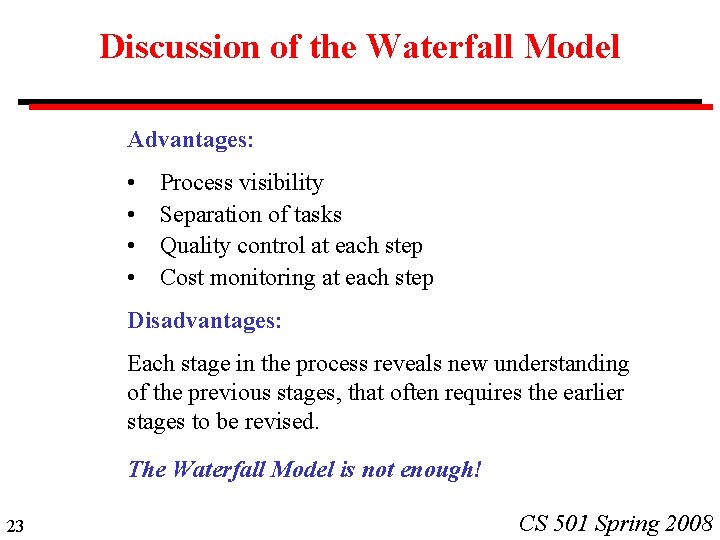
Discussion of the Waterfall Model Advantages: • • Process visibility Separation of tasks Quality control at each step Cost monitoring at each step Disadvantages: Each stage in the process reveals new understanding of the previous stages, that often requires the earlier stages to be revised. The Waterfall Model is not enough! 23 CS 501 Spring 2008
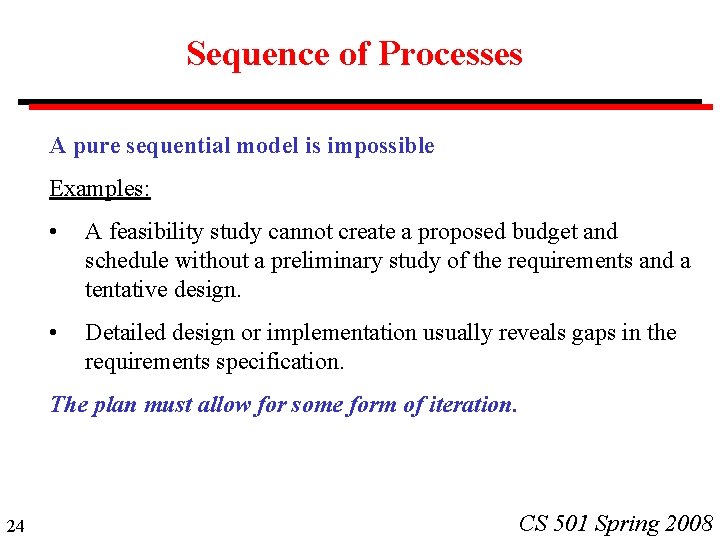
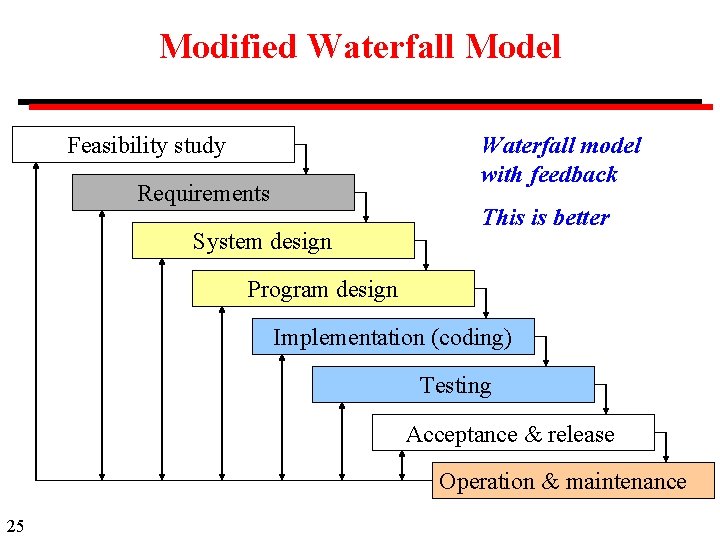
Sequence of Processes A pure sequential model is impossible Examples: • A feasibility study cannot create a proposed budget and schedule without a preliminary study of the requirements and a tentative design. • Detailed design or implementation usually reveals gaps in the requirements specification. The plan must allow for some form of iteration. 24 CS 501 Spring 2008
Modified Waterfall Model Feasibility study Waterfall model with feedback Requirements System design This is better Program design Implementation (coding) Testing Acceptance & release Operation & maintenance 25 CS 501 Spring 2008
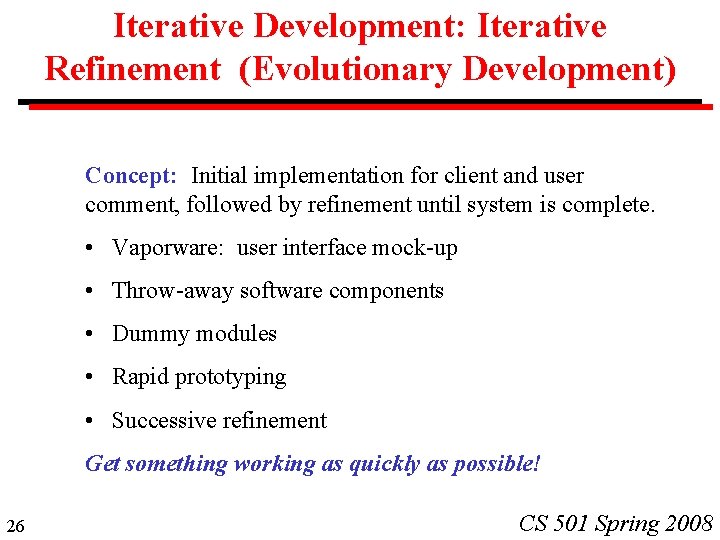
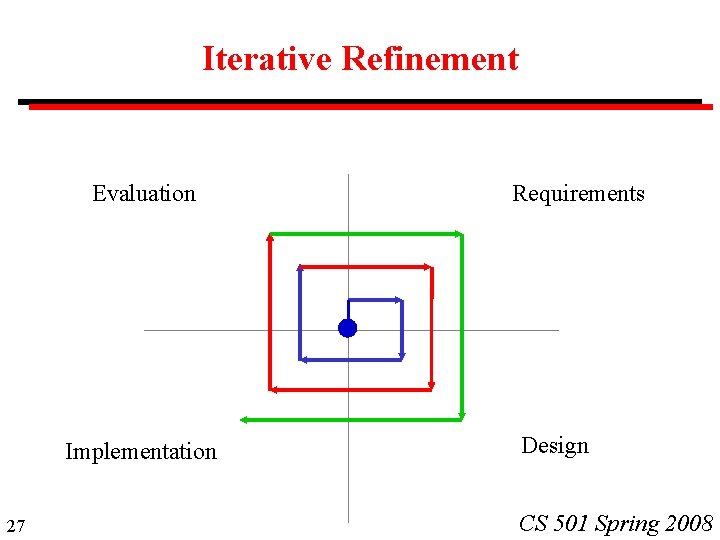
Iterative Development: Iterative Refinement (Evolutionary Development) Concept: Initial implementation for client and user comment, followed by refinement until system is complete. • Vaporware: user interface mock-up • Throw-away software components • Dummy modules • Rapid prototyping • Successive refinement Get something working as quickly as possible! 26 CS 501 Spring 2008
Iterative Refinement Evaluation Implementation 27 Requirements Design CS 501 Spring 2008
Iterative Refinement Evaluation may be continuous Concurrent Activities Requirements Outline Description Design Implementation 28 Initial Version Intermediate Versions Final Version CS 501 Spring 2008
Mixed Processes: Phased Development Combine sequential and iterative elements A simple system with basic functionality is brought quickly into production (Phase 1). Subsequent phases are based on experience gained from users of each previous phase. Advantages • Pay-back on investment begins soon. • Requirement are more clearly understood in developing subsequent phases 29 CS 501 Spring 2008
Phased Development Online When software is released online it is possible to divide it into very small phases that are developed and released in quick succession. Example: Amazon. com divides most software development into phases of about four weeks elapsed time. This approach is excellent for continual enhancement of a system within a well established architecture. It is not possible for shrink wrapped software, embedded systems, or similar environments. 30 CS 501 Spring 2008
Example: Iterative Refinement + Waterfall Model: Problem: Add graphics package to a programming environment Phase 1: Iterative refinement Extend current environment with a preprocessor and run-time support package. Test with users. Make several new versions until users are pleased with function. Phase 2: Modified waterfall Use the results of Phase 1 as the basis for a detailed set of requirements. Write new compiler and run-time system incorporating graphics elements. Make minor adjustments to requirements as needed. 31 CS 501 Spring 2008
Observations about Software Processes Completed projects should have the basic process steps but. . . the development process is always partly evolutionary. Risk is lowered by: • Prototyping key components • Dividing into phases • Following a visible software process • Making use of reusable components Conclusion It is not possible to complete each step and throw it over the wall. 32 CS 501 Spring 2008
CS 501 Project Presentations: Sequential Option 1. Requirements Feasibility study Requirements 2. Design System design Program design 3. Implementation (coding) If you follow a sequential process the three presentations should be as shown. 33 Testing Acceptance & release Operation & maintenance CS 501 Spring 2008
CS 501 Project Presentations: Iterative Option Evaluation Requirements first presentation second presentation third presentation Implementation 34 Design CS 501 Spring 2008