
CS 501 Software Engineering Lecture 16 Object Oriented
CS 501: Software Engineering Lecture 16 Object Oriented Design I 1 CS 501 Spring 2002
Administration 2 CS 501 Spring 2002
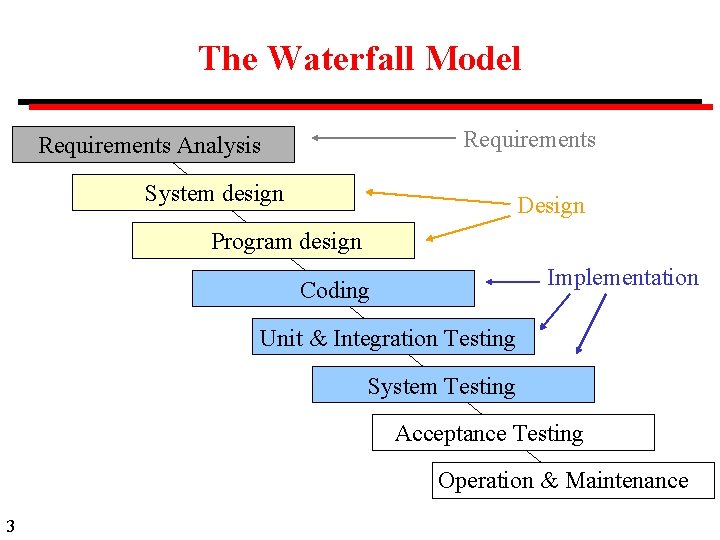
The Waterfall Model Requirements Analysis System design Design Program design Implementation Coding Unit & Integration Testing System Testing Acceptance Testing Operation & Maintenance 3 CS 501 Spring 2002
Program Design The task of program design is to represent the software system functions in a form that can be transformed into one or more executable programs. Given a system architecture, the program design specifies: • computers and networks • programs, components, packages, classes and class hierarchies • interfaces, protocols • security mechanisms, operational procedures 4 CS 501 Spring 2002
The Importance of Modeling • A model is a simplification of reality. • We build models so that we can better understand the system we are developing. • We build models of complex system because we cannot comprehend such a system in its entirety. Models can be informal or formal. The more complex the project the more valuable a formal model becomes. BRJ 5 CS 501 Spring 2002
Principles of Modeling • The choice of what models to create has a profound influence on how a problem is attacked and how a solution is shaped. • Every model can be expressed at different levels of precision. • The best models are connected to reality. • No single model is sufficient. Every nontrivial system is best approached through a small set of nearly independent models. BRJ 6 CS 501 Spring 2002
The Unified Modeling Language UML is a standard language for modeling software systems • Serves as a bridge between the requirements specification and the implementation. • Provides a means to specify and document the design of a software system. • Is process and programming language independent. • Is particularly suited to object-oriented program development. 7 CS 501 Spring 2002
Useful Texts Grady Booch, James Rumbaugh, Ivar Jacobson, The Unified Modeling Language. Addison-Wesley 1999. Grady Booch, Object-Oriented Analysis and Design with Applications, second edition. Benjamin/Cummings 1994. Rob Pooley, Perdita Stevens, Using UML Software Engineering with Objects and Components. Addison-Wesley 1999. 8 CS 501 Spring 2002
Rational Rose is a system for creating and managing UML diagrams. It is available on all Computer Science Department computers. See: http: //adm/Software/purify_install. htm for installation instructions. 9 CS 501 Spring 2002
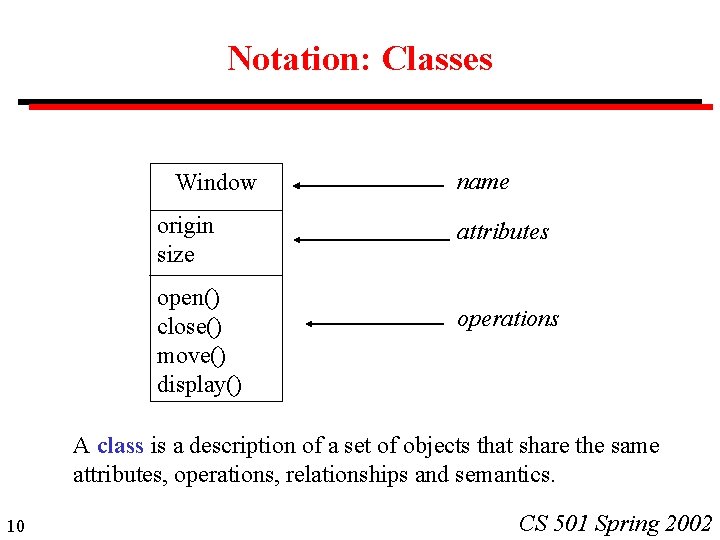
Notation: Classes Window origin size open() close() move() display() name attributes operations A class is a description of a set of objects that share the same attributes, operations, relationships and semantics. 10 CS 501 Spring 2002
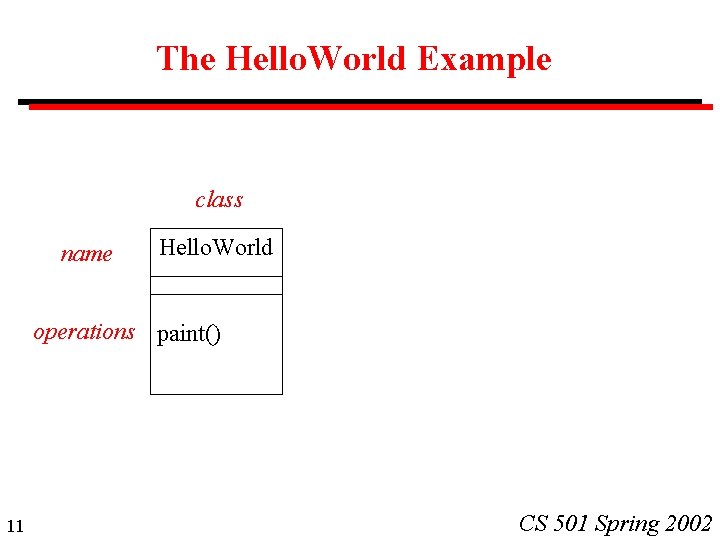
The Hello. World Example class name Hello. World operations paint() 11 CS 501 Spring 2002
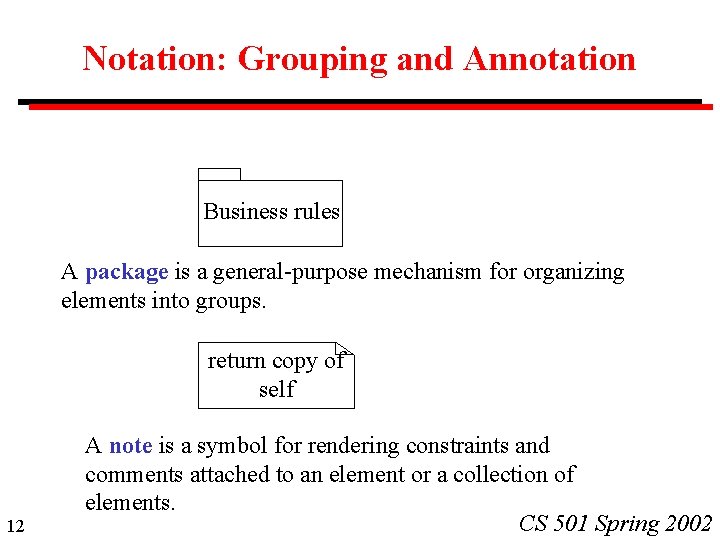
Notation: Grouping and Annotation Business rules A package is a general-purpose mechanism for organizing elements into groups. return copy of self 12 A note is a symbol for rendering constraints and comments attached to an element or a collection of elements. CS 501 Spring 2002
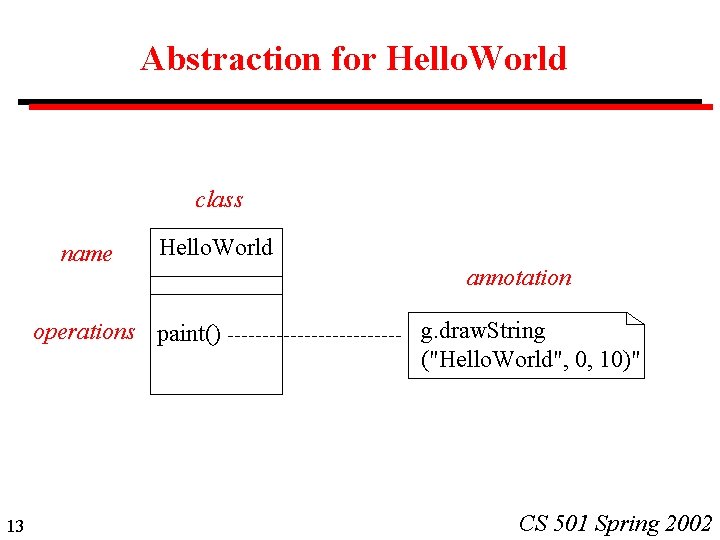
Abstraction for Hello. World class name Hello. World operations paint() 13 annotation g. draw. String ("Hello. World", 0, 10)" CS 501 Spring 2002
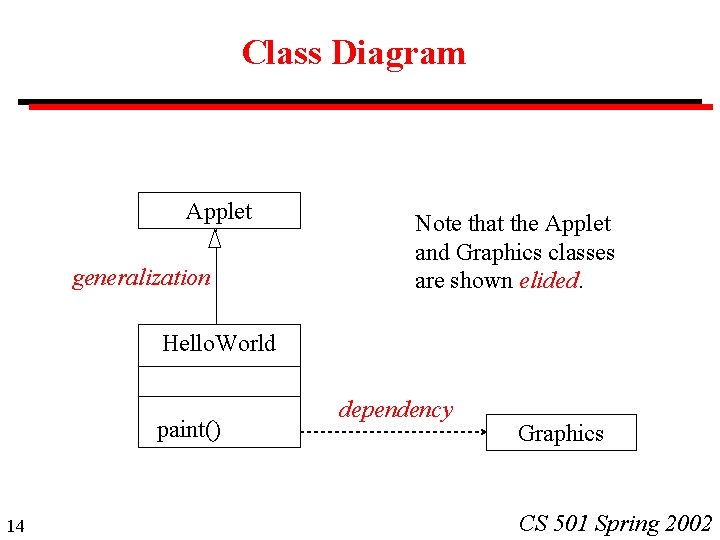
Class Diagram Applet generalization Note that the Applet and Graphics classes are shown elided. Hello. World paint() 14 dependency Graphics CS 501 Spring 2002
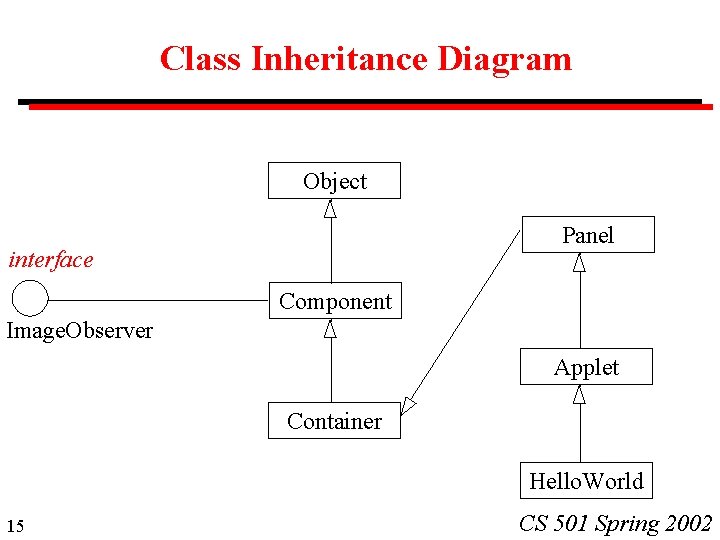
Class Inheritance Diagram Object Panel interface Component Image. Observer Applet Container Hello. World 15 CS 501 Spring 2002
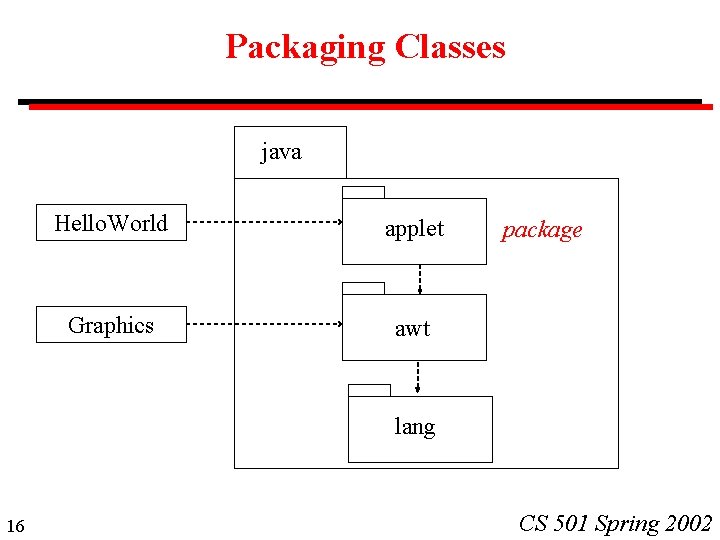
Packaging Classes java Hello. World applet Graphics awt package lang 16 CS 501 Spring 2002
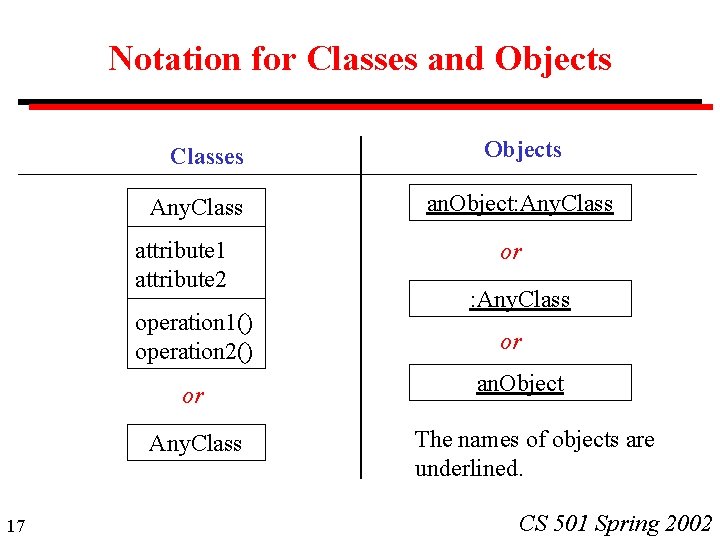
Notation for Classes and Objects Classes Any. Class attribute 1 attribute 2 operation 1() operation 2() or Any. Class 17 Objects an. Object: Any. Class or an. Object The names of objects are underlined. CS 501 Spring 2002
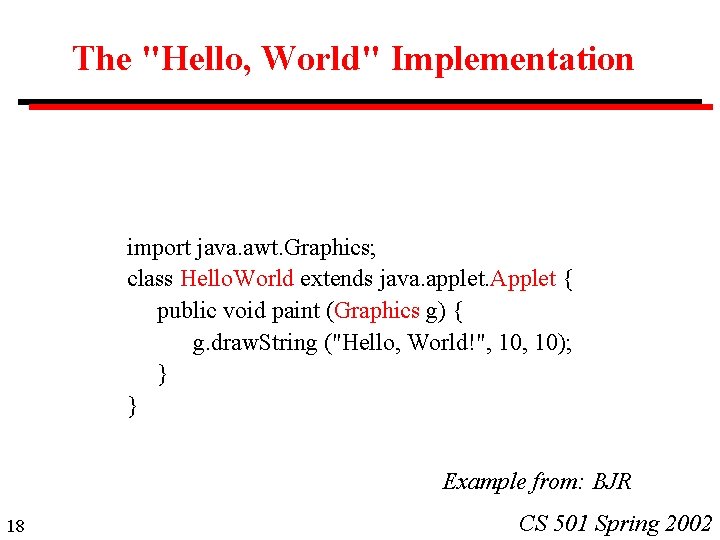
The "Hello, World" Implementation import java. awt. Graphics; class Hello. World extends java. applet. Applet { public void paint (Graphics g) { g. draw. String ("Hello, World!", 10); } } Example from: BJR 18 CS 501 Spring 2002
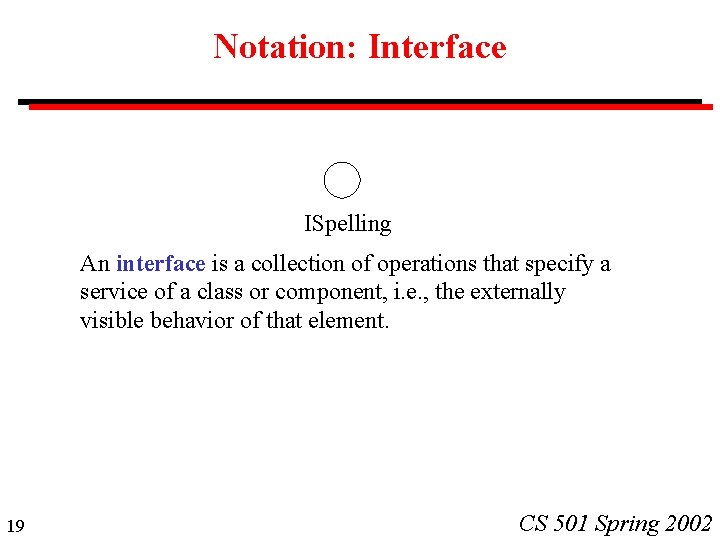
Notation: Interface ISpelling An interface is a collection of operations that specify a service of a class or component, i. e. , the externally visible behavior of that element. 19 CS 501 Spring 2002
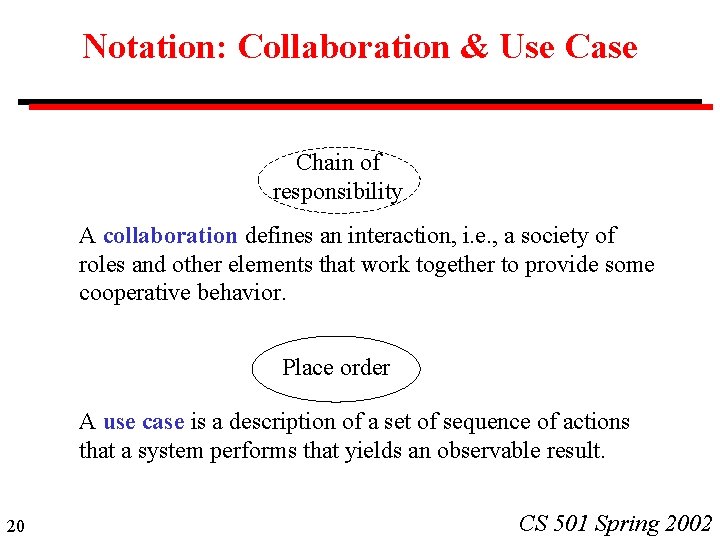
Notation: Collaboration & Use Case Chain of responsibility A collaboration defines an interaction, i. e. , a society of roles and other elements that work together to provide some cooperative behavior. Place order A use case is a description of a set of sequence of actions that a system performs that yields an observable result. 20 CS 501 Spring 2002
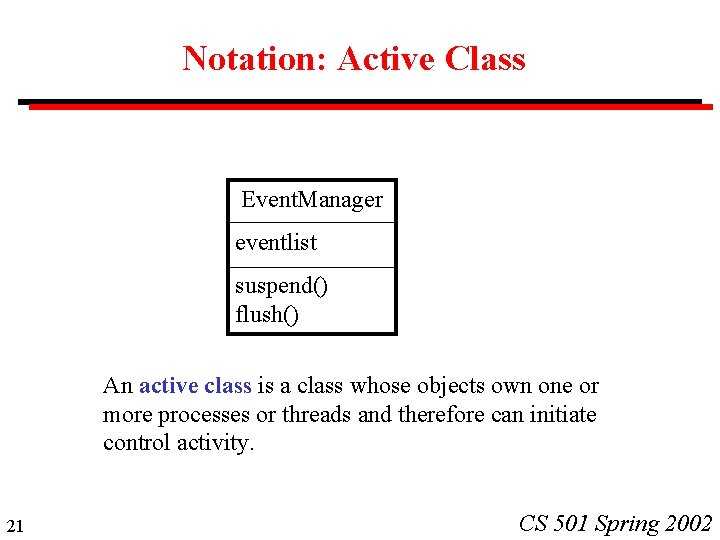
Notation: Active Class Event. Manager eventlist suspend() flush() An active class is a class whose objects own one or more processes or threads and therefore can initiate control activity. 21 CS 501 Spring 2002
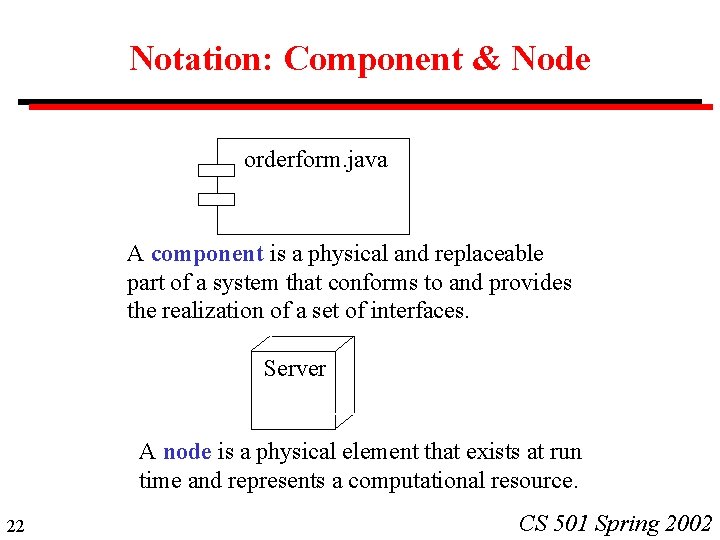
Notation: Component & Node orderform. java A component is a physical and replaceable part of a system that conforms to and provides the realization of a set of interfaces. Server A node is a physical element that exists at run time and represents a computational resource. 22 CS 501 Spring 2002
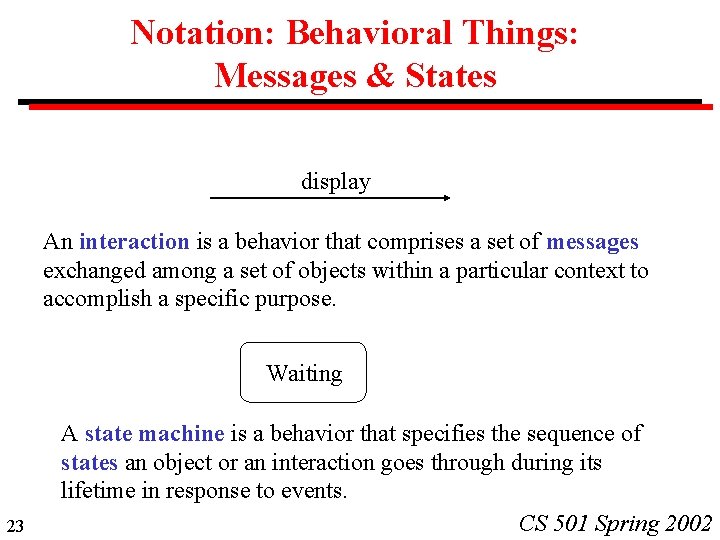
Notation: Behavioral Things: Messages & States display An interaction is a behavior that comprises a set of messages exchanged among a set of objects within a particular context to accomplish a specific purpose. Waiting 23 A state machine is a behavior that specifies the sequence of states an object or an interaction goes through during its lifetime in response to events. CS 501 Spring 2002
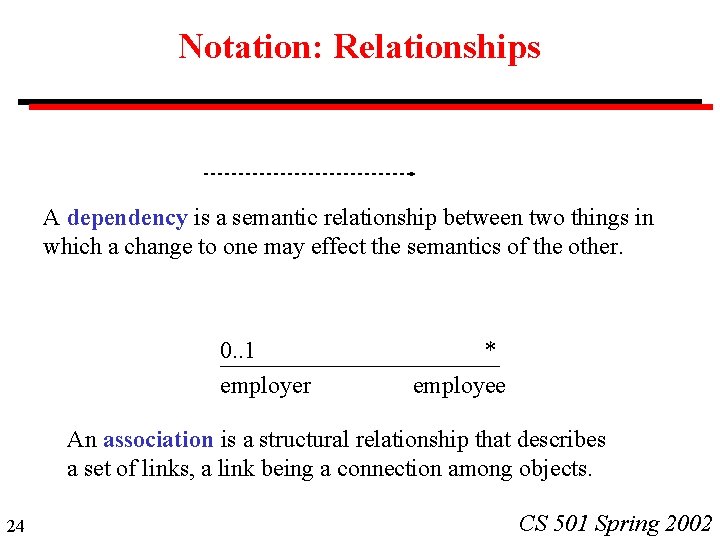
Notation: Relationships A dependency is a semantic relationship between two things in which a change to one may effect the semantics of the other. 0. . 1 employer * employee An association is a structural relationship that describes a set of links, a link being a connection among objects. 24 CS 501 Spring 2002
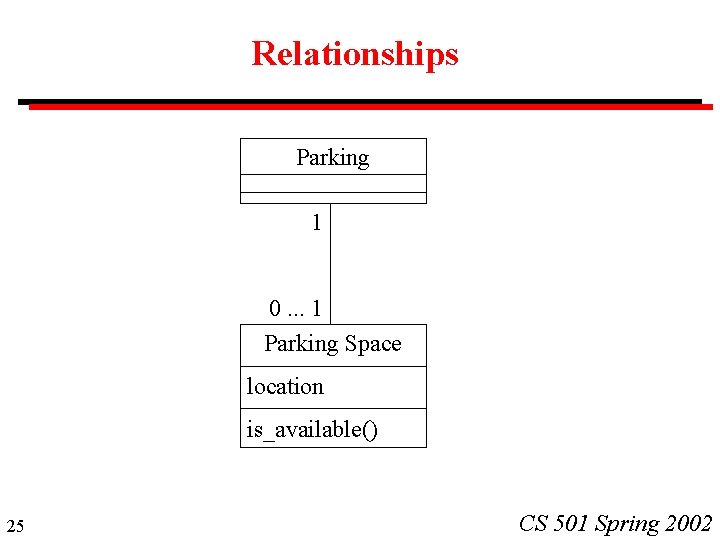
Relationships Parking 1 0. . . 1 Parking Space location is_available() 25 CS 501 Spring 2002
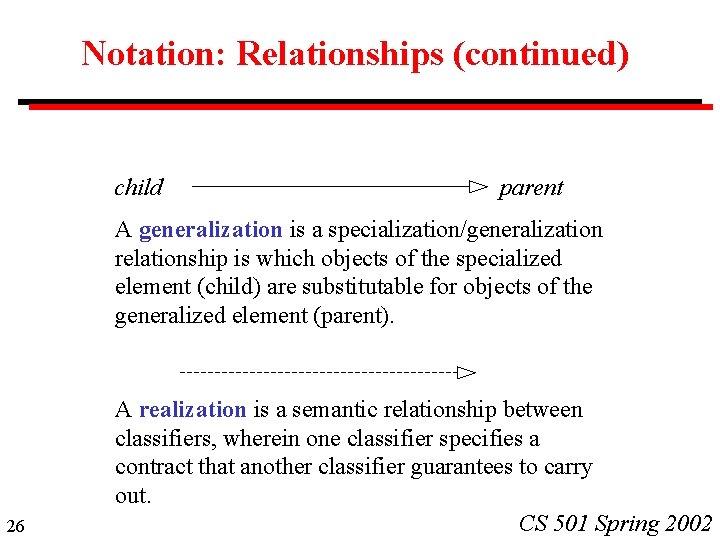
Notation: Relationships (continued) child parent A generalization is a specialization/generalization relationship is which objects of the specialized element (child) are substitutable for objects of the generalized element (parent). 26 A realization is a semantic relationship between classifiers, wherein one classifier specifies a contract that another classifier guarantees to carry out. CS 501 Spring 2002
Diagrams in UML A diagram is the graphical representation of a set of elements, usually rendered as a connected graph of vertices (things) and arcs (relationships). • Class diagram shows a set of classes, interfaces, and collaborations with their relationships. • Object diagram shows a set of objects and their relationships. • Use case diagram shows a set of use cases and actors (a special kind of class) and their relationships. 27 CS 501 Spring 2002
Diagrams in UML (continued) Interaction diagram shows an interaction, consisting of a set of objects and the relationships, including the messages that may be dispatched among them. => A sequence diagram emphasizes the time ordering. => A collaboration diagram emphasizes the structural organization of the objects that send and receive messages. 28 CS 501 Spring 2002
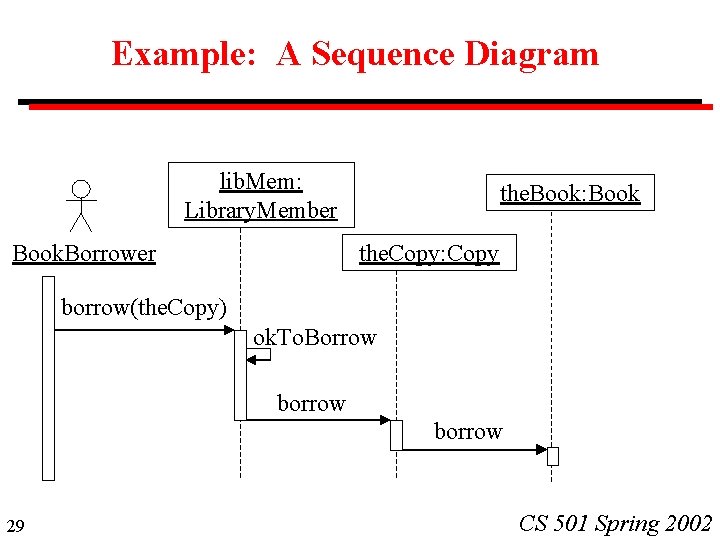
Example: A Sequence Diagram lib. Mem: Library. Member Book. Borrower the. Book: Book the. Copy: Copy borrow(the. Copy) ok. To. Borrow borrow 29 CS 501 Spring 2002
Diagrams in UML (continued) • Statechart diagram shows a state machine consisting of states, transitions, events, and activities. • Activity diagram is a statechart diagram that shows the flow from activity to activity within a system. • Component diagram shows the organization and dependencies among a set of components. • Deployment diagram shows the configuration of processing nodes and the components that live on them. 30 CS 501 Spring 2002
- Slides: 30