
CS 492 Special Topics in Computer Science Distributed
CS 492 Special Topics in Computer Science: Distributed Algorithms and Systems Lecture #12 Distributed Algorithms (I)
Admin Stuff • Quiz #5 return • Cloud computing article • Lynch’s book chapters 2
The Byzantine Generals Problem • An agreement problem between the Byzantine generals on whether to attack a city or not – Messengers are not lost, but … – There may be traitors among them • To find an algorithm to ensure that the loyal generals will reach agreement – Traitors can trick some to attack and other not to – They can force an attack when no general wants – They can confuse some that the generals cannot decide 3
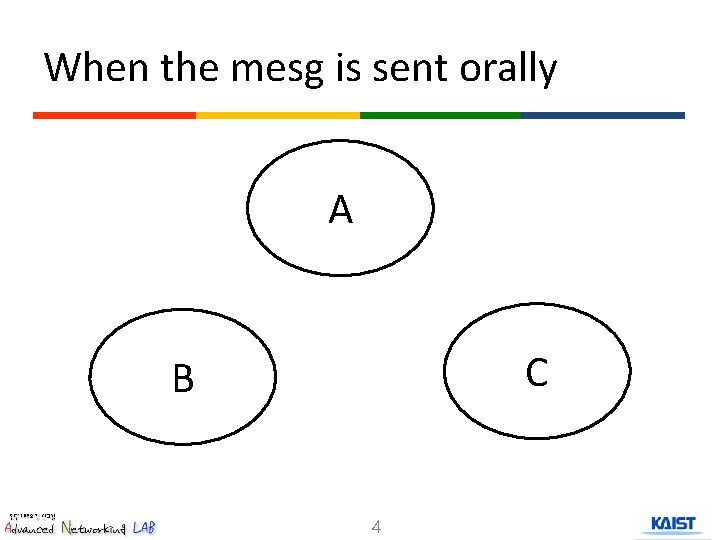
When the mesg is sent orally A C B 4
Answer: • There is no solution with fewer than 3 m+1 generals can cope with m traitors 5
Reference “The Byzantine Generals Problem” Leslie Lamport, Robert Shostak, Marshall Pease ACM Trans. on Programming Languages and Systems, Vol. 4, No. 3, July 1982, pp 382 -401 6
Distributed Algorithms • A large variety of concurrent algorithms – Originally refer to algorithms that were designed to run on many processors “distributed” over a large geographical area – Nowadays those on LAN or even on shared memory multiprocessors 7
Attributes of distributed algorithms • • IPC Timing model Failure model Problems the algorithms solve – Resource allocation, communication, consensus, database concurrency control, deadlock detection, global snapshots, synchronization, etc. 8
General Style of Work • Problems of significance in practical distributed computing identified • Abstract versions are defined • Algorithms are developed – They are describe precisely and proved to solve the stated problems; their complexity analyzed • Impossibility results and lower bounds proved 9
Topics to Cover • Synchronous Network Model (Ch. 2 -4) – Leader election in a synchronous ring – Breadth-first search – Shortest paths – Min spanning tree – Maximal independent set • Asynchronous System Model (Ch. 8 -9) – Asynchronous shared memory model 10
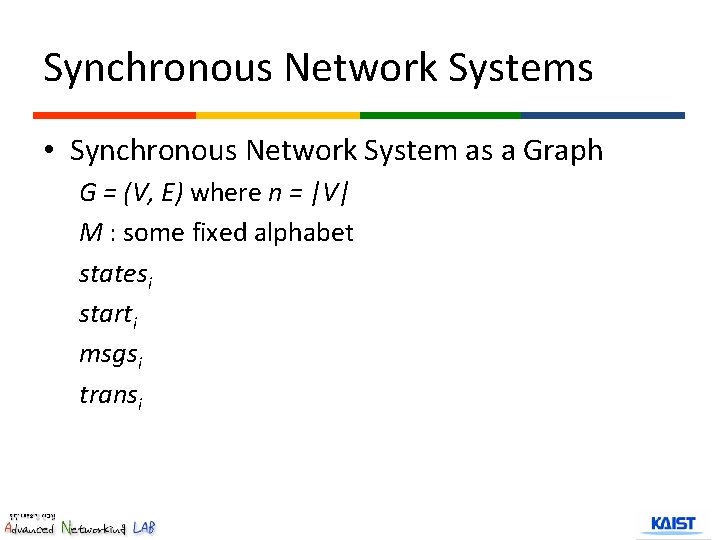
Synchronous Network Systems • Synchronous Network System as a Graph G = (V, E) where n = |V| M : some fixed alphabet statesi starti msgsi transi
A round = two steps 1. Apply the message-generation function 2. Apply the state-transition function 12
Difference from a traditional automata • Accepting states vs halting states 13
Failures • Process vs link failures • Byzantine failure – A process can generate its next messages and next state in some arbitrary way, without necessarily following the rules specified by its messagegeneration and state-transition functions.
Inputs and Outputs • Adopt a simple convention to encode the inputs and outputs in the states
Executions • An execution of the system is an infinite sequence C 0 , M 1 , N 1 , C 1 , M 2 , N 2 , C 3 , M 3 , N 3 , … – C: state assignment – M: message assignment (messages sent) – N: message assignment (messages received)
Proof Methods • invariant assertion – A property of the system state that is true in every execution, after every round. – Generally proved by induction on r • simulation – A goal to show A “implements” another asynchronous algorithm B, in the sense of producing the same input/ouput behavior. – Generally proved by induction on r
Complexity Measures • time complexity • communication complexity
Still, how different from an automata? • Add a random function to pick new states at each round 19
Now our first problem • Leader election in a synchronous ring 20
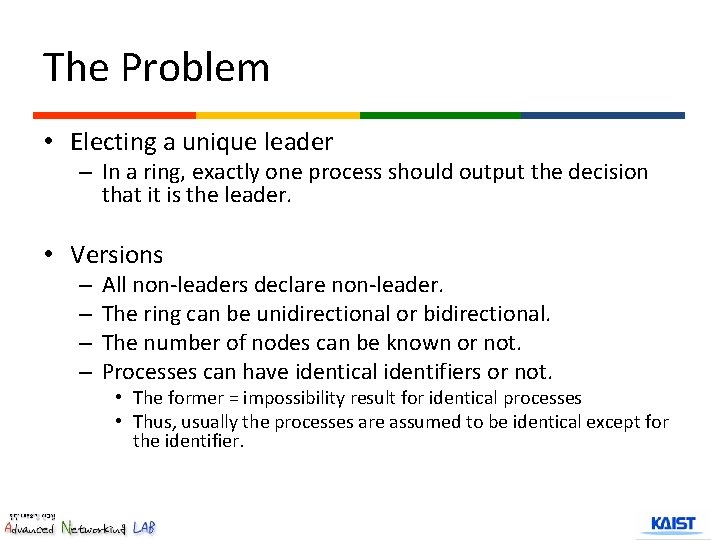
The Problem • Electing a unique leader – In a ring, exactly one process should output the decision that it is the leader. • Versions – – All non-leaders declare non-leader. The ring can be unidirectional or bidirectional. The number of nodes can be known or not. Processes can have identical identifiers or not. • The former = impossibility result for identical processes • Thus, usually the processes are assumed to be identical except for the identifier.
- Slides: 21