
CS 492 B Analysis of Concurrent Programs Code
CS 492 B Analysis of Concurrent Programs Code Coverage-based Testing of Concurrent Programs Prof. Moonzoo Kim Computer Science, KAIST
Coverage Metric for Software Testing • A coverage metric defines a set of test requirements on a target program which a complete test should satisfy – A test requirement (a. k. a. , test obligation) is a condition over a target program – An execution covers a test requirement when the execution satisfies the test requirement – The coverage level of a test (i. e. , a set of executions) is the ratio of the test requirements covered by at least one execution to the number of all test requirements • A coverage metric is used for assessing completeness of a test – Measure the quality of a test (to assess whether a test is sufficient or not) – Detect missing cases of a test (to find next test generation target) Code Coverage-based Testing of Concurrent Programs 2
Code Coverage Metric and Test Generation • A code coverage metric derives test requirements from the elements of a target program code – Standard methodology in testing sequential programs – E. g. branch/statement coverage metrics • Many test generation techniques for sequential programs aim to achieve high code coverage fast – Empirical studies have shown that a test achieving high code coverage tends to detect more faults in the sequential program testing domain Code Coverage-based Testing of Concurrent Programs 3
Concurrency Code Coverage Metric • Many concurrency coverage metrics have been proposed, which are specialized for concurrent program tests – Derive test requirements from synchronization operations or shared memory access operations • A concurrency coverage metric is a good solution to alleviate the limitation of the random testing techniques • Is a test achieving higher concurrency coverage better for detecting faults? • How can we generate concurrent executions to achieve high concurrency coverage? • How can we overcome the limitations of existing concurrency coverage metrics? Code Coverage-based Testing of Concurrent Programs 4
Part I. The Impact of Concurrent Coverage Metrics on Testing Effectiveness
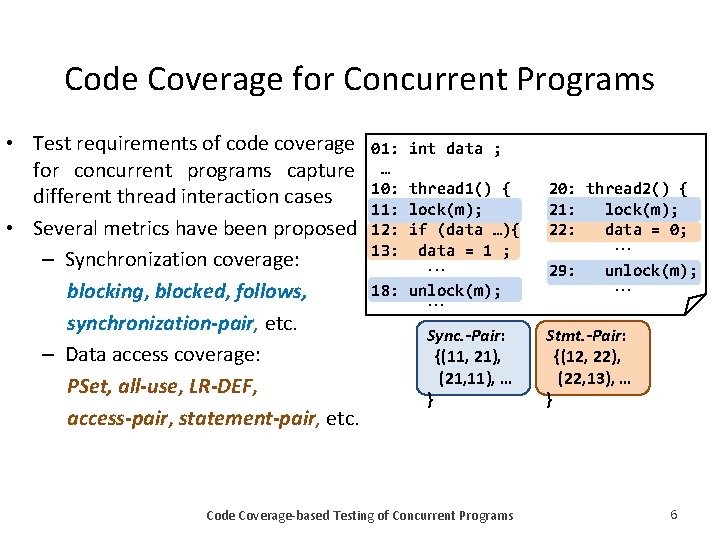
Code Coverage for Concurrent Programs • Test requirements of code coverage for concurrent programs capture different thread interaction cases • Several metrics have been proposed – Synchronization coverage: blocking, blocked, follows, synchronization-pair, etc. – Data access coverage: PSet, all-use, LR-DEF, access-pair, statement-pair, etc. 01: … 10: 11: 12: 13: int data ; thread 1() { lock(m); if (data …){ data = 1 ; . . . 18: unlock(m); 20: thread 2() { 21: lock(m); 22: data = 0; . . . 29: unlock(m); . . . Sync. -Pair: {(11, 21), (21, 11), … } Code Coverage-based Testing of Concurrent Programs Stmt. -Pair: {(12, 22), (22, 13), … } 6

Concurrent Coverage Example – “follows” Coverage • Structure: a requirement has two code lines of lock operations <l 1 , l 2 > • Condition: <l 1 , l 2 > is covered when 2 different threads hold a lock consecutively at two lines l 1 and l 2 10: thread 1() { 11: lock(m) ; 12: unlock(m) ; 13: lock(m) ; 14: unlock(m) ; 15: } - thread 1() - 20: thread 2() { 21: lock(m) ; 22: unlock(m) ; 23: lock(m) ; 24: unlock(m) ; 25: } - thread 2()- 11: lock(m) 12: unlock(m) <11, 21> is covered 21: lock(m) 22: unlock(m) 23: lock(m) 24: unlock(m) 13: lock(m) 14: unlock(m) <23, 13> is covered Code Coverage-based Testing of Concurrent Programs <11, 21>, <11, 23>, <13, 21>, <13, 23>, <21, 11>, <21, 13>, <23, 11>, <23, 13> 7
Is Concurrent Coverage Good for Testing? • A common belief about concurrent coverage metrics is that “As more test requirements for the metrics are covered, testing becomes more likely to detect faults”. • A few automated testing techniques for concurrent programs utilize concurrent coverage information recently – – Saturation-based testing [Sherman et al. , ESEC/FSE 09], Coverage-guided systematic testing [Wang et al. , ICSE 11], Coverage-guided thread scheduling [Hong et al. , ISSTA 12], Search-based testing w/ concurrent coverage [Krena et al. , PADTAD 10] Is this hypothesis really true? - We have to provide empirical evidence Code Coverage-based Testing of Concurrent Programs 8
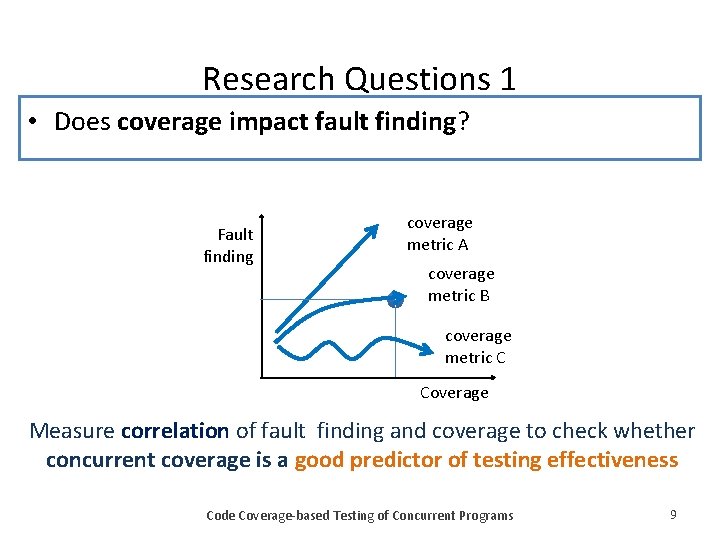
Research Questions 1 • Does coverage impact fault finding? Fault finding coverage metric A coverage metric B coverage metric C Coverage Measure correlation of fault finding and coverage to check whether concurrent coverage is a good predictor of testing effectiveness Code Coverage-based Testing of Concurrent Programs 9
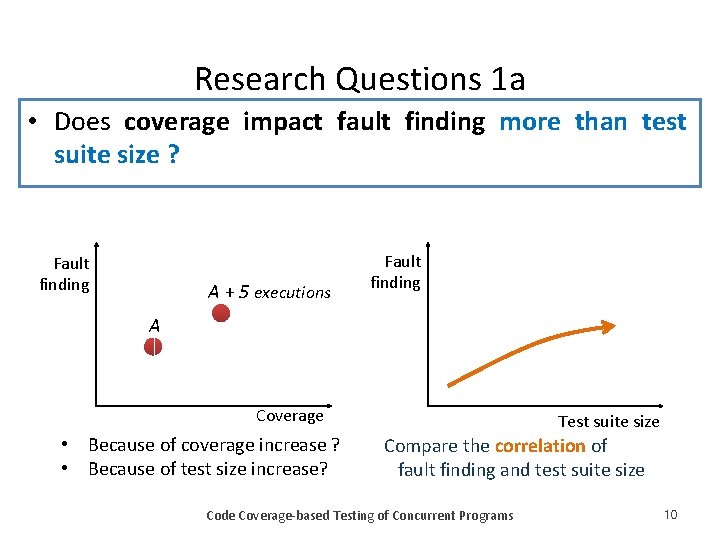
Research Questions 1 a • Does coverage impact fault finding more than test suite size ? Fault finding A + 5 executions Fault finding A Coverage • Because of coverage increase ? • Because of test size increase? Test suite size Compare the correlation of fault finding and test suite size Code Coverage-based Testing of Concurrent Programs 10
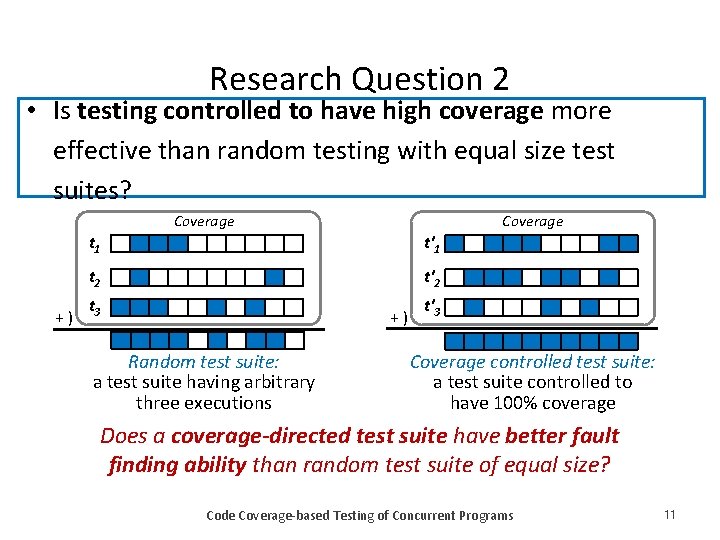
Research Question 2 • Is testing controlled to have high coverage more effective than random testing with equal size test suites? Coverage +) Coverage t 1 t'1 t 2 t'2 t 3 +) Random test suite: a test suite having arbitrary three executions t'3 Coverage controlled test suite: a test suite controlled to have 100% coverage Does a coverage-directed test suite have better fault finding ability than random test suite of equal size? Code Coverage-based Testing of Concurrent Programs 11
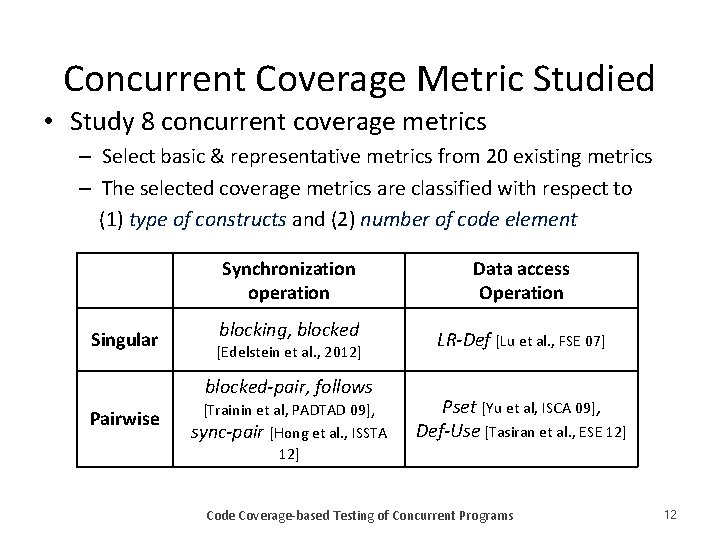
Concurrent Coverage Metric Studied • Study 8 concurrent coverage metrics – Select basic & representative metrics from 20 existing metrics – The selected coverage metrics are classified with respect to (1) type of constructs and (2) number of code element Singular Synchronization operation Data access Operation blocking, blocked LR-Def [Lu et al. , FSE 07] [Edelstein et al. , 2012] blocked-pair, follows Pairwise [Trainin et al, PADTAD 09], sync-pair [Hong et al. , ISSTA 12] Pset [Yu et al, ISCA 09], Def-Use [Tasiran et al. , ESE 12] Code Coverage-based Testing of Concurrent Programs 12
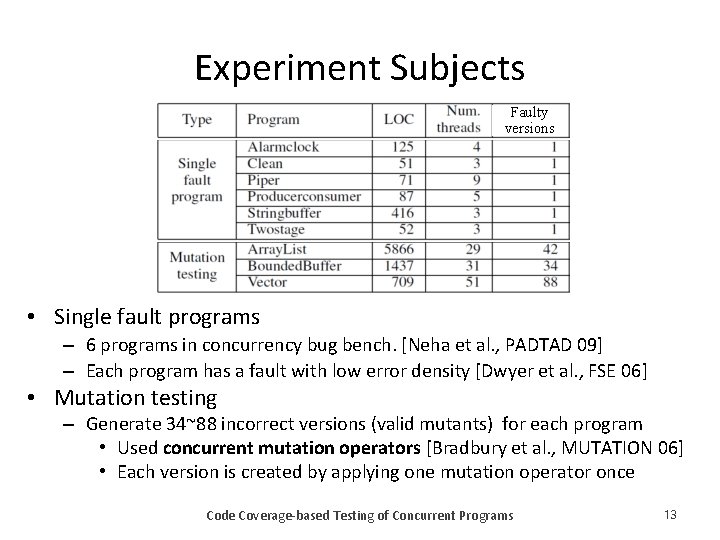
Experiment Subjects Faulty versions • Single fault programs – 6 programs in concurrency bug bench. [Neha et al. , PADTAD 09] – Each program has a fault with low error density [Dwyer et al. , FSE 06] • Mutation testing – Generate 34~88 incorrect versions (valid mutants) for each program • Used concurrent mutation operators [Bradbury et al. , MUTATION 06] • Each version is created by applying one mutation operator once Code Coverage-based Testing of Concurrent Programs 13
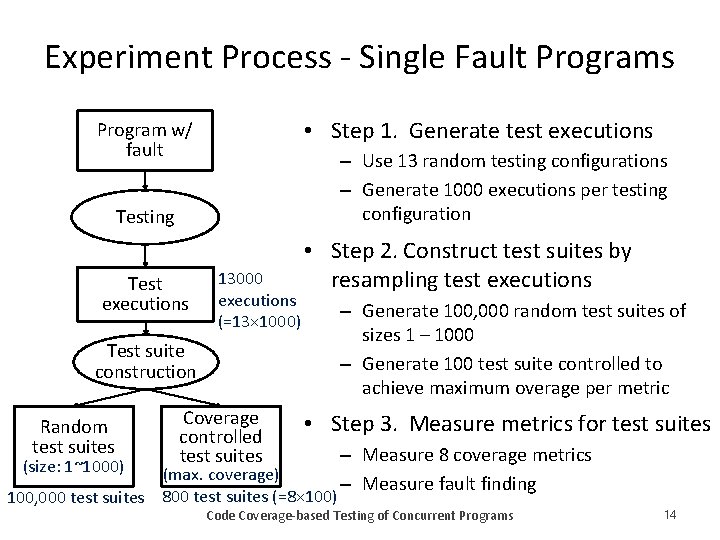
Experiment Process - Single Fault Programs • Step 1. Generate test executions Program w/ fault – Use 13 random testing configurations – Generate 1000 executions per testing configuration Testing Test executions 13000 executions (=13× 1000) • Step 2. Construct test suites by resampling test executions – Generate 100, 000 random test suites of sizes 1 – 1000 – Generate 100 test suite controlled to achieve maximum overage per metric Test suite construction Random test suites (size: 1~1000) Coverage controlled test suites • Step 3. Measure metrics for test suites (max. coverage) 100, 000 test suites 800 test suites (=8× 100) – Measure 8 coverage metrics – Measure fault finding Code Coverage-based Testing of Concurrent Programs 14
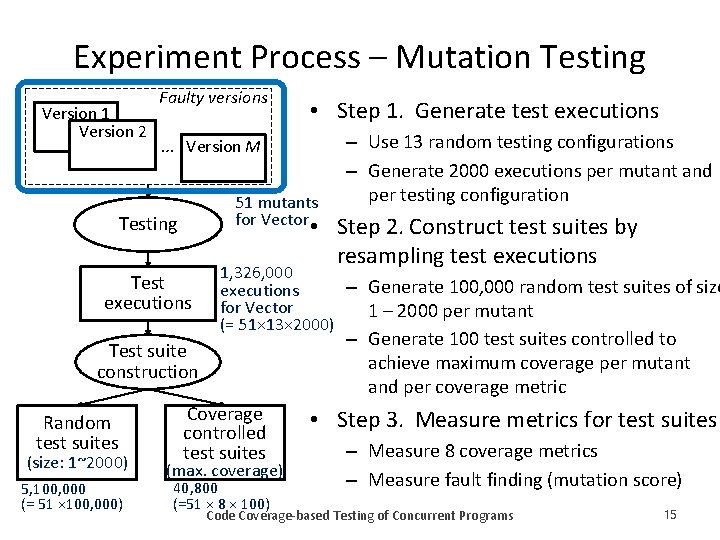
Experiment Process – Mutation Testing Version 1 Version 2 Faulty versions … Version M 51 mutants for Vector Test executions 1, 326, 000 – Generate 100, 000 random test suites of size executions for Vector 1 – 2000 per mutant (= 51× 13× 2000) – Generate 100 test suites controlled to achieve maximum coverage per mutant and per coverage metric Test suite construction (size: 1~2000) 5, 100, 000 (= 51 × 100, 000) – Use 13 random testing configurations – Generate 2000 executions per mutant and per testing configuration • Step 2. Construct test suites by resampling test executions Testing Random test suites • Step 1. Generate test executions Coverage controlled test suites (max. coverage) 40, 800 (=51 × 8 × 100) • Step 3. Measure metrics for test suites – Measure 8 coverage metrics – Measure fault finding (mutation score) Code Coverage-based Testing of Concurrent Programs 15
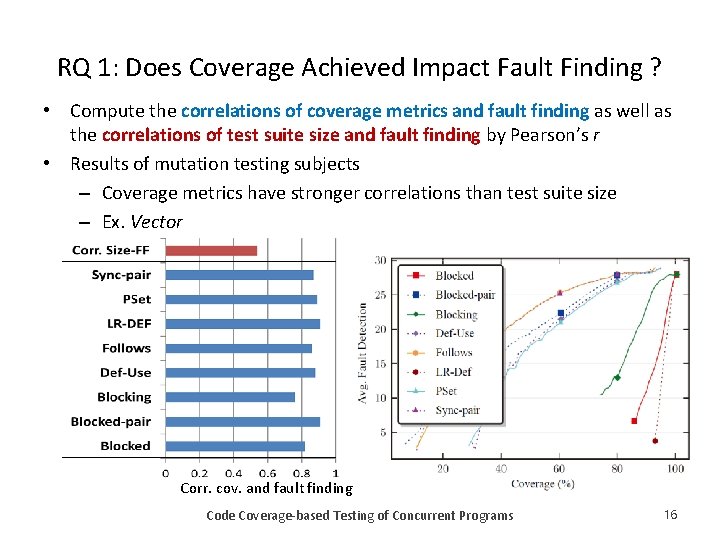
RQ 1: Does Coverage Achieved Impact Fault Finding ? • Compute the correlations of coverage metrics and fault finding as well as the correlations of test suite size and fault finding by Pearson’s r • Results of mutation testing subjects – Coverage metrics have stronger correlations than test suite size – Ex. Vector Corr. cov. and fault finding Code Coverage-based Testing of Concurrent Programs 16
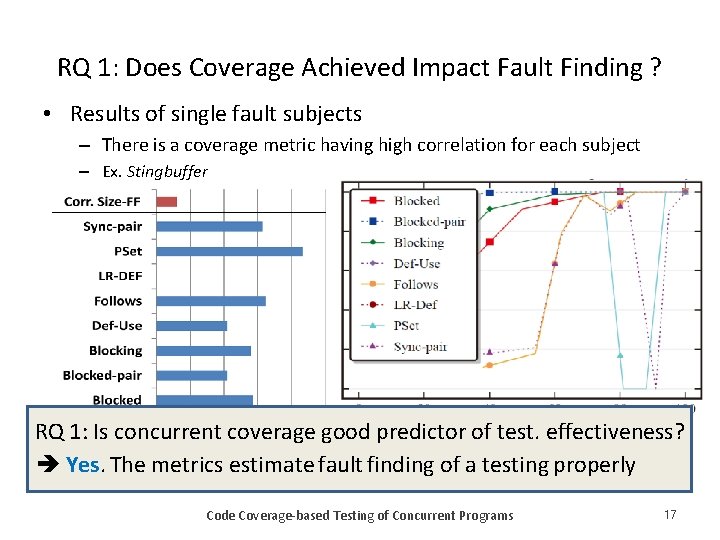
RQ 1: Does Coverage Achieved Impact Fault Finding ? • Results of single fault subjects – There is a coverage metric having high correlation for each subject – Ex. Stingbuffer RQ 1: Is concurrent coverage effectiveness? Corr. cov. and fault finding good predictor Corr. of cov. test. and fault finding Yes. The metrics estimate fault finding of a testing properly Code Coverage-based Testing of Concurrent Programs 17
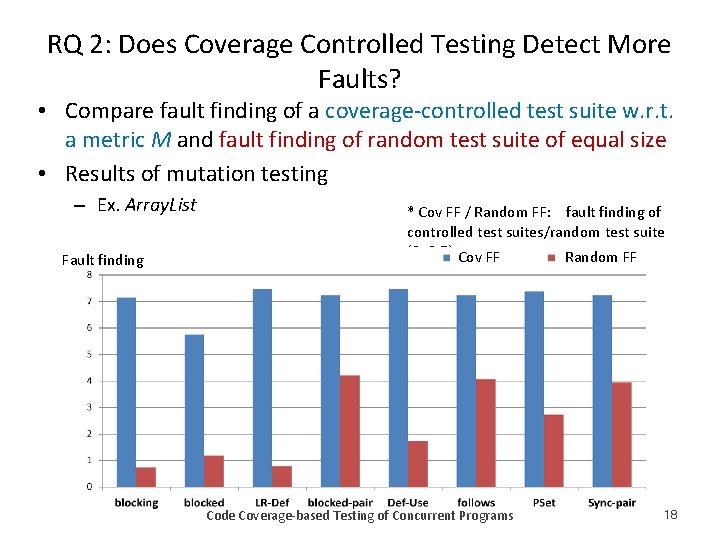
RQ 2: Does Coverage Controlled Testing Detect More Faults? • Compare fault finding of a coverage-controlled test suite w. r. t. a metric M and fault finding of random test suite of equal size • Results of mutation testing – Ex. Array. List Fault finding * Cov FF / Random FF: fault finding of controlled test suites/random test suite (0~8. 5) Cov FF Random FF Code Coverage-based Testing of Concurrent Programs 18
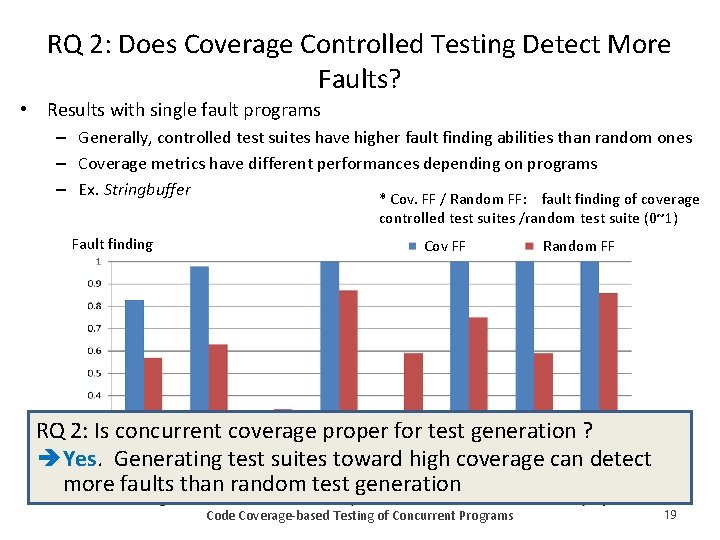
RQ 2: Does Coverage Controlled Testing Detect More Faults? • Results with single fault programs – Generally, controlled test suites have higher fault finding abilities than random ones – Coverage metrics have different performances depending on programs – Ex. Stringbuffer * Cov. FF / Random FF: fault finding of coverage controlled test suites /random test suite (0~1) Fault finding Cov FF Random FF RQ 2: Is concurrent coverage proper for test generation ? Yes. Generating test suites toward high coverage can detect more faults than random test generation Code Coverage-based Testing of Concurrent Programs 19
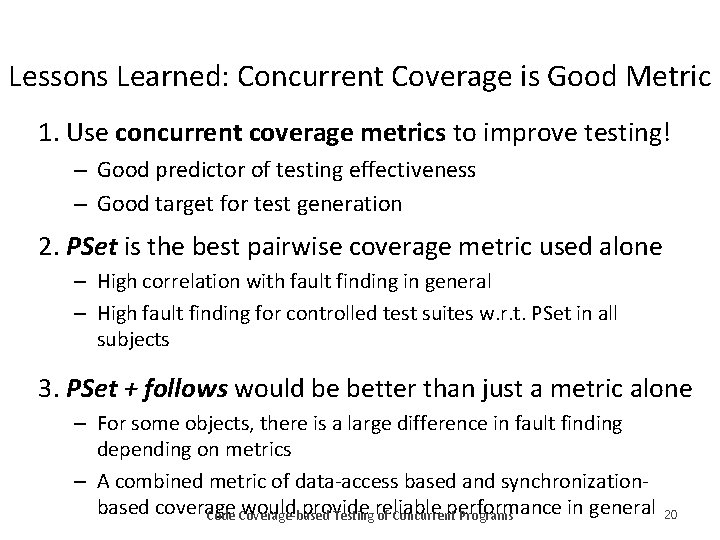
Lessons Learned: Concurrent Coverage is Good Metric 1. Use concurrent coverage metrics to improve testing! – Good predictor of testing effectiveness – Good target for test generation 2. PSet is the best pairwise coverage metric used alone – High correlation with fault finding in general – High fault finding for controlled test suites w. r. t. PSet in all subjects 3. PSet + follows would be better than just a metric alone – For some objects, there is a large difference in fault finding depending on metrics – A combined metric of data-access based and synchronizationbased coverage would provide performance in general Code Coverage-based Testing reliable of Concurrent Programs 20
Part II. Testing Concurrent Programs to Achieve High Synchronization Coverage Code Coverage-based Testing of Concurrent Programs 21
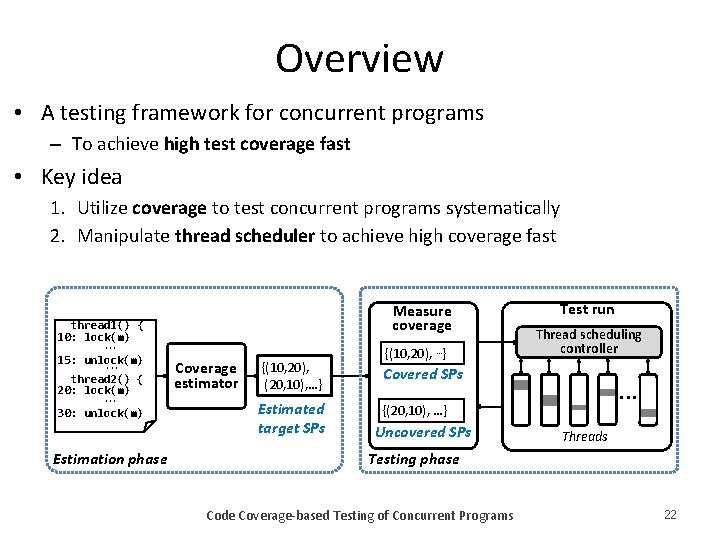
Overview • A testing framework for concurrent programs – To achieve high test coverage fast • Key idea 1. Utilize coverage to test concurrent programs systematically 2. Manipulate thread scheduler to achieve high coverage fast Measure coverage thread 1() { 10: lock(m). . . 15: unlock(m). . . thread 2() { 20: lock(m). . . 30: unlock(m) Estimation phase Coverage estimator {(10, 20), …} {(10, 20), (20, 10), …} Covered SPs Estimated target SPs {(20, 10), …} Uncovered SPs Test run Thread scheduling controller Threads Testing phase Code Coverage-based Testing of Concurrent Programs 22
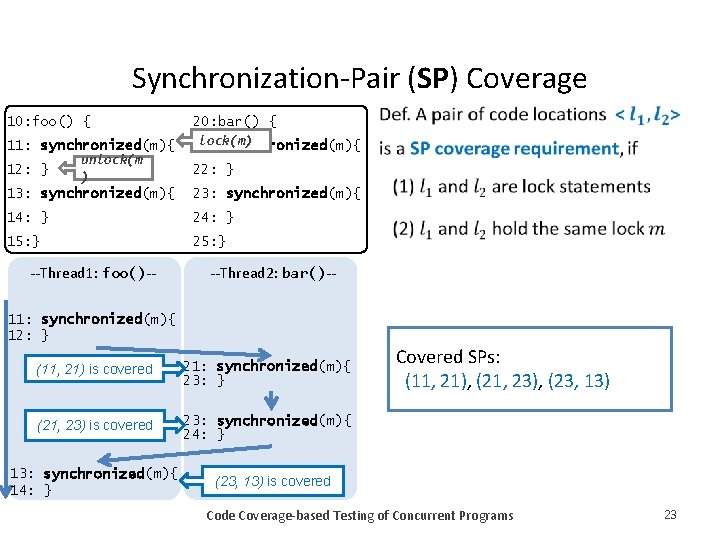
10: foo() { Synchronization-Pair (SP) Coverage • 20: bar() { 11: synchronized(m){ unlock(m 12: } ) 13: synchronized(m){ lock(m) 21: synchronized(m){ 14: } 24: } 15: } 25: } --Thread 1: foo()-- 22: } 23: synchronized(m){ --Thread 2: bar()-- 11: synchronized(m){ 12: } (11, 21) is covered 21: synchronized(m){ 23: } (21, 23) is covered 23: synchronized(m){ 24: } 13: synchronized(m){ 14: } Covered SPs: (11, 21), (21, 23), (23, 13) is covered Code Coverage-based Testing of Concurrent Programs 23
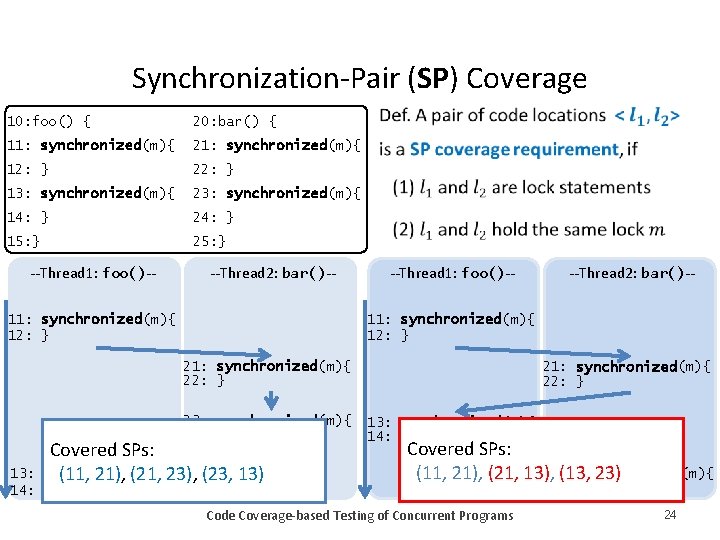
10: foo() { Synchronization-Pair (SP) Coverage • 20: bar() { 11: synchronized(m){ 21: synchronized(m){ 12: } 22: } 13: synchronized(m){ 23: synchronized(m){ 14: } 24: } 15: } 25: } --Thread 1: foo()-- --Thread 2: bar()-- 11: synchronized(m){ 12: } --Thread 1: foo()-11: synchronized(m){ 12: } 21: synchronized(m){ 22: } 23: synchronized(m){ 24: } Covered SPs: synchronized(m){ (11, 21), (21, 23), (23, 13) 13: 14: } --Thread 2: bar()-- 21: synchronized(m){ 22: } 13: synchronized(m){ 14: } Covered SPs: synchronized(m){ (11, 21), (21, 13), 23: (13, 23) Code Coverage-based Testing of Concurrent Programs 24: } 24
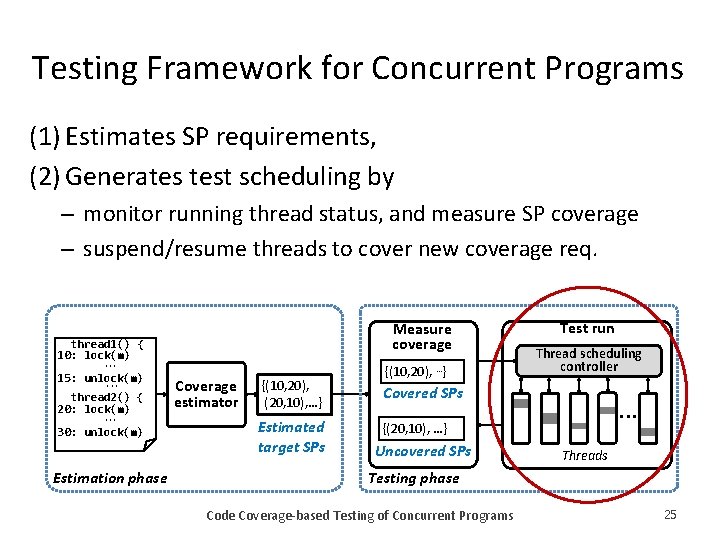
Testing Framework for Concurrent Programs (1) Estimates SP requirements, (2) Generates test scheduling by – monitor running thread status, and measure SP coverage – suspend/resume threads to cover new coverage req. Measure coverage thread 1() { 10: lock(m). . . 15: unlock(m). . . thread 2() { 20: lock(m). . . 30: unlock(m) Estimation phase Coverage estimator {(10, 20), …} {(10, 20), (20, 10), …} Covered SPs Estimated target SPs {(20, 10), …} Uncovered SPs Test run Thread scheduling controller Threads Testing phase Code Coverage-based Testing of Concurrent Programs 25
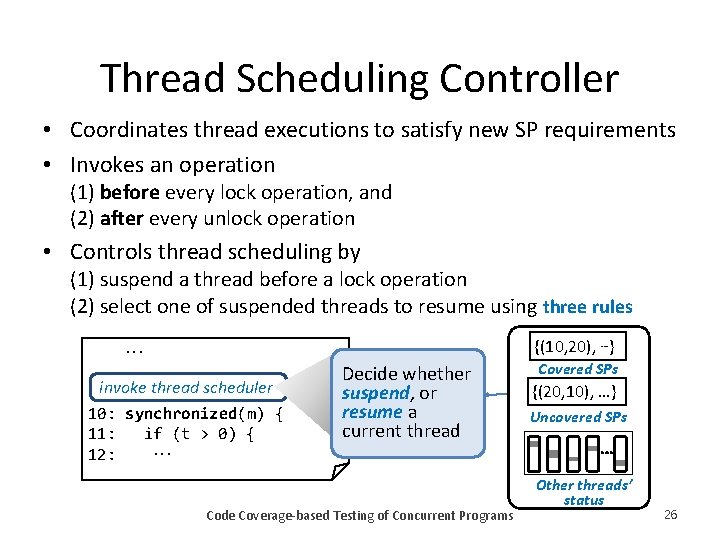
Thread Scheduling Controller • Coordinates thread executions to satisfy new SP requirements • Invokes an operation (1) before every lock operation, and (2) after every unlock operation • Controls thread scheduling by (1) suspend a thread before a lock operation (2) select one of suspended threads to resume using three rules {(10, 20), …} . . . invoke thread scheduler 10: synchronized(m) { 11: if (t > 0) {. . . 12: Decide whether suspend, or resume a current thread Code Coverage-based Testing of Concurrent Programs Covered SPs {(20, 10), …} Uncovered SPs Other threads’ status 26
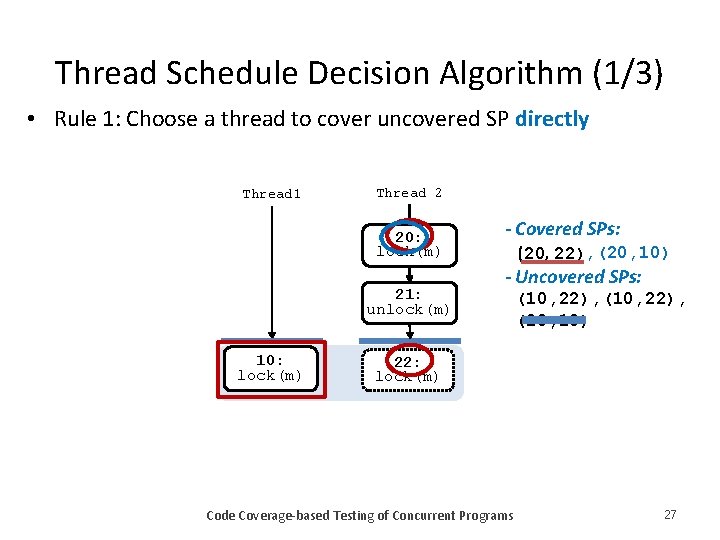
Thread Schedule Decision Algorithm (1/3) • Rule 1: Choose a thread to cover uncovered SP directly Thread 1 Thread 2 20: lock(m) 21: unlock(m) 10: lock(m) - Covered SPs: (20, 22), (20, 10) - Uncovered SPs: (10, 22), (20, 10) 22: lock(m) Code Coverage-based Testing of Concurrent Programs 27
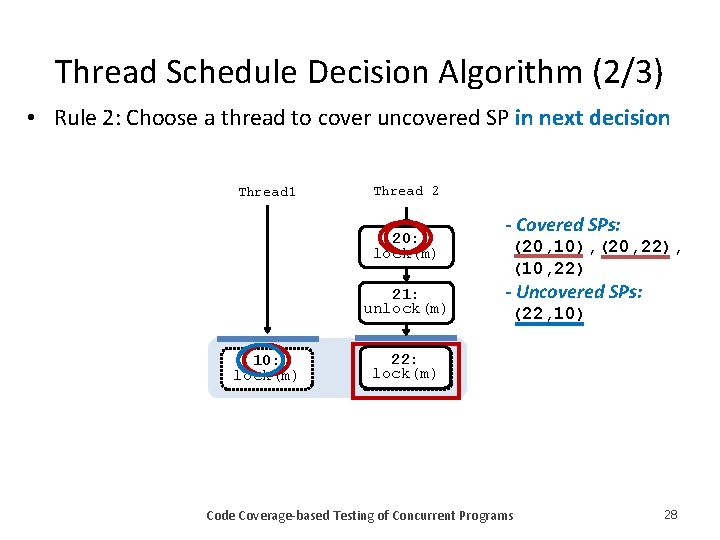
Thread Schedule Decision Algorithm (2/3) • Rule 2: Choose a thread to cover uncovered SP in next decision Thread 1 Thread 2 20: lock(m) 21: unlock(m) 10: lock(m) - Covered SPs: (20, 10), (20, 22), (10, 22) - Uncovered SPs: (22, 10) 22: lock(m) Code Coverage-based Testing of Concurrent Programs 28
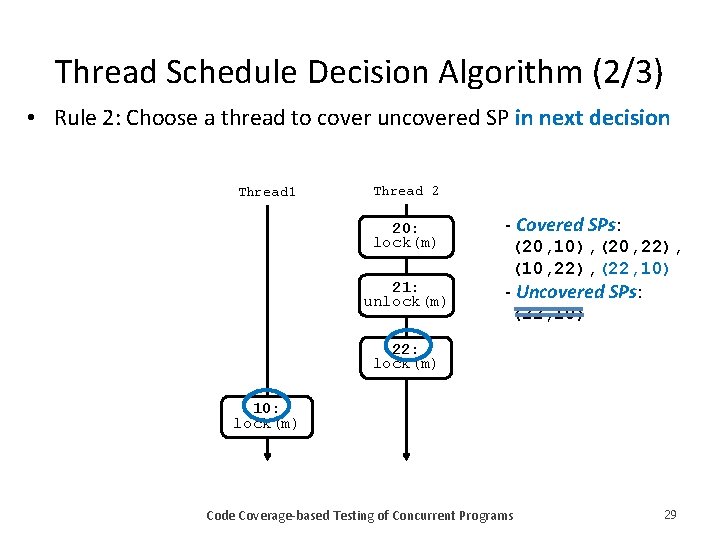
Thread Schedule Decision Algorithm (2/3) • Rule 2: Choose a thread to cover uncovered SP in next decision Thread 1 Thread 2 20: lock(m) 21: 25: unlock(m) - Covered SPs: (20, 10), (20, 22), (10, 22), (22, 10) - Uncovered SPs: (22, 10) 22: lock(m) 10: lock(m) Code Coverage-based Testing of Concurrent Programs 29
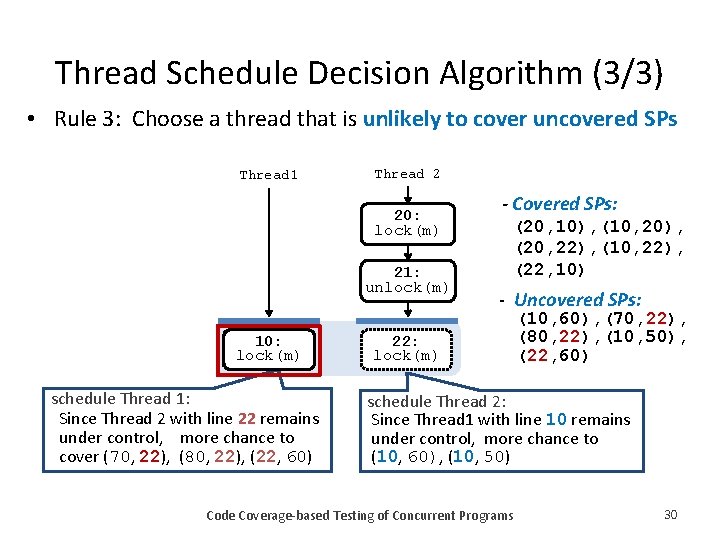
Thread Schedule Decision Algorithm (3/3) • Rule 3: Choose a thread that is unlikely to cover uncovered SPs Thread 1 Thread 2 20: lock(m) 21: unlock(m) 10: lock(m) schedule Thread 1: Since Thread 2 with line 22 remains under control, more chance to cover (70, 22), (80, 22), (22, 60) - Covered SPs: (20, 10), (10, 20), (20, 22), (10, 22), (22, 10) - Uncovered SPs: 22: lock(m) (10, 60), (70, 22), (80, 22), (10, 50), (22, 60) schedule Thread 2: Since Thread 1 with line 10 remains under control, more chance to (10, 60), (10, 50) Code Coverage-based Testing of Concurrent Programs 30
![Empirical Evaluation • Implementation [Thread Scheduling Algorithm, TSA] – Used Soot for estimation phase](http://slidetodoc.com/presentation_image_h2/f0302ff48cda092ec254ad4972a7a81b/image-31.jpg "Empirical Evaluation • Implementation [Thread Scheduling Algorithm, TSA] – Used Soot for estimation phase")
Empirical Evaluation • Implementation [Thread Scheduling Algorithm, TSA] – Used Soot for estimation phase – Extended Cal. Fuzzer 1. 0 for testing phase – Built in Java (about 2 KLOC) • Subjects – 7 Java library benchmarks (e. g. Vector, Hash. Table, etc. ) (< 11 KLOC) – 3 Java server programs (cache 4 j, pool, VFS) (< 23 KLOC) Code Coverage-based Testing of Concurrent Programs 31
Empirical Evaluation • Compared techniques – We compared TSA to random testing – We inserted probes at every read, write, and lock operations – Each probe makes a time-delay d with probability p • d: sleep(1 ms), sleep(1~10 ms), sleep (1~100 ms) • p : 0. 1, 0. 2, 0. 3, 0. 4, 0. 5 – We use 15 (= 3 x 5) different versions of random testing • Experiment setup – Executed the program 500 times for each technique – Measured accumulated coverage and time cost – Repeated the experiment 30 times for statistical significance in results Code Coverage-based Testing of Concurrent Programs 32
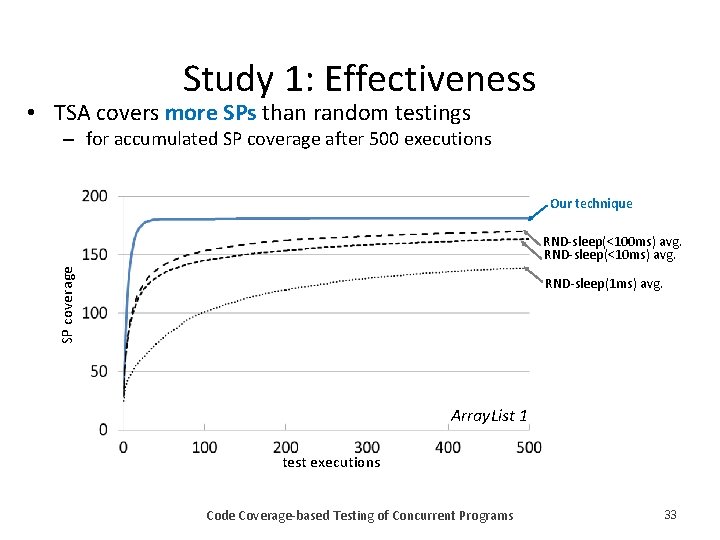
Study 1: Effectiveness • TSA covers more SPs than random testings – for accumulated SP coverage after 500 executions Our technique SP coverage RND-sleep(<100 ms) avg. RND-sleep(<10 ms) avg. RND-sleep(1 ms) avg. Array. List 1 test executions Code Coverage-based Testing of Concurrent Programs 33
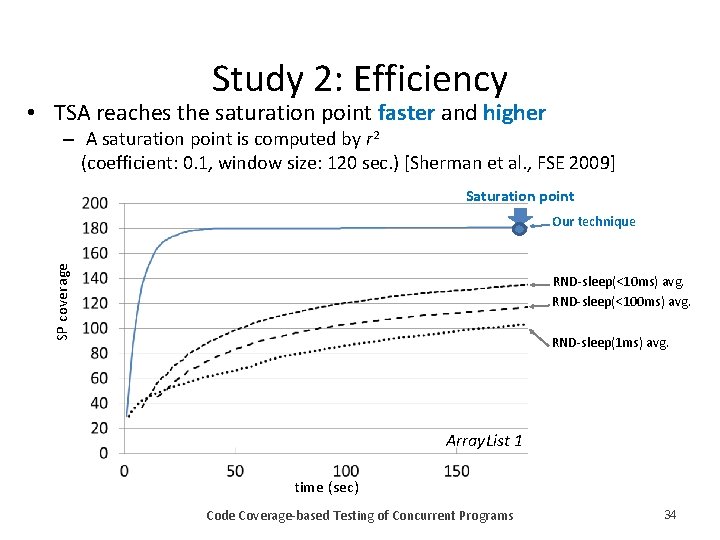
Study 2: Efficiency • TSA reaches the saturation point faster and higher – A saturation point is computed by r 2 (coefficient: 0. 1, window size: 120 sec. ) [Sherman et al. , FSE 2009] Saturation point SP coverage Our technique RND-sleep(<10 ms) avg. RND-sleep(<100 ms) avg. RND-sleep(1 ms) avg. Array. List 1 time (sec) Code Coverage-based Testing of Concurrent Programs 34
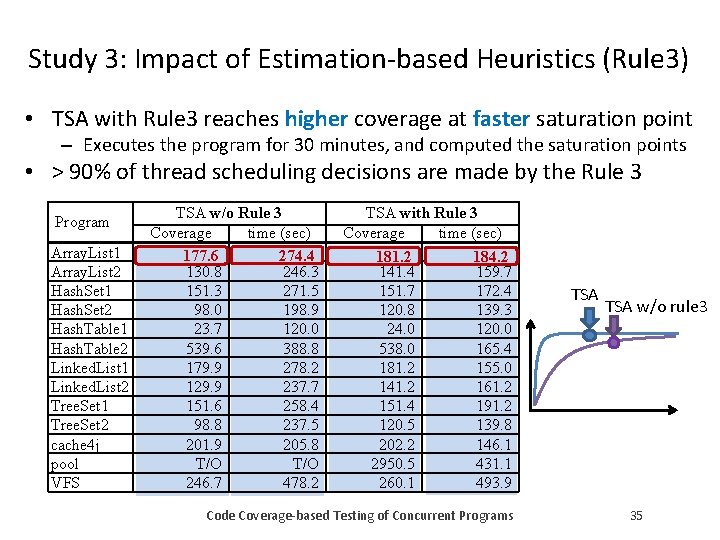
Study 3: Impact of Estimation-based Heuristics (Rule 3) • TSA with Rule 3 reaches higher coverage at faster saturation point – Executes the program for 30 minutes, and computed the saturation points • > 90% of thread scheduling decisions are made by the Rule 3 Program Array. List 1 Array. List 2 Hash. Set 1 Hash. Set 2 Hash. Table 1 Hash. Table 2 Linked. List 1 Linked. List 2 Tree. Set 1 Tree. Set 2 cache 4 j pool VFS TSA w/o Rule 3 Coverage time (sec) 177. 6 274. 4 177. 6 130. 8 246. 3 151. 3 271. 5 98. 0 198. 9 23. 7 120. 0 539. 6 388. 8 179. 9 278. 2 129. 9 237. 7 151. 6 258. 4 98. 8 237. 5 201. 9 205. 8 T/O 246. 7 478. 2 TSA with Rule 3 Coverage time (sec) 181. 2 184. 2 141. 4 159. 7 151. 7 172. 4 120. 8 139. 3 24. 0 120. 0 538. 0 165. 4 181. 2 155. 0 141. 2 161. 2 151. 4 191. 2 120. 5 139. 8 202. 2 146. 1 2950. 5 431. 1 260. 1 493. 9 Code Coverage-based Testing of Concurrent Programs TSA w/o rule 3 35
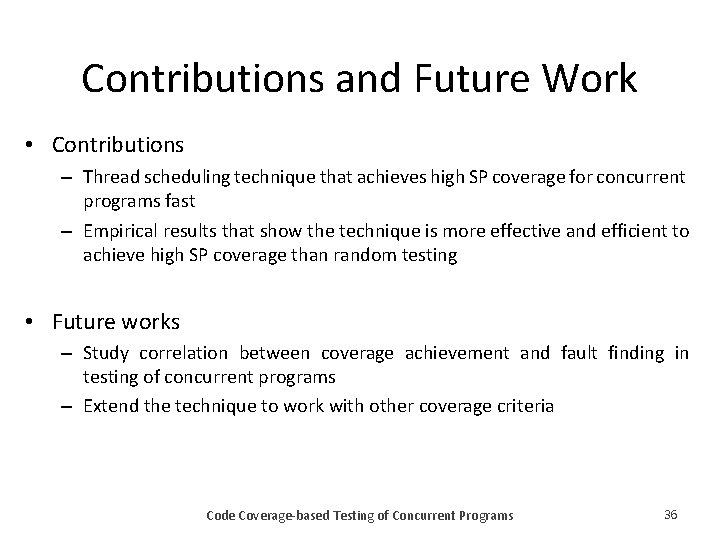
Contributions and Future Work • Contributions – Thread scheduling technique that achieves high SP coverage for concurrent programs fast – Empirical results that show the technique is more effective and efficient to achieve high SP coverage than random testing • Future works – Study correlation between coverage achievement and fault finding in testing of concurrent programs – Extend the technique to work with other coverage criteria Code Coverage-based Testing of Concurrent Programs 36
- Slides: 36