
CS 4803 7643 Deep Learning Topics Variational AutoEncoders





- Slides: 85
CS 4803 / 7643: Deep Learning Topics: – Variational Auto-Encoders (VAEs) – Reparameterization trick – Generative Adversarial Networks (GANs) Dhruv Batra Georgia Tech
Administrativia • Project submission instructions released – – Due: 12/04, 11: 55 pm Last deliverable in the class Can’t use late days https: //piazza. com/class/jkujs 03 pgu 75 cd? cid=225 (C) Dhruv Batra 2
Recap from last time (C) Dhruv Batra 3
Variational Autoencoders (VAE)
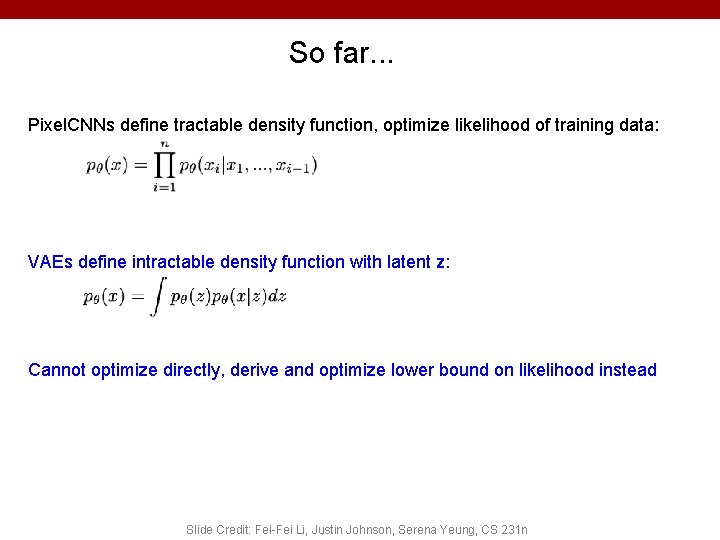
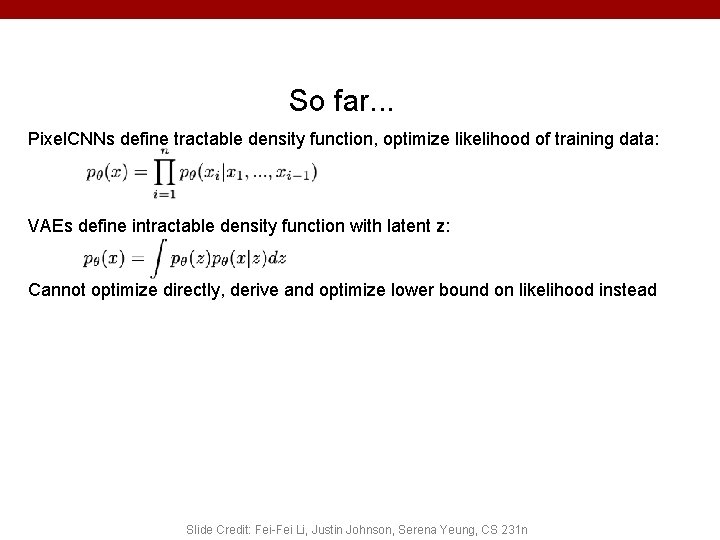
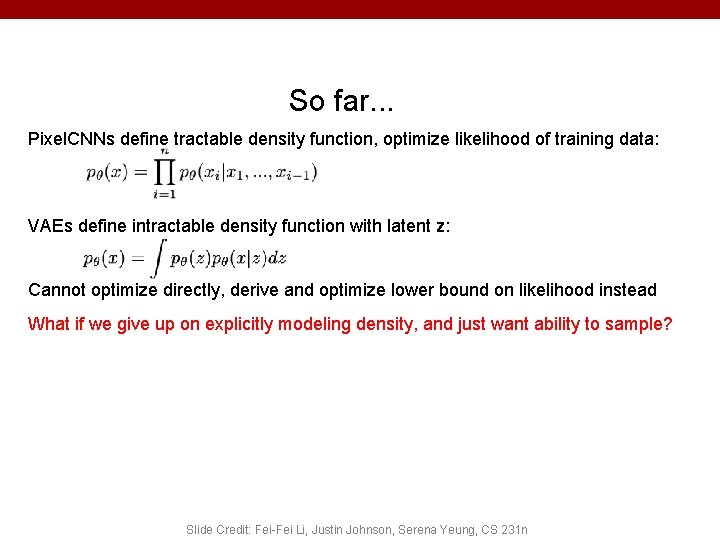
So far. . . Pixel. CNNs define tractable density function, optimize likelihood of training data: VAEs define intractable density function with latent z: Cannot optimize directly, derive and optimize lower bound on likelihood instead Slide Credit: Fei-Fei Li, Justin Johnson, Serena Yeung, CS 231 n
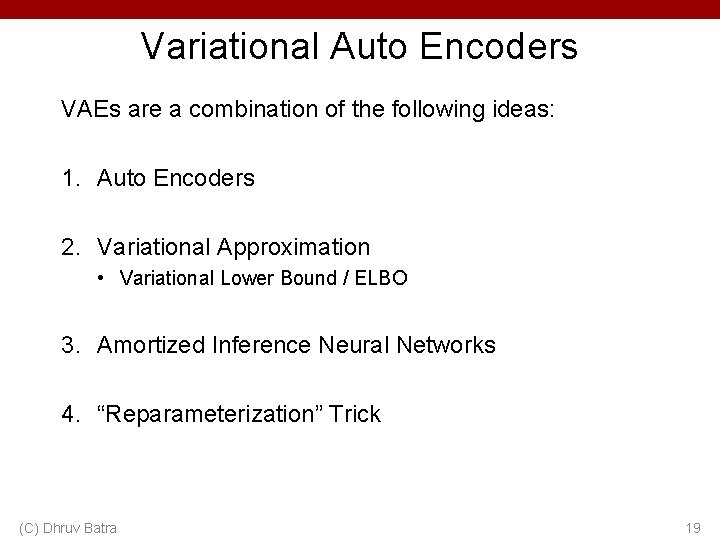
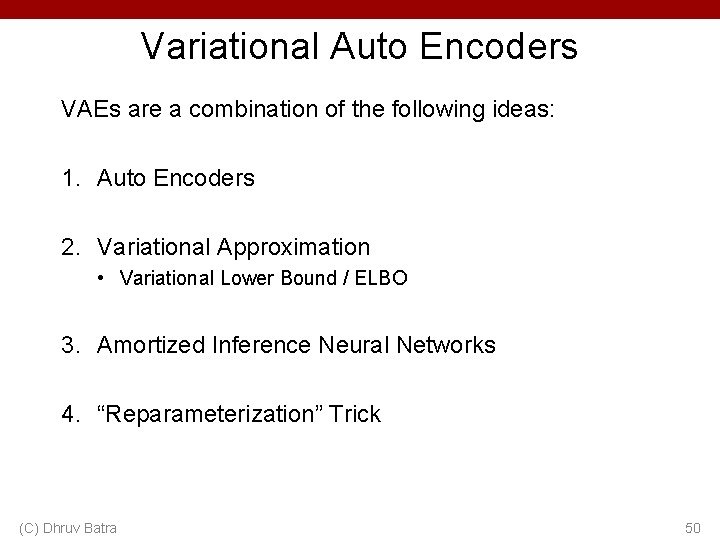
Variational Auto Encoders VAEs are a combination of the following ideas: 1. Auto Encoders 2. Variational Approximation • Variational Lower Bound / ELBO 3. Amortized Inference Neural Networks 4. “Reparameterization” Trick (C) Dhruv Batra 6
Autoencoders Reconstructed data Train such that features can be used to reconstruct original data L 2 Loss function: Reconstructed input data Encoder: 4 -layer conv Decoder: 4 -layer upconv Decoder Features Encoder Input data Slide Credit: Fei-Fei Li, Justin Johnson, Serena Yeung, CS 231 n Input data
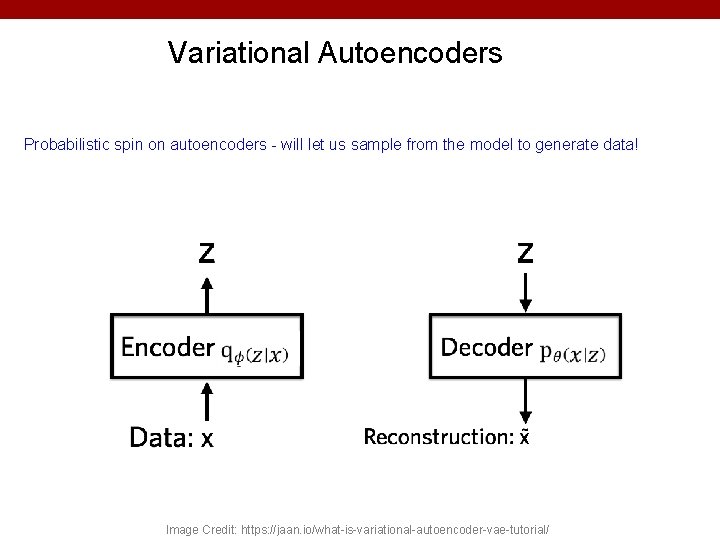
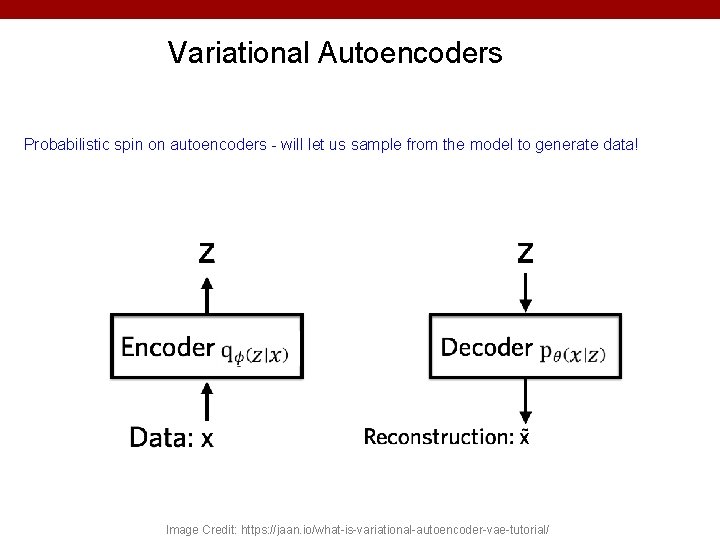
Variational Autoencoders Probabilistic spin on autoencoders - will let us sample from the model to generate data! Image Credit: https: //jaan. io/what-is-variational-autoencoder-vae-tutorial/
Variational Auto Encoders VAEs are a combination of the following ideas: 1. Auto Encoders 2. Variational Approximation • Variational Lower Bound / ELBO 3. Amortized Inference Neural Networks 4. “Reparameterization” Trick (C) Dhruv Batra 9
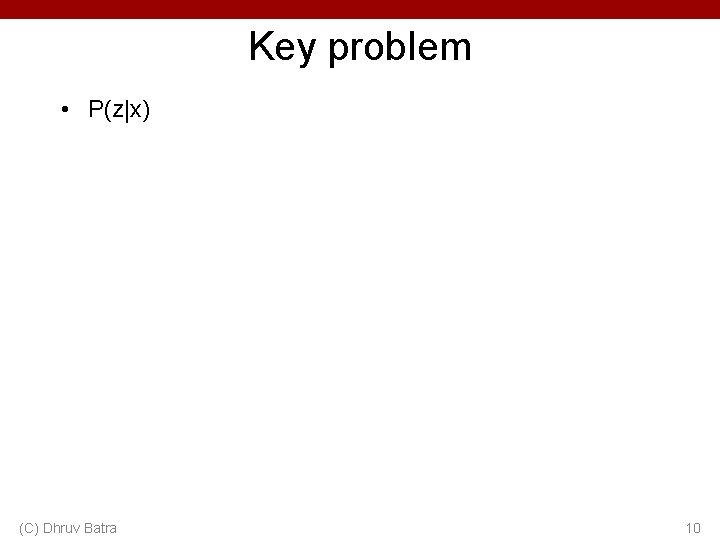
Key problem • P(z|x) (C) Dhruv Batra 10
What is Variational Inference? • Key idea – Reality is complex – Can we approximate it with something “simple”? – Just need to make sure the simple thing is “close” to the complex thing. (C) Dhruv Batra 11
Intuition (C) Dhruv Batra 12
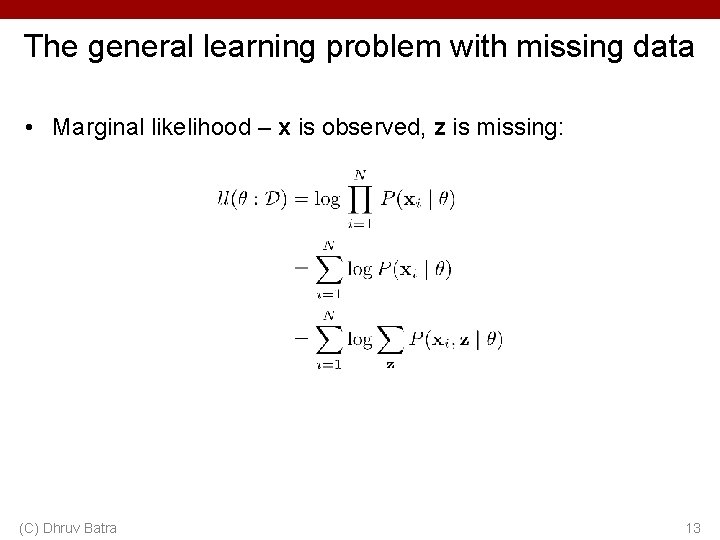
The general learning problem with missing data • Marginal likelihood – x is observed, z is missing: (C) Dhruv Batra 13
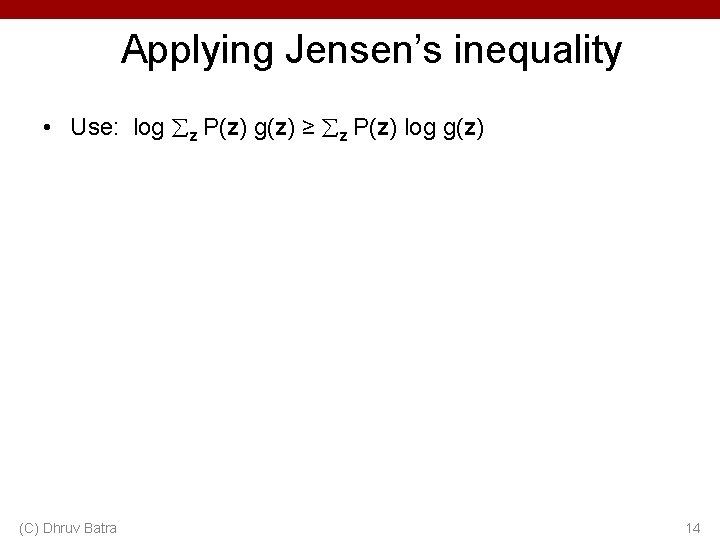
Applying Jensen’s inequality • Use: log z P(z) g(z) ≥ z P(z) log g(z) (C) Dhruv Batra 14
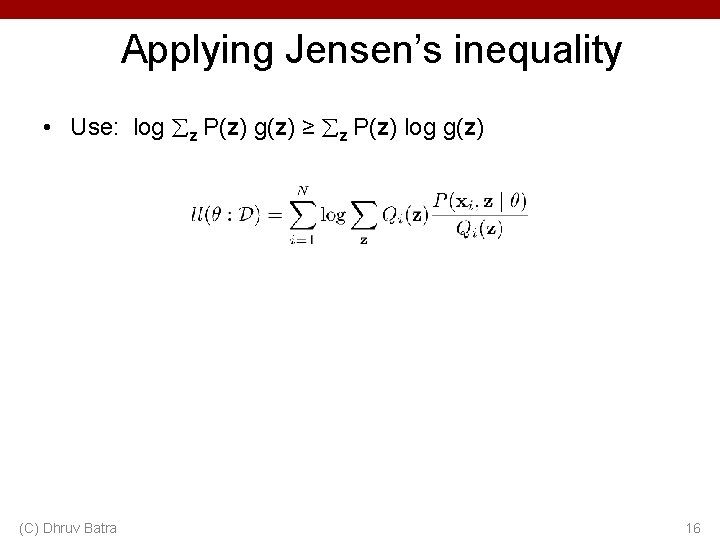
Applying Jensen’s inequality • Use: log z P(z) g(z) ≥ z P(z) log g(z) (C) Dhruv Batra 15
Applying Jensen’s inequality • Use: log z P(z) g(z) ≥ z P(z) log g(z) (C) Dhruv Batra 16
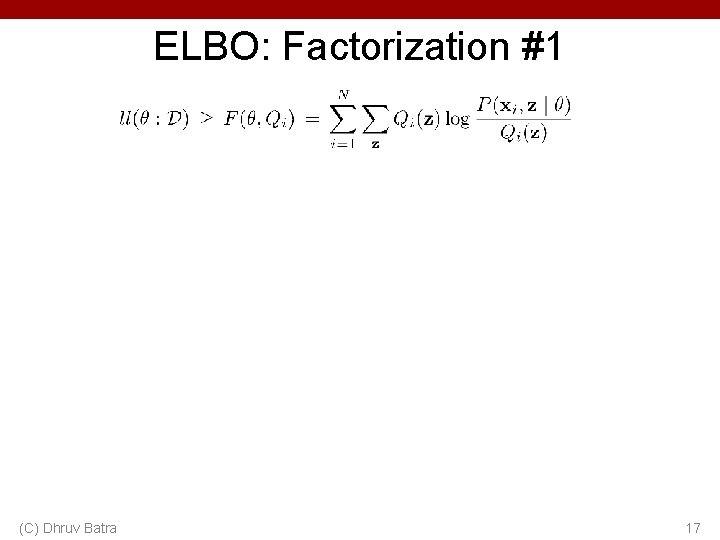
ELBO: Factorization #1 (C) Dhruv Batra 17
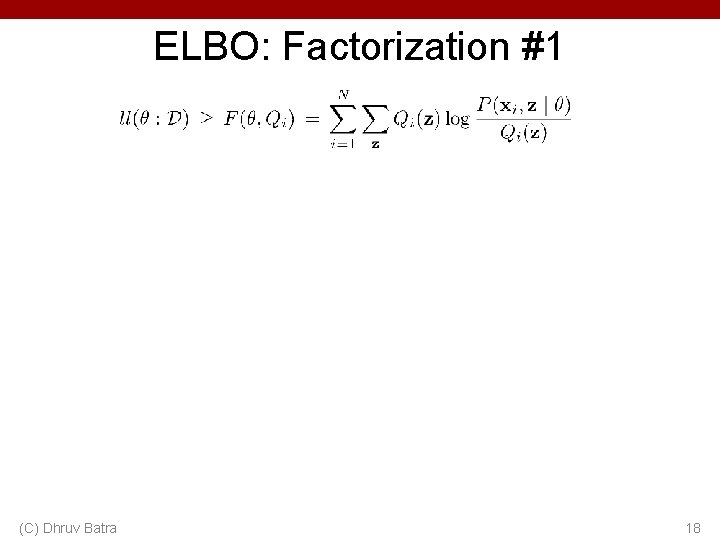
ELBO: Factorization #1 (C) Dhruv Batra 18
Variational Auto Encoders VAEs are a combination of the following ideas: 1. Auto Encoders 2. Variational Approximation • Variational Lower Bound / ELBO 3. Amortized Inference Neural Networks 4. “Reparameterization” Trick (C) Dhruv Batra 19
Amortized Inference Neural Networks (C) Dhruv Batra 20
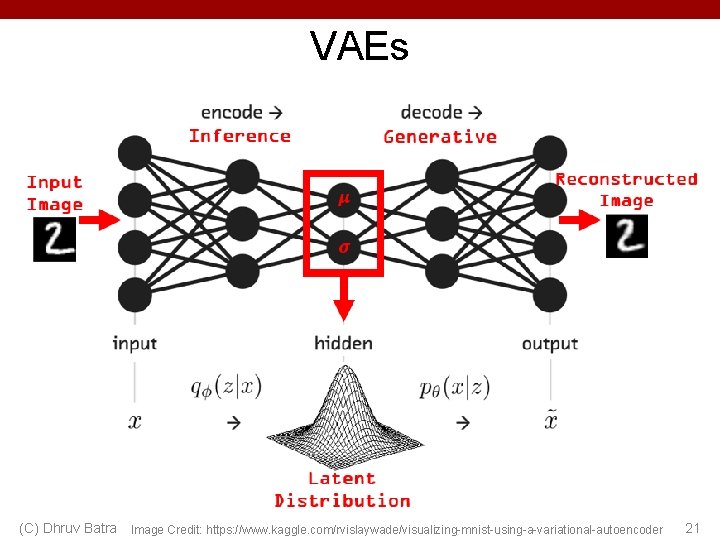
VAEs (C) Dhruv Batra Image Credit: https: //www. kaggle. com/rvislaywade/visualizing-mnist-using-a-variational-autoencoder 21
Variational Autoencoders Probabilistic spin on autoencoders - will let us sample from the model to generate data! Image Credit: https: //jaan. io/what-is-variational-autoencoder-vae-tutorial/
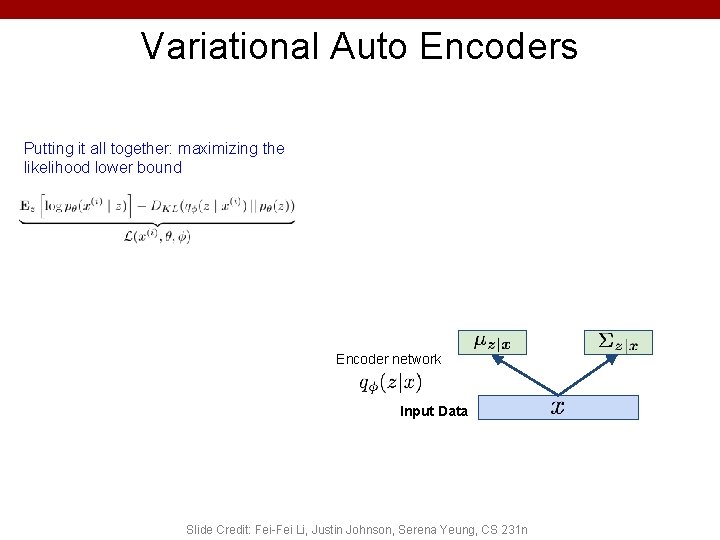
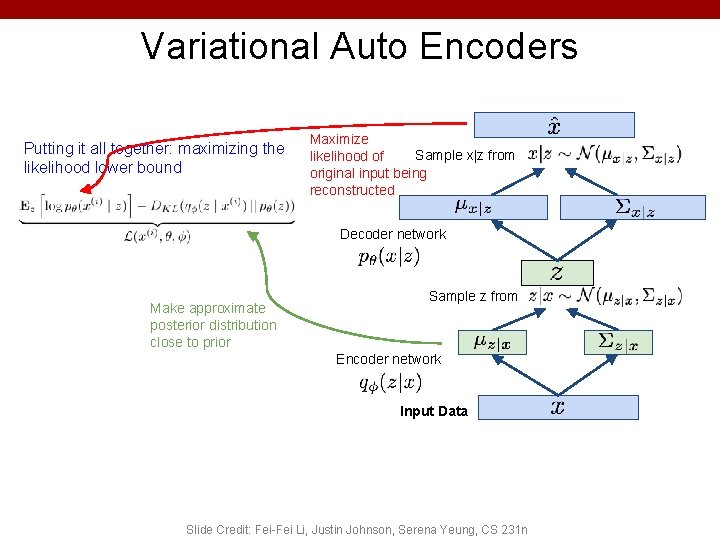
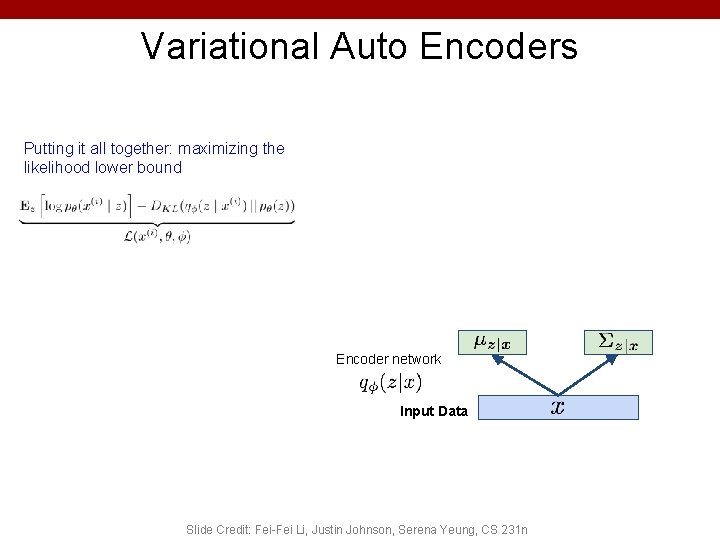
Variational Auto Encoders Putting it all together: maximizing the likelihood lower bound Encoder network Input Data Slide Credit: Fei-Fei Li, Justin Johnson, Serena Yeung, CS 231 n
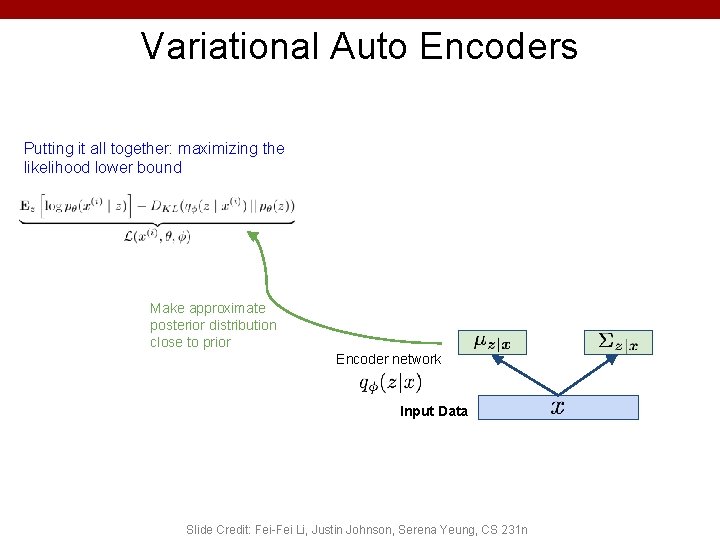
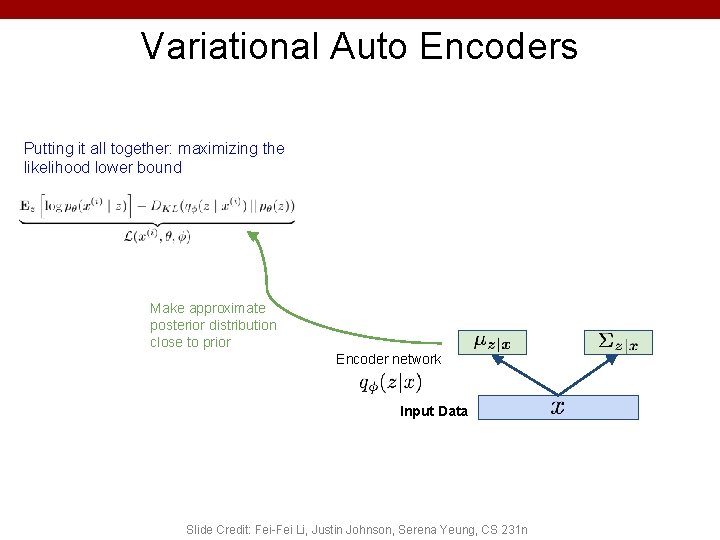
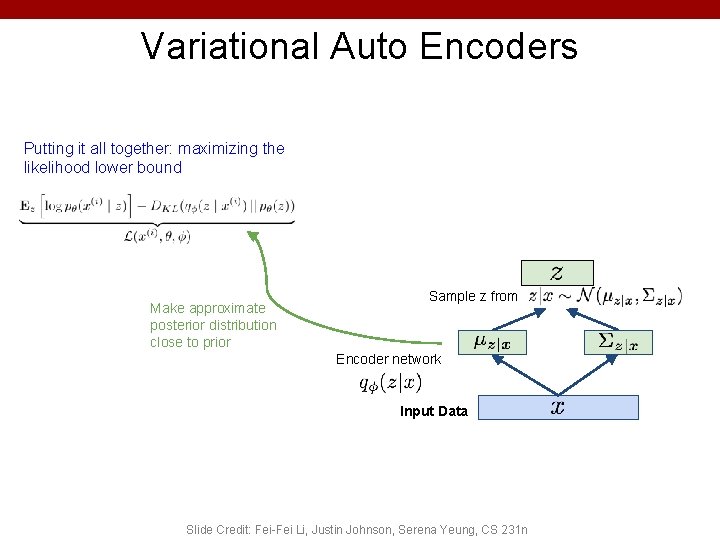
Variational Auto Encoders Putting it all together: maximizing the likelihood lower bound Make approximate posterior distribution close to prior Encoder network Input Data Slide Credit: Fei-Fei Li, Justin Johnson, Serena Yeung, CS 231 n
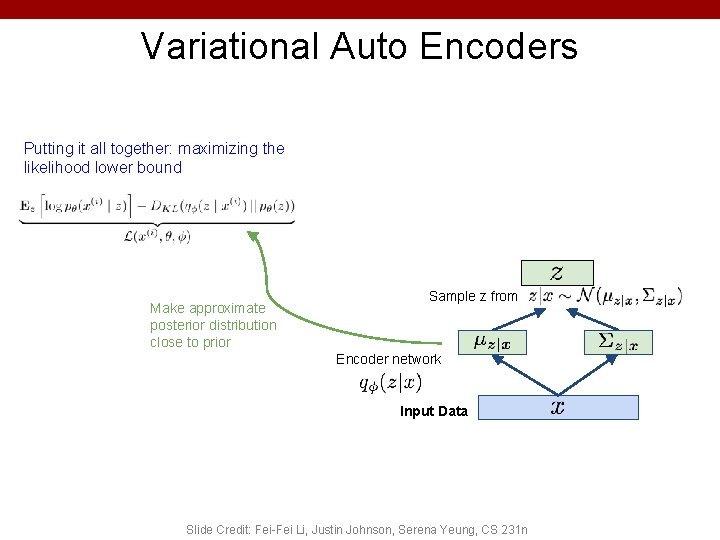
Variational Auto Encoders Putting it all together: maximizing the likelihood lower bound Make approximate posterior distribution close to prior Sample z from Encoder network Input Data Slide Credit: Fei-Fei Li, Justin Johnson, Serena Yeung, CS 231 n
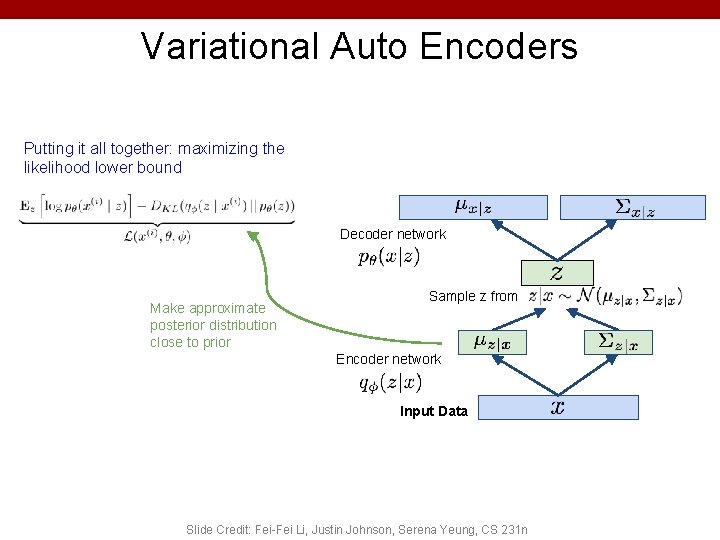
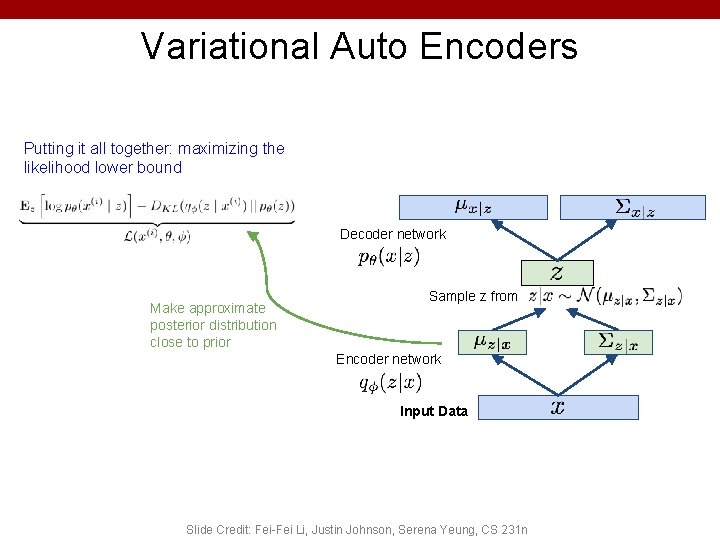
Variational Auto Encoders Putting it all together: maximizing the likelihood lower bound Decoder network Make approximate posterior distribution close to prior Sample z from Encoder network Input Data Slide Credit: Fei-Fei Li, Justin Johnson, Serena Yeung, CS 231 n
Variational Auto Encoders Putting it all together: maximizing the likelihood lower bound Maximize Sample x|z from likelihood of original input being reconstructed Decoder network Make approximate posterior distribution close to prior Sample z from Encoder network Input Data Slide Credit: Fei-Fei Li, Justin Johnson, Serena Yeung, CS 231 n
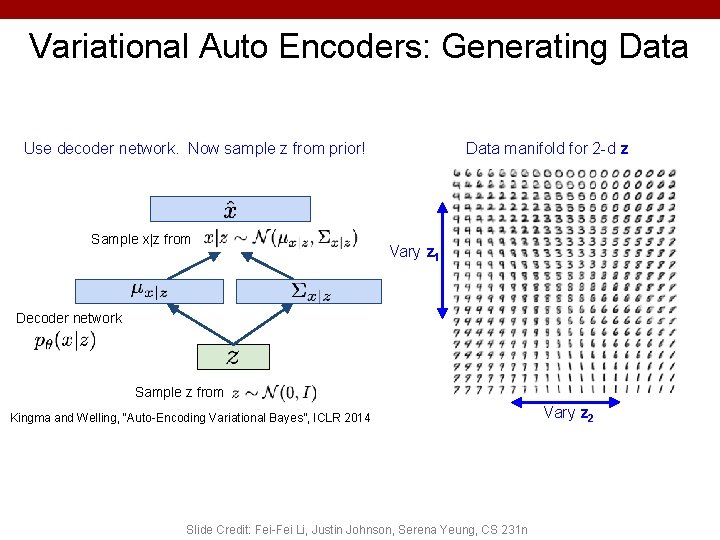
Variational Auto Encoders: Generating Data Use decoder network. Now sample z from prior! Sample x|z from Data manifold for 2 -d z Vary z 1 Decoder network Sample z from Kingma and Welling, “Auto-Encoding Variational Bayes”, ICLR 2014 Slide Credit: Fei-Fei Li, Justin Johnson, Serena Yeung, CS 231 n Vary z 2
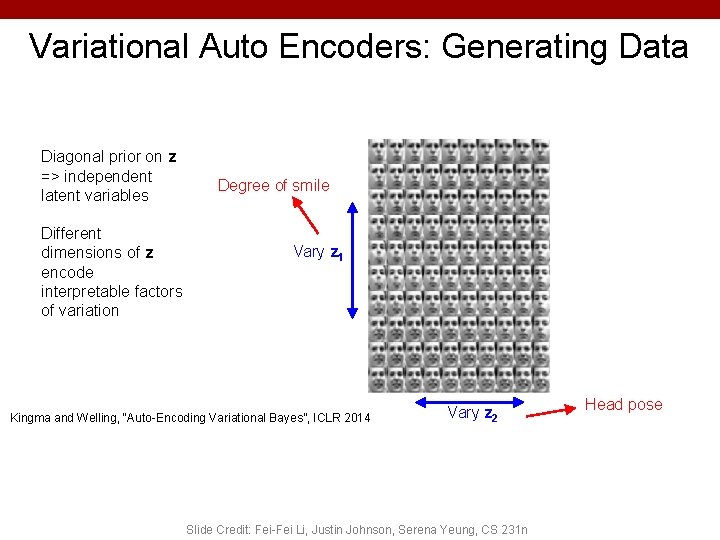
Variational Auto Encoders: Generating Data Diagonal prior on z => independent latent variables Degree of smile Different dimensions of z encode interpretable factors of variation Vary z 1 Kingma and Welling, “Auto-Encoding Variational Bayes”, ICLR 2014 Vary z 2 Slide Credit: Fei-Fei Li, Justin Johnson, Serena Yeung, CS 231 n Head pose
Plan for Today • VAEs – Reparameterization trick • Generative Adversarial Networks (GANs) (C) Dhruv Batra 30
Variational Auto Encoders VAEs are a combination of the following ideas: 1. Auto Encoders 2. Variational Approximation • Variational Lower Bound / ELBO 3. Amortized Inference Neural Networks 4. “Reparameterization” Trick (C) Dhruv Batra 31
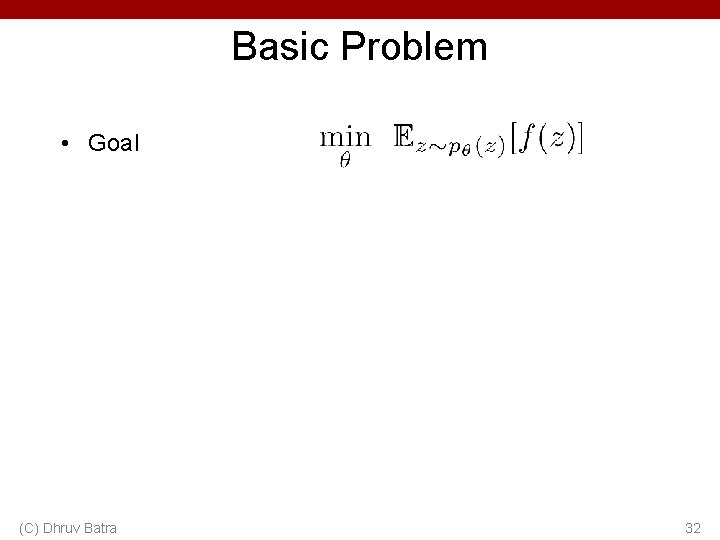
Basic Problem • Goal (C) Dhruv Batra 32
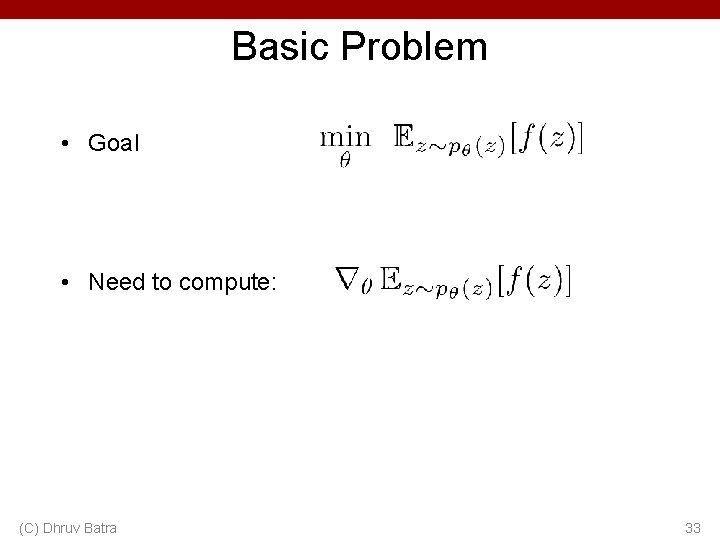
Basic Problem • Goal • Need to compute: (C) Dhruv Batra 33
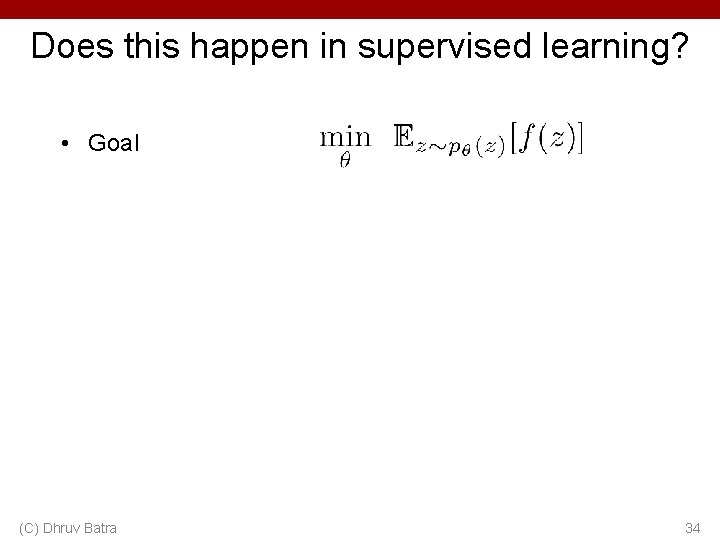
Does this happen in supervised learning? • Goal (C) Dhruv Batra 34
Example (C) Dhruv Batra 35
Example (C) Dhruv Batra 36
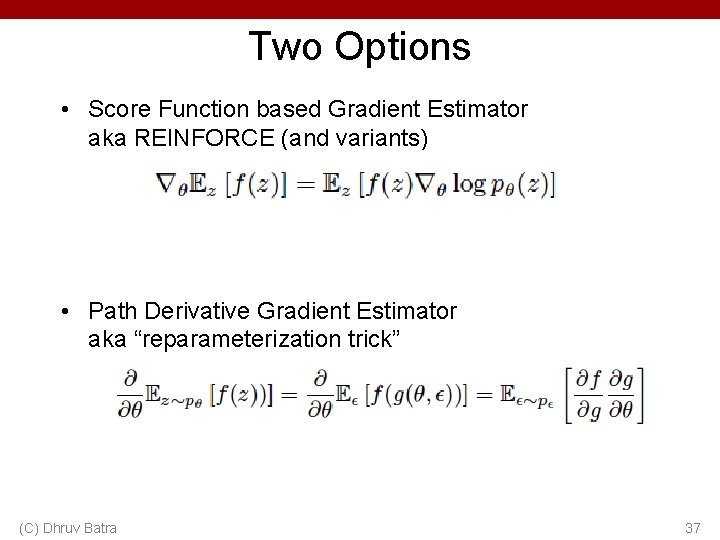
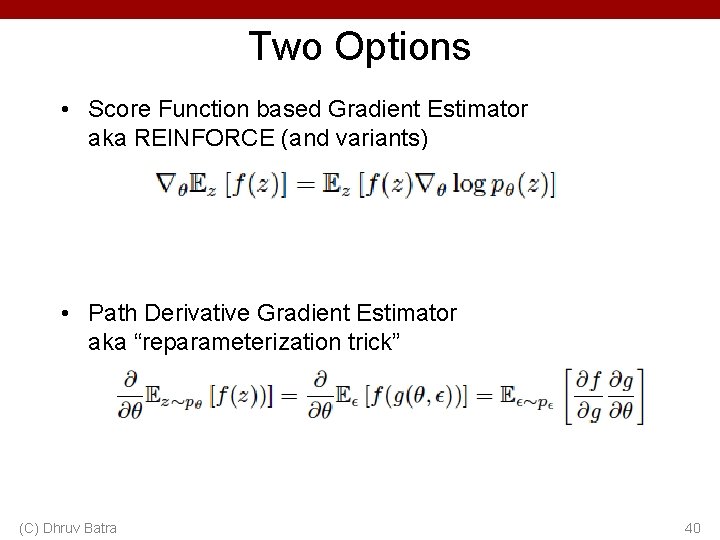
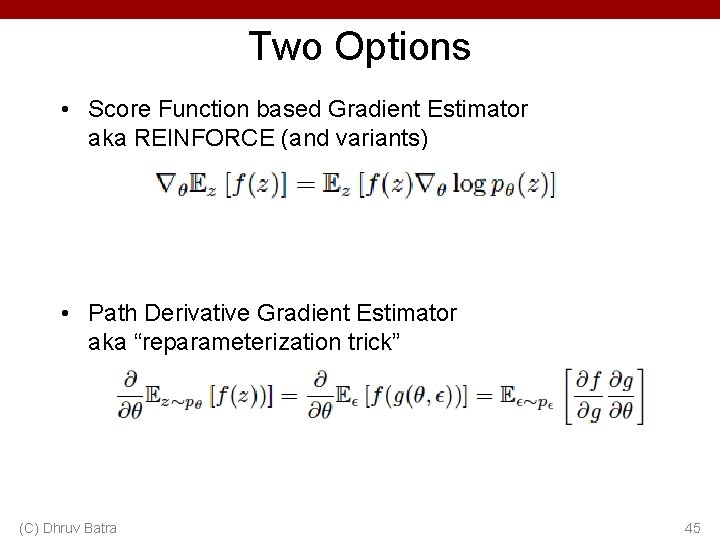
Two Options • Score Function based Gradient Estimator aka REINFORCE (and variants) • Path Derivative Gradient Estimator aka “reparameterization trick” (C) Dhruv Batra 37
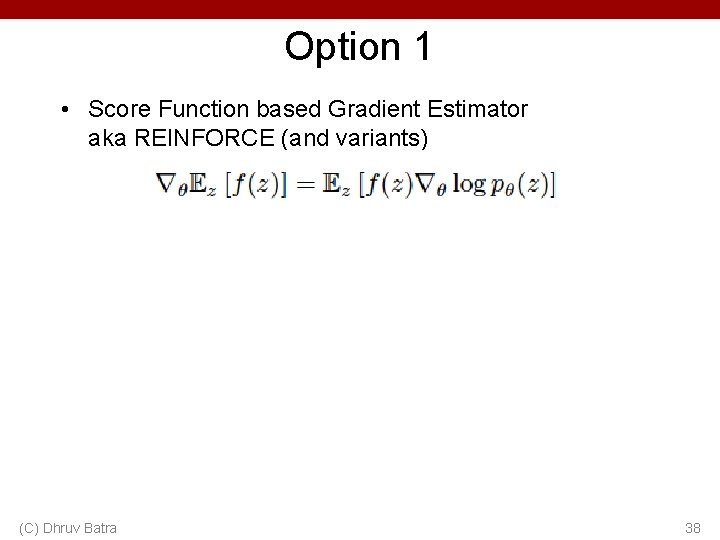
Option 1 • Score Function based Gradient Estimator aka REINFORCE (and variants) (C) Dhruv Batra 38
Example (C) Dhruv Batra 39
Two Options • Score Function based Gradient Estimator aka REINFORCE (and variants) • Path Derivative Gradient Estimator aka “reparameterization trick” (C) Dhruv Batra 40
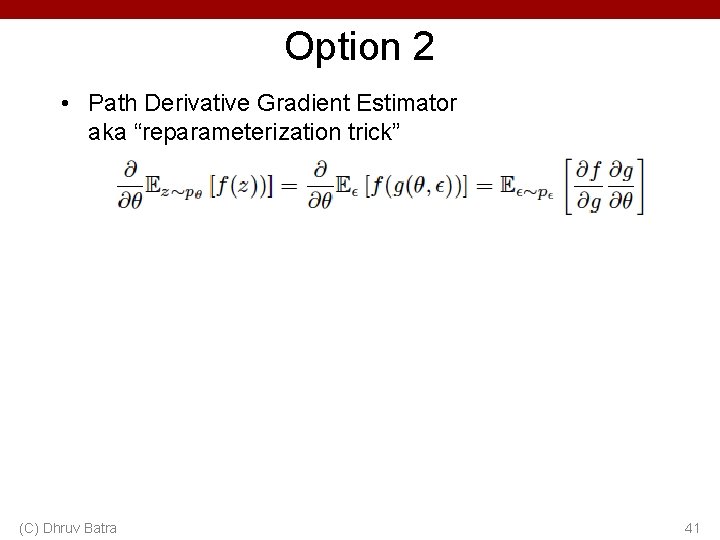
Option 2 • Path Derivative Gradient Estimator aka “reparameterization trick” (C) Dhruv Batra 41
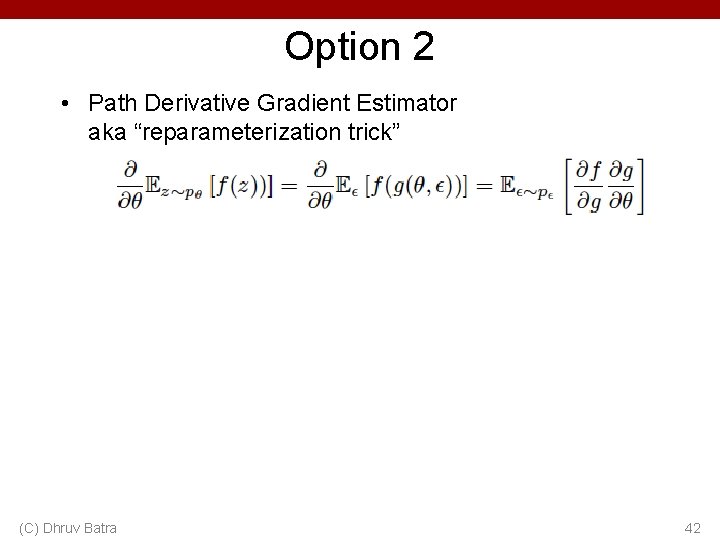
Option 2 • Path Derivative Gradient Estimator aka “reparameterization trick” (C) Dhruv Batra 42
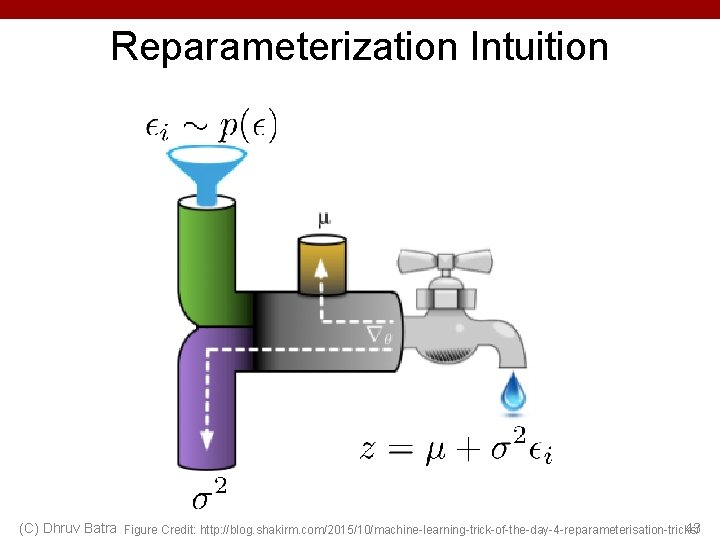
Reparameterization Intuition (C) Dhruv Batra Figure Credit: http: //blog. shakirm. com/2015/10/machine-learning-trick-of-the-day-4 -reparameterisation-tricks/ 43
Example (C) Dhruv Batra 44
Two Options • Score Function based Gradient Estimator aka REINFORCE (and variants) • Path Derivative Gradient Estimator aka “reparameterization trick” (C) Dhruv Batra 45
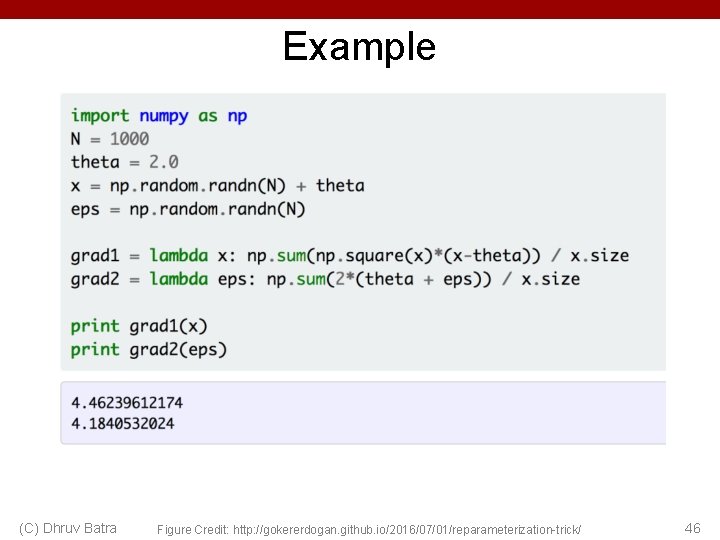
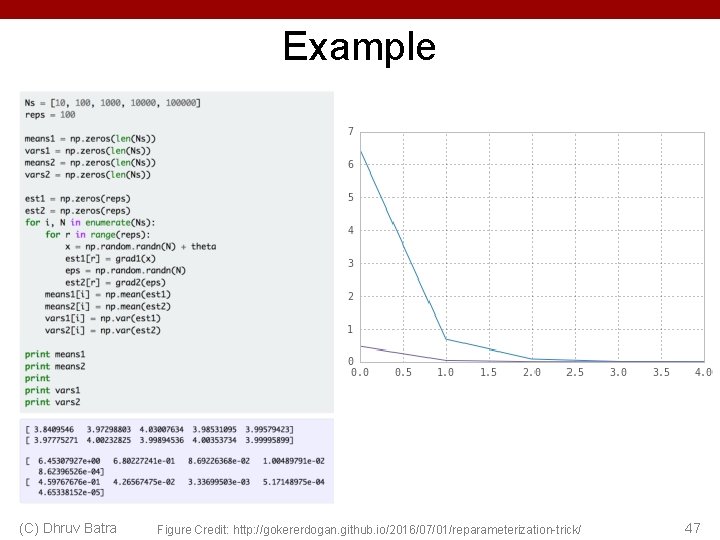
Example (C) Dhruv Batra Figure Credit: http: //gokererdogan. github. io/2016/07/01/reparameterization-trick/ 46
Example (C) Dhruv Batra Figure Credit: http: //gokererdogan. github. io/2016/07/01/reparameterization-trick/ 47
Variational Auto Encoders VAEs are a combination of the following ideas: 1. Auto Encoders 2. Variational Approximation • Variational Lower Bound / ELBO 3. Amortized Inference Neural Networks 4. “Reparameterization” Trick (C) Dhruv Batra 50
Variational Auto Encoders Putting it all together: maximizing the likelihood lower bound Encoder network Input Data Slide Credit: Fei-Fei Li, Justin Johnson, Serena Yeung, CS 231 n
Variational Auto Encoders Putting it all together: maximizing the likelihood lower bound Make approximate posterior distribution close to prior Encoder network Input Data Slide Credit: Fei-Fei Li, Justin Johnson, Serena Yeung, CS 231 n
Variational Auto Encoders Putting it all together: maximizing the likelihood lower bound Make approximate posterior distribution close to prior Sample z from Encoder network Input Data Slide Credit: Fei-Fei Li, Justin Johnson, Serena Yeung, CS 231 n
Variational Auto Encoders Putting it all together: maximizing the likelihood lower bound Decoder network Make approximate posterior distribution close to prior Sample z from Encoder network Input Data Slide Credit: Fei-Fei Li, Justin Johnson, Serena Yeung, CS 231 n
Generative Adversarial Networks (GAN)
So far. . . Pixel. CNNs define tractable density function, optimize likelihood of training data: VAEs define intractable density function with latent z: Cannot optimize directly, derive and optimize lower bound on likelihood instead Slide Credit: Fei-Fei Li, Justin Johnson, Serena Yeung, CS 231 n
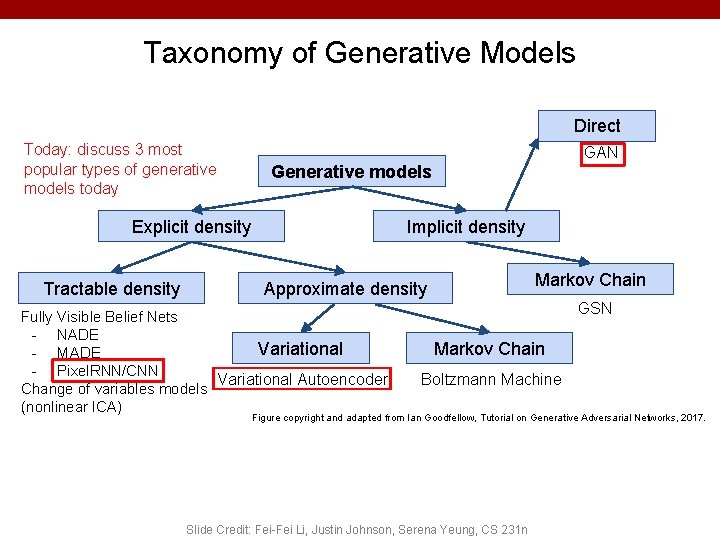
Taxonomy of Generative Models Direct Today: discuss 3 most popular types of generative models today GAN Generative models Explicit density Tractable density Implicit density Markov Chain Approximate density Fully Visible Belief Nets - NADE Variational - MADE - Pixel. RNN/CNN Variational Autoencoder Change of variables models (nonlinear ICA) GSN Markov Chain Boltzmann Machine Figure copyright and adapted from Ian Goodfellow, Tutorial on Generative Adversarial Networks, 2017. Slide Credit: Fei-Fei Li, Justin Johnson, Serena Yeung, CS 231 n
So far. . . Pixel. CNNs define tractable density function, optimize likelihood of training data: VAEs define intractable density function with latent z: Cannot optimize directly, derive and optimize lower bound on likelihood instead What if we give up on explicitly modeling density, and just want ability to sample? Slide Credit: Fei-Fei Li, Justin Johnson, Serena Yeung, CS 231 n
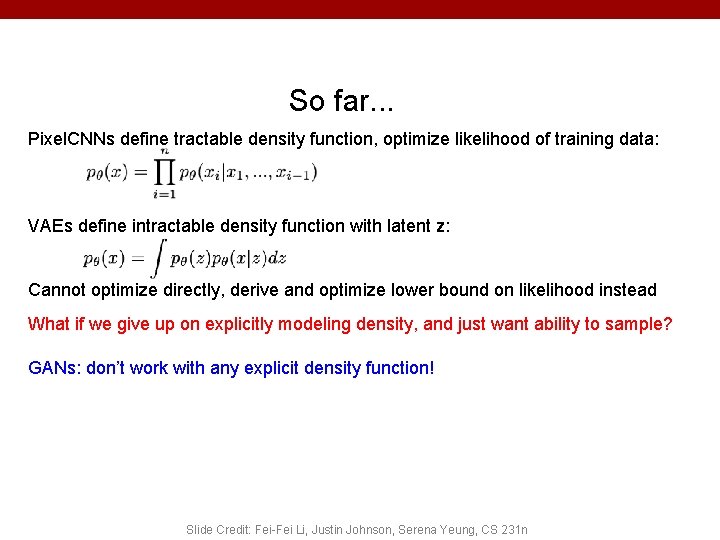
So far. . . Pixel. CNNs define tractable density function, optimize likelihood of training data: VAEs define intractable density function with latent z: Cannot optimize directly, derive and optimize lower bound on likelihood instead What if we give up on explicitly modeling density, and just want ability to sample? GANs: don’t work with any explicit density function! Slide Credit: Fei-Fei Li, Justin Johnson, Serena Yeung, CS 231 n
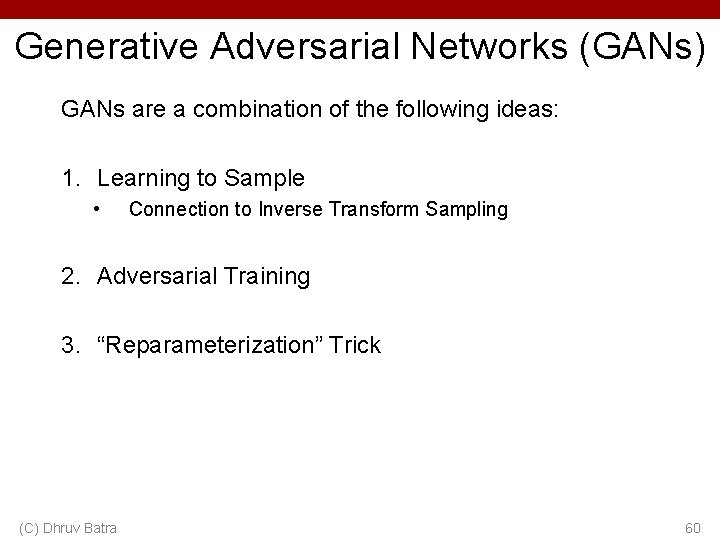
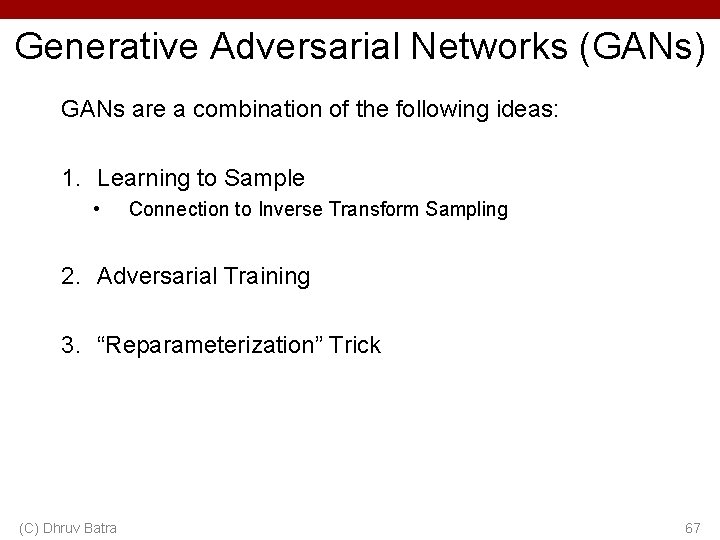
Generative Adversarial Networks (GANs) GANs are a combination of the following ideas: 1. Learning to Sample • Connection to Inverse Transform Sampling 2. Adversarial Training 3. “Reparameterization” Trick (C) Dhruv Batra 60
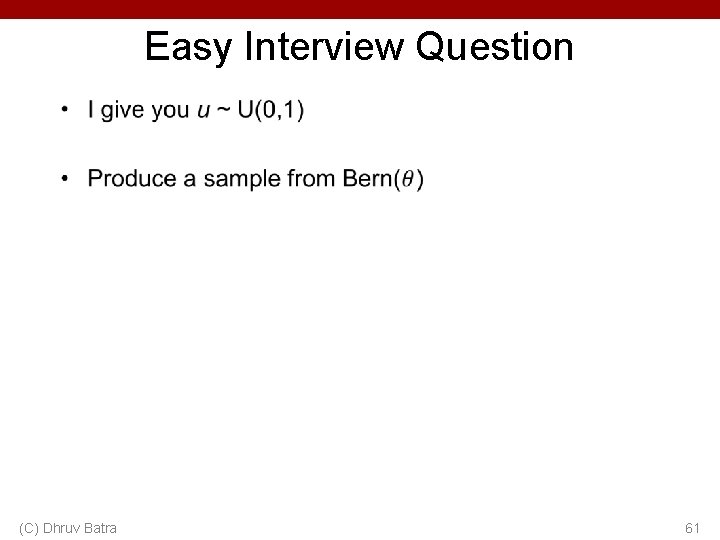
Easy Interview Question • (C) Dhruv Batra 61
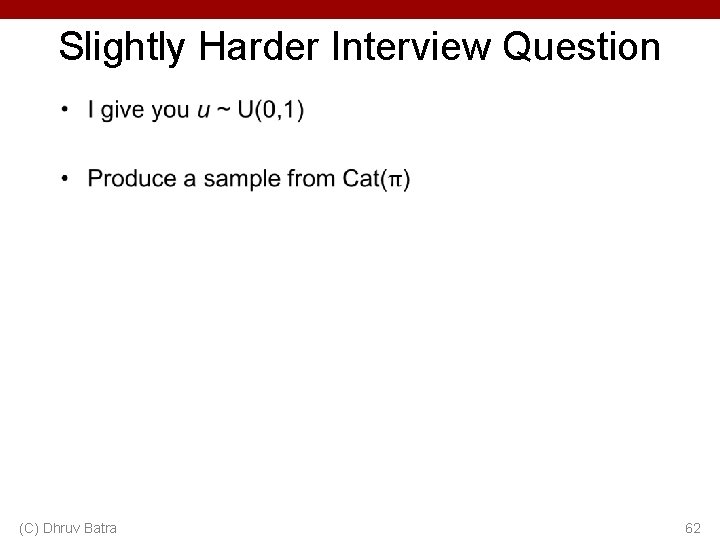
Slightly Harder Interview Question • (C) Dhruv Batra 62
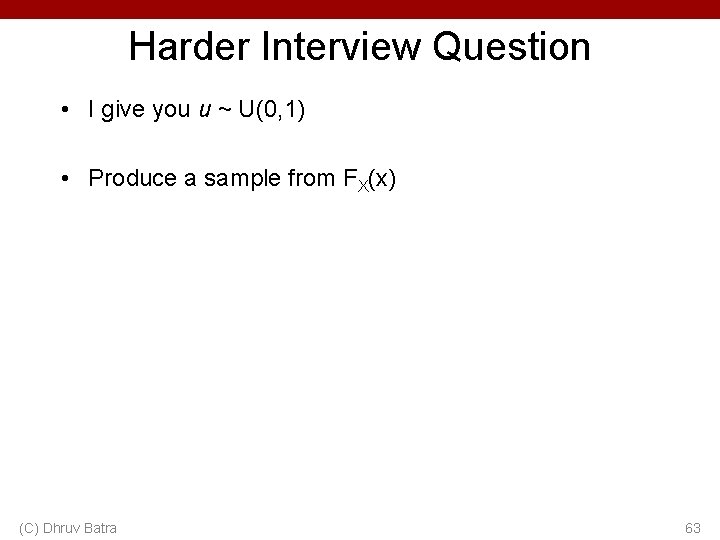
Harder Interview Question • I give you u ~ U(0, 1) • Produce a sample from FX(x) (C) Dhruv Batra 63
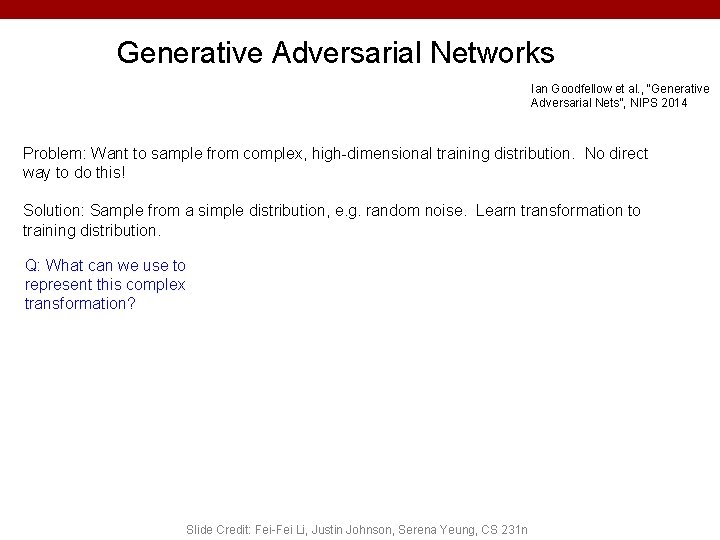
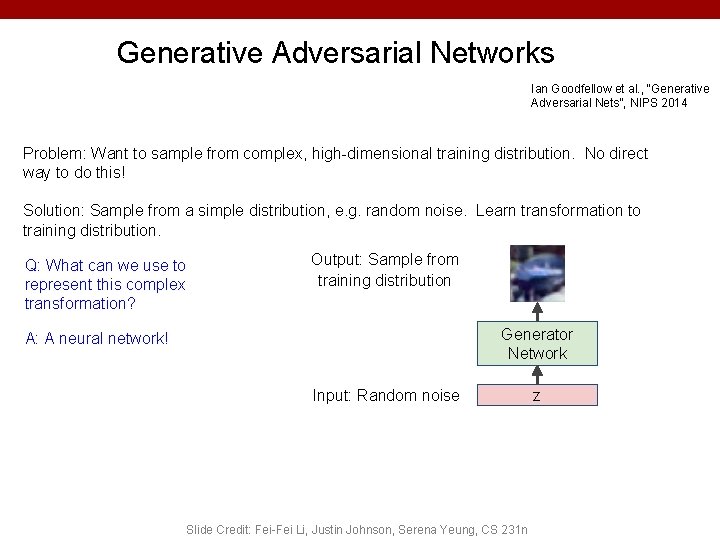
Generative Adversarial Networks Ian Goodfellow et al. , “Generative Adversarial Nets”, NIPS 2014 Problem: Want to sample from complex, high-dimensional training distribution. No direct way to do this! Solution: Sample from a simple distribution, e. g. random noise. Learn transformation to training distribution. Q: What can we use to represent this complex transformation? Slide Credit: Fei-Fei Li, Justin Johnson, Serena Yeung, CS 231 n
Generative Adversarial Networks Ian Goodfellow et al. , “Generative Adversarial Nets”, NIPS 2014 Problem: Want to sample from complex, high-dimensional training distribution. No direct way to do this! Solution: Sample from a simple distribution, e. g. random noise. Learn transformation to training distribution. Q: What can we use to represent this complex transformation? Output: Sample from training distribution Generator Network A: A neural network! Input: Random noise Slide Credit: Fei-Fei Li, Justin Johnson, Serena Yeung, CS 231 n z
Generative Adversarial Networks (GANs) GANs are a combination of the following ideas: 1. Learning to Sample • Connection to Inverse Transform Sampling 2. Adversarial Training 3. “Reparameterization” Trick (C) Dhruv Batra 67
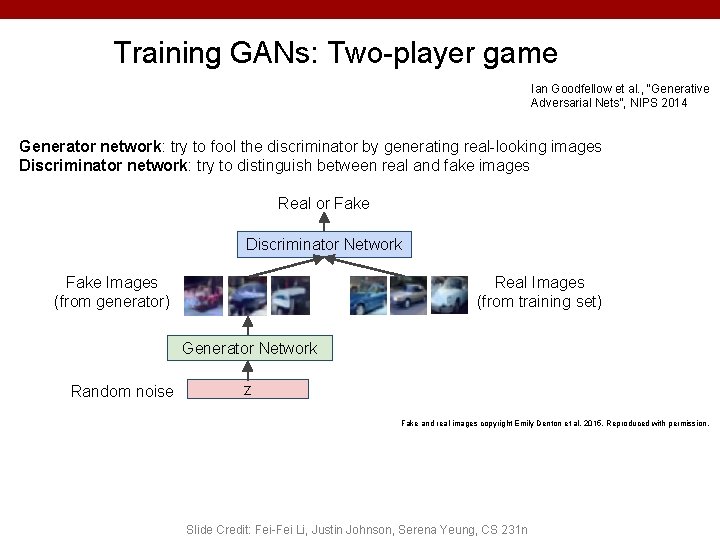
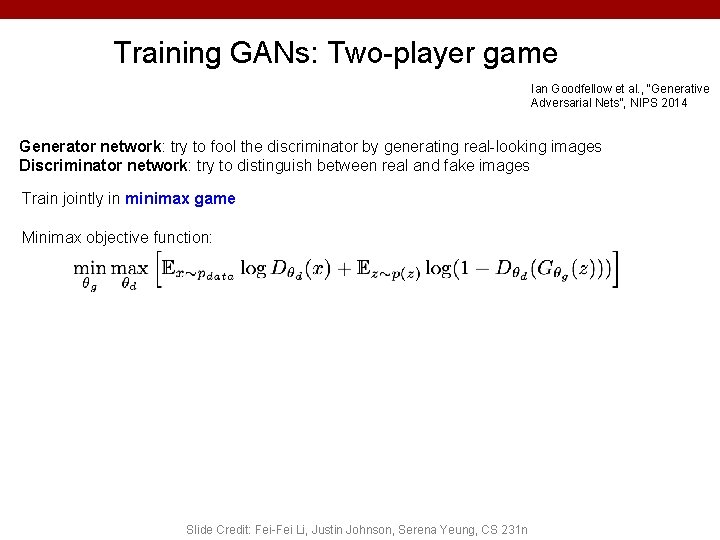
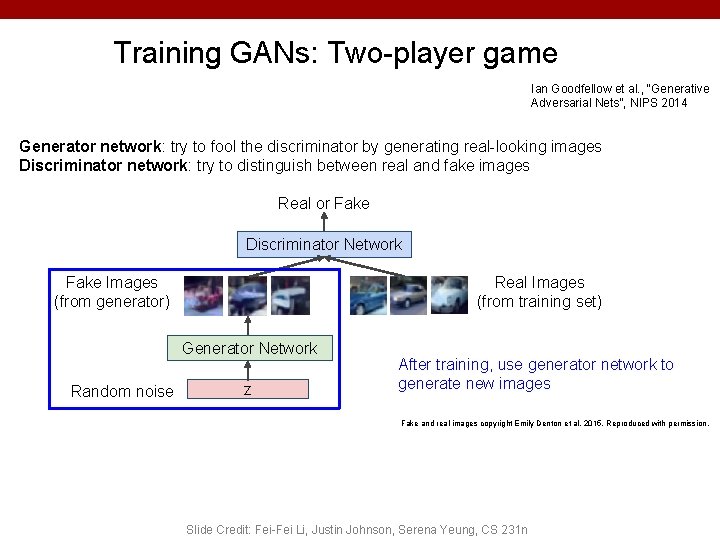
Training GANs: Two-player game Ian Goodfellow et al. , “Generative Adversarial Nets”, NIPS 2014 Generator network: try to fool the discriminator by generating real-looking images Discriminator network: try to distinguish between real and fake images Slide Credit: Fei-Fei Li, Justin Johnson, Serena Yeung, CS 231 n
Training GANs: Two-player game Ian Goodfellow et al. , “Generative Adversarial Nets”, NIPS 2014 Generator network: try to fool the discriminator by generating real-looking images Discriminator network: try to distinguish between real and fake images Real or Fake Discriminator Network Real Images (from training set) Fake Images (from generator) Generator Network Random noise z Fake and real images copyright Emily Denton et al. 2015. Reproduced with permission. Slide Credit: Fei-Fei Li, Justin Johnson, Serena Yeung, CS 231 n
Training GANs: Two-player game Ian Goodfellow et al. , “Generative Adversarial Nets”, NIPS 2014 Generator network: try to fool the discriminator by generating real-looking images Discriminator network: try to distinguish between real and fake images Train jointly in minimax game Minimax objective function: Slide Credit: Fei-Fei Li, Justin Johnson, Serena Yeung, CS 231 n
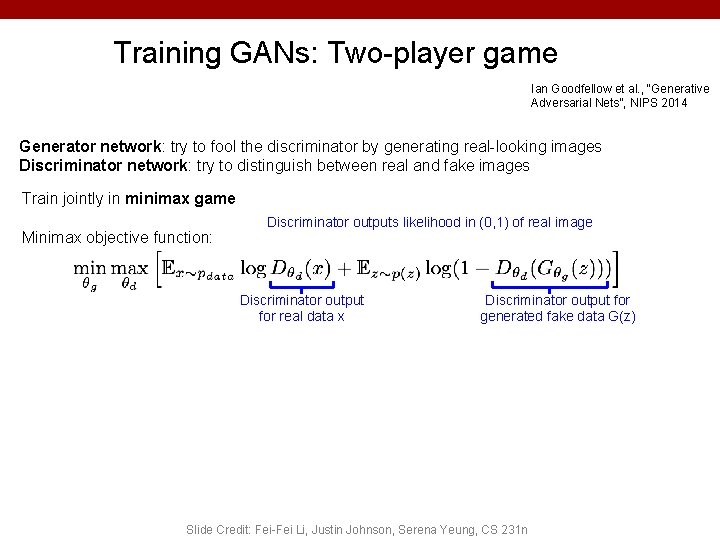
Training GANs: Two-player game Ian Goodfellow et al. , “Generative Adversarial Nets”, NIPS 2014 Generator network: try to fool the discriminator by generating real-looking images Discriminator network: try to distinguish between real and fake images Train jointly in minimax game Minimax objective function: Discriminator outputs likelihood in (0, 1) of real image Discriminator output for real data x Discriminator output for generated fake data G(z) Slide Credit: Fei-Fei Li, Justin Johnson, Serena Yeung, CS 231 n
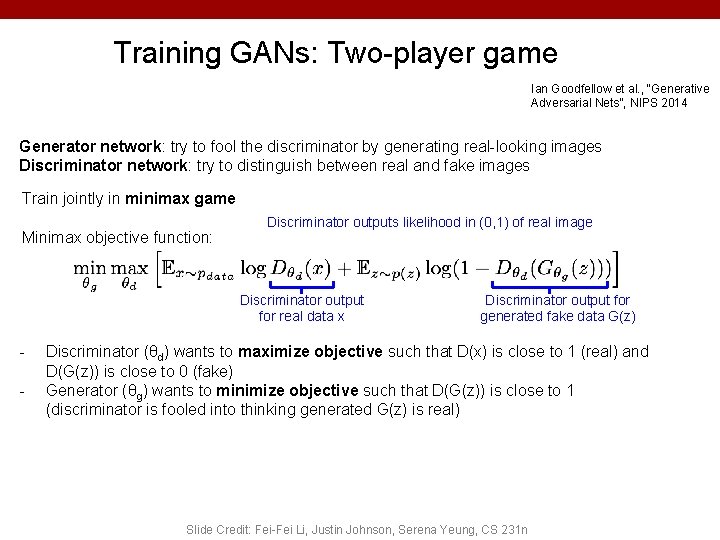
Training GANs: Two-player game Ian Goodfellow et al. , “Generative Adversarial Nets”, NIPS 2014 Generator network: try to fool the discriminator by generating real-looking images Discriminator network: try to distinguish between real and fake images Train jointly in minimax game Minimax objective function: Discriminator outputs likelihood in (0, 1) of real image Discriminator output for real data x - Discriminator output for generated fake data G(z) Discriminator (θd) wants to maximize objective such that D(x) is close to 1 (real) and D(G(z)) is close to 0 (fake) Generator (θg) wants to minimize objective such that D(G(z)) is close to 1 (discriminator is fooled into thinking generated G(z) is real) Slide Credit: Fei-Fei Li, Justin Johnson, Serena Yeung, CS 231 n
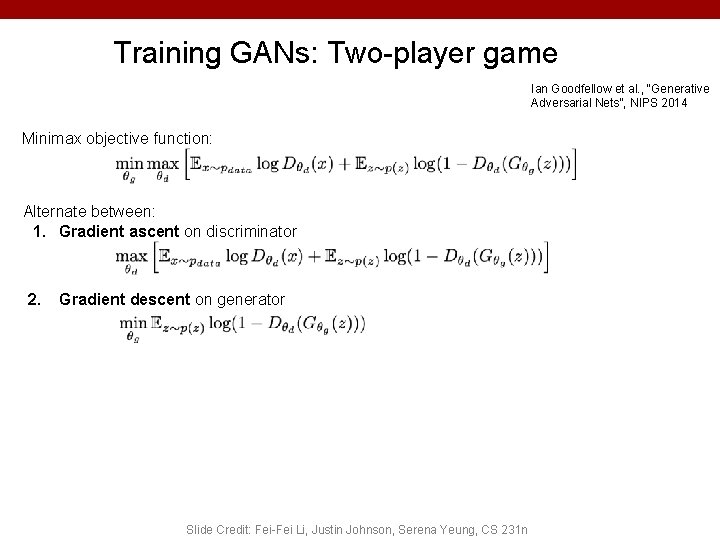
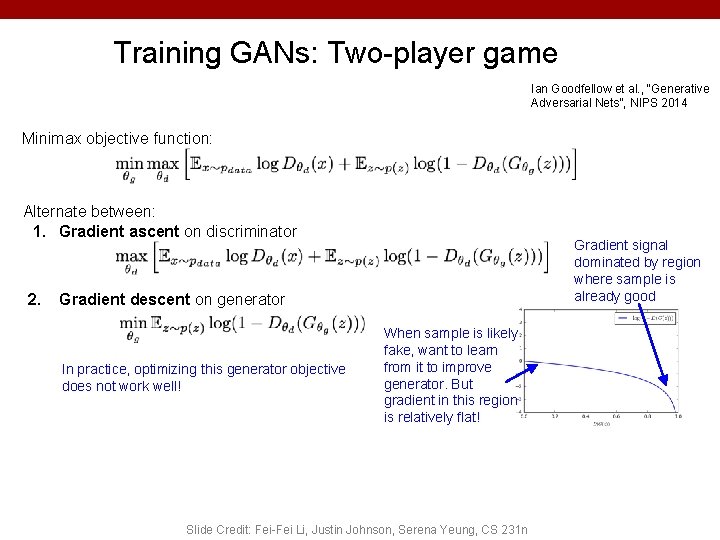
Training GANs: Two-player game Ian Goodfellow et al. , “Generative Adversarial Nets”, NIPS 2014 Minimax objective function: Alternate between: 1. Gradient ascent on discriminator 2. Gradient descent on generator Slide Credit: Fei-Fei Li, Justin Johnson, Serena Yeung, CS 231 n
Training GANs: Two-player game Ian Goodfellow et al. , “Generative Adversarial Nets”, NIPS 2014 Minimax objective function: Alternate between: 1. Gradient ascent on discriminator 2. Gradient signal dominated by region where sample is already good Gradient descent on generator In practice, optimizing this generator objective does not work well! When sample is likely fake, want to learn from it to improve generator. But gradient in this region is relatively flat! Slide Credit: Fei-Fei Li, Justin Johnson, Serena Yeung, CS 231 n
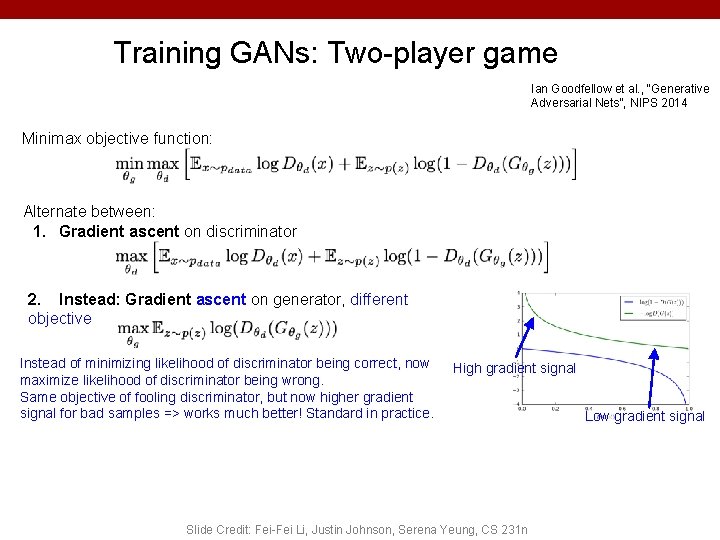
Training GANs: Two-player game Ian Goodfellow et al. , “Generative Adversarial Nets”, NIPS 2014 Minimax objective function: Alternate between: 1. Gradient ascent on discriminator 2. Instead: Gradient ascent on generator, different objective Instead of minimizing likelihood of discriminator being correct, now maximize likelihood of discriminator being wrong. Same objective of fooling discriminator, but now higher gradient signal for bad samples => works much better! Standard in practice. High gradient signal Slide Credit: Fei-Fei Li, Justin Johnson, Serena Yeung, CS 231 n Low gradient signal
Training GANs: Two-player game Ian Goodfellow et al. , “Generative Adversarial Nets”, NIPS 2014 Minimax objective function: Aside: Jointly training two networks is challenging, can be unstable. Choosing objectives with better loss landscapes helps training, is an active area of research. Alternate between: 1. Gradient ascent on discriminator 2. Instead: Gradient ascent on generator, different objective Instead of minimizing likelihood of discriminator being correct, now maximize likelihood of discriminator being wrong. Same objective of fooling discriminator, but now higher gradient signal for bad samples => works much better! Standard in practice. High gradient signal Slide Credit: Fei-Fei Li, Justin Johnson, Serena Yeung, CS 231 n Low gradient signal
Training GANs: Two-player game Ian Goodfellow et al. , “Generative Adversarial Nets”, NIPS 2014 Generator network: try to fool the discriminator by generating real-looking images Discriminator network: try to distinguish between real and fake images Real or Fake Discriminator Network Real Images (from training set) Fake Images (from generator) Generator Network Random noise z After training, use generator network to generate new images Fake and real images copyright Emily Denton et al. 2015. Reproduced with permission. Slide Credit: Fei-Fei Li, Justin Johnson, Serena Yeung, CS 231 n
GANs • Demo – https: //poloclub. github. io/ganlab/ 80
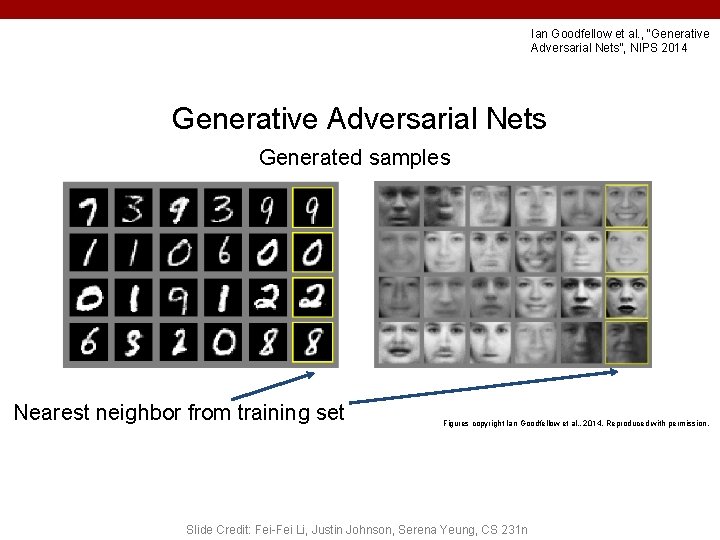
Ian Goodfellow et al. , “Generative Adversarial Nets”, NIPS 2014 Generative Adversarial Nets Generated samples Nearest neighbor from training set Figures copyright Ian Goodfellow et al. , 2014. Reproduced with permission. Slide Credit: Fei-Fei Li, Justin Johnson, Serena Yeung, CS 231 n
Ian Goodfellow et al. , “Generative Adversarial Nets”, NIPS 2014 Generative Adversarial Nets Generated samples (CIFAR-10) Nearest neighbor from training set Figures copyright Ian Goodfellow et al. , 2014. Reproduced with permission. Slide Credit: Fei-Fei Li, Justin Johnson, Serena Yeung, CS 231 n
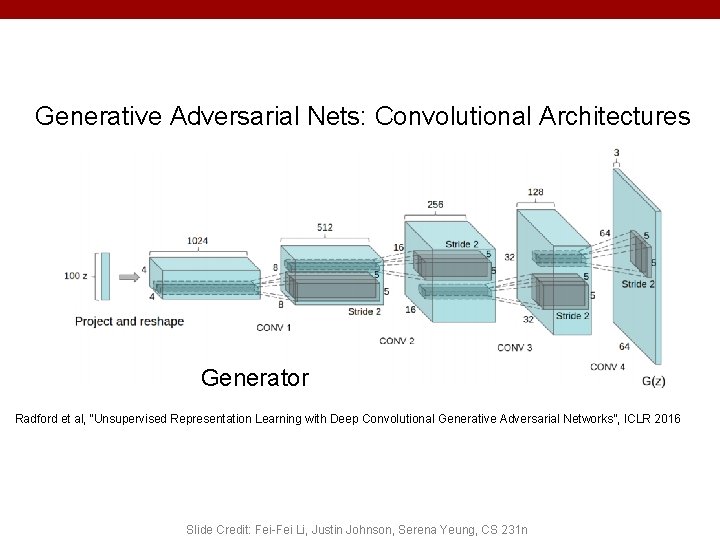
Generative Adversarial Nets: Convolutional Architectures Generator Radford et al, “Unsupervised Representation Learning with Deep Convolutional Generative Adversarial Networks”, ICLR 2016 Slide Credit: Fei-Fei Li, Justin Johnson, Serena Yeung, CS 231 n
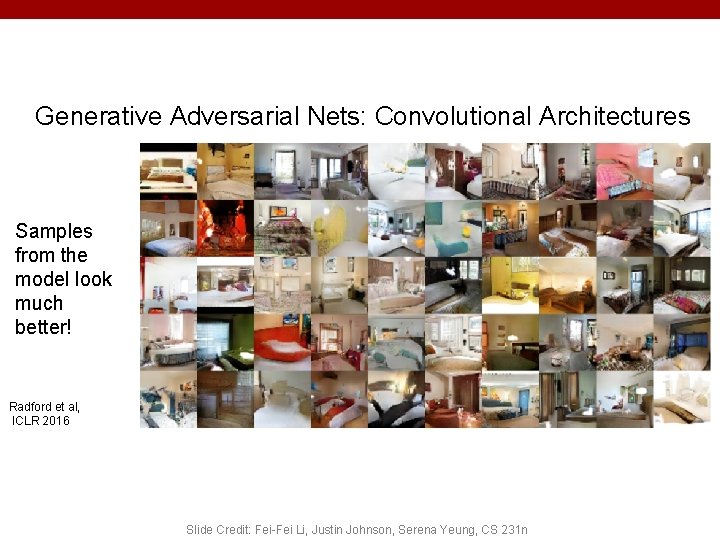
Generative Adversarial Nets: Convolutional Architectures Samples from the model look much better! Radford et al, ICLR 2016 Slide Credit: Fei-Fei Li, Justin Johnson, Serena Yeung, CS 231 n
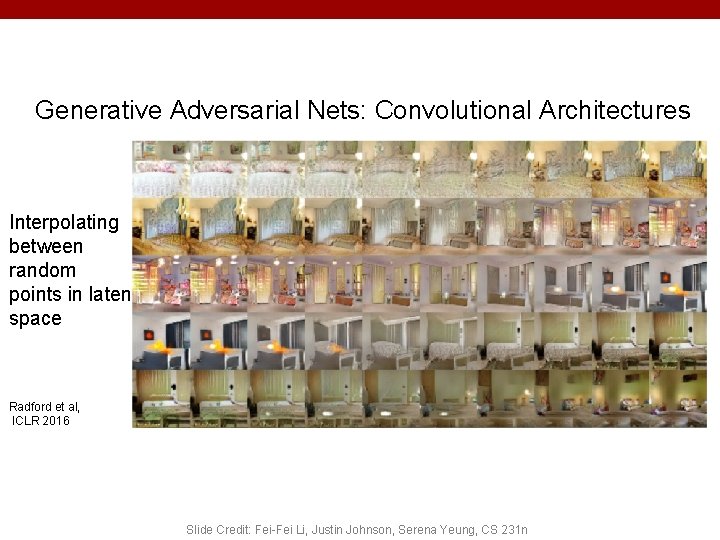
Generative Adversarial Nets: Convolutional Architectures Interpolating between random points in latent space Radford et al, ICLR 2016 Slide Credit: Fei-Fei Li, Justin Johnson, Serena Yeung, CS 231 n
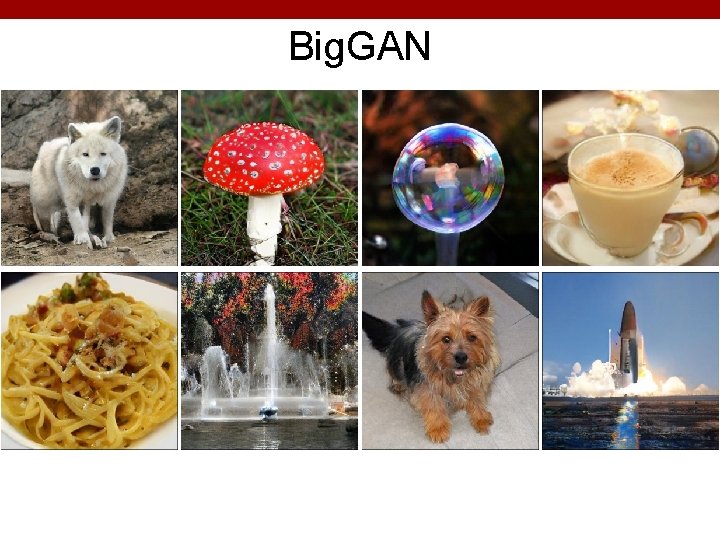
Big. GAN 87
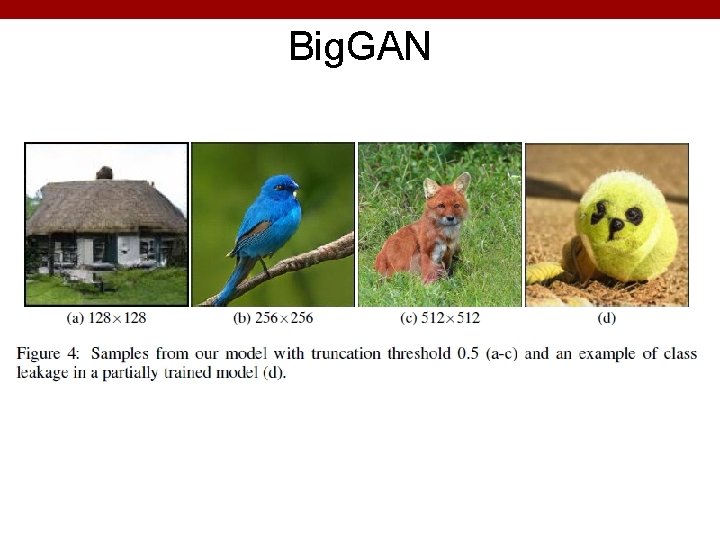
Big. GAN 88
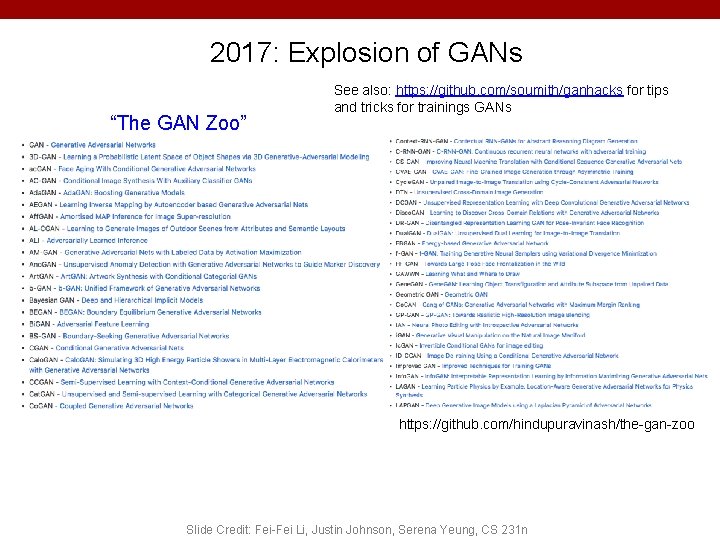
2017: Explosion of GANs “The GAN Zoo” https: //github. com/hindupuravinash/the-gan-zoo Slide Credit: Fei-Fei Li, Justin Johnson, Serena Yeung, CS 231 n
2017: Explosion of GANs “The GAN Zoo” See also: https: //github. com/soumith/ganhacks for tips and tricks for trainings GANs https: //github. com/hindupuravinash/the-gan-zoo Slide Credit: Fei-Fei Li, Justin Johnson, Serena Yeung, CS 231 n
GANs Don’t work with an explicit density function Take game-theoretic approach: learn to generate from training distribution through 2 -player game Pros: - Beautiful, state-of-the-art samples! Cons: - Trickier / more unstable to train - Can’t solve inference queries such as p(x), p(z|x) Active areas of research: - Better loss functions, more stable training (Wasserstein GAN, LSGAN, many others) - Conditional GANs, GANs for all kinds of applications Slide Credit: Fei-Fei Li, Justin Johnson, Serena Yeung, CS 231 n