
CS 47406740 Network Security Lecture 8 Hostbased Defenses
CS 4740/6740 Network Security Lecture 8: Host-based Defenses (Canaries, DEP, ASLR, CFI)
Stack-Based Defenses Canaries Data Execution Prevention (DEP)
Stack Overflow Defenses 1. 2. 3. 4. 5. 6. Don't write vulnerable code (realistic? ) Don't use languages that aren't memory-safe, e. g. Rust (if you can) Safer APIs – e. g. , strlcpy, std: : string Shadow stacks Stack canaries DEP (later)
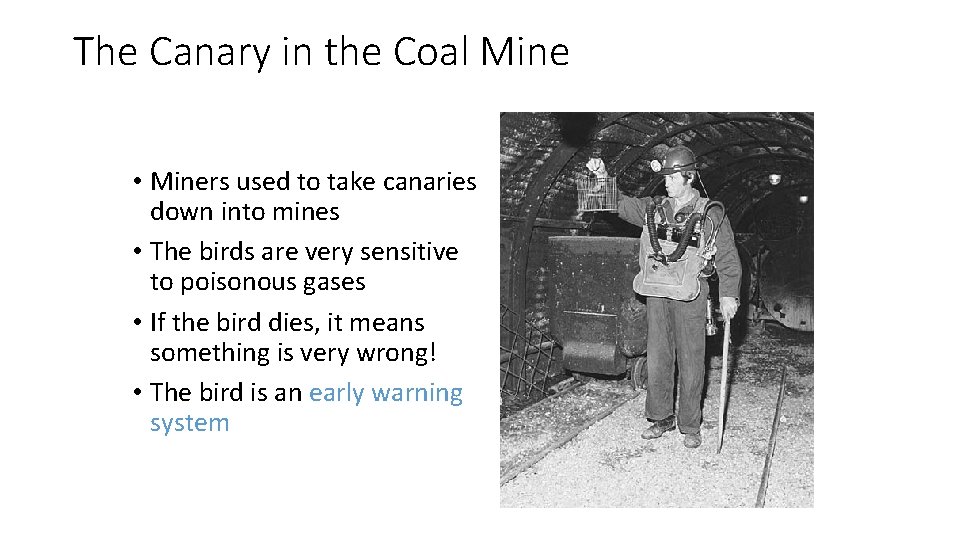
The Canary in the Coal Mine • Miners used to take canaries down into mines • The birds are very sensitive to poisonous gases • If the bird dies, it means something is very wrong! • The bird is an early warning system
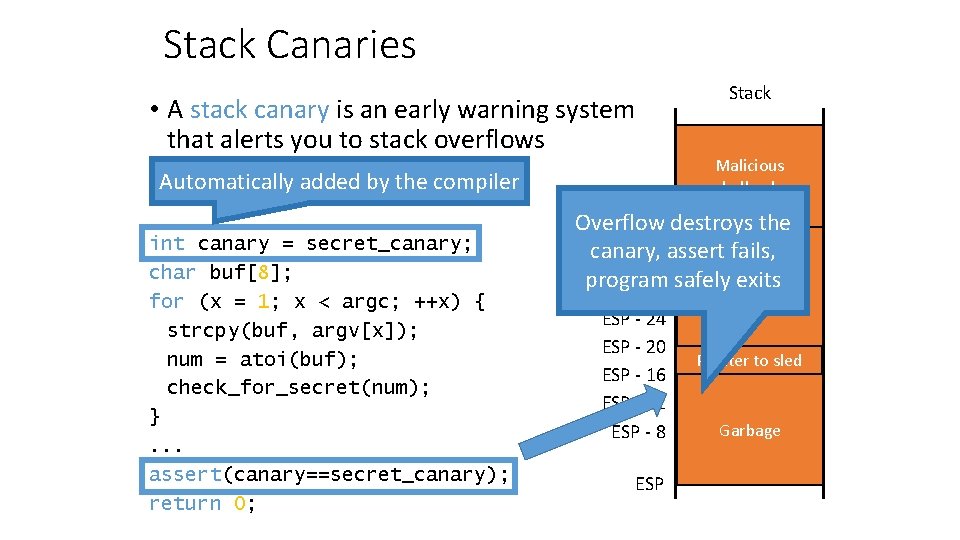
Stack Canaries • A stack canary is an early warning system that alerts you to stack overflows Automatically added by the compiler int canary = secret_canary; char buf[8]; for (x = 1; x < argc; ++x) { strcpy(buf, argv[x]); num = atoi(buf); check_for_secret(num); }. . . assert(canary==secret_canary); return 0; Stack Malicious shellcode Overflow destroys the Stuff from previous frame canary, assert fails, program safely exits NOP sled ESP - 24 ESP - 20 ESP - 16 ESP - 12 ESP - 8 return address Pointer sled canary to value int num int x Garbage char buf[8] ESP
Canary Implementation • Canary code and data are inserted by the compiler • gcc supports canaries • Disable using the –fno-stack-protector argument • Canary secret must be random • Otherwise the attacker could guess it • Canary secret is stored on its own page at semi-random location in virtual memory • Makes it difficult to locate and read from memory
![Canaries in Action [cbw@finalfight game]. /guessinggame AAAAAAAAAAAA *** stack smashing detected ***: . /guessinggame](http://slidetodoc.com/presentation_image_h/b3b2eefa09df6bd02aaec256719122c2/image-7.jpg "Canaries in Action [cbw@finalfight game]. /guessinggame AAAAAAAAAAAA *** stack smashing detected ***: . /guessinggame")
Canaries in Action [cbw@finalfight game]. /guessinggame AAAAAAAAAAAA *** stack smashing detected ***: . /guessinggame terminated Segmentation fault (core dumped) • Note: canaries do not prevent the buffer overflow • The canary prevents the overflow from being exploited
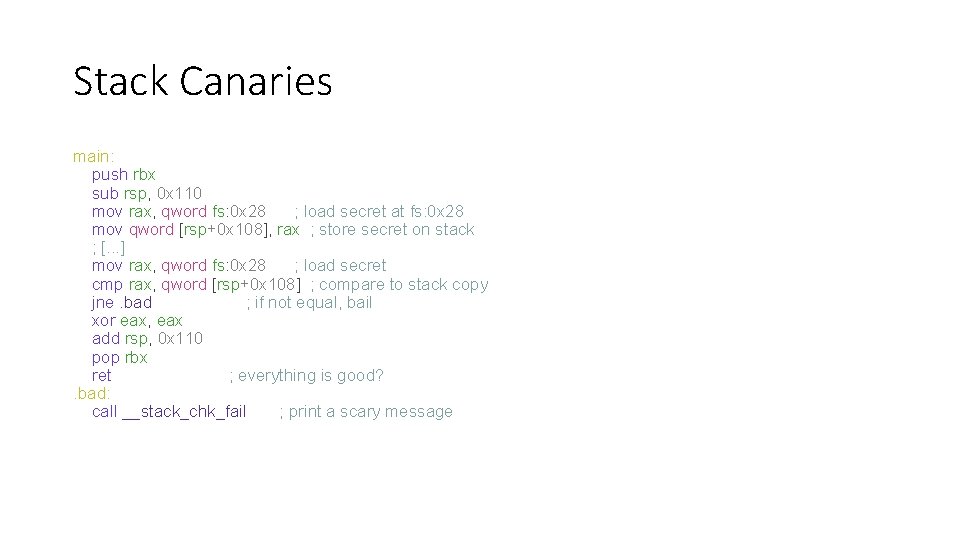
Stack Canaries main: push rbx sub rsp, 0 x 110 mov rax, qword fs: 0 x 28 ; load secret at fs: 0 x 28 mov qword [rsp+0 x 108], rax ; store secret on stack ; [. . . ] mov rax, qword fs: 0 x 28 ; load secret cmp rax, qword [rsp+0 x 108] ; compare to stack copy jne. bad ; if not equal, bail xor eax, eax add rsp, 0 x 110 pop rbx ret ; everything is good? . bad: call __stack_chk_fail ; print a scary message
Stack Canaries • How to make canaries hard to guess? • Random from large domain, generated at runtime • Example of a great success story for security • One simple compiler flag • Downsides • Introduces bloat, results in worse cache behavior • Incomplete coverage in popular implementations • Can be defeated by information leaks
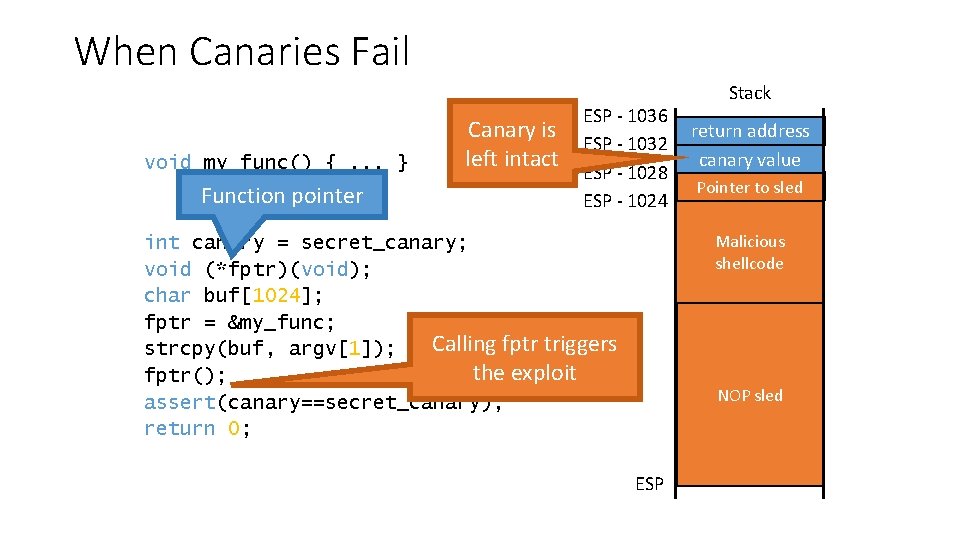
When Canaries Fail void my_func() {. . . } Function pointer Canary is left intact ESP - 1036 ESP - 1032 ESP - 1028 ESP - 1024 Stack return address canary value Pointer to sled fptr Malicious shellcode int canary = secret_canary; void (*fptr)(void); char buf[1024]; fptr = &my_func; Calling fptr triggers strcpy(buf, argv[1]); the exploit fptr(); assert(canary==secret_canary); return 0; char buf[1024] NOP sled ESP
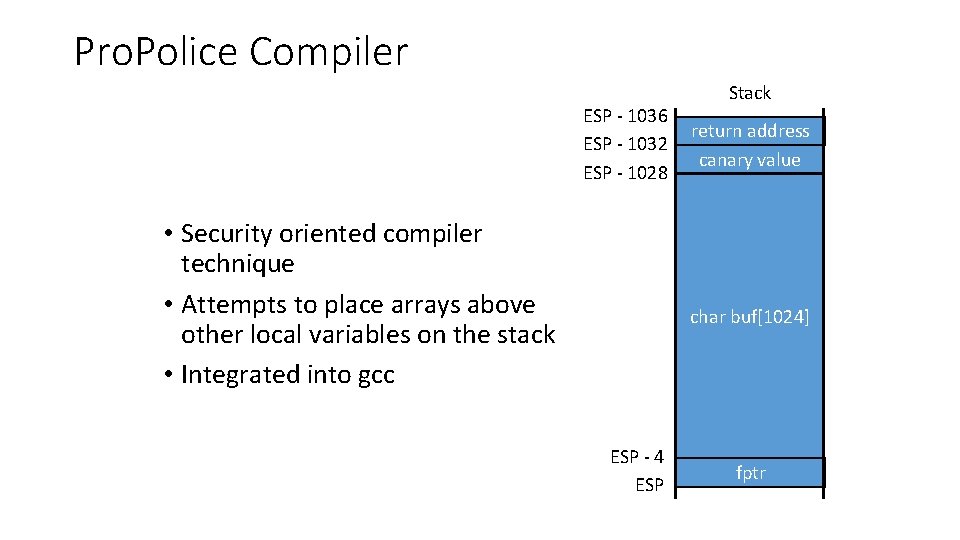
Pro. Police Compiler ESP - 1036 ESP - 1032 ESP - 1028 • Security oriented compiler technique • Attempts to place arrays above other local variables on the stack • Integrated into gcc Stack return address canary value char buf[1024] ESP - 4 ESP fptr
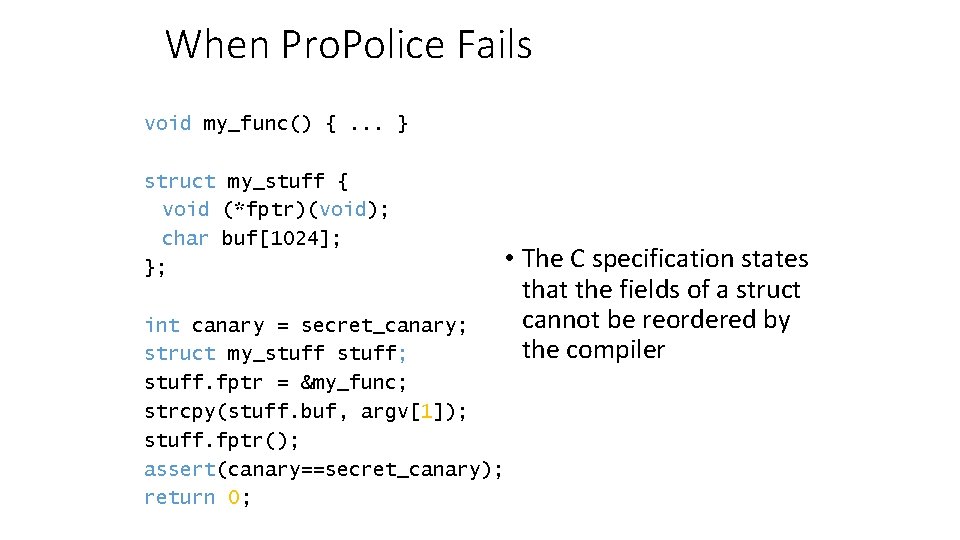
When Pro. Police Fails void my_func() {. . . } struct my_stuff { void (*fptr)(void); char buf[1024]; }; • The C specification states that the fields of a struct cannot be reordered by the compiler int canary = secret_canary; struct my_stuff; stuff. fptr = &my_func; strcpy(stuff. buf, argv[1]); stuff. fptr(); assert(canary==secret_canary); return 0;
Data Execution Prevention (DEP) • Problem: compiler techniques cannot prevent all stack-based exploits • Key insight: many exploits require placing code in the stack and executing it • Code doesn’t typically go on stack pages • Solution: make stack pages non-executable • Originally implemented by Pa. X on Linux • Closely followed by W^X on Open. BSD • Modern implementations rely on hardware support • e. g. , NX bit on page table entries • Or, fine-grain memory tags
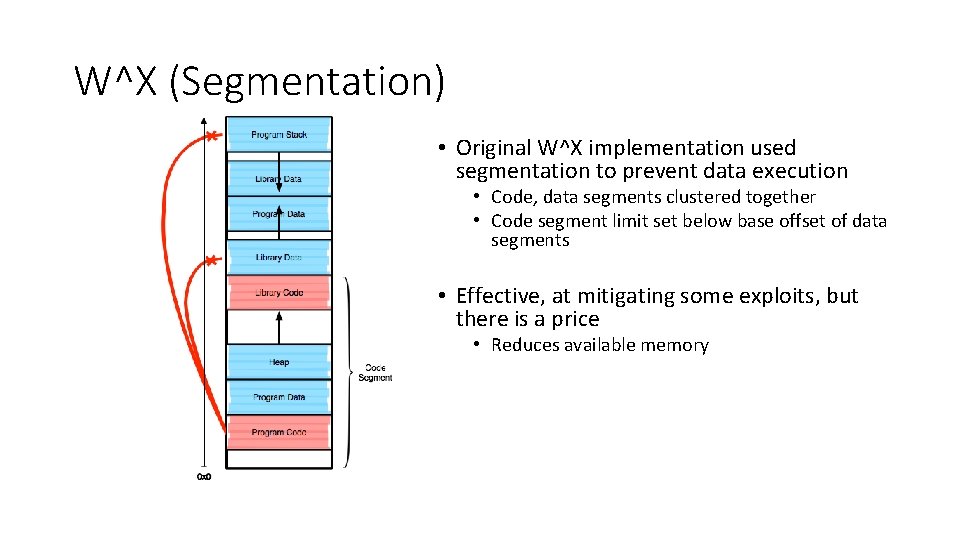
W^X (Segmentation) • Original W^X implementation used segmentation to prevent data execution • Code, data segments clustered together • Code segment limit set below base offset of data segments • Effective, at mitigating some exploits, but there is a price • Reduces available memory
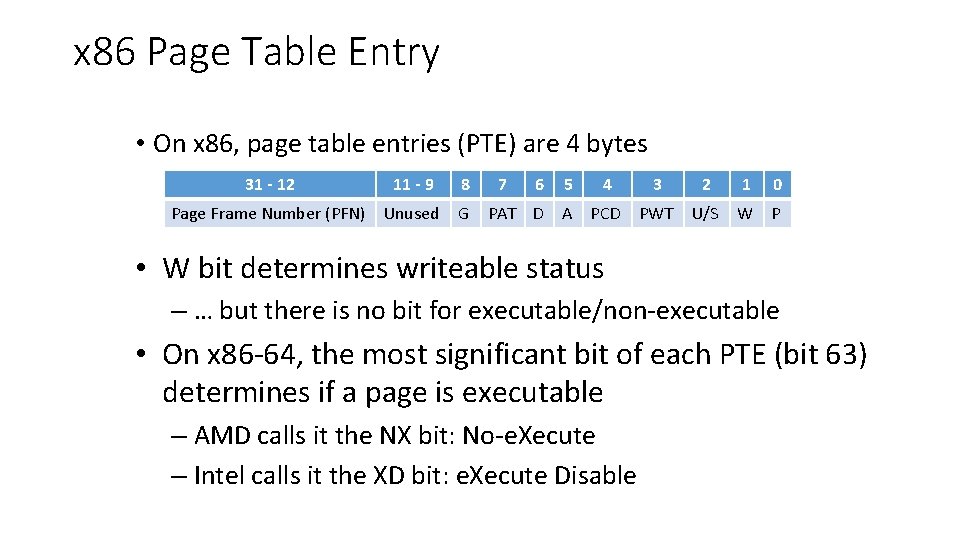
x 86 Page Table Entry • On x 86, page table entries (PTE) are 4 bytes 31 - 12 11 - 9 8 Page Frame Number (PFN) Unused G 7 6 5 4 3 2 1 0 PAT D A PCD PWT U/S W P • W bit determines writeable status – … but there is no bit for executable/non-executable • On x 86 -64, the most significant bit of each PTE (bit 63) determines if a page is executable – AMD calls it the NX bit: No-e. Xecute – Intel calls it the XD bit: e. Xecute Disable
When NX bits Fail • NX prevents shellcode from being placed on the stack • NX must be enabled by the process • NX must be supported by the OS • Can exploit writers get around NX? • Of course ; ) • Return-to-libc • Return-oriented programming (ROP)
Data Exploits and Countermeasures Return-to-libc Return Oriented Programing (ROP) Address Space Layout Randomization (ASLR) Control Flow Integrity (CFI)
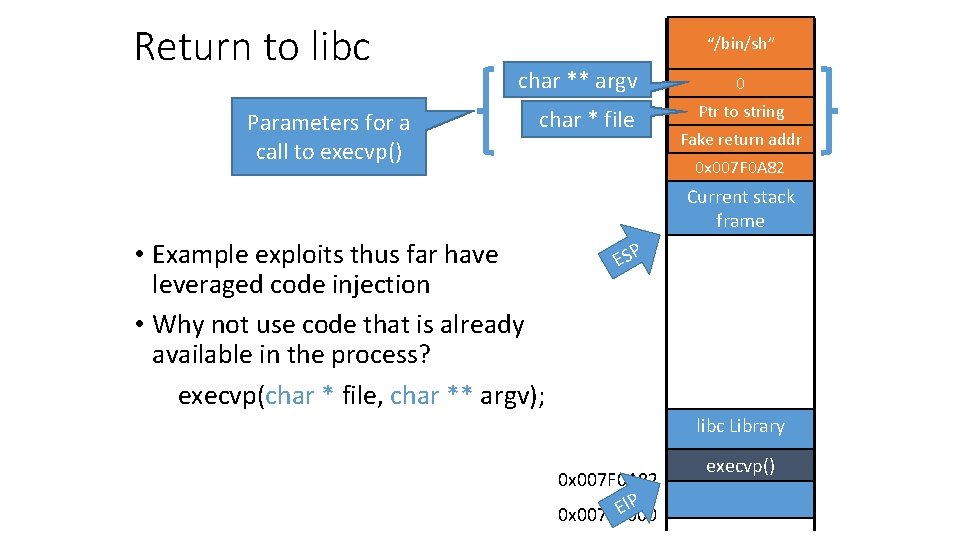
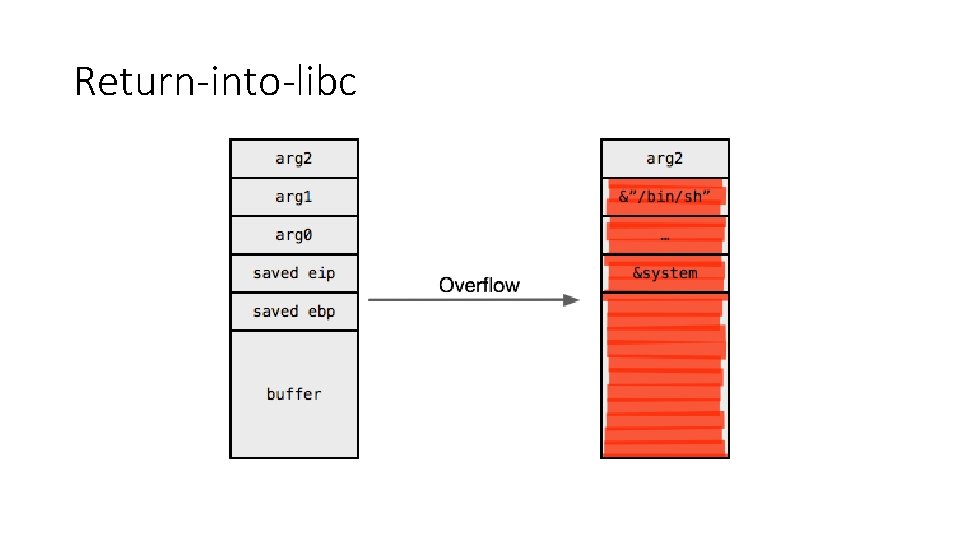
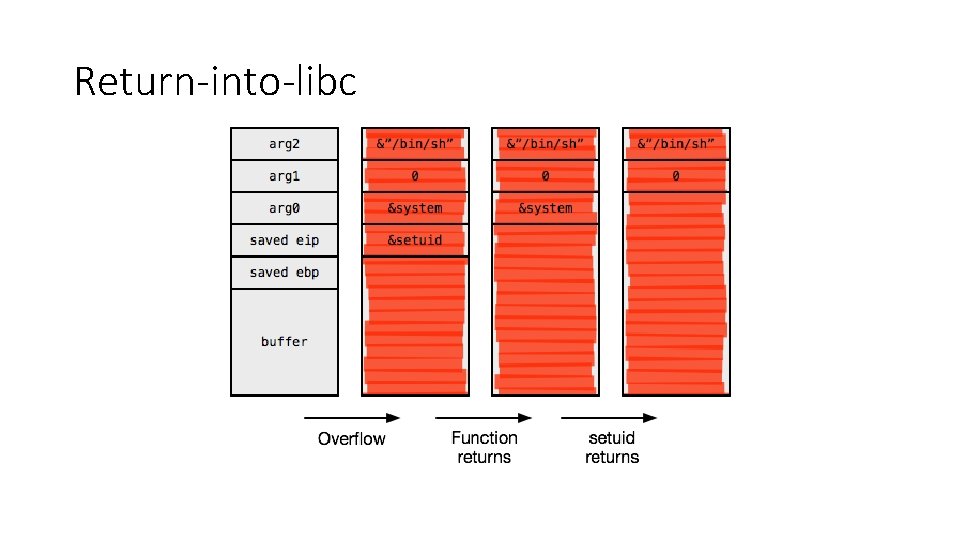
Return to libc Parameters for a call to execvp() “/bin/sh” char ** argv char * file • Example exploits thus far have leveraged code injection • Why not use code that is already available in the process? execvp(char * file, char ** argv); 0 Ptr to string Fake return addr 0 x 007 F 0 A 82 return address Current stack frame ESP libc Library 0 x 007 F 0 A 82 IP E 0 x 007 F 0000 execvp()
Return-into-libc
Return-into-libc
ROP • Return-oriented programming (ROP) extends return-into-libc by changing the granularity of code reuse • Introduced by Shacham in 2007 • Shown to be Turing complete • Instead of returning to functions, ROP uses gadgets • Gadgets: small sequences of instructions ending in a control transfer – e. g. , a return • Each gadget performs a small update to the program state • Execution becomes a chain of returns to gadgets
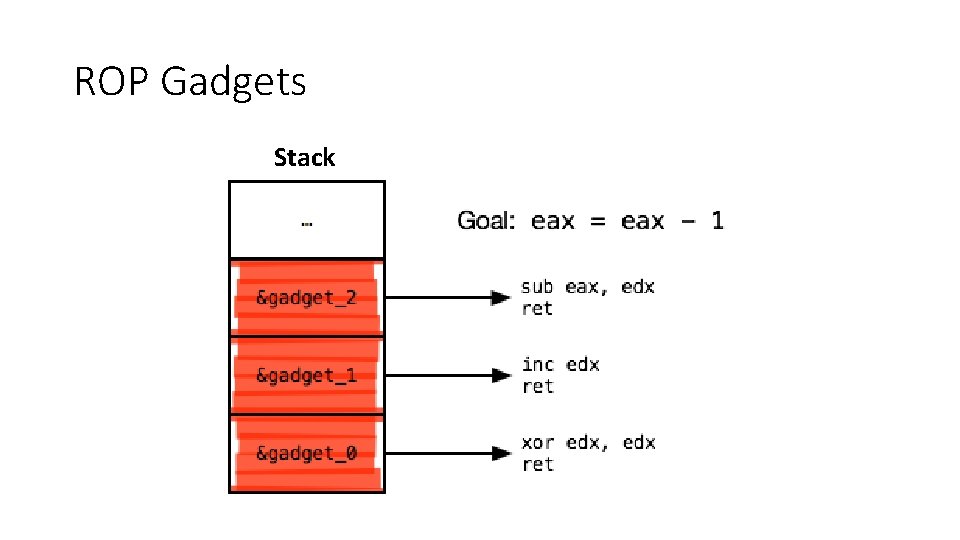
ROP Gadgets Stack
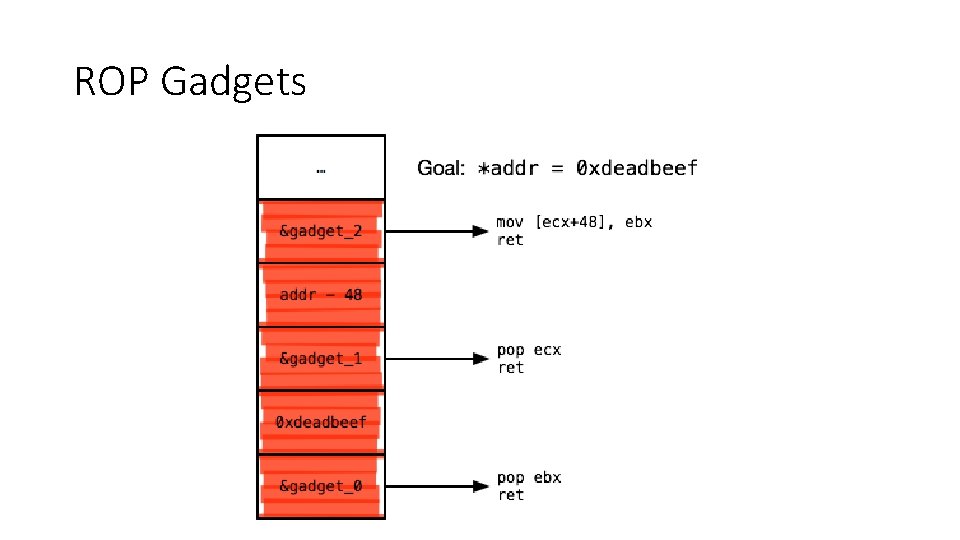
ROP Gadgets
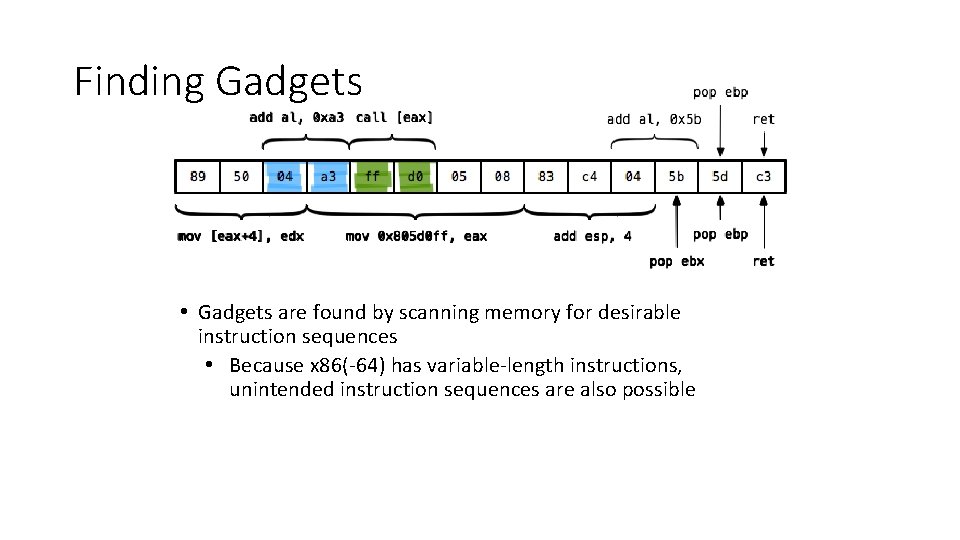
Finding Gadgets • Gadgets are found by scanning memory for desirable instruction sequences • Because x 86(-64) has variable-length instructions, unintended instruction sequences are also possible
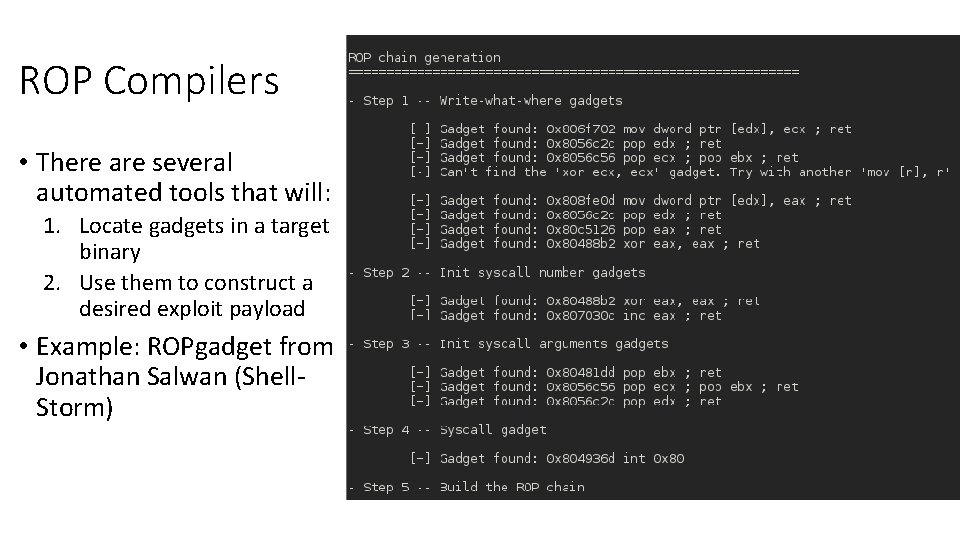
ROP Compilers • There are several automated tools that will: 1. Locate gadgets in a target binary 2. Use them to construct a desired exploit payload • Example: ROPgadget from Jonathan Salwan (Shell. Storm)
ROP • Works against virtually any architecture, not just x 86 • Useful in many situations • Non-executable memory, signed code enforcement • When combined with memory disclosures, ROP is very difficult to defend against • Extremely active area of research
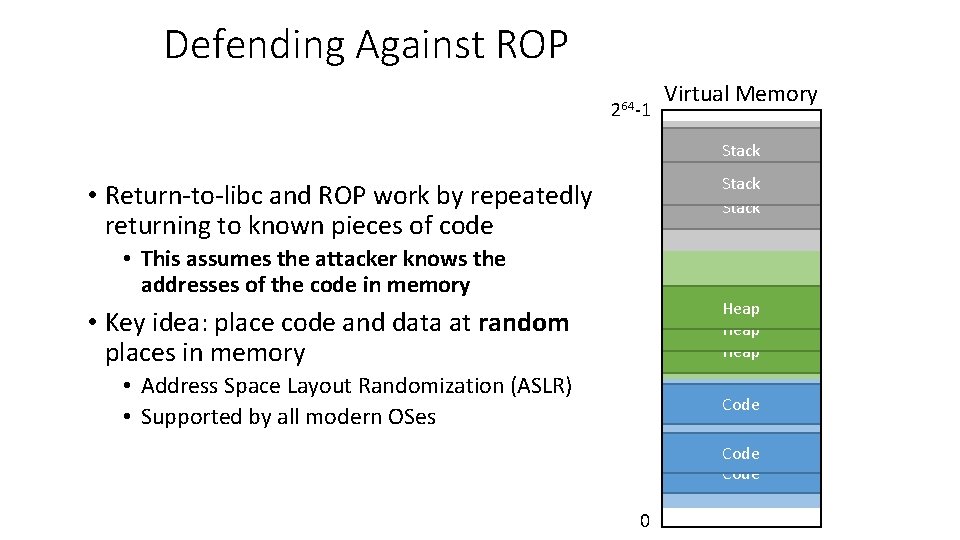
Defending Against ROP 264 -1 Virtual Memory Stack Region • Return-to-libc and ROP work by repeatedly returning to known pieces of code Stack • This assumes the attacker knows the addresses of the code in memory Heap Region • Key idea: place code and data at random places in memory Heap • Address Space Layout Randomization (ASLR) • Supported by all modern OSes Code Region Code 0
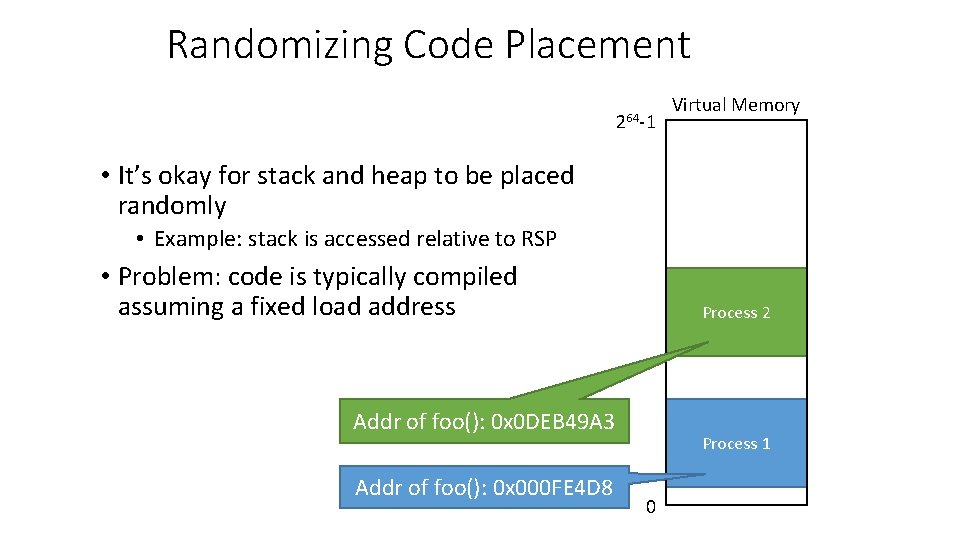
Randomizing Code Placement 264 -1 Virtual Memory • It’s okay for stack and heap to be placed randomly • Example: stack is accessed relative to RSP • Problem: code is typically compiled assuming a fixed load address Process 2 Addr of foo(): 0 x 0 DEB 49 A 3 Addr of foo(): 0 x 000 FE 4 D 8 Process 1 0
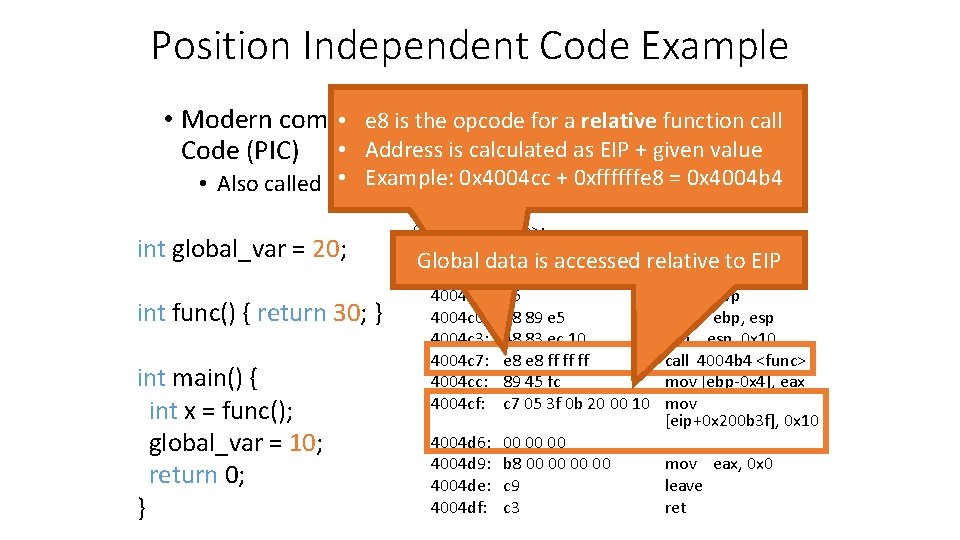
Position Independent Code Example • e 8 is theproduce opcode for a relative function call • Modern compilers can Position Independent Code (PIC) • Address is calculated as EIP + given value • Example: 0 x 4004 cc. Executable + 0 xffffffe 8(PIE) = 0 x 4004 b 4 • Also called Position Independent int global_var = 20; int func() { return 30; } int main() { int x = func(); global_var = 10; return 0; } 004004 b 4 <func>: Global data is accessed relative to EIP 004004 bf <main>: 4004 bf: 55 4004 c 0: 48 89 e 5 4004 c 3: 48 83 ec 10 4004 c 7: e 8 ff ff ff 4004 cc: 89 45 fc 4004 cf: c 7 05 3 f 0 b 20 00 10 4004 d 6: 4004 d 9: 4004 de: 4004 df: 00 00 00 b 8 00 00 c 9 c 3 push ebp mov ebp, esp sub esp, 0 x 10 call 4004 b 4 <func> mov [ebp-0 x 4], eax mov [eip+0 x 200 b 3 f], 0 x 10 mov eax, 0 x 0 leave ret
Tradeoffs with PIC/PIE • Pro • Enables the OS to place the code and data segments at a random place in memory (ASLR) • Con • Code is slightly less efficient • Some addresses must be calculated • In general, the security benefits of ASLR far outweigh the cost
ASLR • Lightweight and effective defense • No program recompilation required (in most cases) • Transparent to benign applications • Little overhead • When to randomize? 1. At process creation? 2. Or, periodically – e. g. , after every process fork?
Security of ALSR • Let's call an attempted attack with randomization guess x a probe • If x is correct, the attack succeeds; if not, it fails • Assume a 32 bit architecture and uniform probe distribution • Scenarios • Address spaces are randomized once • Address spaces are randomized after each probe • What is the expected number of trials required to perform a successful attack in each scenario?
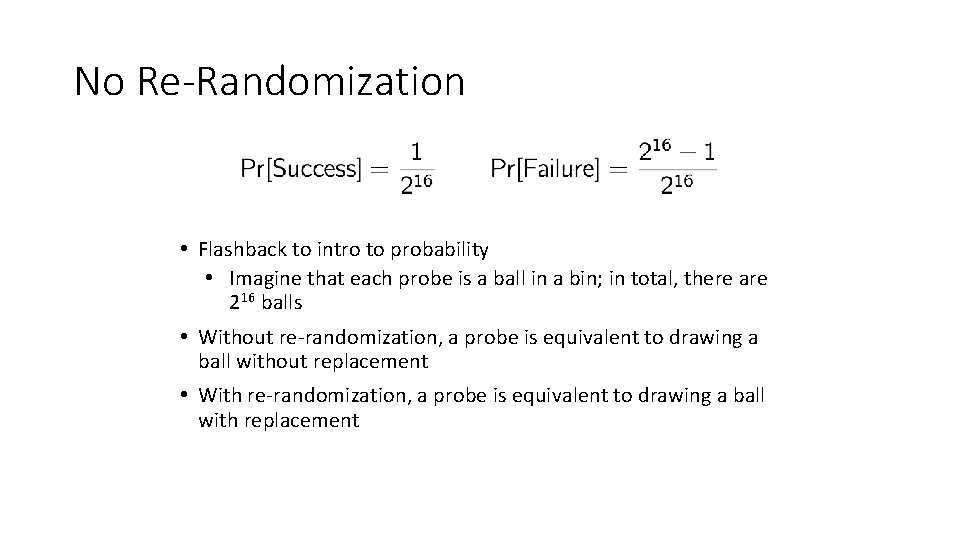
No Re-Randomization • Flashback to intro to probability • Imagine that each probe is a ball in a bin; in total, there are 216 balls • Without re-randomization, a probe is equivalent to drawing a ball without replacement • With re-randomization, a probe is equivalent to drawing a ball with replacement
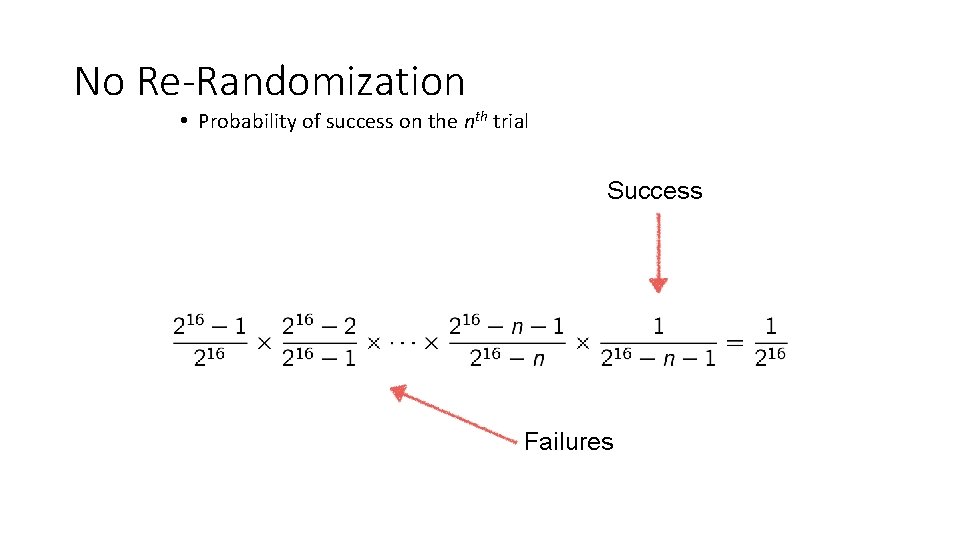
No Re-Randomization • Probability of success on the nth trial Success Failures
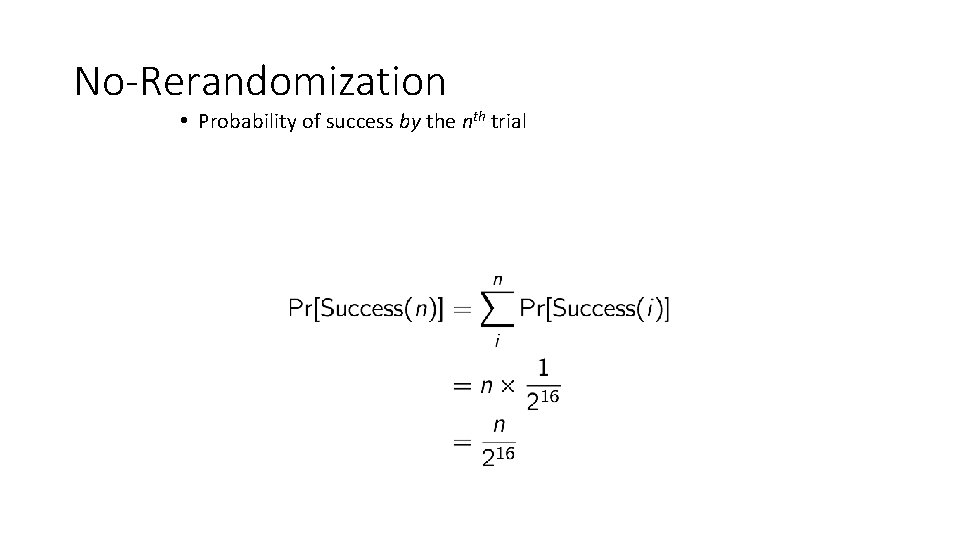
No-Rerandomization • Probability of success by the nth trial
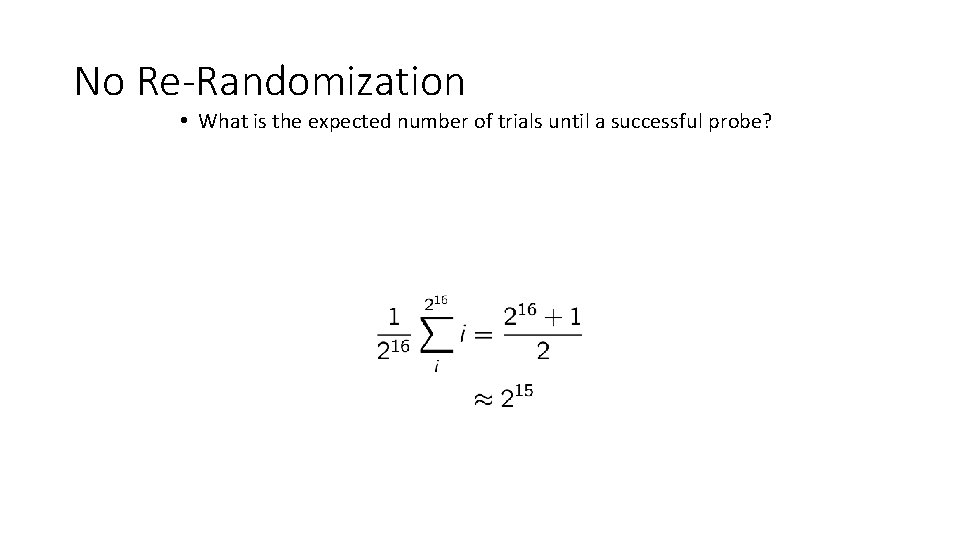
No Re-Randomization • What is the expected number of trials until a successful probe?
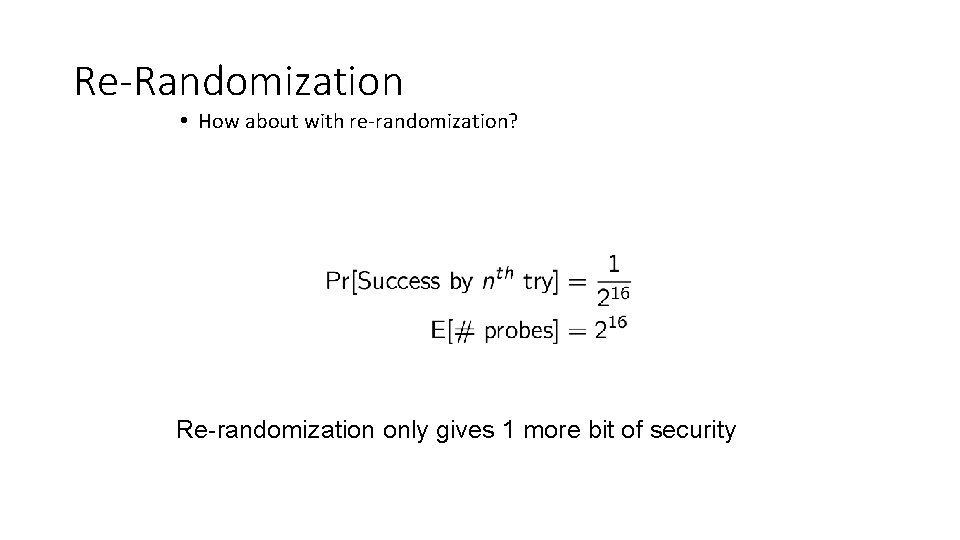
Re-Randomization • How about with re-randomization? Re-randomization only gives 1 more bit of security
ASLR Circumvention • Lots of guesses (but this is inefficient) • Memory disclosures • Typically the target executable and libraries are known • If an address of known code or data is leaked, it's simple to recover the image base • Spraying (heap, JIT) • Exploit any remaining fixed structures – e. g. , the PLT
More Randomization • How about another artificial diversity defense? • What if the attacker is allowed to: 1. Hijack control flow 2. Inject a payload 3. Locate and jump to the payload • . . . but, cannot reliably execute the payload? • The attacker also assumes the target uses a particular instruction set architecture • e. g. , injecting an ARM payload won't work on x 86_64
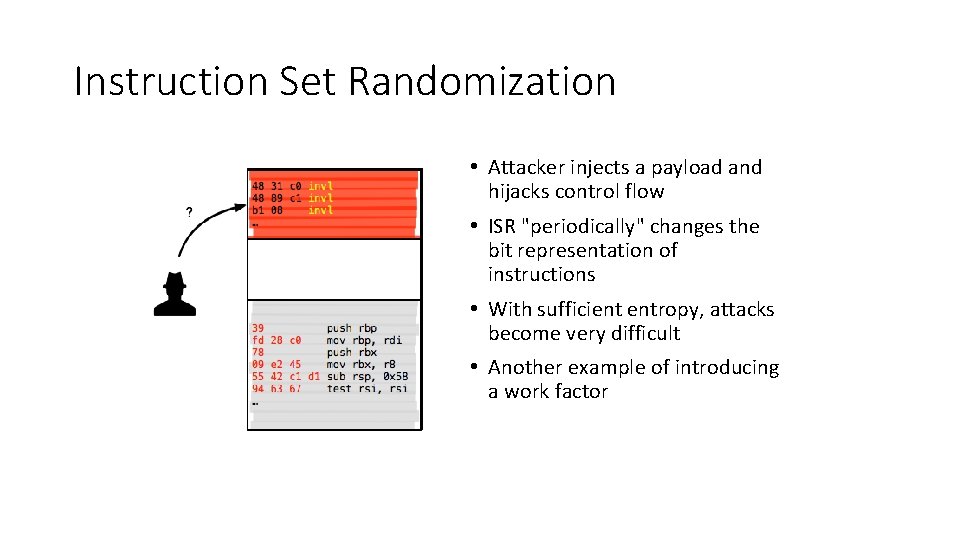
Instruction Set Randomization • Attacker injects a payload and hijacks control flow • ISR "periodically" changes the bit representation of instructions • With sufficient entropy, attacks become very difficult • Another example of introducing a work factor
ISR Discussion • Fine-grain approach to artificial diversity • Requires a large degree of support from underlying software and hardware • How to efficiently execute randomized code? • Implementation approaches • Virtual machines (e. g. , JVM) • Or, hardware support • Deemed not worth the cost to implement and deploy so far
Control Flow Integrity (CFI) • Let's move on from randomization to fine-grained policy enforcement • Control-flow integrity (CFI) • Extract all possible control flow transfers from a program • Enforce that only those transfers can occur during execution 4 3
CFG • A program's control-flow graph (CFG) is an abstraction of all possible control-flow transfers that can be made when executing a program • Directed graph where nodes represent basic blocks and edges represent jumps/calls/returns • Basic blocks are contiguous sets of instructions that must execute sequentially • No jumps out of a basic block except at the end • No jumps into the middle of a basic block 4 4
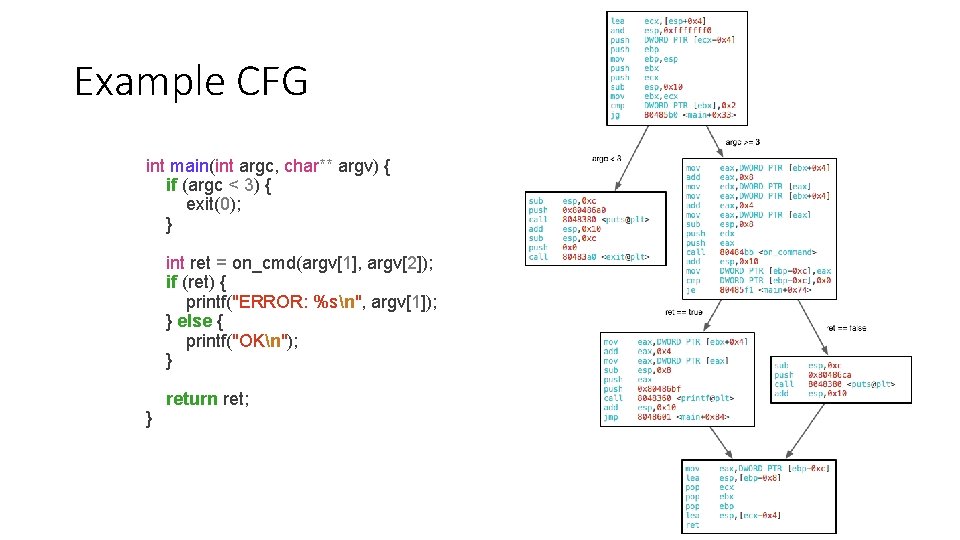
Example CFG int main(int argc, char** argv) { if (argc < 3) { exit(0); } int ret = on_cmd(argv[1], argv[2]); if (ret) { printf("ERROR: %sn", argv[1]); } else { printf("OKn"); } } return ret;
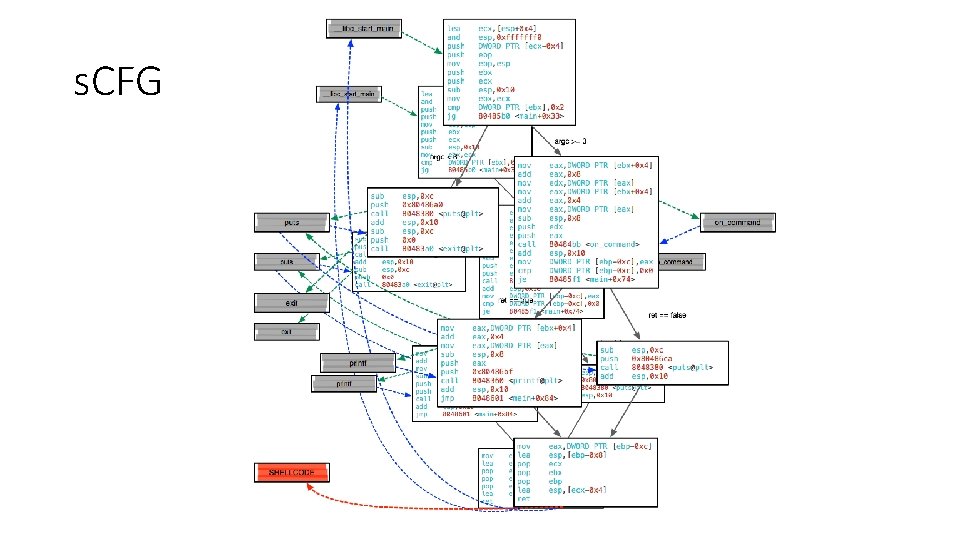
s. CFG
CFI Implementation • Many ways to implement CFI • Original idea: static binary analysis and rewriting • Extract a CFG from a binary program • Add runtime checks on destinations of control-flow transfers • Program terminated if a check fails
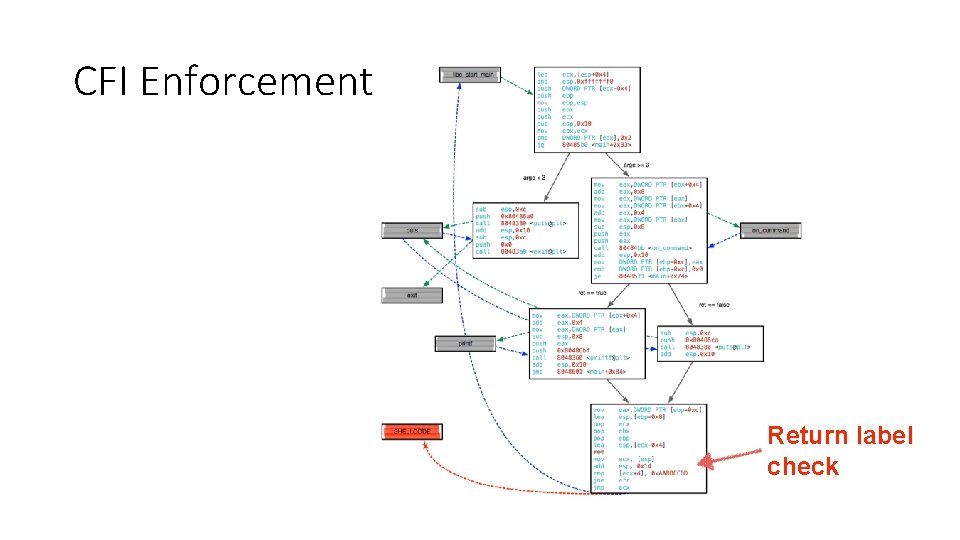
CFI Enforcement Return label check
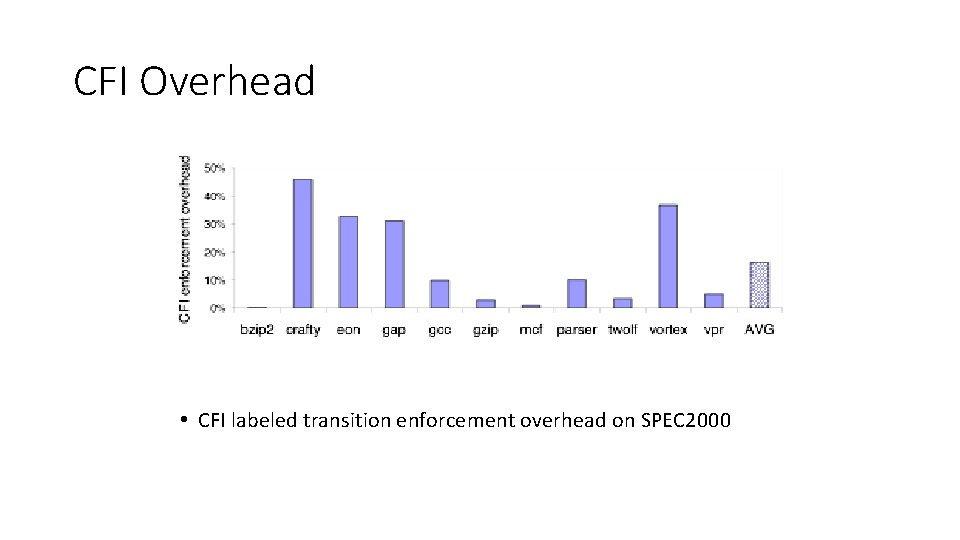
CFI Overhead • CFI labeled transition enforcement overhead on SPEC 2000
CFI Discussion • Why is this better than, e. g. , DEP or ASLR? • Overhead is significant • Much work on more efficient, but weaker, implementations • Can you always extract an accurate CFG? • Is it sound? • Is it a tight approximation? • Still vulnerable to mimicry attacks • What if adversary can implement an attack within the enforced CFG?
![CFI Mimicry Attack int exec_prog(char* path) { char buf[1024]; strcpy(buf, path); return system(buf); }](http://slidetodoc.com/presentation_image_h/b3b2eefa09df6bd02aaec256719122c2/image-50.jpg "CFI Mimicry Attack int exec_prog(char* path) { char buf[1024]; strcpy(buf, path); return system(buf); }")
CFI Mimicry Attack int exec_prog(char* path) { char buf[1024]; strcpy(buf, path); return system(buf); } • Assuming CFI is enforced, can the attacker perform a stack-smashing attack? • What can the attacker do instead? • Overflow buf, perform a return-to-libc attack that directs to system() • The CFI enforcer expects exec_prog() to call system() • Thus, the attack succeeds ; )
Sources 1. Many slides courtesy of Wil Robertson: https: //wkr. io 2. ROPgadget. py: http: //shell-storm. org/project/ROPgadget/
- Slides: 51