
CS 473 Algorithms I Lecture X Dynamic Tables
CS 473 -Algorithms I Lecture X Dynamic Tables CS 473 Lecture X 1
Why Dynamic Tables? In some applications: • We don't know how many objects will be stored in a table. • We may allocate space for a table – But, later we may find out that it is not enough. – Then, the table must be reallocated with a larger size. • All the objects stored in the original table • Must be copied over into the new table. 2
Why Dynamic Tables? • Similarly, if many objects are deleted from the table: – it may be worthwhile to reallocate the table with a smaller size. This problem is called Dynamically Expanding and Contracting a table. CS 473 Lecture X 3
Why Dynamic Tables? Using amortized analysis we will show that, The amortized cost of insertion and deletion is O(1). Even though the actual cost of an operation is large when it triggers an expansion or a contraction. We will also show to guarantee that The unused space in a dynamic table never exceeds a constant fraction of the total space. CS 473 Lecture X 4
Operations TABLE-INSERT: Inserts into the table an item that occupies a single slot. TABLE-DELETE: Removes an item from the table & frees its slot. CS 473 Lecture X 5
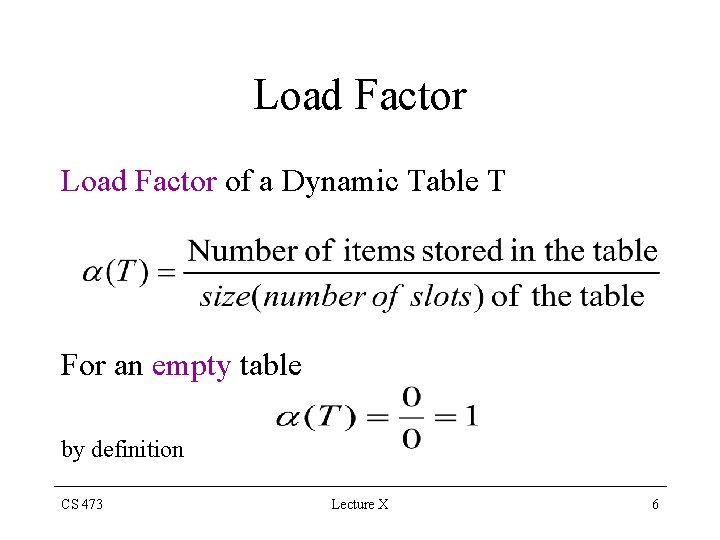
Load Factor of a Dynamic Table T For an empty table by definition CS 473 Lecture X 6
Insertion-Only Dynamic Tables Table-Expansion: • Assumption: – Table is allocated as an array of slots • A table fills up when – all slots have been used – equivalently, when its load factor becomes 1 • Table-Expansion occurs when – An item is to be inserted into a full table CS 473 Lecture X 7
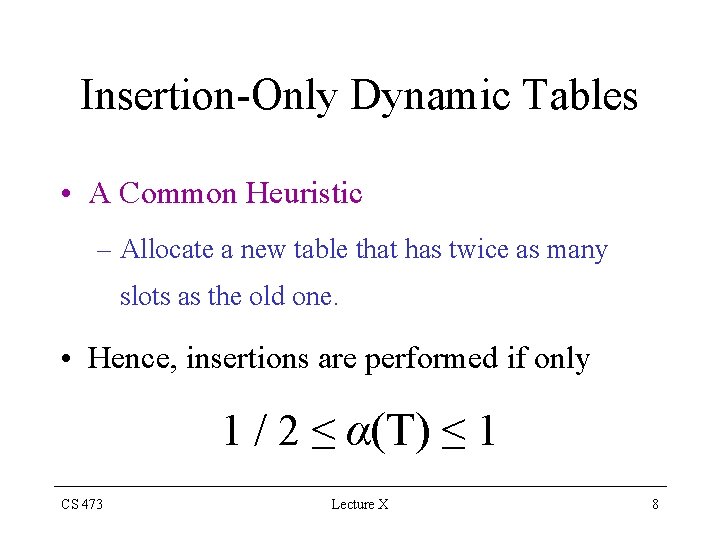
Insertion-Only Dynamic Tables • A Common Heuristic – Allocate a new table that has twice as many slots as the old one. • Hence, insertions are performed if only 1 / 2 ≤ α(T) ≤ 1 CS 473 Lecture X 8
![Table Insert TABLE-INSERT (T, x) if size[T] = 0 then allocate table[T] with 1](http://slidetodoc.com/presentation_image_h2/fed5abb9d93640fd203b3c69e3a2a531/image-9.jpg "Table Insert TABLE-INSERT (T, x) if size[T] = 0 then allocate table[T] with 1")
Table Insert TABLE-INSERT (T, x) if size[T] = 0 then allocate table[T] with 1 slot size[T] 1 if num[T] = size[T] then allocate new-table with 2. size[T] slots copy all items in table[T] into new-table free table[T] new-table[T] size[T] 2. size[T] insert x into table[T] num[T] + 1 end CS 473 Lecture X table[T] : pointer to block of table storage num[T] : number of items in the table size[T] : total number of slots in the table Initially, table is empty, so num[T] = size[T] = 0 9
Table Expansion • Running time of TABLE-INSERT is proportional to the number of elementary insert operations. • Assign a cost of 1 to each elementary insertion • Analyze a sequence of n TABLE-INSERT operations on an initially empty table CS 473 Lecture X 10
Cost of Table Expansion What is cost ci of the i-th operation? • If there is room in the current table (or this is the first operation) ci = 1 (only one elementary insert operation) • If the current table is full, an expansion occurs, then the cost is ci = i. 1 for the elementary insertion of the new item i-1 for the items that must be copied from the old table to the new table. CS 473 Lecture X 11
Cost of Table Expansion • If n operations are performed, The worst case cost of an operation is O(n) Therefore the total running time is O(n 2) • This bound is not tight, because Expansion does not occur so often in the course of n operations. CS 473 Lecture X 12
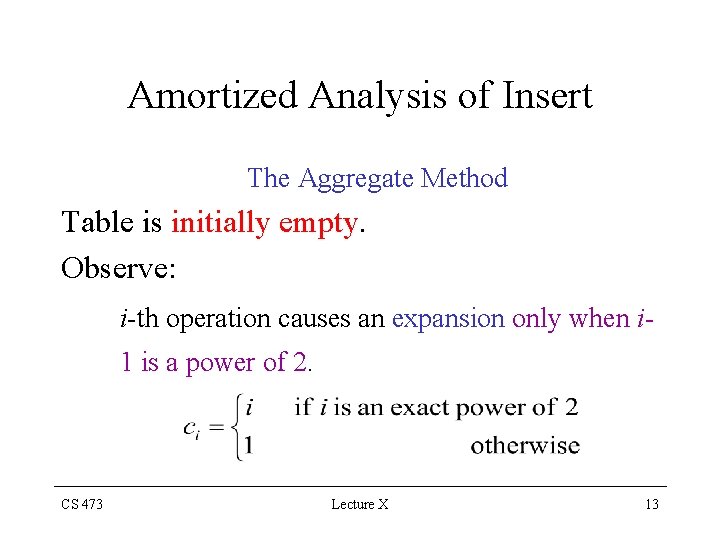
Amortized Analysis of Insert The Aggregate Method Table is initially empty. Observe: i-th operation causes an expansion only when i 1 is a power of 2. CS 473 Lecture X 13
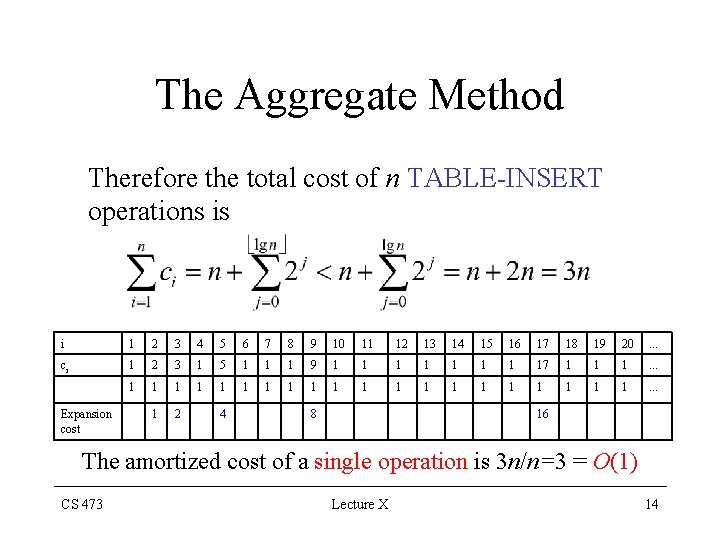
The Aggregate Method Therefore the total cost of n TABLE-INSERT operations is i 1 2 3 4 5 6 7 8 9 10 11 12 13 14 15 16 17 18 19 20 . . . ci 1 2 3 1 5 1 1 1 9 1 1 1 17 1 1 1 . . . 1 1 1 1 1 . . . 1 2 Expansion cost 4 8 16 The amortized cost of a single operation is 3 n/n=3 = O(1) CS 473 Lecture X 14
The Accounting Method Assign the following amortized costs – – Table-Expansion : 0 Insertion of a new item : 3 Insertion of a new item a) 1 (as an actual cost) for inserting itself into the table b) 1 (as a credit) for moving itself in the next expansion c) 1 (as a credit) for moving another item (in the next expansion) that has already moved in the last expansion CS 473 Lecture X 15
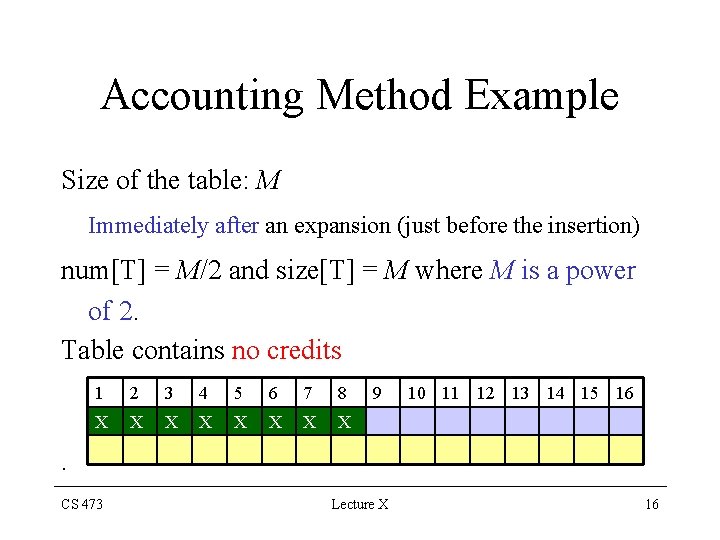
Accounting Method Example Size of the table: M Immediately after an expansion (just before the insertion) num[T] = M/2 and size[T] = M where M is a power of 2. Table contains no credits 1 2 3 4 5 6 7 8 X X X X 9 10 11 12 13 14 15 16 . CS 473 Lecture X 16
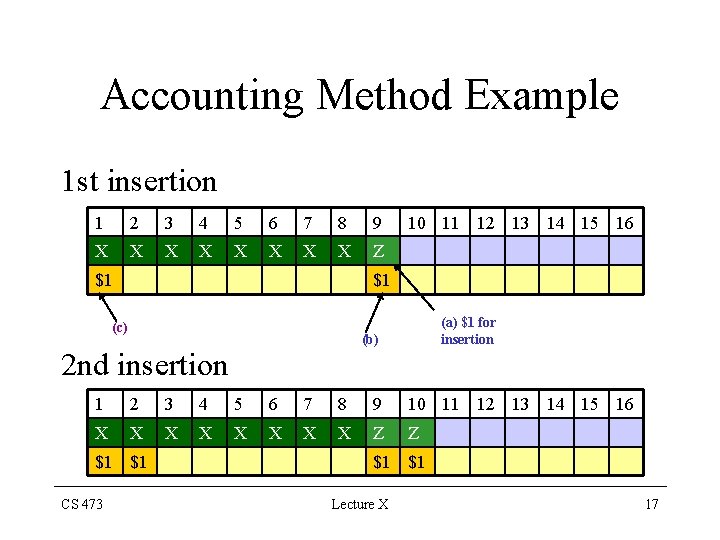
Accounting Method Example 1 st insertion 1 2 3 4 5 6 7 8 9 X X X X Z $1 10 11 12 13 14 15 16 $1 (c) (a) $1 for insertion (b) 2 nd insertion 1 2 3 4 5 6 7 8 9 10 11 12 13 14 15 16 X X X X Z Z $1 $1 CS 473 $1 $1 Lecture X 17
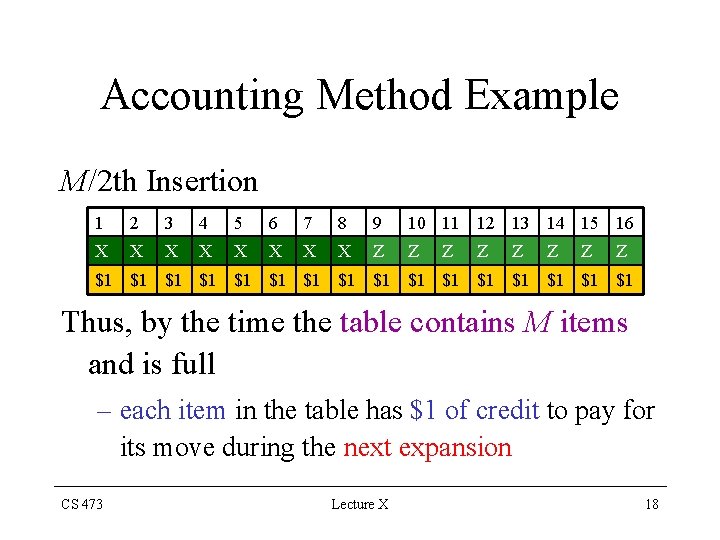
Accounting Method Example M/2 th Insertion 1 2 3 4 5 6 7 8 9 10 11 12 13 14 15 16 X X X X Z Z Z Z $1 $1 $1 $1 Thus, by the time the table contains M items and is full – each item in the table has $1 of credit to pay for its move during the next expansion CS 473 Lecture X 18
The Potential Method Define a potential function Φ that is – 0 immediately after an expansion – builds to the table size by the time table becomes full Next expansion can be paid for by the potential. CS 473 Lecture X 19
![Definition of Φ One possible Φ is: Φ(T) = 2*num[T] –size[T] Immediately after an](http://slidetodoc.com/presentation_image_h2/fed5abb9d93640fd203b3c69e3a2a531/image-20.jpg "Definition of Φ One possible Φ is: Φ(T) = 2*num[T] –size[T] Immediately after an")
Definition of Φ One possible Φ is: Φ(T) = 2*num[T] –size[T] Immediately after an expansion size[T] = 2*num[T] Φ(T) = 0 Immediately before an expansion size[T] = num[T] Φ(T) = num[T] The initial value for the potential is 0 CS 473 Lecture X 20
![Definition of Φ Since the table is at least half full (i. e. num[T]](http://slidetodoc.com/presentation_image_h2/fed5abb9d93640fd203b3c69e3a2a531/image-21.jpg "Definition of Φ Since the table is at least half full (i. e. num[T]")
Definition of Φ Since the table is at least half full (i. e. num[T] ≥ size[T] / 2) Φ(T) is always nonnegative. Thus, the sum of the amortized cost of n TABLE-INSERT operations is an upper bound on the sum of the actual costs. CS 473 Lecture X 21
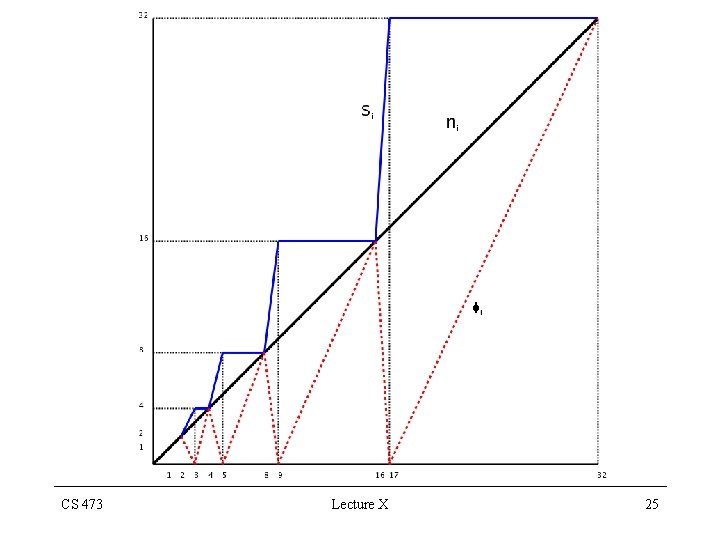
![Analysis of i-th Table Insert ni : num[T] after the i-th operation si :](http://slidetodoc.com/presentation_image_h2/fed5abb9d93640fd203b3c69e3a2a531/image-22.jpg "Analysis of i-th Table Insert ni : num[T] after the i-th operation si :")
Analysis of i-th Table Insert ni : num[T] after the i-th operation si : size[T] after the i-th operation Φi : Potential after the i-th operation Initially we have ni = si = Φi = 0 Note that, ni = ni-1 +1 always hold. CS 473 Lecture X 22
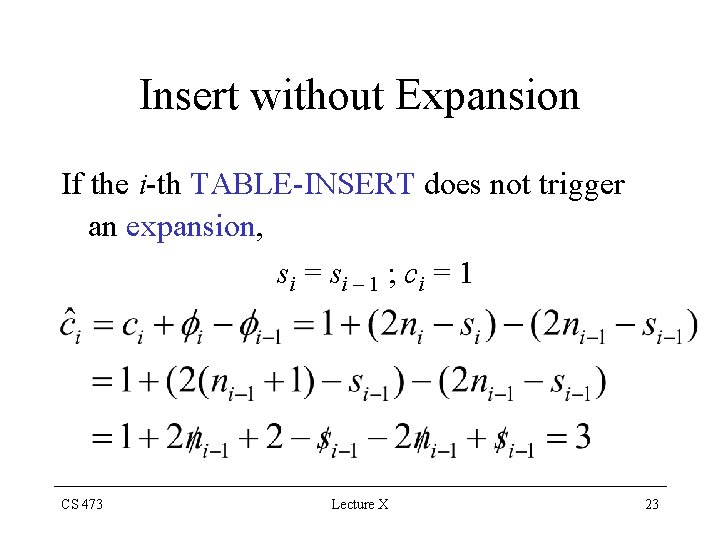
Insert without Expansion If the i-th TABLE-INSERT does not trigger an expansion, si = si – 1 ; c i = 1 CS 473 Lecture X 23
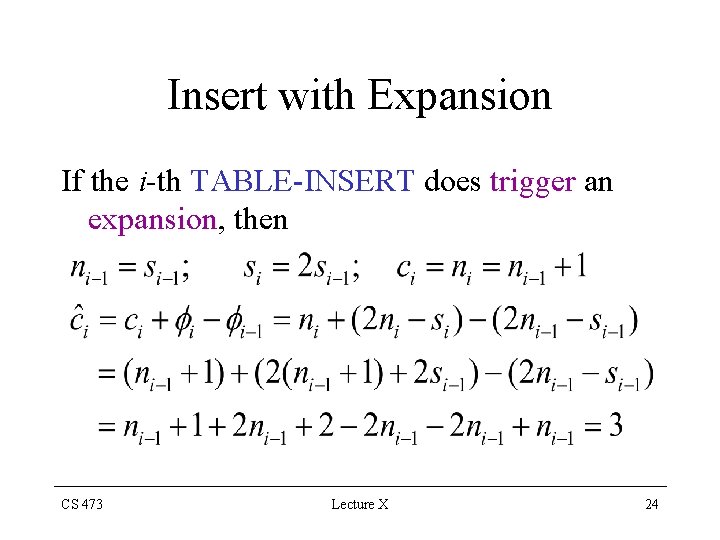
Insert with Expansion If the i-th TABLE-INSERT does trigger an expansion, then CS 473 Lecture X 24
CS 473 Lecture X 25
Adding Delete Operation TABLE-DELETE: Remove the specified item from the table. It is often desirable to contract the table. In table contraction, we would like to preserve two properties • Load factor of dynamic table is bounded below by a constant • Amortized cost of a table operation is bounded above by a constant We assume that the cost can be measured in terms of elementary insertions and deletions CS 473 Lecture X 26
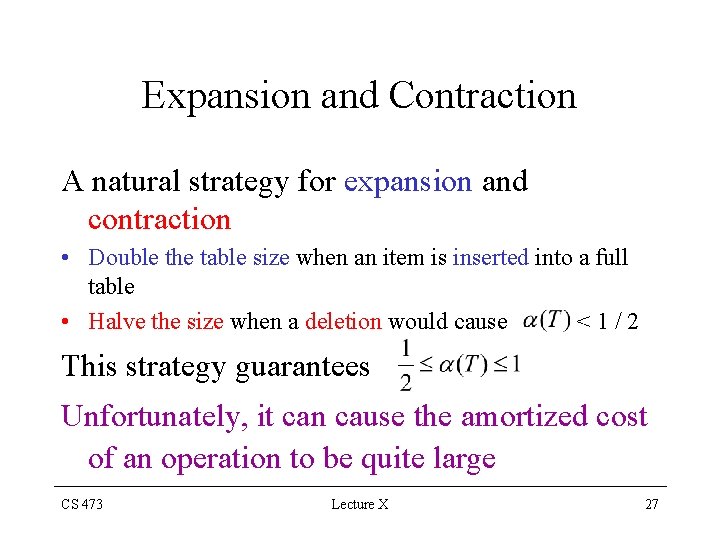
Expansion and Contraction A natural strategy for expansion and contraction • Double the table size when an item is inserted into a full table • Halve the size when a deletion would cause <1/2 This strategy guarantees Unfortunately, it can cause the amortized cost of an operation to be quite large CS 473 Lecture X 27
Worst-Case for α(T) ≥ ½ Consider the following worst case scenario – We perform n operations on an empty table where n is a power of 2 – First n/2 operations are all insertions , cost a total of Θ(n) at the end: we have num[T] = size[T] = n/2 – Second n/2 operations repeat the sequence IDDI that is I D D I. . . CS 473 Lecture X 28
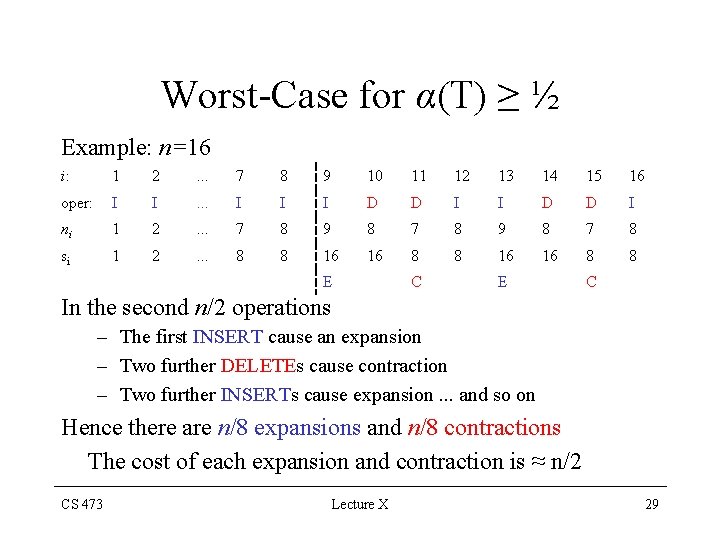
Worst-Case for α(T) ≥ ½ Example: n=16 i: 1 2 . . . 7 8 9 10 11 12 13 14 15 16 oper: I I . . . I I I D D I ni 1 2 . . . 7 8 9 8 7 8 si 1 2 . . . 8 8 16 16 8 8 E C In the second n/2 operations – The first INSERT cause an expansion – Two further DELETEs cause contraction – Two further INSERTs cause expansion. . . and so on Hence there are n/8 expansions and n/8 contractions The cost of each expansion and contraction is ≈ n/2 CS 473 Lecture X 29
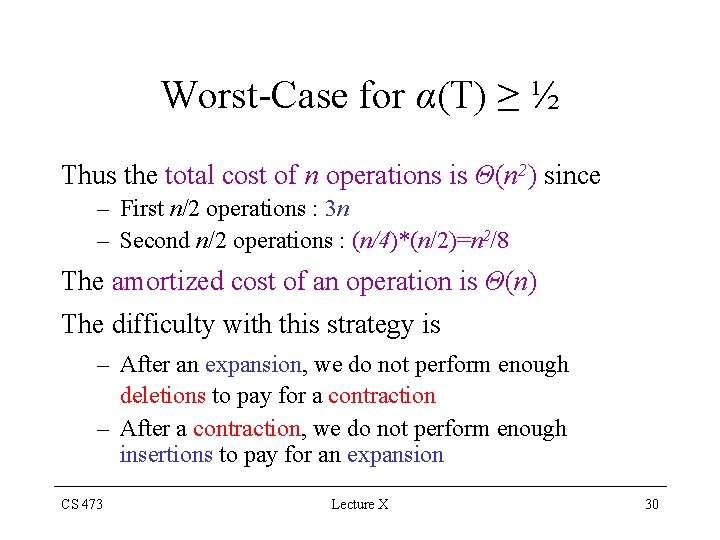
Worst-Case for α(T) ≥ ½ Thus the total cost of n operations is Θ(n 2) since – First n/2 operations : 3 n – Second n/2 operations : (n/4)*(n/2)=n 2/8 The amortized cost of an operation is Θ(n) The difficulty with this strategy is – After an expansion, we do not perform enough deletions to pay for a contraction – After a contraction, we do not perform enough insertions to pay for an expansion CS 473 Lecture X 30
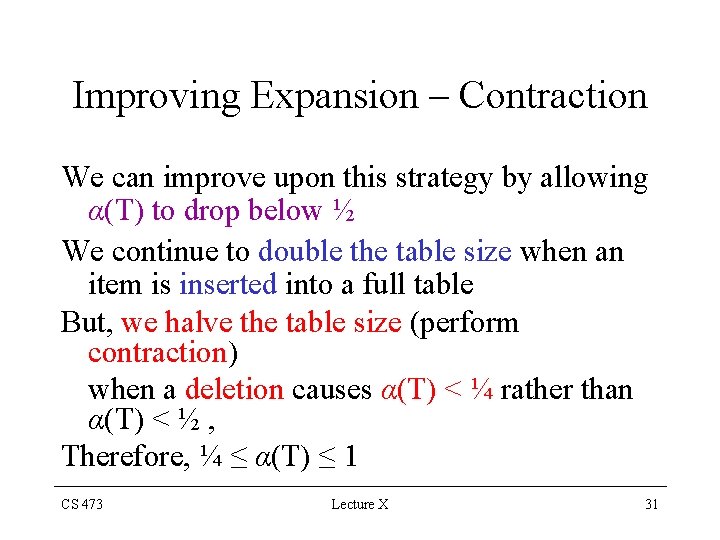
Improving Expansion – Contraction We can improve upon this strategy by allowing α(T) to drop below ½ We continue to double the table size when an item is inserted into a full table But, we halve the table size (perform contraction) when a deletion causes α(T) < ¼ rather than α(T) < ½ , Therefore, ¼ ≤ α(T) ≤ 1 CS 473 Lecture X 31
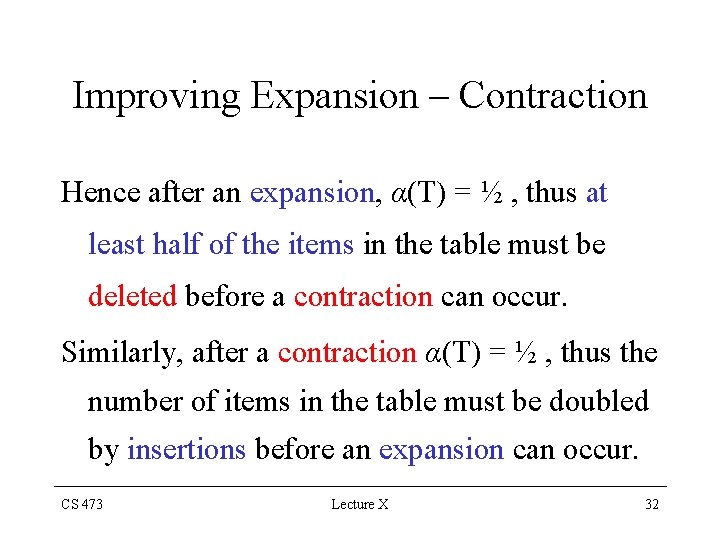
Improving Expansion – Contraction Hence after an expansion, α(T) = ½ , thus at least half of the items in the table must be deleted before a contraction can occur. Similarly, after a contraction α(T) = ½ , thus the number of items in the table must be doubled by insertions before an expansion can occur. CS 473 Lecture X 32
Potential Method Define the potential function as follows • Φ(T) = 0 immediately after an expansion or contraction • Recall that, α(T) = ½ immediately after and expansion or contraction, therefore the potential should build up to num[T] as α(T) increases to 1 or decreases to ¼ • So that the next expansion or contraction can be paid by the potential. CS 473 Lecture X 33
![Φ(α) w. r. t. α(T) M=num[T] when an expansion or contraction occurs CS 473](http://slidetodoc.com/presentation_image_h2/fed5abb9d93640fd203b3c69e3a2a531/image-34.jpg "Φ(α) w. r. t. α(T) M=num[T] when an expansion or contraction occurs CS 473")
Φ(α) w. r. t. α(T) M=num[T] when an expansion or contraction occurs CS 473 Lecture X 34
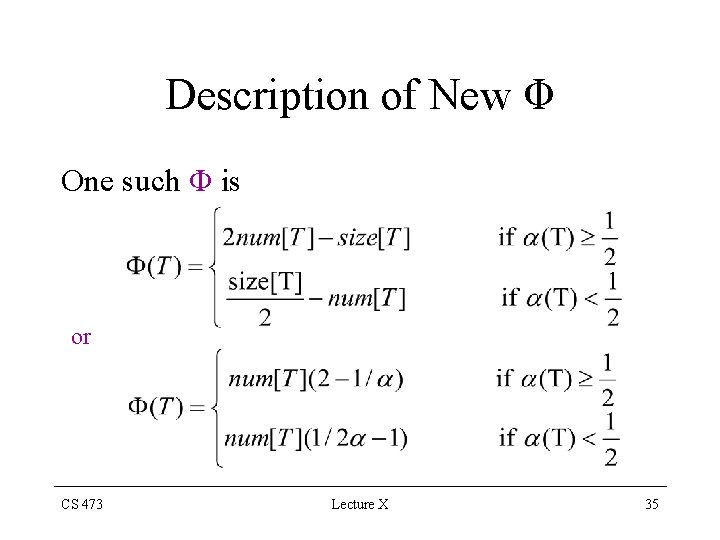
Description of New Φ One such Φ is or CS 473 Lecture X 35
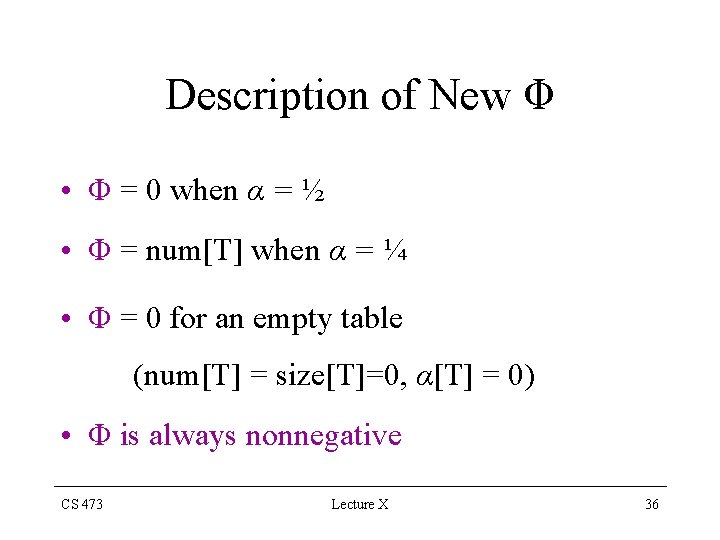
Description of New Φ • Φ = 0 when α = ½ • Φ = num[T] when α = ¼ • Φ = 0 for an empty table (num[T] = size[T]=0, α[T] = 0) • Φ is always nonnegative CS 473 Lecture X 36
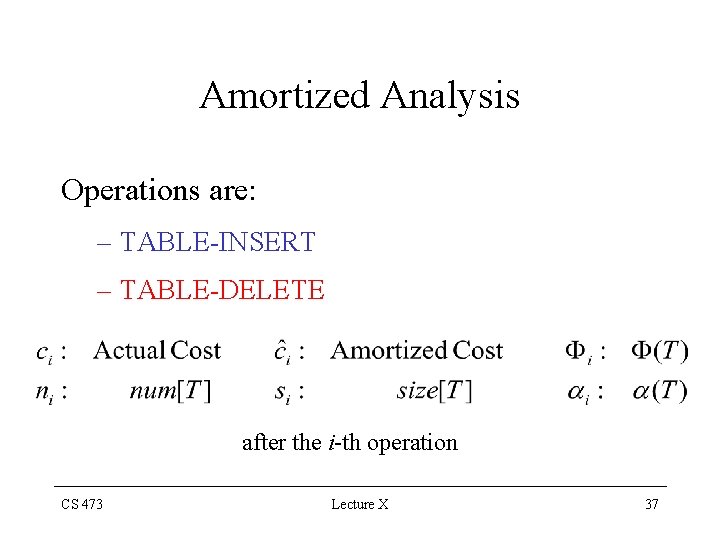
Amortized Analysis Operations are: – TABLE-INSERT – TABLE-DELETE after the i-th operation CS 473 Lecture X 37
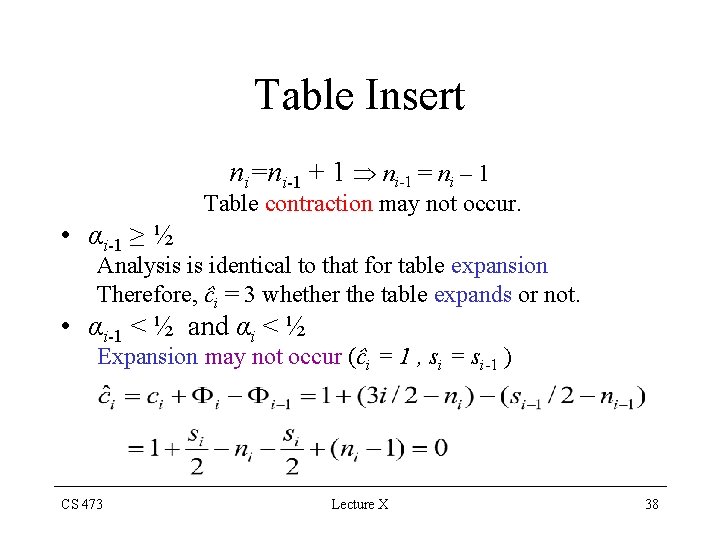
Table Insert ni=ni-1 + 1 ni-1 = ni – 1 Table contraction may not occur. • αi-1 ≥ ½ Analysis is identical to that for table expansion Therefore, ĉi = 3 whether the table expands or not. • αi-1 < ½ and αi < ½ Expansion may not occur (ĉi = 1 , si = si-1 ) CS 473 Lecture X 38
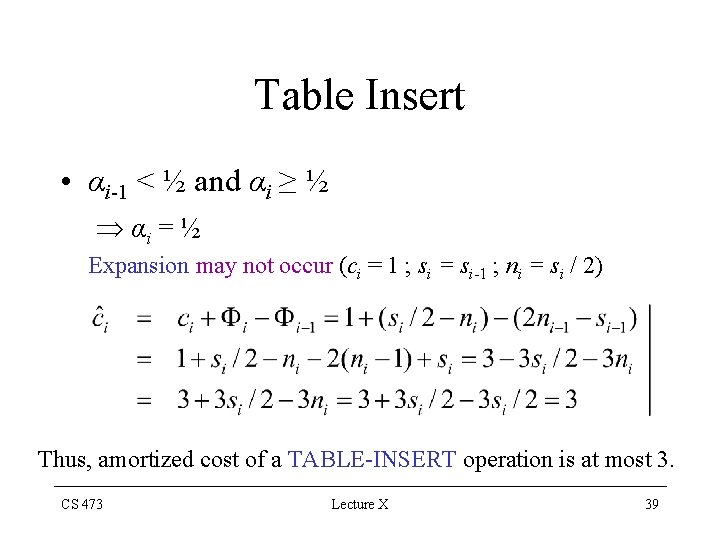
Table Insert • αi-1 < ½ and αi ≥ ½ αi = ½ Expansion may not occur (ci = 1 ; si = si-1 ; ni = si / 2) Thus, amortized cost of a TABLE-INSERT operation is at most 3. CS 473 Lecture X 39
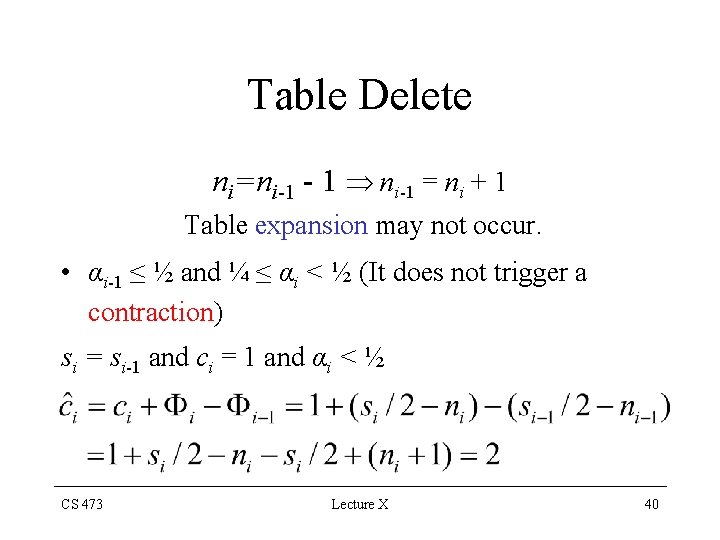
Table Delete ni=ni-1 - 1 ni-1 = ni + 1 Table expansion may not occur. • αi-1 ≤ ½ and ¼ ≤ αi < ½ (It does not trigger a contraction) si = si-1 and ci = 1 and αi < ½ CS 473 Lecture X 40
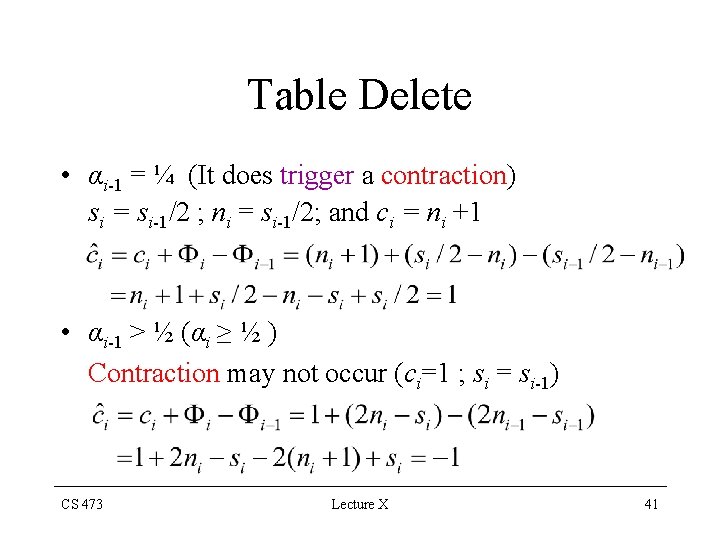
Table Delete • αi-1 = ¼ (It does trigger a contraction) si = si-1/2 ; ni = si-1/2; and ci = ni +1 • αi-1 > ½ (αi ≥ ½ ) Contraction may not occur (ci=1 ; si = si-1) CS 473 Lecture X 41
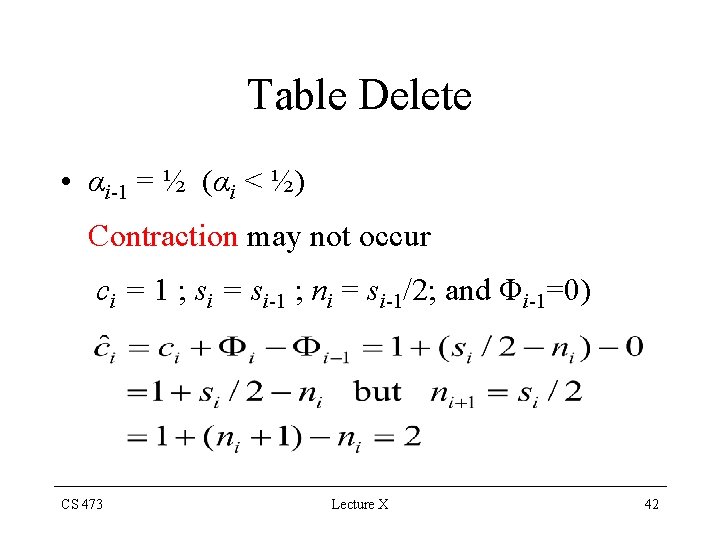
Table Delete • αi-1 = ½ (αi < ½) Contraction may not occur ci = 1 ; si = si-1 ; ni = si-1/2; and Φi-1=0) CS 473 Lecture X 42
Table Delete Thus, the amortized cost of a TABLE-DELETE operation is at most 2 Since the amortized cost of each operation is bounded above by a constant The actual time for any sequence of n operations on a Dynamic Table is O(n) CS 473 Lecture X 43
- Slides: 43