
CS 4700 Foundations of Artificial Intelligence Prof Bart
CS 4700: Foundations of Artificial Intelligence Prof. Bart Selman selman@cs. cornell. edu Machine Learning: Decision Trees R&N 18. 3 1
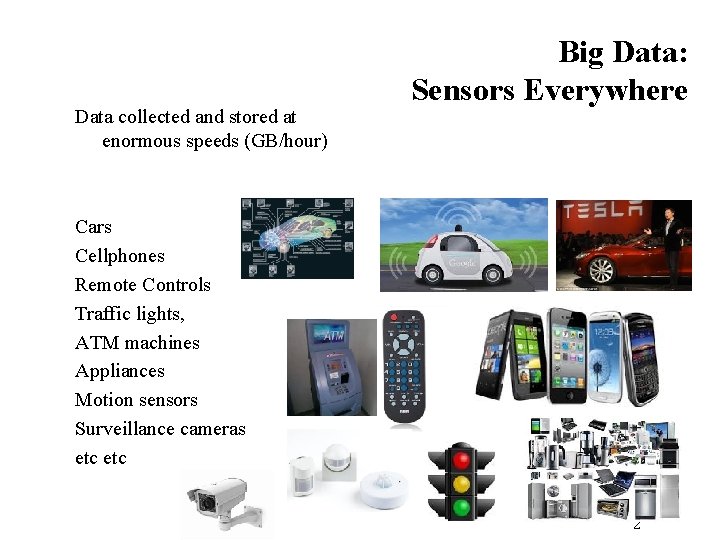
Data collected and stored at enormous speeds (GB/hour) Big Data: Sensors Everywhere Cars Cellphones Remote Controls Traffic lights, ATM machines Appliances Motion sensors Surveillance cameras etc 2
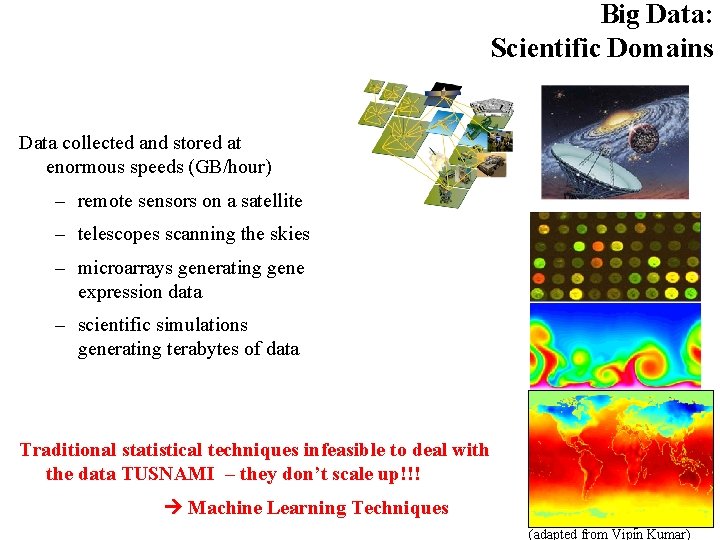
Big Data: Scientific Domains Data collected and stored at enormous speeds (GB/hour) – remote sensors on a satellite – telescopes scanning the skies – microarrays generating gene expression data – scientific simulations generating terabytes of data Traditional statistical techniques infeasible to deal with the data TUSNAMI – they don’t scale up!!! Machine Learning Techniques 3 (adapted from Vipin Kumar)
Machine Learning Tasks Prediction Methods – Use some variables to predict unknown or future values of other variables. Description Methods – Find human-interpretable patterns that describe the data. 4
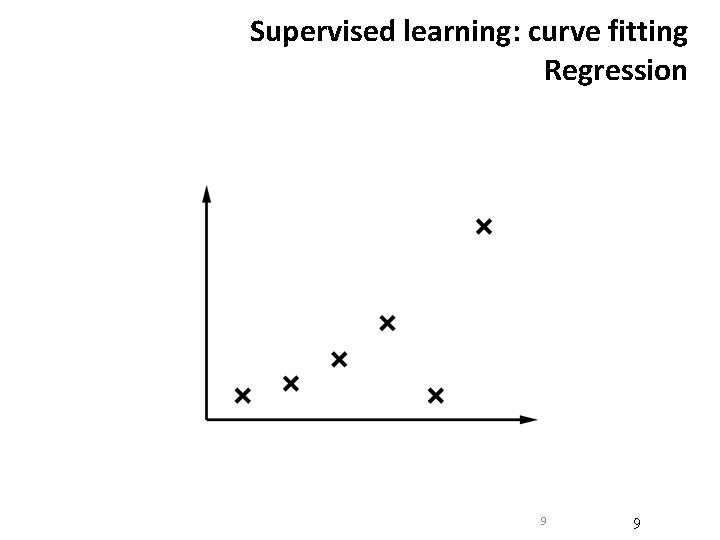
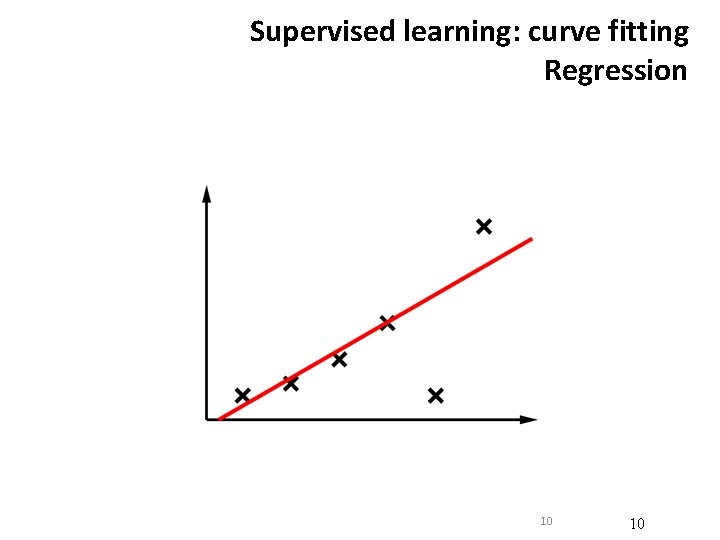
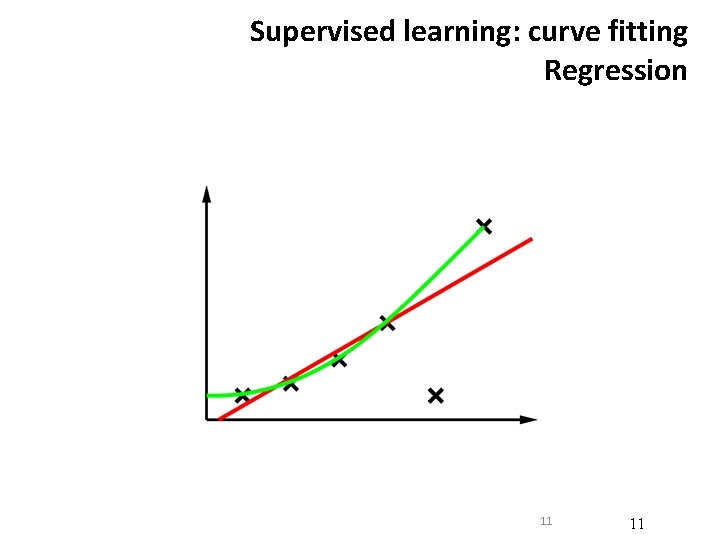
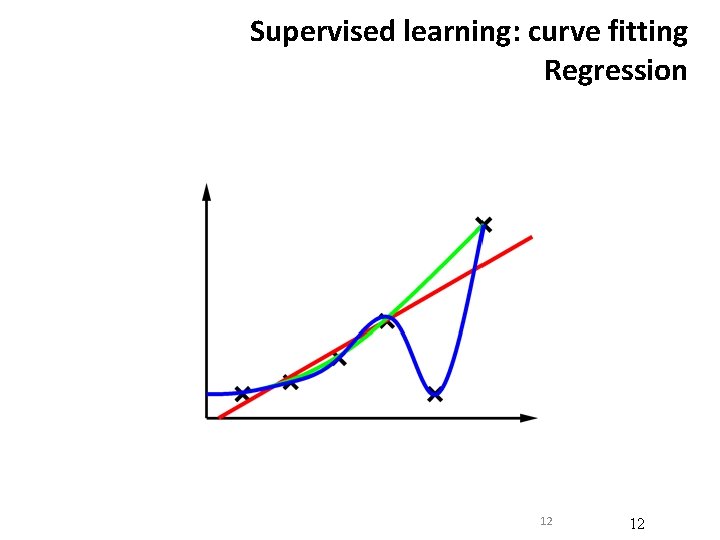
Machine Learning Tasks Supervised learning: We are given a set of examples with the correct answer classification and regression Unsupervised learning: “just make sense of the data” 5
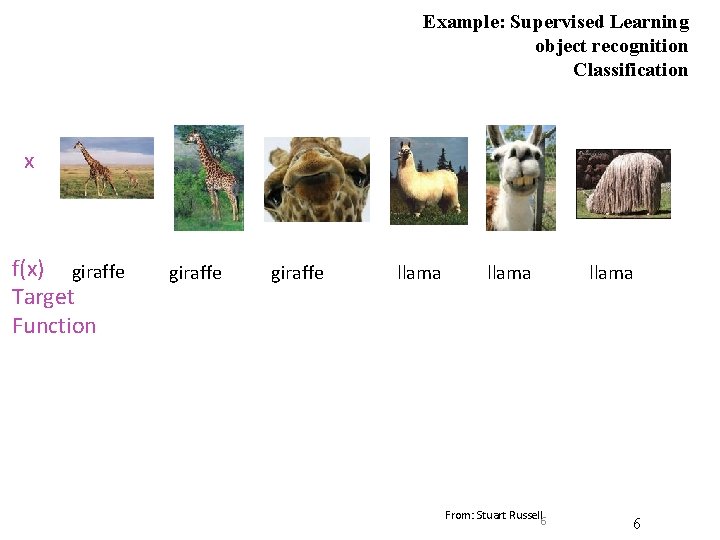
Example: Supervised Learning object recognition Classification x f(x) giraffe Target Function giraffe llama From: Stuart Russell 6 llama 6
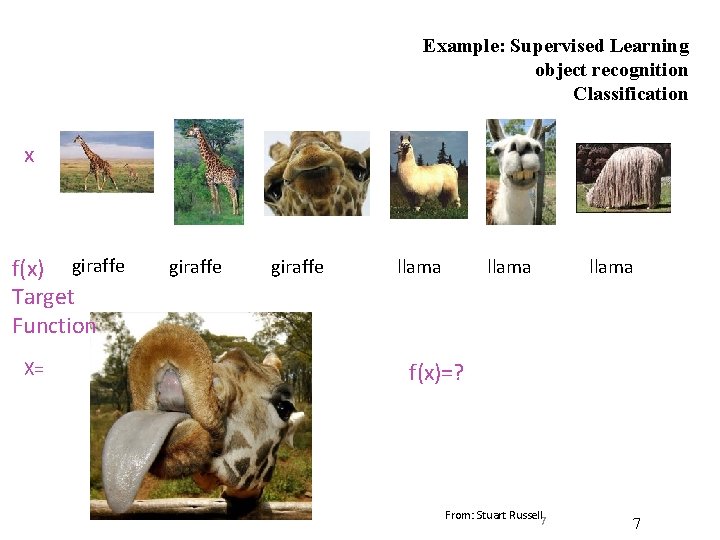
Example: Supervised Learning object recognition Classification x f(x) giraffe Target Function X= giraffe llama f(x)=? From: Stuart Russell 7 7
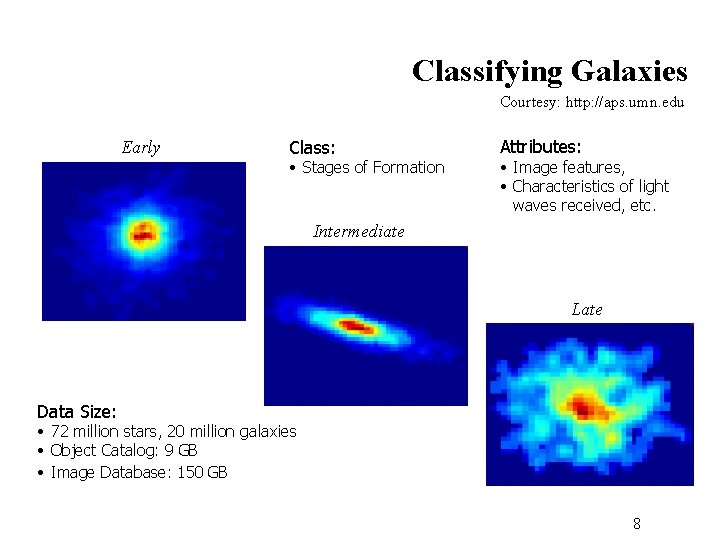
Classifying Galaxies Courtesy: http: //aps. umn. edu Early Class: • Stages of Formation Attributes: • Image features, • Characteristics of light waves received, etc. Intermediate Late Data Size: • 72 million stars, 20 million galaxies • Object Catalog: 9 GB • Image Database: 150 GB 8
Supervised learning: curve fitting Regression 9 9
Supervised learning: curve fitting Regression 10 10
Supervised learning: curve fitting Regression 11 11
Supervised learning: curve fitting Regression 12 12
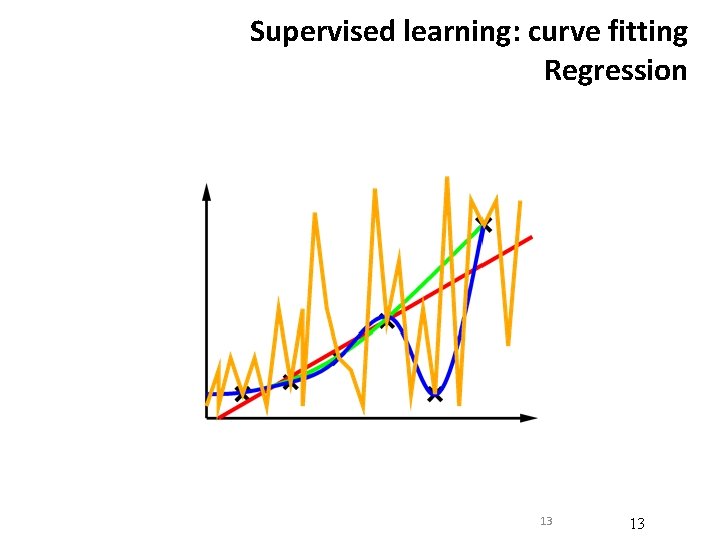
Supervised learning: curve fitting Regression 13 13
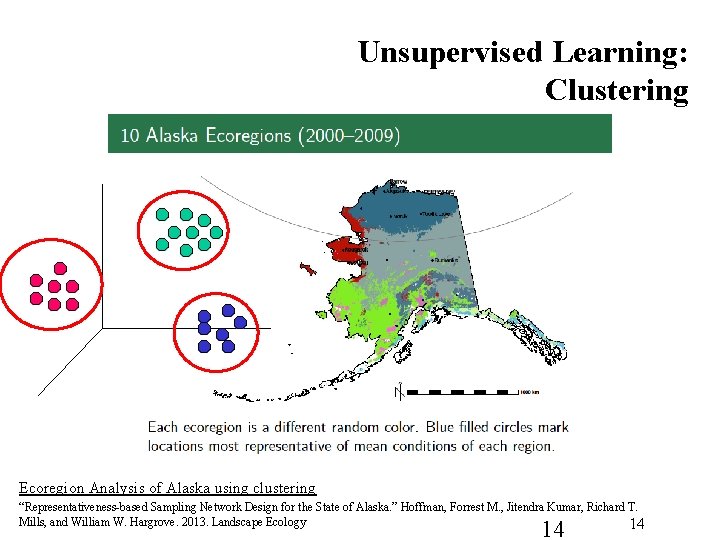
Unsupervised Learning: Clustering Ecoregion Analysis of Alaska using clustering “Representativeness-based Sampling Network Design for the State of Alaska. ” Hoffman, Forrest M. , Jitendra Kumar, Richard T. Mills, and William W. Hargrove. 2013. Landscape Ecology 14 14
Machine Learning In classification – inputs belong two or more classes. Goal: the learner must produce a model that assigns unseen inputs to one (or multi-label classification) or more of these classes. Typically supervised learning. – Example – – Spam filtering is an example of classification, where the inputs are email (or other) messages and the classes are "spam" and "not spam". In regression, also typically supervised, the outputs are continuous rather than discrete. In clustering, a set of inputs is to be divided into groups. Typically done in an unsupervised way (i. e. , no labels, the groups are not known beforehand). 15
Supervised learning: Big Picture Goal: To learn an unknown target function f Input: a training set of labeled examples (xj, yj) where yj = f(xj) • E. g. , xj is an image, f(xj) is the label “giraffe” • E. g. , xj is a seismic signal, f(xj) is the label “explosion” Output: hypothesis h that is “close” to f, i. e. , predicts well on unseen examples (“test set”) Many possible hypothesis families for h – Linear models, logistic regression, neural networks, support vector machines, decision trees, examples (nearest-neighbor), grammars, kernelized separators, etc 16
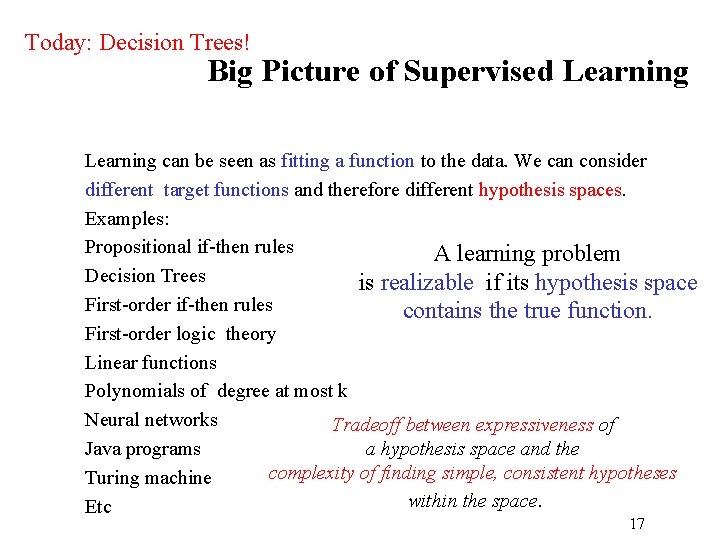
Today: Decision Trees! Big Picture of Supervised Learning can be seen as fitting a function to the data. We can consider different target functions and therefore different hypothesis spaces. Examples: Propositional if-then rules A learning problem Decision Trees is realizable if its hypothesis space First-order if-then rules contains the true function. First-order logic theory Linear functions Polynomials of degree at most k Neural networks Tradeoff between expressiveness of Java programs a hypothesis space and the complexity of finding simple, consistent hypotheses Turing machine within the space. Etc 17
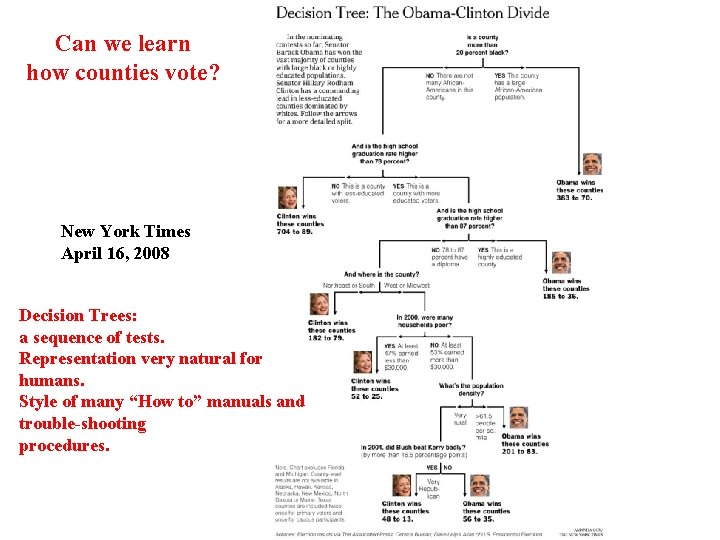
Can we learn how counties vote? New York Times April 16, 2008 Decision Trees: a sequence of tests. Representation very natural for humans. Style of many “How to” manuals and trouble-shooting procedures.
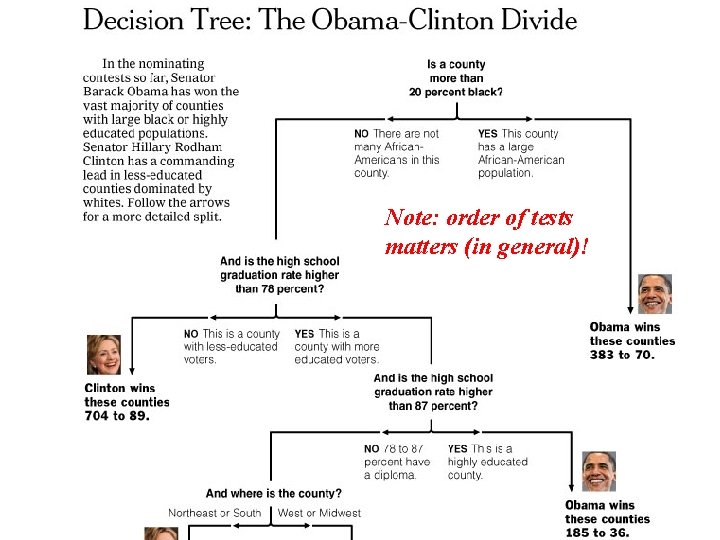
Note: order of tests matters (in general)! 19
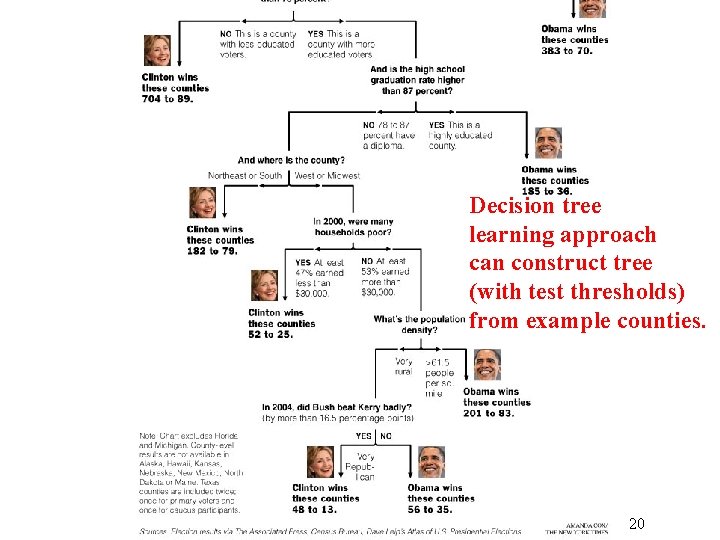
Decision tree learning approach can construct tree (with test thresholds) from example counties. 20
Decision Tree Learning 21
Decision Tree Learning Task: – Given: collection of examples (x, f(x)) – Return: a function h (hypothesis) that approximates f – h is a decision tree Input: an object or situation described by a set of attributes (or features) Output: a “decision” – the predicts output value for the input. The input attributes and the outputs can be discrete or continuous. We will focus on decision trees for Boolean classification: each example is classified as positive or negative. 22
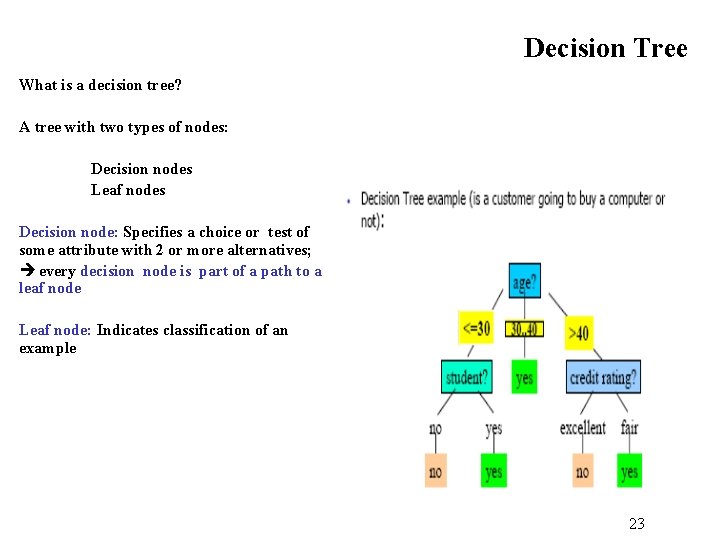
Decision Tree What is a decision tree? A tree with two types of nodes: Decision nodes Leaf nodes Decision node: Specifies a choice or test of some attribute with 2 or more alternatives; every decision node is part of a path to a leaf node Leaf node: Indicates classification of an example 23
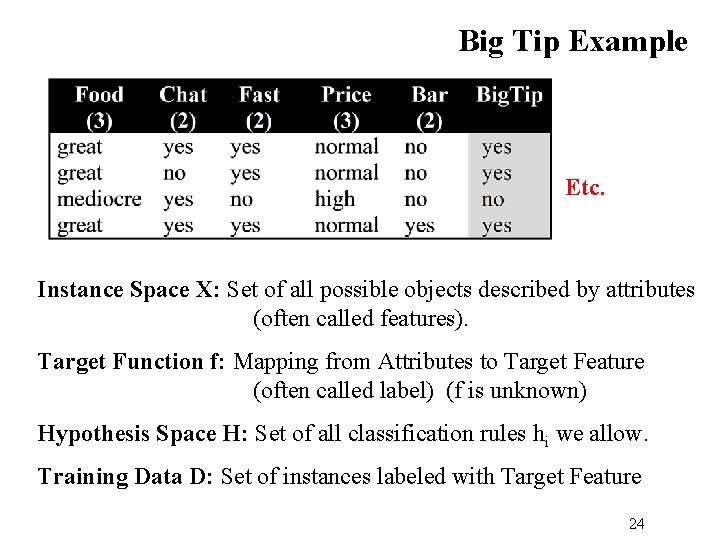
Big Tip Example Etc. Instance Space X: Set of all possible objects described by attributes (often called features). Target Function f: Mapping from Attributes to Target Feature (often called label) (f is unknown) Hypothesis Space H: Set of all classification rules hi we allow. Training Data D: Set of instances labeled with Target Feature 24
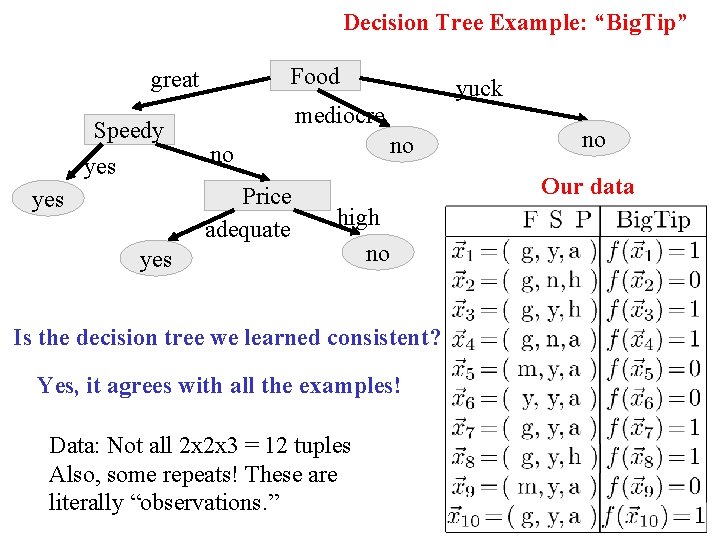
Decision Tree Example: “Big. Tip” Food great Speedy yes mediocre yes no no Price adequate yes yuck no Our data high no Is the decision tree we learned consistent? Yes, it agrees with all the examples! Data: Not all 2 x 2 x 3 = 12 tuples Also, some repeats! These are literally “observations. ”
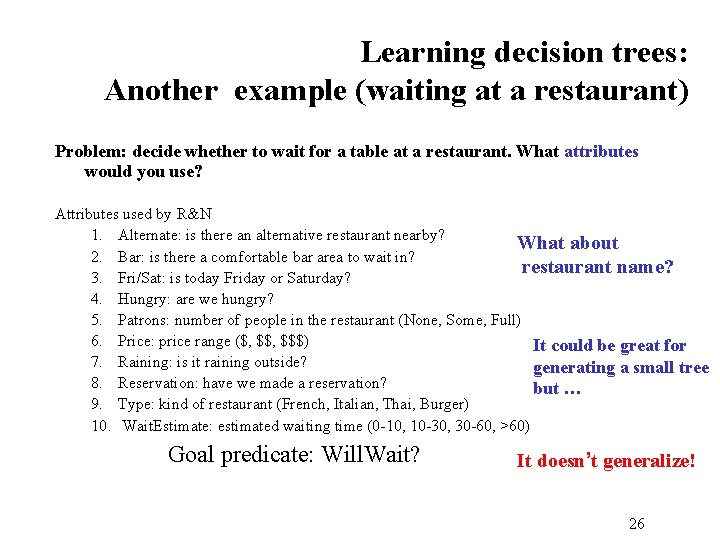
Learning decision trees: Another example (waiting at a restaurant) Problem: decide whether to wait for a table at a restaurant. What attributes would you use? Attributes used by R&N 1. Alternate: is there an alternative restaurant nearby? What about 2. Bar: is there a comfortable bar area to wait in? restaurant name? 3. Fri/Sat: is today Friday or Saturday? 4. Hungry: are we hungry? 5. Patrons: number of people in the restaurant (None, Some, Full) 6. Price: price range ($, $$$) It could be great for 7. Raining: is it raining outside? generating a small tree 8. Reservation: have we made a reservation? but … 9. Type: kind of restaurant (French, Italian, Thai, Burger) 10. Wait. Estimate: estimated waiting time (0 -10, 10 -30, 30 -60, >60) Goal predicate: Will. Wait? It doesn’t generalize! 26
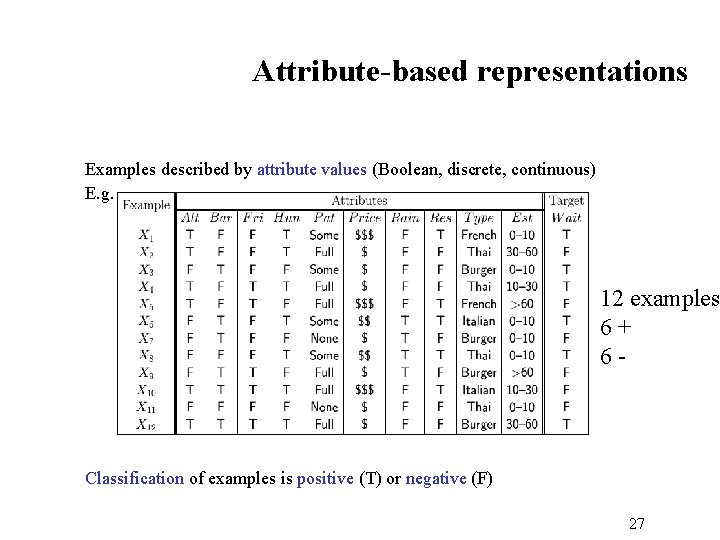
Attribute-based representations Examples described by attribute values (Boolean, discrete, continuous) E. g. , situations where I will/won't wait for a table: 12 examples 6+ 6 - Classification of examples is positive (T) or negative (F) 27
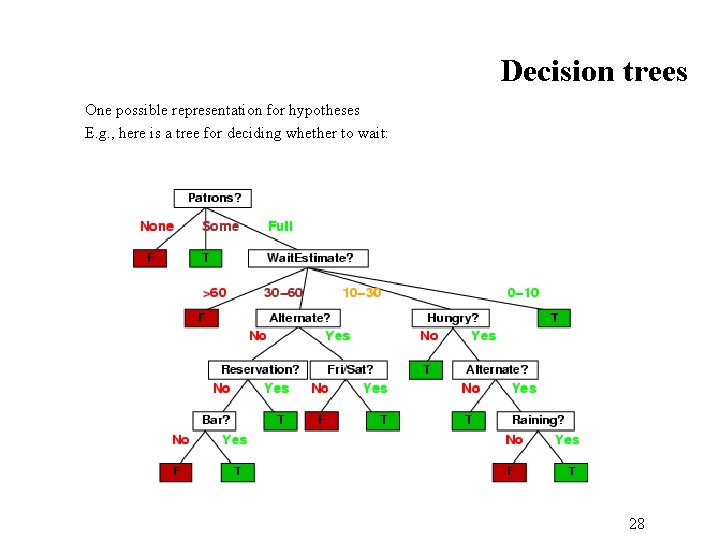
Decision trees One possible representation for hypotheses E. g. , here is a tree for deciding whether to wait: 28
Decision tree learning Algorithm Decision trees can express any Boolean function. Goal: Finding a decision tree that agrees with training set. We could construct a decision tree that has one path to a leaf for each example, where the path tests sets each attribute value to the value of the example. What is the problem with this from a learning point of view? Problem: This approach would just memorize example. How to deal with new examples? It doesn’t generalize! (But sometimes hard to avoid --- e. g. parity function, 1, if an even number of inputs, or majority function, 1, if more than half of the inputs are 1). We want a compact/smallest tree. But finding the smallest tree consistent with the examples is NP-hard! Overall Goal: get a good classification with a small number of tests. 29
“most significant” In what sense? Basic DT Learning Algorithm Goal: find a small tree consistent with the training examples Idea: (recursively) choose "most significant" attribute as root of (sub)tree; Use a top-down greedy search through the space of possible decision trees. Greedy because there is no backtracking. It picks highest values first. Variations of known algorithms ID 3, C 4. 5 (Quinlan -86, -93) Top-down greedy construction – Which attribute should be tested? (ID 3 Iterative Dichotomiser 3) 3 • Heuristics and Statistical testing with current data – Repeat for descendants 30
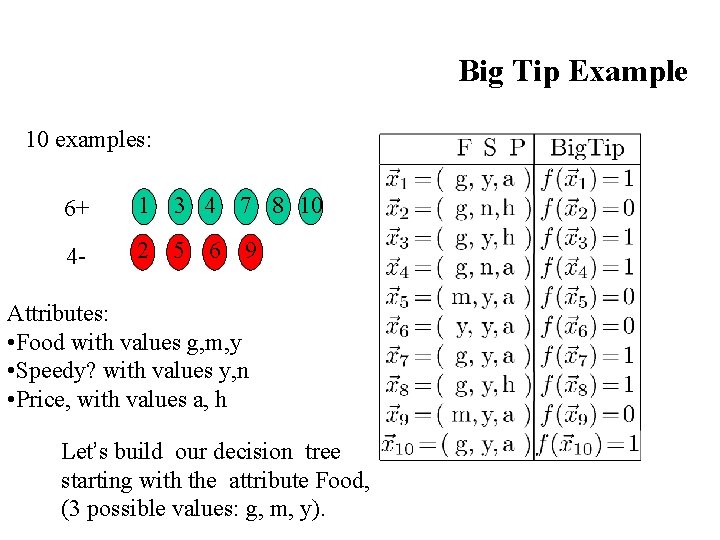
Big Tip Example 10 examples: 6+ 1 3 4 7 8 10 4 - 2 5 9 6 Attributes: • Food with values g, m, y • Speedy? with values y, n • Price, with values a, h Let’s build our decision tree starting with the attribute Food, (3 possible values: g, m, y).
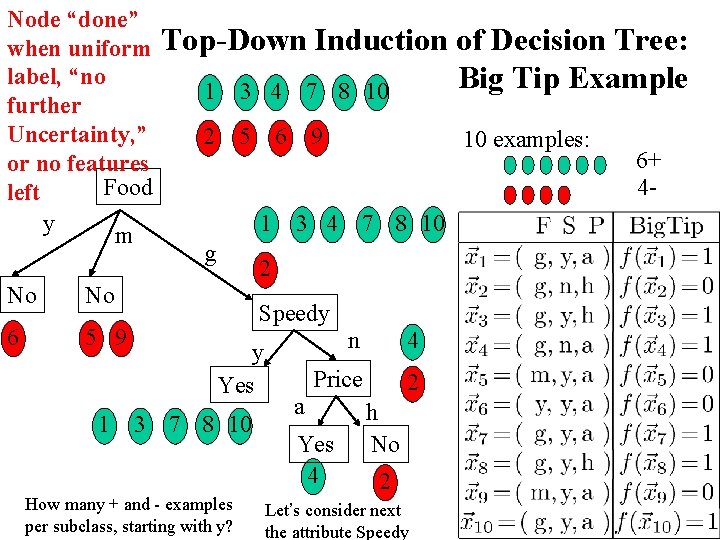
Node “done” when uniform label, “no further Uncertainty, ” or no features Food left y m No No 6 5 9 Top-Down Induction of Decision Tree: Big Tip Example 1 3 4 7 8 10 2 5 6 1 g 9 10 examples: 3 4 7 8 10 2 Speedy y Yes 1 3 7 8 10 How many + and - examples per subclass, starting with y? n 4 Price 2 a Yes 4 h No 2 Let’s consider next the attribute Speedy 6+ 4 -
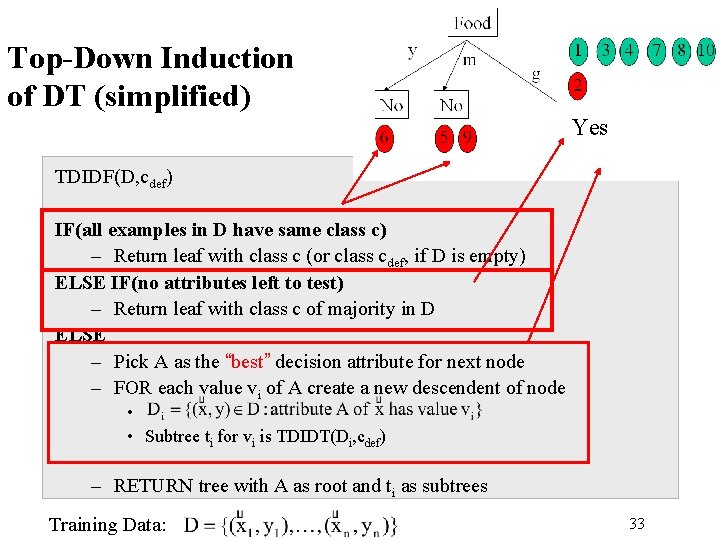
Top-Down Induction of DT (simplified) Yes TDIDF(D, cdef) IF(all examples in D have same class c) – Return leaf with class c (or class cdef, if D is empty) ELSE IF(no attributes left to test) – Return leaf with class c of majority in D ELSE – Pick A as the “best” decision attribute for next node – FOR each value vi of A create a new descendent of node • • Subtree ti for vi is TDIDT(Di, cdef) – RETURN tree with A as root and ti as subtrees Training Data: 33
Picking the Best Attribute to Split Ockham’s Razor: – All other things being equal, choose the simplest explanation Decision Tree Induction: – Find the smallest tree that classifies the training data correctly Problem – Finding the smallest tree is computationally hard ! Approach – Use heuristic search (greedy search) Key Heuristics: – Pick attribute that maximizes information (Information Gain) i. e. “most informative” – Other statistical tests 34
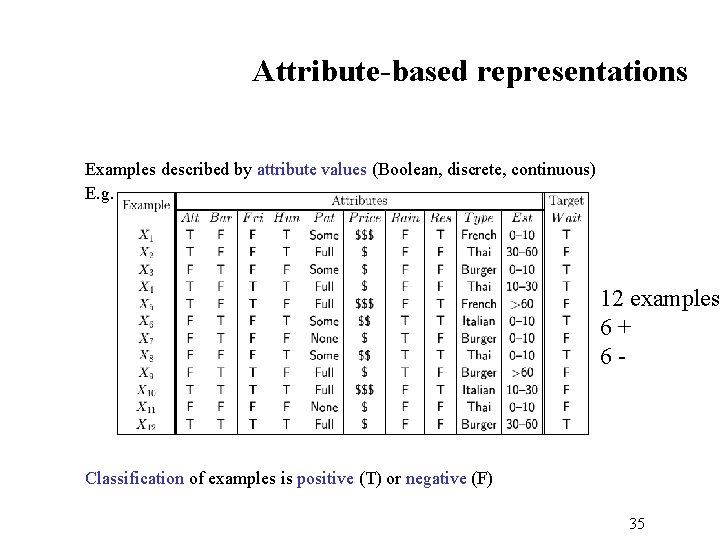
Attribute-based representations Examples described by attribute values (Boolean, discrete, continuous) E. g. , situations where I will/won't wait for a table: 12 examples 6+ 6 - Classification of examples is positive (T) or negative (F) 35
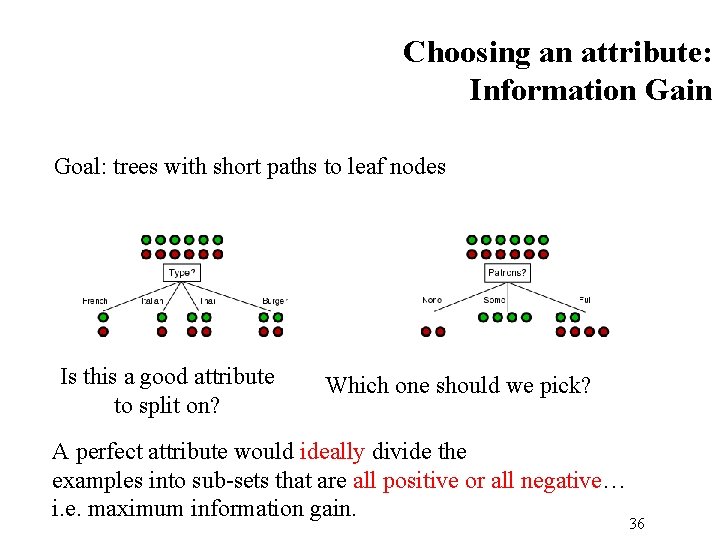
Choosing an attribute: Information Gain Goal: trees with short paths to leaf nodes Is this a good attribute to split on? Which one should we pick? A perfect attribute would ideally divide the examples into sub-sets that are all positive or all negative… i. e. maximum information gain. 36
Information Gain Most useful in classification – how to measure the ‘worth’ of an attribute information gain – how well attribute separates examples according to their classification Next – precise definition for gain measure from Information Theory Shannon and Weaver 49 One of the most successful and impactful mathematical theories known. 37
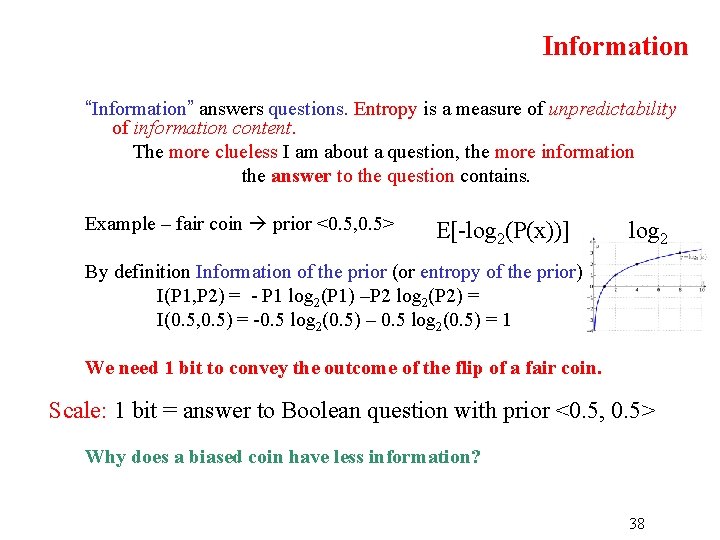
Information “Information” answers questions. Entropy is a measure of unpredictability of information content. The more clueless I am about a question, the more information the answer to the question contains. Example – fair coin prior <0. 5, 0. 5> E[-log 2(P(x))] log 2 By definition Information of the prior (or entropy of the prior): I(P 1, P 2) = - P 1 log 2(P 1) –P 2 log 2(P 2) = I(0. 5, 0. 5) = -0. 5 log 2(0. 5) – 0. 5 log 2(0. 5) = 1 We need 1 bit to convey the outcome of the flip of a fair coin. Scale: 1 bit = answer to Boolean question with prior <0. 5, 0. 5> Why does a biased coin have less information? 38
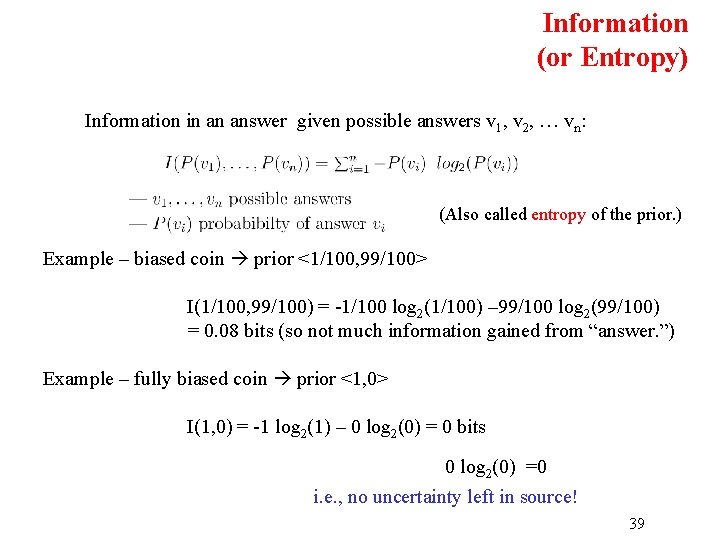
Information (or Entropy) Information in an answer given possible answers v 1, v 2, … vn: (Also called entropy of the prior. ) Example – biased coin prior <1/100, 99/100> I(1/100, 99/100) = -1/100 log 2(1/100) – 99/100 log 2(99/100) = 0. 08 bits (so not much information gained from “answer. ”) Example – fully biased coin prior <1, 0> I(1, 0) = -1 log 2(1) – 0 log 2(0) = 0 bits 0 log 2(0) =0 i. e. , no uncertainty left in source! 39
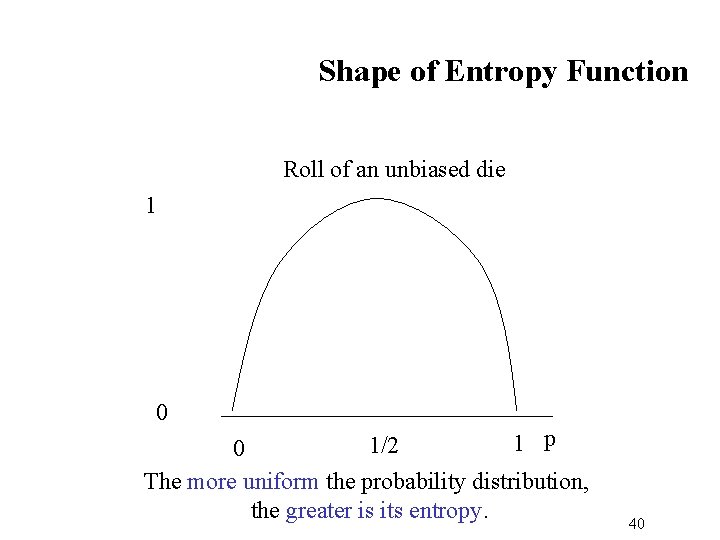
Shape of Entropy Function Roll of an unbiased die 1 0 1 p 1/2 0 The more uniform the probability distribution, the greater is its entropy. 40
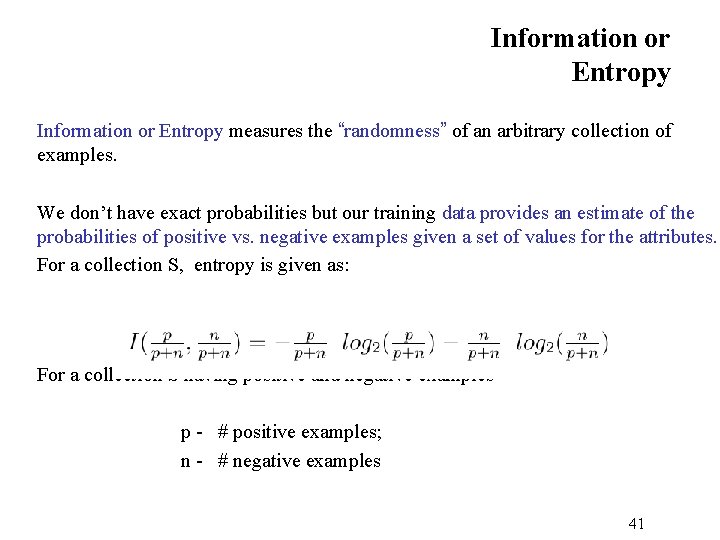
Information or Entropy measures the “randomness” of an arbitrary collection of examples. We don’t have exact probabilities but our training data provides an estimate of the probabilities of positive vs. negative examples given a set of values for the attributes. For a collection S, entropy is given as: For a collection S having positive and negative examples p - # positive examples; n - # negative examples 41
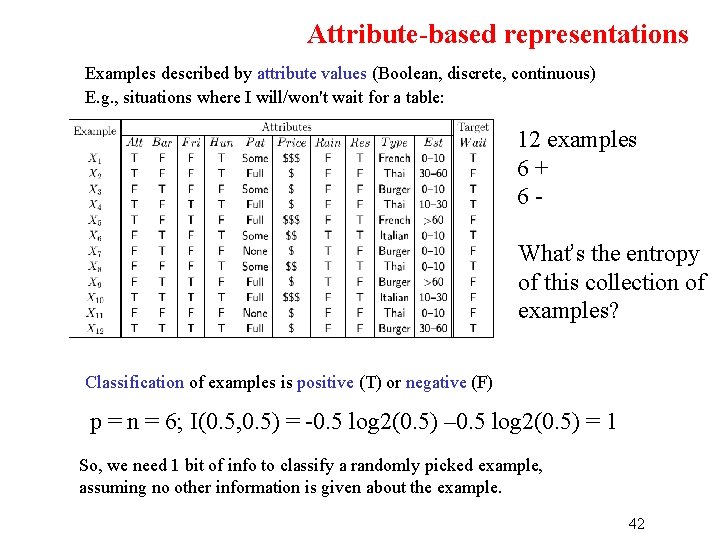
Attribute-based representations Examples described by attribute values (Boolean, discrete, continuous) E. g. , situations where I will/won't wait for a table: 12 examples 6+ 6 What’s the entropy of this collection of examples? Classification of examples is positive (T) or negative (F) p = n = 6; I(0. 5, 0. 5) = -0. 5 log 2(0. 5) – 0. 5 log 2(0. 5) = 1 So, we need 1 bit of info to classify a randomly picked example, assuming no other information is given about the example. 42
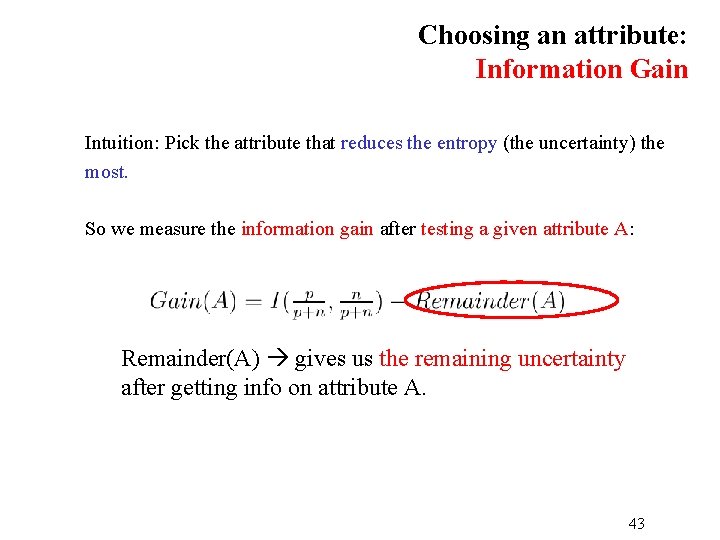
Choosing an attribute: Information Gain Intuition: Pick the attribute that reduces the entropy (the uncertainty) the most. So we measure the information gain after testing a given attribute A: Remainder(A) gives us the remaining uncertainty after getting info on attribute A. 43
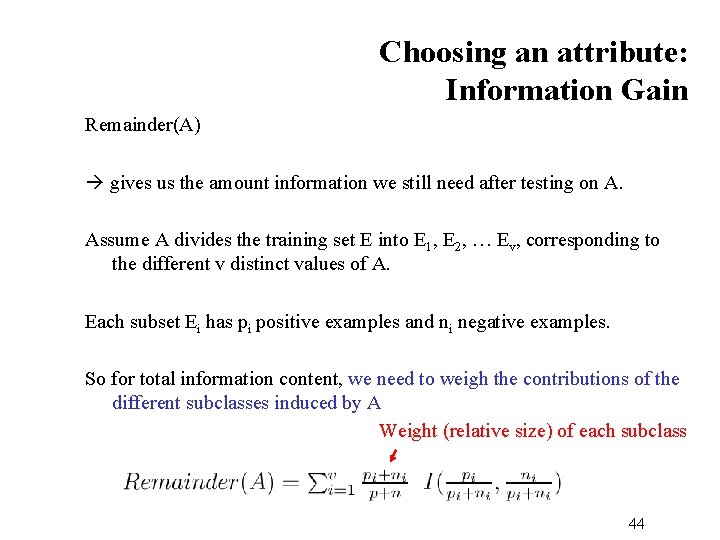
Choosing an attribute: Information Gain Remainder(A) gives us the amount information we still need after testing on A. Assume A divides the training set E into E 1, E 2, … Ev, corresponding to the different v distinct values of A. Each subset Ei has pi positive examples and ni negative examples. So for total information content, we need to weigh the contributions of the different subclasses induced by A Weight (relative size) of each subclass 44
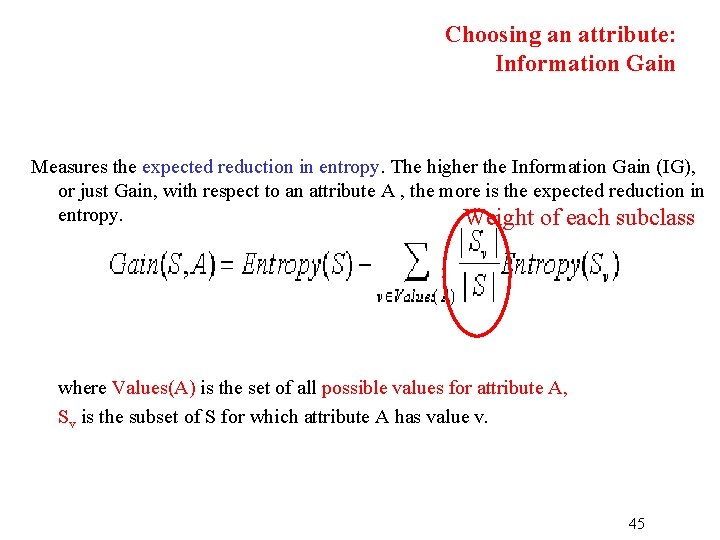
Choosing an attribute: Information Gain Measures the expected reduction in entropy. The higher the Information Gain (IG), or just Gain, with respect to an attribute A , the more is the expected reduction in entropy. Weight of each subclass where Values(A) is the set of all possible values for attribute A, Sv is the subset of S for which attribute A has value v. 45
Interpretations of gain Gain(S, A) – expected reduction in entropy caused by knowing A – information provided about the target function value given the value of A – number of bits saved in the coding a member of S knowing the value of A Used in ID 3 (Iterative Dichotomiser 3) 3 Ross Quinlan 46
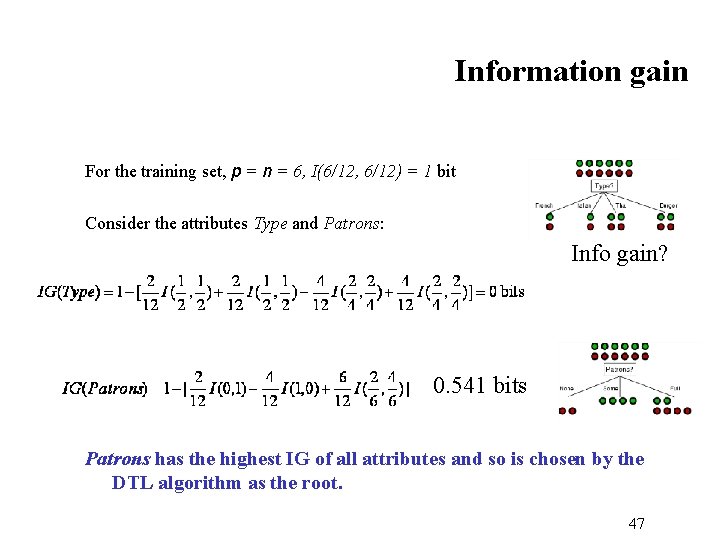
Information gain For the training set, p = n = 6, I(6/12, 6/12) = 1 bit Consider the attributes Type and Patrons: Info gain? 0. 541 bits Patrons has the highest IG of all attributes and so is chosen by the DTL algorithm as the root. 47
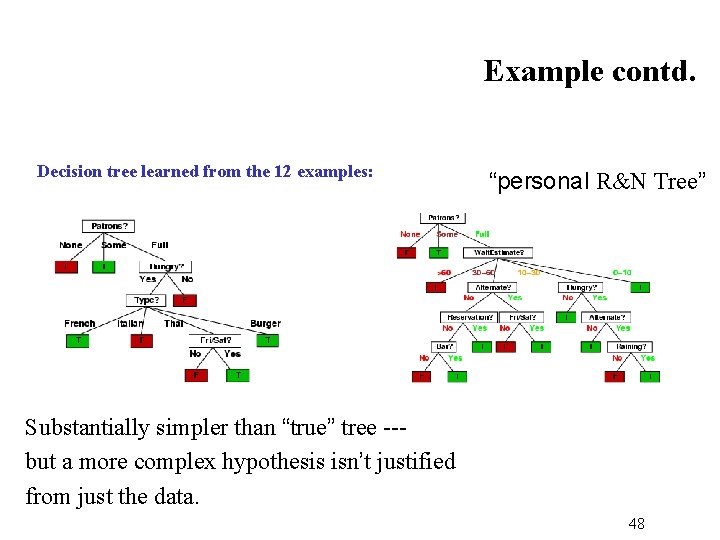
Example contd. Decision tree learned from the 12 examples: “personal R&N Tree” Substantially simpler than “true” tree --but a more complex hypothesis isn’t justified from just the data. 48
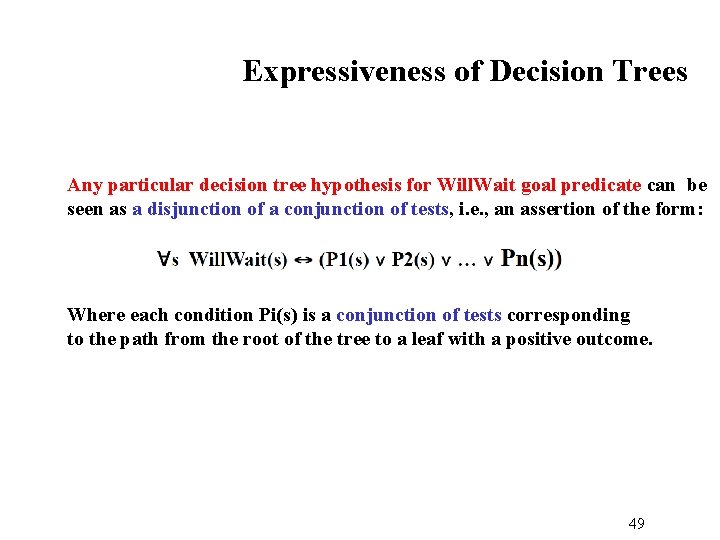
Expressiveness of Decision Trees Any particular decision tree hypothesis for Will. Wait goal predicate can be seen as a disjunction of a conjunction of tests, i. e. , an assertion of the form: s Will. Wait(s) (P 1(s) P 2(s) … Pn(s)) Where each condition Pi(s) is a conjunction of tests corresponding to the path from the root of the tree to a leaf with a positive outcome. 49
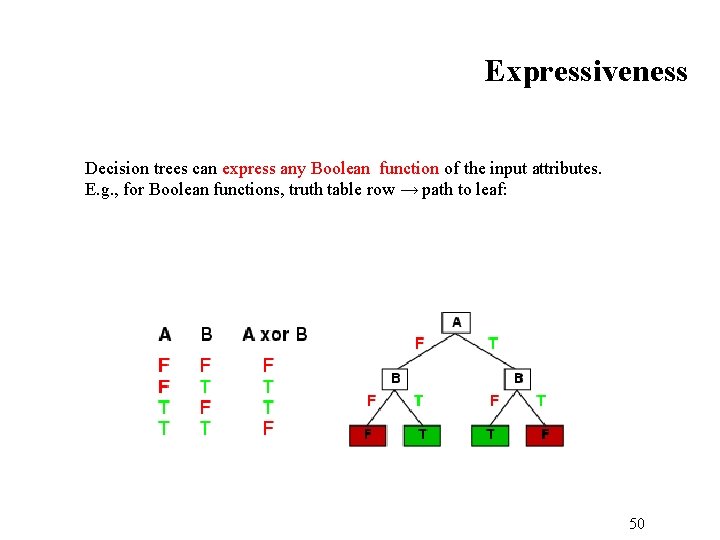
Expressiveness Decision trees can express any Boolean function of the input attributes. E. g. , for Boolean functions, truth table row → path to leaf: 50
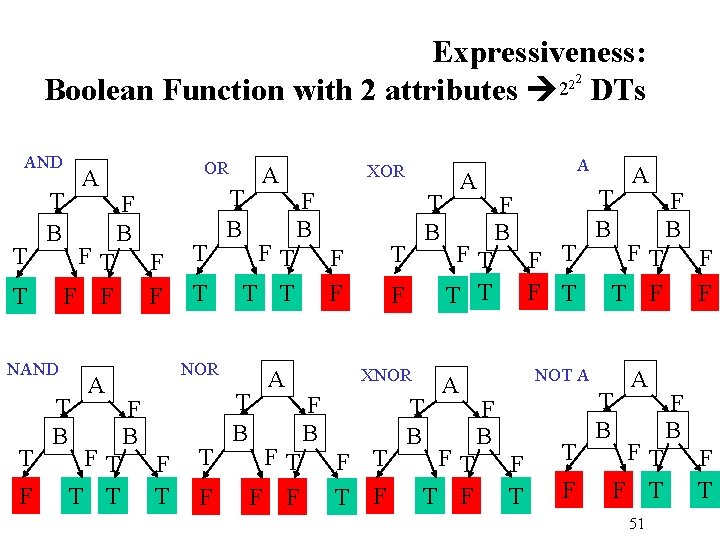
Expressiveness: 22 2 Boolean Function with 2 attributes DTs AND T A T B FT F F T NAND T F T B OR F B A FT T T F F T T A T B FT T T NOR F B F T T F T B XOR F B A FT F F T B F XNOR F B F T T F T B A FT T T A FT T F A F B F T T B FT T F NOT A F B F T T F A T B A FT F T 51 F B F F F B F T
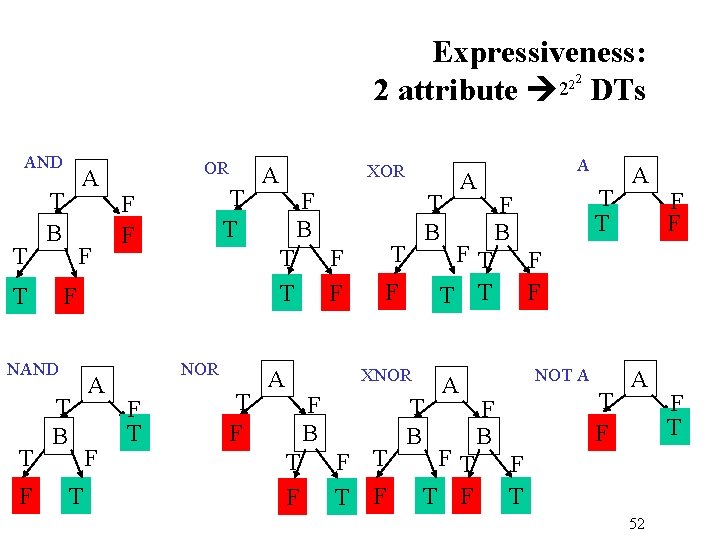
Expressiveness: 22 2 2 attribute DTs AND T A T B T F F T B T A F NOR F T XOR A F B T T F NAND T OR T F F F T T B FT T T F XNOR A F B T F F T T F A T B A FT T F A T T F B A F F NOT A T F F B A F T 52 F T
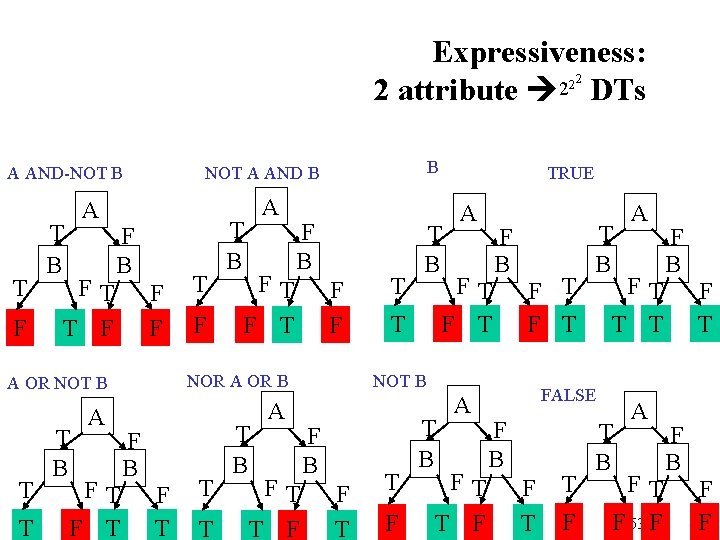
Expressiveness: 22 2 2 attribute DTs A AND-NOT B T F A T B FT T F F B F F T F A T B FT F T A OR NOT B NOR A OR B A A T T T B FT F T B NOT A AND B F T T B FT T F F F T TRUE T B A FT F T T F B F T NOT B F T T F T B A FT T F T B FT T T FALSE F B F T T F A T B A FT F 53 F F B F T F B F F
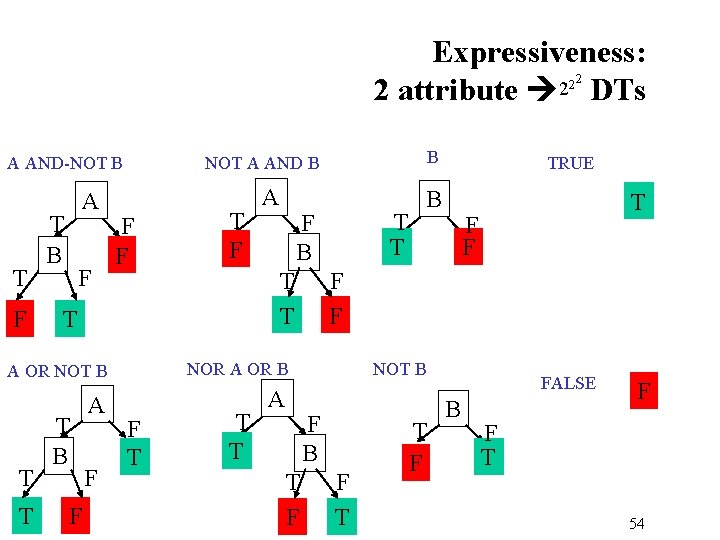
Expressiveness: 22 2 2 attribute DTs A AND-NOT B T F A T B F F F T F A A OR NOT B NOR A OR B A A T T F F F T T T F B T T B B NOT A AND B B T F F NOT B F B T F TRUE F T T F FALSE B F F T 54
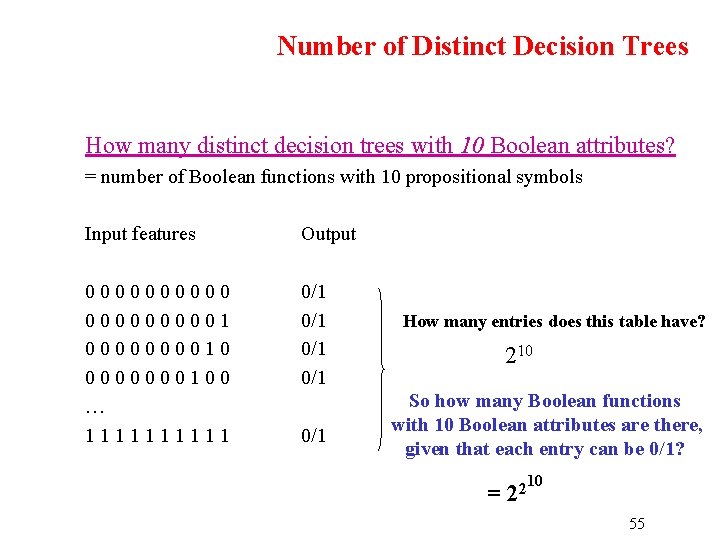
Number of Distinct Decision Trees How many distinct decision trees with 10 Boolean attributes? = number of Boolean functions with 10 propositional symbols Input features Output 000001 000010 0000000100 … 11111 0/1 0/1 0/1 How many entries does this table have? 210 So how many Boolean functions with 10 Boolean attributes are there, given that each entry can be 0/1? = 10 2 2 55
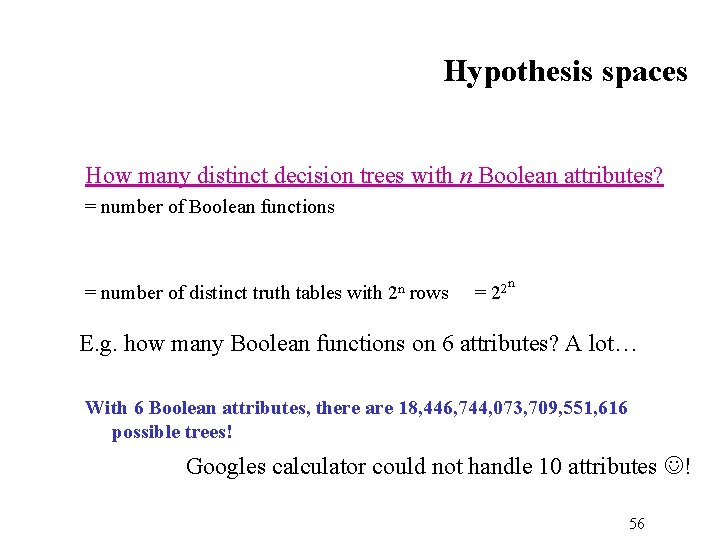
Hypothesis spaces How many distinct decision trees with n Boolean attributes? = number of Boolean functions = number of distinct truth tables with 2 n rows = 22 n E. g. how many Boolean functions on 6 attributes? A lot… With 6 Boolean attributes, there are 18, 446, 744, 073, 709, 551, 616 possible trees! Googles calculator could not handle 10 attributes ! 56

Evaluation Methodology General for Machine Learning 57
Evaluation Methodology How to evaluate the quality of a learning algorithm, i. e. , : How good are the hypotheses produce by the learning algorithm? How good are they at classifying unseen examples? Standard methodology (“Holdout Cross-Validation”): 1. Collect a large set of examples. 2. Randomly divide collection into two disjoint sets: training set and test set. 3. Apply learning algorithm to training set generating hypothesis h 4. Measure performance of h w. r. t. test set (a form of cross-validation) measures generalization to unseen data Important: keep the training and test sets disjoint! “No peeking”! Note: The first two questions about any learning result: Can you describe your training and your test set? What’s your error on the test set? 58
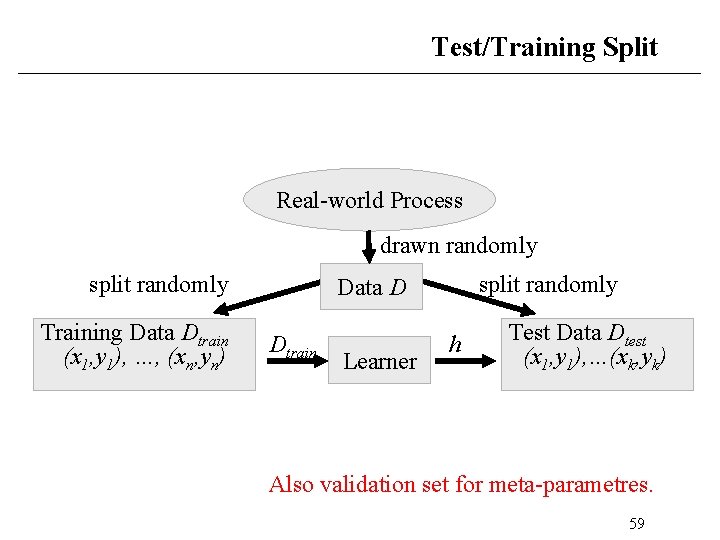
Test/Training Split Real-world Process drawn randomly split randomly Training Data Dtrain (x 1, y 1), …, (xn, yn) split randomly Data D Dtrain Learner h Test Data Dtest (x 1, y 1), …(xk, yk) Also validation set for meta-parametres. 59
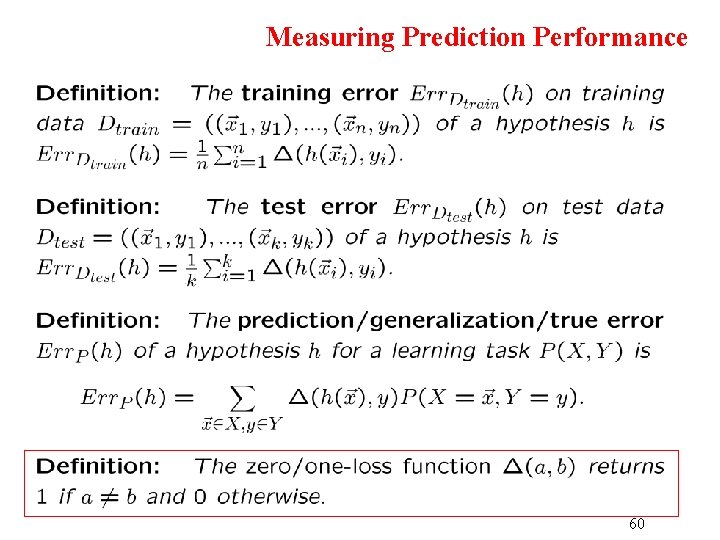
Measuring Prediction Performance 60
Performance Measures Error Rate – Fraction (or percentage) of false predictions Accuracy – Fraction (or percentage) of correct predictions Precision/Recall Example: binary classification problems (classes pos/neg) – Precision: Fraction (or percentage) of correct predictions among all examples predicted to be positive – Recall: Fraction (or percentage) of correct predictions among all real positive examples (Can be generalized to multi-class case. ) 61
Extensions of the Decision Tree Learning Algorithm Noisy data Overfitting and Model Selection Cross Validation Missing Data (R&N, Section 18. 3. 6) Using gain ratios (R&N, Section 18. 3. 6) Real-valued data (R&N, Section 18. 3. 6) Generation of rules and pruning DT Ensembles Regression DT 62
How well does it work? Many case studies have shown that decision trees are at least as accurate as human experts. – A study for diagnosing breast cancer had humans correctly classifying the examples 65% of the time, and the decision tree classified 72% correct. – British Petroleum designed a decision tree for gas-oil separation for offshore oil platforms that replaced an earlier rule-based expert system. – Cessna designed an airplane flight controller using 90, 000 examples and 20 attributes per example. 63
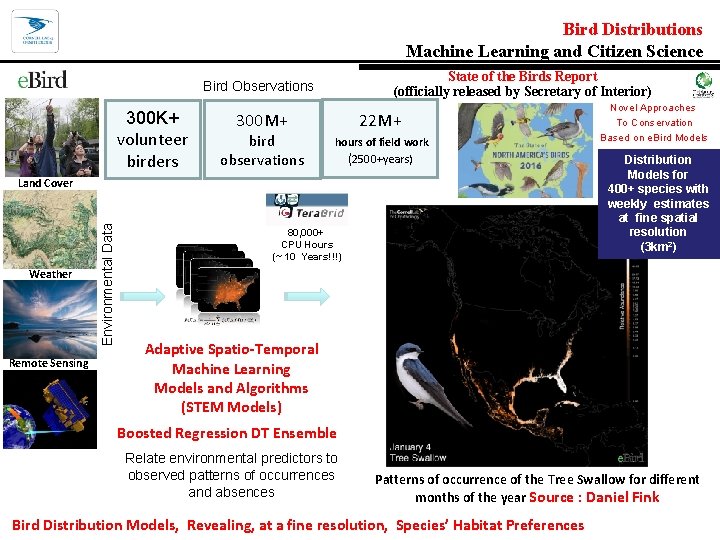
Bird Distributions Machine Learning and Citizen Science State of the Birds Report (officially released by Secretary of Interior) Bird Observations 300 K+ volunteer birders 300 M+ bird observations 22 M+ hours of field work (2500+years) Weather Remote Sensing Environmental Data Land Cover 80, 000+ CPU Hours (~ 10 Years!!!) Novel Approaches To Conservation Based on e. Bird Models Distribution Models for 400+ species with weekly estimates at fine spatial resolution (3 km 2) Adaptive Spatio-Temporal Machine Learning Models and Algorithms (STEM Models) Boosted Regression DT Ensemble Relate environmental predictors to observed patterns of occurrences and absences Patterns of occurrence of the Tree Swallow for different months of the year Source : Daniel Fink Bird Distribution Models, Revealing, at a fine resolution, Species’ Habitat Preferences
Summary: When to use Decision Trees Instances presented as attribute-value pairs Method of approximating discrete-valued functions Target function has discrete values: classification problems Robust to noisy data: Training data may contain – errors – missing attribute values Typical bias: prefer smaller trees (Ockham's razor ) Widely used, practical and easy to interpret results 65
Inducing decision trees is one of the most widely used learning methods in practice Can outperform human experts in many problems Strengths include – Fast Can be a legal requirement! Why? – simple to implement – human readable – can convert result to a set of easily interpretable rules – empirically valid in many commercial products – handles noisy data Weaknesses include: – "Univariate" splits/partitioning using only one attribute at a time so limits types of possible trees – large decision trees may be hard to understand – requires fixed-length feature vectors – non-incremental (i. e. , batch method) 66
- Slides: 66