
CS 4670 5670 Computer Vision Noah Snavely Lecture













- Slides: 72
CS 4670 / 5670: Computer Vision Noah Snavely Lecture 36: Course review
Announcements • Project 5 due tonight, 11: 59 pm • Final exam Monday, Dec 10, 9 am – Open-note, closed-book • Course evals – http: //www. engineering. cornell. edu/Course. Eval/
Questions?
Neat Video
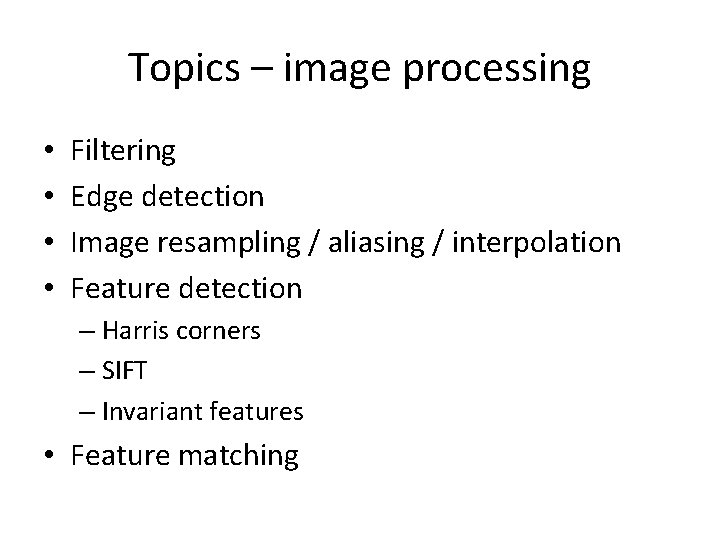
Topics – image processing • • Filtering Edge detection Image resampling / aliasing / interpolation Feature detection – Harris corners – SIFT – Invariant features • Feature matching
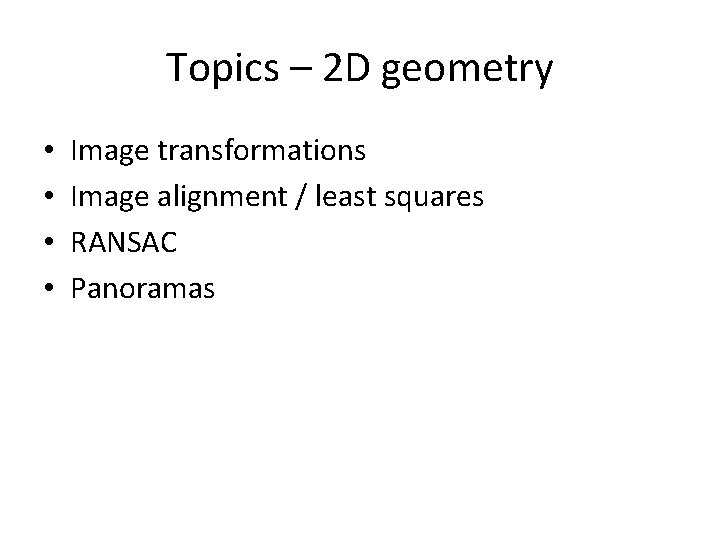
Topics – 2 D geometry • • Image transformations Image alignment / least squares RANSAC Panoramas
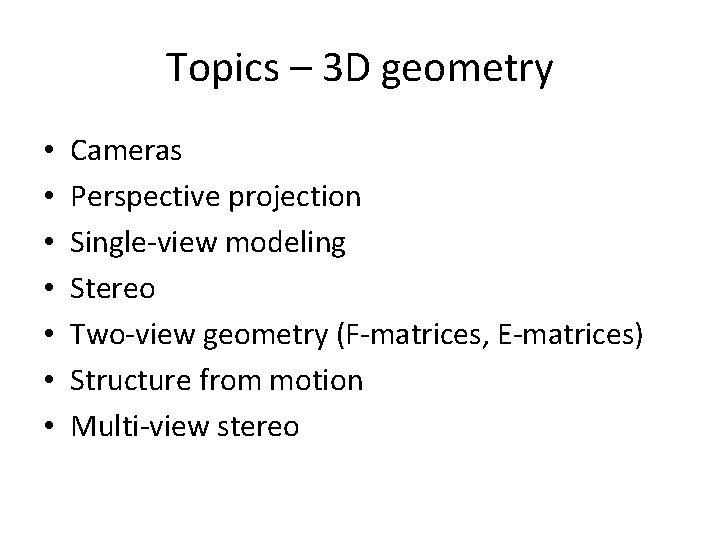
Topics – 3 D geometry • • Cameras Perspective projection Single-view modeling Stereo Two-view geometry (F-matrices, E-matrices) Structure from motion Multi-view stereo
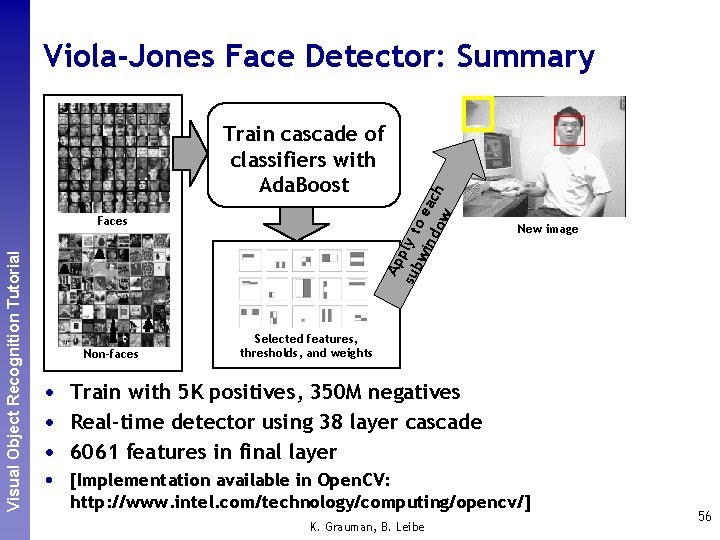
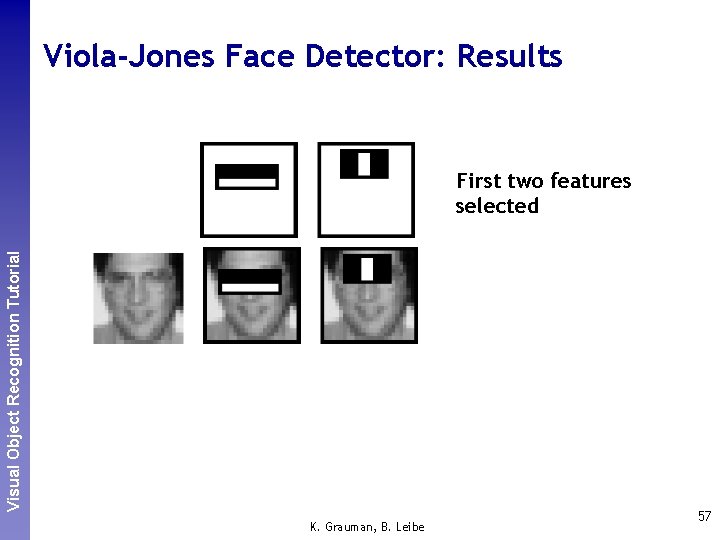
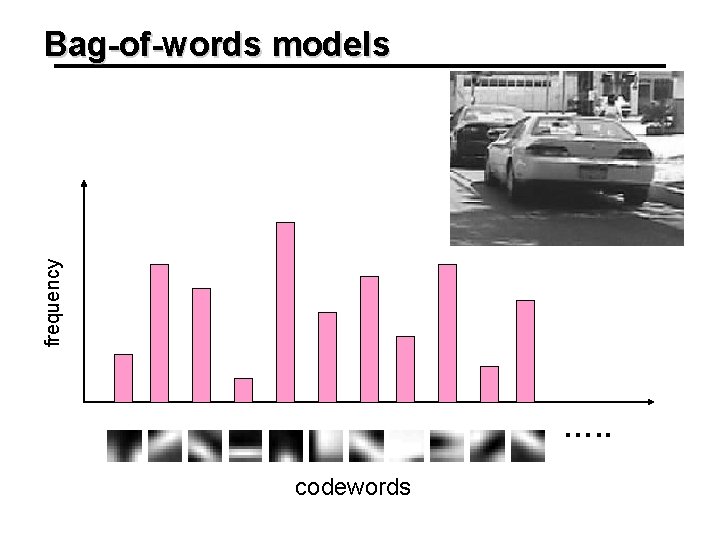
Topics – recognition • • • Skin detection / probabilistic modeling Eigenfaces Viola-Jones face detection (cascades / adaboost) Bag-of-words models Segmentation / graph cuts
Topics – Light, reflectance, cameras • Light, BRDFS • Photometric stereo
Image Processing
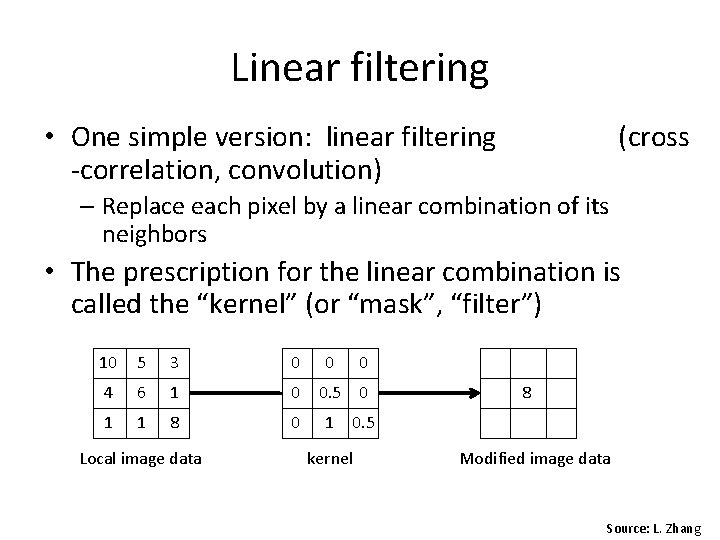
Linear filtering • One simple version: linear filtering -correlation, convolution) (cross – Replace each pixel by a linear combination of its neighbors • The prescription for the linear combination is called the “kernel” (or “mask”, “filter”) 10 5 3 0 4 6 1 0 1 1 8 0 Local image data 0 0 0. 5 0 8 1 0. 5 kernel Modified image data Source: L. Zhang
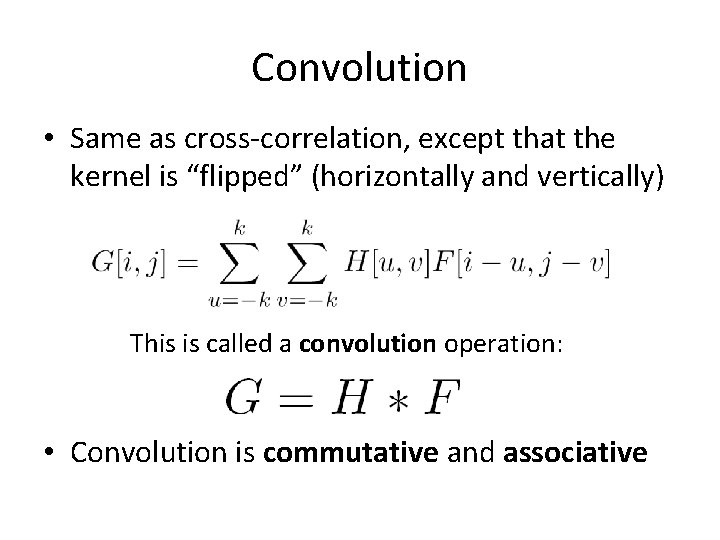
Convolution • Same as cross-correlation, except that the kernel is “flipped” (horizontally and vertically) This is called a convolution operation: • Convolution is commutative and associative
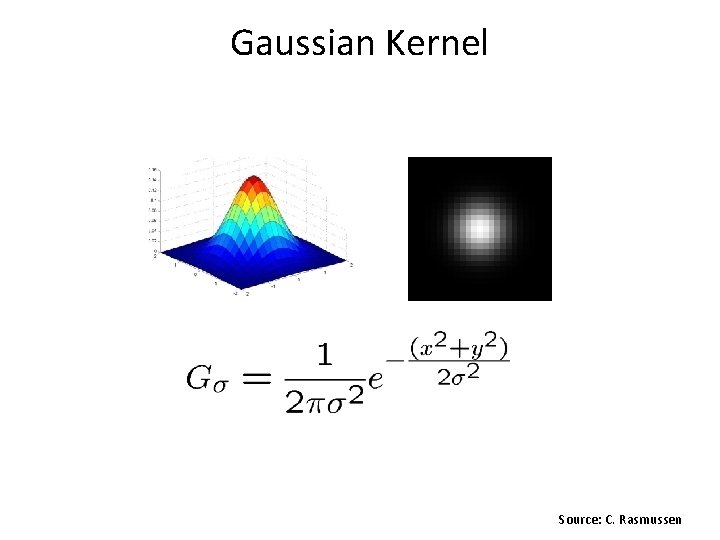
Gaussian Kernel Source: C. Rasmussen
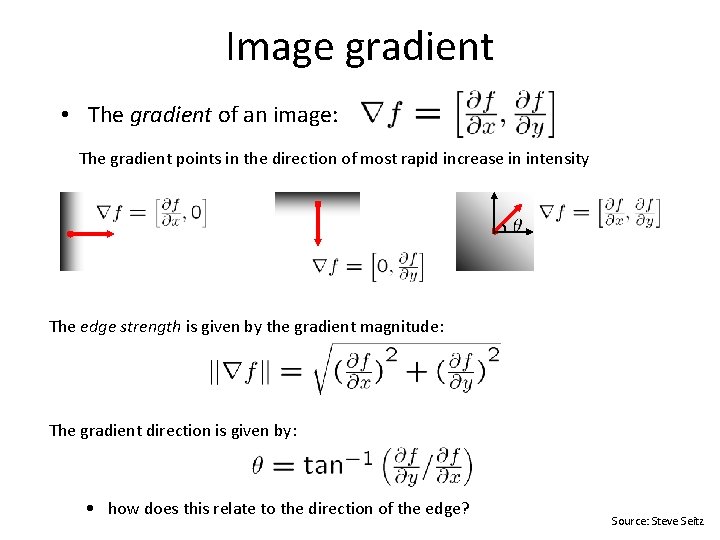
Image gradient • The gradient of an image: The gradient points in the direction of most rapid increase in intensity The edge strength is given by the gradient magnitude: The gradient direction is given by: • how does this relate to the direction of the edge? Source: Steve Seitz
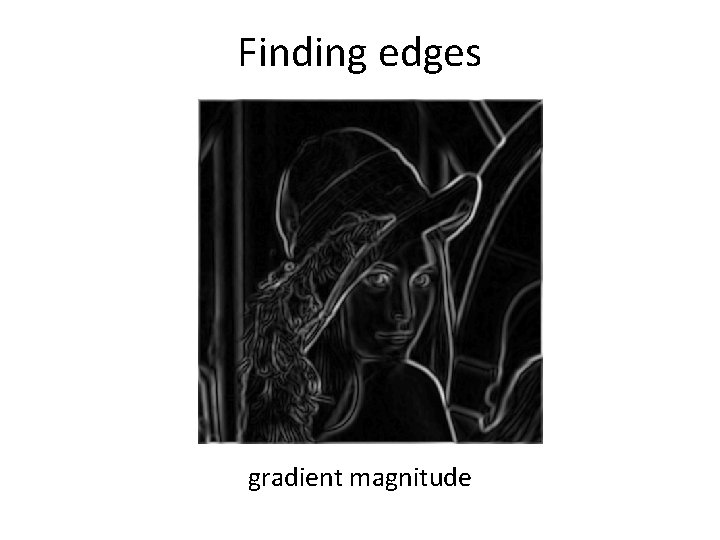
Finding edges gradient magnitude
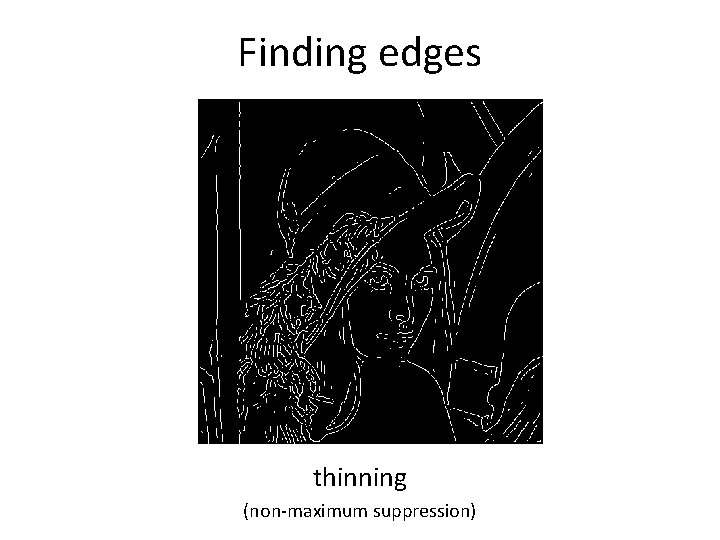
Finding edges thinning (non-maximum suppression)
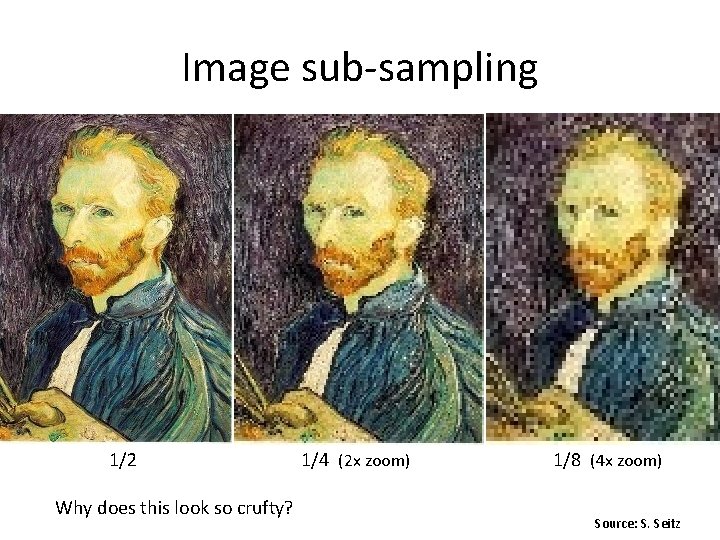
Image sub-sampling 1/2 Why does this look so crufty? 1/4 (2 x zoom) 1/8 (4 x zoom) Source: S. Seitz
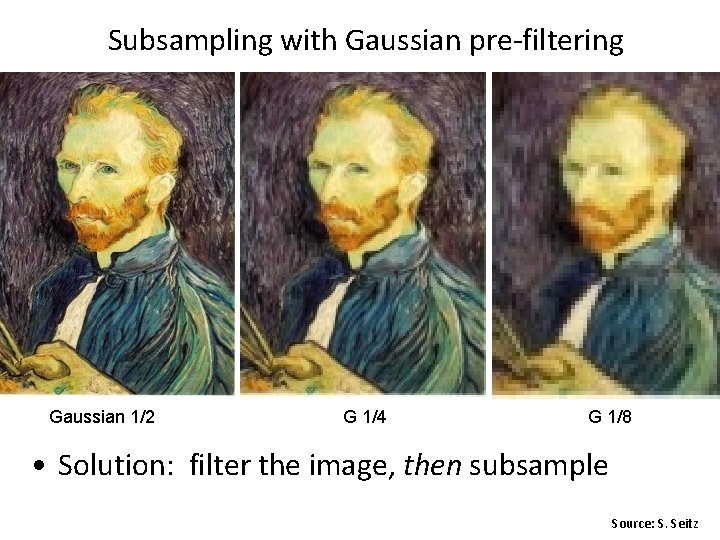
Subsampling with Gaussian pre-filtering Gaussian 1/2 G 1/4 G 1/8 • Solution: filter the image, then subsample Source: S. Seitz
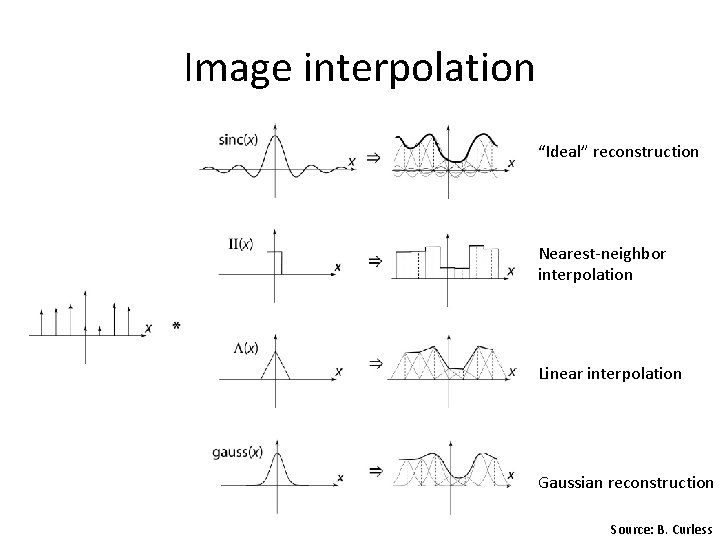
Image interpolation “Ideal” reconstruction Nearest-neighbor interpolation Linear interpolation Gaussian reconstruction Source: B. Curless
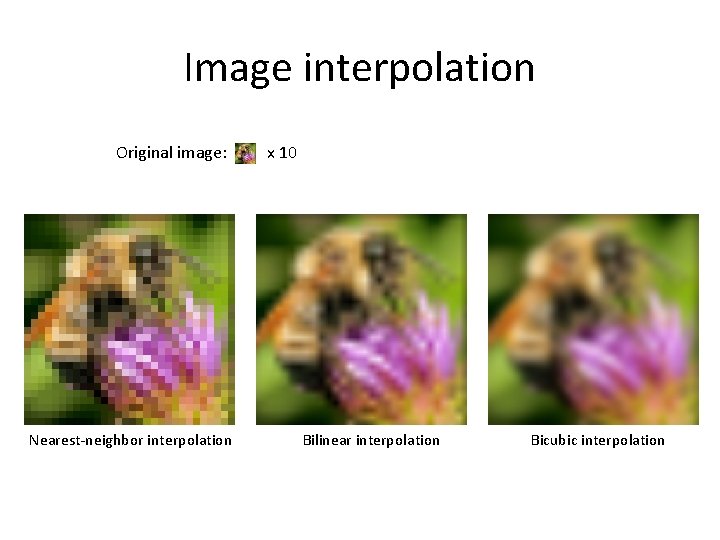
Image interpolation Original image: Nearest-neighbor interpolation x 10 Bilinear interpolation Bicubic interpolation
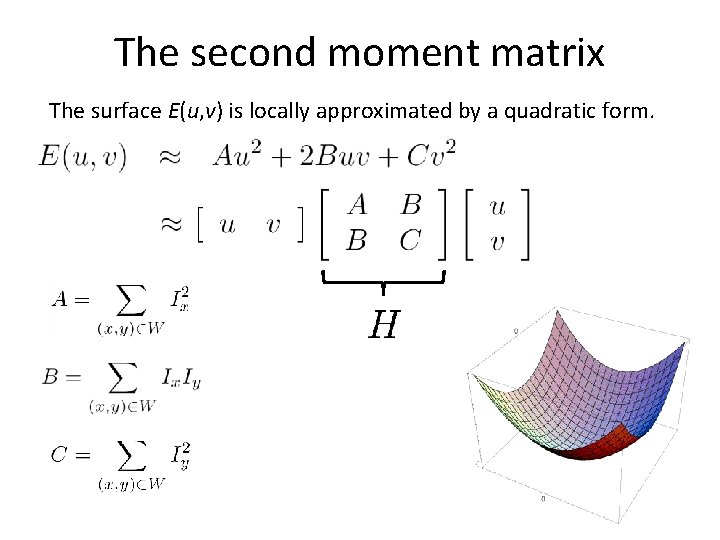
The second moment matrix The surface E(u, v) is locally approximated by a quadratic form.
The Harris operator min is a variant of the “Harris operator” for feature detection • • The trace is the sum of the diagonals, i. e. , trace(H) = h 11 + h 22 Very similar to min but less expensive (no square root) Called the “Harris Corner Detector” or “Harris Operator” Lots of other detectors, this is one of the most popular
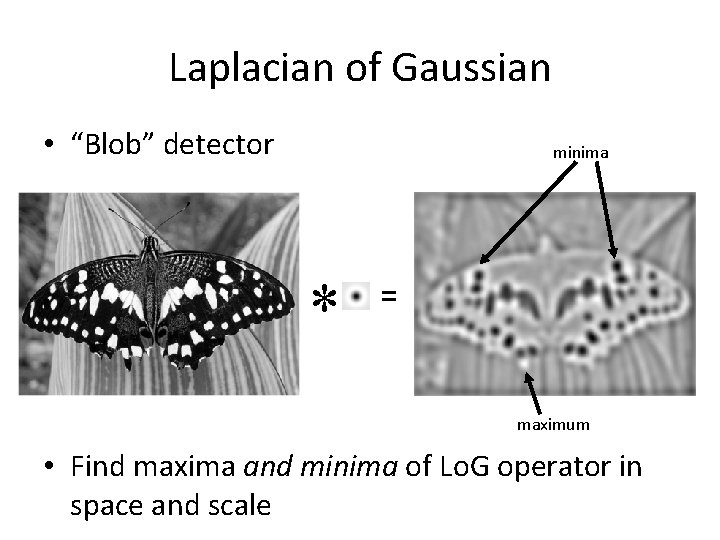
Laplacian of Gaussian • “Blob” detector minima * = maximum • Find maxima and minima of Lo. G operator in space and scale
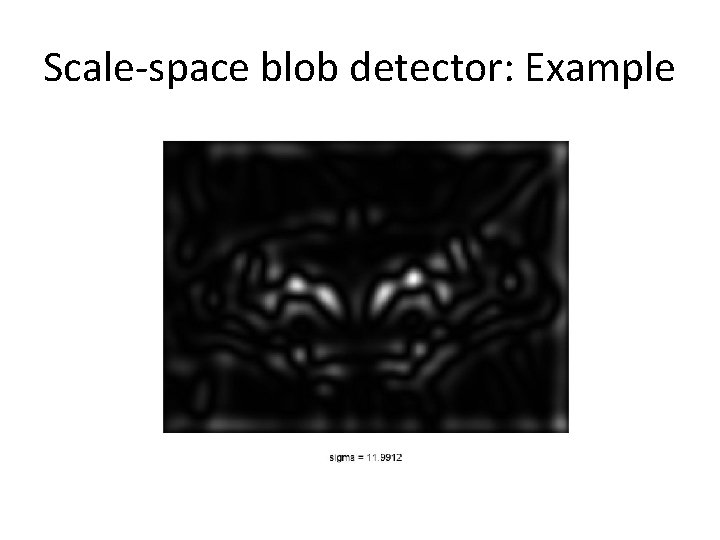
Scale-space blob detector: Example
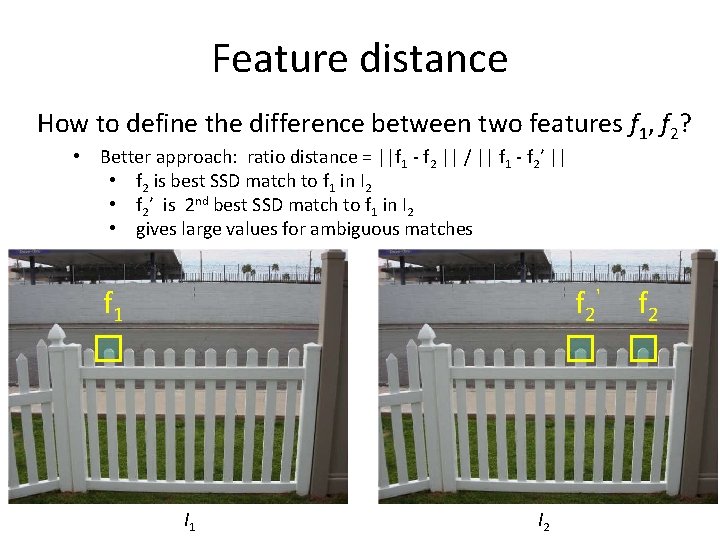
Feature distance How to define the difference between two features f 1, f 2? • Better approach: ratio distance = ||f 1 - f 2 || / || f 1 - f 2’ || • f 2 is best SSD match to f 1 in I 2 • f 2’ is 2 nd best SSD match to f 1 in I 2 • gives large values for ambiguous matches f 1 f 2 ' I 1 I 2 f 2
2 D Geometry
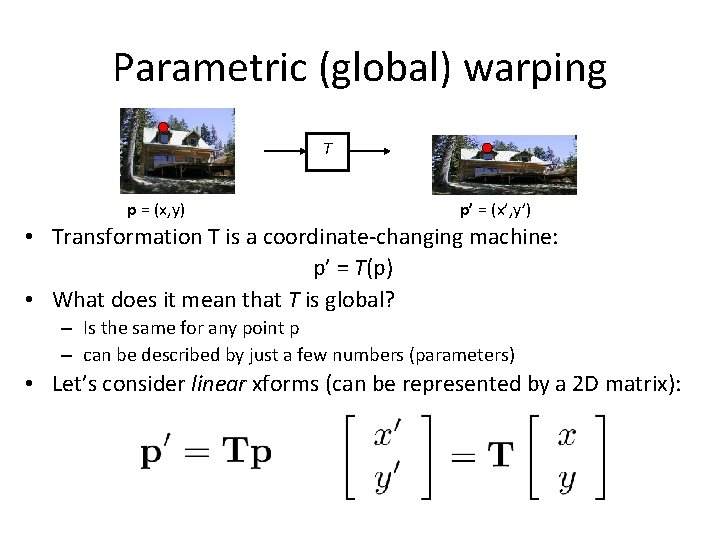
Parametric (global) warping T p = (x, y) p’ = (x’, y’) • Transformation T is a coordinate-changing machine: p’ = T(p) • What does it mean that T is global? – Is the same for any point p – can be described by just a few numbers (parameters) • Let’s consider linear xforms (can be represented by a 2 D matrix):
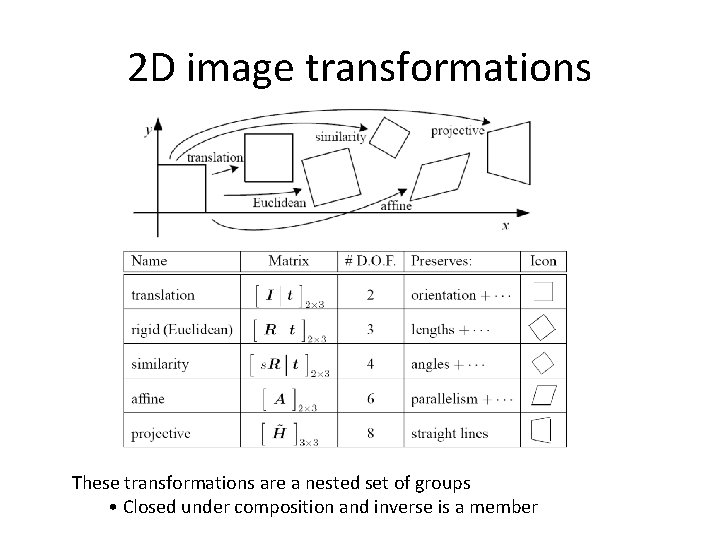
2 D image transformations These transformations are a nested set of groups • Closed under composition and inverse is a member
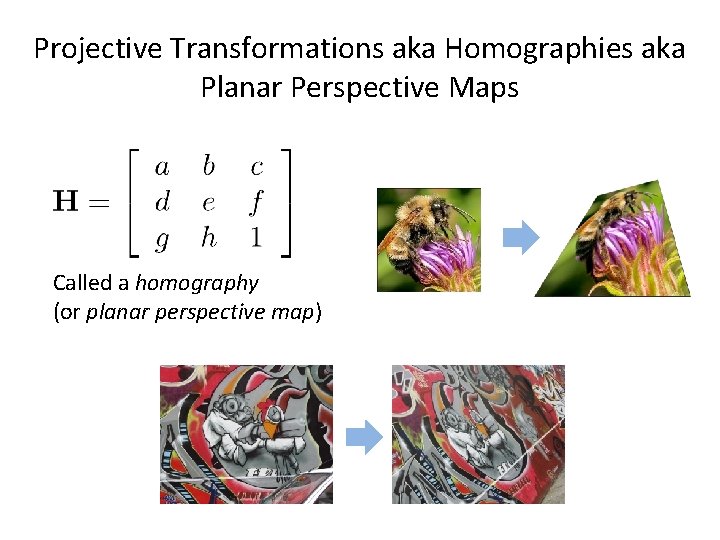
Projective Transformations aka Homographies aka Planar Perspective Maps Called a homography (or planar perspective map)
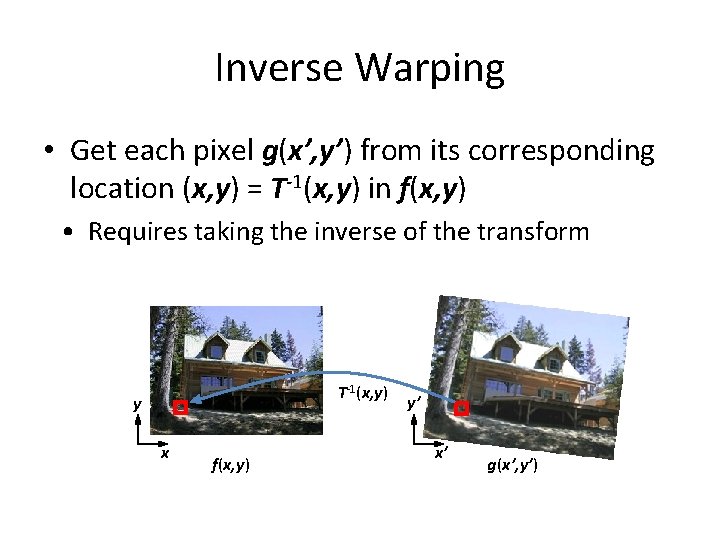
Inverse Warping • Get each pixel g(x’, y’) from its corresponding location (x, y) = T-1(x, y) in f(x, y) • Requires taking the inverse of the transform T-1(x, y) y x f(x, y) y’ x’ g(x’, y’)
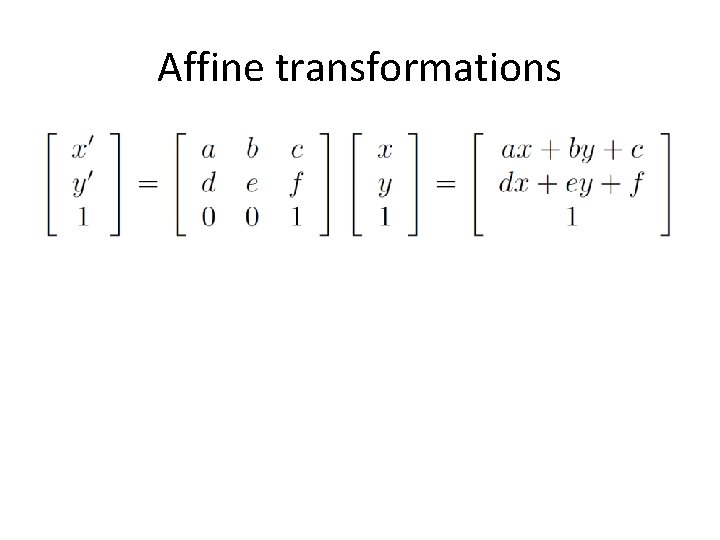
Affine transformations
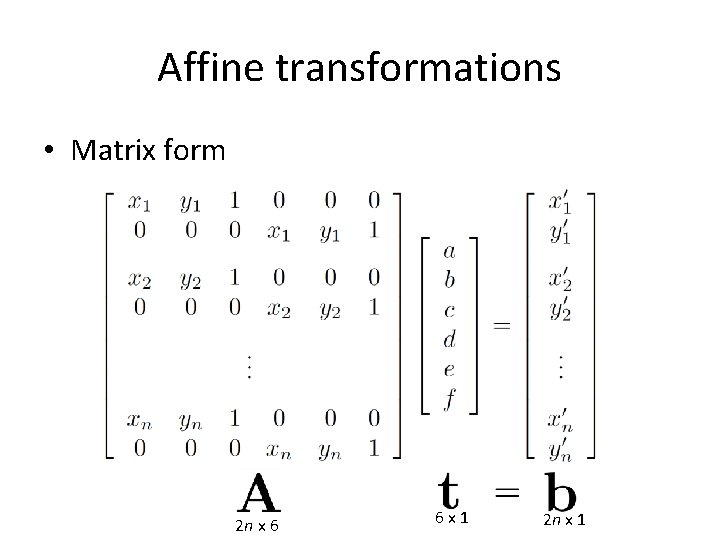
Affine transformations • Matrix form 2 n x 6 6 x 1 2 n x 1
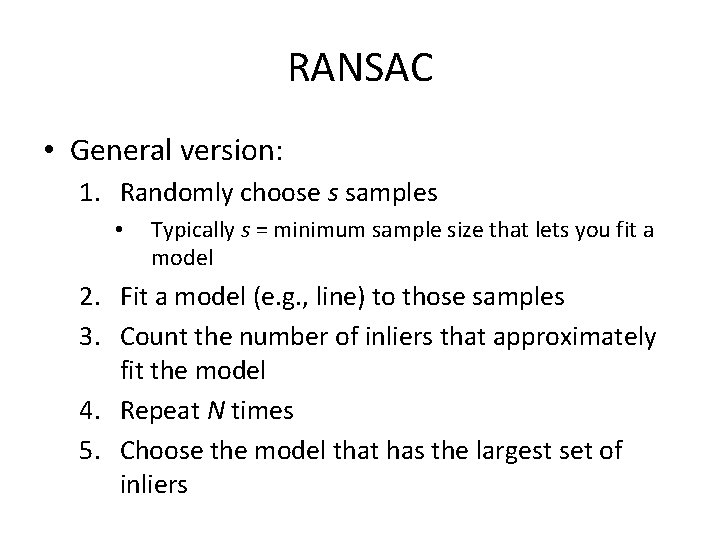
RANSAC • General version: 1. Randomly choose s samples • Typically s = minimum sample size that lets you fit a model 2. Fit a model (e. g. , line) to those samples 3. Count the number of inliers that approximately fit the model 4. Repeat N times 5. Choose the model that has the largest set of inliers
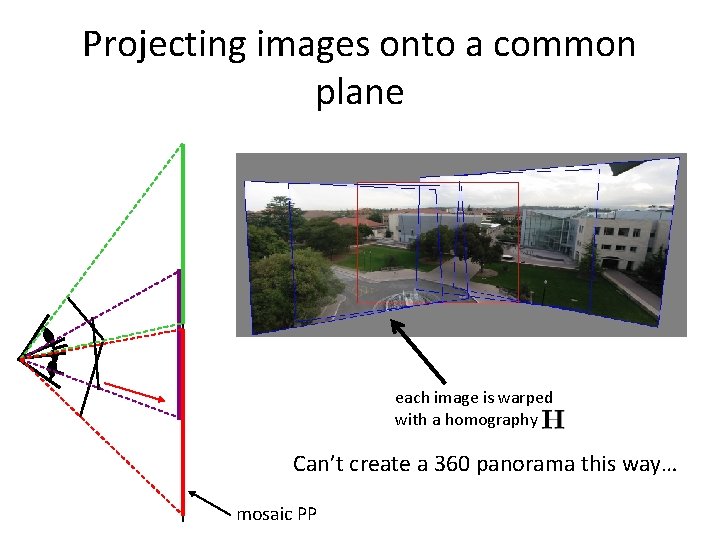
Projecting images onto a common plane each image is warped with a homography Can’t create a 360 panorama this way… mosaic PP
3 D Geometry
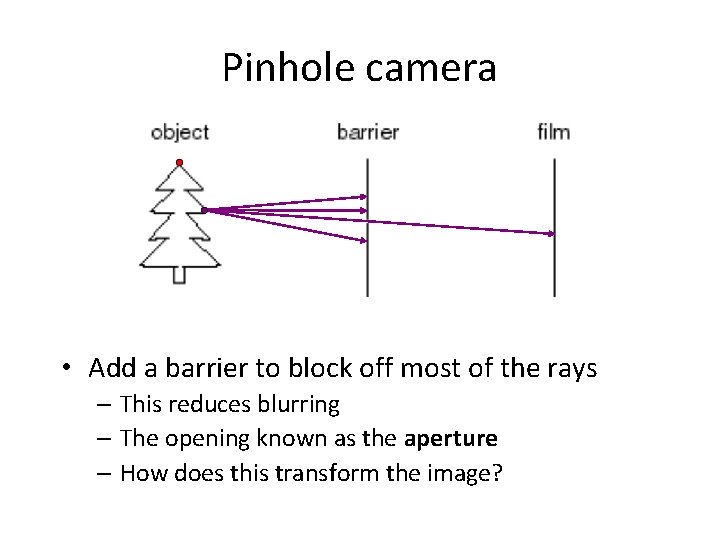
Pinhole camera • Add a barrier to block off most of the rays – This reduces blurring – The opening known as the aperture – How does this transform the image?
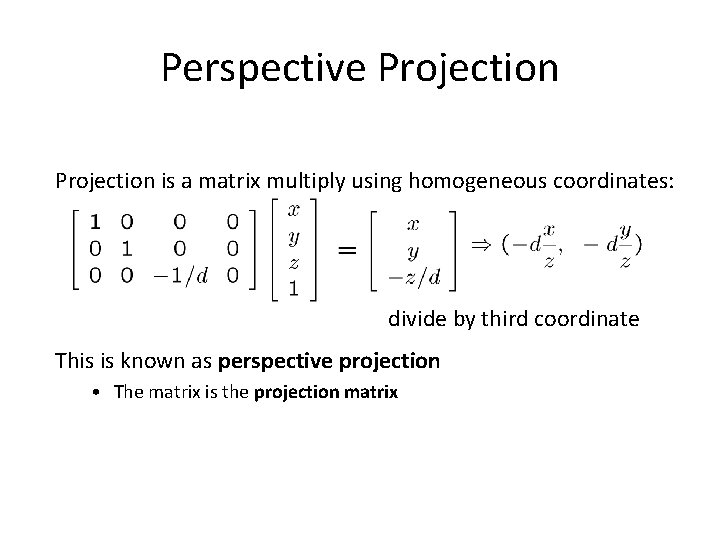
Perspective Projection is a matrix multiply using homogeneous coordinates: divide by third coordinate This is known as perspective projection • The matrix is the projection matrix
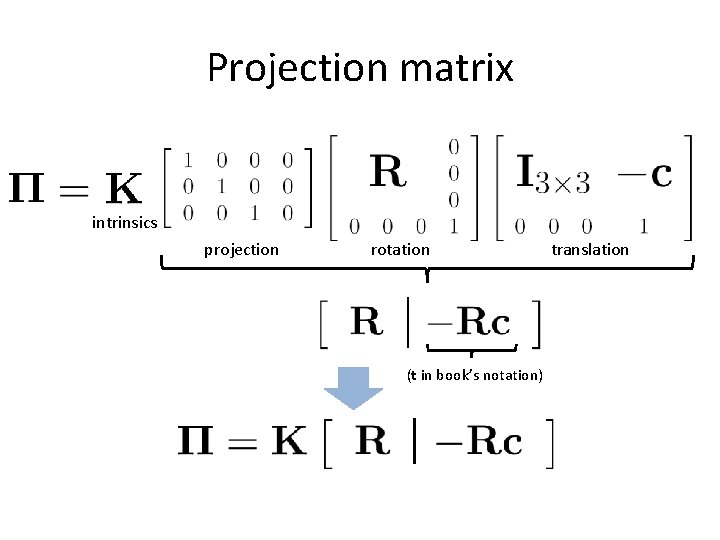
Projection matrix intrinsics projection rotation (t in book’s notation) translation
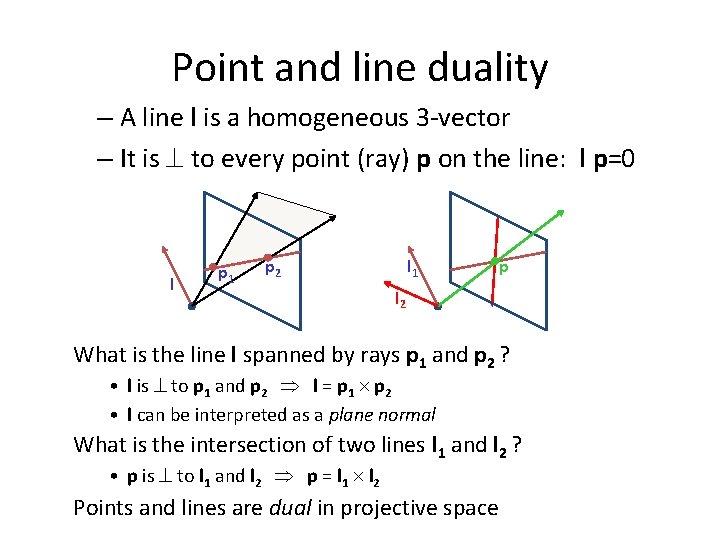
Point and line duality – A line l is a homogeneous 3 -vector – It is to every point (ray) p on the line: l p=0 l p 1 p 2 l 1 p l 2 What is the line l spanned by rays p 1 and p 2 ? • l is to p 1 and p 2 l = p 1 p 2 • l can be interpreted as a plane normal What is the intersection of two lines l 1 and l 2 ? • p is to l 1 and l 2 p = l 1 l 2 Points and lines are dual in projective space
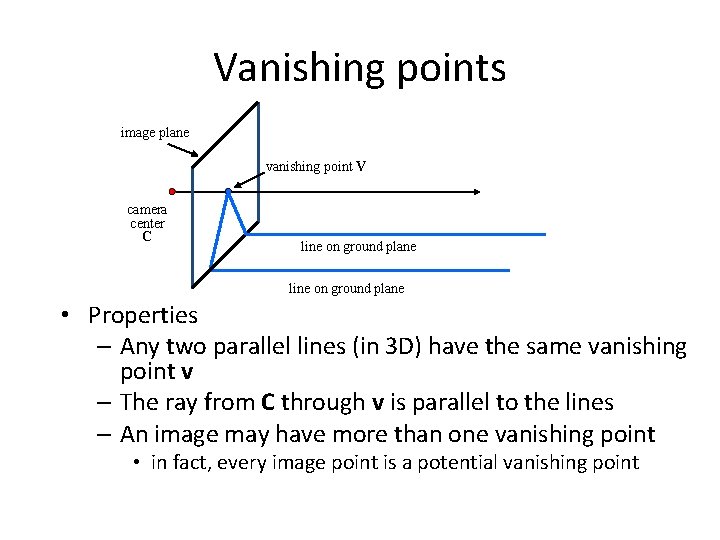
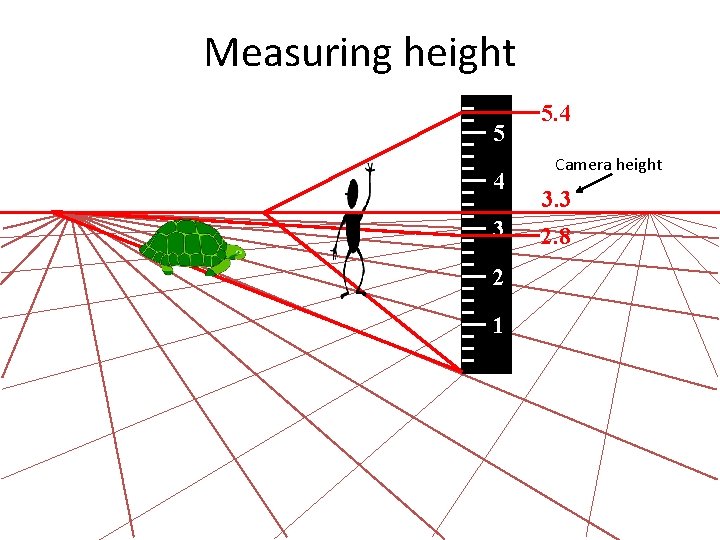
Vanishing points image plane vanishing point V camera center C line on ground plane • Properties – Any two parallel lines (in 3 D) have the same vanishing point v – The ray from C through v is parallel to the lines – An image may have more than one vanishing point • in fact, every image point is a potential vanishing point
Measuring height 5 4 3 2 1 5. 4 Camera height 3. 3 2. 8
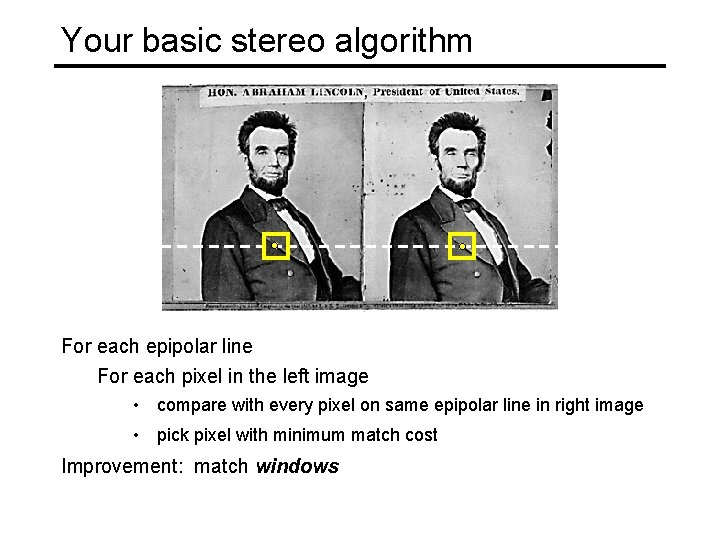
Your basic stereo algorithm For each epipolar line For each pixel in the left image • compare with every pixel on same epipolar line in right image • pick pixel with minimum match cost Improvement: match windows
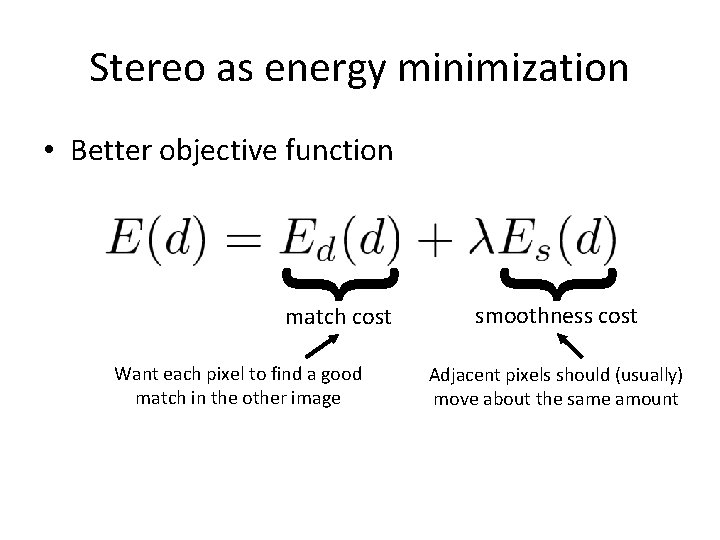
Stereo as energy minimization match cost Want each pixel to find a good match in the other image { { • Better objective function smoothness cost Adjacent pixels should (usually) move about the same amount
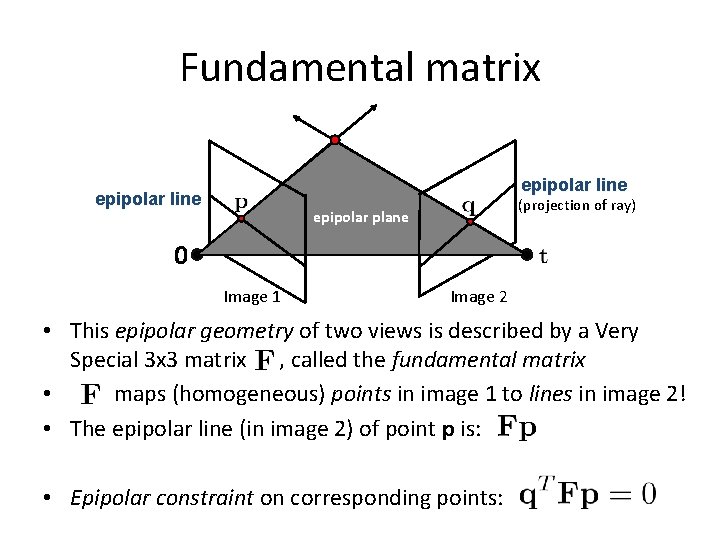
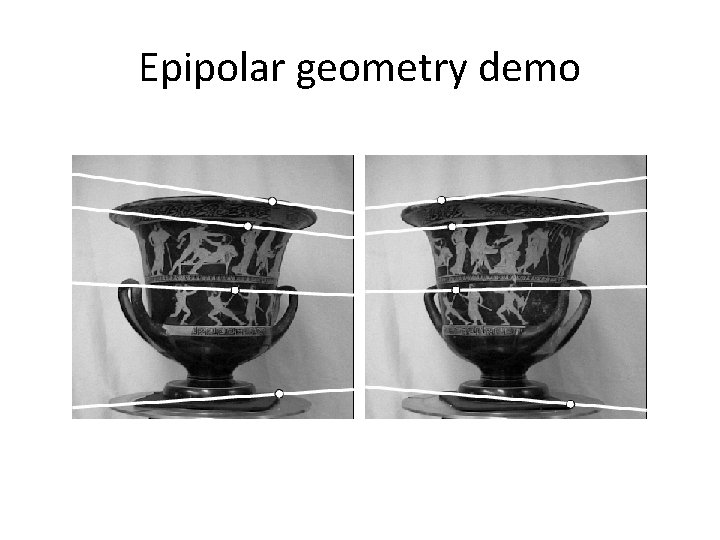
Fundamental matrix epipolar line (projection of ray) epipolar plane 0 Image 1 Image 2 • This epipolar geometry of two views is described by a Very Special 3 x 3 matrix , called the fundamental matrix • maps (homogeneous) points in image 1 to lines in image 2! • The epipolar line (in image 2) of point p is: • Epipolar constraint on corresponding points:
Epipolar geometry demo
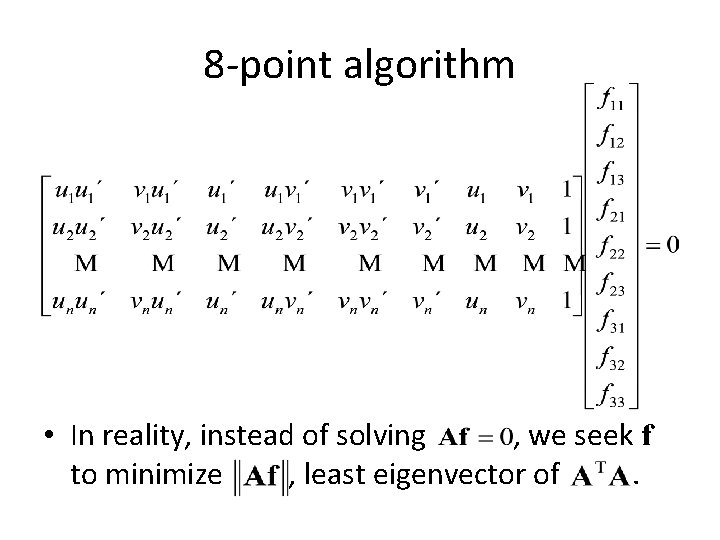
8 -point algorithm • In reality, instead of solving , we seek f to minimize , least eigenvector of.
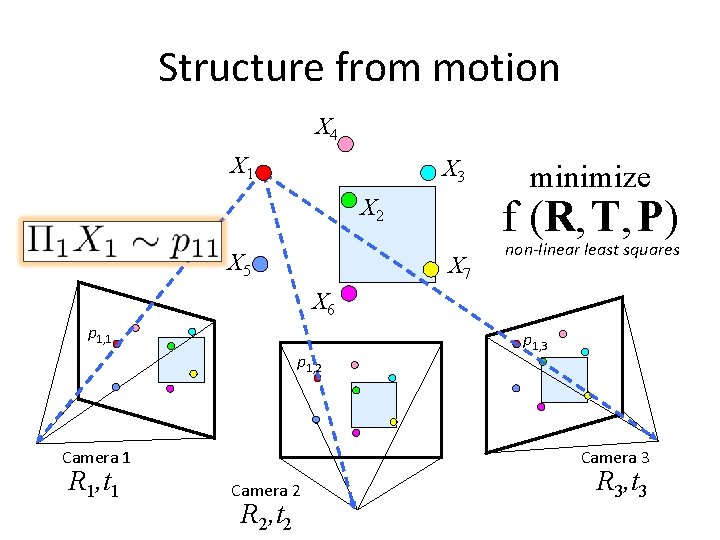
Structure from motion X 4 X 1 X 3 f (R, T, P) X 2 X 5 minimize X 7 non-linear least squares X 6 p 1, 1 p 1, 2 Camera 1 R 1, t 1 p 1, 3 Camera 2 R 2, t 2 R 3, t 3
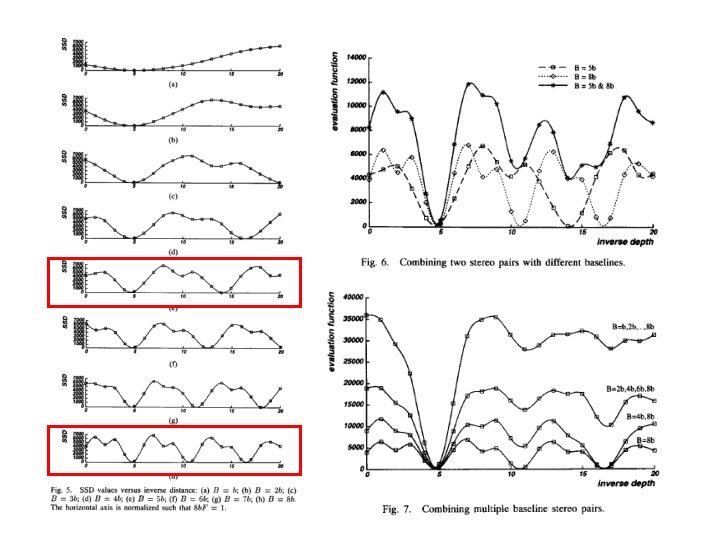
Stereo: another view error depth
Recognition
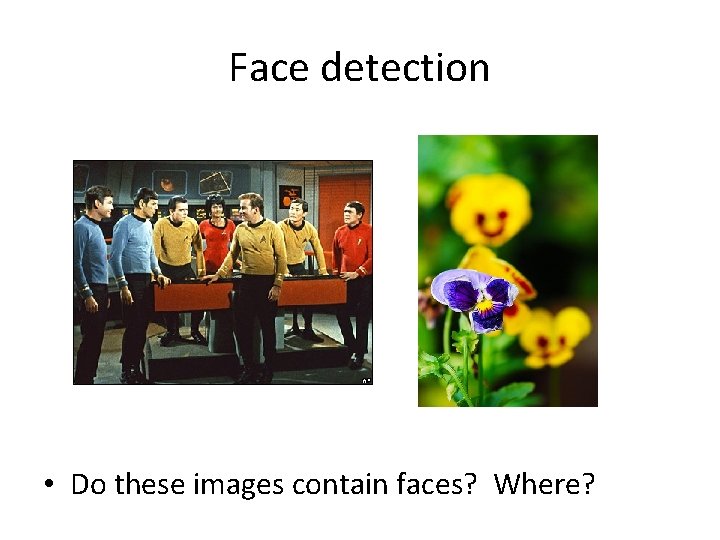
Face detection • Do these images contain faces? Where?
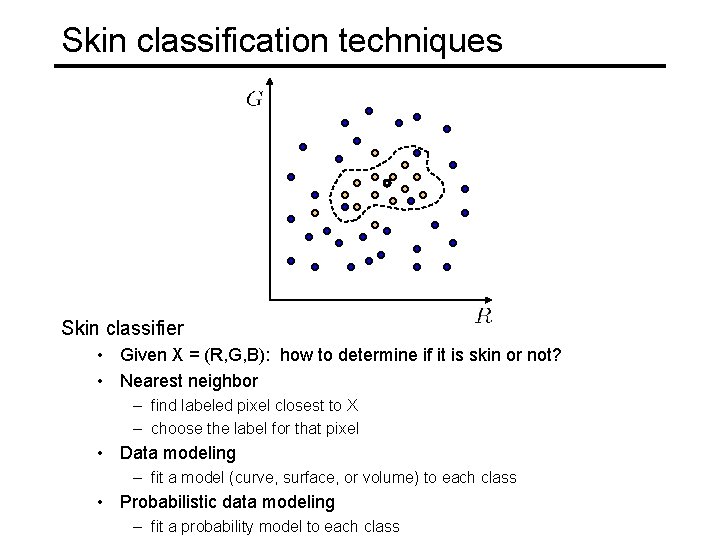
Skin classification techniques Skin classifier • Given X = (R, G, B): how to determine if it is skin or not? • Nearest neighbor – find labeled pixel closest to X – choose the label for that pixel • Data modeling – fit a model (curve, surface, or volume) to each class • Probabilistic data modeling – fit a probability model to each class
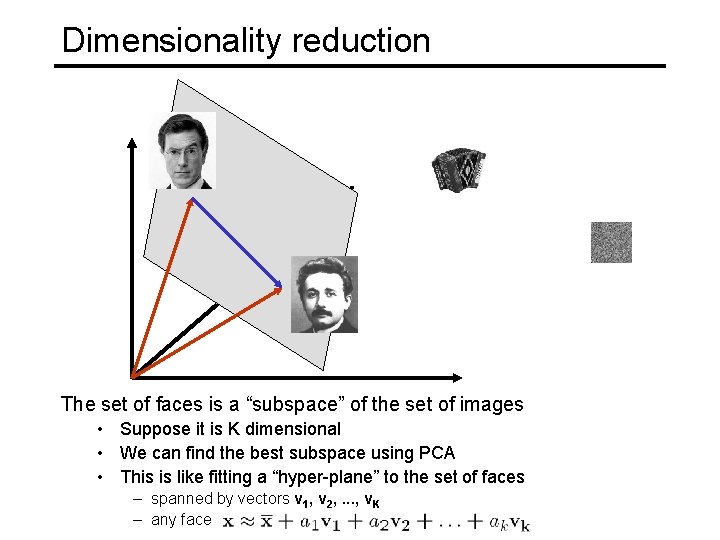
Dimensionality reduction The set of faces is a “subspace” of the set of images • Suppose it is K dimensional • We can find the best subspace using PCA • This is like fitting a “hyper-plane” to the set of faces – spanned by vectors v 1, v 2, . . . , v. K – any face
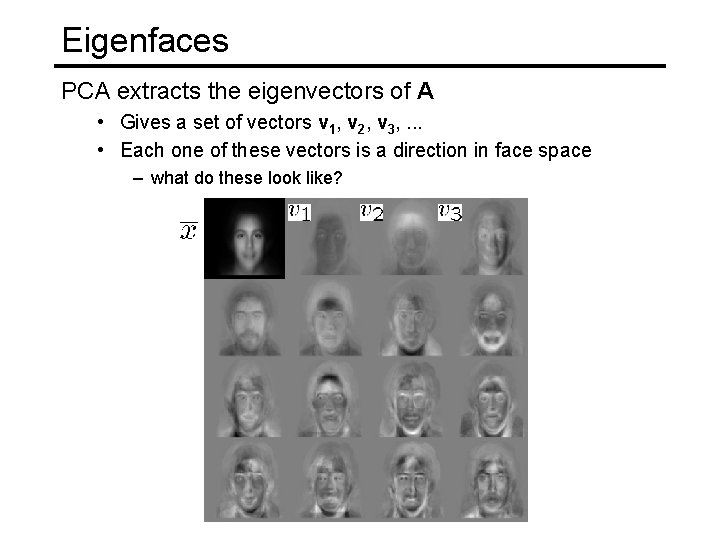
Eigenfaces PCA extracts the eigenvectors of A • Gives a set of vectors v 1, v 2, v 3, . . . • Each one of these vectors is a direction in face space – what do these look like?
Train cascade of classifiers with Ada. Boost Ap sub ply t wi o ea nd ow ch Perceptual and. Recognition Sensory Augmented Visual Object Tutorial Computing Viola-Jones Face Detector: Summary Faces Non-faces New image Selected features, thresholds, and weights • Train with 5 K positives, 350 M negatives • Real-time detector using 38 layer cascade • 6061 features in final layer • [Implementation available in Open. CV: http: //www. intel. com/technology/computing/opencv/] K. Grauman, B. Leibe 56
Perceptual and. Recognition Sensory Augmented Visual Object Tutorial Computing Viola-Jones Face Detector: Results First two features selected K. Grauman, B. Leibe 57
frequency Bag-of-words models …. . codewords
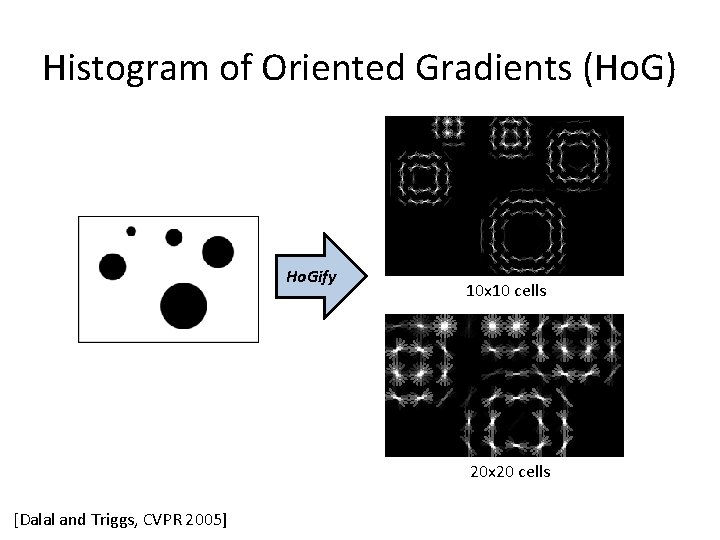
Histogram of Oriented Gradients (Ho. G) Ho. Gify 10 x 10 cells 20 x 20 cells [Dalal and Triggs, CVPR 2005]
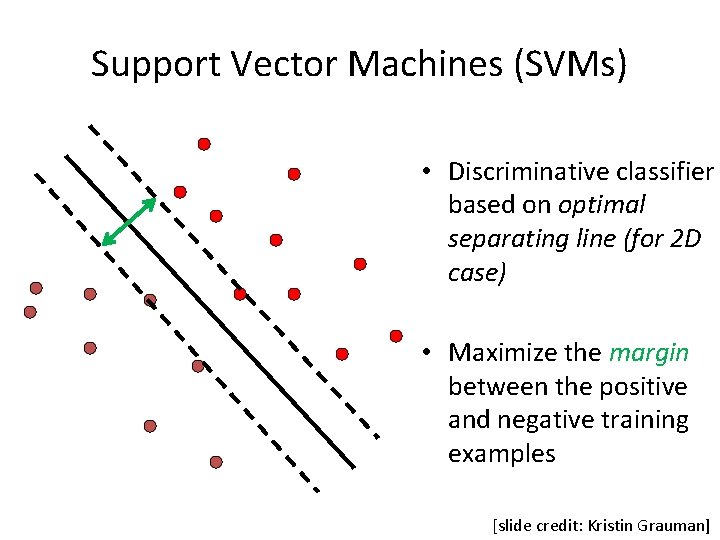
Support Vector Machines (SVMs) • Discriminative classifier based on optimal separating line (for 2 D case) • Maximize the margin between the positive and negative training examples [slide credit: Kristin Grauman]
Vision Contests • PASCAL VOC Challenge • 20 categories • Annual classification, detection, segmentation, … challenges
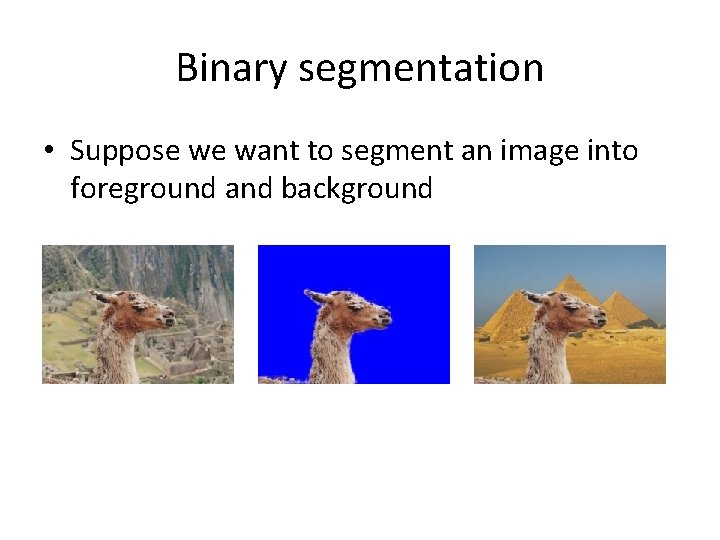
Binary segmentation • Suppose we want to segment an image into foreground and background
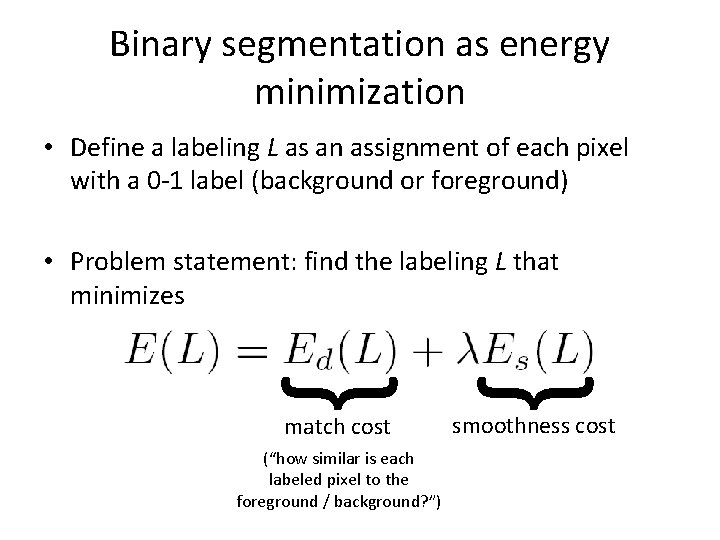
Binary segmentation as energy minimization • Define a labeling L as an assignment of each pixel with a 0 -1 label (background or foreground) { { • Problem statement: find the labeling L that minimizes match cost (“how similar is each labeled pixel to the foreground / background? ”) smoothness cost
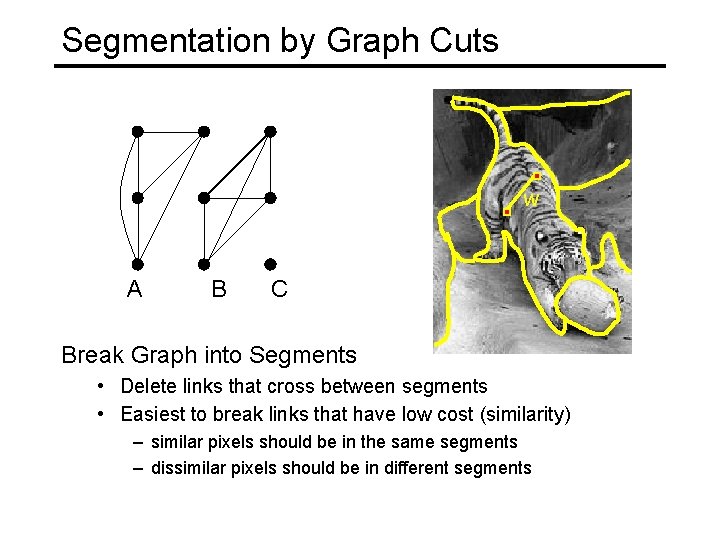
Segmentation by Graph Cuts w A B C Break Graph into Segments • Delete links that cross between segments • Easiest to break links that have low cost (similarity) – similar pixels should be in the same segments – dissimilar pixels should be in different segments
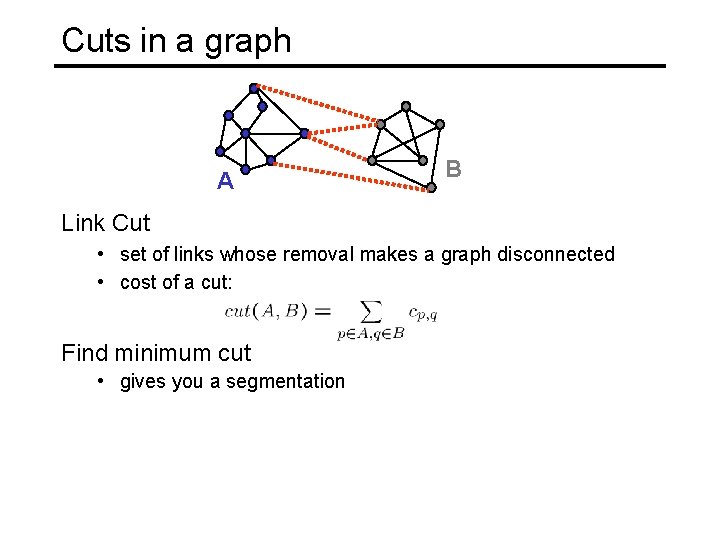
Cuts in a graph A B Link Cut • set of links whose removal makes a graph disconnected • cost of a cut: Find minimum cut • gives you a segmentation
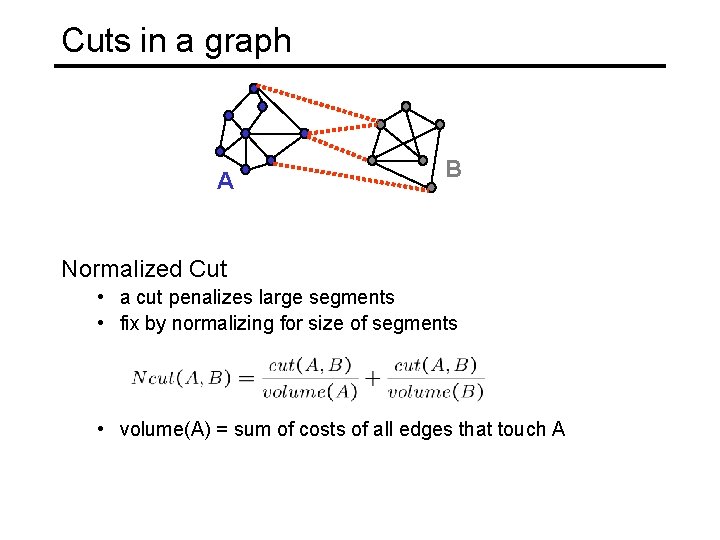
Cuts in a graph A B Normalized Cut • a cut penalizes large segments • fix by normalizing for size of segments • volume(A) = sum of costs of all edges that touch A
Light, reflectance, cameras
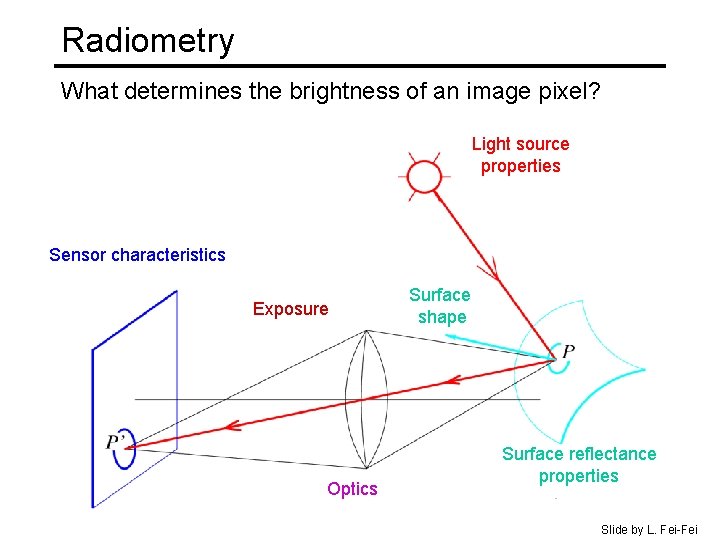
Radiometry What determines the brightness of an image pixel? Light source properties Sensor characteristics Exposure Optics Surface shape Surface reflectance properties Slide by L. Fei-Fei
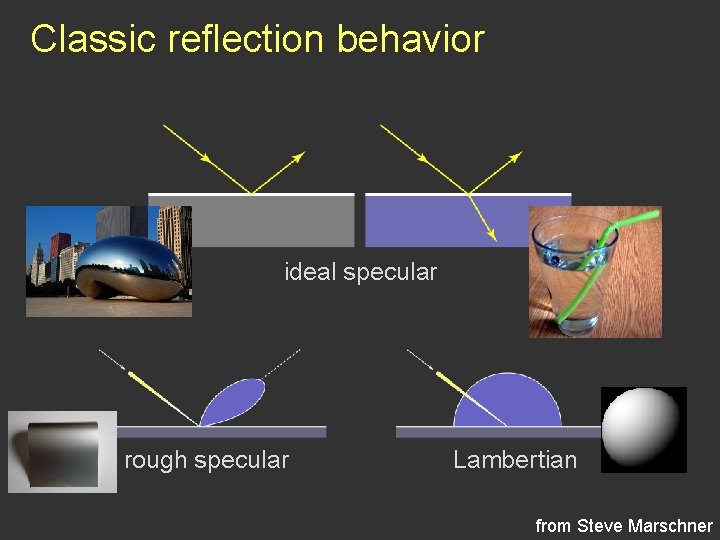
Classic reflection behavior ideal specular rough specular Lambertian from Steve Marschner
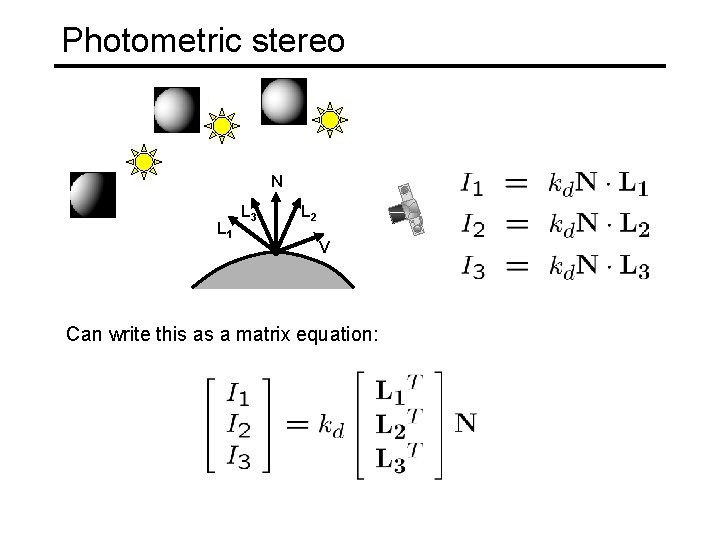
Photometric stereo N L 1 L 3 L 2 V Can write this as a matrix equation:
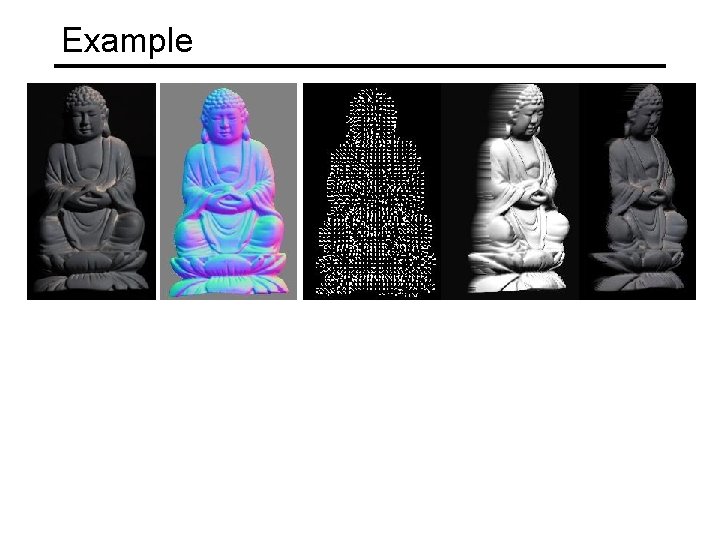
Example
Questions? Good luck!