
CS 461 Nov 18 Section 7 1 Overview
- Slides: 10
CS 461 – Nov. 18 Section 7. 1 • Overview of complexity issues – “Can quickly decide” vs. “Can quickly verify” • Measuring complexity • Dividing decidable languages into complexity classes. • Next, please finish sections 7. 1 – 7. 2: – Algorithm complexity depends on what kind of TM you use – Formal definition of P, NP-complete
Revisit: P and NP • P = Problems where deterministic polynomialtime algorithm. – “can quickly decide” (in the TM sense) – The run time is O(n 2) or O(n 3), etc. • NP = Problems where non-deterministic polynomial-time algorithm. – “can quickly verify” – A deterministic algorithm would require exponential time, which isn’t too helpful. – (NP – P) consists of problems where we don’t know of any deterministic polynomial algorithm.
Conjecture • P and NP are distinct. – Meaning that some NP problems are not in P. – There are some problems that seem inherently exponential. • Major unsolved question! – For each NP problem, try to find a deterministic polynomial algorithm, so it can be reclassed as P. – Or, prove that such an algorithm can’t exist. We don’t know how to do this. Therefore, it’s still possible that P = NP. • Ex. Primality was recently shown to be in P.
Example • Consider this problem: subset-sum. Given a set S of integers and a number n, is there a subset of S that adds up to n? – If we’re given the subset, easy to check. NP – Nobody knows of a deterministic polynomial algorithm. • What about the complement? – In other words, there is no subset with that sum. – Seems even harder. Nobody knows of a nondeterministic algorithm to check. Seems like we need to check all subsets and verify none adds up to n. – Another general unsolved problem: are complements of NP problems also NP?
Graph examples • The “clique” problem. Given a graph, does it contain a subgraph that’s complete? – Non-deterministically, we would be “given” the clique, then verify that it’s complete. – What is the complexity? – (Complement of Clique: not known to be in NP. ) • Hamiltonian path: Given a graph, can we visit each vertex exactly once? – Non-deterministically, we’d be given the itinerary.
Inside NP • There are generally 2 kinds of NP problems. – Smaller category: Problems where a deterministic polynomial algorithm is lurking out there, and we’ll eventually find it. – Larger category: Problems that seem hopelessly exponential. When you distill these problems, they all have the same structure. If a polynomial solution exists for one, they would all be solvable! These problems are called NP-complete.
Examples • Some graph problems – – Finding the shortest path Finding the cheapest network (spanning tree) Hamiltonian and Euler cycles Traveling salesman problem • Why do similar sounding problems have vastly different complexity?
“O” review • Order of magnitude upper bound • Rationale: 1000 n 2 is fundamentally less than n 3, and is in the same family as n 2. • Definition: f(n) is O(g(n)) if there exist integer constants c and n 0 such that f(n) c g(n) for all n n 0. – In other words: in the long run, f(n) can be bounded by g(n) times a constant. – e. g. 7 n 2 + 1 is O(n 2) and also O(n 3) but not O(n). O(n 2) would be a tight or more useful upper bound. – e. g. Technically, 2 n is O(3 n) but 3 n is not O(2 n). – log(n) is between 1 and n. • Ordering of common complexities: O(1), O(log n), O(n 2), O(n 3), O(2 n), O(n!)
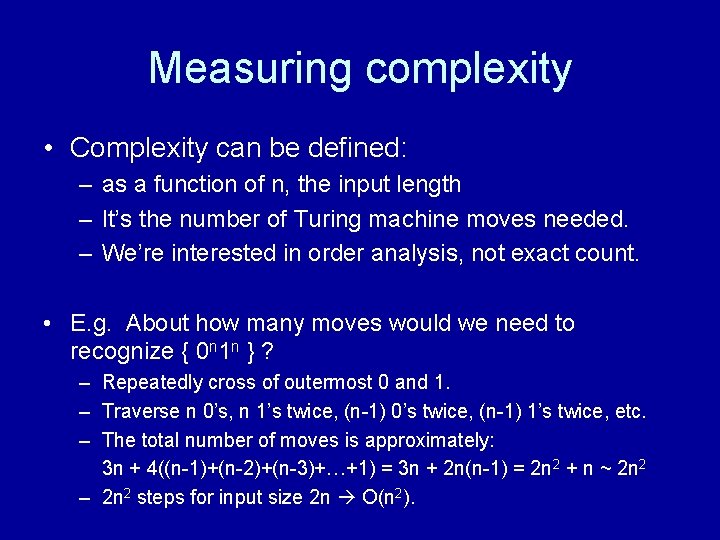
Measuring complexity • Complexity can be defined: – as a function of n, the input length – It’s the number of Turing machine moves needed. – We’re interested in order analysis, not exact count. • E. g. About how many moves would we need to recognize { 0 n 1 n } ? – Repeatedly cross of outermost 0 and 1. – Traverse n 0’s, n 1’s twice, (n-1) 0’s twice, (n-1) 1’s twice, etc. – The total number of moves is approximately: 3 n + 4((n-1)+(n-2)+(n-3)+…+1) = 3 n + 2 n(n-1) = 2 n 2 + n ~ 2 n 2 – 2 n 2 steps for input size 2 n O(n 2).
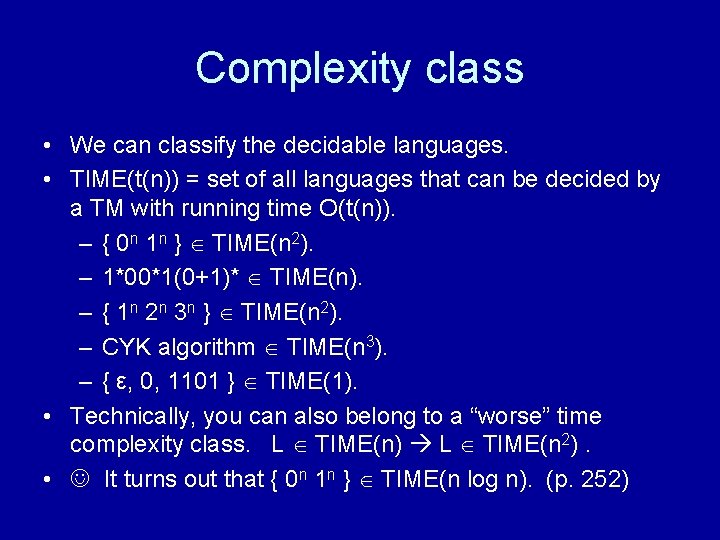
Complexity class • We can classify the decidable languages. • TIME(t(n)) = set of all languages that can be decided by a TM with running time O(t(n)). – { 0 n 1 n } TIME(n 2). – 1*00*1(0+1)* TIME(n). – { 1 n 2 n 3 n } TIME(n 2). – CYK algorithm TIME(n 3). – { ε, 0, 1101 } TIME(1). • Technically, you can also belong to a “worse” time complexity class. L TIME(n) L TIME(n 2). • It turns out that { 0 n 1 n } TIME(n log n). (p. 252)