
CS 46 B Introduction to Data Structures July
CS 46 B: Introduction to Data Structures July 23 Class Meeting Department of Computer Science San Jose State University Summer 2015 Instructor: Ron Mak www. cs. sjsu. edu/~mak

Quizzes for July 23 o Quiz 20 July 28 16. 4 Computer Science Dept. Summer 2015: July 23 CS 46 B: Introduction to Data Structures © R. Mak 2
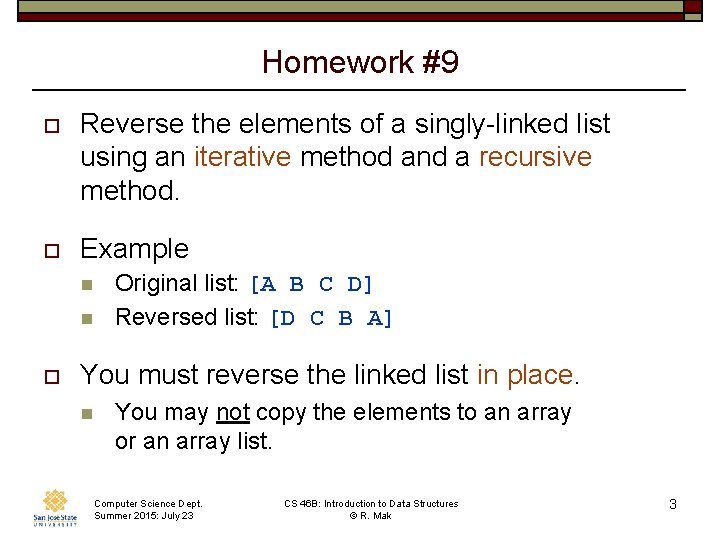
Homework #9 o Reverse the elements of a singly-linked list using an iterative method and a recursive method. o Example n n o Original list: [A B C D] Reversed list: [D C B A] You must reverse the linked list in place. n You may not copy the elements to an array or an array list. Computer Science Dept. Summer 2015: July 23 CS 46 B: Introduction to Data Structures © R. Mak 3
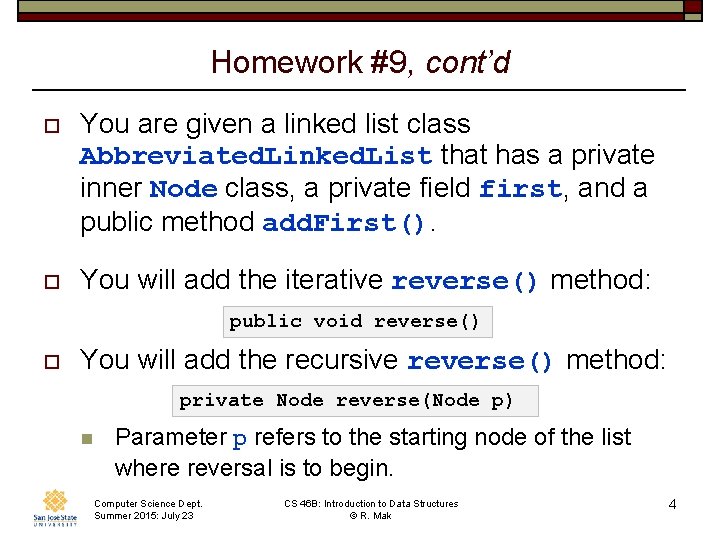
Homework #9, cont’d o You are given a linked list class Abbreviated. Linked. List that has a private inner Node class, a private field first, and a public method add. First(). o You will add the iterative reverse() method: public void reverse() o You will add the recursive reverse() method: private Node reverse(Node p) n Parameter p refers to the starting node of the list where reversal is to begin. Computer Science Dept. Summer 2015: July 23 CS 46 B: Introduction to Data Structures © R. Mak 4
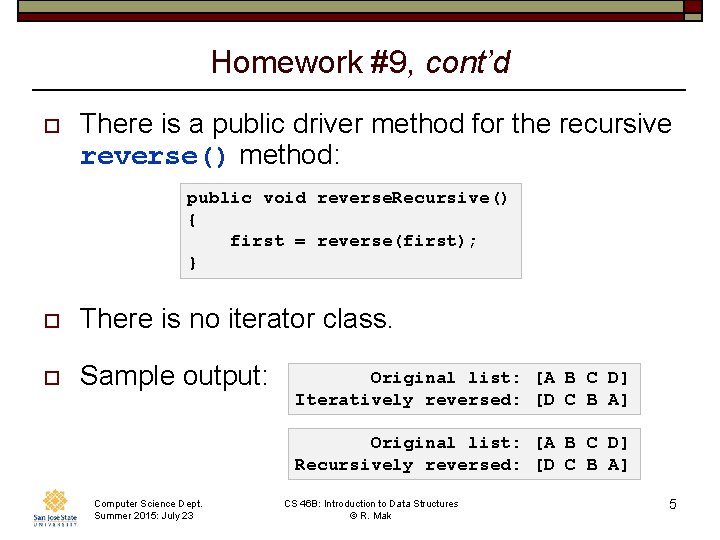
Homework #9, cont’d o There is a public driver method for the recursive reverse() method: public void reverse. Recursive() { first = reverse(first); } o There is no iterator class. o Sample output: Original list: [A B C D] Iteratively reversed: [D C B A] Original list: [A B C D] Recursively reversed: [D C B A] Computer Science Dept. Summer 2015: July 23 CS 46 B: Introduction to Data Structures © R. Mak 5
Homework #9, cont’d o Draft: Iterative version only. n n n o Codecheck: http: //codecheck. it/codecheck/files/15072108363747 y 0 fo 08 ar 6 knsd 11 a 5 wjak Canvas: Homework 9 Draft Due: Friday, July 24 at 11: 59 PM Final: Replace your iterative method with your recursive method. n n n Codecheck: http: //codecheck. it/codecheck/files/1507210846 ccvdhl 3 kluu 0 qf molsx 1 y 2 h 1 i Canvas: Homework 9 Final Due: Monday, July 27 at 11: 59 PM Computer Science Dept. Summer 2015: July 23 CS 46 B: Introduction to Data Structures © R. Mak 6
Use a Linked List Iterator o Applications that use a linked list must create an iterator for the linked list. o Use the iterator to: n n n Traverse the elements of the list. Add and remove elements from the list (except for the first element). Set an element of the list. Computer Science Dept. Summer 2015: July 23 CS 46 B: Introduction to Data Structures © R. Mak 7
Use a Linked List Iterator, cont’d o o Advantages n Applications that use the linked list don’t directly manipulate the elements’ next reference. n Hide the list implementation from applications. Disadvantages n n More complex linked list implementation code. Applications must deal with yet another object. Computer Science Dept. Summer 2015: July 23 CS 46 B: Introduction to Data Structures © R. Mak 8
Direct Linked List Manipulation o Don’t use an iterator. n o Advantages n o Applications that use the linked list directly manipulates the elements’ next reference. Simpler linked list implementation code. Disadvantages n n Applications are aware of how the linked list is implemented. Application code is less safe. Computer Science Dept. Summer 2015: July 23 CS 46 B: Introduction to Data Structures © R. Mak 9
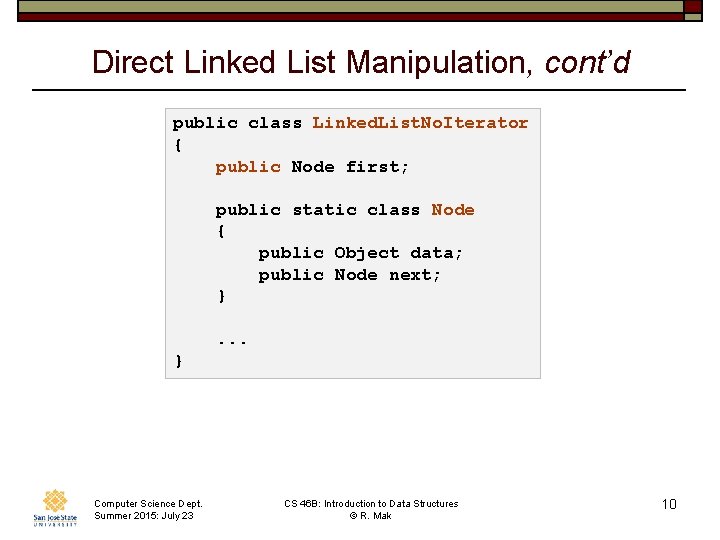
Direct Linked List Manipulation, cont’d public class Linked. List. No. Iterator { public Node first; public static class Node { public Object data; public Node next; }. . . } Computer Science Dept. Summer 2015: July 23 CS 46 B: Introduction to Data Structures © R. Mak 10
![Direct Linked List Manipulation, cont’d public static void main(String[] args) { Linked. List. No.](http://slidetodoc.com/presentation_image_h2/5514f0dcf27b7abaa33f827ac235b2ec/image-11.jpg "Direct Linked List Manipulation, cont’d public static void main(String[] args) { Linked. List. No.")
Direct Linked List Manipulation, cont’d public static void main(String[] args) { Linked. List. No. Iterator list = new Linked. List. No. Iterator(); add(list, new String[] {"C", "S", "4", "6", "B"}); print(list); System. out. println("n. Remove B"); Node prev = get. Previous(list, "B"); prev. next = prev. next; print(list); System. out. println("n. Add 1"); prev = get. Previous(list, "4"); Node one = new Node(); one. data = "1"; one. next = prev. next; prev. next = one; print(list); } Computer Science Dept. Summer 2015: July 23 CS 46 B: Introduction to Data Structures © R. Mak 11
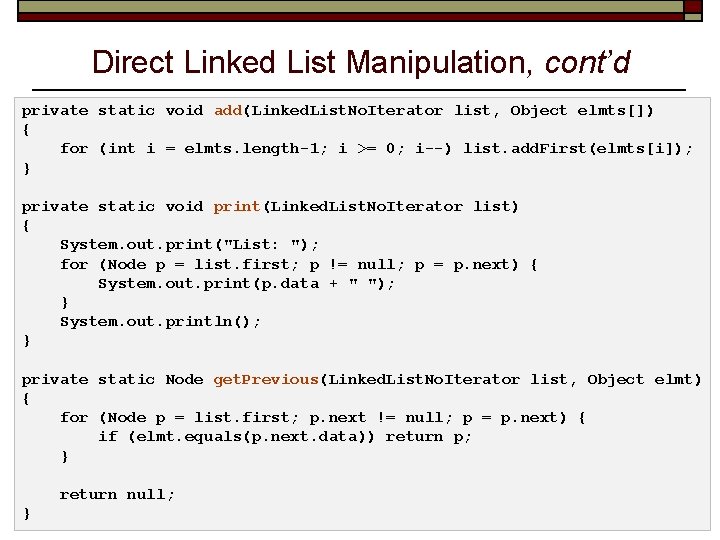
Direct Linked List Manipulation, cont’d private static void add(Linked. List. No. Iterator list, Object elmts[]) { for (int i = elmts. length-1; i >= 0; i--) list. add. First(elmts[i]); } private static void print(Linked. List. No. Iterator list) { System. out. print("List: "); for (Node p = list. first; p != null; p = p. next) { System. out. print(p. data + " "); } System. out. println(); } private static Node get. Previous(Linked. List. No. Iterator list, Object elmt) { for (Node p = list. first; p. next != null; p = p. next) { if (elmt. equals(p. next. data)) return p; } } return null; Computer Science Dept. Summer 2015: July 23 CS 46 B: Introduction to Data Structures © R. Mak 12
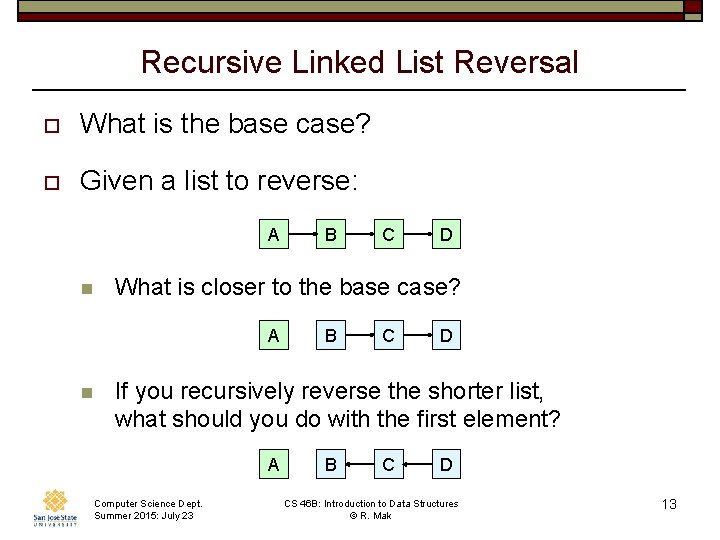
Recursive Linked List Reversal o What is the base case? o Given a list to reverse: A n C D What is closer to the base case? A n B B C D If you recursively reverse the shorter list, what should you do with the first element? A Computer Science Dept. Summer 2015: July 23 B C D CS 46 B: Introduction to Data Structures © R. Mak 13
![Arrays o The most basic data structure. o Array of primitives: double values[] =](http://slidetodoc.com/presentation_image_h2/5514f0dcf27b7abaa33f827ac235b2ec/image-14.jpg "Arrays o The most basic data structure. o Array of primitives: double values[] =")
Arrays o The most basic data structure. o Array of primitives: double values[] = new double[20]; o Array of objects: Employee workers[] = new Employee[50]; o Easy to access an element. n Just use an index! values[14] = Math. PI; workers[42] = new Employee(); Computer Science Dept. Summer 2015: July 23 CS 46 B: Introduction to Data Structures © R. Mak 14
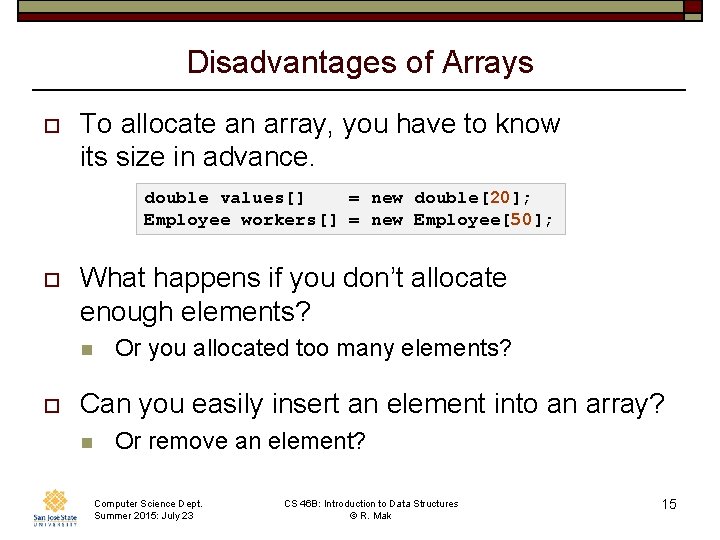
Disadvantages of Arrays o To allocate an array, you have to know its size in advance. double values[] = new double[20]; Employee workers[] = new Employee[50]; o What happens if you don’t allocate enough elements? n o Or you allocated too many elements? Can you easily insert an element into an array? n Or remove an element? Computer Science Dept. Summer 2015: July 23 CS 46 B: Introduction to Data Structures © R. Mak 15
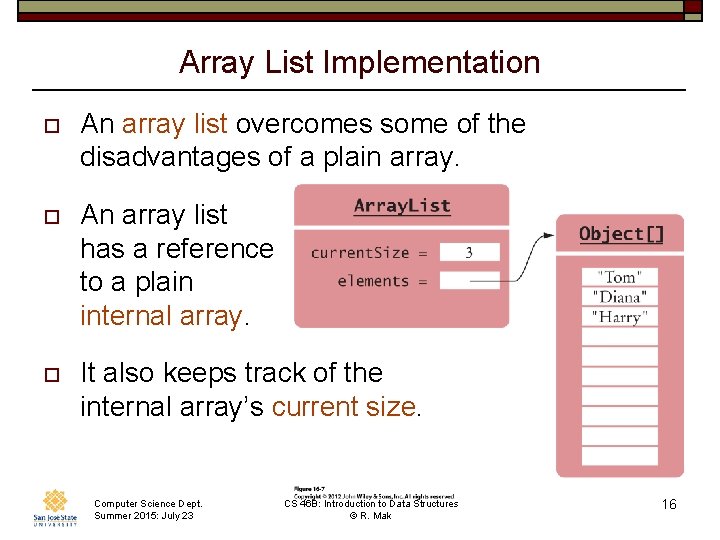
Array List Implementation o An array list overcomes some of the disadvantages of a plain array. o An array list has a reference to a plain internal array. o It also keeps track of the internal array’s current size. Computer Science Dept. Summer 2015: July 23 CS 46 B: Introduction to Data Structures © R. Mak 16
Array List Element Remove and Insert o If you remove an element, the array list will move each of the following elements up to fill in the hole. n o It copies each element to the previous position. If you insert (add) an element at a particular position, the array list will move each of the following elements down to make a hole for the new element. n It copies each element to the next position. Computer Science Dept. Summer 2015: July 23 CS 46 B: Introduction to Data Structures © R. Mak 17
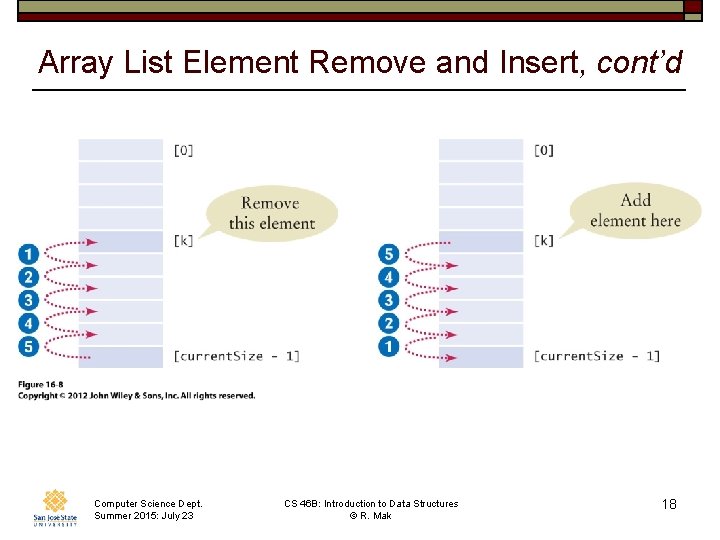
Array List Element Remove and Insert, cont’d Computer Science Dept. Summer 2015: July 23 CS 46 B: Introduction to Data Structures © R. Mak 18
Array List Grows the Internal Array o If its internal array is full and you add a new element, the array list will grow the internal array. n n n Allocate a new internal array that’s twice the size. Copy all the elements from the old array to the new. This is an O(n) operation. Computer Science Dept. Summer 2015: July 23 CS 46 B: Introduction to Data Structures © R. Mak 19
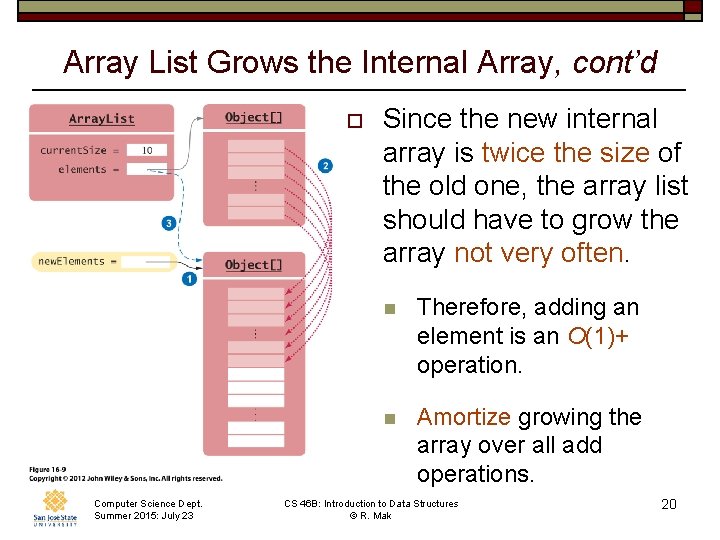
Array List Grows the Internal Array, cont’d o Computer Science Dept. Summer 2015: July 23 Since the new internal array is twice the size of the old one, the array list should have to grow the array not very often. n Therefore, adding an element is an O(1)+ operation. n Amortize growing the array over all add operations. CS 46 B: Introduction to Data Structures © R. Mak 20
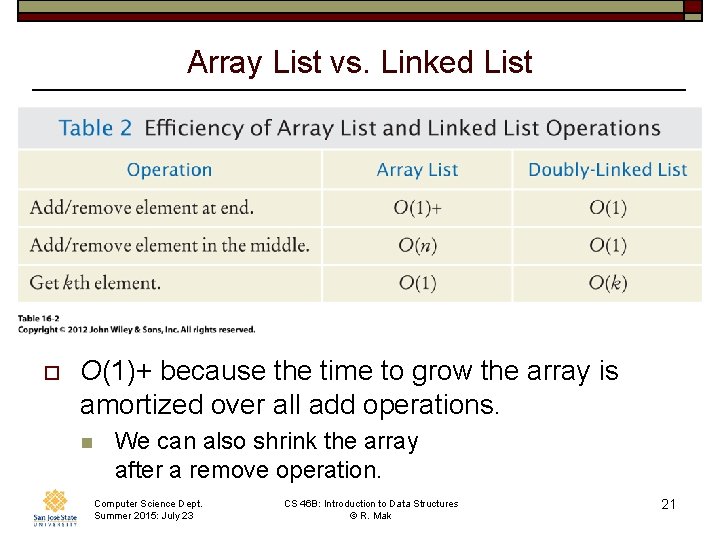
Array List vs. Linked List o O(1)+ because the time to grow the array is amortized over all add operations. n We can also shrink the array after a remove operation. Computer Science Dept. Summer 2015: July 23 CS 46 B: Introduction to Data Structures © R. Mak 21
Break Computer Science Dept. Summer 2015: July 23 CS 46 B: Introduction to Data Structures © R. Mak 22
Stack Implementation o We can implement a stack using a linked list or an array list. o Which end of the linked list or array list to use for push and pop operations? Computer Science Dept. Summer 2015: July 23 CS 46 B: Introduction to Data Structures © R. Mak 23
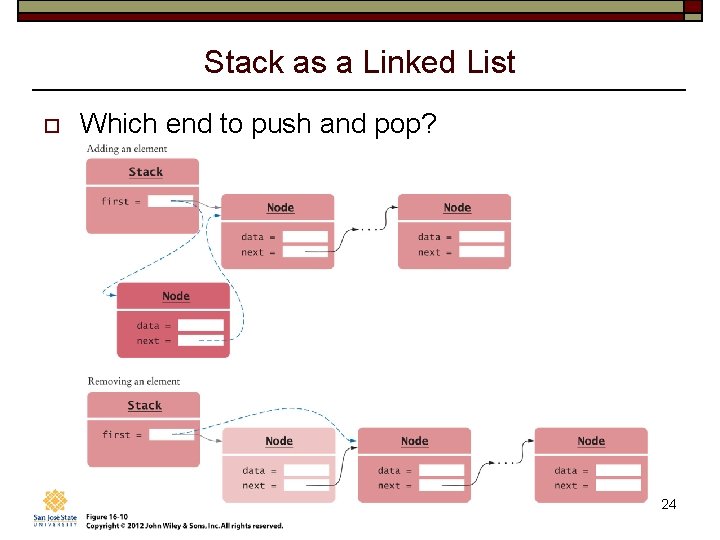
Stack as a Linked List o Which end to push and pop? Computer Science Dept. Summer 2015: July 23 CS 46 B: Introduction to Data Structures © R. Mak 24
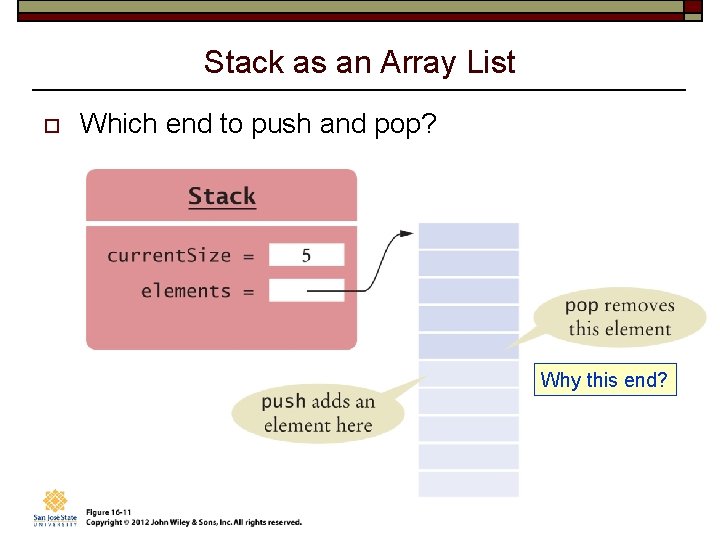
Stack as an Array List o Which end to push and pop? Why this end? Computer Science Dept. Summer 2015: July 23 CS 46 B: Introduction to Data Structures © R. Mak 25
Queue Implementation o We can implement a queue using a linked list or an array. o Which end of the linked list or array to use for add and remove operations? Computer Science Dept. Summer 2015: July 23 CS 46 B: Introduction to Data Structures © R. Mak 26
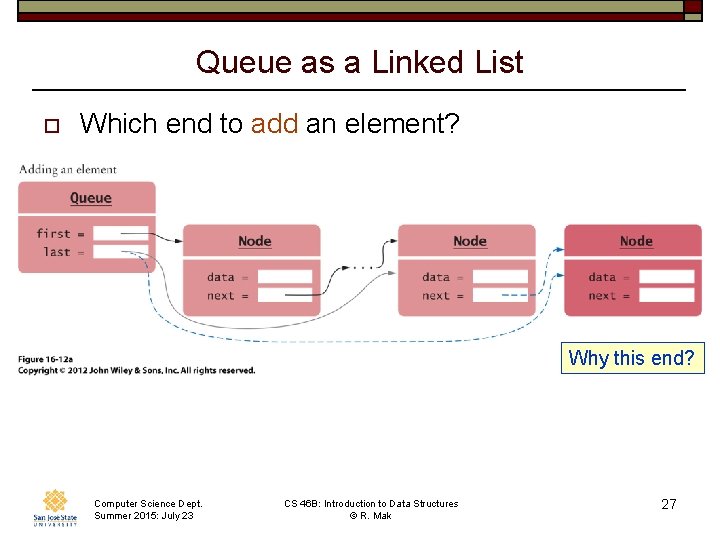
Queue as a Linked List o Which end to add an element? Why this end? Computer Science Dept. Summer 2015: July 23 CS 46 B: Introduction to Data Structures © R. Mak 27
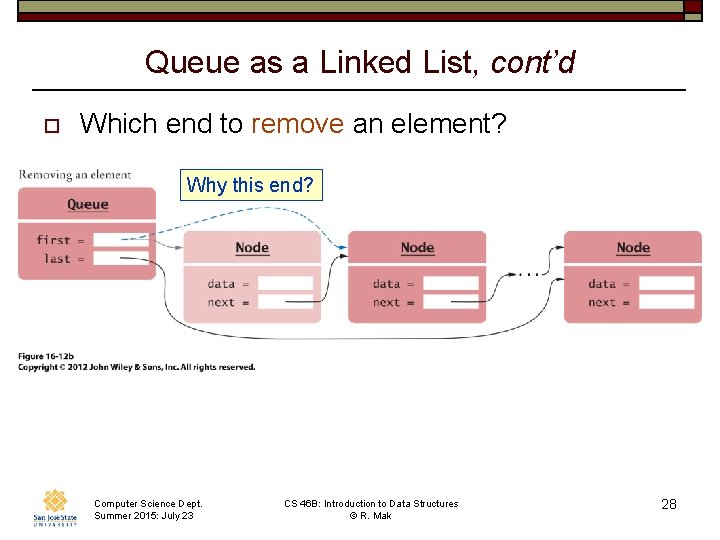
Queue as a Linked List, cont’d o Which end to remove an element? Why this end? Computer Science Dept. Summer 2015: July 23 CS 46 B: Introduction to Data Structures © R. Mak 28
Queue as an Array o We can also implement a queue using a plain array. o But then there’s a problem with the remove operation. n o Removing an element from the middle of an array is an O(n) operation. We can overcome this problem by using a circular array. n AKA circular buffer Computer Science Dept. Summer 2015: July 23 CS 46 B: Introduction to Data Structures © R. Mak 29
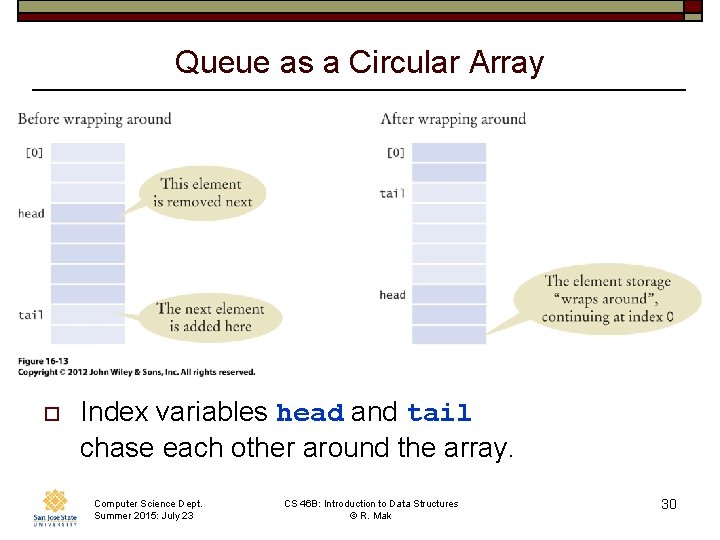
Queue as a Circular Array o Index variables head and tail chase each other around the array. Computer Science Dept. Summer 2015: July 23 CS 46 B: Introduction to Data Structures © R. Mak 30
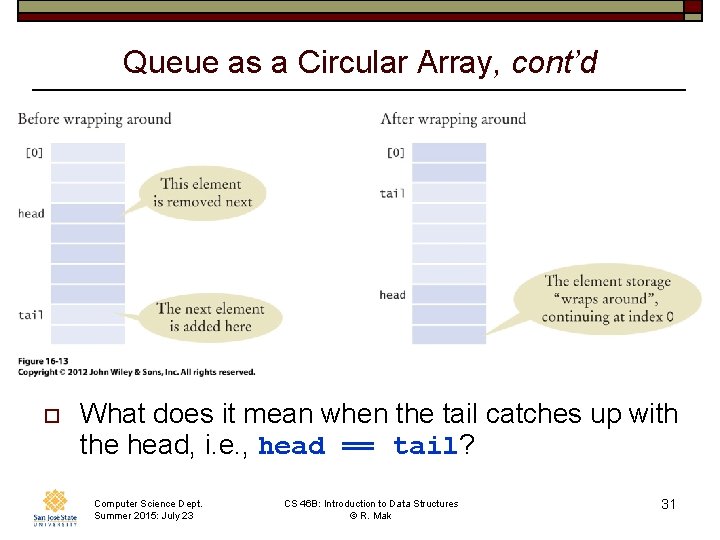
Queue as a Circular Array, cont’d o What does it mean when the tail catches up with the head, i. e. , head == tail? Computer Science Dept. Summer 2015: July 23 CS 46 B: Introduction to Data Structures © R. Mak 31
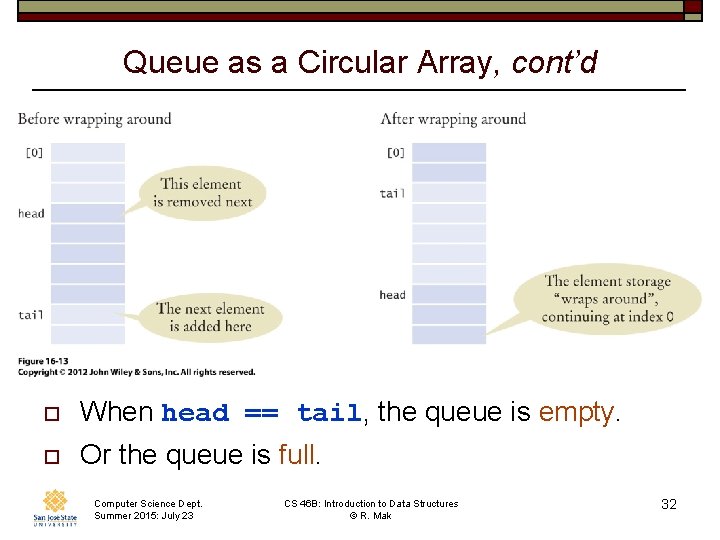
Queue as a Circular Array, cont’d o When head == tail, the queue is empty. o Or the queue is full. Computer Science Dept. Summer 2015: July 23 CS 46 B: Introduction to Data Structures © R. Mak 32
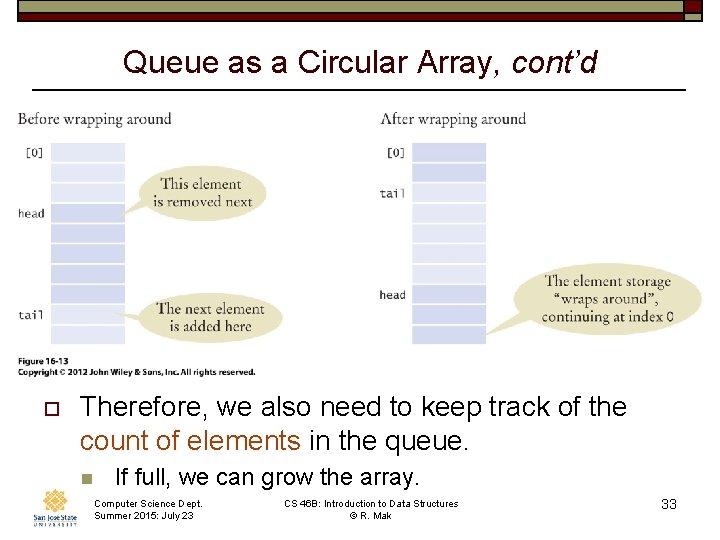
Queue as a Circular Array, cont’d o Therefore, we also need to keep track of the count of elements in the queue. n If full, we can grow the array. Computer Science Dept. Summer 2015: July 23 CS 46 B: Introduction to Data Structures © R. Mak 33
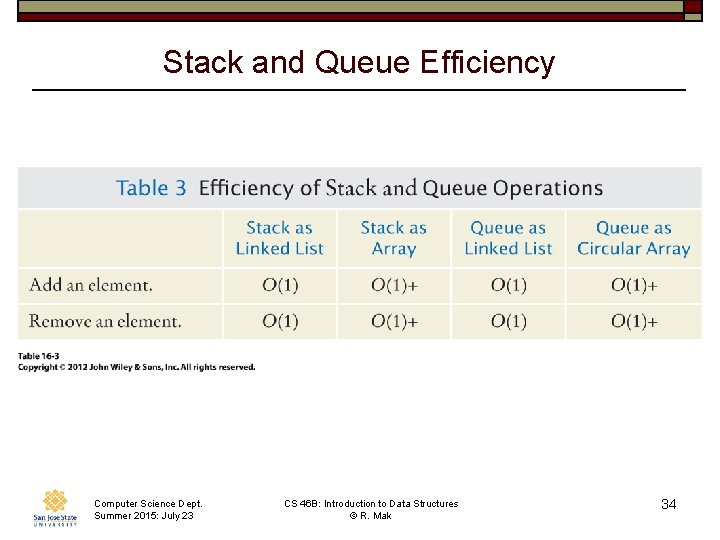
Stack and Queue Efficiency Computer Science Dept. Summer 2015: July 23 CS 46 B: Introduction to Data Structures © R. Mak 34
- Slides: 34