
CS 4527 Artificial Intelligence Markov Decision Processes Instructor


- Slides: 49
CS 4/527: Artificial Intelligence Markov Decision Processes Instructor: Jared Saia University of New Mexico [These slides adapted from Dan Klein and Pieter Abbeel]
Non-Deterministic Search
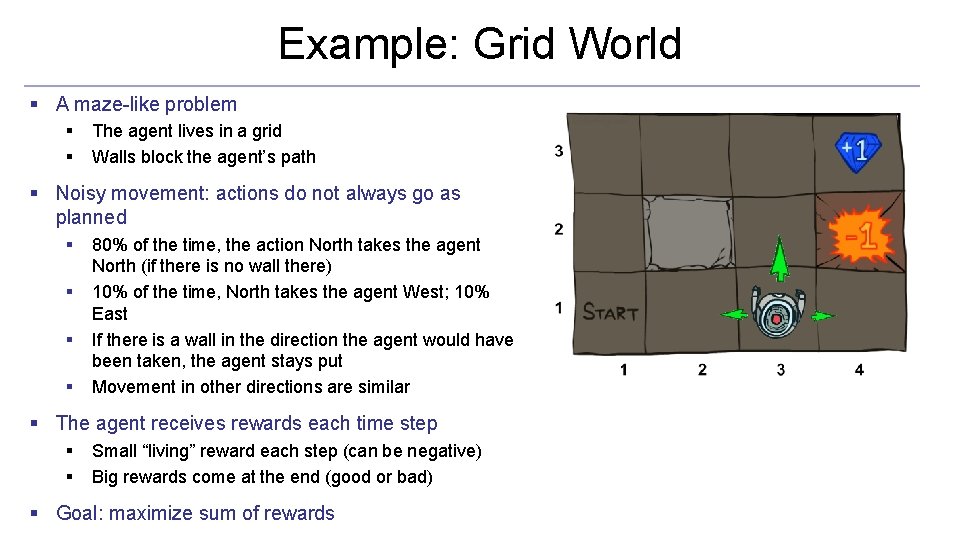
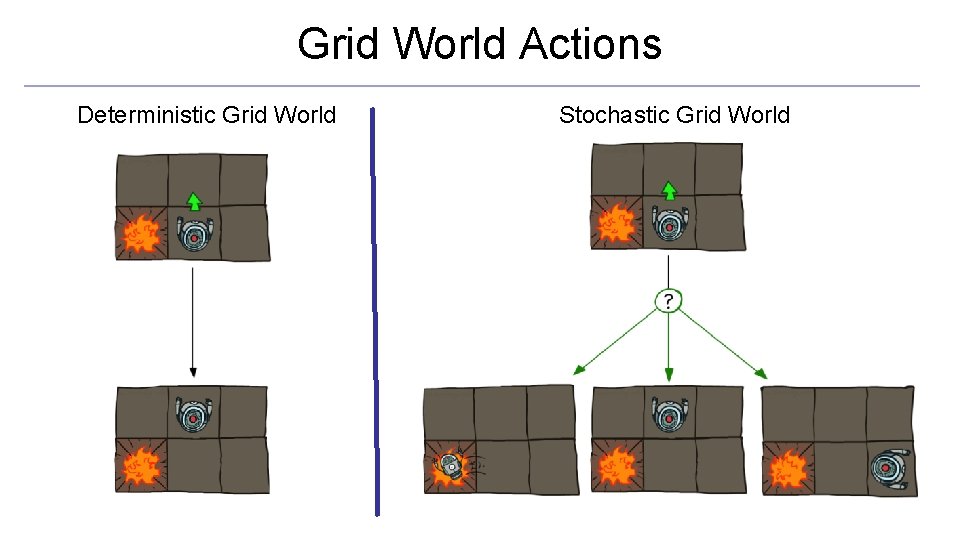
Example: Grid World § A maze-like problem § § The agent lives in a grid Walls block the agent’s path § Noisy movement: actions do not always go as planned § § 80% of the time, the action North takes the agent North (if there is no wall there) 10% of the time, North takes the agent West; 10% East If there is a wall in the direction the agent would have been taken, the agent stays put Movement in other directions are similar § The agent receives rewards each time step § § Small “living” reward each step (can be negative) Big rewards come at the end (good or bad) § Goal: maximize sum of rewards
Grid World Actions Deterministic Grid World Stochastic Grid World
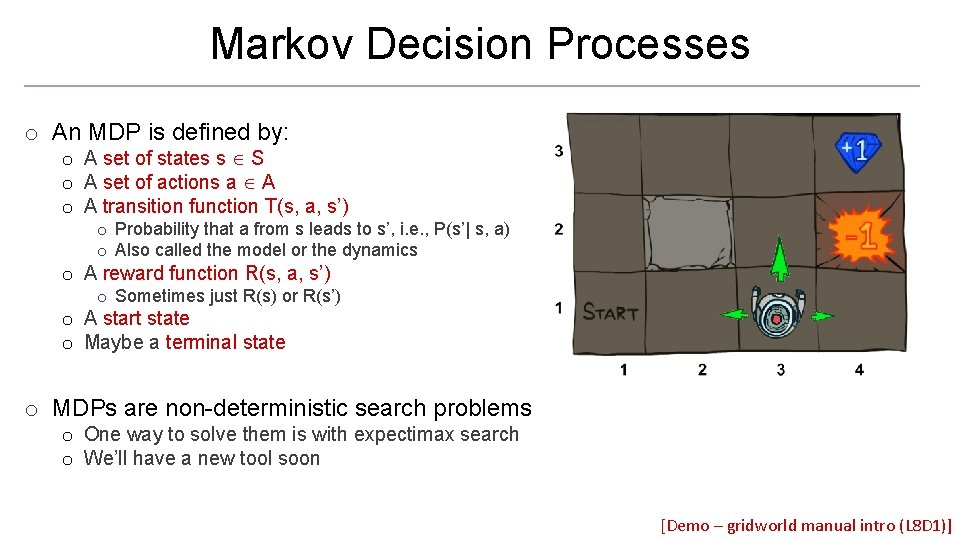
Markov Decision Processes o An MDP is defined by: o A set of states s S o A set of actions a A o A transition function T(s, a, s’) o Probability that a from s leads to s’, i. e. , P(s’| s, a) o Also called the model or the dynamics o A reward function R(s, a, s’) o Sometimes just R(s) or R(s’) o A start state o Maybe a terminal state o MDPs are non-deterministic search problems o One way to solve them is with expectimax search o We’ll have a new tool soon [Demo – gridworld manual intro (L 8 D 1)]
Video of Demo Gridworld Manual Intro
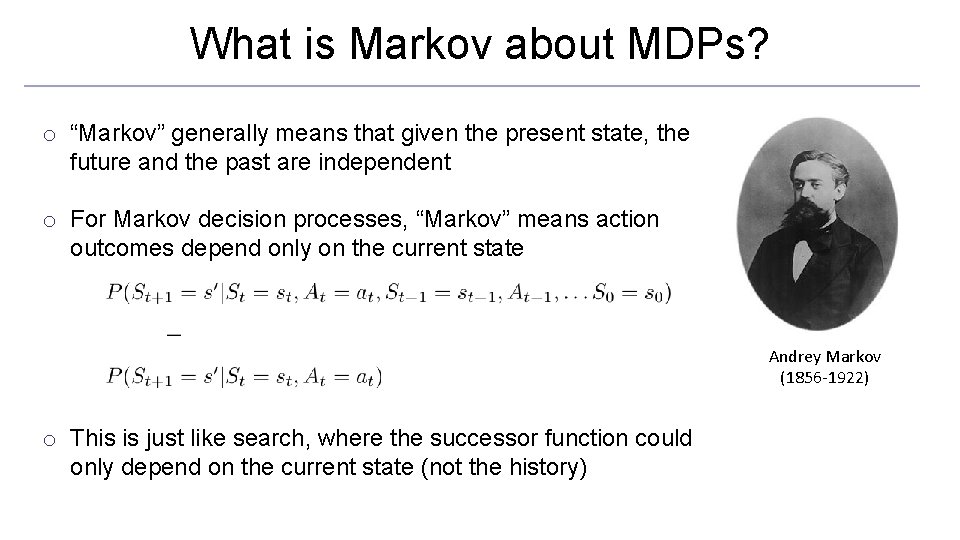
What is Markov about MDPs? o “Markov” generally means that given the present state, the future and the past are independent o For Markov decision processes, “Markov” means action outcomes depend only on the current state Andrey Markov (1856 -1922) o This is just like search, where the successor function could only depend on the current state (not the history)
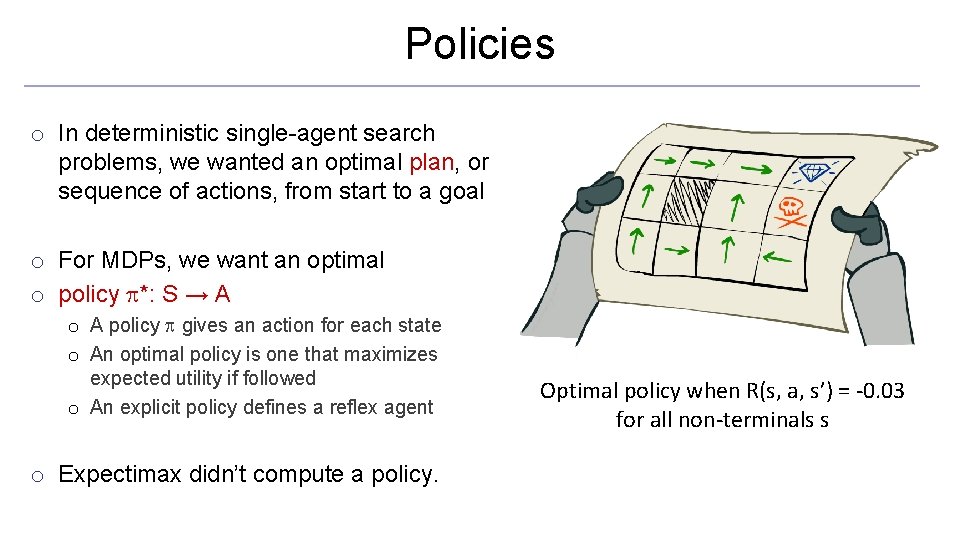
Policies o In deterministic single-agent search problems, we wanted an optimal plan, or sequence of actions, from start to a goal o For MDPs, we want an optimal o policy *: S → A o A policy gives an action for each state o An optimal policy is one that maximizes expected utility if followed o An explicit policy defines a reflex agent o Expectimax didn’t compute a policy. Optimal policy when R(s, a, s’) = -0. 03 for all non-terminals s
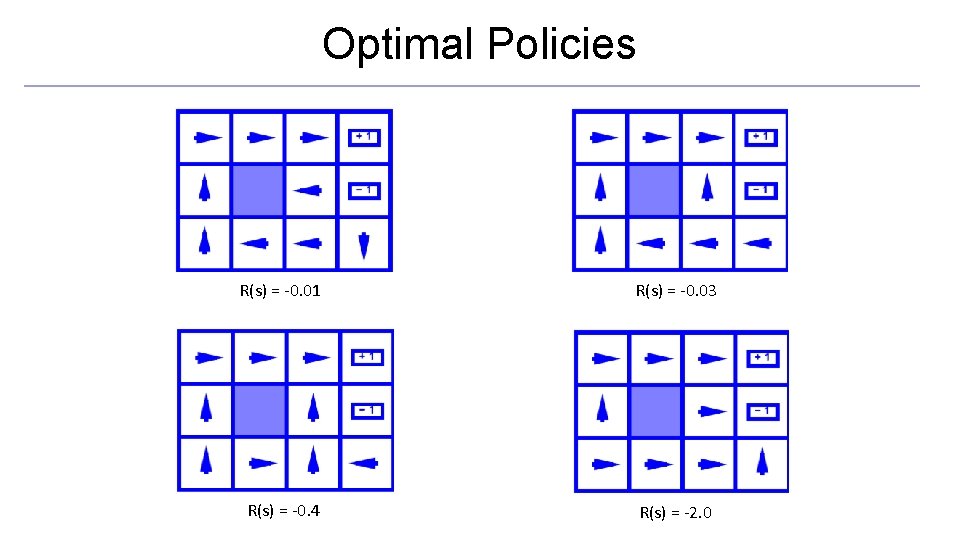
Optimal Policies R(s) = -0. 01 R(s) = -0. 03 R(s) = -0. 4 R(s) = -2. 0
Example: Racing
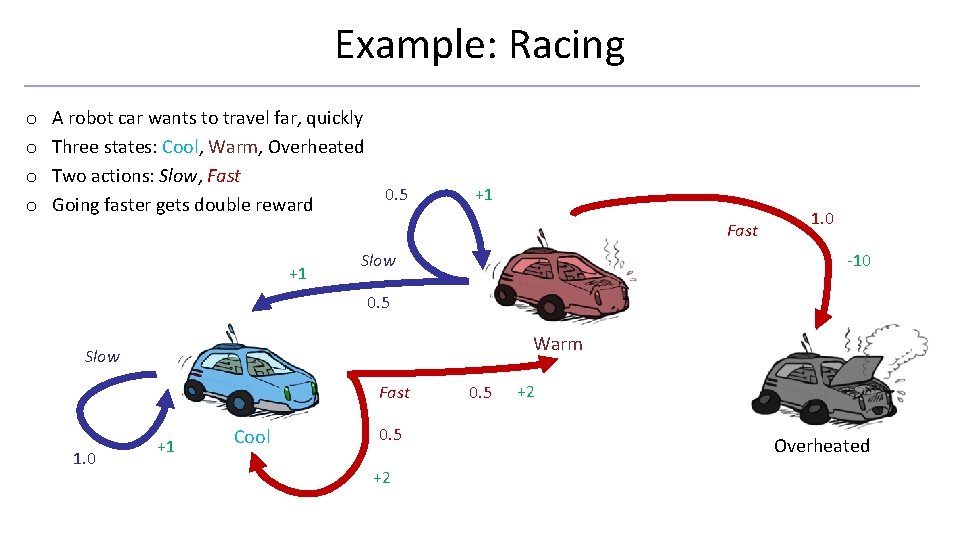
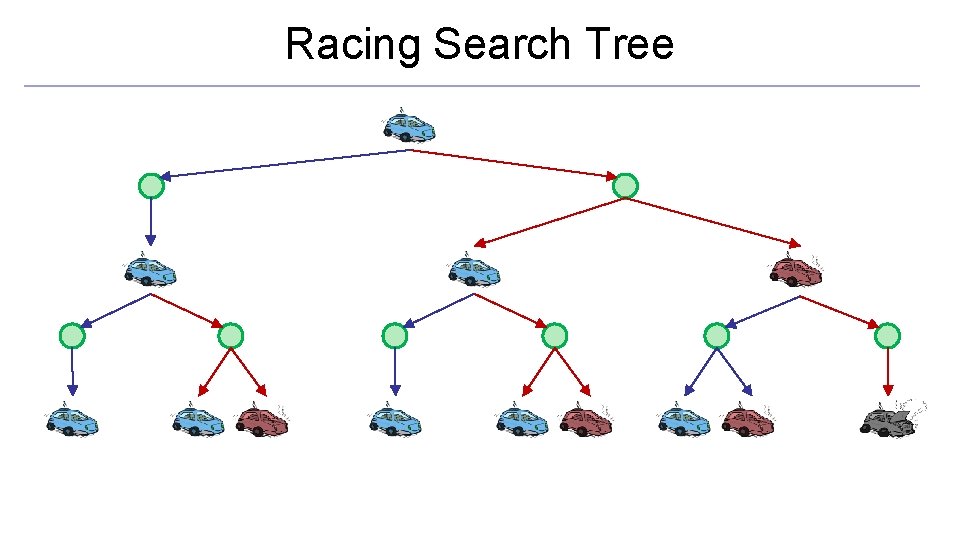
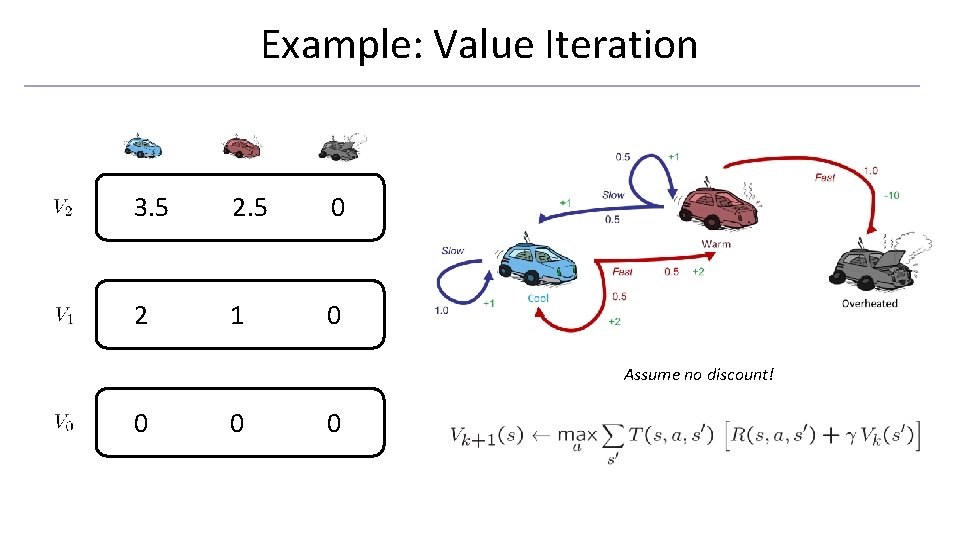
Example: Racing o o A robot car wants to travel far, quickly Three states: Cool, Warm, Overheated Two actions: Slow, Fast Going faster gets double reward 0. 5 +1 Fast +1 Slow 1. 0 -10 0. 5 Warm Slow Fast 1. 0 +1 Cool 0. 5 +2 Overheated
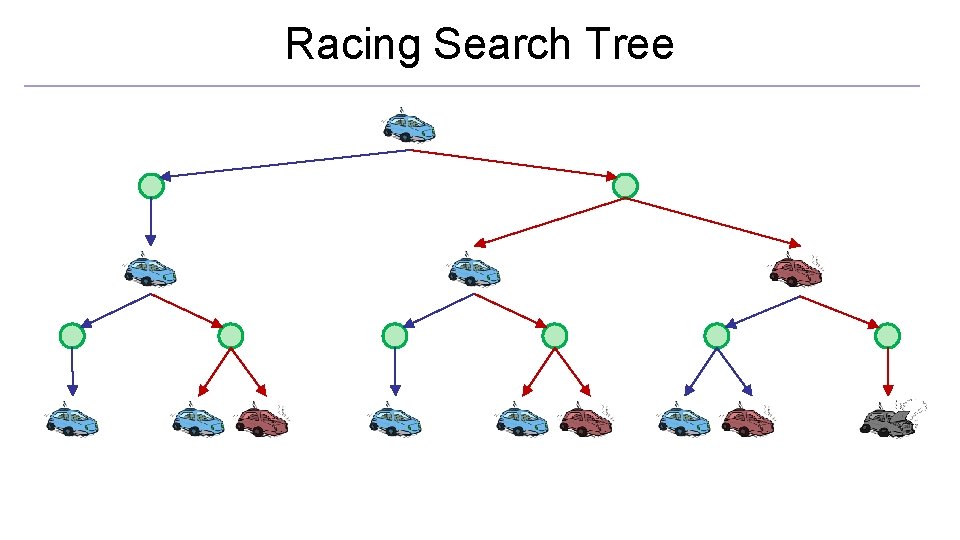
Racing Search Tree
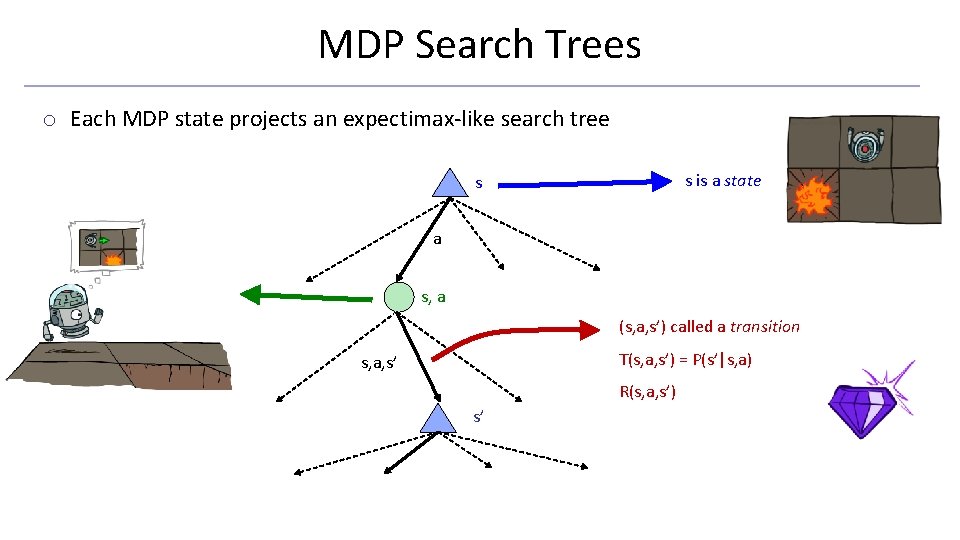
MDP Search Trees o Each MDP state projects an expectimax-like search tree s is a state s a (s, a) is a qstate s, a (s, a, s’) called a transition T(s, a, s’) = P(s’|s, a) s, a, s’ R(s, a, s’) s’
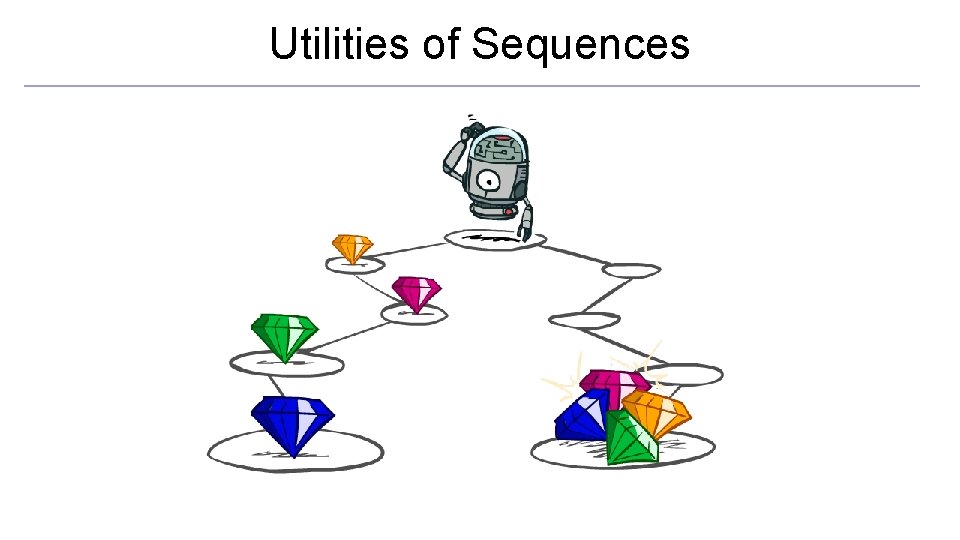
Utilities of Sequences
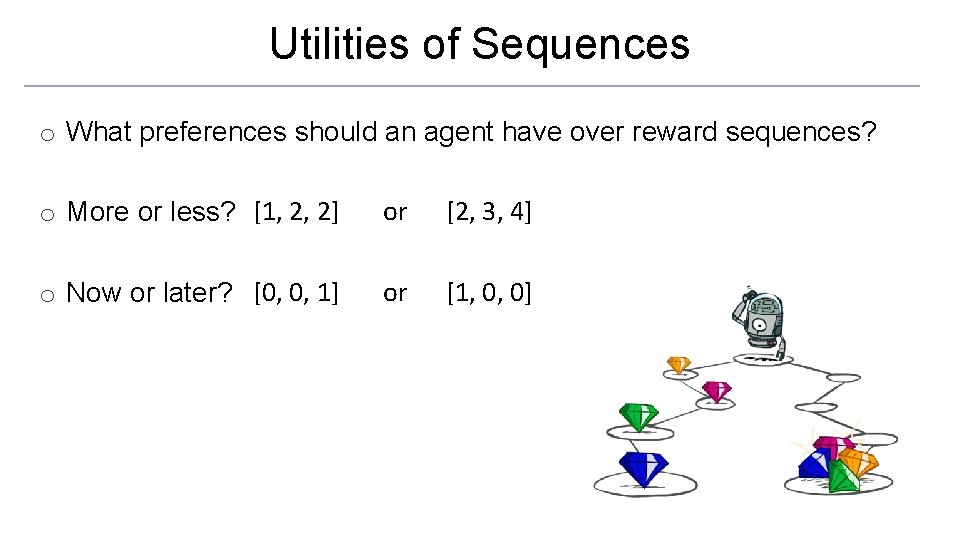
Utilities of Sequences o What preferences should an agent have over reward sequences? o More or less? [1, 2, 2] or [2, 3, 4] o Now or later? [0, 0, 1] or [1, 0, 0]
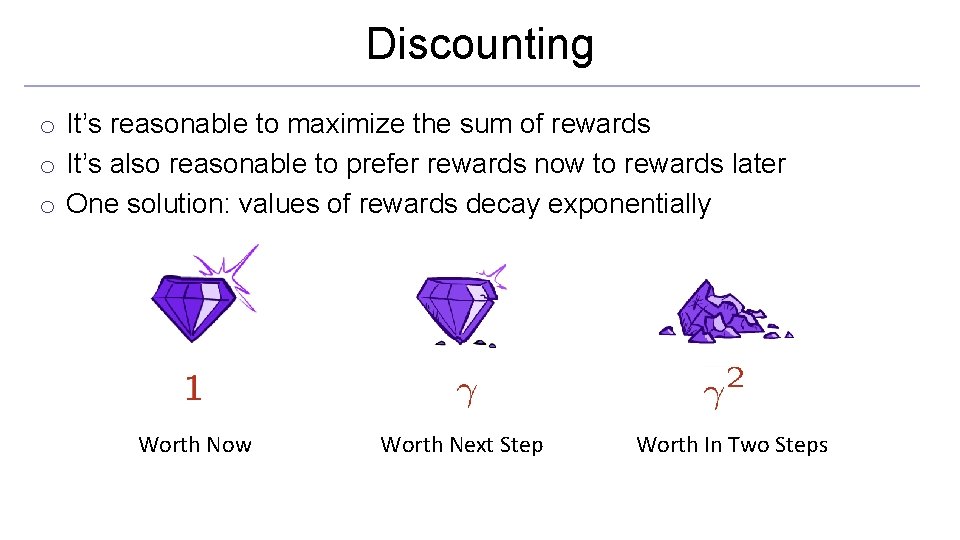
Discounting o It’s reasonable to maximize the sum of rewards o It’s also reasonable to prefer rewards now to rewards later o One solution: values of rewards decay exponentially Worth Now Worth Next Step Worth In Two Steps
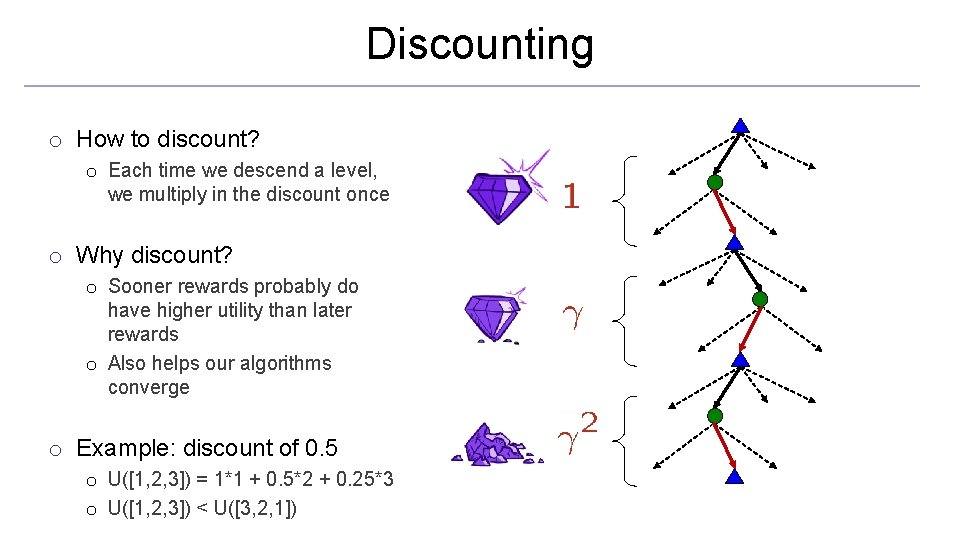
Discounting o How to discount? o Each time we descend a level, we multiply in the discount once o Why discount? o Sooner rewards probably do have higher utility than later rewards o Also helps our algorithms converge o Example: discount of 0. 5 o U([1, 2, 3]) = 1*1 + 0. 5*2 + 0. 25*3 o U([1, 2, 3]) < U([3, 2, 1])
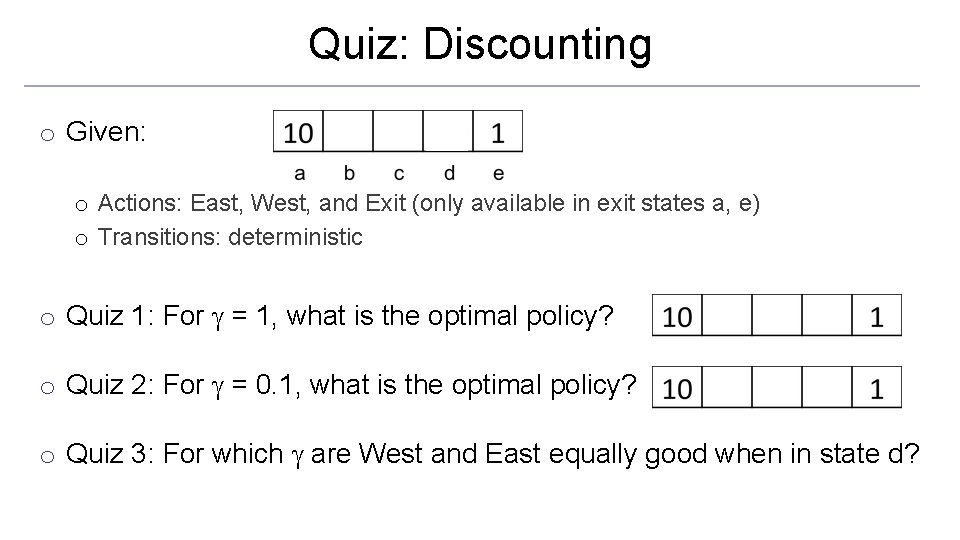
Quiz: Discounting o Given: o Actions: East, West, and Exit (only available in exit states a, e) o Transitions: deterministic o Quiz 1: For = 1, what is the optimal policy? o Quiz 2: For = 0. 1, what is the optimal policy? o Quiz 3: For which are West and East equally good when in state d?
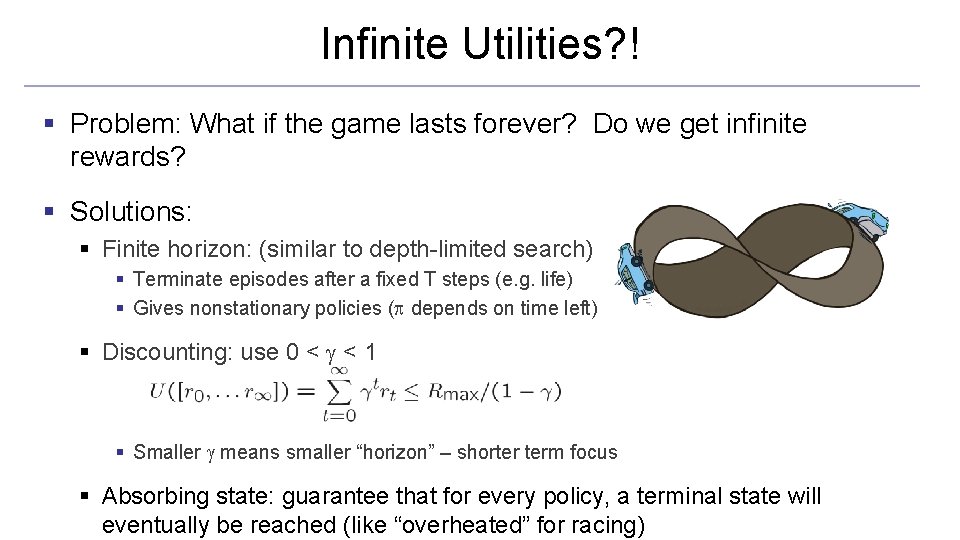
Infinite Utilities? ! § Problem: What if the game lasts forever? Do we get infinite rewards? § Solutions: § Finite horizon: (similar to depth-limited search) § Terminate episodes after a fixed T steps (e. g. life) § Gives nonstationary policies ( depends on time left) § Discounting: use 0 < < 1 § Smaller means smaller “horizon” – shorter term focus § Absorbing state: guarantee that for every policy, a terminal state will eventually be reached (like “overheated” for racing)
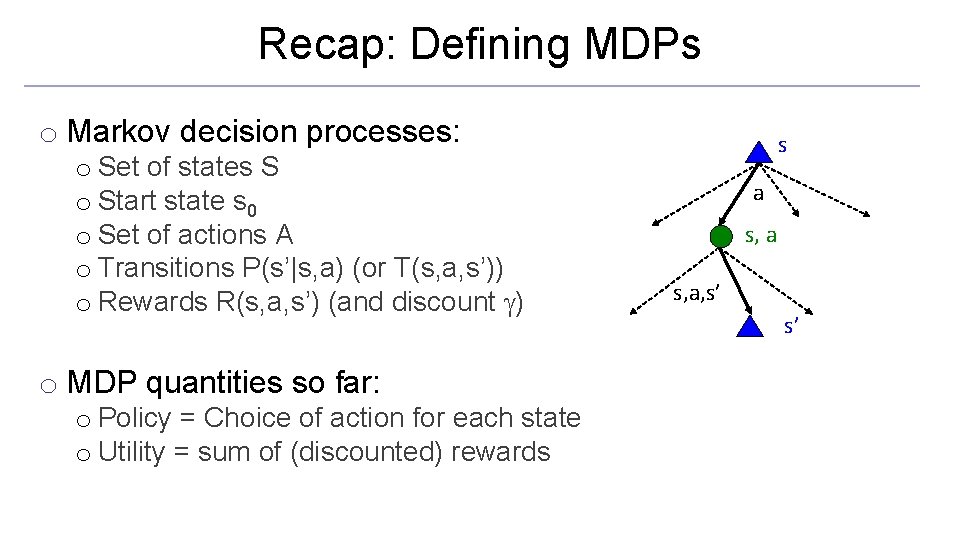
Recap: Defining MDPs o Markov decision processes: o Set of states S o Start state s 0 o Set of actions A o Transitions P(s’|s, a) (or T(s, a, s’)) o Rewards R(s, a, s’) (and discount ) o MDP quantities so far: o Policy = Choice of action for each state o Utility = sum of (discounted) rewards s a s, a, s’ s’
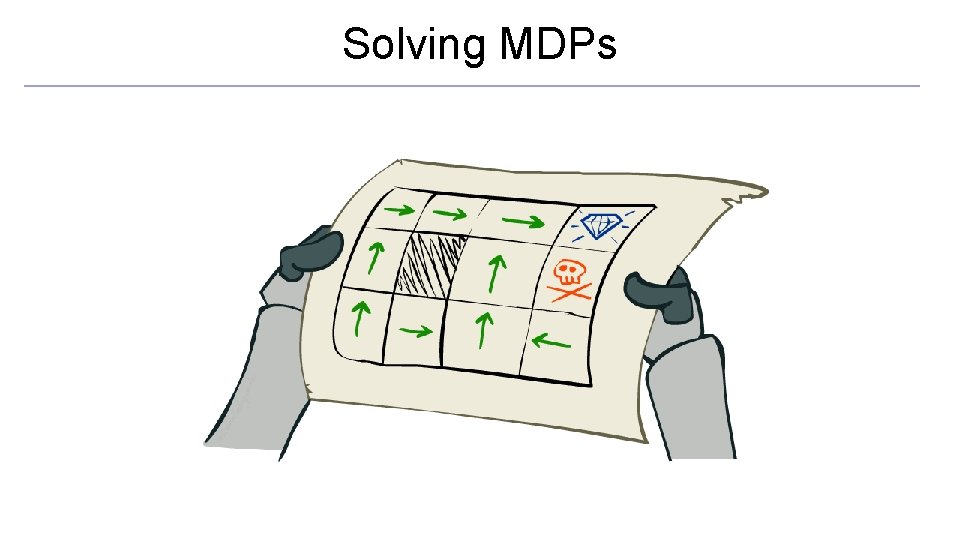
Solving MDPs
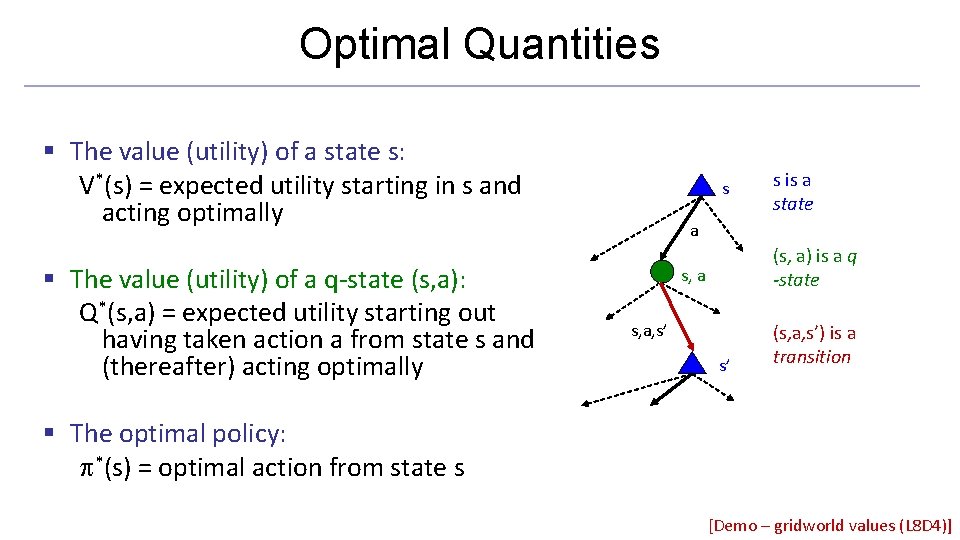
Optimal Quantities § The value (utility) of a state s: V*(s) = expected utility starting in s and acting optimally § The value (utility) of a q-state (s, a): Q*(s, a) = expected utility starting out having taken action a from state s and (thereafter) acting optimally s s is a state a (s, a) is a q -state s, a, s’ s’ (s, a, s’) is a transition § The optimal policy: *(s) = optimal action from state s [Demo – gridworld values (L 8 D 4)]
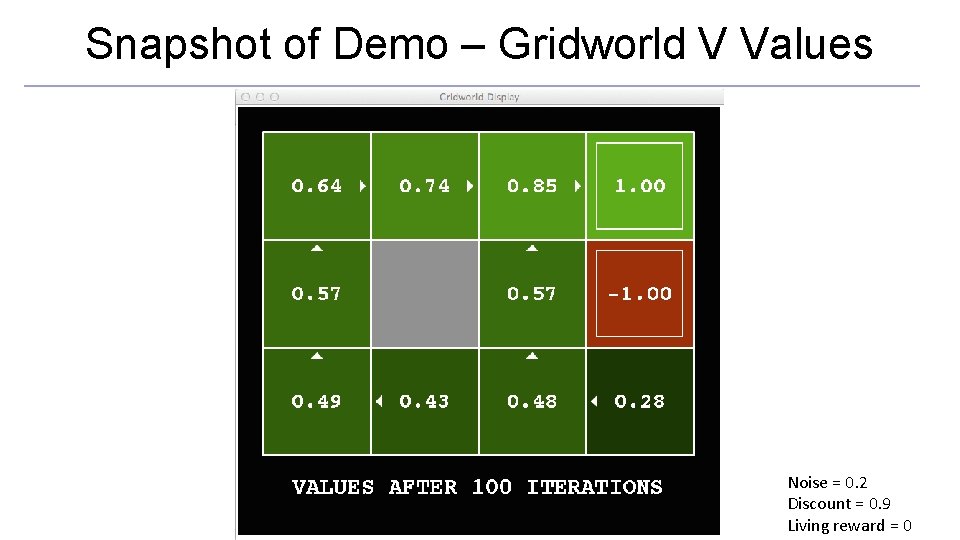
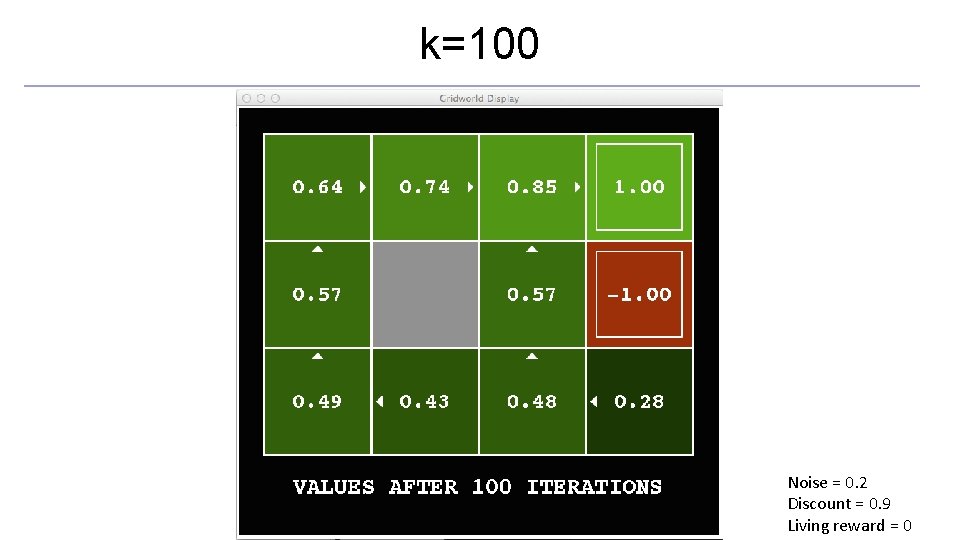
Snapshot of Demo – Gridworld V Values Noise = 0. 2 Discount = 0. 9 Living reward = 0
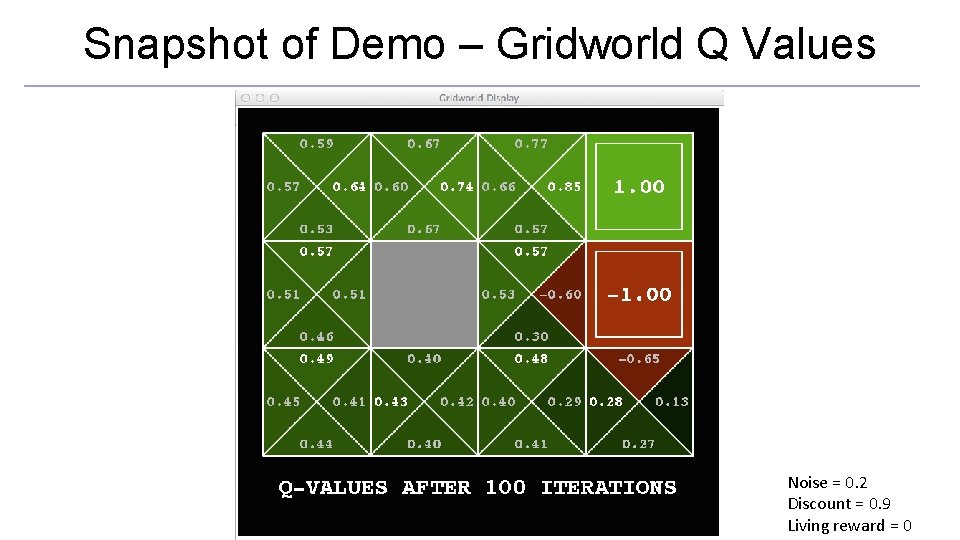
Snapshot of Demo – Gridworld Q Values Noise = 0. 2 Discount = 0. 9 Living reward = 0
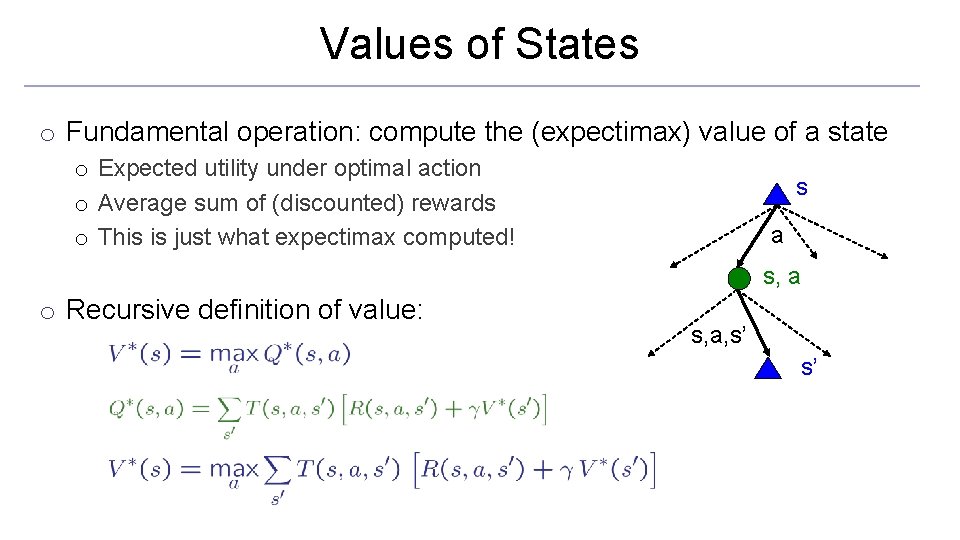
Values of States o Fundamental operation: compute the (expectimax) value of a state o Expected utility under optimal action o Average sum of (discounted) rewards o This is just what expectimax computed! s a s, a o Recursive definition of value: s, a, s’ s’
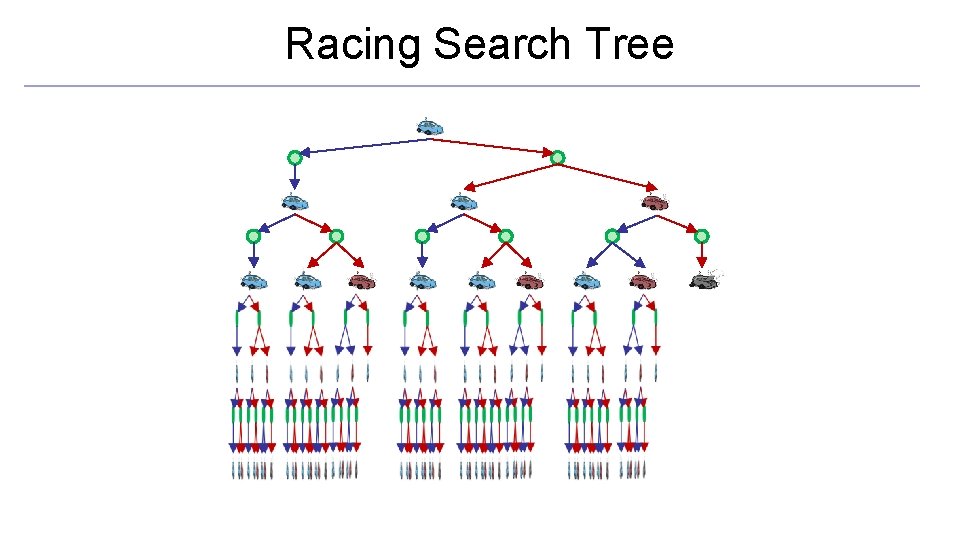
Racing Search Tree
Racing Search Tree
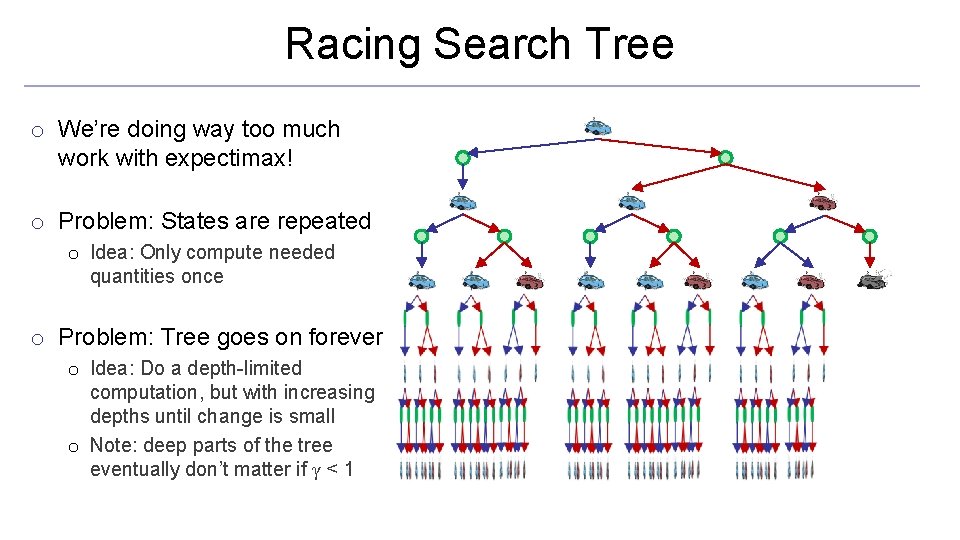
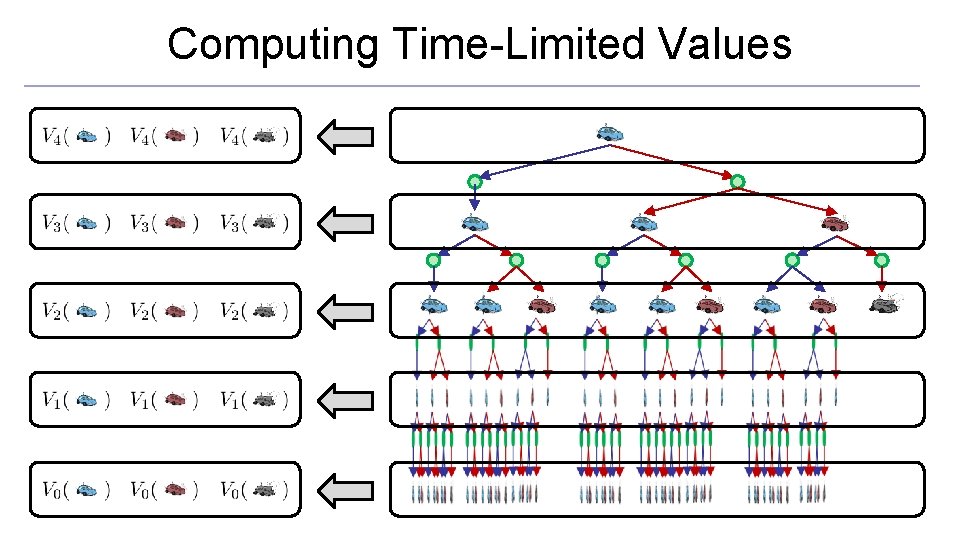
Racing Search Tree o We’re doing way too much work with expectimax! o Problem: States are repeated o Idea: Only compute needed quantities once o Problem: Tree goes on forever o Idea: Do a depth-limited computation, but with increasing depths until change is small o Note: deep parts of the tree eventually don’t matter if γ < 1
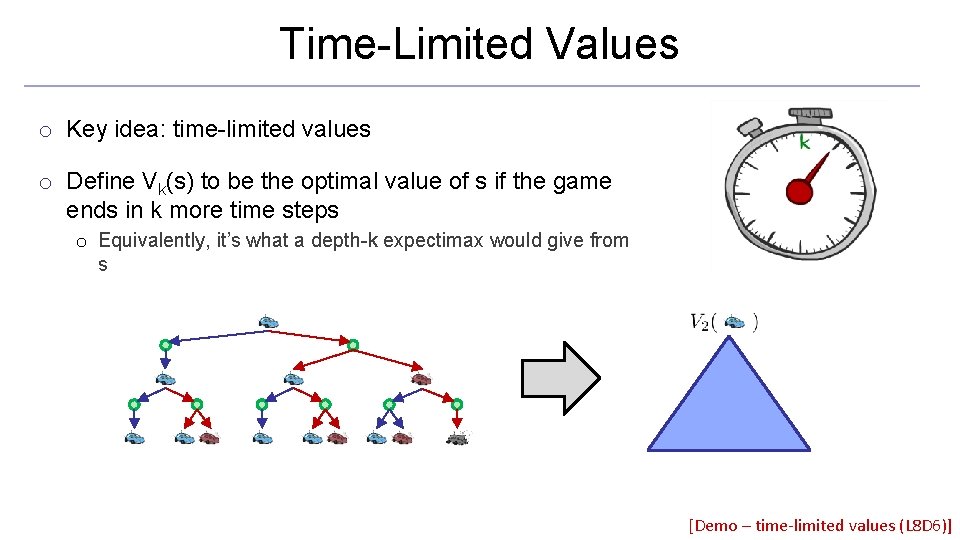
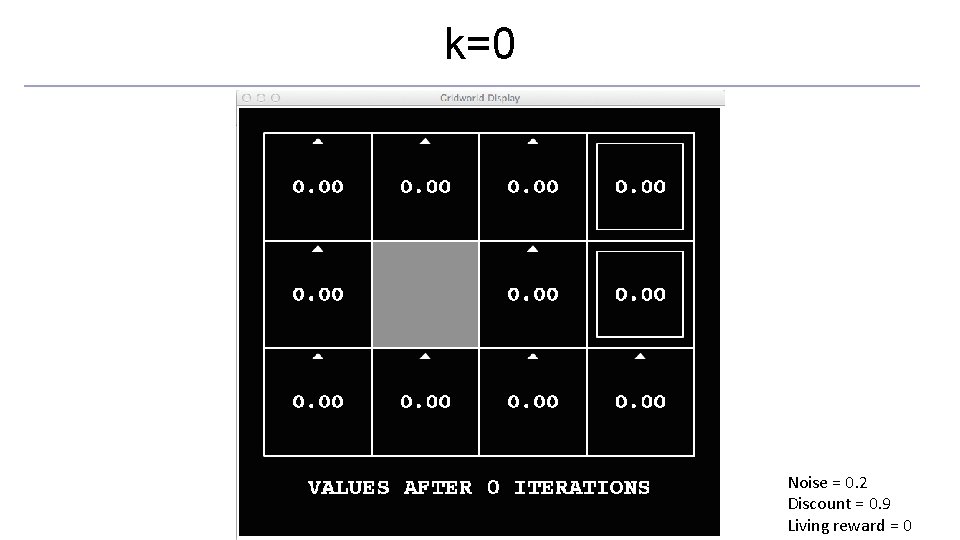
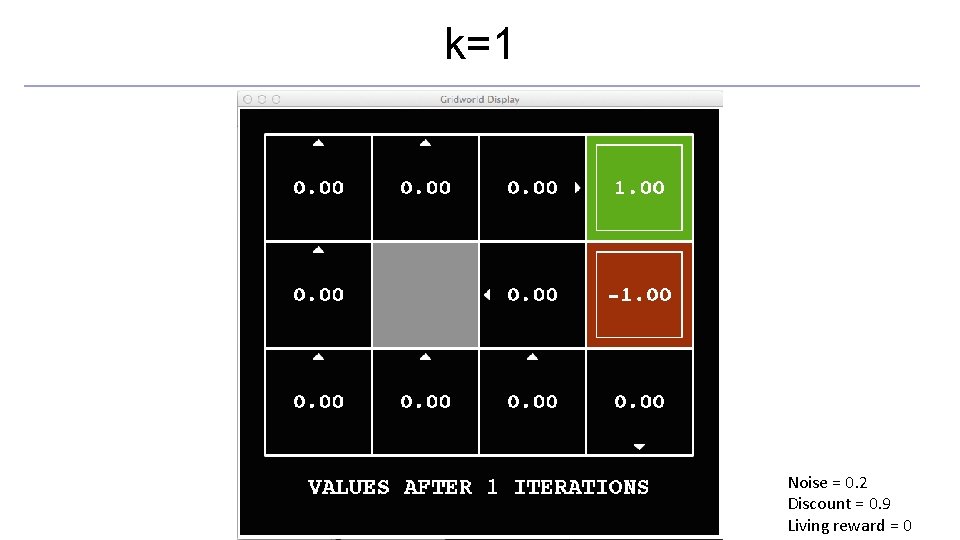
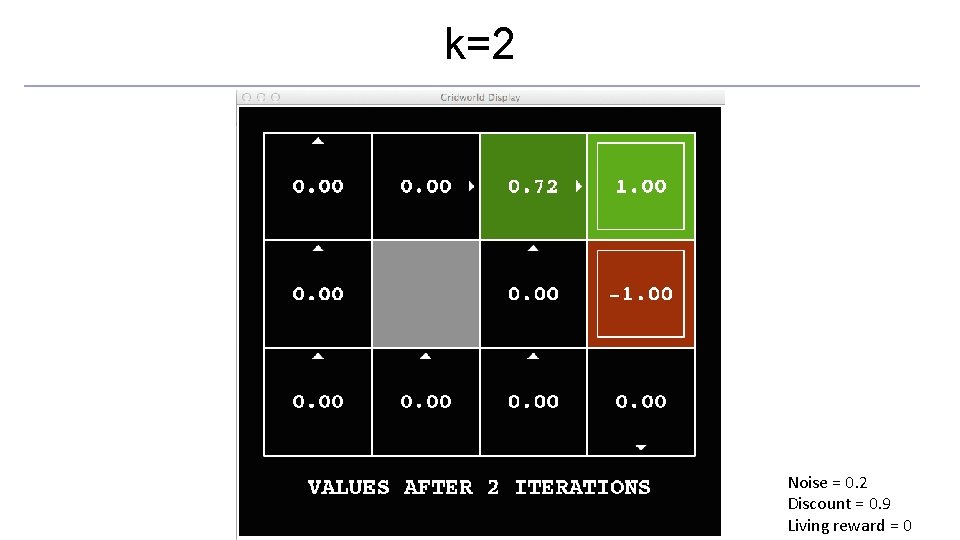
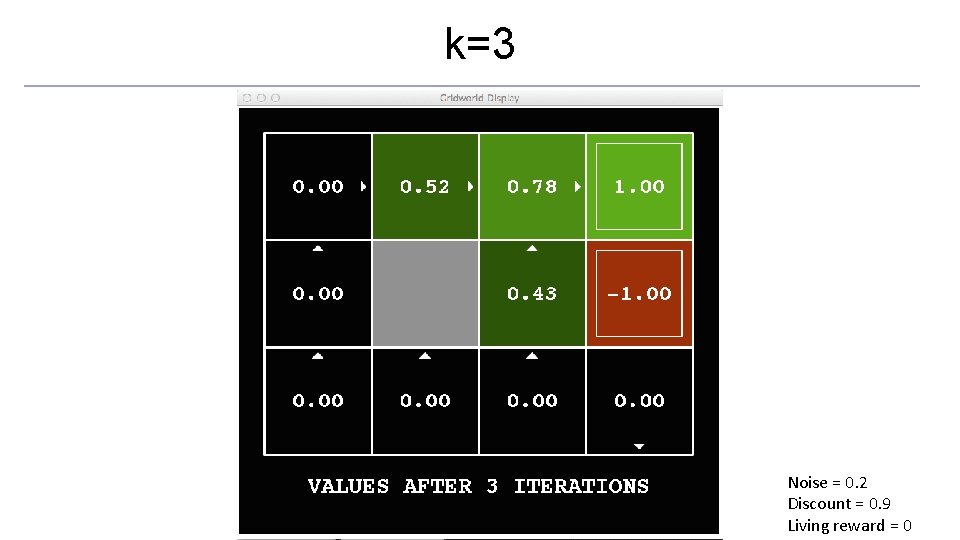
Time-Limited Values o Key idea: time-limited values o Define Vk(s) to be the optimal value of s if the game ends in k more time steps o Equivalently, it’s what a depth-k expectimax would give from s [Demo – time-limited values (L 8 D 6)]
k=0 Noise = 0. 2 Discount = 0. 9 Living reward = 0
k=1 Noise = 0. 2 Discount = 0. 9 Living reward = 0
k=2 Noise = 0. 2 Discount = 0. 9 Living reward = 0
k=3 Noise = 0. 2 Discount = 0. 9 Living reward = 0
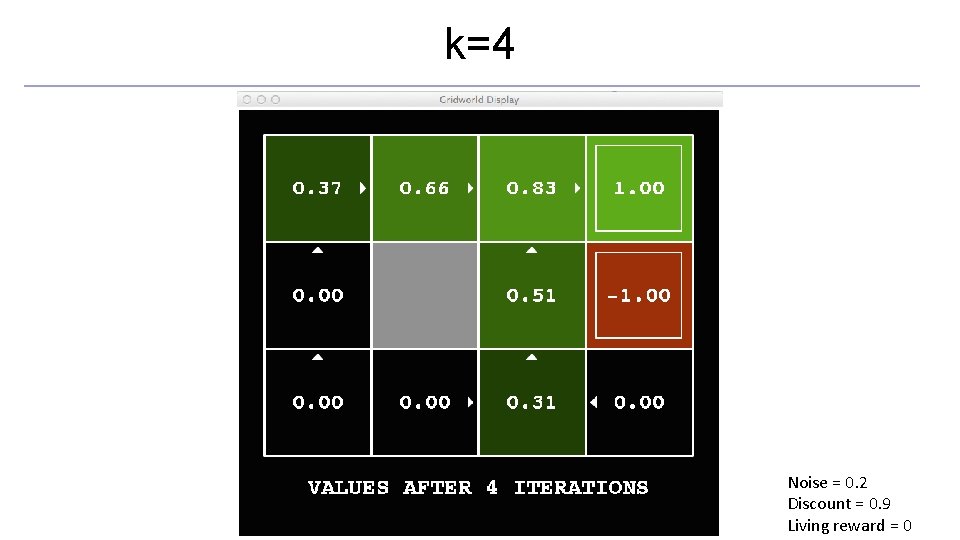
k=4 Noise = 0. 2 Discount = 0. 9 Living reward = 0
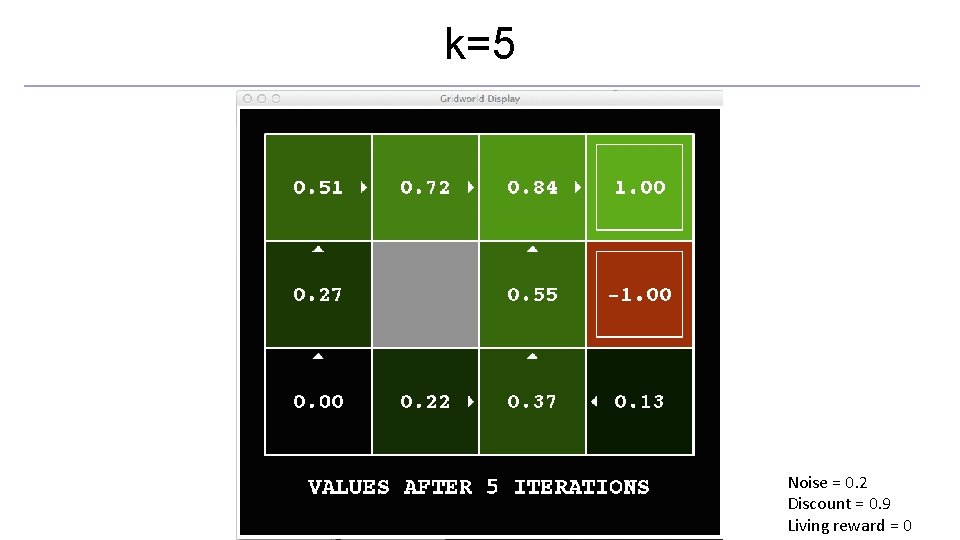
k=5 Noise = 0. 2 Discount = 0. 9 Living reward = 0
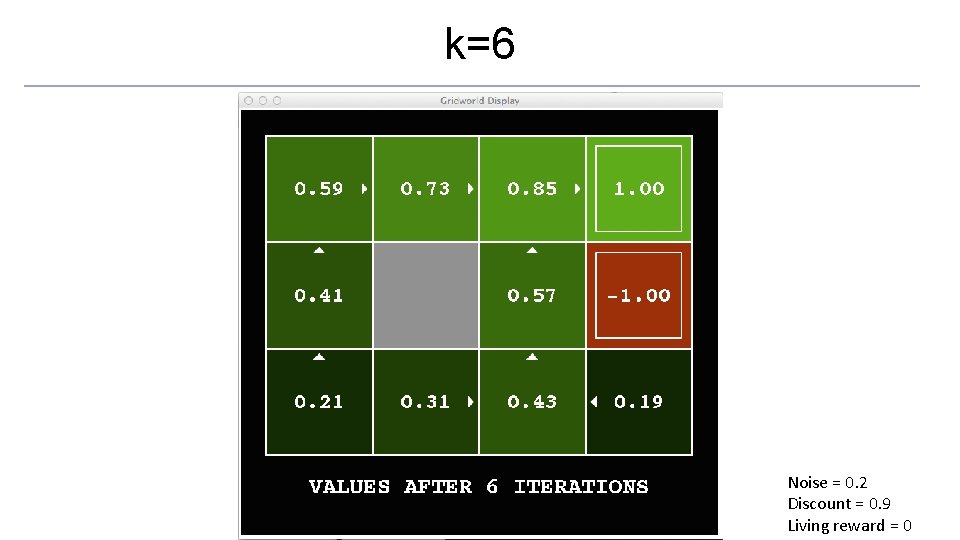
k=6 Noise = 0. 2 Discount = 0. 9 Living reward = 0
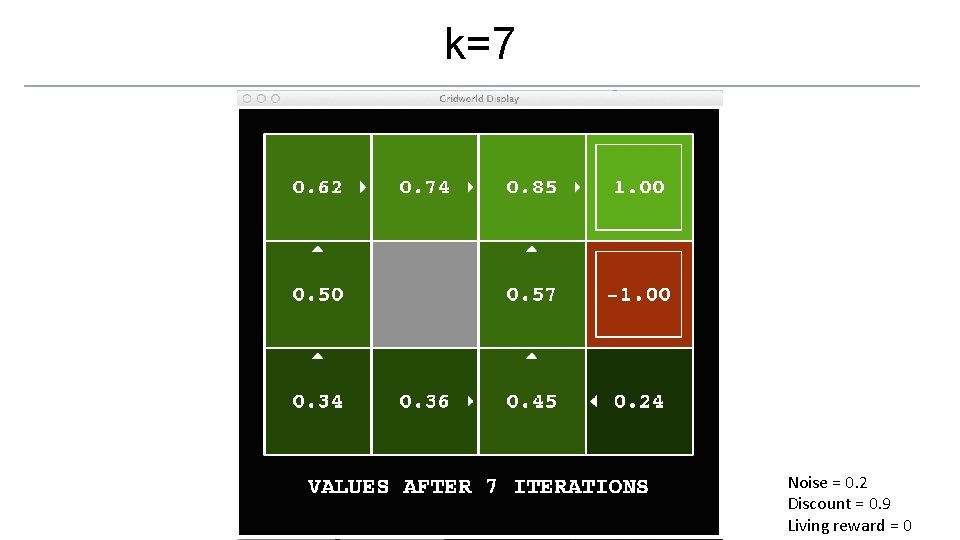
k=7 Noise = 0. 2 Discount = 0. 9 Living reward = 0
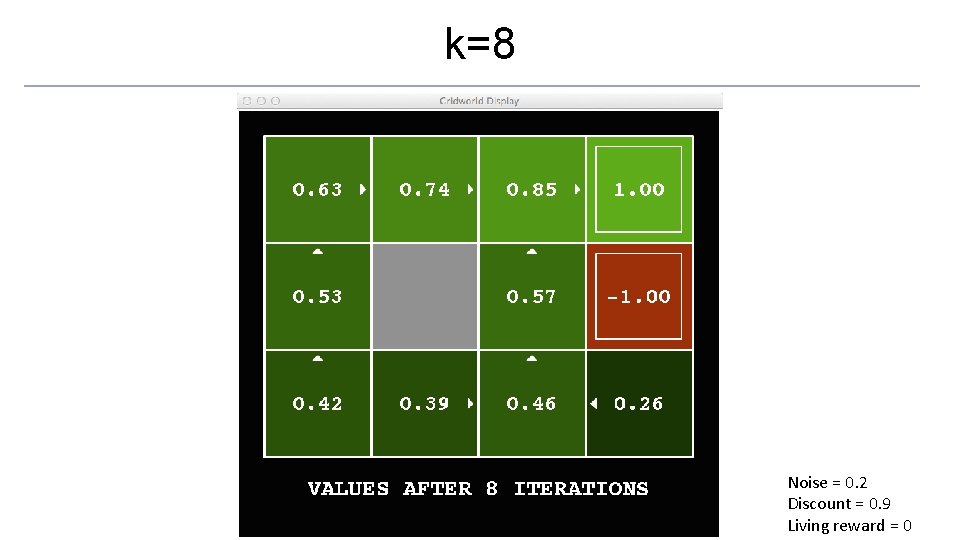
k=8 Noise = 0. 2 Discount = 0. 9 Living reward = 0
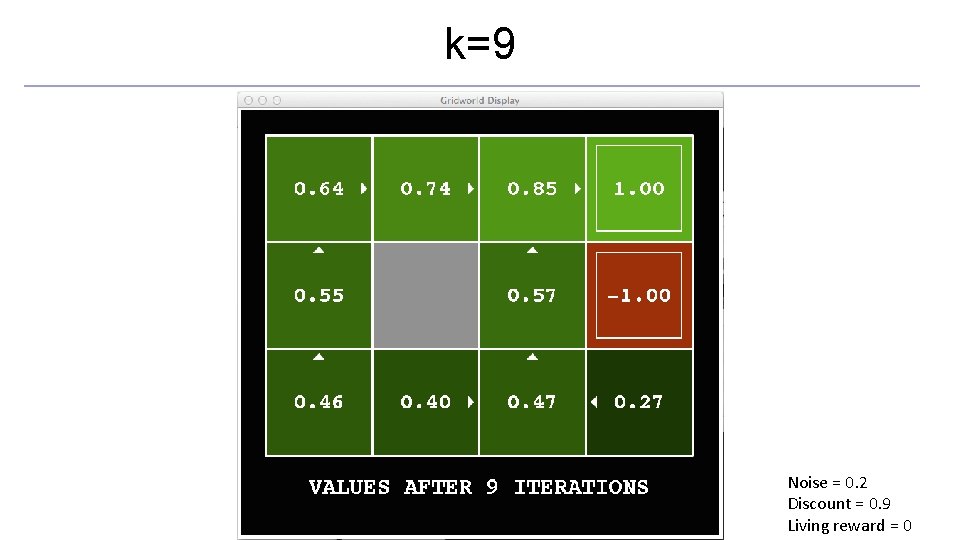
k=9 Noise = 0. 2 Discount = 0. 9 Living reward = 0
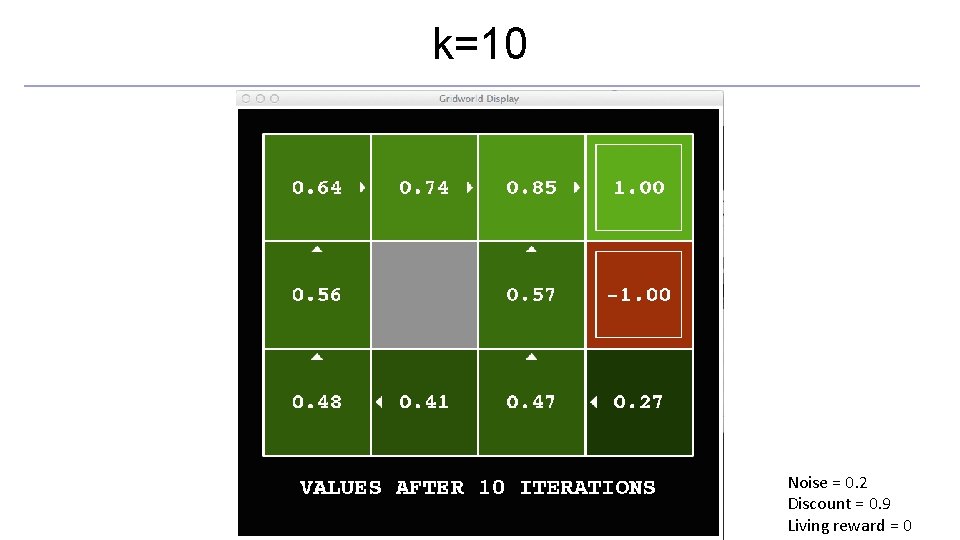
k=10 Noise = 0. 2 Discount = 0. 9 Living reward = 0
k=11 Noise = 0. 2 Discount = 0. 9 Living reward = 0
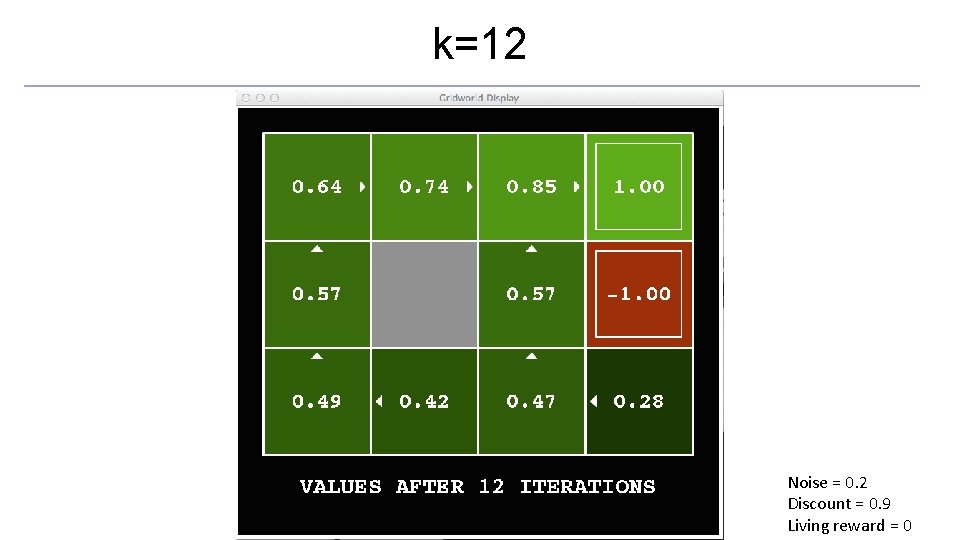
k=12 Noise = 0. 2 Discount = 0. 9 Living reward = 0
k=100 Noise = 0. 2 Discount = 0. 9 Living reward = 0
Computing Time-Limited Values
Value Iteration
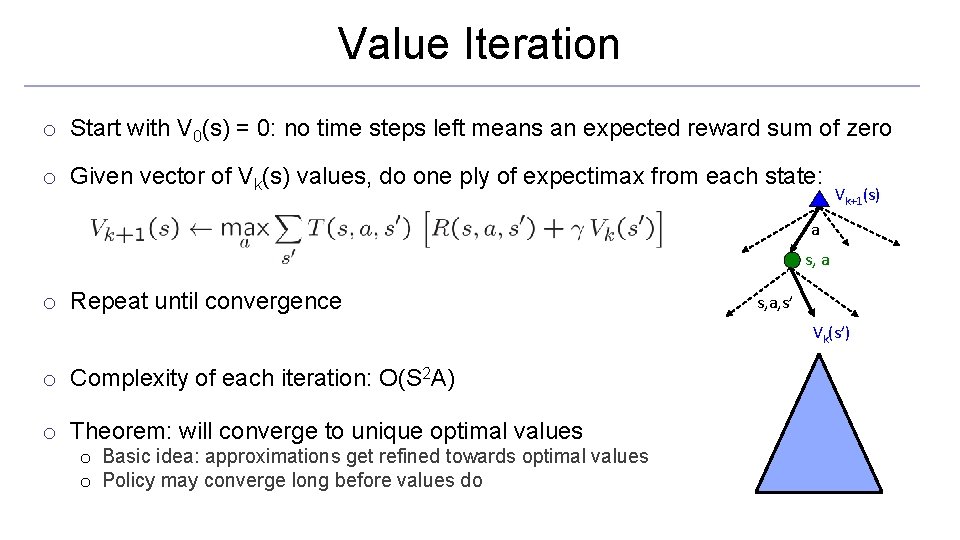
Value Iteration o Start with V 0(s) = 0: no time steps left means an expected reward sum of zero o Given vector of Vk(s) values, do one ply of expectimax from each state: Vk+1(s) a s, a o Repeat until convergence s, a, s’ Vk(s’) o Complexity of each iteration: O(S 2 A) o Theorem: will converge to unique optimal values o Basic idea: approximations get refined towards optimal values o Policy may converge long before values do
Example: Value Iteration 3. 5 2. 5 0 2 1 0 Assume no discount! 0 0 0
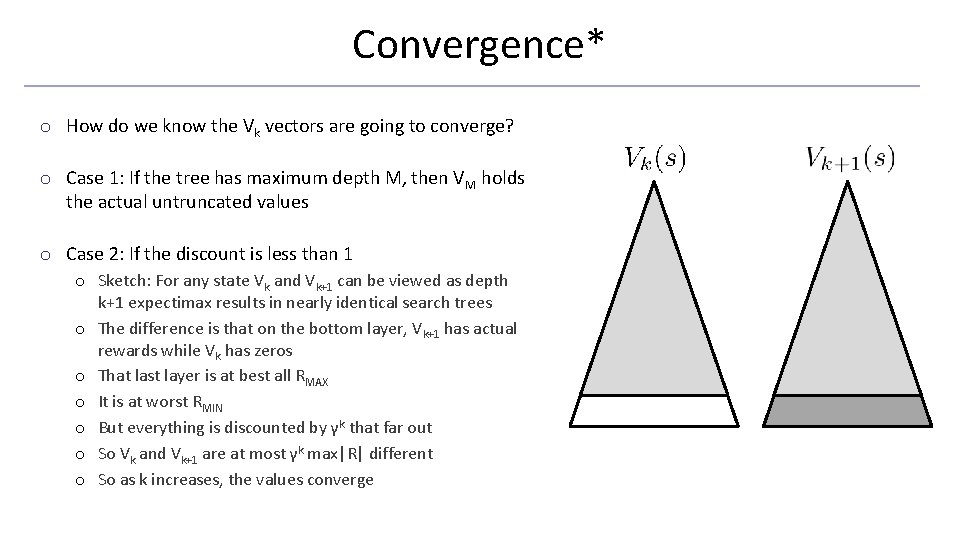
Convergence* o How do we know the Vk vectors are going to converge? o Case 1: If the tree has maximum depth M, then VM holds the actual untruncated values o Case 2: If the discount is less than 1 o Sketch: For any state Vk and Vk+1 can be viewed as depth k+1 expectimax results in nearly identical search trees o The difference is that on the bottom layer, Vk+1 has actual rewards while Vk has zeros o That last layer is at best all RMAX o It is at worst RMIN o But everything is discounted by γk that far out o So Vk and Vk+1 are at most γk max|R| different o So as k increases, the values converge
Next Time: Policy-Based Methods