
CS 4501 Introduction to Computer Vision Neural Networks






- Slides: 34
CS 4501: Introduction to Computer Vision Neural Networks + Backpropagation
Last Class • Softmax Classifier • Generalization / Overfitting • Pytorch
Today’s Class • Global Features • The perceptron model • Neural Networks – multilayer perceptron model (MLP) • Backpropagation
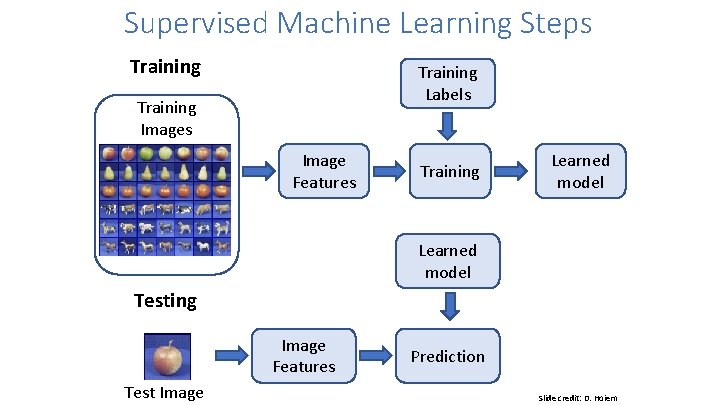
Supervised Machine Learning Steps Training Labels Training Images Image Features Training Learned model Testing Image Features Test Image Prediction Slide credit: D. Hoiem
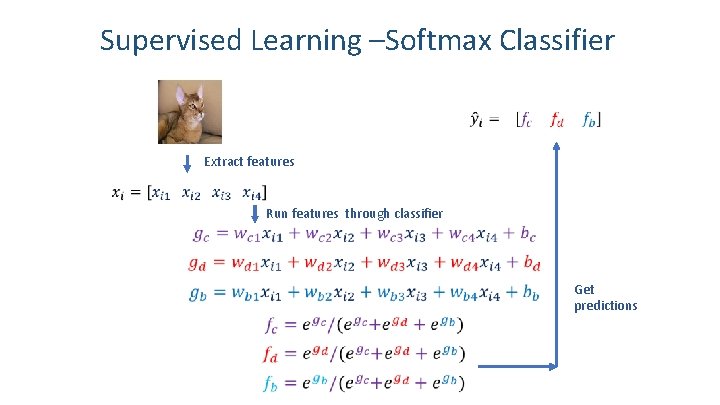
Supervised Learning –Softmax Classifier Extract features Run features through classifier Get predictions 5
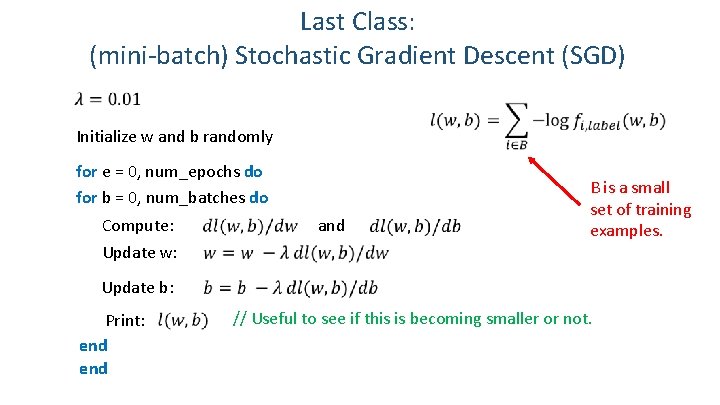
Last Class: (mini-batch) Stochastic Gradient Descent (SGD) Initialize w and b randomly for e = 0, num_epochs do for b = 0, num_batches do Compute: Update w: Update b: Print: end and B is a small set of training examples. // Useful to see if this is becoming smaller or not. 6
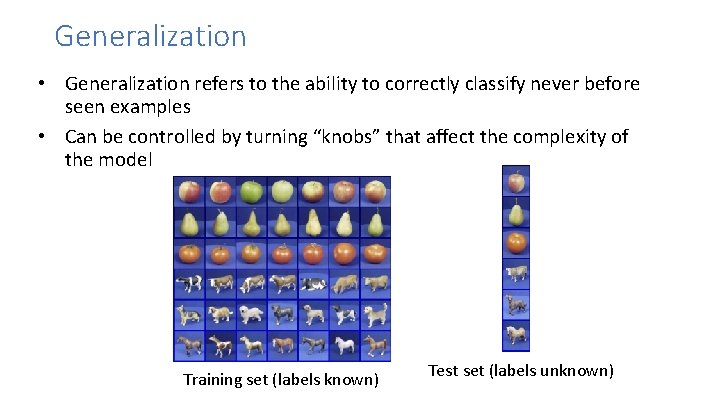
Generalization • Generalization refers to the ability to correctly classify never before seen examples • Can be controlled by turning “knobs” that affect the complexity of the model Training set (labels known) Test set (labels unknown)
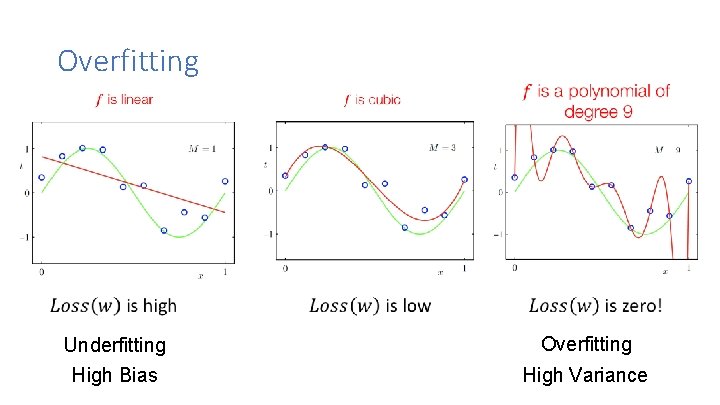
Overfitting Underfitting High Bias Overfitting High Variance
Pytorch: Project Assignment 4 • http: //vicenteordonez. com/vision/
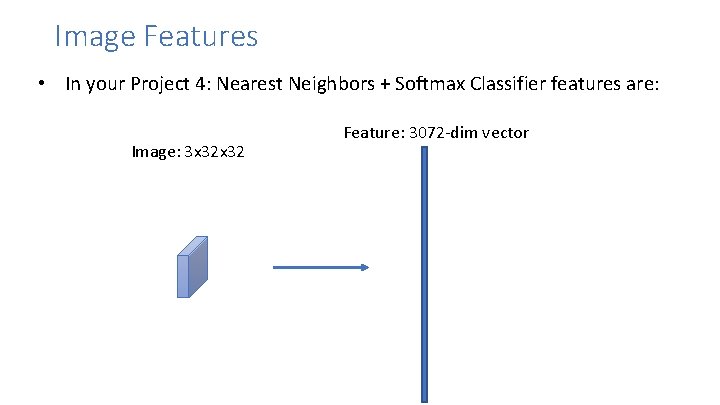
Image Features • In your Project 4: Nearest Neighbors + Softmax Classifier features are: Image: 3 x 32 Feature: 3072 -dim vector
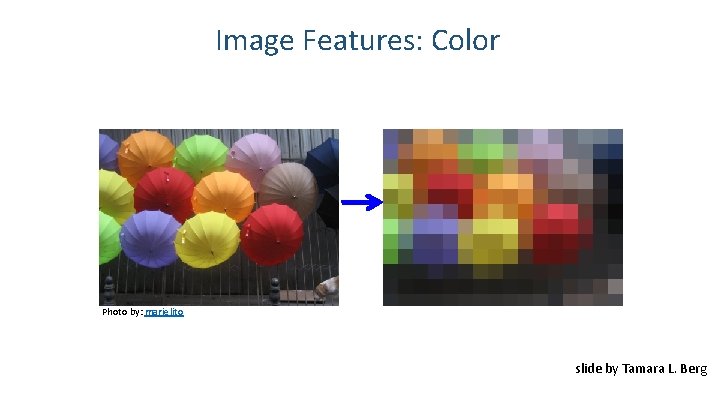
Image Features: Color Photo by: marielito slide by Tamara L. Berg
Image Features: Color
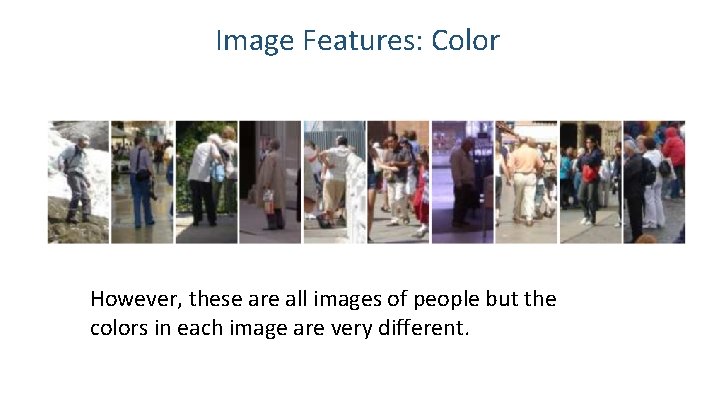
Image Features: Color However, these are all images of people but the colors in each image are very different.
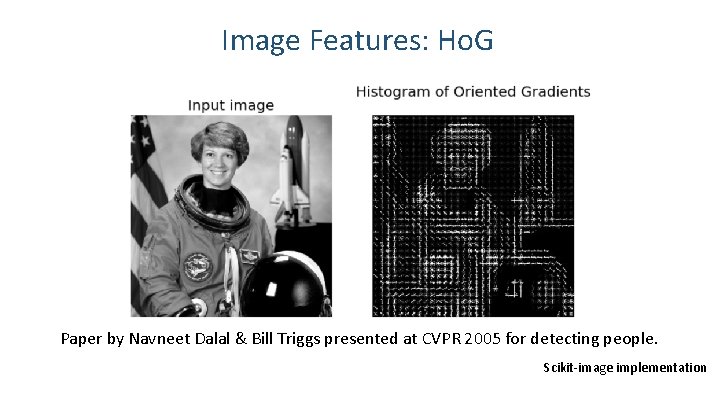
Image Features: Ho. G Paper by Navneet Dalal & Bill Triggs presented at CVPR 2005 for detecting people. Scikit-image implementation
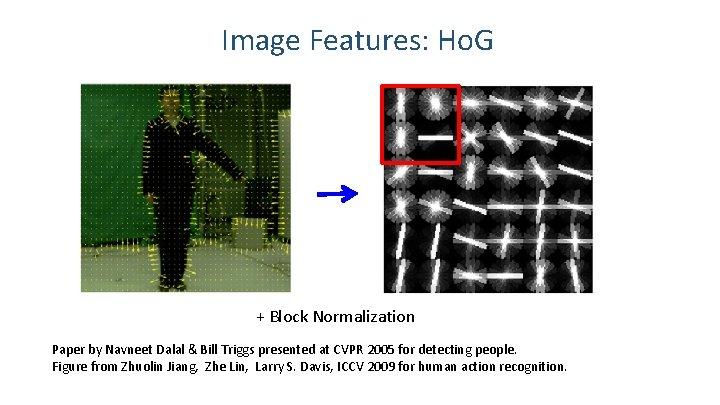
Image Features: Ho. G + Block Normalization Paper by Navneet Dalal & Bill Triggs presented at CVPR 2005 for detecting people. Figure from Zhuolin Jiang, Zhe Lin, Larry S. Davis, ICCV 2009 for human action recognition.
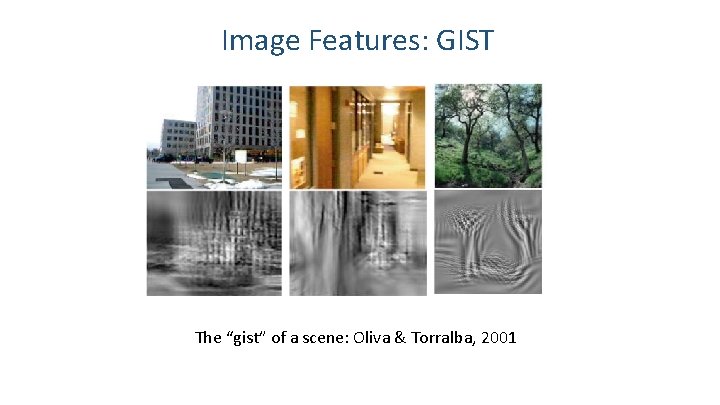
Image Features: GIST The “gist” of a scene: Oliva & Torralba, 2001
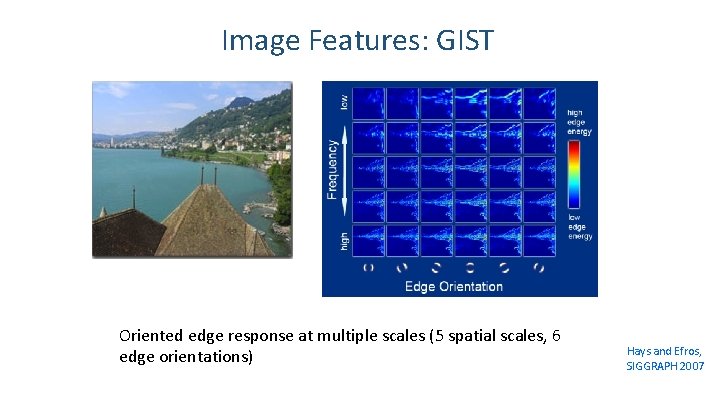
Image Features: GIST Oriented edge response at multiple scales (5 spatial scales, 6 edge orientations) Hays and Efros, SIGGRAPH 2007
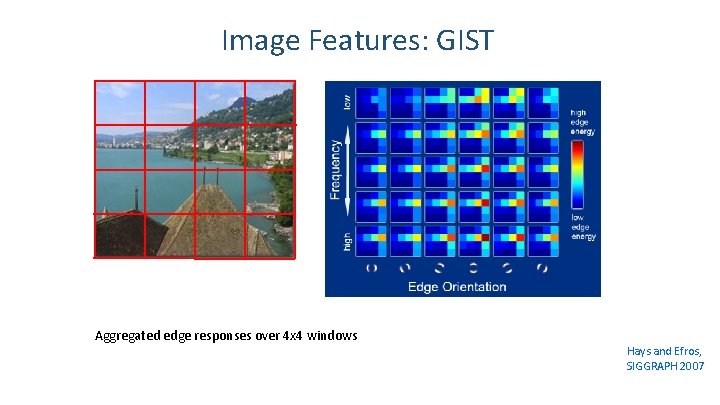
Image Features: GIST Aggregated edge responses over 4 x 4 windows Hays and Efros, SIGGRAPH 2007
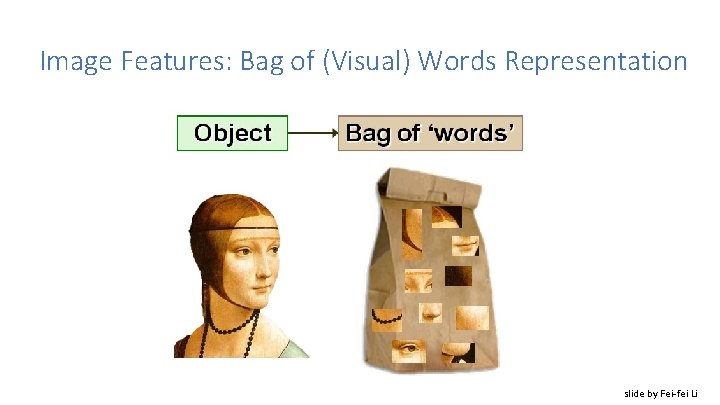
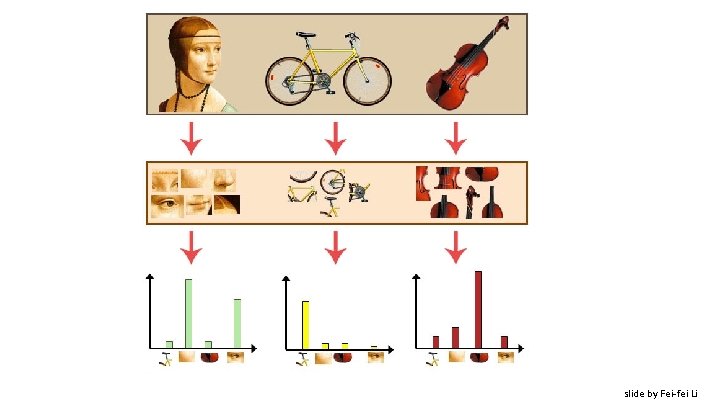
Image Features: Bag of (Visual) Words Representation slide by Fei-fei Li
slide by Fei-fei Li
Summary: Image Features • Largely replaced by Neural networks • Still useful to study for inspiration in designing neural networks that compute features. • Many other features proposed • LBP: Local Binary Patterns: Useful for recognizing faces. • Dense SIFT: SIFT features computed on a grid similar to the HOG features. • etc.
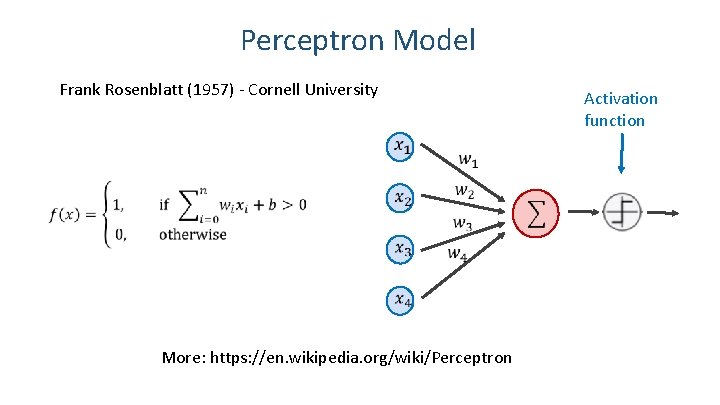
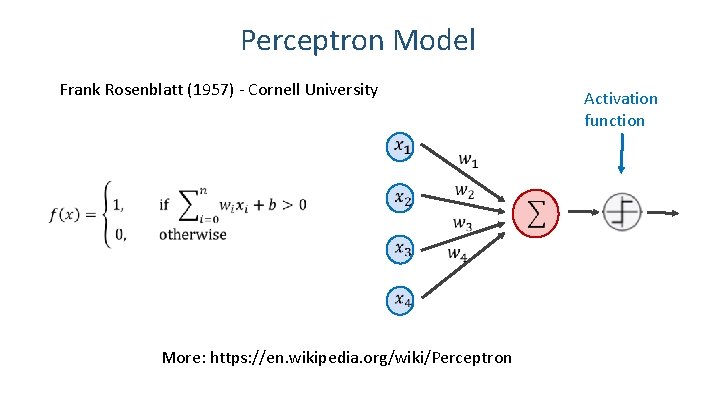
Perceptron Model Frank Rosenblatt (1957) - Cornell University Activation function More: https: //en. wikipedia. org/wiki/Perceptron
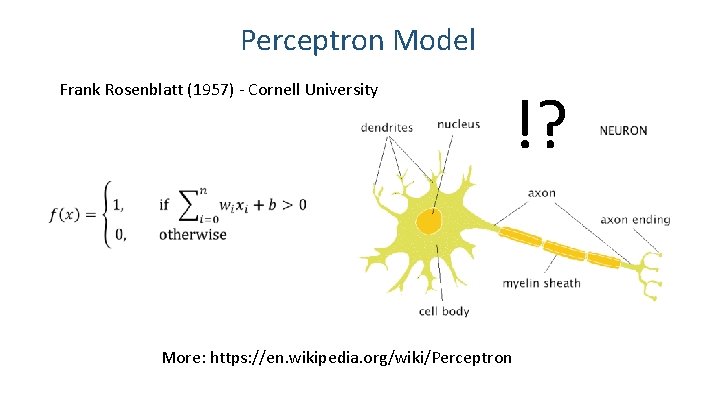
Perceptron Model Frank Rosenblatt (1957) - Cornell University !? More: https: //en. wikipedia. org/wiki/Perceptron
Perceptron Model Frank Rosenblatt (1957) - Cornell University Activation function More: https: //en. wikipedia. org/wiki/Perceptron
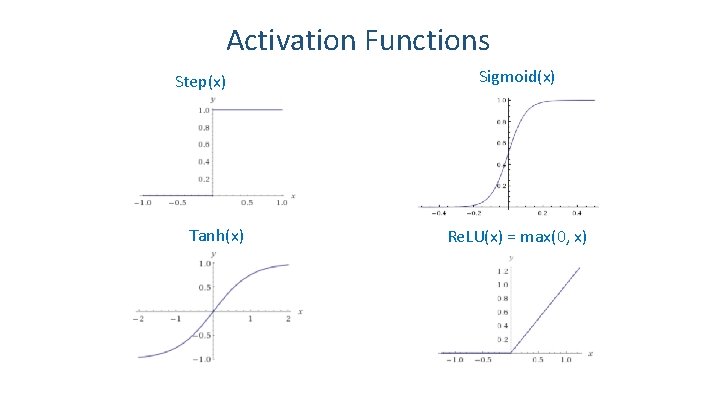
Activation Functions Step(x) Tanh(x) Sigmoid(x) Re. LU(x) = max(0, x)
Pytorch - Perceptron
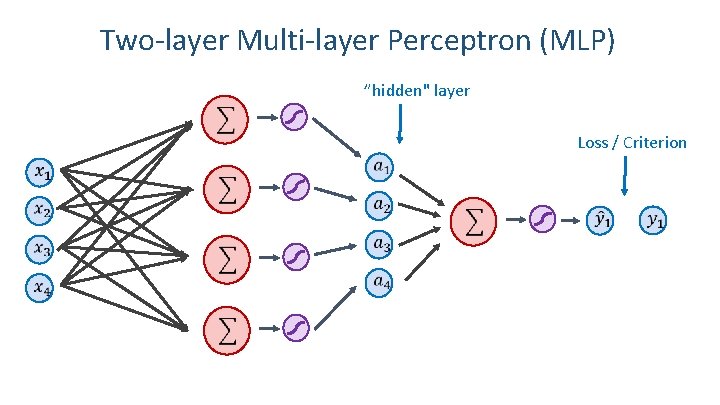
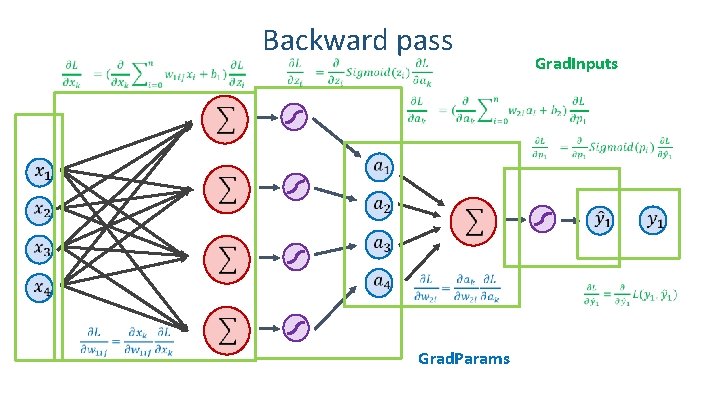
Two-layer Multi-layer Perceptron (MLP) ”hidden" layer Loss / Criterion
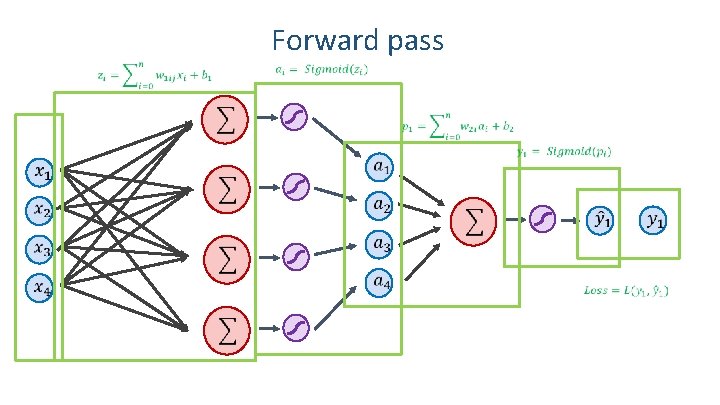
Forward pass
Backward pass Grad. Inputs Grad. Params
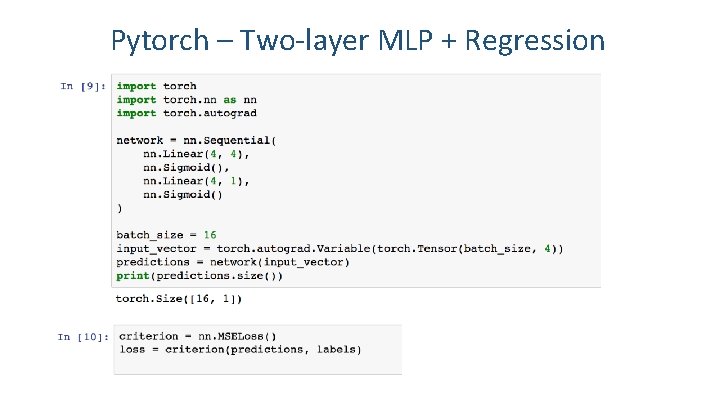
Pytorch – Two-layer MLP + Regression
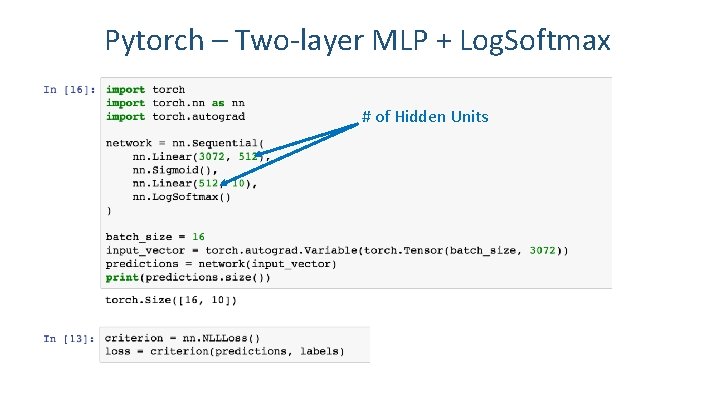
Pytorch – Two-layer MLP + Log. Softmax # of Hidden Units
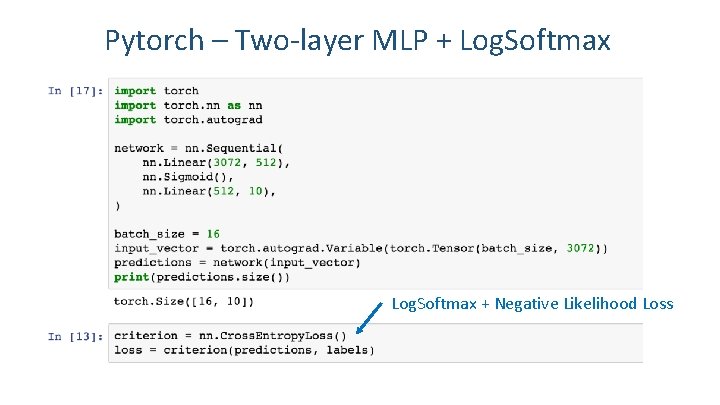
Pytorch – Two-layer MLP + Log. Softmax + Negative Likelihood Loss
Bookmark Opportunity!
Questions? 34