
CS 444544 OS II Lab Tutorial 8 CopyonWrite
CS 444/544 OS II Lab Tutorial #8 Copy-on-Write Fork, Preemptive Multitasking, and Inter-process Communication (Lab 4 – Part B & C) 1
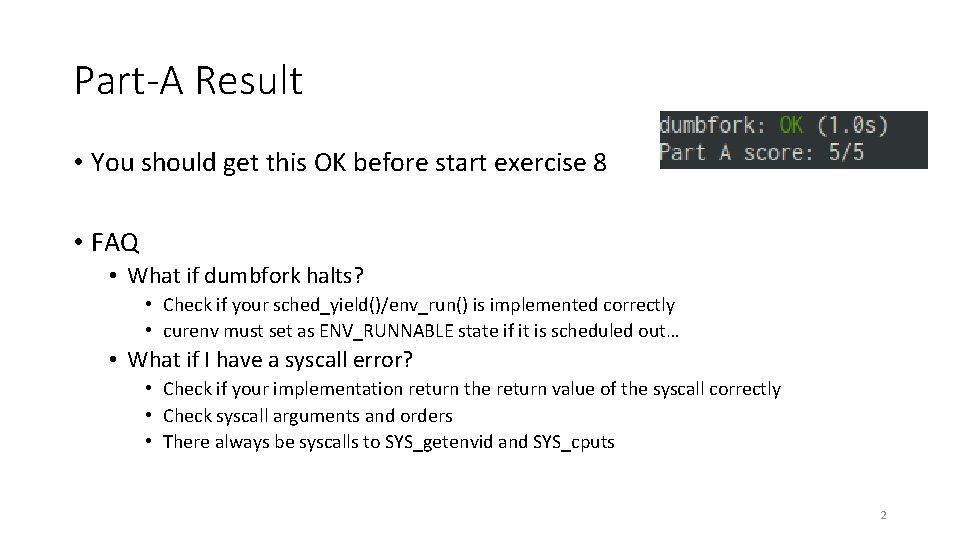
Part-A Result • You should get this OK before start exercise 8 • FAQ • What if dumbfork halts? • Check if your sched_yield()/env_run() is implemented correctly • curenv must set as ENV_RUNNABLE state if it is scheduled out… • What if I have a syscall error? • Check if your implementation return the return value of the syscall correctly • Check syscall arguments and orders • There always be syscalls to SYS_getenvid and SYS_cputs 2
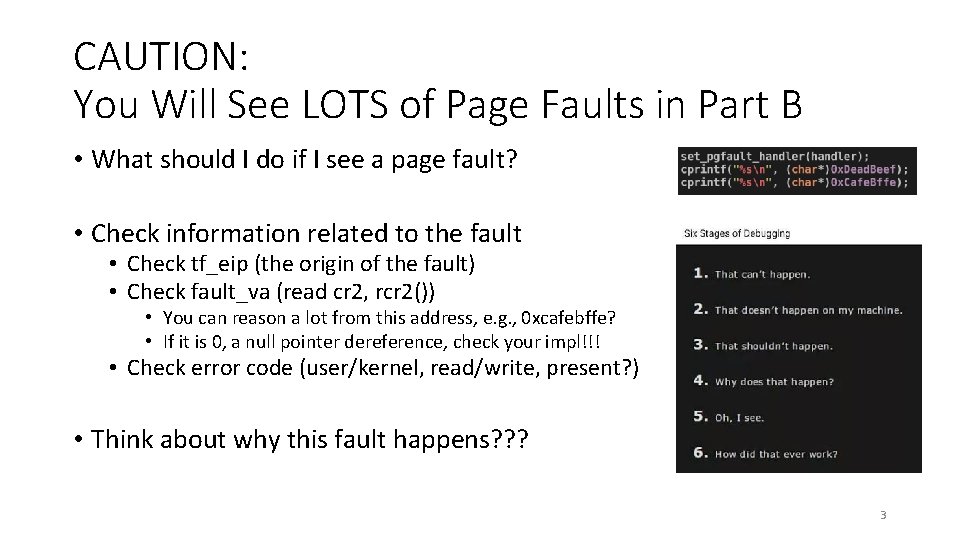
CAUTION: You Will See LOTS of Page Faults in Part B • What should I do if I see a page fault? • Check information related to the fault • Check tf_eip (the origin of the fault) • Check fault_va (read cr 2, rcr 2()) • You can reason a lot from this address, e. g. , 0 xcafebffe? • If it is 0, a null pointer dereference, check your impl!!! • Check error code (user/kernel, read/write, present? ) • Think about why this fault happens? ? ? 3
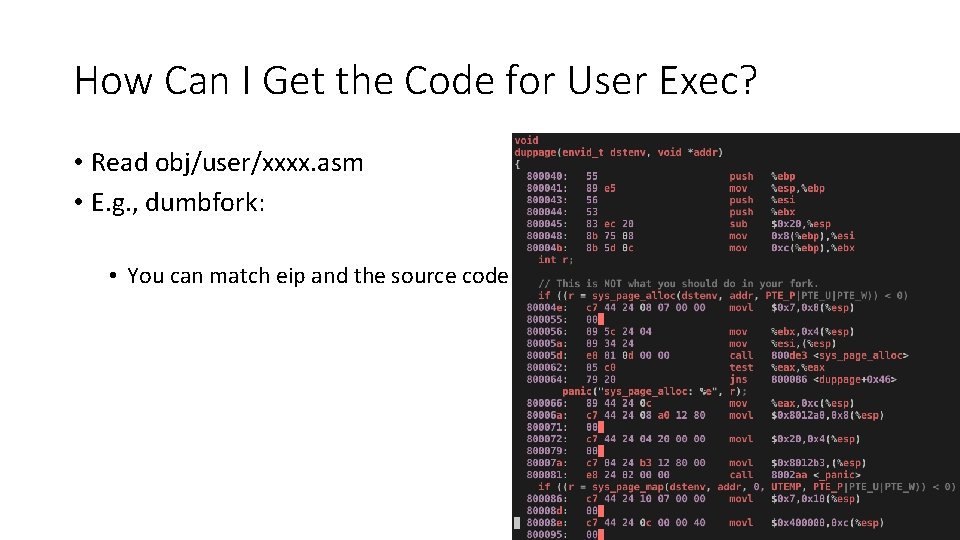
How Can I Get the Code for User Exec? • Read obj/user/xxxx. asm • E. g. , dumbfork: • You can match eip and the source code 4
Part B: Copy-on-Write Fork • We will implement an efficient, copy-on-write fork • Purely in user-level with user-level page fault handler • Will use syscalls that we implemented in Exercise 7 • sys_exofork, sys_env_set_status, sys_page_alloc, sys_page_map, sys_page_unmap • DO NOT implement lib/fork. c the same as user/dumbfork. c • Dumbfork does not do Copy-on-write • fork() should not copy any of memory page • It only copies VA-to-PA mappings (page table entries) 5
Part B: Copy-on-Write Fork • We will implement • User-level exception handling (page fault handler) (Exercise 8— 11) • Copy-on-write fork() (Exercise 12) 6
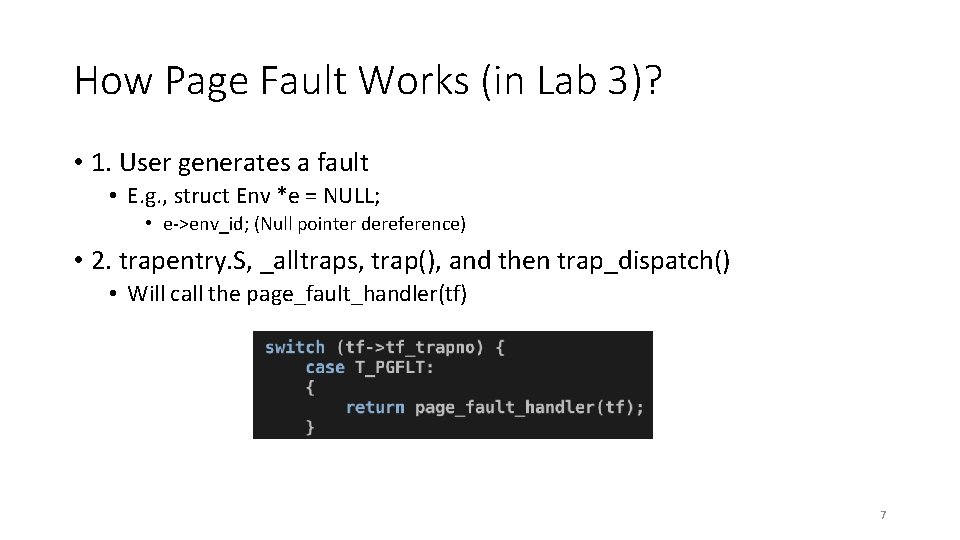
How Page Fault Works (in Lab 3)? • 1. User generates a fault • E. g. , struct Env *e = NULL; • e->env_id; (Null pointer dereference) • 2. trapentry. S, _alltraps, trap(), and then trap_dispatch() • Will call the page_fault_handler(tf) 7
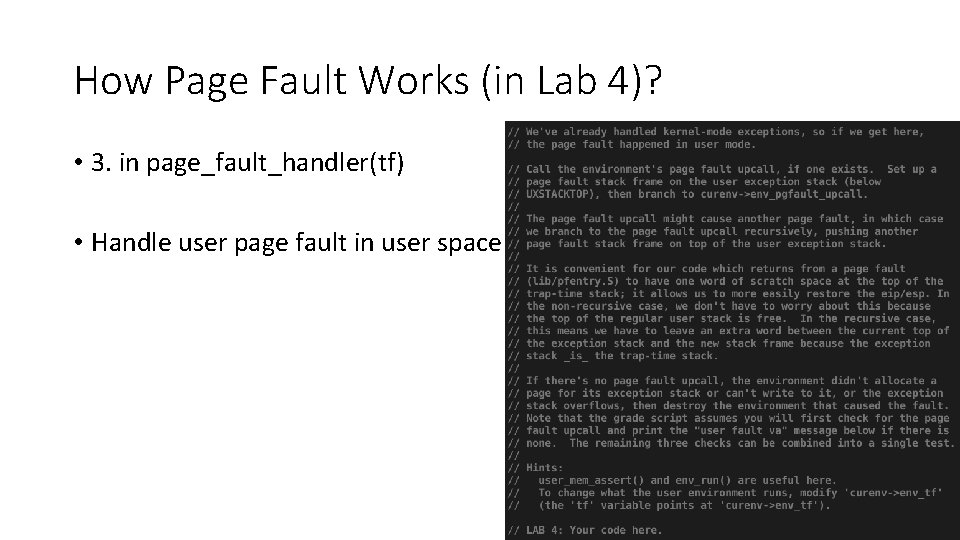
How Page Fault Works (in Lab 4)? • 3. in page_fault_handler(tf) • Handle user page fault in user space 8
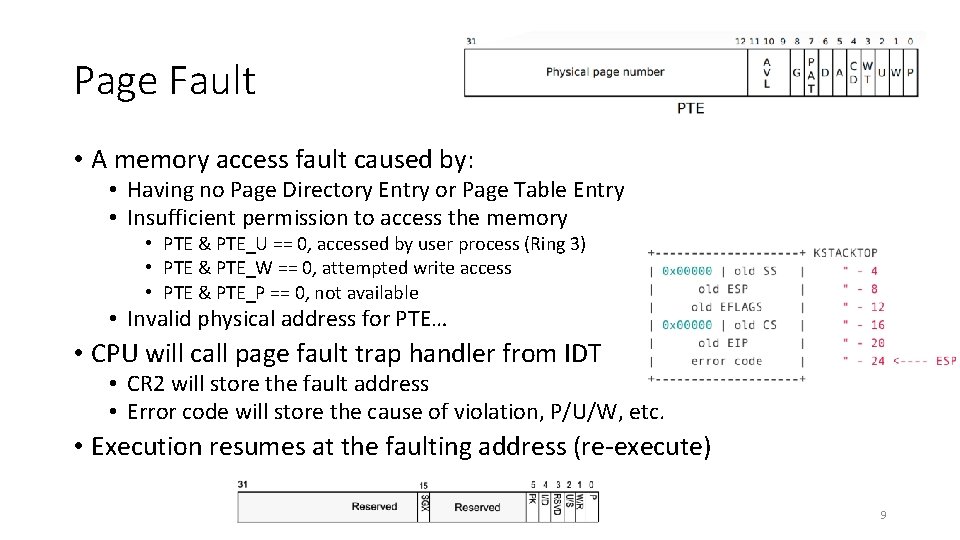
Page Fault • A memory access fault caused by: • Having no Page Directory Entry or Page Table Entry • Insufficient permission to access the memory • PTE & PTE_U == 0, accessed by user process (Ring 3) • PTE & PTE_W == 0, attempted write access • PTE & PTE_P == 0, not available • Invalid physical address for PTE… • CPU will call page fault trap handler from IDT • CR 2 will store the fault address • Error code will store the cause of violation, P/U/W, etc. • Execution resumes at the faulting address (re-execute) 9
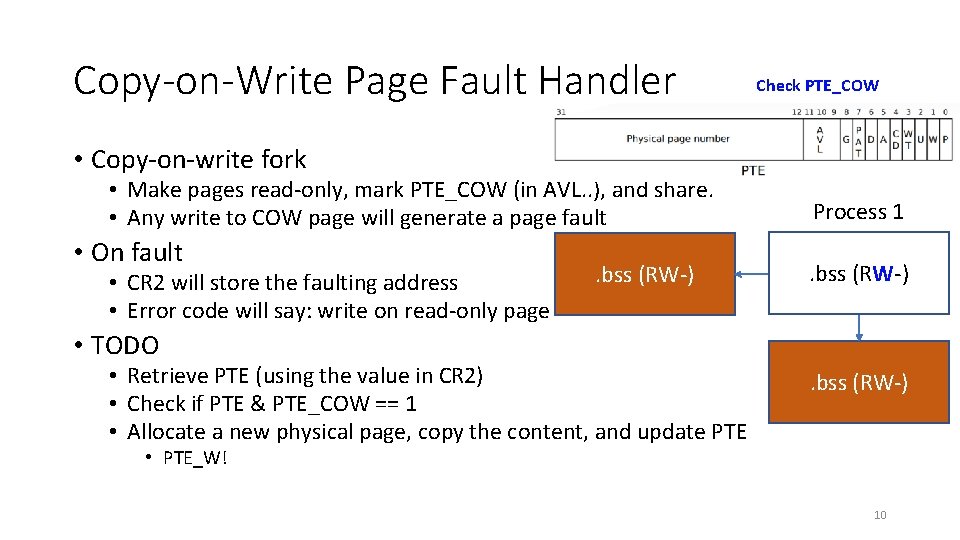
Copy-on-Write Page Fault Handler Check PTE_COW • Copy-on-write fork • Make pages read-only, mark PTE_COW (in AVL. . ), and share. • Any write to COW page will generate a page fault • On fault • CR 2 will store the faulting address • Error code will say: write on read-only page . bss (RW-) Process 1. bss(RW-) (R--) • TODO • Retrieve PTE (using the value in CR 2) • Check if PTE & PTE_COW == 1 • Allocate a new physical page, copy the content, and update PTE . bss (RW-) • PTE_W! 10
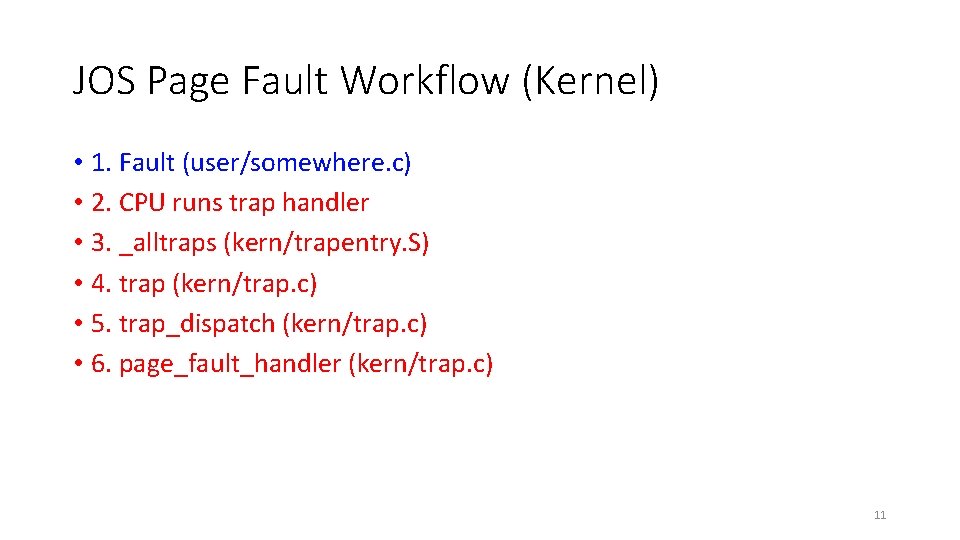
JOS Page Fault Workflow (Kernel) • 1. Fault (user/somewhere. c) • 2. CPU runs trap handler • 3. _alltraps (kern/trapentry. S) • 4. trap (kern/trap. c) • 5. trap_dispatch (kern/trap. c) • 6. page_fault_handler (kern/trap. c) 11
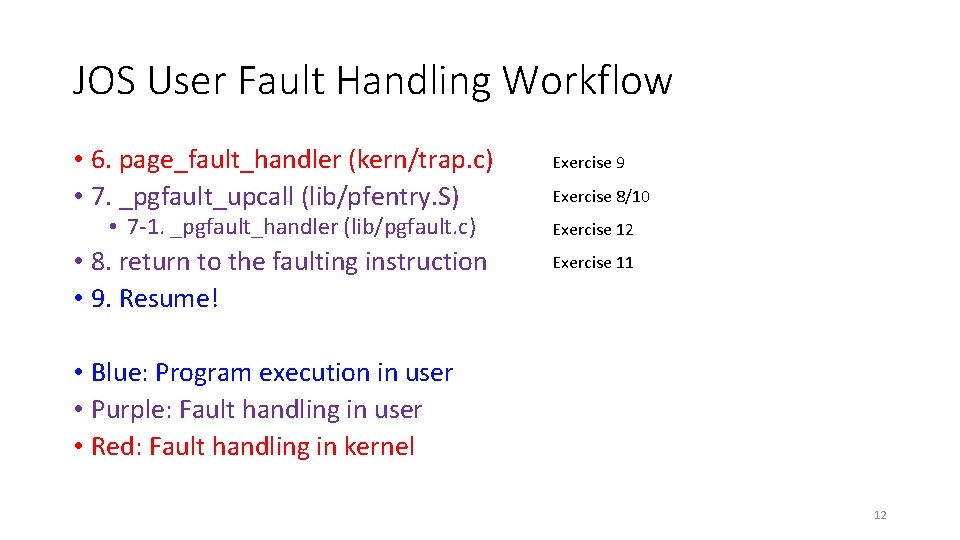
JOS User Fault Handling Workflow • 6. page_fault_handler (kern/trap. c) • 7. _pgfault_upcall (lib/pfentry. S) • 7 -1. _pgfault_handler (lib/pgfault. c) • 8. return to the faulting instruction • 9. Resume! Exercise 9 Exercise 8/10 Exercise 12 Exercise 11 • Blue: Program execution in user • Purple: Fault handling in user • Red: Fault handling in kernel 12
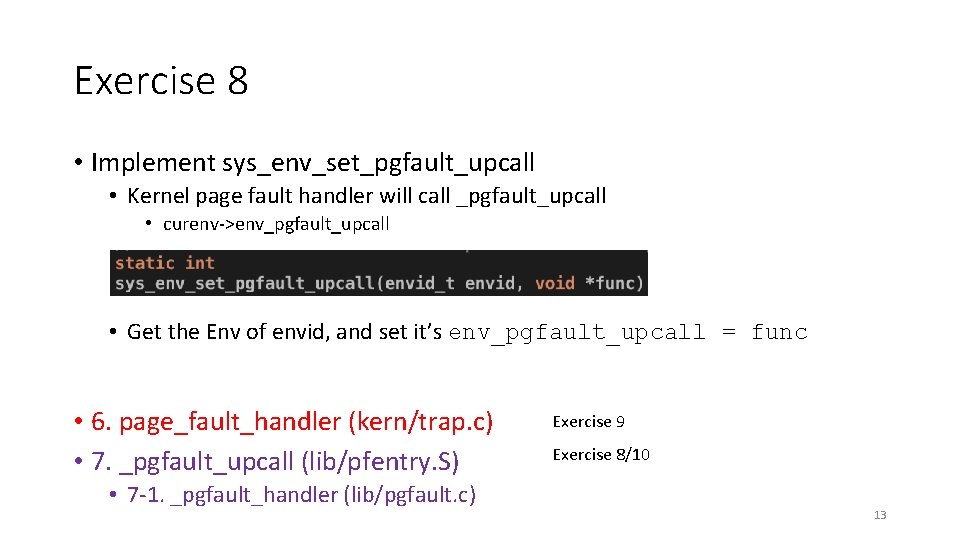
Exercise 8 • Implement sys_env_set_pgfault_upcall • Kernel page fault handler will call _pgfault_upcall • curenv->env_pgfault_upcall • Get the Env of envid, and set it’s env_pgfault_upcall = func • 6. page_fault_handler (kern/trap. c) • 7. _pgfault_upcall (lib/pfentry. S) • 7 -1. _pgfault_handler (lib/pgfault. c) Exercise 9 Exercise 8/10 13
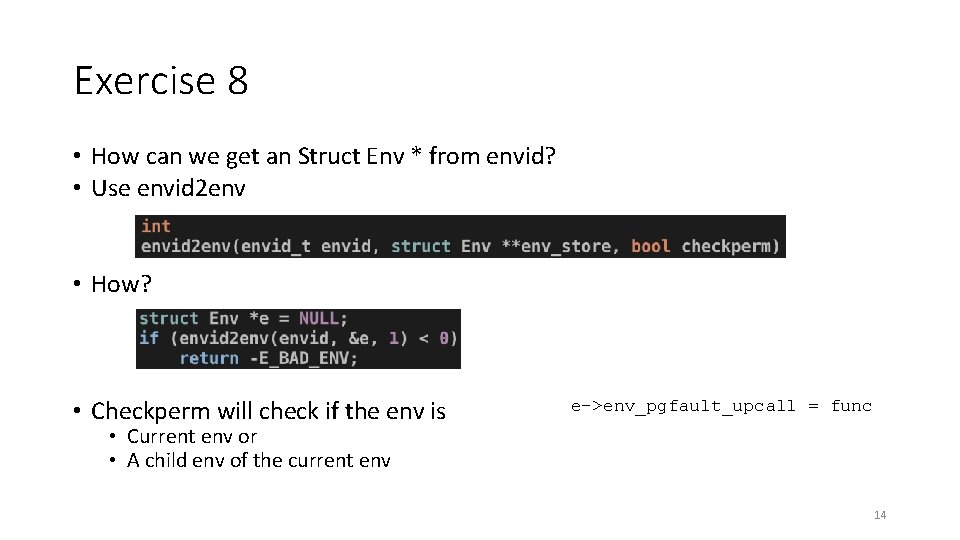
Exercise 8 • How can we get an Struct Env * from envid? • Use envid 2 env • How? • Checkperm will check if the env is e->env_pgfault_upcall = func • Current env or • A child env of the current env 14
Exercise 9: page_fault_handler (kern/trap. c) • What should it do? • Execute curenv->env_pgfault_upcall (set by user via syscall) • 6. page_fault_handler (kern/trap. c) • 7. _pgfault_upcall (lib/pfentry. S) • tf->tf_eip = (uintptr_t) curenv->env_pgfault_upcall; • Requirement? • Let env_pgfault_upcall returns to the faulting instruction • Restore all CPU context after handing the fault • 7. _pgfault_upcall (lib/pfentry. S) • 7 -1. _pgfault_handler (lib/pgfault. c) • 8. return to the faulting instruction • 9. Resume! 15
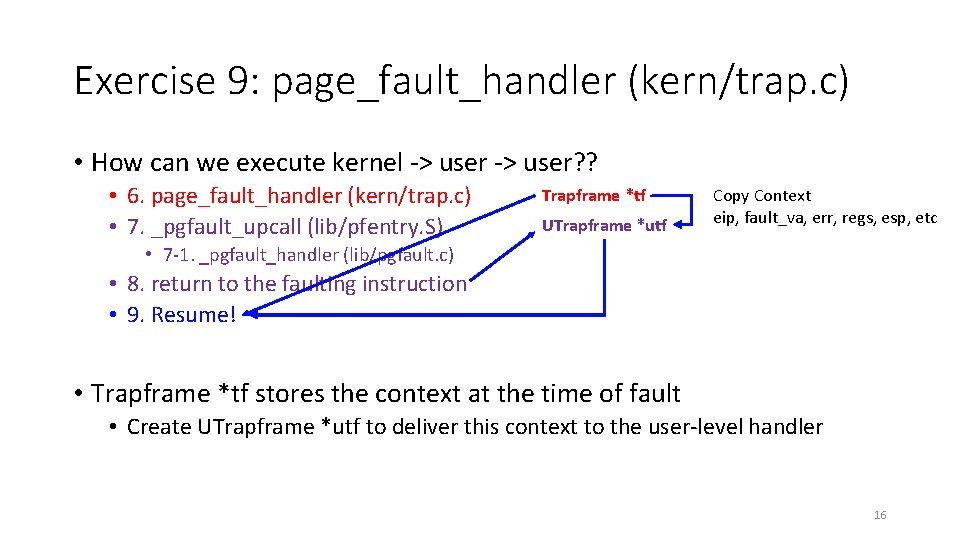
Exercise 9: page_fault_handler (kern/trap. c) • How can we execute kernel -> user? ? • 6. page_fault_handler (kern/trap. c) • 7. _pgfault_upcall (lib/pfentry. S) Trapframe *tf UTrapframe *utf Copy Context eip, fault_va, err, regs, esp, etc • 7 -1. _pgfault_handler (lib/pgfault. c) • 8. return to the faulting instruction • 9. Resume! • Trapframe *tf stores the context at the time of fault • Create UTrapframe *utf to deliver this context to the user-level handler 16
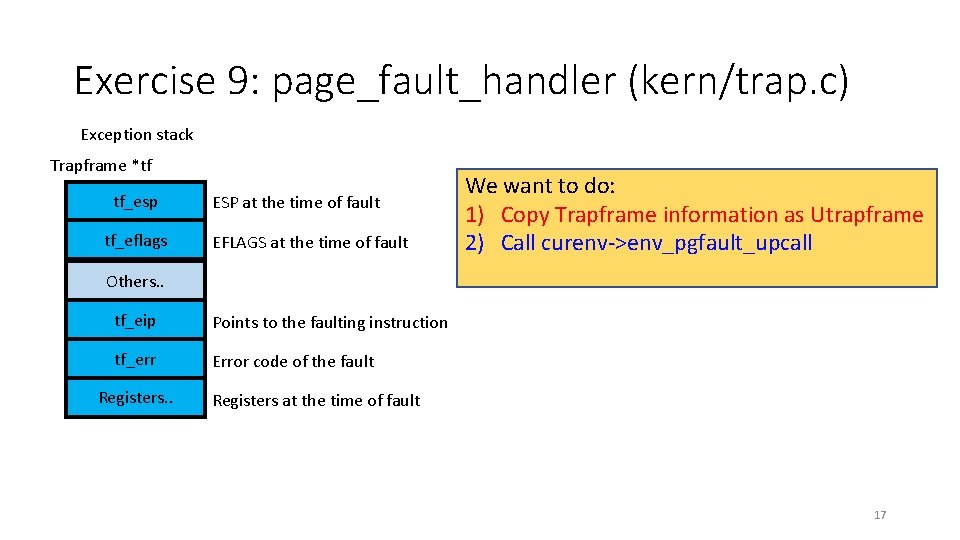
Exercise 9: page_fault_handler (kern/trap. c) Exception stack Trapframe *tf tf_esp tf_eflags ESP at the time of fault EFLAGS at the time of fault We want to do: 1) Copy Trapframe information as Utrapframe 2) Call curenv->env_pgfault_upcall Others. . tf_eip Points to the faulting instruction tf_err Error code of the fault Registers. . Registers at the time of fault 17
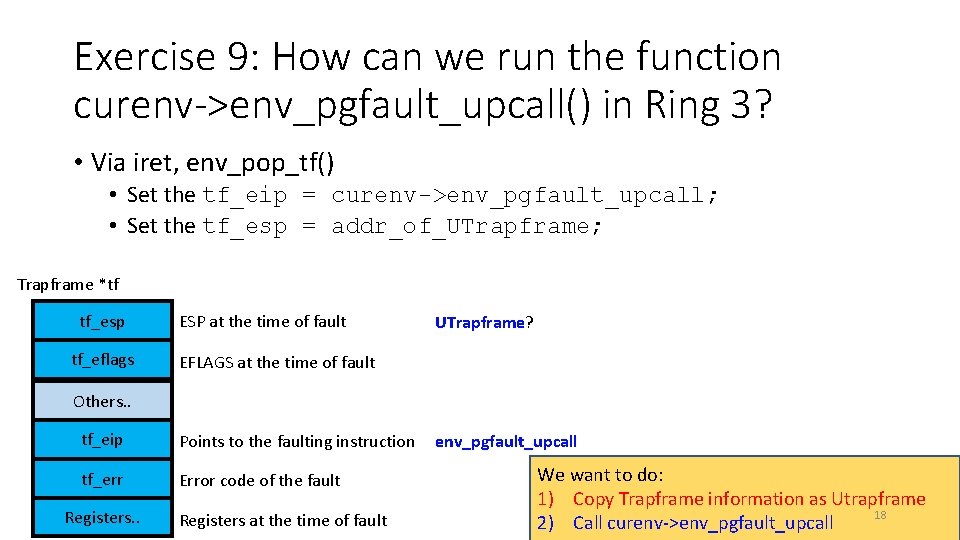
Exercise 9: How can we run the function curenv->env_pgfault_upcall() in Ring 3? • Via iret, env_pop_tf() • Set the tf_eip = curenv->env_pgfault_upcall; • Set the tf_esp = addr_of_UTrapframe; Trapframe *tf tf_esp tf_eflags ESP at the time of fault UTrapframe? EFLAGS at the time of fault Others. . tf_eip Points to the faulting instruction tf_err Error code of the fault Registers. . Registers at the time of fault env_pgfault_upcall We want to do: 1) Copy Trapframe information as Utrapframe 18 2) Call curenv->env_pgfault_upcall
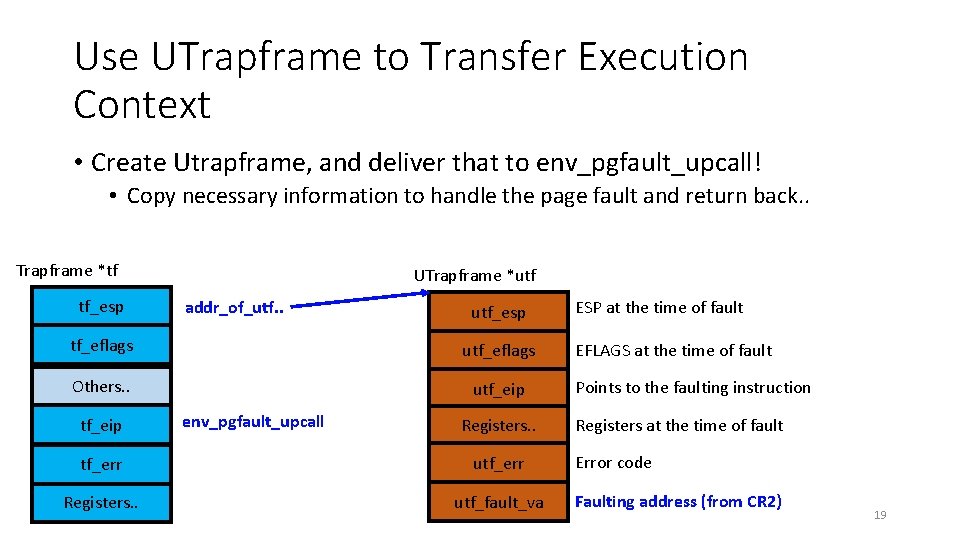
Use UTrapframe to Transfer Execution Context • Create Utrapframe, and deliver that to env_pgfault_upcall! • Copy necessary information to handle the page fault and return back. . Trapframe *tf tf_esp UTrapframe *utf addr_of_utf. . utf_esp tf_eflags utf_eflags Others. . utf_eip env_pgfault_upcall Registers. . tf_err utf_err Registers. . utf_fault_va ESP at the time of fault EFLAGS at the time of fault Points to the faulting instruction Registers at the time of fault Error code Faulting address (from CR 2) 19
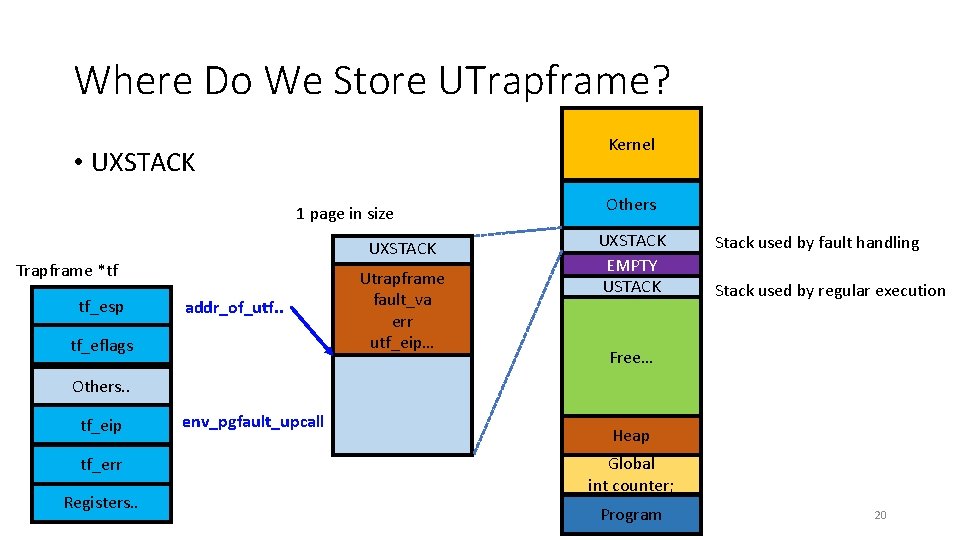
Where Do We Store UTrapframe? Kernel • UXSTACK 1 page in size UXSTACK Trapframe *tf tf_esp addr_of_utf. . tf_eflags Utrapframe fault_va err utf_eip… Others UXSTACK EMPTY USTACK Stack used by fault handling Stack used by regular execution Free… Others. . tf_eip tf_err Registers. . env_pgfault_upcall Heap Global int counter; Program 20
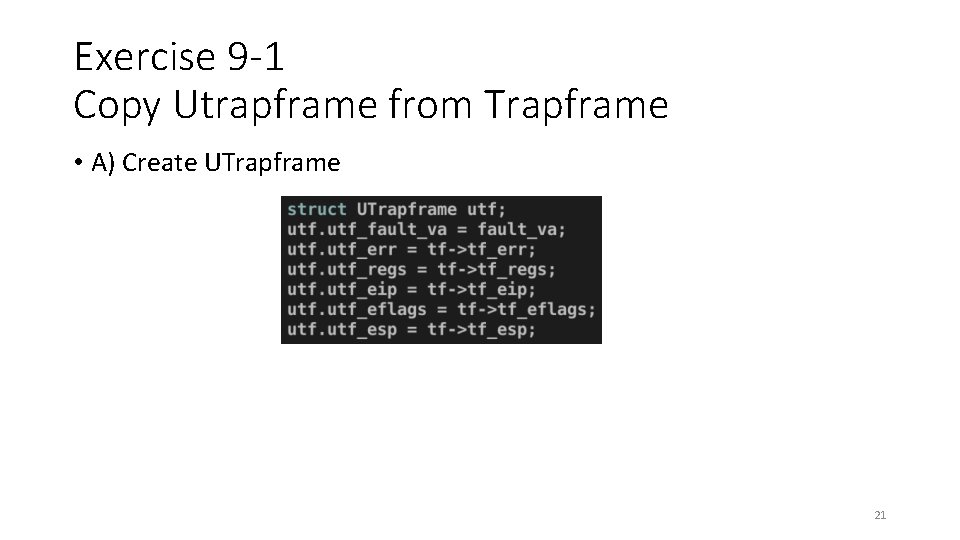
Exercise 9 -1 Copy Utrapframe from Trapframe • A) Create UTrapframe 21
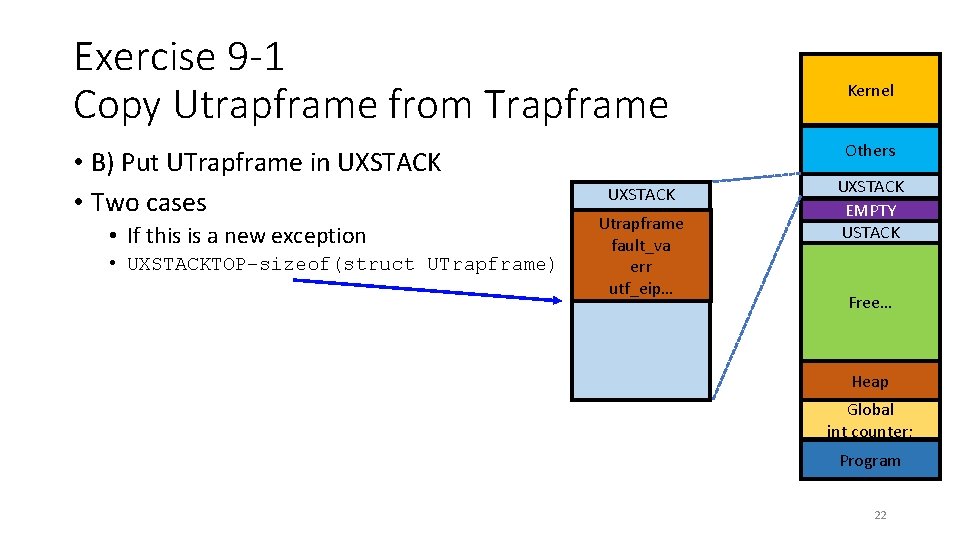
Exercise 9 -1 Copy Utrapframe from Trapframe • B) Put UTrapframe in UXSTACK • Two cases • If this is a new exception • UXSTACKTOP–sizeof(struct UTrapframe) Kernel Others UXSTACK Utrapframe fault_va err utf_eip… UXSTACK EMPTY USTACK Free… Heap Global int counter; Program 22
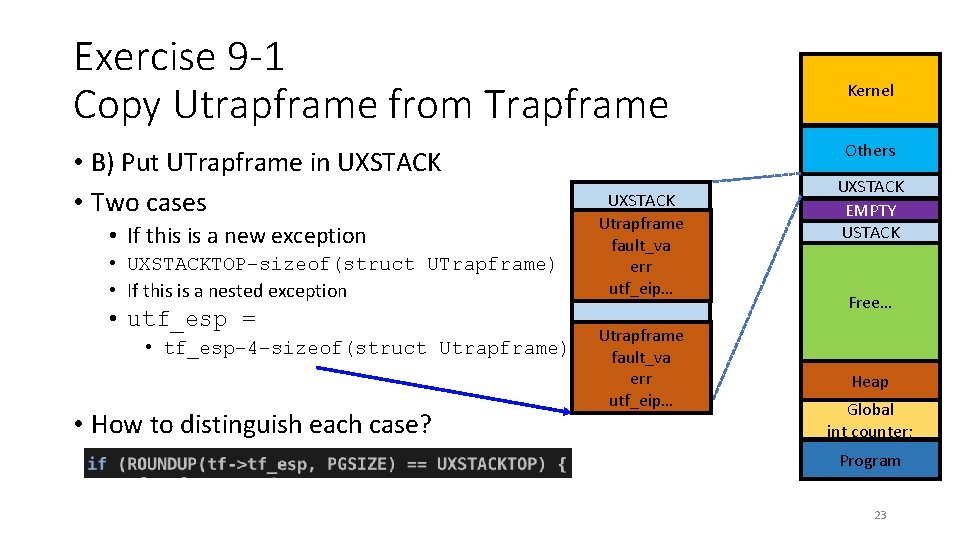
Exercise 9 -1 Copy Utrapframe from Trapframe • B) Put UTrapframe in UXSTACK • Two cases • If this is a new exception • UXSTACKTOP–sizeof(struct UTrapframe) • If this is a nested exception • utf_esp = • tf_esp– 4–sizeof(struct Utrapframe) • How to distinguish each case? Kernel Others UXSTACK Utrapframe fault_va err utf_eip… UXSTACK EMPTY USTACK Free… Heap Global int counter; Program 23
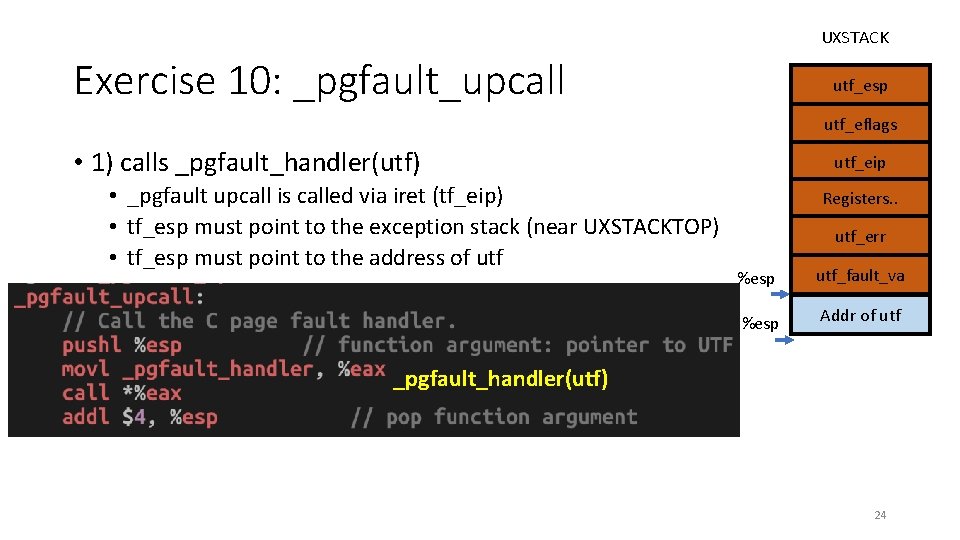
UXSTACK Exercise 10: _pgfault_upcall utf_esp utf_eflags • 1) calls _pgfault_handler(utf) • _pgfault upcall is called via iret (tf_eip) • tf_esp must point to the exception stack (near UXSTACKTOP) • tf_esp must point to the address of utf_eip Registers. . utf_err %esp utf_fault_va %esp Addr of utf _pgfault_handler(utf) 24
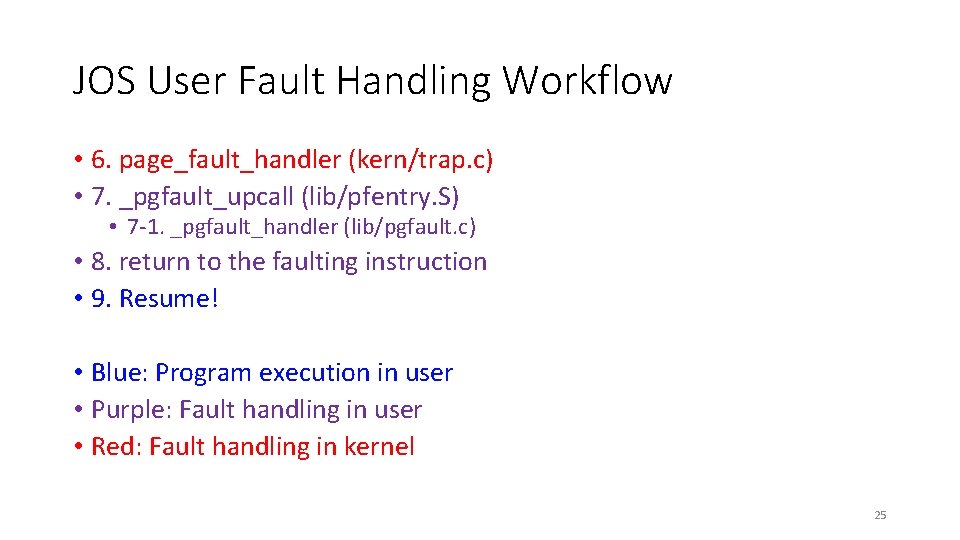
JOS User Fault Handling Workflow • 6. page_fault_handler (kern/trap. c) • 7. _pgfault_upcall (lib/pfentry. S) • 7 -1. _pgfault_handler (lib/pgfault. c) • 8. return to the faulting instruction • 9. Resume! • Blue: Program execution in user • Purple: Fault handling in user • Red: Fault handling in kernel 25
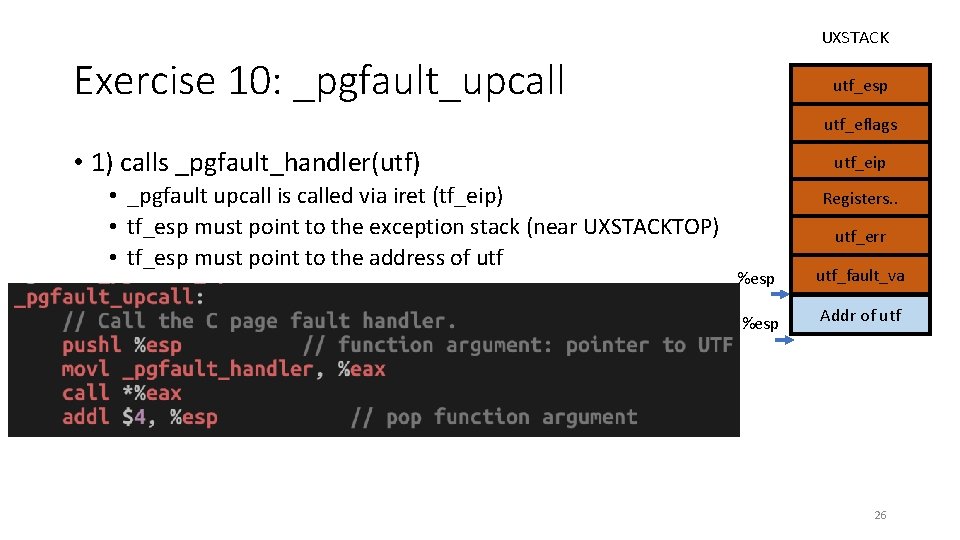
UXSTACK Exercise 10: _pgfault_upcall utf_esp utf_eflags • 1) calls _pgfault_handler(utf) • _pgfault upcall is called via iret (tf_eip) • tf_esp must point to the exception stack (near UXSTACKTOP) • tf_esp must point to the address of utf_eip Registers. . utf_err %esp utf_fault_va %esp Addr of utf 26
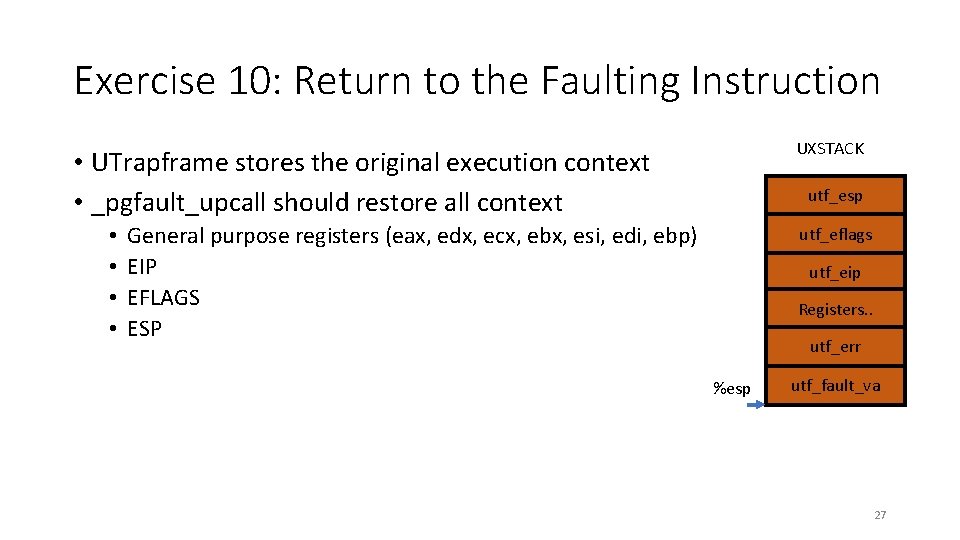
Exercise 10: Return to the Faulting Instruction UXSTACK • UTrapframe stores the original execution context • _pgfault_upcall should restore all context • • utf_esp General purpose registers (eax, edx, ecx, ebx, esi, edi, ebp) EIP EFLAGS ESP utf_eflags utf_eip Registers. . utf_err %esp utf_fault_va 27
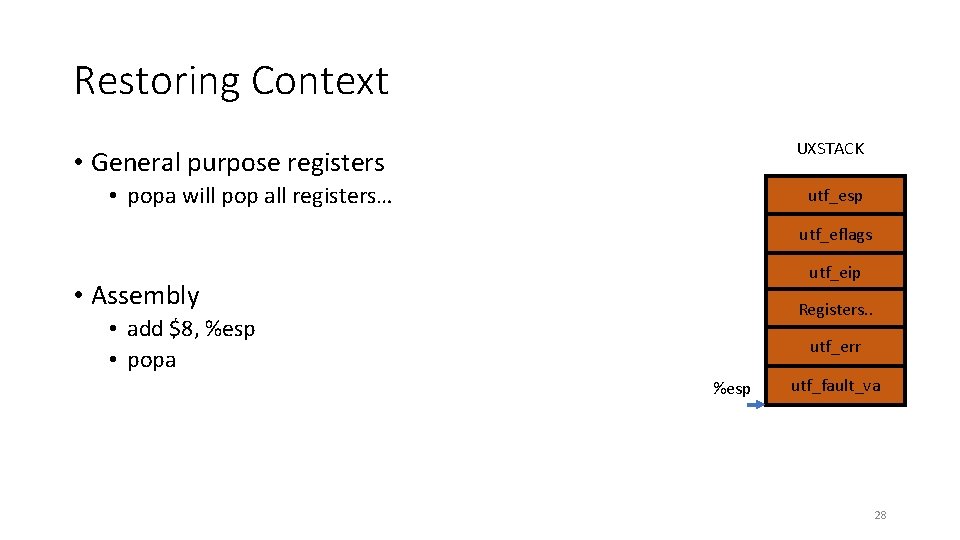
Restoring Context UXSTACK • General purpose registers • popa will pop all registers… utf_esp utf_eflags utf_eip • Assembly Registers. . • add $8, %esp • popa utf_err %esp utf_fault_va 28
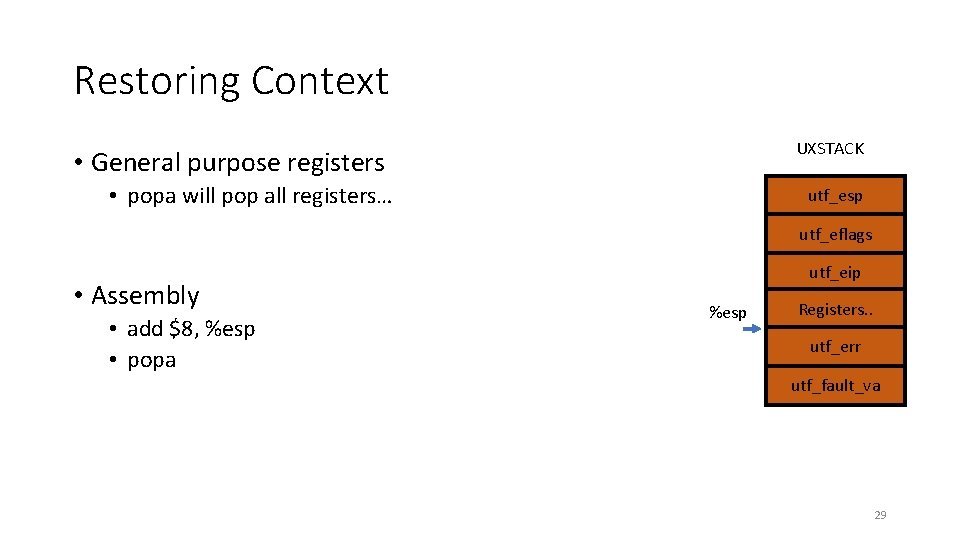
Restoring Context UXSTACK • General purpose registers • popa will pop all registers… utf_esp utf_eflags • Assembly • add $8, %esp • popa utf_eip %esp Registers. . utf_err utf_fault_va 29
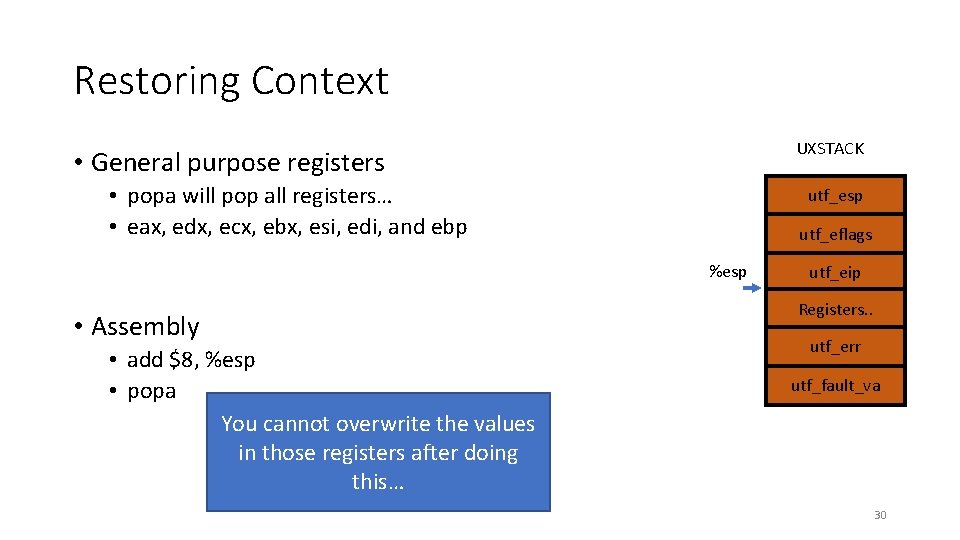
Restoring Context UXSTACK • General purpose registers • popa will pop all registers… • eax, edx, ecx, ebx, esi, edi, and ebp utf_esp utf_eflags %esp • Assembly • add $8, %esp • popa You cannot overwrite the values in those registers after doing this… utf_eip Registers. . utf_err utf_fault_va 30
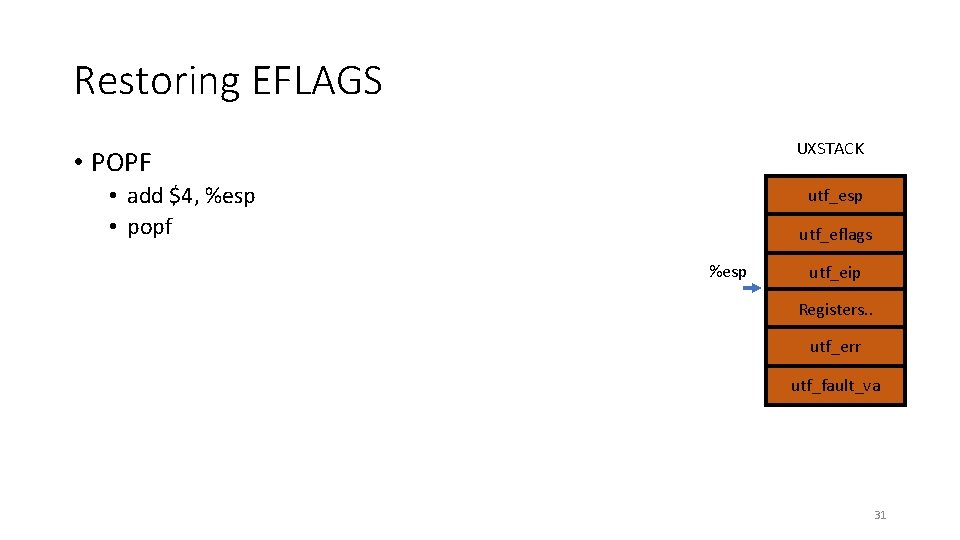
Restoring EFLAGS UXSTACK • POPF • add $4, %esp • popf utf_esp utf_eflags %esp utf_eip Registers. . utf_err utf_fault_va 31
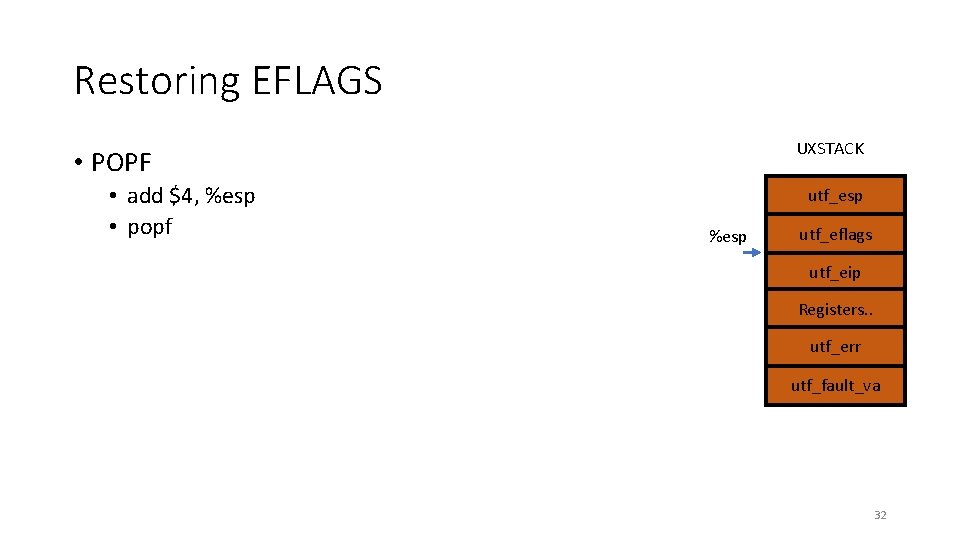
Restoring EFLAGS UXSTACK • POPF • add $4, %esp • popf utf_esp %esp utf_eflags utf_eip Registers. . utf_err utf_fault_va 32
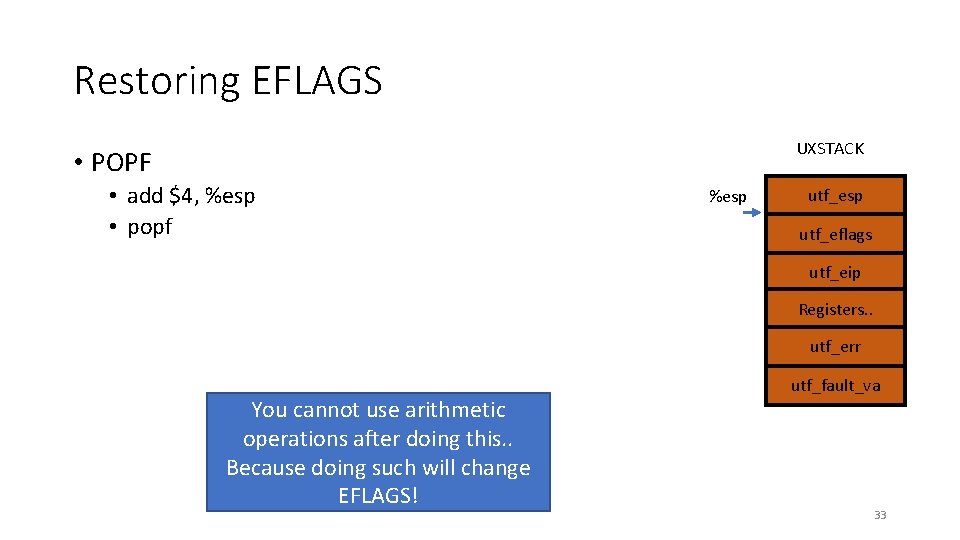
Restoring EFLAGS UXSTACK • POPF • add $4, %esp • popf %esp utf_eflags utf_eip Registers. . utf_err You cannot use arithmetic operations after doing this. . Because doing such will change EFLAGS! utf_fault_va 33
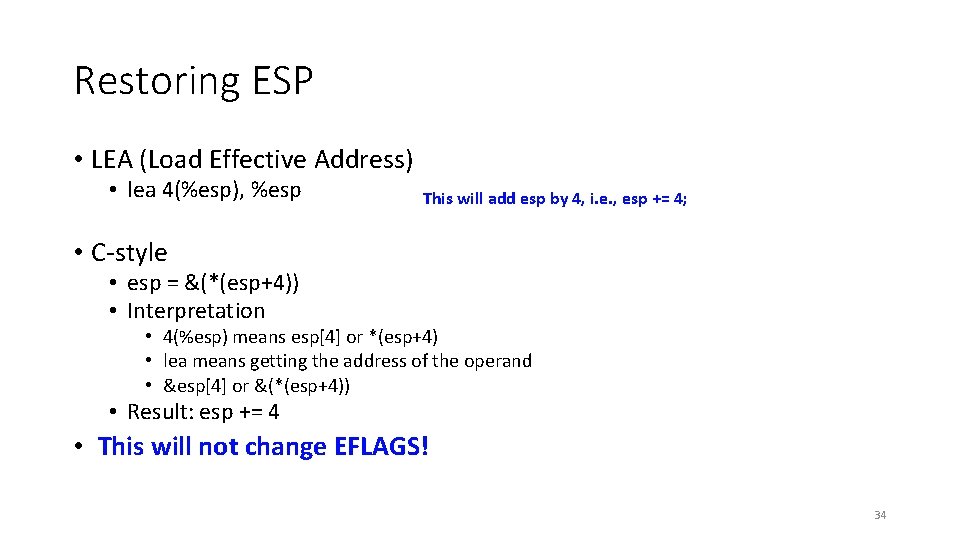
Restoring ESP • LEA (Load Effective Address) • lea 4(%esp), %esp This will add esp by 4, i. e. , esp += 4; • C-style • esp = &(*(esp+4)) • Interpretation • 4(%esp) means esp[4] or *(esp+4) • lea means getting the address of the operand • &esp[4] or &(*(esp+4)) • Result: esp += 4 • This will not change EFLAGS! 34
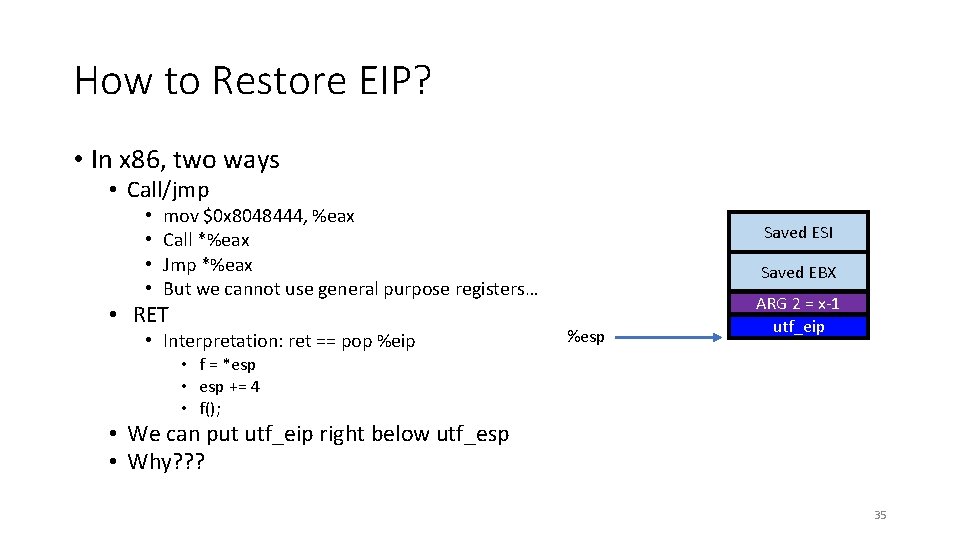
How to Restore EIP? • In x 86, two ways • Call/jmp • • mov $0 x 8048444, %eax Call *%eax Jmp *%eax But we cannot use general purpose registers… • RET • Interpretation: ret == pop %eip Saved ESI Saved EBX %esp ARG 2 = x-1 utf_eip • f = *esp • esp += 4 • f(); • We can put utf_eip right below utf_esp • Why? ? ? 35
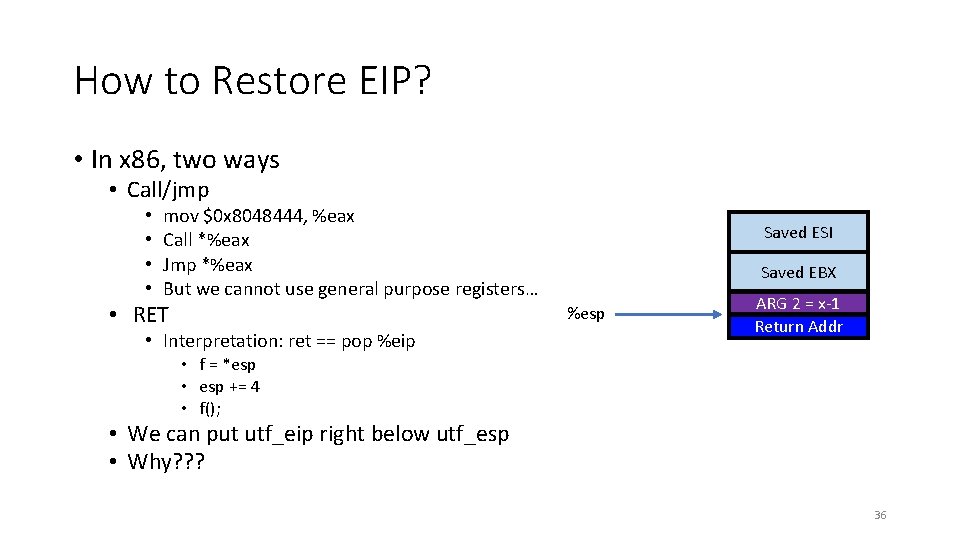
How to Restore EIP? • In x 86, two ways • Call/jmp • • mov $0 x 8048444, %eax Call *%eax Jmp *%eax But we cannot use general purpose registers… • RET Saved ESI Saved EBX %esp • Interpretation: ret == pop %eip ARG 2 = x-1 Return Addr • f = *esp • esp += 4 • f(); • We can put utf_eip right below utf_esp • Why? ? ? 36
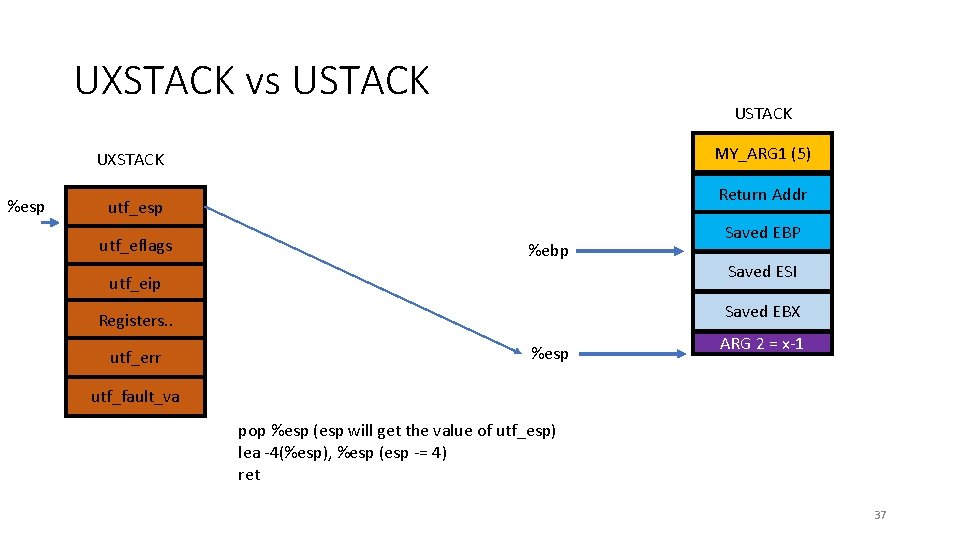
UXSTACK vs USTACK MY_ARG 1 (5) UXSTACK %esp Return Addr utf_esp utf_eflags %ebp utf_eip Saved ESI Saved EBX Registers. . utf_err Saved EBP %esp ARG 2 = x-1 utf_fault_va pop %esp (esp will get the value of utf_esp) lea -4(%esp), %esp (esp -= 4) ret 37
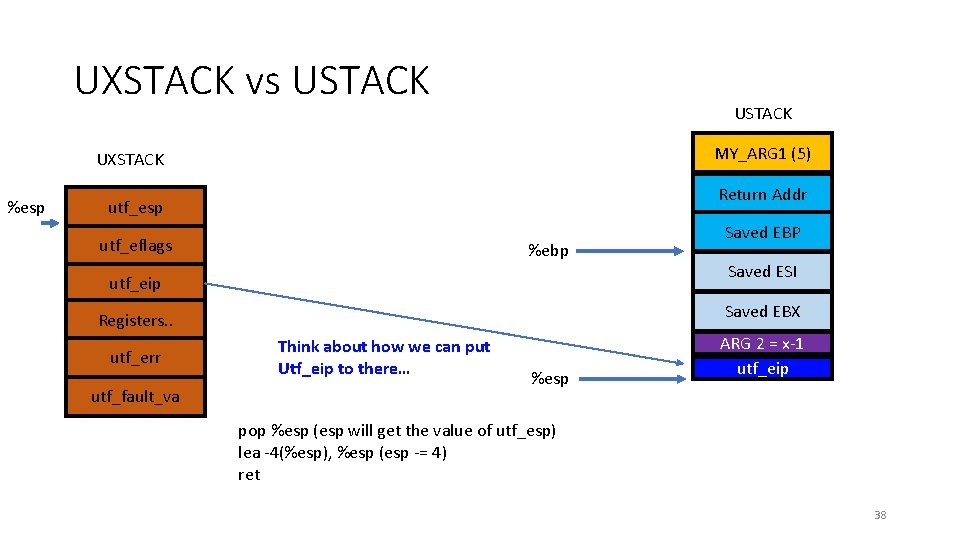
UXSTACK vs USTACK MY_ARG 1 (5) UXSTACK %esp Return Addr utf_esp utf_eflags %ebp utf_eip utf_fault_va Saved ESI Saved EBX Registers. . utf_err Saved EBP Think about how we can put Utf_eip to there… %esp ARG 2 = x-1 utf_eip pop %esp (esp will get the value of utf_esp) lea -4(%esp), %esp (esp -= 4) ret 38
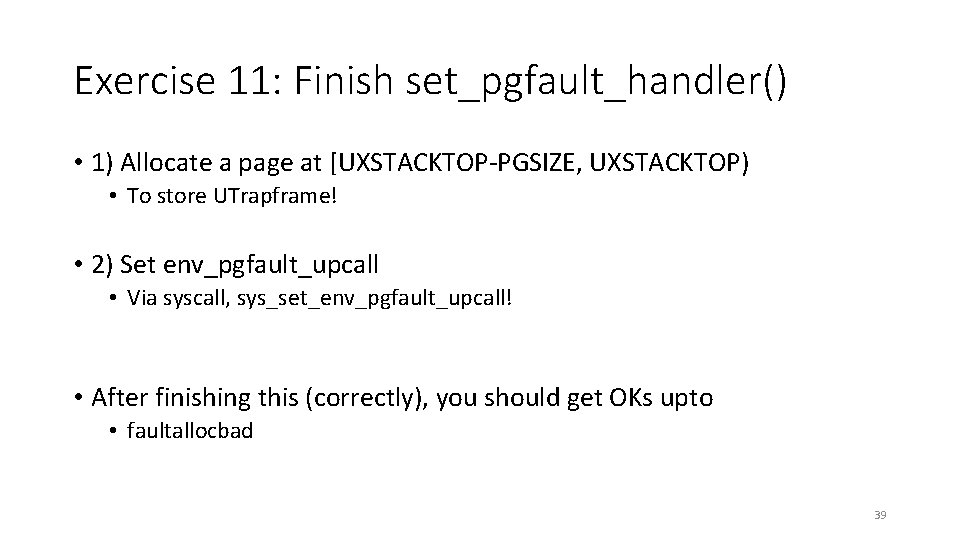
Exercise 11: Finish set_pgfault_handler() • 1) Allocate a page at [UXSTACKTOP-PGSIZE, UXSTACKTOP) • To store UTrapframe! • 2) Set env_pgfault_upcall • Via syscall, sys_set_env_pgfault_upcall! • After finishing this (correctly), you should get OKs upto • faultallocbad 39
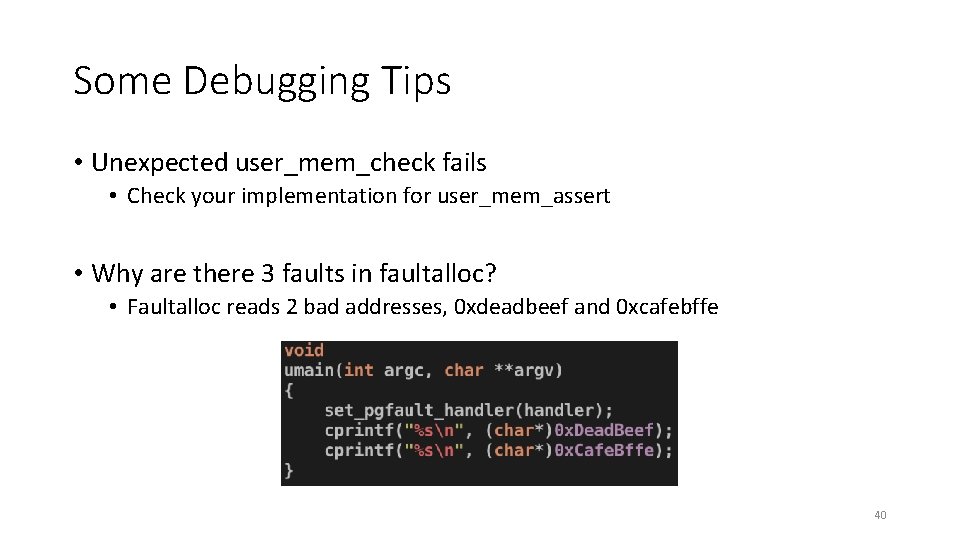
Some Debugging Tips • Unexpected user_mem_check fails • Check your implementation for user_mem_assert • Why are there 3 faults in faultalloc? • Faultalloc reads 2 bad addresses, 0 xdeadbeef and 0 xcafebffe 40
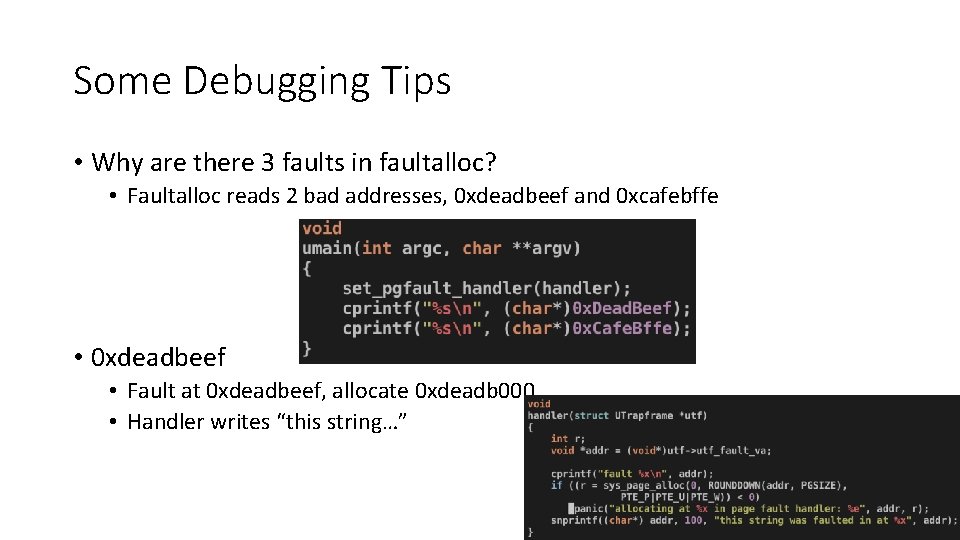
Some Debugging Tips • Why are there 3 faults in faultalloc? • Faultalloc reads 2 bad addresses, 0 xdeadbeef and 0 xcafebffe • 0 xdeadbeef • Fault at 0 xdeadbeef, allocate 0 xdeadb 000 • Handler writes “this string…” 41
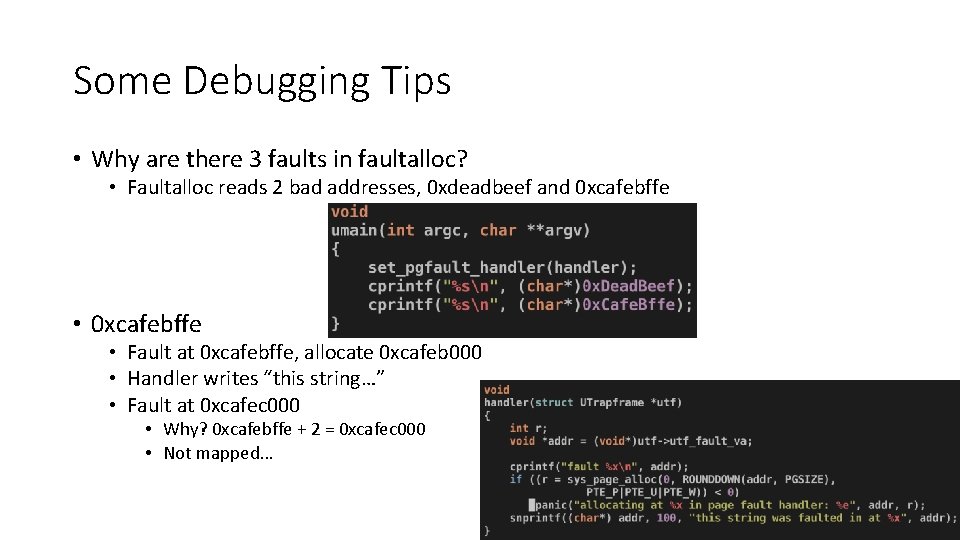
Some Debugging Tips • Why are there 3 faults in faultalloc? • Faultalloc reads 2 bad addresses, 0 xdeadbeef and 0 xcafebffe • Fault at 0 xcafebffe, allocate 0 xcafeb 000 • Handler writes “this string…” • Fault at 0 xcafec 000 • Why? 0 xcafebffe + 2 = 0 xcafec 000 • Not mapped… 42
Handling Multiple Faults • Page fault can occur during handling a page fault • In kernel: Panic • In user: • 7. _pgfault_upcall (lib/pfentry. S) • 7 -1. _pgfault_handler (lib/pgfault. c) • How? • Recursively handle the fault… 43
JOS Page Fault Workflow (Kernel) • A-1. Fault (user/somewhere. c) • A-2. CPU runs trap handler • A-3. _alltraps (kern/trapentry. S) • A-4. trap (kern/trap. c) • A-5. trap_dispatch (kern/trap. c) • A-6. page_fault_handler (kern/trap. c) 44
JOS User Fault Handling Workflow • A-6. page_fault_handler (kern/trap. c) • A-7. _pgfault_upcall (lib/pfentry. S) • A-7 -1. _pgfault_handler (lib/pgfault. c, FAULT) 45
JOS Page Fault Workflow (Kernel) • B-1. Fault (user/fork. c) • B-2. CPU runs trap handler • B-3. _alltraps (kern/trapentry. S) • B-4. trap (kern/trap. c) • B-5. trap_dispatch (kern/trap. c) • B-6. page_fault_handler (kern/trap. c) 46
JOS User Fault Handling Workflow • B-6. page_fault_handler (kern/trap. c) • B-7. _pgfault_upcall (lib/pfentry. S) • B-7 -1. _pgfault_handler (lib/pgfault. c, FAULT) • B-8. return to the faulting instruction • B-9. Resume to A-7 47
JOS User Fault Handling Workflow • B-9. Resume to A-7 • A-7 -1. _pgfault_handler (lib/pgfault. c, FAULT) • A-8. return to the faulting instruction • A-9. Resume! 48
Exercise 11 • So you must correctly handle nested page fault • Fault at 0 xcafebffe • While handling this fault, the handler generates another fault at 0 xcafec 000 • Handle it! • This is the case that you need to check if Trapframe stack is in UXSTACK region or not 49
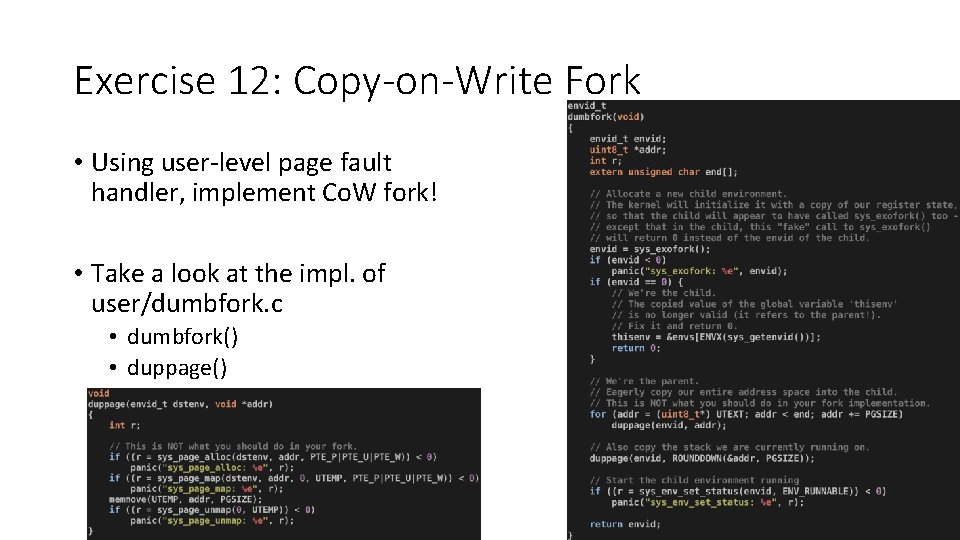
Exercise 12: Copy-on-Write Fork • Using user-level page fault handler, implement Co. W fork! • Take a look at the impl. of user/dumbfork. c • dumbfork() • duppage() 50
Exercise 12: in duppage() • Unlike the one in dumbfork, we will not call memmove nor sys_page_alloc • We will only call sys_page_map • You need to duplicate mappings in a parent env to child env • No memory copy! This is copy-on-write! • Caveat • For Read-only mapping, you can map the region read-only in child • For Writable mapping, you can map • The child as read-only with PTE_COW • The parent as read-only with PTE_COW • You must change the permission of both pages as PTE_P | PTE_U | PTE_COW 51
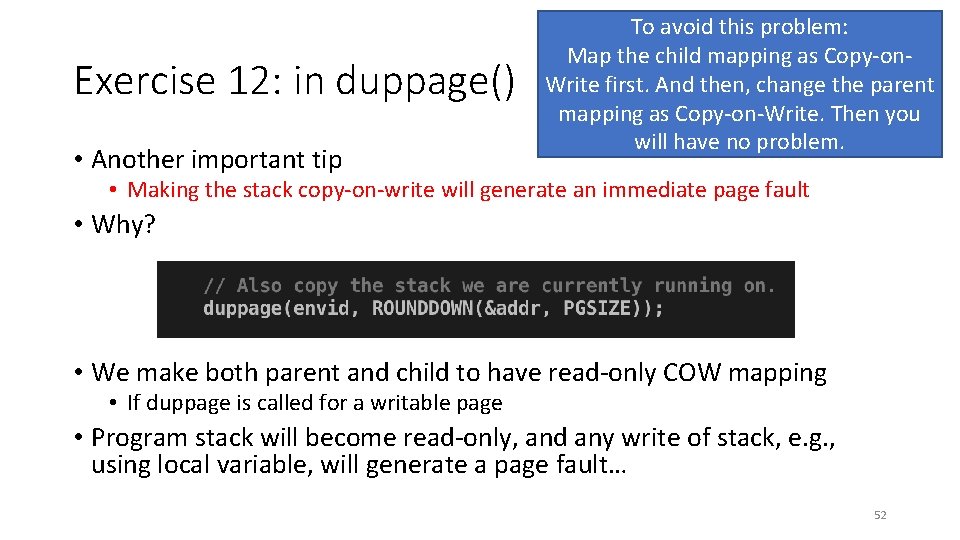
Exercise 12: in duppage() • Another important tip To avoid this problem: Map the child mapping as Copy-on. Write first. And then, change the parent mapping as Copy-on-Write. Then you will have no problem. • Making the stack copy-on-write will generate an immediate page fault • Why? • We make both parent and child to have read-only COW mapping • If duppage is called for a writable page • Program stack will become read-only, and any write of stack, e. g. , using local variable, will generate a page fault… 52
Exercise 12: in fork() • Don’t forget to • 1. set_page_fault_handler(&pgfault); • 2. Allocate a new page at UXSTACKTOP – PGSIZE • For having a separate exception handling stack! • 3. SYS_env_set_pgfault_upcall(envid, thisenv->env_pgfault_upcall); • Child must have set its page fault handler to handle Co. W • 4. SYS_env_set_status(envid, ENV_RUNNABLE); • Make child runnable after finishing the Copy-on-Write fork! 53
Exercise 12: in pgfault() • What should we do in the page fault handler to support Co. W? • COPY ON WRITE • Yes, we need to copy the faulting page if • The access is a write attempt (read attempt is true error on unmapped page) • The access is not a privilege violation nor not present fault (user->user, PTE_P) • The page is set with PTE_COW == 1 • Otherwise, it’s a write fault on a true read-only page • So copy the page if all such condition meets, otherwise, panic! 54
Exercise 12: in pgfault() Now the faulted page is backed by a private, writable copy • Then, how can we copy a page? • 1. allocate a page at the address PFTEMP • 2. memcpy(PFTEMP, PTE_ADDR(fault_addr), PGSIZE); • 3. sys_page_map(0, PFTEMP, 0, PTE_ADDR(fault_addr), PTE_U | PTE_P | PTE_W); • 4. sys_page_unmap(PFTEMP); 55
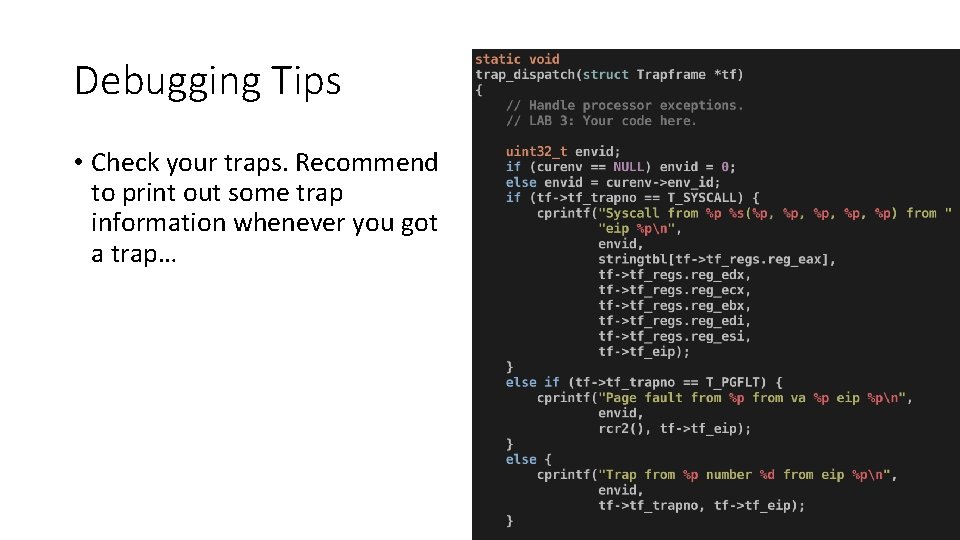
Debugging Tips • Check your traps. Recommend to print out some trap information whenever you got a trap… 56
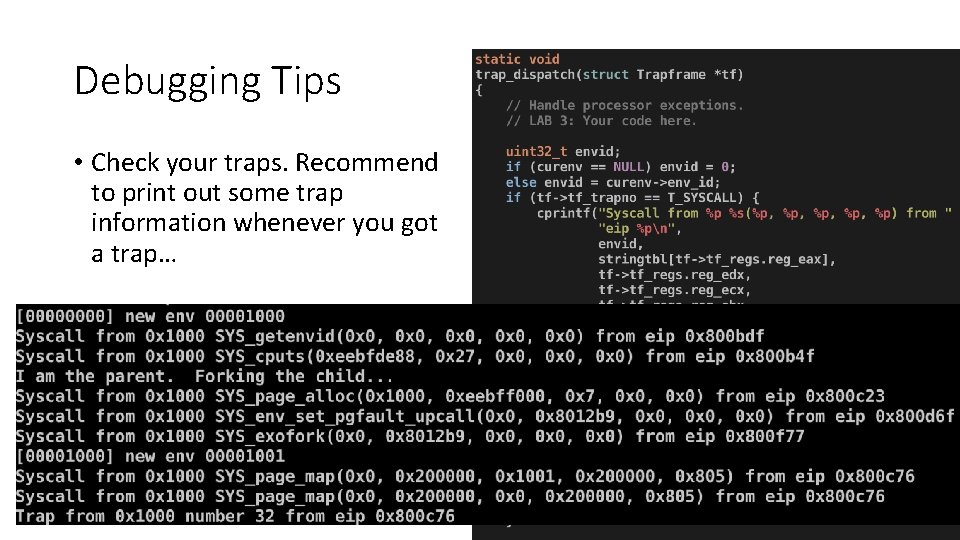
Debugging Tips • Check your traps. Recommend to print out some trap information whenever you got a trap… 57
Debugging Tips • You will get a page fault (due to Copy-on-Write) immediately after making your stack Copy-on-Write • This is because duppage will make both virtual page in parent and child set with PTE_COW == 1 • So don’t be surprise, that’s an intended behavior 58
Debugging Tips • Make sure you set env_pgfault_upcall for both parent and child • For parent • Run set_pgfault_handler • For child • Run sys_env_set_pgfault_upcall(envid, thisenv->env_pgfault_upcall) • Right after forking the child • Before changing the child to ENV_RUNNABLE 59
Exercise 13/14: Enable Timer-interrupt-based Preemptive Multitasking • We will now enable timer-based preemptive multitasking, the mechanism that we learn in the lecture • To do this, you need to do the following: • • 1) write TRAPHANDLER / IDT entry to Hardware IRQs 2) handle timer interrupt 3) enable interrupt in user mode (ring 3) 4) enable interrupt in the scheduler (ring 0) 60
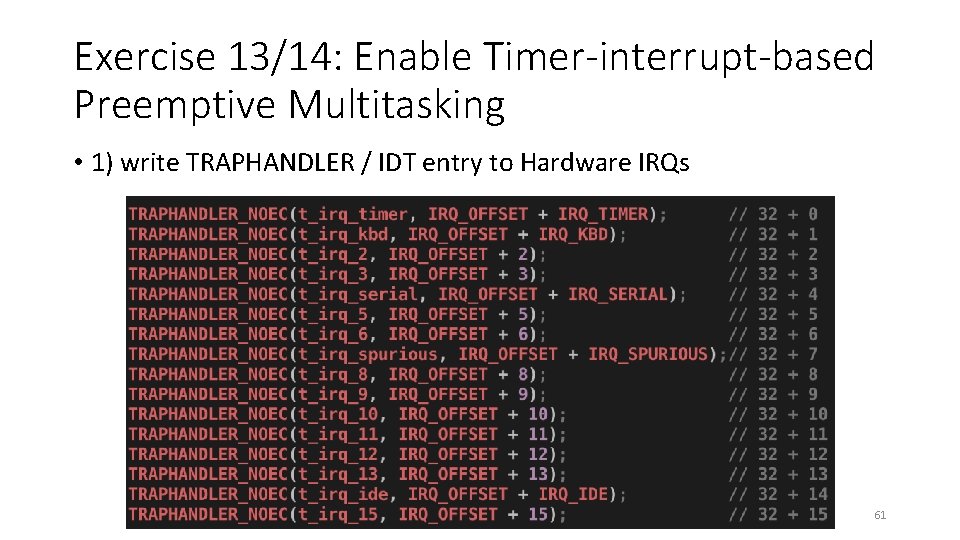
Exercise 13/14: Enable Timer-interrupt-based Preemptive Multitasking • 1) write TRAPHANDLER / IDT entry to Hardware IRQs 61
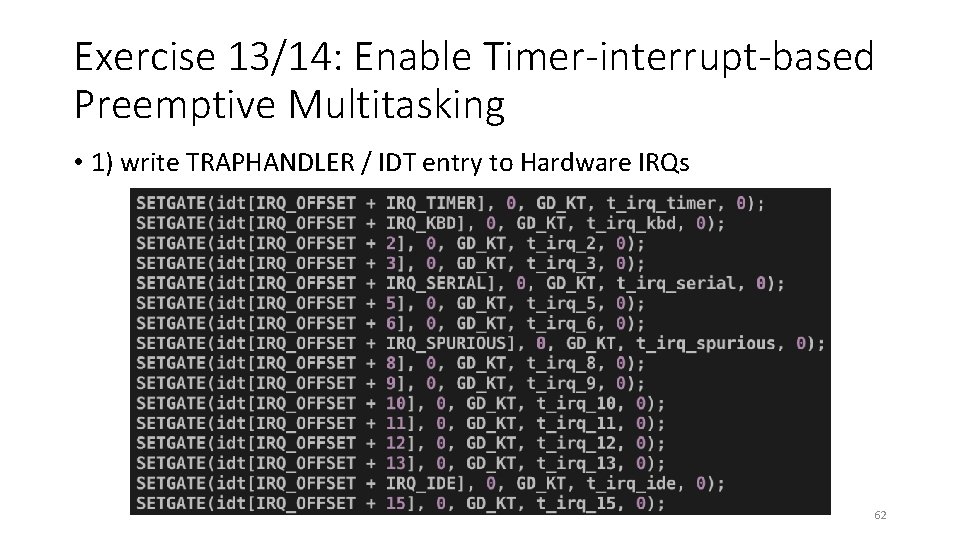
Exercise 13/14: Enable Timer-interrupt-based Preemptive Multitasking • 1) write TRAPHANDLER / IDT entry to Hardware IRQs 62
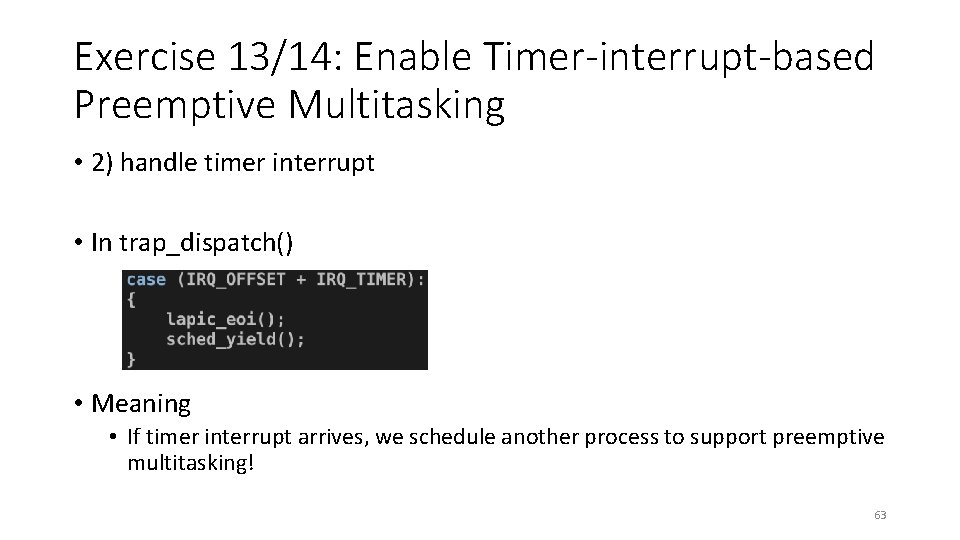
Exercise 13/14: Enable Timer-interrupt-based Preemptive Multitasking • 2) handle timer interrupt • In trap_dispatch() • Meaning • If timer interrupt arrives, we schedule another process to support preemptive multitasking! 63
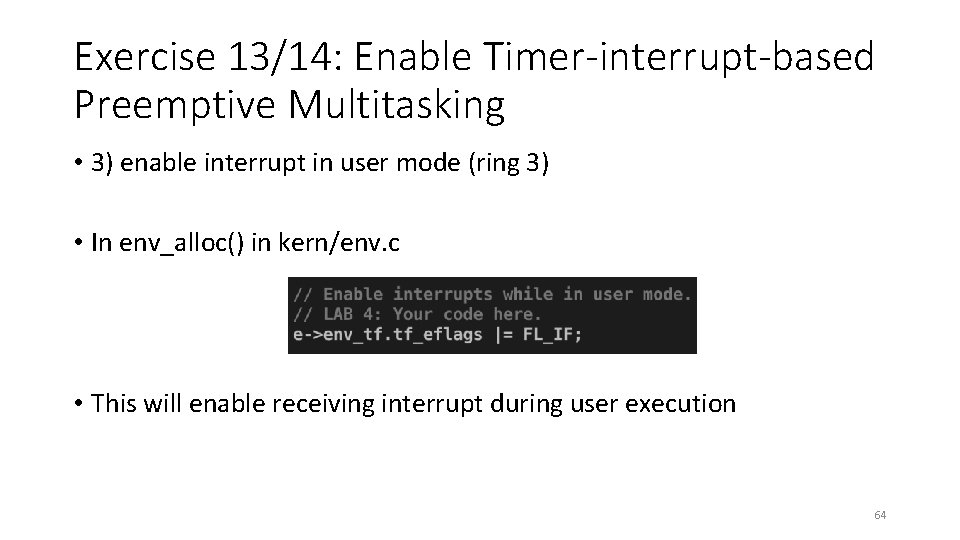
Exercise 13/14: Enable Timer-interrupt-based Preemptive Multitasking • 3) enable interrupt in user mode (ring 3) • In env_alloc() in kern/env. c • This will enable receiving interrupt during user execution 64
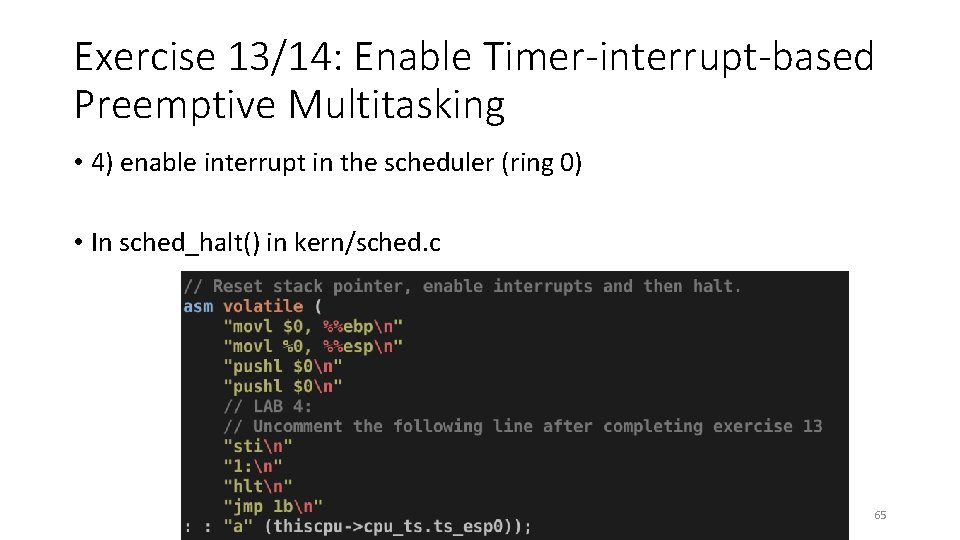
Exercise 13/14: Enable Timer-interrupt-based Preemptive Multitasking • 4) enable interrupt in the scheduler (ring 0) • In sched_halt() in kern/sched. c 65
Now You Should Get ALL OKs up to SPIN • Check TRAPHANDLER, IDT, trap_dispatch, or enabling/disabling interrupt if your JOS does not switch among environment correctly… 66
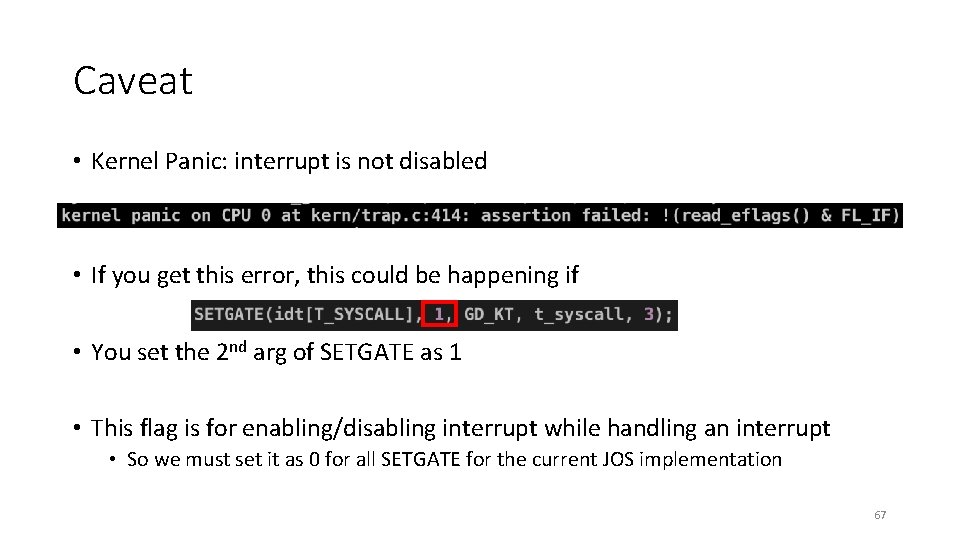
Caveat • Kernel Panic: interrupt is not disabled • If you get this error, this could be happening if • You set the 2 nd arg of SETGATE as 1 • This flag is for enabling/disabling interrupt while handling an interrupt • So we must set it as 0 for all SETGATE for the current JOS implementation 67
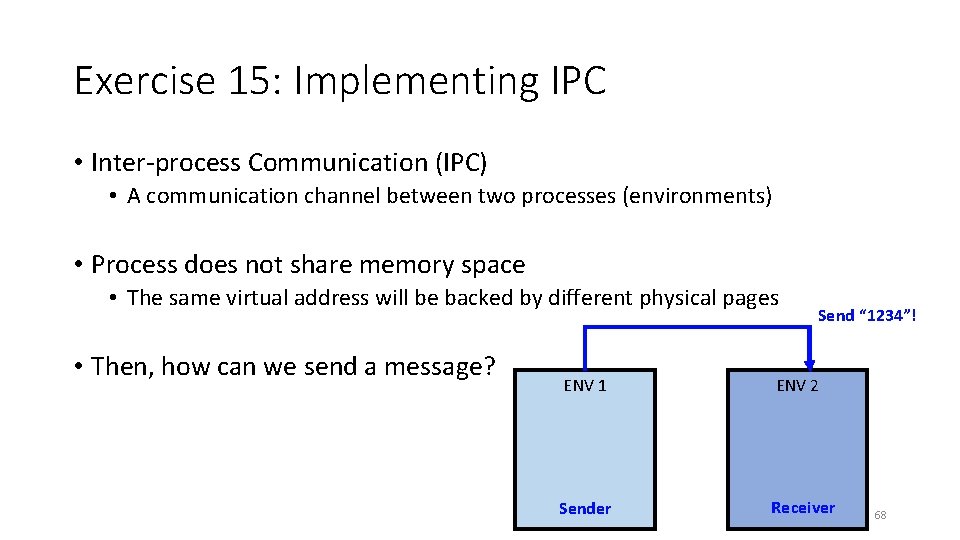
Exercise 15: Implementing IPC • Inter-process Communication (IPC) • A communication channel between two processes (environments) • Process does not share memory space • The same virtual address will be backed by different physical pages • Then, how can we send a message? Send “ 1234”! ENV 1 ENV 2 Sender Receiver 68
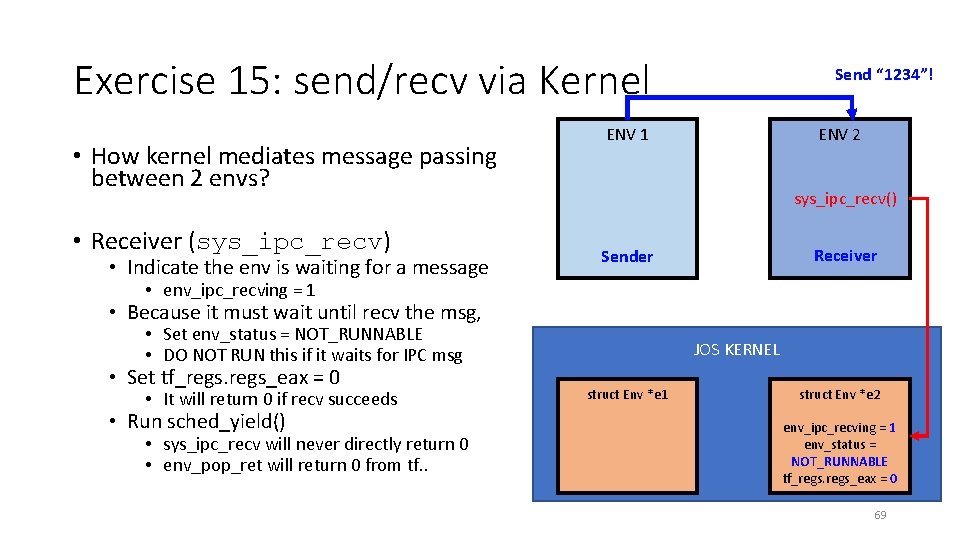
Exercise 15: send/recv via Kernel • How kernel mediates message passing between 2 envs? • Receiver (sys_ipc_recv) • Indicate the env is waiting for a message Send “ 1234”! ENV 1 ENV 2 sys_ipc_recv() Receiver Sender • env_ipc_recving = 1 • Because it must wait until recv the msg, • Set env_status = NOT_RUNNABLE • DO NOT RUN this if it waits for IPC msg • Set tf_regs_eax = 0 • It will return 0 if recv succeeds • Run sched_yield() • sys_ipc_recv will never directly return 0 • env_pop_ret will return 0 from tf. . JOS KERNEL struct Env *e 1 struct Env *e 2 env_ipc_recving = 1 env_status = NOT_RUNNABLE tf_regs_eax = 0 69
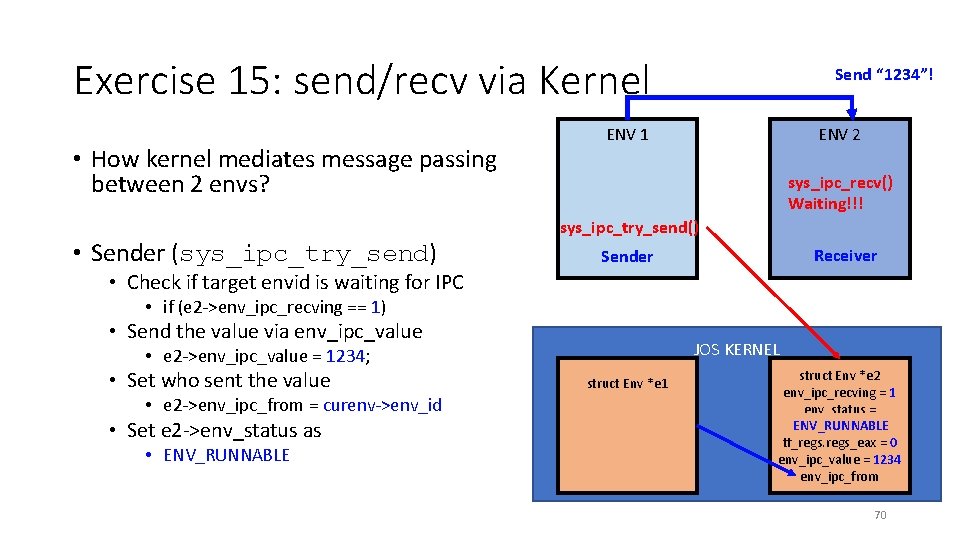
Exercise 15: send/recv via Kernel • How kernel mediates message passing between 2 envs? • Sender (sys_ipc_try_send) Send “ 1234”! ENV 1 ENV 2 sys_ipc_recv() Waiting!!! sys_ipc_try_send() Receiver Sender • Check if target envid is waiting for IPC • if (e 2 ->env_ipc_recving == 1) • Send the value via env_ipc_value JOS KERNEL • e 2 ->env_ipc_value = 1234; • Set who sent the value • e 2 ->env_ipc_from = curenv->env_id • Set e 2 ->env_status as • ENV_RUNNABLE struct Env *e 1 struct Env *e 2 env_ipc_recving = 1 env_status = ENV_RUNNABLE NOT_RUNNABLE tf_regs_eax = 0 env_ipc_value = 1234 env_ipc_from 70
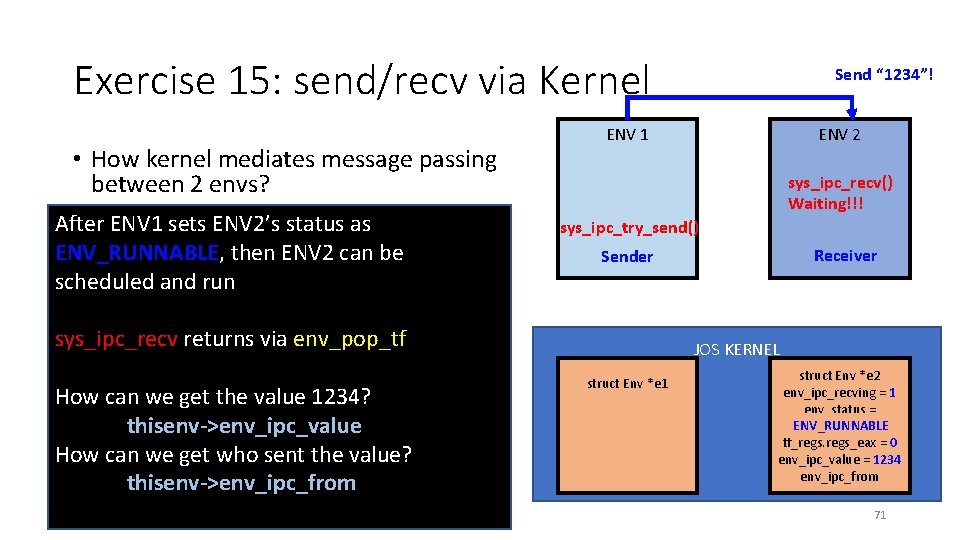
Exercise 15: send/recv via Kernel • How kernel mediates message passing between 2 envs? After ENV 1 sets ENV 2’s status as ENV_RUNNABLE, then ENV 2 can be • Sender (sys_ipc_try_send) • Check target envid is waiting for IPC scheduled andif run Send “ 1234”! ENV 1 ENV 2 sys_ipc_recv() Waiting!!! sys_ipc_try_send() Receiver Sender • if (e 2 ->env_ipc_recving == 1) • Send the value via env_pop_tf env_ipc_value sys_ipc_recv returns JOS KERNEL • e 2 ->env_ipc_value = 1234; • Set who sent the value How can we get the value =1234? • e 2 ->env_ipc_from curenv->env_id • thisenv->env_ipc_value Set e 2 ->env_status as • ENV_RUNNABLE How can we get who sent the value? thisenv->env_ipc_from struct Env *e 1 struct Env *e 2 env_ipc_recving = 1 env_status = ENV_RUNNABLE NOT_RUNNABLE tf_regs_eax = 0 env_ipc_value = 1234 env_ipc_from 71
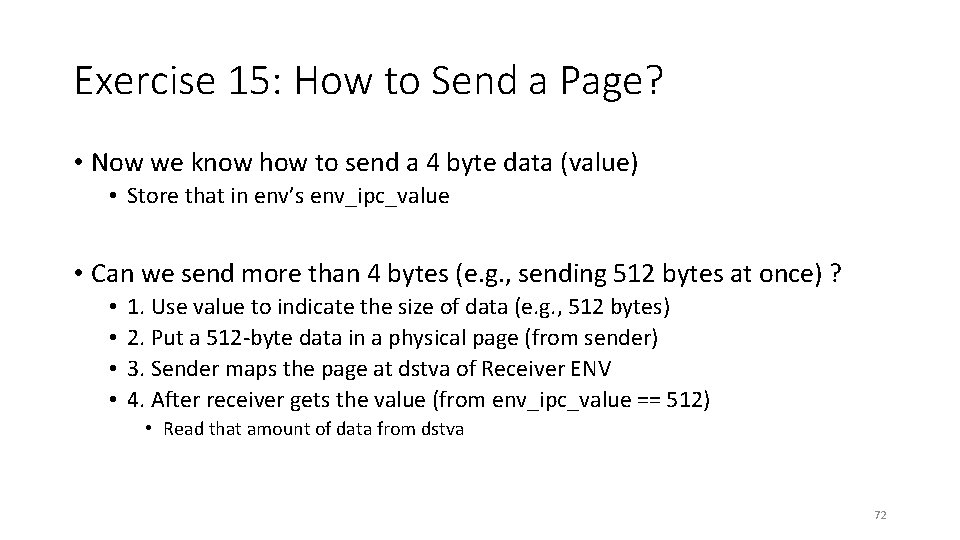
Exercise 15: How to Send a Page? • Now we know how to send a 4 byte data (value) • Store that in env’s env_ipc_value • Can we send more than 4 bytes (e. g. , sending 512 bytes at once) ? • • 1. Use value to indicate the size of data (e. g. , 512 bytes) 2. Put a 512 -byte data in a physical page (from sender) 3. Sender maps the page at dstva of Receiver ENV 4. After receiver gets the value (from env_ipc_value == 512) • Read that amount of data from dstva 72
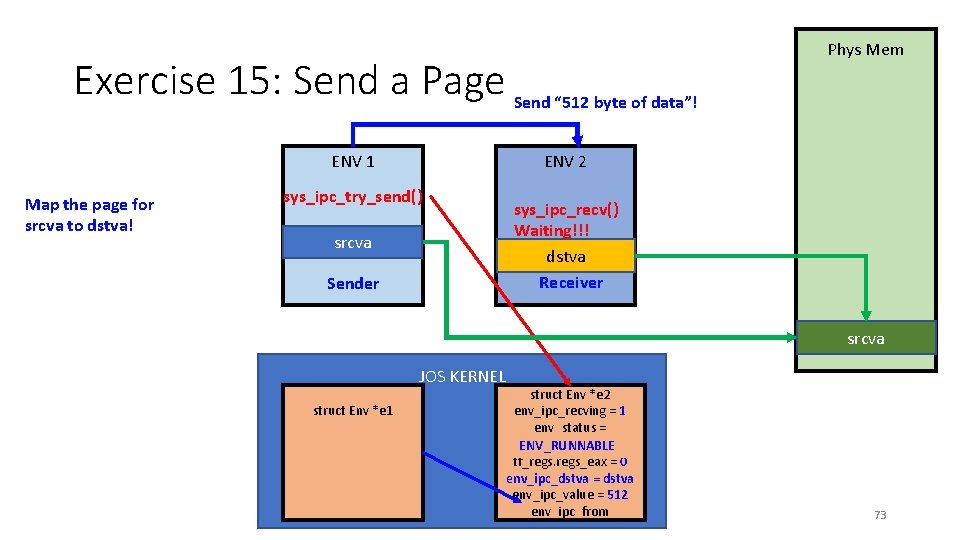
Exercise 15: Send a Page Send “ 512 byte of data”! ENV 1 Map the page for srcva to dstva! Phys Mem ENV 2 sys_ipc_try_send() srcva Sender sys_ipc_recv() Waiting!!! dstva Receiver srcva JOS KERNEL struct Env *e 1 struct Env *e 2 env_ipc_recving = 1 env_status = NOT_RUNNABLE ENV_RUNNABLE tf_regs_eax = 0 env_ipc_dstva = dstva env_ipc_value = 512 env_ipc_from 73
Exercise 15: Some hints • Use page_lookup and page_insert to • • Get the PTE of srcva Get the corresponding physical page of srcva (struct Page. Info *pp) Put pp to dstva via page_insert Also set e->env_ipc_perm (get the perm from the PTE of srcva) 74
Exercise 15: Some hints • In lib/ipc. c • sys_ipc_recv never returns if there is no error • It will internally run sched_yield() -> then env_run() will schedule it back • So pass the return value via tf_regs_eax = 0 • ipc_send must wait if receiving env is not ready • sys_ipc_try_end returns –E_IPC_NOT_RECV • Then stay in a while loop and keep try to send… • NULL is not an invalid address for srcva/dstva • Put higher address than UTOP, e. g. , KERNBASE? 75
Exercise 15: Some hints • When submitting lab 4, make your JOS runs fast enough to pass grading script • DO NOT use too many cprintf • Primes could be VERY SLOW • Removing debug printing will let you finish this within 30 seconds… 76
- Slides: 76