
CS 440ECE 448 Lecture 18 Bayesian Networks Slides
CS 440/ECE 448 Lecture 18: Bayesian Networks Slides by Svetlana Lazebnik, 10/2016 Modified by Mark Hasegawa-Johnson, 3/2019
Review: Bayesian inference A general scenario: Query variables: X Evidence (observed) variables and their values: E = e Inference problem: answer questions about the query variables given the evidence variables This can be done using the posterior distribution P(X | E = e) Example of a useful question: Which X is true? More formally: what value of X has the least probability of being wrong? Answer: MPE = MAP (argmin P(error) = argmax P(X=x|E=e))
Today: What if P(X, E) is complicated? • Very, very common problem: P(X, E) is complicated because both X and E depend on some hidden variable Y • SOLUTION: • Draw a bunch of circles and arrows that represent the dependence • When your algorithm performs inference, make sure it does so in the order of the graph • FORMALISM: Bayesian Network
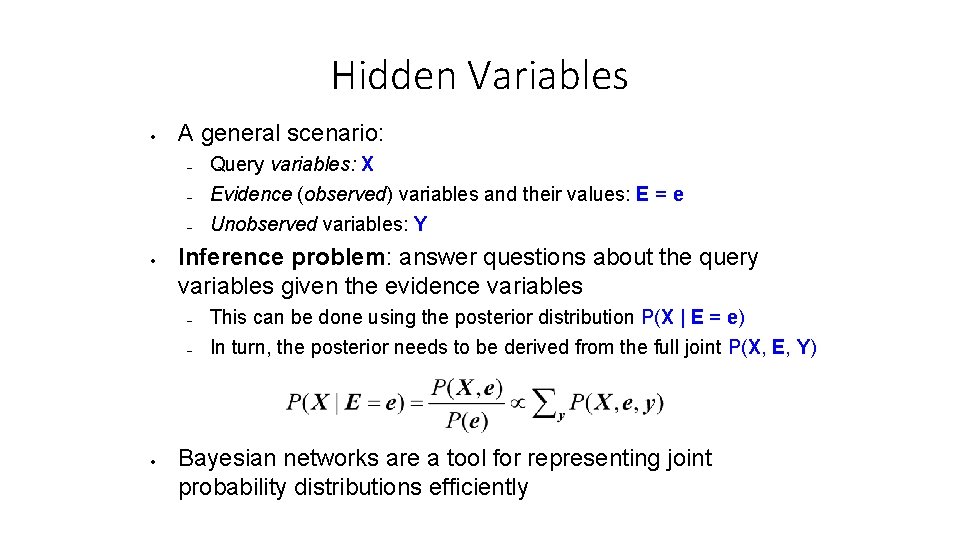
Hidden Variables A general scenario: Inference problem: answer questions about the query variables given the evidence variables Query variables: X Evidence (observed) variables and their values: E = e Unobserved variables: Y This can be done using the posterior distribution P(X | E = e) In turn, the posterior needs to be derived from the full joint P(X, E, Y) Bayesian networks are a tool for representing joint probability distributions efficiently
Bayesian networks • More commonly called graphical models • A way to depict conditional independence relationships between random variables • A compact specification of full joint distributions
Outline • Review: Bayesian inference • Bayesian network: graph semantics • The Los Angeles burglar alarm example • Conditional independence ≠ Independence • Constructing a Bayesian network: Structure learning • Constructing a Bayesian network: Hire an expert
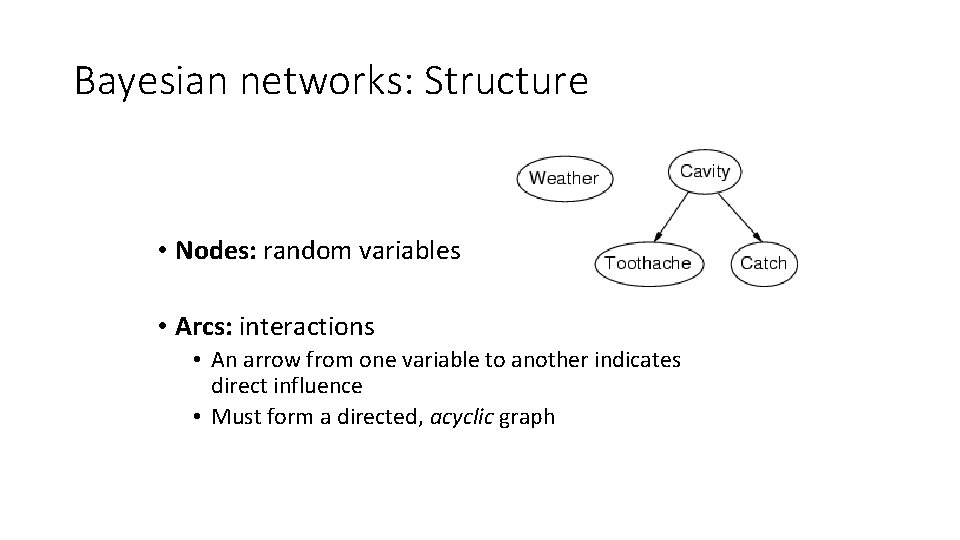
Bayesian networks: Structure • Nodes: random variables • Arcs: interactions • An arrow from one variable to another indicates direct influence • Must form a directed, acyclic graph
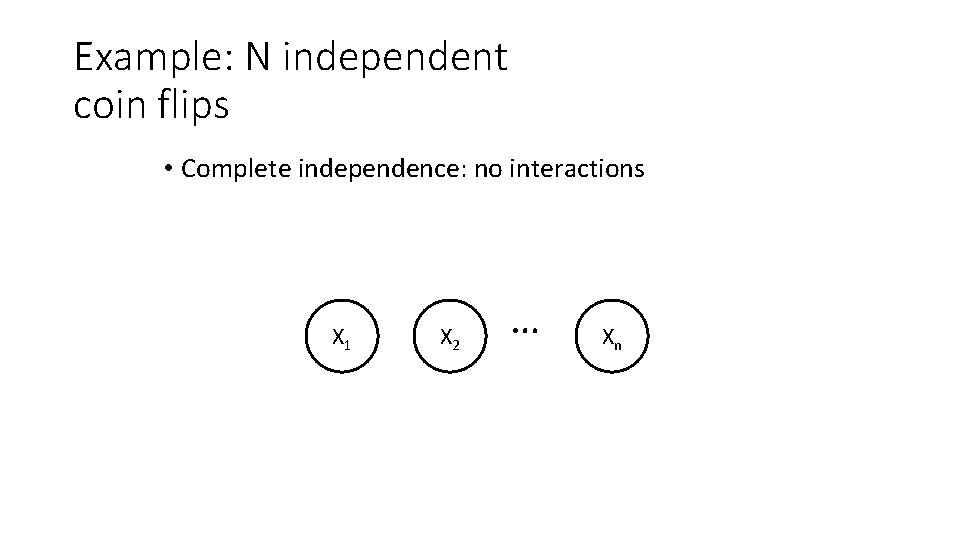
Example: N independent coin flips • Complete independence: no interactions X 1 X 2 … Xn
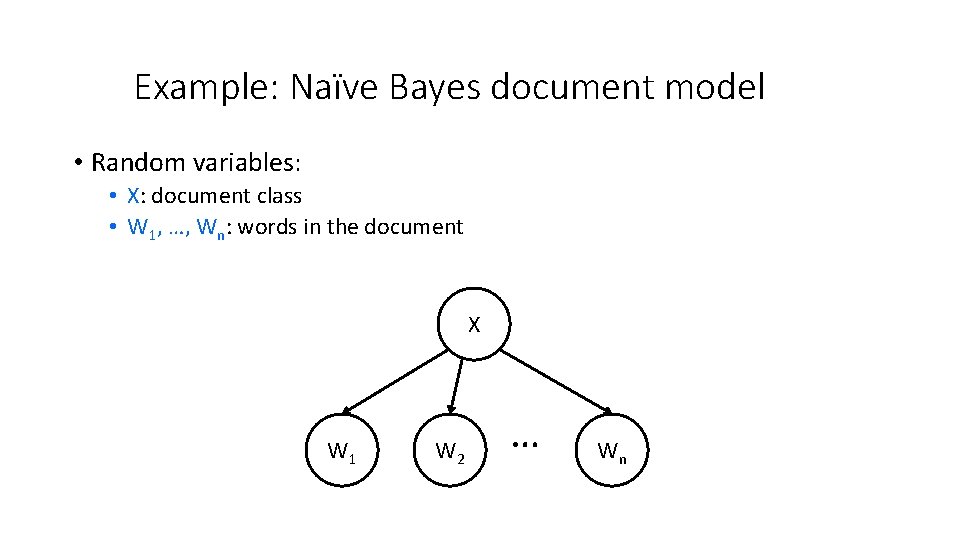
Example: Naïve Bayes document model • Random variables: • X: document class • W 1, …, Wn: words in the document X W 1 W 2 … Wn

Outline • Review: Bayesian inference • Bayesian network: graph semantics • The Los Angeles burglar alarm example • Conditional independence ≠ Independence • Constructing a Bayesian network: Structure learning • Constructing a Bayesian network: Hire an expert
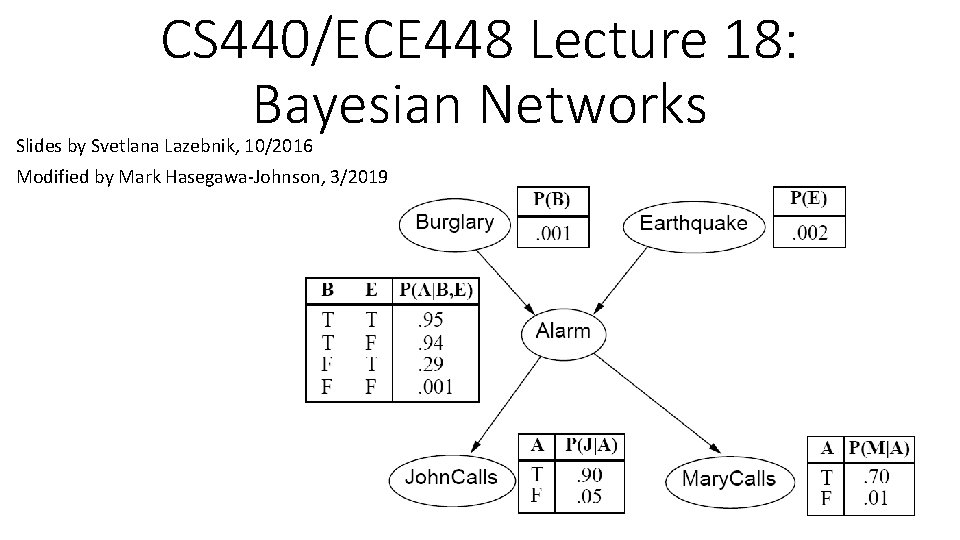
Example: Los Angeles Burglar Alarm • I have a burglar alarm that is sometimes set off by minor earthquakes. My two neighbors, John and Mary, promised to call me at work if they hear the alarm • Example inference task: suppose Mary calls and John doesn’t call. What is the probability of a burglary? • What are the random variables? • Burglary, Earthquake, Alarm, John. Calls, Mary. Calls • What are the direct influence relationships? • • A burglar can set the alarm off An earthquake can set the alarm off The alarm can cause Mary to call The alarm can cause John to call
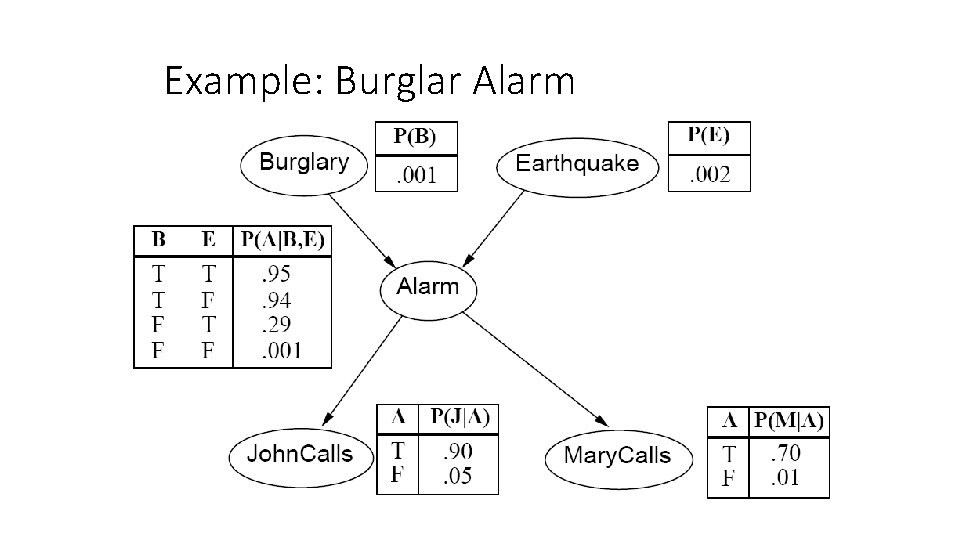
Example: Burglar Alarm
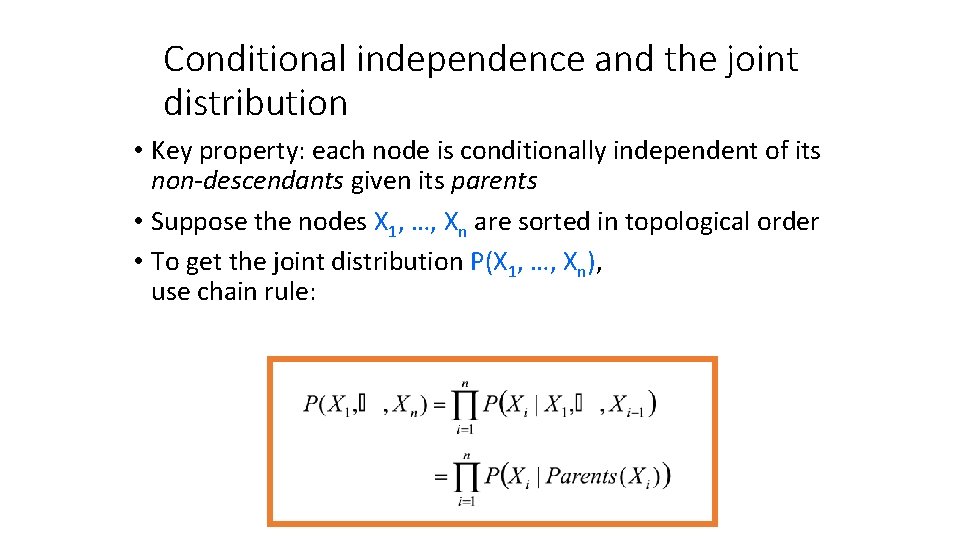
Conditional independence and the joint distribution • Key property: each node is conditionally independent of its non-descendants given its parents • Suppose the nodes X 1, …, Xn are sorted in topological order • To get the joint distribution P(X 1, …, Xn), use chain rule:
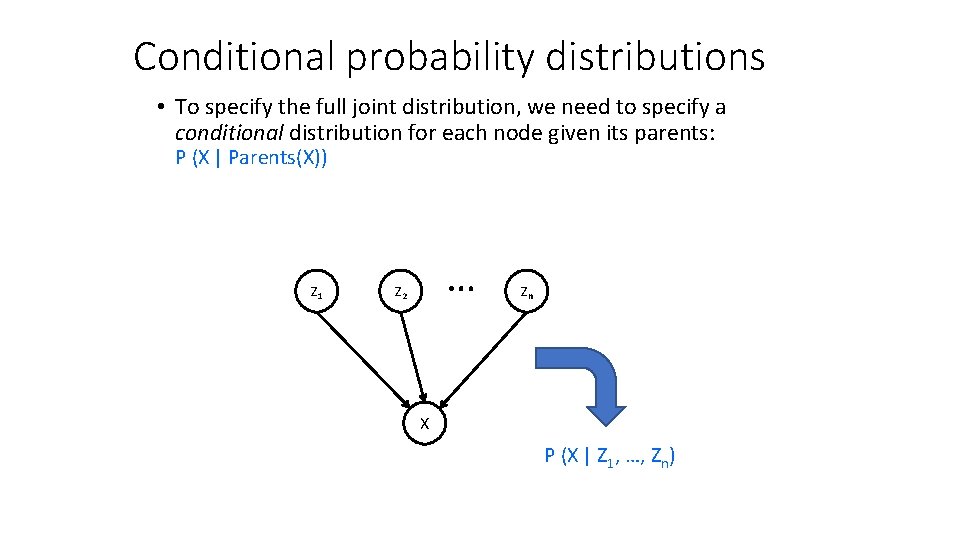
Conditional probability distributions • To specify the full joint distribution, we need to specify a conditional distribution for each node given its parents: P (X | Parents(X)) Z 1 … Z 2 Zn X P (X | Z 1, …, Zn)
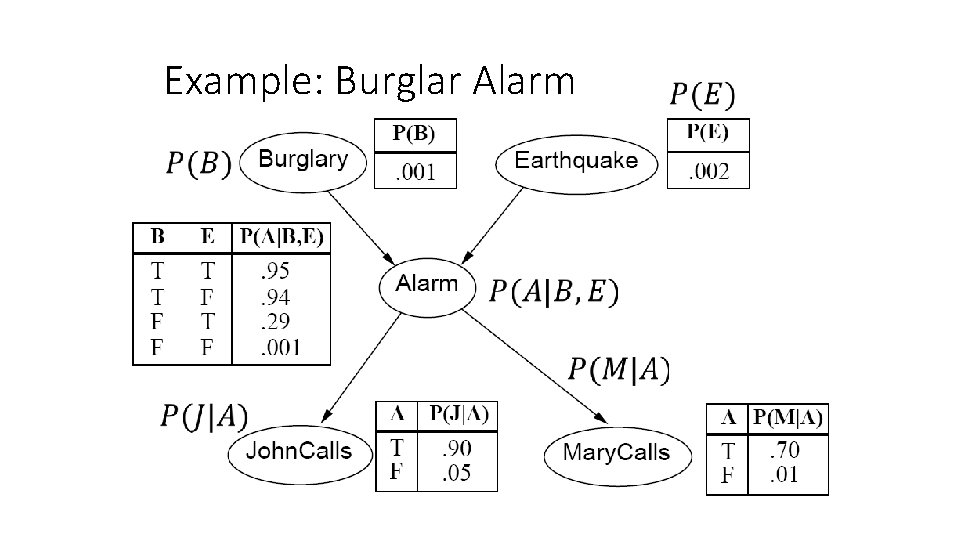
Example: Burglar Alarm

Example: Burglar Alarm • • A “model” is a complete specification of the dependencies. The conditional probability tables are the model parameters.
Outline • Review: Bayesian inference • Bayesian network: graph semantics • The Los Angeles burglar alarm example • Conditional independence ≠ Independence • Constructing a Bayesian network: Structure learning • Constructing a Bayesian network: Hire an expert
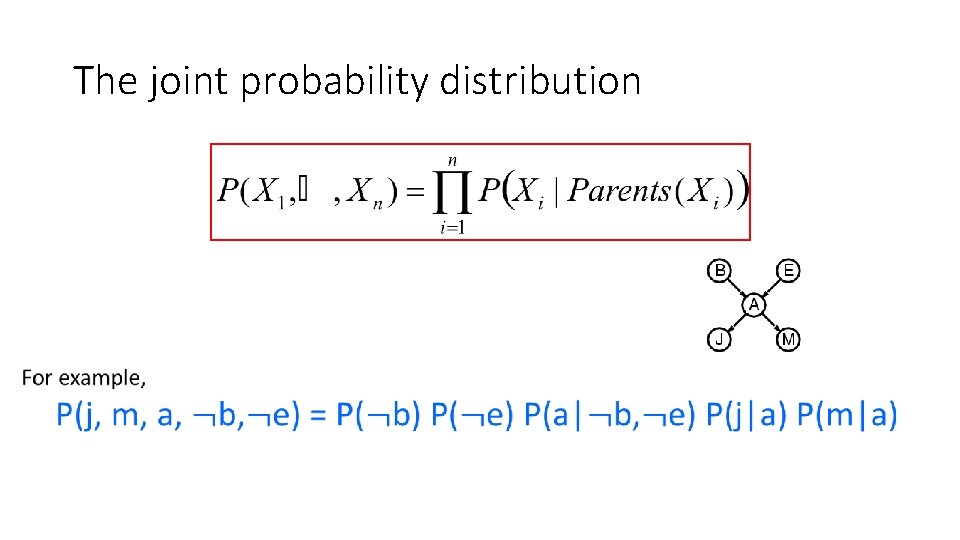
The joint probability distribution •
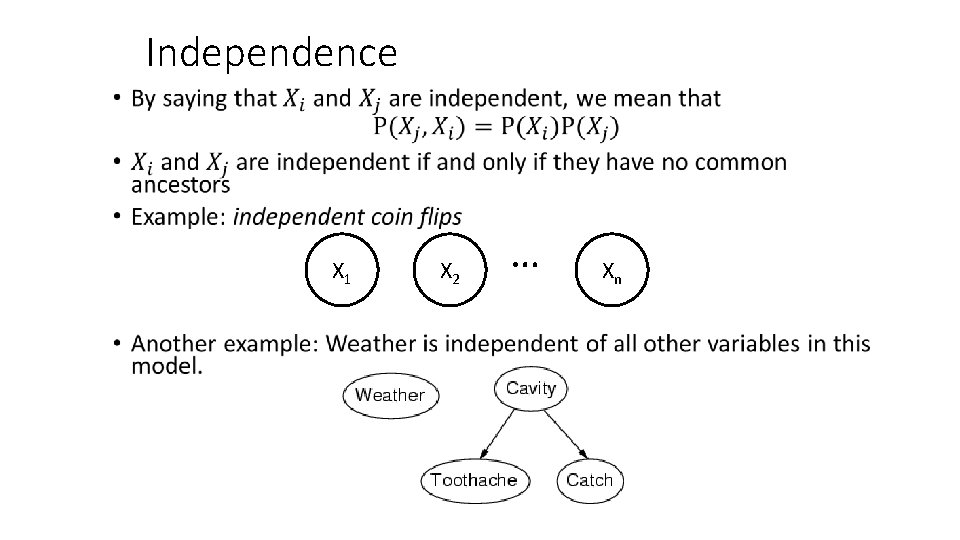
Independence • X 1 X 2 … Xn
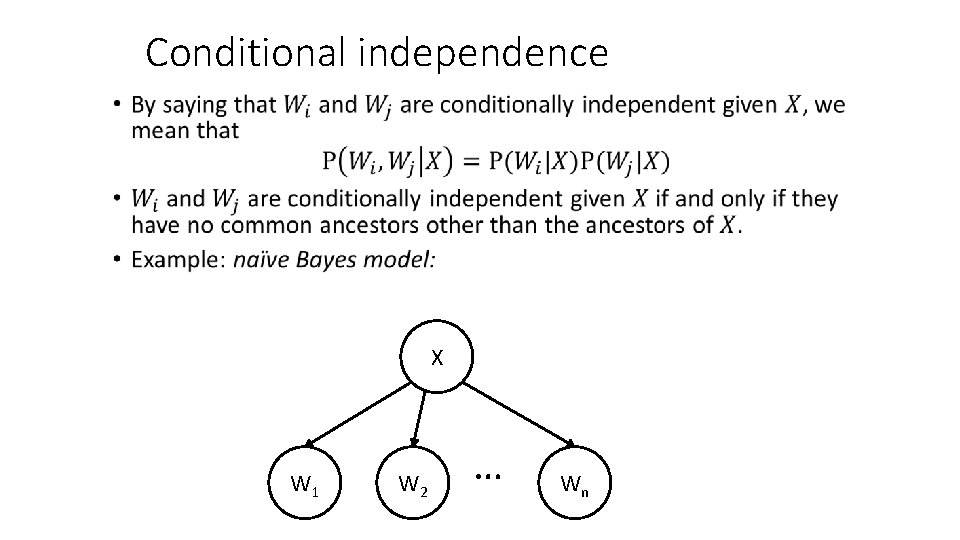
Conditional independence • X W 1 W 2 … Wn
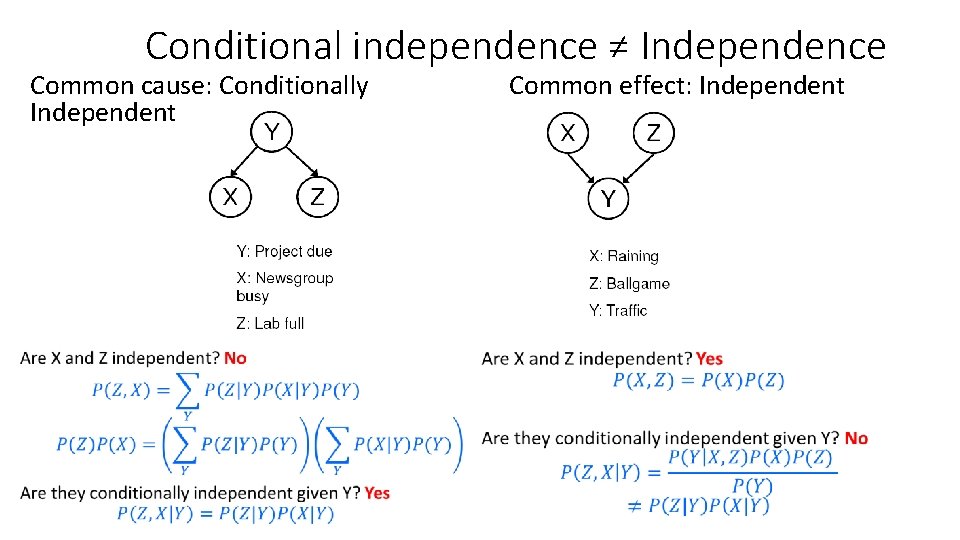
Conditional independence ≠ Independence Common cause: Conditionally Independent Common effect: Independent

Conditional independence ≠ Independence Common cause: Conditionally Independent Common effect: Independent Are X and Z independent? No Are X and Z independent? Yes Knowing X tells you about Y, which tells you about Z. Knowing X tells you nothing about Z. Are they conditionally independent given Y? Yes Are they conditionally independent given Y? No If Y is true, then either X or Z must be true. Knowing that X is false means Z must be true. We say that X “explains away” Z. If you already know Y, then X gives you no useful information about Z.
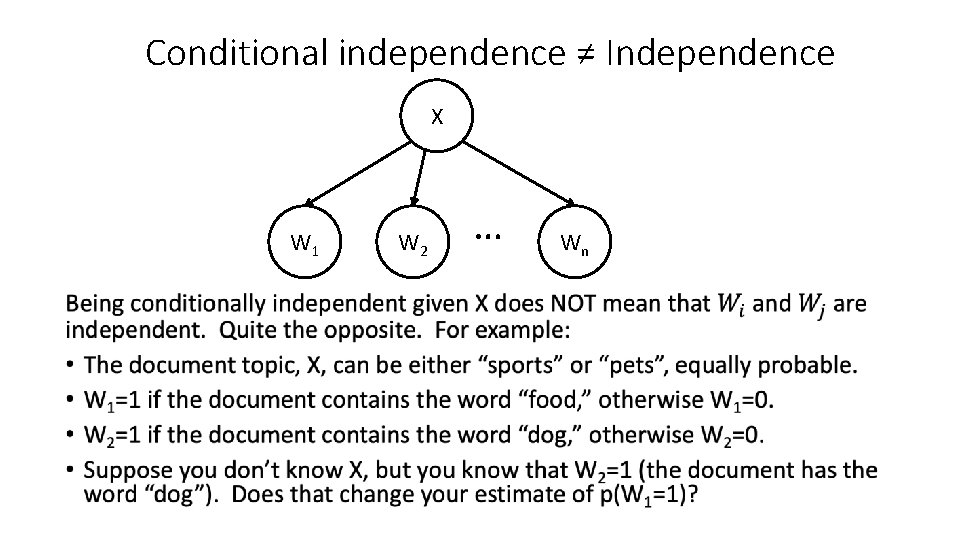
Conditional independence ≠ Independence X W 1 • W 2 … Wn

Conditional independence •
Outline • Review: Bayesian inference • Bayesian network: graph semantics • The Los Angeles burglar alarm example • Conditional independence ≠ Independence • Constructing a Bayesian network: Structure learning • Constructing a Bayesian network: Hire an expert
Constructing a Bayes Network: Two Methods 1. “Structure Learning” a. k. a. “Analysis of Causality: ” 1. Suppose you know the variables, but you don’t know which variables depend on which others. You can learn this from data. 2. This is an exciting new area of research in statistics, where it goes by the name of “analysis of causality. ” 3. … but it’s almost always harder than method #2. You should know how to do this in very simple examples (like the Los Angeles burglar alarm), but you don’t need to know how to do this in the general case. 2. “Hire an Expert: ” 1. Find somebody who knows how to solve the problem. 2. Get her to tell you what are the important variables, and which variables depend on which others. 3. THIS IS ALMOST ALWAYS THE BEST WAY.
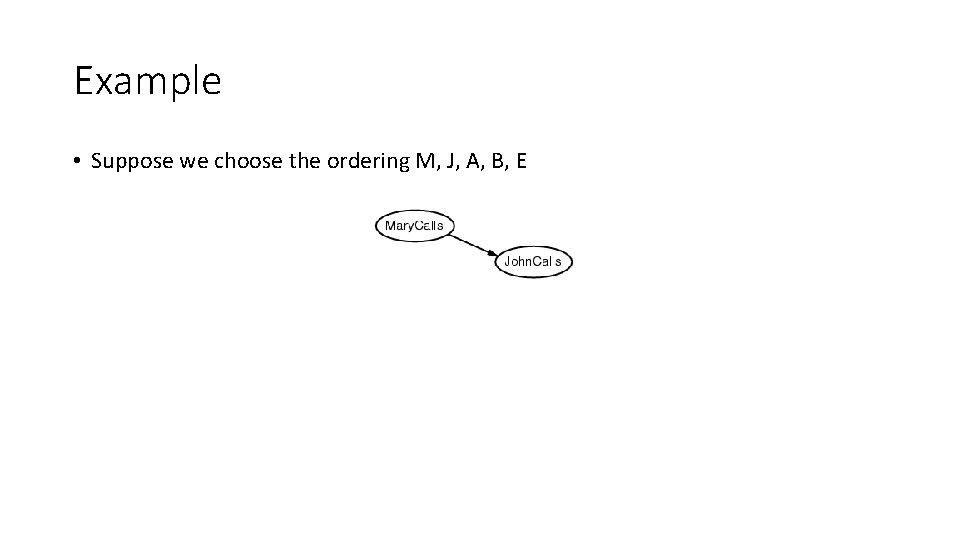
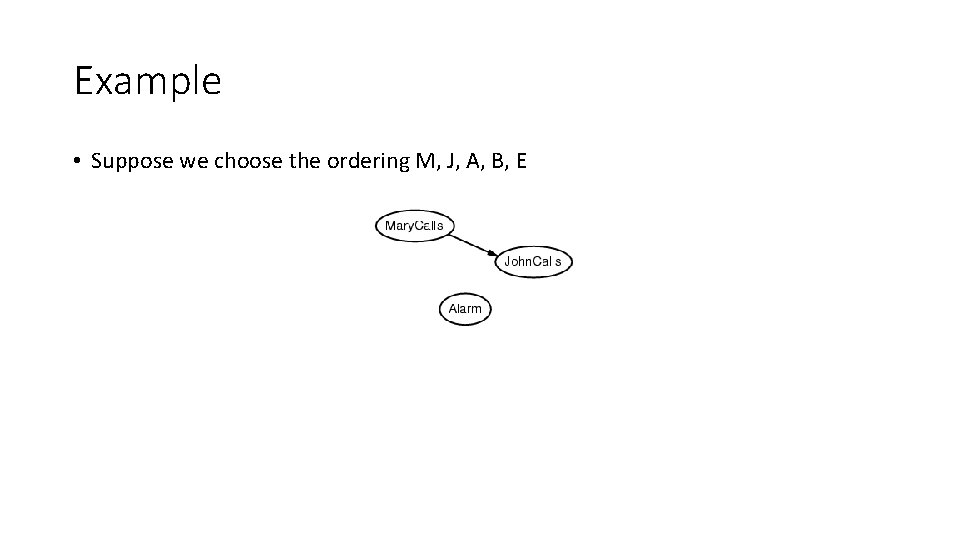
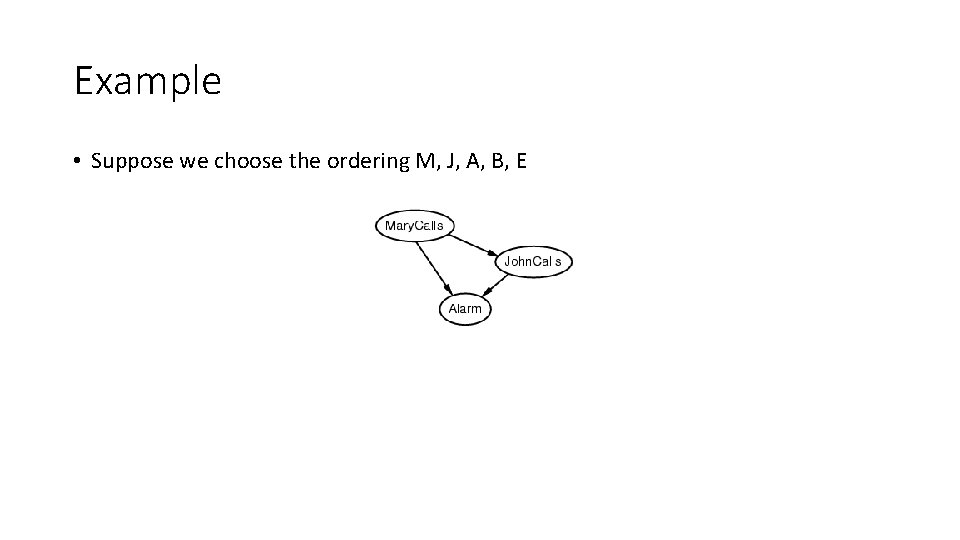
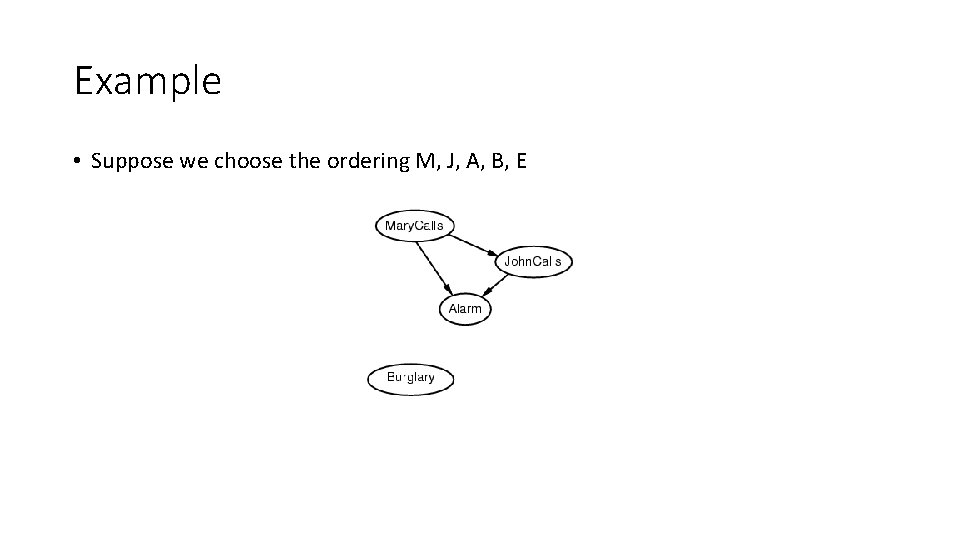
Constructing Bayesian networks: Structure Learning 1. Choose an ordering of variables X 1, … , Xn 2. For i = 1 to n • add Xi to the network • Check your training data. If there is any variable X 1, … , Xi-1 that CHANGES the probability of Xi=1, then add that variable to the set Parents(Xi) such that P(Xi | Parents(Xi)) = P(Xi | X 1, . . . Xi-1) 3. Repeat the above steps for every possible ordering (complexity: n!). 4. Choose the graph that has the smallest number of edges.
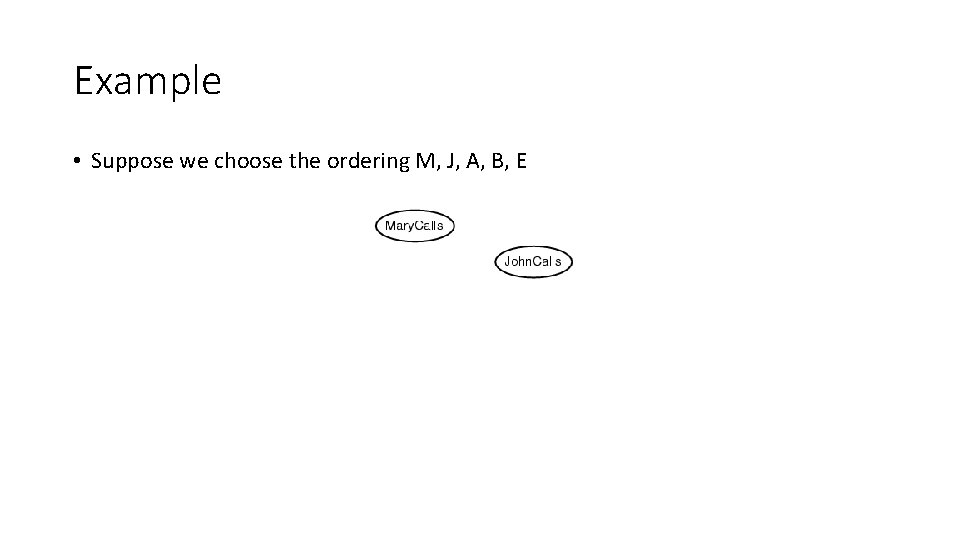
Example • Suppose we choose the ordering M, J, A, B, E
Example • Suppose we choose the ordering M, J, A, B, E
Example • Suppose we choose the ordering M, J, A, B, E
Example • Suppose we choose the ordering M, J, A, B, E
Example • Suppose we choose the ordering M, J, A, B, E
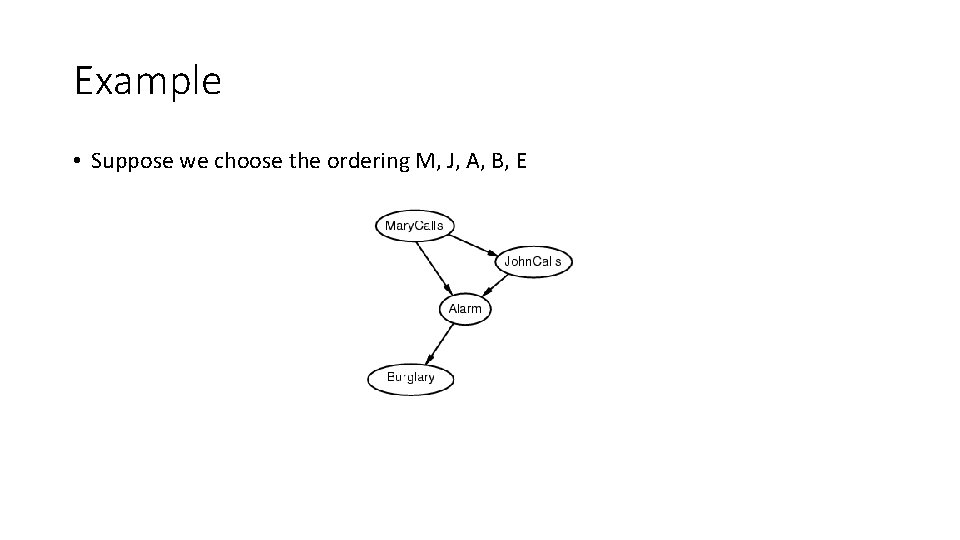
Example • Suppose we choose the ordering M, J, A, B, E
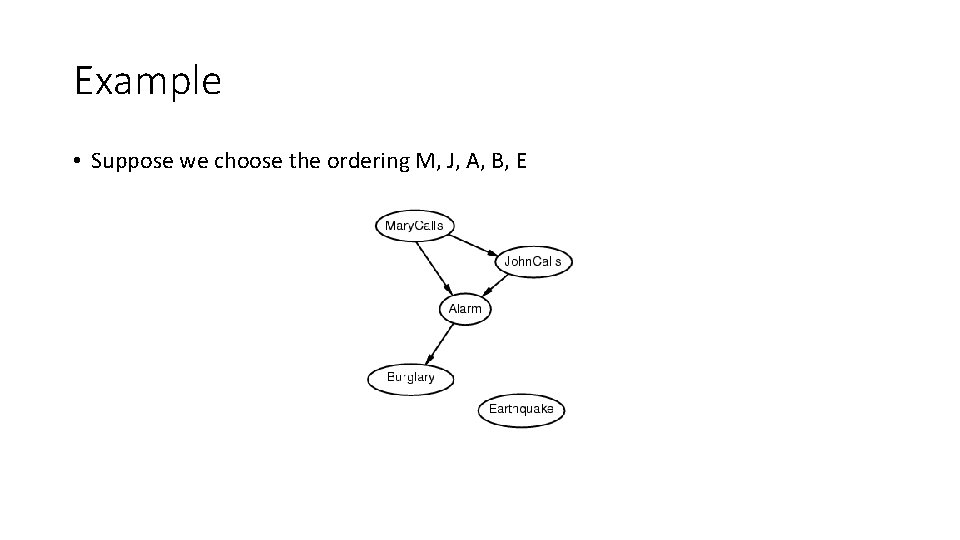
Example • Suppose we choose the ordering M, J, A, B, E
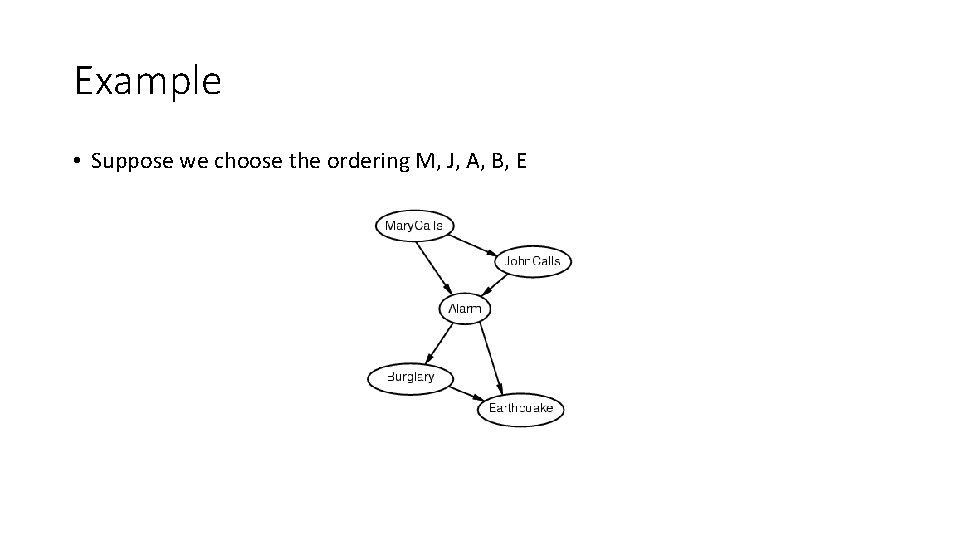
Example • Suppose we choose the ordering M, J, A, B, E
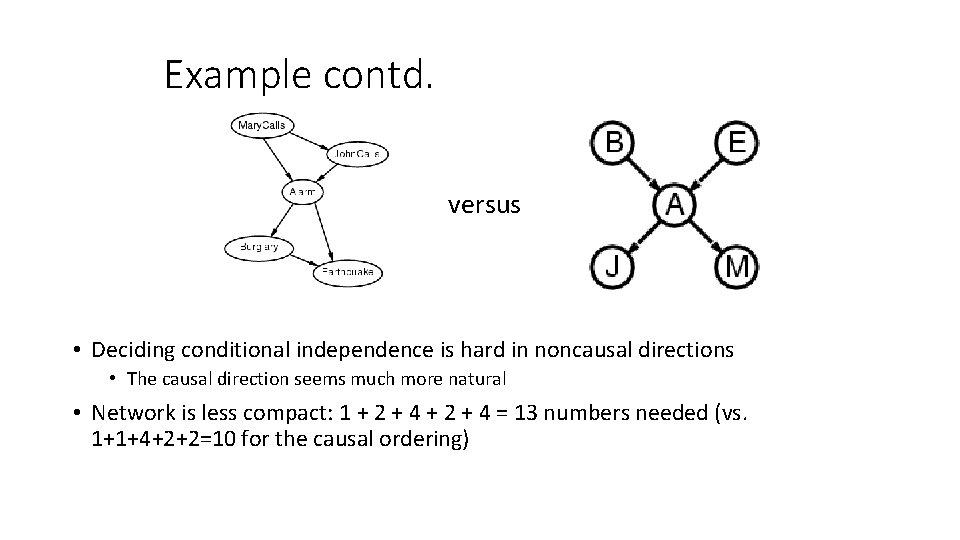
Example contd. versus • Deciding conditional independence is hard in noncausal directions • The causal direction seems much more natural • Network is less compact: 1 + 2 + 4 = 13 numbers needed (vs. 1+1+4+2+2=10 for the causal ordering)
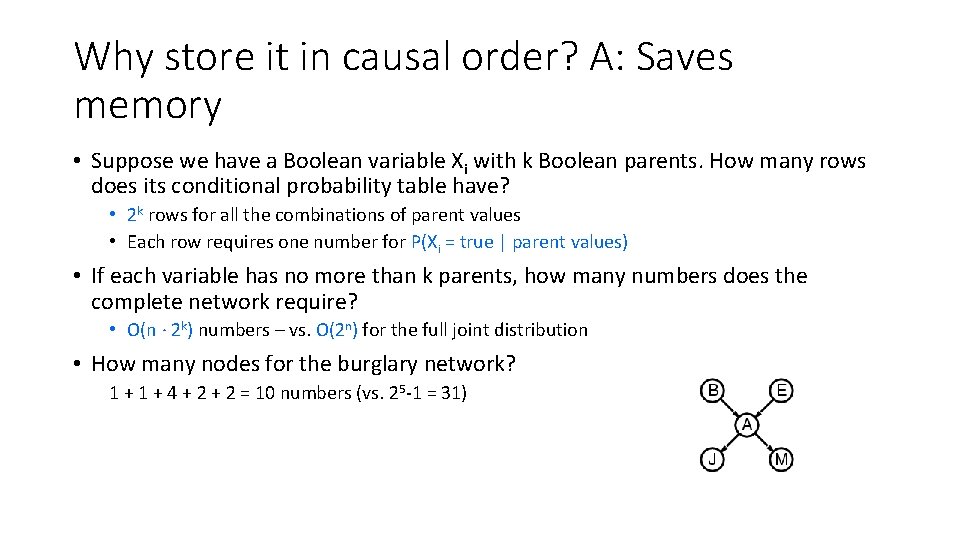
Why store it in causal order? A: Saves memory • Suppose we have a Boolean variable Xi with k Boolean parents. How many rows does its conditional probability table have? • 2 k rows for all the combinations of parent values • Each row requires one number for P(Xi = true | parent values) • If each variable has no more than k parents, how many numbers does the complete network require? • O(n · 2 k) numbers – vs. O(2 n) for the full joint distribution • How many nodes for the burglary network? 1 + 4 + 2 = 10 numbers (vs. 25 -1 = 31)
Outline • Review: Bayesian inference • Bayesian network: graph semantics • The Los Angeles burglar alarm example • Conditional independence ≠ Independence • Constructing a Bayesian network: Structure learning • Constructing a Bayesian network: Hire an expert
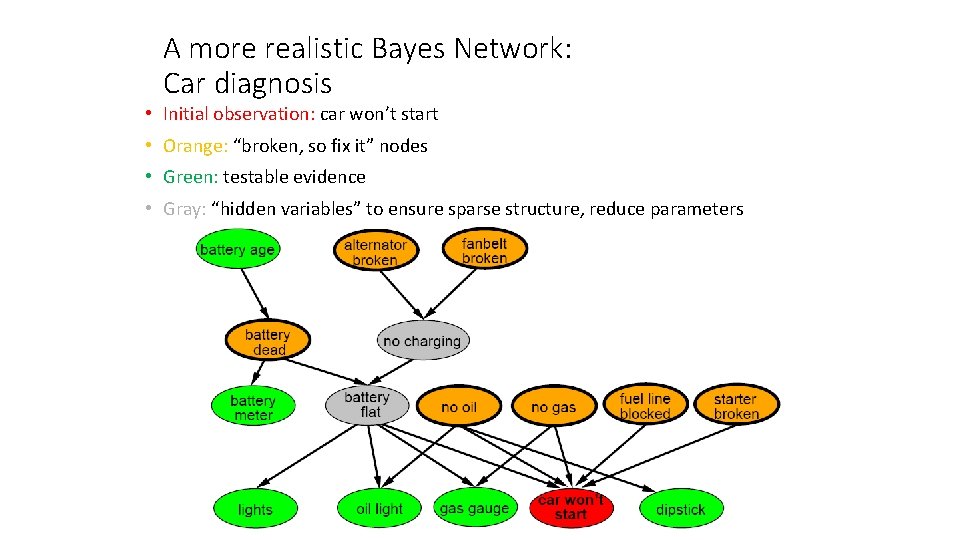
A more realistic Bayes Network: Car diagnosis • Initial observation: car won’t start • Orange: “broken, so fix it” nodes • Green: testable evidence • Gray: “hidden variables” to ensure sparse structure, reduce parameters
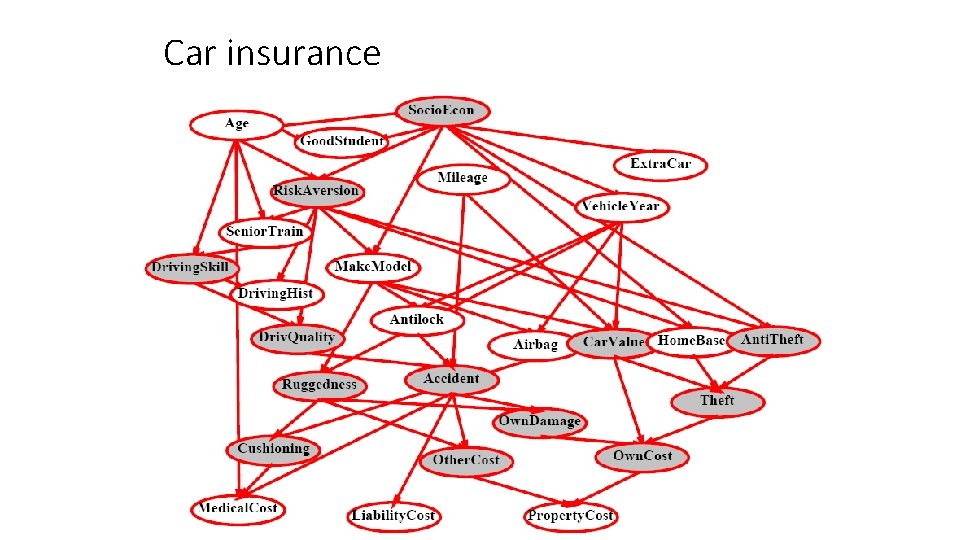
Car insurance
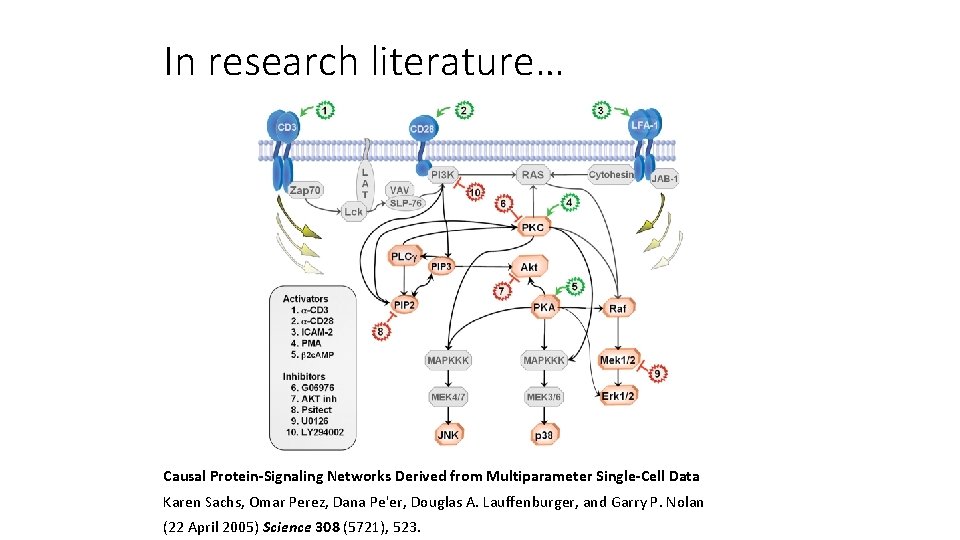
In research literature… Causal Protein-Signaling Networks Derived from Multiparameter Single-Cell Data Karen Sachs, Omar Perez, Dana Pe'er, Douglas A. Lauffenburger, and Garry P. Nolan (22 April 2005) Science 308 (5721), 523.
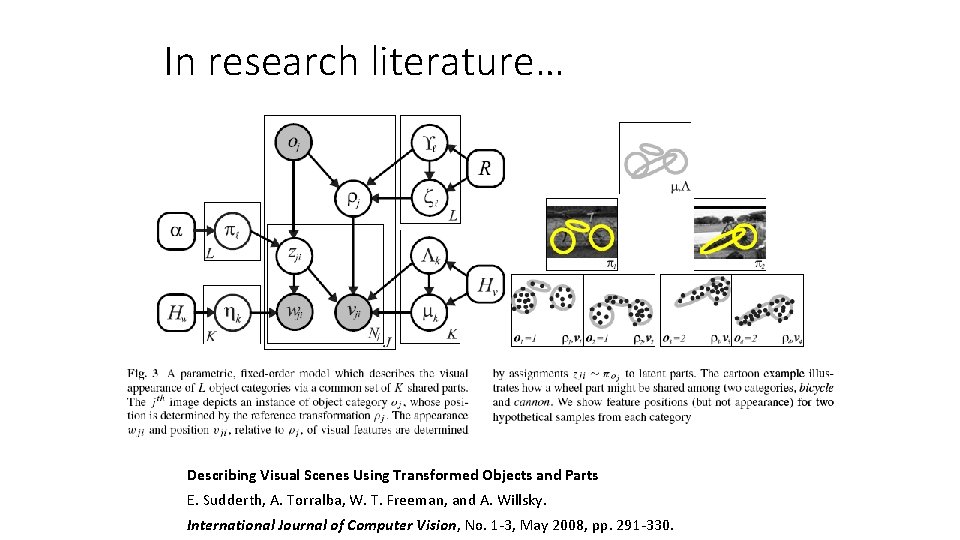
In research literature… Describing Visual Scenes Using Transformed Objects and Parts E. Sudderth, A. Torralba, W. T. Freeman, and A. Willsky. International Journal of Computer Vision, No. 1 -3, May 2008, pp. 291 -330.

In research literature… Audiovisual Speech Recognition with Articulator Positions as Hidden Variables Mark Hasegawa-Johnson, Karen Livescu, Partha Lal and Kate Saenko International Congress on Phonetic Sciences 1719: 299 -302, 2007
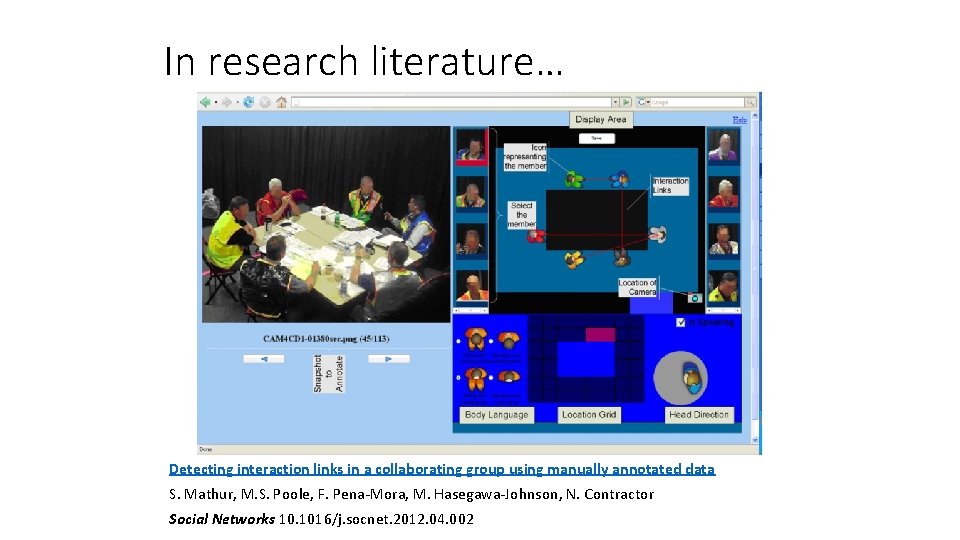
In research literature… Detecting interaction links in a collaborating group using manually annotated data S. Mathur, M. S. Poole, F. Pena-Mora, M. Hasegawa-Johnson, N. Contractor Social Networks 10. 1016/j. socnet. 2012. 04. 002
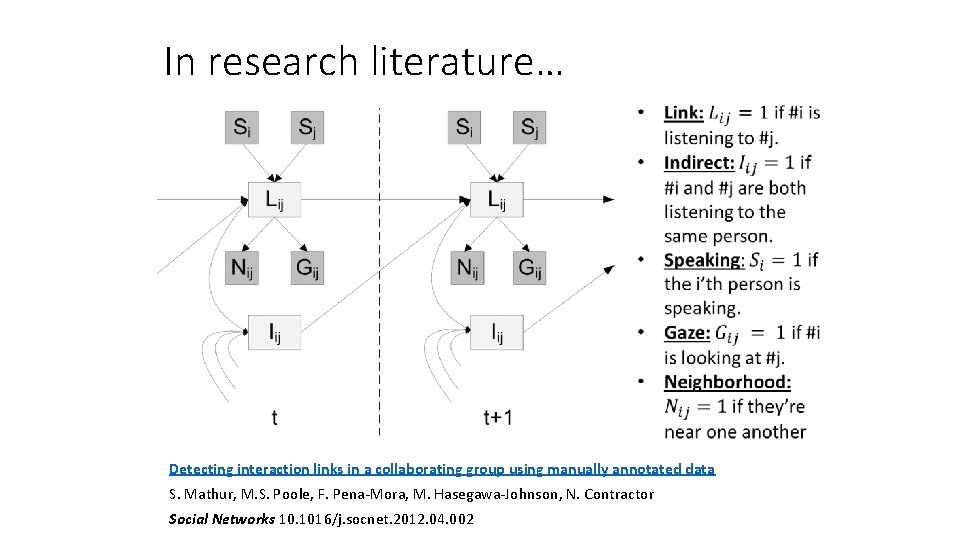
In research literature… Detecting interaction links in a collaborating group using manually annotated data S. Mathur, M. S. Poole, F. Pena-Mora, M. Hasegawa-Johnson, N. Contractor Social Networks 10. 1016/j. socnet. 2012. 04. 002
Summary • Bayesian networks provide a natural representation for (causally induced) conditional independence • Topology + conditional probability tables • Generally easy for domain experts to construct
- Slides: 46