
CS 440ECE 448 Lecture 17 Bayesian Inference Slides
CS 440/ECE 448 Lecture 17: Bayesian Inference Slides by Svetlana Lazebnik, 10/2016 Modified by Mark Hasegawa-Johnson, 10/2017
Review: Probability • Random variables, events • Axioms of probability • Atomic events • Joint and marginal probability distributions • Conditional probability distributions • Product rule, chain rule • Independence and conditional independence
Outline: Bayesian Inference • Bayes Rule • Law of Total Probability • Misdiagnosis • MAP = MPE • The “Naïve Bayesian” Assumption • Bag of Words (Bo. W) • Parameter Estimation for the Bo. W model
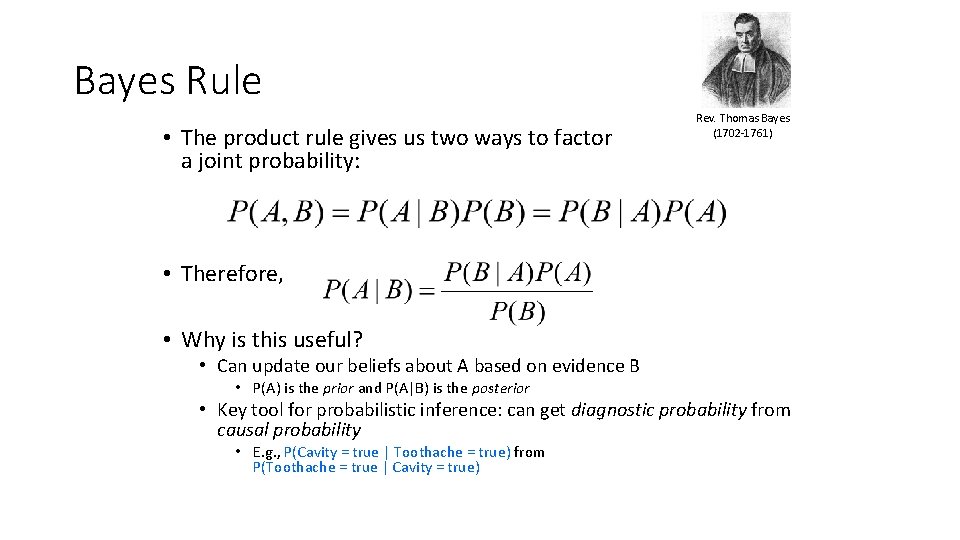
Bayes Rule • The product rule gives us two ways to factor a joint probability: Rev. Thomas Bayes (1702 -1761) • Therefore, • Why is this useful? • Can update our beliefs about A based on evidence B • P(A) is the prior and P(A|B) is the posterior • Key tool for probabilistic inference: can get diagnostic probability from causal probability • E. g. , P(Cavity = true | Toothache = true) from P(Toothache = true | Cavity = true)
Bayes Rule example Dan & Dana are getting married tomorrow, at an outdoor ceremony in the desert. In recent years, it has rained only 5 days each year (5/365 = 0. 014). Unfortunately, the weatherman has predicted rain for tomorrow. When it actually rains, the weatherman correctly forecasts rain 90% of the time. When it doesn't rain, he incorrectly forecasts rain 10% of the time. What is the probability that it will rain on their wedding?
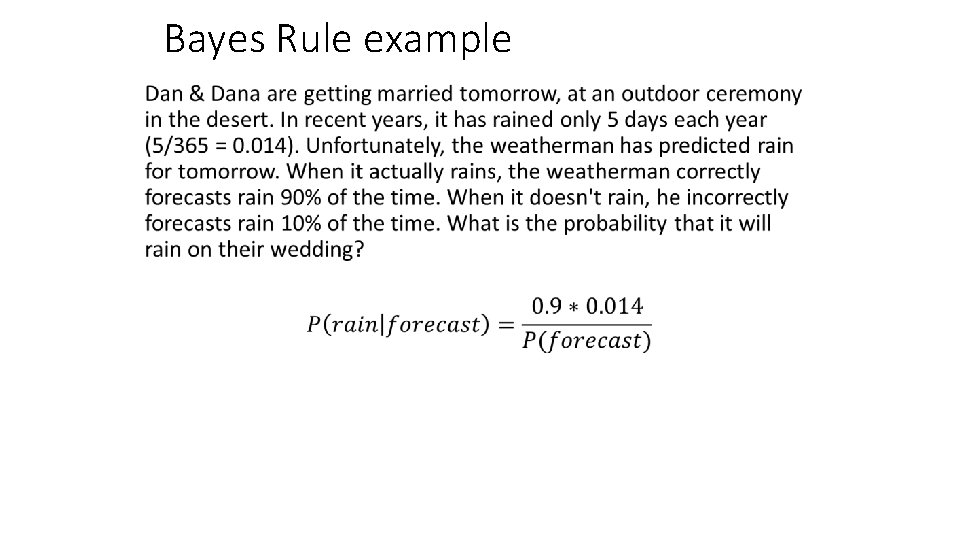
Bayes Rule example •
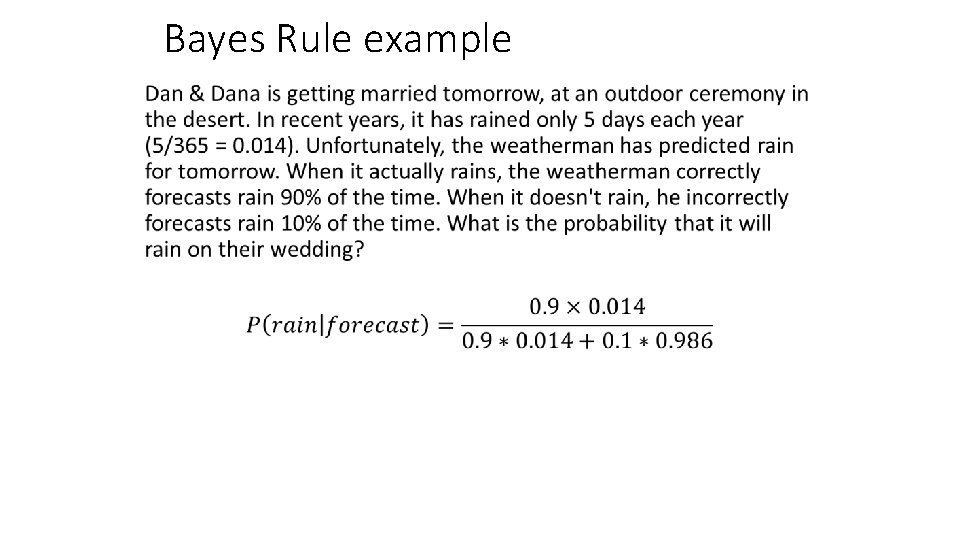
Bayes Rule example •
Outline: Bayesian Inference • Bayes Rule • Law of Total Probability • Misdiagnosis • MAP = MPE • The “Naïve Bayesian” Assumption • Bag of Words (Bo. W) • Parameter Estimation for the Bo. W model
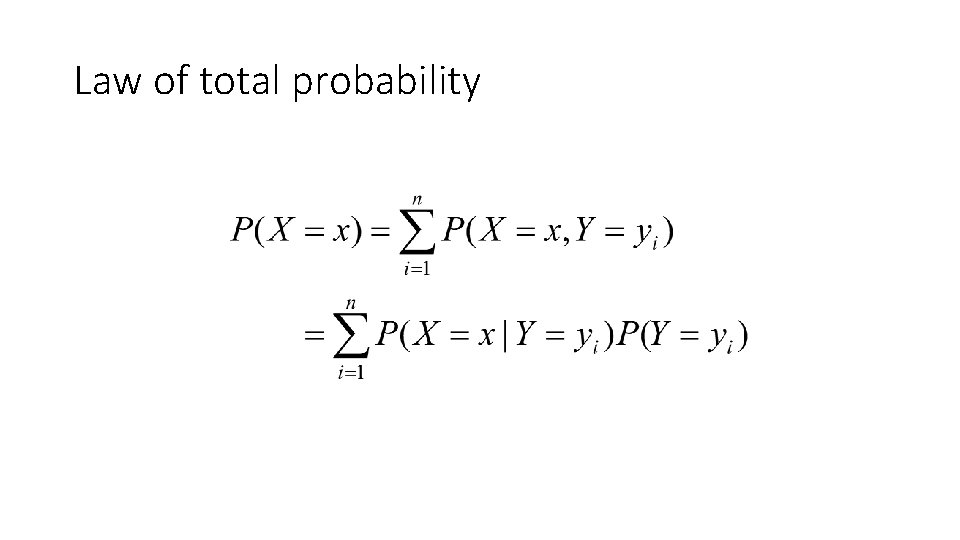
Law of total probability
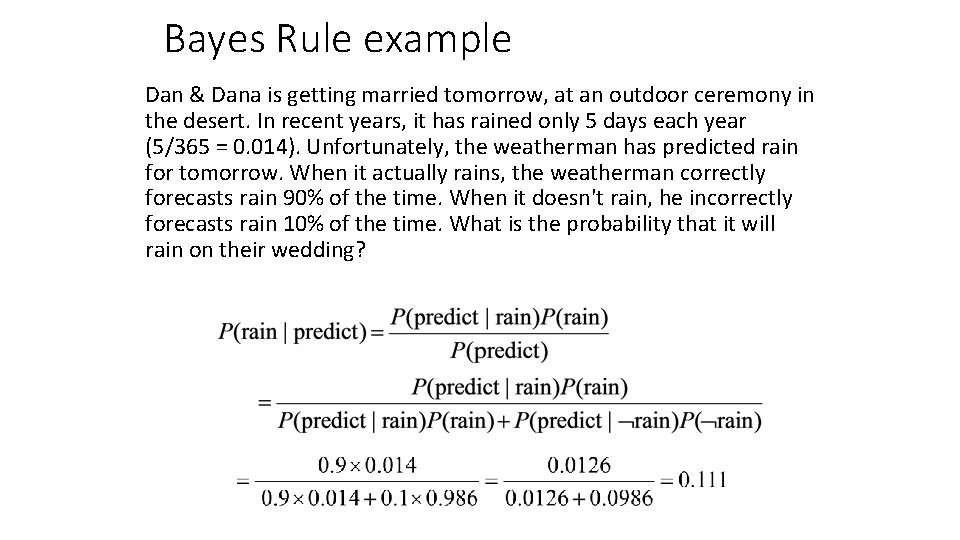
Bayes Rule example Dan & Dana is getting married tomorrow, at an outdoor ceremony in the desert. In recent years, it has rained only 5 days each year (5/365 = 0. 014). Unfortunately, the weatherman has predicted rain for tomorrow. When it actually rains, the weatherman correctly forecasts rain 90% of the time. When it doesn't rain, he incorrectly forecasts rain 10% of the time. What is the probability that it will rain on their wedding?
Outline: Bayesian Inference • Bayes Rule • Law of Total Probability • Misdiagnosis • MAP = MPE • The “Naïve Bayesian” Assumption • Bag of Words (Bo. W) • Parameter Estimation for the Bo. W model
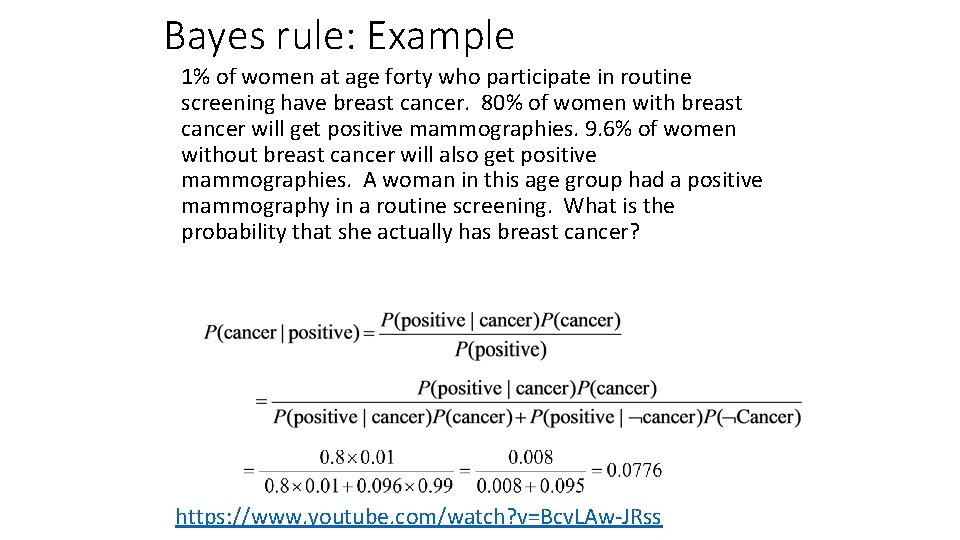
Bayes rule: Example 1% of women at age forty who participate in routine screening have breast cancer. 80% of women with breast cancer will get positive mammographies. 9. 6% of women without breast cancer will also get positive mammographies. A woman in this age group had a positive mammography in a routine screening. What is the probability that she actually has breast cancer? https: //www. youtube. com/watch? v=Bcv. LAw-JRss
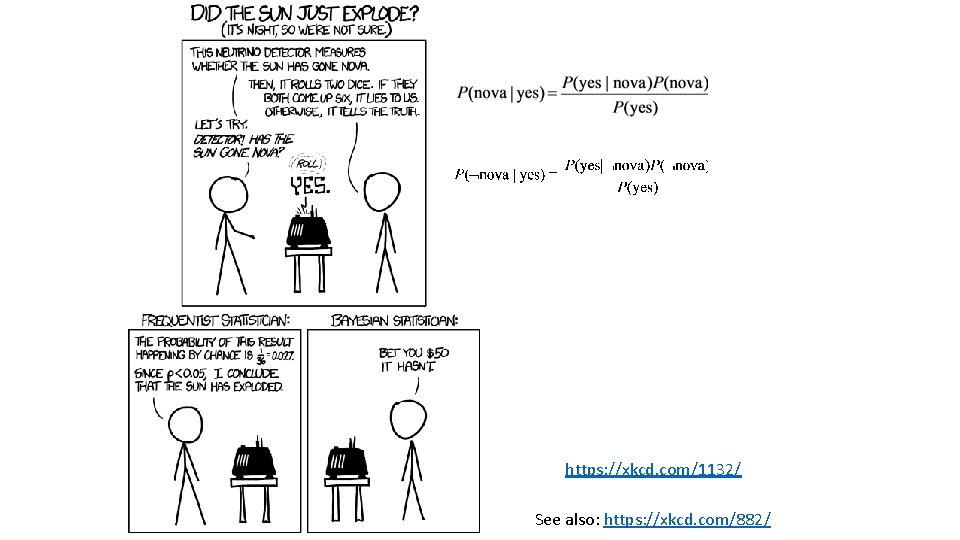
https: //xkcd. com/1132/ See also: https: //xkcd. com/882/
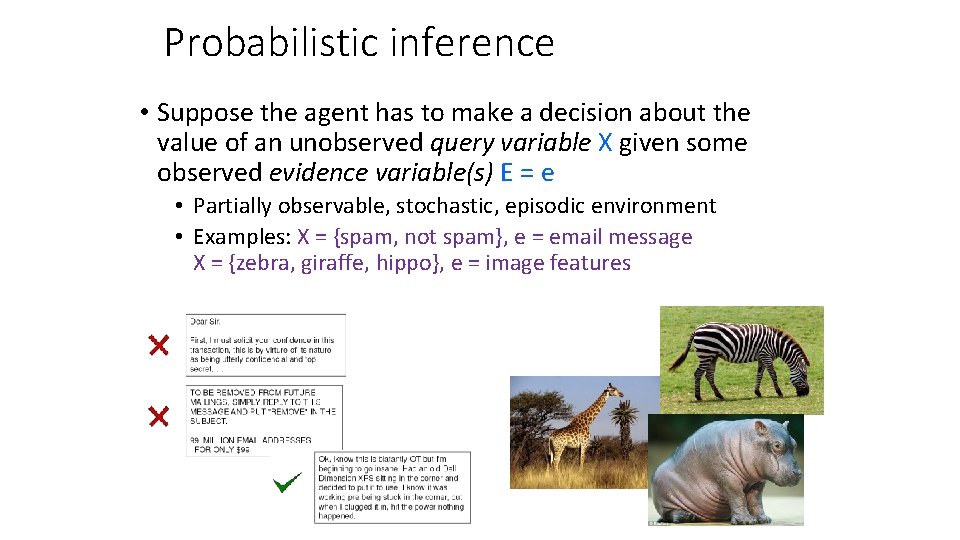
Probabilistic inference • Suppose the agent has to make a decision about the value of an unobserved query variable X given some observed evidence variable(s) E = e • Partially observable, stochastic, episodic environment • Examples: X = {spam, not spam}, e = email message X = {zebra, giraffe, hippo}, e = image features
Outline: Bayesian Inference • Bayes Rule • Law of Total Probability • Misdiagnosis • MAP = MPE • The “Naïve Bayesian” Assumption • Bag of Words (Bo. W) • Parameter Estimation for the Bo. W model
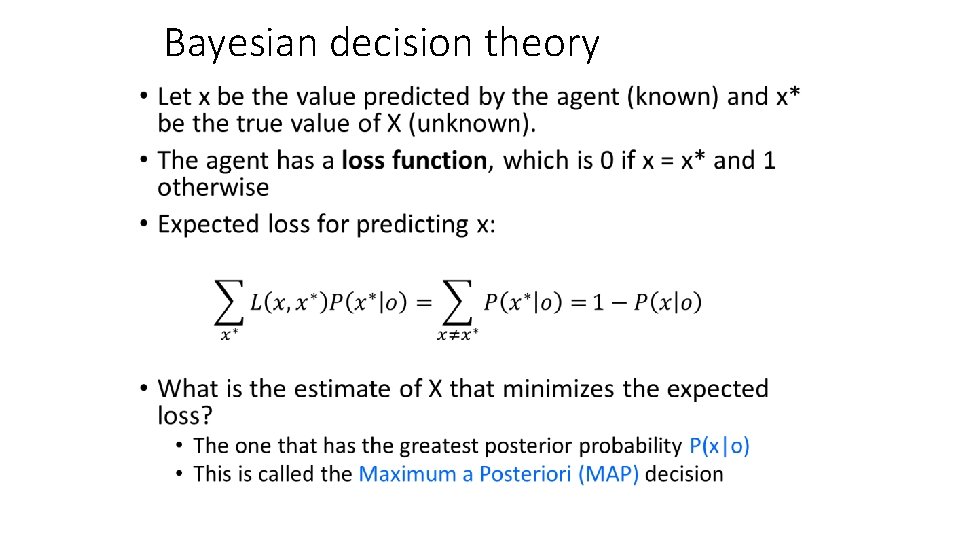
Bayesian decision theory •
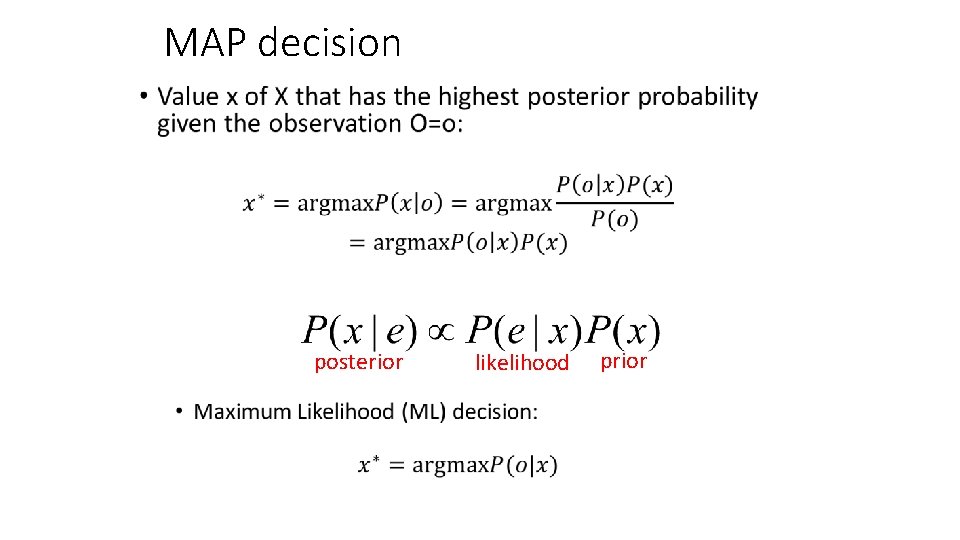
MAP decision • posterior likelihood prior
Outline: Bayesian Inference • Bayes Rule • Law of Total Probability • Misdiagnosis • MAP = MPE • The “Naïve Bayesian” Assumption • Bag of Words (Bo. W) • Parameter Estimation for the Bo. W model
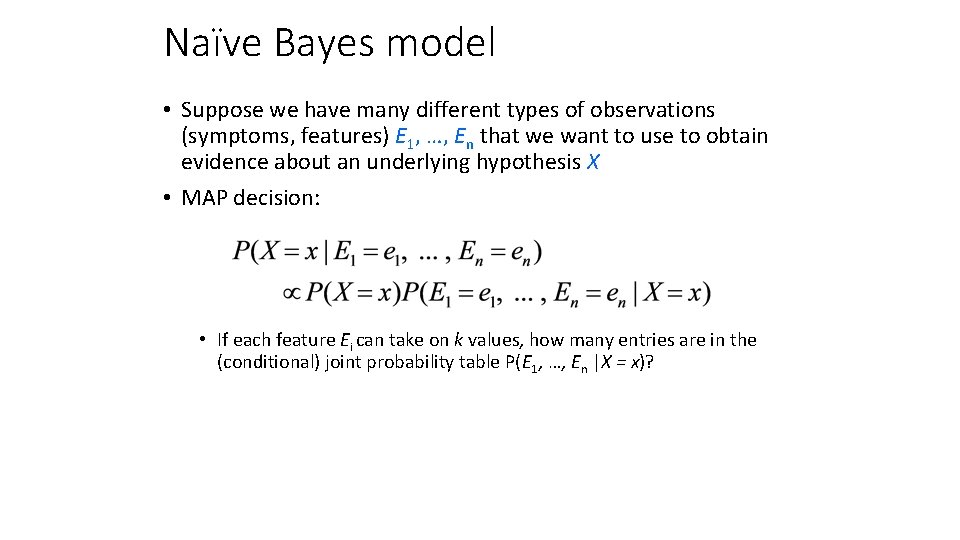
Naïve Bayes model • Suppose we have many different types of observations (symptoms, features) E 1, …, En that we want to use to obtain evidence about an underlying hypothesis X • MAP decision: • If each feature Ei can take on k values, how many entries are in the (conditional) joint probability table P(E 1, …, En |X = x)?
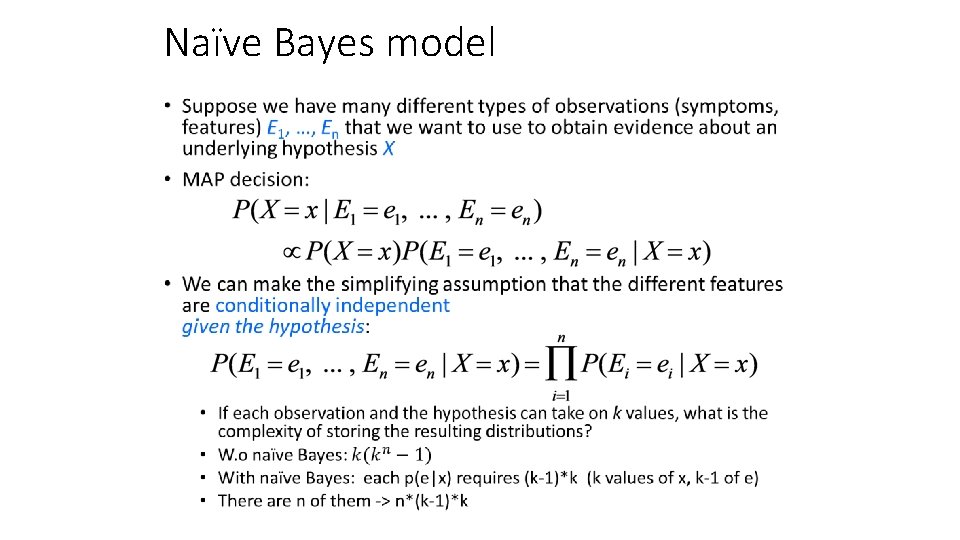
Naïve Bayes model •
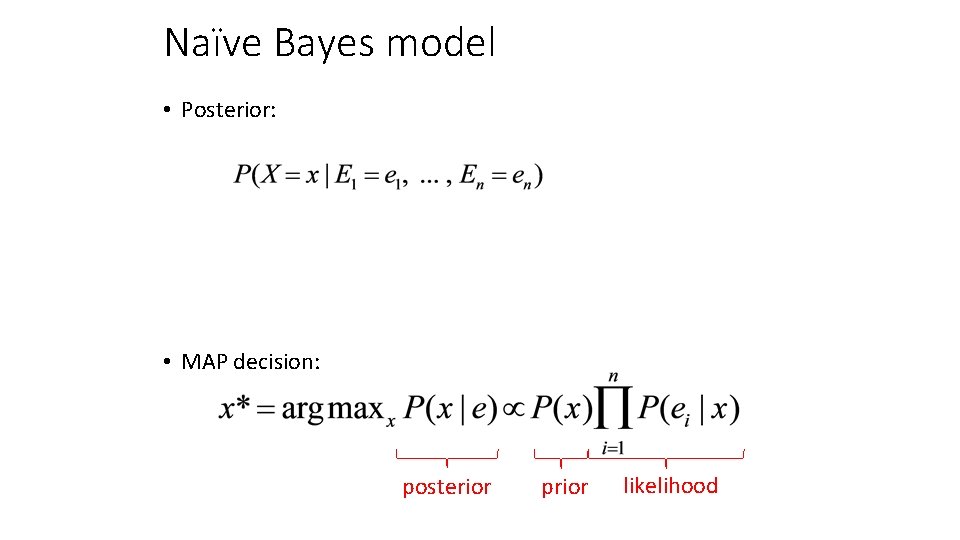
Naïve Bayes model • Posterior: • MAP decision: posterior prior likelihood
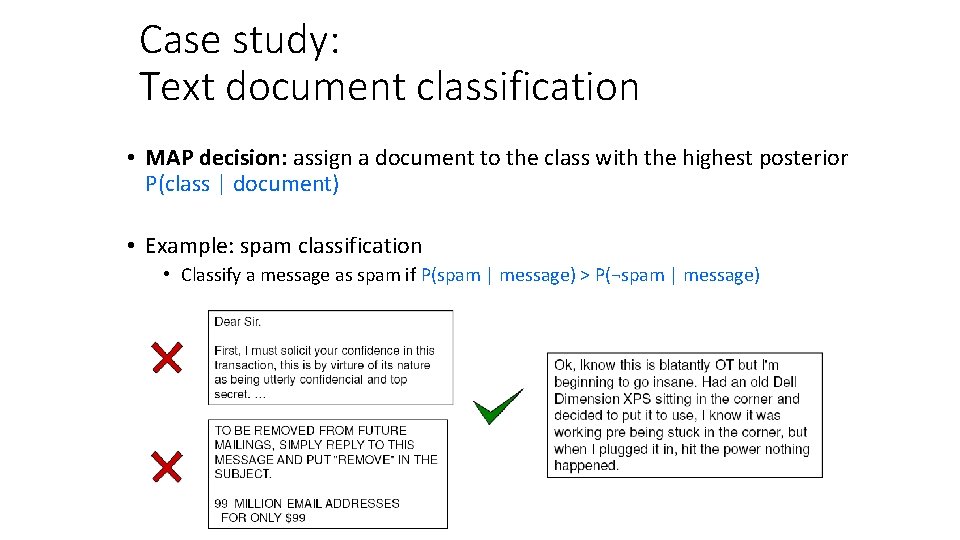
Case study: Text document classification • MAP decision: assign a document to the class with the highest posterior P(class | document) • Example: spam classification • Classify a message as spam if P(spam | message) > P(¬spam | message)
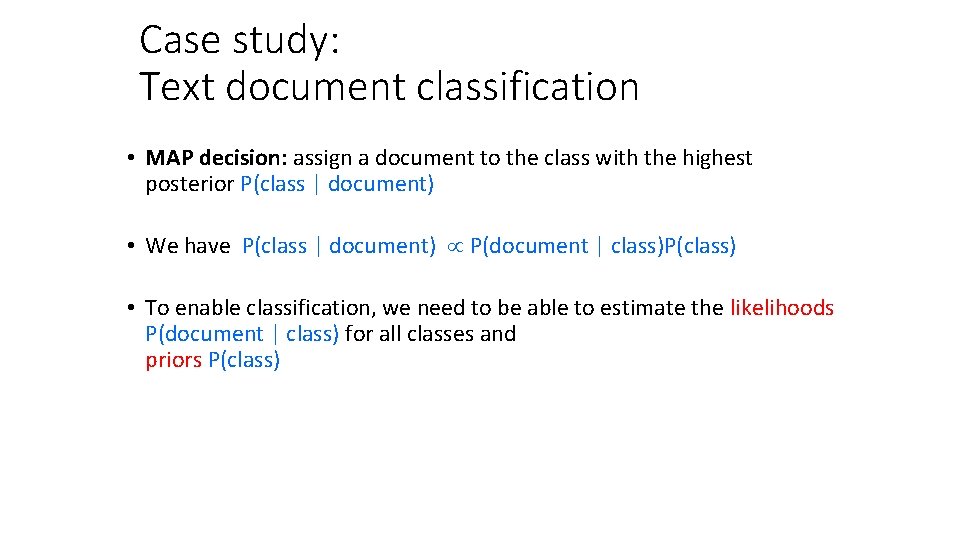
Case study: Text document classification • MAP decision: assign a document to the class with the highest posterior P(class | document) • We have P(class | document) P(document | class)P(class) • To enable classification, we need to be able to estimate the likelihoods P(document | class) for all classes and priors P(class)
Outline: Bayesian Inference • Bayes Rule • Law of Total Probability • Misdiagnosis • MAP = MPE • The “Naïve Bayesian” Assumption • Bag of Words (Bo. W) • Parameter Estimation for the Bo. W model
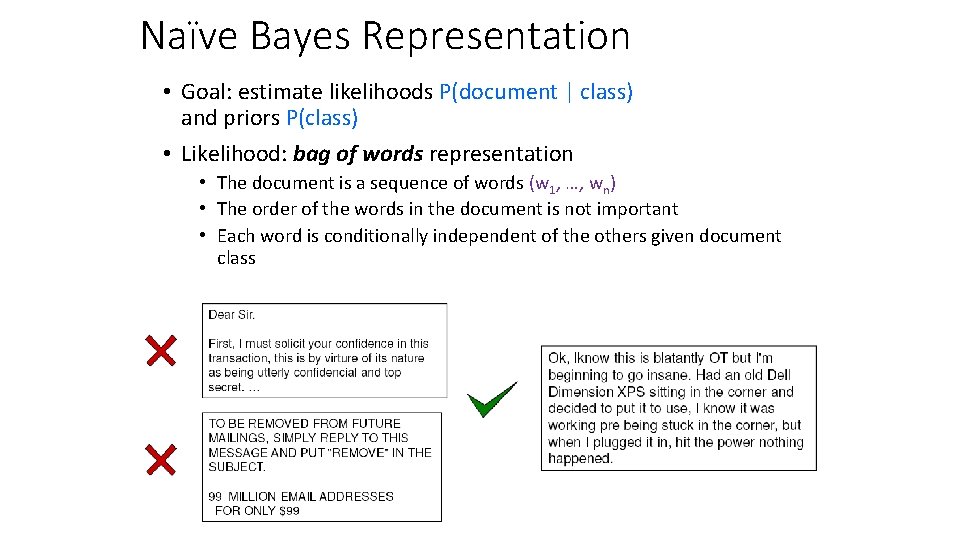
Naïve Bayes Representation • Goal: estimate likelihoods P(document | class) and priors P(class) • Likelihood: bag of words representation • The document is a sequence of words (w 1, …, wn) • The order of the words in the document is not important • Each word is conditionally independent of the others given document class
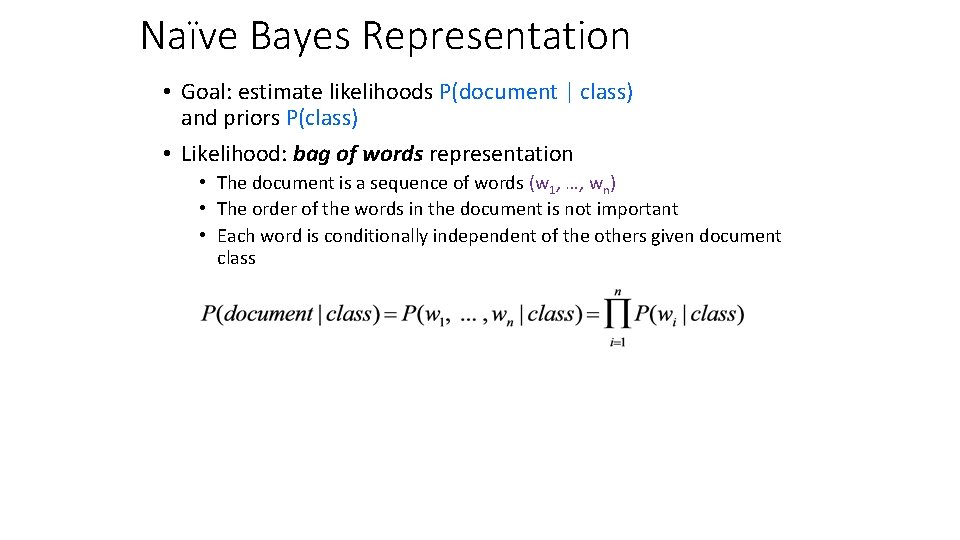
Naïve Bayes Representation • Goal: estimate likelihoods P(document | class) and priors P(class) • Likelihood: bag of words representation • The document is a sequence of words (w 1, …, wn) • The order of the words in the document is not important • Each word is conditionally independent of the others given document class
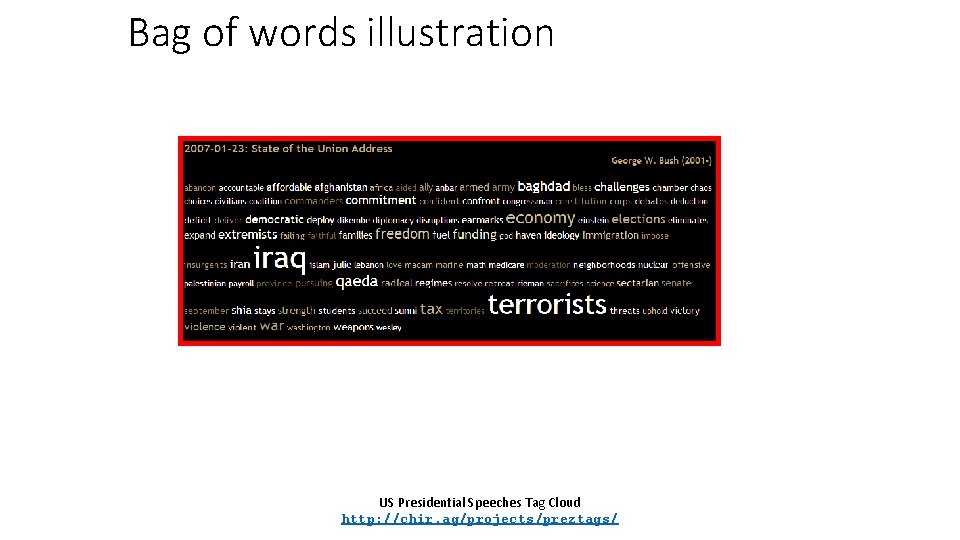
Bag of words illustration US Presidential Speeches Tag Cloud http: //chir. ag/projects/preztags/
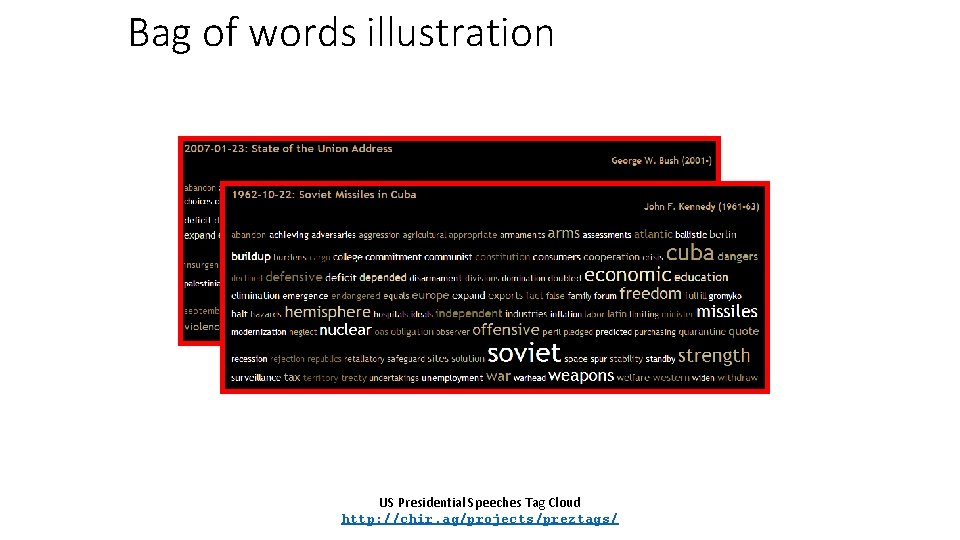
Bag of words illustration US Presidential Speeches Tag Cloud http: //chir. ag/projects/preztags/
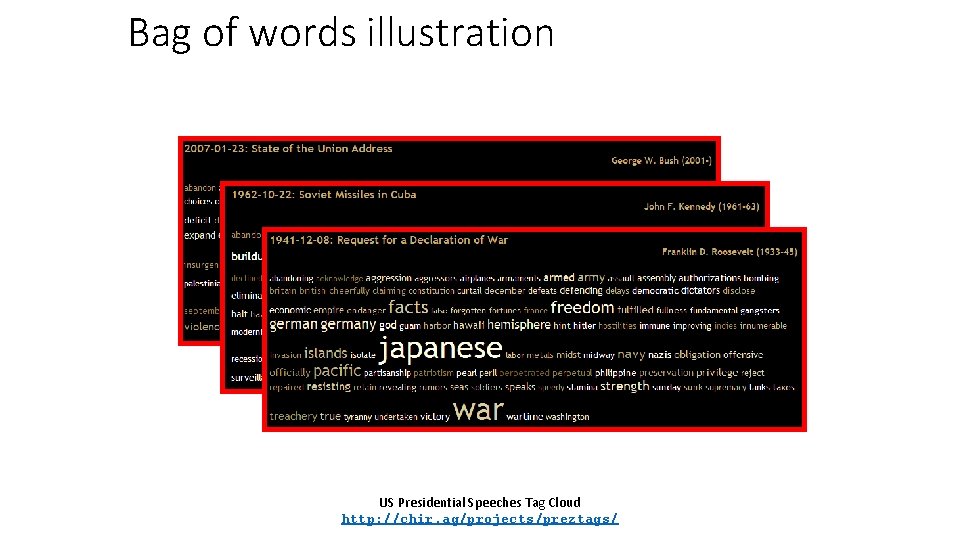
Bag of words illustration US Presidential Speeches Tag Cloud http: //chir. ag/projects/preztags/
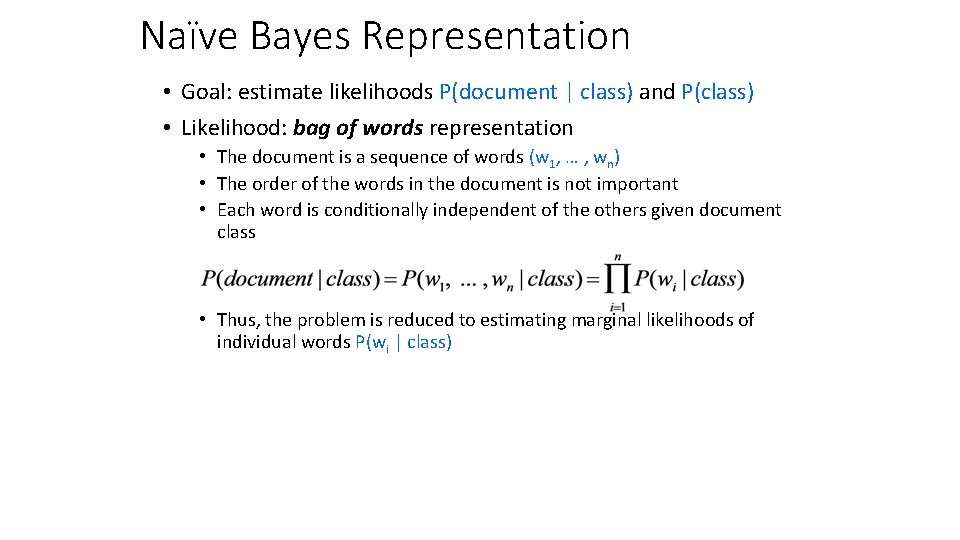
Naïve Bayes Representation • Goal: estimate likelihoods P(document | class) and P(class) • Likelihood: bag of words representation • The document is a sequence of words (w 1, … , wn) • The order of the words in the document is not important • Each word is conditionally independent of the others given document class • Thus, the problem is reduced to estimating marginal likelihoods of individual words P(wi | class)
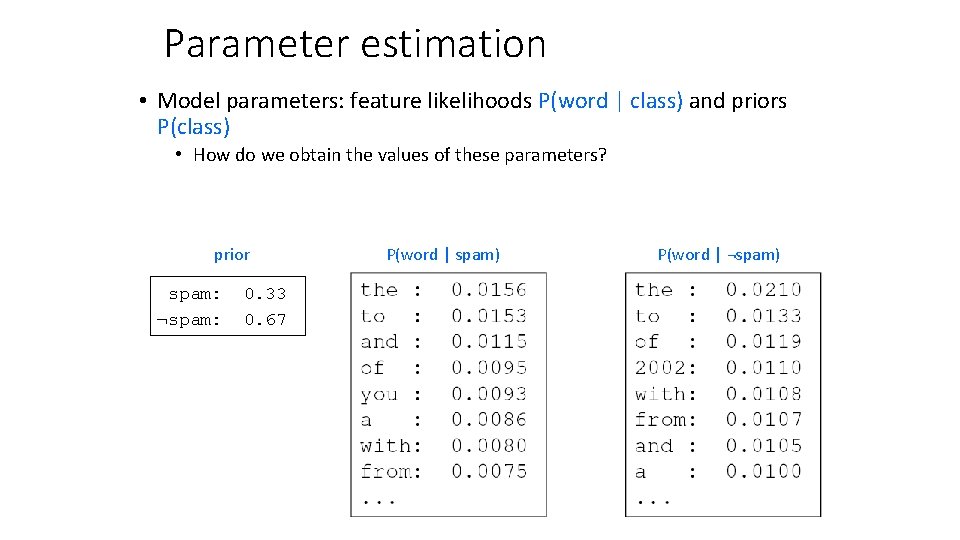
Parameter estimation • Model parameters: feature likelihoods P(word | class) and priors P(class) • How do we obtain the values of these parameters? prior spam: ¬spam: 0. 33 0. 67 P(word | spam) P(word | ¬spam)
Outline: Bayesian Inference • Bayes Rule • Law of Total Probability • Misdiagnosis • MAP = MPE • The “Naïve Bayesian” Assumption • Bag of Words (Bo. W) • Parameter Estimation for the Bo. W model
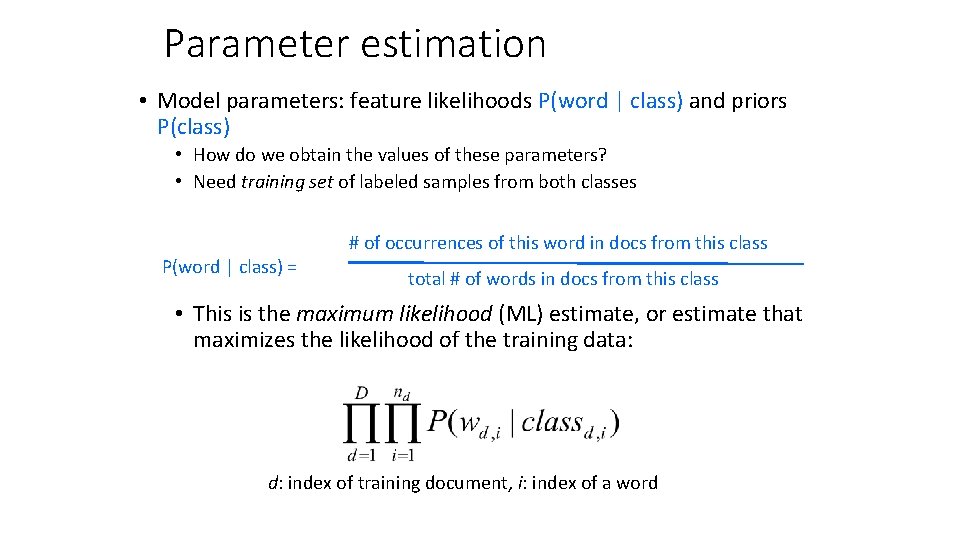
Parameter estimation • Model parameters: feature likelihoods P(word | class) and priors P(class) • How do we obtain the values of these parameters? • Need training set of labeled samples from both classes P(word | class) = # of occurrences of this word in docs from this class total # of words in docs from this class • This is the maximum likelihood (ML) estimate, or estimate that maximizes the likelihood of the training data: d: index of training document, i: index of a word
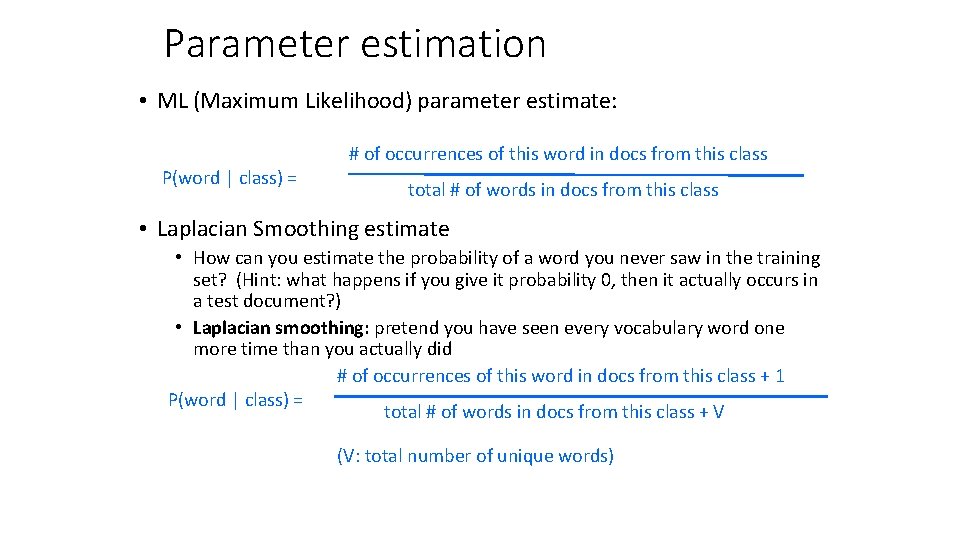
Parameter estimation • ML (Maximum Likelihood) parameter estimate: P(word | class) = # of occurrences of this word in docs from this class total # of words in docs from this class • Laplacian Smoothing estimate • How can you estimate the probability of a word you never saw in the training set? (Hint: what happens if you give it probability 0, then it actually occurs in a test document? ) • Laplacian smoothing: pretend you have seen every vocabulary word one more time than you actually did # of occurrences of this word in docs from this class + 1 P(word | class) = total # of words in docs from this class + V (V: total number of unique words)
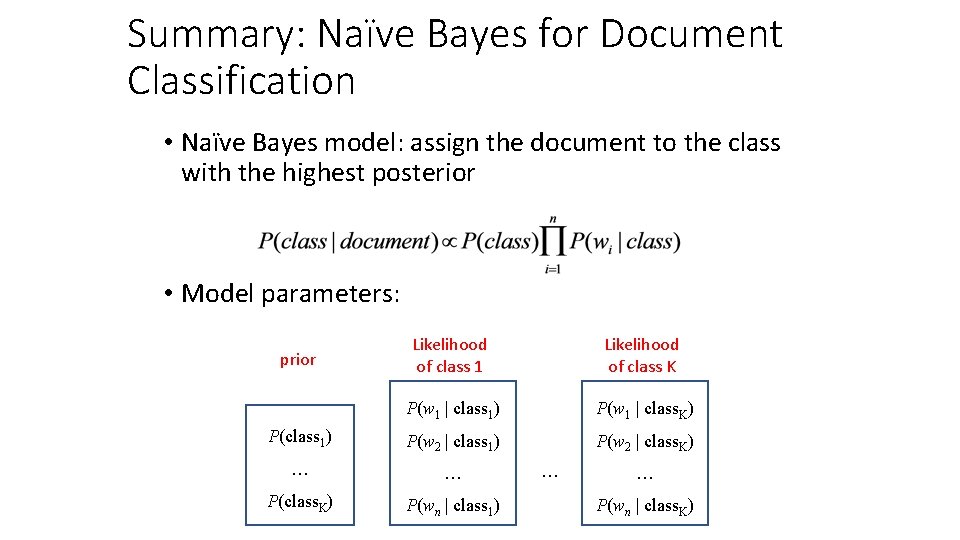
Summary: Naïve Bayes for Document Classification • Naïve Bayes model: assign the document to the class with the highest posterior • Model parameters: Likelihood of class 1 Likelihood of class K P(w 1 | class 1) P(w 1 | class. K) P(class 1) P(w 2 | class. K) … … P(class. K) P(wn | class 1) prior … … P(wn | class. K)
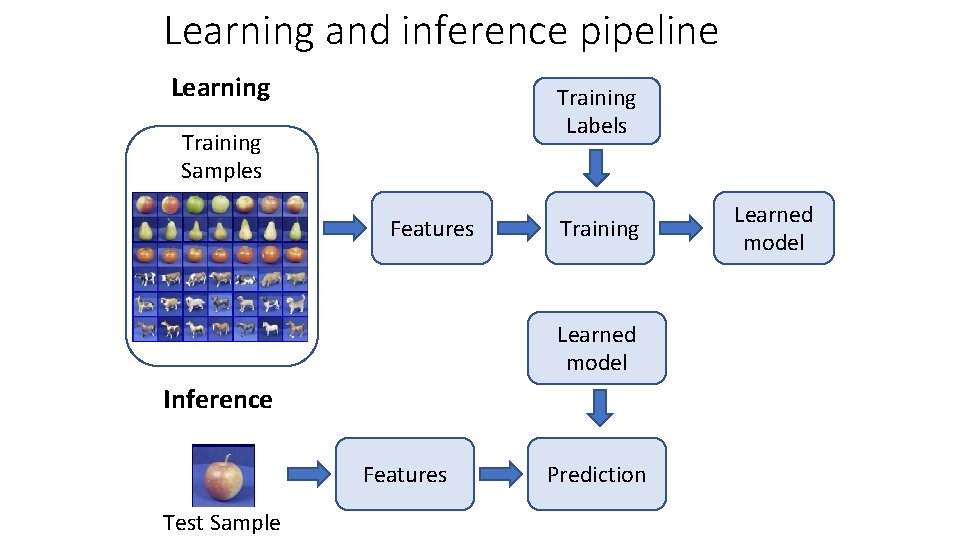
Learning and inference pipeline Learning Training Labels Training Samples Features Training Learned model Inference Features Test Sample Prediction Learned model
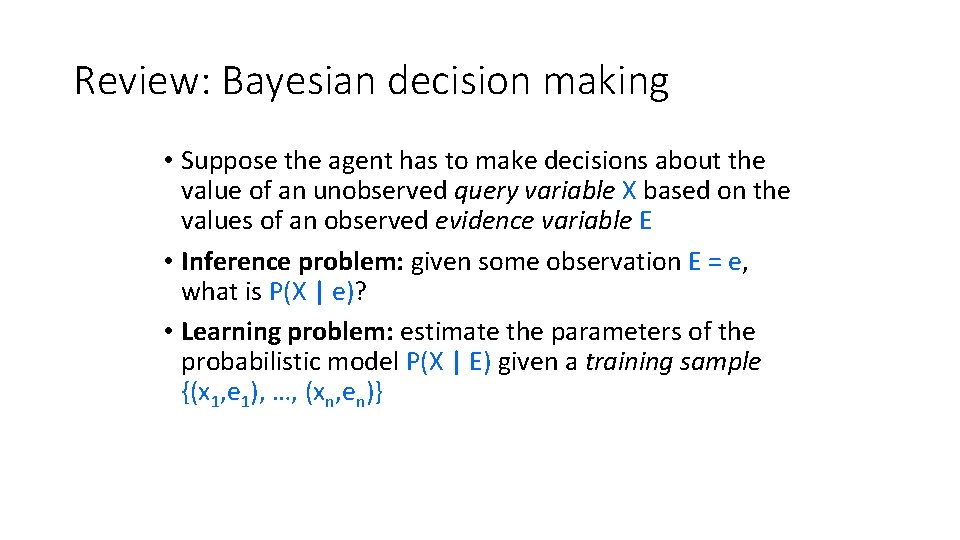
Review: Bayesian decision making • Suppose the agent has to make decisions about the value of an unobserved query variable X based on the values of an observed evidence variable E • Inference problem: given some observation E = e, what is P(X | e)? • Learning problem: estimate the parameters of the probabilistic model P(X | E) given a training sample {(x 1, e 1), …, (xn, en)}
- Slides: 37