
CS 440ECE 448 Lecture 11 AlphaBeta Pruning Limited
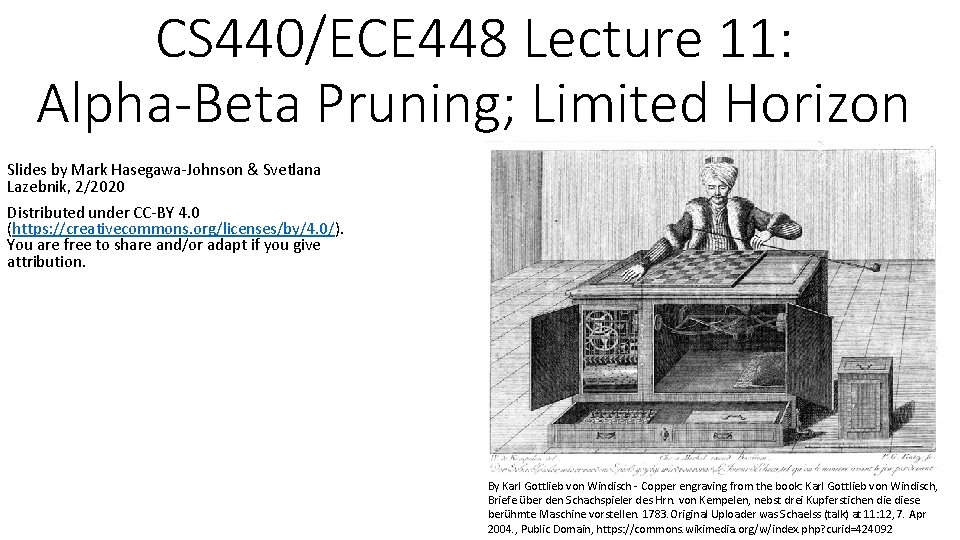
CS 440/ECE 448 Lecture 11: Alpha-Beta Pruning; Limited Horizon Slides by Mark Hasegawa-Johnson & Svetlana Lazebnik, 2/2020 Distributed under CC-BY 4. 0 (https: //creativecommons. org/licenses/by/4. 0/). You are free to share and/or adapt if you give attribution. By Karl Gottlieb von Windisch - Copper engraving from the book: Karl Gottlieb von Windisch, Briefe über den Schachspieler des Hrn. von Kempelen, nebst drei Kupferstichen diese berühmte Maschine vorstellen. 1783. Original Uploader was Schaelss (talk) at 11: 12, 7. Apr 2004. , Public Domain, https: //commons. wikimedia. org/w/index. php? curid=424092
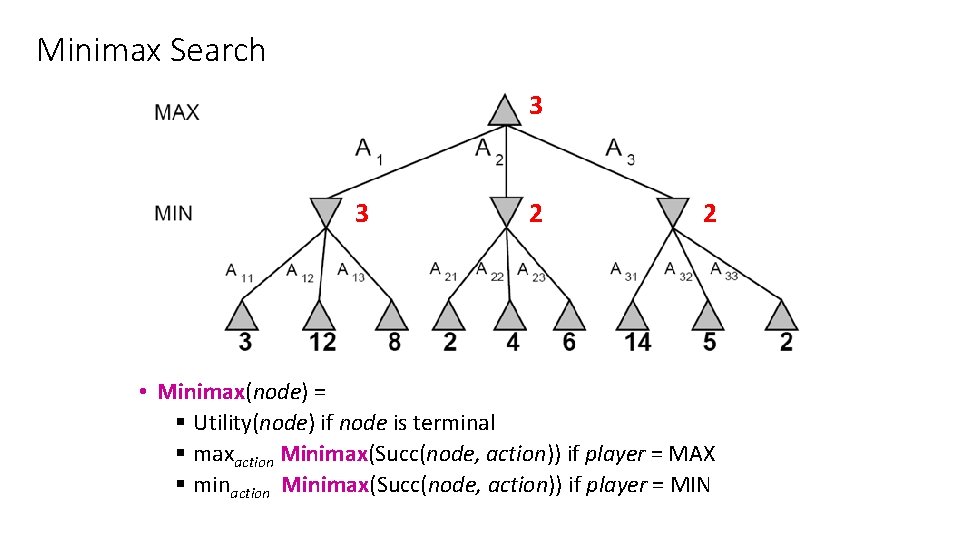
Minimax Search 3 3 2 2 • Minimax(node) = § Utility(node) if node is terminal § maxaction Minimax(Succ(node, action)) if player = MAX § minaction Minimax(Succ(node, action)) if player = MIN
Alpha-Beta Pruning
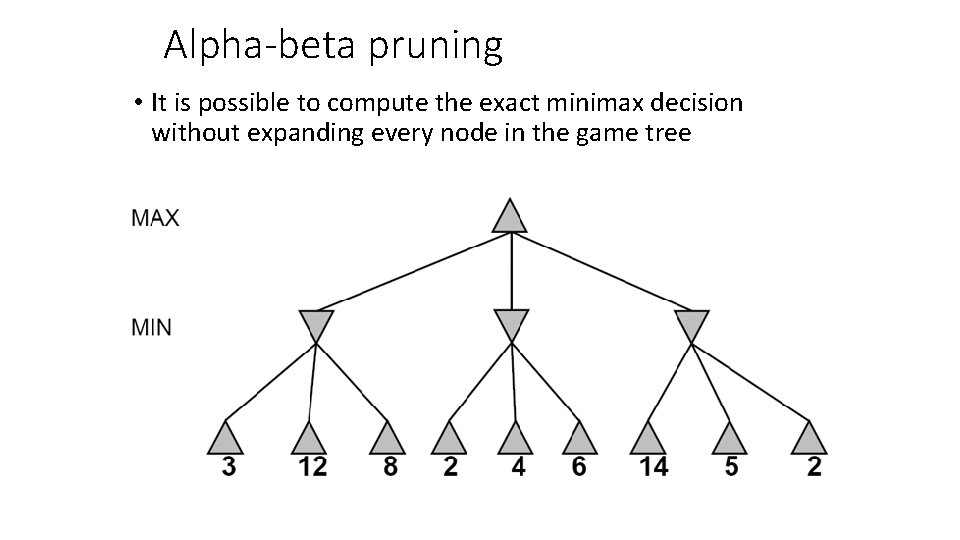
Alpha-beta pruning • It is possible to compute the exact minimax decision without expanding every node in the game tree
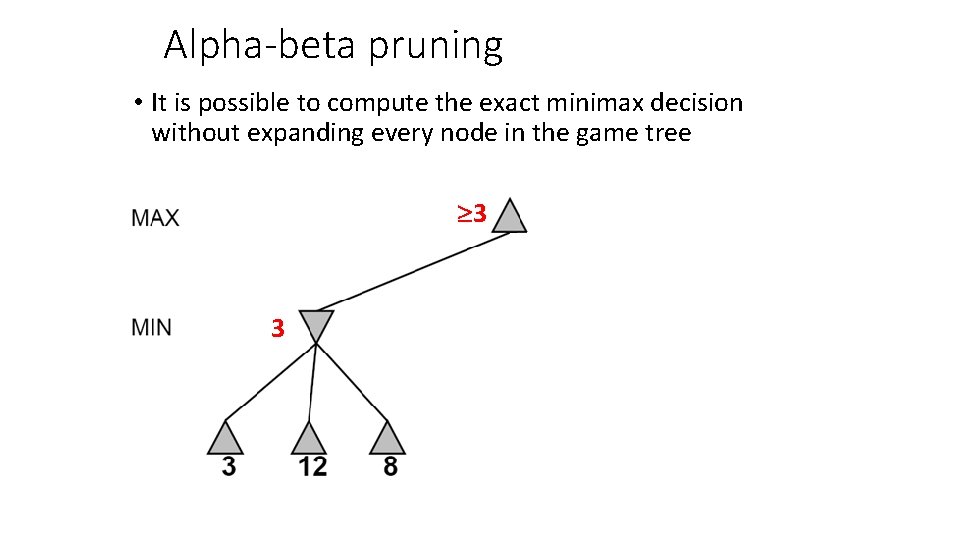
Alpha-beta pruning • It is possible to compute the exact minimax decision without expanding every node in the game tree 3 3

Alpha-beta pruning • It is possible to compute the exact minimax decision without expanding every node in the game tree 3 3 2
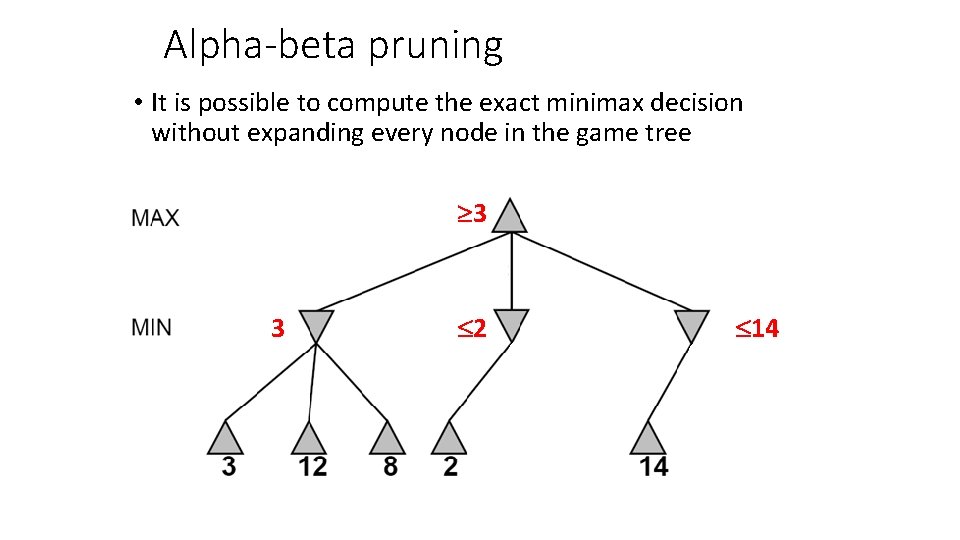
Alpha-beta pruning • It is possible to compute the exact minimax decision without expanding every node in the game tree 3 3 2 14
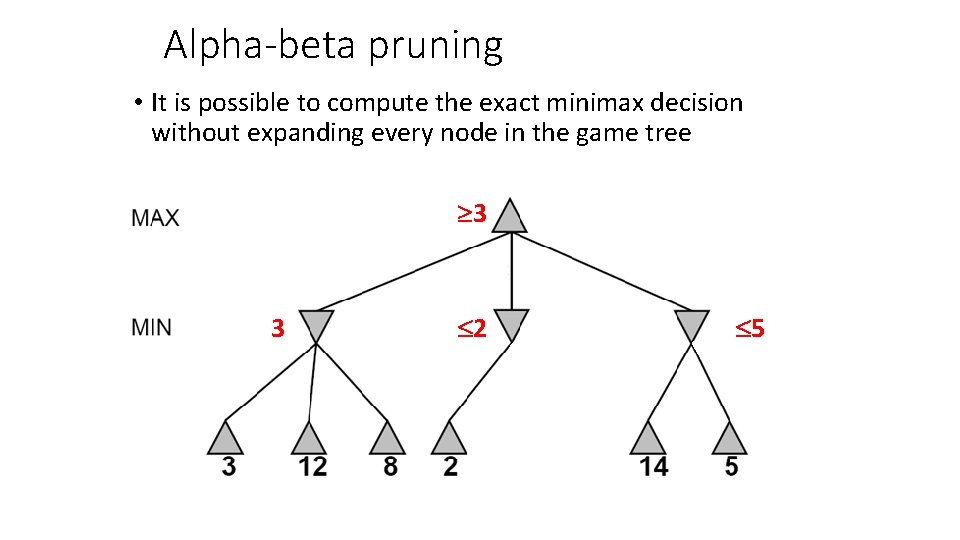
Alpha-beta pruning • It is possible to compute the exact minimax decision without expanding every node in the game tree 3 3 2 5
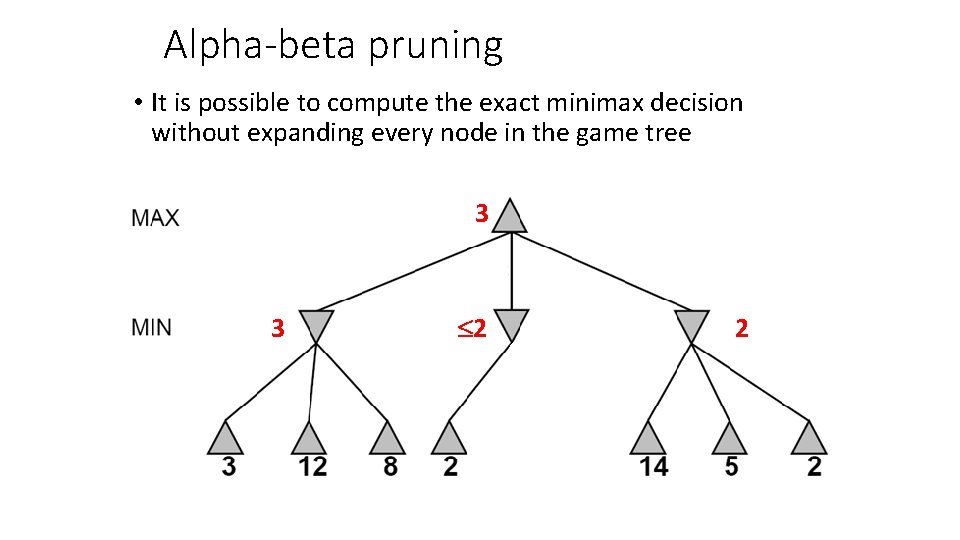
Alpha-beta pruning • It is possible to compute the exact minimax decision without expanding every node in the game tree 3 3 2 2
Alpha-Beta Pruning Key point that I find most counter-intuitive: • If MIN discovers that, at a particular node in the tree, she can make a move that’s REALLY GOOD for her… • She can assume that MAX will never let her reach that node. • … and she can prune it away from the search, and never consider it again.
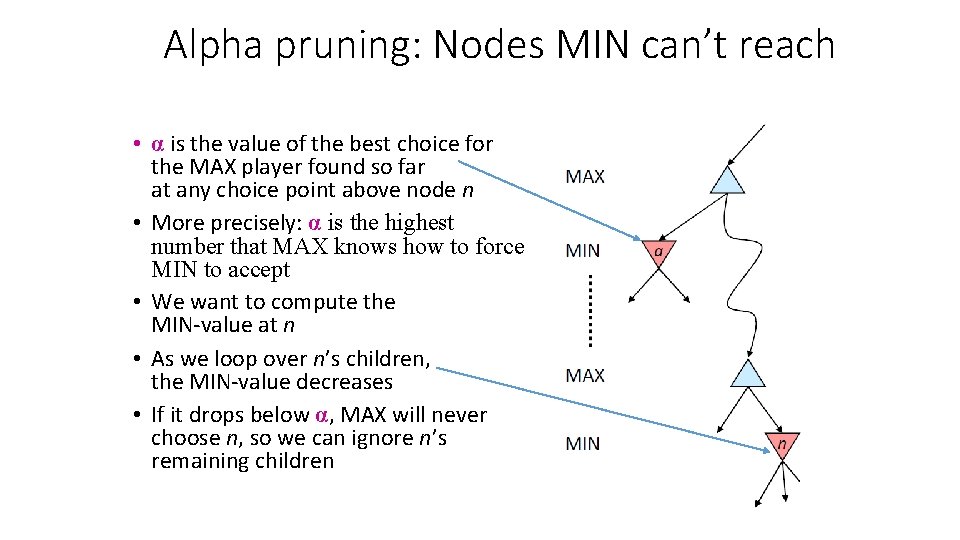
Alpha pruning: Nodes MIN can’t reach • α is the value of the best choice for the MAX player found so far at any choice point above node n • More precisely: α is the highest number that MAX knows how to force MIN to accept • We want to compute the MIN-value at n • As we loop over n’s children, the MIN-value decreases • If it drops below α, MAX will never choose n, so we can ignore n’s remaining children
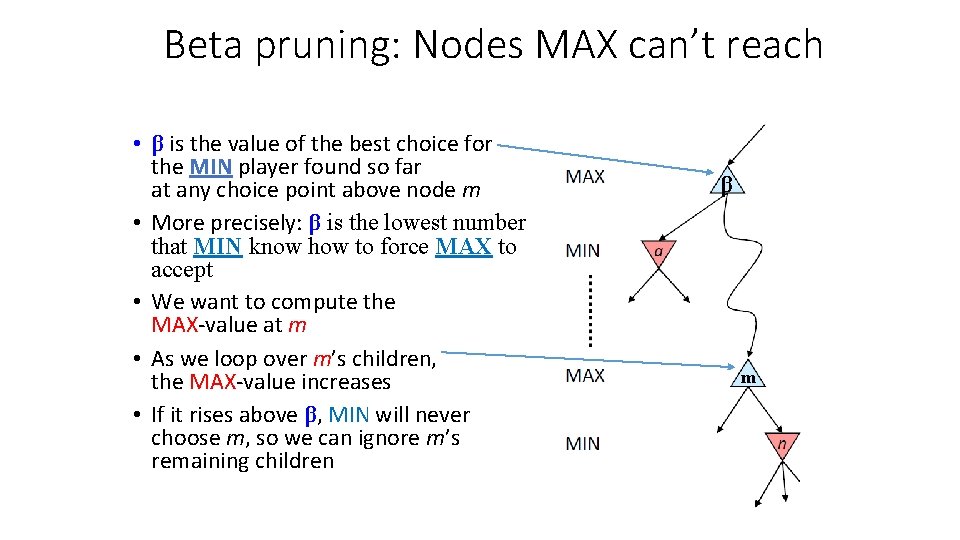
Beta pruning: Nodes MAX can’t reach • β is the value of the best choice for the MIN player found so far at any choice point above node m • More precisely: β is the lowest number that MIN know how to force MAX to accept • We want to compute the MAX-value at m • As we loop over m’s children, the MAX-value increases • If it rises above β, MIN will never choose m, so we can ignore m’s remaining children β m
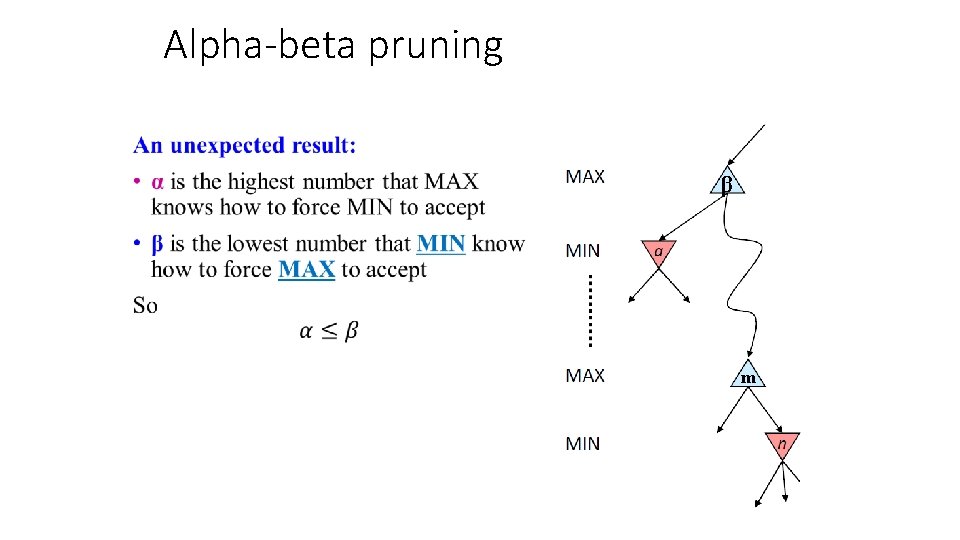
Alpha-beta pruning • β m
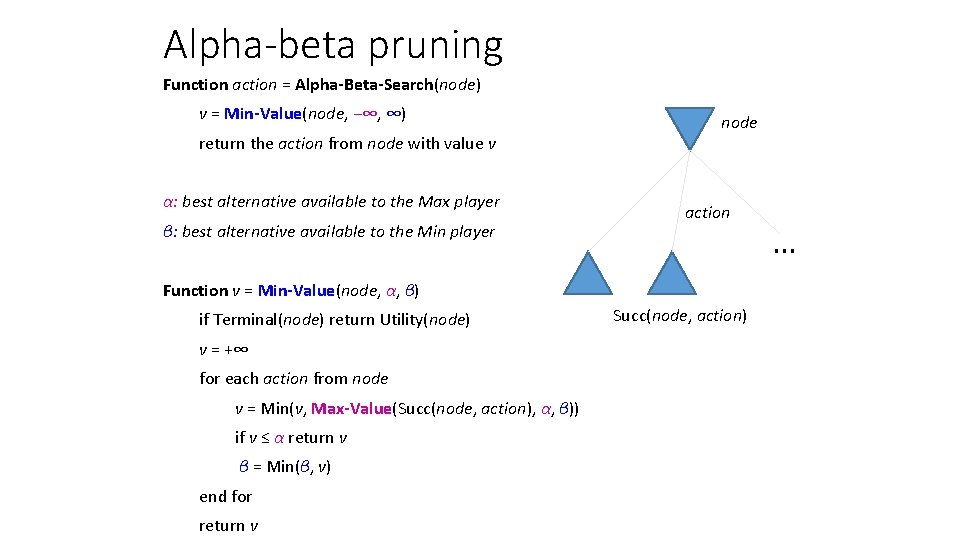
Alpha-beta pruning Function action = Alpha-Beta-Search(node) v = Min-Value(node, −∞, ∞) return the action from node with value v α: best alternative available to the Max player β: best alternative available to the Min player node action Function v = Min-Value(node, α, β) if Terminal(node) return Utility(node) v = +∞ for each action from node v = Min(v, Max-Value(Succ(node, action), α, β)) if v ≤ α return v β = Min(β, v) end for return v Succ(node, action) …
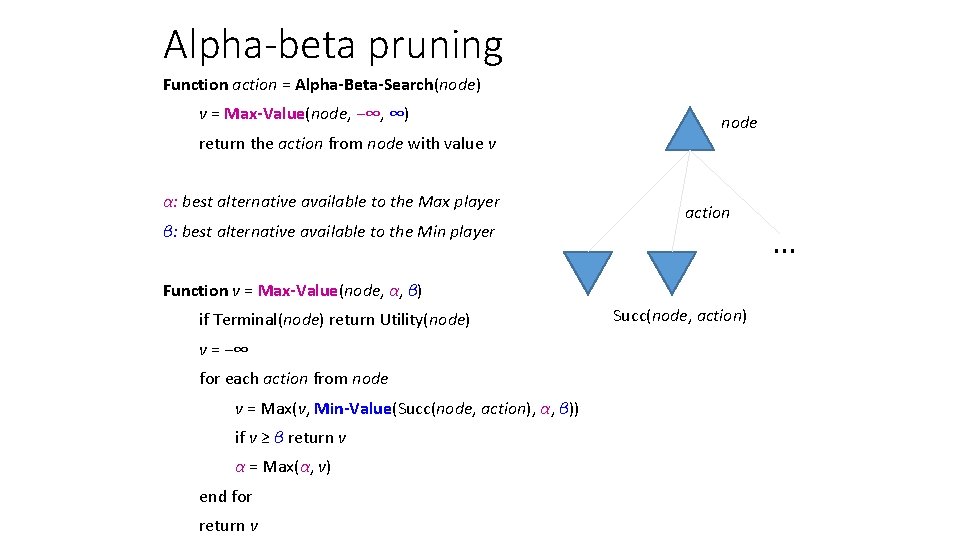
Alpha-beta pruning Function action = Alpha-Beta-Search(node) v = Max-Value(node, −∞, ∞) return the action from node with value v α: best alternative available to the Max player β: best alternative available to the Min player node action Function v = Max-Value(node, α, β) if Terminal(node) return Utility(node) v = −∞ for each action from node v = Max(v, Min-Value(Succ(node, action), α, β)) if v ≥ β return v α = Max(α, v) end for return v Succ(node, action) …
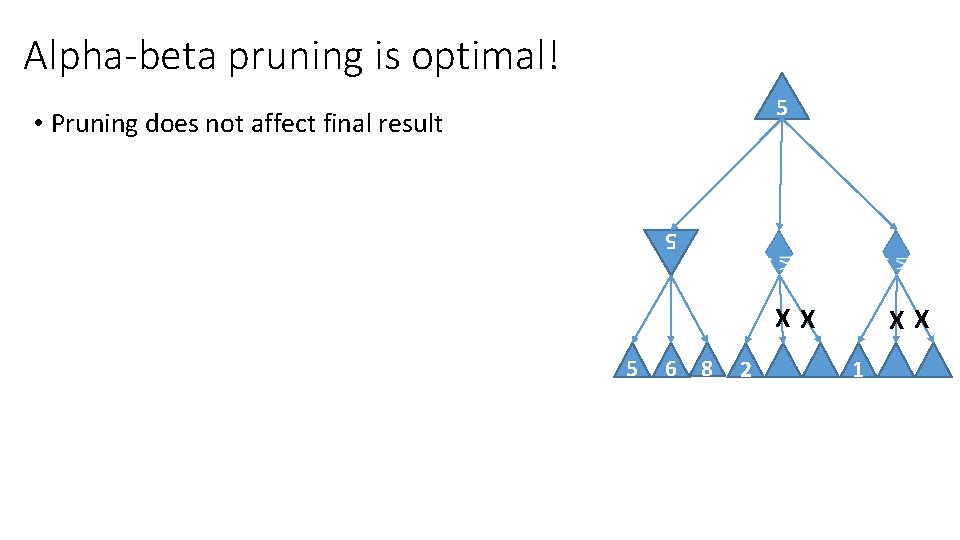
Alpha-beta pruning is optimal! 5 • Pruning does not affect final result 5 XX 5 6 8 2 XX 1
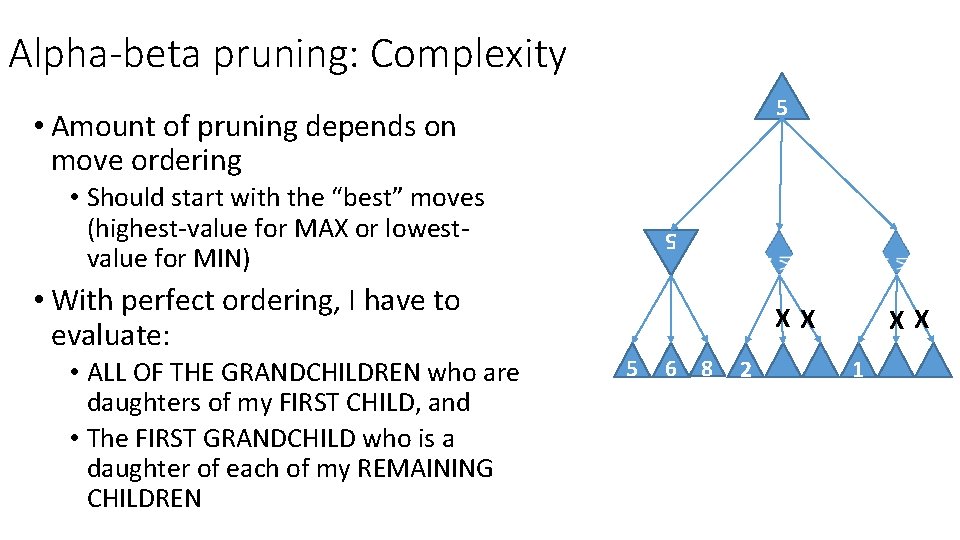
Alpha-beta pruning: Complexity 5 • Should start with the “best” moves (highest-value for MAX or lowestvalue for MIN) 5 • ALL OF THE GRANDCHILDREN who are daughters of my FIRST CHILD, and • The FIRST GRANDCHILD who is a daughter of each of my REMAINING CHILDREN • With perfect ordering, I have to evaluate: • Amount of pruning depends on move ordering XX 5 6 8 2 XX 1
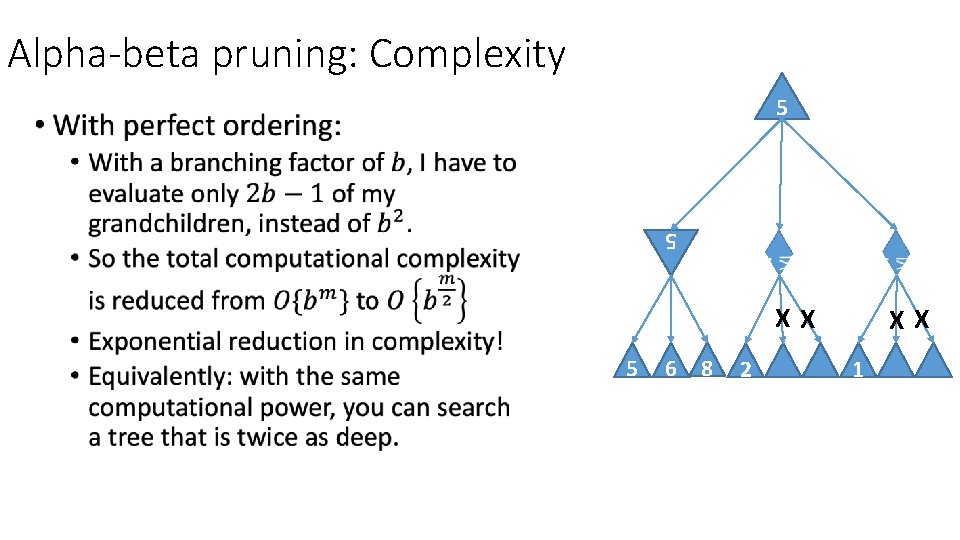
Alpha-beta pruning: Complexity 5 • 5 XX 5 6 8 2 XX 1
Limited-Horizon Computation
Games vs. single-agent search • We don’t know how the opponent will act • The solution is not a fixed sequence of actions from start state to goal state, but a strategy or policy (a mapping from state to best move in that state)
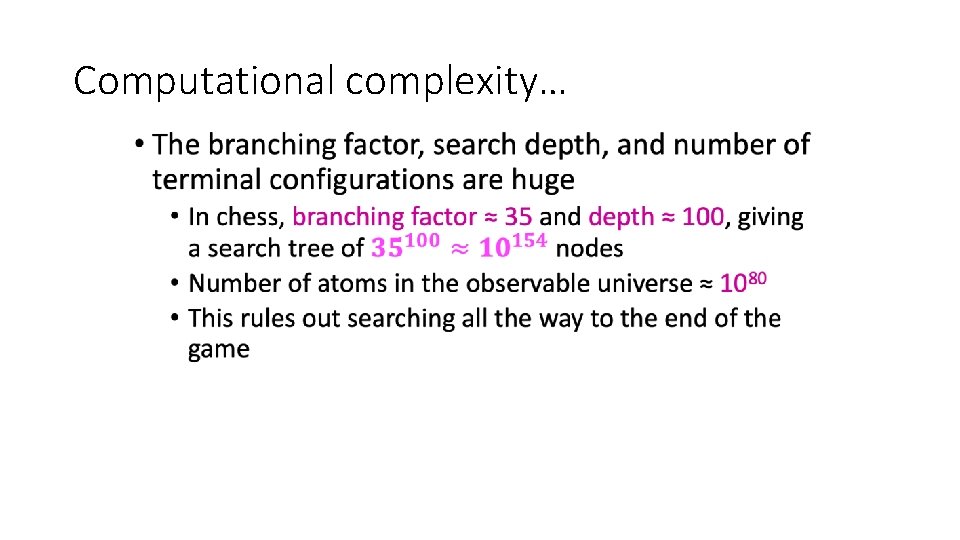
Computational complexity… •
Computational complexity… •
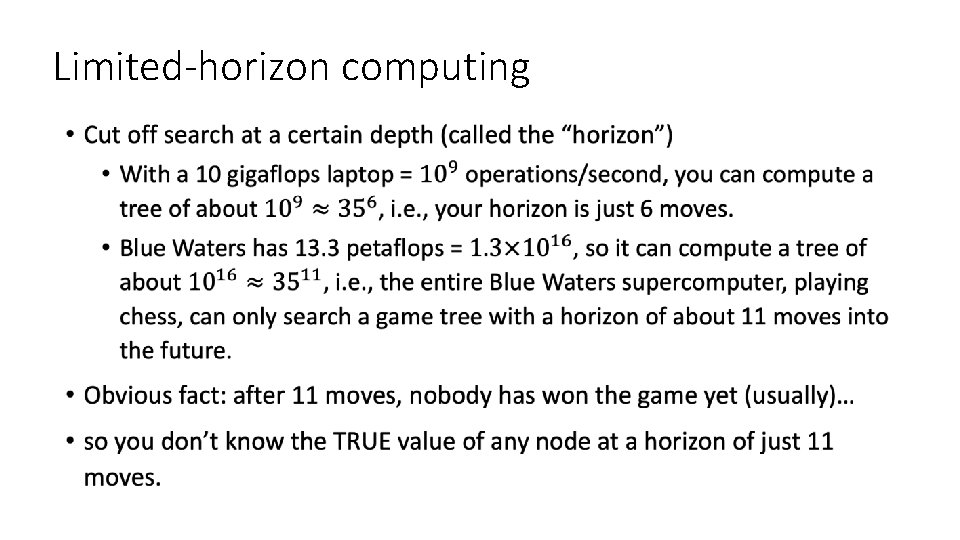
Limited-horizon computing •
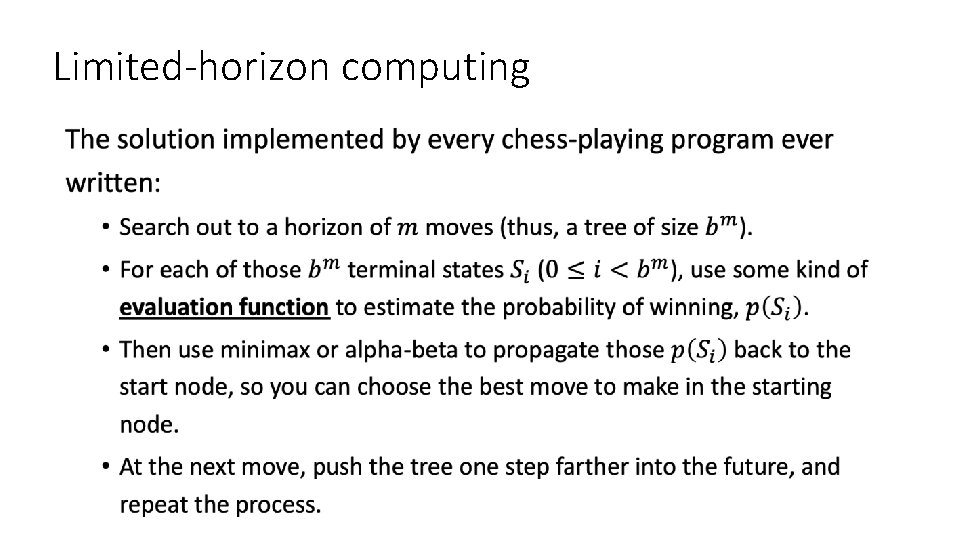
Limited-horizon computing •
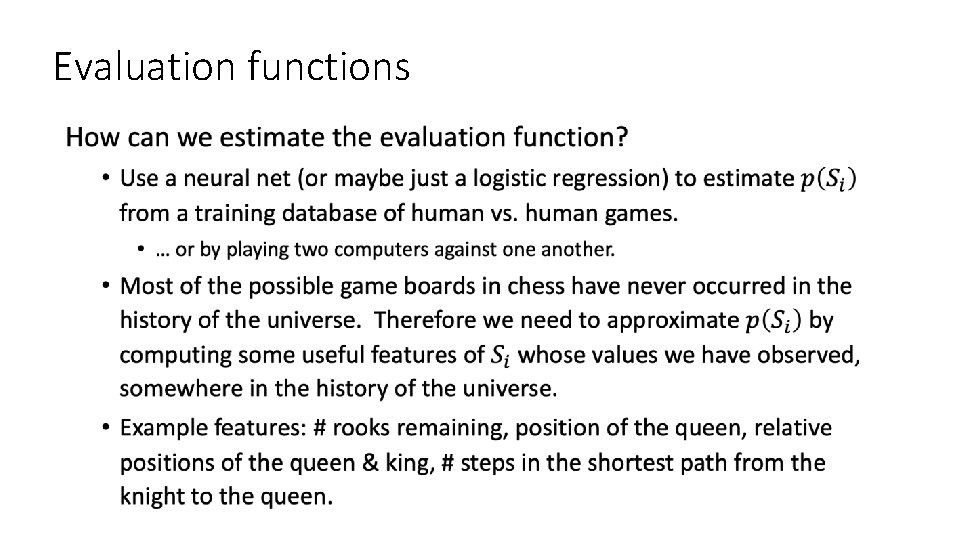
Evaluation functions •
Cutting off search • Horizon effect: you may incorrectly estimate the value of a state by overlooking an event that is just beyond the depth limit • For example, a damaging move by the opponent that can be delayed but not avoided • Possible remedies • Quiescence search: do not cut off search at positions that are unstable – for example, are you about to lose an important piece? • Singular extension: a strong move that should be tried when the normal depth limit is reached
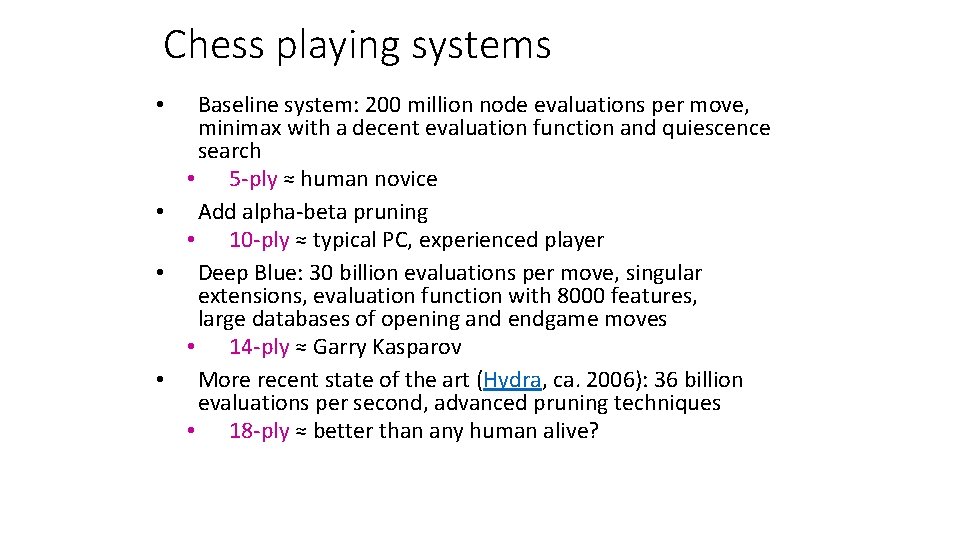
Chess playing systems Baseline system: 200 million node evaluations per move, minimax with a decent evaluation function and quiescence search • 5 -ply ≈ human novice • Add alpha-beta pruning • 10 -ply ≈ typical PC, experienced player • Deep Blue: 30 billion evaluations per move, singular extensions, evaluation function with 8000 features, large databases of opening and endgame moves • 14 -ply ≈ Garry Kasparov • More recent state of the art (Hydra, ca. 2006): 36 billion evaluations per second, advanced pruning techniques • 18 -ply ≈ better than any human alive? •
Summary • A zero-sum game can be expressed as a minimax tree • Alpha-beta pruning finds the correct solution. In the best case, it has half the exponent of minimax (can search twice as deeply with a given computational complexity). • Limited-horizon search is always necessary (you can’t search to the end of the game), and always suboptimal. • Estimate your utility, at the end of your horizon, using some type of learned utility function • Quiescence search: don’t cut off the search in an unstable position (need some way to measure “stability”) • Singular extension: have one or two “super-moves” that you can test at the end of your horizon
- Slides: 28