
CS 4350 Fundamentals of Software Engineering CS 5500
- Slides: 19
CS 4350: Fundamentals of Software Engineering CS 5500: Foundations of Software Engineering Lesson 8. 2 Code Smells and Refactoring Jon Bell, John Boyland, Mitch Wand Khoury College of Computer Sciences © 2021 Jonathan Bell, John Boyland Mitch Wand. Released under the CC BY-SA license 1
Outline of this lesson 1. Some common code “smells” (anti-patterns). 2. “Refactoring”: restructuring of code to improve structure. 3. “Technical Debt”: generalization covering all internal problems in a code-base. 2
Learning Objectives for this Lesson • By the end of this lesson, you should be able to: • • Review several classes of code smells; Describe several kinds of refactoring; Identify the “technical debt” metaphor; Indicate when and where technical debt is appropriate to accrue versus retire. 3
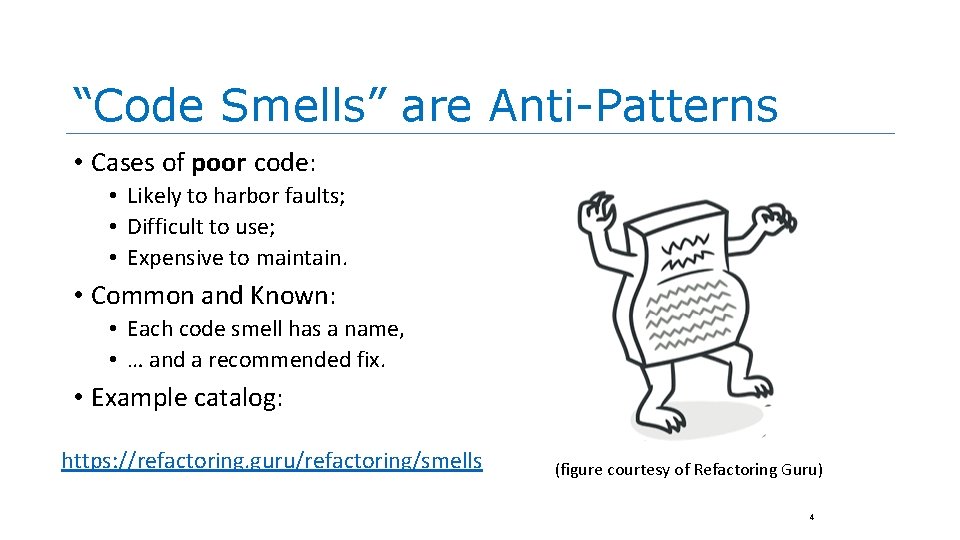
“Code Smells” are Anti-Patterns • Cases of poor code: • Likely to harbor faults; • Difficult to use; • Expensive to maintain. • Common and Known: • Each code smell has a name, • … and a recommended fix. • Example catalog: https: //refactoring. guru/refactoring/smells (figure courtesy of Refactoring Guru) 4
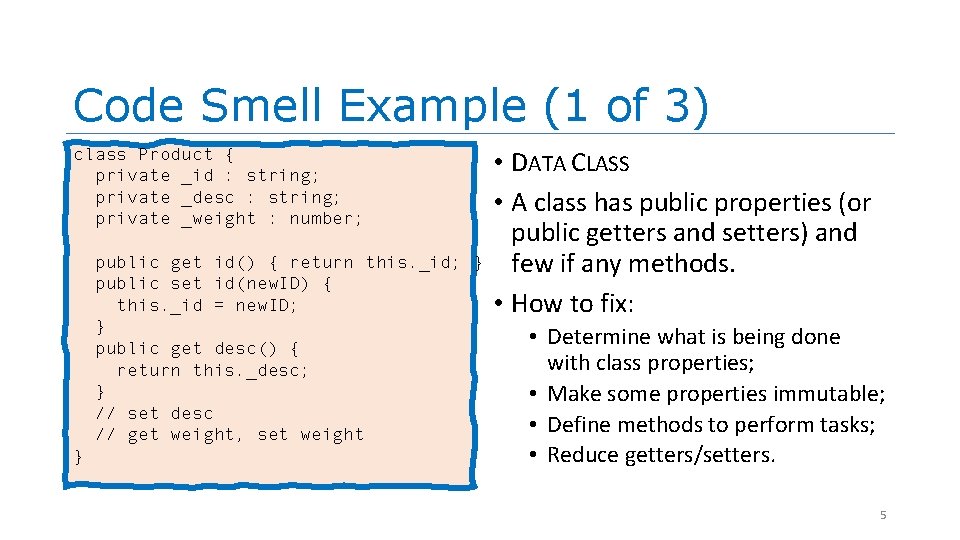
Code Smell Example (1 of 3) class Product { private _id : string; private _desc : string; private _weight : number; public get id() { return this. _id; } public set id(new. ID) { this. _id = new. ID; } public get desc() { return this. _desc; } // set desc // get weight, set weight } • DATA CLASS • A class has public properties (or public getters and setters) and few if any methods. • How to fix: • Determine what is being done with class properties; • Make some properties immutable; • Define methods to perform tasks; • Reduce getters/setters. 5
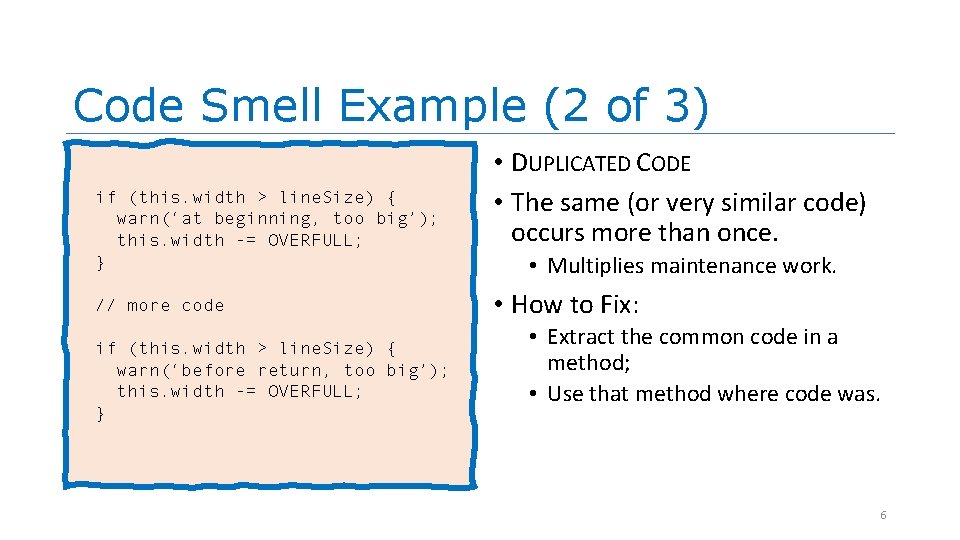
Code Smell Example (2 of 3) if (this. width > line. Size) { warn(‘at beginning, too big’); this. width -= OVERFULL; } // more code if (this. width > line. Size) { warn(‘before return, too big’); this. width -= OVERFULL; } • DUPLICATED CODE • The same (or very similar code) occurs more than once. • Multiplies maintenance work. • How to Fix: • Extract the common code in a method; • Use that method where code was. 6
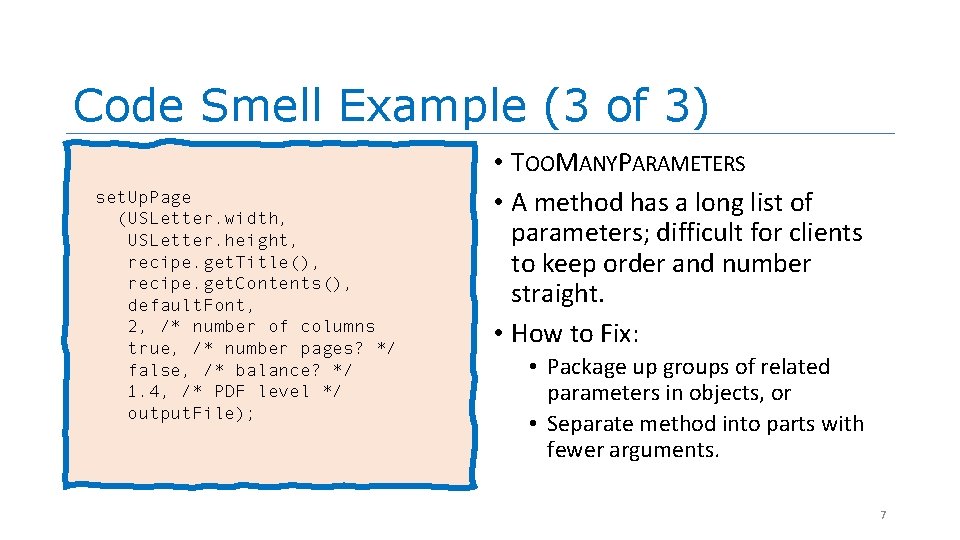
Code Smell Example (3 of 3) set. Up. Page (USLetter. width, USLetter. height, recipe. get. Title(), recipe. get. Contents(), default. Font, 2, /* number of columns true, /* number pages? */ false, /* balance? */ 1. 4, /* PDF level */ output. File); • TOOMANYPARAMETERS • A method has a long list of parameters; difficult for clients to keep order and number straight. • How to Fix: • Package up groups of related parameters in objects, or • Separate method into parts with fewer arguments. 7
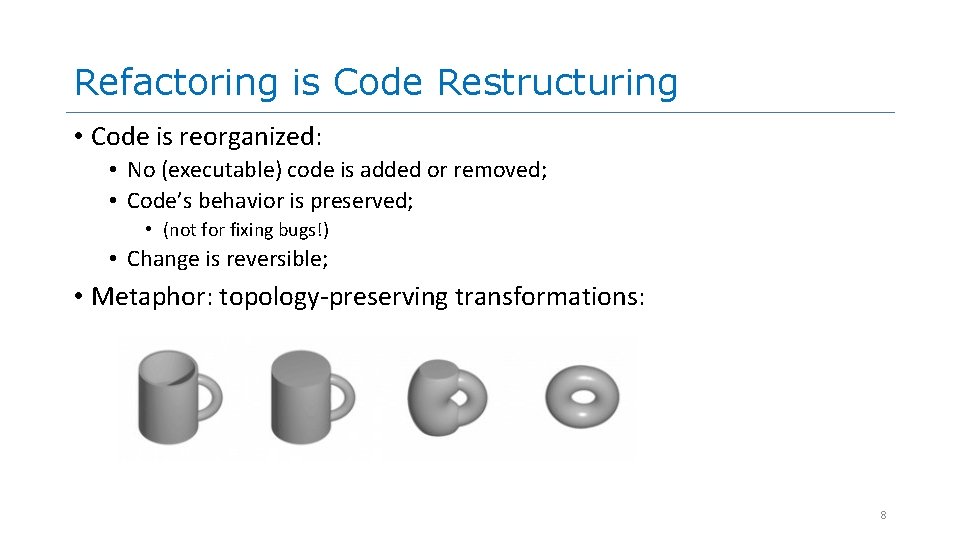
Refactoring is Code Restructuring • Code is reorganized: • No (executable) code is added or removed; • Code’s behavior is preserved; • (not for fixing bugs!) • Change is reversible; • Metaphor: topology-preserving transformations: 8
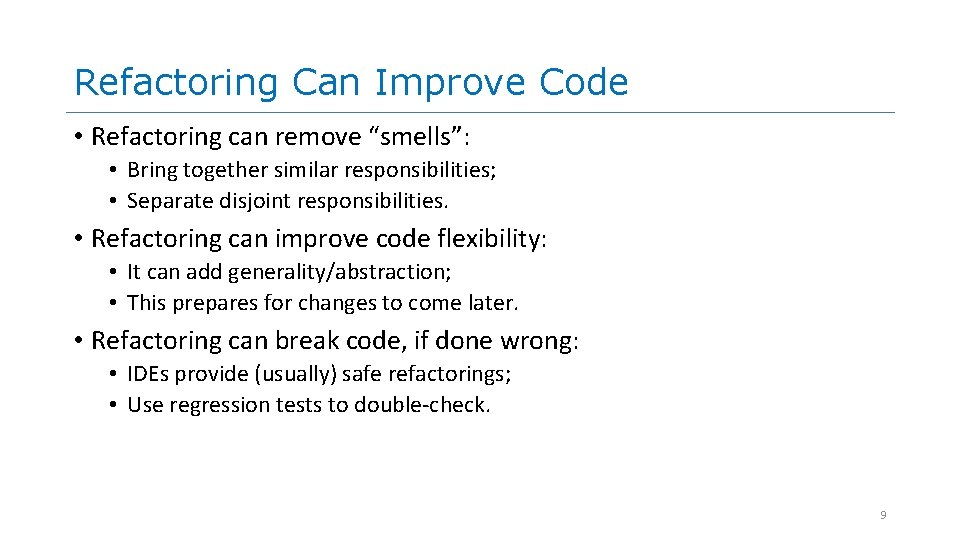
Refactoring Can Improve Code • Refactoring can remove “smells”: • Bring together similar responsibilities; • Separate disjoint responsibilities. • Refactoring can improve code flexibility: • It can add generality/abstraction; • This prepares for changes to come later. • Refactoring can break code, if done wrong: • IDEs provide (usually) safe refactorings; • Use regression tests to double-check. 9
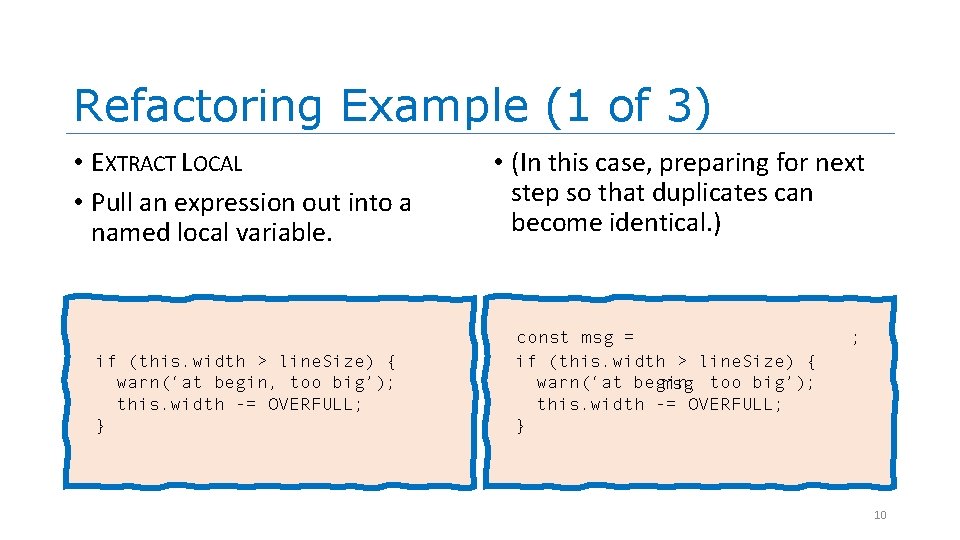
Refactoring Example (1 of 3) • EXTRACT LOCAL • Pull an expression out into a named local variable. if (this. width > line. Size) { warn(‘at begin, too big’); this. width -= OVERFULL; } • (In this case, preparing for next step so that duplicates can become identical. ) const msg = if (this. width > line. Size) { warn(‘at begin, msg too big’); this. width -= OVERFULL; } ; 10
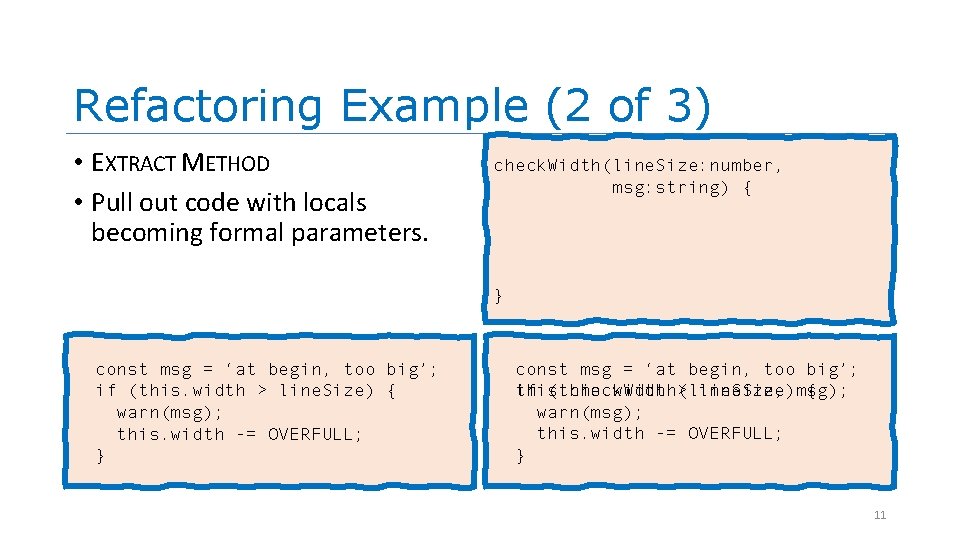
Refactoring Example (2 of 3) • EXTRACT METHOD • Pull out code with locals becoming formal parameters. check. Width(line. Size: number, msg: string) { } const msg = ‘at begin, too big’; if (this. width > line. Size) { warn(msg); this. width -= OVERFULL; } const msg = ‘at begin, too big’; this. check. Width(line. Size, if (this. width > line. Size)msg); { warn(msg); this. width -= OVERFULL; } 11
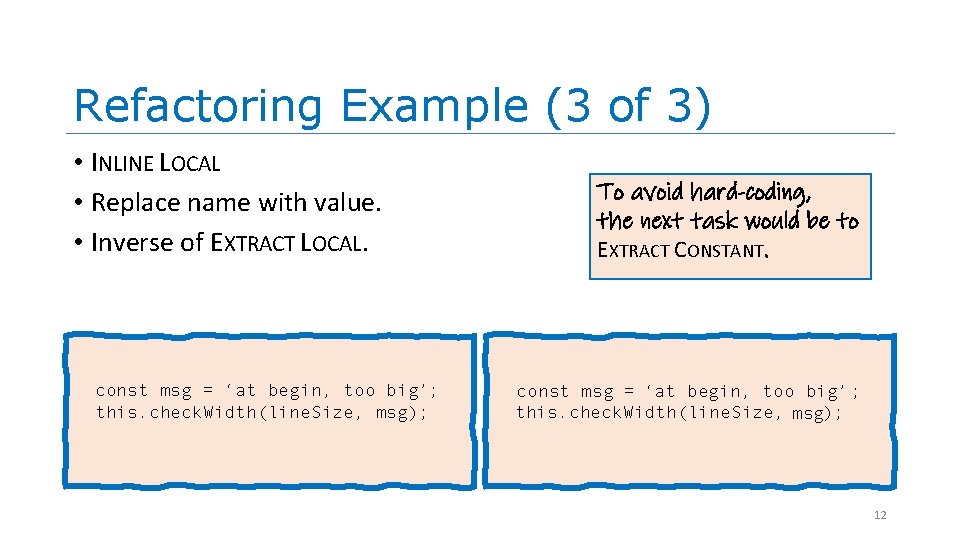
Refactoring Example (3 of 3) • INLINE LOCAL • Replace name with value. • Inverse of EXTRACT LOCAL. const msg = ‘at begin, too big’; this. check. Width(line. Size, msg); To avoid hard-coding, the next task would be to EXTRACT CONSTANT. const msg = ‘at begin, too big’ ; this. check. Width(line. Size, msg); 12
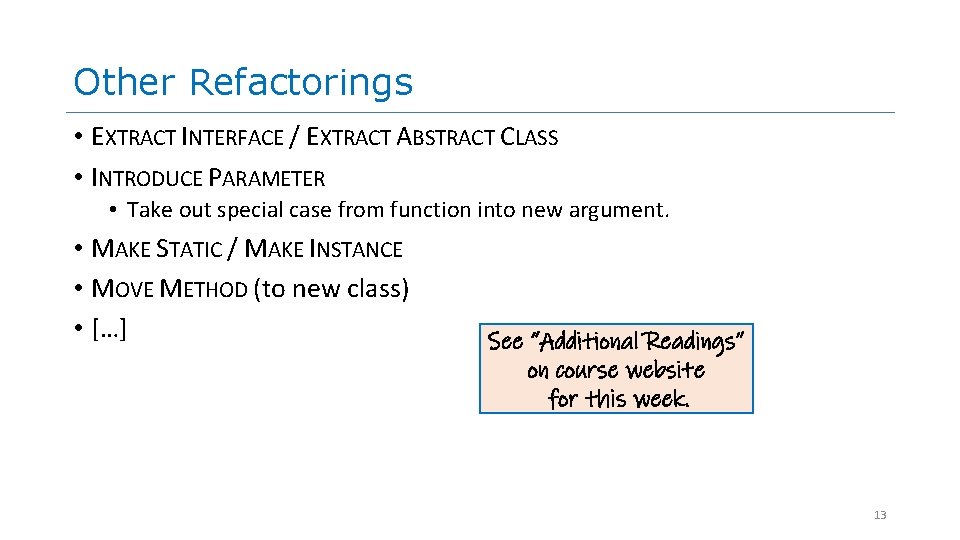
Other Refactorings • EXTRACT INTERFACE / EXTRACT ABSTRACT CLASS • INTRODUCE PARAMETER • Take out special case from function into new argument. • MAKE STATIC / MAKE INSTANCE • MOVE METHOD (to new class) • […] See “Additional Readings” on course website for this week. 13
Technical Debt is Sum of Internal Problems in Project Codebase • Internal because they don’t show as user-visible failures. • Examples: Code Smells; Missing tests; Missing documentation; Dependency on old versions of third-party systems; • Inefficient and/or non-scalable algorithms. • • Not just code! 14
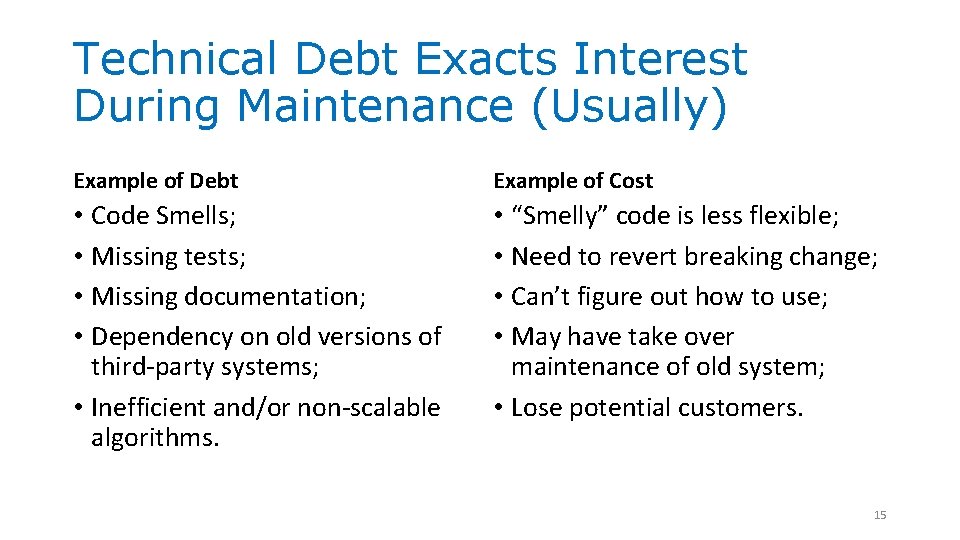
Technical Debt Exacts Interest During Maintenance (Usually) Example of Debt Example of Cost • Code Smells; • Missing tests; • Missing documentation; • Dependency on old versions of third-party systems; • Inefficient and/or non-scalable algorithms. • “Smelly” code is less flexible; • Need to revert breaking change; • Can’t figure out how to use; • May have take over maintenance of old system; • Lose potential customers. 15
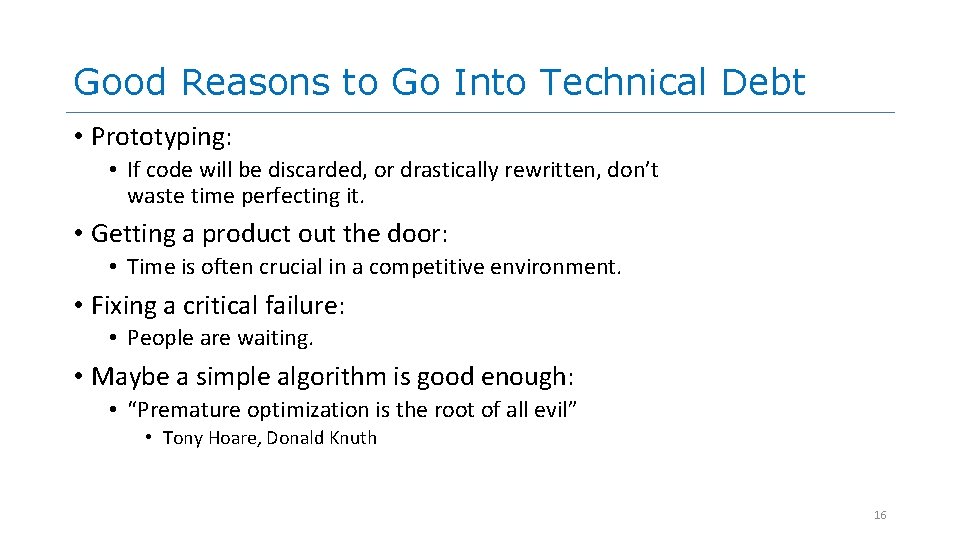
Good Reasons to Go Into Technical Debt • Prototyping: • If code will be discarded, or drastically rewritten, don’t waste time perfecting it. • Getting a product out the door: • Time is often crucial in a competitive environment. • Fixing a critical failure: • People are waiting. • Maybe a simple algorithm is good enough: • “Premature optimization is the root of all evil” • Tony Hoare, Donald Knuth 16
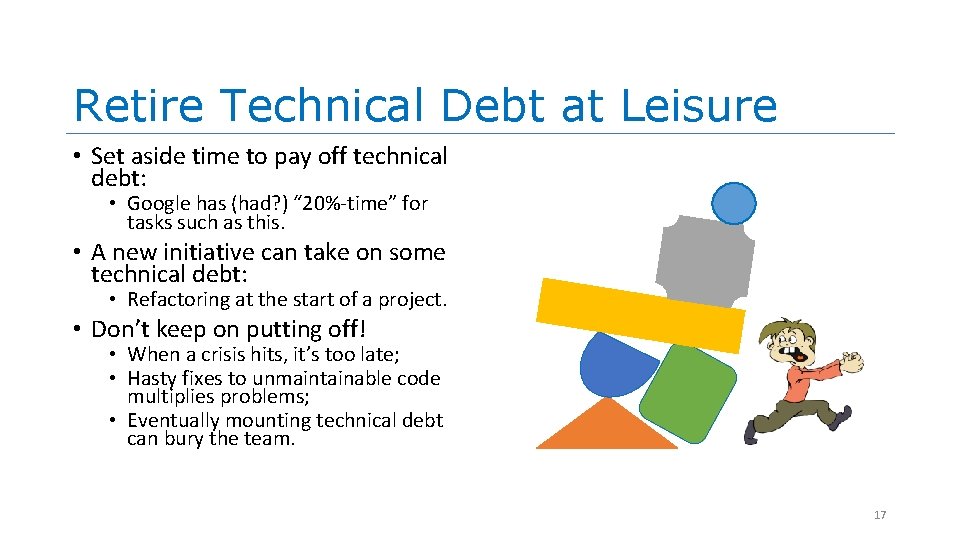
Retire Technical Debt at Leisure • Set aside time to pay off technical debt: • Google has (had? ) “ 20%-time” for tasks such as this. • A new initiative can take on some technical debt: • Refactoring at the start of a project. • Don’t keep on putting off! • When a crisis hits, it’s too late; • Hasty fixes to unmaintainable code multiplies problems; • Eventually mounting technical debt can bury the team. 17
Review: Learning Objectives for this Lesson • You should now be able to: • • Review several classes of code smells; Describe several kinds of refactoring; Identify the “technical debt” metaphor; Indicate when and where technical debt is appropriate to accrue versus retire. 18
Next Week. . . • In our next lesson, we’ll talk about engineering for security. 19