
CS 4300 Computer Graphics Prof Harriet Fell Fall
- Slides: 24
CS 4300 Computer Graphics Prof. Harriet Fell Fall 2012 Lecture 26 – November 7, 2012 ©College of Computer and Information Science, Northeastern University
Topics • Ray intersections with – plane – triangle – quadrics • Recursive Ray Tracing ©College of Computer and Information Science, Northeastern University
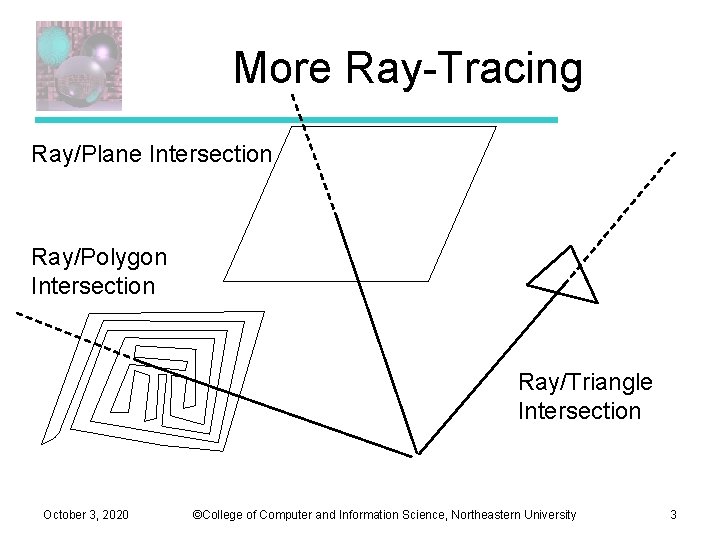
More Ray-Tracing Ray/Plane Intersection Ray/Polygon Intersection Ray/Triangle Intersection October 3, 2020 ©College of Computer and Information Science, Northeastern University 3
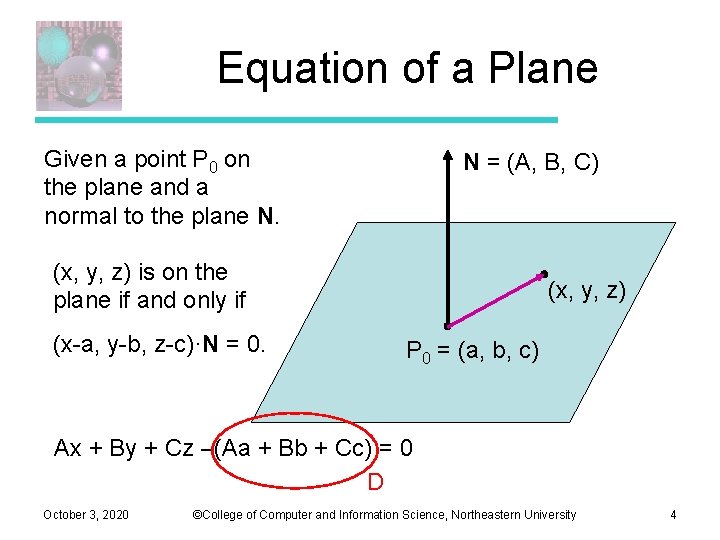
Equation of a Plane Given a point P 0 on the plane and a normal to the plane N. N = (A, B, C) (x, y, z) is on the plane if and only if (x-a, y-b, z-c)·N = 0. (x, y, z) P 0 = (a, b, c) Ax + By + Cz –(Aa + Bb + Cc) = 0 D October 3, 2020 ©College of Computer and Information Science, Northeastern University 4
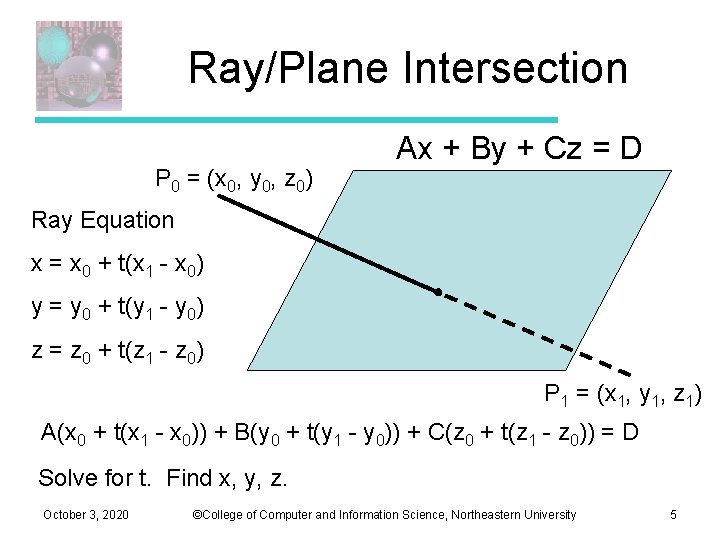
Ray/Plane Intersection P 0 = (x 0, y 0, z 0) Ax + By + Cz = D Ray Equation x = x 0 + t(x 1 - x 0) y = y 0 + t(y 1 - y 0) z = z 0 + t(z 1 - z 0) P 1 = (x 1, y 1, z 1) A(x 0 + t(x 1 - x 0)) + B(y 0 + t(y 1 - y 0)) + C(z 0 + t(z 1 - z 0)) = D Solve for t. Find x, y, z. October 3, 2020 ©College of Computer and Information Science, Northeastern University 5
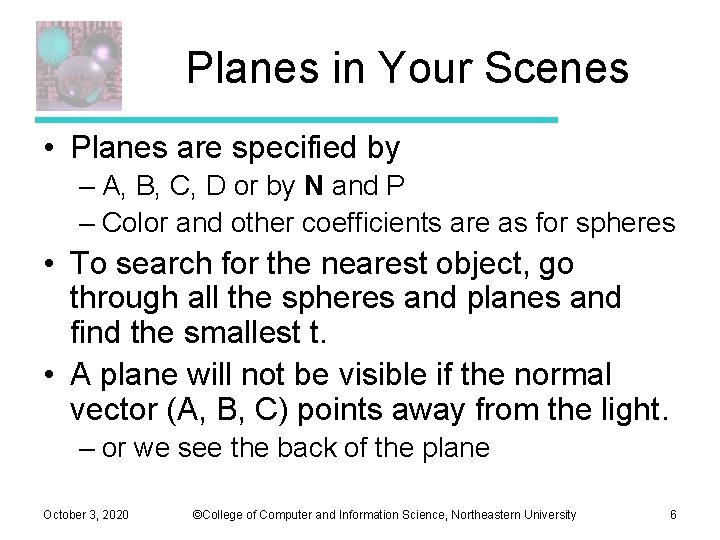
Planes in Your Scenes • Planes are specified by – A, B, C, D or by N and P – Color and other coefficients are as for spheres • To search for the nearest object, go through all the spheres and planes and find the smallest t. • A plane will not be visible if the normal vector (A, B, C) points away from the light. – or we see the back of the plane October 3, 2020 ©College of Computer and Information Science, Northeastern University 6
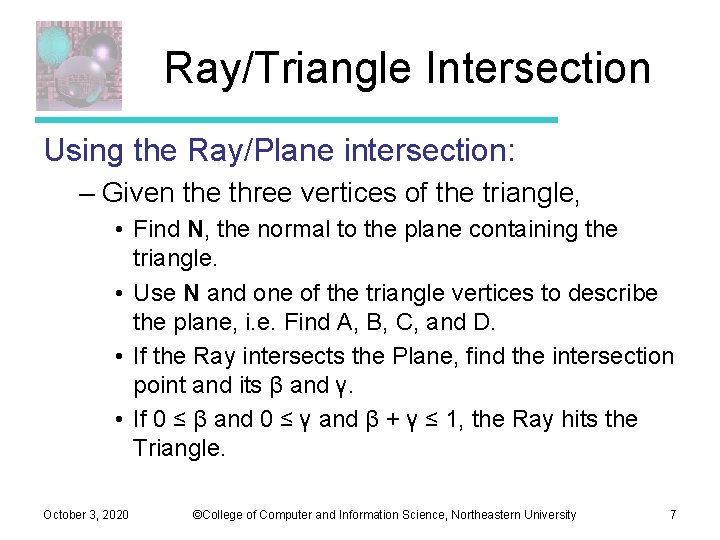
Ray/Triangle Intersection Using the Ray/Plane intersection: – Given the three vertices of the triangle, • Find N, the normal to the plane containing the triangle. • Use N and one of the triangle vertices to describe the plane, i. e. Find A, B, C, and D. • If the Ray intersects the Plane, find the intersection point and its β and γ. • If 0 ≤ β and 0 ≤ γ and β + γ ≤ 1, the Ray hits the Triangle. October 3, 2020 ©College of Computer and Information Science, Northeastern University 7
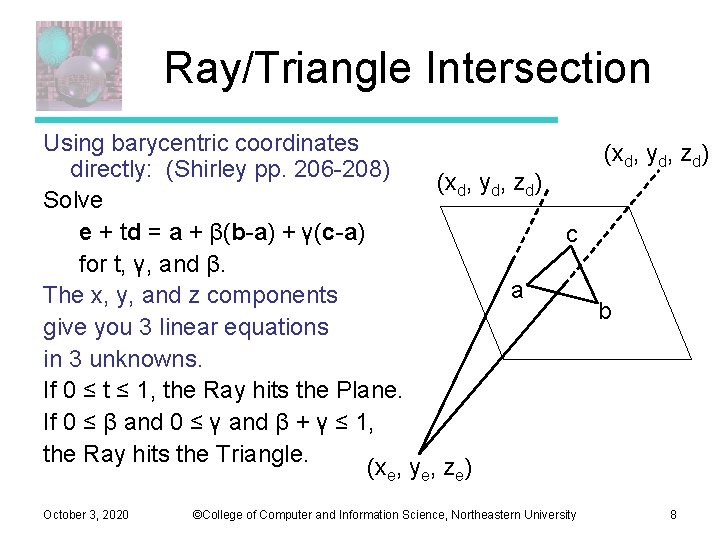
Ray/Triangle Intersection Using barycentric coordinates directly: (Shirley pp. 206 -208) (xd, yd, zd) Solve e + td = a + β(b-a) + γ(c-a) for t, γ, and β. a The x, y, and z components give you 3 linear equations in 3 unknowns. If 0 ≤ t ≤ 1, the Ray hits the Plane. If 0 ≤ β and 0 ≤ γ and β + γ ≤ 1, the Ray hits the Triangle. (xe, ye, ze) October 3, 2020 (xd, yd, zd) c ©College of Computer and Information Science, Northeastern University b 8
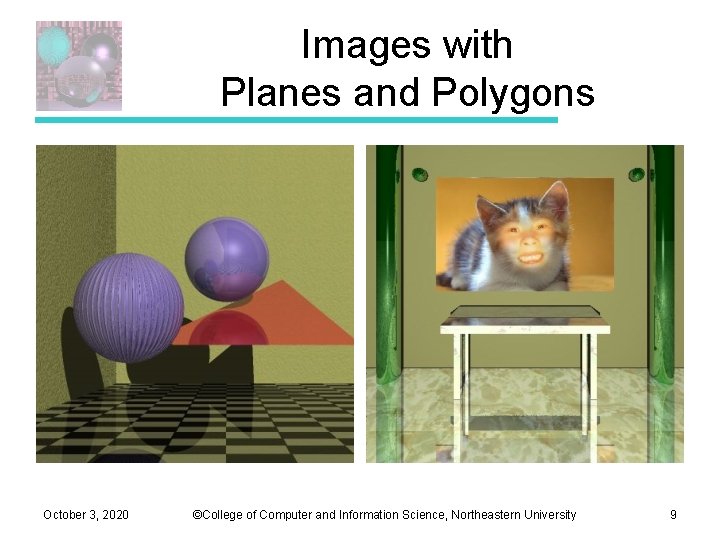
Images with Planes and Polygons October 3, 2020 ©College of Computer and Information Science, Northeastern University 9
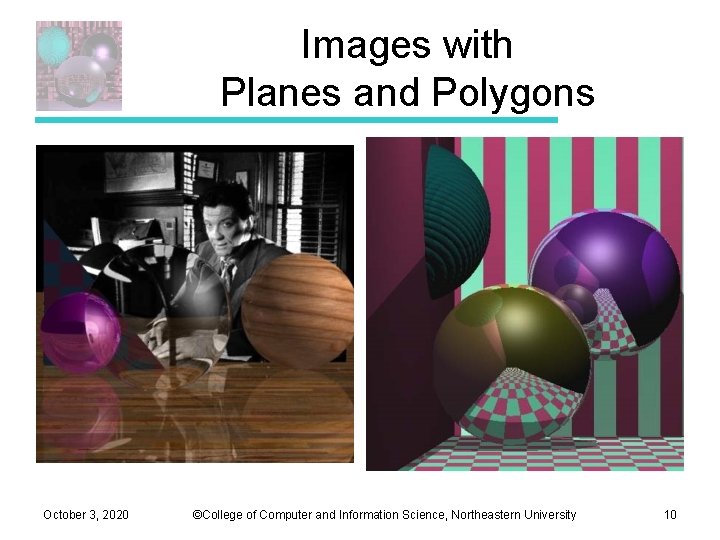
Images with Planes and Polygons October 3, 2020 ©College of Computer and Information Science, Northeastern University 10
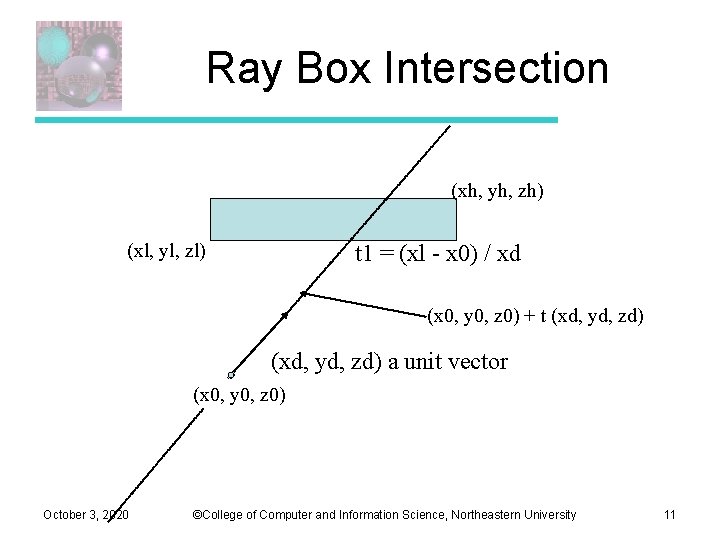
Ray Box Intersection (xh, yh, zh) (xl, yl, zl) t 1 = (xl - x 0) / xd (x 0, y 0, z 0) + t (xd, yd, zd) a unit vector (x 0, y 0, z 0) October 3, 2020 ©College of Computer and Information Science, Northeastern University 11
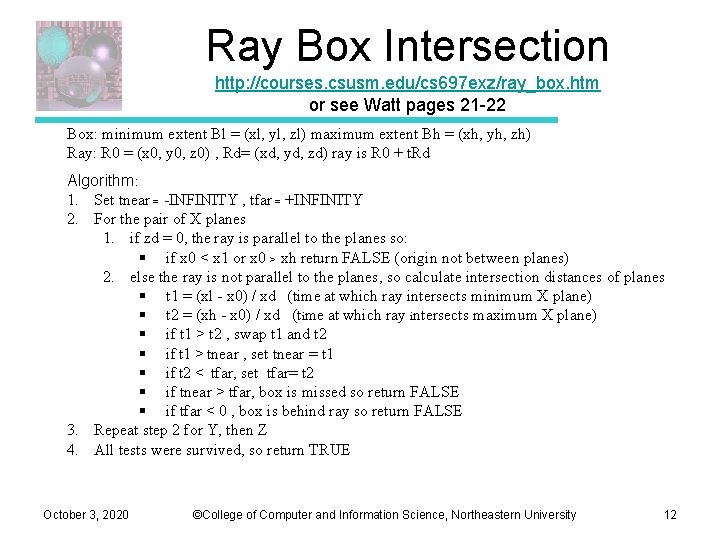
Ray Box Intersection http: //courses. csusm. edu/cs 697 exz/ray_box. htm or see Watt pages 21 -22 Box: minimum extent Bl = (xl, yl, zl) maximum extent Bh = (xh, yh, zh) Ray: R 0 = (x 0, y 0, z 0) , Rd= (xd, yd, zd) ray is R 0 + t. Rd Algorithm: 1. Set tnear = -INFINITY , tfar = +INFINITY 2. For the pair of X planes 1. if zd = 0, the ray is parallel to the planes so: § if x 0 < x 1 or x 0 > xh return FALSE (origin not between planes) 2. else the ray is not parallel to the planes, so calculate intersection distances of planes § t 1 = (xl - x 0) / xd (time at which ray intersects minimum X plane) § t 2 = (xh - x 0) / xd (time at which ray intersects maximum X plane) § if t 1 > t 2 , swap t 1 and t 2 § if t 1 > tnear , set tnear = t 1 § if t 2 < tfar, set tfar= t 2 § if tnear > tfar, box is missed so return FALSE § if tfar < 0 , box is behind ray so return FALSE 3. Repeat step 2 for Y, then Z 4. All tests were survived, so return TRUE October 3, 2020 ©College of Computer and Information Science, Northeastern University 12
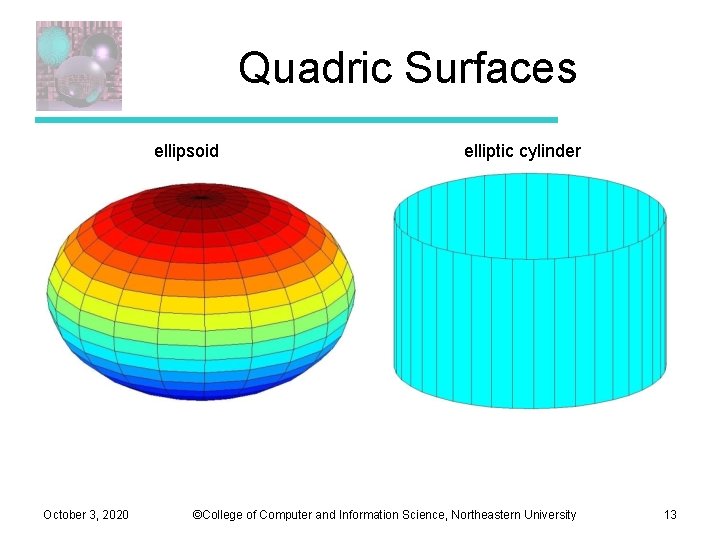
Quadric Surfaces ellipsoid October 3, 2020 elliptic cylinder ©College of Computer and Information Science, Northeastern University 13
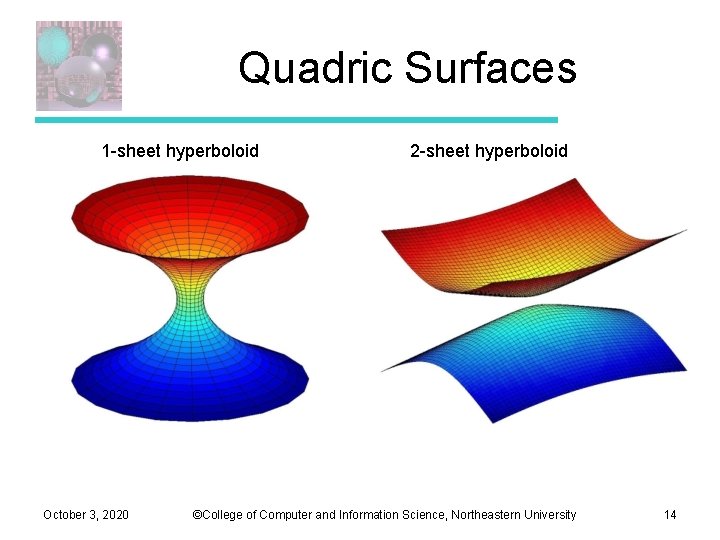
Quadric Surfaces 1 -sheet hyperboloid October 3, 2020 2 -sheet hyperboloid ©College of Computer and Information Science, Northeastern University 14
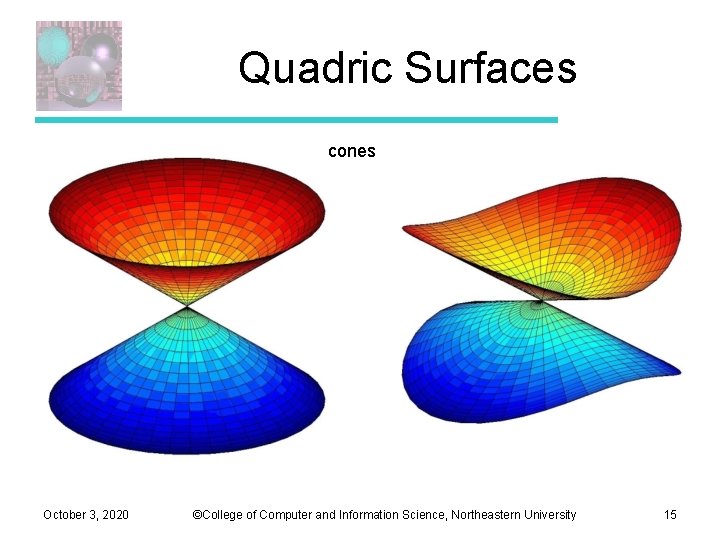
Quadric Surfaces cones October 3, 2020 ©College of Computer and Information Science, Northeastern University 15
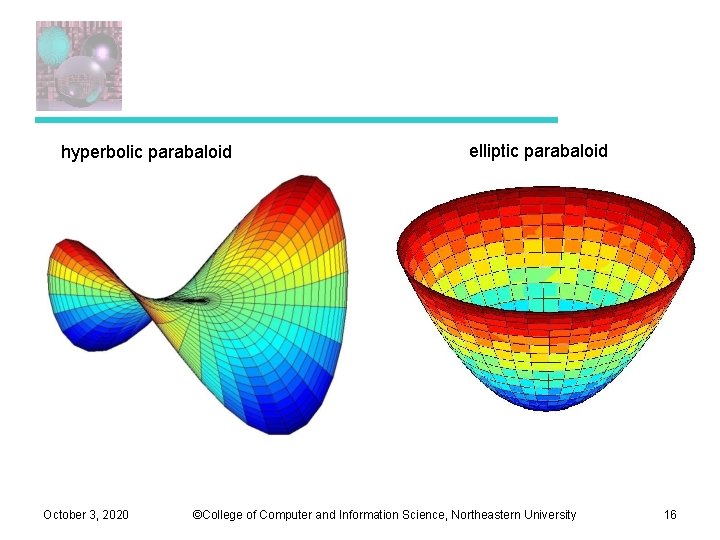
hyperbolic parabaloid October 3, 2020 elliptic parabaloid ©College of Computer and Information Science, Northeastern University 16
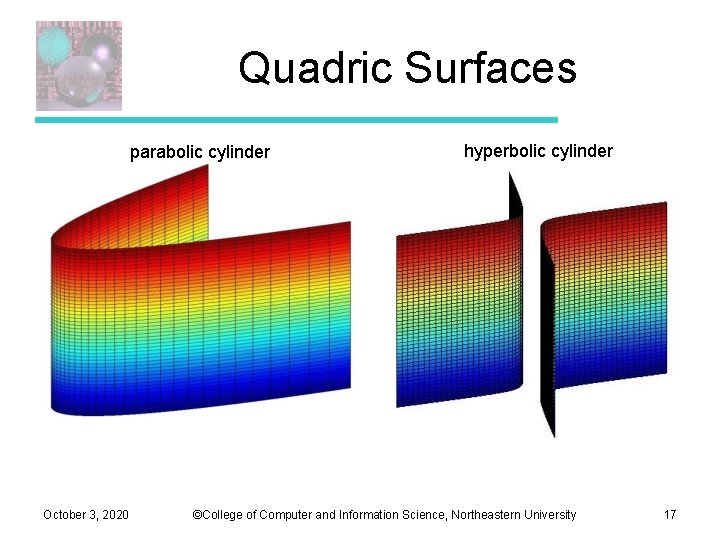
Quadric Surfaces parabolic cylinder October 3, 2020 hyperbolic cylinder ©College of Computer and Information Science, Northeastern University 17
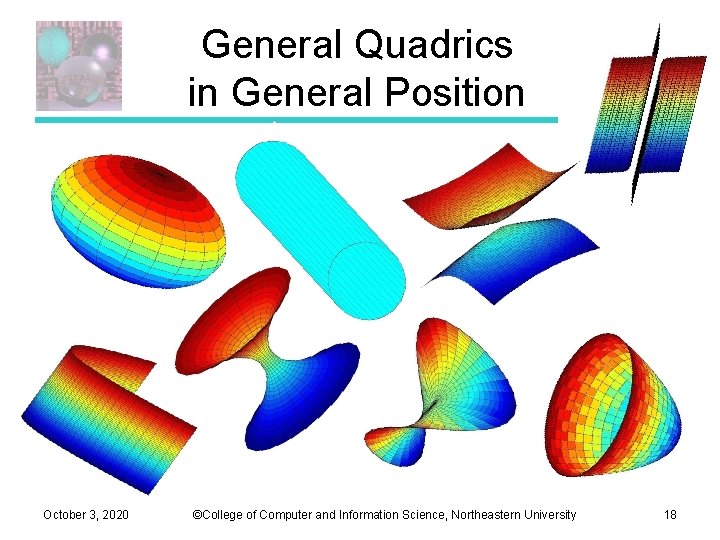
General Quadrics in General Position October 3, 2020 ©College of Computer and Information Science, Northeastern University 18
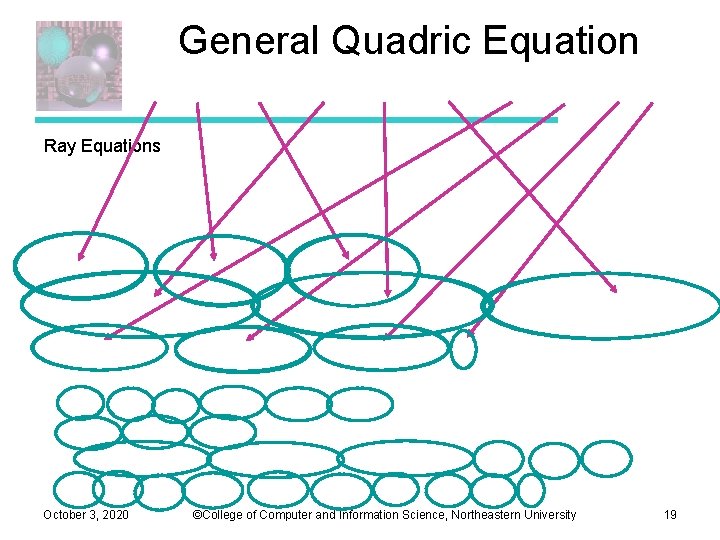
General Quadric Equation Ray Equations October 3, 2020 ©College of Computer and Information Science, Northeastern University 19
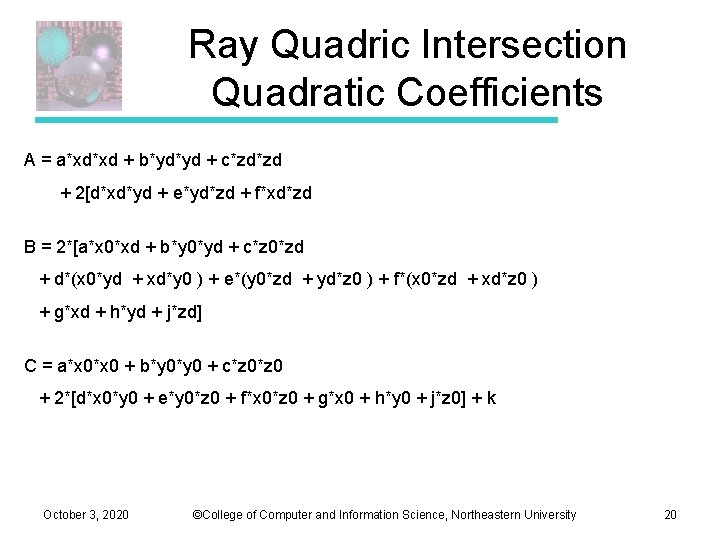
Ray Quadric Intersection Quadratic Coefficients A = a*xd*xd + b*yd*yd + c*zd*zd + 2[d*xd*yd + e*yd*zd + f*xd*zd B = 2*[a*x 0*xd + b*y 0*yd + c*z 0*zd + d*(x 0*yd + xd*y 0 ) + e*(y 0*zd + yd*z 0 ) + f*(x 0*zd + xd*z 0 ) + g*xd + h*yd + j*zd] C = a*x 0 + b*y 0 + c*z 0 + 2*[d*x 0*y 0 + e*y 0*z 0 + f*x 0*z 0 + g*x 0 + h*y 0 + j*z 0] + k October 3, 2020 ©College of Computer and Information Science, Northeastern University 20
Quadric Normals Normalize N and change its sign if necessary. October 3, 2020 ©College of Computer and Information Science, Northeastern University 21
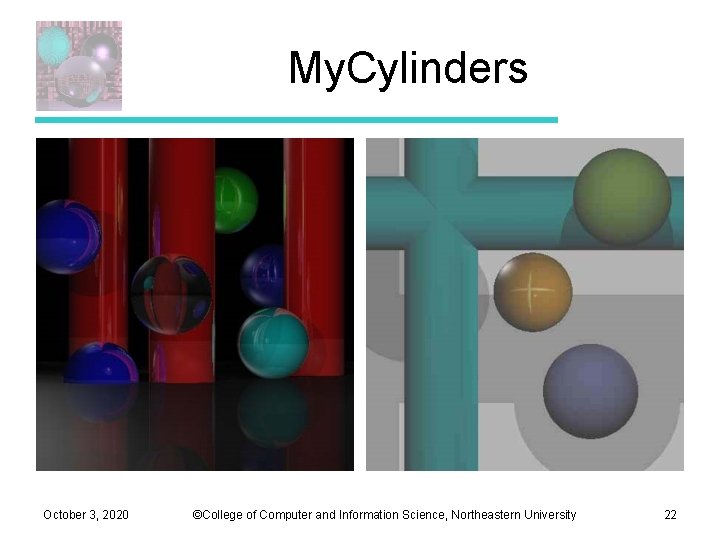
My. Cylinders October 3, 2020 ©College of Computer and Information Science, Northeastern University 22
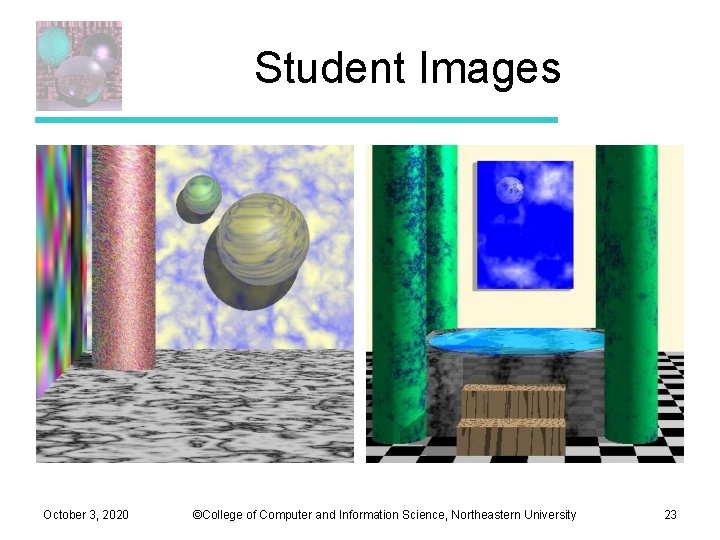
Student Images October 3, 2020 ©College of Computer and Information Science, Northeastern University 23
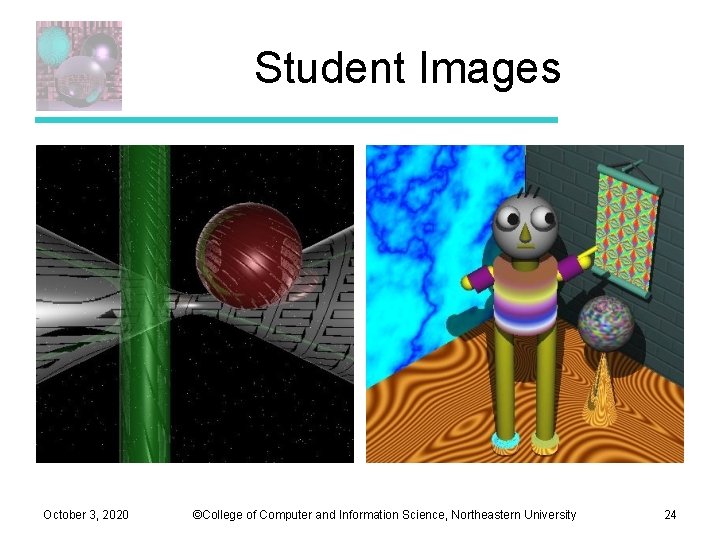
Student Images October 3, 2020 ©College of Computer and Information Science, Northeastern University 24