
CS 427 Multicore Architecture and Parallel Computing Lecture
![Mutual Exclusion • #pragma omp critical [ ( name ) ] structured-block ØA thread](https://slidetodoc.com/presentation_image_h2/2bfabcf4b0ba72f116c84f99f7d57e8b/image-22.jpg "Mutual Exclusion • #pragma omp critical [ ( name ) ] structured-block ØA thread")
![Caveats fibo[ 0 ] = fibo[ 1 ] = 1; for (i = 2;](https://slidetodoc.com/presentation_image_h2/2bfabcf4b0ba72f116c84f99f7d57e8b/image-27.jpg "Caveats fibo[ 0 ] = fibo[ 1 ] = 1; for (i = 2;")
![Loop Carried Dependence for (i=0; i<100; i++) { A[i+1]=A[i]+C[i]; B[i+1]=B[i]+A[i+1]; } • Two loop](https://slidetodoc.com/presentation_image_h2/2bfabcf4b0ba72f116c84f99f7d57e8b/image-32.jpg "Loop Carried Dependence for (i=0; i<100; i++) { A[i+1]=A[i]+C[i]; B[i+1]=B[i]+A[i+1]; } • Two loop")
![Loop Carried Dependence for (i=0; i<100; i++) { A[i]=A[i]+B[i]; B[i+1]=C[i]+D[i]; } Eliminating loop dependence:](https://slidetodoc.com/presentation_image_h2/2bfabcf4b0ba72f116c84f99f7d57e8b/image-33.jpg "Loop Carried Dependence for (i=0; i<100; i++) { A[i]=A[i]+B[i]; B[i+1]=C[i]+D[i]; } Eliminating loop dependence:")
- Slides: 41
CS 427 Multicore Architecture and Parallel Computing Lecture 4 Open. MP Prof. Xiaoyao Liang 2013/9/24 1
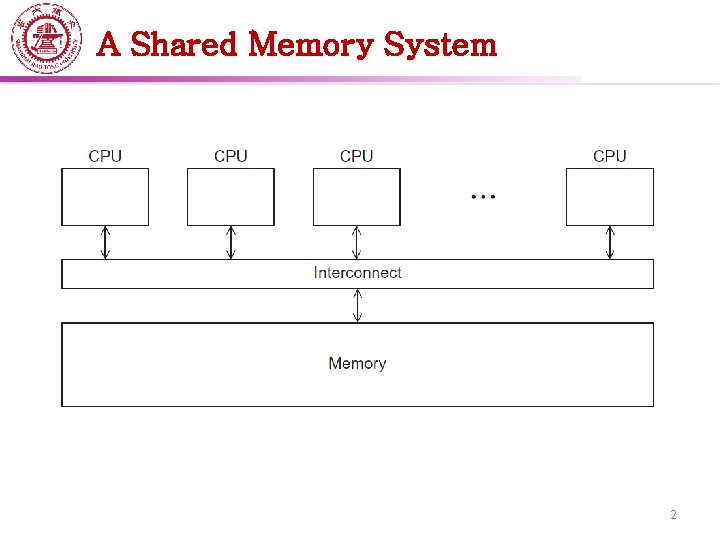
A Shared Memory System 2
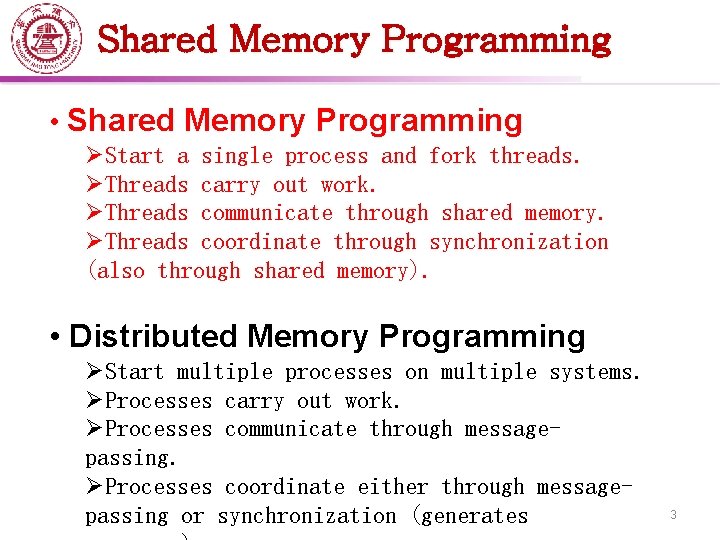
Shared Memory Programming • Shared Memory Programming ØStart a single process and fork threads. ØThreads carry out work. ØThreads communicate through shared memory. ØThreads coordinate through synchronization (also through shared memory). • Distributed Memory Programming ØStart multiple processes on multiple systems. ØProcesses carry out work. ØProcesses communicate through messagepassing. ØProcesses coordinate either through messagepassing or synchronization (generates 3
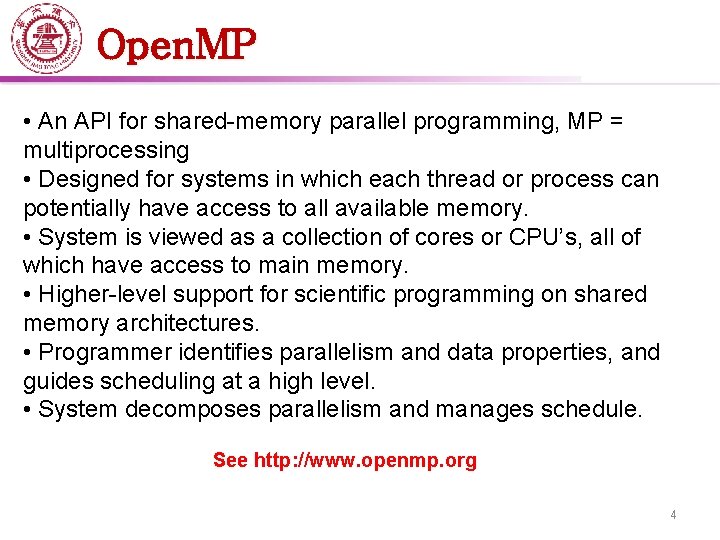
Open. MP • An API for shared-memory parallel programming, MP = multiprocessing • Designed for systems in which each thread or process can potentially have access to all available memory. • System is viewed as a collection of cores or CPU’s, all of which have access to main memory. • Higher-level support for scientific programming on shared memory architectures. • Programmer identifies parallelism and data properties, and guides scheduling at a high level. • System decomposes parallelism and manages schedule. See http: //www. openmp. org 4
Open. MP • Common model for shared-memory parallel programming ØPortable across shared-memory architectures • Scalable (on shared-memory platforms) • Incremental parallelization ØParallelize individual computations in a program while leaving the rest of the program sequential • Compiler based ØCompiler generates thread program and synchronization • Extensions to existing programming languages (Fortran, C and C++) Ømainly by directives Øa few library routines 5
Programmer’s View • Open. MP is a portable, threaded, shared-memory programming specification with “light” syntax Ø Exact behavior depends on Open. MP implementation! Ø Requires compiler support (C/C++ or Fortran) • Open. MP will: Ø Allow a programmer to separate a program into serial regions and parallel regions, rather than concurrentlyexecuting threads. Ø Hide stack management Ø Provide synchronization constructs • Open. MP will not: Ø Ø Parallelize automatically Guarantee speedup 6
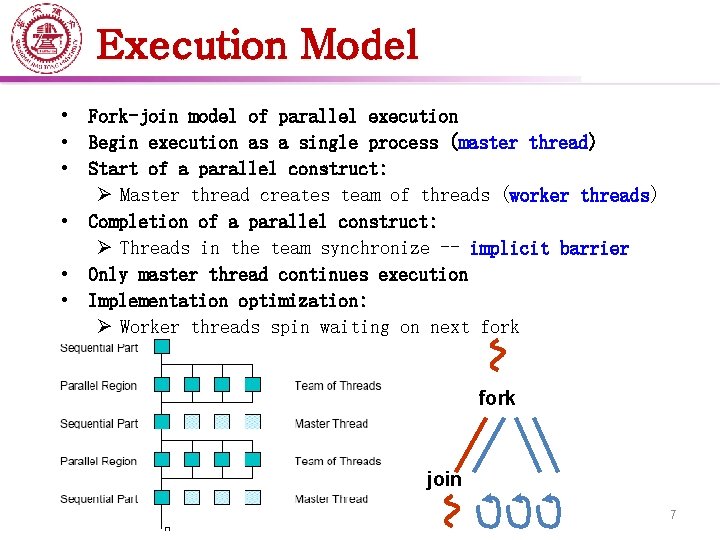
Execution Model • Fork-join model of parallel execution • Begin execution as a single process (master thread) • Start of a parallel construct: Ø Master thread creates team of threads (worker threads) • Completion of a parallel construct: Ø Threads in the team synchronize -- implicit barrier • Only master thread continues execution • Implementation optimization: Ø Worker threads spin waiting on next fork join 7
Pragmas • Pragmas are special preprocessor instructions. • Typically added to a system to allow behaviors that aren’t part of the basic C specification. • Compilers that don’t support the pragmas ignore them. • The interpretation of Open. MP pragmas Ø They modify the statement immediately following the pragma Ø This could be a compound statement such as a loop #pragma omp … 8
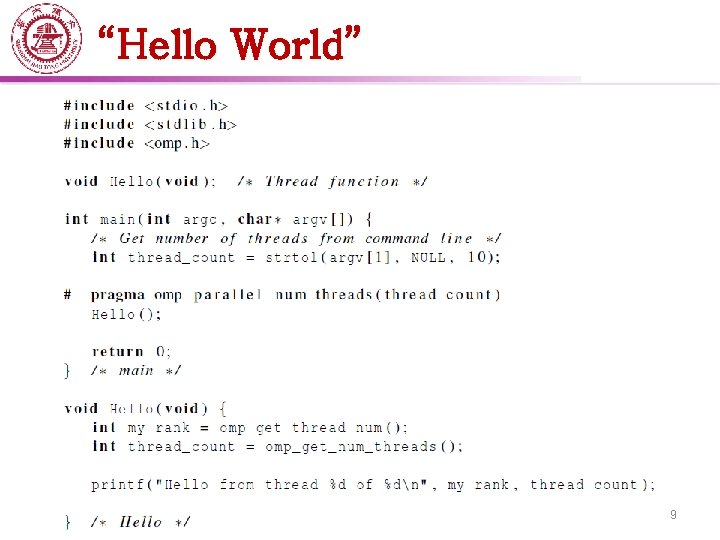
“Hello World” 9
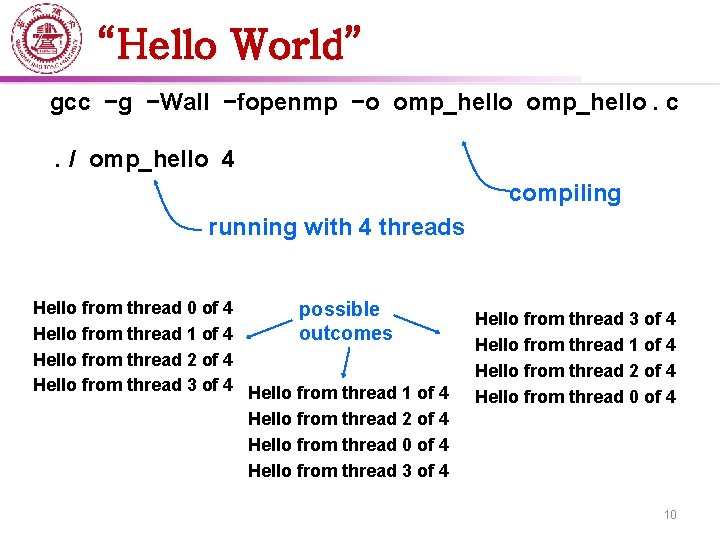
“Hello World” gcc −g −Wall −fopenmp −o omp_hello. c. / omp_hello 4 compiling running with 4 threads Hello from thread 0 of 4 possible Hello from thread 1 of 4 outcomes Hello from thread 2 of 4 Hello from thread 3 of 4 Hello from thread 1 of 4 Hello from thread 2 of 4 Hello from thread 0 of 4 10
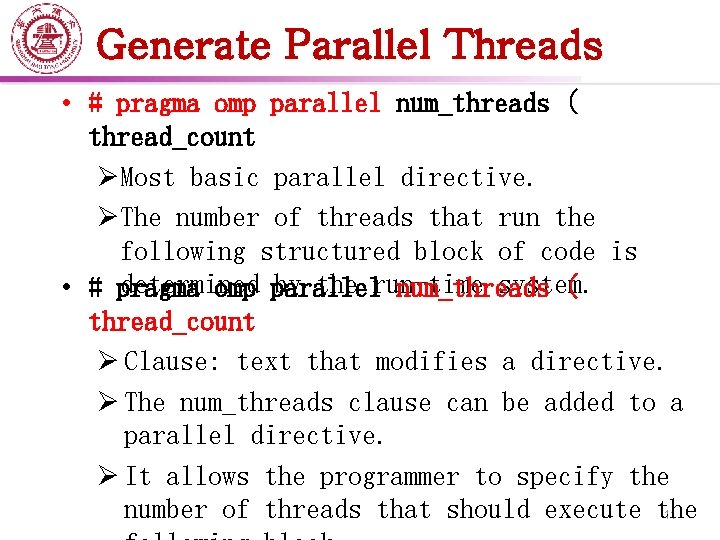
Generate Parallel Threads • # pragma omp parallel num_threads ( thread_count ØMost basic parallel directive. ØThe number of threads that run the following structured block of code is determined by the run-time system. • # pragma omp parallel num_threads ( thread_count Ø Clause: text that modifies a directive. Ø The num_threads clause can be added to a parallel directive. Ø It allows the programmer to specify the number of threads that should execute the 11
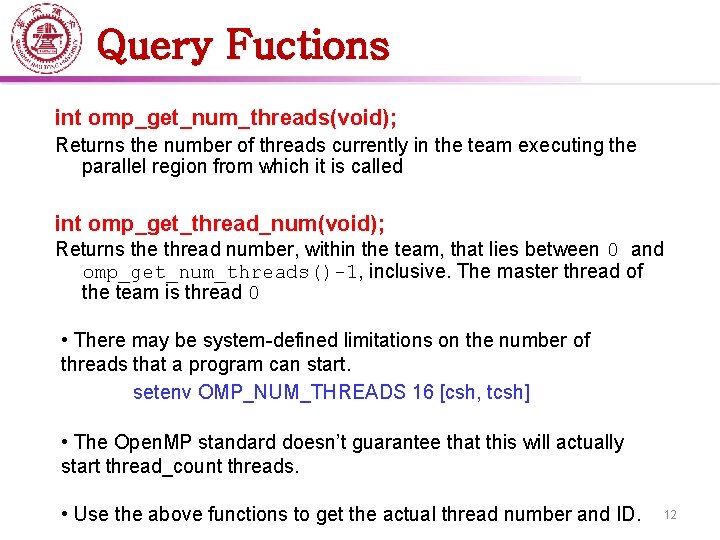
Query Fuctions int omp_get_num_threads(void); Returns the number of threads currently in the team executing the parallel region from which it is called int omp_get_thread_num(void); Returns the thread number, within the team, that lies between 0 and omp_get_num_threads()-1, inclusive. The master thread of the team is thread 0 • There may be system-defined limitations on the number of threads that a program can start. setenv OMP_NUM_THREADS 16 [csh, tcsh] • The Open. MP standard doesn’t guarantee that this will actually start thread_count threads. • Use the above functions to get the actual thread number and ID. 12
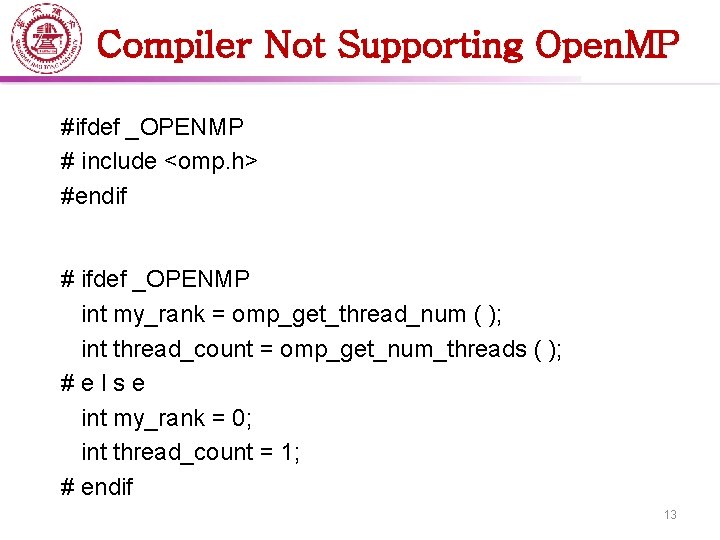
Compiler Not Supporting Open. MP #ifdef _OPENMP # include <omp. h> #endif # ifdef _OPENMP int my_rank = omp_get_thread_num ( ); int thread_count = omp_get_num_threads ( ); #else int my_rank = 0; int thread_count = 1; # endif 13
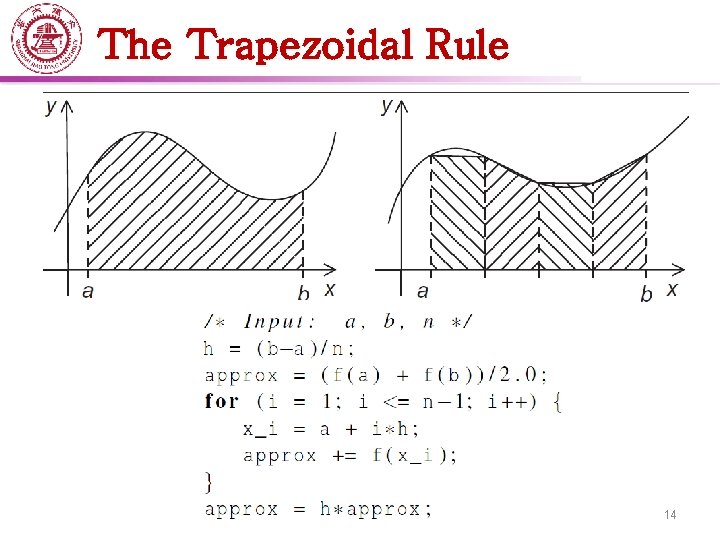
The Trapezoidal Rule 14
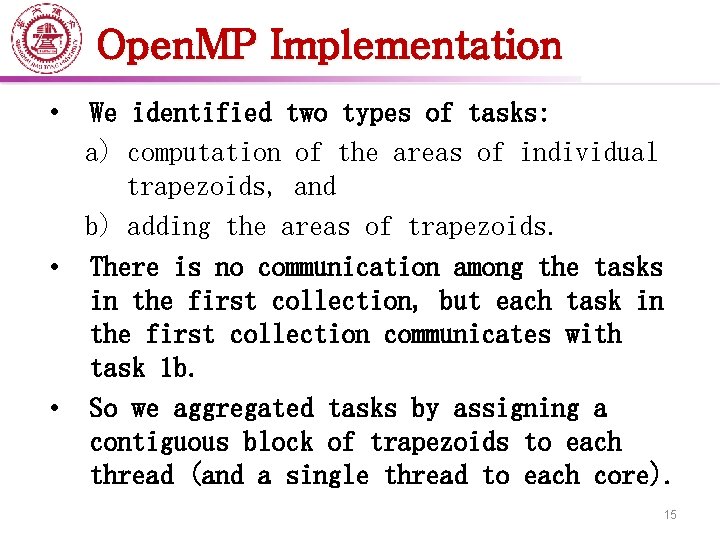
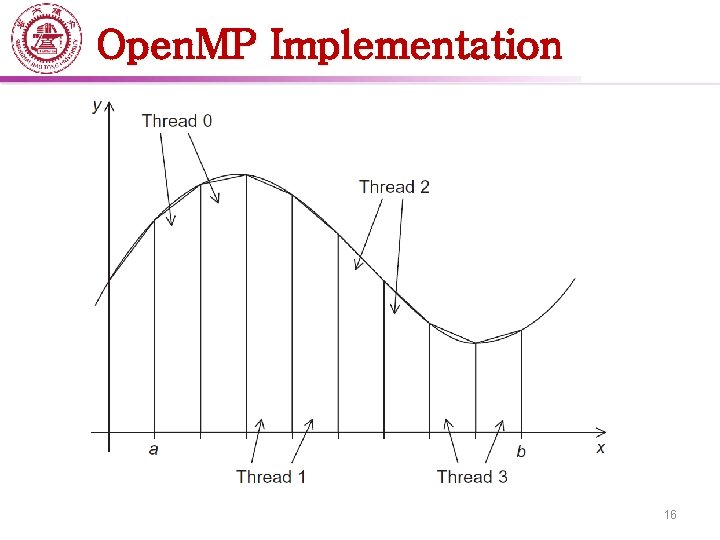
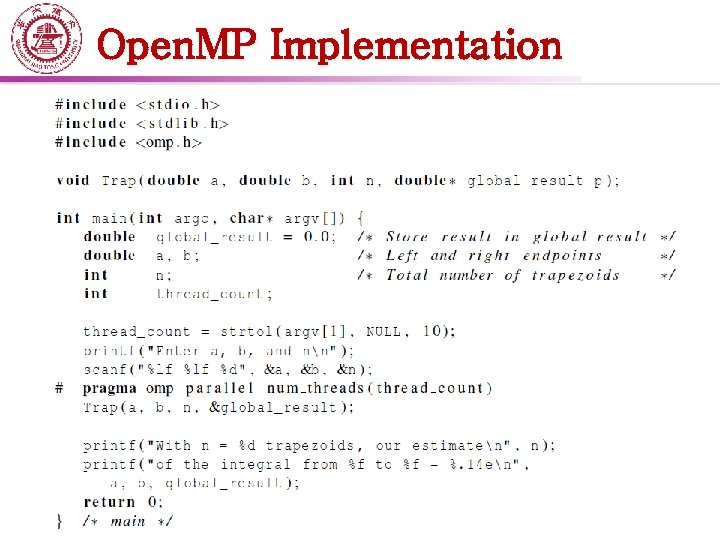
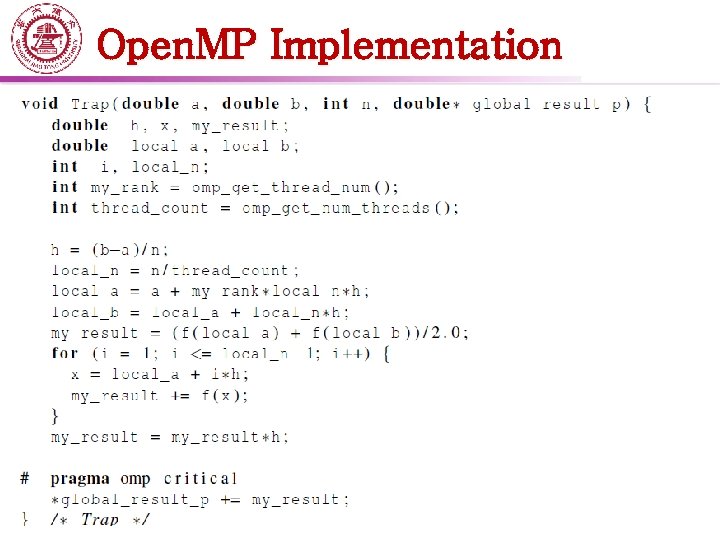
Open. MP Implementation • We identified two types of tasks: a) computation of the areas of individual trapezoids, and b) adding the areas of trapezoids. • There is no communication among the tasks in the first collection, but each task in the first collection communicates with task 1 b. • So we aggregated tasks by assigning a contiguous block of trapezoids to each thread (and a single thread to each core). 15
Open. MP Implementation 16
Open. MP Implementation 17
Open. MP Implementation 18
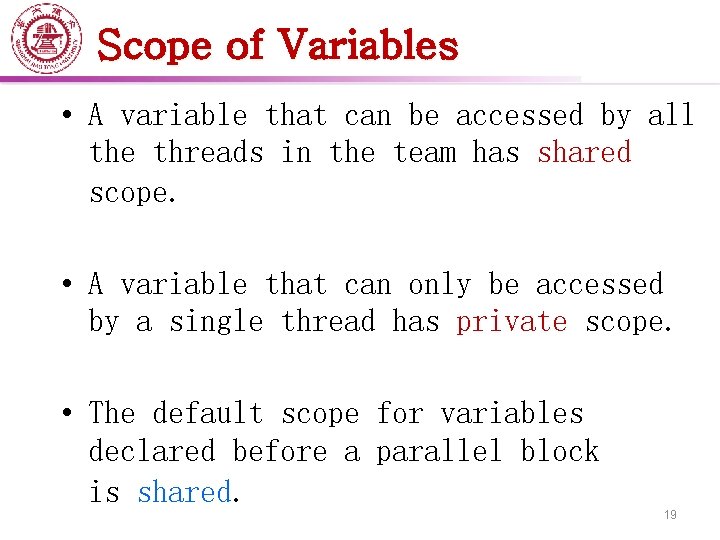
Scope of Variables • A variable that can be accessed by all the threads in the team has shared scope. • A variable that can only be accessed by a single thread has private scope. • The default scope for variables declared before a parallel block is shared. 19
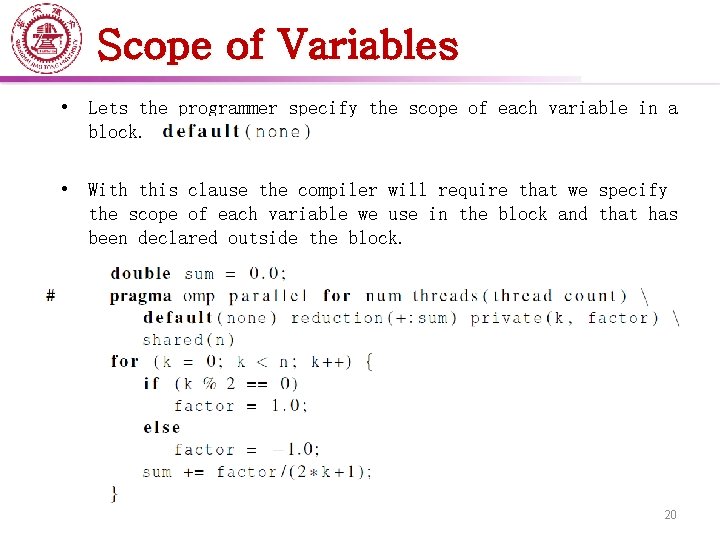
Scope of Variables • Lets the programmer specify the scope of each variable in a block. • With this clause the compiler will require that we specify the scope of each variable we use in the block and that has been declared outside the block. 20
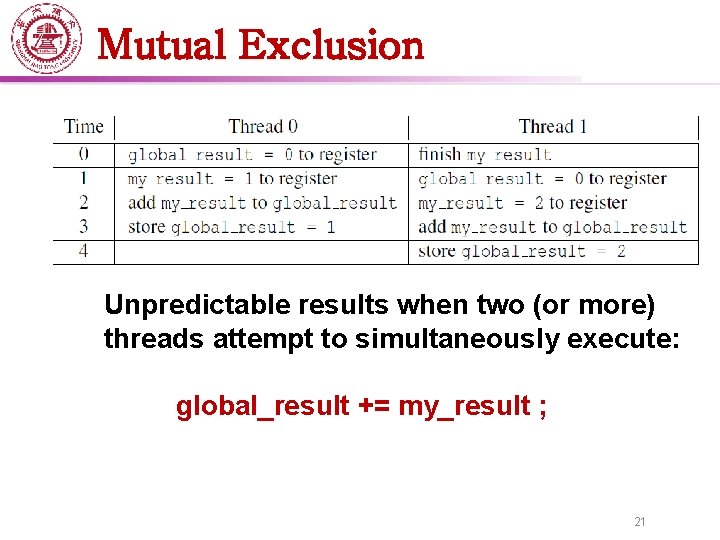
Mutual Exclusion Unpredictable results when two (or more) threads attempt to simultaneously execute: global_result += my_result ; 21
Mutual Exclusion • #pragma omp critical [ ( name ) ] structured-block ØA thread waits at the beginning of a critical region until no other thread in the team is executing a critical region with the same name. # pragma omp critical global_result += my_result ; only one thread can execute the following structured block at a time 22
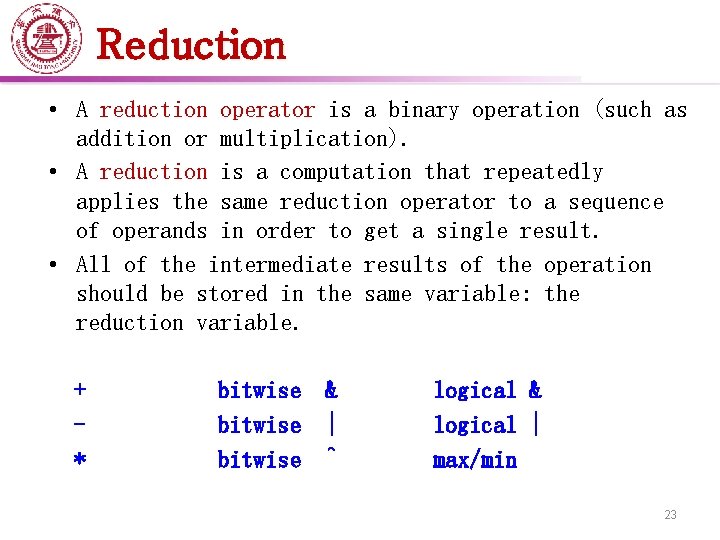
Reduction • A reduction operator is a binary operation (such as addition or multiplication). • A reduction is a computation that repeatedly applies the same reduction operator to a sequence of operands in order to get a single result. • All of the intermediate results of the operation should be stored in the same variable: the reduction variable. + * bitwise & | ^ logical & logical | max/min 23
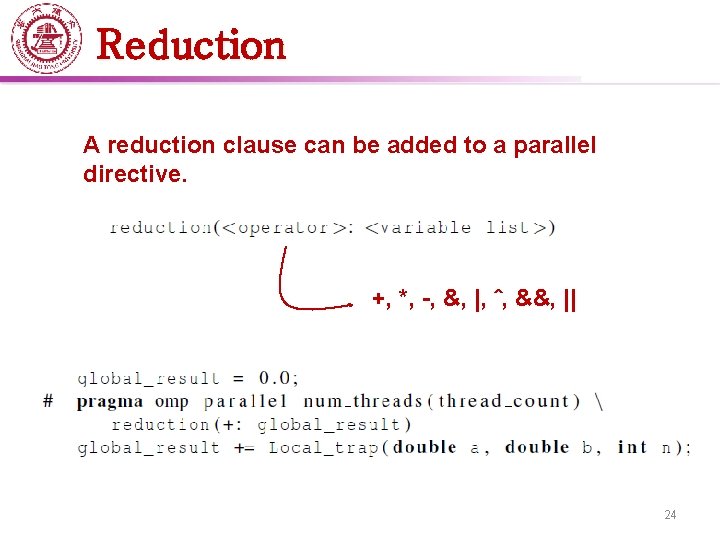
Reduction A reduction clause can be added to a parallel directive. +, *, -, &, |, ˆ, &&, || 24
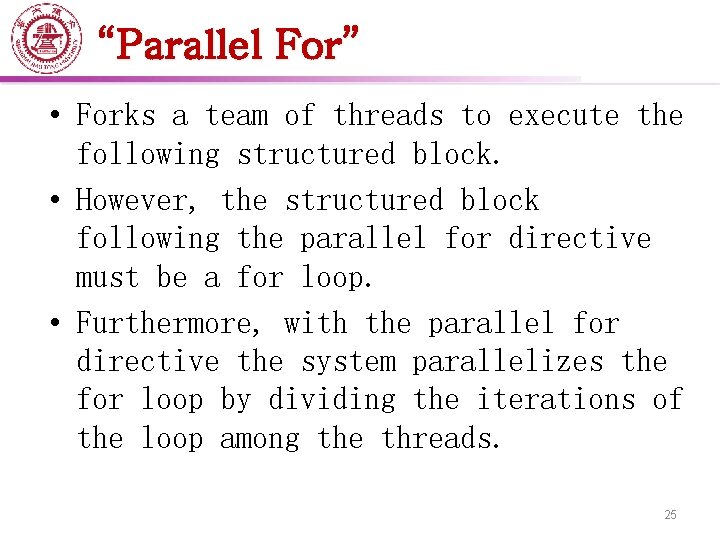
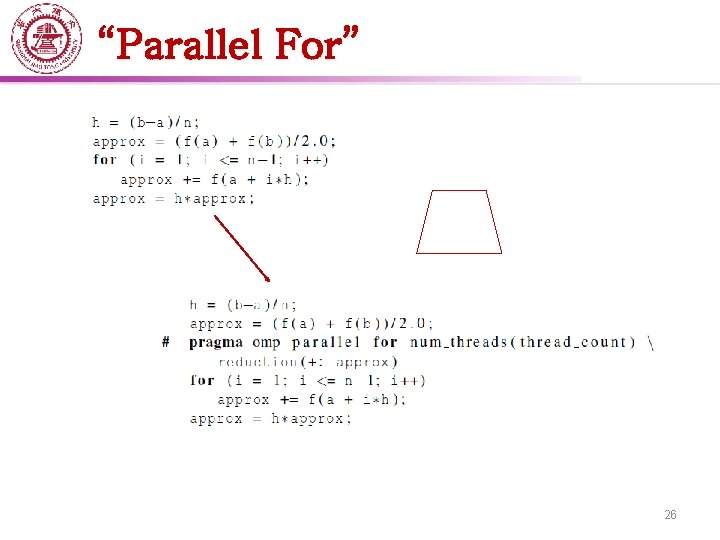
“Parallel For” • Forks a team of threads to execute the following structured block. • However, the structured block following the parallel for directive must be a for loop. • Furthermore, with the parallel for directive the system parallelizes the for loop by dividing the iterations of the loop among the threads. 25
“Parallel For” 26
Caveats fibo[ 0 ] = fibo[ 1 ] = 1; for (i = 2; i < n; i++) fibo[ i ] = fibo[ i – 1 ] + fibo[ i – 2 ]; note 2 threads fibo[ 0 ] = fibo[ 1 ] = 1; # pragma omp parallel for num_threads(2) for (i = 2; i < n; i++) fibo[ i ] = fibo[ i – 1 ] + fibo[ i – 2 ]; 1 1 2 3 5 8 13 21 34 55 this is correct but sometimes we get this 1123580000 27
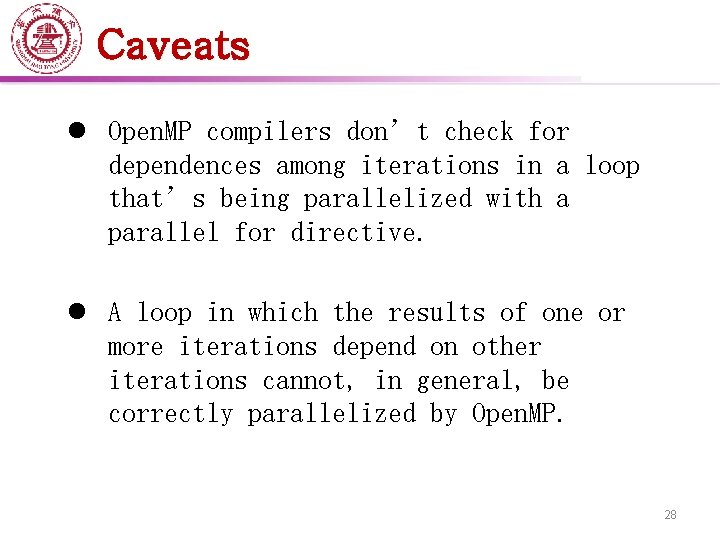
Caveats l Open. MP compilers don’t check for dependences among iterations in a loop that’s being parallelized with a parallel for directive. l A loop in which the results of one or more iterations depend on other iterations cannot, in general, be correctly parallelized by Open. MP. 28
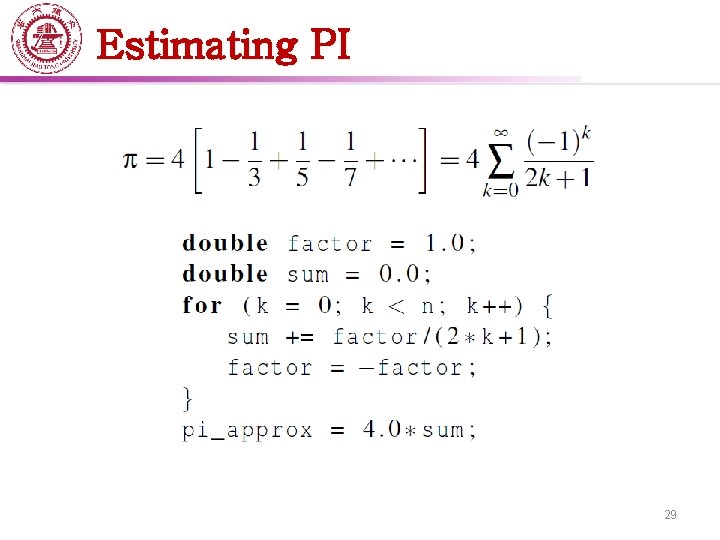
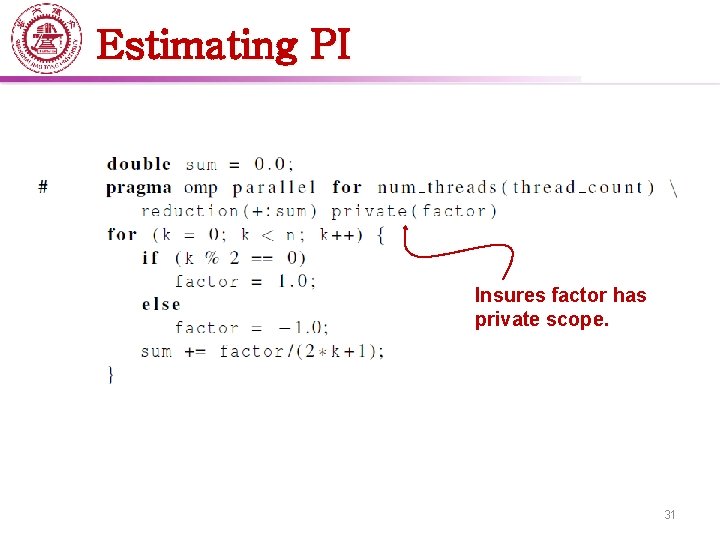
Estimating PI 29
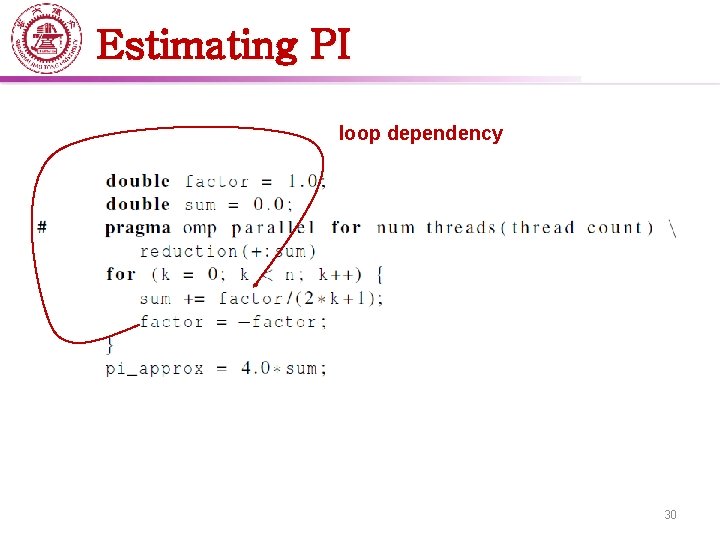
Estimating PI loop dependency 30
Estimating PI Insures factor has private scope. 31
Loop Carried Dependence for (i=0; i<100; i++) { A[i+1]=A[i]+C[i]; B[i+1]=B[i]+A[i+1]; } • Two loop carried dependence. • One intra-loop dependence. 32
Loop Carried Dependence for (i=0; i<100; i++) { A[i]=A[i]+B[i]; B[i+1]=C[i]+D[i]; } Eliminating loop dependence: A[0]=A[0]+B[0]; for (i=0; i<99; i++) { B[i+1]=C[i]+D[i]; A[i+1]=A[i+1]+B[i+1]; } B[100]=C[99]+D[99]; 33
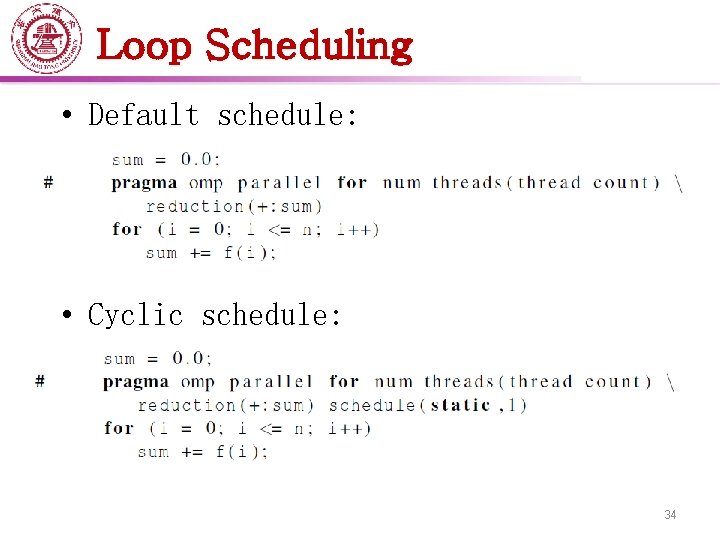
Loop Scheduling • Default schedule: • Cyclic schedule: 34
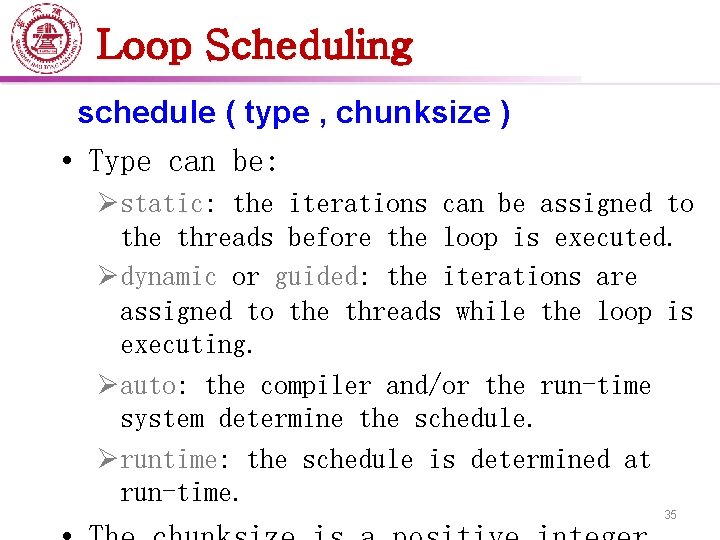
Loop Scheduling schedule ( type , chunksize ) • Type can be: Østatic: the iterations can be assigned to the threads before the loop is executed. Ødynamic or guided: the iterations are assigned to the threads while the loop is executing. Øauto: the compiler and/or the run-time system determine the schedule. Øruntime: the schedule is determined at run-time. 35
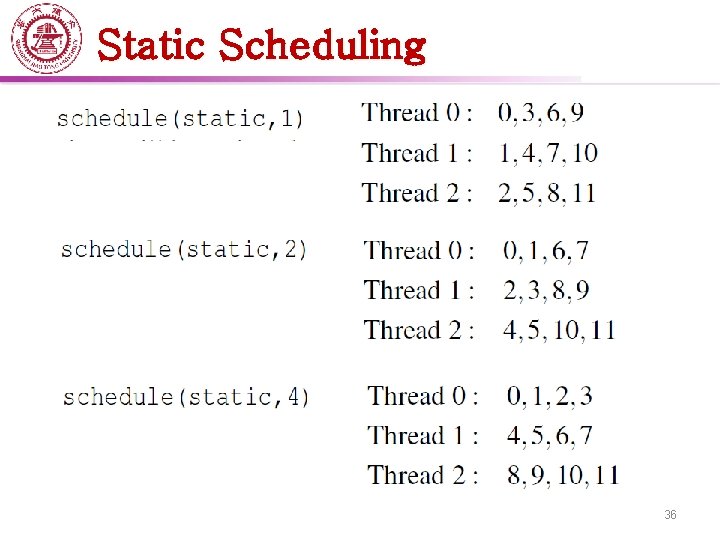
Static Scheduling 36
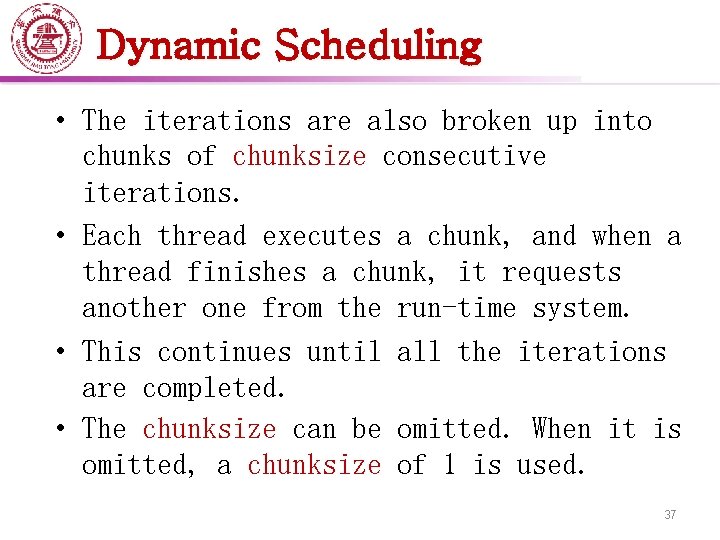
Dynamic Scheduling • The iterations are also broken up into chunks of chunksize consecutive iterations. • Each thread executes a chunk, and when a thread finishes a chunk, it requests another one from the run-time system. • This continues until all the iterations are completed. • The chunksize can be omitted. When it is omitted, a chunksize of 1 is used. 37
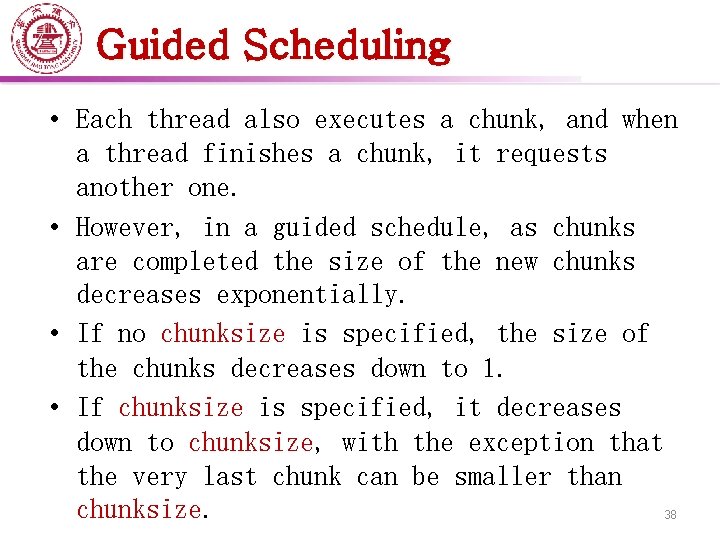
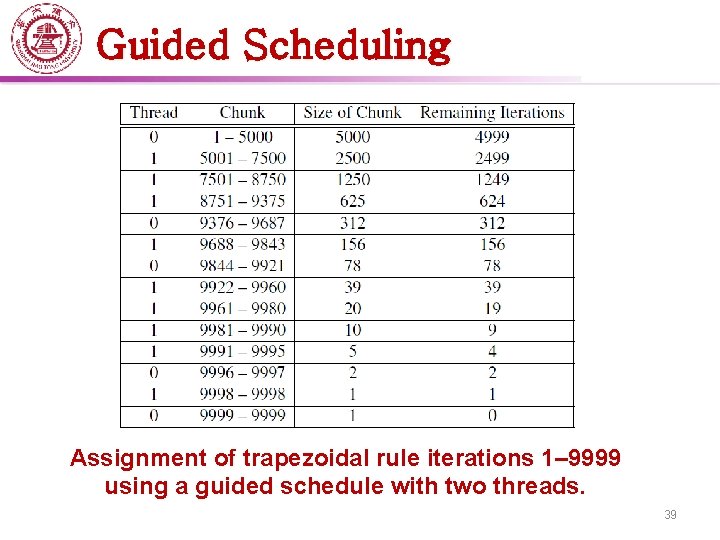
Guided Scheduling • Each thread also executes a chunk, and when a thread finishes a chunk, it requests another one. • However, in a guided schedule, as chunks are completed the size of the new chunks decreases exponentially. • If no chunksize is specified, the size of the chunks decreases down to 1. • If chunksize is specified, it decreases down to chunksize, with the exception that the very last chunk can be smaller than chunksize. 38
Guided Scheduling Assignment of trapezoidal rule iterations 1– 9999 using a guided schedule with two threads. 39
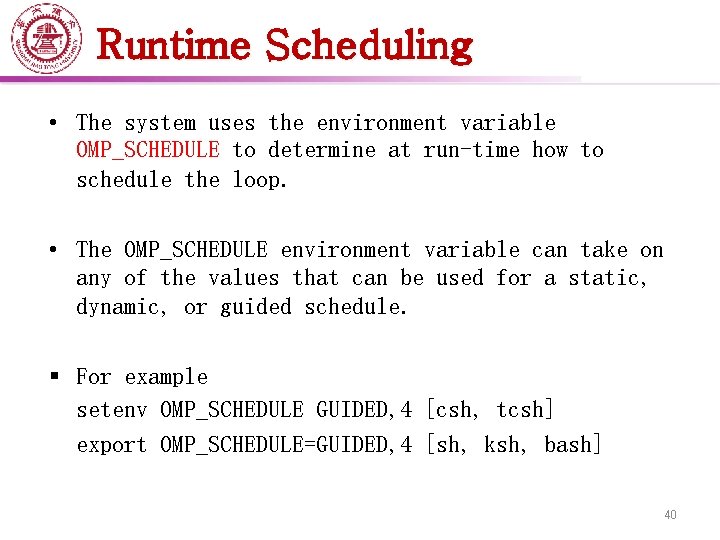
Runtime Scheduling • The system uses the environment variable OMP_SCHEDULE to determine at run-time how to schedule the loop. • The OMP_SCHEDULE environment variable can take on any of the values that can be used for a static, dynamic, or guided schedule. § For example setenv OMP_SCHEDULE GUIDED, 4 [csh, tcsh] export OMP_SCHEDULE=GUIDED, 4 [sh, ksh, bash] 40
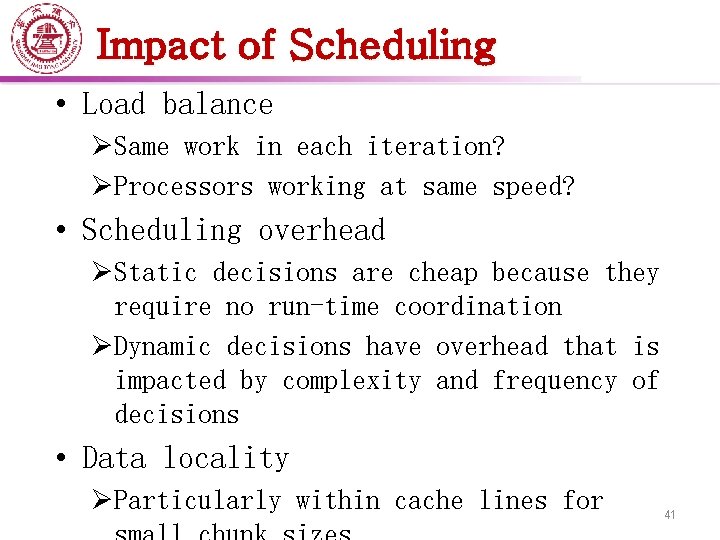
Impact of Scheduling • Load balance ØSame work in each iteration? ØProcessors working at same speed? • Scheduling overhead ØStatic decisions are cheap because they require no run-time coordination ØDynamic decisions have overhead that is impacted by complexity and frequency of decisions • Data locality ØParticularly within cache lines for 41