
CS 425625 Software Engineering Legacy Systems Based on
CS 425/625 Software Engineering Legacy Systems Based on Chapter 26 of the textbook [Somm 00] Ian Sommerville, Software Engineering, 6 th Ed. , Addison-Wesley, 2000 and on the Ch 26 Power. Point presentation available at the book’s web-site: www. comp. lancs. ac. uk/computing/resources/Ian. S/SE 6/Slides/index. html November 26, 2003 1
Outline n n 2 Introduction Legacy System Structures Legacy System Design Legacy System Assessment
Introduction. . n Legacy systems: old computer-based systems still in use by organizations u Many of them still business critical u Incorporate many changes made over the years u Many people have been involved in these changes u Replacing legacy systems with new systems is risky, yet keeping them means new changes become more and more expensive 3
. Introduction. n Risks of replacing a legacy system: u Specification is difficult because existing documentation is typically incomplete u Changing business processes (now adjusted to the system) may entail high costs u Undocumented, yet important business rules may be embedded in the system; a new system may break these rules u The new system may be delivered late, may cost more than expected, and may not function properly 4
. . Introduction n Factors that make changes to legacy systems expensive: In large systems, different parts were implemented by different teams, without consistent programming style u It is difficult to find personnel who knows the obsolete programming languages used in old systems u In may cases the only documentation is provided by the source code; even this may be missing u It is difficult to understand the system given its ad hoc updating over the years u Data used by the system is difficult to understand manipulate; it can also be obsolete and/or redundant u 5
Legacy system structures…. n Legacy systems involve more than software (they are computer-based systems). Typical logical parts of a legacy system are: u System hardware u Support software u Application software (legacy software systems) u Application data u Business processes u Business policies and rules 6
![. Legacy system structures… n 7 Legacy system components [Fig. 26. 1 Somm 00]](http://slidetodoc.com/presentation_image_h/c497240a3e83cc8b44a4c4392779582e/image-7.jpg ". Legacy system structures… n 7 Legacy system components [Fig. 26. 1 Somm 00]")
. Legacy system structures… n 7 Legacy system components [Fig. 26. 1 Somm 00]
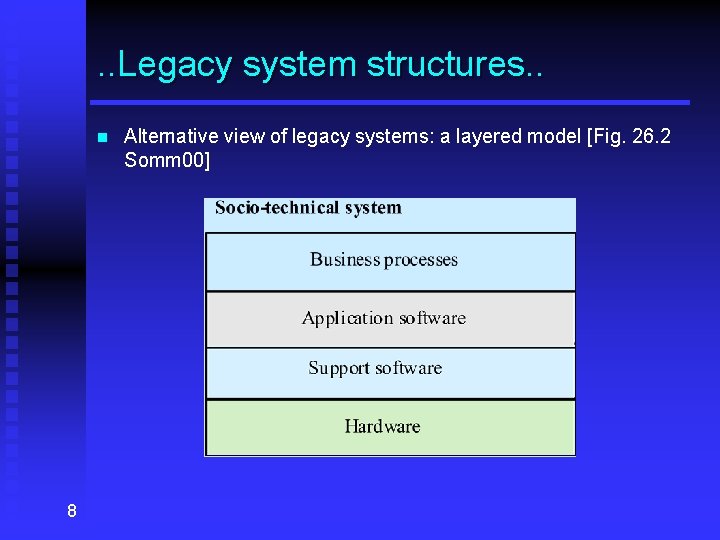
. . Legacy system structures. . n 8 Alternative view of legacy systems: a layered model [Fig. 26. 2 Somm 00]
![…Legacy system structures. n 9 Legacy application software [Fig. 26. 3 Somm 00] Both](http://slidetodoc.com/presentation_image_h/c497240a3e83cc8b44a4c4392779582e/image-9.jpg "…Legacy system structures. n 9 Legacy application software [Fig. 26. 3 Somm 00] Both")
…Legacy system structures. n 9 Legacy application software [Fig. 26. 3 Somm 00] Both programs and data files have been added over the years: components are heterogeneous and strongly coupled
![…. Legacy system structures n Database-centered legacy systems [Fig. 26. 4 Somm 00] u](http://slidetodoc.com/presentation_image_h/c497240a3e83cc8b44a4c4392779582e/image-10.jpg "…. Legacy system structures n Database-centered legacy systems [Fig. 26. 4 Somm 00] u")
…. Legacy system structures n Database-centered legacy systems [Fig. 26. 4 Somm 00] u u 10 Advantages: logical and physical data models are used, redundancy is reduced, impact of system changes can be easier assessed, recovery is possible Main issues: DBMS may be obsolete, accessing software (“teleprocessing monitor”) may need to be replaced
Legacy system design…. . n Legacy systems design is typically function oriented. Two main classes: u u n Both batch processing and transaction processing systems usually follow an IPO model: u u 11 Batch processing systems: both input and output is provided in “batches, ” e. g. , a payroll system Transaction processing systems: input & output related to a database transaction, e. g. , a flight reservation system Input: inputs are collected from one or more sources Processing: some computations are performed on inputs Output: results are provided either in batches or as singletransaction outputs All IPO components may further be organized according the IPO model
![. Legacy system design…. n 12 The IPO Model [Fig. 26. 7 Somm 00].](http://slidetodoc.com/presentation_image_h/c497240a3e83cc8b44a4c4392779582e/image-12.jpg ". Legacy system design…. n 12 The IPO Model [Fig. 26. 7 Somm 00].")
. Legacy system design…. n 12 The IPO Model [Fig. 26. 7 Somm 00].
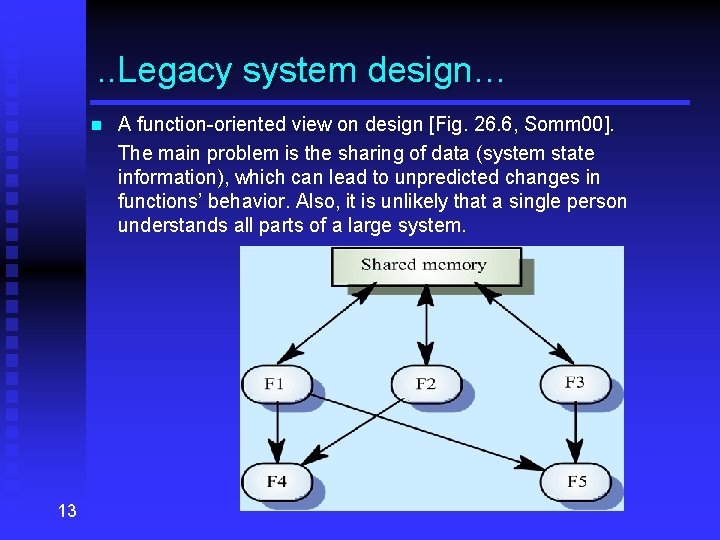
. . Legacy system design… n 13 A function-oriented view on design [Fig. 26. 6, Somm 00]. The main problem is the sharing of data (system state information), which can lead to unpredicted changes in functions’ behavior. Also, it is unlikely that a single person understands all parts of a large system.
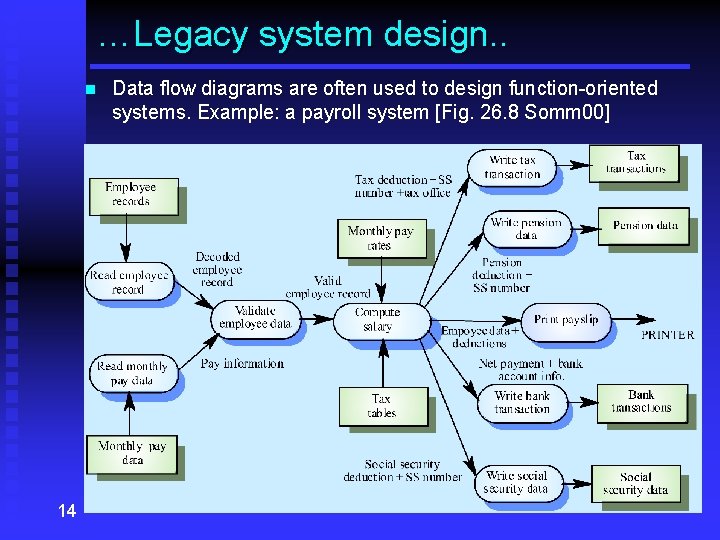
…Legacy system design. . n 14 Data flow diagrams are often used to design function-oriented systems. Example: a payroll system [Fig. 26. 8 Somm 00]
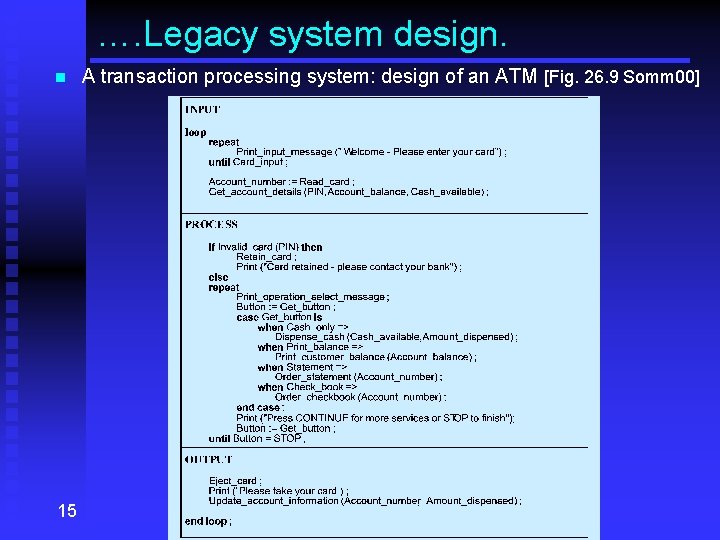
…. Legacy system design. n 15 A transaction processing system: design of an ATM [Fig. 26. 9 Somm 00]
…. . Legacy system design n Function oriented design is not restricted to legacy systems. Can be applied to new systems where: Data processing relies on processing transactions and updating a data store u The company has invested heavily in structured methods, including staff training, development practices, and CASE tools u n 16 An interesting challenge for a company: to work with both approaches, function-oriented and object-oriented
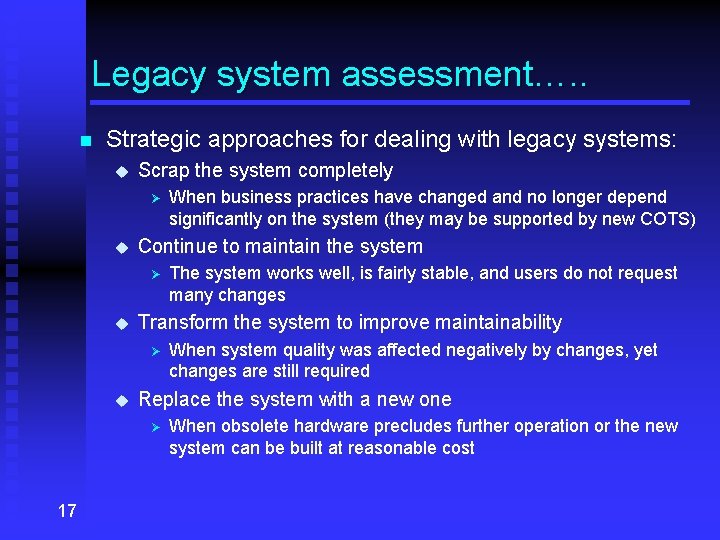
Legacy system assessment…. . n Strategic approaches for dealing with legacy systems: u Scrap the system completely Ø u Continue to maintain the system Ø u When system quality was affected negatively by changes, yet changes are still required Replace the system with a new one Ø 17 The system works well, is fairly stable, and users do not request many changes Transform the system to improve maintainability Ø u When business practices have changed and no longer depend significantly on the system (they may be supported by new COTS) When obsolete hardware precludes further operation or the new system can be built at reasonable cost
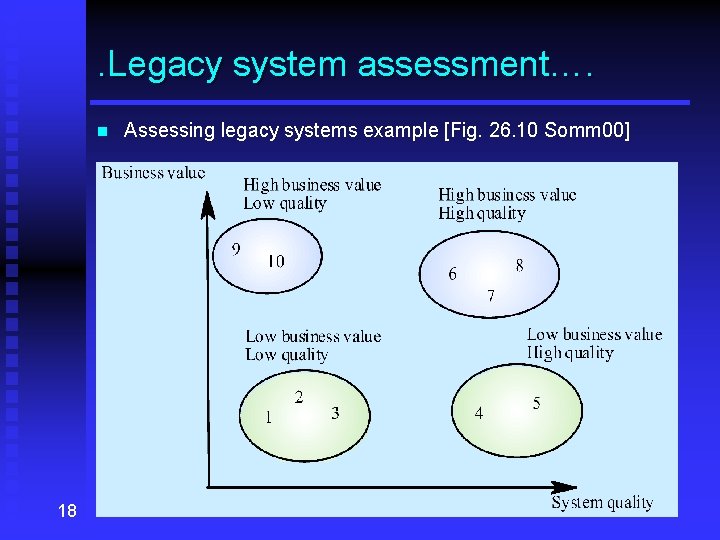
. Legacy system assessment…. n 18 Assessing legacy systems example [Fig. 26. 10 Somm 00]
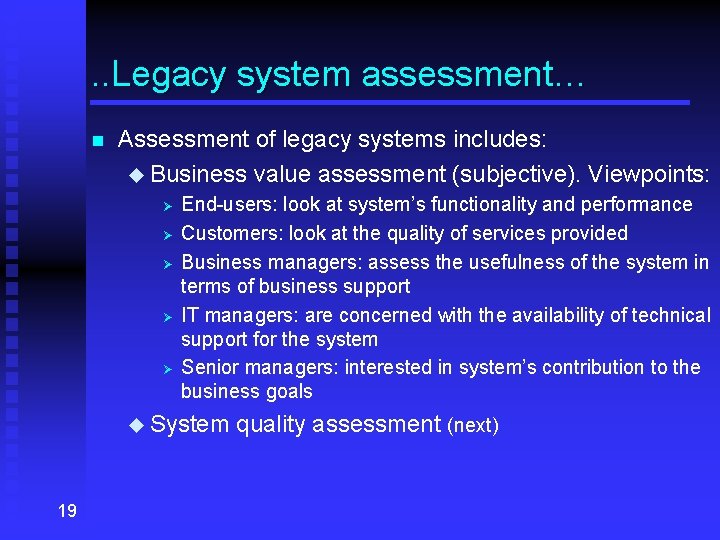
. . Legacy system assessment… n Assessment of legacy systems includes: u Business value assessment (subjective). Viewpoints: Ø Ø Ø End-users: look at system’s functionality and performance Customers: look at the quality of services provided Business managers: assess the usefulness of the system in terms of business support IT managers: are concerned with the availability of technical support for the system Senior managers: interested in system’s contribution to the business goals u System 19 quality assessment (next)
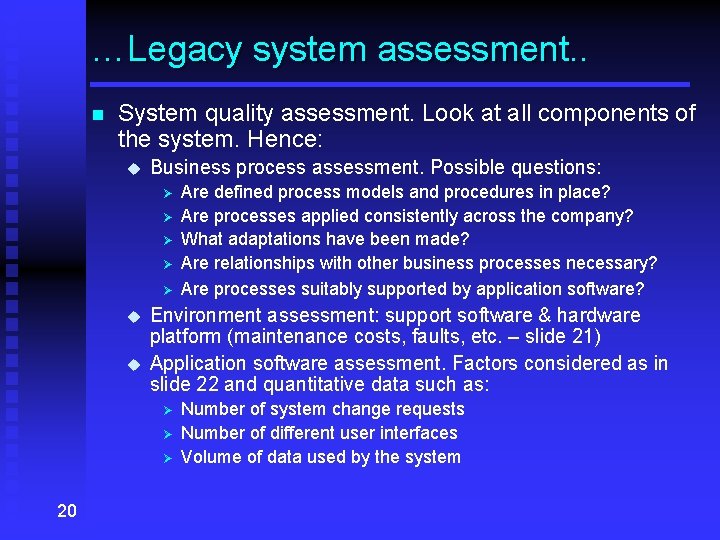
…Legacy system assessment. . n System quality assessment. Look at all components of the system. Hence: u Business process assessment. Possible questions: Ø Ø Ø u u Environment assessment: support software & hardware platform (maintenance costs, faults, etc. – slide 21) Application software assessment. Factors considered as in slide 22 and quantitative data such as: Ø Ø Ø 20 Are defined process models and procedures in place? Are processes applied consistently across the company? What adaptations have been made? Are relationships with other business processes necessary? Are processes suitably supported by application software? Number of system change requests Number of different user interfaces Volume of data used by the system
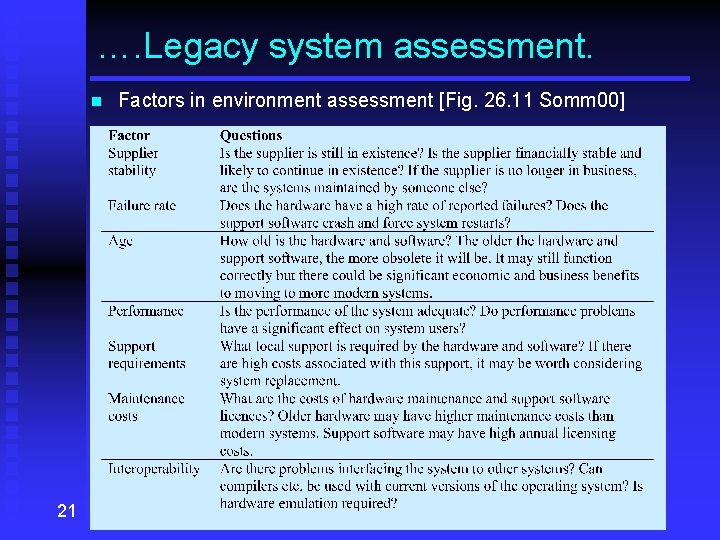
…. Legacy system assessment. n 21 Factors in environment assessment [Fig. 26. 11 Somm 00]
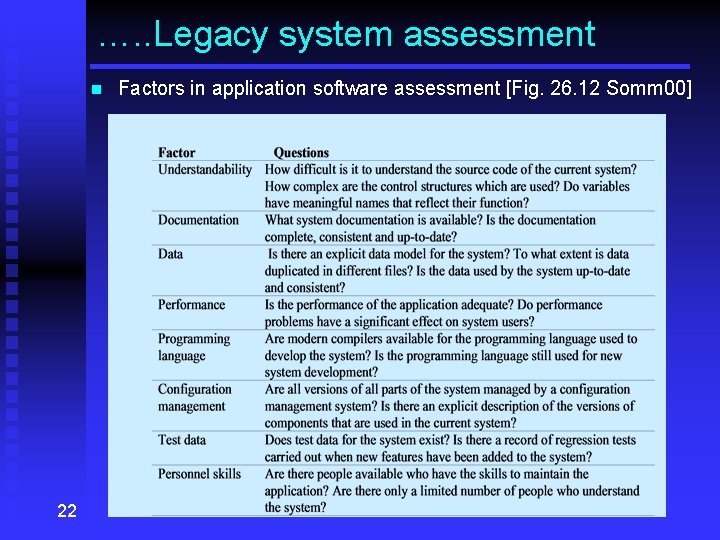
…. . Legacy system assessment n 22 Factors in application software assessment [Fig. 26. 12 Somm 00]
- Slides: 22