
CS 425 Distributed Systems Lecture 27 The Grid
CS 425: Distributed Systems Lecture 27 “The Grid” Klara Nahrstedt
Acknowledgement • The slides during this semester are based on ideas and material from the following sources: – Slides prepared by Professors M. Harandi, J. Hou, I. Gupta, N. Vaidya, Y-Ch. Hu, S. Mitra. – Slides from Professor S. Gosh’s course at University o Iowa.
Administrative • MP 3 posted – Deadline December 7 (Monday) – pre-competition • Top five groups will be selected for final demonstration on Tuesday, December 8 – Demonstration Signup Sheets for Monday, 12/7, will be made available this week (Thursday, 12/3 lecture) – Main Demonstration in front of the Qualcomm Representative will be on Tuesday, December 8 afternoon details will be announced on Thursday and also on the website and newsgroup
Administrative – MP 3 • Don’t forget versioning of your messages in your protocols between client and server (Google phones are getting quickly obsolete so it will be important to know what version of client software/hardware you are running and synchronize the overall application as we upgrade) – Readme file must include: • Boot-straping routine – how one install your system – developers manuscript • How one use your system – usage prescription for users • Known bugs, what are the issues with your system/application – Tar or zip your source code and upload it to agora wiki • URL Information will be provided on the web/in class/on newsgroup – Fill out project template as specified
Administrative • MP 3 instructions – Here's the template page for cs 425 students to copy and fill out. https: //agora. cs. illinois. edu/display/mlc/cs 425 Template. Project • Website only cs 425 students and instructors can access to post the template page and also upload attachments https: //agora. cs. illinois. edu/display/mlc/cs 425 fa 09 -projects
Plan for Today • Discussion what is “Grid” distributed computing paradigm • Some basic capabilities of Grid and tools/protocols/services that drive Grid • Comparison between Grid and P 2 P
Sample Grid Applications • • • Astronomers: SETI@Home Physicists: data from particle colliders Meteorologists: weather prediction Bio-informaticians ….
Example: Rapid Atmospheric Modeling System, Colorado State University • Weather Prediction is inaccurate • Hurricane Georges, 17 days in Sept 1998
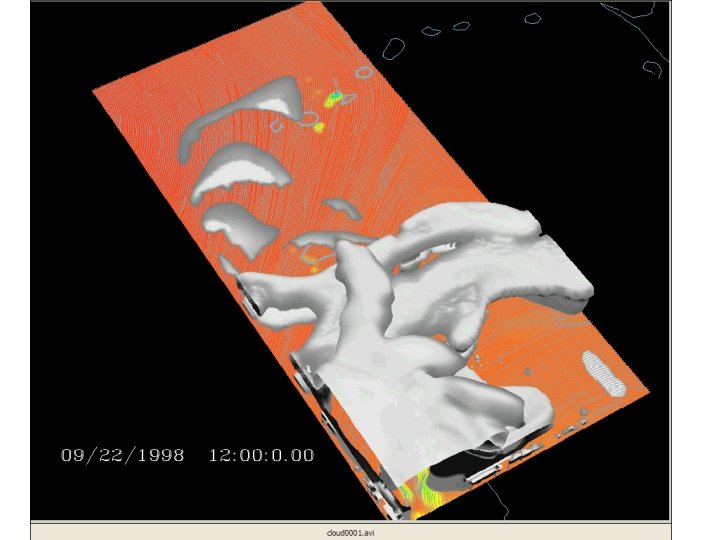
• Hurricane Georges, 17 days in Sept 1998 – “RAMS modeled the mesoscale convective complex that dropped so much rain, in good agreement with recorded data” – Used 5 km spacing instead of the usual 10 km – Ran on 256+ processors
Recently: Large Hadron Collider • http: //lcg. web. cern. ch/lcg/ • LHC@home “LHC collisions will produce 10 to 15 petabytes of data a year” http: //www. techworld. com/mobility/features/index. cfm? featureid=4074&pn=2
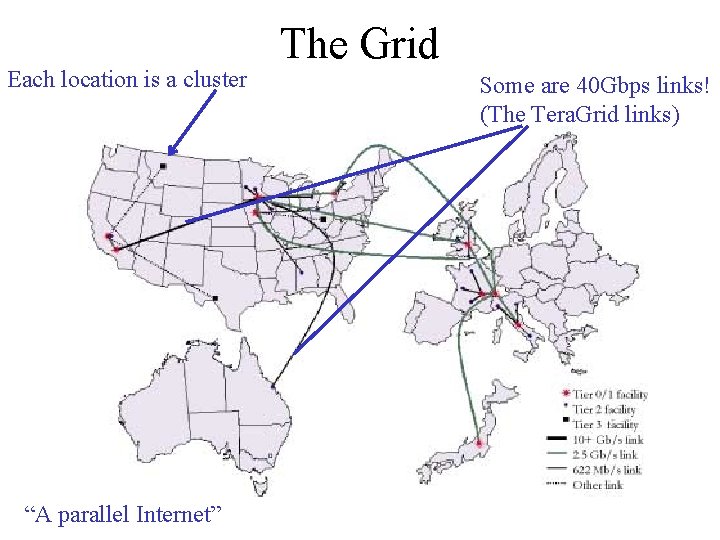
Each location is a cluster “A parallel Internet” The Grid Some are 40 Gbps links! (The Tera. Grid links)
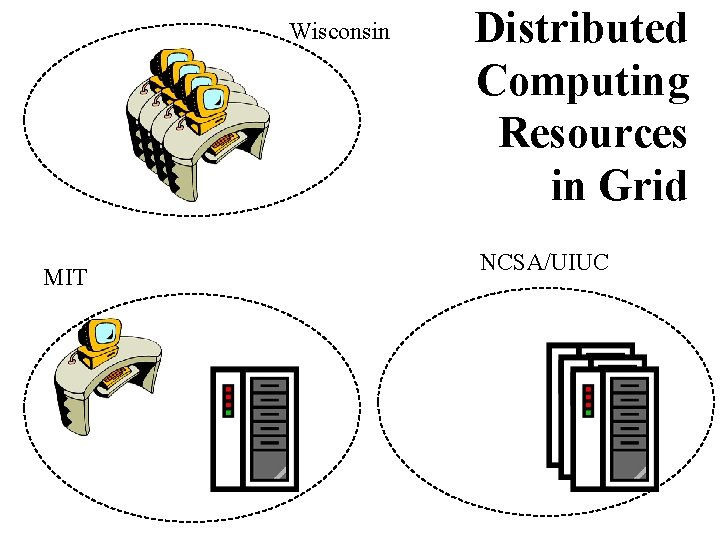
Wisconsin MIT Distributed Computing Resources in Grid NCSA/UIUC
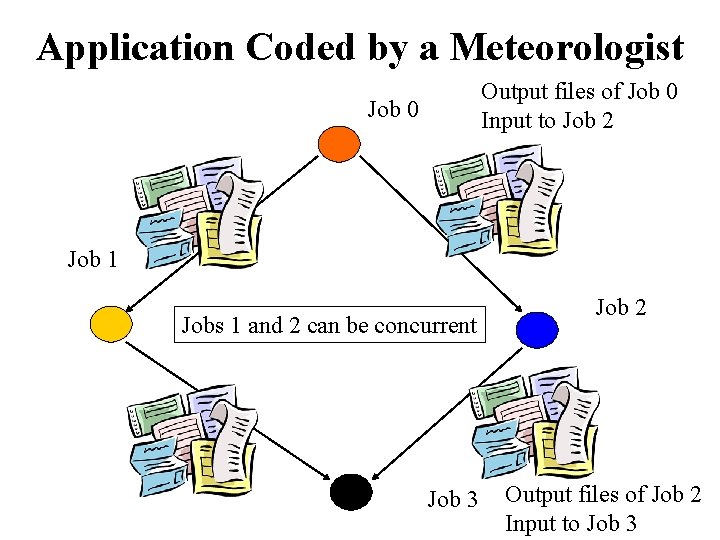
Application Coded by a Meteorologist Output files of Job 0 Input to Job 2 Job 0 Job 1 Jobs 1 and 2 can be concurrent Job 3 Job 2 Output files of Job 2 Input to Job 3
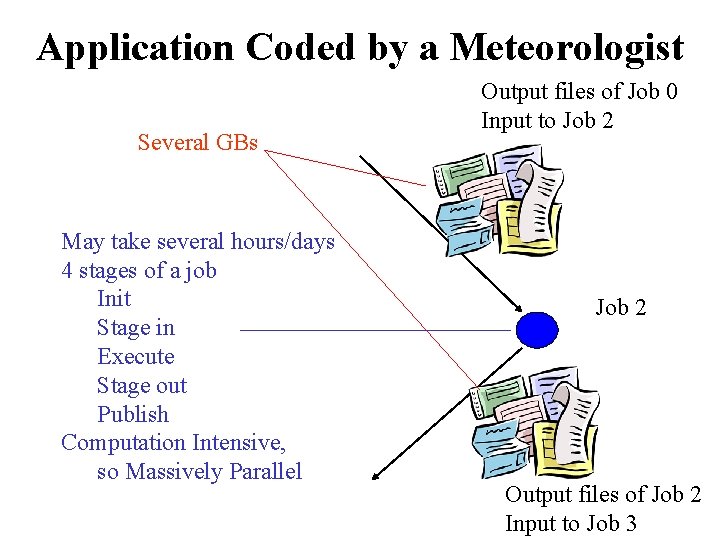
Application Coded by a Meteorologist Several GBs May take several hours/days 4 stages of a job Init Stage in Execute Stage out Publish Computation Intensive, so Massively Parallel Output files of Job 0 Input to Job 2 Output files of Job 2 Input to Job 3
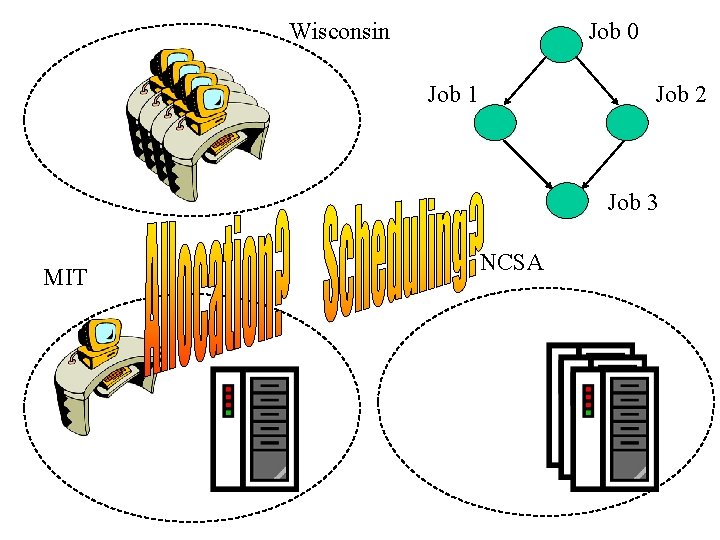
Wisconsin Job 0 Job 1 Job 2 Job 3 MIT NCSA
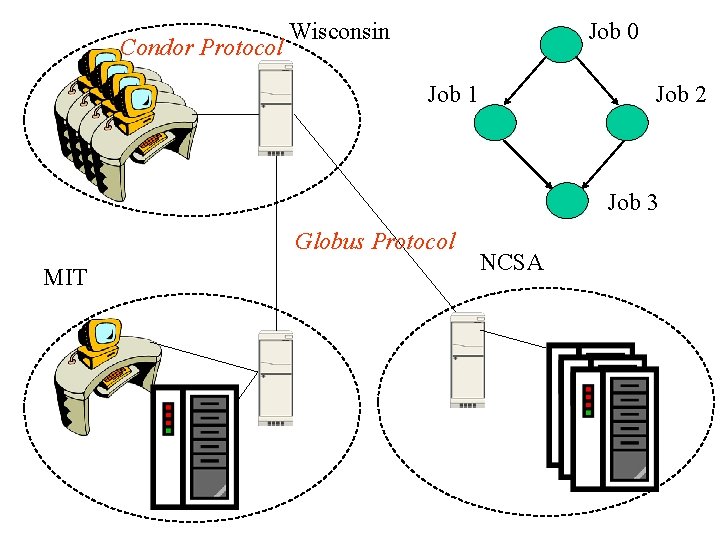
Condor Protocol Wisconsin Job 0 Job 1 Job 2 Job 3 Globus Protocol MIT NCSA
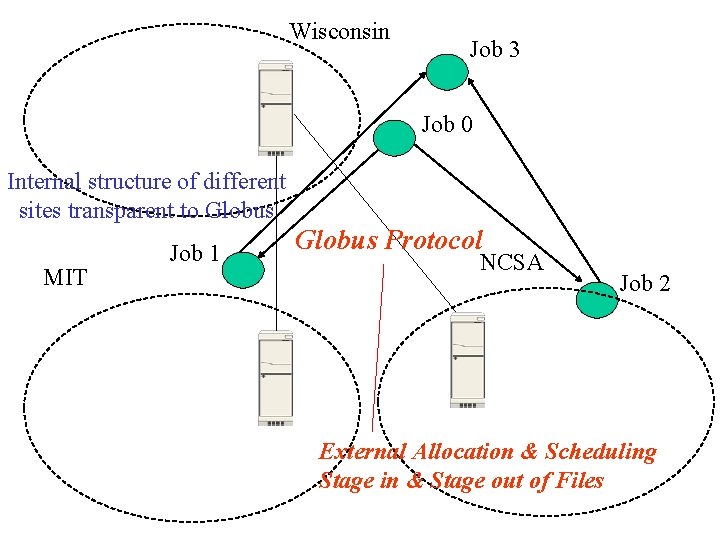
Wisconsin Job 3 Job 0 Internal structure of different sites transparent to Globus MIT Job 1 Globus Protocol NCSA Job 2 External Allocation & Scheduling Stage in & Stage out of Files
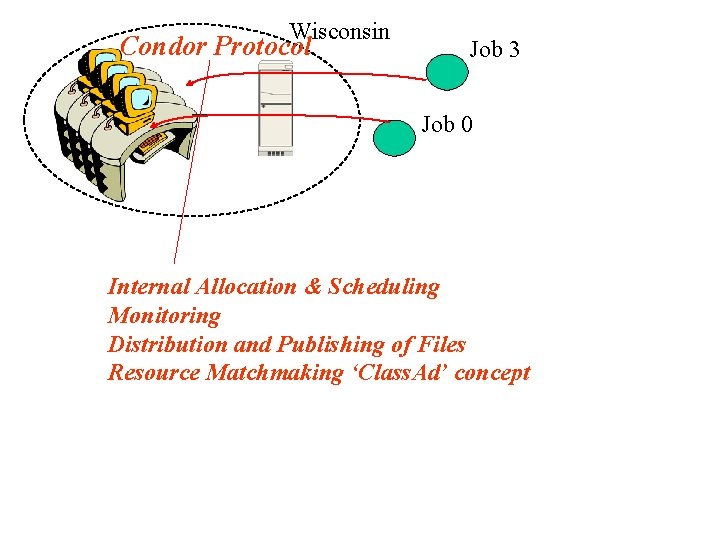
Wisconsin Condor Protocol Job 3 Job 0 Internal Allocation & Scheduling Monitoring Distribution and Publishing of Files Resource Matchmaking ‘Class. Ad’ concept
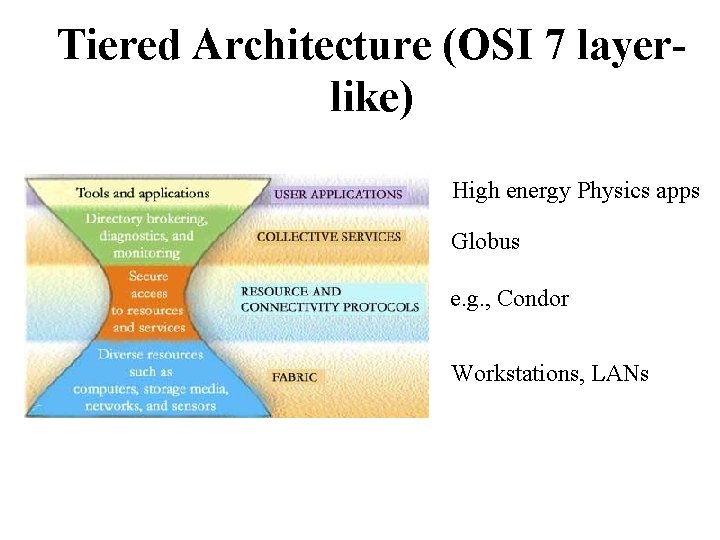
Tiered Architecture (OSI 7 layerlike) High energy Physics apps Globus e. g. , Condor Workstations, LANs
Trends: Technology • Doubling Periods – storage: 12 mos, bandwidth: 9 mos, and (what law is this? ) cpu speed/capacity: 18 mos • Then and Now Bandwidth – 1985: mostly 56 Kbps links nationwide – 2003: 155 Mbps links widespread – 2009: 1 Gbps links wide spread Disk capacity – Today’s PCs have 100 GBs, and clusters – terabytes/petabytes, same as a 1990 supercomputer
Trends: Users • Then and Now Biologists: – 1990: were running small single-molecule simulations – 2003: want to calculate structures of complex macromolecules, want to screen thousands of drug candidates Physicists – 2006: CERN’s Large Hadron Collider produced about 10^15 B during the year • Trends in Technology and User Requirements: Independent or Symbiotic?
Globus Alliance • Alliance involves U. Illinois Chicago, Argonne National Laboratory, USC-ISI, U. Edinburgh, Swedish Center for Parallel Computers, NCSA • Activities : research, testbeds, software tools, applications • Globus Toolkit (latest ver – GT 4) “The Globus Toolkit includes software services and libraries for resource monitoring, discovery, and management, plus security and file management. Its latest version, GT 3, is the first full-scale implementation of new Open Grid Services Architecture (OGSA). ”
More • Entire community, with multiple conferences, gettogethers (GGF), and projects • Grid Projects: http: //www-fp. mcs. anl. gov/~foster/grid-projects • Grid Users: – Today: Core is the physics community (since the Grid originates from the Gri. Phy. N project) – Tomorrow: biologists, large-scale computations (nug 30 already)?
Prophecies In 1965, MIT's Fernando Corbató and the other designers of the Multics operating system envisioned a computer facility operating “like a power company or water company”. Plug your thin client into the computing Utility and Play your favorite Intensive Compute & Communicate Application – [Will this be a reality with the Grid? ]
Recap: Grid vs. … • LANs? • Supercomputers? • Clusters? • Cloud? What separates these? The same technologies? …P 2 P? ? ?
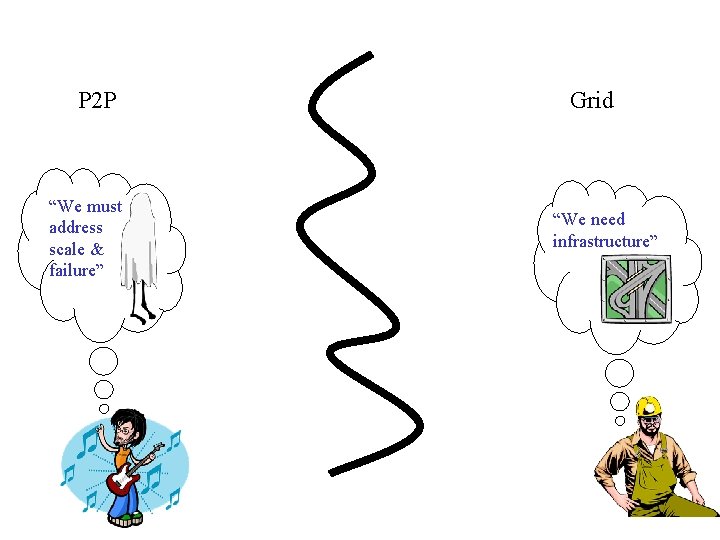
P 2 P “We must address scale & failure” Grid “We need infrastructure”
Definitions Grid • P 2 P “Infrastructure that provides dependable, consistent, pervasive, and inexpensive access to high-end computational capabilities” (1998) • “Applications that takes advantage of resources at the edges of the Internet” (2000)
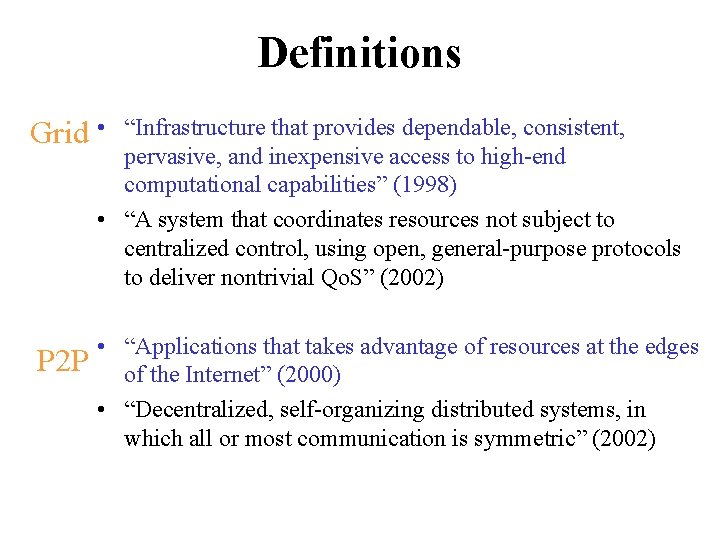
Definitions Grid • “Infrastructure that provides dependable, consistent, pervasive, and inexpensive access to high-end computational capabilities” (1998) • “A system that coordinates resources not subject to centralized control, using open, general-purpose protocols to deliver nontrivial Qo. S” (2002) P 2 P • “Applications that takes advantage of resources at the edges of the Internet” (2000) • “Decentralized, self-organizing distributed systems, in which all or most communication is symmetric” (2002)
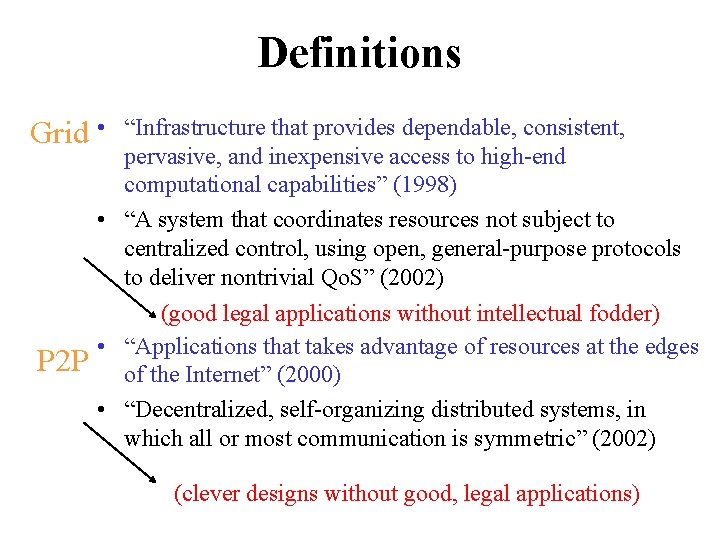
Definitions Grid • “Infrastructure that provides dependable, consistent, pervasive, and inexpensive access to high-end computational capabilities” (1998) • “A system that coordinates resources not subject to centralized control, using open, general-purpose protocols to deliver nontrivial Qo. S” (2002) P 2 P (good legal applications without intellectual fodder) • “Applications that takes advantage of resources at the edges of the Internet” (2000) • “Decentralized, self-organizing distributed systems, in which all or most communication is symmetric” (2002) (clever designs without good, legal applications)
Grid versus P 2 P - Pick your favorite
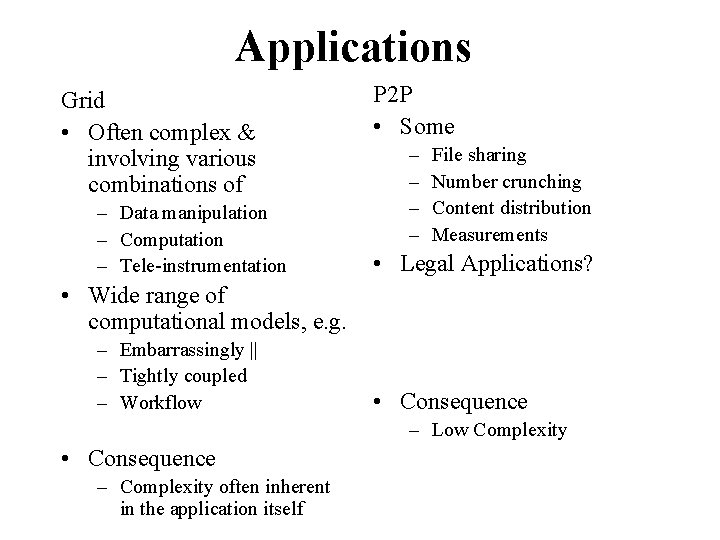
Applications Grid • Often complex & involving various combinations of – Data manipulation – Computation – Tele-instrumentation P 2 P • Some – – File sharing Number crunching Content distribution Measurements • Legal Applications? • Wide range of computational models, e. g. – Embarrassingly || – Tightly coupled – Workflow • Consequence – Low Complexity • Consequence – Complexity often inherent in the application itself
Applications Grid • Often complex & involving various combinations of – Data manipulation – Computation – Tele-instrumentation P 2 P • Some – – File sharing Number crunching Content distribution Measurements • Legal Applications? • Wide range of computational models, e. g. – Embarrassingly || – Tightly coupled – Workflow • Consequence – Low Complexity • Consequence – Complexity often inherent in the application itself
Scale and Failure Grid • Moderate number of entities – 10 s institutions, 1000 s users • Large amounts of activity – 4. 5 TB/day (D 0 experiment) • Approaches to failure reflect assumptions – e. g. , centralized components P 2 P • V. large numbers of entities Fast. Track. C 4, 277, 745 i. Mesh 1, 398, 532 e. Donkey 500, 289 Direct. Connect 111, 454 Blubster 100, 266 File. Navigator 14, 400 Ares 7, 731 (www. slyck. com, 2/19/’ 03) • Moderate activity – E. g. , 1 -2 TB in Gnutella (’ 01) • Diverse approaches to failure – Centralized (SETI) – Decentralized and Self-Stabilizing
Scale and Failure Grid • Moderate number of entities – 10 s institutions, 1000 s users • Large amounts of activity – 4. 5 TB/day (D 0 experiment) • Approaches to failure reflect assumptions – E. g. , centralized components P 2 P • V. large numbers of entities Fast. Track. C 4, 277, 745 i. Mesh 1, 398, 532 e. Donkey 500, 289 Direct. Connect 111, 454 Blubster 100, 266 File. Navigator 14, 400 Ares 7, 731 (www. slyck. com, 2/19/’ 03) • Moderate activity – E. g. , 1 -2 TB in Gnutella (’ 01) • Diverse approaches to failure – Centralized (SETI) – Decentralized and Self-Stabilizing
Some Things Grid Researchers Consider Important • Single sign-on: collective job set should require once-only user authentication • Mapping to local security mechanisms: some sites use Kerberos, others using Unix • Delegation: credentials to access resources inherited by subcomputations, e. g. , job 0 to job 1 • Community authorization: e. g. , third-party authentication
Services and Infrastructure Grid • Standard protocols (Global Grid Forum, etc. ) • De facto standard software (open source Globus Toolkit) • Shared infrastructure (authentication, discovery, resource access, etc. ) Consequences • Reusable services • Large developer & user communities • Interoperability & code reuse P 2 P • Each application defines & deploys completely independent “infrastructure” • JXTA, BOINC, Xtrem. Web? • Efforts started to define common APIs, albeit with limited scope to date Consequences • New (albeit simple) install per application • Interoperability & code reuse not achieved
Services and Infrastructure Grid • Standard protocols (Global Grid Forum, etc. ) • De facto standard software (open source Globus Toolkit) • Shared infrastructure (authentication, discovery, resource access, etc. ) Consequences • Reusable services • Large developer & user communities • Interoperability & code reuse P 2 P • Each application defines & deploys completely independent “infrastructure” • JXTA, BOINC, Xtrem. Web? • Efforts started to define common APIs, albeit with limited scope to date Consequences • New (albeit simple) install per application • Interoperability & code reuse not achieved
Summary: Grid and P 2 P 1) Both are concerned with the same general problem – Resource sharing within virtual communities 2) Both take the same general approach – Creation of overlays that need not correspond in structure to underlying organizational structures 3) Each has made genuine technical advances, but in complementary directions – “Grid addresses infrastructure but not yet failure” – “P 2 P addresses failure but not yet infrastructure” 4) Complementary strengths and weaknesses => room for collaboration (Ian Foster)

EXTRA
Grid History – 1990’s • CASA network: linked 4 labs in California and New Mexico – Paul Messina: Massively parallel and vector supercomputers for computational chemistry, climate modeling, etc. • Blanca: linked sites in the Midwest – Charlie Catlett, NCSA: multimedia digital libraries and remote visualization • More testbeds in Germany & Europe than in the US • I-way experiment: linked 11 experimental networks – Tom De. Fanti, U. Illinois at Chicago and Rick Stevens, ANL: , for a week in Nov 1995, a national high-speed network infrastructure. 60 application demonstrations, from distributed computing to virtual reality collaboration. • I-Soft: secure sign-on, etc.
- Slides: 41