
CS 422 Principles of Database Systems SQL and
CS 422 Principles of Database Systems SQL and Transactions Chengyu Sun California State University, Los Angeles
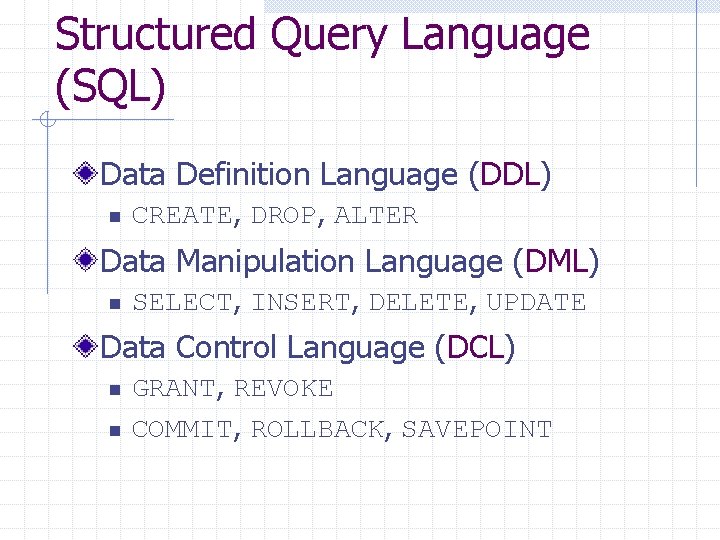
Structured Query Language (SQL) Data Definition Language (DDL) n CREATE, DROP, ALTER Data Manipulation Language (DML) n SELECT, INSERT, DELETE, UPDATE Data Control Language (DCL) n n GRANT, REVOKE COMMIT, ROLLBACK, SAVEPOINT
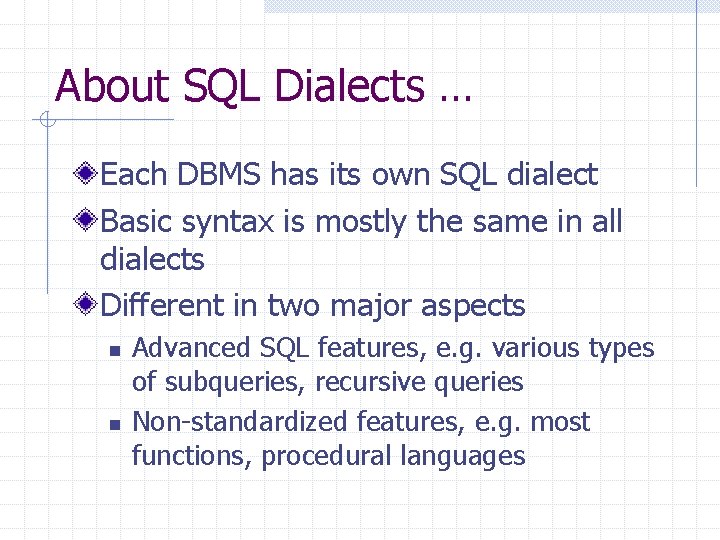
About SQL Dialects … Each DBMS has its own SQL dialect Basic syntax is mostly the same in all dialects Different in two major aspects n n Advanced SQL features, e. g. various types of subqueries, recursive queries Non-standardized features, e. g. most functions, procedural languages
… About SQL Dialects Generally speaking, anything can be done in any dialect, just in different ways Stick to standard when possible, use dialect when necessary
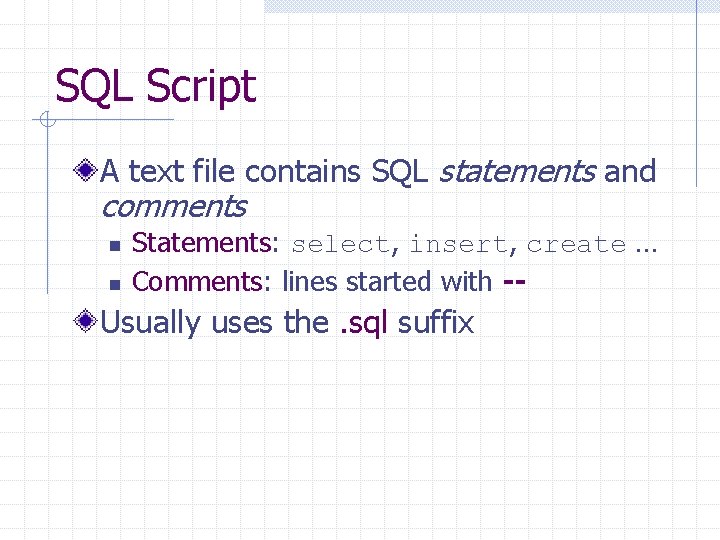
SQL Script A text file contains SQL statements and comments n n Statements: select, insert, create … Comments: lines started with -- Usually uses the. sql suffix

Access Postgre. SQL Server GUI client pg. Admin Command line client psql Web client php. Pg. Admin
Postgre. SQL Documentation http: //www. postgresql. org/docs/
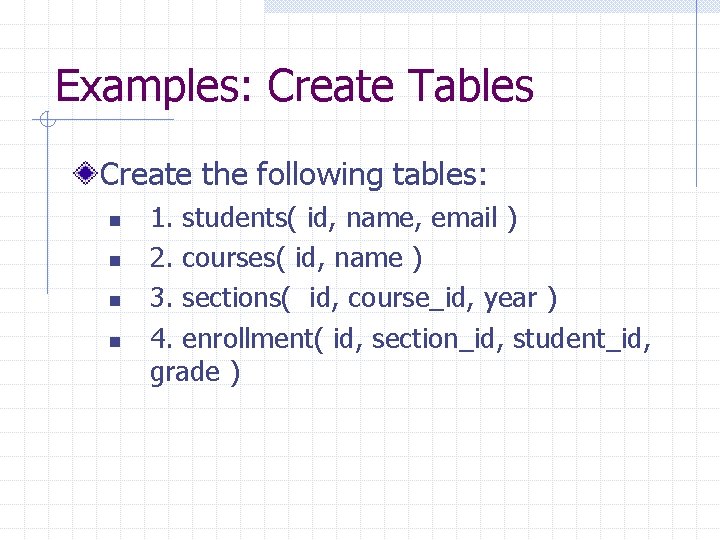
Examples: Create Tables Create the following tables: n n 1. students( id, name, email ) 2. courses( id, name ) 3. sections( id, course_id, year ) 4. enrollment( id, section_id, student_id, grade )
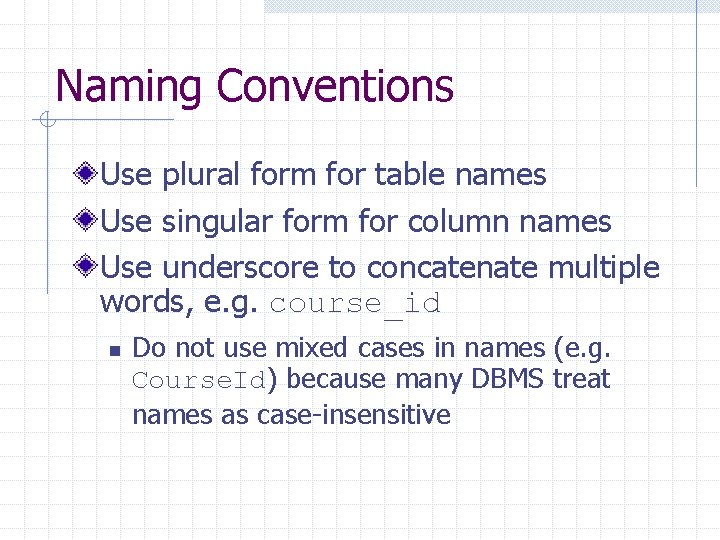
Naming Conventions Use plural form for table names Use singular form for column names Use underscore to concatenate multiple words, e. g. course_id n Do not use mixed cases in names (e. g. Course. Id) because many DBMS treat names as case-insensitive
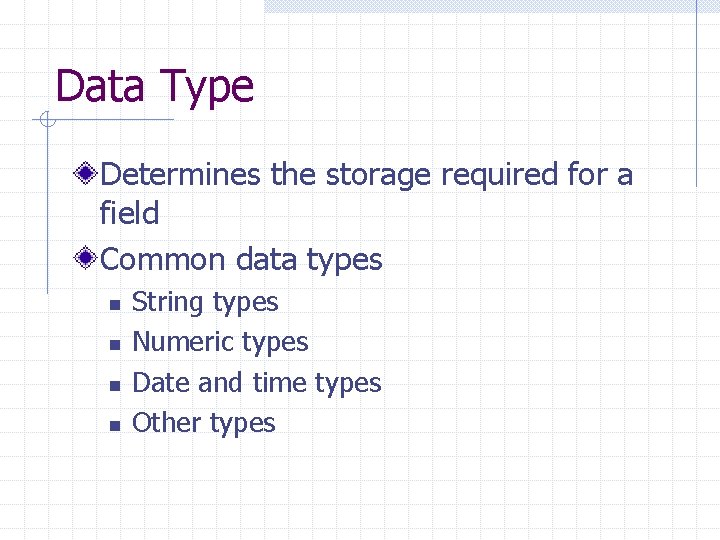
Data Type Determines the storage required for a field Common data types n n String types Numeric types Date and time types Other types
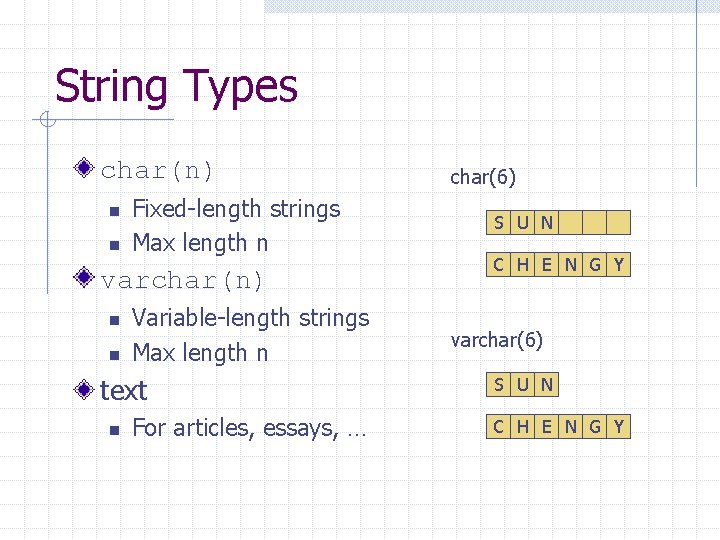
String Types char(n) n n Fixed-length strings Max length n varchar(n) n n Variable-length strings Max length n text n For articles, essays, … char(6) S U N C H E N G Y varchar(6) S U N C H E N G Y
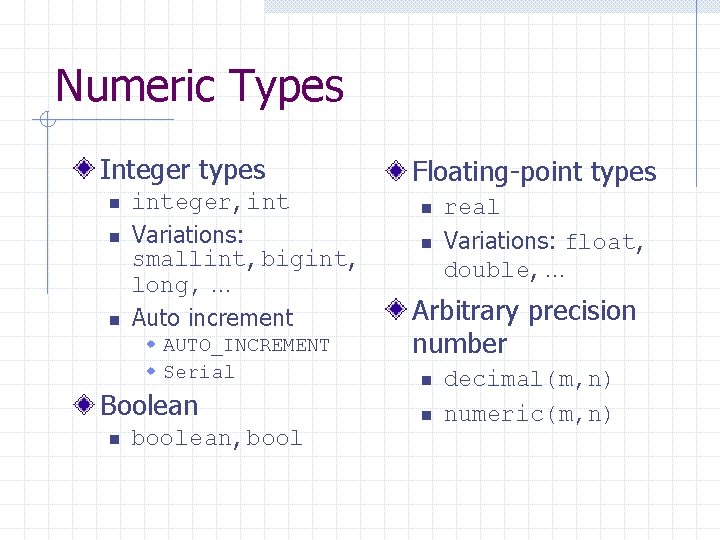
Numeric Types Integer types n n n integer, int Variations: smallint, bigint, long, … Auto increment w AUTO_INCREMENT w Serial Boolean n boolean, bool Floating-point types n n real Variations: float, double, … Arbitrary precision number n n decimal(m, n) numeric(m, n)
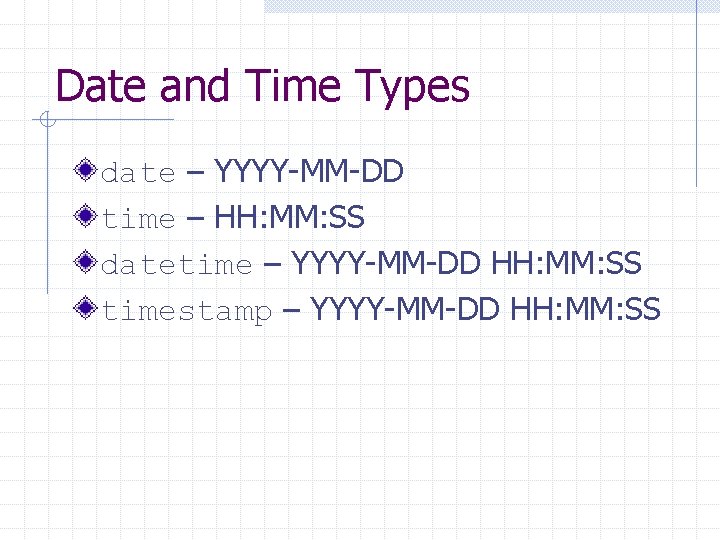
Date and Time Types date – YYYY-MM-DD time – HH: MM: SS datetime – YYYY-MM-DD HH: MM: SS timestamp – YYYY-MM-DD HH: MM: SS
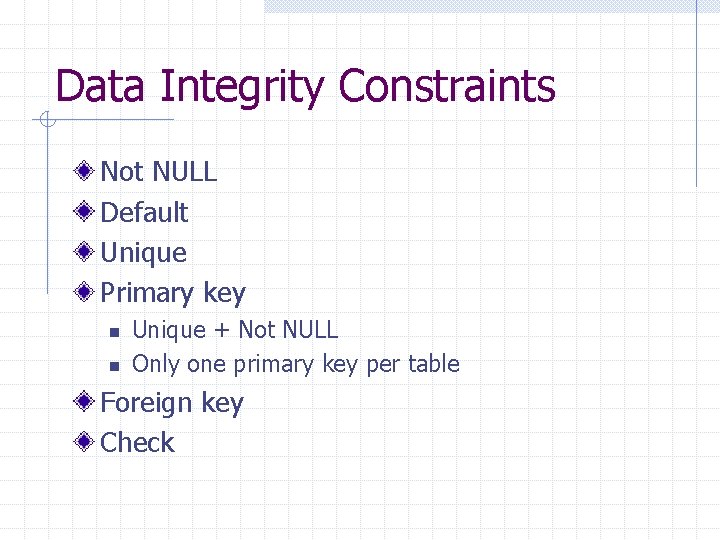
Data Integrity Constraints Not NULL Default Unique Primary key n n Unique + Not NULL Only one primary key per table Foreign key Check
Constraint Syntax Column constraint Table constraint Named constraint
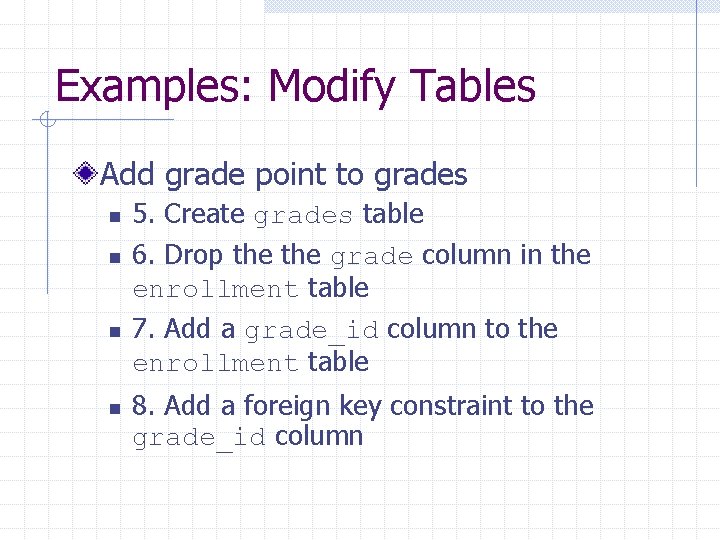
Examples: Modify Tables Add grade point to grades n n 5. Create grades table 6. Drop the grade column in the enrollment table 7. Add a grade_id column to the enrollment table 8. Add a foreign key constraint to the grade_id column
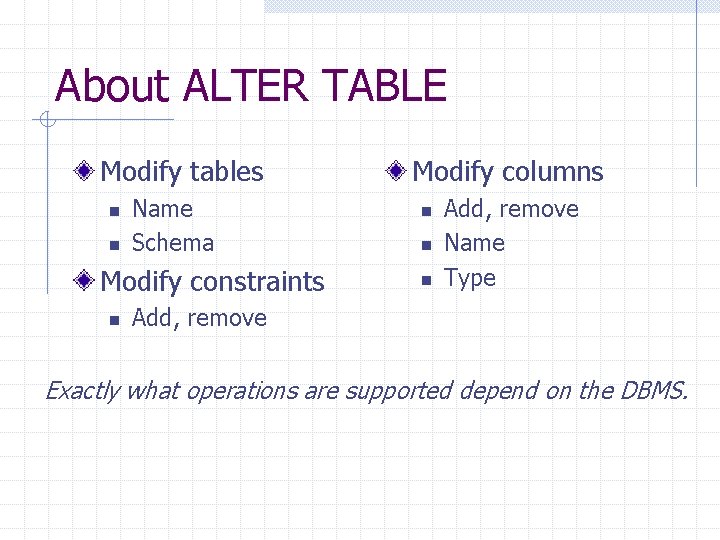
About ALTER TABLE Modify tables n n Name Schema Modify constraints n Modify columns n n n Add, remove Name Type Add, remove Exactly what operations are supported depend on the DBMS.
Delete Table drop table_name;
Examples: Populate Tables Populate the tables we created so far n n 9. Insert a record in each table 10. Create all sections for 2009
SQL Literals Number: 10, 30. 2 String: ‘CPU’, ‘John’’s Kitchen’ Date: ‘ 2007 -06 -01’ Time: ‘ 12: 00’ Boolean: ‘t’, ‘f’, 1, 0 NULL

Sample Database: University departments id name faculty id name department_id students id name grades id letter courses id title sections id course_id instructor_id enrollment id student_id section_id graduation_date major_id value department_id year grade_id
Examples: Simple Selection 11. Find the sections taught by instructor #1 in 2004 12. List the names of the students whose names start with “A” in alphabetic order 13. List the id’s of the courses that were offered before 2009
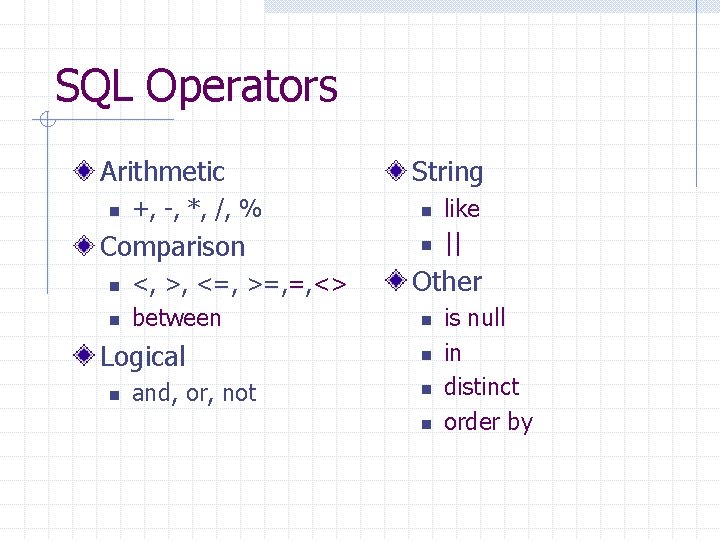
SQL Operators Arithmetic n +, -, *, /, % Comparison n n <, >, <=, >=, =, <> between Logical n and, or, not String n n like || Other n n is null in distinct order by
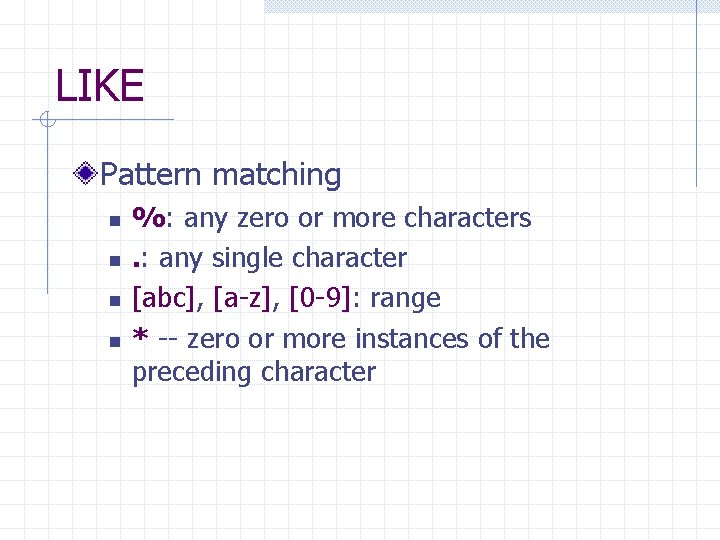
LIKE Pattern matching n n %: any zero or more characters. : any single character [abc], [a-z], [0 -9]: range * -- zero or more instances of the preceding character
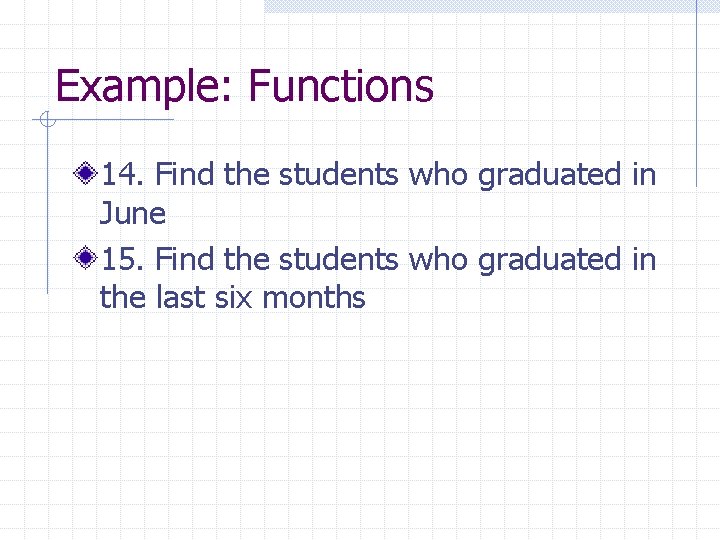
Example: Functions 14. Find the students who graduated in June 15. Find the students who graduated in the last six months

Functions in Postgre. SQL http: //www. postgresql. org/docs/9. 1/int eractive/functions. html
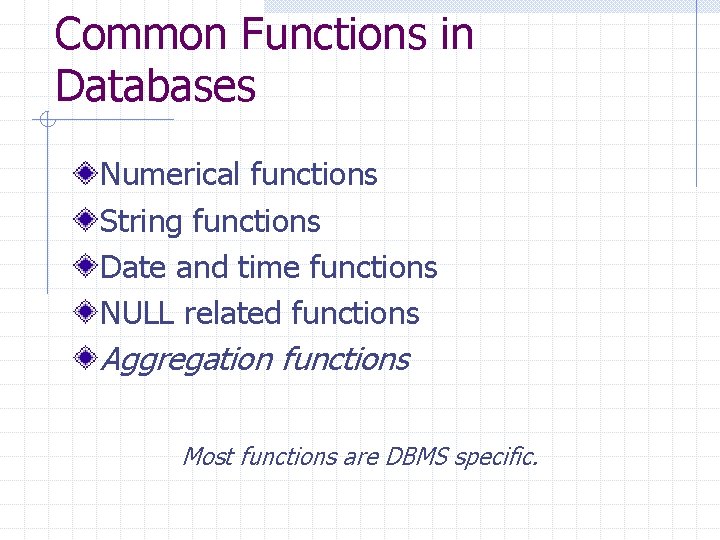
Common Functions in Databases Numerical functions String functions Date and time functions NULL related functions Aggregation functions Most functions are DBMS specific.
Numerical functions Precision functions Power and square root Logarithmic functions Trigonometric functions Random number generator
String Functions String length Concatenation Locate/extract substring Trim white spaces Change cases Format numbers or dates
Date and Time Functions Extract date or time field Add or subtract a time interval Get current date or time Convert string to date or time
NULL Related Functions If NULL then something If something then NULL
Examples: Joins 16. Find the names of the departments that offer the course “Databases” 17. Find the names of the faculty who taught the course “Databases” 18. Find the courses that have never been offered
Join Syntax Equi-join syntax Inner join syntax
Inner Join a. k. a Join Combine two rows (one from each table) if they meet the join condition In other words, the results include the matching rows from the two tables
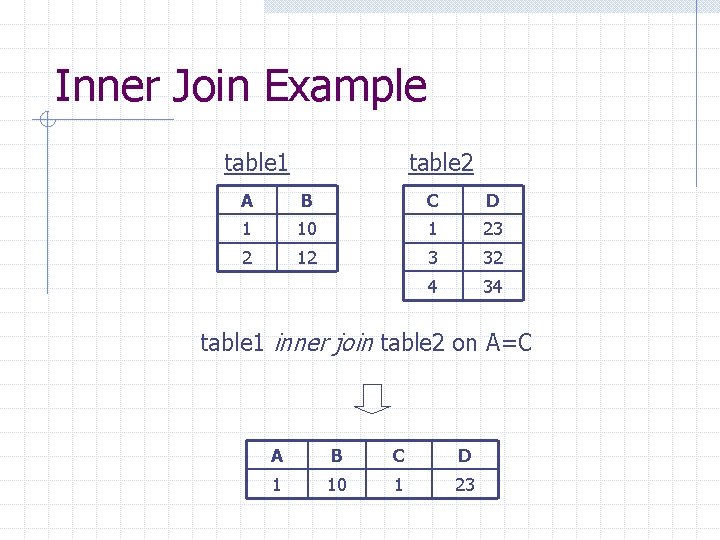
Inner Join Example table 1 table 2 A B C D 1 10 1 23 2 12 3 32 4 34 table 1 inner join table 2 on A=C A B C D 1 10 1 23
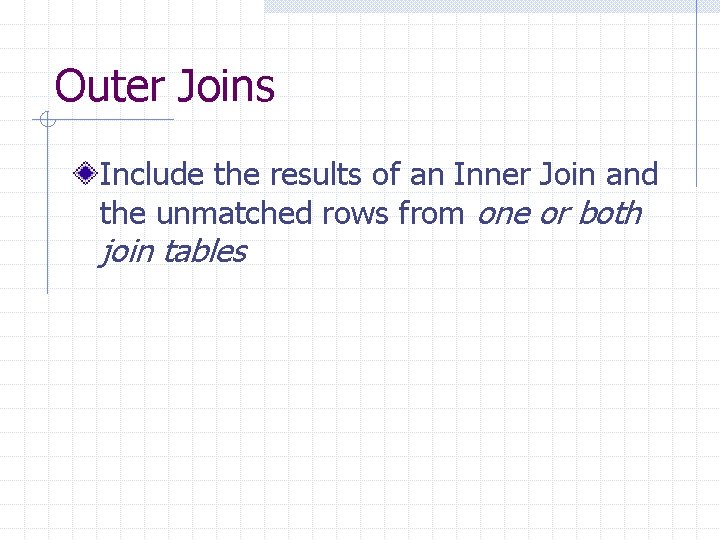
Outer Joins Include the results of an Inner Join and the unmatched rows from one or both join tables
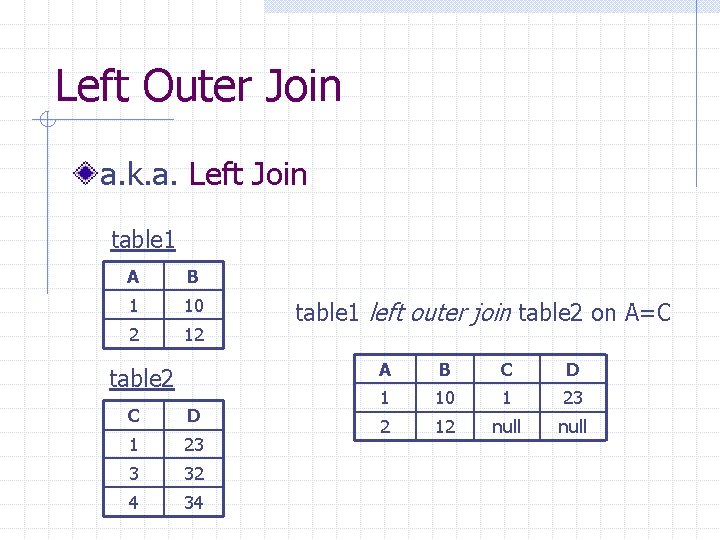
Left Outer Join a. k. a. Left Join table 1 A B 1 10 2 12 table 2 C D 1 23 3 32 4 34 table 1 left outer join table 2 on A=C A B C D 1 10 1 23 2 12 null
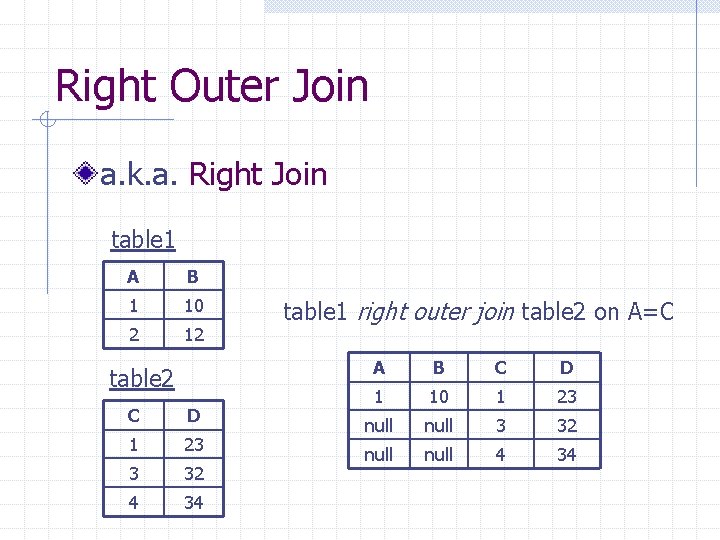
Right Outer Join a. k. a. Right Join table 1 A B 1 10 2 12 table 2 C D 1 23 3 32 4 34 table 1 right outer join table 2 on A=C A B C D 1 10 1 23 null 3 32 null 4 34

Full Outer Join a. k. a. Full Join table 1 A B 1 10 2 12 table 1 full outer join table 2 on A=C A B C D 1 10 1 23 C D 2 12 null 1 23 null 3 32 null 4 34
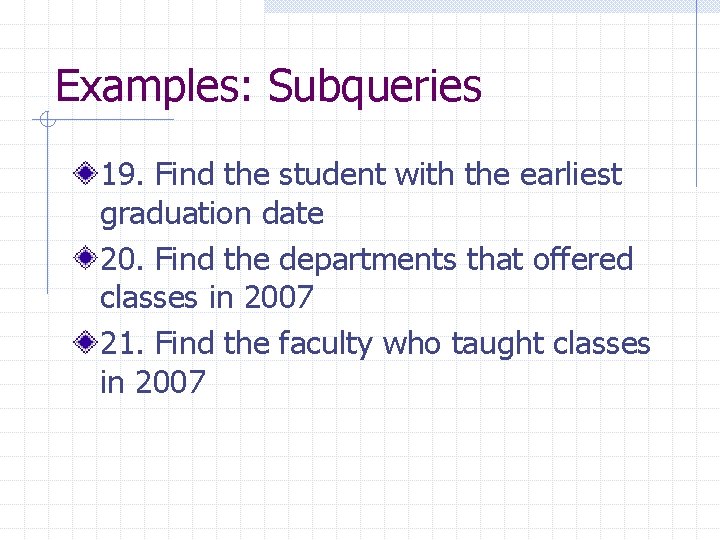
Examples: Subqueries 19. Find the student with the earliest graduation date 20. Find the departments that offered classes in 2007 21. Find the faculty who taught classes in 2007
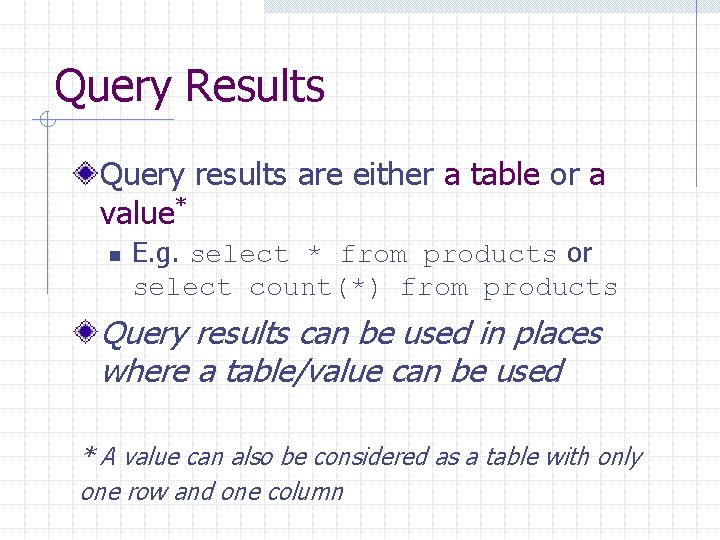
Query Results Query results are either a table or a value* n E. g. select * from products or select count(*) from products Query results can be used in places where a table/value can be used * A value can also be considered as a table with only one row and one column
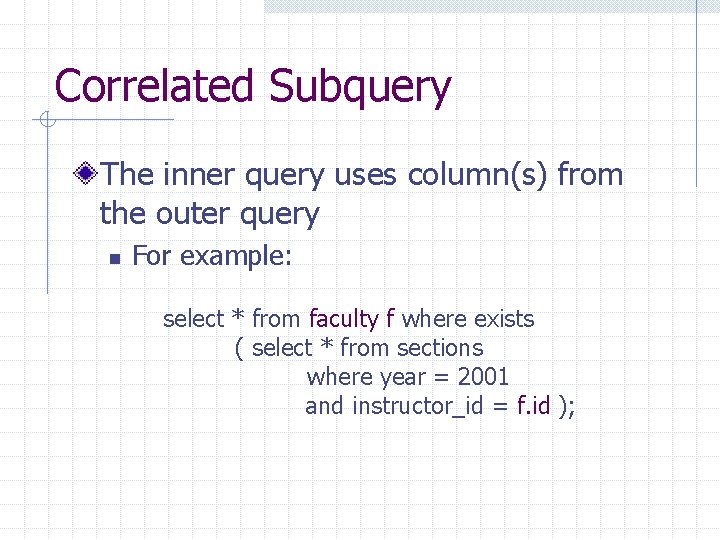
Correlated Subquery The inner query uses column(s) from the outer query n For example: select * from faculty f where exists ( select * from sections where year = 2001 and instructor_id = f. id );
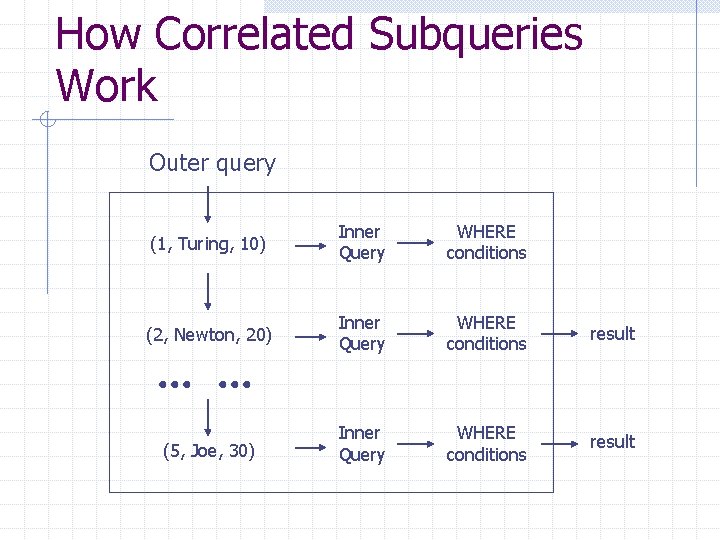
How Correlated Subqueries Work Outer query (1, Turing, 10) Inner Query WHERE conditions (2, Newton, 20) Inner Query WHERE conditions result (5, Joe, 30) Inner Query WHERE conditions result
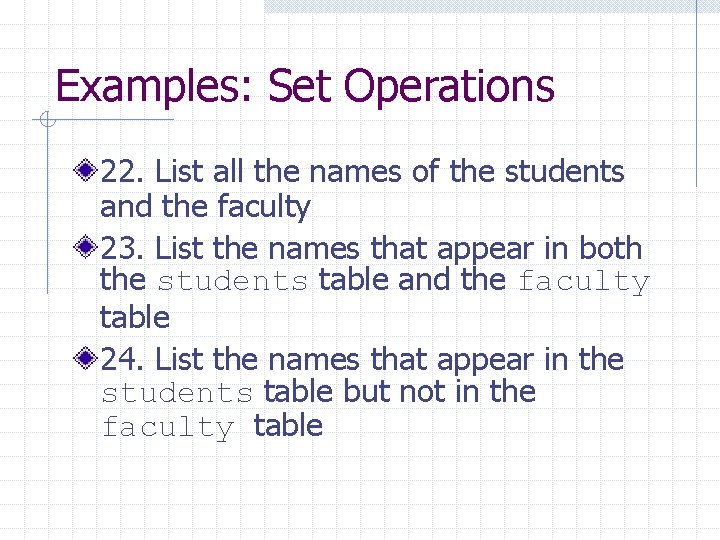
Examples: Set Operations 22. List all the names of the students and the faculty 23. List the names that appear in both the students table and the faculty table 24. List the names that appear in the students table but not in the faculty table
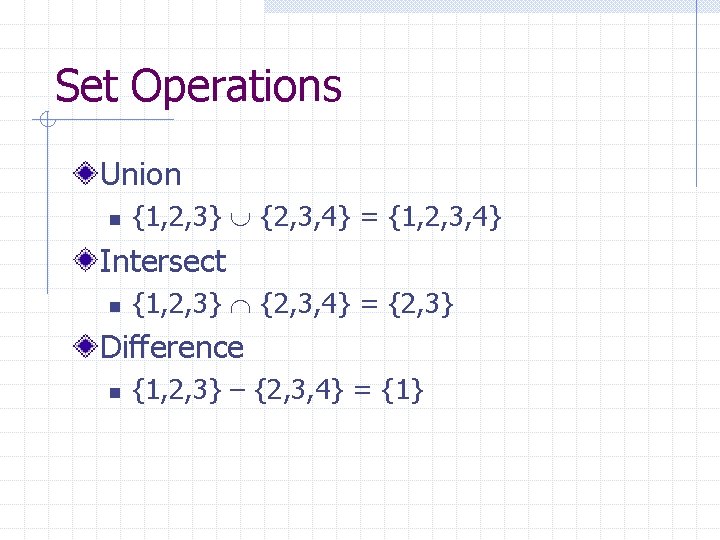
Set Operations Union n {1, 2, 3} {2, 3, 4} = {1, 2, 3, 4} Intersect n {1, 2, 3} {2, 3, 4} = {2, 3} Difference n {1, 2, 3} – {2, 3, 4} = {1}
Set Operations in Databases UNION INTERCEPT EXCEPT
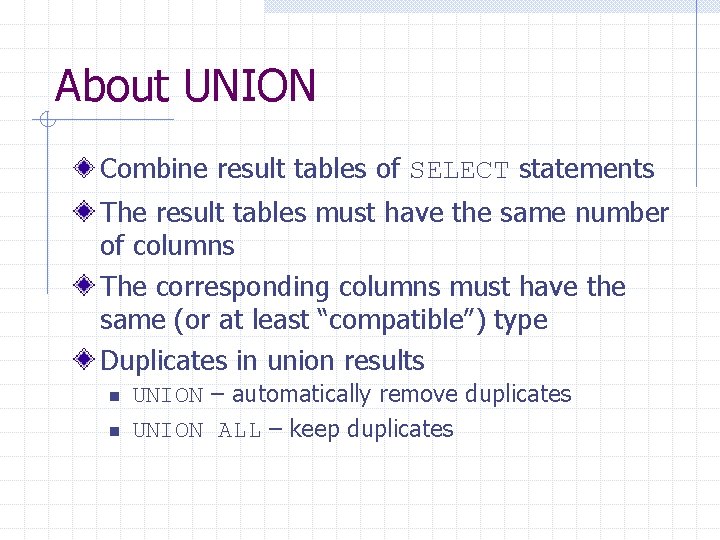
About UNION Combine result tables of SELECT statements The result tables must have the same number of columns The corresponding columns must have the same (or at least “compatible”) type Duplicates in union results n n UNION – automatically remove duplicates UNION ALL – keep duplicates
INTERSECT and EXCEPT Same syntax as UNION Some databases do not support INTERCEPT and EXCEPT, but the operations can be done in different ways n How? ?
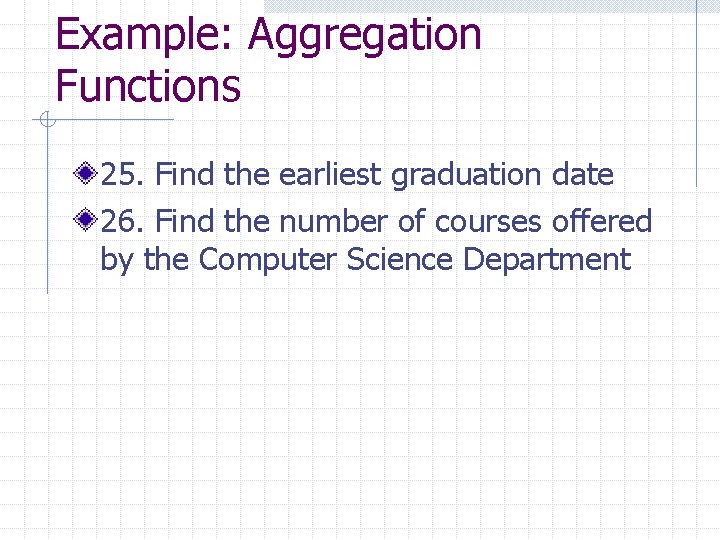
Example: Aggregation Functions 25. Find the earliest graduation date 26. Find the number of courses offered by the Computer Science Department
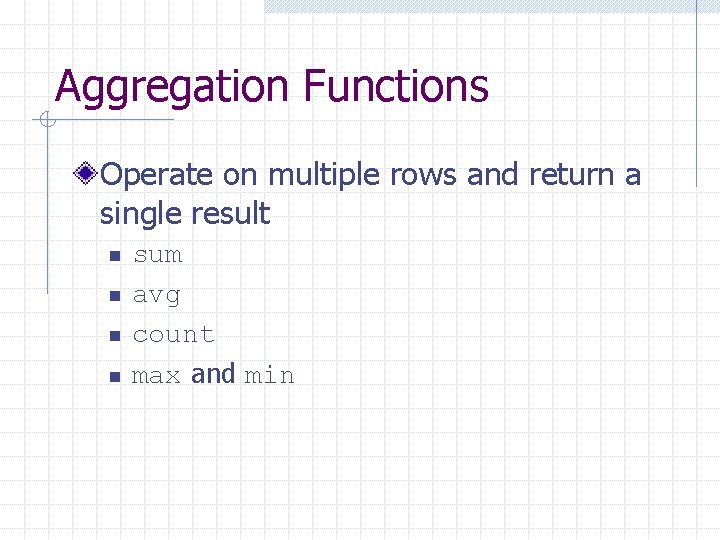
Aggregation Functions Operate on multiple rows and return a single result n n sum avg count max and min
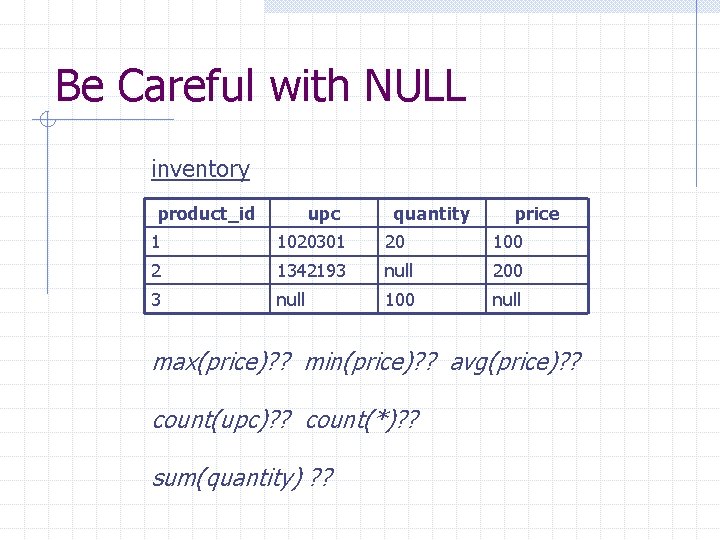
Be Careful with NULL inventory product_id upc quantity price 1 1020301 20 100 2 1342193 null 200 3 null 100 null max(price)? ? min(price)? ? avg(price)? ? count(upc)? ? count(*)? ? sum(quantity) ? ?
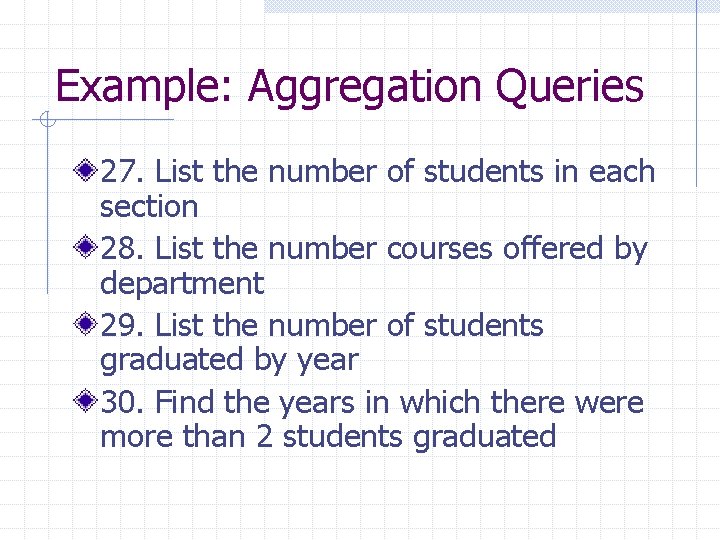
Example: Aggregation Queries 27. List the number of students in each section 28. List the number courses offered by department 29. List the number of students graduated by year 30. Find the years in which there were more than 2 students graduated
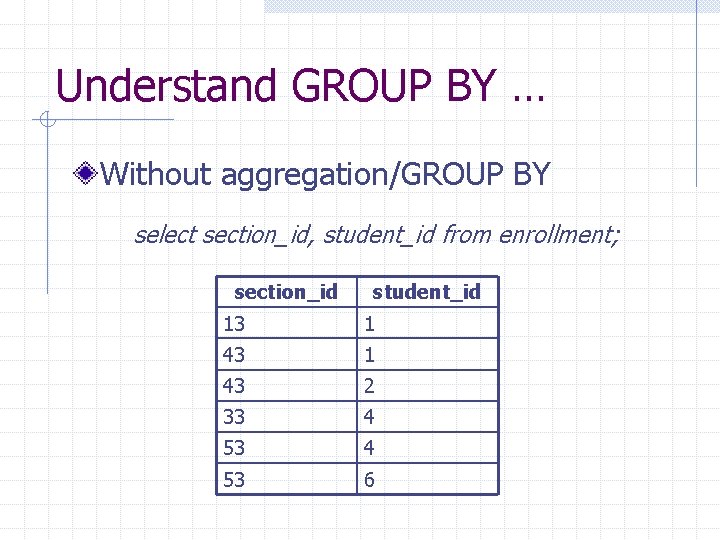
Understand GROUP BY … Without aggregation/GROUP BY select section_id, student_id from enrollment; section_id student_id 13 1 43 2 33 4 53 6
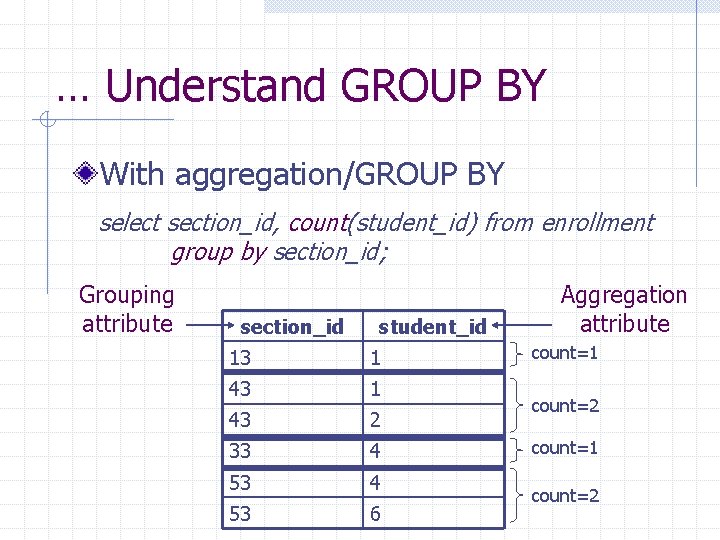
… Understand GROUP BY With aggregation/GROUP BY select section_id, count(student_id) from enrollment group by section_id; Grouping attribute section_id student_id 13 1 43 2 33 4 53 6 Aggregation attribute count=1 count=2
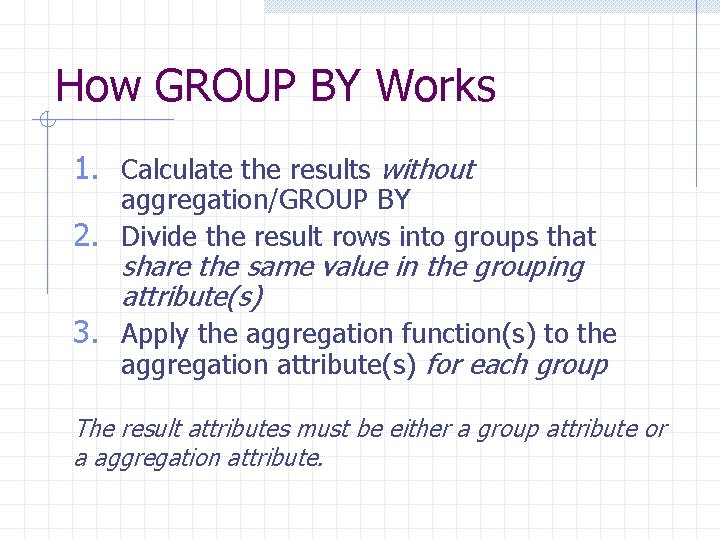
How GROUP BY Works 1. Calculate the results without aggregation/GROUP BY 2. Divide the result rows into groups that share the same value in the grouping attribute(s) 3. Apply the aggregation function(s) to the aggregation attribute(s) for each group The result attributes must be either a group attribute or a aggregation attribute.
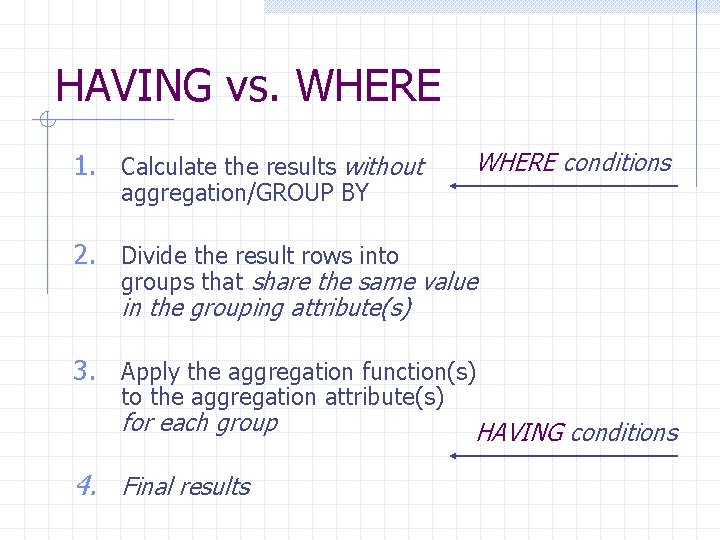
HAVING vs. WHERE 1. Calculate the results without WHERE conditions aggregation/GROUP BY 2. Divide the result rows into groups that share the same value in the grouping attribute(s) 3. Apply the aggregation function(s) to the aggregation attribute(s) for each group 4. Final results HAVING conditions
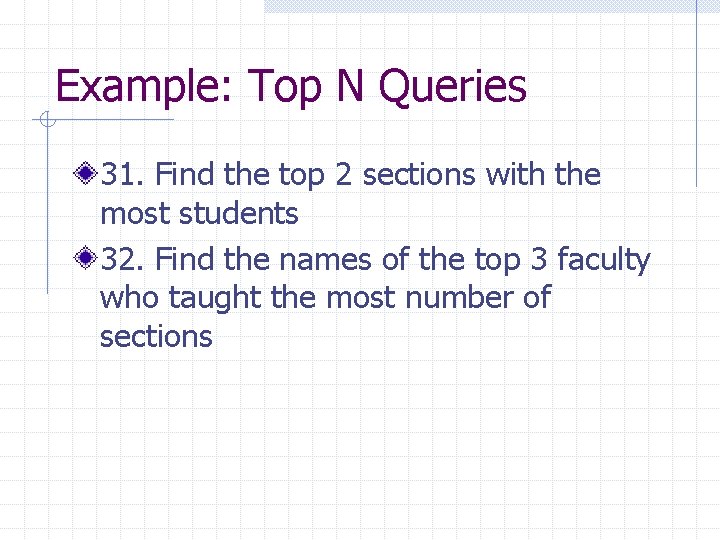
Example: Top N Queries 31. Find the top 2 sections with the most students 32. Find the names of the top 3 faculty who taught the most number of sections
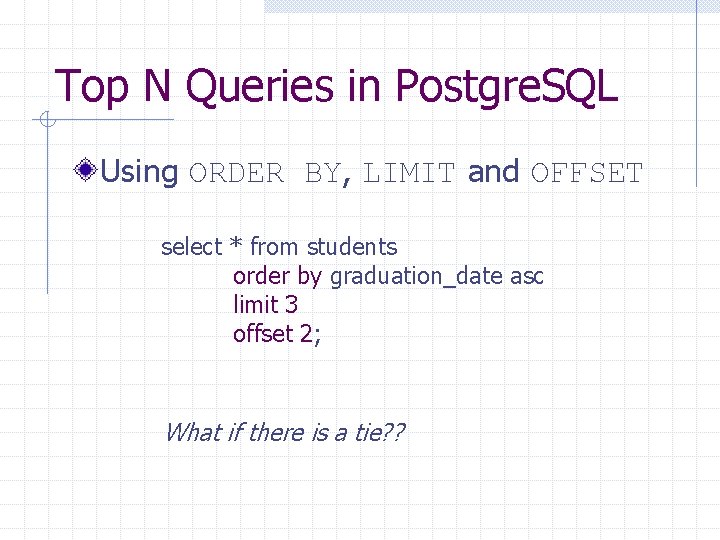
Top N Queries in Postgre. SQL Using ORDER BY, LIMIT and OFFSET select * from students order by graduation_date asc limit 3 offset 2; What if there is a tie? ?
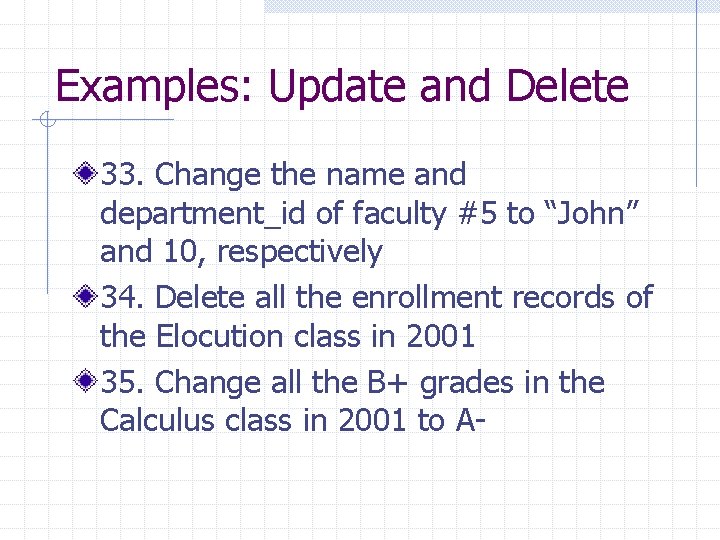
Examples: Update and Delete 33. Change the name and department_id of faculty #5 to “John” and 10, respectively 34. Delete all the enrollment records of the Elocution class in 2001 35. Change all the B+ grades in the Calculus class in 2001 to A-
![Update and Delete delete from table [where condition(s)]; update table set field=value [, …]](http://slidetodoc.com/presentation_image_h/12ed9bbbf5aefa4ad8debe0626e22fd5/image-60.jpg "Update and Delete delete from table [where condition(s)]; update table set field=value [, …]")
Update and Delete delete from table [where condition(s)]; update table set field=value [, …] [where condition(s)];
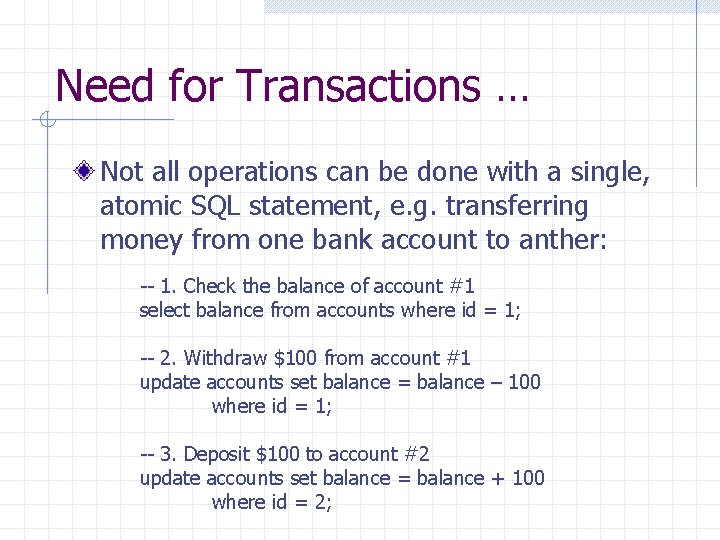
Need for Transactions … Not all operations can be done with a single, atomic SQL statement, e. g. transferring money from one bank account to anther: -- 1. Check the balance of account #1 select balance from accounts where id = 1; -- 2. Withdraw $100 from account #1 update accounts set balance = balance – 100 where id = 1; -- 3. Deposit $100 to account #2 update accounts set balance = balance + 100 where id = 2;
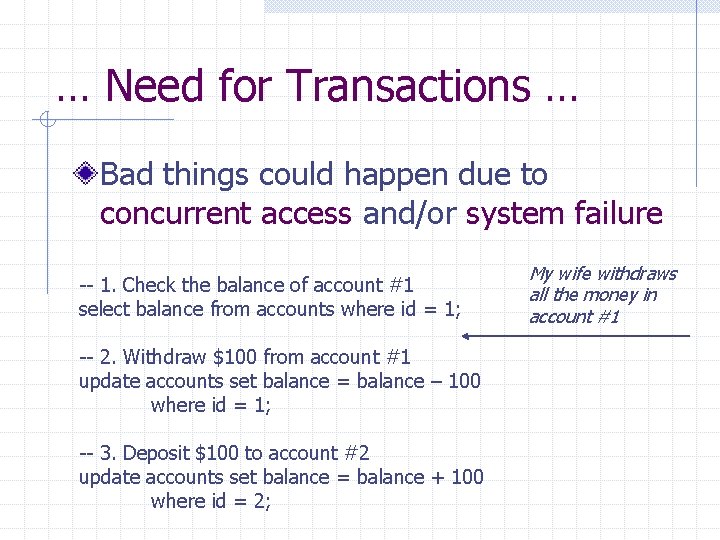
… Need for Transactions … Bad things could happen due to concurrent access and/or system failure -- 1. Check the balance of account #1 select balance from accounts where id = 1; -- 2. Withdraw $100 from account #1 update accounts set balance = balance – 100 where id = 1; -- 3. Deposit $100 to account #2 update accounts set balance = balance + 100 where id = 2; My wife withdraws all the money in account #1
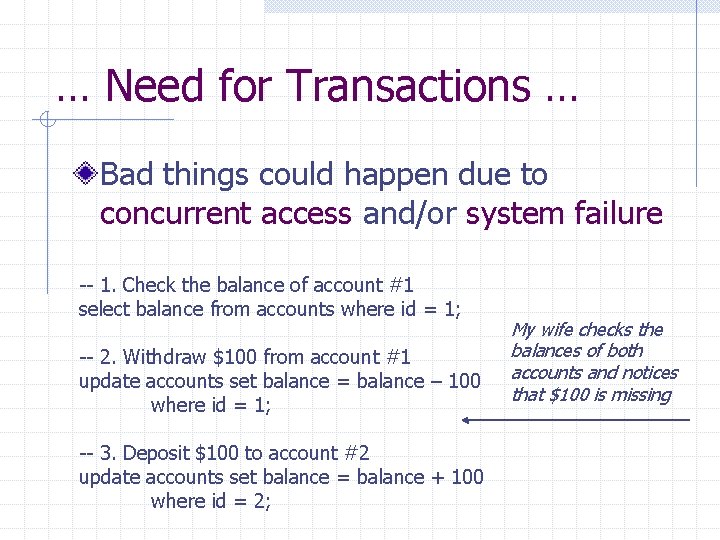
… Need for Transactions … Bad things could happen due to concurrent access and/or system failure -- 1. Check the balance of account #1 select balance from accounts where id = 1; -- 2. Withdraw $100 from account #1 update accounts set balance = balance – 100 where id = 1; -- 3. Deposit $100 to account #2 update accounts set balance = balance + 100 where id = 2; My wife checks the balances of both accounts and notices that $100 is missing
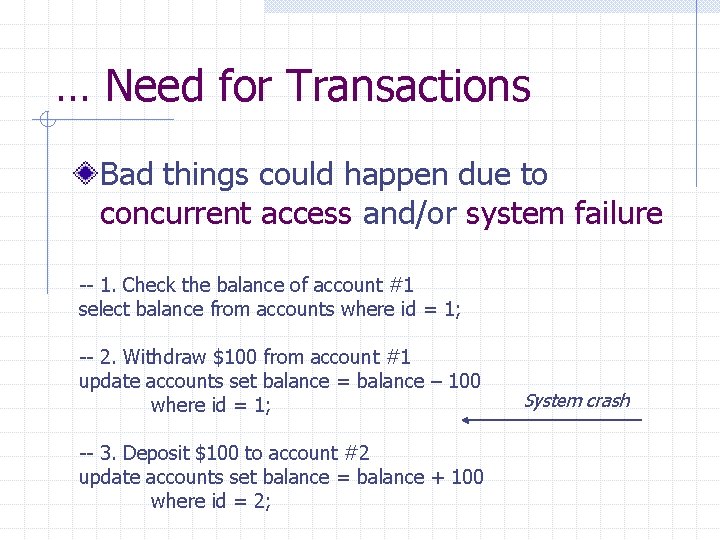
… Need for Transactions Bad things could happen due to concurrent access and/or system failure -- 1. Check the balance of account #1 select balance from accounts where id = 1; -- 2. Withdraw $100 from account #1 update accounts set balance = balance – 100 where id = 1; -- 3. Deposit $100 to account #2 update accounts set balance = balance + 100 where id = 2; System crash
Transaction A transaction is a group of SQL statements treated by the DBMS as a single unit of work
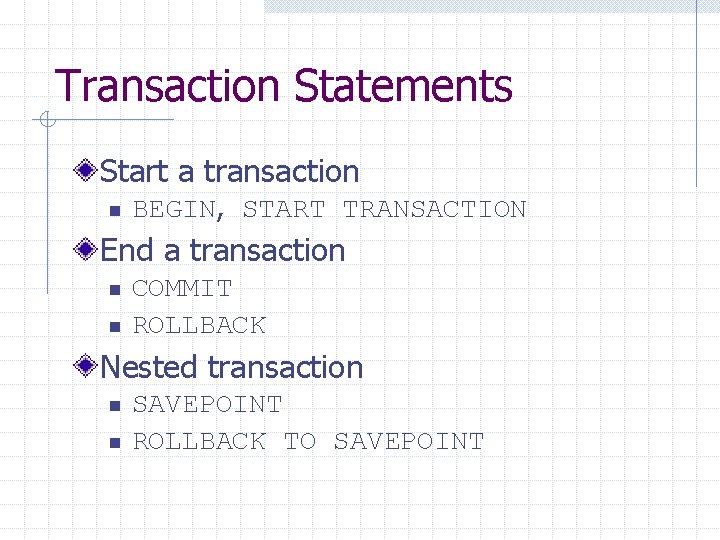
Transaction Statements Start a transaction n BEGIN, START TRANSACTION End a transaction n n COMMIT ROLLBACK Nested transaction n n SAVEPOINT ROLLBACK TO SAVEPOINT
Example: Transactions Use a transaction to add two records to the faculty table n n 36. Abort the transaction 37. Commit the transaction What happens if another transaction access the faculty table at the same time? ?
ACID Properties Database transactions are expected to have ACID properties n n Atomic Consistent Isolated Durable
Atomicity A transaction completes or fails as a whole, i. e. either all operations in the transaction are performed or none of them are.
Consistency Transaction should preserve database constraints.
Durability The changes made by committed transactions are guaranteed to be permanent, despite possible system failures.
Isolation Databases are often accessed by many users at the same time. Multiple transactions running concurrently should not interfere with each other, i. e. it should appear to the user that each transaction is executed in isolation.
SQL Isolation Levels Read uncommitted Read committed Repeatable read Serializable
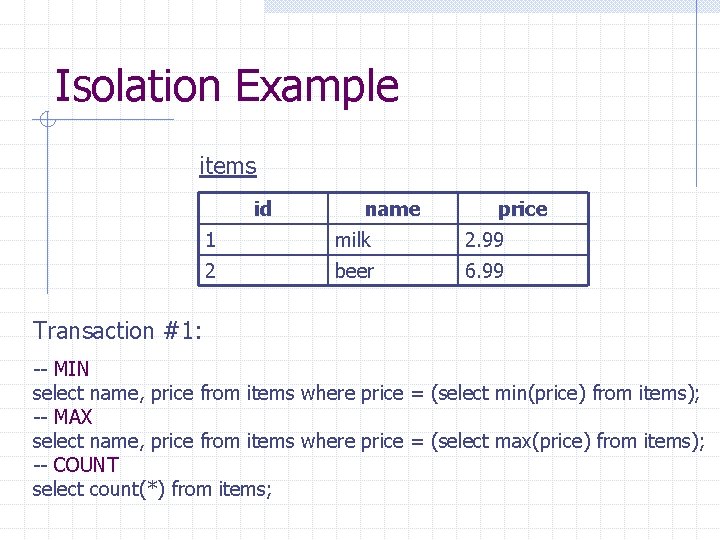
Isolation Example items id name price 1 milk 2. 99 2 beer 6. 99 Transaction #1: -- MIN select name, price from items where price = (select min(price) from items); -- MAX select name, price from items where price = (select max(price) from items); -- COUNT select count(*) from items;
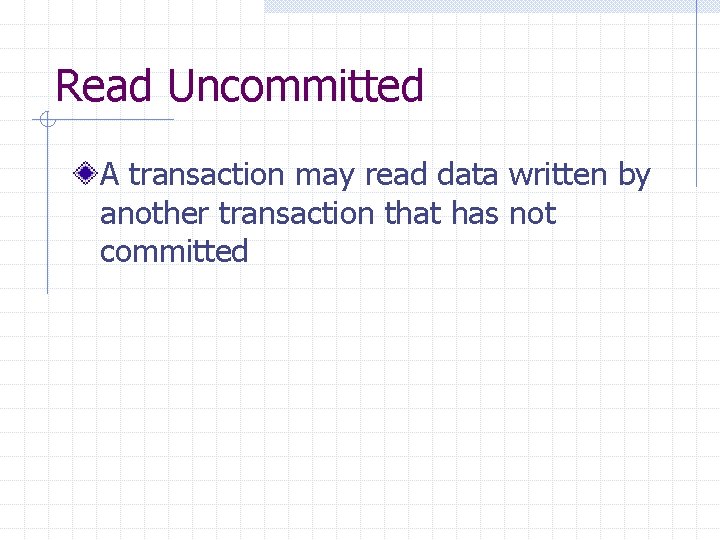
Read Uncommitted A transaction may read data written by another transaction that has not committed
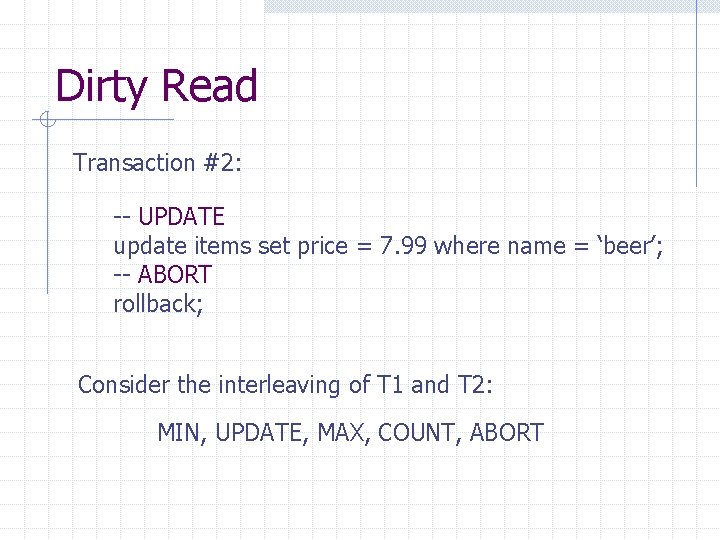
Dirty Read Transaction #2: -- UPDATE update items set price = 7. 99 where name = ‘beer’; -- ABORT rollback; Consider the interleaving of T 1 and T 2: MIN, UPDATE, MAX, COUNT, ABORT
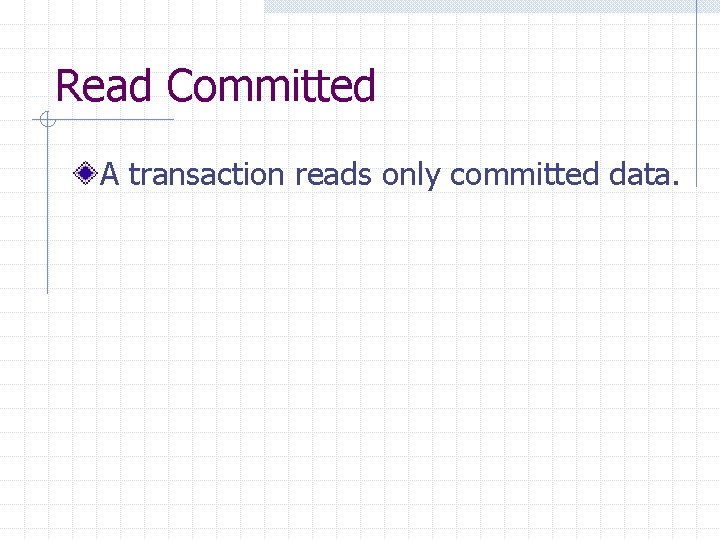
Read Committed A transaction reads only committed data.
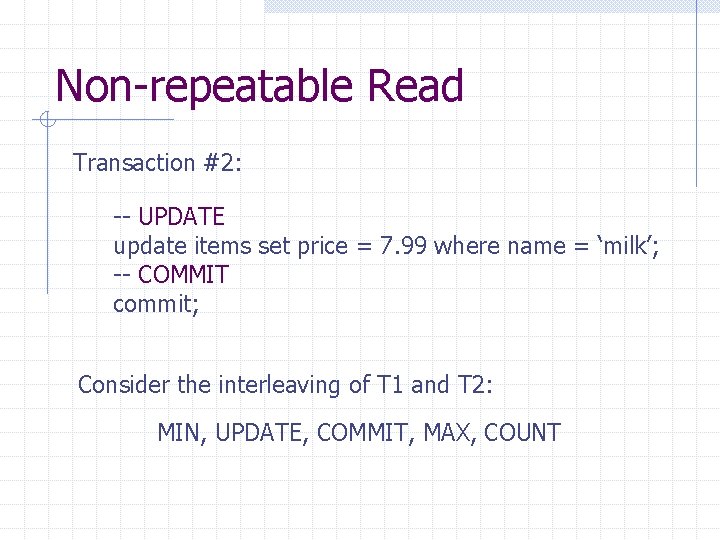
Non-repeatable Read Transaction #2: -- UPDATE update items set price = 7. 99 where name = ‘milk’; -- COMMIT commit; Consider the interleaving of T 1 and T 2: MIN, UPDATE, COMMIT, MAX, COUNT
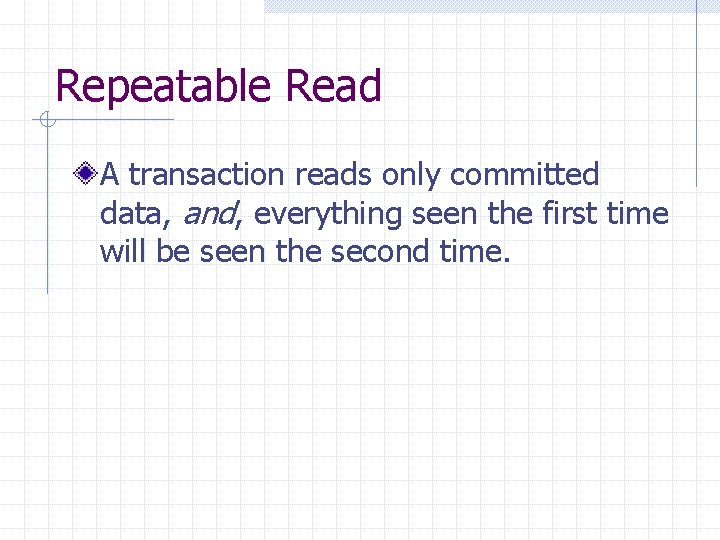
Repeatable Read A transaction reads only committed data, and, everything seen the first time will be seen the second time.
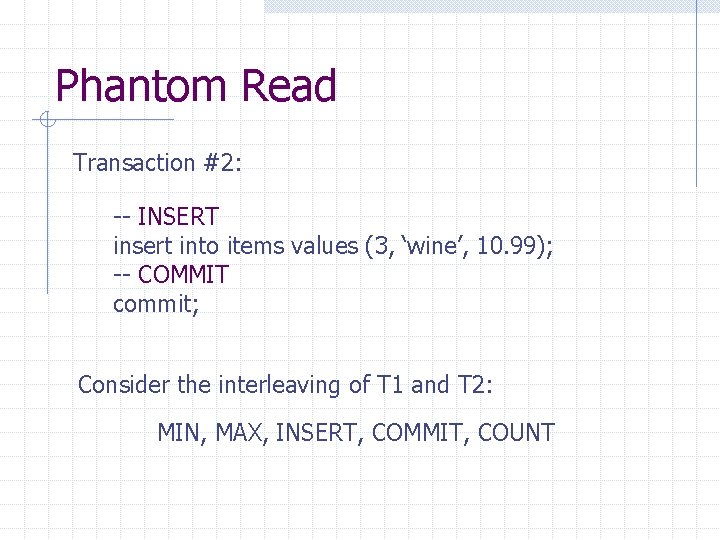
Phantom Read Transaction #2: -- INSERT insert into items values (3, ‘wine’, 10. 99); -- COMMIT commit; Consider the interleaving of T 1 and T 2: MIN, MAX, INSERT, COMMIT, COUNT
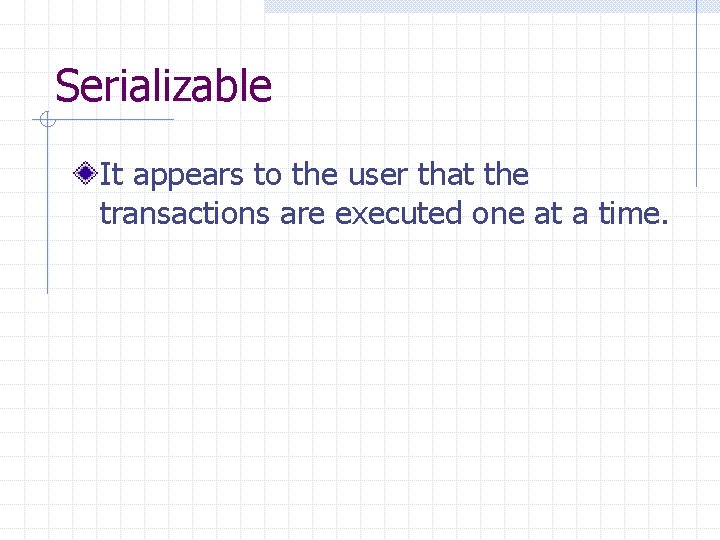
Serializable It appears to the user that the transactions are executed one at a time.
Isolation Levels in Postgre. SQL Read committed (default) Serializable
About Concurrent Transactions Concurrency is needed to maximize performance Concurrent transactions can lead to problems due to aborted operations and interleaving operations 4 isolation levels 3 problems
Example: Indexes and Views 38. Create an index on the name column of the students table 39. Create a view showing the id, course name, instructor’s name, and the number of students in each section 40. Remove the view
![Table Bob Lisa [8, Meg, …] Joe [7, Val, …] John [6, Sally, …]](http://slidetodoc.com/presentation_image_h/12ed9bbbf5aefa4ad8debe0626e22fd5/image-85.jpg "Table Bob Lisa [8, Meg, …] Joe [7, Val, …] John [6, Sally, …]")
Table Bob Lisa [8, Meg, …] Joe [7, Val, …] John [6, Sally, …] Index [5, John, …] Joe [4, Amy, …] Amy [3, Lisa, …] Bob [2, Bob, …] Amy [1, Joe, …] Search with an Index John Meg Lisa Sally Meg Sally Val
About Indexes make query execution more efficient Many DBMS automatically create indexes for primary key and unique columns There are many different types of indexes designed for different types of data and operations n E. g. B-tree, R-tree, Hash Index
About Views A view can be used as a table in SQL statements Most views cannot be updated The data in a view is dynamically computed, i. e. changes to base tables are automatically reflected in the view
Why Views Present the data in a user friendly way while keeping the base tables normalized Simplify SQL queries Security reasons n n Views can be access controlled just like tables Expose only part of the data to certain type of users
Summary Create and maintain database schema Query and update data Transactions and ACID Indexes and views
- Slides: 89