
CS 422 Principles of Database Systems EntityRelationship Model
CS 422 Principles of Database Systems Entity-Relationship Model Chengyu Sun California State University, Los Angeles
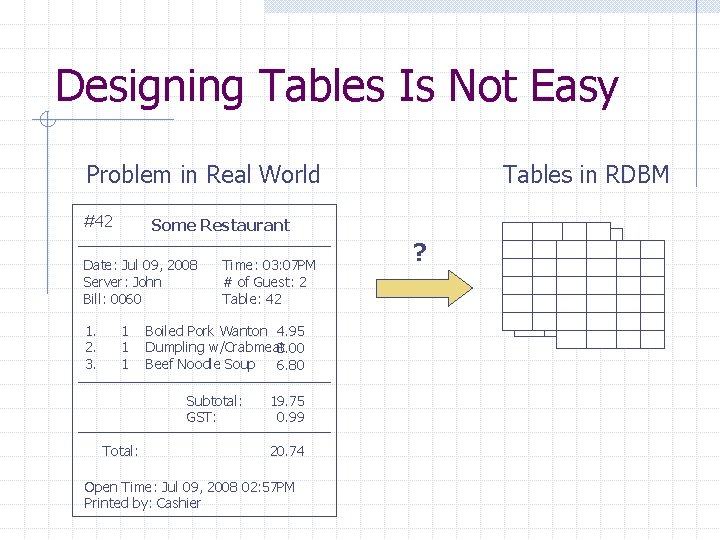
Designing Tables Is Not Easy Problem in Real World #42 Some Restaurant Date: Jul 09, 2008 Server: John Bill: 0060 1. 2. 3. Tables in RDBM 1 1 1 Time: 03: 07 PM # of Guest: 2 Table: 42 Boiled Pork Wanton 4. 95 Dumpling w/Crabmeat 8. 00 Beef Noodle Soup 6. 80 Subtotal: GST: Total: 19. 75 0. 99 20. 74 Open Time: Jul 09, 2008 02: 57 PM Printed by: Cashier ?
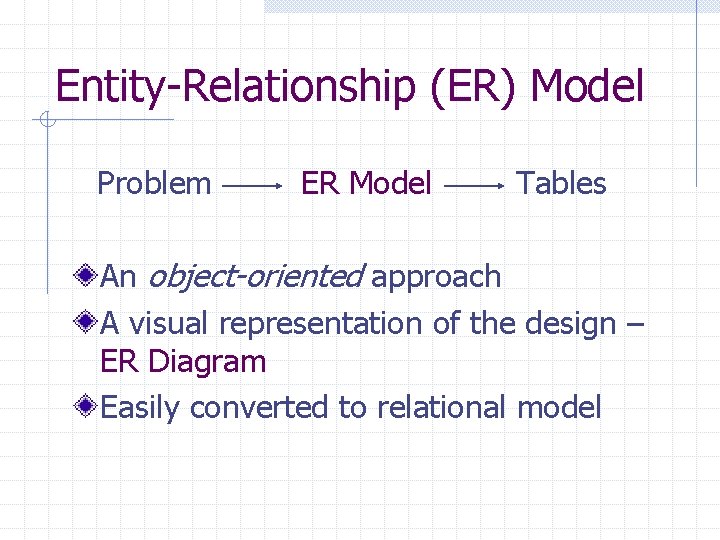
Entity-Relationship (ER) Model Problem ER Model Tables An object-oriented approach A visual representation of the design – ER Diagram Easily converted to relational model
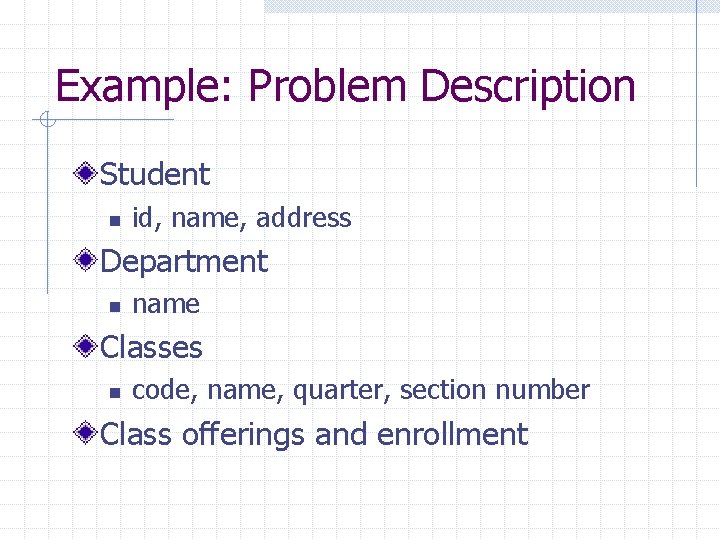
Example: Problem Description Student n id, name, address Department n name Classes n code, name, quarter, section number Class offerings and enrollment
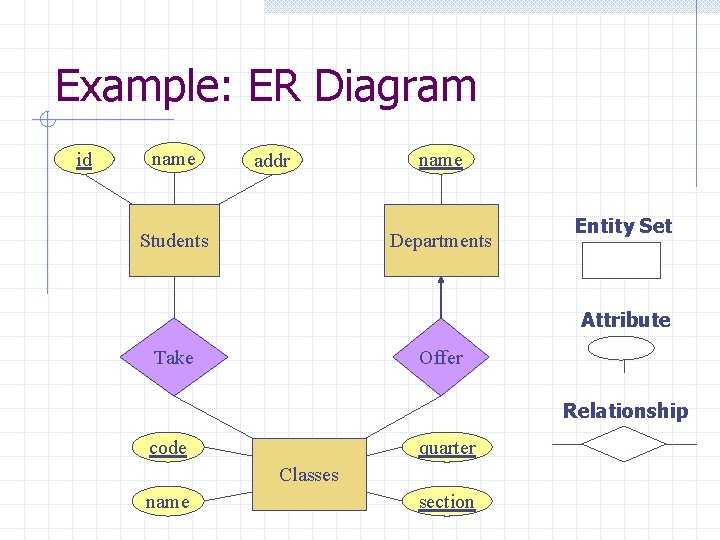
Example: ER Diagram id name addr Students name Departments Entity Set Attribute Take Offer Relationship code quarter Classes name section
Entity Set and Attributes Entity Set is similar to class in an OO language Attributes are the properties of an entity set n n Similar to the class fields in an OO language Must have simple values like numbers or strings, i. e. cannot be collection or composite type
Keys A key is an attribute or a set of attributes that uniquely identify an entity in an entity set. Each entity set must have a key If there are multiple keys, choose one of them as the primary key
Types of Relationships Many-to-Many-to-One / One-to-Many One-to-One
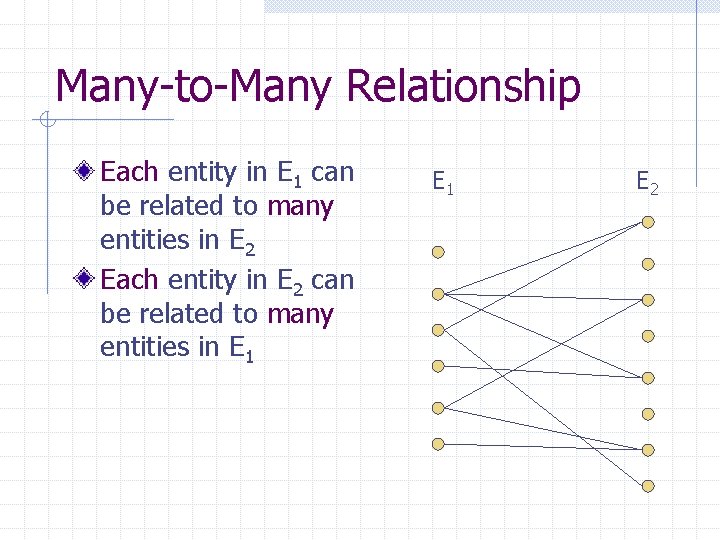
Many-to-Many Relationship Each entity in E 1 can be related to many entities in E 2 Each entity in E 2 can be related to many entities in E 1 E 2
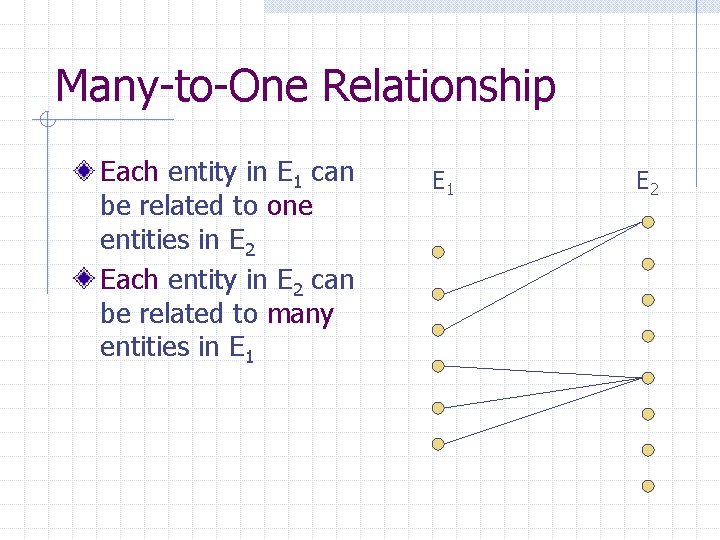
Many-to-One Relationship Each entity in E 1 can be related to one entities in E 2 Each entity in E 2 can be related to many entities in E 1 E 2
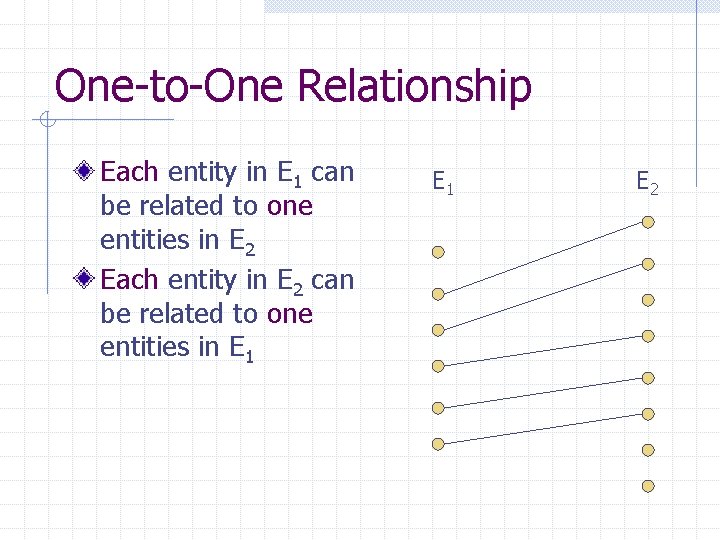
One-to-One Relationship Each entity in E 1 can be related to one entities in E 2 Each entity in E 2 can be related to one entities in E 1 E 2
Relationship Type Examples Students and classes? ? Departments and classes? ? Person and Favorite movie? ?
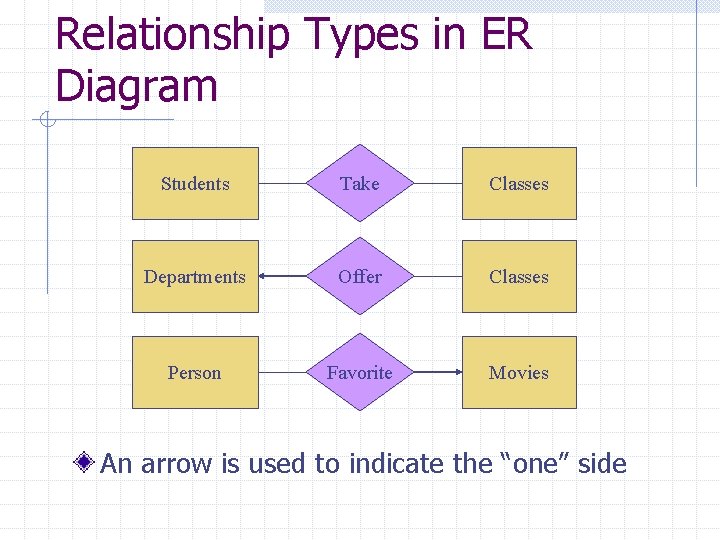
Relationship Types in ER Diagram Students Take Classes Departments Offer Classes Person Favorite Movies An arrow is used to indicate the “one” side
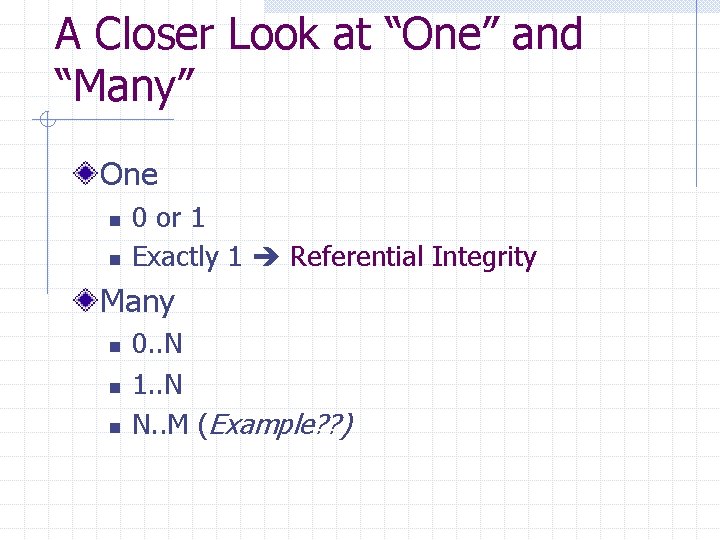
A Closer Look at “One” and “Many” One n n 0 or 1 Exactly 1 Referential Integrity Many n n n 0. . N 1. . N N. . M (Example? ? )
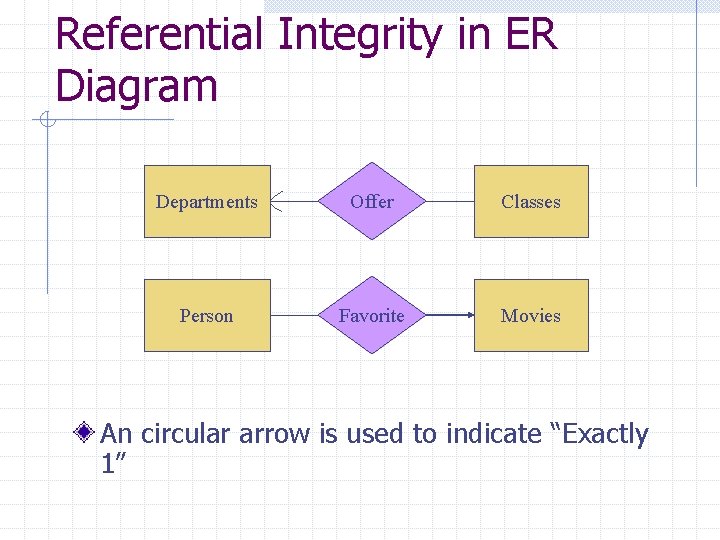
Referential Integrity in ER Diagram Departments Offer Classes Person Favorite Movies An circular arrow is used to indicate “Exactly 1”
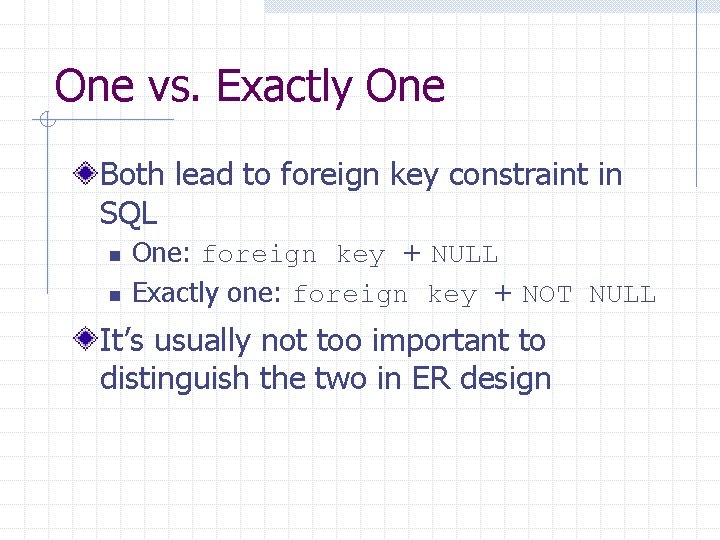
One vs. Exactly One Both lead to foreign key constraint in SQL n n One: foreign key + NULL Exactly one: foreign key + NOT NULL It’s usually not too important to distinguish the two in ER design
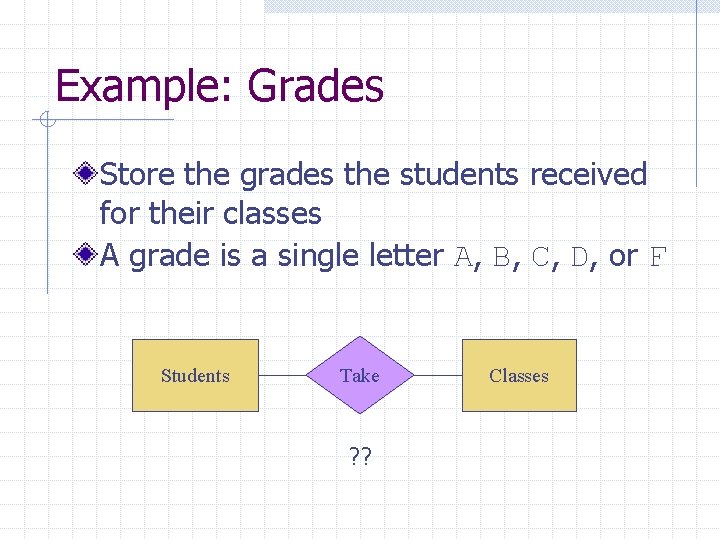
Example: Grades Store the grades the students received for their classes A grade is a single letter A, B, C, D, or F Students Take ? ? Classes
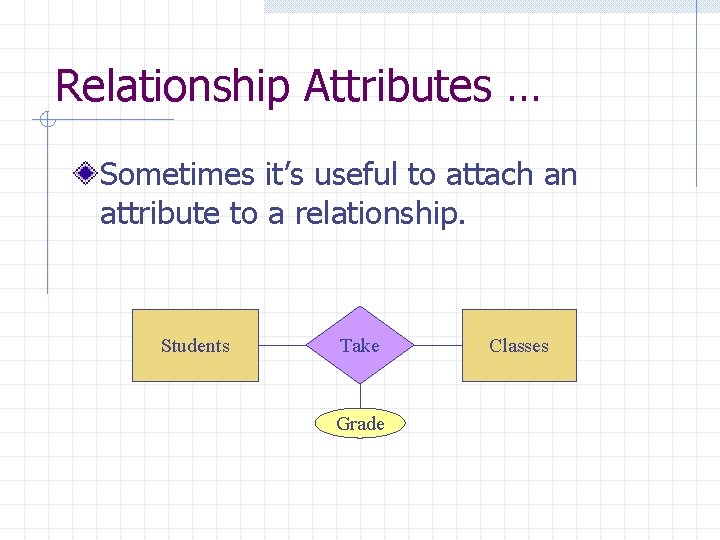
Relationship Attributes … Sometimes it’s useful to attach an attribute to a relationship. Students Take Grade Classes
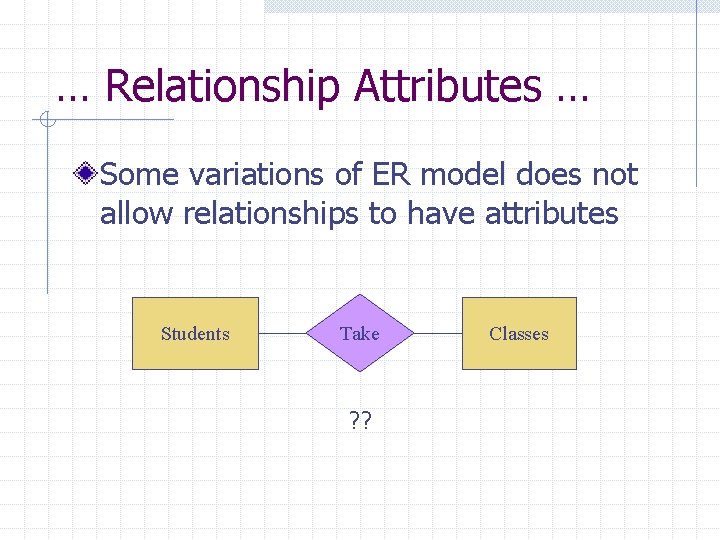
… Relationship Attributes … Some variations of ER model does not allow relationships to have attributes Students Take ? ? Classes
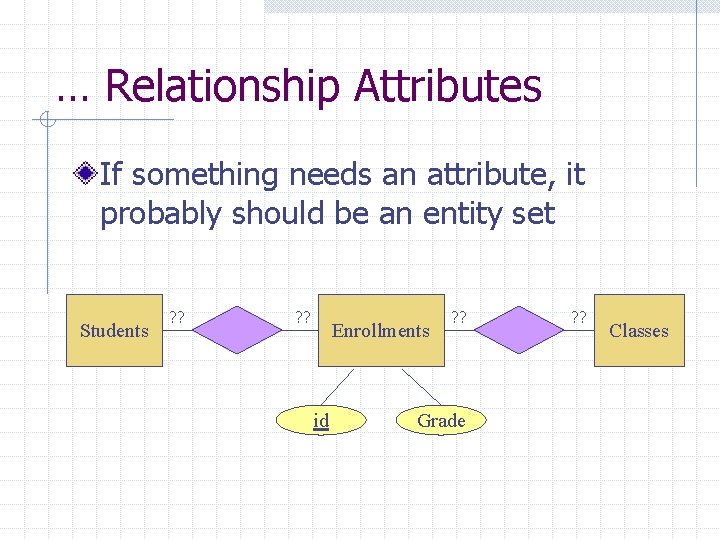
… Relationship Attributes If something needs an attribute, it probably should be an entity set Students ? ? Enrollments id ? ? Grade ? ? Classes
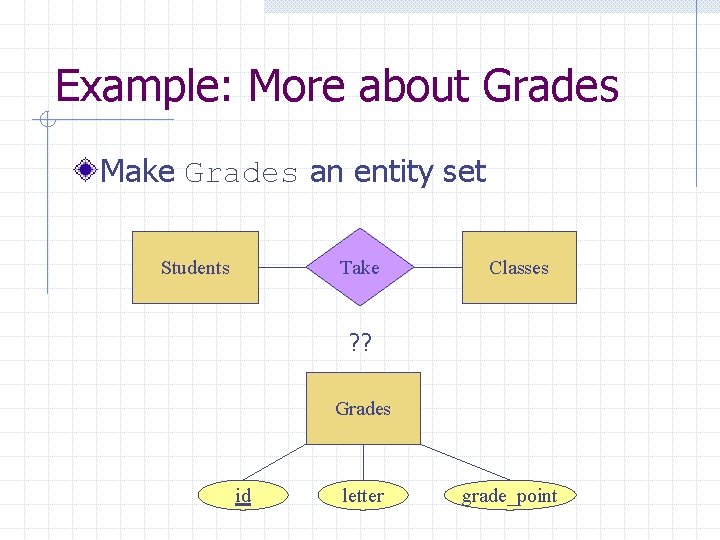
Example: More about Grades Make Grades an entity set Take Students Classes ? ? Grades id letter grade_point
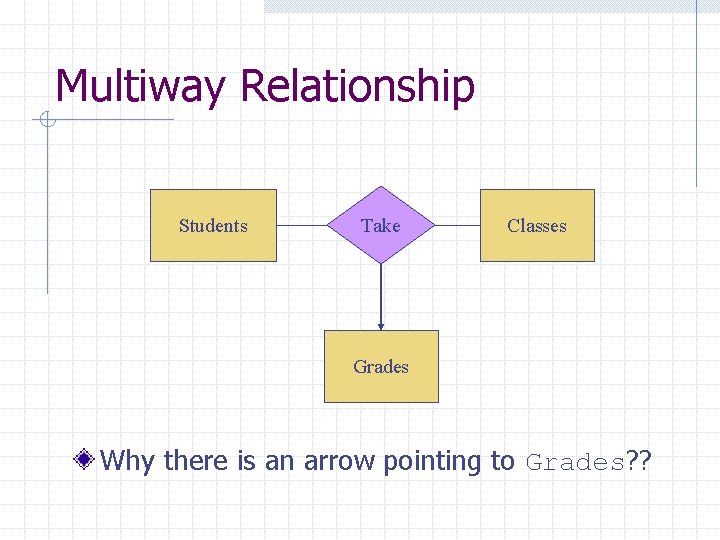
Multiway Relationship Students Take Classes Grades Why there is an arrow pointing to Grades? ?
“Arrows” in Multiway Relationships In multiway relationships, an arrow points to an entity set E means that if we select one entity from each of the other entity sets in the relationship, those entities are related to at most one entity in E.
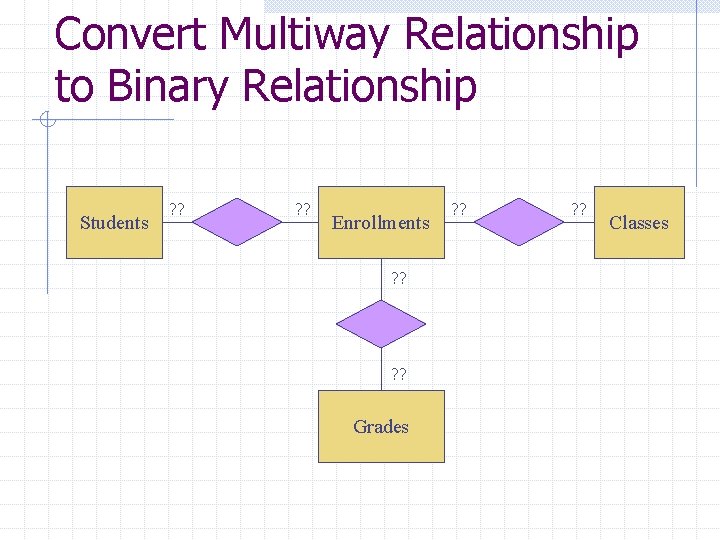
Convert Multiway Relationship to Binary Relationship Students ? ? Enrollments ? ? Grades ? ? Classes
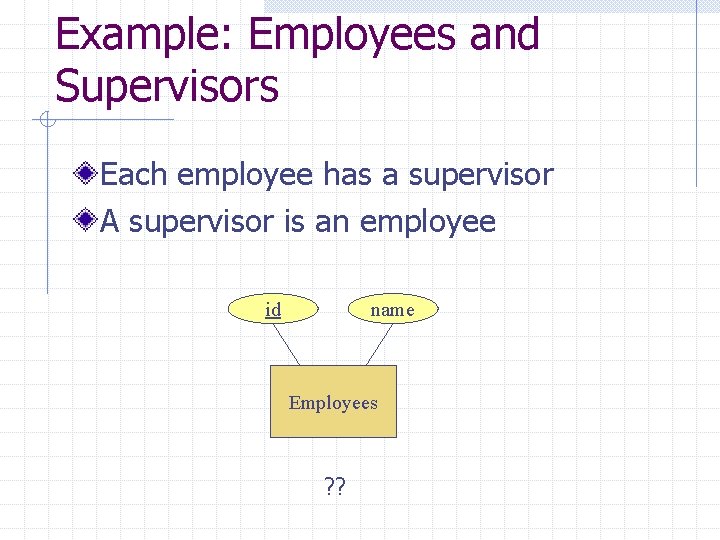
Example: Employees and Supervisors Each employee has a supervisor A supervisor is an employee id name Employees ? ?
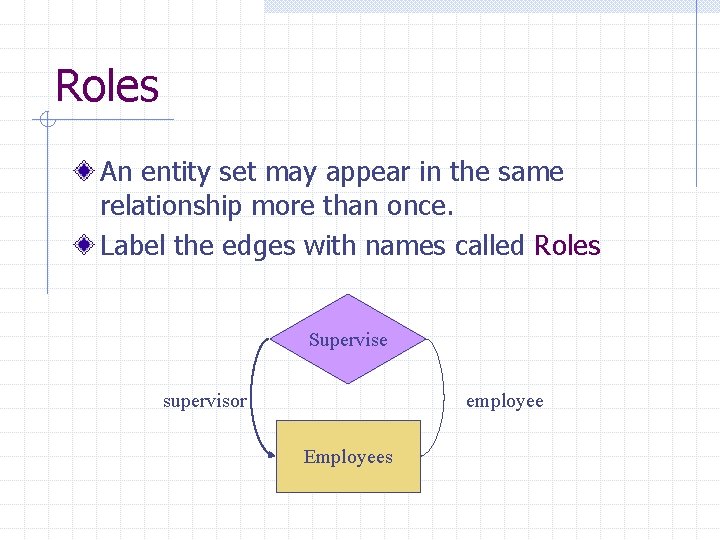
Roles An entity set may appear in the same relationship more than once. Label the edges with names called Roles Supervise supervisor employee Employees
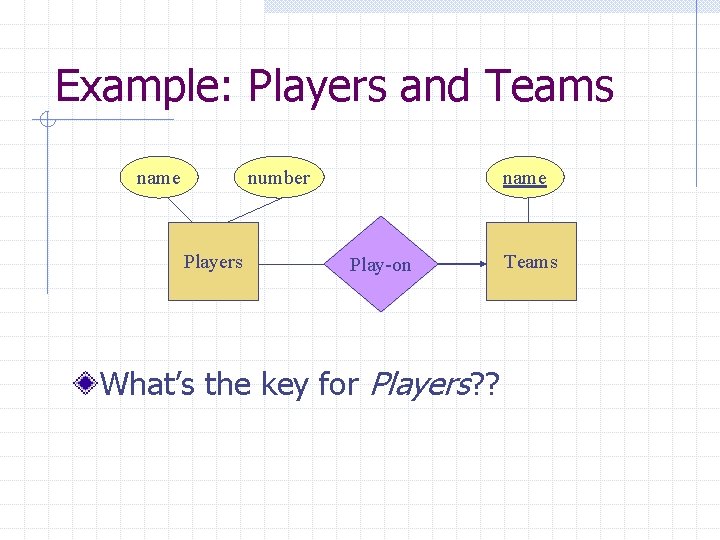
Example: Players and Teams name number Players name Play-on What’s the key for Players? ? Teams
Weak Entity Set Entity set E is said to be weak if in order to identify entities of E uniquely, we need to follow one or more manyone relationships from E and include the key of the related entities from the connected entity sets.
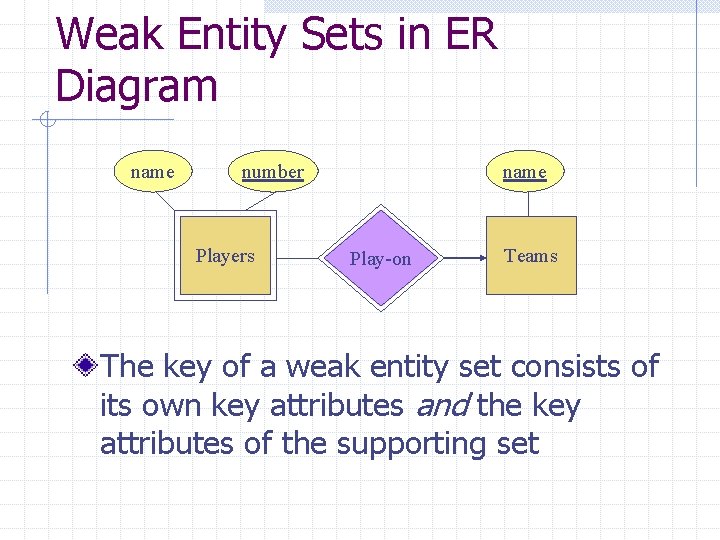
Weak Entity Sets in ER Diagram name number Players name Play-on Teams The key of a weak entity set consists of its own key attributes and the key attributes of the supporting set
From Weak to Strong We can usually create unique IDs for entity sets
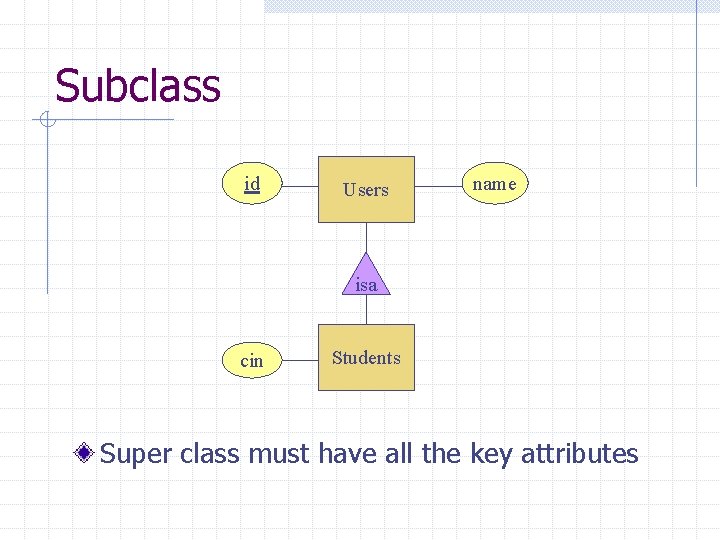
Subclass id Users name isa cin Students Super class must have all the key attributes
Summary of ER Diagram Entity Set n n Attributes, key Weak entity set Relationship n n Many-to-Many, Many-to-One, One-to-One Attributes Multiway relationship Subclass
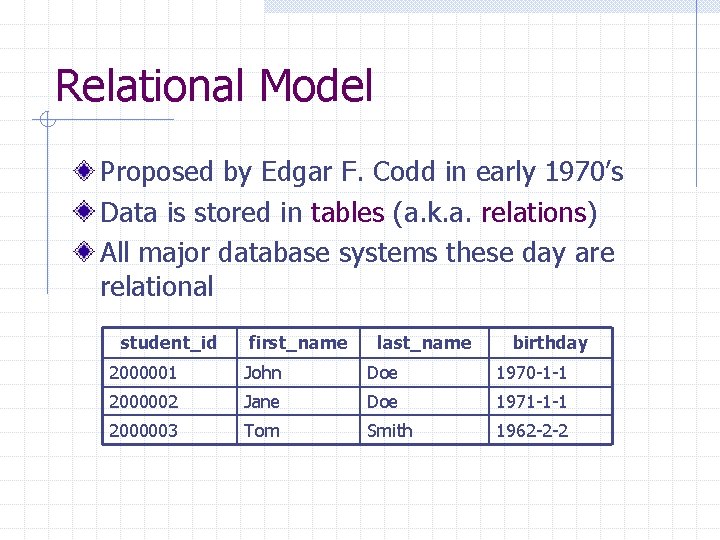
Relational Model Proposed by Edgar F. Codd in early 1970’s Data is stored in tables (a. k. a. relations) All major database systems these day are relational student_id first_name last_name birthday 2000001 John Doe 1970 -1 -1 2000002 Jane Doe 1971 -1 -1 2000003 Tom Smith 1962 -2 -2
About Relational Model Attributes must be of simple type No order among attributes No order among records
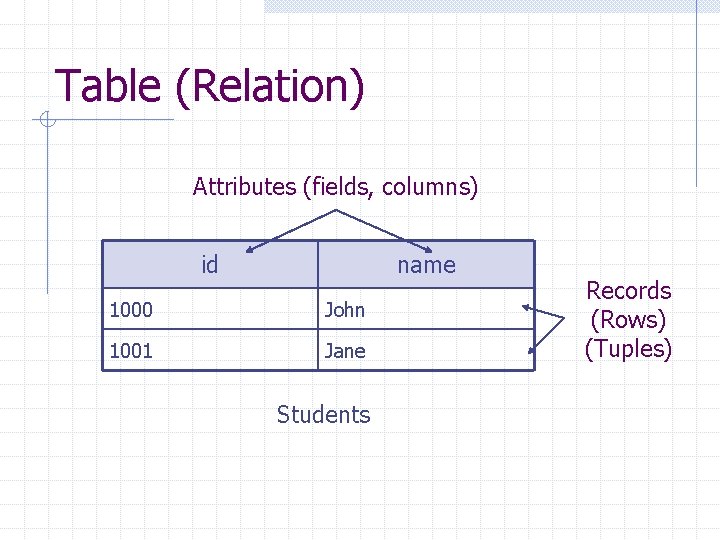
Table (Relation) Attributes (fields, columns) id name 1000 John 1001 Jane Students Records (Rows) (Tuples)
Table and Database Schema Table schema n n Name of the table, and the names and types of the attributes E. g. students(id: integer, name: string) or just students(id, name) Database schema n Schemas of all the tables in the database
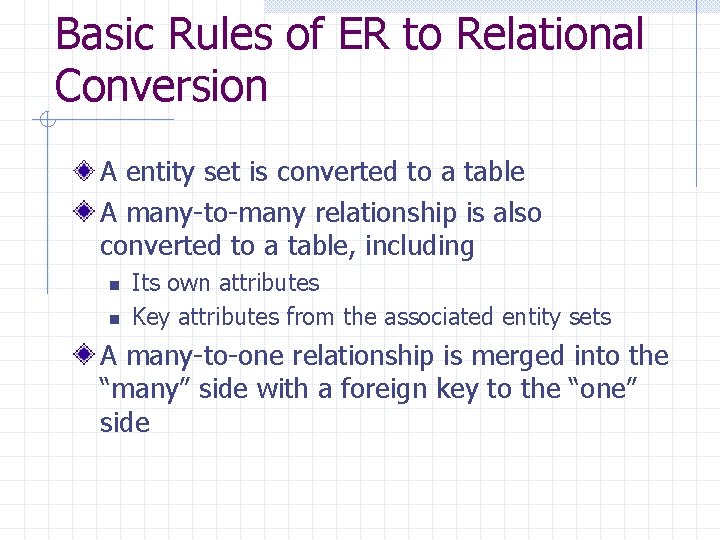
Basic Rules of ER to Relational Conversion A entity set is converted to a table A many-to-many relationship is also converted to a table, including n n Its own attributes Key attributes from the associated entity sets A many-to-one relationship is merged into the “many” side with a foreign key to the “one” side
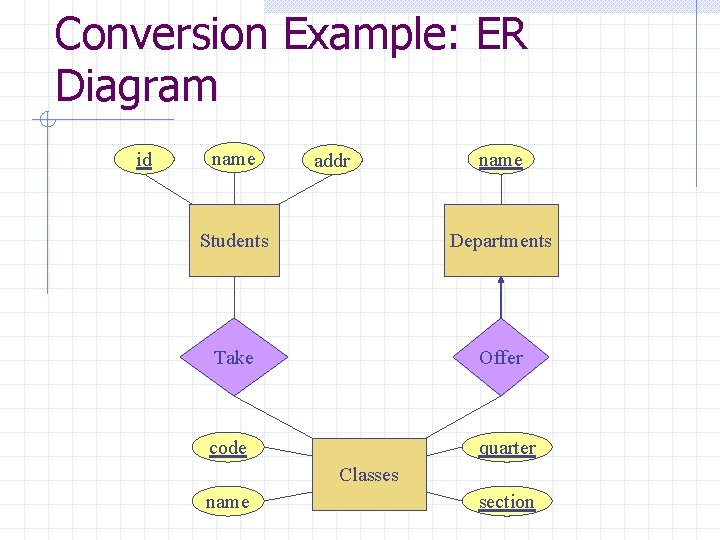
Conversion Example: ER Diagram id name addr name Students Departments Take Offer code quarter Classes name section
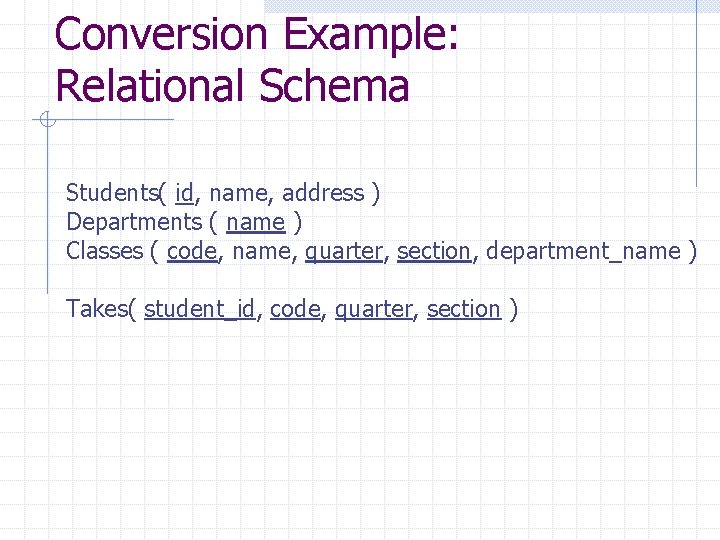
Conversion Example: Relational Schema Students( id, name, address ) Departments ( name ) Classes ( code, name, quarter, section, department_name ) Takes( student_id, code, quarter, section )
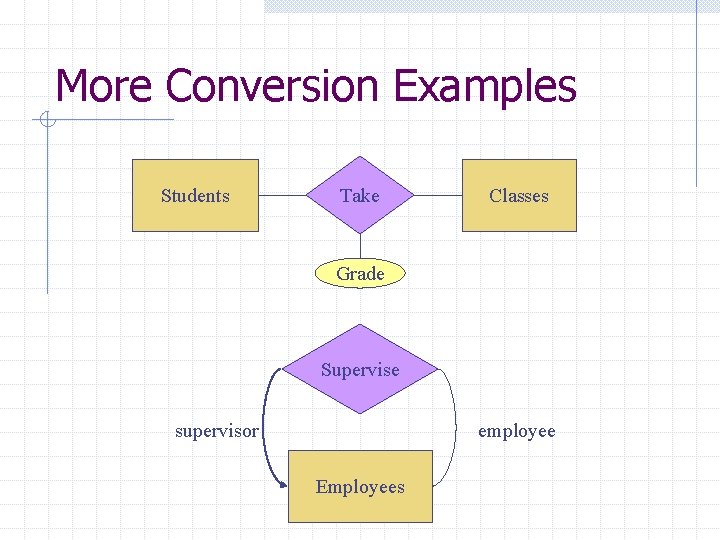
More Conversion Examples Students Take Classes Grade Supervise supervisor employee Employees
Special Cases of Conversion One-to-One relationship Multiway relationship Weak entity set Subclass
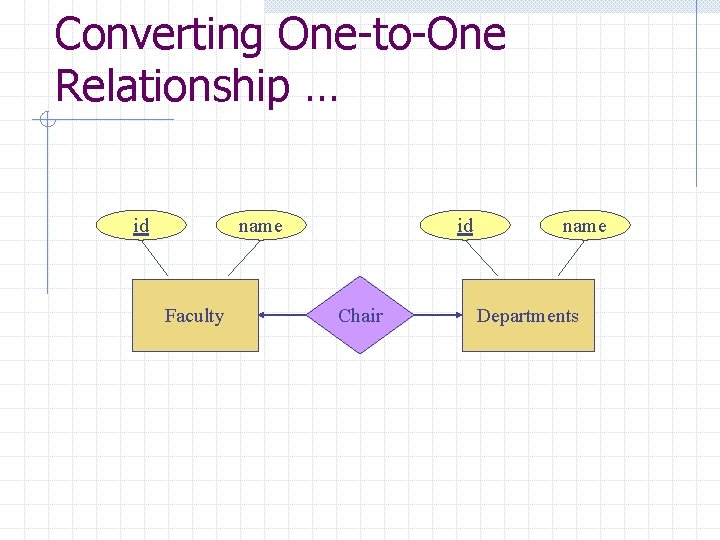
Converting One-to-One Relationship … id name Faculty id Chair name Departments
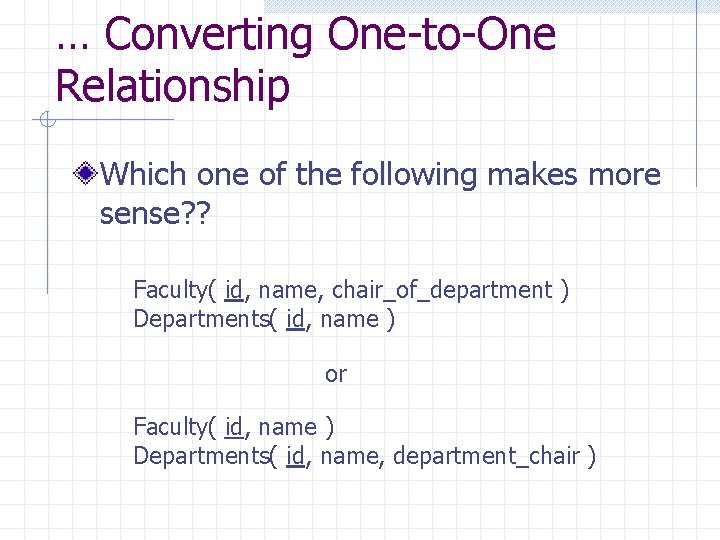
… Converting One-to-One Relationship Which one of the following makes more sense? ? Faculty( id, name, chair_of_department ) Departments( id, name ) or Faculty( id, name ) Departments( id, name, department_chair )
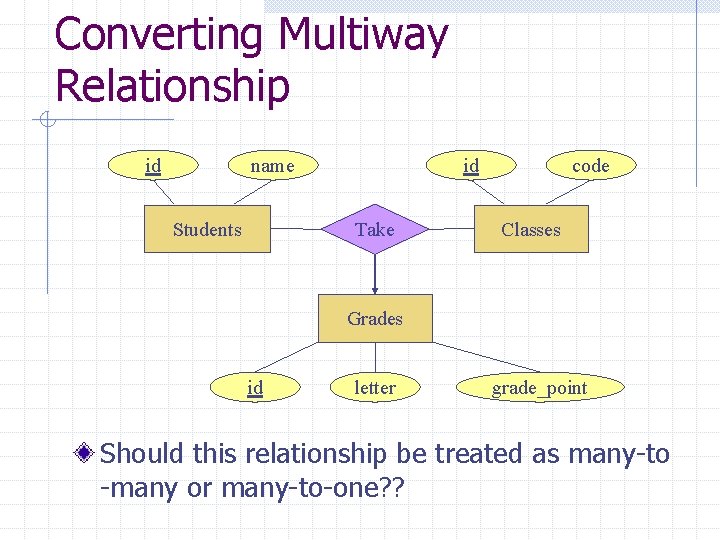
Converting Multiway Relationship id name Students id Take code Classes Grades id letter grade_point Should this relationship be treated as many-to -many or many-to-one? ?
Converting Weak Entity Set … The table for a weak entity set includes its complete key as well as it’s own nonkey attributes A supporting relationship is redundant and yields no relation
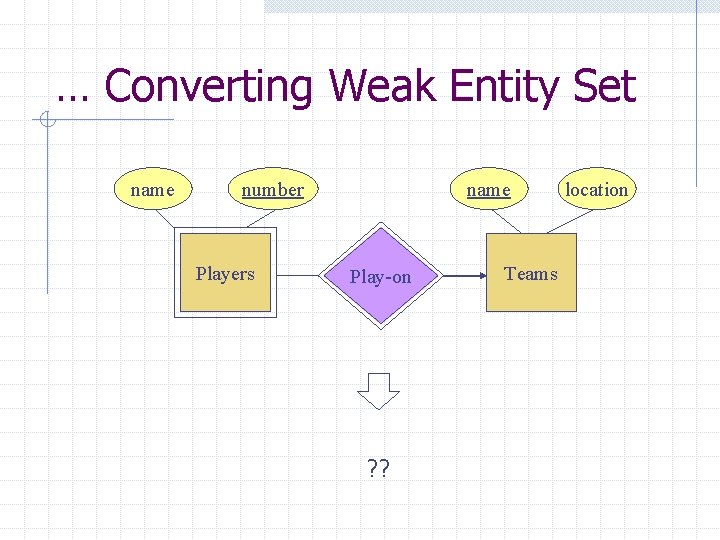
… Converting Weak Entity Set name number Players name Play-on ? ? Teams location
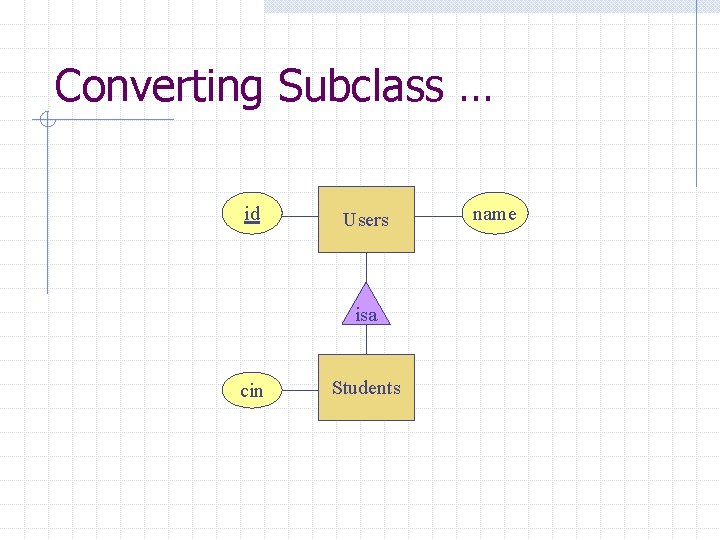
Converting Subclass … id Users isa cin Students name
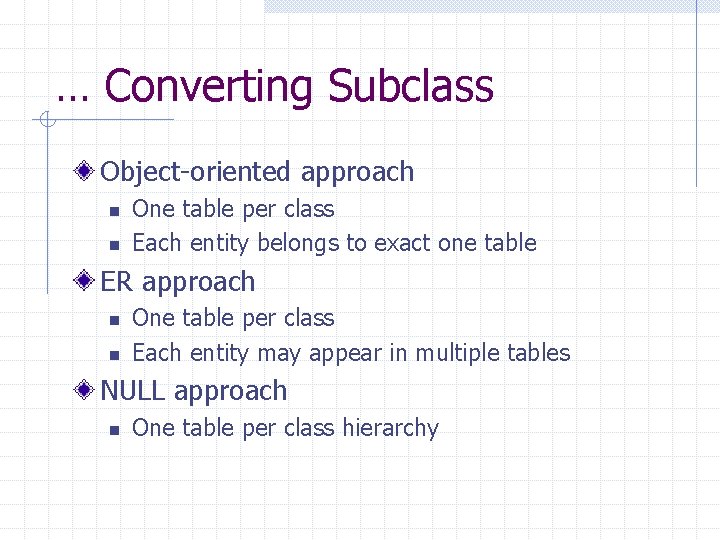
… Converting Subclass Object-oriented approach n n One table per class Each entity belongs to exact one table ER approach n n One table per class Each entity may appear in multiple tables NULL approach n One table per class hierarchy
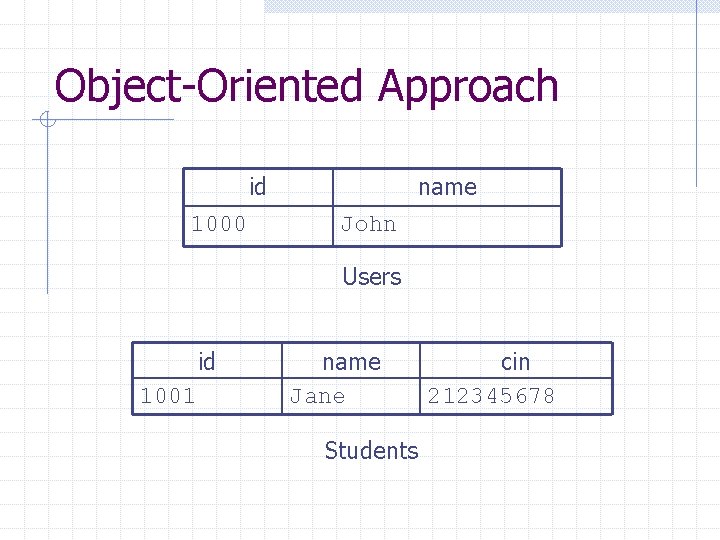
Object-Oriented Approach id 1000 name John Users id 1001 name Jane Students cin 212345678
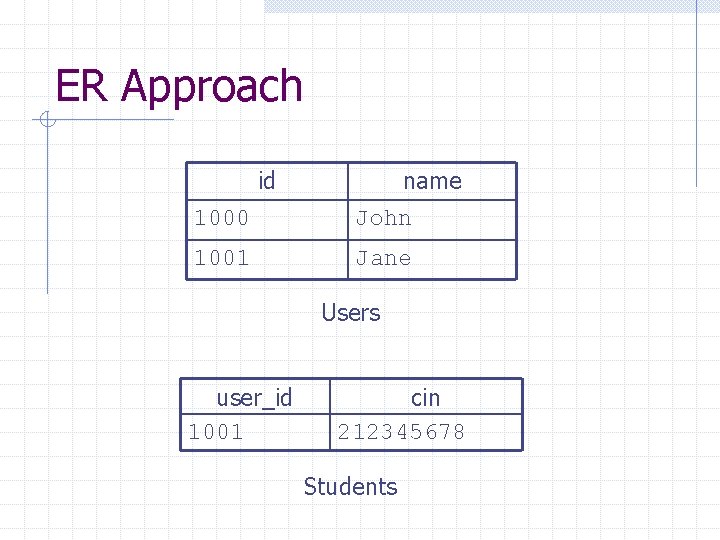
ER Approach id 1000 name John 1001 Jane Users user_id 1001 cin 212345678 Students
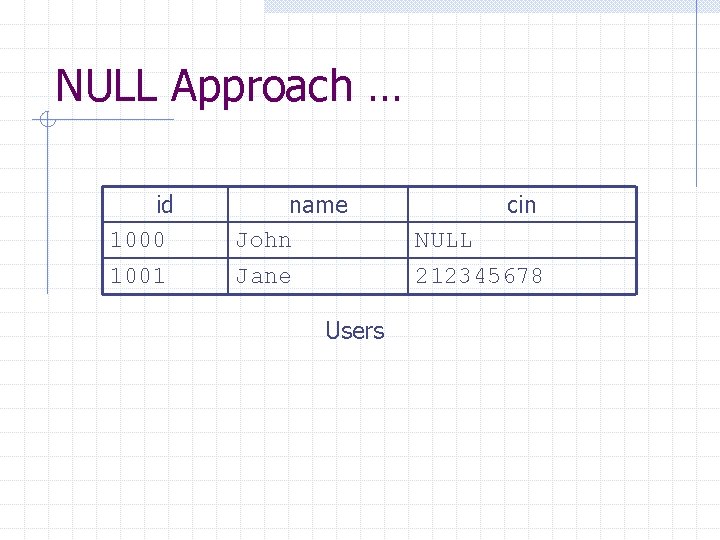
NULL Approach … id 1000 1001 name John Jane Users cin NULL 212345678
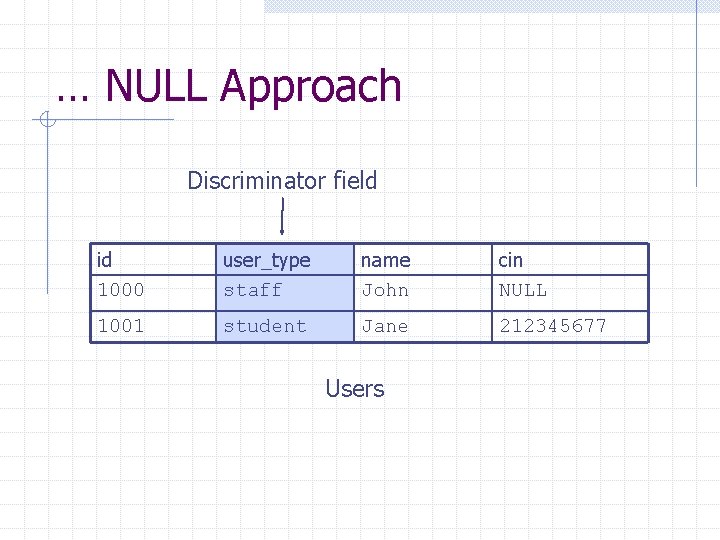
… NULL Approach Discriminator field id 1000 user_type staff name John cin NULL 1001 student Jane 212345677 Users
Comparison of Subclass Conversion Approaches Constraints and data integrity Query performance Q 1: find the number of users Q 2: find the number of students
Summary of ER to Relational Conversion Basic rules n n n Entity set Many-to-many relationship Many-to-one relationship Special cases n n One-to-one relationship Multiway relationship Weak entity set Subclass
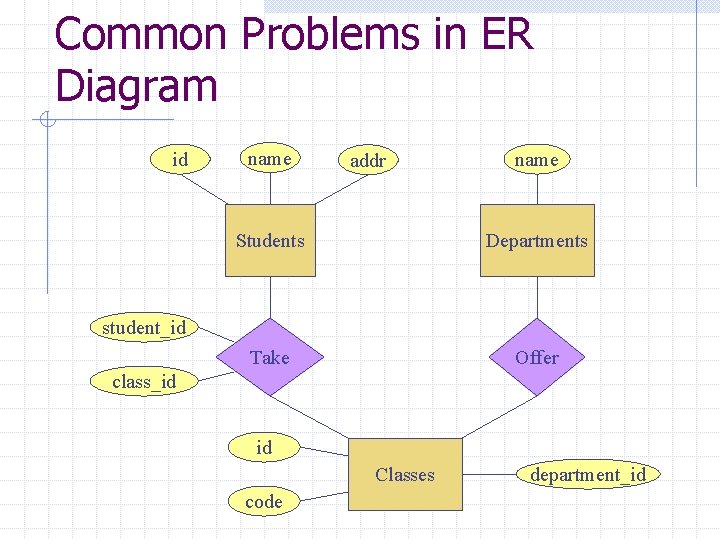
Common Problems in ER Diagram id name addr name Students Departments Take Offer student_id class_id id Classes code department_id
Common Mistakes of ER Design ER diagram n n n Missing arrows Missing keys Redundant foreign keys ER to relational conversion n Missing tables for many-to-many relationships
Variations of ER Model Rule differences n Relationships cannot have attributes w Anything that have attributes should be an entity set w Simplifies ER diagram n No multiway relationship w Better mapping to OO languages Notational differences n n Classic ER diagram OO style ER diagram
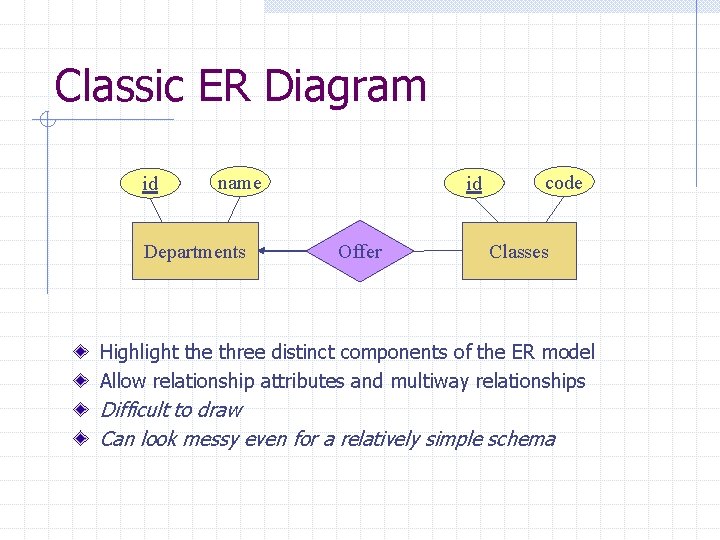
Classic ER Diagram id name Departments id Offer code Classes Highlight the three distinct components of the ER model Allow relationship attributes and multiway relationships Difficult to draw Can look messy even for a relatively simple schema
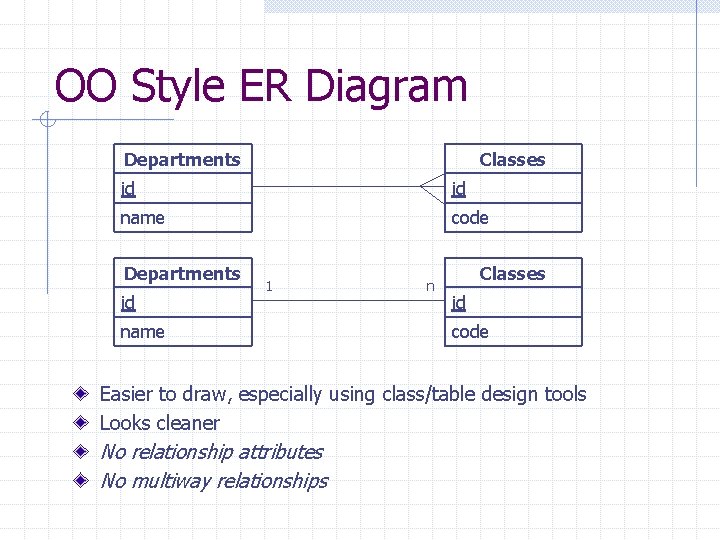
OO Style ER Diagram Departments Classes id id name code Departments id 1 name n Classes id code Easier to draw, especially using class/table design tools Looks cleaner No relationship attributes No multiway relationships
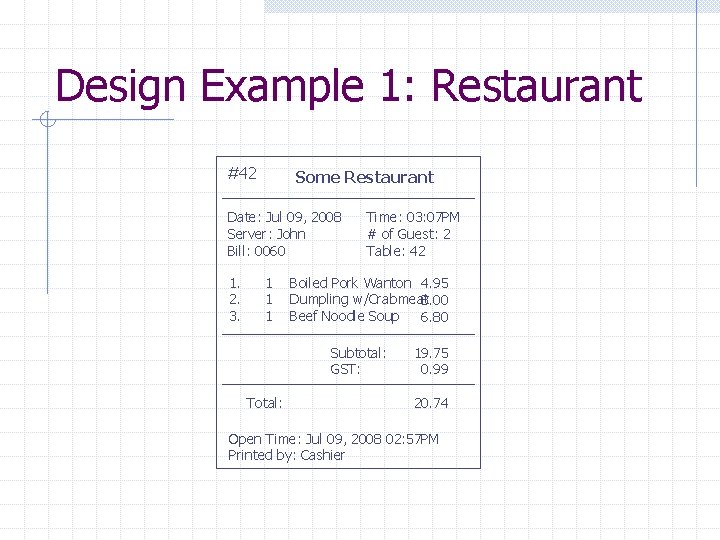
Design Example 1: Restaurant #42 Some Restaurant Date: Jul 09, 2008 Server: John Bill: 0060 1. 2. 3. 1 1 1 Time: 03: 07 PM # of Guest: 2 Table: 42 Boiled Pork Wanton 4. 95 Dumpling w/Crabmeat 8. 00 Beef Noodle Soup 6. 80 Subtotal: GST: Total: 19. 75 0. 99 20. 74 Open Time: Jul 09, 2008 02: 57 PM Printed by: Cashier
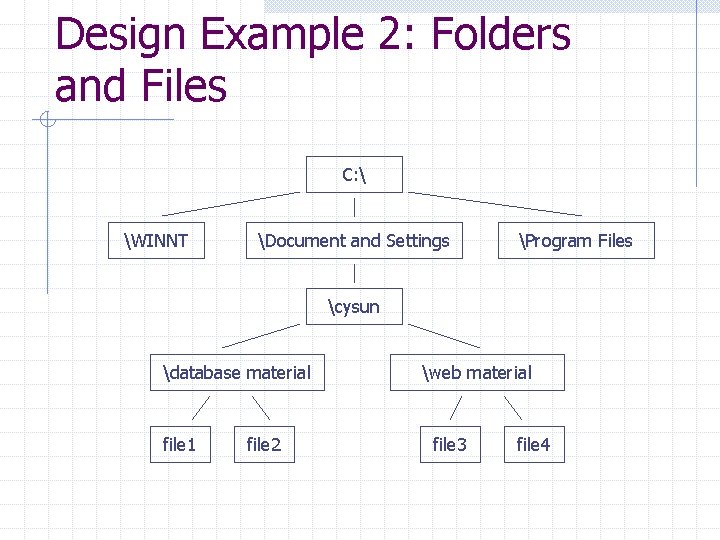
Design Example 2: Folders and Files C: WINNT Document and Settings Program Files cysun database material file 1 file 2 web material file 3 file 4
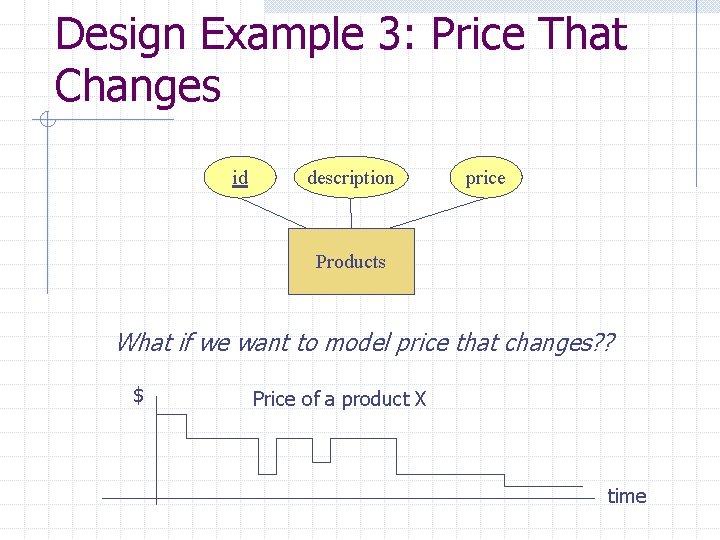
Design Example 3: Price That Changes id description price Products What if we want to model price that changes? ? $ Price of a product X time
- Slides: 62