
CS 422 Principles of Database Systems Disk Access
CS 422 Principles of Database Systems Disk Access Chengyu Sun California State University, Los Angeles
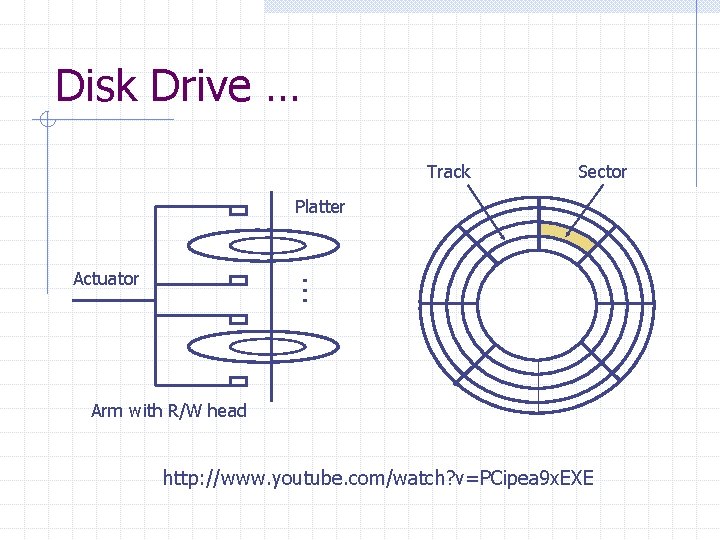
Disk Drive … Track Sector Platter … Actuator Arm with R/W head http: //www. youtube. com/watch? v=PCipea 9 x. EXE
… Disk Drive … Each disk drive contains a number of rotating platters Each platter has a number of tracks on which data is recorded Each track is divided into equal-sized (in bytes) sectors

… Disk Drive The tracks with the same track number on different platters form a cylinder Data can be accessed through read/write heads Read/write heads can move from one track to another controlled by an actuator
Access Data on Disk 1. Move the read/write head to the requested track 2. Rotate the platter so the first requested byte is beneath the r/w head 3. Continue to rotate the platter until all the requested data is transferred
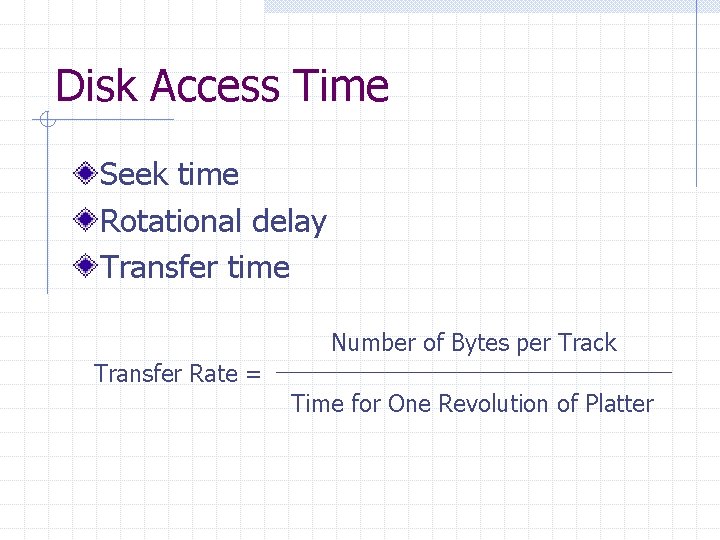
Disk Access Time Seek time Rotational delay Transfer time Number of Bytes per Track Transfer Rate = Time for One Revolution of Platter
Measures of Disk Drive Performance Capacity Average seek time Rotation speed Transfer rate
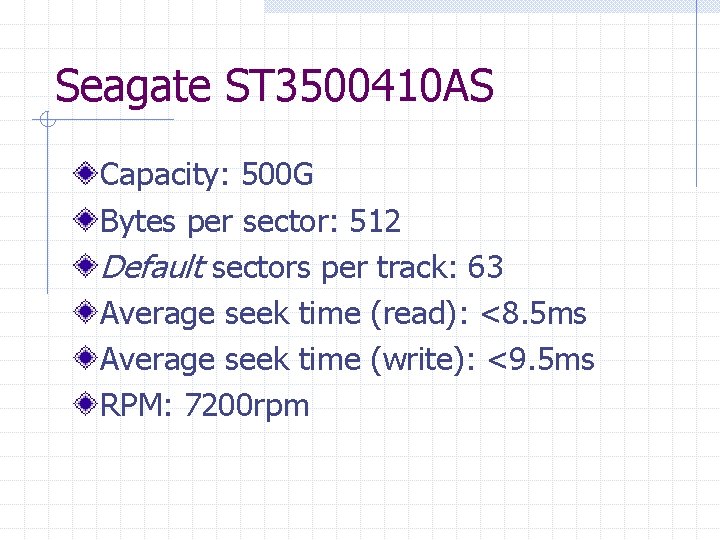
Seagate ST 3500410 AS Capacity: 500 G Bytes per sector: 512 Default sectors per track: 63 Average seek time (read): <8. 5 ms Average seek time (write): <9. 5 ms RPM: 7200 rpm
Examples: Disk Access Time Use the specs of ST 3500410 AS to calculate the time for the following disk accesses n n n Read 1 KB on one track Read 4 KB on four tracks
What We Learned from the Examples Reading more only costs little Sequential access is much more efficient than random access
Improve Disk Performance Caching Striping Mirroring Storing parity
Caching Read more data than requested n Read one sector vs. read one track Transfer data from cache n n n No seek time No rotational delay Transfer rate 3 Gb/s (SATA II)
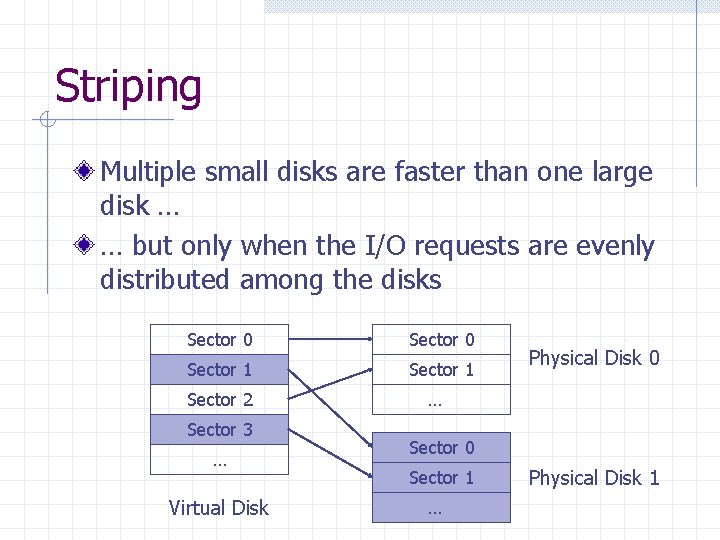
Striping Multiple small disks are faster than one large disk … … but only when the I/O requests are evenly distributed among the disks Sector 0 Sector 1 Sector 2 Sector 3 … Virtual Disk Physical Disk 0 … Sector 0 Sector 1 … Physical Disk 1
Example: Striping Suppose we using N disks for striping, and each disk has k sectors. An access to virtual sector x is mapped to an access to which sector on which disk? ?
Mirroring Store the same data on two or more disks Improve reliability Do not improve speed n n Same read speed Slower write (why? ? )
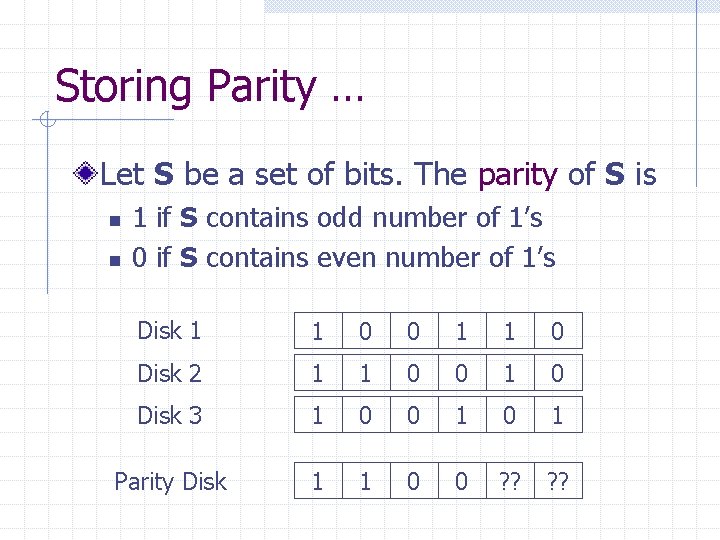
Storing Parity … Let S be a set of bits. The parity of S is n n 1 if S contains odd number of 1’s 0 if S contains even number of 1’s Disk 1 1 0 0 1 1 0 Disk 2 1 1 0 0 1 0 Disk 3 1 0 0 1 Parity Disk 1 1 0 0 ? ?
… Storing Parity Backup any number of disks with one disk Can only recovery from single disk failure
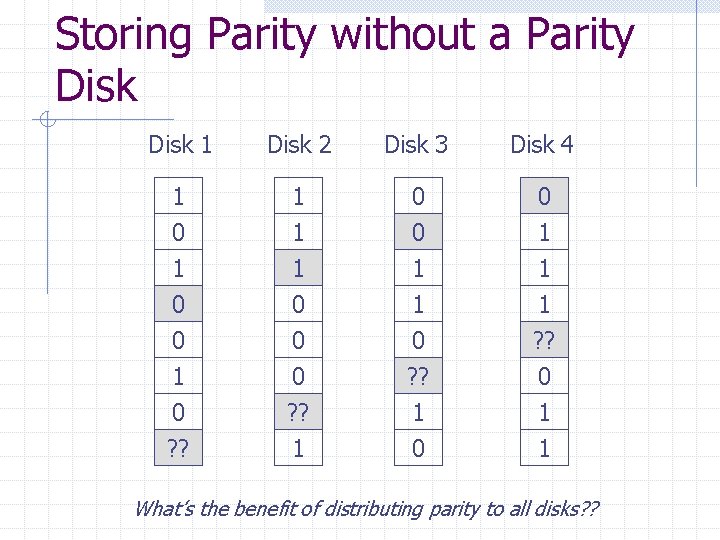
Storing Parity without a Parity Disk 1 Disk 2 Disk 3 Disk 4 1 0 0 1 0 ? ? 1 1 1 0 0 0 ? ? 1 0 0 1 1 1 ? ? 0 1 1 What’s the benefit of distributing parity to all disks? ?
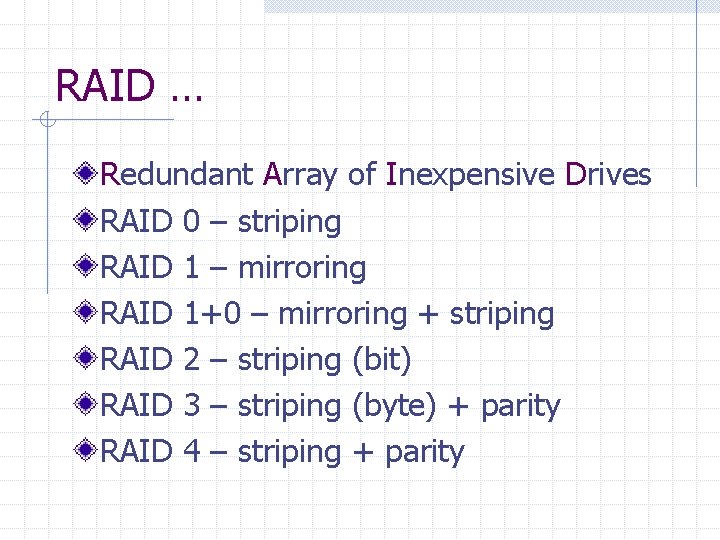
RAID … Redundant Array of Inexpensive Drives RAID 0 – striping RAID 1 – mirroring RAID 1+0 – mirroring + striping RAID 2 – striping (bit) RAID 3 – striping (byte) + parity RAID 4 – striping + parity
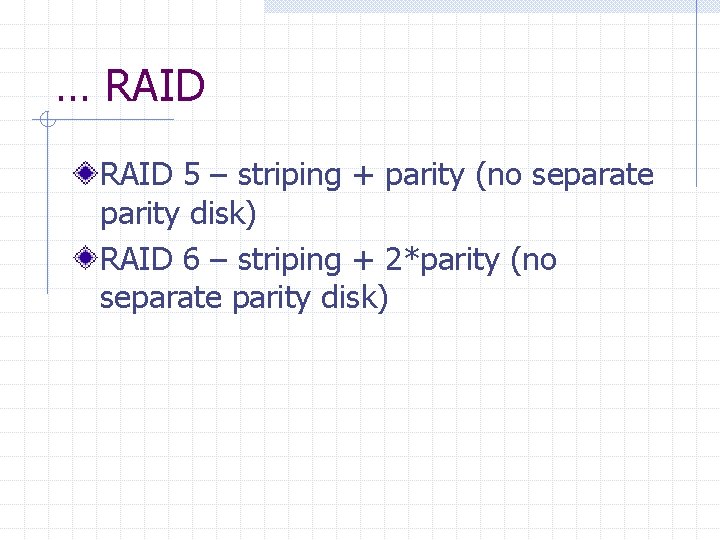
… RAID 5 – striping + parity (no separate parity disk) RAID 6 – striping + 2*parity (no separate parity disk)
OS Disk Access API Block-level API File-level API
Block and Page … A block is similar to a sector except that the size is determined by the OS n E. g. NTFS default block size on Vista is 4 KB A file always starts at the beginning of a block n Tradeoff between large and small block sizes? ?
… Block and Page A page is a block-sized area of main memory Each block/page is uniquely numbered by the OS
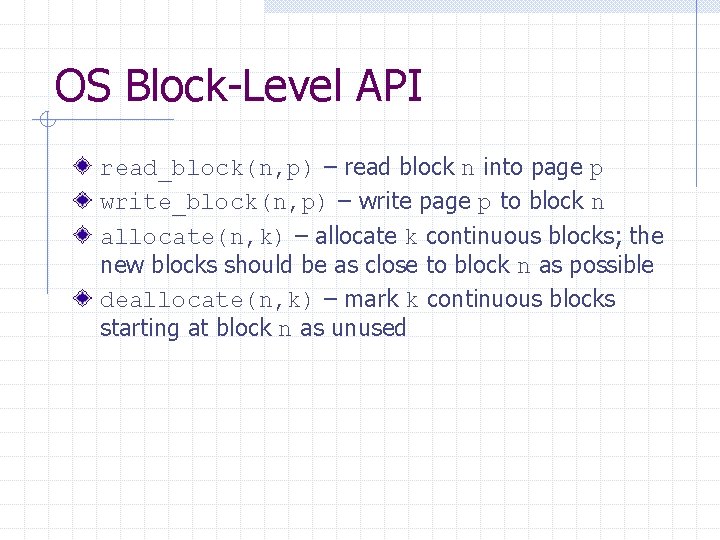
OS Block-Level API read_block(n, p) – read block n into page p write_block(n, p) – write page p to block n allocate(n, k) – allocate k continuous blocks; the new blocks should be as close to block n as possible deallocate(n, k) – mark k continuous blocks starting at block n as unused
OS File-Level API Similar to the API of Random. Access. File in Java n http: //java. sun. com/javase/6/docs/api/java /io/Random. Access. File. html Treat a file as a continuous sequence of bytes seek(long position) n Read and write various data types n n
DBMS Disk Access API … Approach 1: use OS block-level API n Full control of disk access w Most efficient w Not constrained by file system limitations (e. g. file size) n n n Complex to implement Disks must be mounted as raw disk Difficult to administrate
… DBMS Disk Access API … Approach 2: use OS file-level API n n n Easy to implement Easy to administrate No block I/O w Much less efficient w No paging, which is required by DBMS buffer management
… DBMS Disk Access API Approach 3: build a block I/O API on top of OS’s file I/O API n The approach taken by most DBMS
Readings Chapter 12 of the textbook Simple. DB disk access code in the package simpledb. file The SSD Anthology http: //www. anandtech. com/show/2738
- Slides: 29