
CS 412 Introduction to Computer Networking Telecommunication Data
- Slides: 42
CS 412 Introduction to Computer Networking & Telecommunication Data Link Layer Part II – Sliding Window Protocols Chi-Cheng Lin, Winona State University
Part 2 - Topics l Sliding Window Protocols l Go Back N Sliding Window Protocol l Selective Repeat Sliding Window Protocol 2
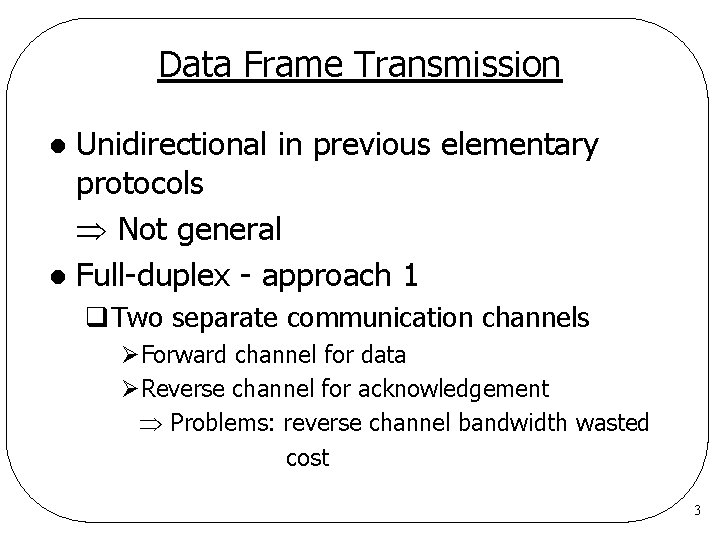
Data Frame Transmission Unidirectional in previous elementary protocols Not general l Full-duplex - approach 1 l q. Two separate communication channels ØForward channel for data ØReverse channel for acknowledgement Problems: reverse channel bandwidth wasted cost 3
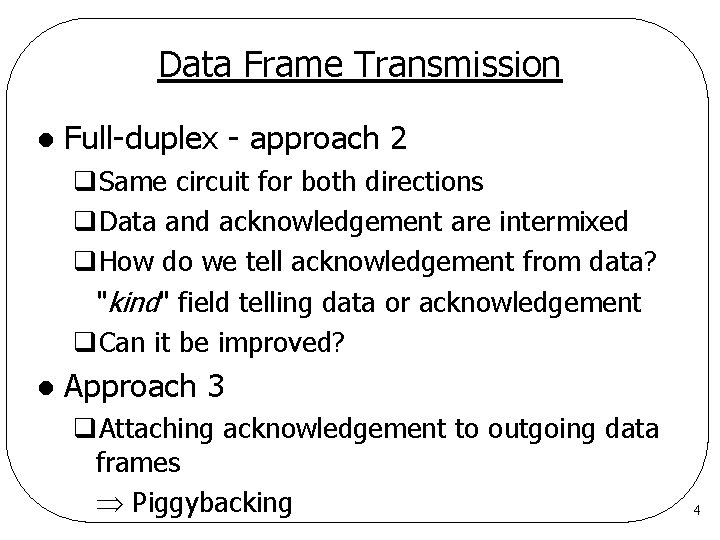
Data Frame Transmission l Full-duplex - approach 2 q. Same circuit for both directions q. Data and acknowledgement are intermixed q. How do we tell acknowledgement from data? "kind" field telling data or acknowledgement q. Can it be improved? l Approach 3 q. Attaching acknowledgement to outgoing data frames Piggybacking 4
Piggybacking Temporarily delaying outgoing acknowledgement so that they can be hooked onto the next outgoing data frame l Advantage: higher channel bandwidth utilization l Complication: l q. How long to wait for a packet to piggyback? q. If longer than sender timeout period then sender retransmit Purpose of acknowledgement is lost 5
Piggybacking l Solution for timing complexion q. If a new packet arrives quickly Piggybacking q. If no new packet arrives after a receiver timeout Sending a separate acknowledgement frame 6
Sliding Window Protocol l We are going to study three bidirectional sliding window protocols q. One-bit sliding window protocol q. Go back N q. Selective repeat l Differ in efficiency, complexity, and buffer requirements 7
Sliding Window Protocol l Each outbound frame contains an n-bit sequence number q. Range: 0 - MAX_SEQ (MAX_SEQ = 2 n - 1) q. For stop-and-wait, n = __. Why? l At any instance of time q. Sender maintains a set of sequence numbers of frames permitted to send ØThese frames fall within sending window q. Receiver maintains a set of sequence numbers of frames permitted to accept ØThese frames fall within receiving window 8
Sliding Window Protocol Lower limit, upper limit, and size of two windows need not be the same l Fixed or variable size l Requirements l q. Packets delivered to the receiver's network layer must be in the same order that they were passed to the data link layer on the sending machine q. Frames must be delivered by the physical communication channel in the order in which they were sent 9
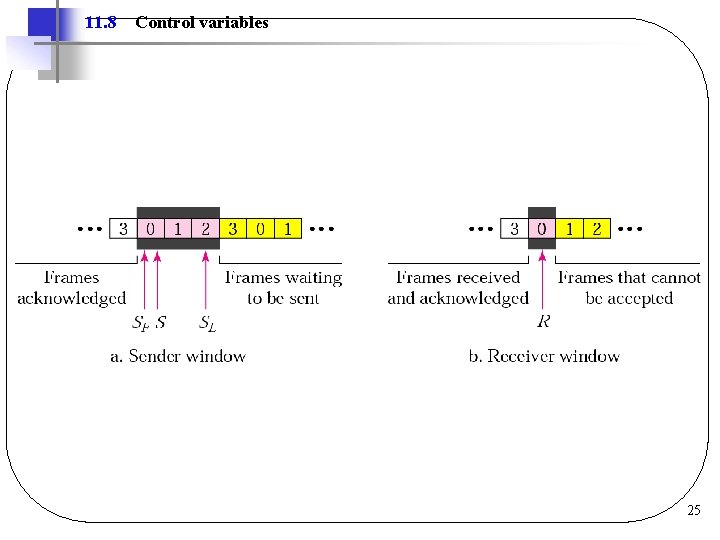
Sending Window Contains frames have been sent or can be sent but not yet acknowledged – outstanding frames l When a packet arrives from network layer l q. Next highest sequence number assigned q. Upper edge of window advanced by 1 l When an acknowledgement arrives q. Lower edge of window advanced by 1 10
Sending Window If the maximum window size is n, n buffers is needed to hold unacknowledged frames l Window full (maximum window size reached) shut off network layer l 11
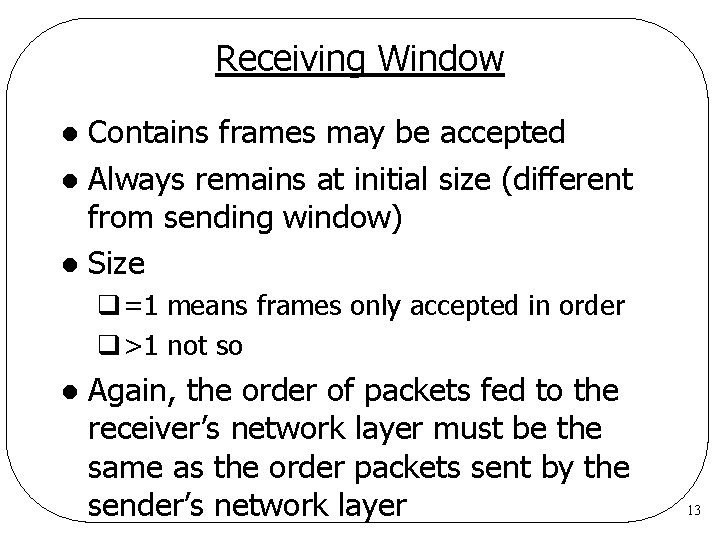
Receiving Window Contains frames may be accepted l Frame outside the window discarded l When a frame's sequence number equals to lower edge l q. Passed to the network layer q. Acknowledgement generated q. Window rotated by 1 12
Receiving Window Contains frames may be accepted l Always remains at initial size (different from sending window) l Size l q=1 means frames only accepted in order q>1 not so l Again, the order of packets fed to the receiver’s network layer must be the same as the order packets sent by the sender’s network layer 13
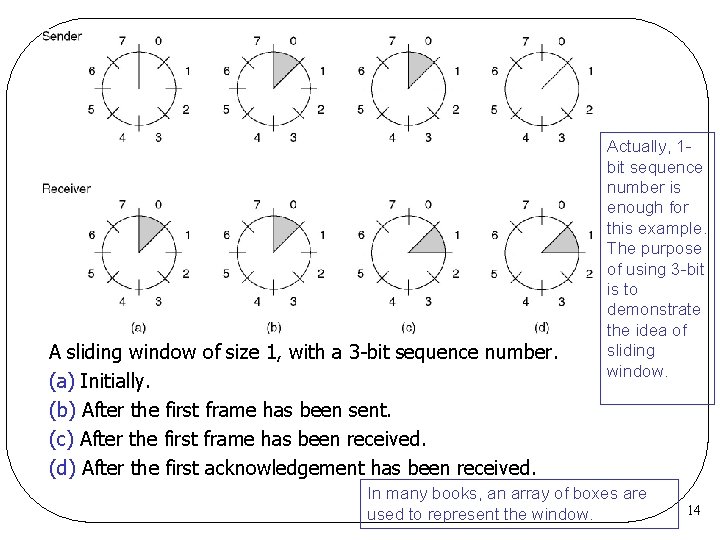
A sliding window of size 1, with a 3 -bit sequence number. (a) Initially. (b) After the first frame has been sent. (c) After the first frame has been received. (d) After the first acknowledgement has been received. Actually, 1 bit sequence number is enough for this example. The purpose of using 3 -bit is to demonstrate the idea of sliding window. In many books, an array of boxes are used to represent the window. 14
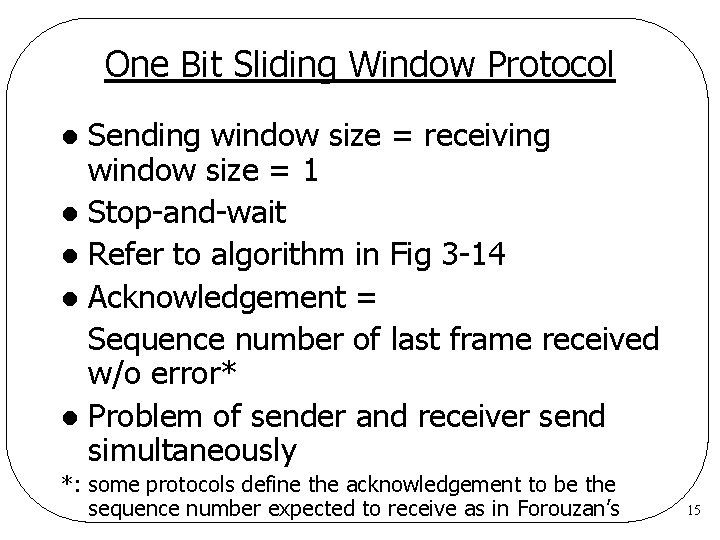
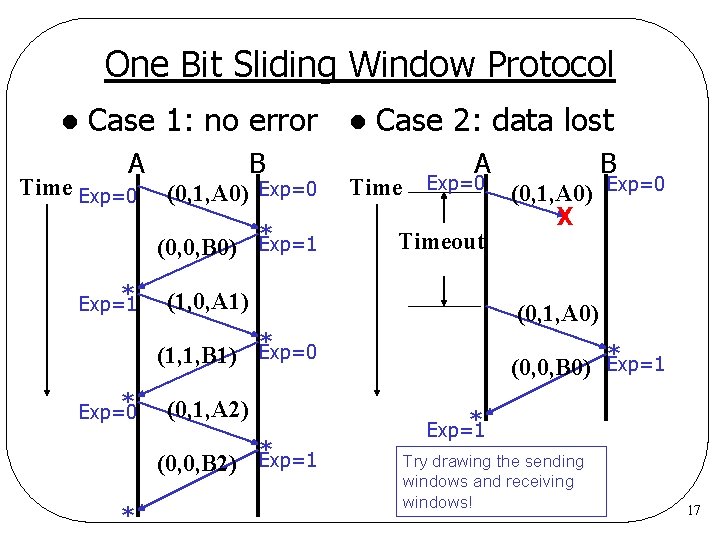
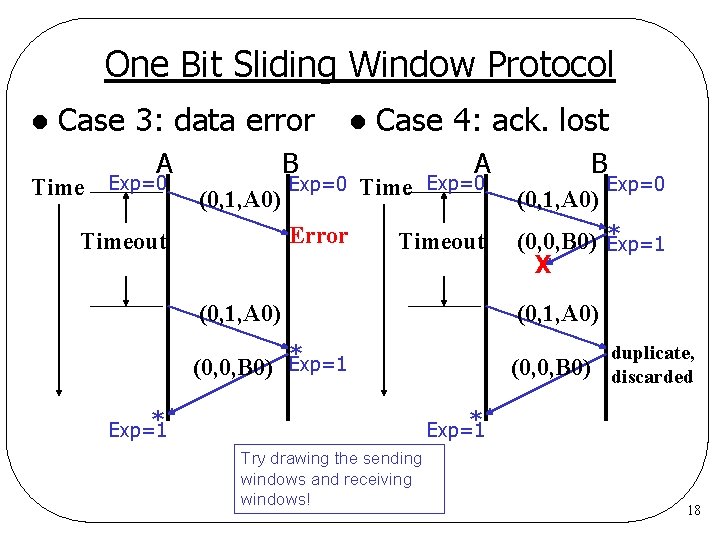
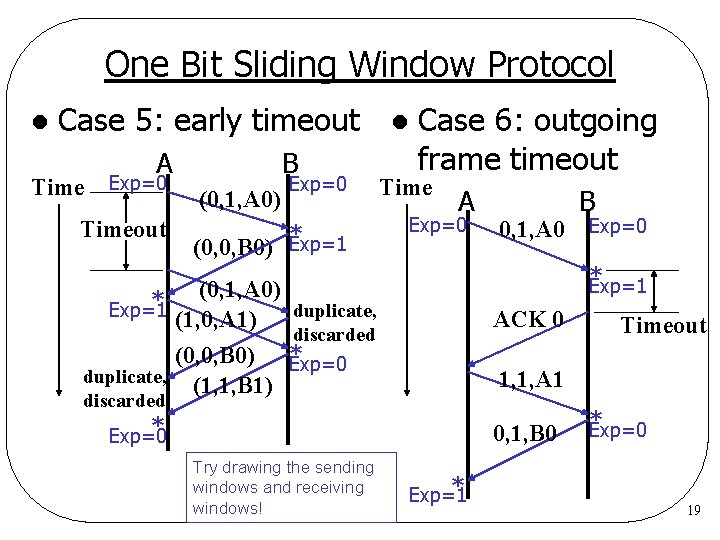
One Bit Sliding Window Protocol Sending window size = receiving window size = 1 l Stop-and-wait l Refer to algorithm in Fig 3 -14 l Acknowledgement = Sequence number of last frame received w/o error* l Problem of sender and receiver send simultaneously l *: some protocols define the acknowledgement to be the sequence number expected to receive as in Forouzan’s 15
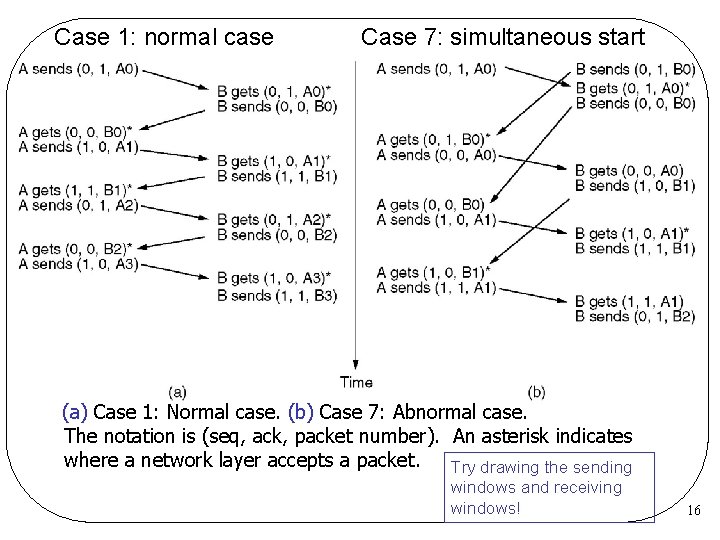
Case 1: normal case Case 7: simultaneous start (a) Case 1: Normal case. (b) Case 7: Abnormal case. The notation is (seq, ack, packet number). An asterisk indicates where a network layer accepts a packet. Try drawing the sending windows and receiving windows! 16
One Bit Sliding Window Protocol l Case 1: no error A Time Exp=0 B (0, 1, A 0) Exp=0 * (0, 0, B 0) Exp=1 * Exp=1 l Case 2: data lost Time A Exp=0 Timeout (1, 0, A 1) (0, 1, A 2) * (0, 0, B 2) Exp=1 * (0, 1, A 0) Exp=0 X (0, 1, A 0) * (1, 1, B 1) Exp=0 * Exp=0 B * (0, 0, B 0) Exp=1 * Exp=1 Try drawing the sending windows and receiving windows! 17
One Bit Sliding Window Protocol l Case 3: data error Time A Exp=0 B (0, 1, A 0) Timeout l Case 4: ack. lost A Exp=0 Time Exp=0 Error Timeout (0, 1, A 0) (0, 0, B 0) B (0, 1, A 0) Exp=0 * (0, 0, B 0) Exp=1 X (0, 1, A 0) * Exp=1 (0, 0, B 0) duplicate, discarded * Exp=1 Try drawing the sending windows and receiving windows! 18
One Bit Sliding Window Protocol l Case 5: early timeout Time A Exp=0 Timeout B (0, 1, A 0) Exp=0 * (0, 0, B 0) Exp=1 (0, 1, A 0) * Exp=1 (1, 0, A 1) (0, 0, B 0) duplicate, (1, 1, B 1) l Case 6: outgoing frame timeout Time A Exp=0 0, 1, A 0 B Exp=0 * Exp=1 duplicate, discarded ACK 0 * Exp=0 1, 1, A 1 discarded * Exp=0 0, 1, B 0 Try drawing the sending windows and receiving windows! Timeout * Exp=1 * Exp=0 19
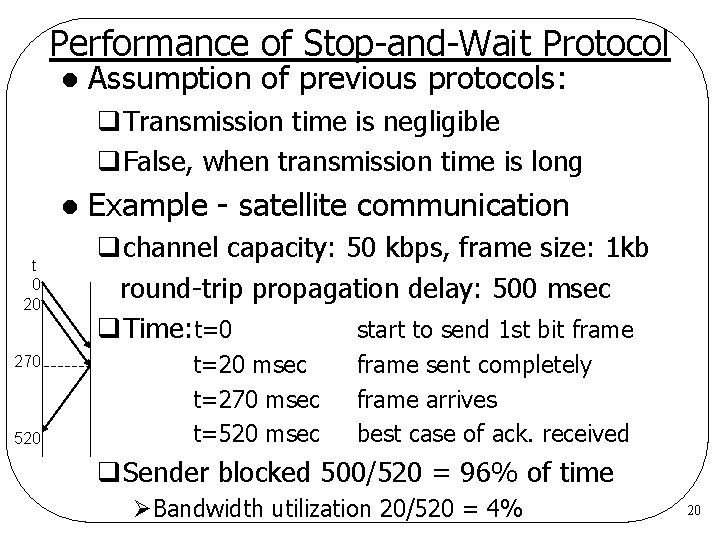
Performance of Stop-and-Wait Protocol l Assumption of previous protocols: q. Transmission time is negligible q. False, when transmission time is long l t 0 20 270 520 Example - satellite communication qchannel capacity: 50 kbps, frame size: 1 kb round-trip propagation delay: 500 msec q. Time: t=0 start to send 1 st bit frame t=20 msec t=270 msec t=520 msec frame sent completely frame arrives best case of ack. received q. Sender blocked 500/520 = 96% of time ØBandwidth utilization 20/520 = 4% 20
Performance of Stop-and-Wait Protocol If channel capacity = b, frame size = L, and round-trip propagation delay = R, then bandwidth utilization = _____ l Conclusion: l q. Long transit time + high bandwidth + short frame length disaster 21
Performance of Stop-and-Wait Protocol l Solution: Pipelining q. Allowing w frames sent before blocking l In our example, for 100% utilization qw = __, max window size = __ qsequence number = __ bits Problem: errors l Solutions l q. Go back n protocol (GNP) q. Selective repeat protocol (SRP) Acknowledge n means frames n, n-1, n-2, … are acknowledged (i. e. , received correctly) 22
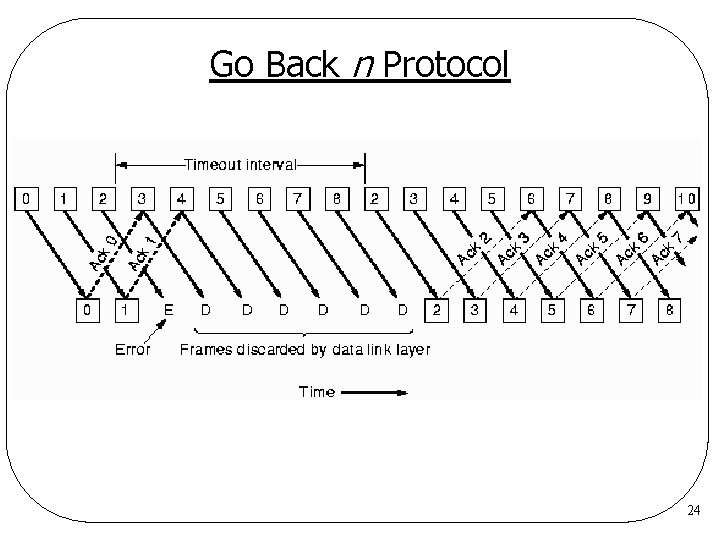
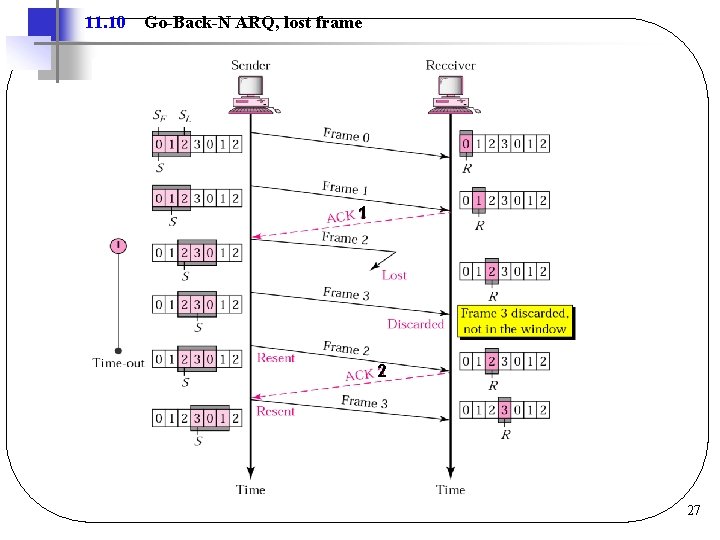
Go Back n Protocol Receiver discards all subsequent frames following an error one, and send no acknowledgement for those discarded l Receiving window size = 1 (i. e. , frames must be accepted in the order they were sent) l Sending window might get full l q. If so, re-transmitting unacknowledged frames l Wasting a lot of bandwidth if error rate is high 23
Go Back n Protocol 24
11. 8 Control variables 25
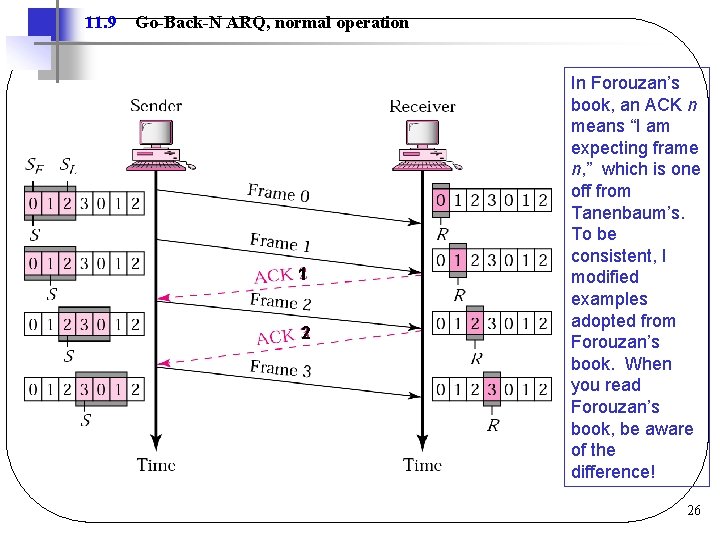
11. 9 Go-Back-N ARQ, normal operation 1 2 In Forouzan’s book, an ACK n means “I am expecting frame n, ” which is one off from Tanenbaum’s. To be consistent, I modified examples adopted from Forouzan’s book. When you read Forouzan’s book, be aware of the difference! 26
11. 10 Go-Back-N ARQ, lost frame 1 2 27
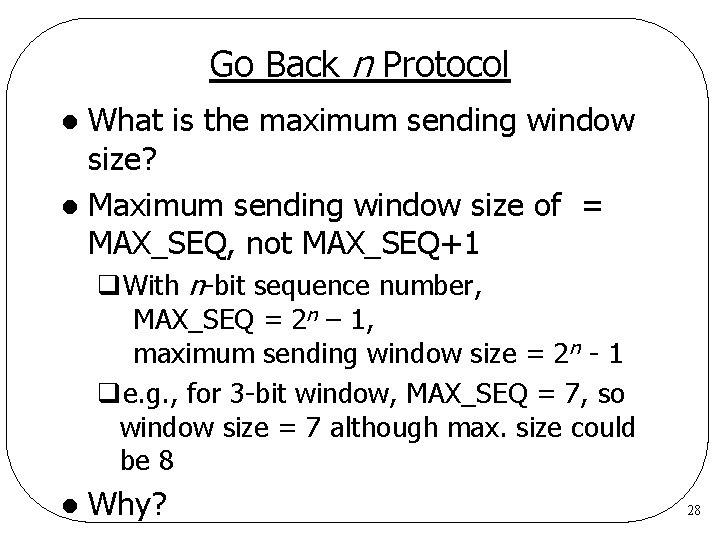
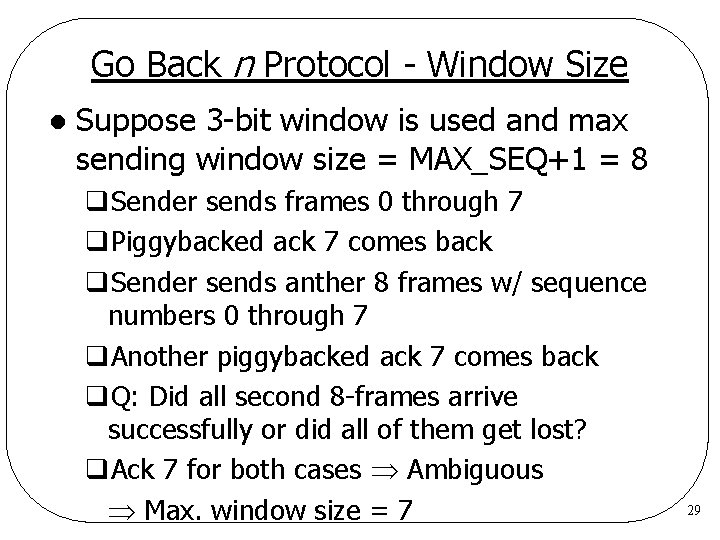
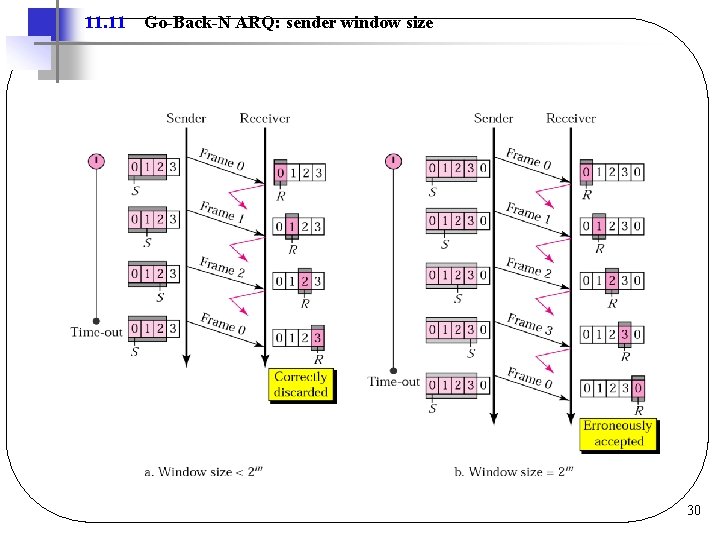
Go Back n Protocol What is the maximum sending window size? l Maximum sending window size of = MAX_SEQ, not MAX_SEQ+1 l q. With n-bit sequence number, MAX_SEQ = 2 n – 1, maximum sending window size = 2 n - 1 qe. g. , for 3 -bit window, MAX_SEQ = 7, so window size = 7 although max. size could be 8 l Why? 28
Go Back n Protocol - Window Size l Suppose 3 -bit window is used and max sending window size = MAX_SEQ+1 = 8 q. Sender sends frames 0 through 7 q. Piggybacked ack 7 comes back q. Sender sends anther 8 frames w/ sequence numbers 0 through 7 q. Another piggybacked ack 7 comes back q. Q: Did all second 8 -frames arrive successfully or did all of them get lost? q. Ack 7 for both cases Ambiguous Max. window size = 7 29
11. 11 Go-Back-N ARQ: sender window size 30
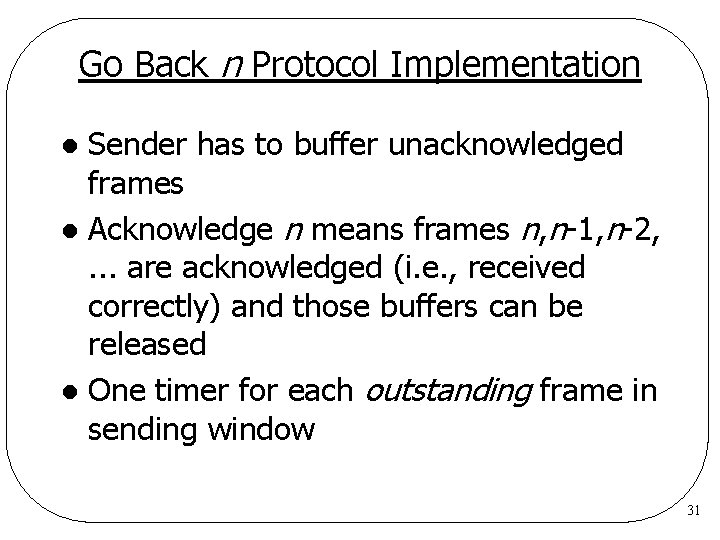
Go Back n Protocol Implementation Sender has to buffer unacknowledged frames l Acknowledge n means frames n, n-1, n-2, . . . are acknowledged (i. e. , received correctly) and those buffers can be released l One timer for each outstanding frame in sending window l 31
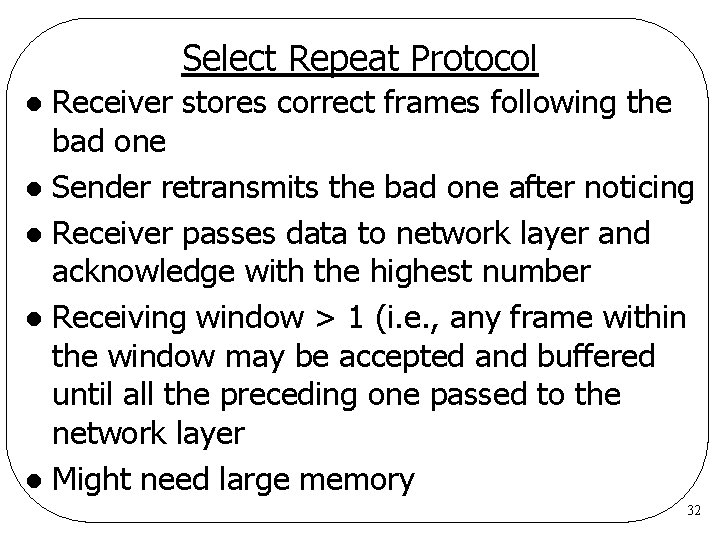
Select Repeat Protocol Receiver stores correct frames following the bad one l Sender retransmits the bad one after noticing l Receiver passes data to network layer and acknowledge with the highest number l Receiving window > 1 (i. e. , any frame within the window may be accepted and buffered until all the preceding one passed to the network layer l Might need large memory l 32
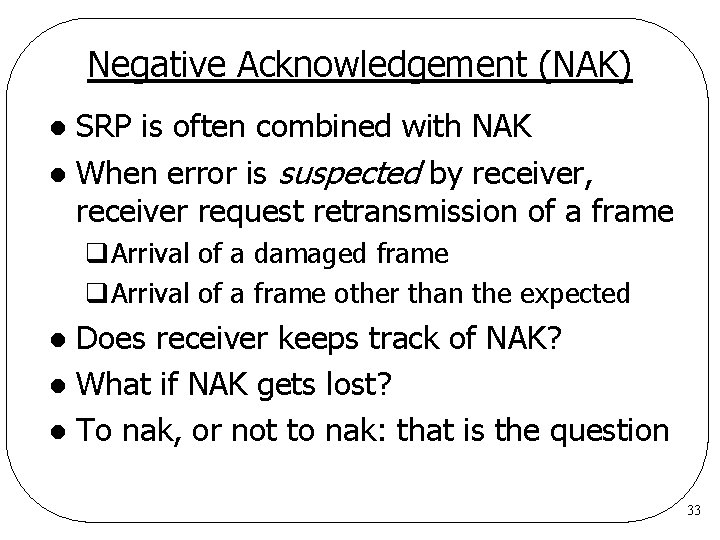
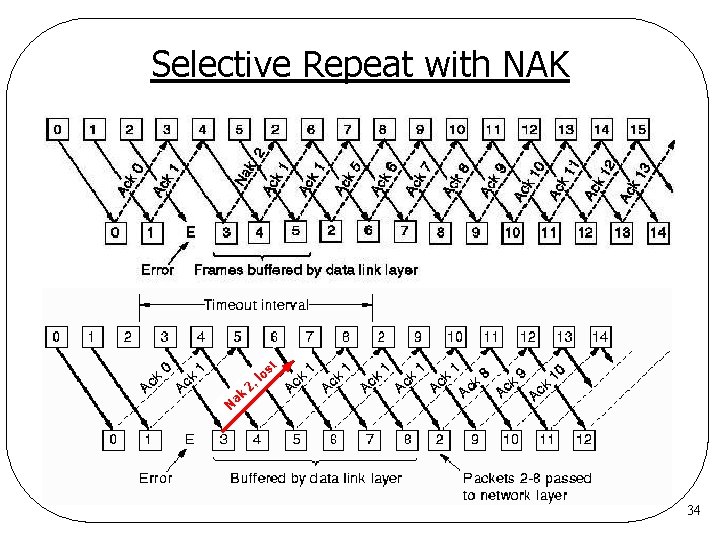
Negative Acknowledgement (NAK) SRP is often combined with NAK l When error is suspected by receiver, receiver request retransmission of a frame l q. Arrival of a damaged frame q. Arrival of a frame other than the expected Does receiver keeps track of NAK? l What if NAK gets lost? l To nak, or not to nak: that is the question l 33
Selective Repeat with NAK st k Na lo , 2 34
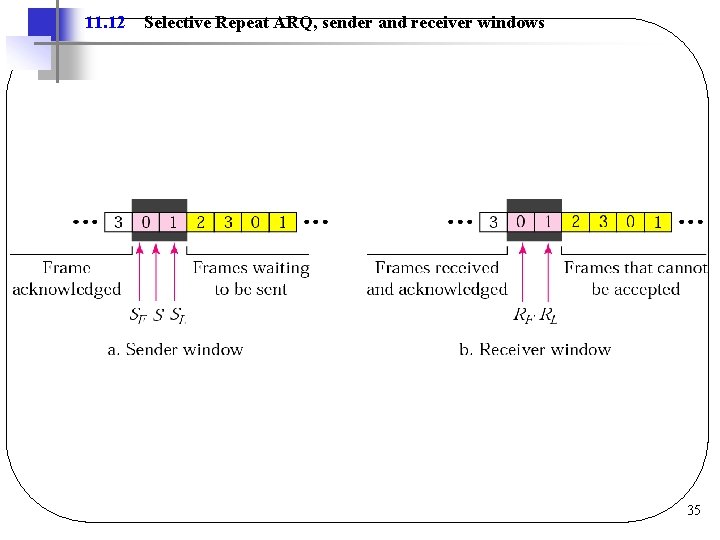
11. 12 Selective Repeat ARQ, sender and receiver windows 35
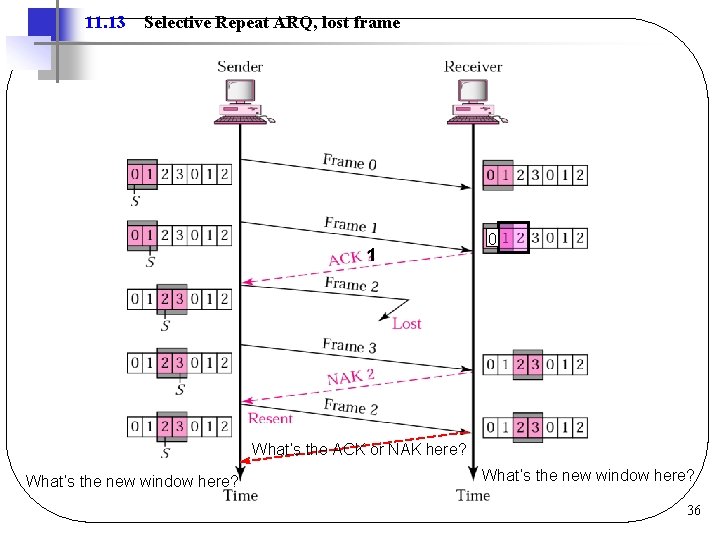
11. 13 Selective Repeat ARQ, lost frame 1 0 What’s the ACK or NAK here? What’s the new window here? 36
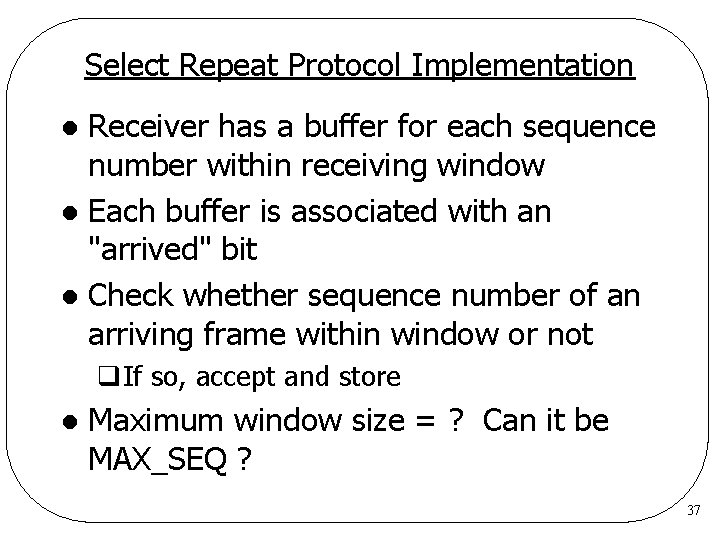
Select Repeat Protocol Implementation Receiver has a buffer for each sequence number within receiving window l Each buffer is associated with an "arrived" bit l Check whether sequence number of an arriving frame within window or not l q. If so, accept and store l Maximum window size = ? Can it be MAX_SEQ ? 37
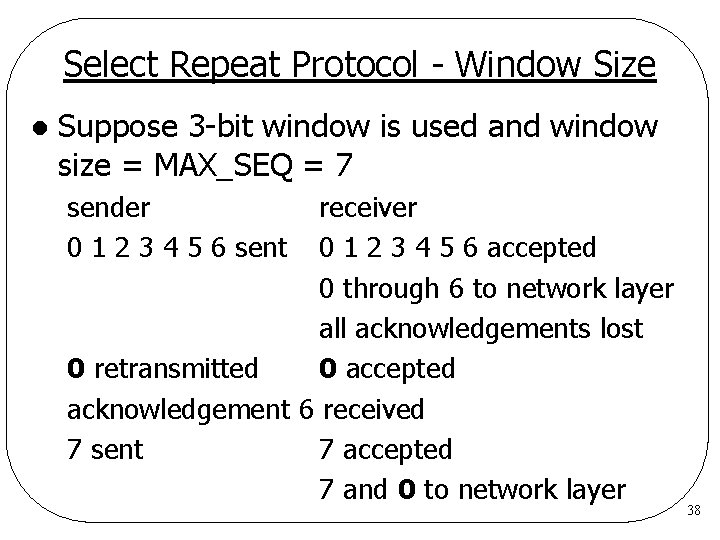
Select Repeat Protocol - Window Size l Suppose 3 -bit window is used and window size = MAX_SEQ = 7 sender 0 1 2 3 4 5 6 sent receiver 0 1 2 3 4 5 6 accepted 0 through 6 to network layer all acknowledgements lost 0 retransmitted 0 accepted acknowledgement 6 received 7 sent 7 accepted 7 and 0 to network layer 38
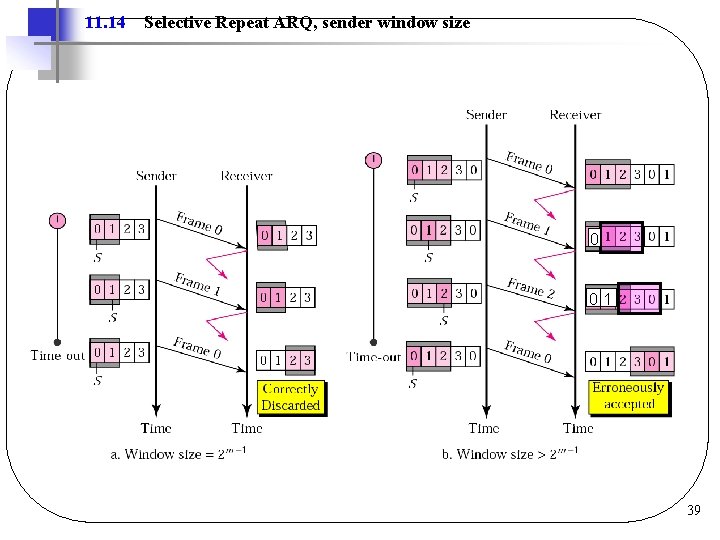
11. 14 Selective Repeat ARQ, sender window size 0 01 39
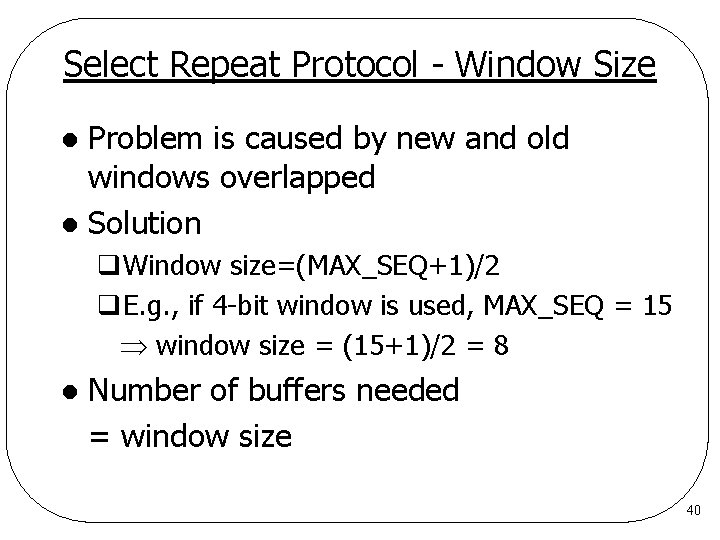
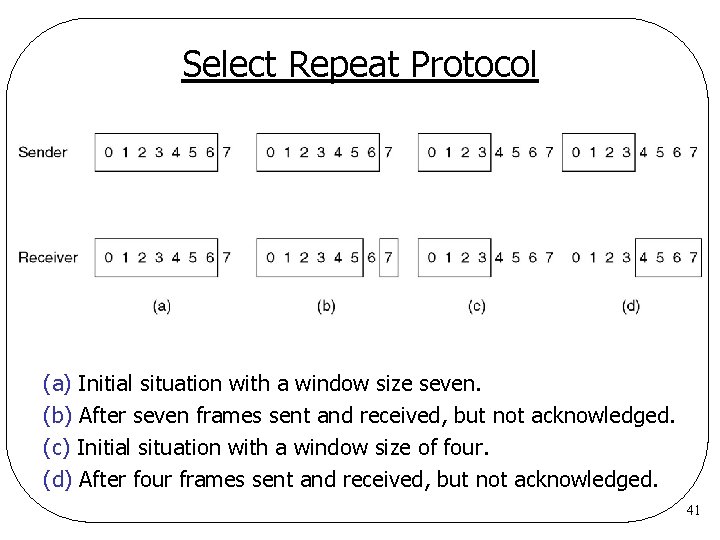
Select Repeat Protocol - Window Size Problem is caused by new and old windows overlapped l Solution l q. Window size=(MAX_SEQ+1)/2 q. E. g. , if 4 -bit window is used, MAX_SEQ = 15 window size = (15+1)/2 = 8 l Number of buffers needed = window size 40
Select Repeat Protocol (a) Initial situation with a window size seven. (b) After seven frames sent and received, but not acknowledged. (c) Initial situation with a window size of four. (d) After four frames sent and received, but not acknowledged. 41
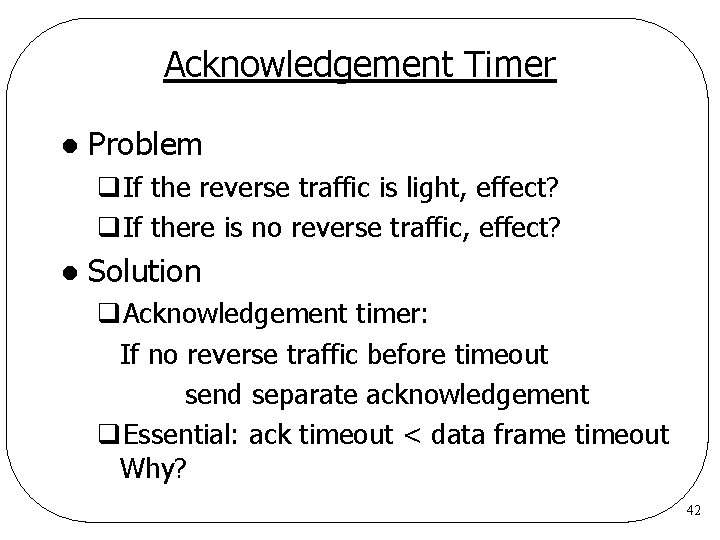
Acknowledgement Timer l Problem q. If the reverse traffic is light, effect? q. If there is no reverse traffic, effect? l Solution q. Acknowledgement timer: If no reverse traffic before timeout send separate acknowledgement q. Essential: ack timeout < data frame timeout Why? 42