
CS 411 Database Systems 04 Relational Schema Design
CS 411 Database Systems 04: Relational Schema Design Kazuhiro Minami
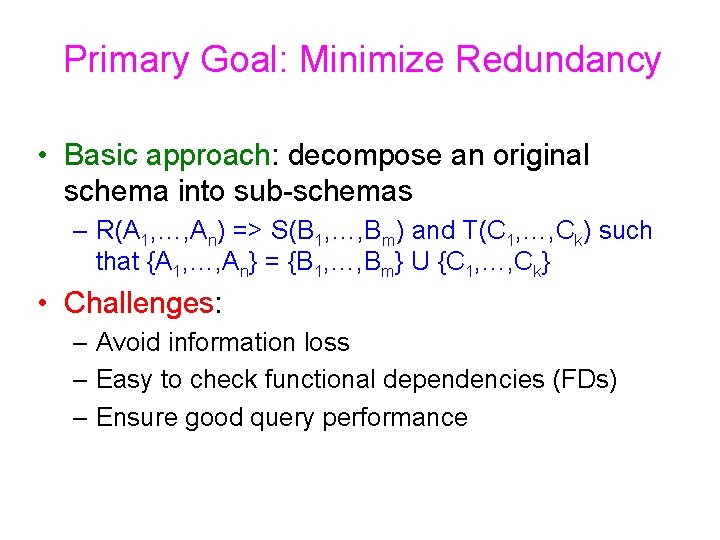
Primary Goal: Minimize Redundancy • Basic approach: decompose an original schema into sub-schemas – R(A 1, …, An) => S(B 1, …, Bm) and T(C 1, …, Ck) such that {A 1, …, An} = {B 1, …, Bm} U {C 1, …, Ck} • Challenges: – Avoid information loss – Easy to check functional dependencies (FDs) – Ensure good query performance

Normal Forms Define the condition that guarantees the desired properties of a relation schema • Boyce Codd Normal Form (BCNF) • Third Normal Form (3 NF) • Fourth Normal Form (4 NF) Others. . .
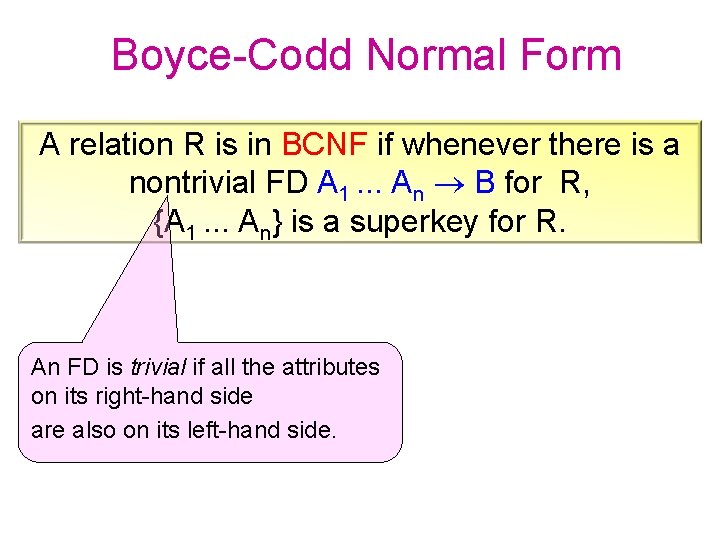
Boyce-Codd Normal Form A relation R is in BCNF if whenever there is a nontrivial FD A 1. . . An B for R, {A 1. . . An} is a superkey for R. An FD is trivial if all the attributes on its right-hand side are also on its left-hand side.
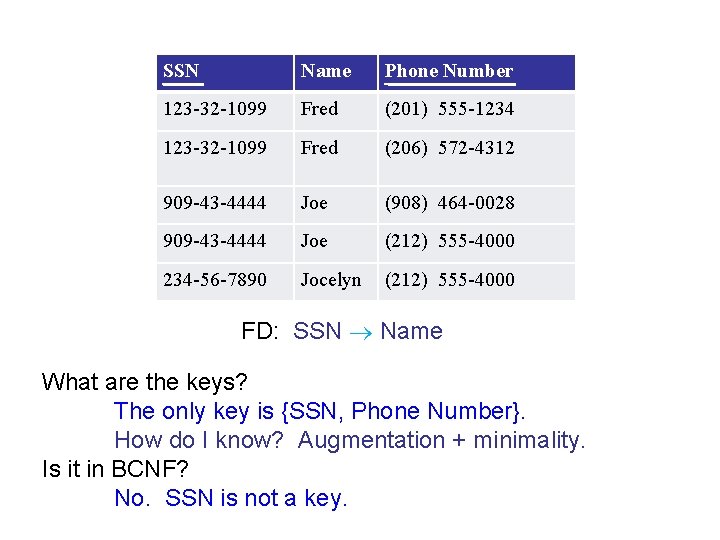
SSN Name Phone Number 123 -32 -1099 Fred (201) 555 -1234 123 -32 -1099 Fred (206) 572 -4312 909 -43 -4444 Joe (908) 464 -0028 909 -43 -4444 Joe (212) 555 -4000 234 -56 -7890 Jocelyn (212) 555 -4000 FD: SSN Name What are the keys? The only key is {SSN, Phone Number}. How do I know? Augmentation + minimality. Is it in BCNF? No. SSN is not a key.
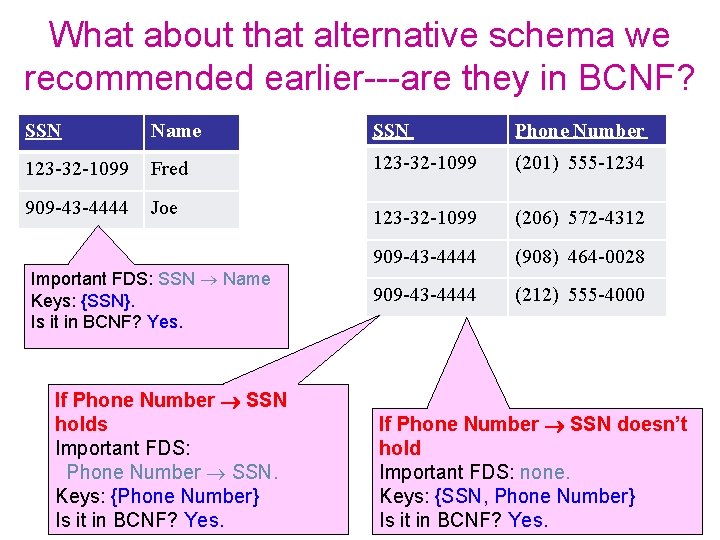
What about that alternative schema we recommended earlier---are they in BCNF? SSN Name SSN Phone Number 123 -32 -1099 Fred 123 -32 -1099 (201) 555 -1234 909 -43 -4444 Joe 123 -32 -1099 (206) 572 -4312 909 -43 -4444 (908) 464 -0028 909 -43 -4444 (212) 555 -4000 Important FDS: SSN Name Keys: {SSN}. Is it in BCNF? Yes. If Phone Number SSN holds Important FDS: Phone Number SSN. Keys: {Phone Number} Is it in BCNF? Yes. If Phone Number SSN doesn’t hold Important FDS: none. Keys: {SSN, Phone Number} Is it in BCNF? Yes.
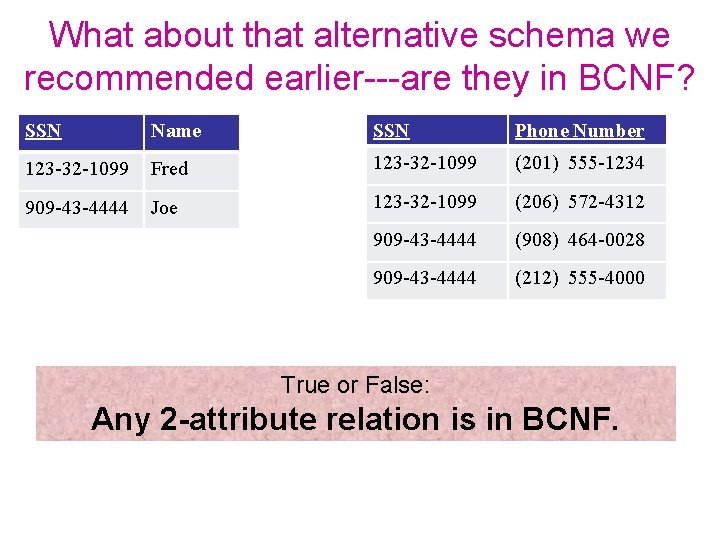
What about that alternative schema we recommended earlier---are they in BCNF? SSN Name SSN Phone Number 123 -32 -1099 Fred 123 -32 -1099 (201) 555 -1234 909 -43 -4444 Joe 123 -32 -1099 (206) 572 -4312 909 -43 -4444 (908) 464 -0028 909 -43 -4444 (212) 555 -4000 True or False: Any 2 -attribute relation is in BCNF.
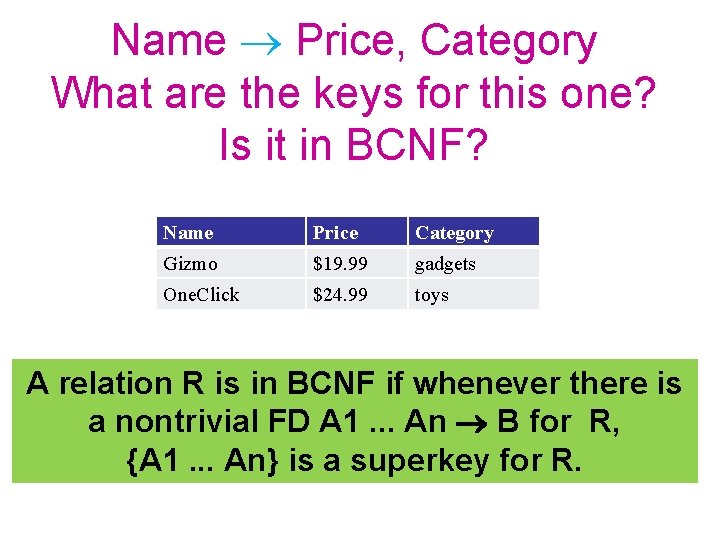
Name Price, Category What are the keys for this one? Is it in BCNF? Name Price Category Gizmo $19. 99 gadgets One. Click $24. 99 toys A relation R is in BCNF if whenever there is a nontrivial FD A 1. . . An B for R, {A 1. . . An} is a superkey for R.
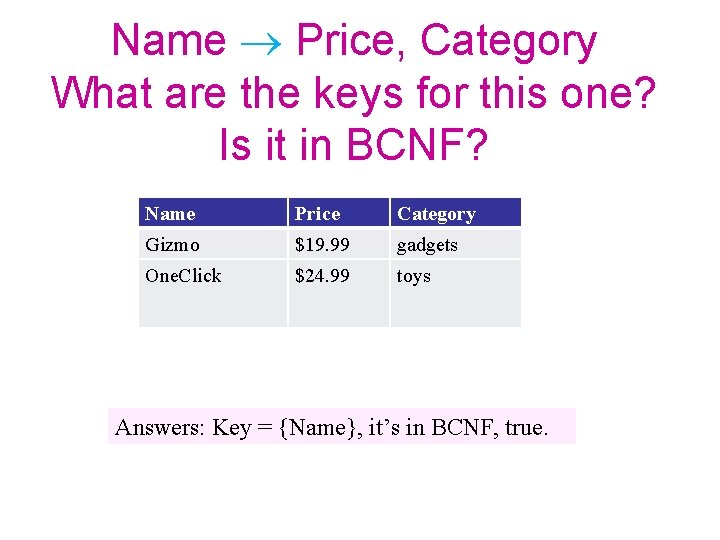
Name Price, Category What are the keys for this one? Is it in BCNF? Name Price Category Gizmo $19. 99 gadgets One. Click $24. 99 toys Answers: Key = {Name}, it’s in BCNF, true.
Just breaking a relation schema into two-attribute subsets could cause information loss Q: Is this a good idea? R(A 1, …, An) => R 1(A 1, A 2), …, Rn/2(An-1, An)
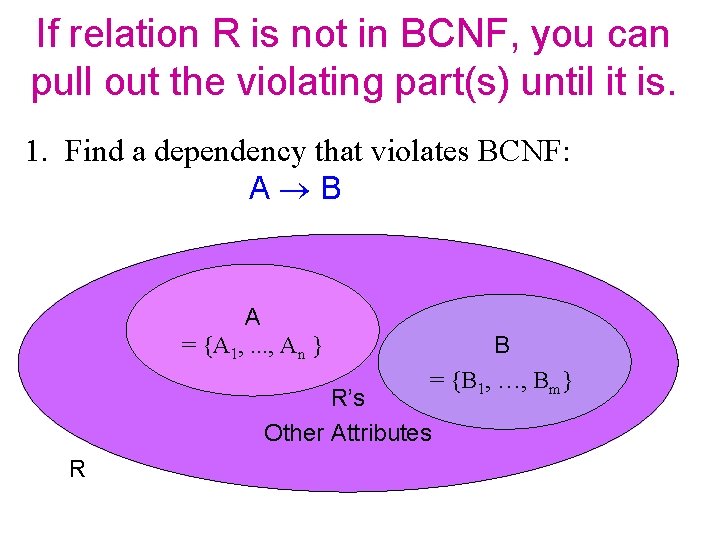
If relation R is not in BCNF, you can pull out the violating part(s) until it is. 1. Find a dependency that violates BCNF: A B A = {A 1, . . . , An } B = {B 1, …, Bm} R’s Other Attributes R
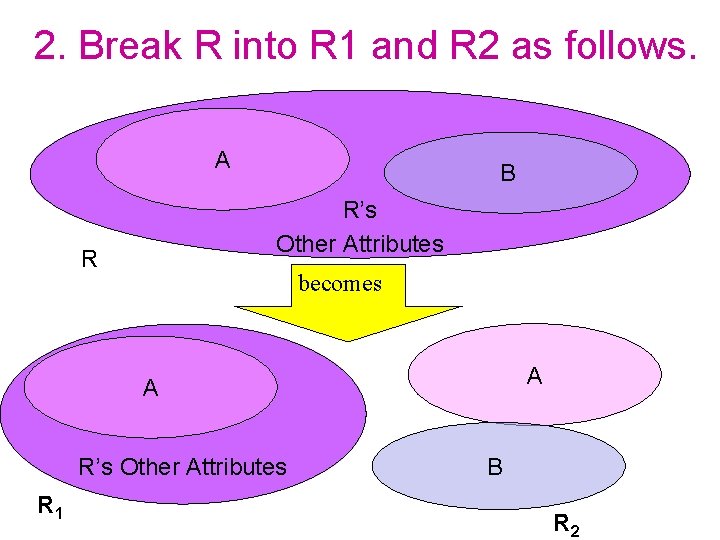
2. Break R into R 1 and R 2 as follows. A B R’s Other Attributes R becomes A A R’s Other Attributes R 1 B R 2
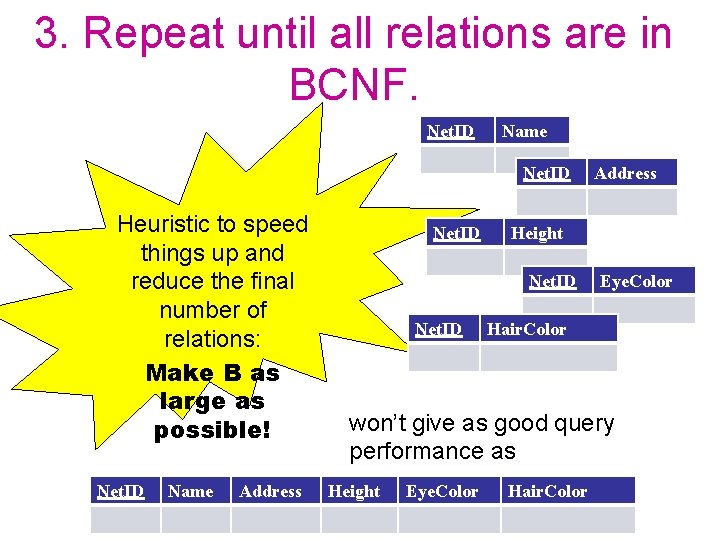
3. Repeat until all relations are in BCNF. Net. ID Name Net. ID Heuristic to speed things up and reduce the final number of relations: Make B as large as possible! Net. ID Name Address Net. ID Height Net. ID Address Eye. Color Hair. Color won’t give as good query performance as Height Eye. Color Hair. Color
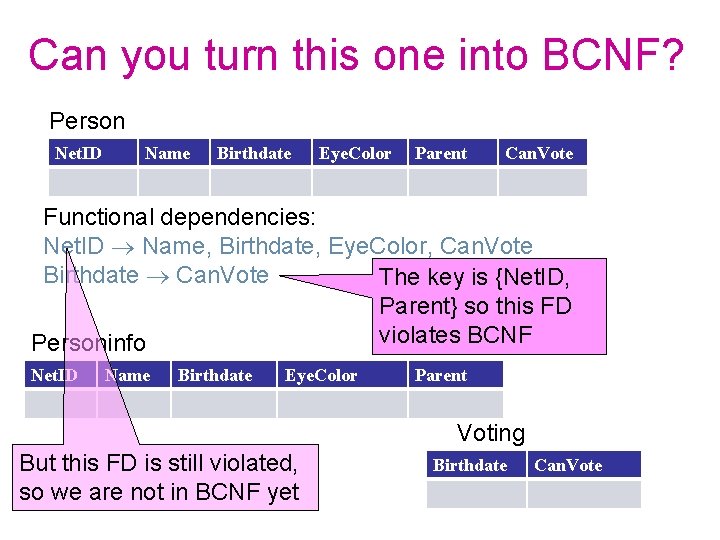
Can you turn this one into BCNF? Person Net. ID Name Birthdate Eye. Color Parent Can. Vote Functional dependencies: Net. ID Name, Birthdate, Eye. Color, Can. Vote Birthdate Can. Vote The key is {Net. ID, Parent} so this FD violates BCNF Personinfo Net. ID Name Birthdate Eye. Color Parent Voting But this FD is still violated, so we are not in BCNF yet Birthdate Can. Vote
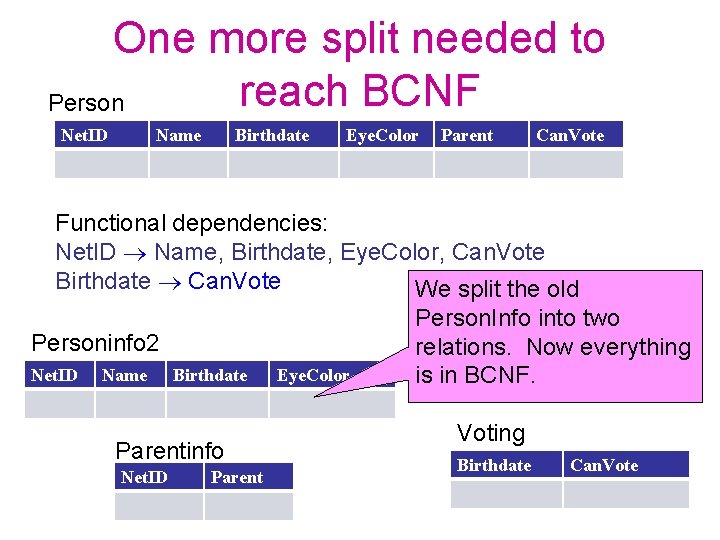
One more split needed to reach BCNF Person Net. ID Name Birthdate Eye. Color Parent Can. Vote Functional dependencies: Net. ID Name, Birthdate, Eye. Color, Can. Vote Birthdate Can. Vote We split the old Personinfo 2 Net. ID Name Birthdate Parentinfo Net. ID Parent Eye. Color Person. Info into two relations. Now everything is in BCNF. Voting Birthdate Can. Vote
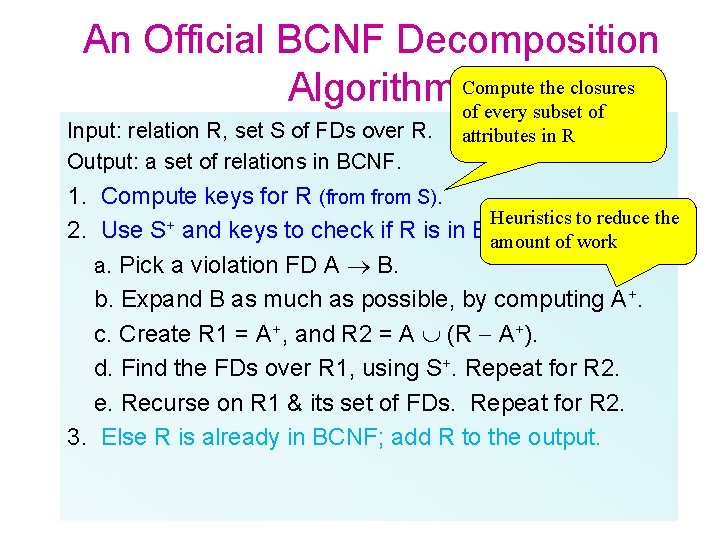
An Official BCNF Decomposition the closures Algorithm Compute of every subset of Input: relation R, set S of FDs over R. Output: a set of relations in BCNF. attributes in R 1. Compute keys for R (from S). Heuristics to reduce the 2. Use S+ and keys to check if R is in BCNF. If not: amount of work a. Pick a violation FD A B. b. Expand B as much as possible, by computing A+. c. Create R 1 = A+, and R 2 = A (R A+). d. Find the FDs over R 1, using S+. Repeat for R 2. e. Recurse on R 1 & its set of FDs. Repeat for R 2. 3. Else R is already in BCNF; add R to the output.
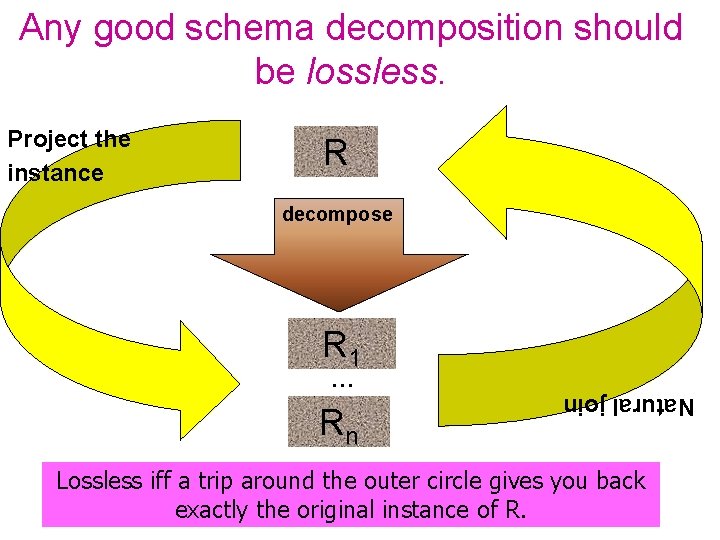
Any good schema decomposition should be lossless. Project the instance R decompose R 1 … Natural join Rn Lossless iff a trip around the outer circle gives you back 17 exactly the original instance of R.
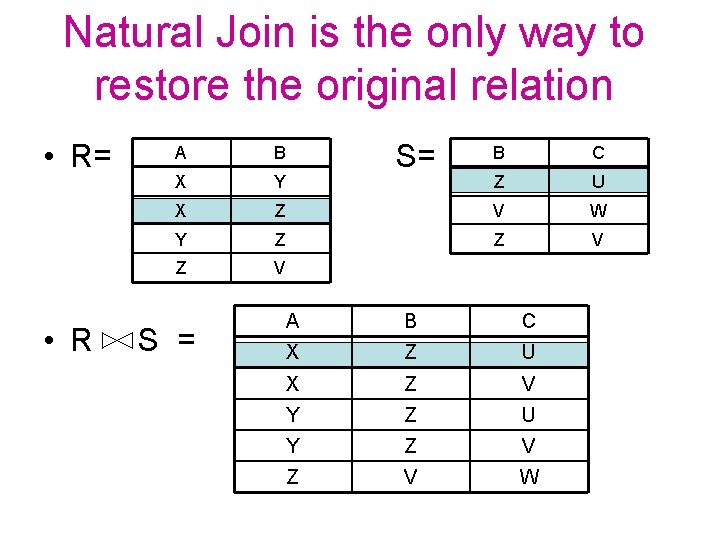
Natural Join is the only way to restore the original relation • R= • R A B X Y X S= B C Z U Z V W Y Z Z V S = A B C X Z U X Z V Y Z U Y Z V W
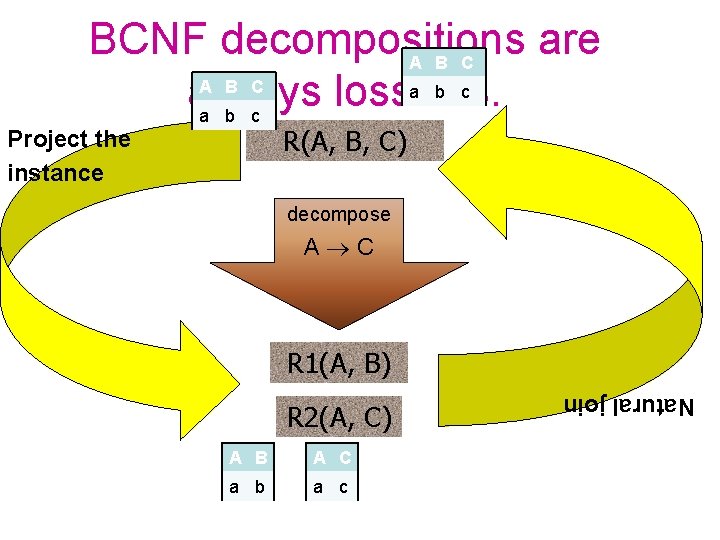
BCNF decompositions are A B C a b c always lossless. a b c R(A, B, C) Project the instance decompose A C R 1(A, B) A B A C a b a c Natural join R 2(A, C)
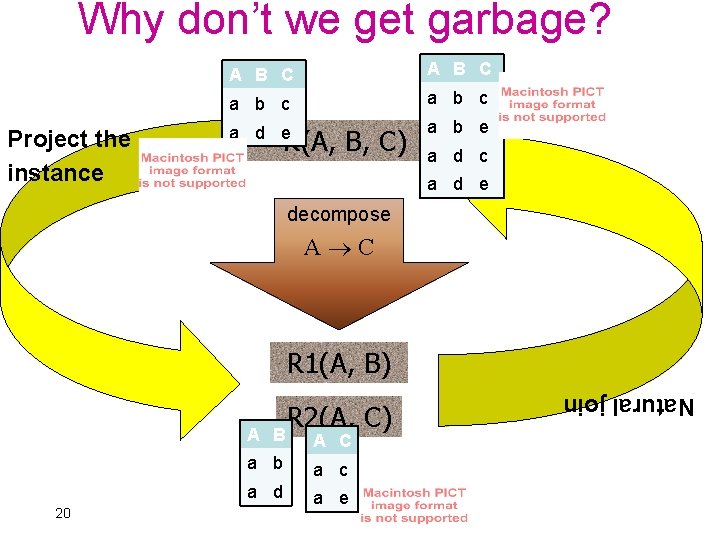
Why don’t we get garbage? Project the instance A B C a b c a d e a b e R(A, B, C) a d c a d e decompose A C R 1(A, B) 20 A C a b a c a d a e Natural join A R 2(A, C) B
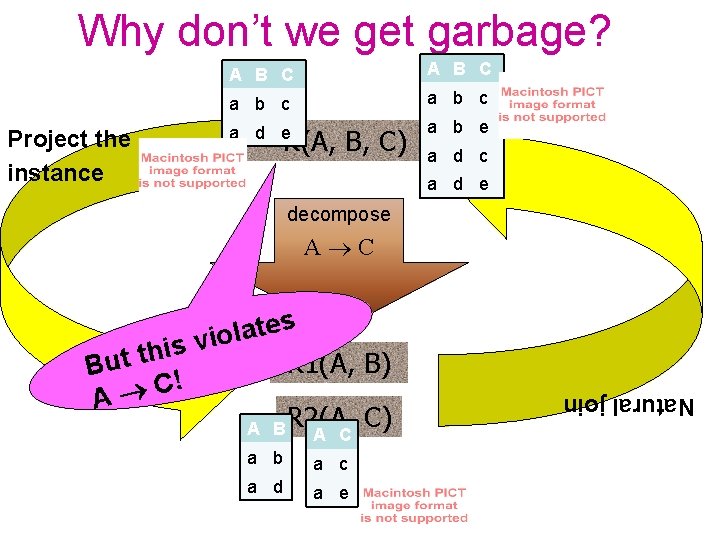
Why don’t we get garbage? Project the instance A B C a b c a d e a b e R(A, B, C) a d c a d e decompose A C a b a c a d a e Natural join s e t a l io v s i h t t u R 1(A, B) B C! A C) A BR 2(A, A C
BCNF doesn’t always have a dependency-preserving decomposition.
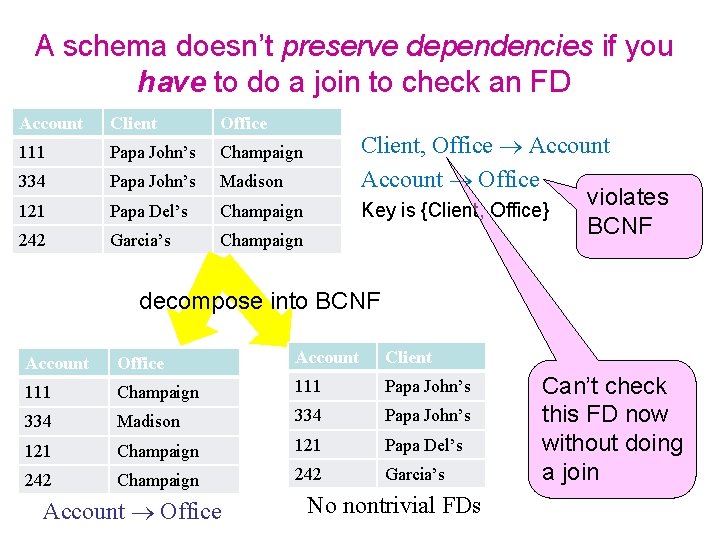
A schema doesn’t preserve dependencies if you have to do a join to check an FD Account Client Office 111 Papa John’s Champaign 334 Papa John’s Madison 121 Papa Del’s Champaign 242 Garcia’s Champaign Client, Office Account Office violates Key is {Client, Office} BCNF decompose into BCNF Account Office Account Client 111 Champaign 111 Papa John’s 334 Madison 334 Papa John’s 121 Champaign 121 Papa Del’s 242 Champaign 242 Garcia’s Account Office No nontrivial FDs Can’t check this FD now without doing a join
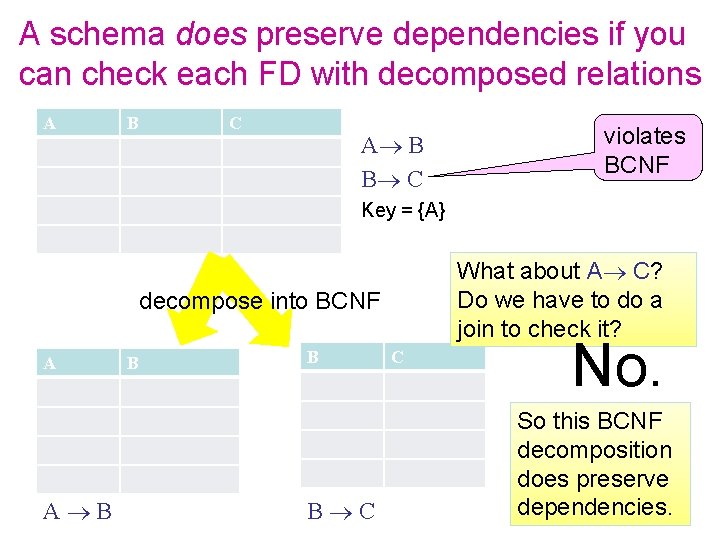
A schema does preserve dependencies if you can check each FD with decomposed relations A B C A B B C violates BCNF Key = {A} What about A C? Do we have to do a join to check it? decompose into BCNF A A B B C C No. So this BCNF decomposition does preserve dependencies.
Normal Forms First Normal Form = all attributes are atomic Second Normal Form (2 NF) = old and obsolete Boyce Codd Normal Form (BCNF) Third Normal Form (3 NF) Fourth Normal Form (4 NF) Others. . .
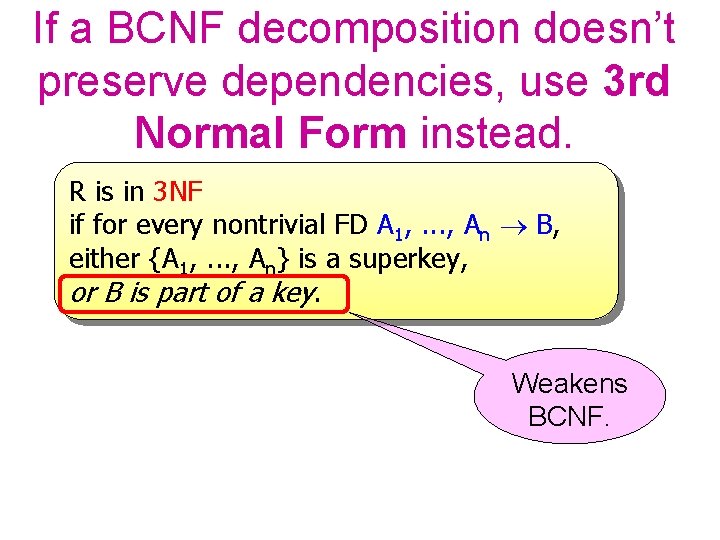
If a BCNF decomposition doesn’t preserve dependencies, use 3 rd Normal Form instead. R is in 3 NF if for every nontrivial FD A 1, . . . , An B, either {A 1, . . . , An} is a superkey, or B is part of a key. Weakens BCNF.
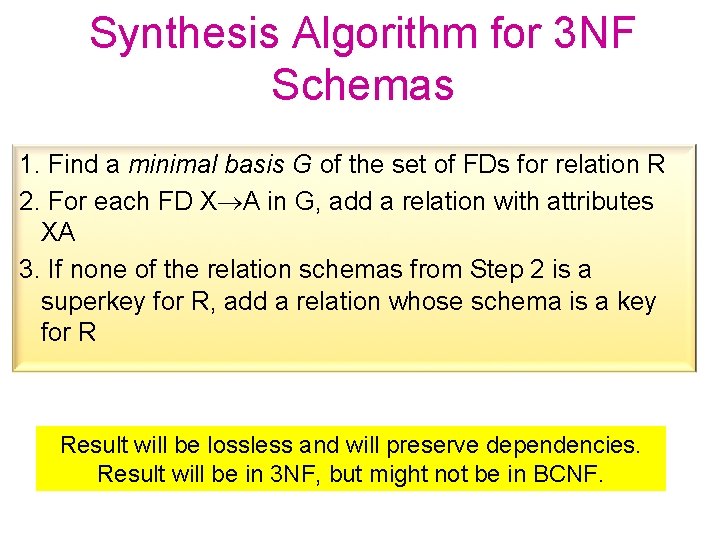
Synthesis Algorithm for 3 NF Schemas 1. Find a minimal basis G of the set of FDs for relation R 2. For each FD X A in G, add a relation with attributes XA 3. If none of the relation schemas from Step 2 is a superkey for R, add a relation whose schema is a key for R Result will be lossless and will preserve dependencies. Result will be in 3 NF, but might not be in BCNF.
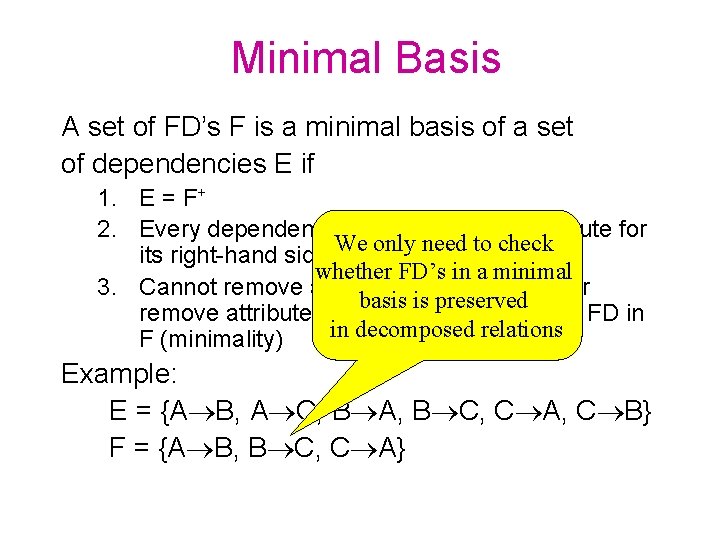
Minimal Basis A set of FD’s F is a minimal basis of a set of dependencies E if 1. E = F+ 2. Every dependency in F has a single attribute for We only need to check its right-hand side whether FD’s in a minimal 3. Cannot remove any dependency from F or basis is preserved remove attributes from the left side of any FD in in decomposed relations F (minimality) Example: E = {A B, A C, B A, B C, C A, C B} F = {A B, B C, C A}
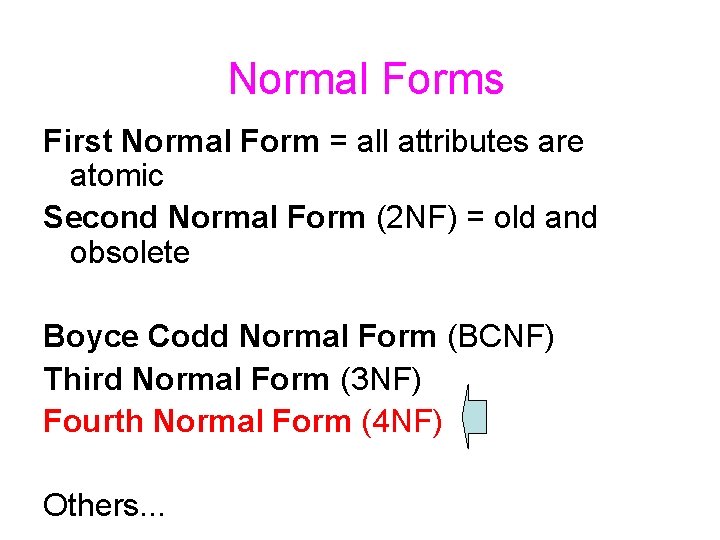
Normal Forms First Normal Form = all attributes are atomic Second Normal Form (2 NF) = old and obsolete Boyce Codd Normal Form (BCNF) Third Normal Form (3 NF) Fourth Normal Form (4 NF) Others. . .
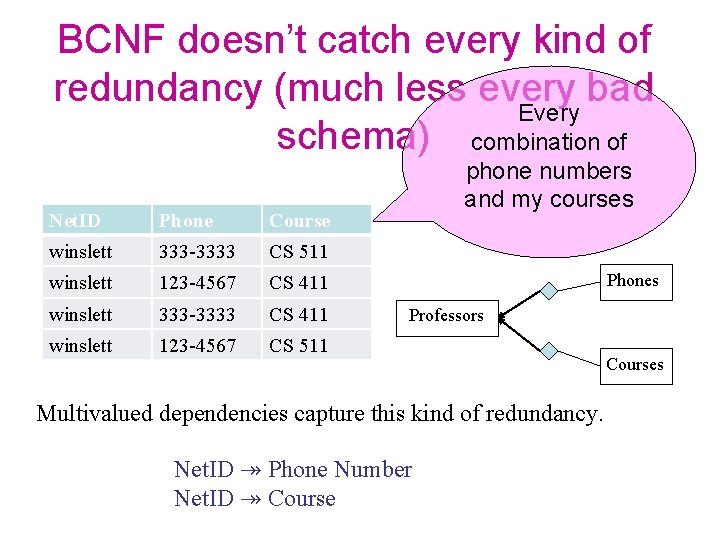
BCNF doesn’t catch every kind of redundancy (much less every bad Every schema) combination of Net. ID Phone Course winslett 333 -3333 CS 511 winslett 123 -4567 CS 411 winslett 333 -3333 CS 411 winslett 123 -4567 CS 511 phone numbers and my courses Phones Professors Multivalued dependencies capture this kind of redundancy. Net. ID ↠ Phone Number Net. ID ↠ Courses
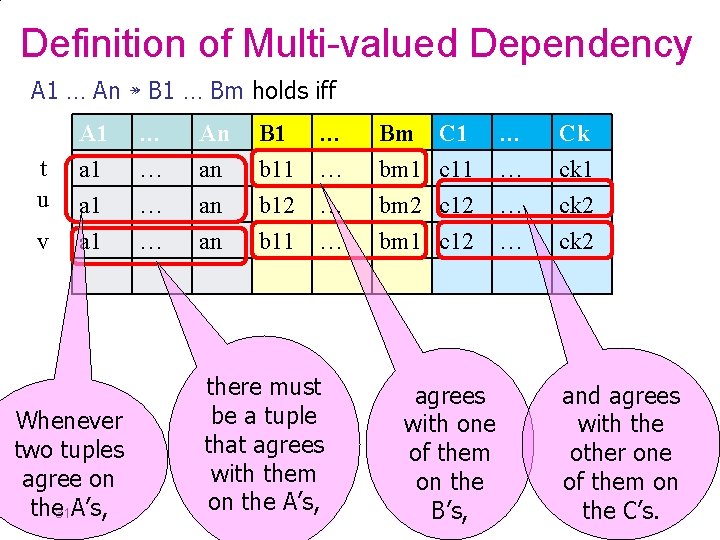
Definition of Multi-valued Dependency A 1 … An ↠ B 1 … Bm holds iff t u v A 1 a 1 a 1 Whenever two tuples agree on the 31 A’s, … … An an an an B 1 b 12 b 11 … … there must be a tuple that agrees with them on the A’s, Bm bm 1 bm 2 bm 1 C 1 c 12 agrees with one of them on the B’s, … … Ck ck 1 ck 2 and agrees with the other one of them on the C’s.
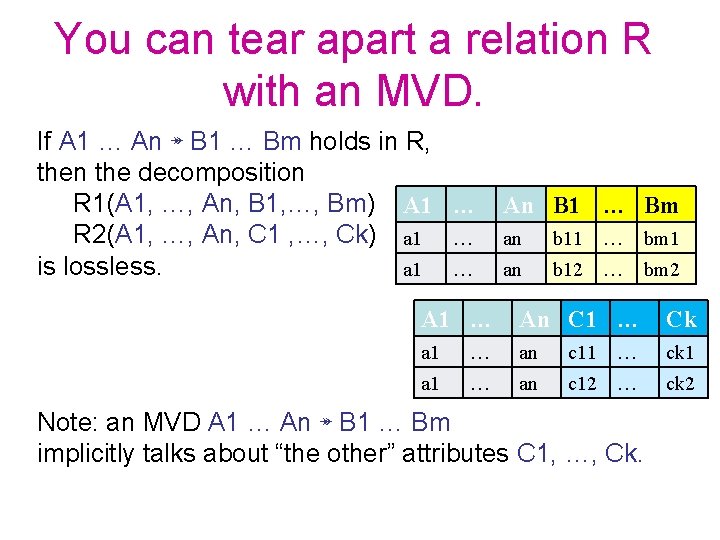
You can tear apart a relation R with an MVD. If A 1 … An ↠ B 1 … Bm holds in R, then the decomposition R 1(A 1, …, An, B 1, …, Bm) A 1 … R 2(A 1, …, An, C 1 , …, Ck) a 1 … is lossless. a 1 … An B 1 … Bm an b 11 … bm 1 an b 12 … bm 2 A 1 … An C 1 … Ck a 1 … an c 11 … ck 1 a 1 … an c 12 … ck 2 Note: an MVD A 1 … An ↠ B 1 … Bm implicitly talks about “the other” attributes C 1, …, Ck.
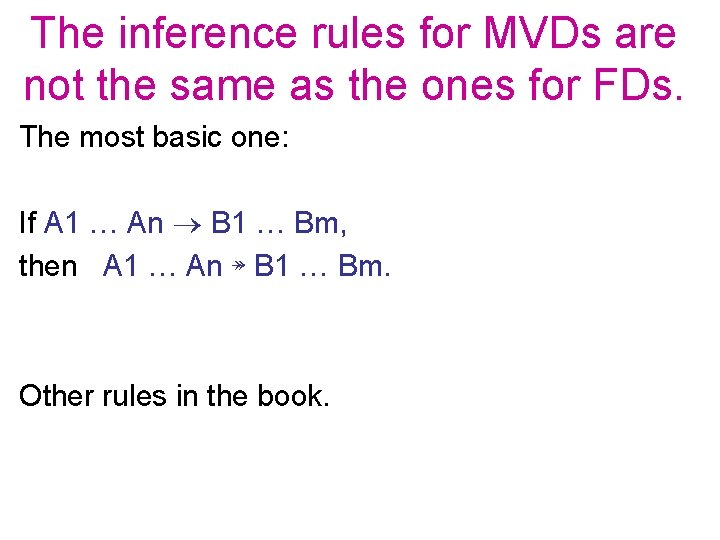
The inference rules for MVDs are not the same as the ones for FDs. The most basic one: If A 1 … An B 1 … Bm, then A 1 … An ↠ B 1 … Bm. Other rules in the book.
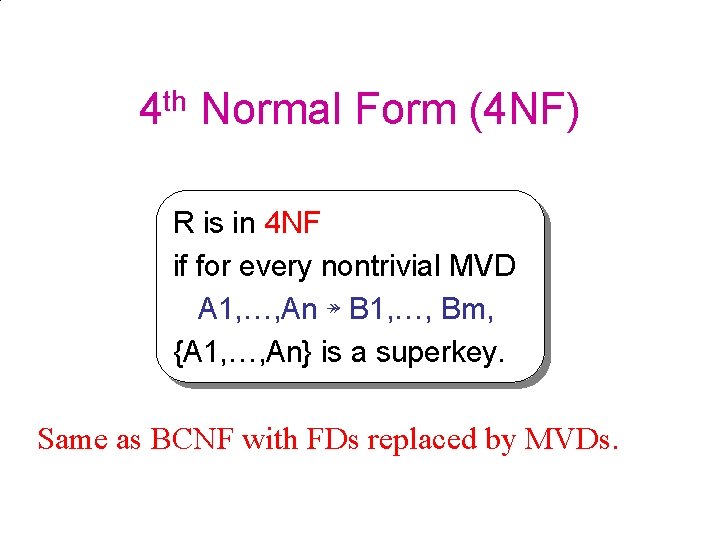
th 4 Normal Form (4 NF) R is in 4 NF if for every nontrivial MVD A 1, …, An ↠ B 1, …, Bm, {A 1, …, An} is a superkey. Same as BCNF with FDs replaced by MVDs.
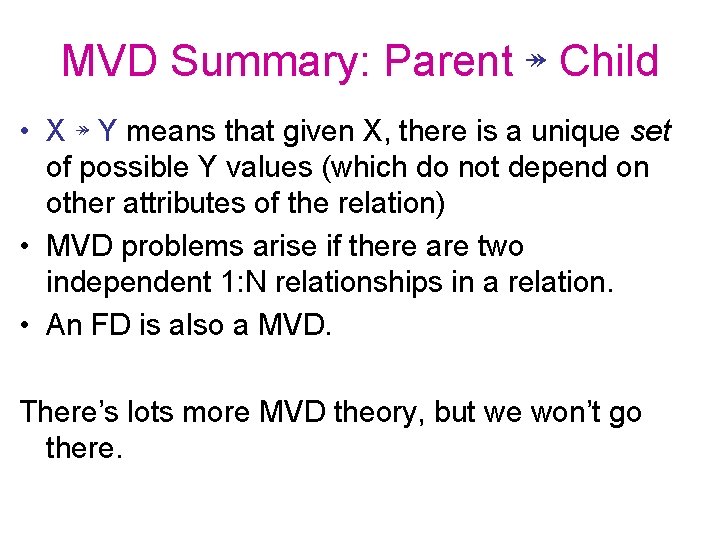
MVD Summary: Parent ↠ Child • X ↠ Y means that given X, there is a unique set of possible Y values (which do not depend on other attributes of the relation) • MVD problems arise if there are two independent 1: N relationships in a relation. • An FD is also a MVD. There’s lots more MVD theory, but we won’t go there.
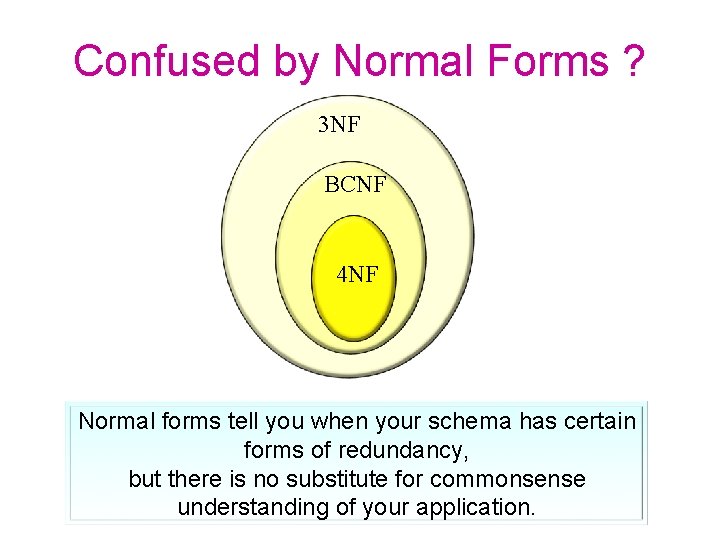
Confused by Normal Forms ? 3 NF BCNF 4 NF Normal forms tell you when your schema has certain forms of redundancy, but there is no substitute for commonsense understanding of your application.
- Slides: 36