
CS 378 Cryptographic Hash Functions Vitaly Shmatikov slide
- Slides: 22
CS 378 Cryptographic Hash Functions Vitaly Shmatikov slide 1
Reading Assignment u. Read Kaufman 5. 1 -2 and 5. 6 -7 slide 2
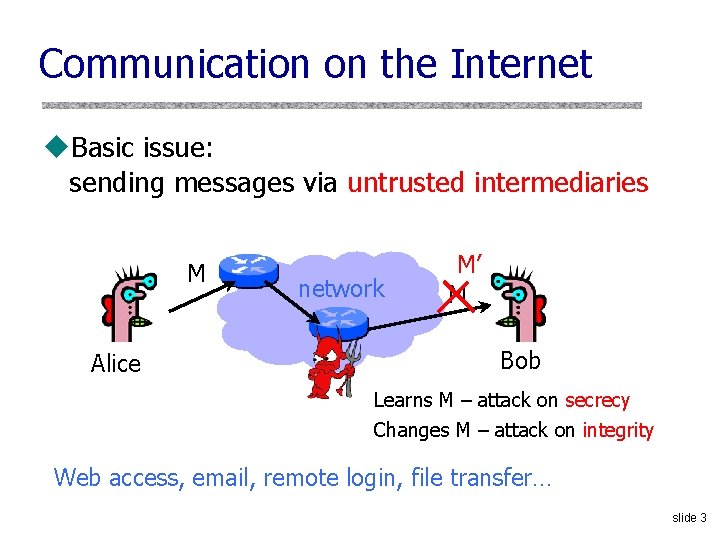
Communication on the Internet u. Basic issue: sending messages via untrusted intermediaries M Alice network M’ M Bob Learns M – attack on secrecy Changes M – attack on integrity Web access, email, remote login, file transfer… slide 3
Integrity vs. Secrecy u. Integrity: attacker cannot tamper with message u. Encryption may not guarantee integrity! • Intuition: attacker may able to modify message under encryption without learning what it is – Given one-time key K, encrypt M as M K… Perfect secrecy, but can easily change M under encryption to M M’ for any M’ – Online auction: halve competitor’s bid without learning its value • This is recognized by industry standards (e. g. , PKCS) – “RSA encryption is intended primarily to provide confidentiality… It is not intended to provide integrity” • Many encryption schemes provide secrecy AND integrity slide 4
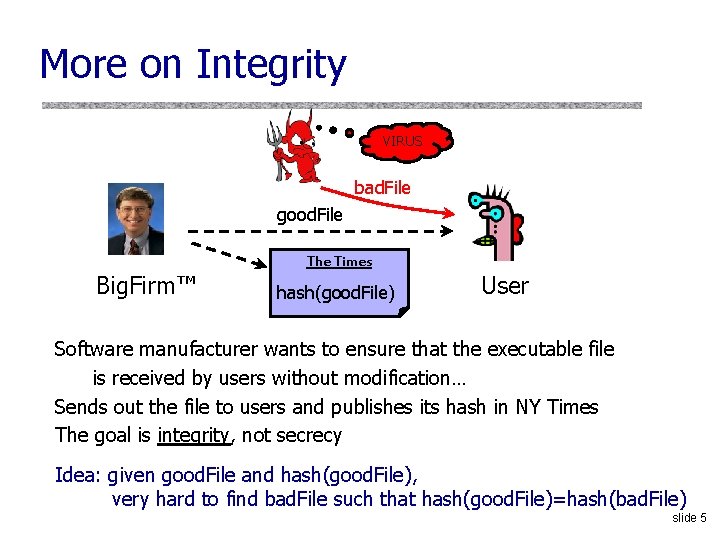
More on Integrity VIRUS bad. File good. File Big. Firm™ The Times hash(good. File) User Software manufacturer wants to ensure that the executable file is received by users without modification… Sends out the file to users and publishes its hash in NY Times The goal is integrity, not secrecy Idea: given good. File and hash(good. File), very hard to find bad. File such that hash(good. File)=hash(bad. File) slide 5
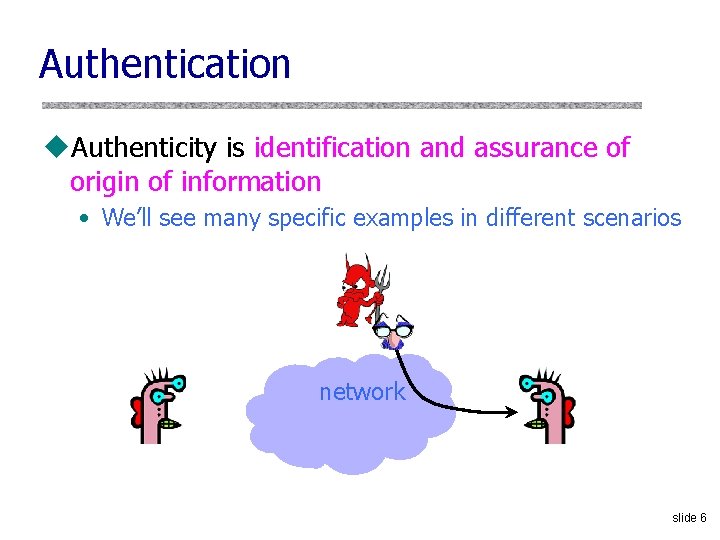
Authentication u. Authenticity is identification and assurance of origin of information • We’ll see many specific examples in different scenarios network slide 6
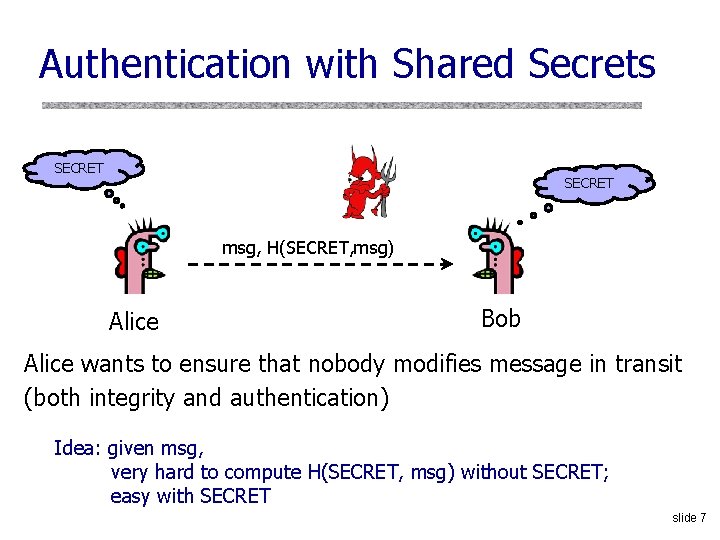
Authentication with Shared Secrets SECRET msg, H(SECRET, msg) Alice Bob Alice wants to ensure that nobody modifies message in transit (both integrity and authentication) Idea: given msg, very hard to compute H(SECRET, msg) without SECRET; easy with SECRET slide 7
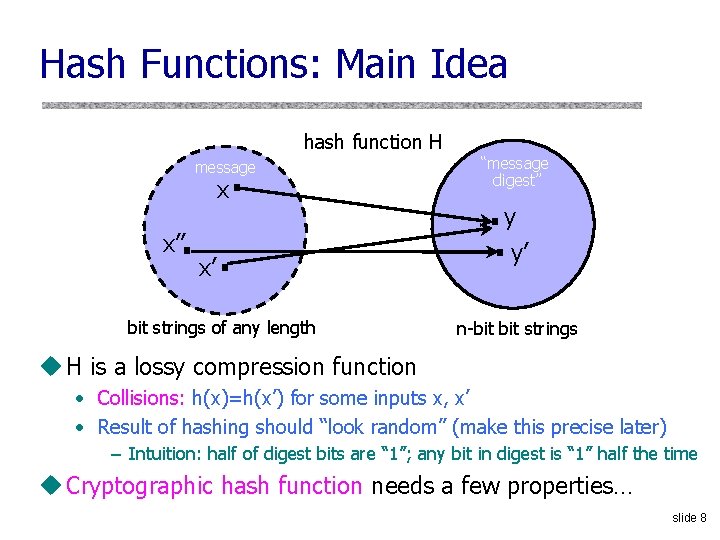
Hash Functions: Main Idea . hash function H message x . x’. x’’ bit strings of any length “message digest” . y. y’ n-bit strings u H is a lossy compression function • Collisions: h(x)=h(x’) for some inputs x, x’ • Result of hashing should “look random” (make this precise later) – Intuition: half of digest bits are “ 1”; any bit in digest is “ 1” half the time u Cryptographic hash function needs a few properties… slide 8
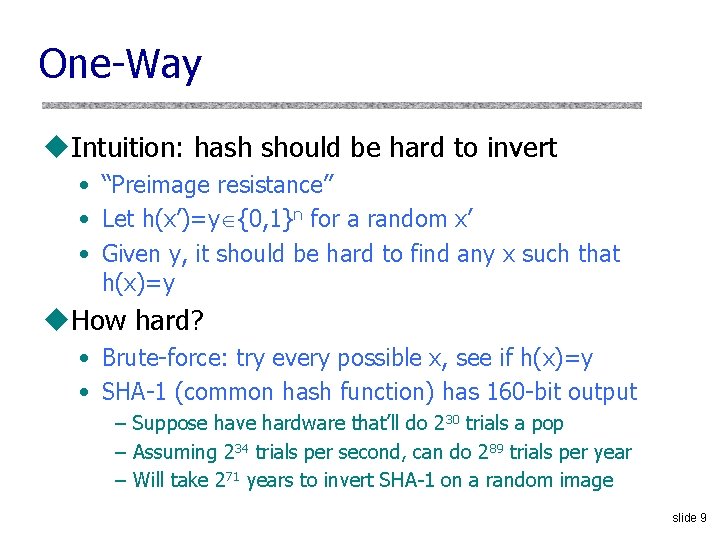
One-Way u. Intuition: hash should be hard to invert • “Preimage resistance” • Let h(x’)=y {0, 1}n for a random x’ • Given y, it should be hard to find any x such that h(x)=y u. How hard? • Brute-force: try every possible x, see if h(x)=y • SHA-1 (common hash function) has 160 -bit output – Suppose have hardware that’ll do 230 trials a pop – Assuming 234 trials per second, can do 289 trials per year – Will take 271 years to invert SHA-1 on a random image slide 9
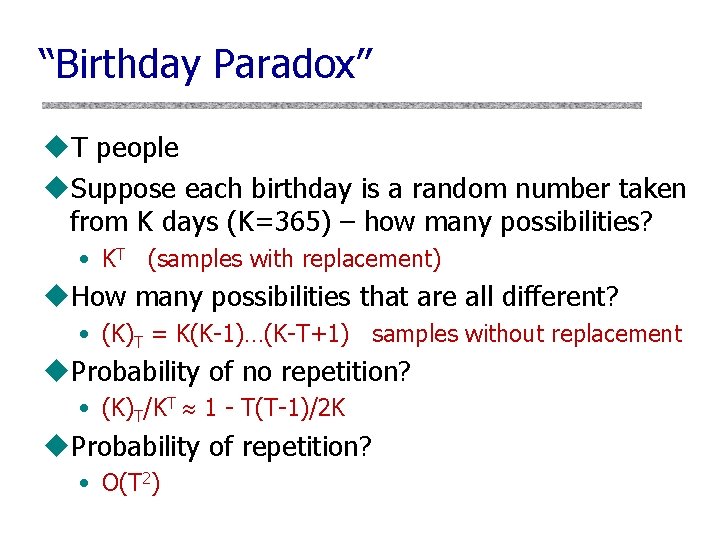
“Birthday Paradox” u. T people u. Suppose each birthday is a random number taken from K days (K=365) – how many possibilities? • KT (samples with replacement) u. How many possibilities that are all different? • (K)T = K(K-1)…(K-T+1) samples without replacement u. Probability of no repetition? • (K)T/KT 1 - T(T-1)/2 K u. Probability of repetition? • O(T 2)
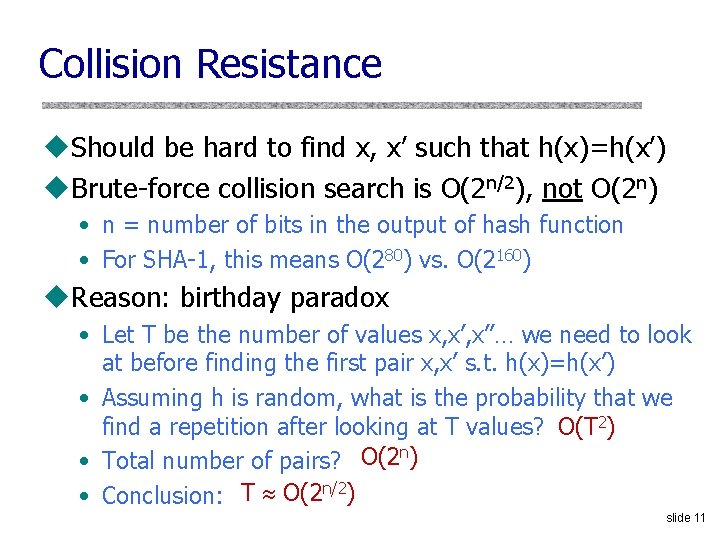
Collision Resistance u. Should be hard to find x, x’ such that h(x)=h(x’) u. Brute-force collision search is O(2 n/2), not O(2 n) • n = number of bits in the output of hash function • For SHA-1, this means O(280) vs. O(2160) u. Reason: birthday paradox • Let T be the number of values x, x’’… we need to look at before finding the first pair x, x’ s. t. h(x)=h(x’) • Assuming h is random, what is the probability that we find a repetition after looking at T values? O(T 2) • Total number of pairs? O(2 n) • Conclusion: T O(2 n/2) slide 11
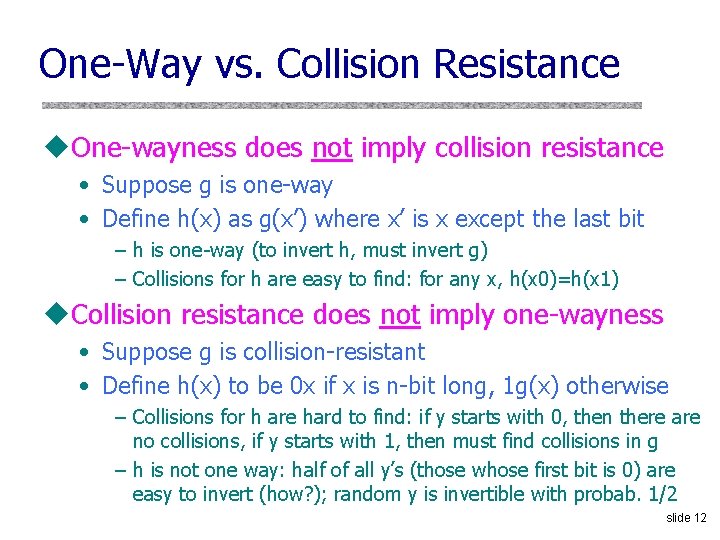
One-Way vs. Collision Resistance u. One-wayness does not imply collision resistance • Suppose g is one-way • Define h(x) as g(x’) where x’ is x except the last bit – h is one-way (to invert h, must invert g) – Collisions for h are easy to find: for any x, h(x 0)=h(x 1) u. Collision resistance does not imply one-wayness • Suppose g is collision-resistant • Define h(x) to be 0 x if x is n-bit long, 1 g(x) otherwise – Collisions for h are hard to find: if y starts with 0, then there are no collisions, if y starts with 1, then must find collisions in g – h is not one way: half of all y’s (those whose first bit is 0) are easy to invert (how? ); random y is invertible with probab. 1/2 slide 12
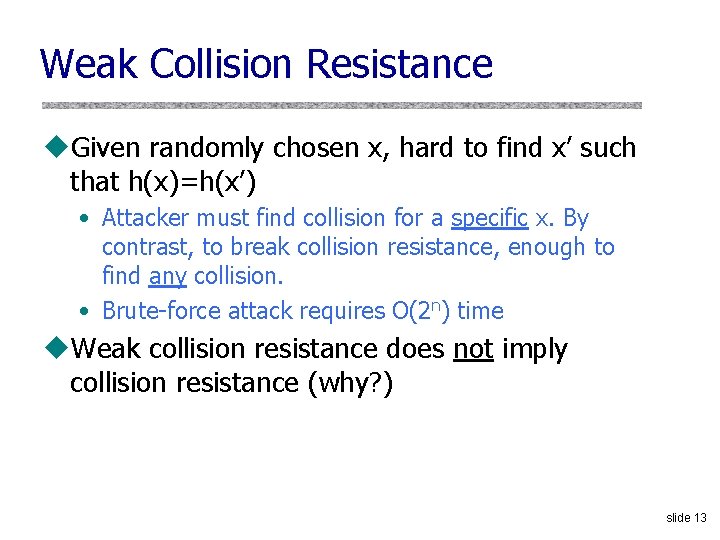
Weak Collision Resistance u. Given randomly chosen x, hard to find x’ such that h(x)=h(x’) • Attacker must find collision for a specific x. By contrast, to break collision resistance, enough to find any collision. • Brute-force attack requires O(2 n) time u. Weak collision resistance does not imply collision resistance (why? ) slide 13
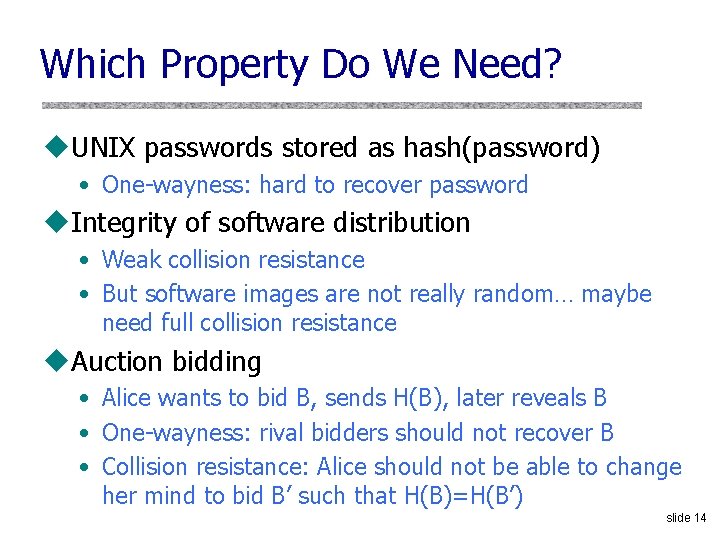
Which Property Do We Need? u. UNIX passwords stored as hash(password) • One-wayness: hard to recover password u. Integrity of software distribution • Weak collision resistance • But software images are not really random… maybe need full collision resistance u. Auction bidding • Alice wants to bid B, sends H(B), later reveals B • One-wayness: rival bidders should not recover B • Collision resistance: Alice should not be able to change her mind to bid B’ such that H(B)=H(B’) slide 14
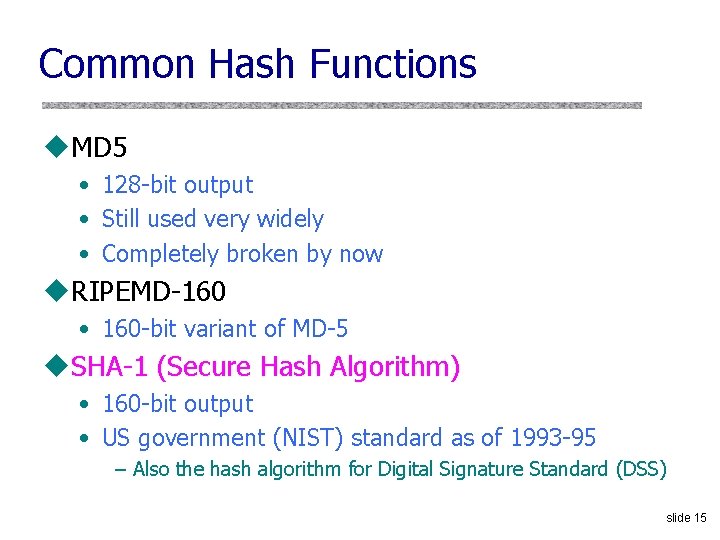
Common Hash Functions u. MD 5 • 128 -bit output • Still used very widely • Completely broken by now u. RIPEMD-160 • 160 -bit variant of MD-5 u. SHA-1 (Secure Hash Algorithm) • 160 -bit output • US government (NIST) standard as of 1993 -95 – Also the hash algorithm for Digital Signature Standard (DSS) slide 15
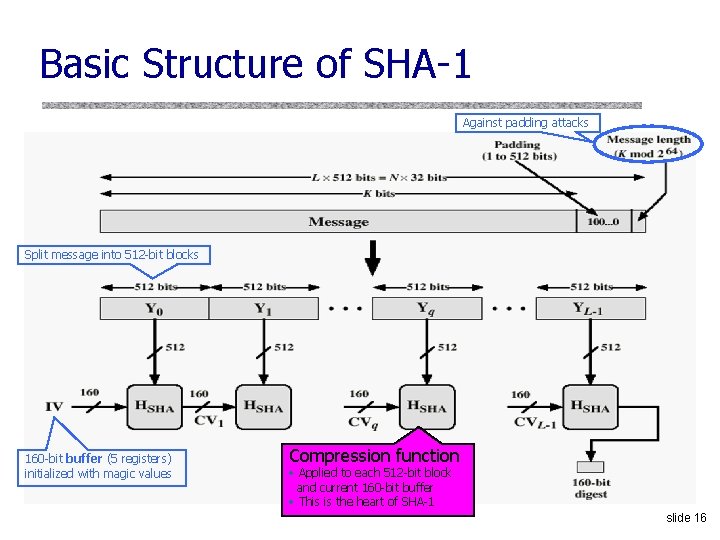
Basic Structure of SHA-1 Against padding attacks Split message into 512 -bit blocks 160 -bit buffer (5 registers) initialized with magic values Compression function • Applied to each 512 -bit block and current 160 -bit buffer • This is the heart of SHA-1 slide 16
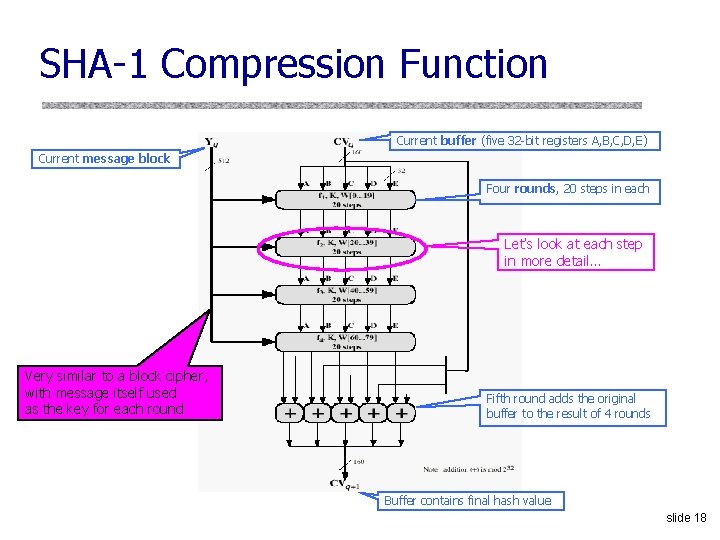
SHA-1 Compression Function Current buffer (five 32 -bit registers A, B, C, D, E) Current message block Four rounds, 20 steps in each Let’s look at each step in more detail… Very similar to a block cipher, with message itself used as the key for each round Fifth round adds the original buffer to the result of 4 rounds Buffer contains final hash value slide 18
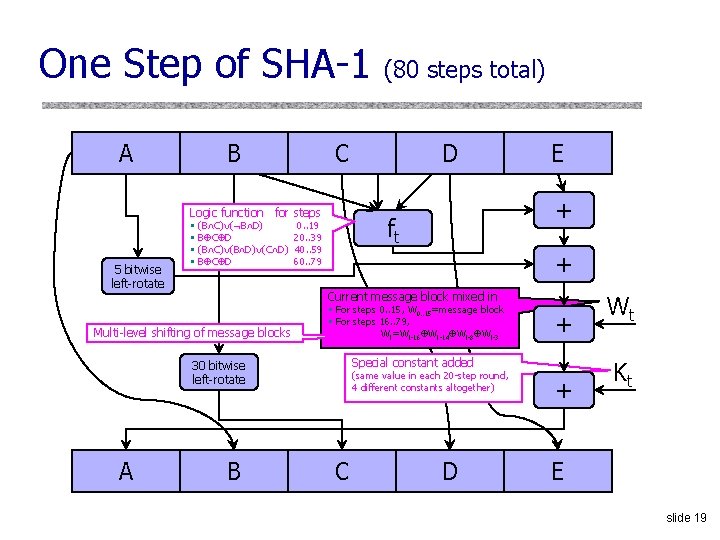
One Step of SHA-1 A B C Logic function for steps 5 bitwise left-rotate • (B C) ( B D) • B C D • (B C) (B D) (C D) • B C D D + ft 0. . 19 20. . 39 40. . 59 60. . 79 E + Current message block mixed in Multi-level shifting of message blocks • For steps 0. . 15, W 0. . 15=message block • For steps 16. . 79, Wt=Wt-16 Wt-14 Wt-8 Wt-3 B + Special constant added 30 bitwise left-rotate A (80 steps total) (same value in each 20 -step round, 4 different constants altogether) C D + Wt Kt E slide 19
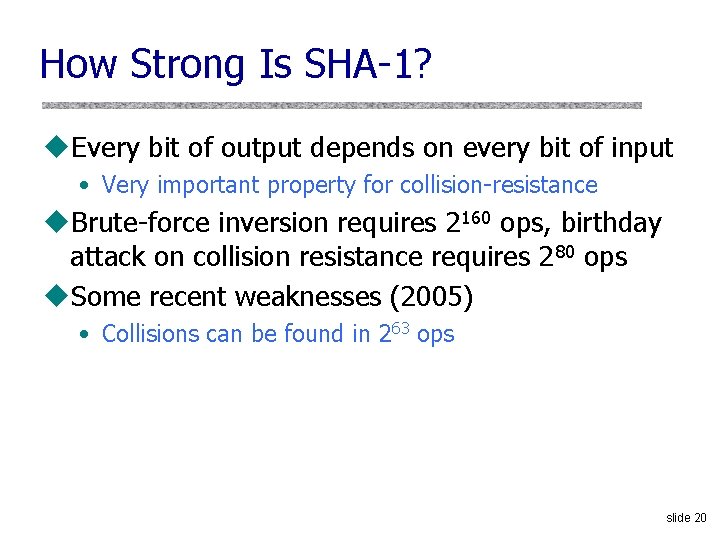
How Strong Is SHA-1? u. Every bit of output depends on every bit of input • Very important property for collision-resistance u. Brute-force inversion requires 2160 ops, birthday attack on collision resistance requires 280 ops u. Some recent weaknesses (2005) • Collisions can be found in 263 ops slide 20
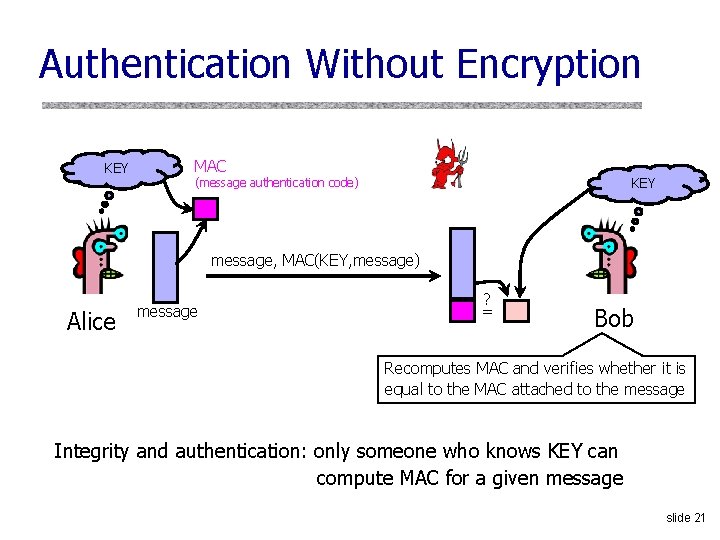
Authentication Without Encryption KEY MAC KEY (message authentication code) message, MAC(KEY, message) Alice message ? = Bob Recomputes MAC and verifies whether it is equal to the MAC attached to the message Integrity and authentication: only someone who knows KEY can compute MAC for a given message slide 21
HMAC u. Construct MAC by applying a cryptographic hash function to message and key • • • Could also use encryption instead of hashing, but… Hashing is faster than encryption in software Library code for hash functions widely available Can easily replace one hash function with another There used to be US export restrictions on encryption u. Invented by Bellare, Canetti, and Krawczyk (1996) u. Mandatory for IP security, also used in SSL/TLS slide 22
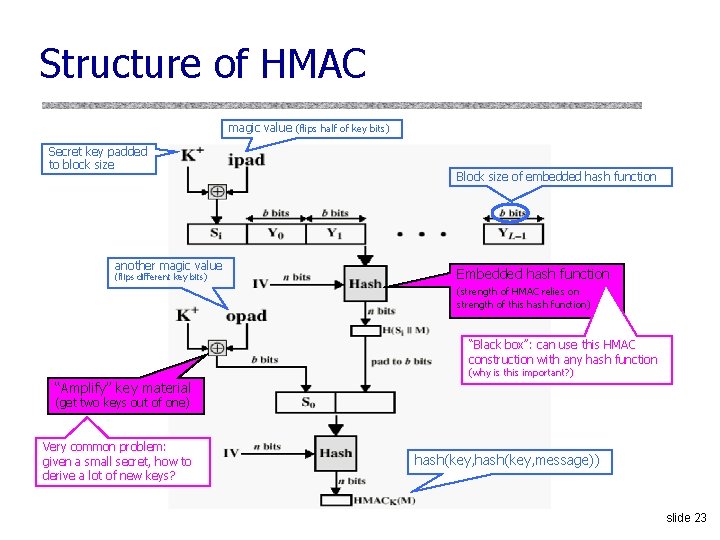
Structure of HMAC magic value (flips half of key bits) Secret key padded to block size another magic value (flips different key bits) Block size of embedded hash function Embedded hash function (strength of HMAC relies on strength of this hash function) “Black box”: can use this HMAC construction with any hash function (why is this important? ) “Amplify” key material (get two keys out of one) Very common problem: given a small secret, how to derive a lot of new keys? hash(key, message)) slide 23